Soap Opera Genre – 
Independent Textual 
Analysis 
OCR Media Studies – A2 
Level 
Unit G324: Advanced 
Portfolio 
Name: Asuka Young 
Candidate Number:4149 
Center Name: St. Andrew’s Catholic School 
Center Number:
Trailer 1 –Coronation street- tram crash promo 
https://www.youtube.com/watch?v=UcVoNEhhICU 
Verbal Codes – Comment on the use of Dialogue, Voiceover, Sound Effects or 
Soundtrack 
The non-diegetic soundtrack is contrapuntal with the diegetic sound of sirens- jazz/joyful beats. The song plays all the way 
through, which almost connotes fake happiness during the siren scenes. The Volume of the diegetic sirens are louder then the 
music, and is sudden- which may foreshadow the element of shock. The verbal code of the non-diegetic lyrics “It’s just out on 
the street where you live’ may ‘signify’ (De Saussure) that trouble is on it’s way. This calls on viewers as they may feel 
involved or identifying themselves in the Program, as where you live” may be also referring to the audience as well. The 
Emergency/chaos sounds does not mix with the happiness, and it produces binary opposition (Claude Levi Strauss). The last 
echo of sirens connotes that the happiness is getting slowly broken by an incident, as the song fades away and sirens take 
over. This acts as a really enticing feature for the audience to potentially consume the upcoming episodes. 
Non-Verbal Codes – Comment on the use of Setting, Lighting, Costumes, Facial 
Expressions and Characters 
Lighting is high key and warm in the first half and the setting is in a street where people have facial expressions with mixed emotions of 
happiness and some with a gazing, loving expression towards somebody, which could represent the community connection. But as the 
sirens come in there are scenes with low key lighting, with rushed movements by serious faced characters. Although the emergency 
scenes are very short, the costumes does connote those of the hospital or the fire engine services. The use of the pipe in terms of 
settings does connote a fire station, and so the audiences will know that something bad has happened immediately. 
The clothing of the people on the street is quite casual and stereotypical according to age group and gender. 
For example, the old woman at the beginning is wearing a long skirt, which connotes comfort and elder age. The fact that she gets off the 
bus, is also stereotypical of this age group’s method of transport. Moreover, the main colours of the costumes for most of the characters 
are red and black, which connotes danger, blood, tragedy and darkness. This suggests to the audiences, that those characters are going 
to suffer in the upcoming series.
Technical Codes – Comment on the use of Camera Angles, Shot Types and Camera 
Movement 
In terms of editing, the slow motion in the streets contradicts the real-time movement for the emergency services and gives the 
connotation of the contrast between dream and real-life, as the spectators are already familiar with the real time movement, 
more than the slow motion and as such associate this with a flashback or see this as a something of a ‘disequilibrium’ 
(Todorov). The technical code of medium close-ups to close-up of different groups of people presents connections between 
people using cuts. The repeated use of an Eye-line match connotes that everyone is equal, and the community is one. From 
every shot to shot, the next group of people is in the background/near them. (composition), which connotes the connection 
between people/characters within the community, whereas the emergency siren scenes were full of different camera angles 
(from high-angle to low-angle, from a long shot to a close-up etc), which not only signify the lack of close connection between 
people in the scene, but solidifies the binary oppositions (Claude Levi Strauss ) of mood and narrative, which is chaos in 
contrast with orderly sequence.
Trailer 2 –Kat and Alfie Trailer- EastEnders - BBC One 
https://www.youtube.com/watch?v=8p4xlLezos0 
Verbal Codes – Comment on the use of Dialogue, Voiceover, Sound Effects or Soundtrack 
The non-diegetic soundtrack is very western and mysterious, connoting that there is an element of mystery for the audience. High pitched 
ringing tone with the sound effects of footsteps also ‘signifies’ (De Saussure) that something important that effects others is approaching. This 
kind of sound builds up expectations for the audiences, thus succeeding in gaining their attention. The diegetic sound of the wind and the 
squeak at the beginning is there for the first few scenes. These diegetic sounds represents the wrecked state of this place, and makes the 
character that seems to have came back somewhat like a hero- (counter stereotypical of female gender). The diegetic dialogue denotes 
“Where do you get a drink around ‘ere?’ sounded very robotic and calm, representing that she is a powerful character. This also sounds quite 
colloquial as well through the exaggerated “ere” phrase that viewers would expect of a text set in the East End of London. The non-diegetic 
soundtrack building up after Alfie coming up behind Kat Says “I think you’ll need one” represents that his status is higher than hers, along with 
the dialogue’s connotations of the person judging/giving their own opinions about the other directly. In terms of sound effects, the sound of the 
beats at the very end connotes the build up of tension and hatred emotion within the two characters, making the audience feel expectations for 
entertainment involving conflict (Katz). Furthermore, the sound effects of the sand when Kat and Alfie is walking is important in order to 
achieve realism in the trailer, so that the audience can be familiar with the scene. 
Non-Verbal Codes – Comment on the use of Setting, Lighting, Costumes, Facial Expressions and 
Characters- Link to Propp 
The non-verbal code of the setting is a very wrecked, countryside place but based on streets. The lighting is quite high key, which represents 
that something new/hope has came into the street. The woman’s costume signifies a ‘cow-boy’ type of character, who are stereotypically 
strong mentally and physically. Her facial expressions are quite static and serious too, which adds to this strength and thus conforms to 
Rebecca Feasey’s (2007) views of there usually being a ‘strong, active female’ in the genre. Moreover, from these features the audience are 
informed that she is the heroine of the upcoming series (Propp). There was a flying paper across a house at the beginning which represents 
the untidiness of the “rough” area. The fact that she is wearing boots and drops her bag connotes homecoming. 
The facial expression of a woman turns from smiling to unhappy, which connotes that the woman who appeared is not wanted in the 
community, which is a significant part in the narrative for the audiences. The costume of the man is all black, and this represents particularly 
his authority and his calmness to her appearance, which is different and almost a binary opposite (Claude Levi Strausse) to the other 
characters’ reactions. This overall gives an impression to the audience that he is close to being the villian, (Propp) as his facial expression 
connotes that he is against the heroine. This represents the significance and importance of these two people and the foretelling of conflict in 
the upcoming episodes.
Technical Codes – Comment on the use of Camera Angles, Shot Types and Camera Movement 
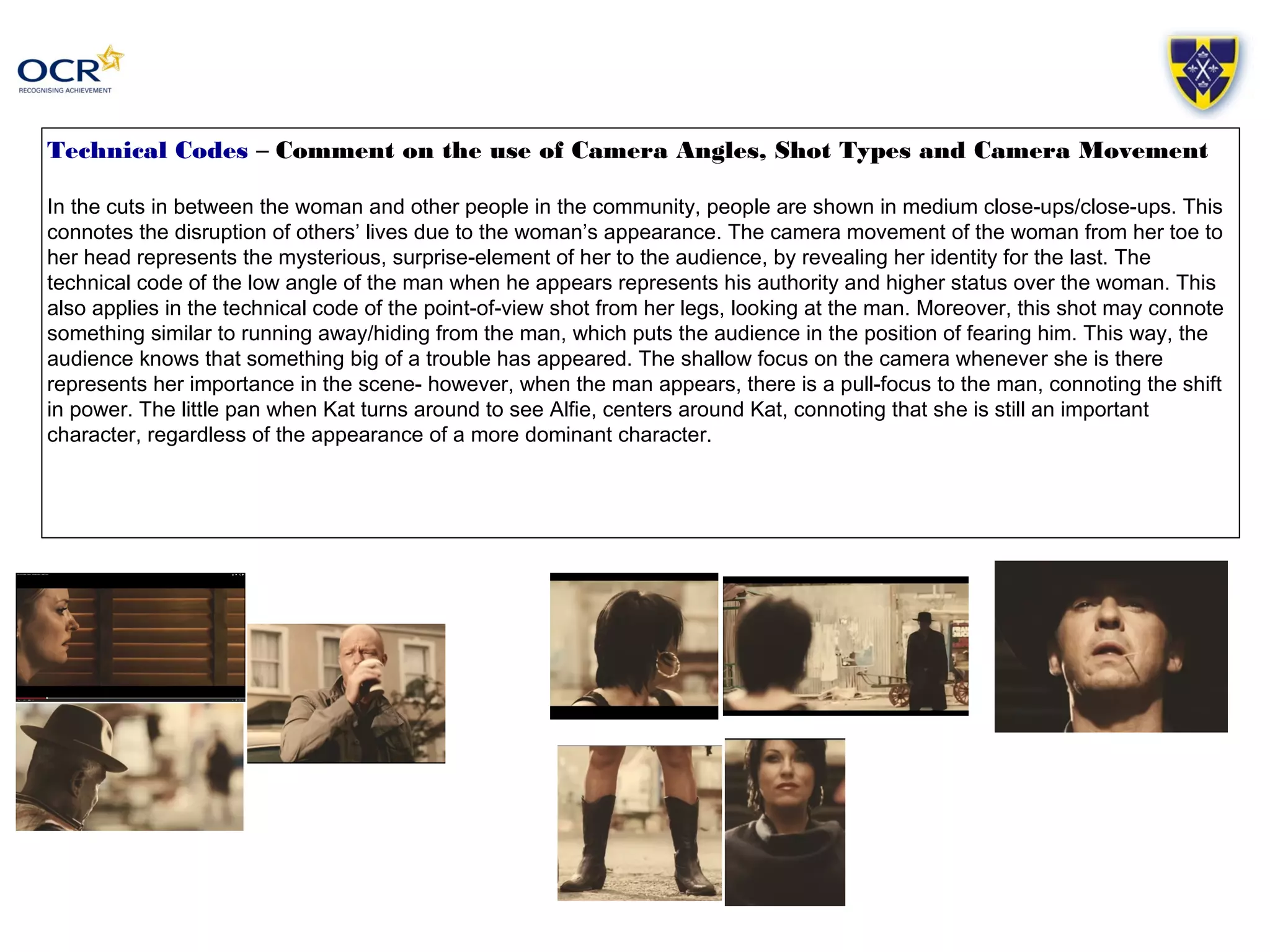
In the cuts in between the woman and other people in the community, people are shown in medium close-ups/close-ups. This 
connotes the disruption of others’ lives due to the woman’s appearance. The camera movement of the woman from her toe to 
her head represents the mysterious, surprise-element of her to the audience, by revealing her identity for the last. The 
technical code of the low angle of the man when he appears represents his authority and higher status over the woman. This 
also applies in the technical code of the point-of-view shot from her legs, looking at the man. Moreover, this shot may connote 
something similar to running away/hiding from the man, which puts the audience in the position of fearing him. This way, the 
audience knows that something big of a trouble has appeared. The shallow focus on the camera whenever she is there 
represents her importance in the scene- however, when the man appears, there is a pull-focus to the man, connoting the shift 
in power. The little pan when Kat turns around to see Alfie, centers around Kat, connoting that she is still an important 
character, regardless of the appearance of a more dominant character.
6 
Evaluation of Textual Analysis – 
Compare and Contrast 
Trailer 1) – Areas of Strength and what you would ‘repeat’ (Steve Neale) or “exploit” 
(Abercrombie – 1995) – You need to refer to this theory 
In this trailer, the main points to repeat (Neale said that genres are instances of repetition and difference) lied on the powerful 
use of contrapuntal, and perhaps asynchronous sound and moving images to create a strong effect. Therefore in my trailer, I 
may include some contrasts to represent something like a trouble that is going to happen. The use of lighting was very important 
here too to set the mood of each scenes, darkness connoting sad, tragic emotions and brightness connoting happiness and joy, 
so I may consider that too. The speeds in which everything is going on was altered in this trailer, which did create an interesting 
effect to the audiences. Slowing down the speed to make it dramatic/speeding it up to make it action packed may be good as 
well. However, the parts in which I would make a difference (Neale), may be the soundtrack of the trailer, as some people in front 
of the TV can be passive, they may not listen out to the lyrics. Therefore instrumental soundtracks may speak more to them. In 
terms of exploiting (Abercrombie), 
Trailer 2) – Areas of Strength and what you would ‘repeat’ (Steve Neale) or “exploit” 
(Abercrombie – 1995) – You need to refer to this theory 
In this trailer, there was a sense of a clear structured narrative compared to the first one, which is a repetition of a trailer 
convention, but in an unconventional setting- which made a difference to this repetition (Neale). Furthermore, I think using only 
one location would make a trailer memorable, as there is less to remember. This trailer also had a clear theme in terms of 
costumes and props etc, which has allowed the audiences to see the narrative clearly and simply, using the surrounding 
environment, rather than pieces of the actual TV Programme together. Therefore having minimal locations may also be a good 
idea for my trailer. For both of these trailers, there was little or almost no voice overs, which did create a unique effect and a 
chance for the audience to think about the trailers for themselves, which was good in my opinion. This is also a good way to 
inform audiences who are quite passive, and I may repeat (Neale) this convention for my trailer.
6 
Evaluation of Textual Analysis – 
Compare and Contrast 
Trailer 1) – Areas of Strength and what you would ‘repeat’ (Steve Neale) or “exploit” 
(Abercrombie – 1995) – You need to refer to this theory 
In this trailer, the main points to repeat (Neale said that genres are instances of repetition and difference) lied on the powerful 
use of contrapuntal, and perhaps asynchronous sound and moving images to create a strong effect. Therefore in my trailer, I 
may include some contrasts to represent something like a trouble that is going to happen. The use of lighting was very important 
here too to set the mood of each scenes, darkness connoting sad, tragic emotions and brightness connoting happiness and joy, 
so I may consider that too. The speeds in which everything is going on was altered in this trailer, which did create an interesting 
effect to the audiences. Slowing down the speed to make it dramatic/speeding it up to make it action packed may be good as 
well. However, the parts in which I would make a difference (Neale), may be the soundtrack of the trailer, as some people in front 
of the TV can be passive, they may not listen out to the lyrics. Therefore instrumental soundtracks may speak more to them. In 
terms of exploiting (Abercrombie), 
Trailer 2) – Areas of Strength and what you would ‘repeat’ (Steve Neale) or “exploit” 
(Abercrombie – 1995) – You need to refer to this theory 
In this trailer, there was a sense of a clear structured narrative compared to the first one, which is a repetition of a trailer 
convention, but in an unconventional setting- which made a difference to this repetition (Neale). Furthermore, I think using only 
one location would make a trailer memorable, as there is less to remember. This trailer also had a clear theme in terms of 
costumes and props etc, which has allowed the audiences to see the narrative clearly and simply, using the surrounding 
environment, rather than pieces of the actual TV Programme together. Therefore having minimal locations may also be a good 
idea for my trailer. For both of these trailers, there was little or almost no voice overs, which did create a unique effect and a 
chance for the audience to think about the trailers for themselves, which was good in my opinion. This is also a good way to 
inform audiences who are quite passive, and I may repeat (Neale) this convention for my trailer.

textual analysis of 2 soap opera trailers

  • 1.
    Soap Opera Genre– Independent Textual Analysis OCR Media Studies – A2 Level Unit G324: Advanced Portfolio Name: Asuka Young Candidate Number:4149 Center Name: St. Andrew’s Catholic School Center Number:
  • 2.
    Trailer 1 –Coronationstreet- tram crash promo https://www.youtube.com/watch?v=UcVoNEhhICU Verbal Codes – Comment on the use of Dialogue, Voiceover, Sound Effects or Soundtrack The non-diegetic soundtrack is contrapuntal with the diegetic sound of sirens- jazz/joyful beats. The song plays all the way through, which almost connotes fake happiness during the siren scenes. The Volume of the diegetic sirens are louder then the music, and is sudden- which may foreshadow the element of shock. The verbal code of the non-diegetic lyrics “It’s just out on the street where you live’ may ‘signify’ (De Saussure) that trouble is on it’s way. This calls on viewers as they may feel involved or identifying themselves in the Program, as where you live” may be also referring to the audience as well. The Emergency/chaos sounds does not mix with the happiness, and it produces binary opposition (Claude Levi Strauss). The last echo of sirens connotes that the happiness is getting slowly broken by an incident, as the song fades away and sirens take over. This acts as a really enticing feature for the audience to potentially consume the upcoming episodes. Non-Verbal Codes – Comment on the use of Setting, Lighting, Costumes, Facial Expressions and Characters Lighting is high key and warm in the first half and the setting is in a street where people have facial expressions with mixed emotions of happiness and some with a gazing, loving expression towards somebody, which could represent the community connection. But as the sirens come in there are scenes with low key lighting, with rushed movements by serious faced characters. Although the emergency scenes are very short, the costumes does connote those of the hospital or the fire engine services. The use of the pipe in terms of settings does connote a fire station, and so the audiences will know that something bad has happened immediately. The clothing of the people on the street is quite casual and stereotypical according to age group and gender. For example, the old woman at the beginning is wearing a long skirt, which connotes comfort and elder age. The fact that she gets off the bus, is also stereotypical of this age group’s method of transport. Moreover, the main colours of the costumes for most of the characters are red and black, which connotes danger, blood, tragedy and darkness. This suggests to the audiences, that those characters are going to suffer in the upcoming series.
  • 3.
    Technical Codes –Comment on the use of Camera Angles, Shot Types and Camera Movement In terms of editing, the slow motion in the streets contradicts the real-time movement for the emergency services and gives the connotation of the contrast between dream and real-life, as the spectators are already familiar with the real time movement, more than the slow motion and as such associate this with a flashback or see this as a something of a ‘disequilibrium’ (Todorov). The technical code of medium close-ups to close-up of different groups of people presents connections between people using cuts. The repeated use of an Eye-line match connotes that everyone is equal, and the community is one. From every shot to shot, the next group of people is in the background/near them. (composition), which connotes the connection between people/characters within the community, whereas the emergency siren scenes were full of different camera angles (from high-angle to low-angle, from a long shot to a close-up etc), which not only signify the lack of close connection between people in the scene, but solidifies the binary oppositions (Claude Levi Strauss ) of mood and narrative, which is chaos in contrast with orderly sequence.
  • 4.
    Trailer 2 –Katand Alfie Trailer- EastEnders - BBC One https://www.youtube.com/watch?v=8p4xlLezos0 Verbal Codes – Comment on the use of Dialogue, Voiceover, Sound Effects or Soundtrack The non-diegetic soundtrack is very western and mysterious, connoting that there is an element of mystery for the audience. High pitched ringing tone with the sound effects of footsteps also ‘signifies’ (De Saussure) that something important that effects others is approaching. This kind of sound builds up expectations for the audiences, thus succeeding in gaining their attention. The diegetic sound of the wind and the squeak at the beginning is there for the first few scenes. These diegetic sounds represents the wrecked state of this place, and makes the character that seems to have came back somewhat like a hero- (counter stereotypical of female gender). The diegetic dialogue denotes “Where do you get a drink around ‘ere?’ sounded very robotic and calm, representing that she is a powerful character. This also sounds quite colloquial as well through the exaggerated “ere” phrase that viewers would expect of a text set in the East End of London. The non-diegetic soundtrack building up after Alfie coming up behind Kat Says “I think you’ll need one” represents that his status is higher than hers, along with the dialogue’s connotations of the person judging/giving their own opinions about the other directly. In terms of sound effects, the sound of the beats at the very end connotes the build up of tension and hatred emotion within the two characters, making the audience feel expectations for entertainment involving conflict (Katz). Furthermore, the sound effects of the sand when Kat and Alfie is walking is important in order to achieve realism in the trailer, so that the audience can be familiar with the scene. Non-Verbal Codes – Comment on the use of Setting, Lighting, Costumes, Facial Expressions and Characters- Link to Propp The non-verbal code of the setting is a very wrecked, countryside place but based on streets. The lighting is quite high key, which represents that something new/hope has came into the street. The woman’s costume signifies a ‘cow-boy’ type of character, who are stereotypically strong mentally and physically. Her facial expressions are quite static and serious too, which adds to this strength and thus conforms to Rebecca Feasey’s (2007) views of there usually being a ‘strong, active female’ in the genre. Moreover, from these features the audience are informed that she is the heroine of the upcoming series (Propp). There was a flying paper across a house at the beginning which represents the untidiness of the “rough” area. The fact that she is wearing boots and drops her bag connotes homecoming. The facial expression of a woman turns from smiling to unhappy, which connotes that the woman who appeared is not wanted in the community, which is a significant part in the narrative for the audiences. The costume of the man is all black, and this represents particularly his authority and his calmness to her appearance, which is different and almost a binary opposite (Claude Levi Strausse) to the other characters’ reactions. This overall gives an impression to the audience that he is close to being the villian, (Propp) as his facial expression connotes that he is against the heroine. This represents the significance and importance of these two people and the foretelling of conflict in the upcoming episodes.
  • 5.
    Technical Codes –Comment on the use of Camera Angles, Shot Types and Camera Movement In the cuts in between the woman and other people in the community, people are shown in medium close-ups/close-ups. This connotes the disruption of others’ lives due to the woman’s appearance. The camera movement of the woman from her toe to her head represents the mysterious, surprise-element of her to the audience, by revealing her identity for the last. The technical code of the low angle of the man when he appears represents his authority and higher status over the woman. This also applies in the technical code of the point-of-view shot from her legs, looking at the man. Moreover, this shot may connote something similar to running away/hiding from the man, which puts the audience in the position of fearing him. This way, the audience knows that something big of a trouble has appeared. The shallow focus on the camera whenever she is there represents her importance in the scene- however, when the man appears, there is a pull-focus to the man, connoting the shift in power. The little pan when Kat turns around to see Alfie, centers around Kat, connoting that she is still an important character, regardless of the appearance of a more dominant character.
  • 6.
    6 Evaluation ofTextual Analysis – Compare and Contrast Trailer 1) – Areas of Strength and what you would ‘repeat’ (Steve Neale) or “exploit” (Abercrombie – 1995) – You need to refer to this theory In this trailer, the main points to repeat (Neale said that genres are instances of repetition and difference) lied on the powerful use of contrapuntal, and perhaps asynchronous sound and moving images to create a strong effect. Therefore in my trailer, I may include some contrasts to represent something like a trouble that is going to happen. The use of lighting was very important here too to set the mood of each scenes, darkness connoting sad, tragic emotions and brightness connoting happiness and joy, so I may consider that too. The speeds in which everything is going on was altered in this trailer, which did create an interesting effect to the audiences. Slowing down the speed to make it dramatic/speeding it up to make it action packed may be good as well. However, the parts in which I would make a difference (Neale), may be the soundtrack of the trailer, as some people in front of the TV can be passive, they may not listen out to the lyrics. Therefore instrumental soundtracks may speak more to them. In terms of exploiting (Abercrombie), Trailer 2) – Areas of Strength and what you would ‘repeat’ (Steve Neale) or “exploit” (Abercrombie – 1995) – You need to refer to this theory In this trailer, there was a sense of a clear structured narrative compared to the first one, which is a repetition of a trailer convention, but in an unconventional setting- which made a difference to this repetition (Neale). Furthermore, I think using only one location would make a trailer memorable, as there is less to remember. This trailer also had a clear theme in terms of costumes and props etc, which has allowed the audiences to see the narrative clearly and simply, using the surrounding environment, rather than pieces of the actual TV Programme together. Therefore having minimal locations may also be a good idea for my trailer. For both of these trailers, there was little or almost no voice overs, which did create a unique effect and a chance for the audience to think about the trailers for themselves, which was good in my opinion. This is also a good way to inform audiences who are quite passive, and I may repeat (Neale) this convention for my trailer.
  • 7.
    6 Evaluation ofTextual Analysis – Compare and Contrast Trailer 1) – Areas of Strength and what you would ‘repeat’ (Steve Neale) or “exploit” (Abercrombie – 1995) – You need to refer to this theory In this trailer, the main points to repeat (Neale said that genres are instances of repetition and difference) lied on the powerful use of contrapuntal, and perhaps asynchronous sound and moving images to create a strong effect. Therefore in my trailer, I may include some contrasts to represent something like a trouble that is going to happen. The use of lighting was very important here too to set the mood of each scenes, darkness connoting sad, tragic emotions and brightness connoting happiness and joy, so I may consider that too. The speeds in which everything is going on was altered in this trailer, which did create an interesting effect to the audiences. Slowing down the speed to make it dramatic/speeding it up to make it action packed may be good as well. However, the parts in which I would make a difference (Neale), may be the soundtrack of the trailer, as some people in front of the TV can be passive, they may not listen out to the lyrics. Therefore instrumental soundtracks may speak more to them. In terms of exploiting (Abercrombie), Trailer 2) – Areas of Strength and what you would ‘repeat’ (Steve Neale) or “exploit” (Abercrombie – 1995) – You need to refer to this theory In this trailer, there was a sense of a clear structured narrative compared to the first one, which is a repetition of a trailer convention, but in an unconventional setting- which made a difference to this repetition (Neale). Furthermore, I think using only one location would make a trailer memorable, as there is less to remember. This trailer also had a clear theme in terms of costumes and props etc, which has allowed the audiences to see the narrative clearly and simply, using the surrounding environment, rather than pieces of the actual TV Programme together. Therefore having minimal locations may also be a good idea for my trailer. For both of these trailers, there was little or almost no voice overs, which did create a unique effect and a chance for the audience to think about the trailers for themselves, which was good in my opinion. This is also a good way to inform audiences who are quite passive, and I may repeat (Neale) this convention for my trailer.