! Unit G321 – Foundation Portfolio in Media – Production Plan Template 
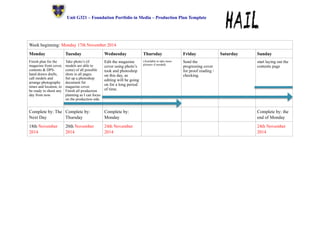
Week beginning: Monday 17th November 2014 
Monday Tuesday Wednesday Thursday Friday Saturday Sunday 
Finish plan for the 
magazine front cover, 
contents & DPS-hand 
drawn drafts, 
call models and 
arrange photography 
times and location, to 
be ready to shoot any 
day from now. 
Take photo’s (if 
models are able to 
come) of all possible 
shots in all pages. 
Set up a photoshop 
document for 
magazine cover. 
Finish all production 
planning as I can focus 
on the production side. 
Edit the magazine 
cover using photo’s 
took and photoshop 
on this day, as 
editing will be going 
on for a long period 
of time. 
(Available to take more 
pictures if needed) 
Send the 
progressing cover 
for proof reading / 
checking. 
start laying out the 
contents page 
Complete by: The 
Next Day 
Complete by: 
Thursday 
Complete by: 
Monday 
Complete by: the 
end of Monday 
18th November 
2014 
20th November 
2014 
24th November 
2014 
24th November 
2014
! Unit G321 – Foundation Portfolio in Media – Production Plan Template 
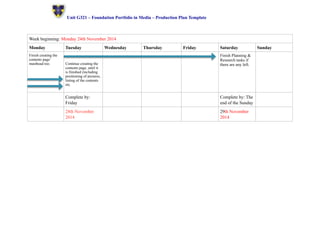
Week beginning: Monday 24th November 2014 
Monday Tuesday Wednesday Thursday Friday Saturday Sunday 
Finish creating the 
contents page’ 
masthead too. Continue creating the 
contents page, until it 
is finished (including 
positioning of pictures, 
listing of the contents 
etc. 
Finish Planning & 
Research tasks if 
there are any left. 
Complete by: 
Friday 
Complete by: The 
end of the Sunday 
28th November 
2014 
29th November 
2014
! Unit G321 – Foundation Portfolio in Media – Production Plan Template 
Week beginning: Monday 1st December 2014 
Monday Tuesday Wednesday Thursday Friday Saturday Sunday 
Start editing the DPS 
Send the DPS for 
using Adobe Indesign. 
checking. 
Start here so that I will 
have time to complete 
it, as well as having 
feedbacks then editing 
the checked points / 
mistakes for other 
pages if necessary. 
Complete by: 
Sunday 
7th December 
2014
! Unit G321 – Foundation Portfolio in Media – Production Plan Template 
Week beginning: Monday 8th December 2014 
Monday Tuesday Wednesday Thursday Friday Saturday Sunday 
Get Feedback and 
work on corrections. 
Upload the final 
pages onto blog and 
start evaluation. 
Use different 
medias to answer 
different questions. 
(Distributing 
magazine onto 
blog) 
Complete by: The 
end of Friday 
Complete by: The 
end of the day 
12th December 
2014 
22nd November 
2014 
13th December 
2014
! Unit G321 – Foundation Portfolio in Media – Production Plan Template 
Week beginning: Monday 15th December 2014 
Monday Tuesday Wednesday Thursday Friday Saturday Sunday 
Start Evaluation 
(answering 7 
Questions). Use 
different forms of 
media. 
Upload all 
evaluations onto 
blog page and make 
sure everything is 
finished. 
Complete by: The 
end of Saturday 
Complete by: The 
end of the day 
20th December 
2014 
21st December 
2014
! Unit G321 – Foundation Portfolio in Media – Production Plan Template 
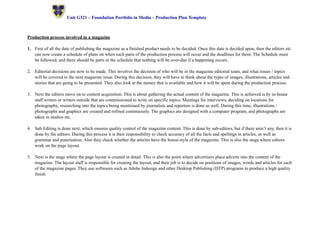
Production process involved in a magazine 
1. First of all the date of publishing the magazine as a finished product needs to be decided. Once this date is decided upon, then the editors etc 
can now create a schedule of plans on when each parts of the production process will occur and the deadlines for them. The Schedule must 
be followed, and there should be parts in the schedule that nothing will be over-due if a happening occurs. 
2. Editorial decisions are now to be made. This involves the decision of who will be in the magazine editorial team, and what issues / topics 
will be covered in the next magazine issue. During this decision, they will have to think about the types of images, illustrations, articles and 
stories that are going to be presented. They also look at the money that is available and how it will be spent during the production process. 
3. Next the editors move on to content acquisition. This is about gathering the actual content of the magazine. This is achieved is by in-house 
staff writers or writers outside that are commissioned to write on specific topics. Meetings for interviews, deciding on locations for 
photography, researching into the topics being mentioned by journalists and reporters is done as well. During this time, illustrations / 
photographs and graphics are created and refined continuously. The graphics are designed with a computer program, and photographs are 
taken in studios etc. 
4. Sub Editing is done next, which ensures quality control of the magazine content. This is done by sub-editors, but if there aren’t any, then it is 
done by the editors. During this process it is their responsibility to check accuracy of all the facts and spellings in articles, as well as 
grammar and punctuation. Also they check whether the articles have the house-style of the magazine. This is also the stage where editors 
work on the page layout. 
5. Next is the stage where the page layout is created in detail. This is also the point where advertisers place adverts into the content of the 
magazine. The layout staff is responsible for creating the layout, and their job is to decide on positions of images, words and articles for each 
of the magazine pages. They use softwares such as Adobe Indesign and other Desktop Publishing (DTP) programs to produce a high quality 
finish.
! Unit G321 – Foundation Portfolio in Media – Production Plan Template 
6. Once all the pages are created, proofreading is done. The editorial department will print out the pages and proofread for any design or 
content corrections. If mistakes are found, the editors correct it on the original document. This is repeated until no more mistakes are found. 
7. The file of the entire magazine is sent to the printer to print the magazine. It is at this stage where ‘Pre-press’ is done. It is the process of 
checking whether or not the editors are sending all the necessary images and fonts needed for the pages. Before the printing company prints 
out many copies of the magazine, they first print out a few for the publication editor to go through a final proof-reading. (Printer’s proofs). 
When all pages are correct and ready to be distributed, mass printing occurs within the printing company. 
8. The last stage of the magazine production process is the distribution. When the printing company finishes printing all the magazine copies, 
they are packaged neatly and are sent to a warehouse, where they are distributed around stores and shops, then they are sold to the public. 
A time scale in which a magazine is published can vary depending on the page numbers and the content. For example, research / writing can 
vary from a few weeks to a several months, depending on how complex the project is. The editing may take 3 to 4 weeks, depending on how 
many proofs the editors had to go through, but also how much corrections are to be done on each page. The total time spent approximately on 
proofreading pages are 2 to 3 weeks. Colour proofing can take up to three weeks but this can be done while editing / design is taking place. 
Key Personnels: 
Editor- They are responsible of the editorial and the production side of magazine. In Kerrang!’s content, they are also responsible for choosing 
cover stars, choosing bands for tours and tracks for CD’s, and overseeing the layout, content and artworks of articles. They also have the 
responsibility to manage writing staffs, and proofreading their articles and the whole magazine, which may be returned to the writer for revision. 
It is also their job to send out briefs to the writers mentioning word counts, deadline, fees etc. 
Writer/journalist- They are responsible for generating ideas for future contents, verifying information and interview sources, writing and 
proofreading the actual text, meeting and discussing ideas and plans with designers, photographers, editors and subs.
! Unit G321 – Foundation Portfolio in Media – Production Plan Template 
Art Director- They are responsible for the aesthetics of the magazine. They oversee the words and images across every page in the magazine, 
and create a house style that represents the magazine. 
Photo Editor- They oversee the photography that goes into the magazine. Their job is to hire photographers, not to take them. It is their 
responsibility to make sure that the photographs are in the right place in the right pages. 
Sources: 
http://hosbeg.com/the-magazine-production-process/ - this webpage is where I gained most of the information from, and it helped me to 
understand exactly what each job roles involves and what they have to do. 
http://www.bpccam.co.uk/timescales.htm - This website is where I gained the information of the timescale in which the timescale a monthly 
magazine may take to be created. 
http://www.independent.co.uk/news/media/my-life-in-media-paul-brannigan-editor-of-kerrang-900352.html - Where I got the information of the 
Kerrang! Editor from.

New magazine production plan template

  • 1.
    ! Unit G321– Foundation Portfolio in Media – Production Plan Template Week beginning: Monday 17th November 2014 Monday Tuesday Wednesday Thursday Friday Saturday Sunday Finish plan for the magazine front cover, contents & DPS-hand drawn drafts, call models and arrange photography times and location, to be ready to shoot any day from now. Take photo’s (if models are able to come) of all possible shots in all pages. Set up a photoshop document for magazine cover. Finish all production planning as I can focus on the production side. Edit the magazine cover using photo’s took and photoshop on this day, as editing will be going on for a long period of time. (Available to take more pictures if needed) Send the progressing cover for proof reading / checking. start laying out the contents page Complete by: The Next Day Complete by: Thursday Complete by: Monday Complete by: the end of Monday 18th November 2014 20th November 2014 24th November 2014 24th November 2014
  • 2.
    ! Unit G321– Foundation Portfolio in Media – Production Plan Template Week beginning: Monday 24th November 2014 Monday Tuesday Wednesday Thursday Friday Saturday Sunday Finish creating the contents page’ masthead too. Continue creating the contents page, until it is finished (including positioning of pictures, listing of the contents etc. Finish Planning & Research tasks if there are any left. Complete by: Friday Complete by: The end of the Sunday 28th November 2014 29th November 2014
  • 3.
    ! Unit G321– Foundation Portfolio in Media – Production Plan Template Week beginning: Monday 1st December 2014 Monday Tuesday Wednesday Thursday Friday Saturday Sunday Start editing the DPS Send the DPS for using Adobe Indesign. checking. Start here so that I will have time to complete it, as well as having feedbacks then editing the checked points / mistakes for other pages if necessary. Complete by: Sunday 7th December 2014
  • 4.
    ! Unit G321– Foundation Portfolio in Media – Production Plan Template Week beginning: Monday 8th December 2014 Monday Tuesday Wednesday Thursday Friday Saturday Sunday Get Feedback and work on corrections. Upload the final pages onto blog and start evaluation. Use different medias to answer different questions. (Distributing magazine onto blog) Complete by: The end of Friday Complete by: The end of the day 12th December 2014 22nd November 2014 13th December 2014
  • 5.
    ! Unit G321– Foundation Portfolio in Media – Production Plan Template Week beginning: Monday 15th December 2014 Monday Tuesday Wednesday Thursday Friday Saturday Sunday Start Evaluation (answering 7 Questions). Use different forms of media. Upload all evaluations onto blog page and make sure everything is finished. Complete by: The end of Saturday Complete by: The end of the day 20th December 2014 21st December 2014
  • 6.
    ! Unit G321– Foundation Portfolio in Media – Production Plan Template Production process involved in a magazine 1. First of all the date of publishing the magazine as a finished product needs to be decided. Once this date is decided upon, then the editors etc can now create a schedule of plans on when each parts of the production process will occur and the deadlines for them. The Schedule must be followed, and there should be parts in the schedule that nothing will be over-due if a happening occurs. 2. Editorial decisions are now to be made. This involves the decision of who will be in the magazine editorial team, and what issues / topics will be covered in the next magazine issue. During this decision, they will have to think about the types of images, illustrations, articles and stories that are going to be presented. They also look at the money that is available and how it will be spent during the production process. 3. Next the editors move on to content acquisition. This is about gathering the actual content of the magazine. This is achieved is by in-house staff writers or writers outside that are commissioned to write on specific topics. Meetings for interviews, deciding on locations for photography, researching into the topics being mentioned by journalists and reporters is done as well. During this time, illustrations / photographs and graphics are created and refined continuously. The graphics are designed with a computer program, and photographs are taken in studios etc. 4. Sub Editing is done next, which ensures quality control of the magazine content. This is done by sub-editors, but if there aren’t any, then it is done by the editors. During this process it is their responsibility to check accuracy of all the facts and spellings in articles, as well as grammar and punctuation. Also they check whether the articles have the house-style of the magazine. This is also the stage where editors work on the page layout. 5. Next is the stage where the page layout is created in detail. This is also the point where advertisers place adverts into the content of the magazine. The layout staff is responsible for creating the layout, and their job is to decide on positions of images, words and articles for each of the magazine pages. They use softwares such as Adobe Indesign and other Desktop Publishing (DTP) programs to produce a high quality finish.
  • 7.
    ! Unit G321– Foundation Portfolio in Media – Production Plan Template 6. Once all the pages are created, proofreading is done. The editorial department will print out the pages and proofread for any design or content corrections. If mistakes are found, the editors correct it on the original document. This is repeated until no more mistakes are found. 7. The file of the entire magazine is sent to the printer to print the magazine. It is at this stage where ‘Pre-press’ is done. It is the process of checking whether or not the editors are sending all the necessary images and fonts needed for the pages. Before the printing company prints out many copies of the magazine, they first print out a few for the publication editor to go through a final proof-reading. (Printer’s proofs). When all pages are correct and ready to be distributed, mass printing occurs within the printing company. 8. The last stage of the magazine production process is the distribution. When the printing company finishes printing all the magazine copies, they are packaged neatly and are sent to a warehouse, where they are distributed around stores and shops, then they are sold to the public. A time scale in which a magazine is published can vary depending on the page numbers and the content. For example, research / writing can vary from a few weeks to a several months, depending on how complex the project is. The editing may take 3 to 4 weeks, depending on how many proofs the editors had to go through, but also how much corrections are to be done on each page. The total time spent approximately on proofreading pages are 2 to 3 weeks. Colour proofing can take up to three weeks but this can be done while editing / design is taking place. Key Personnels: Editor- They are responsible of the editorial and the production side of magazine. In Kerrang!’s content, they are also responsible for choosing cover stars, choosing bands for tours and tracks for CD’s, and overseeing the layout, content and artworks of articles. They also have the responsibility to manage writing staffs, and proofreading their articles and the whole magazine, which may be returned to the writer for revision. It is also their job to send out briefs to the writers mentioning word counts, deadline, fees etc. Writer/journalist- They are responsible for generating ideas for future contents, verifying information and interview sources, writing and proofreading the actual text, meeting and discussing ideas and plans with designers, photographers, editors and subs.
  • 8.
    ! Unit G321– Foundation Portfolio in Media – Production Plan Template Art Director- They are responsible for the aesthetics of the magazine. They oversee the words and images across every page in the magazine, and create a house style that represents the magazine. Photo Editor- They oversee the photography that goes into the magazine. Their job is to hire photographers, not to take them. It is their responsibility to make sure that the photographs are in the right place in the right pages. Sources: http://hosbeg.com/the-magazine-production-process/ - this webpage is where I gained most of the information from, and it helped me to understand exactly what each job roles involves and what they have to do. http://www.bpccam.co.uk/timescales.htm - This website is where I gained the information of the timescale in which the timescale a monthly magazine may take to be created. http://www.independent.co.uk/news/media/my-life-in-media-paul-brannigan-editor-of-kerrang-900352.html - Where I got the information of the Kerrang! Editor from.