Principles of 
Business 
Introduction to Finance – 
lecture 2
Learning outcomes 
By the end of this session you should be able to: 
• Explain the key components of financial statements 
• Evaluate the role of the financial statements for 
different stakeholders 
• Understand the accounting equation 
• Calculate profit and understand how it can be 
manipulated 
2
3 
Financial statements 
• Legally required for all companies in most jurisdictions around the world 
• Used by a variety of different stakeholders 
• Measure Performance (Income statement) 
• Measure Position (Balance sheet) 
• Measure Cashflows (cashflow statement)
4 
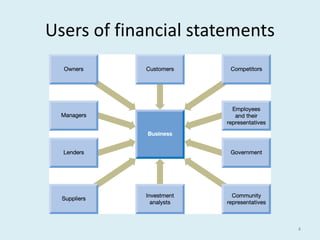
Users of financial statements
5 
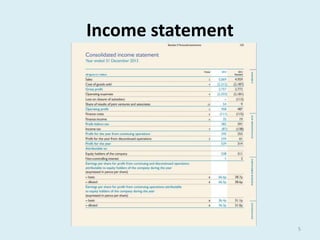
Income statement
6 
Income Statement 
• Measures financial performance (profit) 
Elements of an income statement: 
• Revenue (price x quantity) 
• Cost of sales (Direct costs) 
• Gross profit = revenue less cost of sales 
• Operating expenses (administrative and distribution costs) 
• Finance expenses 
• Income tax expense
7 
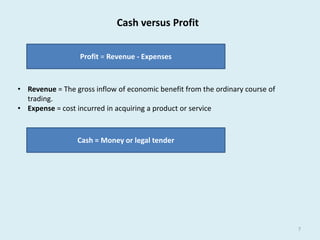
Cash versus Profit 
Profit = Revenue - Expenses 
• Revenue = The gross inflow of economic benefit from the ordinary course of 
trading. 
• Expense = cost incurred in acquiring a product or service 
Cash = Money or legal tender
8 
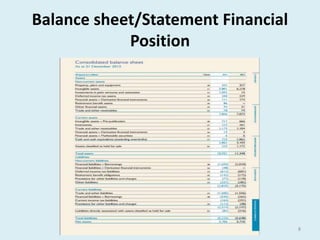
Balance sheet/Statement Financial 
Position
Balance sheet / Statement of Financial 
9 
Position 
• Measures financial position 
• Comprises of three elements: 
- Assets 
- Liabilities 
- Equity 
• The accounting equation will always hold true on a balance sheet: 
ASSETS = LIABILITIES + EQUITY
10 
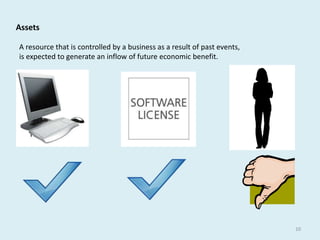
Assets 
A resource that is controlled by a business as a result of past events, 
is expected to generate an inflow of future economic benefit.
11 
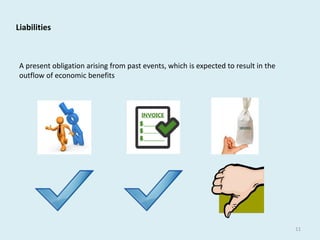
Liabilities 
A present obligation arising from past events, which is expected to result in the 
outflow of economic benefits
12 
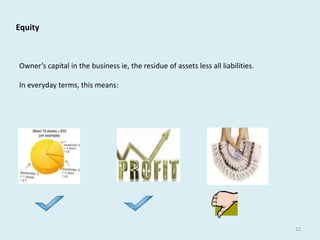
Equity 
Owner’s capital in the business ie, the residue of assets less all liabilities. 
In everyday terms, this means:
13 
Cash flow statements 
• Show actual cash going in and out of the business 
• Internal and external cashflows are very different! 
• External cash flow statements reconcile to the balance sheet and 
income statement and show cash movements in the business in three 
sections: 
• Cashflow from operations 
• Cashflows from investing activities 
• Cashflows from financing activities
14 
Financial statements 
What are they? 
• A set of principles and standards that are used by organisations to prepare 
financial statements. 
Commonly used sets of standards: 
- International Financial Reporting Standards (IFRSs) 
- UK Generally Accepted Accounting Practice (UK GAAP) 
Which standards should an organisation use? 
• The appropriate framework to use generally depends on the location, type 
and nature of the organisation concerned. 
• E.g. All companies listed in EU markets must report under IFRSs.
15 
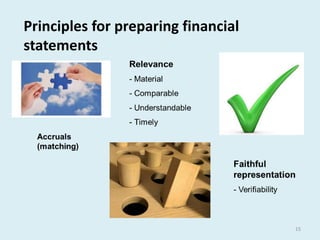
Principles for preparing financial 
statements
Seminar 1: Evaluating sources of financing 
- Read chapter 1 and 15 of core text book (Atrill & McClaney). 
Attempt the questions at the end of these chapters. 
- Research realistic sources of finance, and costs, for a brand 
new start up business 
Seminar 2: Working capital management 
- Read Chapter 16 of core text book (Atrill & McClaney) 
- Consider the following question: 
“Suggest practical ways for a business to keep cash in it’s 
buisness for as long as possible” 
16
Seminar 3: What do financial statements do? 
- Read chapters 2,3,6 of the core textbook (Atrill & McClaney) 
- Review Pearson Plc’s 2013 annual report 
(https://www.pearson.com/content/dam/corporate/global/pearson-dot- 
com/files/annual-reports/ar2013/2013--annual-report-accounts. 
pdf) 
Seminar 4: Managing costs in a business 
- Read chapter 8 of core textbook and attempt questions at 
back of chapter 
17

Introduction to Finance lecture 2

  • 1.
    Principles of Business Introduction to Finance – lecture 2
  • 2.
    Learning outcomes Bythe end of this session you should be able to: • Explain the key components of financial statements • Evaluate the role of the financial statements for different stakeholders • Understand the accounting equation • Calculate profit and understand how it can be manipulated 2
  • 3.
    3 Financial statements • Legally required for all companies in most jurisdictions around the world • Used by a variety of different stakeholders • Measure Performance (Income statement) • Measure Position (Balance sheet) • Measure Cashflows (cashflow statement)
  • 4.
    4 Users offinancial statements
  • 5.
  • 6.
    6 Income Statement • Measures financial performance (profit) Elements of an income statement: • Revenue (price x quantity) • Cost of sales (Direct costs) • Gross profit = revenue less cost of sales • Operating expenses (administrative and distribution costs) • Finance expenses • Income tax expense
  • 7.
    7 Cash versusProfit Profit = Revenue - Expenses • Revenue = The gross inflow of economic benefit from the ordinary course of trading. • Expense = cost incurred in acquiring a product or service Cash = Money or legal tender
  • 8.
    8 Balance sheet/StatementFinancial Position
  • 9.
    Balance sheet /Statement of Financial 9 Position • Measures financial position • Comprises of three elements: - Assets - Liabilities - Equity • The accounting equation will always hold true on a balance sheet: ASSETS = LIABILITIES + EQUITY
  • 10.
    10 Assets Aresource that is controlled by a business as a result of past events, is expected to generate an inflow of future economic benefit.
  • 11.
    11 Liabilities Apresent obligation arising from past events, which is expected to result in the outflow of economic benefits
  • 12.
    12 Equity Owner’scapital in the business ie, the residue of assets less all liabilities. In everyday terms, this means:
  • 13.
    13 Cash flowstatements • Show actual cash going in and out of the business • Internal and external cashflows are very different! • External cash flow statements reconcile to the balance sheet and income statement and show cash movements in the business in three sections: • Cashflow from operations • Cashflows from investing activities • Cashflows from financing activities
  • 14.
    14 Financial statements What are they? • A set of principles and standards that are used by organisations to prepare financial statements. Commonly used sets of standards: - International Financial Reporting Standards (IFRSs) - UK Generally Accepted Accounting Practice (UK GAAP) Which standards should an organisation use? • The appropriate framework to use generally depends on the location, type and nature of the organisation concerned. • E.g. All companies listed in EU markets must report under IFRSs.
  • 15.
    15 Principles forpreparing financial statements
  • 16.
    Seminar 1: Evaluatingsources of financing - Read chapter 1 and 15 of core text book (Atrill & McClaney). Attempt the questions at the end of these chapters. - Research realistic sources of finance, and costs, for a brand new start up business Seminar 2: Working capital management - Read Chapter 16 of core text book (Atrill & McClaney) - Consider the following question: “Suggest practical ways for a business to keep cash in it’s buisness for as long as possible” 16
  • 17.
    Seminar 3: Whatdo financial statements do? - Read chapters 2,3,6 of the core textbook (Atrill & McClaney) - Review Pearson Plc’s 2013 annual report (https://www.pearson.com/content/dam/corporate/global/pearson-dot- com/files/annual-reports/ar2013/2013--annual-report-accounts. pdf) Seminar 4: Managing costs in a business - Read chapter 8 of core textbook and attempt questions at back of chapter 17

Editor's Notes

  • #8 Make the point that consideration for expenses is usually cash, but that cash may not be paid when the product or service is acquired (eg if trading on credit). Therefore cash and profit are different. You should also mention at this point that some expenses recognised by businesses do not involve cash at all (eg, depreciation, amortisation)
  • #11 People are not assets (they are a cost) in an accounting sense as they are not controlled by a company ie. There is nothing to stop an individual from joining another company
  • #14  Might be worth asking the students if they have heard of any others at this point, and going through their answers. Please make the point that retained earnings are not a source of financing (they should know why now – ie profit and cash are different)
  • #15  Might be worth asking the students if they have heard of any others at this point, and going through their answers. Please make the point that retained earnings are not a source of financing (they should know why now – ie profit and cash are different)
  • #16  Might be worth asking the students if they have heard of any others at this point, and going through their answers. Please make the point that retained earnings are not a source of financing (they should know why now – ie profit and cash are different)
  • #17  Might be worth asking the students if they have heard of any others at this point, and going through their answers. Please make the point that retained earnings are not a source of financing (they should know why now – ie profit and cash are different)
  • #18  Might be worth asking the students if they have heard of any others at this point, and going through their answers. Please make the point that retained earnings are not a source of financing (they should know why now – ie profit and cash are different)