Images of Complexity in the Practice of Language
Teaching and Learning
Manchester Roundtable on Complexity Theory
and English Language Teaching
Manchester, April 15, 2015
Juup Stelma
Juup.stelma@manchester.ac.uk
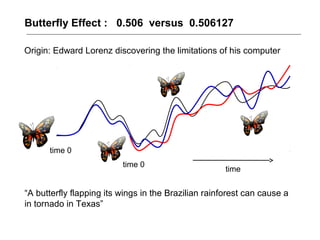
Butterfly Effect : 0.506 versus 0.506127
Origin: Edward Lorenz discovering the limitations of his computer
“A butterfly flapping its wings in the Brazilian rainforest can cause a
in tornado in Texas”
time 0
time 0
time
The Butterfly Effect – So What?
Finch (2010) suggests that language learning has a sensitive
dependence on past critical incidents.
Critical Incidents = things that happened in the past
= the butterfly flapping its wings
Hold on to that thought 
Reflecting on the critical incidents may give learners the freedom to
change their present and future language learning.
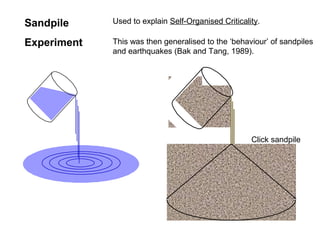
Sandpile
Experiment
Used to explain Self-Organised Criticality.
Click sandpile
This was then generalised to the ‘behaviour’ of sandpiles
and earthquakes (Bak and Tang, 1989).
Sandpile Experiment – So What?
Eventually, the motive to entertain led some students to go ‘over the top’ with
their role-play performances.
Kostoulas and Stelma (to appear) describe a role-play activity repeated over
time, where the learners collectively and increasingly tried to entertain their
classmates.
A collective motive for the activity gradually accumulated (like a sandpile)
The motive to entertain started to dominate, and smaller tensions appeared,
such as students feeling pressure to be ‘as entertaining as others’.
The small tensions = small avalanches in the sandpile …
Going ‘over the top’ = larger avalanches in the sandpile …
At this state of self-organised criticality the teacher decided to terminate the
activity.
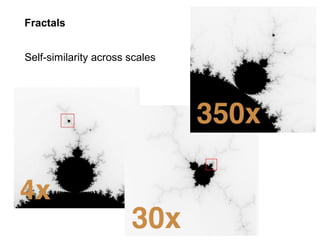
Fractals
Self-similarity across scales
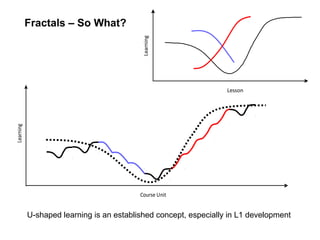
Fractals – So What?
U-shaped learning is an established concept, especially in L1 development
Lesson
Learning
Course Unit
Learning
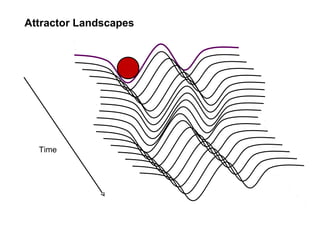
Attractor Landscapes
Time
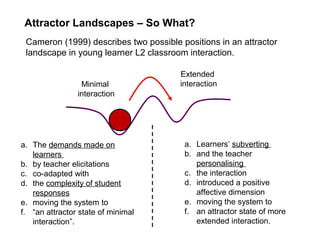
Attractor Landscapes – So What?
Cameron (1999) describes two possible positions in an attractor
landscape in young learner L2 classroom interaction.
a. The demands made on
learners
b. by teacher elicitations
c. co-adapted with
d. the complexity of student
responses
e. moving the system to
f. “an attractor state of minimal
interaction”.
Minimal
interaction
Extended
interaction
a. Learners’ subverting
b. and the teacher
personalising
c. the interaction
d. introduced a positive
affective dimension
e. moving the system to
f. an attractor state of more
extended interaction.
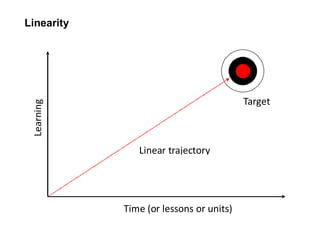
Linearity
Linear trajectory
Target
Time (or lessons or units)
Learning
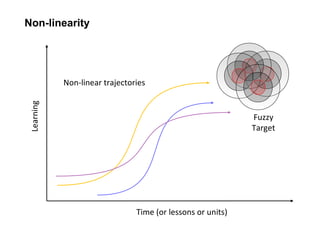
Non-linear trajectories
Fuzzy
Target
Time (or lessons or units)
Learning
Non-linearity
Non-linearity – so What?
Nonlinearity can be found in (among other):
Learning of vocabulary, grammar
Learning of language skills (reading, speaking …)
Learner motivation
Teacher development
Assuming linearity >>> possiblity of unfulfilled expectations
Assuming nonlinearity >>> openness to different outcomes
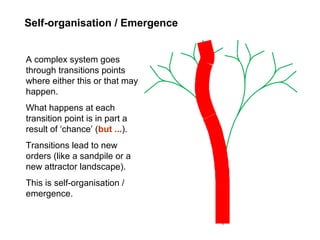
Self-organisation / Emergence
A complex system goes
through transitions points
where either this or that may
happen.
What happens at each
transition point is in part a
result of ‘chance’ (but ...).
Transitions lead to new
orders (like a sandpile or a
new attractor landscape).
This is self-organisation /
emergence.
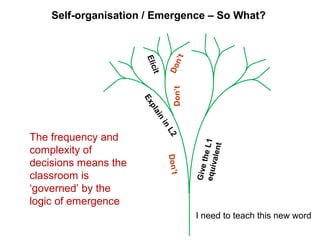
GivetheL1equivalent
Explain
in
L2
Don’t
Don’t
Elicit
Don’t
The frequency and
complexity of
decisions means the
classroom is
‘governed’ by the
logic of emergence
Self-organisation / Emergence – So What?
I need to teach this new word
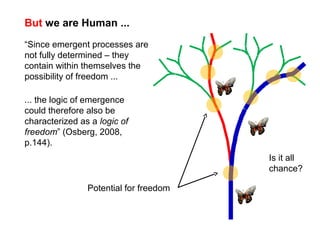
But we are Human ...
“Since emergent processes are
not fully determined – they
contain within themselves the
possibility of freedom ...
Potential for freedom
... the logic of emergence
could therefore also be
characterized as a logic of
freedom” (Osberg, 2008,
p.144).
Is it all
chance?
Freedom in Complex Systems
Teachers can and sometimes make choices
Learners can but don’t always make choices
But, making choices can create a
complex system in our own image
Freedom to make choices is constrained.
References
Bak, P. and Tang, C. (1989). Earthquakes as a Self-Organized Critical
Phenomenon. Journal of Geophysical Research, 94(B11): 15635-15637.
Cameron, L. (1999). The Complex Dynamics of language Use on Tasks. Paper
presented at the BAAL Annual conference, Edinburgh, UK. Available from:
http://www.ibrarian.net/navon/paper/The_Complex_Dynamics_of_Language_U
se_on_Tasks.pdf?paperid=145291
Larsen-Freeman, D. and Cameron, L. (2008). Complex Systems and Applied
Linguistics (see Chapter 7). Oxford: Oxford University Press.
Finch, A. (2010). Critical incidents and language learning: sensitivity to initial
conditions. System, 38: 422-431.
Kostoulas A. and Stelma, J. (to appear). Intentionality and Complex Systems
Theory: a new direction for language learning psychology. In C. Gkonou, D.
Tatzl and S. Mercer (Eds). New directions in Language Learning Psychology.
Springer.
Osberg, D. (2008). The Logic of Emergence: An alternative conceptual space
for theorizing critical education. Journal of the Canadian Association for
Curriculum Studies, 6(1): 133-161.
Image Attributions
Butterfly image on slides 3 and 4:
https://openclipart.org/detail/16282/butterfly-effect
Fractal images on slide 7:
http://commons.wikimedia.org/wiki/File:Mandelbrot-similar2.png
http://commons.wikimedia.org/wiki/File:Mandelbrot-similar3.png
http://commons.wikimedia.org/wiki/File:Mandelbrot-similar4.png
All other images are my own.

Images of complexity

  • 1.
    Images of Complexityin the Practice of Language Teaching and Learning Manchester Roundtable on Complexity Theory and English Language Teaching Manchester, April 15, 2015 Juup Stelma Juup.stelma@manchester.ac.uk
  • 2.
    Butterfly Effect :0.506 versus 0.506127 Origin: Edward Lorenz discovering the limitations of his computer “A butterfly flapping its wings in the Brazilian rainforest can cause a in tornado in Texas” time 0 time 0 time
  • 3.
    The Butterfly Effect– So What? Finch (2010) suggests that language learning has a sensitive dependence on past critical incidents. Critical Incidents = things that happened in the past = the butterfly flapping its wings Hold on to that thought  Reflecting on the critical incidents may give learners the freedom to change their present and future language learning.
  • 4.
    Sandpile Experiment Used to explainSelf-Organised Criticality. Click sandpile This was then generalised to the ‘behaviour’ of sandpiles and earthquakes (Bak and Tang, 1989).
  • 5.
    Sandpile Experiment –So What? Eventually, the motive to entertain led some students to go ‘over the top’ with their role-play performances. Kostoulas and Stelma (to appear) describe a role-play activity repeated over time, where the learners collectively and increasingly tried to entertain their classmates. A collective motive for the activity gradually accumulated (like a sandpile) The motive to entertain started to dominate, and smaller tensions appeared, such as students feeling pressure to be ‘as entertaining as others’. The small tensions = small avalanches in the sandpile … Going ‘over the top’ = larger avalanches in the sandpile … At this state of self-organised criticality the teacher decided to terminate the activity.
  • 6.
  • 7.
    Fractals – SoWhat? U-shaped learning is an established concept, especially in L1 development Lesson Learning Course Unit Learning
  • 8.
  • 9.
    Attractor Landscapes –So What? Cameron (1999) describes two possible positions in an attractor landscape in young learner L2 classroom interaction. a. The demands made on learners b. by teacher elicitations c. co-adapted with d. the complexity of student responses e. moving the system to f. “an attractor state of minimal interaction”. Minimal interaction Extended interaction a. Learners’ subverting b. and the teacher personalising c. the interaction d. introduced a positive affective dimension e. moving the system to f. an attractor state of more extended interaction.
  • 10.
  • 11.
    Non-linear trajectories Fuzzy Target Time (orlessons or units) Learning Non-linearity
  • 12.
    Non-linearity – soWhat? Nonlinearity can be found in (among other): Learning of vocabulary, grammar Learning of language skills (reading, speaking …) Learner motivation Teacher development Assuming linearity >>> possiblity of unfulfilled expectations Assuming nonlinearity >>> openness to different outcomes
  • 13.
    Self-organisation / Emergence Acomplex system goes through transitions points where either this or that may happen. What happens at each transition point is in part a result of ‘chance’ (but ...). Transitions lead to new orders (like a sandpile or a new attractor landscape). This is self-organisation / emergence.
  • 14.
    GivetheL1equivalent Explain in L2 Don’t Don’t Elicit Don’t The frequency and complexityof decisions means the classroom is ‘governed’ by the logic of emergence Self-organisation / Emergence – So What? I need to teach this new word
  • 15.
    But we areHuman ... “Since emergent processes are not fully determined – they contain within themselves the possibility of freedom ... Potential for freedom ... the logic of emergence could therefore also be characterized as a logic of freedom” (Osberg, 2008, p.144). Is it all chance?
  • 16.
    Freedom in ComplexSystems Teachers can and sometimes make choices Learners can but don’t always make choices But, making choices can create a complex system in our own image Freedom to make choices is constrained.
  • 17.
    References Bak, P. andTang, C. (1989). Earthquakes as a Self-Organized Critical Phenomenon. Journal of Geophysical Research, 94(B11): 15635-15637. Cameron, L. (1999). The Complex Dynamics of language Use on Tasks. Paper presented at the BAAL Annual conference, Edinburgh, UK. Available from: http://www.ibrarian.net/navon/paper/The_Complex_Dynamics_of_Language_U se_on_Tasks.pdf?paperid=145291 Larsen-Freeman, D. and Cameron, L. (2008). Complex Systems and Applied Linguistics (see Chapter 7). Oxford: Oxford University Press. Finch, A. (2010). Critical incidents and language learning: sensitivity to initial conditions. System, 38: 422-431. Kostoulas A. and Stelma, J. (to appear). Intentionality and Complex Systems Theory: a new direction for language learning psychology. In C. Gkonou, D. Tatzl and S. Mercer (Eds). New directions in Language Learning Psychology. Springer. Osberg, D. (2008). The Logic of Emergence: An alternative conceptual space for theorizing critical education. Journal of the Canadian Association for Curriculum Studies, 6(1): 133-161.
  • 18.
    Image Attributions Butterfly imageon slides 3 and 4: https://openclipart.org/detail/16282/butterfly-effect Fractal images on slide 7: http://commons.wikimedia.org/wiki/File:Mandelbrot-similar2.png http://commons.wikimedia.org/wiki/File:Mandelbrot-similar3.png http://commons.wikimedia.org/wiki/File:Mandelbrot-similar4.png All other images are my own.