





From Faith to Evidence: 
Demonstrating the Value of Libraries 
Martha Kyrillidou 
Directora del Programa Estadística y Calidad de Servicio de 
la Association of Research Libraries, ARL (Estados Unidos) 
Congreso de Bibliotecas Universitarias Y Especializadas 
Santiago de Chile 
28 de mayo, 2014
Overview 
• ARL (Association of Research Libraries) 
• Demonstrating value 
• Assessment librarians 
• StatsQUAL – LibQUAL+ 
• LIBValue (emphasis on Commons) 
• Testing New Methods 
• Value Scorecard (Town & Kyrillidou, 2013) 
• Strategy and Metrics 
http://www.arl.org 
Association of Research Libraries
http://www.arl.org 
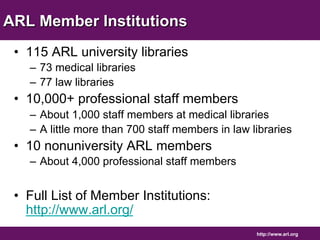
ARL Member Institutions 
• 115 ARL university libraries 
– 73 medical libraries 
– 77 law libraries 
• 10,000+ professional staff members 
– About 1,000 staff members at medical libraries 
– A little more than 700 staff members in law libraries 
• 10 nonuniversity ARL members 
– About 4,000 professional staff members 
• Full List of Member Institutions: 
http://www.arl.org/
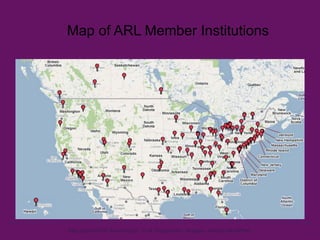
Map of ARL Member Institutions 
Map data ©2011 AvanteLogic, CLiK Productions, Google – Map by MultiPlottr
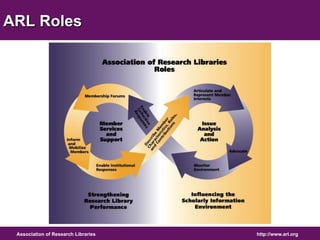
ARL Roles 
Association of Research Libraries http://www.arl.org
ARL Statistics and Assessment 
…To describe and measure the 
performance of research 
libraries and their contribution to 
teaching, research, scholarship and community 
service … 
Association of Research Libraries http://www.arl.org
ARL Statistics and Assessment 
…To describe and measure the performance of research 
libraries and their contribution to 
teaching, research, 
scholarship and community service 
… 
Association of Research Libraries http://www.arl.org
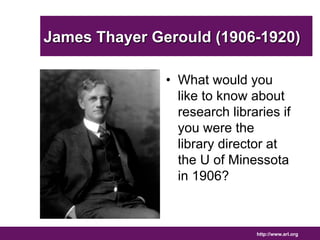
James Thayer Gerould (1906-1920) 
• What would you 
like to know about 
research libraries if 
you were the 
library director at 
the U of Minessota 
in 1906? 
http://www.arl.org
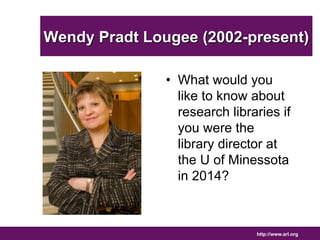
Wendy Pradt Lougee (2002-present) 
• What would you 
like to know about 
research libraries if 
you were the 
library director at 
the U of Minessota 
in 2014? 
http://www.arl.org
http://www.arl.org 
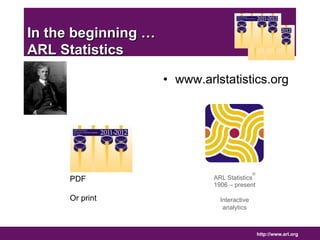
In the beginning … 
ARL Statistics 
• www.arlstatistics.org 
ARL Statistics® 
1906 – present 
Interactive 
analytics 
PDF 
Or print
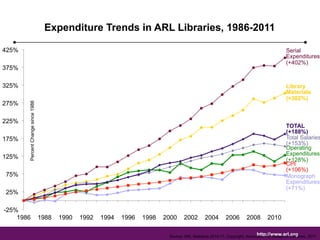
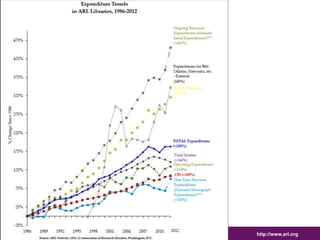
Expenditure Trends in ARL Libraries, 1986-2011! 
Serial 
Expenditures 
(+402%) 
Library 
Materials 
(+302%) 
TOTAL 
(+188%) 
Total Salaries 
(+153%) 
Operating 
Expenditures 
(+128%) 
CPI 
(+106%) 
Monograph 
Expenditures 
(+71%) 
http://www.arl.org 
Percent Change since 1986 
Source: ARL Statistics 2010-11, Copyright, Association of Research Libraries, 2011 
425% 
375% 
325% 
275% 
225% 
175% 
125% 
75% 
25% 
-25% 
1986 1988 1990 1992 1994 1996 1998 2000 2002 2004 2006 2008 2010
http://www.arl.org
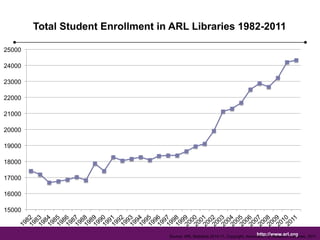
Total Student Enrollment in ARL Libraries 1982-2011! 
http://www.arl.org 
25000 
24000 
23000 
22000 
21000 
20000 
19000 
18000 
17000 
16000 
15000 
Source: ARL Statistics 2010-11, Copyright, Association of Research Libraries, 2011
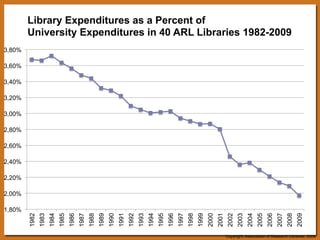
Library Expenditures as a Percent of 
University Expenditures in 40 ARL Libraries 1982-2009! 
3,80% 
3,60% 
3,40% 
3,20% 
3,00% 
2,80% 
2,60% 
2,40% 
2,20% 
2,00% 
1,80% 
1982 
1983 
1984 
1985 
1986 
1987 
1988 
1989 
1990 
1991 
1992 
1993 
1994 
1995 
1996 
1997 
1998 
1999 
2000 
2001 
2002 
2003 
2004 
2005 
2006 
2007 
2008 
2009 
Copyright, Association of Research Libraries, 2009
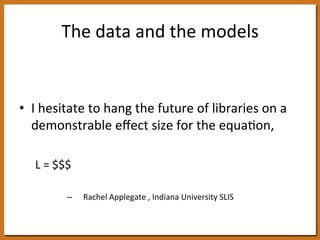
The 
data 
and 
the 
models 
• I 
hesitate 
to 
hang 
the 
future 
of 
libraries 
on 
a 
demonstrable 
effect 
size 
for 
the 
equa8on, 
L 
= 
$$$ 
– 
Rachel 
Applegate 
, 
Indiana 
University 
SLIS
Why 
study 
value 
• Faced 
with 
difficult 
economic 
8mes 
and 
university 
budget 
cuts, 
the 
value 
of 
the 
library 
to 
the 
wider 
goals 
of 
the 
university 
is 
increasingly 
ques8oned. 
– Introduc8on 
to 
the 
Lib-­‐Value 
Project 
» www.libvalue.org 
Association of Research 
Libraries
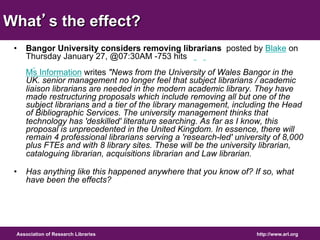
What’s the effect? 
• Bangor University considers removing librarians posted by Blake on 
Thursday January 27, @07:30AM -753 hits 
Ms Information writes "News from the University of Wales Bangor in the 
UK. senior management no longer feel that subject librarians / academic 
liaison librarians are needed in the modern academic library. They have 
made restructuring proposals which include removing all but one of the 
subject librarians and a tier of the library management, including the Head 
of Bibliographic Services. The university management thinks that 
technology has 'deskilled' literature searching. As far as I know, this 
proposal is unprecedented in the United Kingdom. In essence, there will 
remain 4 professional librarians serving a 'research-led' university of 8,000 
plus FTEs and with 8 library sites. These will be the university librarian, 
cataloguing librarian, acquisitions librarian and Law librarian. 
• Has anything like this happened anywhere that you know of? If so, what 
have been the effects? 
Association of Research Libraries http://www.arl.org
Assessment 
Librarian
Assessment is… 
“…a structured process to learn about 
communities and evaluate how well the 
library supports them.” 
- Steve Hiller, Director of Assessment & Planning 
University of Washington Libraries 
Association of Research Libraries http://www.arl.org
Assessment can… 
• Support decision making 
• Establish accountability 
• Strengthen organizational mission, goals, and 
objectives 
• Realign library goals and mission statements 
with the needs of users 
• Identify trends in user behaviors and 
technology 
• Measure learning outcomes and impact 
• Improve programs and services 
Association of Research Libraries http://www.arl.org
Good Analytical Skills needed 
• Quantitative Analysis: IBM SPSS, SAS BI 
• Qualitative Analysis: Atlas.ti, NVivo 
• Data collection: Qualtrics, Survey Monkey, 
FormStack 
• Data storage: SQL Server, Access, Excel 
• Reporting: Crystal Reports, SPSS, SQL, Excel, 
• Web delivery: interactive charts, analytics, 
Tableau, etc. 
• Web development, usability, user experience? 
Association of Research Libraries http://www.arl.org
http://www.arl.org 
arl-assess@arl.org 
• Anyone with an interest in library assessment 
• Assessment librarians 
• User Experience and Planning 
• Anthropologists 
• Space planners 
• Functional area leaders involved in 
assessment (teaching and learning, special 
collections, spaces) 
Join the arl-assess google group 
Association of Research Libraries
The 
Value 
of 
Academic 
Libraries 
http://www.acrl.ala.org/value/ 
The Value of Libraries for 
Research and Researchers 
http://www.rin.ac.uk/our-work/using-and-accessing- 
information-resources/value-libraries- 
research-and-researchers
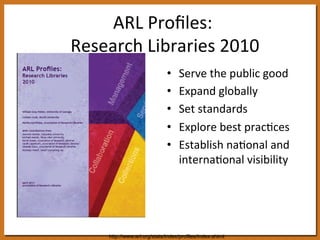
ARL 
Profiles: 
Research 
Libraries 
2010 
• Serve 
the 
public 
good 
• Expand 
globally 
• Set 
standards 
• Explore 
best 
prac8ces 
• Establish 
na8onal 
and 
interna8onal 
visibility 
http://www.arl.org/stats/index/profiles/index.shtml
Ethnography 
The 
art 
and 
science 
of 
describing 
a 
group, 
culture, 
or 
social 
process.
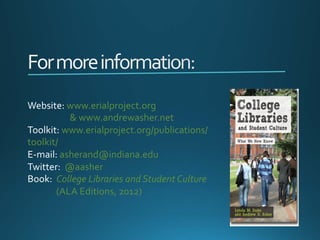
Website: 
www.erialproject.org 
& 
www.andrewasher.net 
Toolkit: 
www.erialproject.org/publications/ 
toolkit/ 
E-­‐mail: 
asherand@indiana.edu 
Twitter: 
@aasher 
Book: 
College 
Libraries 
and 
Student 
Culture 
(ALA 
Editions, 
2012)
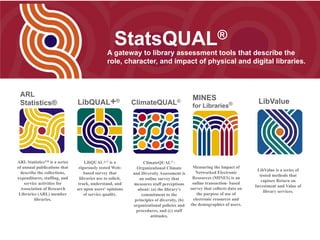
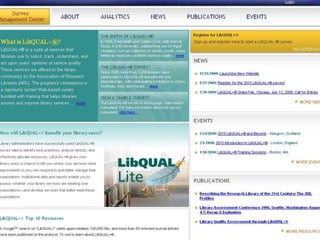
StatsQUAL® 
A gateway to library assessment tools that describe the 
role, character, and impact of physical and digital libraries. 
LibQUAL+® MINES 
LibQUAL+® is a 
rigorously tested Web-based 
survey that 
libraries use to solicit, 
track, understand, and 
act upon users‘ opinions 
of service quality. 
for Libraries® 
Measuring the Impact of 
Networked Electronic 
Resources (MINES) is an 
online transaction- based 
survey that collects data on 
the purpose of use of 
electronic resources and 
the demographics of users. 
ClimateQUAL® 
ClimateQUAL® : 
Organizational Climate 
and Diversity Assessment is 
an online survey that 
measures staff perceptions 
about: (a) the library's 
commitment to the 
principles of diversity, (b) 
organizational policies and 
procedures, and (c) staff 
attitudes. 
ARL 
Statistics® 
ARL Statistics™ is a series 
of annual publications that 
describe the collections, 
expenditures, staffing, and 
service activities for 
Association of Research 
Libraries (ARL) member 
libraries. 
LibValue 
LibValue is a series of 
tested methods that 
capture Return on 
Investment and Value of 
library services.
Association of Research Libraries http://www.arl.org
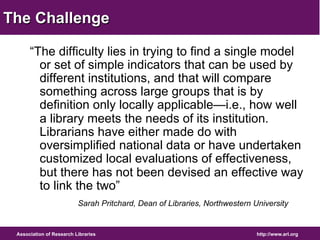
The Challenge 
“The difficulty lies in trying to find a single model 
or set of simple indicators that can be used by 
different institutions, and that will compare 
something across large groups that is by 
definition only locally applicable—i.e., how well 
a library meets the needs of its institution. 
Librarians have either made do with 
oversimplified national data or have undertaken 
customized local evaluations of effectiveness, 
but there has not been devised an effective way 
to link the two” 
Sarah Pritchard, Dean of Libraries, Northwestern University 
Association of Research Libraries http://www.arl.org
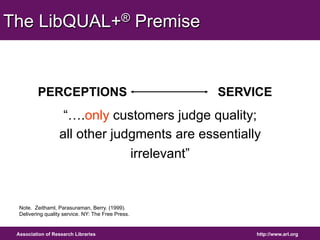
The LibQUAL+® Premise 
PERCEPTIONS SERVICE 
“….only customers judge quality; 
all other judgments are essentially 
irrelevant” 
Note. Zeithaml, Parasuraman, Berry. (1999). 
Delivering quality service. NY: The Free Press. 
Association of Research Libraries http://www.arl.org
…a revolution in the making 
Il est plus nécessaire d'étudier les hommes que 
les livres 
—FRANÇOIS DE LA ROCHEFOUCAULD (1613–1680) 
Association of Research Libraries http://www.arl.org
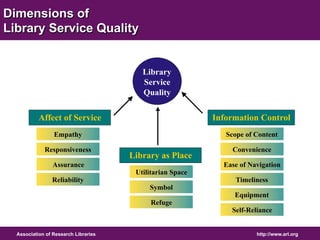
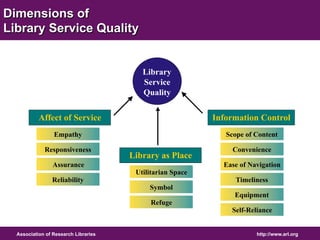
Dimensions of 
Library Service Quality 
Information Control 
Library 
Service 
Quality 
Scope of Content 
Convenience 
Ease of Navigation 
Timeliness 
Equipment 
Self-Reliance 
Affect of Service 
Library as Place 
Empathy 
Responsiveness 
Assurance 
Reliability 
Utilitarian Space 
Symbol 
Refuge 
Association of Research Libraries http://www.arl.org
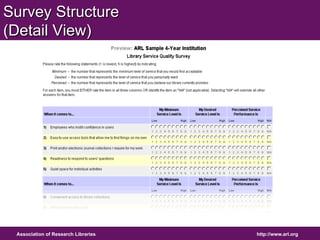
Survey Structure 
(Detail View) 
Association of Research Libraries http://www.arl.org
Dimensions of 
Library Service Quality 
Information Control 
Library 
Service 
Quality 
Scope of Content 
Convenience 
Ease of Navigation 
Timeliness 
Equipment 
Self-Reliance 
Affect of Service 
Library as Place 
Empathy 
Responsiveness 
Assurance 
Reliability 
Utilitarian Space 
Symbol 
Refuge 
Association of Research Libraries http://www.arl.org
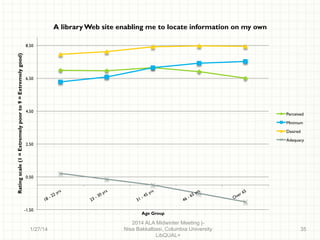
8.50 
6.50 
4.50 
2.50 
0.50 
-1.50 
A library Web site enabling me to locate information on my own 
18 - 22 yrs 
23 - 30 yrs 
31 - 45 yrs 
46 - 65 yrs 
Over 65 
Rating scale (1 = Extremely poor to 9 = Extremely good) 
Age Group 
Perceived 
Minimum 
Desired 
Adequacy 
1/27/14 
2014 ALA Midwinter Meeting |- 
Nisa Bakkalbasi, Columbia University 
LibQUAL+ 
35
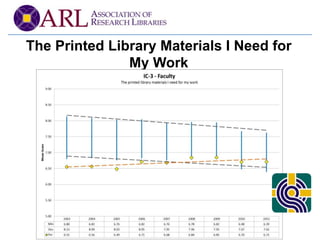
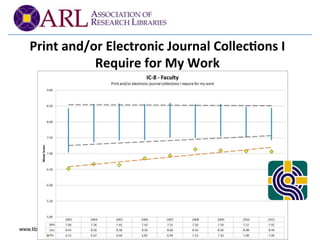
The Printed Library Materials I Need for 
My Work
Print 
and/or 
Electronic 
Journal 
Collec2ons 
I 
Require 
for 
My 
Work 
www.libqual.org
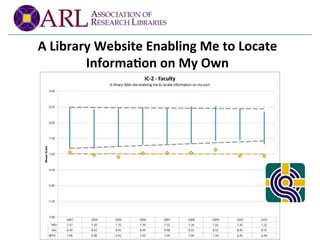
A 
Library 
Website 
Enabling 
Me 
to 
Locate 
Informa2on 
on 
My 
Own
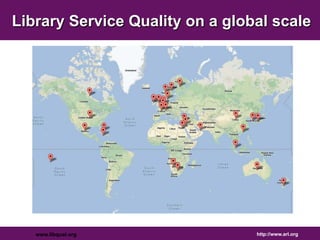
Library Service Quality on a global scale 
www.libqual.org http://www.arl.org
Contributions 
• LibQUAL+® methodology focuses on success from the 
user’s point of view (outcomes) 
• Demonstrates that a Web-based survey can handle 
large numbers; users are willing to fill it out; and 
survey can be executed quickly with minimal expense 
• LibQUAL+® requires limited local survey expertise and 
resources 
• Analysis available at local and inter-institutional levels 
• Many opportunities for using demographics to discern 
user behaviors 
Association of Research Libraries http://www.arl.org
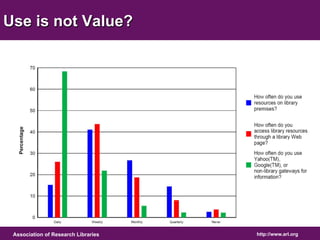
Use is not Value? 
Association of Research Libraries http://www.arl.org
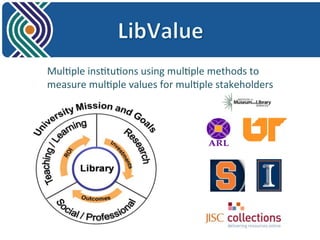
Mul8ple 
ins8tu8ons 
using 
mul8ple 
methods 
to 
measure 
mul8ple 
values 
for 
mul8ple 
stakeholders
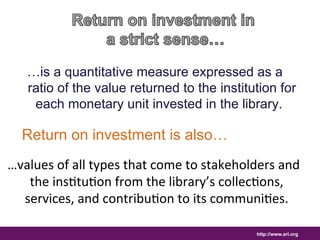
…is a quantitative measure expressed as a 
ratio of the value returned to the institution for 
each monetary unit invested in the library. 
Return on investment is also… 
…values 
of 
all 
types 
that 
come 
to 
stakeholders 
and 
the 
ins8tu8on 
from 
the 
library’s 
collec8ons, 
services, 
and 
contribu8on 
to 
its 
communi8es. 
http://www.arl.org
LIBValue Webcasts 
http://www.arl.org 
02/07/2011 
} Scholarly Reading 
} Teaching and Learning 
} eBooks 
} Special Collections 
} Commons 
} Comprehensive value 
} Coming: LibValue Toolkit: www.libvalue.org 
» ARL YouTube Channel
Changing 
Higher 
Educa8on 
Landscape 
• Outcomes-­‐based 
budget 
• Complete 
College 
Act, 
2010 
• A 
Top 
25 
Mandate, 
2009
New 
University 
Strategic 
Plan 
The 
Five 
Top 
25 
Strategic 
Priori8es 
• Undergraduate 
Educa8on 
• Graduate 
Educa8on 
• Research 
and 
Crea8ve 
Ac8vity 
• Faculty 
and 
Staff 
• Infrastructure 
and 
resources
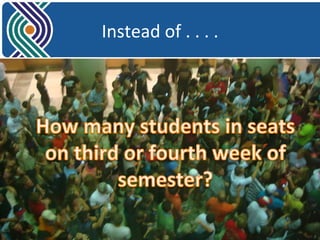
Instead 
of 
. 
. 
. 
.
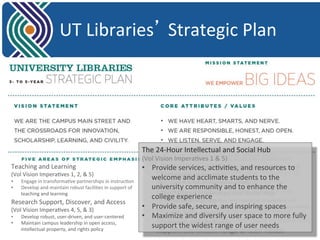
UT 
Libraries’ 
Strategic 
Plan 
Teaching 
and 
Learning 
(Vol 
Vision 
Impera8ves 
1, 
2, 
& 
5) 
• Engage 
in 
transforma8ve 
partnerships 
in 
instruc8on 
• Develop 
and 
maintain 
robust 
facili8es 
in 
support 
of 
teaching 
and 
learning 
Research 
Support, 
Discover, 
and 
Access 
(Vol 
Vision 
Impera8ves 
4, 
5, 
& 
3) 
• Develop 
robust, 
user-­‐driven, 
and 
user-­‐centered 
• Maintain 
campus 
leadership 
in 
open 
access, 
intellectual 
property, 
and 
rights 
policy 
The 
24-­‐Hour 
Intellectual 
and 
Social 
Hub 
(Vol 
Vision 
Impera8ves 
1 
& 
5) 
• Provide 
Digital 
services, 
Ini8a8ves, 
acScholarly 
8vi8es, 
Communicaand 
resources 
8on, 
to 
and 
Technology 
Innova8on 
• Lead 
welcome 
and 
acclimate 
students 
to 
the 
university 
new 
community 
ini8a8ves 
in 
data 
and 
curato 
8on 
enhance 
the 
college 
The 
24-­‐experience 
Hour 
Intellectual 
and 
Social 
Hub 
• Provide 
• Provide 
services, 
ac8vi8es, 
and 
resources 
to 
welcome 
and 
safe, 
secure, 
and 
inspiring 
spaces 
acclimate 
students 
to 
the 
University 
community 
and 
to 
enhance 
the 
college 
experience 
Outreach 
and 
Marke8ng 
• Provide 
bold 
communica8on 
program 
and 
strategies 
• Maximize 
and 
diversify 
user 
space 
to 
more 
fully 
support 
the 
widest 
range 
of 
user 
needs
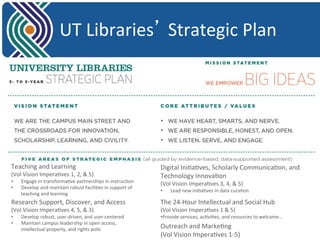
UT 
Libraries’ 
Strategic 
Plan 
Teaching 
and 
Learning 
(Vol 
Vision 
Impera8ves 
1, 
2, 
& 
5) 
• Engage 
in 
transforma8ve 
partnerships 
in 
instruc8on 
• Develop 
and 
maintain 
robust 
facili8es 
in 
support 
of 
teaching 
and 
learning 
Research 
Support, 
Discover, 
and 
Access 
(Vol 
Vision 
Impera8ves 
4, 
5, 
& 
3) 
• Develop 
robust, 
user-­‐driven, 
and 
user-­‐centered 
• Maintain 
campus 
leadership 
in 
open 
access, 
intellectual 
property, 
and 
rights 
polic 
Digital 
Ini8a8ves, 
Scholarly 
Communica8on, 
and 
Technology 
Innova8on 
(Vol 
Vision 
Impera8ves 
3, 
4, 
& 
5) 
• Lead 
new 
ini8a8ves 
in 
data 
cura8on 
The 
24-­‐Hour 
Intellectual 
and 
Social 
Hub 
(Vol 
Vision 
Impera8ves 
1 
& 
5) 
• Provide 
services, 
ac8vi8es, 
and 
resources 
to 
welcome… 
Outreach 
and 
Marke8ng 
(Vol 
Vision 
Impera8ves 
1-­‐5)
The 
old 
paradigm 
• Comparables 
– “X 
is 
like 
us, 
so 
we 
should 
have 
their 
budget.” 
• Stoke 
Rivalries 
– “We 
must 
be 
befer 
than 
X.” 
• Infla8on 
factor 
– “Let’s 
scare 
‘em 
with 
scary 
infla8on 
numbers.”
The 
New 
Paradigm: 
Student 
success 
outcomes 
(mostly) 
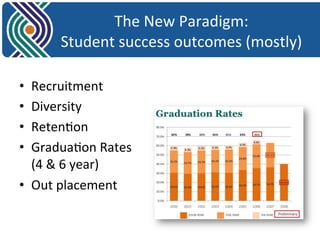
• Recruitment 
• Diversity 
• Reten8on 
• Gradua8on 
Rates 
(4 
& 
6 
year) 
• Out 
placement
LibValue 
and 
ROI 
Not 
a 
moment 
too 
soon!
Commons 
Spaces 
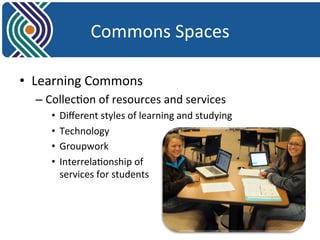
• Learning 
Commons 
– Collec8on 
of 
resources 
and 
services 
• Different 
styles 
of 
learning 
and 
studying 
• Technology 
• Groupwork 
• Interrela8onship 
of 
services 
for 
students
Commons 
Spaces 
& 
Student 
Success 
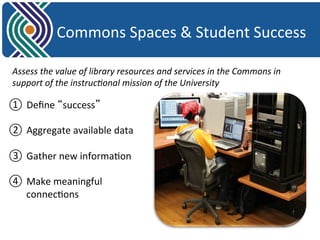
Assess 
the 
value 
of 
library 
resources 
and 
services 
in 
the 
Commons 
in 
support 
of 
the 
instruc7onal 
mission 
of 
the 
University 
① 
Define 
“success” 
② Aggregate 
available 
data 
③ Gather 
new 
informa8on 
④ Make 
meaningful 
connec8ons
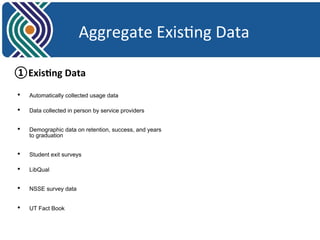
Aggregate 
Exis8ng 
Data 
① Exis2ng 
Data 
• Automatically collected usage data 
• Data collected in person by service providers 
• Demographic data on retention, success, and years 
to graduation 
• Student exit surveys 
• LibQual 
• NSSE survey data 
• UT Fact Book
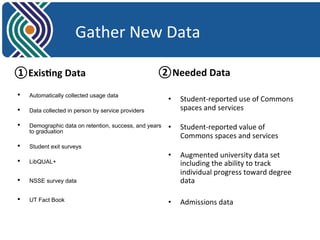
Gather 
New 
Data 
① Exis2ng 
Data 
② Needed 
Data 
• Student-­‐reported 
use 
of 
Commons 
spaces 
and 
services 
• Student-­‐reported 
value 
of 
Commons 
spaces 
and 
services 
• Augmented 
university 
data 
set 
including 
the 
ability 
to 
track 
individual 
progress 
toward 
degree 
data 
• Admissions 
data 
• Automatically collected usage data 
• Data collected in person by service providers 
• Demographic data on retention, success, and years 
to graduation 
• Student exit surveys 
• LibQUAL+ 
• NSSE survey data 
• UT Fact Book
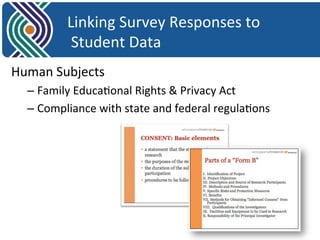
Linking 
Survey 
Responses 
to 
Student 
Data 
Human 
Subjects 
– Family 
Educa8onal 
Rights 
& 
Privacy 
Act 
– Compliance 
with 
state 
and 
federal 
regula8ons
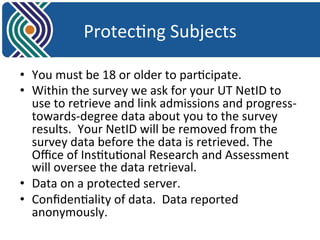
Protec8ng 
Subjects 
• You 
must 
be 
18 
or 
older 
to 
par8cipate. 
• Within 
the 
survey 
we 
ask 
for 
your 
UT 
NetID 
to 
use 
to 
retrieve 
and 
link 
admissions 
and 
progress-­‐ 
towards-­‐degree 
data 
about 
you 
to 
the 
survey 
results. 
Your 
NetID 
will 
be 
removed 
from 
the 
survey 
data 
before 
the 
data 
is 
retrieved. 
The 
Office 
of 
Ins8tu8onal 
Research 
and 
Assessment 
will 
oversee 
the 
data 
retrieval. 
• Data 
on 
a 
protected 
server. 
• Confiden8ality 
of 
data. 
Data 
reported 
anonymously.
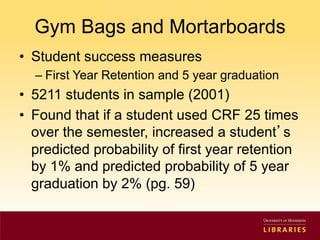
Gym Bags and Mortarboards 
• Student success measures 
– First Year Retention and 5 year graduation 
• 5211 students in sample (2001) 
• Found that if a student used CRF 25 times 
over the semester, increased a student’s 
predicted probability of first year retention 
by 1% and predicted probability of 5 year 
graduation by 2% (pg. 59)
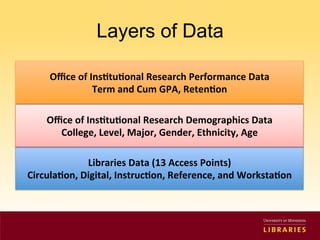
Layers of Data 
Office 
of 
Ins2tu2onal 
Research 
Performance 
Data 
Term 
and 
Cum 
GPA, 
Reten2on 
Office 
of 
Ins2tu2onal 
Research 
Demographics 
Data 
College, 
Level, 
Major, 
Gender, 
Ethnicity, 
Age 
Libraries 
Data 
(13 
Access 
Points) 
Circula2on, 
Digital, 
Instruc2on, 
Reference, 
and 
Worksta2on
Library 
Cube 
University 
of 
Wollongong 
hfp://www.youtube.com/watch?v=Z9UN8O_KMQ
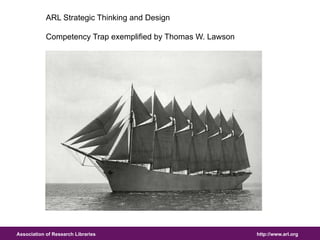
ARL Strategic Thinking and Design 
Competency Trap exemplified by Thomas W. Lawson 
Association of Research Libraries http://www.arl.org
Value and strategy 
• How can you use 
LibValue results 
strategically? 
http://www.arl.org
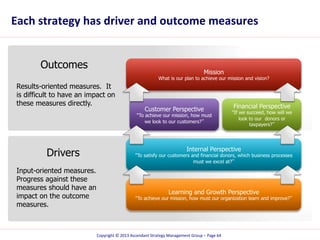
Each 
strategy 
has 
driver 
and 
outcome 
measures 
Copyright 
© 
2013 
Ascendant 
Strategy 
Management 
Group 
– 
Page 
64 
Outcomes 
Drivers 
Mission 
What is our plan to achieve our mission and vision? 
Financial Perspective 
"If we succeed, how will we 
look to our donors or 
taxpayers?” 
Customer Perspective 
"To achieve our mission, how must 
we look to our customers?” 
Internal Perspective 
"To satisfy our customers and financial donors, which business processes 
must we excel at?” 
Learning and Growth Perspective 
"To achieve our mission, how must our organization learn and improve?” 
Results-oriented measures. It 
is difficult to have an impact on 
these measures directly. 
Input-oriented measures. 
Progress against these 
measures should have an 
impact on the outcome 
measures.
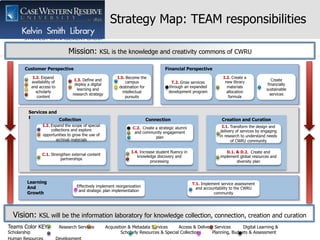
Strategy Map: TEAM responsibilities 
Mission: KSL is the knowledge and creativity commons of CWRU 
Customer Perspective 
I.1. Transform the design and 
delivery of services by engaging 
in research to understand needs 
of CWRU community 
I.3. Define and 
deploy a digital 
learning and 
research strategy 
I.2. Expand the scope of special 
collections and explore 
opportunities to grow the use of 
archival materials 
Teams Color KEY: Research Services Acquisition & Metadata Services Access & Delivery Services Digital Learning & 
Scholarship Scholarly Resources & Special Collections Planning, Budgets & Assessment 
Copyright 
© 
2008 
Ascendant 
Strategy 
Management 
Group 
Human Resources Development 
I.2. Expand 
availability of 
and access to 
scholarly 
content 
I.5. Become the 
campus 
destination for 
intellectual 
pursuits 
Financial Perspective 
Services and 
Engagement Collection Connection Creation and Curation 
Learning 
And 
Growth 
Create 
financially 
sustainable 
services 
C.2. Create a strategic alumni 
and community engagement 
plan 
Effectively implement reorganization 
and strategic plan implementation 
T.1. Implement service assessment 
and accountability to the CWRU 
community 
T.2. Grow services 
through an expanded 
development program 
D.1. & D.2. Create and 
implement global resources and 
diversity plan 
C.1. Strengthen external content 
partnerships 
I.4. Increase student fluency in 
knowledge discovery and 
processing 
I.2. Create a 
new library 
materials 
allocation 
formula 
Vision: KSL will be the information laboratory for knowledge collection, connection, creation and curation
Libraries 
and 
Cultural 
Resources 
inspires 
its 
communi8es 
to 
discover, 
explore, 
and 
create 
knowledge 
through 
innova8ve 
collec8ons, 
technologically 
advanced 
facili8es, 
and 
engaged 
exper8se. 
[15 
May 
2012] 
“We 
want 
our 
communi2es 
to 
say 
that 
Libraries 
and 
Cultural 
Resources 
… 
“ 
Enables 
innova8on 
in 
research, 
scholarship 
and 
crea8ve 
works 
Engages 
communi8es 
with 
programs 
and 
services 
welcoming 
to 
all 
“Financially 
we 
need 
to… 
“ 
“Internally 
we 
will 
focus 
on…” 
Fosters 
interdisciplinary 
discovery 
[i.e. 
puts 
the 
Universe 
in 
University] 
“To 
be 
ready 
for 
the 
future 
we 
must….” 
Focus 
on 
resources 
and 
services 
with 
a 
high 
ra8o 
of 
value 
to 
cost 
Developing 
a 
proac8ve 
and 
responsive 
marke8ng 
strategy 
Develop 
a 
sustainable 
business 
plan 
Implement 
a 
targeted 
community 
partnerships 
and 
development 
program 
Communica2ons 
by 
… 
Program 
Management 
by 
… 
Opera2ons 
Management 
by 
… 
Maximizing 
opportuni8es 
for 
discovery 
Is 
a 
factor 
in 
recruitment 
and 
reten8on 
Improving 
formal 
and 
informal 
communica8ons 
Enhancing 
the 
user 
experience 
Promo8ng 
ac8ve 
outreach 
Coordina8ng 
programs 
and 
services 
across 
Libraries 
and 
Cultural 
Resources 
Employing 
innova8ve 
means, 
models 
and 
technological 
solu8ons 
in 
the 
selec8on 
and 
delivery 
of 
programs 
and 
services 
Foster 
strategic 
staff 
development 
Support 
a 
culture 
of 
“Yes 
we 
can” 
Promote 
a 
culture 
of 
collegiality, 
respect 
and 
recogni8on
Town and Kyrillidou (2013) 
• The value which stakeholders seek from 
libraries is transcendent, in the sense that the 
impact demonstrated must be beyond the 
library and immediate satisfaction or fulfillment. 
Library assessment effort to date has been 
(mainly) about quality rather than value. 
http://www.arl.org 
Association of Research Libraries
http://www.arl.org 
A Value Scorecard 
• Relationship & reputation capital 
• Organisational capital 
– Tangible assets and resources 
– Intangible and meta-assets 
• Library virtue 
– Impact and social capital 
• Library momentum
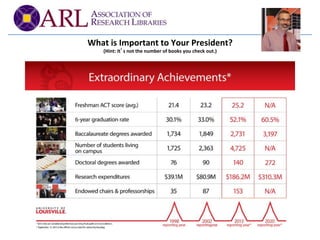
What 
is 
Important 
to 
Your 
President? 
(Hint: 
It’s 
not 
the 
number 
of 
books 
you 
check 
out.)
http://www.arl.org 
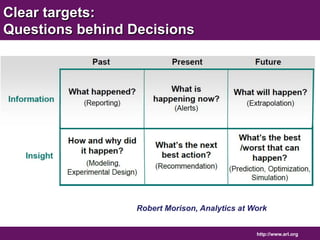
Clear targets: 
Questions behind Decisions 
Robert Morison, Analytics at Work
http://www.arl.org 
Final Blessings 
• Indulge your curiosity 
• Influence your friends 
• Enable your organization. 
– May your analytics always be good – and your 
judgment even better. 
» Robert Morison, Analytics at Work
http://www.arl.org 
Some current issues 
• Importance of internal relationships and 
external partnerships 
• Extension of traditional role 
– Research publication and research data 
• Sustaining our academic role in planning 
• Digital media, services and curation 
• Capability, capacity and critical mass 
• Library as reputational enhancer …
http://www.arl.org
http://www.arl.org 
Thank you 
Association of Research Libraries

From faith to evidence: demonstrating the value of libraries.

  • 1.
    From Faith toEvidence: Demonstrating the Value of Libraries Martha Kyrillidou Directora del Programa Estadística y Calidad de Servicio de la Association of Research Libraries, ARL (Estados Unidos) Congreso de Bibliotecas Universitarias Y Especializadas Santiago de Chile 28 de mayo, 2014
  • 2.
    Overview • ARL(Association of Research Libraries) • Demonstrating value • Assessment librarians • StatsQUAL – LibQUAL+ • LIBValue (emphasis on Commons) • Testing New Methods • Value Scorecard (Town & Kyrillidou, 2013) • Strategy and Metrics http://www.arl.org Association of Research Libraries
  • 3.
    http://www.arl.org ARL MemberInstitutions • 115 ARL university libraries – 73 medical libraries – 77 law libraries • 10,000+ professional staff members – About 1,000 staff members at medical libraries – A little more than 700 staff members in law libraries • 10 nonuniversity ARL members – About 4,000 professional staff members • Full List of Member Institutions: http://www.arl.org/
  • 4.
    Map of ARLMember Institutions Map data ©2011 AvanteLogic, CLiK Productions, Google – Map by MultiPlottr
  • 5.
    ARL Roles Associationof Research Libraries http://www.arl.org
  • 6.
    ARL Statistics andAssessment …To describe and measure the performance of research libraries and their contribution to teaching, research, scholarship and community service … Association of Research Libraries http://www.arl.org
  • 7.
    ARL Statistics andAssessment …To describe and measure the performance of research libraries and their contribution to teaching, research, scholarship and community service … Association of Research Libraries http://www.arl.org
  • 8.
    James Thayer Gerould(1906-1920) • What would you like to know about research libraries if you were the library director at the U of Minessota in 1906? http://www.arl.org
  • 9.
    Wendy Pradt Lougee(2002-present) • What would you like to know about research libraries if you were the library director at the U of Minessota in 2014? http://www.arl.org
  • 10.
    http://www.arl.org In thebeginning … ARL Statistics • www.arlstatistics.org ARL Statistics® 1906 – present Interactive analytics PDF Or print
  • 11.
    Expenditure Trends inARL Libraries, 1986-2011! Serial Expenditures (+402%) Library Materials (+302%) TOTAL (+188%) Total Salaries (+153%) Operating Expenditures (+128%) CPI (+106%) Monograph Expenditures (+71%) http://www.arl.org Percent Change since 1986 Source: ARL Statistics 2010-11, Copyright, Association of Research Libraries, 2011 425% 375% 325% 275% 225% 175% 125% 75% 25% -25% 1986 1988 1990 1992 1994 1996 1998 2000 2002 2004 2006 2008 2010
  • 12.
  • 13.
    Total Student Enrollmentin ARL Libraries 1982-2011! http://www.arl.org 25000 24000 23000 22000 21000 20000 19000 18000 17000 16000 15000 Source: ARL Statistics 2010-11, Copyright, Association of Research Libraries, 2011
  • 14.
    Library Expenditures asa Percent of University Expenditures in 40 ARL Libraries 1982-2009! 3,80% 3,60% 3,40% 3,20% 3,00% 2,80% 2,60% 2,40% 2,20% 2,00% 1,80% 1982 1983 1984 1985 1986 1987 1988 1989 1990 1991 1992 1993 1994 1995 1996 1997 1998 1999 2000 2001 2002 2003 2004 2005 2006 2007 2008 2009 Copyright, Association of Research Libraries, 2009
  • 15.
    The data and the models • I hesitate to hang the future of libraries on a demonstrable effect size for the equa8on, L = $$$ – Rachel Applegate , Indiana University SLIS
  • 16.
    Why study value • Faced with difficult economic 8mes and university budget cuts, the value of the library to the wider goals of the university is increasingly ques8oned. – Introduc8on to the Lib-­‐Value Project » www.libvalue.org Association of Research Libraries
  • 17.
    What’s the effect? • Bangor University considers removing librarians posted by Blake on Thursday January 27, @07:30AM -753 hits Ms Information writes "News from the University of Wales Bangor in the UK. senior management no longer feel that subject librarians / academic liaison librarians are needed in the modern academic library. They have made restructuring proposals which include removing all but one of the subject librarians and a tier of the library management, including the Head of Bibliographic Services. The university management thinks that technology has 'deskilled' literature searching. As far as I know, this proposal is unprecedented in the United Kingdom. In essence, there will remain 4 professional librarians serving a 'research-led' university of 8,000 plus FTEs and with 8 library sites. These will be the university librarian, cataloguing librarian, acquisitions librarian and Law librarian. • Has anything like this happened anywhere that you know of? If so, what have been the effects? Association of Research Libraries http://www.arl.org
  • 18.
  • 19.
    Assessment is… “…astructured process to learn about communities and evaluate how well the library supports them.” - Steve Hiller, Director of Assessment & Planning University of Washington Libraries Association of Research Libraries http://www.arl.org
  • 20.
    Assessment can… •Support decision making • Establish accountability • Strengthen organizational mission, goals, and objectives • Realign library goals and mission statements with the needs of users • Identify trends in user behaviors and technology • Measure learning outcomes and impact • Improve programs and services Association of Research Libraries http://www.arl.org
  • 21.
    Good Analytical Skillsneeded • Quantitative Analysis: IBM SPSS, SAS BI • Qualitative Analysis: Atlas.ti, NVivo • Data collection: Qualtrics, Survey Monkey, FormStack • Data storage: SQL Server, Access, Excel • Reporting: Crystal Reports, SPSS, SQL, Excel, • Web delivery: interactive charts, analytics, Tableau, etc. • Web development, usability, user experience? Association of Research Libraries http://www.arl.org
  • 22.
    http://www.arl.org arl-assess@arl.org •Anyone with an interest in library assessment • Assessment librarians • User Experience and Planning • Anthropologists • Space planners • Functional area leaders involved in assessment (teaching and learning, special collections, spaces) Join the arl-assess google group Association of Research Libraries
  • 23.
    The Value of Academic Libraries http://www.acrl.ala.org/value/ The Value of Libraries for Research and Researchers http://www.rin.ac.uk/our-work/using-and-accessing- information-resources/value-libraries- research-and-researchers
  • 24.
    ARL Profiles: Research Libraries 2010 • Serve the public good • Expand globally • Set standards • Explore best prac8ces • Establish na8onal and interna8onal visibility http://www.arl.org/stats/index/profiles/index.shtml
  • 25.
    Ethnography The art and science of describing a group, culture, or social process.
  • 26.
    Website: www.erialproject.org & www.andrewasher.net Toolkit: www.erialproject.org/publications/ toolkit/ E-­‐mail: asherand@indiana.edu Twitter: @aasher Book: College Libraries and Student Culture (ALA Editions, 2012)
  • 27.
    StatsQUAL® A gatewayto library assessment tools that describe the role, character, and impact of physical and digital libraries. LibQUAL+® MINES LibQUAL+® is a rigorously tested Web-based survey that libraries use to solicit, track, understand, and act upon users‘ opinions of service quality. for Libraries® Measuring the Impact of Networked Electronic Resources (MINES) is an online transaction- based survey that collects data on the purpose of use of electronic resources and the demographics of users. ClimateQUAL® ClimateQUAL® : Organizational Climate and Diversity Assessment is an online survey that measures staff perceptions about: (a) the library's commitment to the principles of diversity, (b) organizational policies and procedures, and (c) staff attitudes. ARL Statistics® ARL Statistics™ is a series of annual publications that describe the collections, expenditures, staffing, and service activities for Association of Research Libraries (ARL) member libraries. LibValue LibValue is a series of tested methods that capture Return on Investment and Value of library services.
  • 28.
    Association of ResearchLibraries http://www.arl.org
  • 29.
    The Challenge “Thedifficulty lies in trying to find a single model or set of simple indicators that can be used by different institutions, and that will compare something across large groups that is by definition only locally applicable—i.e., how well a library meets the needs of its institution. Librarians have either made do with oversimplified national data or have undertaken customized local evaluations of effectiveness, but there has not been devised an effective way to link the two” Sarah Pritchard, Dean of Libraries, Northwestern University Association of Research Libraries http://www.arl.org
  • 30.
    The LibQUAL+® Premise PERCEPTIONS SERVICE “….only customers judge quality; all other judgments are essentially irrelevant” Note. Zeithaml, Parasuraman, Berry. (1999). Delivering quality service. NY: The Free Press. Association of Research Libraries http://www.arl.org
  • 31.
    …a revolution inthe making Il est plus nécessaire d'étudier les hommes que les livres —FRANÇOIS DE LA ROCHEFOUCAULD (1613–1680) Association of Research Libraries http://www.arl.org
  • 32.
    Dimensions of LibraryService Quality Information Control Library Service Quality Scope of Content Convenience Ease of Navigation Timeliness Equipment Self-Reliance Affect of Service Library as Place Empathy Responsiveness Assurance Reliability Utilitarian Space Symbol Refuge Association of Research Libraries http://www.arl.org
  • 33.
    Survey Structure (DetailView) Association of Research Libraries http://www.arl.org
  • 34.
    Dimensions of LibraryService Quality Information Control Library Service Quality Scope of Content Convenience Ease of Navigation Timeliness Equipment Self-Reliance Affect of Service Library as Place Empathy Responsiveness Assurance Reliability Utilitarian Space Symbol Refuge Association of Research Libraries http://www.arl.org
  • 35.
    8.50 6.50 4.50 2.50 0.50 -1.50 A library Web site enabling me to locate information on my own 18 - 22 yrs 23 - 30 yrs 31 - 45 yrs 46 - 65 yrs Over 65 Rating scale (1 = Extremely poor to 9 = Extremely good) Age Group Perceived Minimum Desired Adequacy 1/27/14 2014 ALA Midwinter Meeting |- Nisa Bakkalbasi, Columbia University LibQUAL+ 35
  • 36.
    The Printed LibraryMaterials I Need for My Work
  • 37.
    Print and/or Electronic Journal Collec2ons I Require for My Work www.libqual.org
  • 38.
    A Library Website Enabling Me to Locate Informa2on on My Own
  • 39.
    Library Service Qualityon a global scale www.libqual.org http://www.arl.org
  • 40.
    Contributions • LibQUAL+®methodology focuses on success from the user’s point of view (outcomes) • Demonstrates that a Web-based survey can handle large numbers; users are willing to fill it out; and survey can be executed quickly with minimal expense • LibQUAL+® requires limited local survey expertise and resources • Analysis available at local and inter-institutional levels • Many opportunities for using demographics to discern user behaviors Association of Research Libraries http://www.arl.org
  • 41.
    Use is notValue? Association of Research Libraries http://www.arl.org
  • 42.
    Mul8ple ins8tu8ons using mul8ple methods to measure mul8ple values for mul8ple stakeholders
  • 43.
    …is a quantitativemeasure expressed as a ratio of the value returned to the institution for each monetary unit invested in the library. Return on investment is also… …values of all types that come to stakeholders and the ins8tu8on from the library’s collec8ons, services, and contribu8on to its communi8es. http://www.arl.org
  • 44.
    LIBValue Webcasts http://www.arl.org 02/07/2011 } Scholarly Reading } Teaching and Learning } eBooks } Special Collections } Commons } Comprehensive value } Coming: LibValue Toolkit: www.libvalue.org » ARL YouTube Channel
  • 45.
    Changing Higher Educa8on Landscape • Outcomes-­‐based budget • Complete College Act, 2010 • A Top 25 Mandate, 2009
  • 46.
    New University Strategic Plan The Five Top 25 Strategic Priori8es • Undergraduate Educa8on • Graduate Educa8on • Research and Crea8ve Ac8vity • Faculty and Staff • Infrastructure and resources
  • 47.
  • 48.
    UT Libraries’ Strategic Plan Teaching and Learning (Vol Vision Impera8ves 1, 2, & 5) • Engage in transforma8ve partnerships in instruc8on • Develop and maintain robust facili8es in support of teaching and learning Research Support, Discover, and Access (Vol Vision Impera8ves 4, 5, & 3) • Develop robust, user-­‐driven, and user-­‐centered • Maintain campus leadership in open access, intellectual property, and rights policy The 24-­‐Hour Intellectual and Social Hub (Vol Vision Impera8ves 1 & 5) • Provide Digital services, Ini8a8ves, acScholarly 8vi8es, Communicaand resources 8on, to and Technology Innova8on • Lead welcome and acclimate students to the university new community ini8a8ves in data and curato 8on enhance the college The 24-­‐experience Hour Intellectual and Social Hub • Provide • Provide services, ac8vi8es, and resources to welcome and safe, secure, and inspiring spaces acclimate students to the University community and to enhance the college experience Outreach and Marke8ng • Provide bold communica8on program and strategies • Maximize and diversify user space to more fully support the widest range of user needs
  • 49.
    UT Libraries’ Strategic Plan Teaching and Learning (Vol Vision Impera8ves 1, 2, & 5) • Engage in transforma8ve partnerships in instruc8on • Develop and maintain robust facili8es in support of teaching and learning Research Support, Discover, and Access (Vol Vision Impera8ves 4, 5, & 3) • Develop robust, user-­‐driven, and user-­‐centered • Maintain campus leadership in open access, intellectual property, and rights polic Digital Ini8a8ves, Scholarly Communica8on, and Technology Innova8on (Vol Vision Impera8ves 3, 4, & 5) • Lead new ini8a8ves in data cura8on The 24-­‐Hour Intellectual and Social Hub (Vol Vision Impera8ves 1 & 5) • Provide services, ac8vi8es, and resources to welcome… Outreach and Marke8ng (Vol Vision Impera8ves 1-­‐5)
  • 50.
    The old paradigm • Comparables – “X is like us, so we should have their budget.” • Stoke Rivalries – “We must be befer than X.” • Infla8on factor – “Let’s scare ‘em with scary infla8on numbers.”
  • 51.
    The New Paradigm: Student success outcomes (mostly) • Recruitment • Diversity • Reten8on • Gradua8on Rates (4 & 6 year) • Out placement
  • 52.
    LibValue and ROI Not a moment too soon!
  • 53.
    Commons Spaces •Learning Commons – Collec8on of resources and services • Different styles of learning and studying • Technology • Groupwork • Interrela8onship of services for students
  • 54.
    Commons Spaces & Student Success Assess the value of library resources and services in the Commons in support of the instruc7onal mission of the University ① Define “success” ② Aggregate available data ③ Gather new informa8on ④ Make meaningful connec8ons
  • 55.
    Aggregate Exis8ng Data ① Exis2ng Data • Automatically collected usage data • Data collected in person by service providers • Demographic data on retention, success, and years to graduation • Student exit surveys • LibQual • NSSE survey data • UT Fact Book
  • 56.
    Gather New Data ① Exis2ng Data ② Needed Data • Student-­‐reported use of Commons spaces and services • Student-­‐reported value of Commons spaces and services • Augmented university data set including the ability to track individual progress toward degree data • Admissions data • Automatically collected usage data • Data collected in person by service providers • Demographic data on retention, success, and years to graduation • Student exit surveys • LibQUAL+ • NSSE survey data • UT Fact Book
  • 57.
    Linking Survey Responses to Student Data Human Subjects – Family Educa8onal Rights & Privacy Act – Compliance with state and federal regula8ons
  • 58.
    Protec8ng Subjects •You must be 18 or older to par8cipate. • Within the survey we ask for your UT NetID to use to retrieve and link admissions and progress-­‐ towards-­‐degree data about you to the survey results. Your NetID will be removed from the survey data before the data is retrieved. The Office of Ins8tu8onal Research and Assessment will oversee the data retrieval. • Data on a protected server. • Confiden8ality of data. Data reported anonymously.
  • 59.
    Gym Bags andMortarboards • Student success measures – First Year Retention and 5 year graduation • 5211 students in sample (2001) • Found that if a student used CRF 25 times over the semester, increased a student’s predicted probability of first year retention by 1% and predicted probability of 5 year graduation by 2% (pg. 59)
  • 60.
    Layers of Data Office of Ins2tu2onal Research Performance Data Term and Cum GPA, Reten2on Office of Ins2tu2onal Research Demographics Data College, Level, Major, Gender, Ethnicity, Age Libraries Data (13 Access Points) Circula2on, Digital, Instruc2on, Reference, and Worksta2on
  • 61.
    Library Cube University of Wollongong hfp://www.youtube.com/watch?v=Z9UN8O_KMQ
  • 62.
    ARL Strategic Thinkingand Design Competency Trap exemplified by Thomas W. Lawson Association of Research Libraries http://www.arl.org
  • 63.
    Value and strategy • How can you use LibValue results strategically? http://www.arl.org
  • 64.
    Each strategy has driver and outcome measures Copyright © 2013 Ascendant Strategy Management Group – Page 64 Outcomes Drivers Mission What is our plan to achieve our mission and vision? Financial Perspective "If we succeed, how will we look to our donors or taxpayers?” Customer Perspective "To achieve our mission, how must we look to our customers?” Internal Perspective "To satisfy our customers and financial donors, which business processes must we excel at?” Learning and Growth Perspective "To achieve our mission, how must our organization learn and improve?” Results-oriented measures. It is difficult to have an impact on these measures directly. Input-oriented measures. Progress against these measures should have an impact on the outcome measures.
  • 65.
    Strategy Map: TEAMresponsibilities Mission: KSL is the knowledge and creativity commons of CWRU Customer Perspective I.1. Transform the design and delivery of services by engaging in research to understand needs of CWRU community I.3. Define and deploy a digital learning and research strategy I.2. Expand the scope of special collections and explore opportunities to grow the use of archival materials Teams Color KEY: Research Services Acquisition & Metadata Services Access & Delivery Services Digital Learning & Scholarship Scholarly Resources & Special Collections Planning, Budgets & Assessment Copyright © 2008 Ascendant Strategy Management Group Human Resources Development I.2. Expand availability of and access to scholarly content I.5. Become the campus destination for intellectual pursuits Financial Perspective Services and Engagement Collection Connection Creation and Curation Learning And Growth Create financially sustainable services C.2. Create a strategic alumni and community engagement plan Effectively implement reorganization and strategic plan implementation T.1. Implement service assessment and accountability to the CWRU community T.2. Grow services through an expanded development program D.1. & D.2. Create and implement global resources and diversity plan C.1. Strengthen external content partnerships I.4. Increase student fluency in knowledge discovery and processing I.2. Create a new library materials allocation formula Vision: KSL will be the information laboratory for knowledge collection, connection, creation and curation
  • 66.
    Libraries and Cultural Resources inspires its communi8es to discover, explore, and create knowledge through innova8ve collec8ons, technologically advanced facili8es, and engaged exper8se. [15 May 2012] “We want our communi2es to say that Libraries and Cultural Resources … “ Enables innova8on in research, scholarship and crea8ve works Engages communi8es with programs and services welcoming to all “Financially we need to… “ “Internally we will focus on…” Fosters interdisciplinary discovery [i.e. puts the Universe in University] “To be ready for the future we must….” Focus on resources and services with a high ra8o of value to cost Developing a proac8ve and responsive marke8ng strategy Develop a sustainable business plan Implement a targeted community partnerships and development program Communica2ons by … Program Management by … Opera2ons Management by … Maximizing opportuni8es for discovery Is a factor in recruitment and reten8on Improving formal and informal communica8ons Enhancing the user experience Promo8ng ac8ve outreach Coordina8ng programs and services across Libraries and Cultural Resources Employing innova8ve means, models and technological solu8ons in the selec8on and delivery of programs and services Foster strategic staff development Support a culture of “Yes we can” Promote a culture of collegiality, respect and recogni8on
  • 67.
    Town and Kyrillidou(2013) • The value which stakeholders seek from libraries is transcendent, in the sense that the impact demonstrated must be beyond the library and immediate satisfaction or fulfillment. Library assessment effort to date has been (mainly) about quality rather than value. http://www.arl.org Association of Research Libraries
  • 68.
    http://www.arl.org A ValueScorecard • Relationship & reputation capital • Organisational capital – Tangible assets and resources – Intangible and meta-assets • Library virtue – Impact and social capital • Library momentum
  • 69.
    What is Important to Your President? (Hint: It’s not the number of books you check out.)
  • 70.
    http://www.arl.org Clear targets: Questions behind Decisions Robert Morison, Analytics at Work
  • 71.
    http://www.arl.org Final Blessings • Indulge your curiosity • Influence your friends • Enable your organization. – May your analytics always be good – and your judgment even better. » Robert Morison, Analytics at Work
  • 72.
    http://www.arl.org Some currentissues • Importance of internal relationships and external partnerships • Extension of traditional role – Research publication and research data • Sustaining our academic role in planning • Digital media, services and curation • Capability, capacity and critical mass • Library as reputational enhancer …
  • 73.
  • 74.
    http://www.arl.org Thank you Association of Research Libraries