Group Members:
Zobia Hamid
Sumair Iqbal
Zargham Shafi
Yasir Khan
TS-1
Submitted to: Syed Abdul Rafey Qadri
What is Global Warming?
 Global warming is the term used to describe a gradual increase in the
average temperature of the Earth's atmosphere and its oceans, a
change that is believed to be permanently changing the Earth’s climate.
 The scientific consensus on climatic changes related to global warming
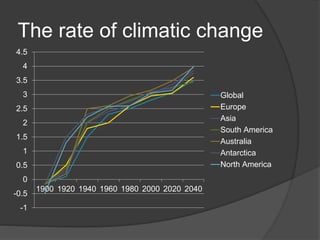
is that the average temperature of the Earth has risen between 0.4 and
0.8 °C over the past 100 years.
 The increased volumes of carbon dioxide and other greenhouse gases
released by the burning of fossil fuels, land clearing, agriculture, and
other human activities, are believed to be the primary sources of the
global warming that has occurred over the past 50 years.
 Scientists from the Intergovernmental Panel on Climate carrying out
global warming research have recently predicted that average global
temperatures could increase between 1.4 and 5.8 °C by the year 2100.
 Changes resulting from global warming may include rising sea levels
due to the melting of the polar ice caps, as well as an increase in
occurance of storms, landslides, avalanches etc.
The rate of climatic change
-1
-0.5
0
0.5
1
1.5
2
2.5
3
3.5
4
4.5
1900 1920 1940 1960 1980 2000 2020 2040
Global
Europe
Asia
South America
Australia
Antarctica
North America
What causes Global warming?
0
5
10
15
20
25
30
35
40 CarsandTrucks
BurningFossil…
Theozonehole
ToxicWastes
Deforestation
NuclearPower…
Thesun
Cows
Aerosols
Volcanic…
Acidrain
Main Cause of
Global…
0
1
2
3
4
5
6
7
8
1 2 3 4
How worried are you
about global
warming?
Attending global
warming seminars is
helpful?
Waste,
3.20%
Agriculture,
13.80%
Land and
Use change,
12.20%
Industrial
Processes,
4.30%
Fugitive
Emissions,
4%
Indusrty,
14.70%
Other fuel
Combustion ,
8.60%
Electricity
and heat,
24.90%
Tranportation
, 14.30%
World's Greenhouse Gas
Emissions
Waste
Agriculture
Land and
Use
change
Industrial
Processes
0
0.5
1
1.5
2
2.5
3
3.5
4
4.5
5
Change in
human behavior
Lack of
vegetation
Wildlife disturbed Lack of rain
How much do you think global warming will
harm you personally?
How much do you think global
warming will harm you personally?
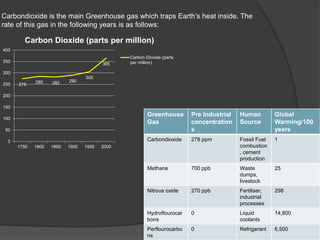
Carbondioxide is the main Greenhouse gas which traps Earth’s heat inside. The
rate of this gas in the following years is as follows:
275
285 282 290
305
365
0
50
100
150
200
250
300
350
400
1750 1800 1850 1900 1950 2000
Carbon Dioxide (parts per million)
Carbon Dioxide (parts
per million)
Greenhouse
Gas
Pre Industrial
concentration
s
Human
Source
Global
Warming/100
years
Carbondioxide 278 ppm Fossil Fuel
combustion
, cement
production
1
Methane 700 ppb Waste
dumps,
livestock
25
Nitrous oxide 270 ppb Fertiliser,
industrial
processes
298
Hydroflourocar
bons
0 Liquid
coolants
14,800
Perflourocarbo
ns
0 Refrigerant 6,500
Conclusion
 Global warming creates many problems, and not just that the air gets too hot.
 One problem is that global warming results in more typhoons, hurricanes, and storms
 When it rains more, it floods more often. As everyone knows, hurricanes and floods can
cause tremendous damage. Houses get blown or swept away, roads and bridges are
destroyed, and many people die.
 Also, as temperatures rise, ice melts. Indeed, the Arctic and Antarctic ice caps have been
melting away in recent years. Polar bears in the Arctic and emperor penguins in
Antarctica are in trouble
 As the Earth's climate continues to change, the types of trees, grass, animals, and other
organisms near you will also change. Farming, too, will face major problems
 Diseases like Malaria is spreading in hotter regions.
 Global warming will cause (and in fact, is already causing) a variety of problems. Think
twice the next time someone tells you, "It just means we'll feel a little hotter."
 To reduce the effects of Global warming, we need to reduce the emissions of
Carbondioxide and other Green house gases

Global warming (2)

  • 1.
    Group Members: Zobia Hamid SumairIqbal Zargham Shafi Yasir Khan TS-1 Submitted to: Syed Abdul Rafey Qadri
  • 2.
    What is GlobalWarming?  Global warming is the term used to describe a gradual increase in the average temperature of the Earth's atmosphere and its oceans, a change that is believed to be permanently changing the Earth’s climate.  The scientific consensus on climatic changes related to global warming is that the average temperature of the Earth has risen between 0.4 and 0.8 °C over the past 100 years.  The increased volumes of carbon dioxide and other greenhouse gases released by the burning of fossil fuels, land clearing, agriculture, and other human activities, are believed to be the primary sources of the global warming that has occurred over the past 50 years.  Scientists from the Intergovernmental Panel on Climate carrying out global warming research have recently predicted that average global temperatures could increase between 1.4 and 5.8 °C by the year 2100.  Changes resulting from global warming may include rising sea levels due to the melting of the polar ice caps, as well as an increase in occurance of storms, landslides, avalanches etc.
  • 3.
    The rate ofclimatic change -1 -0.5 0 0.5 1 1.5 2 2.5 3 3.5 4 4.5 1900 1920 1940 1960 1980 2000 2020 2040 Global Europe Asia South America Australia Antarctica North America
  • 4.
    What causes Globalwarming? 0 5 10 15 20 25 30 35 40 CarsandTrucks BurningFossil… Theozonehole ToxicWastes Deforestation NuclearPower… Thesun Cows Aerosols Volcanic… Acidrain Main Cause of Global… 0 1 2 3 4 5 6 7 8 1 2 3 4 How worried are you about global warming? Attending global warming seminars is helpful?
  • 5.
    Waste, 3.20% Agriculture, 13.80% Land and Use change, 12.20% Industrial Processes, 4.30% Fugitive Emissions, 4% Indusrty, 14.70% Otherfuel Combustion , 8.60% Electricity and heat, 24.90% Tranportation , 14.30% World's Greenhouse Gas Emissions Waste Agriculture Land and Use change Industrial Processes 0 0.5 1 1.5 2 2.5 3 3.5 4 4.5 5 Change in human behavior Lack of vegetation Wildlife disturbed Lack of rain How much do you think global warming will harm you personally? How much do you think global warming will harm you personally?
  • 6.
    Carbondioxide is themain Greenhouse gas which traps Earth’s heat inside. The rate of this gas in the following years is as follows: 275 285 282 290 305 365 0 50 100 150 200 250 300 350 400 1750 1800 1850 1900 1950 2000 Carbon Dioxide (parts per million) Carbon Dioxide (parts per million) Greenhouse Gas Pre Industrial concentration s Human Source Global Warming/100 years Carbondioxide 278 ppm Fossil Fuel combustion , cement production 1 Methane 700 ppb Waste dumps, livestock 25 Nitrous oxide 270 ppb Fertiliser, industrial processes 298 Hydroflourocar bons 0 Liquid coolants 14,800 Perflourocarbo ns 0 Refrigerant 6,500
  • 7.
    Conclusion  Global warmingcreates many problems, and not just that the air gets too hot.  One problem is that global warming results in more typhoons, hurricanes, and storms  When it rains more, it floods more often. As everyone knows, hurricanes and floods can cause tremendous damage. Houses get blown or swept away, roads and bridges are destroyed, and many people die.  Also, as temperatures rise, ice melts. Indeed, the Arctic and Antarctic ice caps have been melting away in recent years. Polar bears in the Arctic and emperor penguins in Antarctica are in trouble  As the Earth's climate continues to change, the types of trees, grass, animals, and other organisms near you will also change. Farming, too, will face major problems  Diseases like Malaria is spreading in hotter regions.  Global warming will cause (and in fact, is already causing) a variety of problems. Think twice the next time someone tells you, "It just means we'll feel a little hotter."  To reduce the effects of Global warming, we need to reduce the emissions of Carbondioxide and other Green house gases