Icing map of Sweden


                               Øyvind Byrkjedal
                              Kjeller Vindteknikk
                       oyvind.byrkjedal@vindteknikk.no


Winterwind, Östersund, 12.02.2013
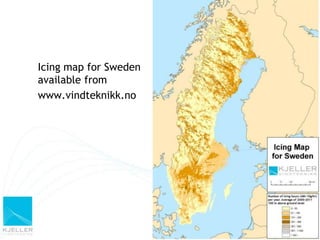
Icing map for Sweden
available from
www.vindteknikk.no


                       2
Outline

 1. Icing atlas methodology
       background
       meso scale modelling
       Icing calculations
       height corrections
       long term correction
       verification
 2. Applications of the icing atlas
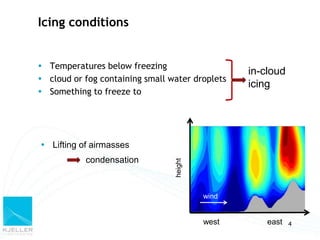
Icing conditions


 Temperatures below freezing
                                                 in-cloud
 cloud or fog containing small water droplets
                                                 icing
 Something to freeze to


 Lifting of airmasses
           condensation

                                 height

                                          wind


                                          west       east   4
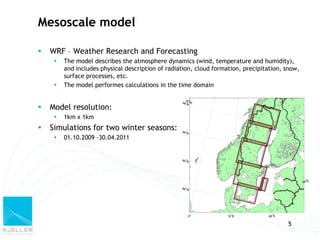
Mesoscale model

   WRF – Weather Research and Forecasting
        The model describes the atmosphere dynamics (wind, temperature and humidity),
         and includes physical description of radiation, cloud formation, precipitation, snow,
         surface processes, etc.
        The model performes calculations in the time domain


   Model resolution:
        1km x 1km
   Simulations for two winter seasons:
        01.10.2009 -30.04.2011


                                                                                         5
Calculation of in-cloud icing

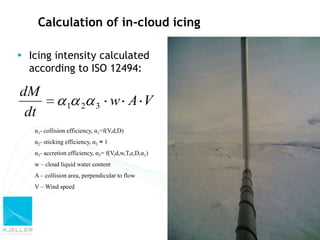
 Icing intensity calculated
  according to ISO 12494:

dM
                1     2     3        w A V
 dt
   α1- collision efficiency, α1=f(V,d,D)
   α2- sticking efficiency, α2 ≈ 1
   α3- accretion efficiency, α3= f(V,d,w,T,e,D,α1)
   w – cloud liquid water content
   A – collision area, perpendicular to flow
   V – Wind speed
Calculation of in-cloud icing


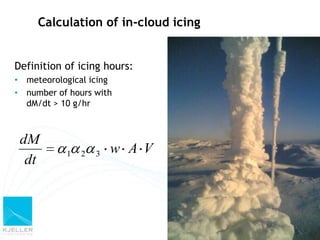
Definition of icing hours:
• meteorological icing
• number of hours with
  dM/dt > 10 g/hr


 dM
           1   2   3   w A V
  dt
Topography
   The terrain is smoothed in the coarse model resolution:
      The orographic lifting of the air masses will be too small
      The coarse model will therefore underestimate the icing on hills

WRF model:                              Terrainmodel:
1 km x 1km resolution                   50 m x 50 m resolution


                                                                          8
Height adjustment
    Height adjustment routine:
        Forced lifting of the air masses from the coarse smoothed terrain to
         the height in the terrain model
        Icing atlas with 50 m x 50 m resolution.
WRF model:                                WRF model:
1 km x 1km resolution                     With height adjustment


                                                                         9
Long term correction

 WRF simulations with high resolution (1km) is only carried out
  for two winters (2009/2010 and 2010/2011)
 The variability in icing is large from one year to the next.
 A long term correction has been applied using icing data from
  a 4 km x 4 km simulation


                                                            10
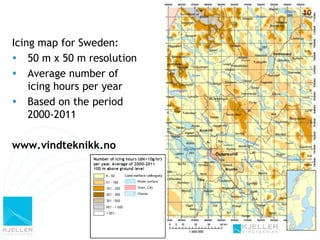
Icing map for Sweden:
 50 m x 50 m resolution
 Average number of
    icing hours per year
 Based on the period
    2000-2011

www.vindteknikk.no


                           11
Verification

 No systematical verification has been carried out (yet!)
 Model calculations has been compared to observed ice loades
  at several Swedish sites through a wind pilot project funded by
  Energimyndigheten:
Verification

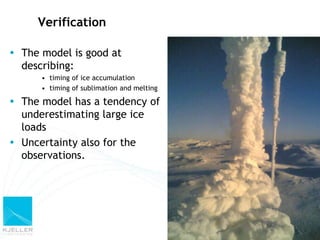
 The model is good at
  describing:
      • timing of ice accumulation
      • timing of sublimation and melting

 The model has a tendency of
  underestimating large ice
  loads
 Uncertainty also for the
  observations.
Applications of the icing atlas

 The geographical distribution of icing is described in the map

 Timeseries of icing and meterological parameters are also
  available.
Icing atlas applications
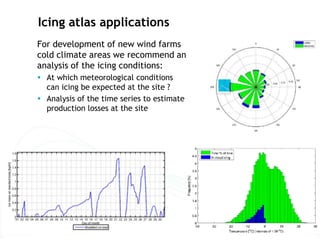
For development of new wind farms
cold climate areas we recommend an
analysis of the icing conditions:
 At which meteorological conditions
  can icing be expected at the site ?
 Analysis of the time series to estimate
  production losses at the site


                                            15
Icing atlas applications
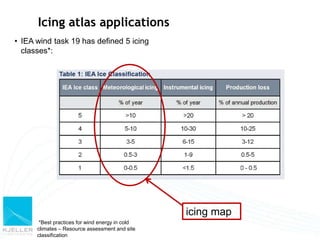
• IEA wind task 19 has defined 5 icing
  classes*:


                                                 icing map
       *Best practices for wind energy in cold
      climates – Resource assessment and site
      classification
Icing atlas applications
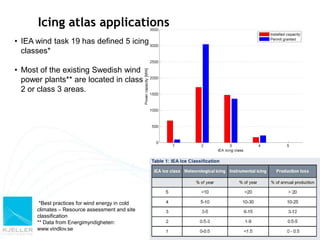
• IEA wind task 19 has defined 5 icing
  classes*

• Most of the existing Swedish wind
  power plants** are located in class
  2 or class 3 areas.


       *Best practices for wind energy in cold
      climates – Resource assessment and site
      classification
      ** Data from Energimyndigheten:
      www.vindlov.se
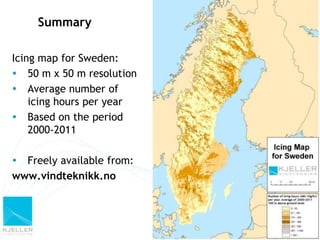
Summary

Icing map for Sweden:
 50 m x 50 m resolution
 Average number of
    icing hours per year
 Based on the period
    2000-2011

 Freely available from:
www.vindteknikk.no


                           18

Kvt mapping of_icing

  • 1.
    Icing map ofSweden Øyvind Byrkjedal Kjeller Vindteknikk oyvind.byrkjedal@vindteknikk.no Winterwind, Östersund, 12.02.2013
  • 2.
    Icing map forSweden available from www.vindteknikk.no 2
  • 3.
    Outline  1. Icingatlas methodology  background  meso scale modelling  Icing calculations  height corrections  long term correction  verification  2. Applications of the icing atlas
  • 4.
    Icing conditions  Temperaturesbelow freezing in-cloud  cloud or fog containing small water droplets icing  Something to freeze to  Lifting of airmasses condensation height wind west east 4
  • 5.
    Mesoscale model  WRF – Weather Research and Forecasting  The model describes the atmosphere dynamics (wind, temperature and humidity), and includes physical description of radiation, cloud formation, precipitation, snow, surface processes, etc.  The model performes calculations in the time domain  Model resolution:  1km x 1km  Simulations for two winter seasons:  01.10.2009 -30.04.2011 5
  • 6.
    Calculation of in-cloudicing  Icing intensity calculated according to ISO 12494: dM 1 2 3 w A V dt α1- collision efficiency, α1=f(V,d,D) α2- sticking efficiency, α2 ≈ 1 α3- accretion efficiency, α3= f(V,d,w,T,e,D,α1) w – cloud liquid water content A – collision area, perpendicular to flow V – Wind speed
  • 7.
    Calculation of in-cloudicing Definition of icing hours: • meteorological icing • number of hours with dM/dt > 10 g/hr dM 1 2 3 w A V dt
  • 8.
    Topography The terrain is smoothed in the coarse model resolution:  The orographic lifting of the air masses will be too small  The coarse model will therefore underestimate the icing on hills WRF model: Terrainmodel: 1 km x 1km resolution 50 m x 50 m resolution 8
  • 9.
    Height adjustment Height adjustment routine:  Forced lifting of the air masses from the coarse smoothed terrain to the height in the terrain model  Icing atlas with 50 m x 50 m resolution. WRF model: WRF model: 1 km x 1km resolution With height adjustment 9
  • 10.
    Long term correction WRF simulations with high resolution (1km) is only carried out for two winters (2009/2010 and 2010/2011)  The variability in icing is large from one year to the next.  A long term correction has been applied using icing data from a 4 km x 4 km simulation 10
  • 11.
    Icing map forSweden:  50 m x 50 m resolution  Average number of icing hours per year  Based on the period 2000-2011 www.vindteknikk.no 11
  • 12.
    Verification  No systematicalverification has been carried out (yet!)  Model calculations has been compared to observed ice loades at several Swedish sites through a wind pilot project funded by Energimyndigheten:
  • 13.
    Verification  The modelis good at describing: • timing of ice accumulation • timing of sublimation and melting  The model has a tendency of underestimating large ice loads  Uncertainty also for the observations.
  • 14.
    Applications of theicing atlas  The geographical distribution of icing is described in the map  Timeseries of icing and meterological parameters are also available.
  • 15.
    Icing atlas applications Fordevelopment of new wind farms cold climate areas we recommend an analysis of the icing conditions:  At which meteorological conditions can icing be expected at the site ?  Analysis of the time series to estimate production losses at the site 15
  • 16.
    Icing atlas applications •IEA wind task 19 has defined 5 icing classes*: icing map *Best practices for wind energy in cold climates – Resource assessment and site classification
  • 17.
    Icing atlas applications •IEA wind task 19 has defined 5 icing classes* • Most of the existing Swedish wind power plants** are located in class 2 or class 3 areas. *Best practices for wind energy in cold climates – Resource assessment and site classification ** Data from Energimyndigheten: www.vindlov.se
  • 18.
    Summary Icing map forSweden:  50 m x 50 m resolution  Average number of icing hours per year  Based on the period 2000-2011  Freely available from: www.vindteknikk.no 18