Mapping of icing in Sweden
        The benefits of forecasting icing for
                energy production
                     gy p
                               Øyvind Byrkjedal
                              Kjeller Vindteknikk
                       oyvind.byrkjedal@vindteknikk.no


Wintewind 2012, Skellefteå 07.02.2012
Mesoscale model
   The meso-scale refers to the time and spatial scale of the features
    resolved by the model. The model resolves low pressure systems and
                    model                      low-pressure
    fronts.
   WRF – Weather Research and Forecasting
   The
    Th model d
            d l describes the atmosphere d
                     ib    h        h    dynamics ( i d temperature
                                                i (wind,
    and humidity), and includes physical description of radiation, cloud
    formation, precipitation, snow, surface processes, etc.
   The model performes calculations in the time domain, no steady-
    state model
   Typical model resolution down to 1km x 1km


                                                                     2
Mesoscale wind
    index

    2000


                 3
Mesoscale wind
    index

    2001


                 4
Mesoscale wind
    index

    2002


                 5
Mesoscale wind
    index

    2003


                 6
Mesoscale wind
    index

    2004


                 7
Mesoscale wind
    index

    2005


                 8
Mesoscale wind
    index

    2006


                 9
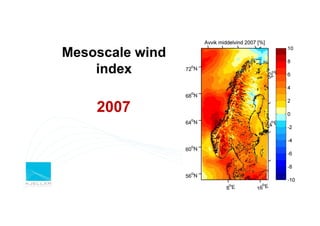
Mesoscale wind
    index

    2007


                 10
Mesoscale wind
    index

    2008


                 11
Mesoscale wind
    index

    2009


                 12
Mesoscale wind
    index

    2010


                 13
Mesoscale wind
    index

    2011


                 14
Calculation of in-cloud icing
 We calculate icing on a standard body following
  Makkonen.
  Makkonen 1m cylinder with diameter 30mm:

dM
      1 2 3  w  A  V       α1- collision efficiency, α1=f(V,d,D)
                                        lli i    ffi i         f(V d D)

 dt                               α2- sticking efficiency, α2 ≈ 1
                                  α3- accretion efficiency, α3=
                                  f(V,d,w,T,e,D,α1)
                                  w – cloud liquid water content
                                  A – collision area, perpendicular to flow
                                  V – Wind speed
Power production index
             %]
       ndex [%
Power in


                                           16
Power production index
             %]
       ndex [%
Power in


                  The winter 2008/2009:
                  According to the wind index we would expect more production than normal.
                  Due to icing we would find less production than normal.
                                                                                         17
Power production index
             %]
       ndex [%
Power in


                                               The winter 2010/2011:
                         Large ice loads and large production losses
                                                                       18
Production
     forecasts


                                                  ncy
                                   Relative frequen
The analysis is based on 3 years
of operational data from a wind
farm in Sweden


                                            f


                                                        Forecast error [%] 19
Production
     forecasts


                                                  ncy
                                   Relative frequen
The analysis is based on 3 years
of operational data from a wind
farm in Sweden


                                            f
The overall forecast errors
are reduced by incluing
forecasts of ice


                                                        Forecast error [%] 20
Production
     forecasts


                                                  ncy
                                   Relative frequen
The analysis is based on 3 years
of operational data from a wind
farm in Sweden


                                            f
With the current model we
particulary reduce the
number of cases when the
production is overpredicted


                                                        Forecast error [%] 21
Production
     forecasts


                                                  ncy
                                   Relative frequen
The analysis is based on 3 years
of operational data from a wind
farm in Sweden


                                            f
We get an increase of the
number of cases when we
underpredict production


                                                        Forecast error [%] 22
Conclusions
 For a large number of sites the variability in icing from
  year to year will dominate over the variability in wind
  in the production index.

 An improvement in the energy production forecasts
  can be achieved by including the effects of icing


                                                       23
Thank you!
Wind and icing map are now available for Sweden:
           www.vindteknikk.no


                                               24

The benefits of forecasting icing on wind energy produc- tion Øyvind Byrkjedal, Kjeller Vindteknikk

  • 1.
    Mapping of icingin Sweden The benefits of forecasting icing for energy production gy p Øyvind Byrkjedal Kjeller Vindteknikk oyvind.byrkjedal@vindteknikk.no Wintewind 2012, Skellefteå 07.02.2012
  • 2.
    Mesoscale model  The meso-scale refers to the time and spatial scale of the features resolved by the model. The model resolves low pressure systems and model low-pressure fronts.  WRF – Weather Research and Forecasting  The Th model d d l describes the atmosphere d ib h h dynamics ( i d temperature i (wind, and humidity), and includes physical description of radiation, cloud formation, precipitation, snow, surface processes, etc.  The model performes calculations in the time domain, no steady- state model  Typical model resolution down to 1km x 1km 2
  • 3.
    Mesoscale wind index 2000 3
  • 4.
    Mesoscale wind index 2001 4
  • 5.
    Mesoscale wind index 2002 5
  • 6.
    Mesoscale wind index 2003 6
  • 7.
    Mesoscale wind index 2004 7
  • 8.
    Mesoscale wind index 2005 8
  • 9.
    Mesoscale wind index 2006 9
  • 10.
    Mesoscale wind index 2007 10
  • 11.
    Mesoscale wind index 2008 11
  • 12.
    Mesoscale wind index 2009 12
  • 13.
    Mesoscale wind index 2010 13
  • 14.
    Mesoscale wind index 2011 14
  • 15.
    Calculation of in-cloudicing  We calculate icing on a standard body following Makkonen. Makkonen 1m cylinder with diameter 30mm: dM   1 2 3  w  A  V α1- collision efficiency, α1=f(V,d,D) lli i ffi i f(V d D) dt α2- sticking efficiency, α2 ≈ 1 α3- accretion efficiency, α3= f(V,d,w,T,e,D,α1) w – cloud liquid water content A – collision area, perpendicular to flow V – Wind speed
  • 16.
    Power production index %] ndex [% Power in 16
  • 17.
    Power production index %] ndex [% Power in The winter 2008/2009: According to the wind index we would expect more production than normal. Due to icing we would find less production than normal. 17
  • 18.
    Power production index %] ndex [% Power in The winter 2010/2011: Large ice loads and large production losses 18
  • 19.
    Production forecasts ncy Relative frequen The analysis is based on 3 years of operational data from a wind farm in Sweden f Forecast error [%] 19
  • 20.
    Production forecasts ncy Relative frequen The analysis is based on 3 years of operational data from a wind farm in Sweden f The overall forecast errors are reduced by incluing forecasts of ice Forecast error [%] 20
  • 21.
    Production forecasts ncy Relative frequen The analysis is based on 3 years of operational data from a wind farm in Sweden f With the current model we particulary reduce the number of cases when the production is overpredicted Forecast error [%] 21
  • 22.
    Production forecasts ncy Relative frequen The analysis is based on 3 years of operational data from a wind farm in Sweden f We get an increase of the number of cases when we underpredict production Forecast error [%] 22
  • 23.
    Conclusions  For alarge number of sites the variability in icing from year to year will dominate over the variability in wind in the production index.  An improvement in the energy production forecasts can be achieved by including the effects of icing 23
  • 24.
    Thank you! Wind andicing map are now available for Sweden: www.vindteknikk.no 24