KURSUS JURULATIH UTAMA KURIKULUM STANDARD
SEKOLAH RENDAH( KSSR ) 2010
BAHASA INGGERIS-TAHUN 1
BAHAGIAN PEMBANGUNAN KURIKULUM
KEMENTERIAN PELAJARAN MALAYSIA
EDUCATIONALEDUCATIONAL
EMPHASESEMPHASES
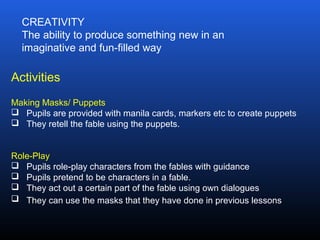
CREATIVITY
The ability to produce something new in an
imaginative and fun-filled way
Activities
Making Masks/ Puppets
 Pupils are provided with manila cards, markers etc to create puppets
 They retell the fable using the puppets.
Role-Play
 Pupils role-play characters from the fables with guidance
 Pupils pretend to be characters in a fable.
 They act out a certain part of the fable using own dialogues
 They can use the masks that they have done in previous lessons
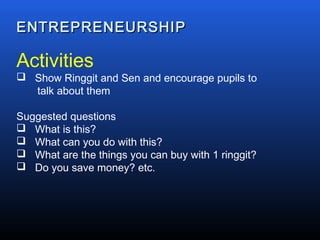
ENTREPRENEURSHIPENTREPRENEURSHIP
Activities
 Show Ringgit and Sen and encourage pupils to
talk about them
Suggested questions
 What is this?
 What can you do with this?
 What are the things you can buy with 1 ringgit?
 Do you save money? etc.
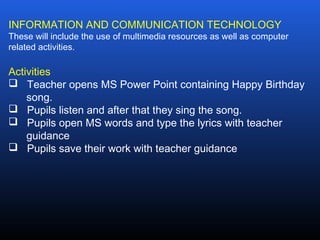
INFORMATION AND COMMUNICATION TECHNOLOGY
These will include the use of multimedia resources as well as computer
related activities.
Activities
 Teacher opens MS Power Point containing Happy Birthday
song.
 Pupils listen and after that they sing the song.
 Pupils open MS words and type the lyrics with teacher
guidance
 Pupils save their work with teacher guidance
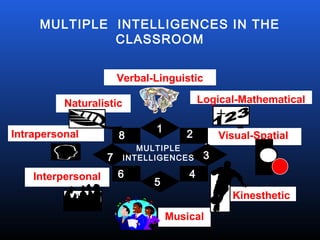
Verbal-Linguistic
Visual-Spatial
Musical
Naturalistic
Interpersonal
Intrapersonal
Logical-Mathematical
Kinesthetic
+
-1
8 2
3
4
5
6
7
MULTIPLE INTELLIGENCES IN THE
CLASSROOM
MULTIPLE
INTELLIGENCES
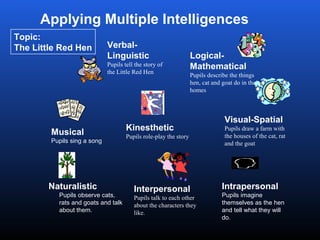
Logical-
Mathematical
Pupils describe the things
hen, cat and goat do in their
homes
Musical
Pupils sing a song
Verbal-
Linguistic
Pupils tell the story of
the Little Red Hen
Kinesthetic
Pupils role-play the story
Interpersonal
Pupils talk to each other
about the characters they
like.
Intrapersonal
Pupils imagine
themselves as the hen
and tell what they will
do.
Visual-Spatial
Pupils draw a farm with
the houses of the cat, rat
and the goat
Naturalistic
Applying Multiple Intelligences
Topic:
The Little Red Hen
Pupils observe cats,
rats and goats and talk
about them.
Learning How to LearnLearning How to Learn
• Listen, view, read, select and retain
• Able to skim (read everything fast) and
scan ( read those bits of relevant
information) in order to get information
fast and efficiently
• Intensive (close) reading for details and
depth
• Use Index and Table of Contents to have
an idea of important content
• Find key words and phrases in
paragraphs
• Use highlighter pen to mark important
points
• Summarise and tell in your own words
• Make notes of important points
THE SKILLS:
Being able to recall and retell accurately
Being able to select and organise information
Being able to build a good visual memory
To practise recalling important points a few hours after reading (or
listening or viewing)
WritingWriting
RememberingRemembering
Planning what is to be learnt before starting
Asking oneself questions during the learning process
Monitoring progress
Assessing what learning has taken place
ReflectionReflection
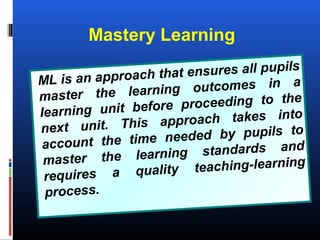
Mastery Learning
ML is an approach that ensures all pupils
master the learning outcomes in a
learning unit before proceeding to the
next unit. This approach takes into
account the time needed by pupils to
master the learning standards and
requires a quality teaching-learning
process.
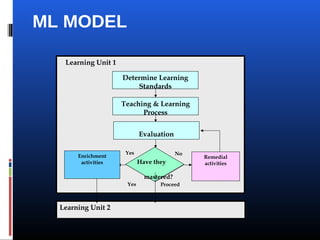
Learning Unit 1
Teaching & Learning
Process
Evaluation
Have they
mastered?
Learning Unit 2
Proceed
Enrichment
activities
Yes
NoYes
Determine Learning
Standards
Remedial
activities
ML MODEL
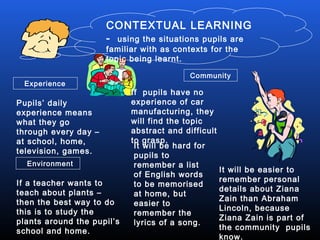
Pupils’ daily
experience means
what they go
through every day –
at school, home,
television, games.
Community
CONTEXTUAL LEARNING
- using the situations pupils are
familiar with as contexts for the
topic being learnt.
Environment
If a teacher wants to
teach about plants –
then the best way to do
this is to study the
plants around the pupil’s
school and home.
Experience
If pupils have no
experience of car
manufacturing, they
will find the topic
abstract and difficult
to grasp.
It will be easier to
remember personal
details about Ziana
Zain than Abraham
Lincoln, because
Ziana Zain is part of
the community pupils
know.
It will be hard for
pupils to
remember a list
of English words
to be memorised
at home, but
easier to
remember the
lyrics of a song.
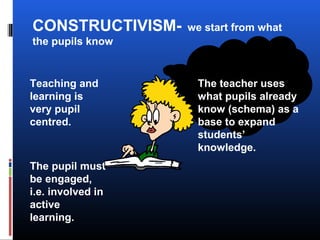
The teacher uses
what pupils already
know (schema) as a
base to expand
students’
knowledge.
CONSTRUCTIVISM- we start from what
the pupils know
Teaching and
learning is
very pupil
centred.
The pupil must
be engaged,
i.e. involved in
active
learning.
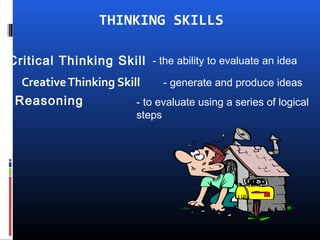
THINKING SKILLS
CreativeThinking Skill
- the ability to evaluate an ideaCritical Thinking Skill
- generate and produce ideas
- to evaluate using a series of logical
steps
Reasoning
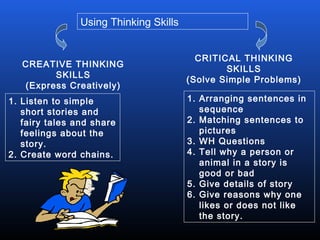
1. Listen to simple
short stories and
fairy tales and share
feelings about the
story.
2. Create word chains.
1. Arranging sentences in
sequence
2. Matching sentences to
pictures
3. WH Questions
4. Tell why a person or
animal in a story is
good or bad
5. Give details of story
6. Give reasons why one
likes or does not like
the story.
CREATIVE THINKING
SKILLS
(Express Creatively)
CRITICAL THINKING
SKILLS
(Solve Simple Problems)
Using Thinking Skills
Kssr english-pedagogy-111122031336-phpapp01

Kssr english-pedagogy-111122031336-phpapp01

  • 1.
    KURSUS JURULATIH UTAMAKURIKULUM STANDARD SEKOLAH RENDAH( KSSR ) 2010 BAHASA INGGERIS-TAHUN 1 BAHAGIAN PEMBANGUNAN KURIKULUM KEMENTERIAN PELAJARAN MALAYSIA EDUCATIONALEDUCATIONAL EMPHASESEMPHASES
  • 2.
    CREATIVITY The ability toproduce something new in an imaginative and fun-filled way Activities Making Masks/ Puppets  Pupils are provided with manila cards, markers etc to create puppets  They retell the fable using the puppets. Role-Play  Pupils role-play characters from the fables with guidance  Pupils pretend to be characters in a fable.  They act out a certain part of the fable using own dialogues  They can use the masks that they have done in previous lessons
  • 3.
    ENTREPRENEURSHIPENTREPRENEURSHIP Activities  Show Ringgitand Sen and encourage pupils to talk about them Suggested questions  What is this?  What can you do with this?  What are the things you can buy with 1 ringgit?  Do you save money? etc.
  • 4.
    INFORMATION AND COMMUNICATIONTECHNOLOGY These will include the use of multimedia resources as well as computer related activities. Activities  Teacher opens MS Power Point containing Happy Birthday song.  Pupils listen and after that they sing the song.  Pupils open MS words and type the lyrics with teacher guidance  Pupils save their work with teacher guidance
  • 5.
  • 6.
    Logical- Mathematical Pupils describe thethings hen, cat and goat do in their homes Musical Pupils sing a song Verbal- Linguistic Pupils tell the story of the Little Red Hen Kinesthetic Pupils role-play the story Interpersonal Pupils talk to each other about the characters they like. Intrapersonal Pupils imagine themselves as the hen and tell what they will do. Visual-Spatial Pupils draw a farm with the houses of the cat, rat and the goat Naturalistic Applying Multiple Intelligences Topic: The Little Red Hen Pupils observe cats, rats and goats and talk about them.
  • 7.
    Learning How toLearnLearning How to Learn • Listen, view, read, select and retain • Able to skim (read everything fast) and scan ( read those bits of relevant information) in order to get information fast and efficiently • Intensive (close) reading for details and depth • Use Index and Table of Contents to have an idea of important content • Find key words and phrases in paragraphs • Use highlighter pen to mark important points • Summarise and tell in your own words • Make notes of important points THE SKILLS:
  • 8.
    Being able torecall and retell accurately Being able to select and organise information Being able to build a good visual memory To practise recalling important points a few hours after reading (or listening or viewing) WritingWriting RememberingRemembering Planning what is to be learnt before starting Asking oneself questions during the learning process Monitoring progress Assessing what learning has taken place ReflectionReflection
  • 9.
    Mastery Learning ML isan approach that ensures all pupils master the learning outcomes in a learning unit before proceeding to the next unit. This approach takes into account the time needed by pupils to master the learning standards and requires a quality teaching-learning process.
  • 10.
    Learning Unit 1 Teaching& Learning Process Evaluation Have they mastered? Learning Unit 2 Proceed Enrichment activities Yes NoYes Determine Learning Standards Remedial activities ML MODEL
  • 11.
    Pupils’ daily experience means whatthey go through every day – at school, home, television, games. Community CONTEXTUAL LEARNING - using the situations pupils are familiar with as contexts for the topic being learnt. Environment If a teacher wants to teach about plants – then the best way to do this is to study the plants around the pupil’s school and home. Experience If pupils have no experience of car manufacturing, they will find the topic abstract and difficult to grasp. It will be easier to remember personal details about Ziana Zain than Abraham Lincoln, because Ziana Zain is part of the community pupils know. It will be hard for pupils to remember a list of English words to be memorised at home, but easier to remember the lyrics of a song.
  • 12.
    The teacher uses whatpupils already know (schema) as a base to expand students’ knowledge. CONSTRUCTIVISM- we start from what the pupils know Teaching and learning is very pupil centred. The pupil must be engaged, i.e. involved in active learning.
  • 13.
    THINKING SKILLS CreativeThinking Skill -the ability to evaluate an ideaCritical Thinking Skill - generate and produce ideas - to evaluate using a series of logical steps Reasoning
  • 14.
    1. Listen tosimple short stories and fairy tales and share feelings about the story. 2. Create word chains. 1. Arranging sentences in sequence 2. Matching sentences to pictures 3. WH Questions 4. Tell why a person or animal in a story is good or bad 5. Give details of story 6. Give reasons why one likes or does not like the story. CREATIVE THINKING SKILLS (Express Creatively) CRITICAL THINKING SKILLS (Solve Simple Problems) Using Thinking Skills