CREDITS
LEAD DEVELOPER
Rob Vaughn
ADDITIONAL DEVELOPMENT
Greg Benage, Iain Brogan
WRITING
Gary Astleford, Greg Benage, Iain Brogan, Darrell Hardy, Will Hindmarch,
Jeff Tidball, Rob Vaughn
COVER ILLUSTRATION
Camille Kuo
INTERIOR COLOR ILLUSTRATIONS
William Balzer, Corlen Kruger, Michael Dixon, Andrew Johanson,
Camille Kuo, Jeff Preston
INTERIOR ILLUSTRATIONS
J. A. Aranguren, Ed Bourelle, Matt Cavotta, Kevin Crossley, Michael
Dixon, Dragonfly Studios, Gary Eyre, Jonathon Fowler, Ted Galaday, David
Grant, David Griffith, Dwayne Harris, Corlen Kruger, Anneth Lagamo, Eric
Lofgren, Ken Meyer, Jim Nelson, Torstein Nordstrand, Michael Phillippi,
James Stowe, Thalia Tomlison, Tyler Walpole, Shane Watson, Erik Wilkerson,
Jarreau Wimberly
GRAPHIC DESIGN
Brian Schomburg
COPY AND CONTENT EDITING
Greg Benage, Rob Vaughn
LAYOUT
Rob Vaughn
ART DIRECTION
Darrell Hardy, Rob Vaughn
PUBLISHER
Christian T. Petersen
PLAYTESTERS AND SPECIAL THANKS
John Applebee, Erich Borchardt, Rob Brenhofer, Andy Christian, Jeff Corn,
Tony Doepner, Tod Gelle, Aaron Gilbertson, Darrell Hardy, Will Hindmarch,
Scott Nicely, Roberta Olson, Brian Schomburg, Tim Sturm, Giles Sutcliffe,
Karle Thomas, Odile Thomas, Erik Tyrrell, Justin Virnala, and William Wardo
FIREBORNTM
© 2004 Fantasy Flight Publishing, Inc. All rights reserved.
FANTASY FLIGHT GAMES
1975 W. County Rd. B2, Suite 1
Roseville, MN 55113
651.639.1905
www.fantasyflightgames.com
ORIGINAL CONCEPT
Greg Benage
2
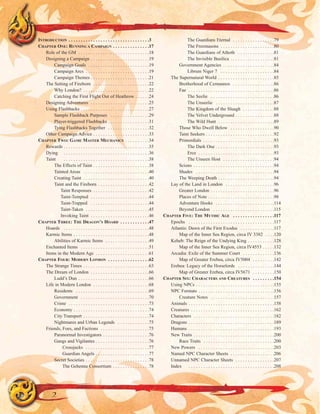
INTRODUCTION . . . . . . . . . . . . . . . . . . . . . . . . . . . . . . . . .3
CHAPTER ONE: RUNNING A CAMPAIGN . . . . . . . . . . . . . . .17
Role of the GM . . . . . . . . . . . . . . . . . . . . . . . . . . . . .18
Designing a Campaign . . . . . . . . . . . . . . . . . . . . . . . .19
Campaign Goals . . . . . . . . . . . . . . . . . . . . . . . . .19
Campaign Arcs . . . . . . . . . . . . . . . . . . . . . . . . . .19
Campaign Themes . . . . . . . . . . . . . . . . . . . . . . . .21
The Setting of Fireborn . . . . . . . . . . . . . . . . . . . . . . .22
Why London? . . . . . . . . . . . . . . . . . . . . . . . . . . .22
Catching the First Flight Out of Heathrow . . . . . .24
Designing Adventures . . . . . . . . . . . . . . . . . . . . . . . .25
Using Flashbacks . . . . . . . . . . . . . . . . . . . . . . . . . . . .27
Sample Flashback Purposes . . . . . . . . . . . . . . . .29
Player-triggered Flashbacks . . . . . . . . . . . . . . . . .31
Tying Flashbacks Together . . . . . . . . . . . . . . . . .32
Other Campaign Advice . . . . . . . . . . . . . . . . . . . . . . .33
CHAPTER TWO: GAME MASTER MECHANICS . . . . . . . . . .34
Rewards . . . . . . . . . . . . . . . . . . . . . . . . . . . . . . . . . . .35
Dying . . . . . . . . . . . . . . . . . . . . . . . . . . . . . . . . . . .36
Taint . . . . . . . . . . . . . . . . . . . . . . . . . . . . . . . . . . .38
The Effects of Taint . . . . . . . . . . . . . . . . . . . . . . .38
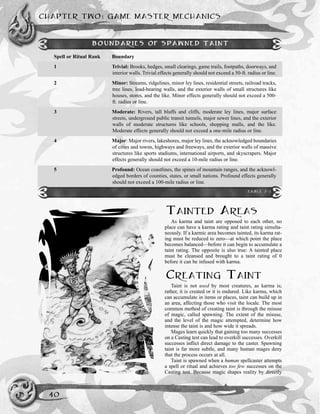
Tainted Areas . . . . . . . . . . . . . . . . . . . . . . . . . . .40
Creating Taint . . . . . . . . . . . . . . . . . . . . . . . . . . .40
Taint and the Fireborn . . . . . . . . . . . . . . . . . . . . .42
Taint Responses . . . . . . . . . . . . . . . . . . . . . . .42
Taint-Tempted . . . . . . . . . . . . . . . . . . . . . . . .44
Taint-Trapped . . . . . . . . . . . . . . . . . . . . . . . .44
Taint-Taken . . . . . . . . . . . . . . . . . . . . . . . . . .45
Invoking Taint . . . . . . . . . . . . . . . . . . . . . . . .46
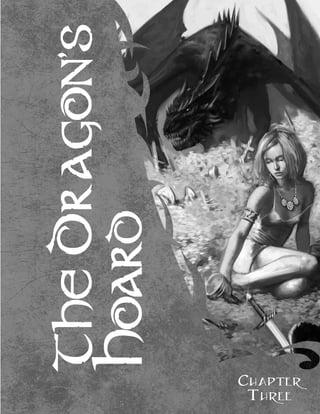
CHAPTER THREE: THE DRAGON’S HOARD . . . . . . . . . . . .47
Hoards . . . . . . . . . . . . . . . . . . . . . . . . . . . . . . . . . . .48
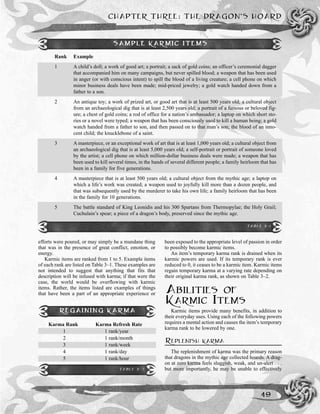
Karmic Items . . . . . . . . . . . . . . . . . . . . . . . . . . . . . . .48
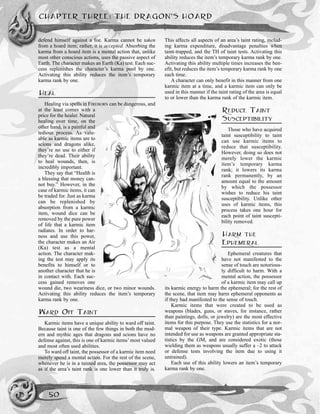
Abilities of Karmic Items . . . . . . . . . . . . . . . . . .49
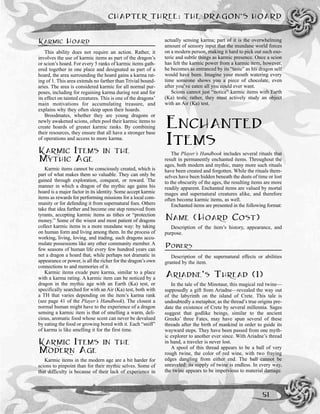
Enchanted Items . . . . . . . . . . . . . . . . . . . . . . . . . . . .51
Items in the Modern Age . . . . . . . . . . . . . . . . . . . . . .61
CHAPTER FOUR: MODERN LONDON . . . . . . . . . . . . . . . . .62
The Strange Times . . . . . . . . . . . . . . . . . . . . . . . . . . .63
The Dream of London . . . . . . . . . . . . . . . . . . . . . . . .66
Ludd’s Dun . . . . . . . . . . . . . . . . . . . . . . . . . . . . .66
Life in Modern London . . . . . . . . . . . . . . . . . . . . . . .68
Residents . . . . . . . . . . . . . . . . . . . . . . . . . . . . . .69
Government . . . . . . . . . . . . . . . . . . . . . . . . . . . .70
Crime . . . . . . . . . . . . . . . . . . . . . . . . . . . . . . . . .73
Economy . . . . . . . . . . . . . . . . . . . . . . . . . . . . . . .74
City Transport . . . . . . . . . . . . . . . . . . . . . . . . . . .74
Nightmares and Urban Legends . . . . . . . . . . . . .75
Friends, Foes, and Factions . . . . . . . . . . . . . . . . . . . .75
Paranormal Investigators . . . . . . . . . . . . . . . . . . .76
Gangs and Vigilantes . . . . . . . . . . . . . . . . . . . . . .76
Crossjacks . . . . . . . . . . . . . . . . . . . . . . . . . .77
Guardian Angels . . . . . . . . . . . . . . . . . . . . . .77
Secret Societies . . . . . . . . . . . . . . . . . . . . . . . . . .78
The Gehenna Consortium . . . . . . . . . . . . . . .78
The Guardians Eternal . . . . . . . . . . . . . . . . .79
The Freemasons . . . . . . . . . . . . . . . . . . . . . .80
The Guardians of Athoth . . . . . . . . . . . . . . .81
The Invisible Basilica . . . . . . . . . . . . . . . . . .81
Government Agencies . . . . . . . . . . . . . . . . . . . . .84
Librum Niger 7 . . . . . . . . . . . . . . . . . . . . . .84
The Supernatural World . . . . . . . . . . . . . . . . . . . . . . .85
Brotherhood of Cernunnos . . . . . . . . . . . . . . . . .86
Fae . . . . . . . . . . . . . . . . . . . . . . . . . . . . . . . . . . .86
The Seelie . . . . . . . . . . . . . . . . . . . . . . . . . .86
The Unseelie . . . . . . . . . . . . . . . . . . . . . . . .87
The Kingdom of the Sluagh . . . . . . . . . . . . .88
The Velvet Underground . . . . . . . . . . . . . . . .88
The Wild Hunt . . . . . . . . . . . . . . . . . . . . . . .89
Those Who Dwell Below . . . . . . . . . . . . . . . . . .90
Taint Seekers . . . . . . . . . . . . . . . . . . . . . . . . . . . .92
Primordials . . . . . . . . . . . . . . . . . . . . . . . . . . . . .93
The Dark One . . . . . . . . . . . . . . . . . . . . . . . .93
Erce . . . . . . . . . . . . . . . . . . . . . . . . . . . . . . .93
The Unseen Host . . . . . . . . . . . . . . . . . . . . .94
Scions . . . . . . . . . . . . . . . . . . . . . . . . . . . . . . . . .94
Shades . . . . . . . . . . . . . . . . . . . . . . . . . . . . . . . .94
The Weeping Death . . . . . . . . . . . . . . . . . . . . . . .94
Lay of the Land in London . . . . . . . . . . . . . . . . . . . .96
Greater London . . . . . . . . . . . . . . . . . . . . . . . . . .96
Places of Note . . . . . . . . . . . . . . . . . . . . . . . . . . .98
Adventure Hooks . . . . . . . . . . . . . . . . . . . . . . . .114
Beyond London . . . . . . . . . . . . . . . . . . . . . . . . .115
CHAPTER FIVE: THE MYTHIC AGE . . . . . . . . . . . . . . . . .117
Epochs . . . . . . . . . . . . . . . . . . . . . . . . . . . . . . . . . . .117
Atlantis: Dawn of the First Exodus . . . . . . . . . . . . . .117
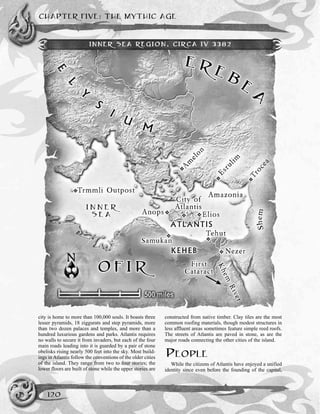
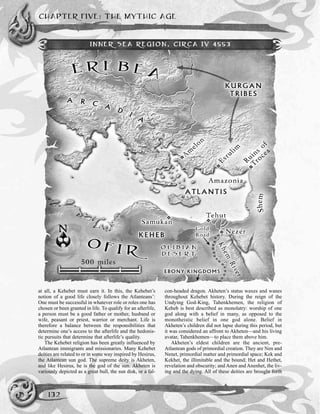
Map of the Inner Sea Region, circa IV 3382 . . . .120
Keheb: The Reign of the Undying King . . . . . . . . . . .128
Map of the Inner Sea Region, circa IV4553 . . . . .132
Arcadia: Exile of the Summer Court . . . . . . . . . . . . .136
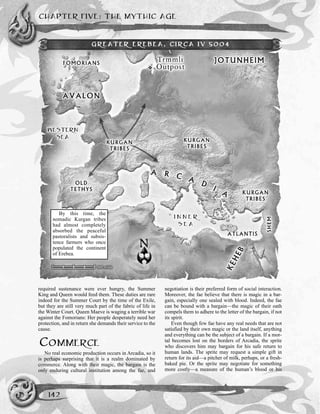
Map of Greater Erebea, circa IV5004 . . . . . . . . .142
Erebea: Legacy of the Horselords . . . . . . . . . . . . . . .144
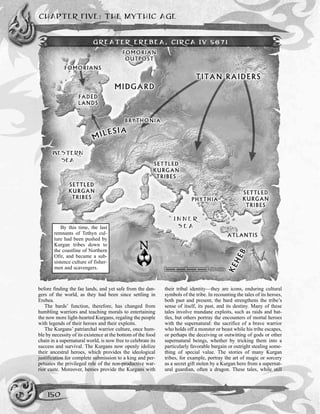
Map of Greater Erebea, circa IV5671 . . . . . . . . .150
CHAPTER SIX: CHARACTERS AND CREATURES . . . . . . . . .154
Using NPCs . . . . . . . . . . . . . . . . . . . . . . . . . . . . . . . .155
NPC Formats . . . . . . . . . . . . . . . . . . . . . . . . . . . . . . .156
Creature Notes . . . . . . . . . . . . . . . . . . . . . . . . . .157
Animals . . . . . . . . . . . . . . . . . . . . . . . . . . . . . . . . . . .158
Creatures . . . . . . . . . . . . . . . . . . . . . . . . . . . . . . . . . .162
Characters . . . . . . . . . . . . . . . . . . . . . . . . . . . . . . . . .182
Dragons . . . . . . . . . . . . . . . . . . . . . . . . . . . . . . . . . . .189
Humans . . . . . . . . . . . . . . . . . . . . . . . . . . . . . . . . . . .193
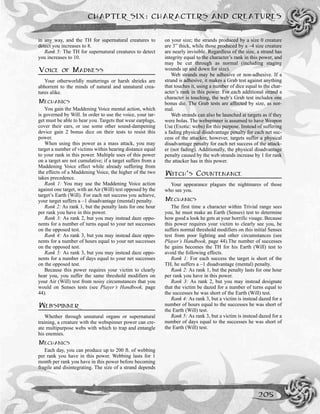
New Traits . . . . . . . . . . . . . . . . . . . . . . . . . . . . . . . . .200
Race Traits . . . . . . . . . . . . . . . . . . . . . . . . . . . . .200
New Powers . . . . . . . . . . . . . . . . . . . . . . . . . . . . . . .203
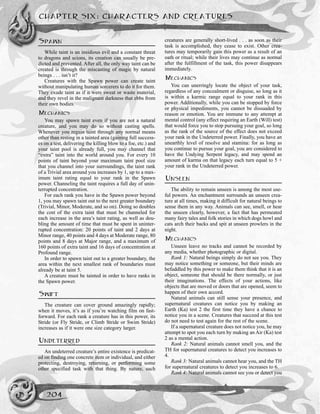
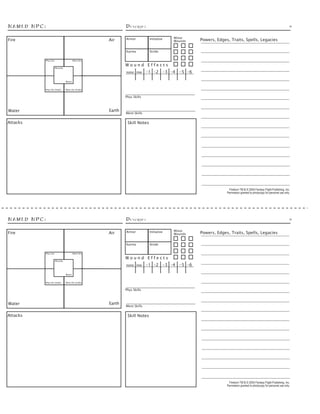
Named NPC Character Sheets . . . . . . . . . . . . . . . . . .206
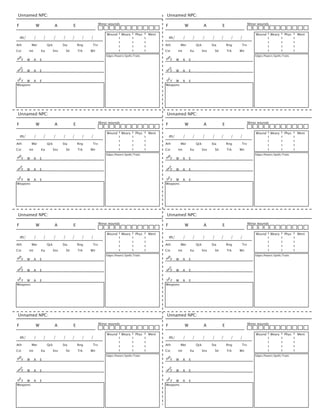
Unnamed NPC Character Sheets . . . . . . . . . . . . . . . .207
Index . . . . . . . . . . . . . . . . . . . . . . . . . . . . . . . . . . .208
BORN OF FIRE
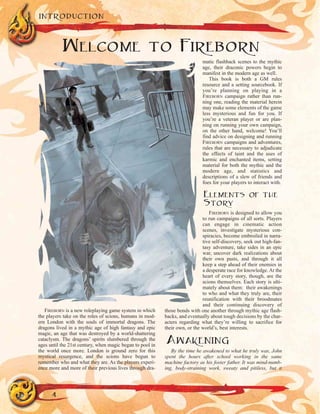
He was born ignobly, in an aging hospital, in a
decaying neighborhood. His father had gotten back on
his battleship eight months earlier and his mother’s
labor was hard. He came nine days late.
The doctor was worried about his temperature from
the beginning—about a degree and a half above nor-
mal—so they monitored him closely.
It would be unreasonable to imagine that the fire that
raced through the hospital the night he was born had
anything to do with the infant John Russell. After a
handful of oxygen tanks exploded and the automatic
extinguishers malfunctioned, it was a miracle more did-
n’t die—like John’s mother did—from the heat and
smoke inhalation, trapped in their rooms by curtains of
raging flame.
John’s adoptive parents, blue collar through and
through, knew about the tragedy that had heralded his
arrival in the world and claimed his birth mother.
Though John was too young to articulate anything
about the night terrors that afflicted him as a toddler,
they always suspected they had something to do with the
hospital conflagration.
It was in fact fire that possessed the boy’s sleeping
mind, but it didn’t have anything to do with the hospital.
The horror that woke John every night since he could
first remember was a fire a thousand times hotter than
the burn of hospital beds and building timbers. It was
the fire of the end of the world.
As John grew up, he learned to stop talking about the
flames he saw in his nightmares. After a while, when he
wasn’t afraid of them anymore, the nightmares became
dreams. Of flame, and death, but not his. Of power.
Eventually they seeped through into his waking mus-
ings. A lush, ancient world, treasures piled up for the
taking, devoured by heat and hate and lust.
And other images. Giant serpents, all fang and claw
and spine. They killed and rampaged, destroyed and
commanded, but John wasn’t afraid of them in the
visions. His waking mind told him they were nasty, bru-
tal, alien. But in the visions, he always looked forward
to their coming.
John lost his virginity when he was thirteen, to an
older girl whose name he quickly forgot. The event’s wet
fumbling was eclipsed in his mind by the dream he had
that night. As he slept, the torched landscape spread out
before him as usual, the flames crowded him everywhere
he turned. But for the first time, he realized that the fire
was not just a force, a devastating power. It was him. It
was his. He could control it at as easily as he controlled
his breathing. So he stopped, he held his breath . . . and
the flames faded. He saw who he was. What he was. He
knew why he wasn’t afraid of the beasts of claw and
fang, scale and wing. He couldn’t be afraid of them . . .
not when, in the visions at least, he was one.
3
INTRODUCTION
FIREBORN is a new roleplaying game system in which
the players take on the roles of scions, humans in mod-
ern London with the souls of immortal dragons. The
dragons lived in a mythic age of high fantasy and epic
magic, an age that was destroyed by a world-shattering
cataclysm. The dragons’ spirits slumbered through the
ages until the 21st century, when magic began to pool in
the world once more. London is ground zero for this
mystical resurgence, and the scions have begun to
remember who and what they are. As the players experi-
ence more and more of their previous lives through dra-
matic flashback scenes to the mythic
age, their draconic powers begin to
manifest in the modern age as well.
This book is both a GM rules
resource and a setting sourcebook. If
you’re planning on playing in a
FIREBORN campaign rather than run-
ning one, reading the material herein
may make some elements of the game
less mysterious and fun for you. If
you’re a veteran player or are plan-
ning on running your own campaign,
on the other hand, welcome! You’ll
find advice on designing and running
FIREBORN campaigns and adventures,
rules that are necessary to adjudicate
the effects of taint and the uses of
karmic and enchanted items, setting
material for both the mythic and the
modern age, and statistics and
descriptions of a slew of friends and
foes for your players to interact with.
ELEMENTS OF THE
STORY
FIREBORN is designed to allow you
to run campaigns of all sorts. Players
can engage in cinematic action
scenes, investigate mysterious con-
spiracies, become embroiled in narra-
tive self-discovery, seek out high-fan-
tasy adventure, take sides in an epic
war, uncover dark realizations about
their own pasts, and through it all
keep a step ahead of their enemies in
a desperate race for knowledge. At the
heart of every story, though, are the
scions themselves. Each story is ulti-
mately about them: their awakenings
to who and what they truly are, their
reunification with their broodmates
and their continuing discovery of
those bonds with one another through mythic age flash-
backs, and eventually about tough decisions by the char-
acters regarding what they’re willing to sacrifice for
their own, or the world’s, best interests.
AWAKENING
By the time he awakened to what he truly was, John
spent the hours after school working in the same
machine factory as his foster father. It was mind-numb-
ing, body-straining work, sweaty and pitiless, but it
INTRODUCTION
4
WELCOME TO FIREBORN
brought a bi-weekly pittance that nevertheless helped
his folks keep him clothed and fed.
It was the day after John’s new revelation when it
happened. He was listening to another verbal spew from
his foreman, the greasy bastard that ordered John and
his dad around, day after day after godforsaken day.
John took his lead from his dad. Stand there and take it,
soak in the daily ration of verbal abuse. You don’t need
to pretend to like it, but you need to deal with it. This
time, the night after the vision, the realization, his gut
wasn’t having it. His insides roiled with impotent anger,
his fists clenched, and he could feel a fever building. He
felt like he was going to puke, to yell, to kill, and keel
over, all at once. He avoided the foreman’s eye, because
he was afraid of what he’d do if he met it. Instead, he
focused his gaze on the drilling press above and behind
the bastard’s head. The foreman noticed, got in his face,
put himself in the way. And what the foreman saw in
John’s eyes, what John saw as he brought it into the
world, was fire.
The factory burned to the ground. The cops never
figured anything out. The fire came from nowhere, and
spread like a demon. Nobody standing near ground zero
of the blast survived, except John, and he pretended to
be on break, nowhere nearby, when the cops asked him
where he had been. Some ironhide detectives gave him
grief for all of 10 seconds, saying they didn’t believe
him. Then John felt the fever, and saw the fire coming.
They must’ve seen it too, because they backed right the
hell down. His mom never said a thing, but she would-
n’t look him in the eye anymore. She wouldn’t touch him.
Some of the blokes from the factory started to mutter.
They weren’t sad to lose the bastard that had bossed
them around, but the factory was the only work they
could get. Now they were hungry. Their families were
hungry. The government covered them, barely, but with
all the foreigners flocking in, the jobs and the support
were getting used up. They were bitter, desperate. There
was talk about John, about the blaze. Stories started fly-
ing. A few went by his folks’ place one night, to “talk”
to him. They went home, not a scratch on them, not a
word coming out of their mouths. Anyone that talked
about going after the Russell kid again, those unlucky
pioneers would warn them.
“Stay away. The rags all say that ‘strange things’re
afoot,’ya hear? And I tell you, he’s strange, he’s a thing,
and he’s ‘afoot.’Unless you’re crazy, or you got a death-
wish, keep away from the Russell boy.”
John had burned his connections to everything that
he knew, so he pulled the corpse of his old life around
him like a blanket against the cold and hunched forward
into his new one. This life smelled of ash and blood.
With no job, John learned the time-honored arts of
delinquency and crime: theft, violence, posturing, fear.
Maybe he knew he’d end up in jail. Maybe he didn’t
care. Regardless, he found more there than he ever
could have expected.
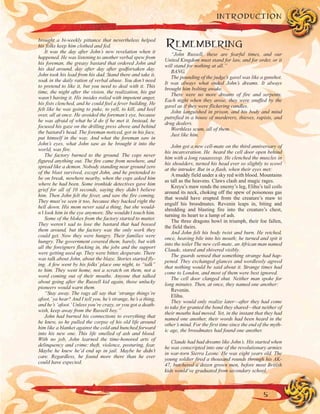
REMEMBERING
“John Russell, these are fearful times, and our
United Kingdom must stand for law, and for order, or it
will stand for nothing at all.”
BANG.
The pounding of the judge’s gavel was like a gunshot.
It was always what ended John’s dreams. It always
brought him bolting awake.
There were no more dreams of fire and serpents.
Each night when they arose, they were snuffed by the
gavel as if they were flickering candles.
John languished in prison, and his body and mind
putrefied in a house of murderers, thieves, rapists, and
drug dealers.
Worthless scum, all of them.
Just like him.
John got a new cell-mate on the third anniversary of
his incarceration. He heard the cell door open behind
him with a long raaasssssp. He clenched the muscles in
his shoulders, turned his head ever so slightly to scowl
at the intruder. But in a flash, when their eyes met:
A muddy field under a sky red with blood. Mountains
as tall as the heavens. Claws clash and magic rages.
Kreyu’s maw rends the enemy’s leg, Elihu’s tail coils
around its neck, choking off the spew of poisonous gas
that would have erupted from the creature’s maw to
engulf his broodmates. Revenin leaps in, biting and
shredding and blasting fire into the creature’s chest,
turning its heart to a lump of ash.
The three dragons howl in triumph, their foe fallen,
the field theirs.
And John felt his body twist and burn. He retched,
once, heaving bile into his mouth; he turned and spit it
into the toilet The new cell-mate, an African man named
Claude, stared and shivered visibly.
The guards sensed that something strange had hap-
pened. They exchanged glances and wordlessly agreed
that nothing would be said about it. Strange times had
come to London, and most of them were best ignored.
The cell door clanged shut. Neither man spoke for
long minutes. Then, at once, they named one another:
Revenin.
Elihu.
They would only realize later—after they had come
to take for granted the bond they shared—that neither of
their mouths had moved. Yet, in the instant that they had
named one another, their words had been heard in the
other’s mind. For the first time since the end of the myth-
ic age, the broodmates had found one another.
Claude had had dreams like John’s. His started when
he was conscripted into one of the revolutionary armies
in war-torn Sierra Leone. He was eight years old. The
young soldier fired a thousand rounds through his AK-
47, butchered a dozen grown men, before most British
kids would’ve graduated from secondary school.
5
INTRODUCTION
The dreams had gotten to him as he got older. It got
harder to tell the visions from reality. Both were violent.
Both were bloody. He could control neither. So he decid-
ed it was time to control both.
So Claude smuggled himself to London, where he
lived on the street and came by food and money the only
way he knew how. It had landed him in prison inside two
weeks.
John Russell and Claude Chebue became brothers.
Each educated the other. John interpreted the subtleties
of “civilized” life for Claude, both as a Londoner as a
veteran inmate. Claude gave John a conscience. When
necessary, he forced it on him. It wasn’t an easy match.
But even as the pair re-forged their bonds and discov-
ered depths of humanity and camaraderie they hadn’t
believed possible, they realized that their circle was
incomplete.
SONG OF THE BROOD
Proud Revenin was hatched in a dim antiquity even
he could not recall. Humans worshipped him as a god,
and rightfully so, in his draconic eye.
Serene Elihu had always been in love with the right-
ness of things. Mankind’s awe of him was as natural as
the warmth of the sun or the pull of gravity.
Striving Kreyu was brave and courageous in all
things but worship. The youngest of the three, she could
not see herself as worthy of divinity.
These three were different in appearance, in perspec-
tive, in experiences lived and triumphs achieved.
Yet they were broodmates, and therefore the same.
They were bound and devoted to one another more than
to any treasure, lover, place, or thing.
THERE YOU ARE
It was the tone an anxious owner would take with a
missing kitten, finally found stuck in a tree.
There you are.
The fourteen-year-old girl pronounced the sentence
with equal parts reproach, relief, and realization. It was
as if this, of course, was the only reasonable place she
could have found the objects of her searching. Her life’s
chronic, subconscious search.
Her name was Allison. She had come to the prison
with the Sisters of Mary Magdalene to minister to
ungrateful felons. She had lived with the nuns since she
had been orphaned as a baby.
She was serving glop to a line of inmates. She was
giving them all the same shy, fearful, simple smile. And
then she said it. There you are. Looking at John and
Claude.
But she hadn’t moved her lips. She hadn’t broken the
smile.
They stared, until someone in line behind them
shoved Claude’s shoulder. “Move it, blighter.”
Allison’s face never changed, but they heard the pout
in her voice. What, no hello? Then a sense of laughter.
Never mind. You move along. I’ll be back tonight. She
spoke into their minds as the sluggish but inexorable
movement of the serving line moved them past her sta-
tion. Back to set you free.
Allison didn’t remember her folks. Didn’t remember
much of anything from before she had come to live with
the Sisters. Ironically, she did remember whole other
lifetimes. She always had. And she sensed karma, with
the same ease with which she sensed light and dark, hot
and cold. She knew how to manipulate it, pulling it in
and releasing it, with the same instinct she had for
breathing. Men without the benefit of a draconic heart
struggled with ancient tomes and forgotten lore.
Struggled to breathe even the tiniest spark of karma into
their impotent castings. But Allison could manipulate
magic with the ease of a spider spinning her web.
INTRODUCTION
6
THE SCIONS
Scions are the heart of FIREBORN. They are the
players’avatars within the game world, the heroes
in the drama of the unfolding story.
Scions are at once human and more than
human. They are born of man and woman, they
are made of flesh and blood like their fellows. But
their souls are those of dragons of the mythic age.
And those souls bring more than just memories,
more than just an outlook on life. They bring
power. Once awakened, a scion’s soul screams for
release, kindles into life at the merest breath.
Scions are born unaware of their heritage.
Before the return of magic, scions lived out their
lives as capable, driven, but ultimately mundane
men and women. Because while the souls of drag-
ons are eternal, they require karma to flourish, as
a fire needs oxygen to burn. In the absence of
karma, the soul of a dragon is only potential, an
embryo of flame in an airless hall.
With the coming of the strange times, as the
locals of London call it, that all changed. Scions
began to remember. And the more they remember,
the more of their past lives they recreate, the more
supernatural powers they regain.
Newly awakened scions have their own agen-
das. They may seek power, survival, kinship, or
knowledge. But with each passing day, a scion
realizes that there is something more. Something
beyond himself, and eventually, beyond his
brood. Something that spelled their doom count-
less lifetimes ago. Something that, just like them,
grows stronger every day.
7
INTRODUCTION
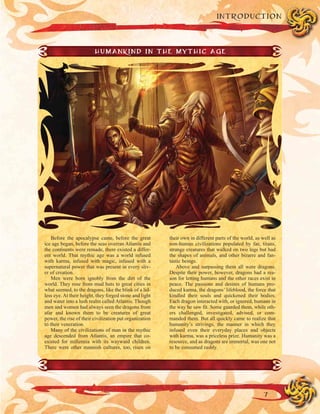
HUMANKIND IN THE MYTHIC AGE
Before the apocalypse came, before the great
ice age began, before the seas overran Atlantis and
the continents were remade, there existed a differ-
ent world. That mythic age was a world infused
with karma, infused with magic, infused with a
supernatural power that was present in every sliv-
er of creation.
Men were born ignobly from the dirt of the
world. They rose from mud huts to great cities in
what seemed, to the dragons, like the blink of a lid-
less eye. At their height, they forged stone and light
and water into a lush realm called Atlantis. Though
men and women had always seen the dragons from
afar and known them to be creatures of great
power, the rise of their civilization put organization
to their veneration.
Many of the civilizations of man in the mythic
age descended from Atlantis, an empire that co-
existed for millennia with its wayward children.
There were other mannish cultures, too, risen on
their own in different parts of the world, as well as
non-human civilizations populated by fae, titans,
strange creatures that walked on two legs but had
the shapes of animals, and other bizarre and fan-
tastic beings.
Above and surpassing them all were dragons.
Despite their power, however, dragons had a rea-
son for letting humans and the other races exist in
peace. The passions and desires of humans pro-
duced karma, the dragons’ lifeblood, the force that
kindled their souls and quickened their bodies.
Each dragon interacted with, or ignored, humans in
the way he saw fit. Some guarded them, while oth-
ers challenged, investigated, advised, or com-
manded them. But all quickly came to realize that
humanity’s strivings, the manner in which they
infused even their everyday places and objects
with karma, was a priceless prize. Humanity was a
resource, and as dragons are immortal, was one not
to be consumed rashly.
INTRODUCTION
8
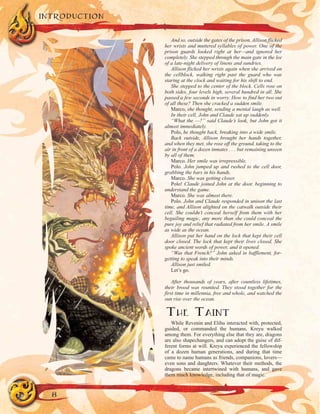
And so, outside the gates of the prison, Allison flicked
her wrists and muttered syllables of power. One of the
prison guards looked right at her—and ignored her
completely. She stepped through the main gate in the lee
of a late-night delivery of linens and sundries.
Allison flicked her wrists again when she arrived on
the cellblock, walking right past the guard who was
staring at the clock and waiting for his shift to end.
She stepped to the center of the block. Cells rose on
both sides, four levels high, several hundred in all. She
passed a few seconds in worry. How to find her two out
of all these? Then she cracked a sudden smile.
Marco, she thought, sending a mental laugh as well.
In their cell, John and Claude sat up suddenly.
“What the —?” said Claude’s look, but John got it
almost immediately.
Polo, he thought back, breaking into a wide smile.
Back outside, Allison brought her hands together,
and when they met, she rose off the ground, taking to the
air in front of a dozen inmates . . . but remaining unseen
by all of them.
Marco. Her smile was irrepressible.
Polo. John jumped up and rushed to the cell door,
grabbing the bars in his hands.
Marco. She was getting closer.
Polo! Claude joined John at the door, beginning to
understand the game.
Marco. She was almost there.
Polo. John and Claude responded in unison the last
time, and Allison alighted on the catwalk outside their
cell. She couldn’t conceal herself from them with her
beguiling magic, any more than she could conceal the
pure joy and relief that radiated from her smile. A smile
as wide as the ocean.
Allison put her hand on the lock that kept their cell
door closed. The lock that kept their lives closed. She
spoke ancient words of power, and it opened.
“Was that French?” John asked in bafflement, for-
getting to speak into their minds.
Allison just smiled.
Let’s go.
After thousands of years, after countless lifetimes,
their brood was reunited. They stood together for the
first time in millennia, free and whole, and watched the
sun rise over the ocean.
THE TAINT
While Revenin and Elihu interacted with, protected,
guided, or commanded the humans, Kreyu walked
among them. For everything else that they are, dragons
are also shapechangers, and can adopt the guise of dif-
ferent forms at will. Kreyu experienced the fellowship
of a dozen human generations, and during that time
came to name humans as friends, companions, lovers—
even sons and daughters. Whatever their methods, the
dragons became intertwined with humans, and gave
them much knowledge, including that of magic.
9
INTRODUCTION
Revenin often accused Kreyu of forgetting her her-
itage. Of adopting all of humanity as her brood. But it
was Kreyu’s connection to humanity that told the brood
of taint.
By this time, dragons knew that the living, feeling,
and being of humans and all other natural organisms
generated karma. Their existence itself was a boon to all
supernatural creatures. Taint, Kreyu discovered, was a
perversion of karma, a corruption of the natural, a tarry
aberration. It brought despair to humans and madness to
dragons. Some took to destroying the humanity that had
once worshipped them, demanding sacrifices of blood
and gold, carrying off the sons and daughters of royalty
and feasting on their flesh. Others still, to avoid such a
fate, withdrew from the lands of men completely, hid in
their lairs, surrounded themselves with bulwarks of
karmic items to keep the taint at bay. But there was no
escape.
Too late, the brood discovered that magic, the direct
manipulation of karma into visible and manifest effects,
was the greatest source of taint. Supernatural creatures
could create magic nearly effortlessly; they needed to
exercise some caution, lest they harm themselves with
the excess energy magic could generate, but the use of
magic itself did not harm the world around them. The
same, it seemed, did not hold true for human magicians.
The more recklessly men explored magic, the more
greedily they sucked at that fountain of knowledge, the
more grotesquely taint spread in the world.
The dragons’ greatest gift to mankind, that of magic,
would be their downfall.
THIS WAS OURS
I’ve never brought anyone down here before, Allison
thought to them.I just wanted you to know that, before
we went down.
She had gotten used to talking to John and Claude in
her mind right away. Her experience with magic had
probably paved the way for those mental processes.
With her broodmates to talk to, she didn’t care if she
never spoke out loud again until the day she died.
The three of them stood just inside a centuries-old
crypt. They were in Highgate Cemetery, adjacent to the
old church where the Sisters made their retreat from the
worldly.
Allison put her hand on one of the massive stone sar-
cophagi, and its lid slid noiselessly to the side. There
was no desiccated corpse in the stone box. Instead, John
and Claude peered into a rough-hewn hole in the living
earth, a shaft leading downward.
Allison climbed up onto the edge of the sarcophagus
and spoke some ancient, slurring words that summoned
light from nothing. Then she stepped off of her perch
and floated effortlessly down into the hole. She looked
like she was riding an invisible elevator into the ground.
It was the same magic she’d used to ascend to their cell
in the prison. John and Claude were starting to be able
to tell one incantation from another.
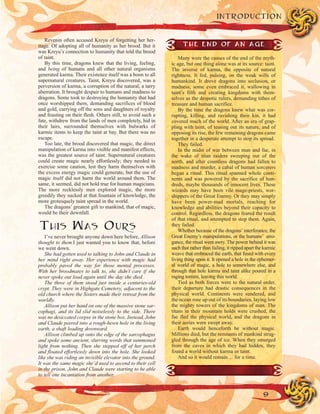
THE END OF AN AGE
Many were the causes of the end of the myth-
ic age, but one thing alone was at its source: taint.
The inverse of karma, the opposite of natural
rightness. It fed, pulsing, on the weak wills of
humankind. It drove dragons into seclusion, or
madness; some even embraced it, wallowing in
taint’s filth and creating kingdoms with them-
selves as the despotic rulers, demanding tithes of
treasure and human sacrifice.
By the time the dragons knew what was cor-
rupting, killing, and ravishing their kin, it had
covered much of the world. After an era of grap-
pling with taint, of teasing out its nature, and of
opposing its rise, the few remaining dragons came
together in a desperate attempt to stop its spread.
They failed.
In the midst of war between man and fae, in
the wake of titan raiders sweeping out of the
north, and after countless dragons had fallen to
madness and murder, a cabal of human sorcerers
began a ritual. This ritual spanned whole conti-
nents and was powered by the sacrifice of hun-
dreds, maybe thousands of innocent lives. These
wizards may have been vile mage-priests, wor-
shippers of the Great Enemy. Or they may simply
have been power-mad mortals, reaching for
knowledge and abilities beyond their capacity to
control. Regardless, the dragons feared the result
of that ritual, and attempted to stop them. Again,
they failed.
Whether because of the dragons’interferance, the
Great Enemy’s manipulations, or the humans’ arro-
gance, the ritual went awry. The power behind it was
such that rather than failing, it ripped apart the karmic
weave that embraced the earth, that fused with every
living thing upon it. It opened a hole in the ephemer-
al world of magic, a hole to somewhere else, and
through that hole karma and taint alike poured in a
raging torrent, leaving this world.
Tied as both forces were to the natural order,
their departure had drastic consequences in the
physical world. Continents were sundered, and
the ocean rose up out of its boundaries, laying low
the mighty towers of the kingdoms of man. The
titans in their mountain holds were crushed, the
fae fled the physical world, and the dragons in
their aeries were swept away.
Earth would henceforth be without magic.
Millions died, but the remnants of mankind strug-
gled through the age of ice. When they emerged
from the caves in which they had hidden, they
found a world without karma or taint.
And so it would remain… for a time.
Come on.
John and Claude exchanged a glance, then
climbed in after her. The same invisible force cra-
dled them as they descended into the earth.
After a moment, they found themselves on solid
ground in a vault that stretched back toward the
main church building.
That’s the only way in, she babbled in their
heads as she hurried down the vault corridor. I
sealed off the main entrance, inside the church. No
one ever comes down here but me. This is my
place. She sounded more and more like a teenager
the closer they got to wherever it was they were
going, and she walked faster and faster.
“What’s the rush?” asked John, out loud.
“Come on,” she said back to him, also aloud.
She spoke aloud whenever she was impatient. As if
she wasn’t sure they could hear her in their heads.
She rounded a corner and her light bloomed.
John and Claude rounded the corner to find her
beaming, almost bouncing in excitement. She
looked up at them with a grin wide enough to split
her face wide open. These were the only two people
in the whole world that could appreciate what she
was showing them—her hoard. She searched their
faces for approval.
And she found it.
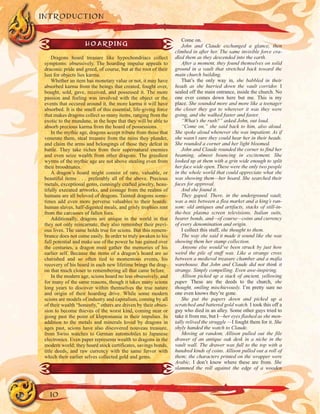
They gaped. There, in the underground vault,
was a mix between a flea market and a king’s ran-
som: old antiques and artifacts, stacks of still-in-
the-box plasma screen televisions, Italian suits,
bearer bonds, and—of course—coins and currency
of every denomination and origin.
I collect this stuff, she thought to them.
The way she said it made it sound like she was
showing them her stamp collection.
Anyone else would’ve been struck by just how
weird the pile of stuff was. Like a strange cross
between a medieval treasure chamber and a mafia
warehouse. But John and Claude did not think it
strange. Simply compelling. Even awe-inspiring.
Allison picked up a stack of ancient, yellowing
paper. These are the deeds to the church, she
thought, smiling mischievously. I’m pretty sure no
one even knows they’re gone.
She put the papers down and picked up a
scratched and battered gold watch. I took this off a
guy who died in an alley. Some other guys tried to
take it from me, but I—her eyes flashed as she men-
tally relived the struggle —I fought them for it. She
shyly handed the watch to Claude.
Moving at random, Allison pulled out the file
drawer of an antique oak desk in a niche in the
vault wall. The drawer was full to the top with a
hundred kinds of coins. Allison pulled out a roll of
them; the characters printed on the wrapper were
Arabic. I don’t know where these are from. She
slammed the roll against the edge of a wooden
INTRODUCTION
10
HOARDING
Dragons hoard treasure like hypochondriacs collect
symptoms: obsessively. The hoarding impulse appeals to
draconic pride and greed, of course, but at the root of their
lust for objects lies karma.
Whether an item has monetary value or not, it may have
absorbed karma from the beings that created, fought over,
bought, sold, gave, received, and possessed it. The more
passion and feeling was involved with the object or the
events that occured around it, the more karma it will have
absorbed. It is the smell of this essential, life-giving force
that makes dragons collect so many items, ranging from the
exotic to the mundane, in the hope that they will be able to
absorb precious karma from the hoard of possessions.
In the mythic age, dragons accept tribute from those that
venerate them, steal treasure from the ruins they plunder,
and claim the arms and belongings of those they defeat in
battle. They take riches from their supernatural enemies
and even seize wealth from other dragons. The greediest
wyrms of the mythic age are not above stealing even from
their broodmates.
A dragon’s hoard might consist of rare, valuable, or
beautiful items . . . preferably all of the above. Precious
metals, exceptional gems, cunningly crafted jewelry, beau-
tifully executed artworks, and coinage from the realms of
humans are all beloved of dragons. Tainted dragons some-
times add even more perverse valuables to their hoards:
human slaves, half-digested meals, and grisly trophies rent
from the carcasses of fallen foes.
Additionally, dragons are unique in the world in that
they not only reincarnate, they also remember their previ-
ous lives. The same holds true for scions. But this remem-
brance does not come easily. In order to truly awaken to his
full potential and make use of the power he has gained over
the centuries, a dragon must gather the memories of his
earlier self. Because the items of a dragon’s hoard are so
cherished and so often tied to momentous events, his
recovery of his hoard in each new lifetime brings the drag-
on that much closer to remembering all that came before.
In the modern age, scions hoard no less obsessively, and
for many of the same reasons, though it takes many scions
long years to discover within themselves the true nature
and origin of their hoarding drive. While some modern
scions are models of industry and capitalism, coming by all
of their wealth “honestly,” others are driven by their obses-
sion to become thieves of the worst kind, coming near or
going past the point of kleptomania in their impulses. In
addition to the metals and minerals loved by dragons in
ages past, scions have also discovered nouveau treasure,
from Swiss watches to German automobiles to Japanese
electronics. Even paper represents wealth to dragons in the
modern world; they hoard stock certificates, savings bonds,
title deeds, and raw currency with the same fervor with
which their earlier selves collected gold and gems.
crate labeled “Apple Computer,” whose bill of lading,
in a clear plastic pouch, specified that a half-dozen Mac
Powerbooks lay undisturbed inside. Middle Eastern
coins spilled out of the roll, some falling onto the
ground. Allison picked up a few of the freed coins and
turned them over in her hand, temporarily mesmerized.
“Pretty,” she remarked, before tossing them back into
the drawer.
Then Allison saw that John and Claude were staring
at a small gold statue that sat alone and above the rest
of the lucre. It perched on a stone pillar of what could’ve
been ancient Roman origin.
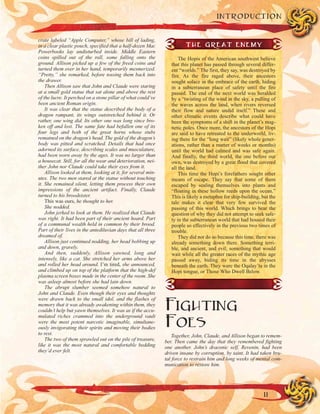
It was clear that the statue described the body of a
dragon rampant, its wings outstretched behind it. Or
rather, one wing did. Its other one was long since bro-
ken off and lost. The same fate had befallen one of its
four legs and both of the great horns whose stubs
remained on the dragon’s head. The gold of the dragon’s
body was pitted and scratched. Details that had once
adorned its surface, describing scales and musculature,
had been worn away by the ages. It was no larger than
a housecat. Still, for all the wear and deterioration, nei-
ther John nor Claude could take their eyes from it.
Allison looked at them, looking at it, for several min-
utes. The two men stared at the statue without touching
it. She remained silent, letting them process their own
impressions of the ancient artifact. Finally, Claude
turned to his broodsister.
This was ours, he thought to her.
She nodded.
John jerked to look at them. He realized that Claude
was right. It had been part of their ancient hoard. Part
of a communal wealth held in common by their brood.
Part of their lives in the antediluvian days that all three
dreamed of.
Allison just continued nodding, her head bobbing up
and down, gravely.
And then, suddenly, Allison yawned, long and
intensely, like a cat. She stretched her arms above her
and rolled her head around. I’m tired, she announced,
and climbed up on top of the platform that the high-def
plasma screen boxes made in the center of the room. She
was asleep almost before she had lain down.
The abrupt slumber seemed somehow natural to
John and Claude. Even though their eyes and thoughts
were drawn back to the small idol, and the flashes of
memory that it was already awakening within them, they
couldn’t help but yawn themselves. It was as if the accu-
mulated riches crammed into the underground vault
were the most potent narcotic imaginable, simultane-
ously invigorating their spirits and moving their bodies
to rest.
The two of them sprawled out on the pile of treasure,
like it was the most natural and comfortable bedding
they’d ever felt.
FIGHTING
FOES
Together, John, Claude, and Allison began to remem-
ber. Then came the day that they remembered fighting
one another. John’s draconic self, Revenin, had been
driven insane by corruption, by taint. It had taken bru-
tal force to restrain him and long weeks of mental com-
munication to restore him.
11
INTRODUCTION
THE GREAT ENEMY
The Hopis of the American southwest believe
that this planet has passed through several differ-
ent “worlds.” The first, they say, was destroyed by
fire. As the fire raged above, their ancestors
sought solace in the embrace of the earth, hiding
in a subterranean place of safety until the fire
passed. The end of the next world was heralded
by a “twisting of the wind in the sky, a pulling of
the waves across the land, when rivers reversed
their flow and nature undid itself.” These and
other climatic events describe what could have
been the symptoms of a shift in the planet’s mag-
netic poles. Once more, the ancestors of the Hopi
are said to have retreated to the underworld, liv-
ing there for the “long wait” (likely whole gener-
ations, rather than a matter of weeks or months)
until the world had calmed and was safe again.
And finally, the third world, the one before our
own, was destroyed by a great flood that covered
all the land.
This time the Hopi’s forefathers sought other
means of escape. They say that some of them
escaped by sealing themselves into plants and
“floating in these hollow reeds upon the ocean.”
This is likely a metaphor for ship-building, but the
tale makes it clear that very few survived the
passing of this world. Which brings to bear the
question of why they did not attempt to seek safe-
ty in the subterranean world that had housed their
people so effectively in the previous two times of
trouble.
They did not do so because this time, there was
already something down there. Something terri-
ble, and ancient, and evil; something that would
wait while all the greater races of the mythic age
passed away, biding its time in the abysses
beneath the earth. They were the Oqalay’ta in the
Hopi tongue, or Those Who Dwell Below.
At that instant, the brood realized something else. If
taint existed then, taint existed now. And it could do the
same thing today as it did in the mythic age. Corrupt,
overwhelm, drive mad. Kill. They agreed to begin hunt-
ing down the tainted creatures who had begun to plague
the streets of London. Allison was the brains of their
enterprise, Claude its conscience, and John its fire.
They weren’t sure what, exactly, it was, but they knew
one thing for sure: It was big.
The three had gotten word about the attack when one
of their contacts at the local precinct passed an enve-
lope under their door in the middle of the night. In
exchange for a bit of magical help now and then, the
local officers were only too happy to turn the brood on
to events around the city—criminal and otherwise—that
looked like they might be related to the supernatural.
After packing up their gear into giant duffels, John,
Claude, and Allison had made haste across town to the
abandoned sewer-works. The police had discovered the
maimed bodies of a half-dozen crusties about seven
hours earlier. Such attacks were becoming common. The
authorities had become practiced in finding them,
cleaning them up, and filing them away to be forgotten
as quickly as possible.
The place had already been cleaned out. A cordon of
police tape played connect-the-dots with the chalk out-
lines and blood spatters.
As they entered the sewer, the three scions immedi-
ately noticed the unmistakable reek—you couldn’t smell
it, but all three of them thought of it as a scent nonethe-
less—of taint. They got right to work, the sooner to get
out of the unhealthy atmosphere.
The only light in the cavernous building came from
the maglites they produced from their duffel bags. They
began to search the scene, moving between giant pipes,
empty vats, and tangles of rusting machinery.
Claude discovered a gory footprint in the middle of
one of the chalk outlines. He crouched over it, playing
his light back and forth. It was about two feet long, with
seven toes and a giant claw in the heel. In addition to
the blood, a measure of pulpy tissue from an unfortunate
victim’s mashed organs had been smashed into cracks in
the rough concrete, left behind when the medics had
peeled the corpse up off the ground. When Claude
looked up to trace the creature’s obvious direction of
travel, he saw that Allison had already found the trail of
bloody footprints, and that they led to a chasm. A rift in
the concrete opened to some dark underground space.
With a motion of her hand and a few muttered words
of power, she calmly stepped forward to stand on noth-
ing at all. Then she waved her fingers deftly and spoke
a few more words. A soft light appeared below her, illu-
minating the darkness and casting her shadow on the
tangle of beams and catwalks that held up the roof some
forty feet above them.
It’s huge, Allison thought to her broodmates, seeing
that the chasm opened on a natural underground cavern
easily as large or larger than the whole extent of the
above-ground sewer-works.
John still thought that the words of power associated
with Allison’s spells sounded French, but he knew—that
is to say, Allison constantly remind him—that the lan-
guage was far more ancient than anything spoken in
Europe.
He was about to crack the predictable joke to lighten
the mood, when the ceiling collapsed.
Claude had a pair of Glocks in his hand before the
first piece of rubble hit the floor. John’s eyes flashed fire
and his fingers lengthened into claws as he saw the
monstrosity they were looking for riding a chariot of
rubble and rebar from the ceiling to the floor. Allison
shrieked and dove downward into the chasm, narrowly
avoiding the avalanche of iron beams and concrete. She
was sealed in.
Allison!? John thought in a flash.
It was amazing the way their thought-link could con-
vey emotion as well as meaning; John could sense
Allison breathing hard as she reported back, I’ll live.
John was pissed. The tainted bastard had been lying
in ambush, just waiting for them to look down into the
chasm. He was also more than a little worried, but he’d
never admit to that. He and Claude were going to have
to fight the thing without Allison’s considerable magical
talents.
And the mofo was big. About fourteen feet tall with
fangs the size of steak knives and claws that hadn’t seen
a manicure since the first Christmas.
Claude launched himself into the air as the creature
advanced on him, somersaulting in an arc that took him
over the creature’s head and outstretched claws. He
passed above his enemy while upside down, and opened
up with his hand-cannons as he flew. Both magazines
were empty before he landed in a metal vat thirty feet
from where he had begun his leap. Unfortunately, the .45
caliber slugs had done sod-all against the monstrosity.
John roared to get the creature’s attention, fire erupt-
ing from his mouth to surround him in a nimbus glow
that would shield him—to some extent—from the crea-
ture’s attacks. John and his enemy took slow steps
toward one another, each taking the other’s measure.
Then their eyes met, and in a hundredth of an instant
they went from fifteen yards apart to directly on top of
each other.
It was a dogfight, the pair snarling and fighting for
the top, their bodies twisting in a blur of claws, fangs,
and fire.
In the temporary safety of his metal bowl, Claude
dug frantically through his duffel bag.
In the melee, blood flowed freely from both combat-
ants’ wounds. John twisted his body and managed to
wrap his arms around the creature’s head; he wrenched
its neck unnaturally with a vicious jerk . . .
. . . to no appreciable effect. John felt the creature’s
skeleton and muscle shifting beneath the surface of its
scaly skin to adopt a new shape. Probably an even
meaner one.
INTRODUCTION
12
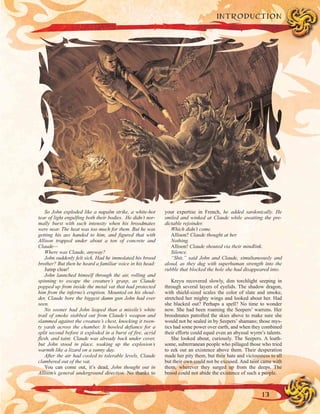
So John exploded like a napalm strike, a white-hot
tear of light engulfing both their bodies. He didn’t nor-
mally burst with such intensity when his broodmates
were near. The heat was too much for them. But he was
getting his ass handed to him, and figured that with
Allison trapped under about a ton of concrete and
Claude—
Where was Claude, anyway?
John suddenly felt sick. Had he immolated his brood
brother? But then he heard a familiar voice in his head:
Jump clear!
John launched himself through the air, rolling and
spinning to escape the creature’s grasp, as Claude
popped up from inside the metal vat that had protected
him from the inferno’s eruption. Mounted on his shoul-
der, Claude bore the biggest damn gun John had ever
seen.
No sooner had John leaped than a missile’s white
trail of smoke stabbed out from Claude’s weapon and
slammed against the creature’s chest, knocking it twen-
ty yards across the chamber. It howled defiance for a
split second before it exploded in a burst of fire, acrid
flesh, and taint. Claude was already back under cover,
but John stood in place, soaking up the explosion’s
warmth like a lizard on a sunny day.
After the air had cooled to tolerable levels, Claude
clambered out of the vat.
You can come out, it’s dead, John thought out in
Allison’s general underground direction. No thanks to
your expertise in French, he added sardonically. He
smiled and winked at Claude while awaiting the pre-
dictable rejoinder.
Which didn’t come.
Allison? Claude thought at her.
Nothing.
Allison! Claude shouted via their mindlink.
Silence.
“Shit,” said John and Claude, simultaneously and
aloud, as they dug with superhuman strength into the
rubble that blocked the hole she had disappeared into.
Kreyu recovered slowly, dim torchlight seeping in
through several layers of eyelids. The shadow dragon,
with shield-sized scales the color of slate and smoke,
stretched her mighty wings and looked about her. Had
she blacked out? Perhaps a spell? No time to wonder
now. She had been roaming the Seepers’ warrens. Her
broodmates patrolled the skies above to make sure she
would not be sealed in by Seepers’ shamans; those mys-
tics had some power over earth, and when they combined
their efforts could equal even an abyssal wyrm’s talents.
She looked about, curiously. The Seepers. A loath-
some, subterranean people who pillaged those who tried
to eek out an existence above them. Their desperation
made her pity them, but their hate and viciousness to all
but their own could not be excused. And taint came with
them, wherever they surged up from the deeps. The
brood could not abide the existence of such a people.
13
INTRODUCTION
Then they came. They boiled forth from the caverns
below, their shapes only vaguely man-like. She lashed
through their front ranks with her razor-sharp tail.
Several dove beneath her, stabbing with burning-bright
spears at her soft underbelly, but she managed to leap
sideways and up, twisting and lashing as she launched
through the air, before they could do much damage. Her
arc ended high up on a nearby wall, and she clung there
with her claws deep in the stone, hurling spells at her
foes.
Then she realized . . . there was something else com-
ing. It loomed above the back rank of its minions, an
unnatural light from below reflecting off its slick, alien
flesh. It was evil where the seepers were only pathetic,
it was dangerous where they were only a nuisance, and
it was older, far older even than she . . .
Allison’s eyes snapped open. She was herself again,
and once more in the tunnels near the Thames.
Everything had returned to normal, except for the howls
of the seepers. They had followed her through the ages,
echoing in her mind. Then she realized with alarm that
the echoes were not in her mind at all, but rather in the
tunnels all around her. They were coming, and if her
flashback was accurate, as it usually was, something
pretty damn scary was coming with them.
Guys, she thought forcefully to her broodmates, the
sound of whose desperate digging was reaching her,
You’d better either hurry up and get me out of here, or
blow this joint and seal me in with the roaches.
Something’s coming . . . something way worse than us.
If they answered, she couldn’t hear them.
FINDING ALLIES
It was no difficult feat for John and Claude to clear
away the rubble that blocked them from the under-
ground chamber. Once in, however, they couldn’t find
any trace of her.
Although they had seen Allison work her spells a
thousand times, neither John nor Claude had bothered
to learn wizardry themselves. And with no magical way
of locating her, and their contacts in the legal precincts
of little obvious help, they found themselves as helpless
as the cops were in their everyday encounters with the
supernatural.
As days turned into weeks, they doggedly persisted.
Someone had to be able to help them locate their sister.
They paid off hucksters, watched fortune-tellers gibber
and moan, visited candle-lit tombs where “demonolo-
gists” roared and sprayed pigs’ blood on the walls. All
to no appreciable effect. It was worse than pointless,
and just like Allison had always said: watching humans
do magic was like watching someone with no rhythm try
to dance.
But through it all, they kept up their momentum.
Neither put it in so many words, but both of them knew
that giving up would be admitting that Allison was dead.
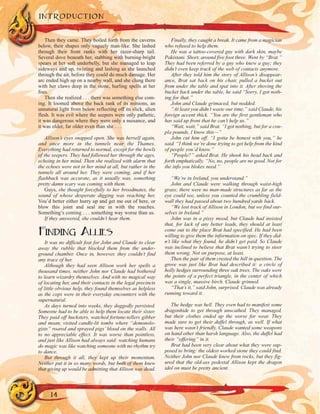
Finally, they caught a break. It came from a magician
who refused to help them.
He was a tattoo-covered guy with dark skin, maybe
Pakistani. Short, around five foot three. Went by “Brat.”
They had been referred by a guy who knew a guy; they
didn’t even keep track of the web of contacts anymore.
After they told him the story of Allison’s disappear-
ance, Brat sat back on his chair, pulled a bucket out
from under the table and spat into it. After shoving the
bucket back under the table, he said “Sorry, I got noth-
ing for that.”
John and Claude grimaced, but nodded.
“At least you didn’t waste our time,” said Claude, his
foreign accent thick. “You are the first gentleman who
has said up front that he can’t help us.”
“Wait, wait,” said Brat. “I got nothing, but for a cou-
pla pounds, I know this—”
John cut him off. “I gotta be honest with you,” he
said. “I think we’re done trying to get help from the kind
of people you’d know.”
“People?” asked Brat. He shook his head back and
forth emphatically. “No, no, people are no good. Not for
the info you blokes need.”
“We’re in Ireland, you understand.”
John and Claude were walking through waist-high
grass; there were no man-made structures as far as the
eye could see, unless you counted the crumbling field-
wall they had passed about two hundred yards back.
“We lost track of Allison in London, but we find our-
selves in Ireland.”
John was in a pissy mood, but Claude had insisted
that, for lack of any better leads, they should at least
come out to the place Brat had specified. He had been
willing to give them the information on spec. If they did-
n’t like what they found, he didn’t get paid. So Claude
was inclined to believe that Brat wasn’t trying to steer
them wrong. Not on purpose, at least.
Then the pair of them crested the hill in question. The
grove was just like Brat had described it: a circle of
holly hedges surrounding three oak trees. The oaks were
the points of a perfect triangle, in the center of which
was a single, massive birch. Claude grinned.
“That’s it,” said John, surprised. Claude was already
running toward it.
The hedge was hell. They even had to manifest some
dragonhide to get through unscathed. They managed,
but their clothes ended up the worse for wear. They
made sure to get their duffel through, as well. If what
was here wasn’t friendly, Claude wanted some weapons
on hand other than harsh language. Also, the duffel had
their “offering” in it.
Brat had been very clear about what they were sup-
posed to bring: the oldest worked stone they could find.
Neither John nor Claude knew from rocks, but they fig-
ured that the old-ass pedestal Allison kept the dragon
idol on must be pretty ancient.
INTRODUCTION
14
Wiping the sweat from his brow and looking around,
John was unimpressed. Four trees in a hedge-circle.
This is low-rent, he thought to Claude in the telepathic
equivalent of a whisper. We’re gonna get help from a
mystic that can’t even afford standing stones?
But no sooner had he zipped open the duffel and set
the pedestal on the ground than a low groan issued from
the earth. It was deeper than any hipster’s bass sound
system. The ground trembled, and the two scions took
wary steps backward. John’s eyes began to flame—
always his first reaction to the unexpected. Claude
ignored John’s response, and instead did what Brat had
told him to do: focused his karma on the ground in front
of the birch. He reached into his inner being, what he
thought of as his deepest self, and just . . . gave it.
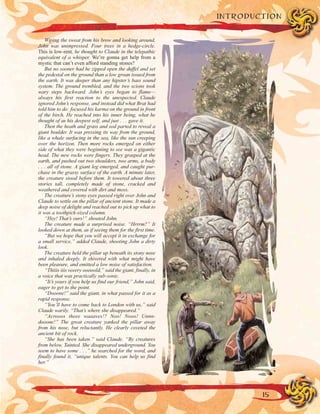
Then the heath and grass and sod parted to reveal a
giant boulder. It was pressing its way from the ground,
like a whale surfacing in the sea, like the sun creeping
over the horizon. Then more rocks emerged on either
side of what they were beginning to see was a gigantic
head. The new rocks were fingers. They grasped at the
earth, and pushed out two shoulders, two arms, a body
. . . all of stone. A giant leg emerged, and caught pur-
chase in the grassy surface of the earth. A minute later,
the creature stood before them. It towered about three
stories tall, completely made of stone, cracked and
weathered and covered with dirt and moss.
The creature’s stony eyes passed right over John and
Claude to settle on the pillar of ancient stone. It made a
deep noise of delight and reached out to pick up what to
it was a toothpick-sized column.
“Hey! That’s ours!” shouted John.
The creature made a surprised noise. “Hrrrm?” It
looked down at them, as if seeing them for the first time.
“But we hope that you will accept it in exchange for
a small service,” added Claude, shooting John a dirty
look.
The creature held the pillar up beneath its stony nose
and inhaled deeply. It shivered with what might have
been pleasure, and emitted a low noise of satisfaction.
“Thiiis iiis veeery ooooold,” said the giant, finally, in
a voice that was practically sub-sonic.
“It’s yours if you help us find our friend,” John said,
eager to get to the point.
“Dooone!” said the giant, in what passed for it as a
rapid response.
“You’ll have to come back to London with us,” said
Claude warily. “That’s where she disappeared.”
“Acrooos theee waaaves!? Noo! Nooo! Unnn-
dooone!” The great creature yanked the pillar away
from his nose, but reluctantly. He clearly coveted the
ancient bit of rock.
“She has been taken.” said Claude. “By creatures
from below. Tainted. She disappeared underground. You
seem to have some . . .” he searched for the word, and
finally found it, “unique talents. You can help us find
her.”
15
INTRODUCTION
It was obvious that the creature was torn. It kept gaz-
ing longingly at the toothpick-pillar, which it still held in
its hand, then glanced uneasily over its shoulder, in
what Claude and John imagined must be the direction of
the ocean.
“Surely you’re no friend of taint,” began Claude, but
before he could continue:
“NNNOOOOO!” The giant bellowed; the ground
shook. “Nooo friennnd of theiiirs!”
The giant breathed hard. It looked to John like it was
hyperventilating.
“Nooo friennnd of the Thoooose Whooo Dwwellll
Bellllowww ,” it added, a bit more calmly. The massive
creature slowly began to sit, and after a moment, had
completed the ponderous repositioning.
“Telll meee ooof . . . youuur friennnd . . . “
The giant, it turned out, was terrified of water. John
and Claude had been forced to redeem a great deal of
the treasure in Allison’s crypt to hire a large ship with an
even-keeled crew. Even then, it was hard to tell who was
more nervous on the trip across St. George’s Channel to
Cardiff: the sailors giving a wide berth to the huge
wooden crate that hummed to itself, or the giant inside
it that tried to take its mind off the miles of water all
around it.
For all the difficulty, though—and all the time it took,
nearly seven weeks since they had seen or heard from
their missing brood-sister—Claude and John finally
found themselves in the underground chamber where
she had disappeared, the stone giant half submerged in
the stone of the place, sticking up out of the ground from
the waist up. He walked through rock as if he was wad-
ing in a pool of water.
And the giant began to sniff.
It sniffed the rock of the chamber from top to bottom,
and from side to side, sucking in great whiffs of air and
dust, sticking its fingers in the smallest crevices they
could fit in to coax more rock-smell out from them. Then,
suddenly, the giant bellowed. The whole cave shook.
Claude was sure the ceiling would collapse. Then the
creature crashed his fist into a niche in one of the walls.
Where his stony fist struck, Hell opened up.
The rock crumbled to reveal some kind of portal. It
generated a howling, vicious wind, sending dirt, rocks,
and trash flying through the cavern. The noise was deaf-
ening. Beyond it was a tunnel leading to what seemed
like another world, full of flame and light and sound.
Where do you think that goes? John thought to his
brood brother.
Claude sent back the mind-speech equivalent of a
shrug. I do not know, he elaborated after a moment. But
evidence suggests that it is where Allison was taken.
And that was enough for either of them. With the
unity of a single mind, John and Claude strode through
the portal, toward whatever fate awaited them, in this
world or another. As they passed through the gaping
maw of stone and wind and magic, John’s eyes flashed
red with heat and light—for he was Fireborn.
INTRODUCTION
16
MODERN AGE MAGIC
On the fifth of February, in the Year of Our
Lord 2001, on the Chinese New Year, magic
returned to the world.
It didn’t return with a rain of fire or the voice
of God thundering in the night. It came back with
the buzzing of cell phones, the stirring of faxes,
the downloading of pixels.
A ritual. Just like the one that accidently sent
taint and karma alike scurrying out beyond reali-
ty and brought the mythic age to a deadly, dra-
matic end. Spanning the globe, just like the other.
Powered by the sacrifice of life, of innocence, of
blood and wealth, just like the other. Spawned by
greed and power, just like the other.
But whereas the ancient ritual caused the end
of an age, the modern ritual gave birth to a new
one, plugging the hole through which karma had
been draining. The center of the ritual was hidden
deep in the catacombs beneath London. And it is
there that the karma welled up, inexorably rising
like a lake filling a basin. That’s when the strange
times came.
Creatures started appearing in very clear pho-
tos and videotapes, taken by quite reliable wit-
nesses. Spoon-benders, once easily debunked by
the likes of Penn & Teller, could suddenly subject
their “trickery” to the scientific method. Secret
cults, brooding in dusty corners since the Dark
Ages, were suddenly able to perform rituals that
worked. After centuries of self-delusion, they
were as surprised as anyone.
The tendency in London had always been that,
the more you believed in the supernatural, the
more marginalized you became. Or vice versa.
But now those beliefs had payoffs. The outsiders
started to assemble an organized understanding of
magic. To know how to harness its power. They
relearned the spells of the ancients. They invented
their own. Some of these mages bent their powers
to malevolent ends, while others allied—infor-
mally, for the most part—with the righteous
authorities of church or state.
Now, all but the most resolute head-in-the-
sand ostriches know that something weird is
going on. The whackos had their usual theories:
God is back (“and boy is she pissed”); the gov-
ernment put nano-tech in the water and it got out
of hand; aliens; mass hallucination; designer
drugs; a new plague. But for the first time in cen-
turies, magic is the explanation chosen by the
common man. Things are changing, magic is real,
and it’s anybody’s guess what that means for the
world at large.
RUNNINGA
CAMPAIGN
CHAPTER
ONE
THE ROLE
OF THE GM
Running a FIREBORN campaign is more challenging
than playing a character. Yet it can be just as, and more,
rewarding. Unlike the other players, who have only their
own characters to worry about, the GM has the respon-
sibility and privilege of controlling the rest of world.
Furthermore, the GM rules on what the characters can
and cannot do, and the results of their actions. It sounds
like a lot to handle, and it can be. But the rewards are
many, including the satisfaction of telling a great story,
running a fun campaign, making your players happy,
and giving everyone tales to tell for years down the
road.
The role of the GM can be
broken into the following,
bite-sized tasks.
DESIGNING
CAMPAIGNS
AND
ADVENTURES
When the players get
together for a session of
FIREBORN, what do their
characters do? Do they hunt
brain-eating demons in back
alleys? Do they try to stop a
plan to assassinate the Prime
Minister? Do they infiltrate
an occult conspiracy dedicat-
ed to world domination?
While the players certainly
have some influence on the
adventure, these questions
can ultimately only be
answered by the GM.
DESCRIBING
THE WORLD
As the GM, you are the
players’ senses in the world.
It’s up to you to describe not just what the characters are
seeing (“There’s a guy on the roof with a rifle, and a car
in the street coming right at you”) but what the world
sounds, smells, tastes, and feels like as well. The more
vivid your descriptions of the world, the more excited
your players will be to interact with it, and the more eas-
ily they will be able to do so.
PLAYING NPCS
From the recurring villain to the old lady next door, a
FIREBORN campaign is full of NPCs. It’s up to you, as
GM, to bring this cast to life. Some of this task is strict-
ly tactical. In combat, for instance, you decide how the
characters’ enemies and allies attack and defend. But
just as often, you’ll be roleplaying the NPCs in narrative
scenes. The goal is to make them unique, memorable
characters, not just sacks of APs waiting to be attacked
or looted.
KNOWING THE RULES
Just as your players are counting on you to describe
the world, they are trusting you to make sure the world
works the way it should. You should be intimately
familiar with the rules. After all, as the GM, your rulings
are final. If you don’t
arbitrate fairly and con-
sistently, your players
may become frustrated or
lose faith in you.
HAVING FUN
The point of the game
is to have fun, and the
heart of being the GM is
to make sure that hap-
pens. Be sensitive to your
players. If they’re bored,
speed things up. If they’re
lost, throw them a clue. If
they’re frustrated, find
out what the problem is
and how you can help
solve it. Sometimes, help-
ing your players have fun
might even mean ignor-
ing the rules or changing
your adventure. That’s
fine, so long as you’re
still having fun too.
While running a
FIREBORN campaign is
very similar to running
any other RPG, the world
and system make the
specifics of the campaign
distinct from other games. Between flashbacks, broods,
and the mysteries of magical London, designing and
running a FIREBORN campaign is as unique as it is chal-
lenging.
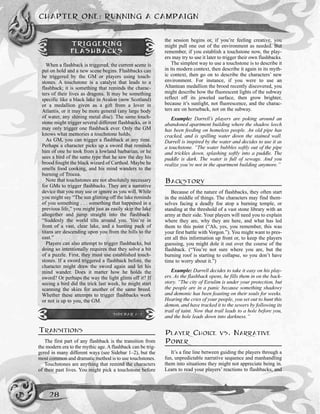
CHAPTER ONE: RUNNING A CAMPAIGN
18
DESIGNING A
CAMPAIGN
The best FIREBORN campaigns are those that are
planned out ahead of time. This doesn’t mean that you
should detail every encounter of every adventure before
the players ever come to the table, but you should have
a general idea of your campaign’s goals, its campaign
arcs, and its themes before the first session.
CAMPAIGN GOALS
When presented with a new campaign, the first ques-
tion many players ask is, “What do our characters do?”
Part of that answer is up to your and your players’
desires. However, there are two goals that are likely to
be universal to all FIREBORN campaigns: stop the taint,
and remember the past.
STOP THE TAINT
Taint is spreading throughout the modern age in
FIREBORN, heralding not only the eventual corruption of
humanity, but another death of dragonkind, as well. The
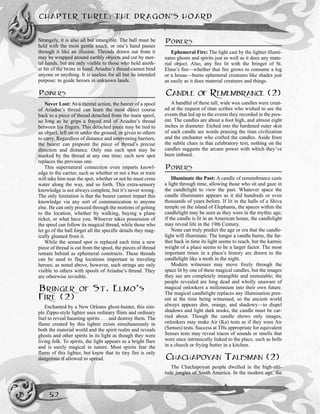
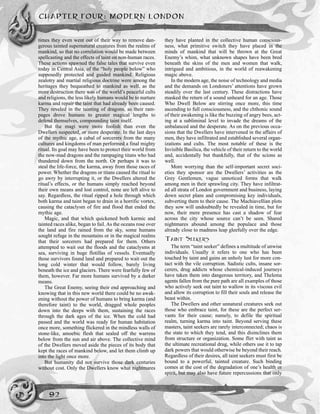
war against taint is fought on many fronts: by tooth and
claw in the lairs of Those Who Dwell Below, by gently
encouraging those who are tempted by taint to resist its
seduction, or by systematically destroying the power
bases of those who use magic unwisely or have given
themselves over to dark masters. The specifics of what
manifestation of taint the characters will face at any
given time, and how they’ll stop it, is determined large-
ly by the campaign arc (see below).
REMEMBER THE PAST
The scions’ powers and true identities are locked
away, and can only be unlocked by memories of the
mythic age. These memories are usually in the form of
flashbacks, which give the scions insight to their previ-
ous selves, to the dangers of taint, and to the workings
of karma. Unlike other goals, which may be accom-
plished over the course of the campaign, remembering
the past is a goal that can never be fully realized. It is an
ongoing quest for all scions, and a karmic thread woven
through the very fabric of who and what they are.
CAMPAIGN ARCS
The two core goals above can be seen as both sur-
vival tactics and destinies for all scions. Eventually, all
scions must try to stop the taint and remember the past,
or die trying. Campaign arcs determine how the charac-
ters can achieve those goals and what obstacles are
placed in their way. They give the characters specific
options over the course of each adventure. Do they
break into museums to steal magic artifacts? Visit col-
lege campuses to recruit fledgling magi into their mys-
tic circle? Or do they stalk the back alleys by the light of
the full moon, hunting for creatures whose names have
been lost for millennia?
Furthermore, your players may have their own goals
for the campaign as a whole or for each campaign arc.
Maybe they want to form an underground resistance
movement that communicates with its member via a
hybrid of magic and technology. Perhaps they want to
investigate corrupt governments or corporations and,
when necessary, take them down. Before designing your
campaign, be sure to discuss it with your players to see
if they have goals in mind. If they do, and your cam-
paign doesn’t give them a chance to pursue those goals,
they are bound to be disappointed.
Below are just a few suggested campaign arcs.
RAW RECRUITS
In this campaign arc, the characters begin their new
lives ignorant of their true natures and the magic in the
world around them. After a flashback “awakens” them
to the truth that the world is not as it seems, they are
recruited by a more knowledgeable creature or group
that serves as their mentor, patron, and guide.
During this campaign arc, the characters discover
and learn to use their new powers against a backdrop of
returning magic. Just as they are developing their own
abilities and other newly awakened supernatural crea-
tures are adjusting to the modern age, the normal
humans of London are likewise discovering a mysteri-
ous and awe-inspiring new aspect to reality.
The characters have no real agendas of their own (at
least, not at first) but are given instructions to be carried
out. The patron’s enemies are the characters’ enemies.
Though they may not realize it immediately, the charac-
ters have been recruited into a war they know little
about, and are serving as front-line soldiers against an
enemy they have never met. The more the characters
learn about what’s going on in the world, the more inde-
pendent they are likely to become. In time they will out-
grow their patron altogether, and may want to branch off
to start a new campaign arc of their own choice.
The raw recruit campaign arc is especially well-suit-
ed for new players starting their first FIREBORN cam-
paign. Because their characters are discovering the
world as they go, the players don’t have to worry about
knowing the setting intimately before the campaign
begins.
TREASURE HUNTERS
In this campaign arc, the characters track down and
“recover” (which often means steal) karmic items,
enchanted artifacts, and other treasures. They may be
motivated by a mentor or patron (who gives them leads
CHAPTER ONE: RUNNING A CAMPAIGN
19
on what to find and where), or may be driven by their
own greed and desire for power.
The specifics of the treasure the characters seek may
vary from one adventure to the next. Maybe they’re
looking for a set of six enchanted kris daggers hidden
during the height of the empire of Atlantis. Or perhaps
the treasures are worthless baubles that provide a pow-
erful connection to the past, allowing the scions to relive
the most important points of their previous lives.
Beyond the searches for smaller treasures, the long-term
goal of the campaign might be a quest to find a single,
world-shakingly powerful item.
Elements of a treasure hunter campaign arc include
lots of travel, research, stealth, and facing down not only
the keepers of the treasure (these things are always pro-
tected), but rival treasure hunters as well.
MONSTER HUNTERS
In monster hunter campaign arcs, the scions work
together to find and take down supernatural creatures.
While they might stalk the night for altruistic reasons
(werewolves are eating people in the forest), they might
do it out of greed or lust for power (werewolf blood
makes a powerful mystic elixir). They might even just
do it for the thrill of it, or because they can gut monsters
and leave them in the sewer without worrying about
doing jail time for it.
The world of FIREBORN is full of monsters to hunt.
Some are tainted creatures slinking through the sewers.
Others are vampires, zombies, and similar “traditional”
monsters loosed by the rising of magic. Many humans
could be viable foes, despite having no supernatural ori-
gins: many would question the humanity of evil mages,
greedy power-brokers, drug dealers, and rapists, and
few would disagree if you called them “monsters.” Even
fellow scions that have given in to taint must be taken
down. Hunting other scions can be a unique experience
for the players, for it shows the seductive power of taint.
The characters may see dark reflections of themselves in
the very beast they are trying to destroy.
Each adventure typically presents the players with a
new threat to track down and kill. Common monster-
hunting campaign elements include investigating
reports of monsters, researching the creature in ques-
tion, and climactic battles against fearsome foes.
DEFENDERS OF MAN
In the mythic age, some dragons appointed them-
selves as guardians. They watched over mankind, pro-
tecting it from threats both within and without. Today,
some reawakened scions continue this tradition. Unlike
their earlier incarnations, modern scions have a deeper
connection to humanity, and are therefore more con-
cerned with humanity’s lot.
In this campaign, the characters are heroes, pure and
simple. They defend the weak against those who would
harm or exploit them, and work to improve the lives of
those around them. While they probably hunt monsters
or seek treasure, they do so only as a means of protect-
ing mankind, not for personal gain or enjoyment.
Characters in a defenders of man campaign arc might
operate a private investigation office (“We help the
helpless”), work with the police (“Looks like the cops
found another body”), or just roam the streets at night
looking for people in trouble (“This is MY neighbor-
hood, creep”). Others may be associated with a patron,
perhaps a secret society, that can provide them with
resources and point them towards problems in need of
heroes.
HUNTED
In this campaign arc, the characters must abandon
their old lives and take up a new existence on the run.
Someone or something is after them, and if they stay in
one place too long, those hunting them will find and
destroy them.
Conspiracies make good hunters, since they can have
agents anywhere. Maybe a secret society has discovered
the scions’ true natures, and has dedicated all of its
resources to their capture. Or perhaps the characters are
being chased by a powerful, taint-corrupted enemy left
over (or reincarnated) from the mythic age, who is seek-
ing vengeance upon them for some crime they don’t
even remember.
The hunted campaign arc can often be combined with
other archetypes to provide a conveniently serialized
format for your campaign. Each adventure is a stop on
the characters’ ongoing journey. When the adventure
has been resolved, the hunters move in once more, and
the characters are on the run again.
QUEST FOR TRUTH
There is more to reality than what we see. The truth
of the world of FIREBORN is strange, seductive, and ter-
rifying. Because magic is real, there are horrors and
wonders beyond imagining if you know where to look.
In this campaign, the characters are dedicated to dis-
covering the world’s true nature. They are not content to
merely live in a time of magic. Instead, they seek to
understand its hidden truths. They seek their place in it.
This place is found through the discovery of arcane
knowledge, mystic enlightenment, or the wisdom of
strange and secretive mentors. It can also be found, of
course, through the rediscoveries of the scions’ true dra-
conic selves.
For every person who seeks the truth, there are scores
who wish to keep it hidden. Knowledge is power, and
those with the power want to keep it for themselves.
Therefore, characters in this campaign arc are sure to be
confronted not only by rival truth-seekers, but by the
keepers of the truth who are willing to threaten, lie, and
even kill to keep the truth from being discovered.
CHAPTER ONE: RUNNING A CAMPAIGN
20
GUARDIANS OF SECRET KNOWLEDGE
Once the scions find the truth or uncover the secret
knowledge they were looking for, they must decide
what to do with it. They might use it for their own gain,
but at what price? They could bring the knowledge to
bear on the war against taint and their enemies, but
doing so may be as dangerous as it is powerful. They
might even bequeath the information to those that they
think can use it the most wisely . . . but first they must
ensure that the recipients of the knowledge can be trust-
ed. Or maybe they just sell it off to the highest bidder.
Usually, however, scions in this campaign arc choose
to keep the knowledge safe and secret, and decide that
they are the best guardians to do so. Since knowledge is
generally desired by all the powers of the modern age,
whether mystical or mundane, this gives the GM an
opportunity to bring many enemies into the picture
simultaneously. The scions will have to decide if the
secrets they guard are worth facing off against several
foes at once . . . or if they are particularly savvy, they
may even be able to play those foes against one another.
BUILDING A POWER BASE
In this campaign archetype, the characters pool their
powers and resources to establish a solid power base for
themselves in order to better accomplish their other
goals. This power base might take any number of forms:
a street gang, a consulting firm, a mercenary band,
or even an occult secret society.
Working with others, the characters can
accomplish greater things than they could
working alone. However, an estab-
lished power base makes a much
better target than a few scions with a
dream and half a plan. The charac-
ters’ enemies have an easier time
finding and attacking them,
and the scions often have
to spend a lot of time pro-
tecting their human
allies from harm, res-
cuing them from
hostage situations, or
simply bailing their
asses out of trouble.
A power base campaign
arc typically has more “big pic-
ture” elements than other cam-
paign arcs. Depending on the
nature and scale of the characters’
power base, they may have to
deal with budgets, clients, and
public perceptions of their opera-
tion.
CAMPAIGN THEMES
Your campaign’s goal and arcs determine what the
characters do during the campaign, but the campaign
theme suggests what it all means. Goals and arcs are
obvious and concrete, but theme is subtle. You should-
n’t tell your players what the theme is. Let them discov-
er it on their own. If they don’t figure it out, that’s fine.
They don’t need to know the theme to play the game.
But as GM, your campaign’s theme can help guide you
as you determine what happens next, and how it all
unfolds.
You might be tempted to give your FIREBORN cam-
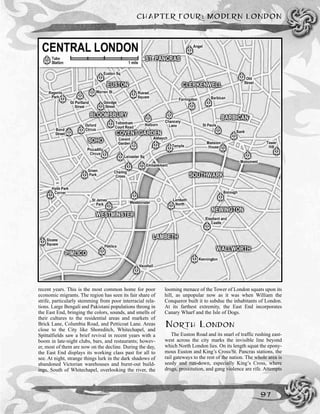
paign several themes. Resist the temptation. Pick one,
and make it your focus. The theme may complement the
campaign’s goals and arcs, or it might oppose them as
an ironic counterpoint. The theme might even change
over time; once you feel a theme has exhausted its use-
fulness, it’s time to shake up the campaign with a new
one.
Below are just a few examples of themes and sug-
gestions for how to use them in your campaign.
PURITY VS. CORRUPTION
The most obvious way to use this theme is with taint,
but corruption comes from many sources—even those
considered good. Knowledge can corrupt, and enlight-
enment corrupts happiness.
WAR
The campaign may
take on a militaristic
tone, with talk of “battle
lines,” “casualties,” and
“collateral damage.”
Does it glorify war?
Condemn it? Or does it
explore the complexities
of war, wherein terrible
things are done for right-
eous reasons?
INTRIGUE
Straight-up battle is
rarely the way to go with
this theme. Spying, sub-
terfuge, and lying are
much more effective.
Secrets are weapons,
and revealing them is an
act of war.
CHAPTER ONE: RUNNING A CAMPAIGN
21
HORROR
Reawakening to your draconic identity is terrifying.
What you’ve known to be reality is suddenly stripped
away, leaving you with nothing to hold onto. Nightmare
creatures you’ve never dreamed of are real and stalk the
streets outside your window. The mysterious, unknown,
and threatening nature of the world seeps through the
campaign, coloring everything that happens with shades
of horror.
IDENTITY VS. APPEARANCE
You are not who you appear to be. This is very true
for the scions, but in this campaign, it might be true for
everyone. The garbage man is a spy, the spy is a novel-
ist, and the novelist is a drunken occultist with dreams
of unholy power.
DRACONIC INSTINCTS VS.
HUMAN NATURE
Dragons are fundamentally different from humans.
As scions, the players’characters bridge the rift between
the two, but may find themselves torn. A campaign with
this theme will probably rely on a lot of flashbacks, pro-
viding stark contrast between the dragons of the mythic
age and the humans of the modern era.
THE FANTASTIC VS. THE MUNDANE
The characters are now part of a magical, dramatic
world where anything can happen, and adventure waits
around every corner. But they still need to go to work,
deal with customers, suck up to their bosses, and put up
with annoying friends and relatives. Even if they’ve left
their old lives behind, they still have to live in the mun-
dane world of traffic jams, irritable shopkeepers, and
long lines at the airport. At some point, the characters
may have to choose between the fantastic and the mun-
dane—or they might have to learn to balance the two.
CHANGE, GROWTH, AND
ENLIGHTENMENT
Every day, the characters learn something new about
the world or about themselves. Every day, they become
a little better at being scions. And every day, they
become a little more like the dragons they truly are.
MEMORY VS. REALITY
Flashbacks can lie. Dragons are ancient creatures,
and their memories are fallible. In this campaign, the
players can never truly trust what their characters
remember of the mythic age, and may find themselves
questing to discover truths within truths.
THE SETTING
OF FIREBORN
Modern London is the default setting for FIREBORN
campaigns. This ancient city has arisen as the epicenter
of a magical awakening, its forgotten pools running over
with karma once more. Karma attracts those who seek to
use it, both for good and for ill, as well as those who
want to taint it. And so London has become the focal
point of this magical struggle, with dragons, monsters,
and secret societies all competing for their piece of
karmic power.
WHY LONDON?
There are many reasons to set your campaign in
London. Beyond the obvious (it’s the setting detailed in
this book), the city has much to offer.
ATMOSPHERE
London is terribly old, yet thoroughly modern.
Ancient Roman ruins exist side-by-side with 21st-cen-
tury office towers, vehicles travel down super-highways
and cobbled roads, and each day thousands of people
drive over a river as old as mankind. All these elements
combine to give London a rather unique atmosphere of
the old co-existing with the new. In other words, an
atmosphere perfectly suited to a FIREBORN campaign.
In the world of FIREBORN, this goes one step further.
That which seemed mystical becomes mystical. In the
scions’ London, supernatural creatures and magical
places of power have always been there, slumbering
beneath its streets and hidden in its walkways and thor-
oughfares. If karma had pooled somewhere like
Albequerque or Cleveland, there might not be much of
a mythic legacy for it to reveal; in London, however, all
it takes is the return of karma for reality itself to turn on
its head and all manner of living folklore to be revealed.
COSMOPOLITAN
As a major city, London attracts people of all sorts,
from all around the world. It has an incredibly diverse
population with countless different cultures, subcul-
tures, counter-cultures, cliques, and fringe groups. As a
result, strange people acting strangely (like the scions
being themselves) rarely earn a second glance. With the
return of magic, the strange has become normal, the
mystic has become an accepted oddity, and terrible
nightmares have become frightening realities. Whereas
the small-town police might come out in force to check
out a circle of punks chanting over a sword in a back
alley, the cops in London have much worse to deal with.
That scene becomes nothing more than a footnote in a
CHAPTER ONE: RUNNING A CAMPAIGN
22
tabloid-spread of the bizarre. (“Honey, guess what I saw
on the way to work.”) The players aren’t completely
immune to public notice (“You just stole my car!”) but
for the most part, they are free to adventure.
PRACTICAL
There’s a kernel of truth to the stereotype of the stoic
Brit. Londoners in particular are adaptable and flexible.
The United Kingdom has gone from being an island of
barbarians to the world’s largest empire to a sidekick to
the superpowers. If they as a people can adapt to those
sweeping changes, they can accept the strange times and
do what needs to be done to get through them. There’s
no reason to get hysterical; if magic is real, there’s noth-
ing for it but to shoulder on and learn to live with it. Not
to mention that the tourists have been stomping around
for years trying to find real faerie mounds and King
Arthur’s bones, and everyone’s grandmothers are
always telling those dusty tales about the wee folk and
what signs to make when you pass an old man with a
wheelbarrow on a dark country road; now maybe every-
one will stop their gobbing and get on with their lives.
LIMITS FOR THE GM
The world may eventually experience changes as
magic returns, but if your players don’t leave London
and its immediate environs, you don’t have to extrapo-
late what those changes might be. As karma spreads far-
ther outwards, there may be hotspots of angry spirits in
North America, a rise of vampires in Eastern Europe, or
a growing cabal of necromancers in Africa, but you
don’t have to care. (This isn’t to say that you shouldn’t
use them as plot ideas, just that you aren’t required to
acknowledge them.)
LIMITS FOR THE PLAYERS
So you’re a reawakened immortal dragon with the
potential to develop near-godlike powers. What do you
do? What do you want to do? If the players have the
whole world at their disposal, it can be a bit intimidat-
ing. Setting the campaign in London gives the players
boundaries that can lead to creativity and inspiration; it
gives them something to focus on. Furthermore, since
players like to know what they’re getting into before
acting, it’s a lot easier for them to know London than it
is to know the entire world. Facing limitless options
(and the possibility of exploring every single one of
them) is a bit overwhelming, and players without
boundaries could be paralyzed instead of challenged.
CHAPTER ONE: RUNNING A CAMPAIGN
23
CATCHING THE
FIRST FLIGHT OUT
OF HEATHROW
Maybe you’re bored with London. Or maybe you
don’t like the atmosphere, don’t care if the locals freak
out, and see a campaign without geographic limits as an
exciting new challenge. That’s fine. If you’re willing to
do the work, there’s no reason you can’t move your
campaign anywhere you want. Below are a few sugges-
tions for doing just that.
BRAVE NEW CITY
What if magic reawakened not in London, but in
Paris? Or New York? Or your hometown? As GM, you
can make it happen. But when planning your campaign,
you should think about what makes the new setting dif-
ferent from London.
How does the local culture react to magic and weird-
ness springing up through the cracks? Do the locals
ignore it, or do they take up arms against the creatures
of the night? Does the local university send out teams of
scholars to take readings? Do they call in the Inquisition
and start witch trials? Does the government get involved
with its secret labs, smoke-filled rooms, and men in
black?
Also, consider who the other power players in town
might be. While some secret societies are sure to show
up wherever the magic is, others might be local. Maybe
they’ve been here for hundreds of years, but now that
there’s real power to be had, they’re not about to share
it with scions and outside cabals.
The same thing goes for fae creatures, Those Who
Dwell Below, and any other supernatural entities popu-
lating your campaign. Some are sure to be common both
to London and to your new city, but some monsters are
regional, spawned of local fears and legends. And while
taint might be as common here as it is in London, it
might take on a subtly different form, shaped by those
around it. Its corruption may be less or more hidden,
may be spiritual, or maybe it can take on a crude intelli-
gence of its own.
Finally, you should establish why your city is the new
wellspring of karma. What happened here in the mythic
age to make it so potent? Or was it something that hap-
pened recently, perhaps with a circle of sorcerers, or a
cabal of physicists? It might even be caused by the exis-
tence of a specific reincarnated entity from the mythic
age, or an item lost for millennia, now found and awak-
ened according to the ancient prophecies.
KARMA EXPLOSION
There is magic in London. The farther away from the
city you get, the weaker the karma grows, until the
world grows as mundane as your parents always told
you it was.
In your campaign, maybe this isn’t the case.
Maybe magic has broken through again not just in
London, but everywhere. Around the world, beasts of
legend are reawakening, occult societies are swelling
with power, and scions are remembering who they truly
are. This is no longer a localized event; this is a world-
wide phenomenon.
How does the world react? That’s up to you. As GM,
you must consider how each region deals with a sudden
rise in unexplained mayhem. Japan deals with it differ-
ently than Russia, and the countries of the Middle East
have a very different outlook than those of South
America.
CHAPTER ONE: RUNNING A CAMPAIGN
24
KARMA AT LARGE
When your players decide to travel outside of
London and its immediate environs, they may
notice some strange effects with regard to magic
and their powers. After all, karma hasn’t reached
everywhere.
Excepting ley lines and areas of high mystic
power, karma and taint lessen as they radiate out
from their focus in the modern age, the Chamber of
Sorrows beneath the Tower of London.
Currently, the effects of karma’s return extend
from London in a rough circle of about a 100-mile
radius. Only London itself, the central 20-mile-cir-
cle, has full karmic potential. This means that all
powers, karma expenditure, superhuman aspect
scores, etc., operate normally. Every 20 miles out
from the center, however, the karmic potential
lessens by one.
Karmic potential is essentially a cap. Within
London proper, all powers can be used, even up to
rank 5 effects; additionally, all spells can be per-
formed up to rank 5, all superhuman aspect scores
exist up to rank 6, and up to 6 karma may be bid on
automatic successes (if a base aspect score is that
high). In the second ring of karmic potential, how-
ever, which begins about 20 miles out from the cen-
ter of London, karmic potential decreases. Only
rank 4 powers and spells can be used, only superhu-
man aspect scores of 5 or lower are possible, and 5
is the maximum number of karma points that may
be bid on automatic successes.
This lessening continues outward in 4 more con-
centric circles, each approximately 20 miles further
out from the previous one, until you reach an area of
no karmic potential at all; this is the spot at which
no supernatural powers or spells may be used.
However, superhuman aspect scores of 1 persist in
areas of no karmic potential, and 1 karma may still
be bid on automatic successes; anywhere one goes
in the world, these minimums remain.
SIDEBAR 1-1
CHAPTER ONE: RUNNING A CAMPAIGN
25
Bringing magic back into the world wholesale has
vast repercussions. Magic is power. As this power
changes hands, it must likewise change the face of war,
economics, and politics. Governments may crumble.
Nations might fall. Long-subjugated peoples may
become stronger than any could have imagined, and
new superpowers may be born overnight.
Playing this sort of campaign will feel very different
from the default FIREBORN campaign. The scions are no
longer unique individuals; every country and major city
should have broods of their own, as scions awaken
throughout the world. Each brood may choose to fight
for a different cause, or all of the Fireborn could unite
under a single organization. While this sort of support
can be useful, it also means that the existence of the
scions will eventually become public knowledge, mak-
ing them more vulnerable to attack. The world knows
something is going on, and that the scions are likely part
of it. There are no shadows left in which to fight.
A THOUSAND POINTS OF KARMA
In this campaign option, London is but one of hun-
dreds or even thousands of karmic hotspots around the
world. These hotspots are very localized, and very
spread out, so as scions and others compete for karma,
some are eventually forced to leave the current spot and
go out in search of another. Of course, that spot might
already be claimed by a rival secret society, a brood of
scions, or some local supernatural entity.
A campaign like this would likely be a nomadic one,
with the scions constantly on the move from one karmic
hotspot to the next and never spending more than an
adventure or two in one place. Coming up with new
background details for each location is a challenge for
the GM, but the reward is a larger sense of travel and
adventure.
DESIGNING
ADVENTURES
The specifics of your adventures are determined
largely by your campaign. For instance, if your cam-
paign designates the characters as new recruits fighting
alongside their mentor in his war against a magic-wield-
ing mob boss, an adventure might be making a hit on
one of the boss’s warehouses. Of course, if your cam-
paign is all about horror investigation, an adventure
might have the characters sneaking through a haunted,
decrepit tenement building in the middle of the night.
Regardless of the specifics, virtually every adventure
will include certain common elements.
HOOK
How do the characters get involved in the adventure?
If they have a patron, they might just receive orders they
are expected to carry out. Or maybe they get a call from
a panicked friend in the middle of the night. Perhaps
they are haunted by dreams that warn them of impend-
ing danger (though such dreams will no doubt lead to
adventures of their own).
Come up with a hook that works for the characters. It
doesn’t have to be perfect (the players will jump at any
chance for adventure) but it should be reasonable. (“A
stranger on the street wants me to shoot the Prime
Minister? I don’t think so.”)
CONFLICT
In many ways, this is the heart of the adventure. If the
hook determines what the characters are supposed to do,
the conflict determines what stands in their way. The
obstacle might be active (“The cult of Ra is trying to kill
me!”) or passive (“The Tablet of Ra is buried beneath
four tons of rubble.”). It might even be internal, as the
characters are faced with moral dilemmas or psycholog-
ical questions (“Am I a man blessed, or cursed, with dra-
conic powers, or am I a dragon given, or trapped in, a
human body?”).
Be sure that the conflict is not too great for the char-
acters to handle. If you’re throwing enemies at them,
make certain the villains’ stats don’t overpower those of
the characters. If it’s a puzzle, mystery, or other obsta-
cle, have a solution in mind. While your players are like-
ly to come up with all kinds of outlandish solutions, you
should have an ideal direction or two that you’re pre-
pared to guide them towards and expand upon.
NPCS
Whether they’re nameless mooks, trusted allies, or
recurring villains, NPCs serve vital roles in the adven-
ture. They present obstacles and dangers, but also offer
information and assistance. More than this, they are
people with whom the players’ characters can interact;
they help bring the world to life for the players.
When designing an adventure, consider who the
NPCs will be. Is there an established nemesis or old
friend you’d like to use again? Or maybe bring in a
minor character the players seemed to like. You could
introduce a new character who brings the plot along
with him, but might stick around to play the love inter-
est. And of course, there are always the NPCs with no
names, no lines, and nothing to contribute to the story
but their fists, blades, and guns. These are fodder, and
they are a valuable part of any GM’s toolkit. Also, con-
sider the stats for the NPCs. While not everyone needs
stats, anyone with whom the characters are likely to
fight should have them. Named villains should have
their own, unique, hand-crafted stats, while “Mook 1,
Mook 2, and Mook 3” can share one set of stats.
FLASHBACKS
Flashbacks are what make FIREBORN adventures
unique. When you design an adventure, it is essential
that you design a flashback or two that is part of that
adventure. (You may choose not to include a flashback,
of course—it’s your game, after all—but this should be
a conscious decision to break from the norm.) For more
information on flashbacks, see below.
LOCATIONS
Where does your adventure
take place? You don’t have to
map out every spot you think the
characters might visit, but you
should think about where they
will go and what will be there. If
the adventure includes research
at a university library, consider
what the characters might find or
who they might talk to. If the cli-
max is a battle on the roof of a
burning tower, think about what
kind of terrain thresholds will be
involved.
Depending on the adventure,
you may want to come up with a
unique location to feature in your
adventure: a castle made of ice,
an eccentric’s mansion populated
with tigers, a foul-smelling tattoo
parlor that sells magical trinkets
on the side. By cementing the
specific details of these locations
CHAPTER ONE: RUNNING A CAMPAIGN
26
in your mind beforehand, you can really bring these
places to life during the game.
CONCLUSION
How does your adventure end? While you’ll proba-
bly never see the end you have envisioned (players are
notoriously creative when it comes to ignoring your plot
and forging their own), it’s important to have one in
mind. But it’s even more important to have in mind the
consequences of the adventure.
Adventures don’t happen in a vacuum; they happen
in a campaign. The consequences of an adventure sug-
gest what rewards and repercussions await the charac-
ters later in the campaign. If they kill the occult mob
boss, for example, his family will no doubt come gun-
ning for them. If they secure an ancient artifact that was
cursing the residents of an apartment building, those res-
idents might offer them a safe place to stay when they
need one. If they demonstrate their ability to work inde-
pendently, their mentor may release them from his care
and turn them loose into the world.
Finally, consider what kind of mechanical reward the
players are likely to earn during the adventure. How
many APs is the adventure worth (for more details on
awarding APs, see “Rewards,” page 35), and should the
characters gain any karmic items along the way?
USING
FLASHBACKS
Flashbacks are the soul of FIREBORN. They are a plot
device, a resource, and a way for players and GMs alike
to steer the direction of the campaign. Flashbacks are
powerful, and must be handled with care.
In terms of the story, flashbacks are exactly what
they seem: the characters “flash back” to scenes buried
in their past, ancient adventures they shared as dragons
in the mythic age. These scenes are memories, however,
and memories are not always to be trusted.
In game terms, flashbacks are adventures tangential
to the campaign. These adventures not only provide the
characters with insights into the campaign, but also with
the experience to put these insights to good use. And, of
course, flashbacks allow characters to regain karma. In
other words, flashbacks “power up” the characters, train
them to use that power, and then point them toward the
most appropriate manner of its application.
In most cases, flashbacks are a planned part of the
adventure. You prepare a flashback just as you would an
action scene or a narrative scene in the modern age.
Each flashback lasts a scene or two, and there are one or
two flashbacks per adventure.
Running a flashback is essentially the same as run-
ning a short adventure, but there are a few extra consid-
erations such as the purpose, the premise, the backstory,
and more. Also, there are differences between running a
flashback that you triggered and one that your players
triggered. Explanations of the key elements of flash-
backs are given below.
PURPOSE
As GM, if you trigger the flashback, you should have
a specific goal in mind; a list of likely purposes is avail-
able on page 29. Note that the players don’t necessarily
know the purpose when the flashback begins, or even
once it has concluded. Discovering the purpose should
be part of the fun, and you should encourage players to
figure it out on their own. Regardless of whether they
understand what has been accomplished, however, bring
the flashback to a close as soon as the purpose has been
achieved and any action scenes have been resolved. This
isn’t to say that you should rush through flashbacks.
Flashbacks are fun and exciting, and fulfilling one’s pur-
pose should be satisfying, no matter how long that takes.
But once that purpose has been fulfilled, you risk boring
the players and stalling the campaign if you don’t draw
it to a close and get on with the campaign. Return the
characters to the modern age where they can put the
flashback to good use.
Example: Darrell wants to run a basic investigative
flashback. His players’scions are tracking down a shad-
ow leech that somehow feeds on peoples’ life forces, so
he decides that the purpose of the flashback is to inform
the players that these creatures are only vulnerable
when they return to their corporeal, snail-like shells.
PREMISE
The premise is the plot of the flashback. The premise
should always be derived from the purpose. If the pur-
pose of the flashback is to introduce an ancient enemy,
the premise might be the characters’ first encounter with
him, the moment he betrays them, or some climactic
showdown with him. If the purpose is to reveal a magi-
cal ritual, the premise might be a conversation with a
dragon wizard, a raid on an arcane library, or even a
scene in which the characters invent the formula.
Example: Darrell wants his players to find the shells
of the shadow leeches the hard way: by slogging
through underground tunnels until they uncover the
creatures’lair. The premise of his flashback, therefore, is
that a shadow leech has taken up residence under a city-
state watched over by one of the player’s dragons, and
is eating dozens of loyal citizens each day. The charac-
ters have tracked the creature to the sewers, and have
just discovered an opening into a cavern beneath the
sewers.
CHAPTER ONE: RUNNING A CAMPAIGN
27
TRANSITIONS
The first part of any flashback is the transition from
the modern era to the mythic age. A flashback can be trig-
gered in many different ways (see Sidebar 1–2), but the
most common and dramatic method is to use touchstones.
Touchstones are anything that remind the characters
of their past lives. You might pick a touchstone before
the session begins or, if you’re feeling creative, you
might pull one out of the environment as needed. But
remember, if you establish a touchstone now, the play-
ers may try to use it later to trigger their own flashbacks.
The simplest way to use a touchstone is to describe it
in its modern context, then describe it again in its myth-
ic context, then go on to describe the characters’ new
environment. For instance, if you were to use an
Altantean medallion the brood recently discovered, you
might describe how the fluorescent lights of the subway
reflect off its jeweled surface, then grow brighter,
because it’s sunlight, not fluorescence, and the charac-
ters are on horseback, not on the subway.
Example: Darrell’s players are poking around an
abandoned apartment building where the shadow leech
has been feeding on homeless people. An old pipe has
cracked, and is spilling water down the stained wall.
Darrell is inspired by the water and decides to use it as
a touchstone. “The water bubbles softly out of the pipe
and trickles down, splashing softly into a puddle. The
puddle is dark. The water is full of sewage. And you
realize you’re not in the apartment building anymore.”
BACKSTORY
Because of the nature of flashbacks, they often start
in the middle of things. The characters may find them-
selves facing a deadly foe atop a burning temple, or
standing at the threshold of a vast stone library with an
army at their side. Your players will need you to explain
where they are, why they are here, and what has led
them to this point (“Ah, yes, you remember, this was
your first battle with Vorgon.”). You might want to pres-
ent all this information up front or, to keep the players
guessing, you might dole it out over the course of the
flashback. (“You’re not sure where you are, but the
burning roof is starting to collapse, so you don’t have
time to worry about it.”)
Example: Darrell decides to take it easy on his play-
ers. As the flashback opens, he fills them in on the back-
story. “The city of Esrulim is under your protection, but
the people are in a panic because something shadowy
and demonic has been feasting on their souls for weeks.
Hearing the cries of your people, you set out to hunt this
demon, and have tracked it to the sewers by following its
trail of taint. Now that trail leads to a hole before you,
and the hole leads down into darkness.”
PLAYER CHOICE VS. NARRATIVE
POWER
It’s a fine line between guiding the players through a
fun, unpredictable narrative sequence and manhandling
them into situations they might not appreciate being in.
Learn to read your players’ reactions to flashbacks, and
CHAPTER ONE: RUNNING A CAMPAIGN
28
TRIGGERING
FLASHBACKS
When a flashback is triggered, the current scene is
put on hold and a new scene begins. Flashbacks can
be triggered by the GM or players using touch-
stones. A touchstone is a catalyst that leads to a
flashback; it is something that reminds the charac-
ters of their lives as dragons. It may be something
specific like a black lake in Avalon (now Scotland)
or a medallion given as a gift from a lover in
Atlantis, or it may be more general (any large body
of water, any shining metal disc). The same touch-
stone might trigger several different flashbacks, or it
may only trigger one flashback ever. Only the GM
knows what memories a touchstone holds.
As GM, you can trigger a flashback at any time.
Perhaps a character picks up a sword that reminds
him of one he took from a lowland barbarian, or he
sees a bird of the same type that he saw the day his
brood fought the black wizard of Carthod. Maybe he
smells food cooking, and his mind wanders to the
burning of Trocea.
Note that touchstones are not absolutely necessary
for GMs to trigger flashbacks. They are a narrative
device that you may use or ignore as you will. While
you might say “The sun glinting off the lake reminds
of you something . . . something that happened in a
previous life,” you might just as easily skip the lake
altogether and jump straight into the flashback:
“Suddenly the world tilts around you. You’re in
front of a vast, clear lake, and a hunting pack of
titans are descending upon you from the hills to the
east.”
Players can also attempt to trigger flashbacks, but
doing so intentionally requires that they solve a bit
of a puzzle. First, they must use established touch-
stones. If a sword triggered a flashback before, the
character might draw the sword again and let his
mind wander. Does it matter how he holds the
sword? Or perhaps the way the light glints off it? If
seeing a bird did the trick last week, he might start
scanning the skies for another of the same breed.
Whether these attempts to trigger flashbacks work
or not is up to you, the GM.
SIDEBAR 1-2
use them appropriately. You may be sure that the group
is going to have fun if you thrust them into a scene with
very difficult odds in the middle of a mythic age battle,
but some players might gripe and grumble about not
being given a choice in the matter. If your players are of
this sort, use such situations sparingly, and certainly
don’t attempt them if the players are already frustrated
or in bad moods. After all, your goal is to provide a fun
roleplaying experience for your players, not use your
narrative power to thrust them into impossible fight
after impossible fight.
BACK TO THE FUTURE
The flashback is over. The purpose has been
achieved, the players have what they came for, and it’s
time to go home. This is essentially the same as transi-
tioning from the present to the mythic age: again, you
can use a touchstone to bring them back gently, or you
can just “jump” the characters directly into the modern
age.
Remember: while the players have spent hours or
days of game time adventuring through the mythic age,
their characters in the modern age are still where they
were a moment ago, lost in their own thoughts. If they
were in danger (or about to be in danger) just before the
flashback, you might surprise them out of their reverie
when that danger strikes.
SAMPLE FLASHBACK
PURPOSES
Whether triggered by the GM or the players, most
flashbacks will serve one or more of the purposes
described below. This is by no means an exhaustive list,
and you should feel free to amend, edit, and ignore it as
you wish for your campaign.
INVESTIGATION
This is the most common type of flashback. The pur-
pose of an investigation flashback is to give the charac-
ters information they need to move forward in the cam-
paign. For example, if the characters are having trouble
defeating a slime primordial in the modern age, they
may flash back to a mythic age scene in which they
killed a gigantic slime primordial by drowning it in salt-
water. Armed with the memory of the creature’s weak-
ness, they can return to the present to destroy the thing
before it kills again.
Aside from an enemy’s weakness, the characters may
also remember the location of a mystic artifact, the
details of an arcane ritual, the true name of an ancient
demon, the secret entrance to a hidden temple, or count-
less other important facts. Entire campaigns can be
crafted around investigation flashbacks, as each flash-
back provides a new piece of the puzzle of the modern
day plot.
BACKSTORY
Like investigation, the purpose of a backstory flash-
back is to give the characters information. However, this
isn’t key information that moves the plot along. Instead,
the purpose provides context to the adventure. By help-
ing the characters understand the background and histo-
ry of the adventure, the flashback can help them make
informed and dramatic decisions.
For example, if the characters are dealing with a
child possessed by an evil spirit in the modern age, they
might flash back to when one of the character’s loved
ones was possessed in the mythic age. While the flash-
back may not specifically tell the characters how to
exorcise the spirit, it makes the situation more personal
and dramatic. Furthermore, if the characters handled the
situation poorly in the past, they have a better idea of
what not to do during the present.
In a less personal example, the characters may face a
wizard using a dangerous and unpredictable style of
magic that they faced before in the mythic age. Again, a
flashback about this magic may not reveal how to deal
with it, but may show the price the wizard and those
around him will eventually have to pay. This knowledge
doesn’t necessarily help the characters take down the
mad mage, but it gives them a greater sense of urgency
now that they know what’s at stake.
DESTINY
The purpose of a destiny flashback is, appropriately, for
the characters to fulfill their destinies. There is something
they must do, something they must get right, and they will
keep on having this flashback until they remember what it
is.
This is a recurring flashback. Whenever it’s trig-
gered, the characters are returned to the same scene, and
the events of the flashback will transpire the same way
each time unless the characters do something to change
them. The characters should have other flashbacks as
well; if the players have to keep playing through the
same scene in multiple adventures, they’re sure to get
sick of it.
Perhaps the characters are faced with the assassina-
tion of a king. Each time they revisit the flashback, they
may try some new approach to save the king’s life. Or
perhaps they only assume their purpose is to save his
life, when in fact they are destined to be the assassins.
As they learn more about themselves and their lives
through the modern age and other flashbacks, the char-
acters can piece together a new course of action ahead
of time, so they know what to do when the flashback
returns.
This type of flashback should be used sparingly. It
should mean something significant, and when the char-
acters finally discover what they are destined to do, it
should be a landmark event, and they should be well
rewarded.
CHAPTER ONE: RUNNING A CAMPAIGN
29
Note that while they keep revisiting the same time
and place with this flashback, the characters are not
actually changing the past. They are merely changing
their memories of the past. Whether the king is assassi-
nated or not, the modern age remains the
same. The characters cannot change the
present by changing how they
remember the past.
DISTRACTION
While this could be con-
sidered a variation of the
“pacing” flashback, the pur-
pose of a distraction flashback is
to distract your players and buy
you some time to think. By
their nature, players are fright-
fully creative, resourceful, and
endlessly capable of under-
mining even the best-
planned adventure. When
your players throw you for a
loop, don’t panic: Just flash back
to the mythic age and put them
knee-deep in a simple stand-
alone adventure. While they
hack their way through the monster-
infested labyrinth of the mad monk
(for example), you can gather your
thoughts regarding how to get the
adventure back on track when the characters
return to the modern age.
ENERGIZING
The purpose of this flashback is to build up
karma. While most any flashback will generate
karma for the characters, players are likely to trigger an
energizing flashback specifically to “power up” before
heading into a major conflict in the modern age. These
flashbacks should be short, since their purpose is most-
ly mechanical. Let the players get what they need, then
get back to the showdown.
FORESHADOWING
This is like an investigation or backstory flashback,
but in reverse. The purpose of a foreshadowing flash-
back is to provide the characters with information that
will be useful later in the adventure. The flashback
might introduce a key plot point, an important character,
or some other element that is not immediately useful,
but is destined to come up later.
In a foreshadowing flashback, the characters might
see a series of mystic sigils that mean nothing at the
time, but take on a whole new meaning when spray-
painted on the side of a bus in the modern age. Or per-
haps the characters meet a traitorous dragon, and
remember his treachery as the scion he has become
hands them his business card in a crowded London
dance club. And if the characters watch a demon plague
wipe out a proud city-state in the mythic age, they’ll be
sure to recognize the plague’s symptoms when they
show up on the homeless who sleep in the Tube stations.
PACING
You can use flashbacks to
control the pace of
your adventure. You
can create tension by
building towards a
climax in the mod-
ern age, then flash-
ing back to the
mythic age, leav-
ing your players
with a cliff-hanger.
On the other hand,
if the adventure is
slowing down, you
can drop in a high-
action flashback to
stir things up.
Nothing takes the
tedium out of a low-
key investigation like
battling a horde of
Fomorians on the blood-
soaked plains of Avalon.
While the purpose of this
type of flashback is to control the pace of the
adventure, it should probably have some
other effect as well. After all, if you’re pulling
your players away from a climactic battle in the
modern age, they’re bound to be disappointed if
they spend the rest of the evening helping the
empress of Xia choose the proper robes for her
wedding. If their quiet evening with the empress
has some other point (such as convincing her to
join them against a tainted dragon nearby) the players
will be much more likely to forgive your cliffhanger.
RAMPAGING
Sometimes, the purpose of a flashback is nothing
more than to let off steam. Maybe the players want a
break from the mundane investigations of the modern
era. Maybe they’re tired of being beaten back by goons
with machine guns. Maybe they just want to go some-
place where no one needs a search warrant, and lawyers
haven’t been invented yet. Whatever the reason, the
CHAPTER ONE: RUNNING A CAMPAIGN
30
players want to flash back to a time when life was sim-
ple, monsters were obvious, and dragons could rampage
with impunity.
You may certainly run a rampaging flashback as a
straight-up fantasy power trip; that’s what it’s there for.
But if your players are losing focus of the big picture,
you might want to slip in some reminders of their true
calling: Maybe someone in the flashback reminds them
of a loved one in the modern age, or a situation resem-
bles a situation they are trying to leave behind. These
subtle echoes of the present can remind the players that,
while rampaging is fun, they have a higher destiny. They
have more important work to do.
STOCKPILING
The purpose of a stockpiling flashback is to build up
a hidden trove the characters can access in the modern
age. The most obvious example would be burying a
magic item in the past, so that it can be recovered and
used in the modern age. Characters might also find it
useful to secret away
journals, tomes,
mundane items
that provide
information
about the past,
and—best of
all—karmic
and enchanted
items.
While these
items might be
valuable in their own
right (ancient relics
are always worth a
lot to the collector’s
market), their true
value is as touch-
stones. If the characters
can recover, for exam-
ple, a stone chalice they
found in the frozen wastes
of Jotunheim, then they
might be able to use that chalice
in the modern age to trigger flash-
backs from that time.
Resourceful players may use stockpiling
flashbacks to retroactively stash items they need in
the modern age. For example, if the characters are fac-
ing a shapeshifter in the modern age, and need a certain
ancient talisman to stop it, they may trigger a flashback
to obtain the talisman and put it where their modern
selves can find it. When they return to the present, the
characters “remember” where they left the talisman.
Of course, just because the characters stockpile some
items, there’s no guarantee that the cache will remain
undisturbed. Over the course of the millennia between
the mythic and modern ages, there’s a good chance that
grave robbers, archeologists, construction crews, or
even the characters’ enemies might find the hoard.
(Imagine the characters’ surprise when they open an
ancient cache and find, not the magic swords they’d
been looking for, but a centuries-old stone tablet
engraved in the Kehebet language with a mocking mes-
sage from their arch-enemy.) If your players come to
rely on stockpiling, this is a good way to shake things
up.
PLAYER-TRIGGERED
FLASHBACKS
When adjudicating player-triggered flashbacks, here
are some things to consider.
PREPARATION
When preparing an adventure, keep in mind any
touchstones your players have and any flash-
backs they may try to trigger.
Maybe make some notes
about what these flashbacks
might entail. Perhaps
even consider whether
you want to permit the
flashbacks or not; after
all, if the climax of
your adventure
involves a high-
speed motorcycle /
machine gun duel,
you might prefer to
put the flashback
off until the next
adventure. Ideally,
your players will
inform you of their
intentions ahead of
time so you know their
flashback plans and can
prepare accordingly.
PERMISSION
While players can try to trigger
flashbacks on their own, they still remain sub-
ject to the GM’s plan. That is, while they can attempt to
flash back all they want, their attempts will fail unless
you want them to succeed. That being said, if the play-
ers have a touchstone and a solid purpose, you’d better
have a good reason to keep them from flashing back or
they’re going to be upset. Good reasons include keeping
the characters together (if not everyone wants to flash
back), maintaining the adventure’s pacing (“We’re in
the middle of a chase scene here!”), and a complete lack
of preparation (“You want to do what?”). All the same,
CHAPTER ONE: RUNNING A CAMPAIGN
31
in all these cases, you can still let the players trigger
the flashback later: when everyone wants to go, when
the scene is over, or after you’ve had time to prepare.
PURPOSE
Your players determine the purpose of the flash-
backs they trigger. If they don’t tell you directly
(“We’re going back to that cave to find what was
glowing at the bottom of the pit”) you should ask
them (“Why do you want to go back to the cave?”).
As always, the purpose of the flashback is most
important, but since the players are choosing the pur-
pose and the flashback, you should follow their lead
as to when the purpose has been fulfilled. When
they’re satisfied that they’ve done all they want to do,
the flashback is over.
TYING FLASHBACKS
TOGETHER
Over the course of the campaign, you will run
many flashbacks. By default, each flashback is some-
how related to the modern age. But how are the flash-
backs related to each other? It’s possible to run each
flashback as an isolated event, with no context out-
side of the modern age. But it’s more thematically sat-
isfying if there is some common, unifying element to
some of the flashbacks. When the characters flash
back, it might often be to a specific location. That
helps you establish setting. If many of your flash-
backs take place in the capital city of Atlantis, for
example, your players know what the place looks like
by the third flashback. You don’t have to describe it.
You just have to say, “You’re in the capital of
Atlantis.”
Or the common element could be a character. In
the case of long-lived creatures like fae, titans, and
dragons, she could be a recurring villain or hero. In
the case of mortals, perhaps the players deal with the
same family line, either as enemies or allies, through-
out many different epochs. You needn’t explain that
you’re tying the flashbacks together in this manner to
your players. After a couple of flashbacks, they’ll see
it for themselves, and begin looking for ways to relate
it to the campaign. (“Hey, it’s that guy again! I bet
he’s going to betray us!”)
Common elements help you establish the settings
for your flashbacks. Common elements also suggest
touchstones for both you and your players. If King
Tahenkhemen sits the throne during a series of your
flashbacks, anything that reminds you (or the scions)
of his reign might serve as a touchstone. If your
flashbacks are linked by conflict or conquest, any-
thing related to war or violence might serve as a
touchstone.
CHAPTER ONE: RUNNING A CAMPAIGN
32
OTHER
CAMPAIGN
ADVICE
FIREBORN is different from other RPGs in several
ways. Because of flashbacks, each adventure might
have several smaller adventures inside it. Because of the
dice system, the characters are versatile and able to
adapt to whatever you throw at them, but may require
more than the normal specific attention to resource man-
agement. And because they play dragons part of the
time, the players may begin the campaign with more
power than they’re used to having right off the bat.
With these differences in mind, here are a few last
items to consider while running your FIREBORN cam-
paign.
MYTHIC VS.
MODERN
Some players love the mythic age, and only enjoy the
game when playing through flashbacks. Others might be
bored with the “sword and sorcery stuff” and prefer the
cultural conflicts, conspiracy, and kung fu of the modern
age. As the GM, it’s your job to keep both types of play-
ers happy.
If this problem crops up, try to identify what ele-
ments of the specific age your player likes, then play up
those elements in the other age. If your player loves the
respect he gets as a dragon in the mythic age, you can
give him a promotion at his job in the modern age. Now
he has subordinates and the respect he desires. Of
course, if he just loves the awesome power of being a
dragon and resents every moment he has to endure as a
scion, there’s very little you can do without disrupting
your campaign. (Maybe you could allow him to have
awesome power in some other aspect of modern life,
such as great wealth, fantastic contacts, or an endless
supply of flashy vehicles . . . but of course, such things
should come with a price.)
VERSATILE
CHARACTERS
Because of the Dynamic d6 dice pool system, the
characters’ aspects are not fixed. Keep this in mind as
you design your adventures and run each encounter. The
fast character, who you expect to be able to dodge the
oncoming train, might have devoted all of his resources
to shielding his mind. The wily character, who you
expect to be able to withstand the mental onslaught but
need to be pushed out of the way of the oncoming loco-
motive, might have made a stance change to enhance his
reflexes. Just as the Dynamic d6 system gives the play-
ers more options on how to respond to any given situa-
tion, it also gives the GM more to consider when design-
ing those situations.
OVERPOWERED
CHARACTERS
In the mythic age, the players’ dragon characters are
terribly powerful. They may be too powerful for their
own good: nothing challenges them any more, and they
are nearing boredom. What do you do?
Attack the characters’ weak spots. Find problems
they cannot solve by torching them with flame breath.
Investigations are good for this: sure, they can take out
the assassins without a problem, but they need to find
them first. What about their hoards? A dragon without
his hoard can be severely limited, as it represents a
major source of his karmic power. And of course, taint
is a very obvious way to weaken dragons; it is essen-
tially their kryptonite. Finally, remember that you have
complete narrative power in the mythic age. When the
flashback begins, the characters can be in chains,
already wounded, or otherwise hobbled. Be careful with
this, however, for if you use it even twice in a row, the
players are sure to you resent you for it.
In the modern era, the scions may eventually reach
the overpowered stage as well. With firearms and high-
tech explosives, they are far less likely to feel invulner-
able, but it may happen. One approach to solving this
problem is based on the fact that the characters’ best
defense in the modern age is anonymity. If their enemies
know where to find them, they’ll need to always be on
their guard. Throw some unwanted publicity the scions’
way, and they’re sure to start acting a little more subtle.
By putting them into situations where using their abili-
ties will draw unwanted attention, you can force them to
find new, creative ways to solve their problems.
CHAPTER ONE: RUNNING A CAMPAIGN
33
GAMEMASTER
MECHANICS
CHAPTER
TWO
REWARDS
As mentioned in the Player’s Handbook, players
should receive around 1–3 APs per session, with around
8 APs per adventure. An adventure is any story arc,
made up of anywhere from one to five sessions of game-
play. An adventure should rarely reward more than 10
APs.
A good rule of thumb is to reward the players with
one AP per action scene and one per three narrative
scenes. Narrative scenes tend to be played through more
quickly than action scenes, but are still important in
terms of character development, problem-solving, and
evoking mood.
The biggest issue is not how many advancement
points to award, but what kind. PCs receive a combina-
tion of humanity points and heritage points as rewards,
and each is awarded using different criteria. Options for
dividing advancement points are presented below.
BY SCENE
The easiest way to divide up humanity and heritage
advancement points is to simply grant them to the play-
ers based on the scenes; humanity points for modern age
scenes, heritage points for flashback scenes. Each
adventure should have at least one flashback, with
preferably one per session.
The result of this method of reward is that the play-
ers improve their skills and edges far more rap-
idly than their powers. This supports a “low
magic” campaign style that is particularly
gritty or that envisions the scions as
extremely skilled humans with just a
taste of supernatural powers.
Additionally, this method means that
all of the PCs advance with the same
ratios of humanity and her-
itage points.
BY BEHAVIOR
Alternatively, a GM
may decide what sort of
advancement points a
character gains by looking
at his attention, behavior,
and tendencies. Does he go
through a modern age
investigation using his
police training, or does he
use his heightened senses?
Does he engage in combat
with a pair of pistols blaz-
ing in his hands, or does he pick up a greatsword, cover
himself in scales, and go to town? In both examples, the
first options demonstrate a reliance on human skills and
habits, and so would be rewarded with humanity points;
the second options, meanwhile, demonstrate a close
connection with and use of draconic traits, powers, and
methods, and so would be rewarded with heritage
points.
BY DESIRE
Finally, the GM can simply use an intuitive system of
rewards based on the individual PC’s goals and desires.
He records the number of action scenes and narrative
scenes, and at the end of the adventure awards an appro-
priate number of advancement points to each player.
The GM can divide up each player’s points differently,
based on his perception of their desires and focuses dur-
ing the adventure. A scion might spend an entire session
using modern weapons, taking advantage of human con-
tacts, and practicing his modern age skills, but if he does
all of that in order to retrieve a hoard item that belonged
to his draconic self in the mythic age, the GM might
skew his ratio heavily toward heritage points.
PLAYER SUGGESTIONS
For GMs that like to involve their players in deter-
mining reward types and campaign direction, there is
nothing wrong with consulting the players on what sorts
of advancement point distribution they would prefer or
think they deserve. The players review the
adventure, pointing out the actions their
characters performed that they
thought were especially cool or
interesting, and discuss the motiva-
tions and thoughts behind those
actions. If the player provides a
good argument, the GM
awards the PC the advance-
ment points as the player
prefers.
Player suggestions can
be requested regardless of
the advancement point divi-
sion criteria used. Also, as a
side benefit, this kind of
interactive reward system
gives players and GMs a
chance to review and rehash
the adventure they just com-
pleted, creating a sense of
closure for the group and
giving each individual a
chance to celebrate his
favorite moments.
CHAPTER TWO: GAME MASTER MECHANICS
35
INDIVIDUAL REWARDS
As the GM, you should refrain from giving notice-
ably disparate numbers of advancement points to differ-
ent players. Dividing up the APs into humanity and her-
itage points differently for each character is fine, and
indeed creates a more interesting brood development
than simply blanket humanity/heritage ratios. However,
one of the goals of a FIREBORN campaign is for each
player to feel like he is on equal footing with the others.
If a player never shows up for sessions, he will
inevitably receive fewer APs; so long as a player puts in
the effort and contributes to the game, however, even if
he’s not the best roleplayer in the group or the cleverest
tactitian, his character should receive the same number
of APs as the others. Likewise, even if a player demon-
strates exceptional roleplaying and excellent tactics, he
should not be rewarded with bonus APs, lest the other
players feel shafted. Instead, reward such quality game-
play with bonus dice on well-described actions or bonus
karma points regained.
DYING
Death in the modern age is permanent and devastat-
ing. The player can reincarnate, certainly, but does so in
the form of an infant. It will be a long time before a
modern age character that dies can rejoin his brood.
Death in the mythic age, on the other hand, is part
and parcel of a FIREBORN campaign. Dying and being
reborn is one of the ways that dragons grow and change.
When the dragon is reincarnated, he is still the same
being, but comes into the world with a clean slate. He
gains the opportunity to bring his power and experience
to a new perspective.
Of course, that doesn’t mean it’s easy.
DEATH AND DRAGONS
When a dragon dies in the mythic age, his spirit
reforms within 10 years minus his base Air score. When
he returns, it is as a lesser dragon, one who has incredi-
ble potential but has not yet discovered how to access it.
Most reborn dragons do not remember their previous
lives at first, and exist more as simple animals than as
sentient beings. As the years pass and they regain more
of their powers, they also regain memories. Once a
dragon remembers who he is, he can begin to search out
his broodmates, re-establish his old connections, and
regather his hoard.
It is not recommended that this process be played out
in flashbacks, except perhaps via narrative flashbacks.
One of the strengths of using flashbacks to the players’
draconic forms is that they do not change much over
time . . . while a player’s scion grows and develops and
is constantly evolving, his dragon character sheet never
needs updating and new powers never need to be
learned. Additionally, while scions in the modern age
are fairly fragile and constantly facing creatures that
may be greater than they, the mythic age is an opportu-
nity for players to become nigh-invulnerable, incredibly
powerful beings. Playing a lesser dragon dilutes that
epic feel.
MOVING ON
Because flashbacks can occur at differing intervals
throughout the mythic age, leaping forward or backward
in time, the dragon who died need not sit out of subse-
quent flashbacks. The GM can simply plan flashbacks
that take place far enough in the future that the dragon
has returned, fully aware and empowered, to the brood.
The GM’s plotline may require that certain flash-
backs be set at rapidly succeeding intervals during the
mythic age, however. If this is the case, the GM has a
few options.
DELAY THE INEVITABLE
If your modern age plotline does not require that spe-
cific flashbacks occur at specific points in an adventure,
simply delay the flashback in which the dead dragon
would not be able to appear. Play on with the rest of the
adventure or campaign, and when the player of that
dragon can’t make it to a session, shows up late, or what
have you, run the flashback then.
FALSE MEMORY
Maybe the scion felt his draconic self die and his
broodmates in the modern age remeber watching his
draconic self die . . . but everyone was wrong. They
remembered the events in the mythic age incorrectly,
and their broodmate actually survived. The death might
have been a metaphor for an emotional or philosophical
loss, or maybe it was just that the mortal wound ended
up being not so mortal. Regardless, the effects on the
scion in the modern age are the same, as it is the remem-
brance of the death, whether accurate or not, that caus-
es the penalties or grants the bonuses described below.
SUPPORTING ROLE
In many cases the pacing and narrative flow of a
GM’s modern age plotline requires specifically timed
flashbacks. When the GM has no choice but to continue
with the next flashback, even if it is set in a time too
recently after a broodmate’s death to include him in the
adventure, the player of that dragon can instead take on
a supporting role.
A supporting role can be nearly anything, so long as
it is agreed upon by the player and the GM. The brood
could have human, fae, or titan allies alongside whom
they will battle during this flashback; the player of the
recently dead dragon could take on the roles of one,
CHAPTER TWO: GAME MASTER MECHANICS
36
some, or all of these allies. Alternatively, the player
could take on the role of more permanent supporting
characters, like a broodmate’s flock of trained griffons
or the human noble that a broodmate is obligated to pro-
tect. Finally, the player could assist the GM by taking on
the role of foes, giving vital attention to the actions and
stance changes of the GM’s named characters and help-
ing combat run more smoothly.
EPIC EXCEPTIONS
If a player’s dragon dies in
the mythic age near a climac-
tic moment in the campaign,
exceptions can be made. For
instance, say a dragon were
to die in a flashback set one
month before the end of the
mythic age. Regardless of
when you run the flashback
of the end of the mythic age
itself, and regardless of what
the brood will be doing at
that moment, you’ll want
each player involved in his
full capacity as a dragon.
In cases like this, you may
resort to the equivalent of
divine intervention or the use
of epically powerful enchant-
ed items. For instance,
maybe the sheer power of
whatever climactic event the
brood is taking part in or try-
ing to stop causes the dead
dragon to reincarnate and
regain his powers almost
instantly. Finally, if there’s
real-world time for the extra
sessions to be run before the
big finale, the brood could go
on an epic quest to restore
their lost broodmate to his full power (mythology
abounds with treks to the underworld to free or resurrect
lost lovers). Finally, the brood could go in search of a
mythic ritual or enchanted item whose power, which can
only be used once, is to instantly restore a lost dragon to
his full power.
THINGS TO DO IN
LONDON WHEN YOU’RE
DEAD
Whereas dragons see death as part of a natural cycle
of growth, it’s a much more difficult experience for
scions. For humans, death is the end, the greatest fear,
and a scion who experiences his own death, albeit in a
flashback to the mythic age, is sure to be scarred.
When a dragon dies in a flashback, his scion must
make an immediate Air check with a TH equal to the
number of mythic age deaths he has experienced so far
(including this one). This is one of the few times that a
character uses an active aspect, rather than a passive
one, in response to an event. The use of Air reflects the
fact that the scion’s link to his former self has been sev-
ered, and that he is actively attempting to keep his soul,
and his sanity, whole. A check rather than a test reflects
that no level of skill or karma can be used to retain one’s
sense of self through the
journey of death; one
simply has a strong
enough will to surmount
the experience without
harm, or not.
For every success the
scion is short of the TH,
he suffers a weariness die
that cannot be removed
normally. Additionally,
for each point he is short
of the TH, the scion’s
maximum karma expen-
diture per turn in any
given aspect is lowered
by one for the same
amount of time. This
includes karma spent on
automatic successes and
karma used to activate
legacies. These penalties
are reduced by one for
each month that passes
after the scion’s remem-
brance of his own death.
HEROIC DEATHS
While death can be
shocking to a scion, it is
not universally something
to be avoided by players. After all, heroic death scenes
make for some of the most rewarding gaming sessions.
However, awarding APs to scions whose draconic
selves die heroically might simply encourage players to
purposely throw their characters into deadly situations
without much regret.
Therefore, a heroic death in the mythic age should be
rewarded, not with APs, but with an increase in the size
of the scion’s karma pool. While not seeming like a very
powerful effect, each point of karma matters during
extended combats against powerful foes. There is no
other way in the game to increase the maximum size of
a character’s karma pool, so this effect should not be
awarded lightly. Only in the most dramatic of circum-
stances, like the taking of a mortal blow for a broodmate
with the Defend action, the sacrifice of oneself to com-
CHAPTER TWO: GAME MASTER MECHANICS
37
plete a ritual that saves one’s brood, or holding off a
pack of foes while one’s broodmates escape, should the
karma pool increase be awarded.
TAINT
Taint is at once the most insidious, evasive foe of the
Fireborn, and the most dangerous. Taint is a corruption
of karma, a perverse force that is in some ways the
opposite of the karma that it once was. Taint is created
when the flow of karma is damaged or overused; the
most recognized way to cause this stretching is via the
misuse of magic by mortals. The karmic flow becomes
weak and poisoned in the area in which it has been mis-
used, and taint fills the gaps where the karma has been
pulled too thin. Once taint bubbles to the surface, it
tends to create more of itself.
THE EFFECTS OF
TAINT
Taint has several effects,
each of which impacts crea-
tures differently, as described
below.
Taint can create a feeling
of heaviness, rage, despair, or
fear. The source of these
emotions can slither in a per-
son’s subconscious for days,
weeks, or years, never fully
surfacing or revealing itself.
A character can experience
the effects of taint over and
over, and never quite be able
to recognize when he comes
under its effects.
However taint expresses
itself, it is universally nega-
tive. This is not to say that
some creatures aren’t drawn
to these feelings. Some, in fact, prefer them. After all, it
is tempting to wallow in ignorance, to resort to anger or
violence. It is much easier than facing conflicts down
the long, hard, slow way: peacefully and rationally.
It is important to note that taint is not created
through, nor does it only promote, feelings like anger,
hatred, violence, or other unpleasant human emotions
and characteristics. Such emotions and the actions that
grow from them—distasteful as they may be to some—
are not inherently tainted, because they are part of the
nature of humans. Taint is above and beside such things.
Taint comes from outside nature. Even generosity, love,
and scrupulous honesty can be manifestations of taint if
they arise from taint’s perversity.
In the world of FIREBORN, like breeds like. Places
where karma is plentiful and strong lead the natural
creatures who live there to have pure, genuine, passion-
ate lives—which in turn creates more karma. The super-
natural creatures that live in such places are aligned with
the natural order, and while they may be dangerous and
fearsome, they are also full of the rightness of the world.
Tainted areas, on the other hand, pervert the natural
processes of those locales. In such places, the unnatural
and unwholesome flourish, further corrupting the super-
natural beings that exist there, which further increases
taint. Tainted areas are the breeding grounds of creatures
whose very existence is an affront to the natural order.
PERCEPTIONS
The effect of taint (or karma) on characters’ percep-
tions is purely in the purview of the GM’s depiction of
the world around them. This gives the GM an unusual
amount of power with which to manipulate the PCs. For
instance, an area with taint 1 might seem a little stuffy
to a character. The GM may describe the NPCs there as
being somewhat shifty, or may ask the PCs for Senses
tests more frequently than normal. Meanwhile, an area
with taint 5 might make
a character feel desper-
ate, confused, or terri-
fied. The GM might
describe NPCs, and even
friends and allies, as
menacing and dark.
Things could seem to be
moving just outside of
the character’s range of
vision, it could seem
hard to breathe, or it
might be alarmingly easy
for a character to get lost.
If these grim, gloomy
descriptions were always
the case, of course, PCs
would quickly catch on
to when they were in
tainted areas. That’s why
the GM can use this descriptive style in tainted areas, or
not, at whim. The PCs will never know if the people on
the street are looking at them strangely, or if they just
think they are. Likewise, just because things are dark and
brooding doesn’t mean an area is tainted . . . that could
just be the look and style of the place or people. And of
course, the two could be intermixed: places or groups of
people that are macabre or melancholy by nature might
also be tainted, making them seem even more so. The
trick for the PCs will be to figure out when they just have
a bad feeling, or when they have a bad feeling for a good
reason.
Judicious GMs will be careful with how much
descriptive license they take with the PCs’ worlds. After
CHAPTER TWO: GAME MASTER MECHANICS
38
TAINT AND THE
DWELLERS
Those Who Dwell Below do not create taint. Their
relationship to the foul power is just like the rela-
tionship of supernatural creatures to karma:
Dwellers are of taint. But rather than being super-
natural, Those Who Dwell Below (and lesser crea-
tures of similar persuasion) are unnatural. The
chicken-and-egg question of taint and the
Dwellers—which came first?—is unanswered in
both the modern and mythic ages.
SIDEBAR 2-1
all, you are the players’ senses in the fictional world that
you describe for them. The players should be able to
rely on those senses to be accurate, as described by the
game mechanics, in most situations.
SPIRIT
The most noticeable in-game effect of taint, put sim-
ply, is to make it harder to draw on karma. If karma were
envisioned as a liquid, taint would be a viscous sub-
stance that muddies its flow. All natural and supernatu-
ral creatures are subject to this effect of taint (though of
course, since humans rarely draw on karma and have lit-
tle to begin with, they tend not to notice it). The effects
of tainted areas on the spirit are outlined below.
— Karma becomes sluggish and difficult to draw
upon. Every point of karma a character wants
to spent in a tainted area costs an additional
amount of karma equal to the area’s taint rat-
ing. For example, in an area with taint 3, it
would cost 4 karma to generate one automatic
success, 12 karma to activate an awakened
power that normally costs 3 karma, and so on.
A character’s normal limitations on maximum
amount of karma spent per action, such as his
base aspect score or his awakened rank, do not
apply to these additional costs. The character
may spend as much additional karma as he
needs for the desired effect; it is the effect itself
that is limited by the normal factors.
— Karma recovery is slowed. Whenever a charac-
ter would recover karma within the tainted area
(not including karma that replenishes after an
action scene), the character subtracts the area’s
taint rating from the number of points of karma
he regains.
SELF
Finally, the most powerful effect that taint can have,
on the Fireborn at least, is the loss of self entirely. As the
creatures on this world that are the most pure of spirit,
and the most closely tied to karma, dragons are also the
most vulnerable to the negative effects of taint. The taste
of this most unnatural energy is anathema to them.
All Fireborn have defensive responses to taint, hard-
wired into their spirits in a very close approximation of
genetic traits. These are called taint responses, and are
described in more detail below (see “Taint and the
Fireborn,” page 42). When acting out these responses,
Fireborn can draw on karma normally. These responses
are usually useful and healthy actions. Or at least, they
would be under normal conditions. As taint pushes the
responding dragon or scion further and further into his
taint response, the character’s acting out of that response
becomes more and more extreme. Eventually, if the taint
is strong enough and the character’s will weak enough,
he may find it impossible to do anything but the actions
dictated by his taint response.
Since taint eventually leads to pain, starvation, and
death, Darwinian principles would suggest that crea-
tures with the most self-destructive taint responses
would be weeded out over time. Unfortunately, the
supernatural does not follow Darwinian principles, at
least not as we understand them. Instead, taint respons-
es insidiously become, not a part of dragons’and scions’
genetic codes, but part of their psyches. As he is rein-
carnated through the centuries, a dragon’s taint response
carries on with him, becoming more ingrained with each
passing lifetime.
Ironically, while taint responses would seem to be
there to protect a dragon and help him survive in tainted
areas, they are just as much a boon to the furthering of
taint itself. After all, the more a taint response affects
others, causing fear or violence, the more likely those
others are to be forced to draw on their own karma
reserves, and the less likely they will be able to nurture
karma in the place to remove the taint. This long-term
effect of taint responses may bring one to question their
origins. Perhaps they were not a natural development
after all, but rather a slow, terrible trap that took hun-
dreds of thousands of years to be sprung.
CHAPTER TWO: GAME MASTER MECHANICS
39
TAINTED AREAS
As karma and taint are opposed to each other, no
place can have a karma rating and taint rating simulta-
neously. If a karmic area becomes tainted, its karma rat-
ing must be reduced to zero—at which point the place
becomes balanced—before it can begin to accumulate a
taint rating. The opposite is also true: A tainted place
must be cleansed and brought to a taint rating of 0
before it can be infused with karma.
CREATING TAINT
Taint is not used by most creatures, as karma is;
rather, it is created or it is endured. Like karma, which
can accumulate in items or places, taint can build up in
an area, affecting those who visit the locale. The most
common method of creating taint is through the misuse
of magic, called spawning. The extent of the misuse,
and the level of the magic attempted, determine how
intense the taint is and how wide it spreads.
Mages learn quickly that gaining too many successes
on a Casting test can lead to overkill successes. Overkill
successes inflict direct damage to the caster. Spawning
taint is far more subtle, and many human mages deny
that the process occurs at all.
Taint is spawned when a human spellcaster attempts
a spell or ritual and achieves too few successes on the
Casting test. Because magic shapes reality by directly
CHAPTER TWO: GAME MASTER MECHANICS
40
Spell or Ritual Rank Boundary
1 Trivial: Brooks, hedges, small clearings, game trails, footpaths, doorways, and
interior walls. Trivial effects generally should not exceed a 50-ft. radius or line.
2 Minor: Streams, ridgelines, minor ley lines, residential streets, railroad tracks,
tree lines, load-bearing walls, and the exterior walls of small structures like
houses, stores, and the like. Minor effects generally should not exceed a 500-
ft. radius or line.
3 Moderate: Rivers, tall bluffs and cliffs, moderate ley lines, major surface
streets, underground public transit tunnels, major sewer lines, and the exterior
walls of moderate structures like schools, shopping malls, and the like.
Moderate effects generally should not exceed a one-mile radius or line.
4 Major: Major rivers, lakeshores, major ley lines, the acknowledged boundaries
of cities and towns, highways and freeways, and the exterior walls of massive
structures like sports stadiums, international airports, and skyscrapers. Major
effects generally should not exceed a 10-mile radius or line.
5 Profound: Ocean coastlines, the spines of mountain ranges, and the acknowl-
edged borders of counties, states, or small nations. Profound effects generally
should not exceed a 100-mile radius or line.
BOUNDARIES OF SPAWNED TAINT
TABLE 2-1
CHAPTER TWO: GAME MASTER MECHANICS
41
manipulating karma, the pushing, pulling, and wrench-
ing can cause dramatic damage to the local karmic flow.
The extent and rating of the taint spawned by spellcast-
ing is tied to the number of successes by which the cast-
er is short of spell’s or ritual’s TH each turn, as well as
the rank of the spell or ritual being attempted.
Supernatural spellcast-
ers (which include scions,
dragons, titans, and fae) do
not spawn taint when they
achieve too few successes;
their link to and control
over karma is such that
they can gently manipulate
it without causing damage.
TAINT
RATING
When a non-supernatu-
ral spellcaster achieves too
few successes on a Casting
test, make a note of how
many successes he is cur-
rently short of the TH.
Compare that number to
the area’s current taint or
karma rating. If it is equal to or lower, nothing happens.
If if is higher, the taint rating of the area within Trivial
range increases by one, or the karma rating within
Trivial range decreases by one. Continue in this manner
each round until the spell is completed or abandoned.
The highest taint rating an area can have is 5.
If the Trivial area in which the spell is being cast
already has a taint rating of 5 and the caster is 5 or more
successes short of the required TH for the spell or ritu-
al, the taint seeps out into an area within Minor range,
causing the taint rating of that area to increase by 1. This
process continues upward through the taint ratings and
outward through the boundaries, always using the taint
rating of the Trivial area in which the spell is being cast
to measure whether or not the taint increases or extends
farther.
Spells and rituals can only cause this outward-
expanding increase in taint up to a range that depends on
their rank. Table 2–1 lists the maximum boundaries of
taint spawned by each rank of spell or ritual.
Example: A wizard gains one success on his Casting
test on the first turn to complete a rank 3 spell (which
has a TH of 6); he is five successes short of the TH, and
is in a balanced area, so the area around him within a
Trivial range gains a taint rating of 1. The next turn he
gains two successes, leaving him still three successes
short of the TH. The GM compares those three success-
es with the taint rating of the area, which is 1. The num-
ber of successes the wizard was short of the TH is
greater than the area’s current taint rating, so it increas-
es to taint 2 on the second turn. On the third turn, the
wizard gains another two successes; he is now only one
success short of the TH, and the area in which he is cast-
ing has taint 2, so he can no longer increase the taint
rating of the area, regardless of how much longer the
spell takes to cast.
Example: An occultist is
performing a rank 4 ritual
in an area that is already at
taint 4. On the first interval
of the ritual, he and his
minions gain two successes
(the TH for a rank 4 ritual
is 8). They are six successes
short of the TH, so the taint
rating of the Trivial area
around them increases by 1,
and is now at taint 5. The
taint around them probably
won’t get any worse, unless
they gain zero successes on
their next Casting test. If
that happens, they will be
six successes short of the
TH. The GM would com-
pare that number to the
area’s current taint rating of
5, find that it is greater, and note that the taint rating of
the Minor area around them increases by 1.
BOUNDARIES OF
TAINT
As with karma, the extent of taint’s spread is always
described by boundaries ranging from Trivial to
Profound, as described in the FIREBORN Player’s
Handbook. The different magnitudes of boundaries and
examples of each are repeated for your convenience in
Table 2–1.
An area of taint created through spawning is always
defined by the nearest reasonable borders to the spawn-
ing event, whether those borders are natural, magical, or
man-made. Thus, spawning might taint a forest clearing,
a magical nexus, or a basement room. It could also taint
a small farm field or auditorium if they were uninter-
rupted by other obvious boundaries. All of this is to say
that there is no precise measured quantity of space that’s
created in all spawning circumstances, and that a spawn-
ing incident caused by a rank 1 spell—regardless of
taint rating—can as easily affect a closet as a highschool
gym. It should be noted that overlapping types of
boundaries can be considered in combination as the bor-
ders of tainted areas. For example, a ley line that cuts
across an underground bunker might define one edge of
the border to a spawning event in the bunker. The walls
MYSTERY OF TAINT
The fact that taint can be spawned isn’t common
knowledge to beginning players. Even when it
occurs, you should feel free to obscure exactly what
happens so as to keep the mystery going a bit longer.
For instance, if a human wizard casts a spell at them
over several turns, you could tell them that some-
thing grim and gray slithers through their minds.
They’ll probably just assume that it’s part of the
spell. Later, when they attempt to draw on karma,
subject them to the taint effect. If they put two and
two together, bully for them. If not, that’s one more
mystery to keep them coming back to the gaming
table.
SIDEBAR 2-2
of the bunker would define three sides of the newly
tainted area, while the ley line would be the fourth; in
the final analysis, only part of the bunker would be taint-
ed, with the remainder—on the other half of the ley
line—unaffected by the spawning. See “Infused Areas”
on page 172 of the Player’s Handbook for more infor-
mation about the way natural, magical, and man-made
borders define areas of karma and taint.
TAINT AND
THE FIREBORN
As mentioned above, all scions (and their previous
dragon incarnations) have taint responses that describe
how they are likely to react when overtaken by taint.
Dragons are particularly susceptible to taint’s negative
influences because they are dependent on pure karma
for survival. A character’s taint response is described by
a verb like flee, suspect, avenge, or consume.
Sometimes, characters even have taint responses that
seem positive or harmless, like protect, accept, or create.
What ties all taint responses together is that a character
under the influence of his taint response may carry the
behavior of the taint response to completely unnatural
extremes. A violent character might murder children. A
cowardly character might flee from a group of nuns. A
self-sacrificing character might mutilate his own body
to demonstrate the extent of his love for a relative or
friend.
A character’s taint response is usually dependent on
the sire he chose during character creation. However,
players will eventually learn which taint responses are
associated with which sires; few people really know
how they’ll ultimately react when taint finally rears its
ugly head, so adventurous players may wish to allow the
GM to choose their taint response for them, only dis-
covering what it is when they are actually confronted
with taint. GMs given this option by their players should
choose appropriate taint responses based on the charac-
ters’ personalities, backgrounds, and strengths and
weaknesses. A list of the default taint responses for each
begotten are presented below.
TAINT RESPONSES
Whenever a scion or dragon enters a tainted area, his
taint response kicks in. The character continues to act of
his own free will, but sees salvation from the taint in his
taint response. The response gives him the ability to
draw on karma as normal in the tainted area . . . but only
when performing actions that further his taint response.
Karma spent to further all other actions suffers the nor-
mal taint penalty. Each taint response is named as a
verb. When in a tainted area, actions coinciding with
that verb count as fulfilling the character’s taint
response.
The benefit of taint responses is obvious and imme-
diate: it allows a Fireborn to spend his precious karma
normally, at least on some actions. The drawbacks are a
bit less obvious, and are described in detail below.
ACT (BASILISK)
The character feels the need to do, regardless of the
appropriateness of planning or the wisdom of patience,
remaining still, or delaying. Any action taken immedi-
ately, without thought to the consequences, is consid-
ered part of the taint response.
EMBRACE (BEHEMOTH)
The character needs to consummate his feelings of
lust, to give in to the passions of the body. The object of
his lust would ideally be the appropriate gender or race,
but that is not necessary.
FLEE (CARANOCH)
The character must hide from anything dangerous. At
higher levels of taint susceptibility, anything becomes
potentially dangerous, even allies, small harmless ani-
mals, germs, and the like.
PROTECT (CERNUNNOS)
The character must protect all allies from harm,
regardless of harm to himself. At higher levels of taint
susceptibility, the identity of the protected beings
becomes irrelevant: all living things must be protected,
regardless of their own intent to harm the character.
SUSPECT (CHIMERA)
Everyone must be suspected of wrong-doing.
Everyone and everything must be questioned. This char-
acter’s taint response is a never-ending cycle of para-
noia, investigation, and inaccurate conclusions.
ACCEPT (DAMBALA)
While acceptance is a powerful ability, the begotten
of Dambala take it to an extreme. All events and crea-
tures must be accepted for who and what they are. There
is little reason to strive, as all is as it should be.
AVENGE (HYDRA)
Even the slightest of wrongs must be addressed.
Insults to honor, attacks on one’s person, disrespectful
glances . . . whether the vengeance is for oneself or on
behalf of a cause, comrades, or code of behavior, the
begotten of Hydra must avenge.
CHAPTER TWO: GAME MASTER MECHANICS
42
CONSUME (JORMUNGAND)
The ultimate safety is in consumption; nothing can
harm you once it becomes a part of you. Likewise, noth-
ing can harm your friends once they have joined your
being. At the higher levels of taint susceptibility, logic
unravels, leading the begotten of Jormungand to con-
sume even dangerous poisons and inedible substances if
they are nearby.
CONTEMPLATE (LADON)
All will be well when all is understood. Any actions
that further consideration and thinking, as well as gath-
ering of knowledge, are considered part of this taint
response.
STAND FAST (LEBE)
The solid earth and one’s own solid will are all that
can be relied upon. The begotten of Lebe will not give
up, will not back down, and at higher levels of taint sus-
ceptibility will not abandon the spots on which they
stand.
COMMAND (MABINOGION)
A begotten of Mabinogion knows that she is destined
to lead and inspire. All will be well if she directs the oth-
ers, and leads them to victory or safety. At higher levels
of taint susceptibility, this need to command prevents
the character from doing anything actively, for she must
always be ready to direct others.
SACRIFICE (NAGA)
Only through loss can positive ends be achieved. At
lower levels of taint susceptibility, the sacrifice of
resources and comrades leads to eventual victory; at
higher levels, sacrifice must be made immediately, even
if that sacrifice is of the begotten himself.
KILL (NEHEBKAU)
Death is the eventual state of all things, both foes and
friends. When all are dead, taint will have nothing more
to corrupt.
MAINTAIN (OUROBOROS)
Safety can be found in balance. Taint is an imbal-
ance, and so by maintaining normalcy and preventing
change, taint can be held in check. At lower levels of
taint susceptibility, the begotten of Ouroboros simply
refuse to react drastically in response to changing
changing circumstances, maintaining balance in them-
selves. At higher levels, every action must be countered;
for everything created something must be destroyed; for
the benefit of the universe, nothing may change.
CHAPTER TWO: GAME MASTER MECHANICS
43
CREATE (QUETZLCOATL)
The people look to Quetzlcoatl to create and build,
and it is in the celebration of this glorious activity that
taint may be held at bay. Whether gathering supplies to
build an icon, creating a moment in time that reminds all
of the dangers of taint, or giving birth to new life itself,
the act of creation holds taint at bay.
PROVE (RYU)
Demonstrating pride, power, and courage keeps taint
at bay, but only if others are shown that example.
Everything the begotten of Ryu does must prove his
abilities and heroism to others.
CONTROL (TIAMAT)
Taint is a loss of control, a loss of self. Only by keep-
ing a rigidly firm control over oneself, one’s allies, and
surrounding events can taint be held at bay.
REBEL (TYPHON)
The mindset of the status quo cannot handle taint in
all its insidious slithering. Only a rebel can catch the
underhanded taint at its own game, and only unpre-
dictable acts of disobeying and defying can evade taint’s
grasp.
SERVE (XIAO)
Only selflessness and service brings one out of one-
self enough to hold taint at bay. So long as the begotten
of Xiao serves others, he retains strength of purpose.
LIE (ZAHHAK)
Taint has everyone in their grips, whether they admit
it or not. The only way to remain safe and unsuspected
is to speak untruths, so your allies will not turn on you.
If you speak enough lies, even to yourself, perhaps taint
will not know who or what it is dealing with, and you
can evade its embrace.
POSSESS (ZU)
Taint can be held at bay by karmic items, and one
never knows when one will find such a boon. Only by
possessing everything around you can you be sure that
you have all of the resources you’ll need to fight the
taint.
TAINT-TEMPTED
When a scion or dragon has been in a tainted area for
an extended length of time, the taint may begin affect
him more drastically. When one of the Fireborn spends
a number of continual hours equal to his base Earth
score in a tainted area, he must make a taint test. This is
an Earth (Ka) test with a TH equal to twice the area’s
taint rating. If the character fails the test, he is taint-
tempted. Taint-tempted characters are desperately fight-
ing taint to the exclusion of nearly all other activities.
They suffer disadvantage penalties on all tests equal to
the taint rating of the area, and may not spend karma at
all. The only way a character can work around the taint
temptation is to give in to his taint response. The imme-
diacy with which any action is considered to be giving
in to a taint response depends on how much the charac-
ter failed the taint test by. Whenever a taint-tempted
character performs an action, compare the action to
Table 2–2. If the character’s action fulfills the level of
his taint susceptibility, the character may spend karma
normally and ignore disadvantage penalties for that
action only.
TAINT-TRAPPED
A dragon or scion cannot simply accept that he is
taint-tempted and move on. For each interval of time
equal to the character’s base Earth score (in hours) that
he remains in the tainted area, the character must make
a new taint test, suffering penalties on the test as normal.
If the character is already taint-tempted when he makes
a taint test, the results of failure are much more dire.
This time, the taint test is to avoid becoming taint-
trapped. Becoming taint-trapped is a terrible fate, so
taint-tempted Fireborn would do well to get out of taint-
ed areas as soon as possible. The TH for this second
taint test is the same as it would be for an initial taint test
CHAPTER TWO: GAME MASTER MECHANICS
44
IMMEDIACY OF TAINT RESPONSE
Failed by Level Immediacy of Action
1–3 Minor Long-term gratification (within an hour)
4–6 Moderate Eventual gratification (within a few minutes)
7+ Major Immediate gratification (instantly)
TABLE 2-2
for the current tainted area (twice the area’s taint rating).
If the character fails this second taint test, he becomes
taint-trapped.
Example: A scion with Earth 3 and Ka 1 enters a
taint 3 area where he in constant danger of ambush.
After three hours of stealthy scouting, the GM asks the
scion for a taint test. The scion rolls only one success
(he needs six); even bidding his maximum karma, he
could not succeed. So he becomes taint-tempted. While
taint-tempted, the scion’s fears come true: he is
ambushed. He manages to fend off his foes and flee, but
just barely. He ducks into an alley to hide, while his ene-
mies patrol the streets for him. Three hours later, the
scion hasn’t been able to make a break for it yet, and
remains in the tainted area. He must roll to avoid
becoming taint-trapped. He is still in a taint 3 area, so
the threshold for his test has a TH of twice that: 6. He
rolls only one success, though, and so becomes taint-
trapped, a state that will persist until he leaves the taint-
ed area.
Rather than suffering penalties on his actions, the
taint-trapped character simply cannot perform any
actions other than his taint response. The immediacy of
the taint response that the character must act out
depends on the number of successes by which the char-
acter was short of the TH, as shown on Table 2–2. If the
character is controlled by a player, his actions immedi-
ately become subject to the GM’s approval. The player
is free to continue to roll for the character, and suggest
what the character’s nature would dictate he do, but the
GM is the arbiter of what the character actually does.
This state persists, as with being taint-tempted, until the
character leaves the tainted area.
TAINT-TAKEN:
EMBRACING TAINT
A character that is tempted or trapped by taint can
choose—if he wishes—to embrace taint rather than
strive against it. He becomes taint-taken.
A taint-taken character immediately “exchanges” all
of the karma in his karma pool for taint. He may spend
taint as if it were karma,
following the rules for
tainted creatures and taint
expenditure as described
under the “Tainted” trait on
page 2–2. Further, he suf-
fers no disadvantage penal-
ties on tests due to taint,
and does not need to worry
about increased cost of
karma (now taint) expendi-
tures, regardless of
whether or not his actions
further his taint response.
Indeed, any actions taken specifically in furtherance of
the character’s taint response receive automatic success-
es: 1 for an action appropriate for minor taint suscepti-
bility, 2 for actions appropriate for moderate taint sus-
ceptibility, and 3 for actions appropriate for major taint
susceptibility.
The down side, of course, is that the character
becomes an unnatural creature, through and through.
His actions become subject to the GM’s approval, as
with being taint-trapped, and while he retains enough
intelligence and wherewithal to perform actions other
than his taint response, his eventual goal must always be
the furtherance of that response. A taint-taken creature
will not willingly leave a tainted area.
A character who has embraced taint remains in that
condition permanently unless rescued. Such an individ-
ual can be brought out of that state by his broodmates,
and no one else.
RESCUING THE TAKEN
Broodmates who would rescue a taint-taken charac-
ter must first bring the character out of the tainted area
(something any taint-taken individual is sure to resist).
Then they must bring him to an area with a karma rat-
ing. The minimum required karma rating of the area
varies based on how long the character has been lost, as
shown on Table 2–3. Once the character has been
brought to a suitable place, his broodmates must keep
him there for a specific interval of time, as shown on
Table 2–3, while they detoxify him with reason and
empathy.
Once the interval has passed, the broodmates must
collectively spend a number of karma points equal to the
sum of the lost character’s total APs (the more powerful
the character, the more powerfully his tainted soul
resists being rescued). This high cost can be shared
among the brood however the broodmates wish. When
the karma has been spent, one of the characters who
contributed must make an Air (Ka) test, opposed by the
taken character’s Earth (Ka) test. If the broodmate wins,
the taken character is rescued, and returned to normal. If
the taken character wins, he remains taken, and another
interval of time must pass, with the requisite detoxifica-
tion and karma expenditure, before the test can be
CHAPTER TWO: GAME MASTER MECHANICS
45
RESCUING THE TAKEN
Length of time taken Karma Rating Required Interval
A century or more 5 1 year
A decade or more 4+ 1 month
A year or more 3+ 1 week
A month or more 2+ 1 day
A week or more 1+ 6 hours
TABLE 2-3
CHAPTER TWO: GAME MASTER MECHANICS
46
attempted again.
Note that, once returned to a natural state, a charac-
ter that has been taint-taken—if he is particularly
depraved—has the option at any time to reject the res-
cue and embrace the taint once more. If that happens,
the character returns immediately to being taint-taken,
and all the karma and time were spent to no avail.
INVOKING TAINT
Despite their hatred of taint, the Fireborn are cursed
with a constant awareness of its potential presence. Just
as humans can bend and rip the weft and weave of
karma by pulling on magic,
dragons can cause similar
damage simply by drawing
on karma . . . that they don’t
have. That’s right—a dragon
or scion that has zero karma
in his karma pool can draw on
an amount of additional
karma points equal to his
APL each day. When the
character reaches within and
tries to exceed his usual
boundaries, the additional
power he needs manifests in
spite of his karmic shortage.
Doing this is called invoking
taint. It is thus named because
the supplemental karma the
character uses is stretched
thin, and taint takes its place.
However, unlike with magic,
the taint does not affect the
world around the character, but rather the character’s
internal landscape.
Any time a character invokes taint, he becomes that
much more susceptible to being taint-tempted and taint-
trapped. For each amount of taint evoked with a single
action, the character’s taint susceptibility rises by that
amount. A character’s taint susceptibility is added to his
TH for all taint tests.
Example: The dragon Valerius has 0 karma, but
needs to succeed at an incredibly difficult attack
sequence against a foe before he kills one of Valerius’
wounded broodmates. After rolling poorly on his attack
test, Valerius invokes taint for 3 additional successes on
a test. His taint susceptibility is now 3. The next time he
makes a taint test, his TH will be twice the area’s taint
rating plus an additional 3.
As with spawning taint through magic, the effects of
invoking taint vary depending on the previous taint rat-
ing of the target in question. When spawning taint, the
target is an area; when invoking taint, the target is a
character. The mechanics used vary slightly, however.
Whenever a character invokes taint, the total amount of
taint invoked with a single action is compared to the
character’s current taint susceptibility. If the amount
being invoked is higher, the character’s previous taint
susceptibility is superseded, and becomes equal to the
higher amount of taint being invoked. If the amount
being invoked is lower, the character’s previous taint
susceptibility increases by one rather than, as in the case
of spawning taint, being
absorbed by the area’s
higher previous taint rat-
ing.
There is no maximum
to a character’s taint sus-
ceptibility.
Example: The previ-
ous example above
assumed that Valerius’s
taint susceptibility was 0.
If he was at taint suscep-
tibility 1 when he invoked
3 taint, his taint suscepti-
bility would increase to
3, the higher of the two.
If he was at taint suscep-
tibility 4 when he invoked
3 taint, his taint suscepti-
bility would increase by
one, to a total of 5.
Aside from the limit on the amount of taint that can
be invoked per day, the amount of taint invoked per test
is also limited, just as karma is, by the aspect the char-
acter is using to make the test. For instance, no more
karma can be spent to gain automatic successes on any
one test than the base aspect score with which the char-
acter is testing, regardless of whether that karma comes
from the character’s karma pool or from invoking taint.
LOWERING TAINT SUSCEPTIBILITY
Taint susceptibility is extremely hard for scions to
lower, and even harder for dragons to lower. Each time
a scion gains an awakened level, he may make an Air
check with a TH of twice his taint susceptibility. For
each success gained beyond the TH, the character’s taint
susceptibility lowers by one.
Dragons, on the other hand, may only lower their
taint susceptibility by completely depleting a karmic
item, as described on page 50. Scions can use this option
as well.
TAINT TESTS VS.
TAINT RESPONSE
It is worth noting that making taint tests are never
considered a furthering of a taint response. Karma
may be spent to gain successes on this test as nor-
mal, but keep in mind that it is likely to be more
expensive than normal (after all, the character
wouldn’t be making a taint test if he wasn’t in a
tainted area). Likewise, if a character is already
taint-tempted when making a taint test, he cannot
rationalize the taint test as part of his taint response;
taint-tempted characters always suffer the tainted
area’s disadvantage penalties on the test to avoid
becoming taint-trapped.
SIDEBAR 2-3
THEDRAGON’S
HOARD
CHAPTER
THREE
This chapter contains rules not only for using a drag-
on’s hoard in the mythic age, but also addresses the rules
and use of items that might be found there: karmic items
and enchanted items. Despite the name of the chapter,
karmic and enchanted items are not used by dragons
alone, but are also cherished belongings of scions in the
modern age.
HOARDS
A dragon’s Hoard and available hoard are very simi-
lar to scions’ Wealth and available wealth, though on a
much larger scale. During each flashback in which a
dragon’s hoard is available, he may lower his available
hoard to find exotic, enchanted, or karmic items.
The items in a dragon’s hoard reflect, more than any-
thing but the creature’s actions, what sort of life it lives.
A lair is its home, vault, fortress, and meditation spot, all
in one, and its hoard is always the focus of the place.
Perhaps not physically . . . a dragon that lairs on float-
ing islands in the sky may not have a mound of gold on
the largest, central-most island, for instance. However,
everything from the way the islands revolve to the plant
life that grows on them is a reflection of the hoard’s
power. Daring and mischievous human adventurers in
the mythic age made livings by observing dragons’lairs,
watching their comings and goings, puzzling out where
their hordes are hidden by the clues they see around
them, and of course subsequently raiding them. They
called themselves Sayers, possibly as a pun on the terms
Soothsayer and Dragonslayer, as well as the fact that
others tended to do whatever they said, once they accu-
mulated their desired wealth. Their lives tended to be
either ludicrously profitable or piteously short.
Dragons are very particular, and some would say
unpredictable, about what objects they include in a
hoard. The classic hoard contains items of vast wealth,
ancient weaponry, and exotic goods from distant lands.
Other dragons are childlike in their hoarding, preferring
feathers from beautiful birds, brilliantly colored but
worthless gemstones, primitive works of art, and other
such keepsakes. What the common person of the myth-
ic age does not realize, and which the scions of the mod-
ern day recognize quite rapidly, is that hoards are not
about wealth . . . they are about karma. A substantial
percentage of any dragon’s hoard is likely to be com-
prised of karmic items.
It is part coincidence and part pride that encourages
dragons to collect valuable objects over the everyday.
The coincidence factors in when you consider that any-
thing of significant monetary wealth is generally associ-
ated with many strong emotions in the human world. A
fine work of art is the object of much passion and love
from its creator, much desire and awe from its viewers,
much pride and greed from those who own it or profit
by it, and much envy from those who cannot have it.
The same holds true for precious metals, jewelry, pres-
tige items, and powerful weapons, in either age.
Certainly, everyday objects like kitchen utensils and
rusty old lockets can have high karmic residues, but
such things require years of slow and gentle investment
of karma through loving and peaceful environments.
Items in the midst of passion and conflict become
imbued with karma much more quickly, and as such are
much more common as karmic items.
FINDING EXOTIC OR VALUABLE
ITEMS
Dragons may draw on their hoards to find exotic or
valuable items with which they may raise armies, bribe
other beings, trade information, or simply equip them-
selves in alternate human forms. A dragon’s available
hoard for such purposes is rated on a quite higher scale
than a scion’s available wealth; increase the dragon’s
purchasing power by a factor of 50 to 100, and you get
a rough idea of the sort of wealth dragons have avail-
able, should they choose to expend it.
Exotic items have hoard costs that vary depending on
the time and place of the flashback; several suits of
Atlantean armor would have a hoard cost of 1 during the
height of the Atlantean empire (still quite expensive),
while they might have a hoard cost of 4 or 5 by the end
of the mythic age when the empire had all but collapsed,
meaning that they were nearly priceless.
FINDING KARMIC ITEMS
Dragons may also search through their hoards to find
karmic items, the uses of which are described below. For
each point of available hoard the dragon expends, he
gains 3 ranks of karmic items. The karmic ranks may be
devoted to one item or may be split among several
items.
FINDING ENCHANTED ITEMS
Enchanted items often find their way into dragons’
hoards. Each enchanted item has a hoard cost. The item
(or similar items, as agreed upon by the GM and the
player) may be gained by expending an appropriate
number of available hoard points.
KARMIC
ITEMS
Any physical object can be a karmic item. It’s not a
question of what the object is, but rather where it has
been and what has been done with it. The item may be
something of great wealth that has been vied over, may
be a work of art into which the artist’s most profound
CHAPTER THREE: THE DRAGON’S HOARD
48
efforts were poured, or may simply be a mundane thing
that was in the presence of great conflict, emotion, or
energy.
Karmic items are ranked from 1 to 5. Example items
of each rank are listed on Table 3–1. These examples are
not intended to suggest that anything that fits that
description will be infused with karma; if that were the
case, the world would be overflowing with karmic
items. Rather, the items listed are examples of things
that have been a part of an appropriate experience or
been exposed to the appropriate level of passion in order
to possibly become karmic items.
An item’s temporary karma rank is drained when its
karmic powers are used. If its temporary rank is ever
reduced to 0, it ceases to be a karmic item. Karmic items
regain temporary karma at a varying rate depending on
their original karma rank, as shown on Table 3–2.
ABILITIES OF
KARMIC ITEMS
Karmic items provide many benefits, in addition to
their everyday uses. Using each of the following powers
requires a mental action and causes the item’s temporary
karma rank to be lowered by one.
REPLENISH KARMA
The replenishment of karma was the primary reason
that dragons in the mythic age collected hoards. A drag-
on at zero karma feels sluggish, weak, and un-alert . . .
but more importantly, he may be unable to effectively
CHAPTER THREE: THE DRAGON’S HOARD
49
Rank Example
1 A child’s doll; a work of good art; a portrait; a sack of gold coins; an officer’s ceremonial dagger
that accompanied him on many campaigns, but never spilled blood; a weapon that has been used
in anger (or with conscious intent) to spill the blood of a living creature; a cell phone on which
minor business deals have been made; mid-priced jewelry; a gold watch handed down from a
father to a son.
2 An antique toy; a work of prized art, or good art that is at least 500 years old; a cultural object
from an archaeological dig that is at least 2,500 years old; a portrait of a famous or beloved fig-
ure; a chest of gold coins; a rod of office for a nation’s ambassador; a laptop on which short sto-
ries or a novel were typed; a weapon that has been consciously used to kill a human being; a gold
watch handed from a father to son, and then passed on to that man’s son; the blood of an inno-
cent child; the knucklebone of a saint.
3 A masterpiece, or an exceptional work of art that is at least 1,000 years old; a cultural object from
an archaeological dig that is at least 5,000 years old; a self-portrait or portrait of someone loved
by the artist; a cell phone on which million-dollar business deals were made; a weapon that has
been used to kill several times, in the hands of several different people; a family heirloom that has
been in a family for five generations.
4 A masterpiece that is at least 500 years old; a cultural object from the mythic age; a laptop on
which a life’s work was created; a weapon used to joyfully kill more than a dozen people, and
that was subsequently used by the murderer to take his own life; a family heirloom that has been
in the family for 10 generations.
5 The battle standard of King Leonidis and his 300 Spartans from Thermopylae; the Holy Grail;
Cuchulain’s spear; a piece of a dragon’s body, preserved since the mythic age.
SAMPLE KARMIC ITEMS
TABLE 3-1
REGAINING KARMA
Karma Rank Karma Refresh Rate
1 1 rank/year
2 1 rank/month
3 1 rank/week
4 1 rank/day
5 1 rank/hour
TABLE 3-2
CHAPTER THREE: THE DRAGON’S HOARD
50
defend himself against a foe. Karma cannot be taken
from a hoard item; rather, it is accepted. Absorbing the
karma from a hoard item is a mental action that, unlike
most other conscious actions, uses the passive aspect of
Earth. The character makes an Earth (Ka) test. Each suc-
cess replenishes the character’s karma pool by one.
Activating this ability reduces the item’s temporary
karma rank by one.
HEAL
Healing via spells in FIREBORN can be dangerous, and
at the least comes with a
price for the healer. Natural
healing over time, on the
other hand, is a painful and
tedious process. As valu-
able as karmic items are to
scions and dragons alike,
they’re no use to either if
they’re dead. Their ability
to heal wounds, then, is
incredibly important.
They say that “Health is
a blessing that money can-
not buy.” However, in the
case of karmic items, it can
be traded for. Just as karma
can be replenished by
absorption from a karmic
item, wound dice can be
removed by the pure power
of life that a karmic item
radiates. In order to har-
ness and use this power,
the character makes an Air
(Ka) test as a mental
action. The character mak-
ing the test may apply its
benefits to himself or to
another character that he is
in contact with. Each suc-
cess gained removes one
wound die, two weariness dice, or two minor wounds.
Activating this ability reduces the item’s temporary
karma rank by one.
WARD OFF TAINT
Karmic items have a unique ability to ward off taint.
Because taint is one of the few things in both the mod-
ern and mythic ages that dragons and scions have no
defense against, this is one of karmic items’ most valued
and most often used abilities.
To ward off taint, the possessor of a karmic item need
merely spend a mental action. For the rest of the scene,
whenever he is in a tainted area, the possessor may act
as if the area’s taint rank is one lower than it truly is.
This affects all aspects of an area’s taint rating, includ-
ing karma expenditure, disadvantage penalties when
taint-trapped, and the TH of taint tests. Activating this
ability reduces the item’s temporary karma rank by one.
Activating this ability multiple times increases the ben-
efit, but reduces the item’s temporary karma rank by one
each time.
A character can only benefit in this manner from one
karmic item at a time, and a karmic item can only be
used in this manner if the taint rating of the area is equal
to or lower than the karma rank of the karmic item.
REDUCE TAINT
SUSCEPTIBILITY
Those who have acquired
taint susceptibility to taint
can use karmic items to
reduce that susceptibility.
However, doing so does not
merely lower the karmic
item’s temporary karma
rank; it lowers its karma
rank permanently, by an
amount equal to the amount
by which the possessor
wishes to reduce his taint
susceptibility. Unlike other
uses of karmic items, this
process takes one hour for
each point of taint suscepti-
bility removed.
HARM THE
EPHEMERAL
Ephemeral creatures that
have not manifested to the
sense of touch are notorious-
ly difficult to harm. With a
mental action, the possessor
of a karmic item may call up
its karmic energy to harm the ephemeral; for the rest of
the scene, that item may harm ephemeral opponents as
if they had manifested to the sense of touch.
Karmic items that were created to be used as
weapons (blades, guns, or staves, for instance, rather
than paintings, dolls, or jewelry) are the most effective
items for this purpose. They use the statistics for a nor-
mal weapon of their type. Karmic items that are not
intended for use as weapons are granted appropriate sta-
tistics by the GM, and are considered exotic (those
wielding them as weapons usually suffer a –2 to attack
or defense tests involving the item due to using it
untrained).
Each use of this ability lowers an item’s temporary
karma rank by one.
KARMIC HOARD
This ability does not require an action. Rather, it
involves the use of karmic items as part of the dragon’s
or scion’s hoard. For every 5 ranks of karmic items gath-
ered together in one place and designated as part of a
hoard, the area surrounding the hoard gains a karma rat-
ing of 1. This area extends no farther than Trivial bound-
aries. The area is considered karmic for all normal pur-
poses, including for regaining karma during rest and for
its effect on tainted creatures. This is one of the dragons’
main motivations for accumulating treasure, and
explains why they often sleep upon their hoards.
Broodmates, whether they are young dragons or
newly awakened scions, often pool their karmic items to
create hoards of greater karmic ranks. By combining
their resources, they ensure that all have a stronger base
of operations and access to more karma.
KARMIC ITEMS IN THE
MYTHIC AGE
Karmic items cannot be consciously created, which is
part of what makes them so valuable. They can only be
gained through exploration, conquest, or reward. The
manner in which a dragon of the mythic age gains his
hoard is a major factor in its identity. Some accept karmic
items as rewards for performing missions for a local com-
munity or for defending it from supernatural foes. Others
take that idea further and become one step removed from
tyrants, accepting karmic items as tithes or “protection
money.” Some of the wisest and most patient of dragons
collect karmic items in a more mundane way: by taking
on human form and living among them. In the process of
working, living, loving, and trading, such dragons accu-
mulate possessions like any other community member. A
few seasons of human life every few hundred years can
net a dragon a hoard that, while perhaps not dramatic in
appearance or power, is all the richer for the dragon’s own
connections to and memories of it.
Karmic items exude pure karma, similar to a place
with a karma rating. A karmic item can be noticed by a
dragon in the mythic age with an Earth (Ka) test, or
specifically searched for with an Air (Ka) test, both with
a TH that varies depending on the item’s karma rank
(see page 41 of the Player’s Handbook). The closest a
normal human might have to the experience of a dragon
sensing a karmic item is that of smelling a warm, deli-
cious, aromatic food whose scent can never be devalued
by eating the food or growing bored with it. Each “sniff”
of karma is like smelling it for the first time.
KARMIC ITEMS IN THE
MODERN AGE
Karmic items in the modern age are a bit harder for
scions to pinpoint than for their mythic selves. Some of
that difficulty is because of their lack of experience in
actually sensing karma; part of it is the overwhelming
amount of sensory input that the mundane world forces
on a modern person, making it hard to pick out such eso-
teric and subtle things as karmic presence. Once a scion
has felt the karmic power from a karmic item, however,
he becomes as entranced by its “taste” as his dragon self
would have been. Imagine your mouth watering every
time someone shows you a piece of chocolate, even
after you’ve eaten all you could ever want.
Scions cannot just “notice” karmic items with Earth
(Ka) tests; rather, they must actively study an object
with an Air (Ka) test.
ENCHANTED
ITEMS
The Player’s Handbook includes several rituals that
result in permanently enchanted items. Throughout the
ages, both modern and mythic, many more such rituals
have been created and forgotten. While the rituals them-
selves have been hidden beneath the dusts of time or lost
to the obscurity of the ages, the resulting items are more
readily apparent. Enchanted items are valued by mortal
mages and supernatural creatures alike, and therefore
often become karmic items, as well.
Enchanted items are presented in the following format:
NAME (HOARD COST)
Description of the item’s history, appearance, and
purpose.
POWERS
Description of the supernatural effects or abilities
granted by the item.
ARIADNE’S THREAD (1)
In the tale of the Minotaur, this magical red twine—
supposedly a gift from Ariadne—revealed the way out
of the labyrinth on the island of Crete. This tale is
undoubtedly a metaphor, as the thread’s true origins pre-
date the existence of Crete by several millennia. Sages
suggest that godlike beings, similar to the ancient
Greeks’ three Fates, may have spun several of these
threads after the birth of mankind in order to guide its
wayward steps. They have been passed from one myth-
ic explorer to another ever since. With Ariadne’s thread
in hand, a traveler is never lost.
A spool of this thread appears to be a ball of very
rough twine, the color of red wine, with two fraying
edges dangling from either end. The ball cannot be
unraveled: its supply of twine is endless. In every way,
the twine appears to be impervious to material damage.
CHAPTER THREE: THE DRAGON’S HOARD
51
CHAPTER THREE: THE DRAGON’S HOARD
52
Strangely, it is also all but intangible. The ball must be
held with the most gentle touch, or one’s hand passes
through it like an illusion. Threads drawn out from it
may be wrapped around earthly objects and cut by mor-
tal hands, but are only visible to those who hold anoth-
er bit of the twine in hand. Ariadne’s thread cannot bind
anyone or anything. It is useless for all but its intended
purpose: to guide heroes in unknown lands.
POWERS
Never Lost: As a mental action, the bearer of a spool
of Ariadne’s thread can learn the most direct course
back to a piece of thread detached from the main spool,
so long as he grips a frayed end of Ariadne’s thread
between his fingers. This detached piece may be tied to
an object, left on or under the ground, or given to others
to carry. Regardless of distance and intervening barriers,
the bearer can pinpoint the piece of thread’s precise
direction and distance. Only one such spot may be
marked by the thread at any one time; each new spot
replaces the previous one.
This supernatural connection even imparts knowl-
edge to the carrier, such as whether or not a bus or train
will take him near the spot, whether or not he must cross
water along the way, and so forth. This extra-sensory
knowledge is not always complete, but it’s never wrong.
The only limitation is that the bearer cannot impart this
knowledge via any sort of communication to anyone
else. He can only proceed through the motions of getting
to the location, whether by walking, buying a plane
ticket, or what have you. Whoever takes possession of
the spool can follow its magical thread, while those who
let go of the ball forget all the specific details they mag-
ically gleaned from it.
While the sensed spot is replaced each time a new
piece of thread is cut from the spool, the pieces of thread
remain behind as ephemeral constructs. These threads
can be used to flag locations important to traveling
heroes; as noted above, however, such strings are only
visible to others with spools of Ariadne’s thread. They
are otherwise invisible.
BRINGER OF ST. ELMO’S
FIRE (2)
Enchanted by a New Orleans ghost-hunter, this sim-
ple Zippo-style lighter uses ordinary flints and ordinary
fuel to reveal haunting spirits . . . and destroy them. The
flame created by this lighter exists simultaneously in
both the material world and the spirit realm and reveals
ghosts and other spirits in its light as though they were
living folk. To spirits, the light appears as a bright flare
and is surely magical in nature. Most spirits fear the
flame of this lighter, but know that its tiny fire is only
dangerous if allowed to spread.
POWERS
Ephemeral Fire: The light cast by the lighter illumi-
nates ghosts and spirits just as well as it does any mate-
rial object. Also, any fire lit with the bringer of St.
Elmo’s fire—whether that fire grows to consume a log
or a house—burns ephemeral creatures like shades just
as easily as it does material creatures and things.
CANDLE OF REMEMBRANCE (2)
A handful of these tall, wide wax candles were creat-
ed at the request of titan scribes who wished to see the
events that led up to the events they recorded in the pres-
ent. The candles are about a foot high, and almost eight
inches in diameter. Etched into the hardened outer skin
of each candle are words praising the titan civilization
and the enchanter who crafted the candles. Aside from
the subtle clues in that celebratory text, nothing on the
candles suggests the arcane power with which they’ve
been imbued.
POWERS
Illuminate the Past: A candle of remembrance casts
a light through time, allowing those who sit and gaze in
the candlelight to view the past. Whatever space the
candle illuminates appears as it did hundreds or even
thousands of years before. If lit in the halls of a Shiva
temple on the island of Elephanta, the spaces within the
candlelight may be seen as they were in the mythic age;
if the candle is lit in an American house, the candlelight
may reveal life in the 19th Century.
None can truly predict the age or era that the candle-
light will illuminate. The longer a candle burns, the far-
ther back in time its light seems to reach, but the karmic
weight of a place seems to be a larger factor. The most
important times in a place’s history are drawn to the
candlelight like a moth in the night.
Modern witnesses may move freely through the
space lit by one of these magical candles, but the images
they see are completely intangible and immutable; the
people revealed are long dead and wholly unaware of
magical onlookers a millennium into their own future.
The magical candlelight replaces any illumination pres-
ent at the time being witnessed, so the ancient world
always appears dim, orange, and shadowy—to dispel
shadows and light dark nooks, the candle must be car-
ried about. Though the candle shows only images,
onlookers may make Air (Ka) tests as if they were Air
(Senses) tests. Success at THs appropriate for equivalent
Senses tests may reveal traces of sounds or smells that
were once intrinsically linked to the place, such as bells
in a church or frying butter in a kitchen.
CHACHAPOYAN TALISMAN (2)
The Chachapoyan people dwelled in the high-alti-
tude jungles of South America. In the modern age, the
cliff-side tombs they constructed are a favorite target of
looters and explorers: each contains a small cache of
mummified warriors or nobles, as well as the precious
treasures they owned in life. To reach these precarious
places requires expert climbing skill, patience, and bal-
ance. The humid jungle mists drift underfoot and
obscure the cliffs, provoking a dangerous sense of verti-
go in even the heartiest climber.
The Chachapoyans’ mythic forbears, however, over-
came the fear of heights through constant climbing and
years of familiarity with the terrain. This comfort and
balance was eventually distilled by mythic age
enchanters into three talismans bearing the stylized
faces of three great warriors, who wore the talismans
until death. Today, the location of only one talisman is
known (it’s currently in storage in a Peruvian museum);
the others are presumed to be hidden away in some
undiscovered cliff-tomb or sold off by treasure-hunters.
Rumors abound, however, that one of the talismans saw
use during the construction of New York skyscrapers in
the 1920s.
POWERS
Perfect Balance: While wearing a Chachapoyan tal-
isman, you cannot be knocked prone or be caused to fall
by any means. Unless you voluntarily move your feet,
they remain supernaturally affixed to the spot you
choose. You enjoy the benefits of the Wallcrawler power
at rank 5 as long as you wear the talisman.
CLOCK OF FORTUNE (3)
The powers of this unique enchanted item are well-
known to occultists throughout the Western world. The
tale of its construction is revered by machinists from
Dublin to Moscow, but, awkwardly, no one knows
exactly where this huge arcane contraption is. The earli-
est, and theoretically most accurate, information on the
clock of fortune is found in a book called The
Compendium of Magickal Machines of Europe, pub-
lished in Prague in 1732. That text claims the clock was
designed by “the oldest Saracen in Spain,” probably an
immortal of unknown race from the mythic age. While
designed in the mythic age,
it is not likely that it was
created then; as advanced
as some of the mythic civ-
ilizations became, none but
Atlantis ever mastered
gears and springs. A
Jewish clockmaker
obtained detailed sketches
and plans for the item in
1660. According to the
book, he claimed on his
deathbed to have started
the clock in Vienna, but to
have begun anew (and “miraculously completed” it) in
some other city, which he would not name.
Later accounts suppose that the clock is not an instru-
ment of timekeeping at all, but an elaborate device for
the tracking and measuring of karmic power throughout
the world. Of course, it was created at a time when there
was no karma in the world, so it spent quite a bit of time
seeming absolutely pointless.
The clock of fortune, wherever it is, is a brass and
steel machine the size of an armored car. It has no dis-
cernable front or back, and sports all manner of odd or
anachronistic instruments, from a stained-glass clock
face to a phonographic speaker cone. Now that karma
has returned, it acts as an arcane barometer, a sorcerous
seismograph, and an occult oscilloscope. Somewhere, if
it’s still running, the clock of fortune may be spitting out
the magical telemetry necessary to locate the world’s
most valuable occult artifacts and unawakend scions. It
is at once a vital tool in the fight against taint and an
immense threat to the young, reincarnated scions of the
modern age. Those who know how to read it correctly
can also use it to follow ley lines and find increases and
decreases in the levels of karma in the world.
POWERS
Karmic Cycle: In effect, the clock of fortune is a
karmic refinery, drawing in the karma and taint of a
region and releasing it in measured and balanced doses
at noon and midnight, when its chime sounds. The area
around the clock up to a Moderate range remains per-
fectly balanced at all times, regardless of karma nur-
tured or taint spawned. Instead, the imbalances of these
energies are stored up in the clock and doled out at reg-
ular intervals to those within Moderate range. At noon,
everyone within range is blessed with a surge of positive
spiritual energy, regaining 2d6 points of karma. A karma
pool cannot be brought beyond its maximum in this
manner. At midnight, everyone within Moderate range
is blasted with a surge of negative spiritual energy; this
has no effect on mortals, but increases the taint suscep-
tibility of anyone subject to taint temptation by 2.
Measure of Magic: By making an Air (Ka) test 5,
someone studying the clock can use it to find all meas-
CHAPTER THREE: THE DRAGON’S HOARD
53
MEASURE OF MAGIC TIME RANGES
Extra Successes Distance in Time
1–2 1 week
3–4 1 month
5–6 1 year
7–8 10 years
9–10 100 years
11–12 1000 years
TABLE 3-3
ures of karma and magic at a distance, whether in space
or time. For each success beyond 5, the user can extend
his senses by one karmic range category or forward or
backward in time, as shown on Table 3–3, but only for
the purposes of locating karma. The character may
effectively travel outside of his body as if he had Distant
Mind 5, but while so traveling does not perceive any-
thing that is not of particular note to karma or magic. In
other words, while the user would be able to make Ka
tests to sense the amount of a creature’s karma, he could
not identify the creature visually. Instead, he would sim-
ply see him as an aura.
DRAGON FANG (5)
A dragon fang is an ancient dagger, rarely longer than
an adult human’s forearm, and crafted with a wavy
blade, like the slithering body of a snake. The blade
might be a shining expanse of flat metal or a rough
stretch of etchings and textured steel. Grips are elabo-
rately carved wood or ivory, often ending in stylized
dragon heads with inset metal fangs or tongues. A drag-
on fang is always made with a companion sheath in a
matched style; without it, the dragon fang cannot sleep
and may become displeased.
The shape and style of dragon fangs influenced the
modern kris dagger, a ceremonial Indonesian blade cus-
tomarily gifted to young men as they come of age.
Amidst these modern adaptations, a few priceless drag-
on fangs remain, hidden among their mundane counter-
parts. A dragon fang contains the wisdom, experience,
and ferocity of the scion or dragon who died owning it.
Subsequent owners can tap that power to learn, to fight,
and to better understand their draconic nature.
A dragon fang is an 8/L weapon that automatically
causes a bleed payoff whenever it inflicts wound dice.
POWERS
One With the Dragon: If possessed by any non-
humanoid being with a bite attack, the fang transforms to
become one of its many teeth. If possessed by any
humanoid being, the fang retains the form of the wavy-
bladed dagger described above, appropriately sized for the
possessor. For shapechangers (like dragons), it can switch
back and forth between the two forms as appropriate.
Divine Vessel: A dragon fang’s most valued ability to
the Fireborn is its power to protect its possessor from the
effects of taint. Each sunrise or sunset, the possessor
may choose to place his spirit within the dragon fang.
While kept safe within, the possessor’s spirit is difficult
to reach; the possessor must spend extra karma at all
times as if he were in a tainted area (of a taint rating of
his choice). As a benefit for this substantial drawback,
the possessor is immune to the effects of tainted areas
that he actually enters, so long as the taint rating of the
place is less than or equal to the taint rating chosen when
CHAPTER THREE: THE DRAGON’S HOARD
54
the possessor’s spirit was placed within the dagger. If
this is the case, the possessor need never make taint
tests, and therefore can never be taint-tempted or taint-
trapped. If the possessor enters an area with a higher
taint rating than he designated when he placed his spirit
within, he still does not need to make taint tests, but he
is not immune from the requirement that extra karma be
spent for automatic successes; indeed, the effects of the
tainted area stack with those caused by the dagger for
this purpose.
Example: Narcissa, an ice drake in the mythic age,
chooses to place her spirit within her dragon fang, pro-
tecting it from up to taint 3. While her spirit is placed
within the dagger, she must spend 3 extra points of
karma for each point of karma she would normally
spend. She then heads on a scouting mission into the
caverns of a subterranean demon, where she enters an
area of taint 2. While in that area, she does not need to
make taint tests, but still pays extra karma as if she were
in an area of taint 3, because her spirit is cut off from
her within the dagger.
Then Narcissa finds the lair of the demon at the heart
of the caverns. She rushes in with righteous fury to do
battle with the creature, only to realize that it has sur-
rounded itself with an area of taint 4. She’s not con-
cerned about becoming taint-tempted or taint-trapped,
because her spirit is safe within her dagger; however,
because the taint rating of the area is now greater than
that which she declared when she placed her spirit in
the dagger, the extra expenditure from the two sources
stack: she must now spend 7 extra points of karma for
each point of karma she would normally spend!
If the spirit was placed within at sunrise, this effect
ends at sunset and the dagger may not be used again in
this way until the next sunrise; likewise, if the spirit was
placed within at sunset, this effect ends at sunrise and
the dagger may not be used again in this way until the
next sunset.
If a possessor with superhuman aspects dies while his
spirit is placed within the fang, his spirit immediately
cleaves to the blade. Such a dragon fang is said to be
invested. The blade gains all of the possessor’s superhu-
man aspects, though it can never have base aspect scores
(i.e., for the uses below, it never rolls dice). If the pos-
sessor is one of the Fireborn, the possessor’s soul cannot
reincarnate as normal until the dragon fang is destroyed.
Unseen Hand: As a mental action, an invested drag-
on fang’s possessor can command it to fight for her,
hovering in the air within her reach and attacking and
defending on its own. It uses its superhuman aspects on
all tests, and has no stance changes. For the purposes of
attack sequences, however, it may perform a total num-
ber of moves (governed by any skill) up to its superhu-
man Fire score. For the purposes of defense sequences,
it may perform a total number of moves (governed by
any skill) up to its superhuman Water score. The pos-
sessor may bid karma on these attack and defense
actions as if they were her own.
A dragon fang’s superhuman aspects temporarily
decrease by one each turn, until, when both scores have
reached 0, it returns to its possessor’s grasp. The pos-
sessor can release it again on her turn with another men-
tal action, its superhuman aspect scores restored.
Unheard Wisdom: An invested dragon fang’s pos-
sessor can ask it to grant her its wisdom. Any time the
possessor makes an Air or Earth test, she may gain a
number of automatic successes equal to the dragon
fang’s superhuman Air or Earth score (whichever type
of test she is making). Each time this ability is used, the
dragon fang’s superhuman Air and Earth scores both
temporarily decrease by 1. Its lowered Air and Earth
scores return at a rate of one point per week.
Sleep: An invested dragon fang must sleep every
day, just as a living creature must. For a dragon fang,
this means eight hours sheathed in relative quiet,
unbothered by mortal business and distractions. Every
day an invested dragon fang goes without sleep, there is
a 1-in-3 cumulative chance that all of its powers cease
functioning for that day. This chance only resets after
the fang has received its eight hours of sleep.
DRAGON’S EYE SHIELD (3)
This infamous round shield was carried into 500
years’ worth of battles by a series of brave and clever
warriors, until it was lost in the fall of Atlantis in the
mythic age. Legends claim it was crafted from dragon-
scales arranged on a curved dish of bronze. The inside
of the shield was polished as smooth as a mirror, and in
the center of the shield’s face was mounted a dragon’s
eye. The eye is said to have belonged to the wyrm
Lycinathrax, who offered it voluntarily to give the shield
its power.
Though the craftsmanship of the shield is better-
known than the various warriors who bore it into bat-
tle—what armor-smith had a reputation admirable
enough to convince Lycinathrax to give up his eye?—
the craftsman himself has been forgotten. He, and there-
fore the shield, is assumed to have been from the region
that would become Macedonia, but he could have been
Atlantean himself. That the shield’s bearers have been
forgotten and the shield itself has been lost has spawned
a rumor that the shield is cursed, perhaps by its crafts-
man’s betrayal of his own people. Of course, it’s not
uncommon for tools of warfare to be lost with their war-
riors, so the shield may simply be sitting beneath the
waves of the Mediterranean, waiting to be rediscovered.
The dragon’s eye shield is a Medium shield with no
skill cap or weariness rating.
POWERS
Purest Lens: With a bit of concentration (a mental
action each turn), the bronze inner surface of the drag-
on’s eye shield becomes a lens. Anyone gazing into the
metallic sheen sees through the shield with the clarity
and scope of a great dragon. The wielder automatically
CHAPTER THREE: THE DRAGON’S HOARD
55
succeeds at all Ka tests made to measure karma or taint,
to view the ephemeral, or to understand the nature of a
creature’s previous incarnations. Second, while looking
through the shield, the wearer is immune to the effects
of both Predator’s Gaze and Baleful Gaze.
Foulest Defense: By smearing the eyeball of a still-
living creature (which may be no smaller than size –1)
over the eye in the center of the shield, the wearer can
cause some of the eye “donor’s” karma to be transferred
to the shield. Up to a maximum of 1 point of karma per
APL of the eye’s donor may be transferred. When par-
ticipating in karma bids on defense actions, the wearer
may use that karma as if it were his own.
Only one eye donor’s karma may be transferred to
the shield at a time; any new investment of karma into
the shield supersedes any karma remaining from a pre-
vious eye donor.
ESCAPIST’S CHALK (4)
Accidentally crafted by the priests of Djehotep dur-
ing their experiments with khemsek, this specialized
substance wasn’t rediscovered in the modern world until
the late 1800’s. An unsuccessful Irish illusionist named
J. Wallace Pepper purchased the recipe for escapist’s
chalk from a “traveling Chinaman” while living in
Australia. The escapist’s chalk (so named by Pepper)
was found in the basement of his county Cork home in
1911, and is thought to be the last in the world. If the
recipe exists somewhere, it may be locked up in a hid-
den room accessible only through the proper use of
Pepper’s trademark magical tool.
Escapist’s chalk is used to create temporary openings
in stone, brick, and other solid surfaces. Like a cartoon-
ist’s trick, the user draws a door or a window on the
desired surface. Once a simple representative image is
created, it is made real by the magic of the chalk: a man-
sized rectangle becomes a wooden door and the circle
drawn on one side becomes a doorknob. The drawing
need not be complicated. The realized portal always
appears sturdy and aged to match its surroundings:
drawn windows on the walls of a turn-of-the-century
house feature wooden sills and glass planes, for example.
The portal created can only be opened once; once closed,
it reverts to nothing more than a simple chalk drawing.
Pepper had been able to use the chalk in his home
because two ley lines intersected nearby; by the time of
his death, however, the ley lines had been accidently
disrupted by major construction efforts by the govern-
ment. When his executors arrived, they found that the
walls and floors of the supposedly crazy old man’s
home were smeared with drawings of manholes, doors,
windows, and fireplaces.
POWERS
Draw Portal: To create a portal, you must make a
Craft (Art) test as a full-turn action; the larger the por-
tal, the more successes you need. A window large
enough for an adult human to crawl through requires 2
successes, while a door that an adult can walk through
requires 4 successes. Larger or smaller portals are cer-
tainly possible. Once the necessary number of success-
es have been achieved, the drawing becomes complete-
ly and temporarily real and functional. A quantity of
escapist’s chalk is measured by the number of successes
remaining in the stick; when it was found, the last
known stick had enough chalk for 22 successes of
drawn portals.
FIVE-CLAW ARMOR (4)
This magnificent suit of armor was crafted for the
dragon Xiao’s human form by the transmuters of Tok
Noyokuni, a mythic age city-state of Xia that he pledged
to protect from the summoned shades of the crazed
necromancer Emmao. The five-claw armor is a com-
plete suit of armor made from leather, bronze, and
laquered wood. It is somewhat similar in style to the
classic Samurai armor of ancient Japan, but has strange-
ly placed straps and oddly formed metal pieces, allow-
ing its wearer to change shape to a limited degree with-
out taking off or damaging the armor (a scion could
manifest wings, a tail, and a draconic head, for instance,
while wearing the armor).
Mundane historians have been baffled by the suit’s
design and history since its rediscovery in a mountain
tomb in Nepal in 1985. The suit sold at auction that year
for more than $2 million to a Japanese executive, who
keeps it in the foyer of his top-floor Tokyo office to this
day. Historians, writers, and photographers have been
allowed access to it over the years, however, and word
of the exquisite suit passed quickly into the occult com-
munity.
The armor provides AV 8, and has no skill cap or
weariness rating.
POWERS
The Five Claw Weapons: The Five-Claw Armor is
imbued with the spirits of five weapons. Each is invisi-
ble to the untrained eye, but to those with the ability to
see the ephemeral, each appears as a ghostly white
image sheathed, slung, or hung from the armor in a tra-
ditional manner. Each of the five weapons becomes
material when drawn out of the spirit world by the wear-
er, though only one may be used at a time. The five
weapons are a katana, a wakizashi, a dagger, a greatbow
and five arrows, and a guan do. If a weapon is dropped,
broken, or resheathed, it is lost until the next sunrise; no
one but the armor’s wearer can use one of the five spir-
it weapons.
The first weapon after sunrise drawn from the armor
into the material world is invested with 5 automatic suc-
cesses. Each time the weapon is used as part of an
action, any number of automatic successes invested in it
may be used to add additional successes to the test.
When a weapon’s final automatic success is used, the
CHAPTER THREE: THE DRAGON’S HOARD
56
weapon disappears; it has returned to the ephemeral
world and cannot be drawn again that day.
The next weapon to be drawn is invested with 4 auto-
matic successes, the one after that with 3 automatic suc-
cesses, and so on.
Alternatively, a weapon can be drawn while still
remaining in the ephemeral realm, allowing it to harm
ephemeral creatures who have not manifested to the
sense of touch. When used in this manner, the automat-
ic successes the weapon would normally be invested
with are not used on attack or defense tests; instead, for
each automatic success invested, the weapon may be
used against ephemeral creatures only for one test.
Once the weapon has been used on a number of tests
equal to the number of automatic successes that are
invested, it disappears and is lost until the next sunrise.
The armor’s pool of automatic successes and any lost
weapons refresh with every sunrise.
Fire Within, Fire Without: The wearer of the five-
claw armor stages down all burn wounds by 3.
FIGURINE OF THE HUNTER (3)
The figurine of the hunter—no formal name is
known for the item—is a small pendant, meant to be
worn around the neck by a warrior on the hunt. It’s little
more than a rough disk with few discernible features,
carved from solid amber.
Thought to have been created by the Midob tribes-
men of mythic age Ofir, the figurine of the hunter is
unusual in that it requires no action on the part of the
wearer for its magic to function. Simply wearing the
pendant causes the wearer to become, in the eyes of
those around him, an inconspicuous being. To gazelles,
the hunter appears as a gazelle; to members of an urban
police force, the hunter appears as a fellow officer. The
hunter’s job is to recognize the appearance his prey has
projected onto him and do his best not to betray the
magic’s power with his actions. When in view of many
different types of prey, this can be nearly impossible.
POWERS
One of the Tribe: The magic of the figurine causes
the pendant wearer to look, feel, sound, and smell to all
potential prey as if he were one of them. Only creatures
viewing the ephemeral will see the wearer’s true shape.
Otherwise, perceptive viewers may notice that some-
thing is not quite right about the wearer with an Earth
(Senses) 6 test; even then, they may not know what is
off about the wearer, just that something doesn’t seem
quite right.
While in a guise, all of the wearer’s actions are trans-
lated by the pendant’s magic into an appropriate coun-
terpart action on the part of his disguise, so the cocking
of a shotgun might make the hunter appear as an angry,
CHAPTER THREE: THE DRAGON’S HOARD
57
rearing buck. The magic does not, however, turn the
hunter into a specific person or creature; he becomes “a
police officer,” for example, rather than “Sgt. Murray.”
Anything dropped or left behind by the hunter, such as
shell casings or footprints, appear as what they truly are.
The magic of the pendant doesn’t extend beyond the
wearer’s personal space.
This effect only works on creatures of whom the
wearer is aware and against whom the wearer wishes
harm. If, by the next sunrise or sunset, the wearer does
not attempt to kill the prey who have seen him in this
guise, the magic will never work against those specific
individuals again.
Whatever form the hunter is given, the pendant is
visible on his person, whether as a spot of fur in the
shape of the disk, or as a tattoo, or as the pendant itself.
FLOATING ZOMBIE BALL (1)
The garishly-named floating zombie ball is a fragile
crystal sphere that was found in the modern age by Neil
Foster, an illusionist and sleight-of-hand performer in
the mid-1900’s. During his run, he used stage tricks to
make it appear to float, impressing such notables as the
magician Cardini and a young Queen Elizabeth. He
claimed that the mysterious spirit within it moved it
through the air at his whim. Littled did Foster know that
the ball was no toy, but a prison: there was in fact a spir-
it trapped inside, the shade of an angry, taint-taken
Kurgan conjurer from the mythic age, trapped there for
his crimes against his people.
The sphere was buried with Foster’s wife in the late
1970s, but has since reappeared in London, given as a
gift to Alestair Crowley by one of his sycophants. He
has since given it to one his lovers, who uses it to ingen-
ious effect against him as a silent, highly mobile spying
implement: she attaches a small radio-camera and audio
receiver to its surface and directs it through the attic of
Crowley’s compound, keeping tabs on his many lovers
and his various machinations.
POWERS
Levitation: By holding the sphere in your hand and
concentrating on your reflection within it as a mental
action, you may cause the sphere to levitate. The sphere
can be mentally commanded to move at a speed of 10
feet per turn anywhere within your karmic range, though
once out of your visibility you can only guess when
mentally commanding it. If you are disturbed or cease
concentrating while the ball is levitating, it continues to
float, simply ceasing any movement.
Meditate: By staring into your own reflection in the
sphere and concentrating on it stillness rather than its
motion, you may center yourself. You must make an Air
(Will) 1 test to do so, which gives you Clarity 1 for one
hour. For each success beyond the first, you may either
increase the duration of the effect by one hour or
increase the rank in Clarity by 1.
Chilling Essence: Those who can see the ephemeral
see something other than simply their own reflections
when concentrating on the sphere. They see the scream-
ing face of the shade that is trapped within, begging for
release. Anyone who sees the face must make an Earth
(Will) test 1 or be surprised and horrified. Those that fail
immediately drop the sphere, which shatters, releasing
the angry shade (see page 175). The released shade fol-
lows and attacks the one who dropped it until that char-
acter is dead; the shade is then trapped within Moderate
range of the spot that it killed the character, and violent-
ly attacks any living creature that comes within range.
If you succeed at the initial Earth (Will) test to avoid
dropping the sphere, you never need to make the test
again. Instead, once the shade realizes that you can’t be
tricked into freeing it, it will offer you power in
exchange for karma. From that point on, anytime you
are within karmic range of the sphere, you may offer the
shade karma as a mental action. For each point of karma
given (which is limited each turn by your base Air
score), the shade lowers the air temperature within 30
feet of the sphere by 20 degrees Fahrenheit, but only for
a split second. The temperature then immediately
returns to normal. In addition to potentially quick-freez-
ing organic materials, this also causes anyone within
that area to suffer a –1 fading disadvantage penalty per
20 degrees dropped.
If the sphere’s wielder ever gives 6 karma in a single
turn, the combination of psychic effort and the rapid
temperature drop cause the sphere to shatter, with the
same results as if it had been dropped.
LIZARD STICK (4)
This type of enchanted glaive saw considerable use
by the smaller giant-kin of the mythic age. The “lizard”
in the name is a derogatory reference to dragons. The
blade is designed and enchanted to deftly slip through
the scales of a dragon’s armor. Once embedded in the
dragon’s flesh, a simple flick of the wrist by the wielder
can cause tremendous internal damage.
A lizard stick is a 16/H weapon that gives its wield-
ers reach as if he were one size category larger; howev-
er, the wielder suffers a –1 disadvantage penalty on
attack tests against opponents within his original reach.
This penalty may be negated by taking the Weapon Use
(elite) edge with this weapon.
POWERS
Sting of the Small: A lizard stick stinks of the blood
of the wyrms it has killed over the millenia, and as such
any bearer of a lizard stick gains 3 automatic successes
when using the Distract, Intimidate, or Taunt action
against only scions or dragons. Further, the lizard stick’s
mightiest power is the ability to lay low even the largest
of dragons. Normally, when an attacker is smaller than
his target, the wound dice inflicted by the attack are
staged down accordingly. When using a lizard stick
CHAPTER THREE: THE DRAGON’S HOARD
58
CHAPTER THREE: THE DRAGON’S HOARD
59
against a dragon, the wielder may deal damage as if he
were one size category larger for each successful Press
move after the attack, up to a maximum of the dragon’s
size category. Such Press moves still inflict +2 damage,
as normal.
LOYAL HAMMER (3)
Tales of weapons as familiar and dedicated as a well-
bred dog are common in a dozen tongues, and no
occultist knows for sure where the first loyal hammer
was created. Though weapons other than hammers may
develop loyalty, loyal hammers are seen as the arche-
typal icons of the phenomena.
Loyal hammers are never gone for good. Each bonds
with a wielder until he or she dies or is surpassed by a
more willful warrior. The hammer always, impossibly,
finds its way back to its favorite owner, despite oceans,
mountains, or monsters. When in the hands of its
favorite wielder, the hammer cooperates in combat and
pursues success in battle. It is a blessing to be chosen by
a loyal hammer.
In play, a character becomes the favorite wielder of a
loyal hammer by making a Fire check when he first
touches the weapon. If he scores more successes on this
check than the current favorite wielder did when she
first touched the weapon, he becomes the new favorite.
This check is only made during initial contact with the
hammer, and so only once per character per incarnation.
A loyal hammer favors only one master at a time. If a
loyal hammer’s current master dies, its Fire check
threshold “resets,” so nearly anyone can claim it. There
are two exceptions to this: first, the one who wishes to
claim the hammer must be able to at least gain 1 success
on his Fire check, and second, even though the hammer
has moved on from its previous master, it hasn’t forgot-
ten those that were unworthy of it. If a character has
attempted to claim the hammer before and has failed, he
may not try again, even when its owner dies.
Loyal hammers are 15/H weapons with a throwing
range of 15 ft.
POWERS
Unyielding: Loyal hammers bond with their masters.
While its master is conscious, a loyal hammer cannot be
taken from its owner by force (or disarmed). Only if the
master voluntarily gives up the hammer will it be parted
from him. The bearer of a loyal hammer is usually
loathe to do so, however, because that means that anoth-
er may become a favorite wielder.
Cooperation: A loyal hammer works with its wield-
er in combat, weighting itself and adjusting its position
to land the most vicious blows and parry even the
swiftest strikes. The hammer grants its master 2 auto-
matic successes on all attack or defense tests in which
the hammer is used. Further, a loyal hammer never deals
damage to its master or to anyone the master names in
the hammer’s presence, even on a successful strike. To
protect someone from injury by a loyal hammer, the
master must shout something to the effect of “Desist!”
every time the hammer is swung at a friendly target.
Returning: If a loyal hammer is separated from its
master, it supernaturally travels back to his side. Every
day, a loyal hammer travels up to 100 miles to do so.
Thus, if the wielder is 300 miles away, the hammer
appears on the morning of the fourth day. The hammer
always appears within reach of its master on the soonest
possible day, when he next awakes. It does not actually
travel any physical distances, but instead traverses the
ephemeral world. The hammer cannot be seen or
touched while it travels, and it arrives when no one is
looking. Finally, if the hammer is within view, its mas-
ter can attempt to call it to his hand with a mental action.
This requires an Air (Will) test with a TH of 1, plus 1 for
every 15 feet between the wielder and the hammer.
POSTER OF SARA
BERNHARDT (1)
A batch of these handsome art nouveau theatrical
posters designed by Alphonse Mucha in the final years
of the 19th century have since been identified as magi-
cal objects. Though Mucha has never been suspected as
a practitioner of magic, his sudden and uncharacteristic
change in style while designing the poster for Sarah
Bernhardt’s Gismonda show in 1894 has led some mod-
ern occultists to speculate that he was under the influ-
ence of an arcane muse—perhaps Bernhardt herself.
The passion with which he designed the posters laid
dormant for a century, until magic returned. Then, not
unlike the fae or other supernatural creatures that slum-
bered away the years between the mythic age and the
return of magic, they awoke.
Whatever the source of the magic, arcane historians
are unable to find links between the individual
Bernhardt posters that turn up with magical powers; a
rare few are imbued with power, but most are not. Those
that are magical defy the passage of time; even when
they fade, they soften into alluring, modest hues and
sepia-brown contours. Over time, these prints don’t
degrade, but perfect themselves.
The most precious of the so-called Bernhardt posters
are said to move like animated films and make noise like
the singing of Sarah Bernhardt, but do so only late in the
evenings or in the presence of flirting lovers and eager
artists. Just inhabiting the space around them is rumored
to make writers drunk as if on absinthe, and to fill one’s
ears with the chatter of a theater lobby at intermission.
For some, this ghostly experience is unnerving, but for
others it’s an inspiration that is sought out and enjoyed.
POWERS
Two known powers have been discovered in different
posters. No one poster has yet been found with both
powers.
Beguile: If the Beguile spell is cast within view of
the poster and within Trivial range, any re-rolls granted
on social tests against the target instead become auto-
matic successes.
Inspire: With periodic looks at the poster, you may
keep yourself focused and inspired on creative efforts.
Any creature using the Craft skill within view of the
poster and within Trivial range may, once per day, make
an Air (Will) test. For each success, the craftsman or
artist gains +1 bonus die to his next Craft test.
SANDALS OF THE WIND (2)
These sandals were used by Atlantean marines to
assist in boarding and landing exercises; the original
items were simple sandals with leather straps that
wrapped around the calf. Their crafters often included
small feathered or membranous wings near the ankles,
but these were purely for decoration. Since the return of
magic, variations on this useful footwear have begun
popping up again in London in the shape of
Birkenstocks, Tevas, and the like. Magi sometimes give
them to their messengers to jaunt about the skyline, or
keep them for quick getaways or pretentious overhead
appearances.
POWERS
Step on the Wind: The wearer of these sandals may
use a mental action each turn to walk on air, but may use
no positioning moves while in the air other than Stride.
The wearer need not use a mental action to remain in the
air, but must use one if he wishes to move.
SHIRT OF THE UNTOUCHABLE
WARRIOR (2)
In the mythic age, great Kurgan warriors were some-
times honored with clothes made by village
craftswomen: shirts woven with quills and beads, jack-
ets stitched together from the hide of handsome stags,
cloaks decorated with the fur from fierce bears. Wise
women with magical powers imbued the greatest of
their reverential clothes with spells and wards to protect
their fathers, sons, or husbands in battle (though many
legends end with the craftswomen wearing the garment
into combat herself to avenge that loved one’s treacher-
ous murder).
One particularly renowned honor-garment is called
the shirt of the untouchable warrior. Made of snakeskin
and hide and cut with a pattern of small round holes, the
shirt was said to have made its wearer invisible—sight
passed through the holes in the shirt and showed what
was on the other side, ignoring the warrior completely.
What’s more, arrows fired at the shirt’s wearer passed
harmlessly through the shirt’s holes, rather than through
the warrior within.
The secrets of this shirt were passed down through
the wise women that would one day give birth to the
Picts. Though the fabled shirt of the untouchable warrior
CHAPTER THREE: THE DRAGON’S HOARD
60
has long been lost, others have been made in its style
with a fraction of its power. Few, however, survived the
relocation and razing of the people who cared for them.
Today, fewer than five of these shirts are thought to
exist, all in the hands of private collectors. None has
ever been sold.
POWERS
Untouched by Sight: The wearer of this garment
gains the camouflage trait, as described on page 69 of
the Player’s Handbook.
Untouched by Shafts: The wearer of this garment
gains a full success on all defense tests to avoid ranged
(non-explosive) attacks against him. This means that
every die the wearer would roll as part of a defense test
to avoid ranged attacks is automatically considered to
come up as a success.
STAFF OF THE SNAKE (2)
Numerous staves from countless cultures may be
accurately described as staves of the snake. Many even
have similar or identical powers. Each, however, has a
unique history, name, and point of origin. The staff
which most famously holds the generic title “Staff of the
Snake” was that carried by a renegad Kehebite sorcerer
called Ahkte, known for his death at the hands of a Maat
commander named Khnum, who died himself later that
year after being bitten by an asp. What became of
Ahkte’s staff following his death is unclear, but the Maat
may well have taken it back as a trophy and buried it
with their beloved commander.
The staff of the snake is a six-foot length of black-
lacquered timber, light as driftwood and carved to
resemble three twisting serpents ending in three gaping
mouths at the top. Two of the snakes have the heads of
asps; the third has the head of a king cobra. Each head
faces in a different direction. Once, the mouths gripped
precious gems, but those have long since been plun-
dered (though with no heretofore discovered effect on
the staff’s power).
POWERS
Command Serpents: The staff exerts great power
over serpentine creatures by amplifying the will of its
bearer; in the hands of one of the Fireborn, the staff’s
power is even more formidable. In anyone’s hands but
one of the Fireborn, the staff gives its bearer the Green
Lord legacy with respect to snakes only. Fireborn who
use the staff gain the Green Lord legacy, as well, but
with respect to all reptiles.
If the bearer has no ranks in Rapport, he is assumed
to have a rank of 1 for the purposes of determining the
amount of karma he may spend when using this legacy
and the TH of its effects.
Create Serpent: As a mental action requiring an Air
(Ka) 2 test, the staff itself can be commanded to trans-
form into a venomous snake. The snake created is a size
0 venomous snake (as described on page 161) that may
take on the appearance of either an asp or a king cobra.
Regardless of its appearance, it is always six feet long
and completely loyal to he who ordered its creation. The
creator of the snake is considered to have Group Mind 1
with the snake. Additionally, for each success on the Air
(Ka) test to summon it beyond the first, the bearer may
increase one of the snake’s base aspect scores by 1, one
of its skill ranks by 2, or the TH to resist its venom by 1.
If the snake is slain, it vanishes and the staff instant-
ly reappears in the staff-bearer’s grasp. Even if the snake
is not slain, the staff-bearer may command it to reappear
in staff form, in his hand, with a mental action. The staff
can be transmuted three times for each journey the sun
chariot makes around the world: once while the sun is
up and twice while it is down.
TORC OF MIDGARD (3)
The torc of Midgard is a heavy lead band worn
around the neck, coated in gold and shaped to resemble
a coiled dragon. Forged at the edge of the Western Sea
at the end of the mythic age, the torc of Midgard was
hand-crafted by a Vansir warrior-poet in preparation for
a difficult battle he did not expect to survive but was
determined to win. His victory ended up being hollow,
however, when the sun set on the mythic age mere days
later. Ever since, the torc has been honored and sung
about by doomed warriors preparing for fatal battles.
“Give me one last gulp of life,” ends the song, “so that I
might triumph and die.”
POWERS
Last Gulp of Life: When the wearer of the torc of
Midgard reaches 5 or more wound dice, all wound
penalties caused by those wound dice disappear. Each
turn thereafter, the wearer’s wound penalties increase by
one until they reach the wound penalties appropriate for
the wearer’s wound dice. The wearer of the torc does not
reach the down, dying, or dead states at 6, 7, or 8
wound dice as normal; instead, he reaches those states
when his wound penalties reach –6, –7, and –8, respec-
tively.
ITEMS IN THE
MODERN AGE
Karmic and enchanted items are so powerful that
they cannot simply be purchased in the modern age.
Such items should instead be the goals of extended
adventures or rewards for defeating powerful foes.
CHAPTER THREE: THE DRAGON’S HOARD
61
MODERN
LONDON
CHAPTER
FOUR
This chapter outlines London, England some time in
our near future, with one major difference from the
London of the real world—magic has returned. This
ancient city has arisen as the epicenter of a mystic
awakening, its forgotten pools run over with karma once
more. Karma attracts those who seek to use it, both for
good and for ill, as well as those who want to taint it.
And so London has become the focal point of this mag-
ical struggle, with dragons, monsters, and secret soci-
eties all competing for their share of karmic power. This
makes modern London the default setting for FIREBORN
campaigns.
Here, the GM will discover the truths that lie behind
the hints of magic, power, and danger that are presented
in the Player’s Handbook. The material presented in this
chapter is intended to provide a cohesive setting in
which to set your adventures, but is left intentionally
vague at points so that individual GMs can adopt and
adapt the material they are interested in. The scions have
only just awoken and have yet to make their impact
upon the world, so their influence is barely felt in the
descriptions that follow—the future is a blank page, and
that particular story is for you and your players to write!
THE
STRANGE
TIMES
In the streets of London, the public make their way
warily through the strange new world in which they live.
They know that change has stalked unheralded into their
city, but are unsure what to do about it. When the
strange times first came, countless stories scurried
underfoot like mice, peddled by the media and in the
rumor mills of the city. In the pubs and offices, a thou-
sand theories took root: they had released mind-influ-
encing drugs to control us; terrorists had contaminated
the city’s water supplies with deadly chemicals; geneti-
cally engineered monsters had escaped their laboratory
confinement. For every pseudoscientific idea and con-
spiracy theory, there was a doomsayer in the tube sta-
tions proclaiming that the end of the world was nigh, or
that men’s sins had released a legion of demons from
Hell. But eventually a new word was offered up. It is
one that has long since been adopted in everyday con-
versation by crusties, students, drifters, and anyone else
with an open mind. The word was magic. It carries with
it a sense of discovery and wonder, but more than that,
it suggests the dangerous unknown.
People are still struggling to see the truth because
they have lived so long without magic that they are blind
to its wonder. The government spent countless man-
hours trying to determine what was truly happening, and
just as many on how to cover it up, disseminating prop-
aganda to obfuscate and confuse. It was in their best
interests to keep the public ignorant, both to maintain a
position of power derived from exclusive knowledge,
and also to stop the spread of panic. But the people of
London weren’t long fooled. The general populace now
knows that a great storm is coming; some are afraid, and
some await it with an almost carnal lust. Barely
restrained panic and an uncontrolled longing for power
both boil just beneath the surface of the city and threat-
en to spill into the wider world.
THE HISTORY OF MAGIC
The mythic age ended in a cataclysm that reshaped
the earth. The land shook and the seas began to boil,
then overflowed. It was followed by a interminable win-
ter, and once the glaciers retreated to the north, the land
lay reformed. Oceans filled the hollows left behind by
the heaving throes of the earth. Mountains and valleys
had been cut by glaciers. In the wake of the howling ice
storms, those that had survived the dark millennia
emerged cautiously to see what was left of their world.
Most of the races that had been dependent on magic,
whether for their existence or to maintain their advanced
civilizations, had perished or regressed to a primitive
form. Countless species of plants and beasts had been
exterminated, and only in the lands near the equator had
the natural diversity of the earth been maintained. Over
the next millennia, humankind struggled slowly back up
the ladder of civilization.
In the absence of magic, this age was hard and grim,
and men relied upon their natural fecundity and clever-
ness to establish their great kingdoms and empires.
Without the power of karma to fuel them, the ancient
rituals and incantations that had survived the cataclysm
were gradually forgotten or discarded as meaningless
superstition, the products of primitive minds that
believed in a world full of spirits rather than atoms and
electrons. Technology became the new art for the
learned, wealth the new god to be worshipped. If not for
the activities of a notable few, the art of magic would
have passed entirely from men’s knowing.
LEY LINES
However, that is not to say magic was always absent
in those dark centuries; it continued to exist along flick-
ering ley lines and even pooled for short periods of time
at the nexuses of those lines. This allowed for brief
bouts of awakened magic throughout history, but such
times were always very localized and incredibly short-
lived, the longest never lasting more than a few months.
Things awakened then that had been long forgotten but
for legend, empowering the spells and magic formulae
of wizards and magicians who had jealously guarded the
ancient lore. But always, those periods would end, and
magic would slumber again. With each successive cen-
tury, more arcane knowledge was lost or corrupted, until
CHAPTER FOUR: MODERN LONDON
63
by the twilight of the 19th century, the true secrets of
that art were lost to all but the most esoteric orders.
One of the most dramatic examples of a ley line
awakening was in 1666, when London saw a great fire
that consumed most of the city. However, the fire on
Pudding Street had nothing to do with careless baker
Goody and his poorly tended ovens. A dragon named
Matorian found his way back from the black unknowing
of the void and manifested as an insane, half-formed
beast. He killed hundreds before the knights of the
Order of St. George eventually trapped and killed the
beast in an ancient mausoleum beneath Pudding Street,
its death throes igniting the conflagration that destroyed
most of the city.
In the period between 1882 to 1945 surges along
many ley lines were discovered, and occult societies and
magical practitioners sprung up like mushrooms in a
darkened cave. Coincidentally, momentous events
accompanied this surge, and the world was rent by two
great wars. Except for in a few hidden places, the loca-
tions of which were killed for and obsessed over by
countless seekers of power, the spiritual world contin-
ued to slumber. In the latter half of the 20th century,
with their rituals and incantations failing even in their
sacred places and on the most auspicious of numerolog-
ical or astrological dates, most of the cults, cabals, and
secret societies from the 1880s disbanded.
THE 21ST CENTURY
Magic is change, and change begets magic, and so
magic begets itself. Whether fate, humanity, or greed
determined the time and place of magic’s reawakening,
it is impossible to say. At midnight before the 5th of
February, 2001, the start of the Chinese Year of the
Golden Dragon, a cabal of sorcerers completed a dark
and ancient ritual. Its focus was upon the heart of the
City of London, but its practitioners were connected by
magic and technology with others of their kind through-
out the world, performing the most widespread, most
populous ritual ever known to man. The ritual’s goal
was to close the rip in the spiritual realm that had, for so
very long, bled magic from the world.
It worked.
THE STATE OF THINGS
TODAY
As the strange times tighten their grip on London,
everyday people are beginning to react along with gov-
ernment agencies and secret societies. At first, of course,
the return of magic was met with ignorance, denial, and
disbelief. As evidence of supernatural forces became
more widespread and inescapable, however, people
reacted the same way modern Westerners face many
challenges in life: They went shopping. Londoners raid-
ed occult bookstores and quaint shops peddling magical
paraphrenalia, then tried to teach themselves magic:
witchcraft, hoodoo, astrology, and countless other tradi-
tions from many cultures. More often than not, of
course, these early experiments in self-taught sorcery
ended in abject failure and disastrous—often fatal—
accidents. After a relatively brief period of chaos and
hysteria, people began looking for the experts.
Those who have always believed in magic and strug-
gled to master it have endured throughout the modern
age, without any true sign of the validity of their beliefs.
Even in an era of reason, science, and industry, many
ancient magical traditions survived and evolved; most
of these were influenced and inspired by authentic prac-
tices originating in the mythic age. Whether via the cer-
emonial regalia of secret societies or the folk beliefs of
indiginous peoples, these traditions preserved arcane
lore that would otherwise have been irrevocably lost
with the ending of the Fourth Sun.
The practitioners of these traditions had never
enjoyed much success prior to February 5th, 2001, and
they were often marginalized and even persecuted by
mainstream society. As magic blossomed in the world
once more, however, even the charlatans who had no
true conviction in their craft suddenly found themselves
in an unusual position: They were respected, envied, and
feared, and for all these reasons, they were much
sought-after. They became celebrities, authorities, pil-
lars of their communities, and were often at odds with
the government and law enforcement agencies, which
had no idea how to deal with them.
CHAPTER FOUR: MODERN LONDON
64
Today, there are thousands of practitioners of various
magical traditions in London, and many more people
who do not practice magic themselves but patronize the
goods and services of those who do. Because many legal
and liability issues surrounding commercial magic
remain unresolved, much of the supernatural trade is
conducted in a kind of “gray market” comprised of pri-
vate practitioners and small shops. In corporate-domi-
nated mainstream commerce, the major book and dis-
count chains have pulled from the shelves all products
deemed by company lawyers to have occult content or
trappings. Most practitioners and purveyors of the
occult are very localized, with ties to a specific commu-
nity and often a shared ethnic and religious tradition.
Everyday magic in London is, unsurprisingly, con-
cerned almost exclusively with the concerns of every-
day life. Hispanic housewives visit their local bruja for
charms that will make their husbands more attentive and
affectionate. African men browse the shop of the Vodun
houngan on the corner for potions that will make their
mistresses more enthusiastic. Native Brits seek enlight-
enment and empowerment at Masonic lodges and
Druidic conclaves. Londoners of all genders and ethnic
backgrounds seek much the same things from magic:
health, love, wealth, and good fortune. Of course, the
return of magic has brought darker things to the streets
of London as well, and many people also seek protec-
tion and security from the practioners of magic. As the
demand for magical services has increased, some prac-
titioners have even branched out into more specialized
fields, and a Londoner can now hire magically skilled
bodyguards, private investigators, monster hunters, and
prostitutes, to name only a few of the most popular.
Most of the spells cast by local practitioners are very
modest in power (rank 1 or rank 2, at most), and they
positively drip with casting options and unnecessary
regalia specific to the practitioner’s chosen tradition.
Most responsible practitioners are aware of the conse-
quences of overcasting; they take their time, stick to
spells with which they are very familiar and comfort-
able, and never delve into arts that are dark, dangerous,
or beyond their skills. A few, however, do all of these
things and more. Some are merely foolish, while others
are driven by an insatiable hunger for knowledge and
personal power. Those latter are typically a self-correct-
ing problem, as they rarely survive their own ill-con-
ceived arcane experiments. The title of “sorcerer” is
reserved by other practitioners for the most skilled and
dangerous of these men and women. Some belong to
orders or secret societies, while other pursue their dan-
gerous craft independently. Sorcerers are the most like-
ly practitioners of magic to spawn taint, and therefore
are among the most deadly enemies of scions.
On the other hand, magic is not all dark and danger-
ous. It is, after all, fueled by karma, the force of life and
passion. Humanity has always been the most powerful
source of karma in the world, and despite Londoners’
fear and uncertainty, the city’s inhabitants live up to that
tradition. The crusties in the punk scene have never been
happier, as magic gives their anarchic voices volume.
The artists of Soho are surprised when the people
depicted in their paintings seem to age with time, and
the bums in Kensington Gardens have developed an
uncanny rapport with the urban animals that make their
homes there.
Humans are not the only sentient beings in London
now. Shades of the dead swirl in a maelstrom about
London, unseen by mortal eyes, but heard and felt
nonetheless. Primordials, manifestations of the elements
given life, veer between harmless antics and dangerous
brutality. Strange beasts prowl the streets and beautiful
fae watch human society from afar.
Amidst all this, the government waits. After all, what
can it do? It is too mired in tradition to give over power
to those who practice magic, but too concerned with its
world image to admit that it needs help. The other
nations of the world are just now beginning to believe
the tales they’ve heard and the evidence they’ve been
shown, and no one can predict how they may react. So
the politicians broker for power and attempt to contain
the strange tales that leak from their capital, leaving the
average citizens to pioneer their city’s return to a dan-
gerous yet powerful age of magic.
THE STRANGE TIMES: AS SEEN
BY THE COMMON MAN
In the midst of the return of magic, mundane issues
are still a problem for the government, the police, and
the common man. The economy is in a slump. The
National Health Service is fairly inefficient, and power
failures bedevil the Underground as usual. There are
still homeless on the streets, still drugs being sold in
doorways, and still good people unable to find jobs. The
weather, if anything, has only gotten more extreme: on
some days the city is so bright and beautiful you feel
like you’re on a movie set, while on others black clouds
brood in the sky and the wind howls with such ferocity
that it is easy to imagine it as a living thing, full of mal-
ice and spite.
If there is a saving grace to all this, it is the sense of
innocence and possibility that has returned to the City of
Contrasts. Along with fear, there is wonder. Along with
lust for power, there is hope. As dangerous as the streets
can be and as pointless as the government seems to be,
it’s hard not to smile when you see an honest-to-god
magic magic trick at a friend’s party, or when you over-
hear an animal striking up a conversation with the
homeless old bloke you’ve always thought was just
another crazy.
CHAPTER FOUR: MODERN LONDON
65
THE DREAM
OF LONDON
The dream of London is not in the bricks and stones
of its buildings, but in the multitudinous diversity of the
life on its streets. London has long been all things to all
people: ascetics and hedonists, city gents and Cockneys,
civil servants and raving clubbers all consider it home.
A flagless energy runs in the veins of this city that defies
adversity and responds by reinventing itself. In the 21st
century, the rushing of that energy has shifted pace,
bringing uncertain times but broader possibilities. The
synchronicities of magic glitter, half-seen, and their
chaotic twinkling is filled with promise, but fear fills the
space between these shining points of light, and within
its shadows dwell great evil.
The powers of magic have returned to London, the
City of Contrasts. The city’s streets and ancient halls
will be the battleground of forces from the world’s
dawn. Perhaps this is the final conflict, but it is surely
not the first: London has a long history, longer than most
guess, which stretches back to the mythic age . . .
LUDD’S DUN
Throughout the mythic age, the Daea and Fomorians
battled for supremacy in Avalon. According to Daea leg-
end, the goat-headed Fomorians were spawned from
tainted titans who forged blasphemous pacts with
unnamed powers in a desperate bid to destroy both the
dragons and the fae at the dawn of the age. The
Fomorians invaded Avalon after the dragons and titans
made a lasting peace, and a bloody war with Queen
Maeve and her shining hosts ensued. The Fomorians, of
course, tell a different story, claiming they had dwelled
in those lands since the age was born, and that the Daea
were the ones who invaded and sparked the war.
The center of Daea power on the peninsula was the
great city of Tara in western Avalon. The royal seat of
the Winter Court, Tara was rooted in the solid earth of a
broad hill blanketed in emerald grass. The heart of the
city was the great hall that served as Maeve’s public
palace, but it also boasted dozens of lesser structures
and dwellings, many of them built on and within the
faerie mounds that would survive into the modern age.
Tara was a powerful nexus of ley lines, and many stand-
ing stones were placed carefully around the hill to chan-
nel and store the magic that flowed into the city’s heart
from the hinterlands of Avalon. No wall was ever built
to protect the city, but the hill was ringed by a chain of
high stone guard towers that gave the fae early warning
of any approaching giants.
While Tara was the political, magical, and cultural
heart of Avalon, the Daea directed their military cam-
paigns from isolated forts scattered all across the penin-
sula. The lords of these forts were warrior-princes of the
Daea, and they were oathbound to maintain a battle-
worthy army of the fae and to protect the lands in their
charge. The Daea forts were generally copies of the hill-
forts of the Kurgans, though the fae used stone in their
construction more prominently than the humans did.
Most of the fae hill-forts were located in the northwest-
ern regions of the peninsula, as this was where the
Fomorians were strongest and most numerous. Many
others, however, were positioned along Avalon’s coasts
and major waterways, as the Fomorians were legendary
mariners and were fond of launching attacks from the
sea deep into the fae heartland. One such fort, built on
twin hills on the banks of a great river, was the ancestral
seat of the Daea warrior-king Ludd, who was also called
Nuada. His outpost was named Ludd’s Dun (“dun”
being the Daea word for “fort”).
Ludd was among the greatest warriors of the Winter
Court. He wielded Fragarach, the Sword of Air, one of
the Four Hallows of the Daea, with which he could
cleave a Fomorian in half with a single blow. At one
time, Ludd was a great king and ruled his own court
before the sundering of the Blessed Land. He was even
the consort of Queen Maeve, but she quickly replaced
him when he lost his right arm in battle against the
Firbolg. A Daea sorcerer and healer, one of Ludd’s
brothers, crafted a new arm for him, and thereafter the
warrior-king was known as Ludd of the Silver Arm.
Girded with the magical arm and the Sword of Air,
Ludd’s prowess in battle, if anything, was greater than
ever. His relationship with the fickle queen remained
strained, however, and he withdrew from court, return-
ing to his ancestral home at Ludd’s Dun.
Ludd’s army was never large by the standards of the
Daea, rarely exceeding 1,000 warriors. Ludd much pref-
ered to go into battle alone or leading small bands of his
kin and close companions. These companies rarely
numbered greater than seven, but such was the might of
Ludd and his warriors that they battled whole armies of
Fomorians. Following the Exile, the warrior-king was
among the first to welcome Daea of the Summer Court
into his company. Ludd and his companions would stalk
the lands around his fort for months at a time, but their
encounters with the Fomorians were surprisingly few:
The giants knew the location of Ludd’s Dun and knew
well enough to avoid it.
Ludd’s Dun itself was impressive by the standards of
the Kurgan hill-forts it mimicked. It consisted of two
walled enclosures that each squatted atop one of the twin
hills. Within each enclosure was a rugged stone hall and
many lesser structures. The great halls extended into the
hills themselves, and the Daea could travel quickly to
almost any point in Avalon along the faerie roads that
were reached through the subterranean warrens. It was
said that Ludd’s hall was fashioned from the ancient tim-
bers of Fomorian warships, and its walls were decorated
with the great bronze shields of a thousand Fomorian
warriors. His chair was carved from a stone menhir that
CHAPTER FOUR: MODERN LONDON
66
CHAPTER FOUR: MODERN LONDON
67
he carried from his lost court in Elysium. His massive
chariot was crafted from the bones of a taint-trapped
dragon that he was forced to slay.
When his battles with the Fomorians were inadequate
to sate his appetite for war, Ludd indulged in his favorite
pastime: hunting the Firbolg. These unwelcome guests
were not as overt in their assaults on Avalon as the
Fomorians, but were dangerous nonetheless. They were
shaped vaguely like men, but much larger and stronger,
and their bodies seemed as much plant as animal. They
were said to have their own secret ways into and out of
Avalon, emerging from and disappearing into solid
ground in the blink of an eye; those who made the faerie
roads could never find
these creatures’ paths,
however. They simply
appeared in the midst of
the kingdom’s towns or
glades as was their wont,
took what they wished, and
disappeared again, only
harming others when they
were attacked. They usual-
ly seemed interested in
karmic or enchanted items,
or occasionally in a pet ani-
mal. Most of the Winter
Court thought of them as
primordials of the forest,
and while wary of them, let
them take what they
wished. Queen Maeve con-
sidered engaging in hostili-
ties with them to protect
her peoples’ possessions,
but the Fomorions seemed
to be a more important
threat (and one that she
was not powerless to do
something about, as she
was with the Firbolg).
Instead, she invited them to
speak with her. Either the
alien creatures were all of a
like mind, or the leader that came forth to speak with
Maeve was well-heeded, for the peace talks were quick
and their effect resoundingly successful. The Firbolg
promised to remain cloistered in the forests of Avalon,
leaving the Daea free to make war on the Fomorians.
This suited Maeve and the other Daea just fine, as they
found something about the Firbolg so inexplicably
unpleasant that it was painful even to remain in their
presence for more than a short while. The Firbolg were
seen no more, and the Daea let them be.
Ludd was not so accommodating. Several years
before the agreement, a Firbolg rose up within one of
Ludd’s forts and tried to take the Sword of Air. In doing
so, it made for its entire race an enemy of Ludd. The
warrior-fae slew the Firbolg and retained his sword, but
not before the creature ripped Ludd’s right arm from his
body. The hero nursed a deep hatred for the Firbolg
since that day, and hunted their kind tirelessly thereafter.
During one of those hunts, he uncovered a vile secret.
Wherever they went, the Firbolg bore large leather
sacks, and after killing one in battle, it occurred to Ludd
to investigate the contents. Inside, he discovered the
skins of countless men and beasts, including the shapes
of Daea that were part of Queen Maeve’s war councils!
Ludd deduced that the Firbolg used them to change their
shapes and disguise their appearances. The Firbolg had-
n’t truly left—they had simply gone into hiding.
Once he discovered the
secret of the Firbolg’s
bags, he believed that he
had irrefutable proof of a
danger as great as the
Fomorians, if far more sub-
tle. Ludd took the captured
bag to Tara and entreated
Maeve to renew hostilities
against the Firbolg. The
queen, however, consid-
ered the bag little better
than hedge magic and
argued that no creature
who depended on such a
ridiculous prop could ever
be a real danger to the
Daea. The warrior-king
returned to Ludd’s Dun,
defeated once again, and
resumed his own private
war against the despised
Firbolg. During the latter
years of the mythic age,
Ludd hunted down and
slaughtered scores of the
powerful creatures. He
gained the assistance of
two powerful dragons,
Lebe and Mabinogion,
who agreed with the pas-
sionate Daea that the Firbolg were more of a threat than
any suspected. In return, Ludd lent the dragons the use
of the ritual chambers in the tunnels beneath his twin
forts, both of which were high in karma. One was called
the Chamber of Fortune and its opposite was the
Chamber of Sorrows. Any ritual performed in both
chambers at the same time was said to be increased in
power tenfold or more.
As the phenomenon known as taint spread through-
out the world of the mythic age, the two dragons came
to rely on those chambers more and more. It was there
that they secluded themselves when word reached them
of a great cabal of sorcerers from the Kurgan lands,
from Shem and Qeztlan, and even from the magic-wary
CHAPTER FOUR: MODERN LONDON
68
realm of Keheb. They had begun the largest ritual ever
attempted by mankind, its practitioners magically join-
ing their power over thousands of miles. The goal of that
ritual has been lost to the mists of time; perhaps it was
to destroy the race of dragons as a whole, who humani-
ty had begun to fear because of their tainted madness.
Perhaps the ritual’s purpose was to sunder the island of
Atlantis, for certainly that land did not survive its after-
effects. Perhaps it was as simple as an attempt by its
casters to seize worldly power for themselves, or as
complex as an attempt at attaining divinity. Whatever
the intent, Lebe and Mabinogion feared the ritual’s com-
pletion, and began separate but simultaneous counter-
rituals in the hills beneath Ludd’s Dun.
For years leading up to that point, the rulers of
Milesia had coveted the magical lands of Avalon. Theirs
was a human kingdom of northwest Erebea, descended
from the Kurgan horselords of old. They craved might
and dominion just as their Kurgan ancestors had, and
made pacts with dark beings in order to achieve their
goals. Perhaps led by greed, perhaps under the sway of
unknown masters, the kings and sorcerers of Milesia led
their people against the fae of Avalon. The southeastern
region of Avalon was the first to come under attack, and
as Lebe and Mabinogion desperately wove their magic,
a great battle between the Milesians and the Daea was
joined on the plains above them. It raged for many days,
and the death toll to the humans was great.
As if coordinated, however, the Fomorians saw their
opening and struck by sea and by land in the north and
west. The Daean forces were stretched thin, and Ludd’s
Dun was infiltrated. The most powerful of the Milesian
sorcerers and the bravest of warriors slaughtered and
thundered through the halls, only to fall like wheat
before the might of the two dragons they encountered in
the fortresses’ depths. But the distraction proved enough.
Something else slid through the earth and stone into the
chambers, something that fouled the very essence of life
and magic. When the dragons attempted to resume their
rituals, they found that their powers were weakened. And
so their counter-ritual did not completely succeed.
But neither did the human ritual that it was meant to
stop. The sorcerers’ black magic opened a hole in the
womb of the earth, and magic began to flow out of the
world into the empty spaces beyond. The flow became a
flood, and in its wake, disasters both magical and mun-
dane assaulted the earth. The result was the cataclysm
that wrought the ending of the mythic age. Mountains
were leveled and the seas rushed in. Fire rained from the
sky and the earth writhed along faults traced by ley lines
swollen with surging magic. Slowly, but with great fury,
the world of the Fourth Sun was pulled apart at the
seams.
As the world died, Avalon was swallowed in a tide of
war and a storm of uncontrolled magic. The Daea bat-
tled the Milesians in the south and the Fomorians in the
north, and suffered brutal losses on both fronts. The
Daea of the Summer Court, ill-suited to war and in des-
perate fear for their survival, forged a secret truce with
the Fomorians. The giants granted the Daea and their fae
subjects respite from the fighting sufficient for them to
retreat from the world. They withdrew into their faerie
mounds and crossed over into the paradisiacal other-
world called Tir na n-Og, closing the way behind them
and leaving the fae of the Winter Court to fend for them-
selves. In doing so, the lords of the fae were diminished;
Daea no longer, they became the faerie race known in
the modern age as the Sidhe, or the Seelie Court.
The Summer Court’s betrayal and cowardice very
nearly resulted in the utter destruction of the Winter
Court. Uncounted Daea and lesser fae perished as the
Milesians and the Fomorians burst through the fae
defenses and swarmed into the heart of Avalon. As their
kingdom burned, the fae of the Winter Court retreated to
the only faerie roads that were still open to them. One
led to a portal that in the modern age is called
Glastonbury Tor. Another was in their capital of Tara.
Both led to Annwn, a far less pleasant otherworld than
Tir na n-Og. A realm of darkness and the dead. In with-
drawing to this place, the fae of the Winter Court dimin-
ished, too, and became the Unseelie.
Ludd’s Dun was completely destroyed in the magical
maelstrom, as was Avalon itself but for a few surviving
menhirs, faerie mounds, and other megaliths. In time,
men would return to the twin hills on the banks of the
great river. The ancient Britons named the place Caer
Lud, after a legendary king called Lud, and the name
was later corrupted to Caerludein, or Kaerlundein in
Welsh. In A.D. 43, Aulus Plautius led four Roman
legions in an invasion of Britain, building the Roman
town of Londinium on the site. Nearly two millennia
later, London sprawls upon those two hills and the lands
around them.
LIFE IN
MODERN
LONDON
Most now admit that a change has arrived.
Manifestations of magic have become impossible for
the authorities to pass off as the activities of terrorists or
as the results of mass hallucinations. There are still mad
prophets proclaiming the end of the world; they throng
the streets and squares, accosting passersby and shaking
their fists at the sky, warning of demons and devils,
avenging angels and an angered God. Stalwart conspir-
acy theorists still tout theories of science gone mad,
mutants in the Underground, and governmental conspir-
acies. To the average Londoner, however, the bizarre has
become the merely strange. The impossible has become
the conceivable. Magic has returned.
CHAPTER FOUR: MODERN LONDON
69
RESIDENTS
With a population of over seven million, London is a
bustling metropolis with every facet of life represented
within its amorphous urbanization. London has been a
cosmopolitan city since at least the17th century, when it
was a haven for Huguenot immigrants escaping perse-
cution in France. Today, it is truly multicultural, with
over a third of its population originating from foreign
shores. The 1900s saw an influx of thousands from the
Caribbean, Europe, and the East, all of whom have
played an integral part in defining a city that is
unmatched in its multitudinous variety.
Although Londoners have exhibited remarkable
adaptability to the constantly changing face of their
home, the city’s history has always been troubled by the
friction of different cultures living cheek by jowl. Now,
a change more profound than any before is moving
through the city, and Londoners’ capacity for adaptation
to strange new vistas is being tested to the limit.
Already, the pressure of this uncertain future is pushing
at society’s weak points, and beneath the strain, they are
beginning to buckle.
The events of the last decade have strained race rela-
tions to their breaking point, as one community looks to
another in search of someone to blame for its worries.
Gang violence has broken out like a rash across the city,
with much of the fighting seeming to be between differ-
ent racial groups. The old trouble spots like Brixton,
infamous for its clashes between the local black com-
munity and the police, continue to be a problem; but
unlike in previous years, when perceived police brutali-
ty sparked off violent protests, these riots appear to be
largely motiveless, and antagonism is focused between
rival gangs rather than at the police.
There is a hidden element to this simmering violence:
a secret war is being fought between the new brokers of
power in the modern age. These range from students of
magic to evil beings whose very reason for existence is
to spread discord and misery like a plague. Battles are
waged between ancient cabals of sorcerers and malign
spirits made flesh. All of these villains gather their
forces beneath banners stained dark with blood. Many
of the gangs and criminal fraternities in London unwit-
tingly serve the diabolical plans of insidious masters;
others knowingly subscribe to their vile plots, seeing
therein the road to wealth and power.
As more of their city’s youth are lost to mishap and
violence, or simply disappear, the coming of magic has
also sparked a unity within race unlike any seen before.
The various immigrant neighborhoods, frustrated with
the lack of assistance from their governmental represen-
tatives, have taken matters into their own hands. Like
watches out for like, and someone who a few years ago
might have been just another neighbor is now a trusted
friend. Shared cultural heritage seems to mean a lot
more when the bogeymen of the old country’s ghost sto-
ries start appearing, and parents are willing to subscribe
FEAR & FAITH
In the last decade, fear has slipped unnoticed into
the City of Contrasts. Fear of violence as crime lev-
els surpass historic highs, and gangs wage bloody
wars in the poorer districts. Fear of destitution as
interest rates soar, and the debts people chalked up
against the over-inflated values of their houses come
back to haunt them. Fear has also crept into the psy-
che of Londoners. At first it was an insidious thing,
hard to define, but later it coalesced into a tangible
presence that now haunts the streets. Rumors are rife
of government conspiracies, strange creatures in the
sewers, plagues of ghosts, and sinister cults stealing
people from the street to sacrifice to the Devil. Even
the broadsheet newspapers, bastions of erudite com-
mentary, are full of stories which were once only pur-
veyed by tacky tabloids and sensationalist rags.
Murder, horror, and the supernatural are the buzz
words of the day, and end-of-the world prophets in
the streets and squares have gained a credence they
have never known before.
On a positive note, as always happens with a threat-
ened populace, Londoners have begun to rediscover
their faith. Not just in a Western, Judeo-Christian
sense; certainly, the churches, mosques, and syna-
gogues are enjoying a renaissance, but alternative
cults and secret societies have also emerged from the
shadows to accommodate a resurgent interest in the
occult. Others are finding new faith in themselves.
England’s disenfranchised youth has flocked to the
capital city, as well, hoping to become a part of this
odd new experience. Many have lost their meager
savings trying to master the ins and outs of London
life, and others have lost their meager minds experi-
menting with magic, drugs, and debauched combina-
tions of the two. Those that survive their first few
months in the City of Contrasts, however, emerge
with a newfound sense of purpose and strength of
identity. For the first time in decades, the nation’s
youth feels that it has a chance to do something
unique in the world, instead of choosing between rid-
ing the coattails of the United States and being fold-
ed into the European Union. On a smaller scale, even
London’s poorest immigrants see the strange times as
an opportunity. Though they live in the worst parts of
town, they are often the least preyed upon by the
threats of the times; after all, many of the elders
among them still hold the traditions, and remember
the words of warding and signs of protection. That
valued knowledge is hoarded within each culture, as
it is the currency by which those elders will pay for
their descendants’ futures.
SIDEBAR 4-2
CHAPTER FOUR: MODERN LONDON
70
to just about any beliefs if they’re told it will keep their
children safe. These almost militarized hierarchies of
leadership are most represented in South London, where
the poor have begun to fight back. The occult manipula-
tors have learned that the youth of South London are no
longer easy targets, and it’s only a matter of time before
the more malevolent forces either back off from that
area or strike at the heart of those responsible for the
resistance to their overtures: the neighborhood leaders
and local elders.
Within this maelstrom of violence and uncertainty,
the middle- and upper-class natives of London maintain
a veneer of civilization over their crumbling world. With
typical British decorum in the face of adversity, people
still visit the night spots of the West End and pubs still
see a bustling trade. Folk seek out others of their kind
for the comfort of numbers and the illusion that all is
still right with the world. The truth is, the world will
never be the same again. Magic is working a profound
change, breaking all the rules that men have come to
believe are sacrosanct in the modern age.
GOVERNMENT
Britain has been a kingdom for nearly two thousand
years, and had a parliament—the mother of all parlia-
ments—for at least 800 years. Both monarchy and par-
liament have been ensconced in London for all that time,
but the city that grew around them predates both institu-
tions. The current system is a parliamentary democracy,
with the monarch as Head of State. The latter is largely a
ceremonial position and the last 400 years has seen a
trend of decline in the monarch’s executive authority,
while parliament has gained power and influence.
Into this time of crisis, dragon-kind has awoken
from millennial slumber, and the forces of destiny
gather about them. Thought to be destroyed by the
cataclysm that claimed the mythic age, the dragons
have in fact been reborn as humans for millennia,
merely slumbering until they could be roused by the
return of karma.
The first difficulty these reborn dragons, called
scions, must contend with is that they have been
reincarnated as humans, with all of the frailties and
disadvantages that form brings. However, while
they rediscover their heritage and their powers, they
can at least move unseen in the heaving metropolis
that appears to be the stage for whatever momen-
tous events are to come.
The second difficulty is that they remember little
or nothing of their previous lives in the mythic age.
From the time they are born, scions know they are
different from other men; that somehow they don’t
mesh with the modern world. For those born before
the return of magic, the night of the Chinese New
Year was an epiphany. After that night they were
completed, and their previous lives seemed like hol-
low falsehoods. Only then did they awake to the
true possibility of their amazing differences from
those around them. A scion’s dreams are troubled by
images of landscapes and creatures that couldn’t
possibly exist, yet seem so compelling that the
dreamer awakes feeling confused and disoriented,
empty and alone in the grey modern world. Often
triggered by the simplest of things, such flashbacks
can also occur in the waking state. These are fre-
quently intense and traumatic, leaving the scion
feeling isolated and vulnerable, but they also con-
tain knowledge and understanding, revealing clues
to the scion’s past. From such dreams power can be
gained, but until a scion accepts his true identity as
a reincarnated dragon in a human shell, he will
remain troubled and tortured by these visions:
weaker, rather than stronger, because of them.
In the mythic age, dragons were reborn as part of
the natural cycle of things. They came to being in
their familiar bodies; the fledgling dragon had to
rediscover himself by dreaming atop his precious
hoard, absorbing all the memories he had lost
through his rebirth, and eventually rejoining his
broodmates. Unfortunately, with the continuum of
their species broken by long millennia, the scions of
the modern age have no hoards to return to. They
must take this voyage of remembrance without
guidance . . . but perhaps not alone. Many scions
feel the call of the brood, their soul-mates through
eternity. If they follow the pull of this irresistible
force, scions will find fellow lost souls that they can
trust, and beside whom they can fight, in the com-
ing storm.
It is critical that the scions learn all they can of
their past and of the final days of the mythic age.
They must understand themselves before they can
discover the nature of the ancient and implacable
enemies that have followed them through the ages,
and even now gather in the night.
THE DRAGONS REBORN
SIDEBAR 4-3
THE KING AND QUEEN
The monarchs of Britain have ruled from London for
more than a thousand years. The monarch is seen to
exercise little real power beyond acting as a ceremonial
Head of State—a flawed perception that fails to see the
considerable power and influence still wielded by the
British monarchy on the national and international
stage. The king and queen are the legal heads of the gov-
ernment, the leaders of the Church of England, and the
largest landowners in the country. Additionally, as the
head of the British Commonwealth, they retain far
greater executive powers abroad than at home.
THE PARLIAMENT
The British parliament is made up of a lower cham-
ber (the House of Commons) and an upper chamber (the
House of Lords). The Commons consists of several hun-
dred elected members of parliament who represent the
people of Britain in their constituencies, and who are
usually members of one of the major political parties.
The House of Lords, on the other hand, draws its mem-
bers from the peerage and the clergy. These are non-
elected positions, granted by hereditary and clerical
rank. The House of Lords serves a judicial as well as a
legislative function. From their ranks the so-called Law
Lords are drawn, and they form the highest court of the
land: the court of appeal, the court of last resort. Ever
near the well-springs of power, Freemasonry is rife
amongst the Lords, particularly the Law Lords, although
such affiliations are kept well hidden.
POLITICAL PARTIES
The three main political parties in Britain are the
Conservatives (or Tories), Labour, and the Liberal
Democrats. The largest minority party is the ultra-far-
right British National Party (BNP), successors to the
fascist National Front and a shaming reflection of the
low ebb of British politics. Elections are held at least
every five years and the party with the majority of votes
gains executive control of the government. The leader of
the winning party is appointed as Prime Minister, and
with a Cabinet of 20 senior ministers makes major poli-
cy decisions. The remaining 80 or so ministers oversee
the myriad governmental departments and agencies. The
second largest party forms His Majesty’s Loyal
Opposition, their duty being to challenge the executive
and present an alternative set of policies. Today, Labour
is in power and the Conservatives are in Opposition.
The Liberal Democrats continue to be a sideline party,
while the BNP has become a viable alternative for the
most hopeless and depressed blue-collar workers and
anti-immigration “intellectuals” alike. It has slithered
like a snake into the bosom of democracy, appealing to
the prejudices and bitterness of a population beset with
fear and uncertainty.
Dark currents move through the corridors and pan-
eled chambers of Westminster Palace, where knots of
civil servants and ministers huddle in whispering
groups. Most are helpless regarding magic and the role
it is playing in the capital; they are blinded by the polit-
ical ferment that embroils their lives. However, some
realize that they must begin to curry favor and find allies
in the supernatural realm, and they seek sorcerers and
occultists as associates, rather than the businessmen of
previous years. Magic is a word taken quite seriously in
private where deals and power are brokered for the
advancement of careers and party and, in a few patriot-
ic cases, for the good of the nation.
THE LABOUR PARTY
When “New Labour” won with a landslide majority
in 1997, it promised great things—unfortunately, it was
quick to disapoint, and soon confirmed itself as a party
of big promises, but little substance. The economy is
now in tatters and society’s ills seem to grow by the day.
Despite this, the Labour Party are still in power, largely
thanks to a populace disenchanted with politics and a
lack of a decent alternative in the opposition.
However, when the Conservatives gained a new,
charismatic leader, the situation changed, and it is the
commonly held view that Labour will see defeat at the
next election. As a result, Labour politicians, and partic-
ularly ministers, are preoccupied with staving off defeat.
They grasp at any straw proffered and unwittingly open
themselves to unscrupuless (even diabolical) advances
that could ultimately spell disaster for the politician in
question, the party, and perhaps even the government.
THE CONSERVATIVE PARTY
From 1979 to 1997, the Conservatives (or Tories)
held the reigns of government, first under the iron fist of
Maggie Thatcher then, later, under the insipid leadership
of John Major. This gray-suited, gray-demeanoured
politician presided over the party rebellion that ousted
the Iron Lady and ultimately led to their defeat by
Labour. Since then, the Conservatives have simply been
viewed as inadequate for office. That is, until recently,
when Alestair Crowley appeared on the scene, claiming
to be the thrice great grandson of the infamous occutist
of the same name. Crowley brought about a remarkable
transformation in the jaded Tory party, and given his
ancestry, a number of his critics half-jokingly accused
him of using sorcery to achieve his success. Revitalised
and invigorated, the Conservatives have proven a formi-
dable Opposition for the government in the last year.
A significant number of Tories are Freemasons of
varying rank, and as such are partially aware of the
potential benefit to be gained from London’s recent
changes. However, the myriad layers of Masonic hier-
achy are as impenetrable as the fogs that once plagued
London’s streets, with each layer sowing disinformation
and hiding secrets from the others. Those who under-
stand what magic can do have reacted in a number of
ways: most see the possibilities for power and pursue it
CHAPTER FOUR: MODERN LONDON
71
wholeheartedly, trampling any who get in their way;
others are more cautious, and some are just terrified,
their fear a beacon to those that exploit weakness and
turn it to their advantage. Those Conservatives not
embroiled in the Masonic conspiracy are genuinely con-
cerned by the current state of affairs, but are torn
between two battles. They can either investigate and
deal with the troubles and changes caused by the return
of magic, or they can continue to try to lessen the
oppressive weight of the social and economic ills that
beset the nation, and particularly the capital. These
politicians see Crowley as the saviour of their party and
the first ray of light for British politics in decades.
For his part, Alestair Crowley keeps his distance
from the Freemasons; he doesn’t actually spurn them,
but neither will he join their ranks. This is a small but
growing concern for the party leaders (who are all
Freemasons), who idolise their new leader yet also have
loyalties to their Masonic brethren. See page 182 for
more information on Alestair Crowley, and page 80 for
more information on the Freemasons and their schemes.
THE LIBERAL
DEMOCRATS
The Liberal Party (or
Whigs) was founded in
1859 and wielded con-
siderable power up until
the early 1900s; since
then it has seen a cata-
stophic decline. The
party attempted to rise
from its ashes on a num-
ber of occasions, form-
ing political alliances;
despite its continued
efforts and other failed
collaborations, the
Liberal-Democrats have
failed to win a single
election and continues to
decline into political
obscurity.
Of the three parties,
the Liberals are the most
naive about the current
crisis and are the most likely to promote one of the sci-
entific or social theories postulated to explain Britain’s
woes, despite all evidence to the contrary. So concerned
with their image that they cannot see what the city looks
like around them, they forthrightly denounce any talk of
monsters or magic.
THE BRITISH NATIONAL PARTY
The BNP was founded in 1982, largely from former
members of the ultra-far-right National Front. Since the
turn of the millennium, it has risen to a disturbing level
of popularity. Immigration remains sensitive as an issue,
and the BNP has been able to gain support in the mid-
dle-right and center of the public imagination as more
people grow wary of “foreign invaders.” The increasing
and seemingly unmotivated violence in Brixton (not to
mention similar unrest in Manchester, Liverpool, York
and a large handful of other cities) has also made the
average white citizen more receptive to the BNP’s mes-
sage of fear and hate. The BNP moved from being a
poor fringe party to having support equal to and occa-
sionally superseding that of the Lib-Dems.
The BNP retains unofficial links to a number of Neo-
Nazi militia groups, such as Combat 18 and the White
Wolves, and more recently have flirted with power-
mongers and vile entities of a higher order; some of their
fringe members have begun making ties with the
Brothers of Cernunnos, whose philosophy of racial puri-
ty is closely aligned with their own.
THE CIVIL SERVICE
An army of officials, more than 600,000 strong,
exists to advise ministers and to implement their deci-
sions. This is the Civil
Service, and the advisors
are called civil servants.
These career politicians
wield considerable power,
and some would say ulti-
mate power: they control
the flow of information
that reaches both the min-
isters and the public. Since
the time of Queen
Elizabeth I, and probably
before, political advisors
have influenced the turn of
events with a whispered
word here and a confiden-
tial report there. These
faceless figures have
manipulated from the
shadows, nominally for
the good of the country,
but always without
accountability to the peo-
ple whose lives they run.
This strange hierarchy is one of the biggest reasons
that the government of London has done, essentially,
nothing to deal with the return of magic. Its answer to
the supernatural is to meet it with the mundane. Its way
of dealing with troubling incidents is to treat the symp-
toms rather than the source, using stricter law enforce-
ment and offering more resources for public programs,
where possible . . . but not addressing the heart of the
problem. The world is changing around them, yet the
ministers and the civil servants around them are too
afraid to stick their necks out to see exactly how it is
changing, and what the best response is. The junior civil
CHAPTER FOUR: MODERN LONDON
72
BRITISH CURRENCY
The currency of Britain is the pound sterling (£),
divided into 100 pence (p). Coins or “shrapnel” come
in denominations of 1p, 2p, 5p, 10p, 20p, 50p, £1 and
£2. Notes or “sheets” come in denominations of £5,
£10, £20, £50 and £100. Shopkeepers scrutinize the
higher value notes, as forgeries are becoming wide-
spread in these hardening economic times.
Like most things, Londoners have a wide range of
slang terms for their money, some of which are given
here: grand (£1,000); monkey (£500); ton or century
(£100); pony (£25); score (£20); tenner (£10); fiver,
Lady Godiva or skin diver (£5). Slang for the various
coins also abound: beer token or double nugget (£2);
quid or nugget (£1); half a bar or spanner (50p); edge
pence (20p).
SIDEBAR 4-4
servants, meanwhile, know
that their superiors wield
considerable power, and
they spend much of their
energy maneuvering for
position and trying to gain
favor.
Beyond merely inepti-
tude and self-interest, a far
more ominous issue is at
hand in the halls of govern-
ment. The webs of intrigue
and shadows of self-protec-
tion are the perfect environ-
ment, or perhaps a hunting
ground, for a group of
disturbing yet vague,
d i ff i c u l t - t o -describe,
never-quite-seen group of
gray-clad gentlemen. These
unseen manipulators, mas-
ters at pulling the strings of
those who pull others’
strings, are the human
forms of an ancient enemy
of mankind: Those Who
Dwell Below.
LOCAL
GOVERNMENT
The Mayor of London
struggles to steer London through the rough seas in
which it currently flounders; his fellow councilors on
the Greater London Authority are pale, nervous men,
afraid of the sharks that swim in the political waters and
the violence that swirls outside the doors of City Hall in
Southwark.
The Lord Mayor of London is chosen by the
Liverymen of Common Hall; much of the power in the
City therefore lies with these men (women are even now
excluded from their exalted ranks). The ubiquitous ten-
tacles of the Freemasons infiltrate the City Corporation,
largely via the Liverymen. The Lord Mayor is not a
member of the secret fraternity (that position is rarely
given to a Freemason for fear of public outcry), but he
is often a puppet of the Freemasons’ machinations.
CRIME
British criminal justice is based on the maxim that
the “accused is presumed innocent until proven guilty.”
Trials are conducted in open court, with the accused pro-
viding his own legal counsel or being provided counsel
if he cannot afford it himself. Minor cases are tried by
lay magistrates, while more serious ones are presided
over by a judge and jury. Despite the overcrowded pris-
ons, judges increasingly impose prison sentences. Better
to make the prisoners miserable, they think, than keep
the maladjusted on the street to bother “normal” people.
On the other hand, many judges are beginning to
wonder if psychiatric assistance and rehabilitation is
more useful than imprisonment. The Liberal Democrats
have proposed a “court psychiatric advisor” for all cases
related to violence or the paranormal, but their lack of
support in the halls of government has done little to fur-
ther the bill.
THE PRISON SERVICE
Britain has more than 100,000 individuals incarcerat-
ed within 140 prisons, of which seven are located in
central London. All were built in the 1800s and have
long and sordid histories. Belmarsh is the most secure
(category A) and holds the most violent and dangerous
convicts; Brixton, Pentonville, Wandsworth and
Wormwood Scrubs are high security (category B), and
Holloway and Latchmere House are category C institu-
tions. Holloway is the only female-only prison in the
Greater London area. It is considered impossible to
escape from Belmarsh, and escape from one of the cat-
egory B prisons would be extremely difficult.
THE POLICE
Law enforcement is carried out by local police
forces, which until recently were unarmed and had strict
CHAPTER FOUR: MODERN LONDON
73
CRIME & PUNISHMENT
Offenses are either scheduled (associated with terrorism or very serious crimes
like rape and murder) without the possibility of bail, or non-scheduled with the
possibility of bail depending on the crime. Average court processing times are 32
weeks from remand to committal, 6 weeks from committal to arraignment, and
9 weeks from arraignment to hearing. If found guilty, the plaintiff is sentenced
to time in prison according to the crime he committed as indicated in the table
below.
Offense Minimum Tariff
Criminal damage Fine and community service
Motoring offenses Fine and community service
Fraud and forgery 9 months
Handling of stolen goods 18 months
Drug offenses 3–6 years
Violence 5 years
Robbery 3–6 years
Sexual offenses 5–10 years
Manslaughter 4–10 years
Murder 11–20 years
There are as of yet no guidelines for supernatural crimes; whenever applicable,
the end result of the crime is focused on and any means by which it was accom-
plished, mundane or magical, are simply regarded as the weapons or tools by
which the crime was committed.
SIDEBAR 4-5
CHAPTER FOUR: MODERN LONDON
74
limits on their powers of arrest and detention. London
has several such forces: the City of London Police, the
Metropolitan Police, and specialist forces.
The City of London Police is responsible for
patrolling the City and falls under the jurisdiction of the
City Corporation. It is stationed in Bishopgate, Snow
Hill, and Wood Street, and its stationhouses still sport
the antiquated blue lamps for which Britain’s police sta-
tions were once famous. The commissioner of the City
of London Police is accountable to the City Corporation.
It is thought that he is a high-ranking Freemason, but
this rumor may just be a persistent remnant of the 1990s
furor, when Freemasonry was discovered to be rife in
the police and judiciary.
The Metropolitan Police Service, also known as the
Met or more famously as Scotland Yard, polices the
Greater London area. Its officers are still called
“Bobbies” or “Peelers” after the Met’s founder, Robert
Peel. The Met is headquartered in New Scotland Yard,
located near the Houses of Parliament.
Police officers of all branches are now trained in and
equipped with firearms, usually H&K P2000 pistols.
The weapons are more to inspire confidence and a feel-
ing of security in the general public than for actual use;
the officers have to suffer through monthly seminars
instructing them to only draw their guns as a matter of last
resort. The number of fatalities associated with police
gunfire have remained correspondingly low . . . at least,
the number of human fatalities.
General gun ownership is still tightly regulated and a
license must be obtained to own a firearm. Citizens who
have done jail time are flatly rejected when applying for
licenses, and even those who have been fined or brought
to court on charges, even if they have been proven inno-
cent, must generally wait several months for their
license application to be processed.
FLYING SQUAD OR “SWEENY”
In the gray area between regular police and the mili-
tary lies the Special Branch. A corollary to the FBI, CIA,
and Secret Service in the United States, Special Branch
deals with intelligence, security, protection of politi-
cians, embassies, and royalty, and investigation of seri-
ous and violent crime. Of the Special Branch’s organi-
zations, the most notable in the world of FIREBORN is a
legendary task force called the Flying Squad, which has
its origins in the interwar years of the 1900s.
Following the Great War, London had experienced a
sharp rise in crime, thought to be the result of large num-
bers of restless, mentally disturbed men returning from
the war and facing an uncertain future. The Met
responded by forming an experimental group of “thief-
takers” with the authority to operate anywhere in
London and deal rapidly and efficiently with violent
crime. The media of the time dubbed them the Flying
Squad. In the parlance of the East End rhyming slang,
the Flying Squad became the “Sweeny” (Sweeny Todd,
Flying Squad), and the nickname stuck.
Of course, the strange events of London early in that
century weren’t just social; that period was also the
point at which several ley lines surged with arcane ener-
gy. These hardened detectives were among the first to
come across signs of paranormal or supernatural activi-
ty in the modern age; as a result, a secret governmental
paranormal division, LN-7, took early steps to infiltrate
the unit and minimize the fallout of such findings.
ECONOMY
Things have been better, but things have been worse.
Interest rates are rising, and unemployment has been
climbing steadily from its 2003 low of 4.4%. At first the
troubles were blamed on out-of-work layabouts and
gangs supporting a burgeoning black market. Now the
cause is anybody’s guess: a populace distracted by the
very real manifestations of magic in their city, the reli-
gious not bothering to work or buy goods because they
believe the end of the world is nigh, the government
turning away foreign investors for fear that they’ll see
too much of the strange goings-on in their city? Any and
all of these could be at the root of the problem.
That isn’t to say there isn’t any money left in
London; it’s just that the divide between the haves and
the have-nots has gotten wider. London’s West End still
sells expensive clothes and fine wines, just less of them,
and the East End still sells fabrics and jellied eels. City
central has been hit the worst, while South London,
already in decline in the early 2000s, is now little more
than a heaving slum of the unemployed living on bene-
fits.
CITY TRANSPORT
Public transport within London is inefficient, dirty,
and unreliable. London’s famous red Routemaster buses
are destined for obsolescence, but are still running. The
city’s taxi fleets are dominated by the famous black
Hackney cabs, still the only taxis allowed to ply for hire
in London thanks to an old law dating back to 1654.
Their drivers are known for their character as much as
for their knowledge of the city’s sprawl and side streets.
Cabs are expensive and they, along with the buses, are
often snarled in the tremendous volume of traffic that
attempts to traverse the city each day.
Due to the gridlock and traffic queues on the surface,
the overburdened Underground is still the most often
used means of navigating the city. In the deep tunnels,
ominous sounds and screams are often heard, but the
commuters standing on the subterranean platforms just
shuffle nervously and convince themselves that the
noises must be the squealing of brakes and rushing wind
as trains move through the darkness. Breakdowns and
sudden power failures are common. During these
episodes, the overcrowded carriages are thrown into
utter darkness and heat, while sweat and fear mingle in
a suffocating cloud. When the power returns, the train
CHAPTER FOUR: MODERN LONDON
75
rattles upon its way . . . sometimes a few passengers
lighter.
Several Underground platforms and stations have
fallen into disuse, forgotten over the years due to shift-
ing patterns of commuter travel and restructuring of the
streets and buildings on the surface. Down Station and
Holborn’s platform 6 are examples of such lost and hid-
den areas. Holborn was used as a bomb-proof headquar-
ters by the government during the World Wars, and
never reinstated into the main travel network. Now these
secret areas are back in use again, commandeered by
clandestine agencies, secret societies, cults, and strange
troglodytes. Some of these passageways lead into cav-
erns that are older still, dating back to an age when a dif-
ferent people dwelled on the twin hills beside the
Thames.
NIGHTMARES &
URBAN LEGENDS
Psychiatrists and therapists have seen a steady trade
since 2001, as an odd phenomenon has manifested itself
in London. Certain recurrent dreams have been reported
which, oddly, appear to be shared by a sizeable portion
of the populace. Not all of them are nightmares, but
even the dreams are alien enough to noticeably disturb
those who report them. Some patients even suffer from
uncontrolled waking dreams that can strike in the most
inopportune times, whether in the middle of a board
meeting or while driving on the freeway. Magic is
undoubtedly involved in this mass neurosis, perhaps by
stirring parts of the human psyche that have lain dor-
mant since the mythic age.
The most common method of combating this embar-
rassing and sometimes dangerous incursion on one’s
psyche are anti-depressants like Prozac and experimen-
tal drugs that suppress dreams; both medications keep
anxiety at bay, but also even out the dreamers’ moods.
While certainly preferable to traffic accidents and mass
hallucinations, the dulling effects of the drugs seem to
have dampened the spirits of the city’s population.
Whereas a normal response to the return of magic might
be curiosity, fear, or passion, a sizeable portion of the
populace prefers to hide from the waking and sleeping
visions in their flats and houses, sitting in front of the
telly and pretending everything is normal.
At least, that’s the story in the middle classes. The
poor seem harder hit, and have less access to medical or
psychiatric aid. Suicide rates are up in the slums, and the
mental hospitals and asylums are doing a brisk business.
The cause is, undoubtedly, taint. The magi of the lower
class are the most desperate for power, and have the
most to gain . . . while many of them end up destroying
their own minds, they often manage to release substan-
tial amounts of taint into the world before they go. Even
the rich instinctively travel to the worst parts of town for
their darker rituals, as if they know that magic sometimes
leaves a dark residue. Where wizards gather, a sickly
film of terror spreads over the city, seeping through the
interstices of reality, figuratively and literally releasing
nightmare forms into the physical world. As taint pools,
it also brings a less figurative form of horror: its scent
has awakened Those Who Dwell Below, allowing them
to cast off the last shackles of sleep and emerge from
their millennial torpor.
FRIENDS,
FOES, AND
FACTIONS
In this time of returning magic, old threats have
awakened from slumber. Secret societies and cults flour-
ish and even step into the open, as their ancient rituals
and spells are empowered for the first time by the
strengthening flows of karma. Academic groups, their
work once vilified as pseudoscience, are vindicated,
gaining new prestige and power. In such times of
change, there are always opportunities, as well as those
who would exploit them. Some are patient predators
who have waited through the centuries, while others are
newly arrived upon the scene. The key to survival in
these changing times is the ability to adapt quickly, and
there is no shortage of opportunists as the old age gives
way to the new.
PARANORMAL
INVESTIGATORS
Since the events of February 5, 2001, London has
experienced numerous paranormal phenomena, from
sightings of ghosts in the Tower of London to poltergeist
activity in the East End at the sites of anti-Semitic riots
of the 1930s. To begin with, most Londoners took these
stories in stride; they were no different from the tales
told for generations. However, the increasing frequency
with which they were reported began to make people
take notice. Most dismissed the stories with typical
British aplomb, while others became concerned and
moved away from these haunted areas; some of
London’s entrepreneurs, meanwhile, tried to profit from
the “psychical hysteria.” Thus, London enjoyed a boom
industry of psychic mediums, tarot card readers, ghost
hunters, paranormal investigators, and gurus teaching
the secrets of tantrism and Kabbalah for suitably
impressive fees.
There are very few of the tricksters and con men
left—when it became all too easy to part the veil into
other worlds and gaze upon the terrors of the abyss,
most got out of the trade by way of the asylum or the
morgue. Those that are left are the genuine article: men
and women with spiritual sensitivity or those with
newly awakened powers, abilities which had long lain
dormant in their ancient blood. These individuals tend to
be loners, although a few agencies exist, such as the
Paranormal Investigators of Whitechapel. They take on
private contracts for people suffering from paranormal
interference and, although not widely publicized, work
closely with Special Branch in investigating unusual
crimes. The largest and best-known of these organiza-
tions, however, is the Society for Psychical Research.
SOCIETY FOR PSYCHICAL
RESEARCH
The Society for Psychical Research (SPR) was the
pinnacle of 19th-century interest in applying the disci-
pline of science to psychic and paranormal research. It
was especially active up until the outbreak of World War
I. Many of the initial group were spiritualists, but there
was also a core of professional investigators. The ten-
sion between the spiritualists and the investigators grew
until many of the former group left the society as early
as 1887. It was from the group of disgruntled spiritual-
ists that a young Nathan Obliette recruited many of the
members of his fledgling LN-7.
After 1953, the SPR saw a downturn in its populari-
ty. They were lambasted by more credbile scientists,
who made great strides in the fields of biology, chem-
istry, and physics, and who saw little need for recourse
to paranormal or mystical explanations for their obser-
vations. Striving for credibility, the SPR attempted to
appear more scientific by describing its field of research
as the study of anomalous phenomena. It is fair to say
that the SPR did little to advance scientific understand-
ing of magic and the paranormal during this period, but
it did gather a wealth of information relating to the
description and history of anomalous phenomena, fill-
ing extensive libraries and archives at its Cambridge and
London sites. In this way the SPR survived the remain-
der of the 20th century on its reputation as an odd but
useful repository of the unusual and the bizarre.
When karma began to return to London, the number
of reports of paranormal activty increased dramatically,
to the point that even the ardent sceptics of the scientif-
ic world began to believe there was perhaps more to
these incidents than at first appeared. The SPR has since
seen an upturn in its fortunes with the securement of
several large grants. The benefactors of these sizeable
sums are undisclosed, but are rumored to include
branches of the government as well as business
investors. Requests to access the SPR’s comphrensive
libraries have also dramatically increased during this
period, an activity that has brought considerable wealth
to the society, and no doubt been encouraged by the
SPR’s adherence to a strict “no questions asked” policy.
LN-7 is interested in finding out who is accessing the
SPR’s data and is seriously considering “acquiring” the
SPR in order to restrict access to the potentially danger-
ous material in its archives. Unsurprisingly, the
Freemasons and the Gehenna Consortium are also
extremely interested in the SPR’s libraries, and have
made subtle moves through their front organizations to
buy them out. So far, neither group has met with any
success; The SPR’s current president, Lyddia Cole, flat-
ly and openly refuses to entertain any such overtures.
Gaining access to the SPR’s library for one week of
research has a Cost of 4, and grants 3 automatic suc-
cesses on Research tests regarding supernatural crea-
tures and phenomena, including spells and rituals.
GANGS AND
VIGILANTES
With a few notable exceptions, such as the Kray
Twins and the Richardsons, London never used to have
much of a gang problem. However, violent gang activi-
ty has increased since the turn of the century. The rea-
sons range from long-term unemployment to a feeling
of disenfranchisement by youth to an attempt by the
magically adept to “claim” mystical turf. Gang members
are typically young males, aged between 14 and 33.
Most have never worked and few completed their edu-
cation. They are rough and ready, violent and sadistic;
however, fear is the emotion that rules them. These
CHAPTER FOUR: MODERN LONDON
76
CHAPTER FOUR: MODERN LONDON
77
youths turn to gang life to gain an identity, bring mean-
ing to their lives, and to protect themselves from their
enemies. Ironically, by joining a gang they also inherit
all of its enemies; but at least they don’t face them alone.
Of course, the economy is not the only force driving the
spiraling discontent in London. The influence of karma,
already slick with the oily corruption of taint, has per-
vaded the dreams of the populace, changing them into
nightmares. In those who are healthy, balanced, well-fed
and with a chance in life, the arrival of karma inspires
hope and possibility. Those who are already unstable,
depressed, downtrodden, or just psychotic, are far more
likely to fixate on the wretched thoughts inspired by
taint, which only makes things worse for them. None of
these effects are overt, but they insidiously begin to
darken the minds and moods of those who dwell in taint-
ed areas. Over time and with a populace of hundreds of
thousands, something as small as a nagging feeling
begins to have a major impact.
Gangs are also tied to London’s black and gray mar-
kets, which use the easily-manipulated youths as couri-
ers and hired muscle. Cigarettes, alcohol, occult refer-
ences and tools, cars, electronics, drugs, firearms, and
pornography are all saleable items on London’s black
market. A disturbing new trend is the selling of slaves
for sex, and worse; sorcerers have infiltrated London’s
gangland, and it has been found to be a fertile recruiting
ground for cults as well as a source for their rituals’
more diabolical components.
CROSSJACKS
Earlier this year, King’s Cross experienced a brutal
gang war that culminated in hundreds of dead over a
bloody period of three days. At the height of the fight-
ing, the rail stations were closed for fear of passenger
safety, causing havoc with an already overburdened
public transport system. The police, unable to cope,
called in the army to quell the civil unrest. After a brief
standoff, the soldiers stormed the area of thickest fight-
ing, only to find it eerily deserted but for the bodies of
the slain. The authorities were quick to suppress stories
coming out of the war zone, but unsubstantiated rumors
claim that the dismembered corpses had to be shipped
out in over 200 body bags, and only after a week of
piecing the body parts back together could the final
death toll be recorded. Within a few weeks, the area was
largely back to normal, the Underground station
reopened, and businesses trading again. So too were the
prostitutes and drug pushers. However, the tone of the
area had drastically changed in the wake of the Argyle
Square Massacre: no longer were there numerous gangs
vying for control of the streets. Rather, one gang seemed
to have emerged supreme—the Crossjacks—and they
ruled their roost with iron claws.
The leader of the Crossjacks is a murky figure,
known only as Bavkakha. Most locals assume that it
was the Crossjacks who committed the murders of
Argyle Square, but the authorities have been unable to
find a link and have written the Crossjacks off as oppor-
tunists who stepped into the power vacuum left in the
wake of the gang war. Whatever the truth, the street peo-
ple are reluctant to talk about the Crossjacks or their sin-
ister leader, and will offer silence, or more likely vio-
lence, if either subject is broached.
GUARDIAN ANGELS
In response to rising crime and supernatural preda-
tors, and the inability of the police to contain either, a
number of individuals have chosen to take the law into
their own hands. Most of these vigilantes are ignorant of
how to fight or use magic, but they have no choice.
The Guardian Angels are one such group, a vigilante
organization that originated in New York in 1979. The
London chapter of the Angels was briefly popular in the
late 1980s, but had died out by the 1990s. Since then,
the organization has seen resurgence under the leader-
ship of Father Thomas O’Brien. The controversial cler-
gyman is an ex-SAS soldier, and now the vicar of
Christchurch Spitalfields parish. He revived the
Guardian Angels in response to the increasing unlawful-
ness in his community, and tried hard to stick to the
tenets of the Angels’ founder, Curtis Sliwa, who advo-
cated weapon-free policing and the empowerment of
people to help themselves. However, since founding his
vigilante group, O’Brien has learned that things are not
what they seem; he and his followers believe an unholy
invasion out of Hell is underway, and have consequent-
ly taken a harder approach to tackling the supernatural
and mundane crimes of their parish. The ex-soldier has
armed his men with contraband hardware gleaned from
his military contacts, and the militant vicar has also
received aid from a mysterious benefactor that he sus-
pects is from a secret branch of the government. In fact,
the man he has encountered is an agent of LN-7 who
figures that the city needs all the help it can get.
SECRET SOCIETIES
THE GEHENNA CONSORTIUM
The Gehenna Consortium is a corrupt and dangerous
organization that has been
focused on one goal since
its inception: to propel its
members into positions of
power. The Consortium
was founded by Marcus
Sagarius, the bastard son of
the Viscount of Rutland,
conceived during an ill-
advised dalliance with a
prostitute in King’s Cross.
Marcus became involved
with mysticism and the
occult from an early age, at
first with his mother who
attended regular séances
and crack-pot mystical
groups, and later when he
became involved with the
Illuminates of Thanateros.
Marcus first glimpsed the
potential of magic within
the Illuminates, but quickly
became frustrated with the
order and left in search of
the secrets of true
magic. Marcus eventu-
ally returned to Britain
in the late 1990s. He
fell in with the
Hellfire Club, where
he rose quickly
through the ranks
until gaining powerful
political contacts he
would later put to
good use. After a
major falling out
with the head of the
cult, Marcus left under a
dark cloud, and decided to
form his own cabal; one that would steer clear of the tra-
ditional mysticism and spiritualism that had character-
ized many occult societies since the 1880s. Instead,
Marcus’s intention was to focus on exploiting magic for
nothing more than to make money and accrue power,
leaving anything superfluous and spiritual by the way-
side. (See page 186 for more information on Marcus
Sagarius).
In order to further his goals, Marcus created the
Gehenna Consortium. His initial funding was easily
managed by threatening his father with blackmail. He
recruited like-minded individuals drawn from varied
walks of life—businessmen, leaders of the faith, and
government officials—each with a vested interest in
pursuing wealth and power to assuage their own greed
or further the goals of their organizations. Marcus had
no true magical powers, however, and used a complex
social strata of smoke and mirrors to bring success to his
consortium’s members;
in return for one political
leaders’ request for
“mystical information,”
for instance, he would
claim that the spirits
demanded the razing of a
certain derelict building
so that they could be free.
That property would hap-
pen to be the target of
some other ambitious
Consortium member’s
real estate schemes, who
in return for Marcus’s
“supernatural interven-
tion” on his behalf would
do his best to attain the
aforementioned politi-
cians’ information. This
proceeded for several
months, Marcus just
barely keeping his flock
convinced of his skills.
Even better than
Marcus’s ability to bluff,
wheedle, and improvise,
however, was his tim-
ing.
The manipulator had
promised his followers a
major demonstration on
the Chinese New Year,
the summoning of a wise
and ancient being that
would guide their eco-
nomic investments with
preternatural insight. He
had paid a gang to inter-
rupt the summoning
under pretense of work-
CHAPTER FOUR: MODERN LONDON
78
CHAPTER FOUR: MODERN LONDON
79
ing for an enemy sorcerer, and assumed that this was
probably going to be the last straw before the
Consortium would fall apart.
But the ritual worked. After contentedly eating the
supposed minions who attacked the Consortium (right
on cue), the bloated creature burbled predictions and
riddles for several hours before once more fading back
to the realm from which it came. After a few days of
deciphering and research, each of its cryptic statements
were found to have a likely real-world correlation in the
business community. Those that based their decisions on
the creature’s claims found themselves ludicrously suc-
cessful within just a few weeks.
Because Marcus had been claiming this sort of power
all along, his webs of support and connections were well
in place for the return of magic. While other occult
groups were still reeling from the realization that their
spells finally worked, and independent magi were just
beginning to gather pupils and followers around them,
the Gehenna Consortium was already in full stride.
Those who days before had scoffed and belittled the
Consortium’s efforts were quick to turn around and offer
it money, favors, land, and even political weight. As the
Consortium’s investments continued to pay off, guided
by magical insight, its members made a fortune. Within
a few years its influence has extended to include illegal
activities, particularly those that offer a high return in
hard cash or power: drugs, slavery, gun-running, and the
like.
To front its illegal operations, the Gehenna
Consortium acquired a number of respectable compa-
nies, such as Connix Haulage Ltd. based at the Eastway
Commercial Centre, in East London. The Connix trucks
are perfect for transporting the Consortium’s illegal
goods. More recently, the Consortium has branched into
even more sinister fields. Genesis Ltd. is a biotech com-
pany that the Gehenna Consortium recently founded in
Innova Park, a high-tech business location built on the
demolished Rammey Marsh Dewatering works in
Enfield. In addition to its declared research into stem
cell regeneration, a secret facility beneath the main lab-
oratories houses experiments that manipulate viruses
and human stem cells using magical energy. Recently,
Genesis Ltd. has recruited a number of scientists from
the SPR and various academic labs, setting them up in
senior research positions. LN-7 and the Freemasons
have become aware of these appointments (the SPR is
of special interest to both organizations), and in
researching Genesis Ltd.’s history they have come
across a number of anomalies that will shortly lead them
to discover the existence of the Gehenna Consortium.
Neither group is likely to be very pleased at what they
find.
THE GUARDIANS ETERNAL
The Knights Templar were the first, and perhaps
most famous, of the monastic military orders formed
during the Crusades. Enshrouded by mystery and
accused of esotericism, the order is far older than even
the most learned historian suspects. The Templars are
the most recent incarnation of an ancient and secret
organization called the Guardians Eternal. In the after-
math of the tumultuous cataclysm that ended the myth-
ic age, the surviving sages of Atlantis founded the secret
order and charged it with guarding the sacred sites and
antediluvian lore of that now forgotten time. They were
to safeguard these ancient mysteries and watch over the
races of men as they began their long struggle back
towards civilization. Down through the centuries, this
powerful group moved within the shadows as empires
rose and fell, occasionally guiding, but mostly observ-
ing the people of those nations. They were invisible in
plain sight. They were among the priests of Ptah, the
priestesses of Nammu, the Druids of the Celts, and myr-
iad other religions of the ancient Mediterranean region.
They were always secretive, always unseen, guiding the
paths of those people away from hidden or dangerous
knowledge and protecting the ancient legacies and arti-
facts of Atlantis and the antediluvian world. When the
Christian religion began to gain ascendancy, they insin-
uated themselves into that burgeoning faith too. To this
end, in the early 12th century the Guardians founded the
Military Order of the Knights Templar.
The Templars were well connected, and quickly
gained great influence and wealth. In their pride, how-
ever, they overstepped themselves, becoming overtly
embroiled in the politics of the time. The Templars’
ascendancy did not sit well with certain political figures,
and in 1307 the Frankish king, Philippe Le Bel, captured
many of the Templars in his kingdom, including their
Grand Master, Jacques de Molay. They were forced to
admit to heresy under torture, and Pope Clement V
commanded that the order be dissolved. The surviving
Templars fled their estates and gave up their holdings
throughout Europe, in what became known as the Great
Dissolution. In London, the knights abandoned Round
Temple, the oldest of their chapter houses outside the
Holy Land, and fled to Scotland. They found succor in
the mist-shrouded lands of the Scots, where King Robert
the Bruce had already been excommunicated, and so did
not recognize the papal decree against them. The
Templars built a new temple there called the Rosslyn
Chapel.
It was at Rosslyn that a split occurred within the
order. One faction believed that it was their abandon-
ment of the ancient precept of “watchfulness without
entanglement” that had led them to their present straits;
others, led by Elias Ash, argued that the time for inac-
tion was over. Elias advocated that the order should use
its ancient and unrivalled knowledge to guide and influ-
ence these cattle they tended. This suggestion was
anathema to the original precepts laid down by their
ancestors, and a furious row ensued. Soon after, Ash and
his followers left Rosslyn and set up a splinter group
that returned to England. The Guardians Eternal were no
more.
THE FREEMASONS
Ash and his followers had spent a lifetime working
beneath the surface of society, and it was a habit that
died hard. They created another secret society to further
their goals, this one with secrecy and hierarchical fail-
safes built into its precepts so that their goals could not
be hindered from within.
Their original name was the Companions of the
Royal Arch. The title referred to an ancient artifact from
the mythic age, an edifice of power called the Cebian
Gate. Old even in that distant time, it was said to give
mystical authority to the way of life of Atlantis. The
companions chose this symbol of past authority to lend
credence to their endeavor, and created a seal to give
them identity. This seal, called the Jewel of the Royal
Arch, is a double triangle, sometimes called the Seal of
Solomon, within a circle of
gold; beneath, a scroll bears
the inscription Nil nisi
clavis deest (Nothing is
wanting but the Key), and
on the circle appears the
legend Si tatlia jungere pos-
sis sit tibi scire posse (If
thou canst comprehend
these things, thou knowest
enough).
While these images and
symbols remain, the organi-
zation itself has changed
drastically over the cen-
turies. Their objective was
to gain power and influence
in order to control and
direct “lesser men.” At the
time it was formed, with the
Church growing ever more
powerful, kings and bish-
ops strove to outdo one
another in the construction
of ever more extravagant
buildings for the glory of
God. There was conse-
quently great demand for
skilled architects and stone
masons to oversee these
great works. With the
Companions’ advanced
knowledge and magical lore, it was easy for them to
take the lead in the fields of architecture and stone-craft.
An unlooked for advantage was that such artisans were
one of the few groups of people, outside the aristocracy,
who were free to move about the kingdom with relative
impunity. During this time, the Freemasons, as the
Companions became known, accrued great wealth and
influence, and by the 17th century, individuals from the
most powerful institutions of the land were members of
the Masonic order.
As the Freemasons gained political and ecclesiastical
power, they became further divorced from the tenets
that had originally defined the Guardians Eternal;
indeed, they forgot that name altogether, along with
much of the truth of their past and the hidden history of
the world. Increasingly, they delved into meaningless
mysticism, diluting their true magical knowledge with
ritualistic nonsense and charlatanry, until they had for-
gotten their origins and their purpose; pursuit of politi-
cal power had become their raison d’etre.
The Masonic order is riddled with conspiracy. Its
many-layered hierarchy propagates intrigue, and each
rank does its utmost to hide its mysteries from the one
below, while all the time desperately trying to attain the
next level. The Grand Masters of the order insinuate and
bluster, claiming to the lower ranks that they hold the
true secrets of magic. This is, of course, a sham; their
knowledge is only marginally greater than that of their
lesser brethren, and it is
this ultimate truth that they
keep hidden at all costs.
While they are magically
weak, the political influ-
ence that the Free-masons
wield is without parallel.
Freemasonry goes to the
heart of every major insti-
tution in the British Isles,
with many of the most
powerful individuals of the
country, particularly high
ranking civil servants,
belonging to its fraternity.
Ironically, now that the
Freemasons have all the
political power they could
ever want, they thirst
instead for that which they
once possessed: magic.
The number one objective
of the Grand Masters is to
regain the secret knowl-
edge they once had. To this
end they have tried, with
limited success, to infil-
trate the magical secret
societies that have
revealed themselves in the
21st century. They have
even gained some influence over LN-7, but proceed
with cautious guile lest they reveal themselves. They
have not yet gained access to the department’s secrets,
which are closely guarded by the formidable Thelema.
In the early 21st century, the Freemasons have suf-
fered enormous setbacks. Many of the ancillary secrets
of their order have been revealed on the Internet, and the
extent to which they have infiltrated the county’s major
institutions has come close to being exposed. It suffered
under an outcry in the late 1990s when its prevalence
CHAPTER FOUR: MODERN LONDON
80
among the police force and judiciary system was dis-
covered. A bill to force existing judges, magistrates, and
police chiefs to declare their Masonic interest failed to
see the light of day, presumably quashed at the highest
level. Shortly after this incident, the Freemasons
declared they were becoming an “open” organization to
dispel the myths that had surrounded them over the
years, and this action went a long way towards deflect-
ing public scrutiny. Of course, this apparent transparen-
cy was superficial, and the Freemasons remain a secre-
tive order. On the one hand, at the mundane and gov-
ernmental level at least, their influence is all-pervading.
On the other, its members are mystic lightweights, and
those with true skill at magic are more likely to pity than
fear these blind, blundering seekers of power.
THE GUARDIANS OF ATHOTH
Following the Great Dissolution, the remaining
Guardians Eternal discarded their latest disguise and
withdrew from society, using the myth and legends of
the Knights Templar as a smokescreen to obfuscate their
escape. These men renamed themselves as the
Guardians of Athoth and watched through the centuries,
a brief moment of time compared to the long years their
order had already existed. They saw the degeneration of
the Companions of the Royal Arch and the greedy
excesses of the Freemasons; they observed, unmoving,
as society plunged into dark times, then pulled itself into
the Renaissance. Each time their hidden enclaves were
threatened, they would fade into the night, always a step
ahead of those who would unveil them. In the dawn of
the new millennium, the Guardians have gathered in
London. They have seen the signs and know that the age
draws to a close. They have hidden themselves in their
ancient sanctuaries, yet undiscovered, and there they
wait, watching from the dark until the time is right to
act.
Unfortunately, the definition of the right time is a
matter of furious discord between the Guardians, and
several believe that the order has failed in its ancient
duty. The Guardians’ close brush with disaster in the
14th century has made them overcautious and reluctant
to expose themselves again. As a result, they missed the
crucial events that led to the blighted healing of the
magical realm. They did nothing when other groups,
such as the Gehenna Consortium, abused the power of
magic for personal gain, and in recent years they have
maintained their aloof watchfulness as tainted magic
spreads across the city. Even though they are few in
number, the Guardians of Athoth are extremely power-
ful and could make a considerable difference in the
coming battle.
The incumbent Grand Master, Charles Alford, is the
strongest proponent of the Guardians’ current inaction.
He has commanded the order to watch and wait until the
great powers of this age reveal themselves. To show
their hand now, he cautions, would be to court utter ruin.
Others are less patient, and are not convinced by musty
old prophecies written in languages that few can still
understand.
The Guardians probably hold the greatest repository
of ancient lore to survive the cataclysm. It would have
been greater still, but for its gradual erosion over the
centuries spent hiding and moving from place to place
in order to avoid detection. Sometimes forced to leave
behind some artifact or other, the Guardians destroyed
many items rather than risk them falling into enemy
hands. Time has also diminished their magical aptitude,
and although they command a far greater mastery of
magic than the unschooled and have life spans perhaps
double those of normal humans, they are pale reflections
of their antecedents.
THE INVISIBLE BASILICA
In 1888, three men (Dr. William Wynn Westcott, Dr.
William Woodman, and Samuel Liddell MacGregor
Mathers) founded a magical fraternity in London called
the Hermetic Order of the Golden Dawn. All three were
members of a mystical society known as the Societas
Rosicruciana in Anglia, and all were Freemasons,
although they claimed to have left that brotherhood in
pursuit of purer spiritual goals. Mathers was most influ-
ential in synthesizing the teachings of Freemasonry,
theosophy, and medieval grimori magic into a new type
of occultism that focused on magical spirtuality.
However, most of the order’s teachings were mystical
nonsense, the garbled interpretations of ancient texts
that themselves were mangled translations of true mag-
ical lore. By 1903, the Golden Dawn had ceased to exist,
rent by internal feuding and philosophical incompatabil-
ities, its members scattered or reorganised into new
groups, such as the Stella Matutina and Alpha et Omega.
Following the order’s collapse, Mathers lived out the
rest of his days in Paris in relative obscurity. He report-
edly died in 1918 in the Spanish influenza pandemic,
but great mystery and confusion surround the exact
details of his death, and his final burial place has never
been discovered. In truth, Mathers had stumbled upon a
terrible secret that claimed his life and set in motion
events that would shake the world.
In the journals of Juibert de’Mortain, Mathers found
entries pertaining to a hidden stair beneath the Tower of
London. Mathers entered the black passage on a cloudy
night as the Tower’s ravens took to the air in an unheed-
ed cacophony of warning. There was a basalt cathedral
far below called the Chamber of Sorrows in the mythic
age, and its name would remain apt in the modern age
as well. In the center of the chamber, Mathers saw the
emaciated form of a huge and ancient dragon, pierced
by many tendrils of gray ectoplasm. Death was heavy in
the air, but Mathers somehow knew the beast was still
alive. The miracle of the dragon’s survival was a result
of the chamber itself, which lay at the heart of a vast net-
work of ley lines whose meager energies were sufficient
to keep the ancient creature from fading into death.
However, the mystery of the dragon’s presence was
CHAPTER FOUR: MODERN LONDON
81
CHAPTER FOUR: MODERN LONDON
82
never revealed to Mathers, because something else lived
within that chamber. It gazed into Mather’s mind and
stopped his heart.
As Mathers’ soul fluttered against its mortal bonds, it
fell into the same trap that had captured the dragon, and
his spirit found itself unable to flee. When the magi-
cian’s light failed, dark things slithered from the shad-
ows to devour his flesh and whisper terrible things to his
naked soul. In the next decade, as magic began its
decline, Mathers’shade was cosseted by loathsome enti-
ties that insinuated themselves into his soul. The beings
whispered of a task that must be done—a great work—
and the tortured spirit eventually came to believe that
these beings meant well, despite their frightful presence.
Following the bidding of his new masters, the ghost of
Samuel Liddell MacGregor Mathers slipped from the
Tower, past the ravens, and visited old acquaintances.
He visited them in their dreams, via correspondence and
telephone, and even learned to possess the bodies of the
weak-willed to deliver his messages. Those associates
who wanted to believe that he was still alive, or the dis-
ciples of those he had known, were quick to respond to
his urgings. After all, he was armed with knowledge, the
lust for which has ever driven men and women of the
kind he gathered. Those who would not believe that he
remained in human form were shown the truth, and suf-
fered for it, but eventually they too succumbed to the
whisperings. So began the long and careful preparations
for the coming millennium, when the stars would be in a
particular conjunction, and a ritual could be performed to
heal the world. These humble servants of strange powers
called themselves the Invisible Basilica of Gnosis. And
though they did not know it, they served the greatest evil
ever to have burrowed beneath the earth.
After a century of preparation, using a worldwide
network of technology and followers, these wizards
completed the impossible. They brought karma back
into the world.
The dragon in the chamber was sacrificed, along with
hundreds of mortal souls, ranging from newborn inno-
cents to the elderly on their deathbeds. All had been
carefully assembled for this terrible act; some were
scions, slumbering in human form; others were the
descendants of kings and heroes of old; many were sim-
ply unfortunate mortals who had led pure lives and
amassed a strong connection to the karmic world.
With evil intentions and wicked genius, the wound in
the metaphysical realm was closed. Karma returned,
filling London as if it were a vast reservoir. And as
karma flowed once more along the veins of the world,
so too did the potential for its opposite: tarry, defiling
taint.
CHAPTER FOUR: MODERN LONDON
83
The centuries that followed the Roman withdrawal
from Britain were dark years. Foreign barbarians
invaded from all sides, and infighting of the existing
leaders and nobles meant that a warrior was as likely
to be killed by his own countrymen as he was by out-
siders. In the midst of this chaos, a shining beacon of
righteousness arose for a brief time. Led by King
Arthur, the Knights of the Round Table came to stand
for more than just purity and goodness. They stood
for an unconquerable hope, one that has danced upon
the breath of legend ever since, refusing to be teth-
ered in time or space. Camelot’s fair spires were
dreamed of and protected by Arthur’s advisor, the
goodly and wise Merlin. As glorious as those times
and its heroes were, they were destined to be defeat-
ed from within. The king’s wicked half sister,
Morgana Le Fey, and her bastard offspring, Mordred,
cast a shadow of evil in the kingdom, and the lust of
Arthur’s queen for one of his knights brewed betrayal.
At least, that is the tale that comes to us in the mod-
ern day.
There was no Arthur. The name is a corruption of
the Celtic ‘Ard-Righ’ (High King), a noble-sounding
title that was naught but a paper crown for Merlin’s
puppet. Merlin was no wise man either, but a vile
evil, eons old: a Dweller taken human form. It is said
that the legendary magician’s power was tied to the
land; that he had tamed the earth dragon itself and
claimed its magic. This was an ironic twist of the
truth. The dragon was real enough though, trapped by
Those Who Dwell Below in a stygian cathedral
beneath earth and stone since the end of the mythic
age.
The earth is littered with magical nexi, nodes of
power interconnected by ley lines that act like veins
and arteries to carry magic through the physical
realm. Two such places lie deep beneath London’s
twin hills, enormous geodes whose walls are encrust-
ed with crystals of pure karma, in which magic once
scintillated and glittered. In these chambers two drag-
ons, Lebe and Mabinogion, attempted a counter-ritu-
al to prevent one being performed by a vast and pow-
erful cabal of human wizards, whose workings would
accidently bring about the end of the mythic age.
Though the purpose of the ritual is unknown, the
Dwellers wanted to see that ritual successful. When
they realized what the dragons were attempting, they
swarmed like enraged serpents, burrowing through
the earth to the punctured geodes. Their pawns, the
human hoards of Milesia, had gotten there first and
weakened the dragons. The Dwellers found
Mabinogion dead, her life sacrificed to the dragons’
desperate counter-ritual, and Lebe mortally wounded.
They moved in for the kill, trilling in ecstasy at the
dragons’ failure, when something went wrong. The
Dwellers could feel the hated karma fleeing in a spi-
ral out of the world, but taint was being pulled out of
reality along with it.
The humans’ ritual had gone awry.
As both the world’s karma and the oily rivers of
taint hemorrhaged from the world, the Dwellers used
the last of their fading power to imprison the mighty
Lebe, preventing his life-force from fading from the
world. He became a living battery, trapped between
life and death, off of which the Dwellers could feed.
As the last of magic boiled away, the Dwellers spun
cocoons for themselves deep in the earth, scattering
throughout the world, but always parasitically tied by
faded ley lines to Lebe’s wretched spirit.
The magic concentrated by the ley lines was suffi-
cient to sustain both the dragon and the Dwellers,
albeit in stasis, even when karma was all but absent
in the rest of the world. And so there Lebe lay as the
millennia passed, trapped by his greatest foes and
denied the release of death and resurrection. The
presence of Those Who Dwell Below corrupted the
glittering cave, quenching the karmic light of the
crystals and casting the geode into malevolent dark-
ness. Taint was thick there, a cloying and stifling cor-
ruption that crept along the leylines like a pernicious
infection. When karma surged along the ley lines on
which they dwelled it was tainted almost instantly,
allowing the Dwellers to emerge from their abyssal
holes and torture the helpless dragon in unspeakable
ways until the once great and noble creature lay bro-
ken, ruined, and insane. By the 4th century A.D., the
foul ones had finally learned what they needed to do.
Mustering what power they could, the Dwellers
sent one of their own forth to rebuild their foul
empire and repair the wound in the spiritual realm so
that there would once more be karma for their human
pawns to taint. Their intention was to sacrifice Lebe
to complete the counter-ritual that he and
Mabinogion had attempted at the end of the mythic
age. For this purpose, they would require a great sac-
rifice of human life to bolster the dragon’s flickering
life-force. The Dark Ages would have been far dark-
er if Merlin and his vile race had succeeded with their
wicked plan. Fortunately, the Dwellers were opposed
by Morgana Le Fey (once a mighty Daea sorceress,
now merely a Sidhe), and she tricked and defeated
the wicked mage. Lebe remained in his prison, for
Morgana was unable to free him from his ancient
bonds: the karma faded from the ley lines and she
was fading too. When next she awoke, centuries had
passed and she remembered her time as Morgana
only in dreams.
MERLIN AND THE DRAGON
SIDEBAR 4-6
GOVERNMENT
AGENCIES
LIBRUM NIGER 7
Librum Niger 7 (LN-7) is the most closely guarded
secret in government. It evolved from a small group
housed in a cramped room of the Old War Office in
Whitehall to a vast organization that occupies several
facilities within London and around the world. Only a
handful of the nation’s most powerful civil servants are
aware of its existence; the rest were convinced by
Churchill’s ruse in 1946, when he publicly denounced
the unit and appeared to have it shut down.
LN-7 was the brainchild of Nathan Obliette, a little-
known minister who became interested in the paranor-
mal in the late 1890s and was greatly influenced by the
SPR. Obliette, a believer in the society’s claims, began
a long struggle to convince his fellow politicians that
there was a need for a psychical research facility within
the government. Eventually, his campaigning came to
the attention of those who felt Obliette’s case had
merit—even if only to investigate the activities of the
plethora of mystical societies emerging at the time.
Based in the Old Admiralty Building under the auspices
of the Defense Intelligence Staff, Obliette’s team went
to work investigating the rising paranormal events of
that decade.
However, it wasn’t until 1934 that the team gained
the information that would change the course of its
future. Since 1918, Obliette had been trying in vain to
recruit the legendary Alestair Crowley, but the anti-
establishment magician would have no dealings with
“gray men and lickspittles.” In 1934, Crowley was
declared bankrupt and suddenly became more receptive
to Obliette’s overtures. Obliette, now an old man, had
done his work well, and his branch had accrued a great
wealth of occult lore. Obliette had also become an
accomplished expert on magic and the occult and,
despite himself, Crowley was impressed; so impressed
that he revealed one of his greatest secrets: the location
of the Black Book, or Librum Niger. Obliette died at the
end of the war, and Crowley followed him into the great
beyond two years later. By that time the team had recov-
ered the Librum Niger from its ancient resting place and
had begun the long and painstaking process of unravel-
ling its secrets. At that time, the department began call-
ing itself LN-7, a name that referred to the eponymous
grimoire and the number of investigators on the team.
Towards the end of the Second World War, LN-7
came under fierce scrutiny by politicians who wanted to
know what this covert group was doing with taxpayers’
money. Fortunately, Prime Minister Churchill was con-
vinced of the need for the group. The wily old politician
made a show of closing the group down, while in reali-
ty giving them complete autonomy. Unfortunately, hav-
ing been wiped from the records, LN-7 no longer had a
budget or base of operations and was left to fend for
itself.
The post-war years were tough for LN-7, which
operated as a ghost in the machine. They built a wide-
ranging network that allowed them to siphon enough
cash from other departments’ budgets to continue to
operate. By the 1960s, thanks in part to the classic espi-
onage skills of its members, it had acquired a portfolio
most multinational conglomerates would envy.
In the 1990s, one of LN-7’s mystics predicted some-
thing she called a level 1 metaphysical event. While
unsure what exactly that would be, the leaders of LN-7
took a gamble and made preparations. Part of these
preparations was to form more active units to deal with
the inevitable manifestations of magic. These included a
crack unit of covert, armed soldiers (called cyphers)
fully briefed for the likely manifestations of magic, as
well as an experimental corps of magic adepts trained
for combat and work in the field (called Thelema). Their
success would not be gauged for several years.
The current director of LN-7, the eighth since
Obliette, is an ex-SAS captain called Philip Miskin.
Under Miskin’s directorship, LN-7 is facing the biggest
challenge of its existence, and he is concerned about the
organization’s capacity to cope. The Thelema have
proven to be a great success—bar those who tried to
channel forces beyond their skill and instead ended up
increasing the statistic for spontaneous human combus-
tion. Despite their effectiveness, Miskin feels that LN-7
is out-gunned, out-numbered, and out-classed. Of
course, he doesn’t reveal such concerns to his men.
They need all the support they can get when out in the
field, facing abominations created by taint and power-
mad magicians alike.
LN-7 has a number of other resources at its disposal.
While the Thelema and cyphers are dedicated resources,
LN-7 has links to almost every other military and secret
service, as well as Scotland Yard. LN-7 can field crack
troops from the Special Branch, covert operatives from
the British Secret Service, and special operations law
enforcement officers. If the director were to pull in all
his favors, he could also mobilize sizeable forces from
any of the military services.
The directors of LN-7 have always faced a moral
dilemma: The department is the self-appointed guardian
of the nation, protecting it from forces beyond the
understanding of the common people, yet it is utterly
undemocratic, being neither elected nor answerable to
the electorate. Some would say it acts with utter arro-
gance, making unilateral decisions about what the peo-
ple and their elected government should know about
matters that have far-reaching implications for their
lives, and perhaps the future of humankind. Perhaps it
was this moral quandary that prompted Alfred Pearson,
the sixth director of LN-7, to hand over ultimate control
of the department to a group of senior officials in the
civil service. Unbeknownst to Pearson, those civil ser-
CHAPTER FOUR: MODERN LONDON
84
CHAPTER FOUR: MODERN LONDON
85
vants were also high-ranking Freemasons, and he had
accidentally handed them LN-7 on a platter. Pearson
must have quickly realized his mistake, as he then set
about making it almost impossible for the civil servants
to access LN-7, except through him. The Freemasons,
keen to keep LN-7 within their grasp, and being far too
subtle for a direct attack, went along with the director’s
wishes; they had long played the waiting game. Today,
the Freemasons who have inherited their predecessors’
connections keep a close eye on LN-7, trying to influ-
ence its activities through the director. However, Miskin
is suspicious of the Whitehall officials, and although he
does not yet realize the involvement of the Freemasons,
he wants to keep the civil servants out of his depart-
ment’s affairs. Like Pearson, he is the only person the
officials see, and he is fru-
gal with the information
he divulges, much to their
annoyance.
Operations currently at
the top of LN-7’s priority
list include Project Black
Death, which is tasked
with locating the source
of the Weeping Death
pathogen and developing
a cure or vaccine for this
frightening disease. To
this end, LN-7 has enlist-
ed the help of trusted
medical researchers from
several hospital labs, as
well as the Society for
Psychical Research, head-
ed up by the infamous
Lyddia Cole. Project
Ground Zero is another
on-going mission, its goal
being to discover the
identity and location of
the individuals or organi-
zation that brought about
the repair of the metaphysi-
cal realm in 2001.
CYPHERS
The official line on cyphers is that they are covert,
armed, tactical response military units employed in anti-
terrorist activities. However, cyphers are actually mem-
bers of LN-7, trained to deal with the rising threat of
magic and supernatural forces, and any bloke that sees
them marching past on the Tube toward a strange green
glow knows that it’s not likely a suicide bomber they’re
going after. The men and women that become cyphers
are often recruited from within Special Branch or other
elite government agencies. They are trained to combat
foes of a supernatural origin and those who employ
occult forces. Cypher teams are often led by a Thelema
adept, who provides magical backup.
THELEMA
The Thelema are magical adepts trained in combat
and covert operations techniques. They are LN-7’s chief
field operatives, and typically work alone when under-
cover or in pairs when conducting a paranormal investi-
gation. As their missions have become increasingly dan-
gerous, they’ve lately been given squads of cypher sup-
port troops for backup on nearly all investigations.
The Thelema were the idea of Philip Miskin, and
their creation was somewhat of a gamble; occurring at a
time before magic had returned to the world, it was
unknown if their magical training would be a complete
waste of time and money. There were a number of fatal-
ities among their ranks before they even entered the
field, many of them a result of failing to control magical
energies that were beyond
their ability and experi-
ence. It has been a steep
learning curve since then,
particularly against the
backdrop of the rising tide
of magic and its multitudi-
nous manifestations, but
their mastery of the art is
now rarely rivaled by mod-
ern magicians. The term
“thelema” was coined by
the infamous Alestair
Crowley in the early
1900s. However, in many
ways the Thelema of LN-7
are the antitheses of
Crowley’s beliefs; he
defined the word as mean-
ing “free will,” and the role
of the Thelema as co-con-
spirators in a plot to con-
trol the use of magic (even
if that plot is justified by
some notion of protecting
the common good) is at
odds with the tenets of
Crowley’s philosophy.
THE SUPERNATURAL
WORLD
As karma pools once more in the world, the creatures
of magic have begun to return as well. Primordial spir-
its of the land, sea, and air coalesce in the city, giving
voice to both delight and rage. The fae have also
returned, finding the way between worlds opened once
more. They are at turns mystified and delighted by this
new world, and are among the most beneficial manifes-
tations of magic. Some have been changed by their dark
years in the beyond or their desperate attempts at sur-
vival in a mundane world, however, and haunt the shad-
DEFENSE INTELLIGENCE
STAFF
The Defense Intelligence Staff (DIS) is a key com-
ponent of British Intelligence. Its headquarters are
located in the Old War Office Building on Whitehall,
from where it provides intelligence assessments of
global defense and strategic warning on threats to the
nation. To this end, DIS draws upon classified infor-
mation provided by the other arms of British
Intelligence.
The head of the DIS is a serving three-star military
officer who may be drawn from the British Army,
Royal Air Force, or Royal Navy. He officially reports
to the Chief of the Defense Staff, but also has an
unseen peer with whom he consults: the Director of
LN-7, who also has offices in the Old War Office
Building. LN-7 relies heavily on the DIS as its inter-
face with the other Secret Services and the military.
SIDEBAR 4-7
ows of countryside and city alike, perching in the cracks
between the real and the imagined. The shades of the
dead have been stirred up by the crackling power that
races through the ephemeral world, and manifest at their
places of death. Other supernatural entities, which have
in the past been called demons or angels, have been
summoned by those who know the words that call and
bind.
BROTHERHOOD OF CERNUNNOS
In the time when Europe was called Erebea and lay
cloaked beneath a vast forest, there lived the people of
Cernunnos, the Horned God, a dragon of the mythic age.
Cernunnos foresaw the end of the mythic age, and
imparted to his people a blessing, one that would allow
them to fuse their spirits with the physical forms of wild
animals. In this way, the dragon hoped his people might
endure the bleak future where magic would no longer
exist. Cernunnos’s people did survive, but his hope had
been misplaced: in the terrible years that followed the
cataclysm, they degenerated to the level of the animals
to which they had been bonded, and turned on each
other until only the strongest remained. Of the sur-
vivors, the wolf-folk were the most powerful, and they
abandoned themselves to the thrill of the hunt. Once
they had slaughtered and devoured Cernunnos’s other
children, they turned on the tribes of men who dwelt in
the surrounding lands. Taking a blasphemous form that
amalgamated man and beast, the wolf-men found they
could couple with humans, continuing their line.
Frightening tales of wolf demons living in the northern
forests spread throughout the continent, and the people
who would become the Frankish and Germanic tribes
gave these areas a wide berth.
At the height of their empire, the Roman legions
swept through Europe, conquering all who stood before
them. When they heard of wolf demons living in the
northern forests, they took it as an affront to their name-
sake. They used the tale as an excuse to slaughter the
native peoples, and did not rest until the lands had been
cleansed of the “demonic stain.” The Romans paid a
bloody price, but appeared to be victorious. In truth, the
wolf-men hand long-since faded into fairytales and
myth.
In the Dark Ages the blood of the wolf awoke in the
veins of their descendants. Called by blood and magic,
the wolf people gathered in the northern forests, close to
their kingdom of old, and spoke of a sound they had
heard, calling from the west. In the misty fens of the Ile
de Fedrun, they found that their god had been reborn as
the greatest of their kind. Cernunnos, punished for his
people’s sins, had been recast into the form of a wild and
violent lycanthrope whose madness knew no bounds.
For a century or more, the Brotherhood of Cernunnos
unleashed a fury of bloodletting. Eventually their blood
grow weak, so that they could no longer assume the
wolf form. Cernunnos’s mortal remains were lost some-
where beneath the English Channel, and the descendants
of the wolf people drifted out into the world, forgetting
their violent heritage.
Since the return of karma, the blood of the wolf has
awoken once more, and the mortals who carry it listen
to a new call. With powers stronger than ever, they gath-
er under the light of the moon to plan a new kingdom,
and dream of finding their fallen god.
FAE
In the mythic age, there existed countless creatures
born of karma. Their splendid forms thrilled with the
flowing of magic, and their varied shapes reflected their
truest natures. In essence, they appeared however they
envisioned themselves. In the beginning, these creatures
were neither intrinsically good nor evil, but capricious;
as wild and elemental as the karma that gave them life.
As taint spread like a black, malignant cloud through the
world, however, the fae found themselves facing a
choice: leave this world in hopes that they might one
day return, or remain as predators and monsters, becom-
ing hateful, corrupted creatures, the antithesis of the joy-
ous dreams from which they had come.
Individual fae of both types have awoken from their
otherworldly existences or their dreamless torpors at
intervals throughout the modern age, perhaps resuscitat-
ed where mortal blood was spilled upon their desiccated
forms or able to find their way back into this world
through portals that had been reactivated by renewed
flows of karma. During these periods, they bedeviled
humankind, spawning new myths of faeries and mon-
sters, agitating a part of the mortal psyche that had long
been quiescent but which had never atrophied. These
rebirths and awakenings have always been confusing for
the fae, to whom the modern world seems strange and
unreal, as though part of a dream. Their pasts, when
remembered at all, are like the half-remembered voices
of sleep. And when the short-lived events that awake
them fade away, the fae also ceased to be, passing into
nothingness until magic returns.
THE SEELIE
The fae that first left this world, glimpsed only occa-
sionally by lucky travelers, remained terribly beautiful
and otherworldly, and became known as the Seelie.
Some Seelie could reenter this world in places that still
harbored magic, and wielded great power for a time,
when men struggled to escape the primitive barbarism
into which they had descended. However, by the time
the ice retreated, leaving behind a changed landscape,
the Seelie fae of the mythic age had passed beyond
knowing, or were irrevocably changed.
One enclave of the Seelie hid themselves away in the
hills of Ireland, a blessed place where karma never com-
pletely fled. They created powerful circles of stones that
harnessed and amplified the residual magic of the land,
and by this means persisted in isolation through to the
CHAPTER FOUR: MODERN LONDON
86
CHAPTER FOUR: MODERN LONDON
87
modern day. These people call themselves the Tuatha
an’Toghair, meaning The Chosen People, and they claim
that they are the last of the true fae, the only descendants
(or perhaps reincarnations) of the proud, mercurial spir-
its that once sang and laughed in the endless forests of a
forgotten age. While not evil, neither are these people
goodly. They are simply true to their natures, and those
natures are to revel in all things beautiful and natural,
and to despise the ugly and the unnatural.
THE UNSEELIE
Those who did not escape with the Seelie at the end
of the mythic age were not so lucky as their kin. They
became known as the Unseelie. Some of them did even-
tually find their way out of the world to a realm called
Annwn, but it was a dark and dread place, and while
they kept their forms, they lost any sense of joy in the
world. Others remained in this world or wandered from
Annwn when given the chance, and learned to survive in
a less savory way: by preying on mortals. The fae had
always known that there was power in blood, especially
that of humans; what the Unseelie discovered was that it
was enough to sustain them, despite magic’s passing.
Human blood was a nourishing, if crude and somewhat
paltry, source of karmic sustenance. These creatures
became habitual blood drinkers, and were cursed to a
blighted and despicable existence. Such monsters
became enshrined in mythology and folklore as redcaps,
vampires, and other bloodthirsty demons.
The fae have always taken on shapes according to
their perceptions of themselves, and those forms are eas-
ily influenced by the nuances of karma or taint. The
Unseelie who remained in the world or found their way
out of Annwn suffered from the lack of karma in the
world, and their bodies slowly shriveled and twisted to
reflect their torment. Most starved, deprived of both
nature’s bounty and magic’s sustenance. Those became
dark, twisted wraiths and tortured spirits, such as the
Bean Sidhe (banshees) and the wights that haunt the old
places. Those that survived often went insane, driven so
by the abhorrent acts they had committed to stay alive.
Thankfully, such creatures were still tied to the fee-
ble flows of karma that occasionally surged along ley
lines and places of power. When able, they awoke and
haunted the lonely places of the world where karma,
ever so faintly, still glittered. In Scotland, tales of the Fír
Adhlacóir are still told with dread by the men of the
Highlands. Fír Adhlacóir is said to be a black-clad old
man who travels the old roads with his black cart, col-
lecting the souls of the dead for his masters. The demon-
ic Ankhral was said to dwell in the terrifying Uaimh
na’Fuilteach, the Cave of the Bloodthirsty. In the remote
moorlands of Britain, the sluagh stalked travelers in the
dark; they were described as hairless, emaciated old
men with long wiry limbs and fingers, sharp teeth and
claws, and whose prehensile tongues are tipped with a
hollow fang for drinking blood.
However, even their merciless predations were insuf-
ficient to sustain the Unseelie. The last fragile nimbi of
magic, clinging to the world as tenuously as a whisper,
faded. Men hastened this dissolution with the rediscov-
ery of civilization and the reclamation of once-sacred
areas of wilderness. By the time man began to record his
history once more, the spirits, monsters, and faerie folk
had faded from the world, dissipated into the ephemeral
realm from which they had once been dreamed.
THE KINGDOM OF THE SLUAGH
The sluagh are perhaps the most degenerate of the
Unseelie fae; their gray-skinned, misshapen bodies are
painful to look at, and they clothe themselves in scraps
of cloth that do little to hide their mutated forms. The
sluagh dwell in the toxic brownfields of the demolished
Thamesmead industrial estate in southeast London.
They have gathered about the old Beam Engine House,
where a vile primordial being of air has taken up resi-
dence in the massive steam powered engines left over
from Victorian times. A bloated, corrupt fae called Jutul
leads the weak-willed sluagh in dark rites of sacrifice to
the demonic spirit in the machine. The sluagh range
through the city’s sewer system, kidnapping victims and
carrying them back to their realm of tunnels beneath the
rubble of Thamesmead.
The sluagh have manifested at other times in history,
and the Irish believed they were the spirits of dead sin-
ners, come back to haunt the living. In truth, they were
once childlike, playful fae who had been starved of their
life force and forced to subsist on blood and on the small
creatures that crawl beneath the earth. While more
pathetic and desperate than maliciously evil, the sluagh
are vindictive and spiteful. They are driven by a gnaw-
ing hunger so powerful that the scent of blood can send
them into a feeding frenzy. It is not known how they
reproduce, if indeed they do, but their numbers seem to
swell each day, and it cannot be long before their pres-
ence in the industrial wasteland is noticed.
THE VELVET UNDERGROUND
For a few heady years, the punk movement of the late
1970s swept the discontented youth of Britain into a
maelstrom of self-absorbed, anarchistic rebellion. To
paraphrase the singer Johnny Rotten, “anger was an
energy.” At its height, punk rock was a vibrant, disso-
nant force that attracted malcontents like rats to a
corpse. Punks rejected the music of their time, reviling
it as pretentious and commercialized and maligning its
artists as the soulless puppets of the music industry and
the establishment. Punk rock emphasized simplicity of
musical structure, and its lyrics were confrontational,
aggressive, and designed to shock. In the seedy clubs
and pubs of London, punk bands sprang up in profusion.
Legends like The Clash, The Sex Pistols and The
Bromley Contingent proved Johnny right: anger was an
energy. Nearby, in Highgate Cemetery’s moldering
tombs, this fulminating rage kindled life within a shriv-
eled heart, long cold.
The punk scene was burning brightly in 1977, the
year that an ancient creature walked into the World’s
End pub. Amongst the sweat and beer, cacophonic
music and swirling hormones, this charismatic newcom-
er looked about in delight. The youth of this man was a
trick; he was no youngling mortal, but an immortal
Seelie fae, as old as the world. He called himself Joe,
and though he bore neither the trappings nor the weak-
nesses of a traditional vampire, that was what the street
people called him. He had little choice but to drink
blood, as his Unseelie kin had learned to do, because
karma still slumbered; nothing else would sustain him,
and he was obviously meant to do something, else he
would not have awakened. Karma had not yet returned
to the world, but Joe could sense a strange power in the
air. The insistent music called to his blood, and he felt a
shiver of expectation as a moment of prescience
revealed a glimpse of the future; a momentous event
was on the horizon.
The fae was not Unseelie, and so not twisted and
dark in form. In fact, he was so fetching as to be quick-
ly accepted by the youth of the punk scene. The fact that
he liked to bite in bed only made him sexier, in their
eyes. But he never killed, at least not intentionally. Like
a spoiled child, he used up women and men and left
them, drained and sleeping, on their couches, heading
back out into the bright sun to experience this strange
new world.
CHAPTER FOUR: MODERN LONDON
88
Joe could not remain awake for more than a few
weeks at a time, and often went back to ground to sleep
and wait. As time passed, he became part celebrity, part
legend, and the adoring men and women of his
entourage began to write him into their wills. Clubs and
pubs were dedicated to the ever-youthful bohemian, and
bartenders never seemed to feel the need to charge him
for his drinks.
In the early years of the third millennium, the raging
cries of the antiestablishment punk movement had died
to a barely audible whimper. Pierced and tattooed punk
rockers were still a common sight on London’s streets,
but they had ironically become as much a tourist attrac-
tion as the bastions of government they profess to hate.
The anarchists of old had been gelded, and subsumed by
the machine. Then, three years ago, Joe woke once
more; as he did so, he tasted karma in the world again.
With the interest and awards accrued in his various
accounts, Joe decided to inject new life into the dwin-
dling culture by creating his own “kingdom.” It
would be part landmark, and partly a new
home. After all, he was here to stay. He
bought World’s End and turned it into
even more of a landmark cafe, nightclub,
eatery, and social venue than ever before;
its name may be more prophetic than
Joseph knows.
Unbeknownst to him, Joe’s feeding on
the youth of the London club scene over
the decades was not merely a matter of his
taking their blood. They received some-
thing from him, as well. Whatever hap-
pened, it would not reveal itself until
the return of karma in 2001. In some,
Joe’s feeding had quickened the karma
within them, awakening long-sleeping powers
that had been lost to the human race since the
days of Atlantis. In others, it left a hole, a
rent in their spirits that taint replaced. The
recipients of both effects were quick to
come to Joe in search of explanation and
guidance.
At first the absent-minded fae was uninterested in
taking on such a role, and in fact did not register the
existence of his “children” half of the time. But it
seemed that the victims of his feeding were not the only
ones to have undergone a change. As karma flooded
back into London, Joe began to remember his past. He
realized that he was once a Daea of the Summer Court
of Arcadia, a minor lord of the fae, and a frequent visi-
tor to the island of Atlantis. Upon realizing the nature of
his former existence, Joe immediately began to recreate
it as best he could.
His manner of doing so reflected, unsurprisingly, the
only thing he truly knew in this lifetime: the London
music scene. He has become something of a modern day
Andy Warhol, making a kingdom for himself and draw-
ing his “children” to his side as his subjects. He half-
reverently and half-jokingly calles his minor kingdom
the Velvet Underground. There is little to no organiza-
tion among the two types of Joe’s subjects (the “come-
ly” and the “coarse,” as Joe calls them), except that most
come from similar walks of life and the same social cir-
cle, extended though it may be over several decades of
trends and music tastes.
Some of the lucky ones, the comely, style themselves
vigilantes and heroes, at least until they get lazy or
bored or realize how dangerous and nasty the street can
be. The others, the coarse, veer between unpredictable
thugs to man-eating monsters, depending on a combina-
tion of how much Joe fed on them over the years and
their own tendencies toward darkness and violence.
Regardless of the composition of the dysfunctional fam-
ily or Joe’s desires for empire-building, the group can-
not sustain itself indefinitely. With karma’s return, Joe
no longer needs to suckle on the blood of young men
and women, who have come to relish the high the expe-
rience grants even more than the social status that
being part of his entourage brings. Both
the comelies and the coarse are
beginning to feel angry and reject-
ed, and have begun to act out in
dangerous ways. The coarse cur-
rently outnumber the comely,
simply because their powers
tend to be more predatory
and they act with more self-
interest; early heroism and
naivete brought the
comelies’ numbers down.
Joe is unsure how to
proceed with his power,
other than continuing to
attract the artistic and the
rebellious to his club. He
has begun to dally as a patron
of the arts, as well, helping musicians
produce albums or giving studio space to struggling
artists. His children, meanwhile, could be an effective
force for good or ill, were their creator be interested in
choosing a side; even so, the coarse and the comely
would be unlikely to work together. Joe himself refuses
to engage in talk of battles; any mention of war or an
extended fight, even a figurative one, makes him vague-
ly ill, for reasons he does not understand. In fact, he was
pressed into service to help defend Ludd’s Dun during
the attack of the Milesians, and was trapped beneath the
ground there by a human sorcerer. London, and the
Highgate Cemetery specifically, eventually built up
around his sleeping form, until his ancient body was
unearthed with countless others when the Cemetery
staff dug up and relocated one of the section’s bodies.
THE WILD HUNT
During the autumn and winter months, when the sky
is leaden and the wind blows chill, Londoners would do
best to stay inside at night and lock their doors. On such
nights, when the moon slips in and out of dark clouds
CHAPTER FOUR: MODERN LONDON
89
and shadows gather in the west, the Wild Hunt rides the
nighttime sky again.
The Hunt was said to be a spectral host of riders and
hounds that swept down from the tops of the trees and
terrorized the mortals it crossed. It is present in legends
and folktales throughout western and nothern Europe,
but modern sightings have thus far been limited to the
British Isles. The host was always led by a black rider,
often headless, and accompanied by huge, black ghost-
ly hounds—the cwm annwn, or hell hounds. Sometimes
the host was joined by the ghosts of mortal men, and
some believed that the Wild Hunt rode out of the under-
world to collect the souls of dead sinners. Other reports
suggested that the host was indiscriminate in the terror
and death it left in its wake, riding down the evil and the
innocent alike.
In modern London, the only truth is that the Wild
Hunt is unpredictable. It is comprised of the spirits of
Unseelie Sidhe, the Daea and their subjects who fled to
Annwn at the end of the mythic age and were lost in its
shadowed halls for eternity. With the return of magic,
the gates of Annwn have opened once more and the
Unseelie who were lost are emerging into the world
again. The Wild Hunt is a manifestation of the spirits of
the lost, spirits who endeavor to draw enough magic to
themselves to return to the living world.
The Wild Hunt accomplishes this by drawing karma
to itself, leeching magic from the people and places it
passes on its nocturnal rides. The first sign of its coming
is always the baying of the ghostly fae hounds and per-
haps a rustling in the trees above. When a mortal hears
these sounds, he would be wise to fall to the ground and
cover his ears. Any being—whether natural or supernat-
ural—who hears the Wild Hunt loses 1d6 points of
karma; any mortal who sees the Wild Hunt loses 2d6
points of karma; any mortal who comes into physical
contact with the host loses 3d6 points of karma. Mortals
can never lose more karma than they currently possess,
but scions can—with the usual consequences of invok-
ing taint (see page 46). This may account for the Hunt’s
reputation in myth as a harbinger of ill fortune.
The Wild Hunt also draws karma from karmic areas,
but not enough to affect the karma rating of the areas
they pass through. The process does have an effect on
the Hunt, however. The more karmic areas the host rides
through, and the stronger those areas are, the more that
benevolent magic is imprinted on the Wild Hunt. On
especially fortuitous nights, the Hunt may appear as a
shining host that aids and bestows favor on those it pass-
es. Unfortunately, the Wild Hunt can draw magic from
tainted places and beings just as easily. On nights when
the host becomes swollen with tainted magic, it takes on
a fearsome and terrible aspect and leaves death and
despair in its wake.
The Wild Hunt is often led by Bran, a Daea prince
who was slain at the end of the mythic age. It is said that
Bran’s head is buried under a hill near London and that
Britain shall never die so long as it remains undisturbed.
Many believe that Bran leads the Wild Hunt on its night-
time sojourns in search of his head, and that great for-
tune would come to any who aided him in recovering it.
THOSE WHO DWELL BELOW
The Great Enemy, the Dwellers, the Oqalay’ta, the
Deep Terrors, Siths, Firbolg, Those Who Dwell Below:
these are a few of the names for the shapeless, insidious
evil that has slithered beneath the earth since mankind’s
first tentative steps upon it. Just as countless cultures
make reference to divine or powerful beings that came
from the skies above, there is another nearly universal
myth among mankind: that of the ones who live beneath
us, of Those Who Dwell Below.
To understand the darkness that is the Dwellers, one
must understand the changing of the ages since the
world began. The Atlanteans describe the world as
going through some sort of transition or change every
25,800 years; coincidence or not, that is also the amount
of time that modern astronomers say the earth requires
to “wobble” significantly on its axis. The Atlanteans
refer to each of these spans of time as a Sun. The pass-
ing of one Sun and the beginning of another was thought
to have been accompanied by any of several types of
cataclysm, whether fire, flood, or something as dramat-
ic and esoteric as the reversal of the earth’s magnetic
poles. Needless to say, most of the life on earth would
have been destroyed by the climactic upheaval these
changes caused. But what if one life form survived? A
race that would seem utterly alien to the modern defini-
tion of life; one that would seem both more primitive
and yet more advanced than even dragons, titans, or fae?
If anything fits that definition, it would be the morphic,
amoebic Dwellers.
In an earlier time, the Dwellers had forms that might
have been considered beautiful. They could become
whatever they believed themselves to be, and took on
shapes both graceful and natural. As one of the Suns
ended and a new one began, however, the rigors of the
changing world affected them. First the sky was burned
away by fire and they were left exposed to the rays of
the sun, which tasted acrid on their smooth and thin
flesh. Then the world reversed its spin, and it ruptured
their very beings. They lost their ability to retain their
shapes for long; they began to leak and melt like thaw-
ing ice until their once-beautiful forms degraded into
alien and almost liquid bodies. Finally they sought safe-
ty in the yawning abysses beneath the earth, in an
ancient place called Catham. This was a subterranean
city built by the Dwellers in preparation for the ending
of the first age, when they were yet aware and whole. By
this time its halls were barren and its storehouses empty.
They gathered there to hide from the stink of the sun and
let their tired forms collapse into a natural amoebic
state, pooling in a collective mass in the center of their
ancient home. They would lie there, helpless, for untold
eons, their consciousnesses intermixing.
CHAPTER FOUR: MODERN LONDON
90
As the karmic races arose to life in the next Sun, the
Dwellers reawakened. They recoiled from the taste of
karma, however; they were no longer creatures of light
and life. Instead, they favored the soothing, cloying
embrace of taint, and pulled on its corruption to become
mobile and aware once more. One by one they left the
tainted mass of their collective hive, and as they
emerged took on the forms of beasts terrible and unique,
each one shaped from shards of the dreams and night-
mares of the ancient race. These forms were as efficient
as they were horrific: they bore tentacles and claws to
pull the bulk of the creatures through lightless caverns,
countless eyes and orifices to see and prey upon the
primitive life that made its homes in the tunnels, and a
gray, putrid skin with an unnatural sheen. This oozed a
viscous slime that hardened into a defensive carapace
when needed, melted back into liquid to assist the crea-
ture’s squeezing through narrow openings or allow it to
cling to cavern walls, or even took on corrosive proper-
ties when needed to eat through rock or flesh.
The Dwellers found the new world to be overflowing
with karma and light, both of which were baleful to
them, and resolved to return it to the primitive, darkened
state they remembered. Their early encounters with
mankind and with the karmic races were disastrous;
primitive humans saw them as demons and monsters
and assaulted them with flame, while the mighty drag-
ons and titans united in the early days of the mythic age
to drive the aggressive Dwellers back underground. One
by one, the parts of that collective entity returned to
Catham, dragging some captives with them, and it
began to whisper foully to itself of hate and revenge.
It was then that the Dwellers discovered that their
forms were not only malleable, but could mimic others’
shapes. All that was necessary for any of the individual
Dwellers to attain a shape was for that creature to have
been brought, living, to Catham, and there immersed in
the living lake and fed upon by its many minds. That
creature was kept alive, eternally, in a dark form of half-
life, constantly aware and in agony and, worst of all, in
terrible fear. Never for a moment are those trapped in the
lake alleviated of the terror of the Great Enemy. Many
folklore tales of doppelgangers, ghosts, and other strange
sightings of people where they should not be, hundreds
of miles from their homes or years after their deaths,
were simply sadistic “tests” by the Dwellers who had
captured unfortunate victims and taken on their forms.
This ability to walk unseen among the other races
was the Dwellers’greatest weapon. Rather than fight the
stronger titans and dragons again, they chose the race of
man as their seeds of taint, as the unwitting servants that
would complete their plan to make all the world their
home. One day they would drown every living creature
in the dark lake below, becoming and controlling any-
one and anything that they wished. They infiltrated the
kingdoms of mankind, using the dragons’ gift of magic
to breed taint. They offered power from their collective
mind to those who would bind themselves to them and
give of their life forces, in return making those mortals
powerful but also susceptible to the madness of taint.
They were there with the Kurgans when they crossed the
plains to Erebea, and they came through the earth to
whisper promises to the Qeztlan slaves that were subju-
gated by the Atlantean imperialists. They took the form
of giants and mated with the titans of Jotunheim, creat-
ing the powerful, warlike spawn called Fomorians, and
they lured broods of dragons into the depths, trapping
them with taint and driving them mad.
They hoped that the magi of the mythic age would be
foolish enough to continue casting spells beyond their
means, spreading taint in ever-increasing boundaries. At
CHAPTER FOUR: MODERN LONDON
91
THE DWELLERS IN MYTH
Subterranean creatures exist in many tales and
myths, even those stories being created in the modern
age today by the crackpots and the outsiders of socie-
ty. Modern psychologists claim that it’s a shared racial
memory. Anthropologists suggest that it’s something
all human cultures latch on to, as the space beneath
the earth is necessarily mysterious yet venerated. Both
are reasonable ideas . . . and both are wrong.
References to an advanced subterranean race is
ubiquitous among human cultures because the
Dwellers are, or at least were, also ubiquitous among
human cultures. They were the race described by the
Christian Bible’s Book of Jubilees as being banished
to the depths of the earth and bound there by angelic
servants of God. They were the beings that early
Africans, Australians, and Pacific Islanders thought of
as their ancestors, coming up from the earth and
“making many tribes,” then returning to the earth.
They were the creatures that Scottish farmers
described to 17th century scholar Reverend Kirk in
his studies of subterranean and supernatural beings.
They were the Agharti of Central Asia, the inspiration
for Grendel and his Hell-mother in the first modern
written literature of the human race, and their memo-
ry persisted even recently in the form of the out-
landish Dero of the Shaver conspiracy of the 1960s.
Why would the Dwellers be so seemingly pacifistic?
Why would they be seen as a “source people” or as
ancient fathers? Throughout the end of the mythic
age, knowing that their time was short, these other-
worldly beings saved many of mankind, and kept
them safe through the long winter in the depths of the
earth. Yet they are not a benign race, and bear no love
for humankind. They kept humans not as children to
be guided or as brothers upon whom to bestow mercy.
They kept them as cattle.
SIDEBAR 4-8
times they even went out of their way to remove dan-
gerous tainted supernatural creatures from the realms of
mankind, so that no correlation would be made between
spellcasting and the effects of taint on non-human races.
These actions spawned the false tales that survive even
today in Central Asia, of the “holy people below” who
supposedly protected and guided mankind. Religious
zealotry and martial religious doctrine were among the
heritages they bequeathed to mankind as well, as the
more destruction there was of the world’s peaceful cults
and religions, the less likely humans would be to nurture
karma and repair the taint that had already been caused.
They reveled in the tainting of dragons, as their ram-
pages drove humans to greater magical lengths to
defend themselves, compounding taint itself.
But the magi were more foolish than even the
Dwellers suspected, or more desperate. In the last days
of the mythic age, a cabal of sorcerers from the many
cultures and kingdoms of man performed a final mighty
ritual. Its goal may have been to protect their world from
the now-mad dragons and the rampaging titans who had
thundered down from the north. Or perhaps it was to
steal the life-force, the karma, away from those races of
power. Whether the dragons or titans caused the ritual to
go awry by interrupting it, or the Dwellers altered the
ritual’s effects, or the humans simply reached beyond
their own means and lost control, none are left alive to
say. Regardless, the ritual ripped a hole through which
both karma and taint began to drain in a horrific vortex,
causing the cataclysm of fire and flood that ended the
mythic age.
Magic, and that which quickened both karmic and
tainted races alike, began to fail. As the oceans rose over
the land and fire rained from the sky, some humans
sought refuge in the mountains or in the magical realms
that their sorcerers had prepared for them. Others
attempted to wait out the floods and the cataclysms at
sea, surviving in huge flotillas of vessels. Eventually
those survivors found land and prepared to wait out the
long cold winter that would follow, barely living
beneath the ice and glaciers. There were fearfully few of
them, however. Far more humans survived by a darker
means.
The Great Enemy, seeing their end approaching and
knowing that in this new world there could be no awak-
ening without the power of humans to bring karma (and
therefore taint) to the world, dragged whole peoples
down into the deeps with them, sustaining the races
through the dark ages of the ice. When the cold had
passed and the world was ready for human habitation
once more, something flickered in the mindless walls of
stone-like, amoebic flesh that sealed off the warrens
below from the sun and air above. The collective mind
of the Dwellers moved aside the pieces of its body that
kept the races of mankind below, and let them climb up
into the light once more.
But humanity did not survive those dark centuries
without cost. Only the Dwellers know what nightmares
they have planted in the collective human conscious-
ness, what primitive switch they have placed in the
minds of mankind that will be thrown at the Great
Enemy’s whim, what unknown shapes have been bred
beneath the skins of the men and women that walk,
intrigued and ambitious, in the world of reawakening
magic above.
In the modern age, the noise of technology and media
and the demands on Londoners’ attentions have grown
steadily over the last century. These distractions have
masked the return of a sound unheard for an age. Those
Who Dwell Below are stirring once more, this time
ascending to full consciousness, and the chthonic sound
of their awakening is like the buzzing of angry bees, act-
ing at a subliminal level to invade the dreams of the
unbalanced and the desperate. As on the previous occa-
sions that the Dwellers have intervened in the affairs of
men, they have infiltrated and established several organ-
izations and cults. The most notable of these is the
Invisible Basilica, the vehicle of their return to the world
and, accidentally but thankfully, that of the scions as
well.
More worrying than the self-important secret soci-
eties they sponsor are the Dwellers’ activities as the
Grey Gentlemen, vague unnoticed forms that walk
among men in their sprawling city. They have infiltrat-
ed all strata of London government and business, laying
down secret plans and compromising key individuals,
subverting them to their cause. The Machiavellian plots
they sow will undoubtedly be revealed in time, but for
now, their mere presence has cast a shadow of fear
across the city whose source can’t be seen. Shared
nightmares abound among the populace and those
already close to madness leap gleefully over the edge.
TAINT SEEKERS
The term “taint seeker” defines a multitude of unwise
individuals. Usually it refers to one who has been
touched by taint and gains an unholy lust for more con-
tact with the vile corruption. Sadistic cults, insane sor-
cerers, drug addicts whose chemical-induced journeys
have taken them into dangerous territory, and Thelema
agents fallen from the pure path are all examples of those
who actively seek out taint to wallow in its viscous evil
and allow its corruption to fill their souls and release the
beast within.
The Dwellers and other unnatural creatures seek out
those who embrace taint, for these are the perfect ser-
vants for their cause; namely, to defile the spiritual
realm, turning karma into taint. Beyond serving these
masters, taint seekers are rarely interconnected; chaos is
the state to which they tend, and this disinclines them
from structure or organization. Some flirt with taint as
the ultimate recreational drug, while others use it to tap
dark powers that would otherwise be beyond their reach.
Regardless of their desires, all taint seekers must first be
bound to a powerful, tainted creature. Such binding
comes at the cost of the degradation of one’s health or
spirit, but may also have future repercussions that only
CHAPTER FOUR: MODERN LONDON
92
CHAPTER FOUR: MODERN LONDON
93
the master in the deal knows about. Of course, the
longer taint seekers submit to the effects of taint, the
harder it is for them to regain control of themselves.
Eventually, they devolve into gibbering monsters,
insane but dangerously powerful. The line between
hedonistic power and self-destruction is a fine one, but
strangely alluring to some. A few cross the line and
become taint-taken, consumed by taint but no longer
affected by the insanity and crippling effects of being
tainted-tempted. However, such power comes at the cost
of the last vestiges of humanity.
PRIMORDIALS
Primordials are the consciousness of place, the
embodiment of the physical and spiritual energies of air,
earth, fire, and water. They
are raw elemental forces
given will. In the modern
age, man has both venerat-
ed these forces and poi-
soned them. In London,
several greater primordial
spirits have endured
through the ages, fitfully
slumbering while man
defiled their physical forms
or attempted to placate
them through ritual and
worship. The return of
karma has quickened these
entities, calling them back
from the abyss of unknow-
ing.
THE DARK ONE
The Thames is the
largest river in Britain, and
as it draws near the sea, fed
by countless rivers and
streams, it becomes a tidal
estuary. The Celts called
this river An Thame, mean-
ing the Dark One, for rea-
sons no longer known. Its
banks are home to many
villages, towns, and cities;
through the centuries, all
have polluted the river’s
water, whether egregiously or not, but among them
London has had the most impact. In the absence of
karma, the primordial spirit known as the Dark One had
lain dormant, unable to counteract the poison that rav-
aged its physical form. As karma returned, the lesser pri-
mordia—fragments of the larger being’s form—have
begun to awake. Most of these benign beings attempt to
cleanse the water, and may befriend those who help
them. Children north of London tell their parents of their
“new friends” that live in the river, and the simple fish-
ermen who dare to eat the fish from the Thames seem to
have more lucky days than they can remember ever hav-
ing had before. Young men wander by the river’s shores
in hopes of meeting one of the elusive, beautiful young
girls, dressed in willowy clothes or not at all, who their
friends claim to have spotted swimming at the water’s
edge.
The Dark One itself has been overwhelmed, howev-
er, and has lately come to full awareness of the level of
sewage, waste, and chemical bile that has been poured
into its body. Its consciousness has slipped into the
lightless hole known as the Black Deep. From this fes-
tering abyss, the elemental sends forth rogue primordia
to wreak havoc along the southern stretches of the river,
starting at the London docks. Those who use the river
for industrial purposes
have reported strange
occurrences: dark
shapes moving swiftly
beneath the water, sud-
den storms and high
waves rising from
nowhere, and dangerous
vortexes that can suck a
small boat under. The
river in central London
and points south has
become a frightening
place, cruel and capri-
cious, and many river
workers are leaving
their jobs in fear fortheir
lives. The official line is
that freak weather pat-
terns caused by global
warming are responsible
for these strange phe-
nomena; the river com-
munity isn’t convinced.
ERCE
Vaster than even the
Dark One, the primor-
dials of the earth are
myriad consciousnesses
that slumber ponderous-
ly within the rock and
soil of the land. The
Goddess (as these primordials are often referred to in
their collective) is benign to those who respect her body,
but terrible in her anger when defiled. In the area now
occupied by London, the largest primordial is an entity
called Erce. Her name is Saxon, and those fair-haired
people worshipped her. So did those who came before
them, and they called her by names such as Danae and
Dannan. However, since Christianity came to Britain’s
shores, the old ways have been all but abandoned. Erce
is a forgotten name. As she slowly awakens, Erce gives
CHAPTER FOUR: MODERN LONDON
94
life to a variety of organisms, ranging from stone
guardians in the shape of men to pallid, motile slime
clinging to the tunnels of the Underground. These crea-
tures alternately attack, ignore, and assist those who
encounter them, seemingly without reason or pre-
dictability.
THE UNSEEN HOST
For the first half of the 20th century, London was
plagued by pea-soupers, vile smogs that contributed to
the deaths of thousands of Londoners each year. The
Clean Air Acts of 1956 and 1965 reduced the clouds of
soot and smoke, but the pollution is now more insidious:
thousands of automobiles clog the city’s roads each day,
spewing forth sulfur and invisible carbon monoxide, and
the city’s industries belch poisons of other sorts into the
skies. Not unlike the
weather itself, the primor-
dials of London’s skies are
mercurial and unpre-
dictable. They are playful
and joyous on clear and
healthy days, pulling off
pedestrians’ hats and mak-
ing rubbish dance in beau-
tiful spirals; on govern-
ment-declared “health
warning” days, when the
elderly are instructed to
remain indoors and chil-
dren are told not to play
outside due to the level of
air pollution, the spirits are
likely to be driven into
violent, confused rages at
the burning particulates
that are thrust into their
forms.
At best on such days,
angered primordial spirits
of air roar through the
streets as an unseen host,
bringing terrible stenches
and worsening the already
unpleasant weather. At
worst, especially at night
and in the gray light of
dawn, strange fogs coa-
lesce, reminiscent of the pea-soupers of the previous
century. These malodorous fumes have a life of their
own, and pursue lone pedestrians down alleyways, clos-
ing in to choke them to death. Small children, among the
few in London to look above the pavement, cower in
terror as their innocent eyes see the truth in the clouds:
monstrous faces that glower with hate at the inhabitants
of the city that have caused them such pain.
SCIONS
The scions of FIREBORN are by necessity central to
the modern age of any campaign. There are a number of
different ways in which both PC and NPC scions could
be incorporated into the setting. Sidebar 4–7 sets out
three alternative scenarios for doing so.
SHADES
Shades are the coalesced will of mortal beings that
have died; in other words, ghosts. Where the will of
such an entity persists, it can shape the flows of karma
and manifest in the physical world for good or ill, or for
some other, unknowable purpose. As magic builds in the
modern age, shades have
returned to the physical
realm in great numbers;
in a city such as London,
where great and terrible
acts were perpetrated on
a daily basis at various
times in its history, the
shades of the dead have
ample reason to remain,
tethered by pride, hate, or
regret.
THE WEEPING
DEATH
Some say that karma
can awaken even the
smallest of natural
forces, creating living
creatures as the embodi-
ment or manifestation of
an ideal. Such may be the
case with Staphylococus
Aureus; if it is, God help
the human race. These
magically empowered
microbes work a hideous
change within those they
infect. Coating the host’s
skeletal structure with a
black resin film that is
both resilient and con-
tractile, and exuding a toxin that causes the surrounding
tissue to rupture, the bacteria transform the host into an
ambulatory, suppurating corpse that is resistant to most
forms of physical and chemical trauma. The host is
given superhuman strength by these chemical effects,
and the primitive awareness of the bacterial colony
directs it to do one thing only: kill the living.
The first case of the disease occurred not long after
the return of magic. It was quickly brought under con-
trol by Special Branch, and LN-7 became involved and
CHAPTER FOUR: MODERN LONDON
95
THE FIREBORN AWAKEN
Dispersed, confused, and largely unaware of their
true heritage, scions are as yet unknown in the wider
world. In London the scions are equally unrevealed,
although some of the more astute occult societies
may guess at their nature.
Most scions have always felt a strangeness about
themselves, a separation between them and other
folks. For a few scions, mostly in London and the
surrounding area, the reason for this became clear
on the eve of the Chinese New Year in 2001; most,
however, still have not come to a true understanding
of their nature since that time. As karma spreads
outward at an ever-increasing rate, more scions
awaken. They make their way to London by chance
or design, but they are still few in number and vul-
nerable in a city where menace gathers like a storm.
As the numbers of awakened Fireborn increase,
the call of the brood becomes more powerful. An
actual brood bonding does not manifest until scions
are near (within Trivial range) their broodmates.
Most therefore wake to their power alone, while
broodmates are in some far-off city. With the song of
their blood thrumming in their veins, the fortunate
ones gather together, pale and uncertain imitations of
the majestic gatherings of old. They gain comfort
from one another, a sense of the familiar in a wide
and hostile world, but they are few against a tide of
darkness and have limited knowledge—if any—of
their past, and even less of what the future holds or
why they have been reincarnated here and now.
It is likely that the first to discover the scions’
existence will be the secret societies and occult
organizations that have the greatest understanding
of the new supernatural forces moving through their
world. There will be groups who regard the scions
as a threat to their power, or as a danger to the
human race; others will want to manipulate them
and take advantage of the potent soul that resides
within the scions’relatively weak human shells. The
military and LN-7 may hunt the scions. The
Gehenna Consortium and Invisible Basilica will
mobilize their extensive resources to capture and
harness their power. Other groups might seek to ally
themselves with, or exploit, the scions.
PROPHECIES OF THE DRAGON
Even those who become aware of the scions are
unlikely to know precisely what they are dealing
with. The true nature of the scions is not widely
known within these hidden circles, and knowledge
of reincarnated dragons is entirely beyond the rest
of society’s ken.
Several ancient prophecies and obtuse occult texts
tell of the return of the Great Ones (this could, of
course, equally refer to the dragons or to Those Who
Dwell Below). Like most prophecies, they are
vague and imprecise, hidden within insane ram-
blings and esoteric gibberish. As a result, although a
number of occult societies and scholars of the
arcane are aware that the great beings of the past
will return in the modern day, their view of what the
beings were and how they will manifest in the mod-
ern age is wildly varied. Some believe that the sup-
posed beings are no more than symbolic representa-
tions of great power, others that they were literally
giant lizards that could breathe fire. Whatever the
view, it is one based on superstition and faith rather
than knowledge.
The knowledge of what the dragons truly were is
known to a very few; the Guardians of Athoth being
the notable example. Others have only myth frag-
ments handed down through the long centuries, and
their knowledge has unfortunately been corrupted
and altered with time. However, there is no doubt
that once the truth is revealed, these societies will
react with fervor.
SCIONS IN THE PUBLIC EYE
Eventually, scions may awake in greater numbers,
and could consolidate their power. The scions might
form broods that infiltrate or influence the power
structures of the nation, or form powerful (but well
known) organizations within the existing govern-
ment base. If this occurs, scions may even eventual-
ly hold positions of great power, and the authorities
and various power groups within society would jos-
tle for their favor.
In this stage of a campaign, the scions are as like-
ly to fight corrupted and misguided scions as any
other supernatural foe. One scenario might be that a
powerful occult group moves quickly to co-opt the
fledgling scions. The Children of the Ascendant
Flame is a sinister new religious group that believes
scions to be the next stage in human evolution; they
pursue a doctrine of eugenics frighteningly similar
to Hitler’s programs. The Children are led by a
taint-taken scion whose true masters lurk in the
shadows, as they ever have.
SCIONS IN MODERN LONDON
SIDEBAR 4-9
CHAPTER FOUR: MODERN LONDON
96
effectively quashed rumors of the outbreak before the
press got hold of the story. While strange creatures and
spells were becoming common knowledge, nobody
wanted the riots and panic that the threat of a “zombie
horde” was sure to cause, especially in the wake of
countless recent films on just that topic. The public was
not yet ready, they believed, to see the worst that this
new world could create. The body was taken to LN-7’s
labs for autopsy and a unit of Thelema was assigned to
clean up. The press were given the following statement:
“The unfortunate death of a young man, believed to be
Michael Daglen, of no fixed abode, at Guy’s Hospital
was the consequence of infection by a previously
unidentified strain of the flesh-eating bacteria,
Staphylococcus Aureus. The appropriate authorities are
doing all they can to investigate the situation.”
The damage caused to the hospital by the victim, and
the firepower required to subdue him, was attributed to
a terrorist attack. Although sceptical, the media have
met with a wall of silence from the authorities, and wit-
nesses are strangely vague about what they saw. Several
other cases have been reported and contained by LN-7
using its cypher units, but the press have the scent now
and fear of this new menace has begun to seep into the
population at large. The Special Branch, meanwhile,
having already made its stance on the issue known and
claimed ignorance of any threat to the public at large, is
afraid to back down for fear of being eaten alive . . . not
by Weeping Death victims, but by the press.
LN-7 managed to trace the source of the Weeping
Death to the city’s water supply. Its most important and
least glorious task at hand is the constant monitoring,
updating, and magical cleansing of the city’s water
plants. It has not yet leaked the source of the Weeping
Death to the powers that be, for fear that the press would
get a hold of it and the public would damage the water
works facilities, start caving in wells, or worse. One
deranged thelema adept, diagnosed with brain cancer,
even deliberately exposed herself to the bacteria in an
insane bid for immortality. Fearing similar incidents, it
will be a long time before the heads of LN-7 are willing
to admit that there’s a way to create the walking dead.
LAY OF THE
LAND IN
LONDON
From Roman fort to the capital of the biggest empire
the world has ever seen, London has always been a
place of intermingling cultures, political tension, and a
seemingly haphazard mix of architectural styles and
chaotic street planning. It encompasses no less than 620
square miles, and is home to over seven million people
living on more than 40,000 streets. Unlike most
European cities of its age, London has never seen a
grand urban remodeling. Even after the Great Fire of
1666 destroyed more than four fifths of the buildings,
the city fathers built along the lines of the old medieval
settlement. There are few grand sweeping vistas or piaz-
zas. Rather, each street seems to hold some monument
or architectural treasure, crowded in amongst buildings
of more modest façade. Since 2000, new structures have
joined the skyline, like the Millennium Dome—the
most expensive tent on earth, and a structure so big that
it can be seen from space. Surprisingly, in amongst all
these buildings, London is generously provided with
open space. This is the legacy of royal hunting grounds
that have become public parks and gardens.
GREATER LONDON
Greater London, as the entirety of the metropolis is
known, is split into 14 inner boroughs and 19 outer bor-
oughs. Crossing the borough boundaries, London is
broadly divided by the points of the compass: West and
East, North and South. Such generalizations speak vol-
umes about the area of town, and define both the inhab-
itants and architecture.
WEST END
The West End contains the main entertainment and
shopping areas of the city, and some of the most salu-
brious addresses in London. To the south it is bordered
by St. James’s Park, the Embankment, and Trafalgar
Square with its pigeons and crusties. Its northern edge is
bordered by the shopping trinity of Oxford, Bond, and
Regent’s Street. To the west of the grand swathe of
Regent’s Street, Mayfair remains one of the swankiest
addresses in London, containing the city’s most luxuri-
ous hotels, finest restaurants, and many of the wealthi-
est residences. Located toward the heart of the city,
Covent Garden and Soho spill into one another, a maze
of alleyways, courtyards, and side-streets lined with
boutiques, cafés, bars, clubs, and theatres. Even in these
strange times, this area buzzes by day and night, with
people trying to forget the black clouds gathering
around them. Leicester Square continues its long histo-
ry of bawdy entertainment with its cinemas and night-
clubs. Coventry Street runs from Leicester Square into
Piccadilly with its famous Circus, and farther west, dis-
tricts such as Knightsbridge, Kensington, and Chelsea
are home to those with wealth who have so far weath-
ered the storm.
EAST END
The East End is diametrically opposed to the West
End, having a reputation for undesirability and poverty,
and justly earning its reputation as “the dark continent
beyond Aldgate.” Things haven’t improved any in
recent years. This is the most common home for poor
economic migrants. The region has seen its fair share of
strife, particularly stemming from poor interracial rela-
tions. Large Bengali and Pakistani populations throng in
the East End, bringing the colors, sounds, and smells of
their cultures to the residential areas and markets of
Brick Lane, Columbia Road, and Petticoat Lane. Areas
close to the City like Shoreditch, Whitechapel, and
Spittalfields saw a brief revival in recent years with a
boom in late-night clubs, bars, and restaurants; howev-
er, most of them are now on the decline. During the day,
the East End displays its working class past for all to
see. At night, strange things lurk in the dark shadows of
abandoned Victorian warehouses and burnt-out build-
ings. South of Whitechapel, overlooking the river, the
looming menace of the Tower of London squats upon its
hill, as unpopular now as it was when William the
Conqueror built it to subdue the inhabitants of London.
At its farthest extremity, the East End incorporates
Canary Wharf and the Isle of Dogs.
NORTH LONDON
The Euston Road and its snarl of traffic rushing east-
west across the city marks the invisible line beyond
which North London lies. On its length squat the epony-
mous Euston and King’s Cross/St. Pancras stations, the
rail gateways to the rest of the nation. The whole area is
seedy and run-down, especially King’s Cross, where
drugs, prostitution, and gang violence are rife. Attempts
CHAPTER FOUR: MODERN LONDON
97
in the late 1990s to inject life back into the area failed
when the terminus for the ill-fated Eurostar, which
would have connected London with Paris via the
Channel Tunnel, never materialized. One of the few
redeeming features in this post-industrial wasteland is
the state-of-the-art British Library, built on Euston Road
as a promise of further renovation to come. That prom-
ise was never fulfilled. Beyond the unremitting squalor
of King’s Cross and the blighted charm of Islington lies
Camden Town, with its markets and bohemian lifestyle.
Once and still the residence of immigrant Irish, Camden
has a reputation for hardened drinking and undesirables,
but also has the Gaelic spirit for music and the arts; its
burgeoning music scene is still thriving in the deepening
recession, and its artists have been inspired by recent
events. Beyond Camden, Chalk Farm Road carries
Camden High Street past the genteel slopes of Primrose
Hill onto the social heights of Hampstead town, the vil-
lage of Highgate and Hampstead Heath in between.
Hampstead is an oasis for the well-to-do, for artists who
make it in Camden, and for minor celebrities. Highgate
is famous for its cemetery, which is magical by day and
ominous by night. Camden, Hampstead, and Highgate
have gained a reputation for the occult in the last few
years, with a high level of supernatural activity being
reported in the area and several notorious occult organ-
izations making their home there.
SOUTH LONDON
South London is most dramatically demarcated by
the Thames on its northern side. Its stretches from South
City Centre to the Tower Bridge, and includes all points
south of them. A fierce rivalry has always existed
between north and south in Britain, and London is no
exception. North Londoners regard their southern fel-
lows with a certain superiority; they claim that outside
the ancient settlements of Southwark, Putney, and
Greenwich, there is little of historical interest south of
the river. On the other hand, the south Londoners con-
sider themselves less up-tight, and don’t much care what
the stroppy northerners think; they live life to the fullest,
rather than allowing themselves to become slaves to
fashion and pretension. South London is a mix of hedo-
nistic night spots and staggering poverty, particularly
since the downturn in the economy.
PLACES OF NOTE
The areas below are appropriate settings for your
campaign’s narrative and action scenes, or might be
chosen by your players as spots they wish to investigate.
Each area uses the following format.
NAME
Location: General neighborhood in which the spot is
found.
Tube Station: Closest Underground rail stations.
HISTORY & DESCRIPTION
Summary of the place’s history, as well as mention of
any notable historical figures involved with its creation
or presence. Also, an overview of the spot’s current
appearance and economic or social status.
FORCES AT WORK
This section contains any secret information regarding
the area or connections it may have to the supernatural.
CHAPTER FOUR: MODERN LONDON
98
THE WORD ON THE
STREET
Throughout this section, you will find sidebars
like this one. They are meant to give your players a
quick summary of not only what is commonly
known about the place being discussed, but also
what is heard in whispered rumors on the street.
London is a hard and dangerous place in the 21st
century, not least for humans, but also for the scions
that have awoken among them. The city of their
youth has changed beyond all recognition in the last
decade, as have their lives. At first glance, London
appears to be the same place, if a bit stranger. But
looking in the shadows one can see the cracks—the
City of Contrasts has fallen through the looking
glass, and life has taken a turn that is as much
Brothers’ Grimm as it is Lewis Caroll.
Within the sprawling metropolis, dangers lurk in
shadowy alleyways and crumbling Victorian ware-
houses; these can be dealt with, or avoided. But
what sanctuary is there in the daylight, where cor-
ruption, both political and supernatural, lies every-
where? Who do you trust in a world suddenly infest-
ed by shapechangers and the possessed, where magi
work to establish their power and government min-
isters broker deals with demons?
To a scion, knowledge is the key; the key to sur-
vival and the key to solving the puzzle of her mod-
ern day incarnation. Perhaps the answer lies hidden
in the museums, libraries, private collections, and
royal palaces of the city, providing clues to the sto-
ries of the past. Or perhaps it is in the people of
London, who are a story themselves that is not yet
finished being told.
SIDEBAR 4-10
CHAPTER FOUR: MODERN LONDON
99
THE LONDON
UNDERGROUND
Travel within the Big Smoke has always been a
nightmare, even with a transport network that is among
the most complex and expensive in the world. The
fastest way of moving around the city is still the
Underground (or Tube, as it’s known to the locals).
Eleven different subterranean rail lines cross much of
the metropolis, although south of the river is patchily
covered. The service isn’t 24-hour, with the last train
just after midnight and the first just before dawn.
Due to the inadequacy of the city’s surface trans-
portation systems, the Underground is still as heavily
used as it ever was, with hundreds of thousands board-
ing the Tube cars day. The dreary Victorian tiles, claus-
trophobic stairs, and crowded escalators echo with the
sounds of the trains. It is a picture that, but for the
clothes and styles of the people, hasn’t changed since
the 1800s. However, now people imagine they can hear
other things on the subterranean winds. The distinctive
smell that comes from tons of dust, derived largely from
the shedding of skin, is accompanied by more alien
odors. Passengers have glimpsed strange things through
the windows in the flickering lights of the hurtling
trains, and unexplained breakdowns have become more
and more frequent.
It is a well-circulated rumor that there are a number
of hidden and lost Underground platforms, the likes of
Down Station and platform 6 of Holborn, which were
used by government agencies during the World Wars.
The rumors suggest that they are back in use, but no one
seems to know by whom.
BRITISH LIBRARY
Location: North London
Tube Stations: Euston, King’s Cross/St. Pancras
HISTORY & DESCRIPTION
The British Library is the national library, and is
among the greatest in the world. Spread over 14 floors,
five of which lie below ground, the British Library has
more than 180 million items in its collection. It houses
manuscripts written in most known languages, maps,
newspapers and magazines, drawings, prints, music
scores, and patents.
FORCES AT WORK
Amongst this stupendous collection are occult and
esoteric tomes, such as the Malleus maleficarum and the
three volumes of the Demonaltry. The Society for
Psychical Research is known to have a far greater col-
lection on this subject matter, but the British Library is
a reasonable starting place and is open to all.
BRITISH MUSEUM
Location: North London
Tube Stations: Tottenham Court Road
HISTORY & DESCRIPTION
Past iron railings decorated with rampant lions on
Great Russell Street, the tall doors of the British
Museum’s front portico give access to the Great
Courtyard. Under a dramatic canopy made up of a lat-
ticework of glass panels, the domed Reading Room
dominates the center of this space. Inside the Reading
Room, once the pride of the British Library (now moved
to its new premises at St. Pancras), rows of desks pro-
vide space to read the selected volumes still held at the
museum. An advanced computer system allows the user
to take a virtual tour of the museum, find information on
its multitudinous collection, and print images. Four clas-
sical porticos lead off the Great Courtyard and into the
wings and floors of the museum, which hold several
million objects in more than 90 rooms.
Among the bewildering collection of artifacts from
ancient times to the modern day are the Rosetta Stone,
the contents of the Sumerian “Royal Cemetery” from
Ur, and the Greek statues of the Parthenon, known as the
Elgin Marbles. The Museum has other premises else-
where in the city and around the country, including the
British Natural History Museum, a country house near
Malvern, and catacombs in the Western Mines, near
Bradford-on-Avon in Wiltshire.
FORCES AT WORK
There are rumors that the museum retains hidden
facilities in the forgotten Underground stations of
Holborn and Aldwych, legacies of the evacuation of
artifacts during the First and Second World Wars.
CLEOPATRA’S
NEEDLE/VICTORIA
EMBANKMENT
Location: The City, Westminster
Tube Stations: Embankment
HISTORY & DESCRIPTION
Supposedly crafted for the Egyptian Pharaoh
Thotmes III in 1460 B.C., the obelisk known as
Cleopatra’s Needle was brought to London from
Alexandria to commemorate the British victory over
Napoleon. The Needle arrived in England after a hor-
rendous journey by sea in 1878, which legends say was
bedeviled by strange occurrences and unnatural weath-
er. Buried beneath Cleopatra’s Needle, which stands
between the Hungerford and Waterloo bridges upon the
CHAPTER FOUR: MODERN LONDON
100
Victoria Embankment, is a time capsule containing arti-
facts from the late 1800s.
The massive bulk of the Embankment, with its eight-
foot-thick granite walls, was built under the direction of
Sir Joseph Bazelgette in an amazing feat of engineering
during the 1860s. The walls still stalwartly hold back the
churning waters of the Thames, protecting both the
Circle and District tube line and the labyrinthine
expanse of Bazelgette’s awesome sewers. The noble
plane trees that line this famous thoroughfare between
the City and Westminster bow before the wind that
howls across the turbulent surface of the river, and
beneath the roaring of the air, their creaking sounds eeri-
ly like children crying.
CROSSNESS SOUTHERN
OUTFALL WORKS
Location: East End
Tube Stations: None
HISTORY & DESCRIPTION
By the mid-19th century, the River Thames was
choking on the fetid ordure of the millions that lived on
its banks, and the city was ravaged by outbreaks of
cholera that at their height claimed 2,000 lives per day.
In 1858, the stench of the river was so bad that the Prime
Minister rushed a bill through that implemented an
ambitious plan for a new sewer system. More than a
thousand miles of new sewers, drainage reservoirs, and
pumping stations carried the city’s effluent to east
London, where it was held in storage lagoons before
being released into the river on the ebb flow of the tide.
In its heyday, huge steam-powered beam engines
pumped six tons of raw sewage per stroke through the
Outfall Works.
In the 1950s, the old steam engines were abandoned,
and waste began to be disposed via a fleet of barges that
carried the residual solid waste matter down the Thames
estuary and dumped it (four million tons annually) into
the aptly named Black Deep. With the advent of the
Sludge-Powered Generators at Crossness and Beckton
in 1998, the Crossness Southern Outfall Works and the
Thamesmead estate in which it was housed was truly
forsaken and left to rot.
The Thamesmead area, northwest of Belmarsh
prison, was slated for urban renewal, but spiraling gov-
ernmental debt ensured that this never came about.
Nonetheless, the damage was done: compulsory pur-
chases, evictions, and bulldozing had already been car-
ried out, leaving in their wake a desolate landscape of
rubble surrounding a toxic brownfield. Seagulls and rats
appear to be the only residents now, but amongst the
rubble more sinister shapes lurk and prowl.
FORCES AT WORK
A tribe of sluagh have gathered in the Thamesmead
area, and dwell in the labyrinth of alleys and tunnels cre-
ated by the collapsed buildings, their basements, and the
creatures’ own extended delving. A bloated fae called
Jutul rules this kingdom of the warped creatures, send-
ing his minions forth each night to wreak havoc in the
slumbering metropolis.
The old Beam Engine House, built in brick with typ-
ical Victorian panache, stands like a haunted cathedral at
the heart of this apocalyptic vista. Within the decora-
tively arched Romanesque walls of the Beam Engine
House stand four moldering beam engines. Why the
Beam Engine House wasn’t demolished along with
everything else is a mystery, but since the bulldozers
and wrecker balls left, a shadowy presence slipped into
this dark mausoleum of the steam age. This evil spirit,
Vorgga’gtha, has possessed the beam engines, which
now thunder and bellow in the night, calling for blood.
Jutul and his deformed followers answer the call. They
bring Vorgga’gtha blood each month, on the night of a
new moon, and worship it as a god. Its metallic body
lubricated by blood, and its appetite whetted by souls,
the spirit-possessed machine is never sated, and hungers
for more.
FLEET STREET
Location: The City
Tube Stations: Temple
HISTORY & DESCRIPTION
In the past, the River Fleet was one of London’s main
waterways, a tidal inlet with busy docks and attendant
businesses. When the river became so polluted that its
stench was unbearable, it was abandoned and eventual-
ly covered over. Now only the name of the street that
runs above it gives us a clue to its past. The river still
flows below the pavement, but is now part of London’s
extensive sewers, and through its malodorous waters
strange shapes crawl by night, making their way into the
heart of the City.
With the river gone, the occupations of the area
changed, except for the taverns and inns, brothels and
freak shows, which remained behind. Fleet Street is
sandwiched by Westminster and the City, the homes of
government and finance, respectively. Unsurprisingly, it
had become the home of the British Press, whose job it
is to comment on both. By the middle of the 20th centu-
ry, the street was crammed with the offices and print
shops of hundreds of periodicals, reporting on every-
thing from the bawdy gossip and rumors of Fleet
Street’s pubs, to highbrow journalism about the politics
of the time. The newspapers’ editors became powerful
magnates, and it soon became de rigueur for crown and
government to court the media, seeking to appease or
curry favor with the power-bloated editors. The
Freemasons, ever on the trail of power, insinuated them-
selves into the industry and gained invisible control of
the nation’s great newspapers: the Daily Telegraph, the
Daily Mail, and the Times, whose power to convince
and deceive should not be underestimated. The Masons’
control of the media was no small contributing factor to
their success at remaining hidden through the centuries.
FORCES AT WORK
The British Press is more than a decade gone from
Fleet Street. The digital age put paid to the printing
press, and the newspapers moved to more efficient
premises in Wapping and Canary Wharf. In their wake,
international conglomerates and finance houses have
moved in. One such is Ziontec Corporation. A holdings
company with a number of subsidiary interests that
include international finance, telecommunications, and
business systems, Ziontec and its subsidiaries are all
perfectly legitimate. However, the corporation is com-
pletely controlled by the Freemasons (one of the few
companies or institutions wholly owned, rather than
infiltrated, by these eternal schemers). During recent
renovation work, their building’s cellars and sub-base-
ments were extended to several secret levels, which con-
tain a number of libraries, sanctums, and summoning
CHAPTER FOUR: MODERN LONDON
101
chambers. Connecting passages to the Tube’s network
of tunnels were also added. The order has its Grand
Temple in this subterranean complex; this is the true
heart of their power, as opposed to the sham
Freemason’s Hall and Grand Temple on Great Queen
Street in Covent Garden, which they opened to the pub-
lic as part of their scheme of overcoming their mysteri-
ous reputation.
GREENWICH OBSERVATORY
Location: East End
Tube Stations: None (reached by British Rail main-
line stations)
HISTORY & DESCRIPTION
Home to the Greenwich Meridian (0o longitude) and
Greenwich Mean Time, the eponymous town is also
associated with the sea. The Royal Naval College stands
between the National Maritime Museum and the
Thames. Along the riverside moorings are the Cutty
Sark, last of the British Empire’s tea clippers, and the
Gipsy Moth IV, used by Sir Francis Chichester to cir-
cumnavigate the globe. Close by to the relics of
Britain’s sea-faring past is the domed entrance to the
eerie Greenwich Footway Tunnel, which leads under the
Thames to the Isle of Dogs. The cost to dig the tunnel
included the lives of several laborers, and it has always
had a haunted and sinister feel; stepping from the stair-
well into the poorly lit passage is like entering a dark
maw.
A steep walk into Greenwich Park past the National
Maritime Museum leads to the Royal Observatory,
where in Meridian Court the line between the eastern
and western hemispheres lies. The gently rolling hills of
the lightly wooded parkland are crisscrossed by numer-
ous pathways and provide spectacular views of the city.
FORCES AT WORK
In recent years, Greenwich Park has been witness to
a number of grisly murders, which counters the normal-
ly proud and fresh air of the pleasant grounds. Those
who believe there is power in the stars have unofficially
claimed the place as their own, however, and teams of
well-meaning but largely helpless astrologers have
begun patrolling the park at night. Northeast of the park
lies the decaying mass of the Millennium Dome.
Abandoned almost before it was started, the Dome had
a troubled birth and was left to rot within a few years of
its completion. Now the much vaunted folly hunkers
like some spectral mammoth on the banks of the
Thames, avoided by the locals and the financiers alike.
HERTFORD HOUSE
Location: Westminster
Tube Stations: Bond Street
DESCRIPTION & HISTORY
Dominating the north side of the tranquilly secluded
Manchester Square, the Georgian mansion of Hertford
House is home to one of London’s more eclectic col-
lected works: the renowned Wallace collection. Famous
paintings line the walls, including the likes of
Rembrandt’s portrait of his son Titus and Halls’ The
Laughing Cavalier, and within the myriad rooms a
bewildering mix of fine art, furniture, and medieval
armor and weaponry abound. Much of the past lingers
there, around artifacts that are perhaps far older than
their plaques claim.
CHAPTER FOUR: MODERN LONDON
102
GREY GENTLEMEN
In recent years, stories have been circulating in
Fleet Street pubs and private clubs alike of the Grey
Gentlemen. In and of themselves these tales don’t
amount to much; for in truth, little is known of the
subject to tell. At the heart of each story is a sense of
deep unease, about a group that appears to have
infiltrated the city’s bastions almost entirely unno-
ticed. But it is the nature of the Grey Gentlemen
themselves that is the focus of most concern.
Although never articulated, each tale conveys that
there is something ineffably odd about these gray-
suited men, who have been reported (but never per-
sonally seen, by those telling or listening to the tale)
leaving office blocks in Westminster and Smithfield,
and standing motionless among the bustling crowds
of London’s streets. To casual observation, there is
nothing extraordinary about these men. They are
surely no different from the tens of thousands of
similarly attired businessmen that work in the City
each day. In fact, it is this very extremity of plain-
ness, their utterly nondescript appearance, that
draws the unconscious eye. On closer inspection—a
thing that is uncommonly hard to accomplish—one
notices a certain indefinable wrongness about them,
as though they are not quite comfortable in their
skin.
At least that is what the storyteller might say if
such concerns could ever be articulated. However,
the second commonality of these tales is that the
speaker, who only moments before burned with a
desperate need to share his sinister tale of conspira-
cy and intrigue, finds himself frustratingly, inexpli-
cably, with nothing to say. Far from being disap-
pointed or irritated, his listeners invariably fall
silent, avoiding each others’ eyes for a few moments
before continuing with gusto on safer topics like
sports teams and the weather.
SIDEBAR 4-11
HIGHGATE CEMETERY
Location: North London
Tube Stations: Archway
HISTORY & DESCRIPTION
Highgate Cemetry was a favorite place for burials
among the rather morbid Victorians, and abounds with
ornate and fanciful gothic tombs. In 1975, the cemetery
ceased to be financially viable and the owners closed
down the West Cemetery. The East Cemetery continued
to operate until 2000, when it too was closed. Now the
Cemetery stands forlorn upon its hill, the buildings
falling into ruin and the landscape choked with bram-
bles, nettles, and self-sown sycamores. The rusted, pad-
locked gates, Gothic arch, and the landscape of crooked,
overgrown gravestones beyond are straight from a 19th
century horror story, but behind every tale they say there
is a kernel of truth.
Within its crypts and tombs, Highgate holds the
remains of many famous people, including Karl Marx,
Michael Faraday, and William Friese-Greene.
Uncounted others lie within its grounds, but not all lie at
peace.
FORCES AT WORK
Many shades call Highgate their home and have jus-
tifiedly earned the place a repuation for being haunted,
CHAPTER FOUR: MODERN LONDON
103
which its Gothic ostentatiousness does little to dispel.
Not all of the restless spirits here are tainted or venge-
ful, however. So long as visitors come in the daytime
with the intent to commune with their departed loved
ones, they remain unmolested by the more vicious spir-
its. Some visitors have even reported friendly conversa-
tions with spirits as they walked the grounds; whether
by design or coincidence, however, a visitor never
seems able to encounter the loved one he has come to
pay his respects to. It seems that another spirit or person
must always act as an intermediary between the living
and their beloved dead, as if to prove that love cannot,
after all, conquer all.
HYDE PARK
Location: West End
Tube Stations: Hyde Park Corner, Marble Arch
HISTORY & DESCRIPTION
Hyde Park covers more than 350 acres of rural land-
scape. It was once part of the extensive royal hunting
grounds that resulted in the preservation of large plots of
land from London’s inexorable sprawl. It has since
become home to walking paths, public plazas, monu-
ments, and memorials. In the last few years, Hyde Park
seems to have reverted to its 17th century wildness.
During the daylight hours, Hyde Park throngs with
tourists, joggers, picnickers, and others seeking a natu-
ral retreat from the concrete and steel of modern
London. Other denizens, far more ancient and yet recent
arrivals in this world, come out to play at night, dancing
across the moonkissed grass and frolicking amidst the
brooding oaks. These ethereal spirits of the woodland
appear as young women untouched by age or sorrow,
though their beauty is far too haunting for mortal flesh
and blood.
FORCES AT WORK
The nymphs of Hyde Park are primarily of two types:
dryads and naiads. The dryads dwell amidst the great
oak trees scattered across the park. Each dryad shares an
ephemeral bond with one of the trees; some, called
hamadryads, actually live within them, melding in and
out of their trees as easily as a Londoner might walk
through fog. All of them, whether dryads or
hamadryads, share the fates of their trees: Should any
harm come to a dryad’s tree, the same will inevitably
befall her as well. The naiads dwell within the great lake
of Hyde Park called The Serpentine. They emerge from
its crystalline waters at night, moonbeams illuminating
the beads of water on their naked skin like a field of
radiant stars.
The park has greatly benefited from the presence and
attentions of these fae creatures. The trees grow stronger
and more full of green vitality; the lake has gained a
pristine clarity that makes it shine like a mirror by the
light of sun and moon. Flowers blossom where none
were planted, and the scents of jasmine and honeysuck-
le are carried on the soft breezes that caress the park at
night. The nymphs themselves have benefited from the
attentions of the amorous admirers who gather alone or
in small secretive groups to watch and worship, and per-
haps to be favored with a kiss or an embrace. Most can-
CHAPTER FOUR: MODERN LONDON
104
CULT OF THE OCCULT
Once the realm of esoteric scholars and weird but
harmless enthusiasts, the occult has become a dead-
ly serious topic. Some of the world’s greatest occult
societies originated in London in the 1880s, when
spiritual theories and magical philosophies bloomed
like pale mushrooms in the dark. The 21st century
has seen a renaissance in the occult: cabals, cults,
and secret societies abound within the city. Some,
such as the Kabbalah Centre above the Vidal
Sassoon salon on New Bond Street, are undoubted-
ly fakes purveying phony hope to the gullible rich of
Mayfair and Chelsea. On the other side of Piccadilly
Circus, the Café de Paris on Coventry Street (once
the hedonistic haunt of decadent royalty and their
sycophantic cronies) still maintains its exclusive air,
but is now frequented by the royalty of the 21st cen-
tury: minor celebrities and the nouveau riche.
Modern-Gothic is the vogue, and these dilettantes
play it up for the crowds, posturing as sorcerers and
vampires. They wile the night away in a haze of alco-
hol and chemical stimulants that further their fan-
tasies, but do little for their neurons or their wallets.
For every occult faker, however, there are a dozen
that are deadly serious. In Notting Hill, old voodoo
practices have seen resurgence in the large Haitian
community that has lived there since the 1950s. The
benign houngans and mambos (priests and priest-
esses) and the sinister bokor (sorcerers) beseech the
spirits (or Iwa) to protect their people or work dark
spells. East and south of Notting Hill, bohemian
Camden Town is home to followers of the Wiccan
religion. These white witches sell their simple
charms and prophetic insights in Camden market,
sending their customers upon their way with the
simple homily: An it harm none, do what ye will. In
the East End, where the skies are darkest, the cults
take a more sinister turn. In the old haunts of Jewish
sorcerers of Kabbalist and Hassidist tradition, it is
rumored that recent murders and disappearances are
the result of black magic and evil cults. Some say
their rituals have summoned ghoulish beasts, who
now crouch among the Victorian sewers and slaver
for human blood.
SIDEBAR 4-12
CHAPTER FOUR: MODERN LONDON
105
not even notice the lovely fae, hidden as they are by
their powers (see Unseen, page 204; for those without
the strength of mind to pierce their glamour, there are
always glasses enchanted with the Second Sight ritual,
which are being sold at a premium to young men and
women throughout the city.
Of course, there are darker and more dangerous
things that stalk Hyde Park at night. None, however,
intrude upon the territory claimed by the nymphs. It is
likely that the glamour of the fae is sufficient to protect
them, but some who frequent the park at night tell a dif-
ferent story. They speak of a man who dwells in the park
and protects the nymphs from harm, though he resorts
more often to trickery and deception than martial
prowess in defending his charges. In some of these sto-
ries, the mysterious figure is not human at all—he is
more goat than man. Those who come to watch the
dance of the nymphs have begun leaving small gifts of
flowers, candy, and liquor at the statue of Peter Pan, and
some claim that they have heard the ghostly sounds of
the shepherd’s pipes drifting on the scented wind.
ISLE OF DOGS
Location: East End
Tube Stations: Canary Wharf, Docklands Light
Railway (DLR)
HISTORY & DESCRIPTION
During the 19th century this was the site of much
industrious enterprise in the guise of the West India
Trading Company and the docks to which they brought
their goods. The area suffered a decline from the 1960s,
only to be regenerated in the 1990s with massive towers
of glass and steel, a new business and finance centre for
the metropolis. In recent years, Canary Wharf has fallen
back into decline, and its offices were being abandoned
as fast as they had been built. Today, Canary Wharf and
the Isle of Dogs are derelict but for a few businesses
tenaciously holding on. West Ferry Print Works is
among the only remaining businesses in operation, and
the Isle of Dogs is otherwise abandoned—an eerie ghost
town of glass and steel that is as grim and depressing in
its own way as the post-industrial wastelands elsewhere
in Greater London.
FORCES AT WORK
Beneath the underpasses and hanging gardens of
Canary Wharf, and among the derelict shells of yuppie
apartment blocks and mews housing, strange things
skitter between the shadows. Only one species, though,
ironically canine, claims lordship of the Isle of Dogs.
The Brotherhood of Cernunnos has a chapterhouse
there, hidden in the residential streets of Millwall. The
howls of these vicious beast men sometimes punctuate
the night air, when their bloodlust is high and they have
not yet fed. At these times, the night watchmen who
guard the perpetually empty premises of defunct busi-
nesses turn up the television and pray for the morning’s
light. However, they need not fear; the brothers of
Cernunnos do not hunt on the Isle of Dogs, not wanting
to draw attention to their lair. Instead, they assume
human form and use the DLR, which still runs for the
benefit of the last surviving businesses and inhabitants
of the isle, to access the city. Once within the metropo-
lis, a prodigious hunting ground lies before them, offer-
ing as many varied locations as the groaning public
transport system opens to bring them. This ability to tra-
verse the city with relative anonymity has made it diffi-
cult for the authorities to track them, and the brethren
are cautious to leave no trail leading back to their island
lair.
The Brotherhood’s choice of the Isle of Dogs as a
base of operations was not an idle one; in the 1800s a
cargo ship from northern France made port in the West
India Docks, and was lost shortly thereafter when the
ship carrying it sank at berth. The Brotherhood believes
that this cargo contained the mummified remains of a
corpse found in the marshes of la Grande Briere on the
Ile de Fedrun, in northwestern France. The corpse was
all that remained of the mortal form of Cernunnos, the
brethren’s god and a dragon reborn. Posing as a team of
archeologists from the University of York, the
Brotherhood has been searching for the lost cargo, hav-
ing traced their master to the old West India Docks.
They are close to uncovering the vessel, which is almost
completely submerged in the mud and silt at the bottom
of the dock. When they uncover it, they intend to revive
their god and reforge their once glorious empire. What
they don’t know is that the cargo was dumped overboard
by superstitious crewmen who claimed that they heard
“slithering and moaning” from within the huge crate.
Cernunnos’s body actually rests near the Black Deep,
just at the southern entrance to the Thames.
If Cernunnos is ever found, he may or may not go
along with his followers’ plan; when last reincarnated,
he was a mad half-beast. Yet, the return of karma for
good may bring him in touch with his original self, a
noble dragon that was a defender of nature and purity, a
being that would look with horror on the actions of his
people. This would be a matter of special interest to
scions who are the begotten of Cernunnos.
KING’S CROSS
Location: North London
Tube Stations: King’s Cross/St. Pancras
HISTORY & DESCRIPTION
In the 1820s, Battle Bridge was a squalid shanty-
town, preyed-upon by highwaymen and dominated by a
smallpox hospital and a towering slagheap produced by
the local brickworks. The eponymous battle of this place
was the conflict at which Queen Boudicca of the Iceni
met her end at the hands of Londinium’s governor,
Suetonius Paulinus, and his Roman legion. Legends
claim that Boudicca’s body is buried beneath the site
where King’s Cross Station now stands.
When King’s Cross was built, it was the largest rail-
way station the nation had ever seen. It was to be the rail
gateway to the north and the east of the country. The
area around it was seeded with hotels, restaurants, fine
theatres, and coffee houses, all sophisticated establish-
ments in which to while away a few hours prior to
boarding the train.
Today, King’s Cross has regressed to its early 19th
century roots, and is once more a haven for the immoral
and the unfortunate. Drug addicts and their pushers,
prostitutes and pimps haunt Euston Road, which runs
past the front of the station. The back streets of the area
are worse: gangs rule in King’s Cross, and the last few
years have seen a shakeup in the local tribes.
FORCES AT WORK
The Iceni Queen and the Roman commander did do
battle here, and any artifacts related to their battle would
be potent karmic items. With karma returned once more,
perhaps a small residue of the Queen’s presence lingers,
enough to spark a scion’s flashbacks.
Other swirls of power gather about the area in these
troubled times. The Crossjacks, under the leadership of
the sinister Bavkakha, have dominated the area since
their creation several years ago. Attributed with sorcer-
ous powers, Bavkakha quashed all resistance in a
bloody gang-war that culminated in a massacre of the
rival gang members in Argyle Square. The raven-crone
and her servants now control the flow of drugs, sex, and
violence in this derelict quarter (see page 77 for more
information on the Crossjacks, and page 183 for further
details on the nature of Bavkakha).
MOD MAIN BUILDING
Location: Westminster
Tube Stations: Westminster
HISTORY & DESCRIPTION
The MOD Main Building was first proposed in 1909,
but was delayed first by the Great War and then by the
inter-war depression. Work eventually started in 1938,
but the Second World War brought another halt, except
for excavation of two underground citadels, which con-
tinued until 1942. The old cellars of Whitehall Palace
were retained—a concealed door leads from this vault to
older catacombs that lay undiscovered during the build-
ing work and, hidden still, may contain treasures or lore
of great value. By 1951, the north part of the building
was ready for the Board of Trade to move in. But all was
not as it seemed.
FORCES AT WORK
Above the northern entrance, sculptures by Sir
Charles Wheeler depict the incarnations of Earth and
Water, and above the south door are matching statues of
Fire and Air. These references to the elemental aspects
of karma betray the hidden hand of the Freemasons, and
the Masonic civil servants who commissioned the build-
ing intended it to be their greatest bastion of power.
However, in 1964 a requirement for a single large build-
ing was created by the merger of the three Service
Ministries of the Armed Forces into the Ministry of
Defense. The Board of Trade was moved to Victoria and
the MOD took occupation of the Main Building (as it
was now called). This was a great blow to the
Freemasons, whose penetration of the armed forces was
relatively weak compared to their dominance of the
civilian government.
The Main Building has been refurbished, and LN-7,
capitalizing on the increasing influence it has gained in
the climate of increasing paranormal activity, recently
staked its claim there. The underground citadels were
extended to accommodate training and research facili-
ties for LN-7, while libraries and sanctums were created
for the thelema. While the Old War Office Building is
the administrative headquarters of LN-7, the subter-
ranean fortresses of the Main Building house its opera-
tional facilities and research laboratories.
CHAPTER FOUR: MODERN LONDON
106
CHAPTER FOUR: MODERN LONDON
107
THE OLD WAR OFFICE
Location: Westminster
Tube Stations: Westminster
HISTORY & DESCRIPTION
Built in the Baroque style in the late 1800s, the Old
War Office Building in the east of Whitehall is trapezoid
in outline with two fronts: the chief elevation to the west
faces Whitehall, and the north faces Whitehall Place.
Rows of Ionic columns decorate the façade, and upon
the roof a line of sculptured figures symbolize War,
Peace, Truth, Justice, Fame, and Victory. Inside, the
décor is in the grand Edwardian style, with oak paneling
and fine marble fireplaces, hung liberally about with
great works of art and fine sculptures.
During the First World War it quickly became appar-
ent that the building was inadequate for its purpose, and
as the demand for space grew, government departments
spread across the city. With the chaos that such frag-
mentation brought, it was easy for certain small depart-
ments to arise within the War Office, relatively undis-
turbed and unquestioned. Nathan Obliette’s Psychical
Research Department was one such.
FORCES AT WORK
The War Office remained the center for the Army’s
administration until 1964, when much of the former
Army Department transferred across Horse Guards
Avenue to the MOD Main Building. Considerable reor-
ganization of the Old War Office Building (as it now
became known) followed, and in 1979 the building was
refurbished. By then, Obliette’s department had grown
into LN-7, which penetrated all levels of government.
LN-7 strongly influenced the refurbishment and com-
missioned numerous secret meeting rooms and commu-
nication facilities to be built in the extensive basements
of the building. When the Old War Office Building was
reopened in 1992, it became the new headquarters for
the Defense Intelligence Staffs and, unofficially, the
headquarters of LN-7.
ROUND TEMPLE
Location: The City
Tube Stations: Holborn, Temple
HISTORY & DESCRIPTION
At the centre of a maze of streets and alleyways,
Round Temple stands surrounded by large buildings that
press in on all ides. Modeled on the Church of the Holy
Sepulcher in Jerusalem, this was the principal residence
of the Knights Templar after their successes in the Holy
Land. An oblong chancel was added in the 13th century,
and both structures still stand, largely unchanged since
that time. The temple’s interior is extremely ornate, with
beautiful pews and recumbent effigies carved from
Purbeck marble, and tortured grotesques grimacing in
the spandrels of the blind arcading. An atmosphere of
heavy solemnity weighs upon the visitor, imparting a
sense of ancient duty and watchful patience that is both
unnerving and humbling.
The Knights Templar were forced to flee during the
Dissolution of 1312, and their holdings passed to the
Knights Hospitaler, who were the new favorites of the
Church and the King. The latter order rented out the
extensive accommodations to the lawyers of the time,
leading to the foundation of the Inns of Court, where
every barrister in England must study before being
JACK’S BACK
The appalling East End murders of the 1880s were
attributed to the actions of one man, who infamous-
ly came to be known as Jack the Ripper. Unlike the
story of Sweeny Todd, the Demon Barber of Fleet
Street, Jack was quite real, and led the Metropolitan
police on a macabre dance through the gas-lit fogs
of old London town. The funerary music stopped
before the dance did, and the Ripper was never
caught. Now, more than a hundred years on, people
are whispering that Jack has come back. The streets
of Whitechapel are once more stalked by a murder-
er with an insatiable lust for mutilation and death,
and the string of broken and bloodied corpses in
London’s East End make Jack the Ripper’s exploits
in the 1880s seem trivial.
The police have concluded that the murders and
disappearances of the area must be the work of sev-
eral individuals, and they have reached such epi-
demic proportions that those that can have left the
area, leaving those who can’t trapped by economics
and fear. London buzzes with stories and specula-
tion about the killers who stalk the streets of
Shoreditch and Mile End, and of a group of vigi-
lantes led by a vicar from Spittalfields who call
themselves the Guardian Angels.
It isn’t only the perennially poor East End that is
suffering murderous attentions; the West End, as
well, has been plagued by brutal killings. The ver-
dant expanses of Hyde, St. James’, and Green Parks
are dark and poorly lit by night. It is there that most
of the attacks have taken place, but several have also
occurred in the palatial hotels and grand residences
of Mayfair and Belgravia. As in the East End, the
police are at a loss in these gruesome cases.
Whoever the killers are, they are too cunning to
leave an easy trail.
SIDEBAR 4-13
called to the Bar. Many have sought the legendary stores
of treasure and knowledge that the Templars supposed-
ly left in hidden chambers beneath their curious temple.
If such catacombs exist, they are cunningly hidden;
none have been successful in finding them yet.
FORCES AT WORK
Legends claim that, before they fled from Pope
Clement V’s order of dissolution, the knights hid a vast
fortune beneath their somber preceptory. Many have
searched in vain for these mythical treasure houses
(including the Knights Hospitaler, who inherited their
holdings, and the Freemasons, who were once part of
their order). The reason they failed is that they were
looking in the wrong place. The first and chief house of
the Knights Templar was built on the other side of Fleet
Street, in Chancery Lane. When the more ostentatious
Round Temple was built, that original residence was
subsumed by the buildings around it. However, the cat-
acombs were not abandoned, and remain intact to this
day. The Guardians of Athoth have returned to their
ancient residence, a mere stone’s throw from those who
unwittingly seek them.
ST. PAUL’S CATHEDRAL
Location: The City
Tube Stations: St. Paul’s
HISTORY & DESCRIPTION
First built by a Saxon king on the site of his ances-
tors’ pagan temple, St. Paul’s Cathedral has had a long
and tumultuous history. Destroyed several times by fire
and war, it was doggedly rebuilt, and in each rebuilding
became more magnificent than the time before. This lat-
est incarnation is the vision of engineer Sir Christopher
Wren. Topped by an enormous lead-covered dome, St.
Paul’s remains a dominating presence in the City,
despite the rearing tower blocks that crowd in on all
sides.
The best place from which to appreciate St. Paul’s is
beneath the dome, which is decorated by trompe l’oeil
frescoes and intricate carvings. A series of stairs, begin-
ning in the south aisle, lead to the dome’s three galleries.
The first of these is the Whispering Gallery, so called
because of its acoustic properties—words whispered to
the wall on one side of the gallery are distinctly audible
one hundred feet away on the other side. The other two
galleries, the Stone and Golden Galleries, are external,
and provide spectacular views of the city and the dirty
ribbon of the Thames lying below.
FORCES AT WORK
In the Whispering Gallery of St. Paul’s Cathedral,
there can sometimes be heard sounds out of time, elu-
sive whispers of the past—or perhaps the future—which
might hold secrets for those who can hear. The inside of
St. Paul’s Cathedral hides other mysteries, some buried
for centuries. The crypts, reputedly the largest in
Europe, hold more than just the tourist attractions of
Wren’s, Nelson’s, and Wellington’s tombs.
The crypts also bear a secret entrance to hidden cata-
combs that riddle the Ludgate. These are all that remain
of the Roman temple of Artemis that once stood upon
this site, and even older tunnels that date back to the
mythic age. Now, as in the distant past, the upper levels
of this necropolis serve as a sanctuary for the Guardians
of Athoth.
Wren’s epitaph, si monumentum requiris, circum-
spice (If you seek his monument, look around you),
obliquely speaks to the presence of the secret passage in
St. Paul’s crypt. Wren was a member of the Guardians,
and ensured that he safeguarded the order’s hidden sanc-
tums when he rebuilt the city after the Great Fire. Many
of his churches contain secret passages and rooms,
CHAPTER FOUR: MODERN LONDON
108
TROUBLED WATERS
The Thames has long been the focus of London
and the lifeblood of her people. Its swirling gray
waters have variously provided food, water, trans-
port, trade, and home.
In the troubled years of the early 21st century,
parts of the river have become a haunted and fright-
ening place. Fierce storms sweep the river valley,
making it all but impossible for most craft to navi-
gate the heaving waters. Deaths associated with the
river have increased dramatically over the last
decade, with drowning, capsizing, and fatal colli-
sions all up. Those who have spent their life on the
river or its banks claim that the Thames has been
cursed, a throwback to old superstitions that never
truly left the maritime communities. In the riverside
pubs and inns of Southwark and Putney, weathered
old sailors mutter into their pints of Directors ale,
telling stories of the river that chill the blood.
One old mariner, called Cap’n by the regulars of
the Old King’s Head pub, has been drinking on a
tale for months. Cap’n claims he saw dark shapes
gliding beneath the water up by Saint Catherine’s
Docks, eerie creatures that looked like large manta
rays; he will swear on his mother’s grave (who the
landlord will later reveal is alive and well) that these
creatures had pale human faces, and that they leered
at him as they went past: “Like bloated corpses they
was, with puffy skin, but still alive and grinnin’ an’
starin’ at me with their great dead white eyes.
Mouthin’ things I couldn’ hear.” At this point Cap’n
will usually finish his pint and stare at the table top
until someone refills it in the hope of hearing more
of his strange tale.
SIDEBAR 4-11
which are now proving invaluable to the Guardians as
they need to hide and move about the city unseen.
TOWER OF LONDON AND
THE CHAMBER OF
SORROWS
Location: The City
Tube Stations: Tower Hill
HISTORY & DESCRIPTION
The Tower is an intimidating landmark whose histo-
ry is steeped in blood. Inside the main castle, called the
White Tower by Henry I, there is a huge banqueting
hall, as well as apartments, guardrooms, a chapel, base-
ments, and crypts. The underground levels are accessed
by a single spiral staircase in the northeastern turret of
the White Tower. Of the other towers built within its
grounds, the most notorious is the Bloody Tower, where
Edward V and Richard Plantagenet were murdered.
Since its construction, the Tower of London has
served English kings variously as residence, stronghold,
prison, torture chamber, place of execution, royal mint,
museum, treasure house, and even menagerie. Henry III
had lions and tigers installed in the Lion Tower so that
visitors would be greeted by the roaring of beasts. Many
famous royal and political prisoners spent their last days
in the Tower and spilt their life’s blood within its walls,
including the Little Princes, Queen Anne Boleyn, and
Guy Fawkes. For this reason alone, the Tower has long
been associated with ghosts, but even the heinous acts
committed within do not account for the evil presence
that seems to loom about the place now.
Once open to the public, the Tower of London was
recently shut without convincing explanation. The
authorities claimed that the millions of tourists that vis-
ited each year were damaging this important monument
of English heritage, but other areas of similar populari-
ty and fragility were left open. It is not known whether
the Crown Jewels, which did reside under considerable
guard within the Jewel House, are still there, but many
antiquarians bemoan the hiding away of Britain’s most
famous treasures. This incomparable collection of
crowns, orbs, swords, scepters, and other regalia incor-
porate numerous jewels of great antiquity and historical
significance. Edward the Confessor’s sapphire, the
Black Prince’s ruby, the Stars of Africa cut from the
Cullinan diamond, and the famous Koh-i-noor
(Mountain of Light) were all part of this collection. The
latter gem has a long and turbulent history, and its leg-
ends say that a male who claims it will suffer only mis-
fortune, while a woman who bears it will rule the world.
Outside the Jewel House upon the Tower Green, an
unkindness of ravens maintains silent vigil. The ravens
have always dwelt on the green slopes where Cornhill
descends to the Thames, and an old legend states that
the Tower will fall if it ever loses its black sentinels.
FORCES AT WORK
When William the Conqueror built his Tower on the
banks of the Thames to intimidate and subdue his
English subjects, the ravens had already been guarding
a dark secret for millennia. They were placed there by
the Guardians of Athoth, sometime after the cataclysm
that ended the mythic age. The Guardians knew only
that a great evil lurked in there, and were too weak or
fearful to deal with it at that time. The ravens and their
descendants were enchanted to serve as watchdogs over
CHAPTER FOUR: MODERN LONDON
109
SHADES OF THE PAST
The Tower of London has long been reviled by
Londoners, ever since it was built in the 11th centu-
ry as a symbol of Norman rule. In recent times, the
foulest of weather seems to squat over the Tower
like some eldritch beast of ash and smoke. A decade
ago, the tabloids began to run stories on ghost sight-
ings in the many towers of William the Conqueror’s
ancient fortress, until it seemed like the very gates of
Hell had opened beneath the Tower Green to
unleash the legions of the dead. Most Londoners
discounted these stories as a ploy by the newspapers
to pick up flagging sales, but would look askance
and perhaps surreptitiously make the sign of the
cross when they should happen to glance towards
the Tower’s glowering presence. However, a few
years ago the Tower of London was closed to the
general public, a staggering move considering the
tourist revenues the Tower attracted. The fortress
has remained closed ever since, despite a half-heart-
ed lobby by various historical societies to have such
an “important monument of English history open for
all to experience and enjoy.” The Tower Trust,
which runs the Tower on behalf of the Royal Family,
have never given a convincing explanation for their
extraordinary decision. Ministers asked to intervene
soon abandoned the cause, citing unusual circum-
stances and pleading “mounting workloads in these
times of economic uncertainty” as they scuttled
back to Westminster.
The Tower of London continues to crouch menac-
ingly upon the riverside flank of Cornhill, perma-
nently swathed in shadows cast by the storm clouds
above. Its eerie silence is sinister and unsettling,
giving the feeling that some nameless evil watches
from the darkened windows of the keep.
The Tower isn’t the only place to have been
afflicted by spectral attentions and ghostly manifes-
tations. Since the Tower closed, a plague of spirits
seems to have visited the city, and any house with
the merest suggestion of a haunted past can claim
renewed activity of its resident spook.
SIDEBAR 4-13
the place and instructed to provide warning if anything
stirred within. Unfortunately, by the time the ravens
took flight in 1082 and later, in 2001, the Guardians had
forgotten how to interpret their loyal creatures’ warning.
Whether they would have been able to do anything to
change the events that followed is perhaps a pointless
debate.
As the massive foundations of the Tower were being
excavated, a slave was set to dig a well within what
would be the Tower’s basement. This unfortunate dug
through centuries of deposited silt, earth, and rock, and
uncovered an entrance to a narrow stair, clearly not
crafted by human hands—the alternating smooth and
jagged marks remaining from the passage’s carving set
the viewer’s nerves on edge, seeming to hold some
secret and hideous meaning. This sinister passage
descended to unknown depths, and the terrified slave
quickly climbed his ladder to report to Juibert
de’Mortain, the Norman overseer of the Tower’s con-
struction. Juibert returned with the greatly agitated
slave; when he saw the tunnel, he knew that something
dark and powerful lay within. A combination of fear and
greed motivated him to stab the slave in the back and
hurl the man into that stygian maw. None but he would
know of the tunnel’s existence.
Juibert ordered the hole filled in and selected a new
location for the Tower’s well; the building work contin-
ued. However, once the main walls were underway and
the ground floor laid down, Juibert began to dream of
the tunnel that only he knew lay below. He could not
ferret the whispers from his mind, and so, mad with lack
of sleep and lustful of the power he imagined within,
Juibert returned over a number of nights. He brought
with him a gang of slaves from foreign lands, none of
whom spoke the Queen’s English, to re-excavate the
sinister stair.
By way of a rickety ladder, the Norman lord made his
way to the top of the passage that had driven him to
murder and had haunted his dreams. With only one slave
to bear the lantern, he descended to the Chamber of
Sorrows and viewed the horrors that lay within, undis-
turbed by mortal man since the mythic age. At that
moment, the ravens rose into the air with a great cawing
and crying, as though the end of the world had come.
No slaves emerged from the tower that night. Juibert
surfaced into the gray light of dawn, covered in blood
and irrevocably changed. The Norman overseer had
stonemasons create a secret entrance to this place, and
then murdered them, as well. Although Juibert never
returned to the Chamber of Sorrows, he recorded in his
journal that he would often stand at the top of the stairs,
wringing his hands and listening to the terrible, whis-
pering voices that haunted him for the rest of his short
life. In those few years, Juibert committed terrible
crimes of murder and mutilation, for which he was
beheaded at the Tower when he was eventually caught
in 1098. However, his journal went undiscovered, and
Juibert’s blackest secret went to the grave with him
until, in 1918, Samuel Mathers discovered the journal
and followed its clues to the hidden stair. In the black
cathedral below, the curious magician met a grisly end
and set in motion events that changed the world.
Since 2001, the spirits of the dead have returned in
force, swirling in a violent maelstrom about the Tower.
Their psychic presence is so vivid with malicious intent
that those sensitive to karma feel nauseous upon enter-
ing the Tower’s grounds. The taint that lies below is not
limited to just the cavern, but oozes outward, fluctuating
between taint 3 and taint 5 at various times and places
within the grounds. Even those blind to the ephemeral
world feel uneasy, a problem that led the Tower Trust to
close this most famous of London’s tourist attractions
several years ago. Outside, upon the tower green, seven
ravens keep guard—Cedric, Gwyllum, Hardey, Hugin,
Munin, Garmin, and Incantatious. These birds have seen
a lot of water pass under Tower Bridge, and are pos-
sessed of uncanny intelligence. They also have a stag-
gering knowledge of the area and its history, gained both
from an ancestral memory and from the sobbing confes-
sions of the spirits whom they guard. If a scion learns
the language of the ravens, he might well be surprised at
what these birds can tell.
TRAFALGAR SQUARE
Location: West End
Tube Stations: Charing Cross
HISTORY & DESCRIPTION
Trafalgar Square has long been the symbolic, if not
the precise, heart of London (the geographical center of
the city is actually Charing Cross, which lies slightly to
the west up the Strand). Surrounded by monolithic
buildings of Georgian and Victorian construction,
Trafalgar Square provides the only truly sweeping vistas
of this chaotically crowded and haphazardly fashioned
metropolis. The Square itself is wide and open, with the
center space dominated by the towering spire of
Nelson’s Column. In recent years the Admiral seems to
radiate a sense of pride and dignity, as if approving of
the reawakening of the city’s magic around him. At his
feet, two majestic lions guard a fountain that now runs
even without power or working plumbing.
Since the royal stables were demolished to make way
for the square, the people of London and her dispos-
sessed have gathered in the square to protest, celebrate,
and seek refuge. It is the home of countless vagabonds,
drifters, and homeless, but its only permanent residents
seem to be a flock of tens of thousands of pigeons.
FORCES AT WORK
Two unnamed entities war for dominance of
Trafalgar Square. They are twin spirits who have been
worshipped upon this site by pagan priests since well
CHAPTER FOUR: MODERN LONDON
110
before the time of Christ. Though the people who
claimed them as gods are long since gone, the spirits
persist. One is a being of community and light, the other
a bringer of discord and darkness. While hardly operat-
ing at a human level, the two consciousnesses seem to
have come to an accord, of sorts: one may exercise its
power during the day, the other gains dominance at
night. The daytime entity is by far the more benevolent
and more subtle of the two. It imbues those that gather
in its domain with a sense of freedom and brotherhood.
Even the police, sent to enforce the as-of-late draconian
loitering laws of the square, give their fellow man the
benefit of the doubt and are caught up in the always-
spirited debates that take place within the being’s pro-
tection. A flock of pigeons intermittently roosts on
Nelson’s shoulders and wheels about the sky above,
tracing arcane symbols for those that know to look.
As the sun sets, however, the square takes on an alto-
gether different aspect. The sower of discord, content to
let its twin give false hope during the day, marshals its
heralds. The filthy pigeons take on a menacing aspect.
The dreamers and debaters pack up their things and
head for safer areas, while the violence-prone among the
homeless and drug-addicts of London shuffle into the
square. They come to Trafalgar to listen to the throaty
sounds of the birds, the collective cooing of which
seems to hide a barely audible voice. What it tells them,
only the slack-jawed followers know.
These weak-willed unfortunates go their way after
half of the evening passes, seemingly peacefully. Once
distant from the square, however, they coalesce in seem-
ingly instinctive patterns, rejoining like a flock of birds
CHAPTER FOUR: MODERN LONDON
111
CHAPTER FOUR: MODERN LONDON
112
that had scattered, and roam
throughout the city, attacking at
will. The pigeons follow like a
shadow and join the attack, a mass
of feathers and beating wings.
They strike with filth-encrusted
claws and sharp, deformed beaks.
The birds have tasted human
blood and always want more. The
police have yet to connect the
brooding, peaceful, almost mind-
less gatherings in the square after
dark with the bloodlust of the
“dosser packs” as they have been
dubbed.
In one corner of the square, a
squat-domed stone building rests.
Stained gray by guano and grime,
it was once the smallest police sta-
tion in the world. It is a long time
since it was put to this use, and
now the ancient wooden door
opens into a cramped cell empty
but for a shelf, a tiny desk, and a
chair. However, there is more to
this place than at first meets the
eye. Upon a shelf marked “lost
property” lie a set of rusting iron
scales and a pair of oversized
calipers, of the sort used by car-
tographers. These are ancient
symbols of the Freemasonry, and
proclaim the proximity of a
Masonic lodge. If the Calipers are
used to inscribe a circle upon the
floor whilst uttering certain archa-
ic phrases, a trapdoor is revealed
that gives access to a hidden hall
built by the Freemasons. This
lodge, little used in the last hun-
dred years and forgotten by the
order, may contain secrets and for-
gotten lore; indeed, it may contain
the key to communicating with,
and perhaps destroying, the spirits
that inhabit the square.
WHITECHAPEL
Location: East End
Tube Stations: Aldgate East,
Whitechapel
HISTORY &
DESCRIPTION
The green fields that once sur-
rounded the church of St. Mary
. . . AND OBERON AND TITANIA
AS THEMSELVES
A new theater company has opened in London in recent months.
Operating out of a converted warehouse in the East End, the company calls
itself Le Theatre d’Aubouin—The Theater of Oberon. The company has
become most well known for its performances of Shakespeare’s classics,
particularly its ethereal interpretation of A Midsummer Night’s Dream.
Indeed, the company’s founders go by Oberon and Titania, and their true
identities remain a mystery. Legal records and documents pertaining to the
two go back only to the spring of 2001—this despite the abundant wealth
that became evident in the restoration of their company and the sumptu-
ousness of their productions.
When King Oberyceum and Queen Tiana led the Summer Court to Tir na
n-Og, they diminished and became the fae beings known to legend as the
Seelie Sidhe. They abided for a timeless while in that paradisical other-
world, but the return of magic opened the way for them to return to the land
they knew as Avalon. When they emerged into the world once more, the
Sidhe had lost much of themselves—including who they were and who they
had been. Like the scions, the Sidhe do not remember their old lives. Unlike
the scions, the Sidhe do not return to the world in mortal form, and do not
have a chance to gain new identities. They simply return, knowing nothing
of themselves or the new world around them, as if they have awakened
from a timeless dream.
While the Sidhe left much of the knowledge of who there were in the oth-
erworld, their natures were not lost to them. Upon emerging into the world
again, the Sidhe set about inventing themselves in the same way the Daea
had in the mythic age: by mimicking human culture. While the customs of
modern London held little resonance for them, the Sidhe found a new
source to inspire them: books. The Sidhe immersed themselves in the writ-
ten record of human cultures they had inspired but had never known.
Eventually, Oberyceum and Tiana discovered the Bard. In Shakespeare, the
Sidhe encountered a poet who seemed to know them—certainly better than
they knew themselves. His stories spoke to them in a way that modern soci-
ety could not, and they thrilled at the intrigues, betrayals, and drama that
filled the pages of his plays. They began to reinvent themselves in his image
and began to rebuild the Summer Court in his honor: Le Theatre
d’Aubouin.
Few Londoners, of course, believe that the company is anything more
than a talented peformance troupe with a charming proclivity for remaining
in character. No one has ever heard a member of the company slip from the
Elizabethan dialect they affect in all their dealings, and some have noted
that there is often a spontaneous poetry in their speech that would be the
envy of the Bard himself. Others remark that their stagecraft produces
incredible performances that rival or even surpass the special-effects block-
busters of Hollywood. Though a few devoted patrons of the theater have
realized that the company is using magic in its productions, only a small but
growing fan following believe that they are actually faeries.
With each passing day, Le Theatre d’Aubouin attracts new members to its
troupe. With each performance, the Sidhe recover more of themselves,
remembering times long past and dangers long forgotten. Perhaps in time
they will become strong and bold enough to declare themselves openly,
seeking a wider court beyond the throngs of adoring fans who attend their
performances. Despite the promise of future glory, dark times await as well:
The Unseelie are waking, too, and many of them nurture a deep enmity for
the Seelie Court and its long-ago betrayal.
SIDEBAR 1-3
Whitechapel disappeared beneath the irresistible march
of the city by the 17th century. The area quickly became
industrialized, attracting the most noisome, malodorous,
and dangerous industries away from the financial dis-
tricts of the City. By Victorian times, the area was
wrecked by poverty and crime. Jack the Ripper was one
of Whitechapel’s most infamous residents, and the
theme of murder has continued to this day. George
Cornell was shot dead by Ronnie Kray in 1966 at the
Blind Beggar pub, and a gang of anarchists led by Peter
the Painter traded shots with police and soldiers in 1911.
The depressed nature of the area meant that its rents
were always low, and so it attracted a steady stream of
immigrants. French Protestant Huguenots fled there to
escape persecution in Louis XIV’s France during the
18th century. Irish and Germans arrived in the early 19th
century, followed by Jewish refugees from Eastern
Europe from 1880 to 1914. During this period, the
Jewish Kabalists were sought out by members of the
emerging mystical societies and cults of the time. But it
was with the textile trade that the Jews prospered, and
many moved north. However, some didn’t move quick-
ly enough, and as strange things began to happen in the
city during the early 1900s, the East Enders turned
against these foreign magicians. The Jews suffered ter-
rible persecution and eventually left, only to be replaced
a few years later by Indians and Bangladeshis.
In the 21st century, the grim cloud of poverty and
crime has returned to the area. Drugs, prostitutes, and
gangs are a major problem, and the wide sweep of
Commercial Road with its grimy Victorian warehouses
is the haunt of curb-crawlers looking for chemical and
physical stimulation. Despite an alarming number of
murders and disappearances in the area, the nighttime
punters do not seem discouraged.
FORCES AT WORK
Magic has returned to Whitechapel, where Kabbalist
rabbis once discussed the mysteries of the Sefer
Yetzirah. However, instead of the active pursuit of
enlightenment and ascension taught by Kabbalism, this
magic has a darker cast, wallowing in blood and death.
In Whitechapel’s alleyways and derelict buildings, lone
sorcerers and crazed cults pursue their dark work,
unknowingly spreading taint and courting unspeakable
evil. One such cult, called the Black Lotus, has taken
over a house in Scott Street, which lies at the back of the
old Jewish Cemetery. These cultists are self-professed
taint seekers, and although little more than hedge wiz-
ards and petty conjurers, they have somehow gained
access to dangerous incantations that invoke dangerous
powers well beyond their control. The “dead things”
they have summoned are only loosely tethered by the
cultists’ will, and run amok in the streets and darkened
alleyways at night, seeking to slake their thirst for mur-
der and pain. Emboldened by their success, and spurred
on by madness and a sinister fellow who dresses like a
city gent, the cult is planning to enact a far more ambi-
tious ritual: an ancient summoning that will call a great
dark one, a vile taint demon, to the physical realm. They
even now make plans to enact this ritual and surrepti-
tiously gather the rare and bizarre ingredients necessary
for the summoning. (See page 196 for more information
on the Cult of the Black Lotus.)
WORLD’S END
Location: West End
Tube Stations: Sloane Square
HISTORY & DESCRIPTION
Once a pub central to the punk scene, the World’s
End on the King’s Road was converted into a more
modern cafe and nightclub several years ago. It is
renowned for being a rowdy night spot, where the disaf-
fected youth of the 21st century come to mosh to the dis-
cordant rhythm of their raucous music. In these odd
times, punk rock is seeing a revival, and has reinvented
itself with heavy apocalyptic and cyberpunk influences.
The World’s End is once more the heart of London’s
punk scene, and its clientele ooze anarchistic belliger-
ence in a pheromone-charged atmosphere that simmers
with menace.
The place is owned and run by a young man that the
staff and regulars know only as Joe. Tales and rumors
cluster about this pale-faced youth like moths to a flame,
as do pretty young girls who want to share his bed and
the vast fortune he has purportedly made. Joe is infa-
mous for his womanizing, and when he attends his club
(as he does most nights) he is attended by a bevy of
black-eyed, sultry Goths and punk chicks who hang
about the pale-faced youth, glaring at all who come
near.
FORCES AT WORK
Joe is a reawakend Seelie fea, and the accidental sire
of beautiful and hideous creatures alike. He has drawn
these children about him in an attempt to recreate his
previous life as a minor Daea noble, but cannot seem to
remember what a ruler and his subjects are meant to do.
Until he ginds a worthy purpose to direct his efforts,
therefore, he simply waits and builds his influence in
London pop culture. (See page 185 for more informa-
tion on Joseph Pennington and page 166 for more infor-
mation on the comely and the coarse.)
CHAPTER FOUR: MODERN LONDON
113
ADVENTURE
HOOKS
BLACK LISTED
Librum Niger-7 discover the PCs’ true natures, and
consider them to be dangerous supernatural entities that
need to be captured or eliminated. A thelema-led cypher
team is sent to recover or neutralize them. The plot
thickens when the PCs discover the order for the opera-
tion came, not from LN-7 command, but from an
unknown source within the Old War Office. Has LN-7
been compromised? The PCs have the opportunity to
make beneficial allies or dangerous enemies, depending
on how they handle the interactions with the LN-7 unit.
DR JEKYLL AND MR HYDE
One of the PCs works for a small pizza restaurant as
a delivery boy. One night, while delivering a fresh slab
of dough and tomato to a wealthy customer on Park
Street, the PC almost runs down an unnaturally swift
figure dashing out of the subway to Hyde Park. The fig-
ure runs off at speed into the night (if pursued, he heads
for Marble Arch station and escapes into the tunnels if
necessary). The next day, the papers are full of the news
of another brutal murder in the park; the Sun’s leading
headline reads “Mr. Hyde Strikes Again!”
The fleeing figure is a Brother of Cernnunos, and the
werewolves will attack the pizza restaurant the next
night (when the PC is off duty), killing the owner and
chef. The restaurant’s office is ransacked, and money
and personnel records are stolen. The police record it as
a botched robbery, and do not notice the theft of the
employee records. The PC can expect a visit in the days
to come, however . . . no witnesses may be left behind!
ESOTERIC THEFTS
There has been a break-in at Hertford House in
Marylebone; oddly, despite there being numerous price-
less pieces of art and sculpture in the Wallace
Collection, the only things taken were old and rather
odd curios of little value. The players may think that the
items were karmic items; in fact, the break-in was per-
petrated by members of the Black Lotus Cult, and the
artifacts are components necessary for the ritual to sum-
mon the taint demon, Icarac.
GHOSTS IN THE MACHINE
The PCs are contacted by a charity worker friend,
Claire Summers, who is concerned about the disappear-
ance of a number of the people who frequent her soup
kitchen. The police refuse to follow up on her concerns,
stating that without evidence of a crime they cannot
open an investigation; anyway, they say, homeless peo-
ple are by their nature transients, and probably just
moved on. Claire is convinced that Mick and Colin
wouldn’t just disappear without saying something. They
have always been very friendly with her, helping her
care for the other, more unfortunate street folk. When
Claire asked around, the homeless community was
strangely reluctant to talk about the two men, simply
saying “It’s best not to know luv . . . Just let it go!”
Claire begs the PCs to help her find the missing men,
who have been kidnapped by the sluagh and taken
through the sewers to the Old Beam Engine House to
feed the voracious hunger of their god, Vorgga’gtha.
INSIDER DEALING
The PCs work for LN-7 or the Defence Intelligence
Staff (or one of their contacts works in either of these
organizations) and it comes to their attention that certain
suspect activities are going on within the Old War
Office. Someone has been using the DIS’s position of
power at the center of the British intelligence network to
engage in corporate espionage, selling company secrets
and financially sensitive information to a third party.
This individual (although there might be more than one)
has been passing information on to a junior civil servant
named Malcom Bigley, who in turn passes it on to an
agent of the Gehenna Consortium. This hook can be
used to introduce the Gehenna Consortium into a cam-
paign, and might lead from mundane insider dealing to
uncovering the supernatural programs Marcus Sagarius
and his fellow board members are engaged in.
THE MAN WHO KNEW TOO MUCH
London Sun Journalist John Gray disappears, leaving
behind the notes and files he has been making on a
rather gruesome and bizarre case. The murder of a man
in Southwark earlier in the year was witnessed by
Michael Farrell (now in Wandsworth’s County Lunatic
Asylum), who claims a gang of punks surrounded the
victim and then transformed into hideous demons before
ripping the unfortunate victim—one Daniel Blake—to
pieces. John Gray’s notes detail his observations of the
punk scene in London, and include clippings from
newspaper articles detailing similar murders dating back
to the 1980s. His most recent notebook seems to be
missing. A post-it note underneath his desk bears the
words “World’s End.” The PCs might become involved
in this scenario thanks to a tip from police contacts, as a
concerned friends, or as colleagues of Mr. Gray.
CHAPTER FOUR: MODERN LONDON
114
STITCH IN TIME
Strange resonances lead the party to Cleopatra’s
Needle and trigger a flashback to the mythic age, when
the Needle was the central obelisk of a temple overrun
by the thralls of Those Who Dwell Below. A Dweller
had taken the form of the High Priest, and when the
flashback begins the PCs have infiltrated the temple in
human form to investigate.
THE TROUBLE WITH SCIENCE
A junior biology lecturer at University College of
London is found dead in his department’s laboratory. He
has been brutally murdered, probably strangled with a
thick cord. His clothes are tattered ruins, and his body is
covered in lacerations that appear as though they were
inflicted by a scourge. The doors to the laboratory were
locked and barricaded from the inside; the only exit
could have been the broken window looking out onto
the street below, but the laboratory is on the fifth floor.
Further investigation reveals that the scientist, Dr.
Andrew Waddell, Ph.D., was a member of the Society
for Psychical Research. Following up this lead will
eventually uncover that Dr. Waddell was under consid-
eration for expulsion after removing a certain tome from
the society’s Cambridge library without permission.
The foolish young man had been experimenting with
powers beyond his control and summoned a dead thing
in the lab. Dr. Waddell had intended to summon the
supernatural creature and then study its physiology;
unfortunately, his wards were badly constructed, and the
dead thing killed him. The creature now lurks in the
maze of buildings that make up UCL, committing mur-
der by night and hiding in basements and the sewers by
day.
WHO DO? YOU DO!
The scions receive a strange summons to a certain
address in Camden. It’s not the address that is so odd,
it’s the manner in which it is delivered: the address
spells itself out with refrigerator magnets, or is revealed
in the scion’s spilled tea on the floor. The address is for
an ethnic curio shop selling items from Africa and the
Caribbean, called Bon Mambo’s. The eponymous Bon
Mambo Mambo Racine Sans Bout Sa Te La Daginen is
a Bocca sorcerer skilled in Voodoo, who knows the true
nature of the scions and seeks to exploit them—dragon
parts are so hard to come by nowadays! However, Bon
Mambo will at first appear to be the scions’ friend, tip-
ping them off to some supernatural event or other, such
as the activities of a demonologist in Whitechapel or
clues to the nature of a vicious murderer. While trying to
be helpful, Bon Mambo will never give a straight
answer—it is not in his style or the nature of his craft—
always referring to things obliquely or cryptically. Once
the scions consider him an ally (and learn to manifest
draconic traits), Bon Mambo will use his supernatural
servants and followers amongst the Haitian community
to capture them and begin harvesting their body parts.
BEYOND
LONDON
Most of the rest of Britain and the outside world
thinks that London has gone mad. They can hardly cred-
it even the more rationale stories emerging from the City
of Contrasts. However, magic isn’t just restricted to the
English capital. Like an overflowing cauldron, karma
spills out of London and spreads in an ever-expanding
and accelerating circle through Britain and into Europe.
Already, towns as far as Oxford, Cambridge, and
Brighton are beginning to experience strange phenome-
na similar to those in the capital. Fae reawaken or coa-
lesce where karma flows, and strange loping shapes are
sometimes glimpsed by passengers in the Chunnel (the
Channel tunnel) from Paris to London. The ferry has
become a much more popular mode of travel, as of late.
Across the Channel, Calais and Boulogne-sur-Mer
have felt the first stirrings of the supernatural. Spates of
odd occurrences that can only be descried as paranormal
plague the coastline. The dead of World War II shift rest-
lessly in graves that line the coastline near Dunkerque
and Calais. A black viscous substance that defies foren-
sic analysis was found befouling the interior of a local
boulangerie. The owner was found dead, burnt to a crisp
in his lit oven, where he had apparently climbed to
escape some unspeakable horror. The citizens of these
communities are not ignorant of London’s situation, nor
of the similarity between the events they are experienc-
ing and those of London during the early 2000s; they
continue nervously with their lives, waiting for the
inevitable rising tide of strangeness that has engulfed
their neighbours across the water.
The inhabitants of Calais and Dunkerque are not the
only ones to be canny about the spreading plague of the
paranormal. Cabals and secret societies from France,
Germany, and farther afield have been watching events
in London very closely, and they have placed their
agents in the port towns of France and communities of
Southeast England. Occult organizations, such as the
dichotomous Hexenberg Lodge (struggling to reconcile
its Nazi past with its philanthropist aspirations), move
carefully in these areas, aware of their rivals and the
dark forces that lurk nearby.
CHAPTER FOUR: MODERN LONDON
115
THEMYTHIC
AGE
CHAPTER
FIVE
CHAPTER FIVE: THE MYTHIC AGE
117
EPOCHS
To facilitate narrative freedom and give both players
and GMs a frame of reference with which to experience
the mythic age, various times and cultures of that era are
presented in the form of epochs. Each epoch focuses on
a specific time and place. In addition to the core nation
and time period, however, each epoch also offers
descriptions of the recent past and near future, including
times as distant as thousands of years apart, as well as
the political situation presented by neighboring cultures
and distant nations of the time.
Four key epochs are presented here. Additional
epochs will be included in future supplements; also,
keep in mind that the mythic age spans thousands of
years and occupies an entire world, so you as the GM
have plenty of room to incorporate your own ideas or
develop your own epochs.
MAP OF MYTH
Each epoch includes a map of the world as it
appeared during that time period. Because the mythic
age spanned many thousands of years, of course, it is
impossible to plot out every expansion and contraction
of a nation’s or people’s borders. The purpose of the
map, therefore, is to give a general idea of scale, prox-
imity, and layout for the GM. If you like, as the GM, you
can show this map to the players, or you can keep the
geographical layout of the mythic age vague. If the
players begin to make their own (possibly flawed) ver-
sions of a mythic age map, that only adds to the sense of
history and mystery of the mythic age.
ATLANTIS:
THE DAWN
OF THE FIRST
EXODUS
Throughout the mythic age, Atlantis stood as the
greatest and most enduring civilization of the mortal
world. Its remarkable achievements cultivated the flow-
ering of culture in the neighboring lands of Erebea and
Ofir, and in time its influence was felt as far away as Xia
and Qeztlan. Its rise and fall would inspire myths and
legends that would survive the ending of the age and
echo throughout all the lands of the world. In many
ways, the story of mankind in the mythic age is the story
of Atlantis, and the opening chapters of that story are
written during the period known as the Dawn of the First
Exodus.
GEOGRAPHY
Atlantis is a large island landmass in the Inner Sea,
roughly 60 miles from the southern coast of Erebea and
90 miles from the northern coast of Ofir. The island’s
longest extent from east to west is 156 miles and its
widest expanse is 95 miles from north to south.
The island and surrounding sea basin are geological-
ly unstable, and Atlantis has been wracked by periodic
earthquakes throughout the mythic age. The landmass is
essentially one large mountainous slab of limestone, and
coastal erosion and seismic activity have left the island
riddled with countless caverns, tunnels, and chasms.
The island’s rugged spine is formed by four distinct
mountain ranges. The Atalus Mountains dominate the
central part of the island, with an average elevation of
12,000 feet. The Omoros range, with an average eleva-
tion of 8,000 feet, is clustered in the west. The Kalanus
Mountains in the south-central part of the island reach
an average elevation of 9,000 feet, as do the Heirions in
the east. These mountain ranges make much of the
island’s surface impassable by conventional means, but
they also gift Atlantis with high meadows and valleys
renowned throughout the world for their fertility.
Atlantis is fed by four major rivers, each having its
source in one of the great mountain chains. The priests
and sages of Atlantis agree that each of these rivers is, in
fact, spring-fed by a single source: a subterranean river
that flows through the stony heart of the island and
encircles the world. According to Atlantean religion,
this mythical river—called Oceanus—is the source of
all life and also the gateway to the realms of the gods
and the dead.
Atlantis’s northern coasts are blessed with broad
sandy beaches and natural harbors, while the south is
uniformly rugged and forbidding. As a result, the
island’s major population centers are located in the
north. These include the capital city, which shares the
name of the island, as well as the mercantile port towns
of Atemnion, Anops, Copreus, Elios, and Maraphis. At
the time of the First Exodus, in the fourth millennium,
the population of the entire island is less than a quarter
of a million. The great city of Atlantis is itself home to
nearly 100,000 people. At its peak, centuries later, its
population will swell to more than 200,000—by far the
largest city of the mythic age.
Atlantis’s climate is temperate, with plentiful rain
during the brief winter months. The spring and fall are
warm and sunny, while the long, hot summers endure
well into the Eighth or Ninth Moon. Each spring, and
again in the fall, the mountain valleys and meadows
bloom with hundreds of different species of beautiful
wildflowers. The warm weather and short winters also
bless farmers with exceptionally long growing seasons,
and the fertile soil of the terraced fields produces a
bounty of agricultural products, including citrus, grapes,
figs, olives, and many varieties of grains. The island
supports light forests and scattered groves of pine, fir,
cypress, chestnut, sycamore, and tamarisk. Atlantis is
also rich in wildlife, including a wild goat called the kri-
kri, a man-size species of eagle with a 20-ft. wingspan,
large predatory cats, and countless smaller mammals,
reptiles, amphibians, fish, and avians, as well as a mul-
titude of native insects.
HISTORY
The mariners of Atlantis, a brave and romantic lot,
describe their island home as an enchantress and seduc-
tress. They say that her first settlers were shipwrecked
sailors, drawn to her by the heaving of her waves, help-
less to her whims as she shivered with anticipation at
their arrival. In all likelihood, these sensual stories have
a kernel of truth. The unstable geology on and around
Atlantis could have made the sea nearby fairly treacher-
ous, and as a large island centrally located between two
vast continents, it was a likely spot for frequent ship-
wrecks. The island nation’s ethnically diverse popula-
tion, as well as its history of maritime expertise, sup-
ports this possibility.
The Atlanteans believe that the course of history, just
like the motions of the celestial bodies, is governed by
cycles. From the dawn of creation and down through the
endless march of years, one world is destroyed and
another is born anew. The priests of Atlantis call these
cycles “Suns,” and they believe that each Sun lasts for
25,800 years. The Atlanteans know their present cycle
as the Fourth Sun, and they chart the years of their cal-
endar accordingly. Thus, on the eve of the First Exodus,
it is the Year of the Fourth Sun Three Thousand Three
Hundred and Eighty-Two, or IV 3382. This reckoning
will serve as the human standard for scholarship,
records, and trade throughout the mythic age.
The first millennia of the Fourth Sun is lost to pre-
history. Atlantean priests and historians claim that the
world of the Third Sun was destroyed by fire—and that
the Fourth Sun will be destroyed by water and ice. At
the dawn of the Fourth Sun, it is said, surviving rem-
nants of humanity began to emerge from the burnt
wastelands and relearn the lessons of their ancestors,
mastering agriculture and the building of cities. In time,
modest—and typically short-lived—civilizations began
to emerge along the coasts and river valleys of the Inner
Sea region. None of these fledgling cultures developed
a written language, but several did learn to build ships
capable of sailing the coastlines and shallows of the
great sea. Whether by accident or design, settlements
began to appear on the fertile island of Atlantis more
than two thousand years before the current epoch, in the
second millennium of the Fourth Sun.
For centuries, these settlements on Atlantis amount-
CHAPTER FIVE: THE MYTHIC AGE
118
ed to little more than chiefdoms. Villages were fash-
ioned of reeds and mud brick along the rivers and
coasts, and the scant population survived through fish-
ing and simple agriculture. Food and land were plentiful
in these years, and there was remarkably little conflict
between the tribes. In time, the villages began to trade
with each other, and this trade created surpluses that
allowed the population to grow rapidly. Artisan, mer-
chant, and aristocratic classes quickly followed, and the
trading towns and ports became the first true cities of the
island, and of the known world itself.
THE UNIFICATION OF ATLANTIS
During this period of city-building, a unified culture
also began to emerge. The foundation of this culture was
a shared religion that revered Hesirus, the Sun-King,
and his wife Selera, Goddess of the Moon. A religious
caste was born, and because the religion was deeply
rooted in the movement of celestial bodies, the priests in
turn became the first astronomers and scholars. The
Atlantean priests believed that all of the heavens and the
earth were the creation of Hesirus, and that to under-
stand the natural world was to draw closer to their deity.
From its beginnings, this religion fostered and cultivat-
ed learning and science, and this enlightened theology
bore the fruits of rapid progress in natural philosophy,
engineering, navigation, agriculture, metallurgy, and
especially astronomy.
Their religion also inspired the Atlanteans’ earliest
great works of architecture and engineering, as ziggu-
rats, temples, shrines, and monuments were constructed
in Anops, Elios, and religious sites throughout the
island. The Atlanteans would not begin their greatest
public work, however, until IV 2563. In that year, in the
aftermath of a brief war with Erebean sea-raiders called
the Trmmali, the high priest of the temple in Anops
declared that the people of Atlantis should build a new
city, and that it should serve as the capital of a great
nation devoted to Hesirus. This city would share the
name of the island and would stand as a symbol of the
nation’s unity and strength until the ending of the Fourth
Sun.
More than a hundred thousand laborers lent their
sweat and blood to the construction of Atlantis over a
span of five decades. Even that monumental effort, how-
ever, would not have been sufficient without the magic
of Atlantean priests and sorcerers. The city was built on
a tall, broad hill overlooking a deep harbor on the north-
ern coast of the island. Wide terraces were cut into the
hillside, and stonework canals were dug into the terraces
in four concentric circles: the first at the base and the
last just below the summit. Secondary canals were built
leading from the First Circle—the lowest canal ring—
through the area cleared for the future city, and a sophis-
ticated system that combined cisterns, pumps, and locks
with bound water spirits transformed the entire con-
struction into a massive, elaborate fountain fed by per-
petually running water.
Atop the hill, the Atlanteans built their greatest mon-
ument to their god: a grand pyramid that reached 1,200
feet at its apex and whose four sides faced precisely in
the four cardinal directions. Great blocks of limestone,
each weighing hundreds of tons, were lifted into place
by magic and the labor of men and beasts. Each of these
massive blocks were seated no more than a hair’s
breadth from the surrounding stones, so intent were the
priests and engineers that their great work would endure
until the end of days. When the initial construction was
complete, the limestone blocks were covered with fac-
ing stones of polished white granite, so that the great
pyramid gleamed under the soft light of Mother Selera
and very nearly glowed in the Sun-King’s brilliant radi-
ance. The structure was crowned with a statue of a drag-
on several hundred feet high, carved from stone and lay-
ered with precious metals. Finally, a vast well—itself
fed by Oceanus, according to the priests—was tapped,
and an intricate network of clay pipes carried water
throughout the immense structure, finally cascading in
great, manmade waterfalls from the four sides of the
pyramid to the Fourth Circle hundreds of feet below.
Throughout the mythic age, the mechanism used to
accomplish this remarkable waterworks remained a
mystery: Some believed that the magic and science of
the Atlanteans was equal to the task. Others believed
that Oceanus was in fact a great water dragon that encir-
cled the world, and that it had been entreated to aid in
the effort.
THE CAPITAL CITY
With the grand pyramid and its canal ring complete,
the Atlanteans began building their city around it. A rec-
tangular reflecting pool 900 feet long was built extend-
ing from the base of the hill toward the sea, and it was
framed by a wide plaza constructed of stone blocks only
somewhat smaller than the building stones of the pyra-
mid. At night, the pristine and magically stilled water of
the pool was a mirror image of the starry heavens, to
which the Atlantean people looked for understanding
and foresight. Flanking the pool along the sides of the
plaza, the finest sculptors of Atlantis created 365 great
stone heads, each representing one of the 365 faces of
Hesirus. Each of the incredibly detailed Stone Faces, as
they were commonly known, represented one of the
possible incarnations of Hesirus, whose true nature
would only be known when he was reborn at the end of
the Fourth Sun. They ranged from very humanlike
images to those of animals and legendary beasts associ-
ated with the Sun-King, including the Bull and the
Dragon.
As the city grew around the Grand Pyramid and the
Place of the Sun, many other architectural wonders were
created, but none approached the awe-inspiring majesty
and scope of these original monuments. In the fourth
century of the fourth millennium of the Fourth Sun, the
CHAPTER FIVE: THE MYTHIC AGE
119
CHAPTER FIVE: THE MYTHIC AGE
120
city is home to more than 100,000 souls. It boasts three
lesser pyramids, 18 ziggurats and step pyramids, more
than two dozen palaces and temples, and more than a
hundred luxurious gardens and parks. Atlantis requires
no walls to secure it from invaders, but each of the four
main roads leading into it is guarded by a pair of stone
obelisks rising nearly 500 feet into the sky. Most build-
ings in Atlantis follow the conventions of the older cities
of the island. They range from two to four stories; the
lower floors are built of stone while the upper stories are
constructed from native timber. Clay tiles are the most
common roofing materials, though modest structures in
less affluent areas sometimes feature simple reed roofs.
The streets of Atlantis are paved in stone, as are the
major roads connecting the other cities of the island.
PEOPLE
While the citizens of Atlantis have enjoyed a unified
identity since even before the founding of the capital,
INNER SEA REGION, CIRCA IV 3382
CHAPTER FIVE: THE MYTHIC AGE
121
the population of the island nation is drawn from a
diverse range of ethnic groups. The streets of its cities
are filled with ebony Ofirans, pale Erebeans, and every
skin tone and coloration in between. By the time of the
First Exodus, Atlantean has become the official lan-
guage, but the tongues of many foreign lands can be
heard in the temples, palaces, and bazaars of the cities as
well. The Atlantean language is derived from earlier
tongues spoken by the first city builders of the Inner Sea
region and features a sophisticated syllabic alphabet.
Due to the hot summers and mild winters, fashions in
Atlantis tend to be light
and comfortable. Men
most commonly wear
sleeveless tunics and kilts,
while women favor thigh-
or knee-length robes open
in front to the navel.
Clothing is usually white
and unadorned, though
dyed fabrics and gold and
silver embroidery are not
uncommon among the
wealthy and powerful
classes. While clothing
tends to simplicity, howev-
er, jewelry is extremely
popular with the people of
Atlantis. Most who can
afford it wear earrings,
bracelets, and torcs of sil-
ver and gold, and those
who cannot make do with
strings of glass or ceramic
beads or simple bronze
pendants, medallions, and
amulets on leather thongs.
SOCIETY
Atlantean society is
extremely stratified, but
this stratification takes a
form unique to the island
nation. An Atlantean
child’s fourth birthday is
his Naming Day. On this
day, he is taken to the local
temple, where a ritualized
ceremony is performed by
the priests. This ritual is said to reveal the child’s
immortal soul and identify his purpose in life and role in
society. According to the Atlanteans, the nature of a per-
son’s soul is determined long before conception or birth
and is immutable and eternal. For most, life is a constant
struggle, first to understand that nature and then to live
in accordance with it. Atlanteans are free from that
struggle, as their natures are determined on that day. All
they need do is look to the priests, who chart their roles
and the courses of their lives. Thus, the Naming Day rit-
ual identifies those who were born to rule and those who
were born to serve, those who were born to build and
those who were born to toil, those who were born to a
life of war and those who were born to a life of learning.
Many cultures of the mythic age subscribe to a simi-
lar notion of a “divine order,” but only Atlantis devel-
oped the theology and sorcery necessary to cultivate and
nourish that order. And while a visitor from the modern
age would certainly abhor the absence of personal
choice and freedom in this
society, the simple fact is
that, to all appearances, the
system works. The priests
who oversee the rituals
could not conceive of
manipulating them for per-
sonal ends, as only the wis-
est and least prone to cor-
ruption are chosen by that
same ritual for the priest-
hood. Most citizens of
Atlantis are truly content
with their lots in life, and
there has been almost no
overt conflict between the
classes in more than eight
centuries. Of course, this
remarkable stability is
aided by the fact that
would-be dissidents are
identified when they are
children and placed in
roles—particularly the
arts—where they can
express their views non-
violently.
While mobility between
the classes is almost non-
existent, mobility within
the classes is entirely open.
The priests may declare
that it is a certain child’s
nature to be a laborer, but
only the child’s ability and
ambition will determine
whether he tills the fields or
becomes a skilled crafts-
man, such as a blacksmith.
Likewise, the priests will determine that a child is born
into the ruling class, but not whether he will be a leader
in a small village or a famous senator.
Marriages of alliance are not unheard of in Atlantis,
but the institution’s openness is atypical of other cul-
tures with similarly rigid social classes. Because blood-
line is no guarantee of social station, marriages are
rarely motivated by a desire to maintain prestige and
SUN AND MOON
Powered as it is by the flowing cycle of water, and
influenced by dragons, it is no surprise that the
Atlanteans’ perceptions of the gods focus on cycles
and rebirth. The most popular metaphor for this
theme is that the sun and moon are divine eggs, and
that the sky is their womb. At the end of each Sun
and the beginning of the next, the myth says, those
eggs hatch, revealing the true countenances of
Hesirus and Selera. The two emerge full-grown, and
immediately cleave to one another. Their mating
both destroys the world and remakes it anew. The
offspring of these immortal newborn, a new sun and
moon, are then left in the sky while the lovers dis-
perse into the world, peopling it with new races and
imbuing it with their divine presence. The gods are
therefore the world’s creators and destroyers, part of
it and outside it, and as is common in religious myth,
are at once their own parents and their own off-
spring.
One of the most noticeable results of this metaphor
in Atlantean culture is that the gods can be pictured
as nearly anything, for none, not even the priests and
sages, know the shapes of their true faces or bodies.
The religion can therefore support countless sects,
each with differing visions of the gods and with dif-
ferent interpretations of their teachings, yet none of
which can be declared as false. This creates an
amazing amount of diversity and freedom of
thought, yet retains unity within the religion as a
whole.
SIDEBAR 5-1
position. The notion of a “good match”—a union of like
souls—is much more deeply valued than any sort of
concern over propriety or standard of living. Thanks to
the Naming Day tradition, of course, those of similar
perceptions and mindsets end up in similar social class-
es; this means that, despite the lack of taboo associated
with them, marriages within classes remain more com-
mon than marriages between different classes. After all,
the soul of a scribe is more likely to sing with the same
voice as another scribe than with that of a shepherd, and
two scribes are far more likely to meet and interact.
Regardless of the stations of a married couple, ten-
dencies toward a specific class are not hereditary. For
example, a senator might prefer to marry another sena-
tor, but their child is as likely to be a laborer as a politi-
cian.
CULTURE
The heart and soul of the Atlanteans’ culture is their
shared religion, which is ruled by Hesirus, the Sun, and
his wife Selera, the Moon. Their children are the planets
known to the Atlanteans: Numion, Isius, Araea, Naeres,
Zetheus, and Caernos (respectively, Mercury, Venus,
Earth, Mars, Jupiter, and Saturn). Each of them is
thought to be an immortal dragon, their karma shining
bright in the heavens as they soar above the world. This
connection of dragons to the divine is not surprising;
dragons were visiting the island long before the arrival
of the first humans.
Much Atlantean ritual, ceremony, and religious doc-
trine is rooted in the predictable motions of the celestial
bodies. These influences are apparent in the Atlantean
calendar, their monuments, and in the stories they tell
about their origins and their gods. One of the central
images of Hesirus and Selera is their role as both ancient
and newborn beings (see the “Sun and Moon” sidebar).
Dragons are the other major influence on Atlantean
culture, second only to the worship of Hesirus and
Selera. According to the Atlanteans, the great serpents
are the only beings to have survived from the forgotten
ages of the First Sun. Whatever the truth of these stories,
when humans took their first tentative steps onto the
welcoming shores of Atlantis, they found dragons wait-
ing for them there. Those first interactions are not
recorded, but it is clear that the dragons left a lasting
impression.
Dragons were likely responsible for both the settle-
ment and protection of Atlantis in its earliest stages. For
instance, despite it being such a large, centrally located
island, Atlantis in its early days was notoriously difficult
to find. Countless seafaring warbands returned from
intended raids with reports of dangerous weather and
monstrous waves blocking their way. Others who had no
intention of traveling to Atlantis at all tell stories of
being swept upon its shores by sudden winds and unex-
plained currents; rather than being warlike, those who
were “chosen” to land upon the island were universally
CHAPTER FIVE: THE MYTHIC AGE
122
ROLE OF THE DRAGONS
As is so often the case, there is a kernel of truth in
the sometimes-contradictory myths and legends
about dragons in Atlantis. Dragons have been
dwelling on Atlantis since the earliest days of the
mythic age. It is a powerful nexus of karmic energy
and most broods consider it a sacred place. The
island acted as a sort of neutral ground, where drag-
ons, titans, fae, and other beings could meet and par-
ley or simply seek refuge and sanctuary without fear
of violence from their enemies. The accord that
ended the legendary war between dragons and titans
in the earliest days of the mythic age was forged on
Atlantis.
Because of its ancient and sacred status, many
beings—including some dragons—were opposed to
human settlement of the island. Due to this same sta-
tus, however, overt attacks against the early settle-
ments were simply not feasible, and so those dragon
broods that sought to nurture human civilization had
a dramatic advantage over those who resisted it.
Eventually, seeing no other worthwhile alternatives,
many opponents of human settlement simply with-
drew—to Jotunheim, to Elysium, and to all the cor-
ners of the world. A few remained and took their
efforts to subvert the human civilization of Atlantis
to the shadows.
Nevertheless, early Atlantis was uniquely situated
as a place where humans and dragons could interact
peacefully and productively to the benefit of both
races. It would be a disservice to the ancient
Atlanteans to suggest that their greatest achievements
were simply gifts by the dragons. It is certainly true
that dragons protected and guided the Atlanteans
through their most vulnerable and formative years,
but what the humans created within that time was a
product of their own genius and inspiration.
As the years unfolded and the human population
of Atlantis grew, dragons gradually withdrew from
their affairs and allowed their civilization to blos-
som on its own. By the fourth millennium, dragons
rarely play an overt role in Atlantis. The Atlanteans
most certainly believe that they exist and continue to
both revere and fear them, but dragons rarely reveal
themselves openly, and play no direct role in the
lives of most citizens. Throughout the mythic age,
however, Atlantis continues to be the heart of mortal
civilization. Dragons are drawn to the streets of its
cities, its magical places, and its corridors of power,
where they walk among mortals in human form and
play their own enigmatic but influential role in the
nation’s rise and fall.
SIDEBAR 5-2
benign, educated, and civilized folk—in other words,
excellent additions to a burgeoning, peaceful culture. It
is almost as if a group of powerful creatures were hand-
picking those who were able to reach the island.
Another consideration is the ease with which
Atlantis’s famed fleets are able to traverse these “ran-
domly treacherous” waters. If the oceans are as danger-
ous and unpredictable as attackers say, the island’s mer-
chants and explorers should have a difficult time reach-
ing foreign lands and spreading the nation’s teachings.
Instead, Atlantis’s ships and the mariners who helm
them have become legends of the mythic age, renowned
for their ability to travel great distances with little peril
or delay. Not coincidentally, crude maps surviving from
this era frequently mark certain regions—including the
seas around Atlantis—as associated with or identified
with dragons. These symbols seem to designate the pre-
ferred routes of the ancient mariners, suggesting that in
the early mythic age, “Here be dragons” was a sign of
safety and good fortune, rather than the dire warning it
would become for the seafarers of the ancient modern
age.
Atlantis’s oral tradition suggests that dragons
remained active in human affairs throughout the prehis-
toric period of Atlantis’s development. The dragons are
almost universally described as benefactors, mentors,
and guardians, and they are credited with many gifts to
the Atlanteans, including map-making, elemental
magic, and their knowledge of the planets and stars. As
the children of the gods, dragons are also seen as divine
messengers sent to Earth to instruct and protect the Sun
and Moon’s chosen people. Throughout the mythic age,
dragons will be portrayed by hundreds of different cul-
tures and peoples as guardians of secret places, and the
genesis of this tradition can be found in the dragons’
intimate relationship with Atlantis and its people.
There are countercurrents to this tradition in
Atlantean myth and legend, however. Dragons are por-
trayed as beings akin to angels and demons in some sto-
ries. Others describe dragons as unfathomable
shapeshifters with ancient, inhuman minds and mysteri-
ous goals and motivations, alien godlings who are ulti-
mately more concerned with their own inscrutable
affairs than with the welfare of humans. In many stories,
the dragons’ role as guardians of secret knowledge is
emphasized: dragons may come bearing gifts, but their
most precious treasures—especially magic—are always
denied to mortal men. Other tales suggest that dragons
are not all of one nature, and that they, like humans, can
be good or evil, benefactors or monsters, protectors or
destroyers.
LANGUAGE
Despite the Atlanteans’ complex language, few citi-
zens other than priests, merchants, and government offi-
cials achieve literacy. The vast majority of written man-
uscripts and records in Atlantis come from those castes,
and are used for primarily practical purposes. The rest of
the population, and Atlantean culture as a whole, relies
more heavily on a strong oral tradition of record-keep-
ing. Each community on the island (or, in the case of
larger cities, each district) gathers together every three
days for an event called a saga. Sagas are equal parts
storytelling performances, town meetings, social events,
and religious rituals. They are both free-form and high-
ly sacred, and play a major role in maintaining cohesion
and identity within communities.
TECHNOLOGY
The Atlanteans are a race of poets, musicians, artists,
and builders. They believe that even the simplest hand-
crafted object is a tribute to Hesirus and should be made
as beautiful as it is functional. This aesthetic ideal influ-
ences the way a simple tenant farmer cultivates and
tends his fields just as it does the way an engineer
designs and builds the greatest monuments of Atlantean
civilization.
Because the cyclical nature of existence is so central
to their religion and worldview, the Atlanteans are very
nearly obsessed with the longevity of their creations.
They build their great monuments to such exacting stan-
dards because they want them to last, not for merely a
lifetime, or a century, or a millennium, but for an age.
Storytellers and sagabearers hand down their legends
and lore to each successive generation, and Atlantean
poets become the first of the mythic age to compile and
record these songs and tales in written form.
The Atlanteans are justifiably proud of their culture
and achievements, but one common thread runs
throughout it and inspires a collective sense of urgency:
Time is running out. The heavens themselves are like a
great clock, ticking down to the day when the wheel will
come full circle and the Fourth Sun will die. Something
must remain, some record must survive, so that the sur-
vivors of that ending will be able to crawl from the ashes
and build a new world from the ruins of the one that per-
ished.
The Atlanteans’achievements are many, and even the
early phase that culminates in the First Exodus is more
advanced and sophisticated than many civilizations that
will follow it. The Atlanteans are the first to forge tools,
weapons, and ornaments of bronze. By the beginning of
the fourth millennium, they have even discovered the
secret of working steel with magic, and weapons of
Atlantean steel enjoy a deservedly mystical and leg-
endary reputation throughout the mythic age. The build-
ings of Atlantis’s Inner City use running water provided
by the same ingenious system of clay pipes and sophis-
ticated plumbing that feeds the great fountains and
canals. The best of the Atlantean craftsmen have invent-
ed complex mechanical instruments, from delicate
clocks to formidable crossbows to winged magical
armor that can carry its wearer on the winds. Even
before the First Exodus, Atlantean galleys that can sail
CHAPTER FIVE: THE MYTHIC AGE
123
CHAPTER FIVE: THE MYTHIC AGE
124
the open seas between Ofir and Erebea are common-
place. The science and technology of Atlantis at the time
of the First Exodus will be approached by ancient civi-
lizations like Egypt, China, Greece, and Rome in the
modern age, but will not be truly rivaled until the
Renaissance blossoms in Southern Europe.
POLITICS
On the national level, Atlantis is governed by a kind
of quasi-republican oligarchy. The 365-member Senate
rules from a palace overlooking the Place of the Sun.
Senators are drawn exclusively from the ranks of the
ruling class, as determined by the priesthood. Elections
are held every seven years, but they are not open to the
public. Instead, senators are chosen by citizens of the
learned classes, including sages, scholars, philosophers,
merchants, military officers, magistrates, and other
politicians and civil servants.
Any senator is entitled to propose a new law and
present it to the senate. A simple majority is then need-
ed to pass the law. In practice, proposed laws that do not
already have the support of a strong coalition within the
senate (before they are brought to the floor) are largely
ignored. Entrenched power bases of elder senators
therefore produce most of the laws that are actually
passed, while the younger generation wields little real
power and often serves as a loud and radical voice of
dissent and opposition. These maverick senators never-
theless represent a real check on the power of the elders,
since they are well placed to move in and fill the vacu-
um should the electorate ever become dissatisfied with
the elders’ governance. Moreover, on more than one
occasion, a charismatic leader among the junior senators
has gained sufficient support to rival or even replace one
of the entrenched factions.
In IV 3382, at the dawn of the First Exodus, three
powerful factions dominate the Senate. The largest is led
by Senator Aloros, an elder statesman of 162 years
whose parents were both respected members of the
priesthood. This conservative faction is deeply rooted in
the principles of tradition, piety, and isolationism. Aloros
believes that the Atlanteans have built a perfect cultural
and religious utopia, and that the only real threat to the
nation is disruption—from both within and without. The
senator believes that as long as the people of Atlantis
remain true to their god and his divine order, Hesirus will
nurture and protect them. These principles resonate
strongly with not only the electorate—whose life work is
deeply invested in the status quo—but also with mem-
bers of the other classes, who simply wish to lead their
lives in continued peace, prosperity, and security.
The second-largest faction is dominated by a tri-
umvirate of powerful senators, one woman and two
men: Etana, Polemo, and Asylus. These three were all
born to professional soldiers, and they lead the most
aggressive and militaristic of the Senate power bases.
This faction has been successful in dramatically expand-
ing the Atlantean military in recent years, and they
believe that Atlantis’s destiny is empire. They argue that
the island is surrounded on all sides across narrow seas
by barbarians, and that true security can only be had
through conquest. Madame Etana’s fiery public speech-
es draw enormous crowds to the Place of the Sun. In
each such address, she entreats the people of Atlantis to
“bring the light of Hesirus to lands shrouded in dark-
ness.” Nationalistic fervor grows stronger by the day in
the cities, and the faction is steadily gaining popularity
with the learned electorate.
The greatest obstacle to the Imperialists, as they are
known, is that there have always been insurmountable
limits on the size of Atlantis’s military forces. Simply
put, no one becomes a soldier in Atlantis unless he pos-
sesses the soul of a warrior and is thus appointed to the
military on his Naming Day—conscriptions would be a
blasphemy against the Atlanteans’most deeply held reli-
gious beliefs and a crippling blow to their whole social
order. Even those citizens who support the Imperialists’
agenda in principle, therefore, often find it problematic
in practice. “What empire without armies?” has become
a popular slogan of the faction’s opponents.
A third faction in the Atlantean Senate has pro-
posed a compelling answer to this riddle.
Led by a young senator named Tebeus,
the son of a sea-captain and a fruit
vendor, this group claims that a true
and lasting empire will not be
built with legions alone, but with
merchants, explorers, magis-
trates, scholars, and priests—
in short, with all the people of
Atlantis. Tebeus advocates
peaceful expansion, coloniza-
tion without conquest. He believes
that Atlantis will create an
empire by “building cities where
there are none, by sailing ships
into empty harbors, by spread-
ing learning where there is
only ignorance, and by creat-
ing prosperity where there is
poverty.” Why must you con-
quer, Tebeus argues, when you can offer the people of
foreign lands the same peace, prosperity, and security
that the people of Atlantis have enjoyed for centuries?
And why must you conscript unwilling Atlanteans into
military service when peaceful expansion will increase
the nation’s population?
Tebeus is gaining increasing support not only from
the Atlantean citizenry, but from the other Senate fac-
tions as well. Many of the Imperialists—including the
triumvirate—view Tebeus’s proposal as a plausible
means of achieving their aims without undermining
their nation’s social order. After all, if only 1% of the
population are destined to be soldiers, then the only way
to increase the number of soldiers is to increase the size
of the population. Additionally, not all foreigners who
are integrated into the Atlantean empire will wish to
have their lives’ paths chosen for them by the Atlantean
priests; those who simply wish to be soldiers, may be
soldiers. Etana in particular sees this peaceful expansion
as an interim measure that will increase the size of the
nation’s military population, which will eventually per-
mit Atlantis’s expansion into a more aggressive phase.
Even the conservatives find the notion of spreading the
religious and cultural traditions of Atlantis to other lands
uniquely compelling.
A new era of exploration, trade, and colonization is
dawning in Atlantis, a period that in future generations
will be known as the First Exodus. The shipyards are
frantic with new construction, and explorers have
already embarked for Erebea and northern Ofir. Almost
unnoticed, a new class is forming in Atlantean society as
well, one that is drawing enthusiastic members from all
walks of life. These Atlanteans are colonists and pio-
neers, and they include among their numbers farmers,
merchants, sailors, soldiers, magistrates, artisans, crafts-
men, diplomats, scholars, priests, and even senators.
Though few will ever lift a sword, they will in time give
birth to an empire, and this empire will in turn
spawn many of the greatest civilizations of
the mythic age.
COMMERCE
Atlantis was settled by seafar-
ers, and trade has remained
important to the island nation
throughout its early history.
Trade between the cities and
rural areas of Atlantis is vigor-
ous, and a few of the largest
merchant companies have
opened markets for Atlantean
wine, textiles, tools, timber,
metals, and other goods in
the scattered city-states
that huddle along the
shores of the Inner Sea. This
trade will intensify and indeed serve
as the principal means of Atlantean
expansion during the First Exodus.
Commerce within Atlantis is dominated by the cities,
and much of that is administered by a sophisticated
guild system. Manufactured and finished goods—from
textiles and tools to wines and weapons—flow out of
the guildhalls into the thriving markets and bazaars,
while unfinished goods and raw materials flow into the
cities from the collective mines, quarries, and fields in
the rural areas. These collectives, called freeholds, are
organized much like the guilds: They are administered
and managed by communal associations, but the free-
holds’ workers are in most cases life tenants who can
CHAPTER FIVE: THE MYTHIC AGE
125
sell and profit from the products of their labor as they
see fit. Most freehold farmers, for example, choose to
sell their produce to the freehold itself, which arranges
contracts for eventual sale to the markets in the cities.
Some farmers, however, find that they can earn a slight-
ly larger profit by transporting and selling their goods
directly. The wagons and stalls of independent freehold-
ers are common sights in the city bazaars and through-
out Atlantis’s towns and villages on market days.
The Treasury, which is located near the Senate in the
city of Atlantis, mints gold and silver coins of various
denominations. The most common unit of currency is a
small silver coin called the Atlantean mark; an image of
the sun is engraved on one face and a stylized, aquatic
dragon is on the other. Atlantean coins are of exception-
al purity and are accepted throughout the Inner Sea
region.
In order to ply a trade in the cities, an Atlantean arti-
san, craftsman, or tradesman must apply for member-
ship in and be accepted by the appropriate guild.
Traditionally, the prospective guildmember is inducted
shortly after his Naming Day, when he is still a child. In
most guilds, children immediately leave their families
and come to the guildhouse to live and begin their train-
ing. In this respect, the temples, universities, and mili-
tary institutions function just like the guilds: They gain
their new acolytes, students, and recruits at a very young
age. However, a link to the child’s family is still very
important, requiring the young guildsman to return to
his family’s home every third month to tell his tale to the
local community at one of the sagas. He remains at his
home for three days, assisting his parents in their work;
in this way, every Atlantean is kept aware of his origins,
and while his skills in one world are honed, his connec-
tion to another is kept fresh.
Education and training are highly focused and spe-
cialized. Most children learn the basic skills of citizen-
ship, including the language, history, and religion of
Atlantis. Otherwise, their days are devoted to mastering
the skills they will need to practice their trades: Children
in the Mason’s Guild learn to cut and work stone, chil-
dren in the temples learn the rituals, ceremonies, and
doctrines of their sects, and children in the military learn
to wage war. Because of the opportunities this sophisti-
cated system of education offers, most children from
small villages and rural areas spend at least some time
in the cities, apprenticing with a guild. When they com-
plete their training, they may return to their homes, but
they bring their guild allegiances and obligations with
them. In this way, the influence of the guilds has spread
from the cities throughout Atlantis.
This sophisticated guild system is remarkable in its
efficiency. It provides advanced education and training
to the people of Atlantis, and, with the exception of pub-
lic institutions, this education is entirely self-funded by
the guilds themselves. If Atlantis’s religion is the foun-
dation on which its civilization is built, the guild system
serves as the stones and mortar that, in practical terms,
bind it together. Despite all the changes that Atlantis
undergoes throughout the centuries, the guild system
endures in one form or another and ensures that its peo-
ple remain competent in a diverse range of endeavors.
Whether in trade, art, or war, Atlantis is never truly chal-
lenged by rival civilizations.
CHAPTER FIVE: THE MYTHIC AGE
126
ROLE OF THE FAE
At first, the culturally parasitic fae were intrigued
by the complex, stratified society produced by the
Atlanteans, and came to observe. Later, once they
had mimicked the political systems of other soci-
eties, the rulers of each holding in their home of
Elysium made it a priority to always have a repre-
sentative in Atlantis to mingle with the senators,
seduce the artists, toy with the warriors, and meddle
with the wizards. The fae saw Atlantis as both a
grand sanctuary, a battleground of wit and intrigue,
and an endlessly entertaining topic of discussion.
Eventually, in their efforts to imitate the Atlanteans’
political system, rulers of the fae would gamble and
trade entire holdings simply for the thrill of the
game.
This misdirected wheeling and dealing, which the
fae refered to as “the lively game,” eventually con-
tributed to the sundering of Elysium, the Blessed
Lands. Not that the fae succumbed to infighting or
civil war; their attention spans for politics, at least
among those of the Summer Court, was far too short
to inflict any lasting damage or to create any moti-
vated effort toward political change. Indeed, many
of the rulers of Elysium’s holdings were mere fig-
ureheads whose decisions had no bearing on the life
within their realms at all. However, distracted by the
lively game in Atlantis, the fae failed to see the dan-
ger presented by the humans of their own lands: they
were reproducing rapidly, and constantly expanding.
Indeed, their games in Atlantis gave the fae reason
to celebrate the coming of human migrations into
their lands. Jealous of the lack of true sway they
held over their fellows, the players of the game, par-
ticularly the noble fae called the Daea, were suscep-
tible to the adoration and offerings of the humans
who came to worship them as gods. The Daea gave
the humans land in Elysium so that their subjects
and worshippers could be nearer to them, let them
cut down trees so that they might grow more food
and raise more children to praise the Daea, and even
allowed them to gouge great holes in their mother
goddess Danae, the earth, the better to mine metals
and stone with which to carve the Daea’s likenesses.
And so, though the fae honored Atlantis and rev-
eled in its glory, it nonetheless contributed to
Elysium’s end.
SIDEBAR 5-3
CHAPTER FIVE: THE MYTHIC AGE
127
FOREIGN LANDS
Before the First Exodus, Atlantean contact with other
lands is largely one-way. There has been some connec-
tion with the emerging city-states of the Inner Sea
region, such as Amelon and Esrulim in southern Erebea,
and Tehut, Nezer, and Samukan in northern Ofir,
whether through trade, diplomacy, or rare instances of
short-lived war. In general, though, while travelers from
many lands visit Atlantis, precious few Atlanteans ever
feel the urge to venture beyond the island’s shores.
While it has not yet developed into outright cultural
arrogance, there is a real sense among Atlanteans that
theirs is literally an island of civilization surrounded by
a vast sea of barbarism and ignorance. In short, most
Atlanteans have never had any compelling reason to
leave.
This tendency, of course, is about to change dramat-
ically with the dawn of the First Exodus. During this
time, explorers and colonists will travel throughout all
the lands of the Inner Sea and beyond, planting
Atlantean seeds in the fallow fields of emerging civi-
lizations in all corners of the world.
There is also limited contact with the nonhuman civ-
ilizations of this time. The ambassadors and lords of the
fae courts are not uncommon sights in the palaces of
Atlantis. While the fae are nearly as inscrutable as the
dragons, they have become intensely interested in
Atlantis by this time. There was significant exchange of
lore, art, and arcana between the two peoples in the
years leading up to the First Exodus, and commercial
and diplomatic contact with the many kingdoms of the
fae grows steadily throughout this period. In IV 3256,
the state visit of King Oberyceum (who would eventu-
ally become the monarch of Arcadia) was both an
enduring inspiration to Atlantean poets and artists and a
historical confirmation of Atlantis’s dominant influence
in the mortal world. That visit was the catalyst for the
Atlanteans’ accord with the fae, in which they promised
never to encroach upon the boundaries of Elysium, the
Blessed Land of the fae, and likewise promised that
Atlantis would ever welcome the fae as guests to its cap-
ital city.
Alongside these official contacts, Atlantis—especial-
ly the capital—retains its ancient role as a neutral
ground for the nonhuman races that populate the world
of the mythic age. It is rife with secret intrigues and hid-
den conflicts of which few Atlanteans are even aware.
Dragons walk the streets of the capital in human form,
following—or being driven by—the first malignant
scent of taint in the world. Princes and ladies of the fae
courts play their ancient game of bargains and betrayals
in darkened corners of the city, masking their other-
worldly presence in glamour. The Dwellers, too, are
making their way to Atlantis, lured by the human frailty,
mortality, and desperate ambition that create such fertile
ground for corruption.
CHAPTER FIVE: THE MYTHIC AGE
128
KEHEB: THE
REIGN OF THE
UNDYING KING
During the height of the First Exodus, one of the first
destinations for Atlantean explorers and colonists was
the northern coast of Ofir. The endless sands of the
Olibian Desert dominated much of this arid and inhos-
pitable region, but by the middle of the fourth millenni-
um of the Fourth Sun, when the First Exodus began in
earnest, trading towns such as Tehut and Samukan had
been established on the shores of the Inner Sea.
Nevertheless, most of northern Ofir was a barren waste-
land inhabited by strange creatures and ancient spirits of
wind and sun.
The exception was the fertile valley of the River
Khem in northeastern Ofir. By the time the Atlanteans
began to exert their influence in the region, the natives
of this land had already developed agriculture and their
largest settlements, such as the river port of Nezer, were
evolving into true cities. Still, Keheb had not yet
emerged as a unified nation with a single government
and identity, and its only political and cultural organiza-
tion were the autonomous villages and towns that were
the center of civil life in Keheb. With the arrival of the
Atlanteans, that was about to change.
GEOGRAPHY
If not for the life-giving waters of the River Khem,
Keheb would be indistinguishable from the surrounding
deserts. Each year, in accord with a very reliable natural
cycle, the River Khem spills over its banks and floods
the valley. The floodwaters deposit silts that transform
the arid land of the valley into a fertile paradise ideal for
agriculture. This feature has made the Khem Valley one
of the most arable lands of the Inner Sea.
The River Khem snakes north through its expansive
and verdant river valley, from deep in the heart of Ofir
north to the Inner Sea. All life in Keheb flows from the
mystical waters of the Khem, and the river has been per-
sonified as a nurturing deity in the vast pantheon of
Kehebet gods. Indeed, the river seems to have a life of
its own, and there are few within Keheb who are not
touched in some way by its magic.
The river flows for more than 4,000 miles from the
heart of Ofir to the sea. Several stretches along its
course, called cataracts, are marked by shallow water,
small islets, and plentiful rocks. These stretches make
the river nearly unnavigable. From the First Cataract—
the one farthest downriver—the river winds clearly but
sluggishly some 600 miles to the Khem delta, and
thence to the sea.
The northern border of Keheb is sharply defined by
the Inner Sea, though its administrative control fades
gradually throughout the reed forests and swampland of
the Khem delta. To the east and west, Keheb is flanked
by the impassable and forbidding eastern and western
expanses of the Olibian Desert. In effect, the nation is a
long, sometimes winding strip from the Cataracts of the
Khem in the far south to the Khem delta on the edge of
the Inner Sea. Keheb is thus naturally isolated and well
protected from foreign invasion.
Expansive deserts of limestone rock and golden-
white sand surround the Khem Valley for miles in every
direction. These inhospitable regions are rarely fre-
quented, unless it is by the cat-like Midob merchant-
nomads who travel along the Gold Road seeking their
fortunes in Nezer and the Keheb cities beyond, such as
Tehut and Sebet. The landscape grows rockier as one
travels south, and its windswept canyons and gullies are
punctuated by rock formations that have been artfully
blasted by sand over the course of millennia.
Sandstorms are common in the Olibian Desert. The
most powerful storms, which the Kehebet call tanet
kalen, or “sighs of god,” can last for weeks. Angry
winds rage continuously across the sands during such
storms; few creatures can withstand their fury. Rain is
rare in the heart of the desert, only falling once every
few decades. Desert plants bloom in the days following
this blessing, casting the dunes and sand flats into a
kaleidoscope of bright colors.
HISTORY
Humans have been living in the Khem Valley since
the dawn of the mythic age. Scholars among the elder
races claim that the valley was settled more than 2,000
years before the first cities were built on the island of
Atlantis. Crude paintings on the walls of limestone
caves in southern Keheb depict both dragons and titans,
and they are often shown battling each other. The first
manmade settlements in the river valley were likely sea-
sonal camps used by semi-nomadic tribes that supple-
mented a predominantly hunter-gatherer lifestyle with
seasonal fishing and simple agriculture along the banks
of the Khem. The dwellings built by these nomads were
often tent rings—simple shelters of animal skins and
reeds set in shallow depressions in the earth and sur-
rounded by sandstone.
The first permanent settlements in Keheb were built
in the last part of the third millennium, by the reckoning
of the Atlantean calendar. These were simple structures
of wood, reeds, and mud that nevertheless offered much
better durability and protection from sandstorms and
other hazards than the tent rings of earlier nomadic set-
tlers. Throughout the latter years of the third millennium
and the early years of the fourth, these settlements grew
as the ancient Kehebet prospered.
By the time the Atlanteans arrived on the leading
edge of the First Exodus, there had already been signif-
icant, if limited, contact between Atlantis and Keheb.
There were perhaps a dozen autonomous city-states in
Keheb at the beginning of this period, and though they
were small and modest by Atlantean standards, they had
nevertheless developed rudimentary shipbuilding and a
functional merchant class. Kehebet merchants made
many voyages to Atlantis in those early years, but until
the First Exodus, trade had been limited because the
Atlanteans themselves rarely traveled to Keheb.
The lack of a unified nation or central government
also meant that the Kehebet experienced their share of
warfare and turmoil, much of it from within, in the pre-
Exodus period. Many of the kings of their various city-
states were little more than warlords who gained and
maintained power through military might. Violent con-
flicts between the Kehebet city-states were common,
impeding trade and cultural exchange and undermining
the emergence of a unified nation. Moreover, many
Kehebet kings launched their own brief and spectacu-
larly unsuccessful campaigns against Ofiran nations to
the south, including the kingdoms of Kesh, Phunt, and
Numebea. Consequently, despite the fact that Keheb had
little to fear from foreign invasion, warfare prevented it
from emerging as a true nation and legitimate competi-
tor to the growing power of Atlantis.
By IV 3385, in large part due to the impetus of the
First Exodus, contact between the Kehebet city-states
and Atlantis had intensified. Atlantean merchants
brought goods ranging from copper and tin to wine and
spices, and returned to their island nation with every-
thing from exotic animals and slaves to textiles, ivory,
and gold. Atlantean priests brought the religious tradi-
tions of Atlantis to Keheb, and Atlantean pioneers began
establishing new settlements along the banks of the
River Khem.
Within a century, Keheb had become a de facto
colony of Atlantis. There were nearly as many people of
Atlantean descent living in the region as there were
natives, and Atlantean advisors and administrators had
quietly transformed into governors and viceroys who
served the Atlantean Senate. This gradual political tran-
sition was largely peaceful and went almost unnoticed
by most of the Kehebet people. They knew only that
they were prospering as never before and saw no reason
to question the gifts of the growing empire to the north.
Over time, the former kings of the Kehebet city-
states became mere figureheads, and the Atlantean
imperial governors became the true rulers in name as
well as practice. The Atlantean Empire also began tax-
ing the Kehebet people; even this onus was born peace-
fully, and the relationship of empire-to-colony between
the two nations continued for several centuries.
Eventually, however, the waves of conflict lapped upon
Keheb’s shores. By IV 4550, the new military regime of
Atlantis was desperate to curry favor from the Atlantean
priests and traditionalists so that they would support
their war efforts abroad. The catastrophic manner in
which they chose to do so was to ban the worship of all
deities within the empire but the many faces of Hesirus
and Selera.
The Kehebet people could tolerate the imperial gov-
ernors—for most of them, one ruler was much the same
as another, and there was still no unified Kehebet iden-
tity to inspire nationalistic fervor. Most could even
accept the taxes, since they realized how much they ben-
efited from the trade and civilizing influences of
Atlantis. They could not, however, stomach this assault
on their religion, and the outcry over this measure even-
tually spawned a full-scale revolt.
Though seemingly a sudden decision, the outlawing
of other religions had been many years in the making.
The first Atlanteans had brought their religious tradi-
tions with them. Reverence for Hesirus, the sun god,
found a natural home among the Kehebet people; the
idea of his many incarnations and countless possible
faces allowed the natives to form conceptual bridges
between each of his aspects and the panoply of gods
held sacred by their own ancient, tribal religions.
Indeed, as ideas and traditions were exchanged between
the scattered city-states of Keheb, the people simply
kept adding new deities to their burgeoning pantheon.
Hesirus claimed an exalted place among them, but for
the Kehebet, he became a descendant of their own sun
god, Akheten. For centuries, Kehebet priests and story-
tellers had been weaving a marvelous theological tapes-
try in which all of the Kehebet gods were given a place.
The Kehebet priests showed much respect and honor to
their Atlantean benefactors by incorporating the aspects
CHAPTER FIVE: THE MYTHIC AGE
129
CHAPTER FIVE: THE MYTHIC AGE
130
of Hesirus into that web of tales, myths, morals, and the-
ologies. There was room, the Kehebet seemed to be sug-
gesting, for both, so long as the relationships between
them were mapped out in a complex but mutually-rein-
forcing mythical doctrine.
After this welcoming of foreign ideas, the Empire’s
attempt to rip the Kehebet myths out of that tapestry
seemed particularly threatening. It was interpreted not
just as an insulting restriction but as an attack on the
Kehebet cultural identity. Indeed, it was the first time
most of the Kehebet people realized that they had a cul-
tural identity. Ironically, in attempting to subjugate the
collection of disorganized and often-quarrelling city-
states, the Atlanteans turned Keheb into a true nation for
the first time.
What followed was a brief colonial war in which the
Atlantean governors and administrators were slain or
imprisoned and Kehebet rebels seized the institutions of
government. The leaders of this revolt were descendants
of the ancient aristocracy that had ruled the city-states
during the pre-Exodus period. Nezer was the largest and
most prosperous city at this time, and during the rebel-
lion, it was led by an aristocratic family that claimed an
unbroken lineage to the city-state’s first kings. After the
rebellion, this family was also in the best position to
claim and defend the throne of a new Kehebet nation,
and the patriarch of that family, crowned Nebekhet I,
became the first king of Keheb. He named Nezer as his
capital city.
PEOPLE
The Kehebet people are a racial and ethnic mix, with
Ofiran, Olibian, and Atlantean bloodlines. As a rule, they
tend to swarthy, brown skin, black hair, and dark eyes.
Facial hair among the men is uncommon, though this is
more a cultural tradition than a racial characteristic.
With its long, hot summers and mild winters, the cli-
mate of Keheb encourages light, airy clothing, usually
made from plant fibers. Along with wheat and maize,
flax is one of the most important crops in Keheb. It is
spun into thread to make durable and comfortable cloth-
ing of woven linen. These garments are usually very
simple: loincloths or wraps resembling kilts for men and
calf-length dresses with straps for women. Both sexes
sometimes wear robes as well, and these articles typi-
cally show more variation in style. They may cover one
or both shoulders, may have long sleeves, short sleeves,
or no sleeves at all, and may reach to the knees or to the
tops of the feet. Clothing most often keeps its natural,
light color, but it is occasionally dyed.
The society of Keheb is organized according to a
strict hierarchy, but one based on the privilege of birth
rather than any mystical or theosophical foundation, as
in Atlantis. The vast majority of Kehebet work the land,
either as peasants or as slaves. The wealthy and power-
ful noble houses—many of them descended from
Atlantean colonists—control the reins of government
CHAPTER FIVE: THE MYTHIC AGE
131
and commerce, aided by the scribes and administrative
classes. The priesthood is responsible for religious life,
as well as the working of magic and important cere-
monies surrounding such events as birth, death, and
marriage. Above all of these, in a class of his own, is the
king, revered as an avatar of Akheten.
Keheb boasts an ancient and refined language influ-
enced by Ofiran, Eastern, and Atlantean sources.
Written records are extremely important in Kehebet
government, administration, and religion, and in this
regard, Keheb surpasses Atlantis in its complexity and
sophistication. Two forms of writing are common in
Keheb, called Kehebet glyph and script. The former is
predominant in religious writing and is found every-
where from architectural inscriptions to sacred texts.
The latter is essentially a form of shorthand and can be
readily translated into glyphic writing.
CULTURE
The Kehebet have inherited many traits from the
Atlantean colonists and explorers of the First Exodus,
and these influences are apparent throughout their cul-
ture. However, these influences have been expressed in
very different ways in Keheb, and they have mingled
with Ofiran, Olibian, and Eastern influences to create a
cultural legacy unlike any other in the mythic age.
Like the Atlanteans, the Kehebet are culturally
obsessed with finitude, with the ending of things.
Throughout their history, the Atlanteans responded by
building grand monuments to their civilization as a
whole. In Keheb, on the other hand, the obsession is
bound up much more intimately with the mortality of
the individual. Why be overly concerned with the even-
tual ending of the age when one’s own death beckons
from a much closer horizon? Ironically, whereas little to
nothing remained of the Atlanteans’ legacy after the
mythic age, the Kehebet with their less momentous
goals ended up being one of the most direct seeds of
modern age civilization.
This collective obsession with mortality permeates
Kehebet religion, which is chiefly concerned with
preparation for the afterlife. It is also found in their fine
art, which is dominated by portraiture—images that
grant a form of immortality to those depicted. It is rep-
resented in their songs, which tell the stories of specific
people, whether shepherds or kings. The obsession with
mortality is even ubiquitous in their architecture.
Whereas Atlanteans build monuments to their nation as
a whole, the Kehebet build monuments to their people
as individuals: tombs, palaces, and obelisks all designed
to recount the lives and achievements of those who
build them. Moreover, these structures are never merely
ornamental, as they may be in Atlantis. Every wall and
surface is a record-keeping device, typically adorned
with portraits and glyphic records of deeds and accom-
plishments, the better to imprint the builder’s imperma-
nent existence in the permanence of stone. Of course,
most Kehebet cannot afford to build great monuments
and tombs in their own honor. The stories of the patri-
archs of more modest households are inscribed in sim-
ple things: pottery, baskets, furniture, and other objects
of practical utility.
The Kehebet are enormously fond of parties, games,
and other leisure activities. Even peasant households
will endeavor to host a banquet for friends and family on
occasion, and social status within one’s class is often
measured by the frequency and relative sumptuousness
of such parties. On these occasions, and during religious
festivals, drinking to excess is tolerated and even
encouraged. Drug use, ranging from blue lotus and man-
drake to hashish and opium, is common among the
noble and merchant classes.
Cultural attitudes towards sex and nudity are also
more open than in other civilizations of this time.
Slaves—especially the young women—are often nude
or barely clothed, and even highborn women sometimes
go partially nude in public or at private galas. Men often
frequent bordellos, and dalliances with slaves are
expected from both the men and women of the noble
and wealthy classes. Nudity and sensuality feature
prominently in art ranging from portraiture to dance,
and as in many civilizations, the young and healthy are
considered more appealing than the old and infirm. The
only cultural taboo in this regard is against sex or sexu-
al displays in temples and other sacred places. There is
no temple prostitution in Keheb.
For the Kehebet, parties, drinking to excess, drug
use, and sex are all celebrations of life. They are a
means of fending off death and of enriching the soul in
preparation for the afterlife. The Kehebet notion of the
afterlife is essentially “contentment.” That is, each per-
son is rewarded in the afterlife according to his nature.
The more a man (or woman) enjoys wine, sex, and song
in life, therefore, the more he can expect such things in
the afterlife. However, to be rewarded with an afterlife
OTHER LANDS
Elsewhere in the world, the Atlanteans’ rise to
empire was not so peaceful. Starting around IV
4220, Atlantis became embroiled in a series of con-
flicts with rival powers such as Tethys and rebel-
lious colonies such as Amazonia. In IV 4327, the
militaristic imperial faction was able to ride this
wave of strife and turmoil to power, disbanding the
senate and declaring its leader, the general Porian,
emperor. The new imperial government immediate-
ly began formalizing the colonial relationship
between Keheb and Atlantis, and led to Atlantis’s
disastrous attempts to conquer and colonize Qeztlan,
far across the sea to the west.
SIDEBAR 5-4
at all, a Kehebet must earn it. In this, the Kehebet’s
notion of a good life closely follows the Atlanteans’:
One must be successful in whatever role or roles one has
chosen or been granted in life. To qualify for an afterlife,
a person must be a good father or mother, husband or
wife, peasant or priest, warrior or merchant. Life is
therefore a balance between the responsibilities that
determine one’s access to the afterlife and the hedonis-
tic pursuits that determine that afterlife’s quality.
The Kehebet religion has been greatly influenced by
Atlantean immigrants and missionaries. Many Kehebet
deities are related to or in some way inspired by Hesirus,
the Atlantean sun god. The supreme deity is Akheten,
and like Hesirus, he is the god of the sun. Akheten is
variously depicted as a great bull, the sun disk, or a fal-
con-headed dragon. Akheten’s status waxes and wanes
throughout Kehebet history. During the reign of the
Undying God-King, Tahenkhemen, the religion of
Keheb is best described as monolatry: worship of one
god along with a belief in many, as opposed to the
monotheistic belief in one god alone. Belief in
Akheten’s children did not lapse during this period, but
it was considered an affront to Akheten—and his living
avatar, Tahenkhemen—to place them above him.
Akheten’s eldest children are the ancient, pre-
Atlantean gods of primordial creation. They are Nen and
Nenet, primordial matter and primordial space; Kek and
Kekhet, the illimitable and the bound; Het and Hethet,
revelation and obscurity; and Anen and Anenhet, the liv-
ing and the dying. All of these deities are brought forth
CHAPTER FIVE: THE MYTHIC AGE
132
INNER SEA REGION, CIRCA IV 4553
CHAPTER FIVE: THE MYTHIC AGE
133
from the Sun, before which there was only chaos, and
from them all of creation is derived. These gods, with
Akheten at their head, were known as the Nine, and
from them came four elemental deities from which the
world was formed: Sek and Tefnek (fire and water), Keb
and Nuk (earth and sky). These four in turn sired a host
of lesser deities that served as the intermediaries
between mortals and the Nine.
These intermediaries were often depicted as human-
animal hybrids. Djehotep gifted mortals with learning,
wisdom, magic, writing, arithmetic, astronomy, and
alchemy. Hesirus—the name borrowed directly from the
Atlanteans—was a god of fertility and the dead. Iskhet,
the sister and consort of Hesirus, is the goddess of fer-
tility, life, love, and the moon, and she is often associat-
ed with the Atlantean Selera. Hesis, the firstborn of
Hesirus and Iskhet, was the god of light, kingship, and
victory. Setekh, the Adversary, was the second son of
Hesirus and Iskhet, and he was the god of war, violence,
and evil.
These are only a few of the most important Kehebet
gods. Many others besides claim temples and active
priesthoods in Keheb’s cities, and countless more are
venerated in village shrines and peasant ceremonies.
The Kehebet religion is an inclusive one, and rather than
outlaw belief in new deities or regional gods, they sim-
ply incorporate them into their grand pantheon.
POLITICS
Before the First Exodus, Keheb was a divided land
dominated by autonomous villages, towns, and small
cities. The leaders of these small city-states often warred
with one another, but none of them were able to unite
the land into a true nation. In the centuries that followed
the First Exodus, Keheb effectively became a colony of
Atlantis, with imperial governors and viceroys holding
the true power in the city-states. After the Atlantean
Empire’s ill-advised attempt to formally annex Keheb
and impose its own state religion, Keheb broke away
from Atlantis and formed a unified, independent nation
for the first time. In the centuries that followed, Keheb
was ruled by a succession of dynastic kings, the first of
whom was Nebekhet I. In IV 4814, however, the priests
of Djehotep made a startling discovery that would for-
ever transform Keheb and its rulers.
When the floodwaters of the River Khem recede each
year, they leave behind pools that soak into the sand and
soil. As these pools evaporate, they deposit a white,
crystalline substance called khemsek. In ancient times,
the people of Keheb used khemsek for everything from
preserving food to cleaning and treating wounds. The
Kehebet had always believed the substance contained
magical properties, and in IV 4814, the priests of the
god Djehotep proved it.
Khemsek is the product of a rare, naturally occurring
alchemical process. When the salts and sediments
deposited by the river water are heated in the sun and
exposed to the desert wind, they are transformed into a
potent mixture of earth, water, fire, and air that has
remarkable powers of healing and preservation. The
priests of Djehotep discovered that with periodic, ritual-
ized applications of khemsek, a person’s lifespan could
be extended indefinitely. Because this process was
expensive and difficult, the treatment was initially
restricted to the current king, Tahenkhemen, and his
immediate family.
THE CRIPPLING OF
ATLANTIS
In the years after the Kehebet rebellion, Atlantis
remained distracted by problems in Erebea and to
the west, and made only half-hearted attempts to
reconquer Keheb. When the life-extending proper-
ties of khemsek were discovered in IV 4814, the
proud and desperate leaders of the Atlantean mili-
tary state gathered their allies and made plans for a
new campaign to reconquer Keheb. Most of the
dragons who had let their fortunes remain tied to
Atlantis over the centuries, disgusted by this petty
attempt by the warmongers to gain immortality,
finally abandoned their adopted home and negated
the accord of peace and protection they had enacted
so long ago. This left the island open to assault from
without; the vicious Trmmali raiders of the Inner
Sea took advantage of the opening, pressing the
Atlanteans for the first time on their home island.
While they were distracted, Kurgan warlords sacked
many of Atlantis’s Erebean trading ports. Even the
remains of feudal Tethys took advantage of the
opening, waylaying the Atlantean ships that passed
through their blockades between southwest Erebea
and northwest Ofir. Succumbing to pressure from
these growing powers, the Atlanteans pulled back
the tendrils of their empire, and began to return to
their mercantile origins. Eventually, as the dream of
conquest died, the military regime of Atlantis was
overthrown, and the Senate regained control. It
became dependent on trade with Keheb to keep its
economy flowing and cultural exchange to keep its
citizens content. The nation’s only source of inde-
pendent power became the vestiges of military dom-
ination and subjugation of the Qeztlan lands that
they had captured during their expansion to the
west.
Over the course of the next thousand years,
Atlantis would fade into a fragile, shadowy version
of its former self, while Keheb would emerge as a
great civilization that leaves behind a cultural lega-
cy to inspire the blossoming of civilization in the
modern age.
SIDEBAR 5-6
CHAPTER FIVE: THE MYTHIC AGE
134
During the next several years, the Kehebet quest for
immortality ran into some obstacles. It seemed that the
natural alchemical process that created khemsek could
only occur in karmic areas. The rituals used to harvest
the khemsek, however, invariably drained the karma
from these areas, until they eventually became balanced
or even tainted. Once it became clear that immortality
would necessarily be reserved to the very few, the
priesthood decided that only King Tahenkhemen would
receive the life-extending magic of khemsek. In this
way, Keheb remained a mortal land but gained an
immortal god-king. At the dawn of the sixth millenni-
um, Tahenkhemen the Undying God-King has ruled
over Keheb for almost 500 years.
Tahenkhemen’s rule is absolute. He is served by a
host of administrators, scribes, governors, advisers, and
priests, but the god-king’s word has the weight of divine
law. In addition to his unlimited secular power,
Tahenkhemen is revered as a living god and the very
personification of Keheb. In effect, what is good for the
god-king is good for the land, and vice versa.
Fortunately for the people of Keheb, Tahenkhemen has
been, for the most part, a benevolent king. If nothing
else, immortality has forced him to take rather a longer
view of things than mortal humans, and he recognizes
that he must ensure the prosperity of Keheb if he is to
enjoy his wealth and power in a hundred years, or five
hundred, or a thousand.
The pharaoh’s immortality has inspired him to under-
take great works that could not ordinarily be completed
in the lifetime of a single king. He builds great pyra-
mids—modeled after the one in Atlantis—that serve as
tombs for the generations of wives, consorts, and chil-
dren that he outlives. The construction of a massive irri-
gation system has been underway for more than a cen-
tury, expanding the fertile oasis of the Khem Valley into
the harsh and unforgiving Olibian Desert. Tahenkhemen
abhors war: He does not age, but he can still be killed
through violence. He aggressively pursues peace and
open trade with the other great human nations of this
epoch, including Atlantis, the Ebony Kingdoms, and the
nations of Xia.
This immortality coupled with vulnerability has a
dark side, as well. Most obviously, the god-king is
dependent on khemsek. If the magical treatments were
to be interrupted, Tahenkhemen would begin to age; if
they were to stop altogether, he would eventually die.
The lands where the richest deposits of khemsek are
found have been declared sacred, and only priests are
allowed to visit them. These deposits also limit the per-
mitted extent of the nation’s irrigation system, as the
substance only forms in the desert.
The scarcity of khemsek and its dependence on
karma also means that the pharaoh is obsessed with
taint. Sorcery is outlawed for all persons except mem-
bers of the priesthood, and taint-spawning creatures are
hunted relentlessly. An elite order of warrior-priests
called the Maat is responsible for enforcing these prohi-
bitions and for ensuring that all of the pharaoh’s people
live karmically ordered and balanced lives. While many
of the Maat’s duties are clearly positive and beneficial,
there are invariably occasions when its soldiers abuse
their authority and persecute the innocent. In its zeal to
protect the land and its king from taint, the Maat’s
efforts are sometimes heavy-handed and misguided. For
example, dragons are often attacked for their use of
magic, despite the fact that they cannot generate taint.
Those dragons that lack the bestial aspects of the
Kehebet gods (animalistic traits like feathers, fur, and
the like) are also often assumed to be demons of some
sort, and sometimes attacked out of fear.
COMMERCE
The craftsmen of Keheb were greatly influenced and
cultivated by the First Exodus. While the Atlanteans
were unrivaled for their thoroughness, grace, and under-
standing of beauty, the Keheb added to that pristine
craftsmanship a sense of abandon and creativity. The
materials pre-Exodus craftsmen relied on are still in
wide use during the reign of Tahenkhemen: stone, clay,
plant products such as wood and fibers, and animal
products such as hides, ivory, and bone. During and
after the First Exodus, the working of metal was added:
gold and silver were used where available, and copper
and tin was imported from Atlantis to make bronze. By
the turn of the sixth millennium, Kehebet craftsmen are
even using quartzite sand to make glass, and Kehebet
merchants export it in great quantities to Atlantis.
Keheb’s economy during this epoch is extremely
centralized, directed at all times by the king through a
large and complex bureaucracy. During the early years
of the First Exodus, Atlantean-style guilds began to
THE REMAINS OF KEHEB
While the worship of the intermediaries ceased
along with the end of the mythic age, Akheten’s eld-
est children left a legacy well into Keheb’s succes-
sor civilizations in the modern age, most notably
Egypt. Of the deities listed above, only Sek went
through a major transformation, becoming a brother
of Nuk and avatar of air instead of fire. Sages sug-
gest that the rejection of the fire aspect of the god
was in response to Keheb’s experience during the
cataclysm that ended the mythic age: whereas most
nations were swept under by the seas, Keheb alone
experienced a rain of fire from the skies. While
destroying all that lived beneath it and making the
once fertile river valley inhospitable, this hellish
barrage spared the structures and legacies of the
Kehebet people.
SIDEBAR 5-7
CHAPTER FIVE: THE MYTHIC AGE
135
emerge, but these were dismantled in favor of central-
ized administration under the reign of Nebekhet I. The
king owns all land and means of production in Keheb—
indeed, he is Keheb—and he grants the use of these
resources to his people. The governmental bureaucracy
tells peasant farmers what crops to grow and when, and
it tells craftsmen what goods to produce, where to sell
them, and where to purchase the raw materials required
to create them. The bureaucracy works closely with the
priesthood. Diviners are responsible for developing a
plan by which the economy of Keheb will be most pros-
perous, down to the smallest detail, while the bureau-
cracy is responsible for executing it. The produce of
individual farmers and tradesmen are taxed and redis-
tributed according to the plan, but successful households
are entitled to keep their surplus and market it however
they wish.
Ninety percent or more of the Kehebet people work
as peasants and laborers on the great estates of the king,
the lesser aristocracy, or the temples. Tradesmen and
skilled craftsmen live in the cities, where they work on
projects both grand and small as assigned by the bureau-
cracy. Small factories owned by wealthy merchants and
noblemen are common in the cities, including bakeries,
breweries, foundries, and carpentry and textile shops.
Large mining operations, also owned by these mer-
chants and aristocrats, produce quarried stone for public
works and construction and precious metals and gems
for the wealthy classes.
Keheb’s economy is not an especially efficient one,
at least by modern standards, and most of this produce
is consumed by the producers themselves. The surplus
that is left over after one has provided for his family and
paid his taxes can be bartered or sold. Most of this com-
merce occurs directly between households or in public
markets. However, surplus produce is also sold to pro-
fessional traders, usually the cat-like Midob. These mer-
chants often work for the government and resell pur-
chased goods elsewhere in Keheb or export it to
Atlantis, Shem, Sheba, or even southern lands past the
desert; of all the residents of Keheb, this nomadic race
of feline humanoids is the most adept at desert survival.
FOREIGN LANDS
At the dawn of the sixth millennium, Keheb has
rivaled Atlantis as one of the dominant powers in the
Inner Sea region. Relations between the two powers
have been generally cordial since Keheb broke away
from Atlantean rule, and God-King Tahenkhemen has
carefully nurtured political and mercantile ties with
Atlantis. A virtual armada of merchant ships plies the
seas between Keheb and Atlantis, and Kehebet emis-
saries are as common in the Atlantean Senate as
Atlantean ambassadors are in Tahenkhemen’s court.
Relations with the ancient kingdoms of southern Ofir
are as cordial as they have ever been during this period.
The Gold Road has opened trade between Keheb and
CHAPTER FIVE: THE MYTHIC AGE
136
the nations of Kesh, Phunt, and Numebea. Precious met-
als, ivory, slaves, and exotic animals flow north along
the Gold Road to the great markets of Nezer, Sebet,
Tehut, and Samukan, while wine, beer, spices, and fin-
ished goods flow south to the Ebony Kingdoms.
Increased trade and the absence of overt warfare have
not resulted in the kind of close political alliance that
exists between Keheb and Atlantis, however. Despite
Tahenkhemen’s fervent and often seemingly desperate
efforts to forge cordial ties with the Ebony Kingdoms,
relations between the nations are often strained. One
source of this tension is magic, as sorcery is an ancient
and revered practice in Kesh, Phunt, and Numebea.
Tahenkhemen is concerned that “black magic” will be
exported to Keheb, while the proud kings of the south
resent the god-king’s efforts to impose his self-obsessed
religious prohibitions on their people.
Tahenkhemen has also opened trade with the Eastern
Kingdoms of Asua, including Xia, and to his country’s
closer neighbors of Shem and Sheba. One of the great
works the god-king has undertaken is creating an eastern
extension of the Gold Road to these ancient nations, so
that it will eventually span thousands of miles from
Numebea in central Ofir all the way to the great city of
Ur in Shem. This project has been dragging on for
decades, being hindered by the periodic wars that plague
the Eastern Kingdoms and seemingly endless hordes of
nomadic bandits that swarm out of the trackless deserts
to waylay both laborers and merchant caravans.
In the north, Keheb’s relations with the Erebean
nations are typically directed by Atlantis. Keheb trades
openly with the free cities of southern Erebea, such as
Amelon and Esrulim. The treaties binding Keheb and
Atlantis, however, ban all trade with old foes of Atlantis
like Tethys and Amazonia. In practice, these treaties do
little to curtail some of the more adventurous Midob
merchants, who frequently smuggle a variety of goods
to and from outlawed ports all along the northern coast
of the Inner Sea.
Ironically, despite the fact that humans spawn taint
and supernatural creatures do not, Tahenkhemen’s edicts
against unsanctioned magic mean that Keheb has little
overt contact with the elder races. As noted previously,
many supernatural creatures are hunted down and slain
by the Maat. Others, including dragons and fae, are typ-
ically unwelcome in Keheb by the beginning of the sixth
millenium. The exceptions are those dragons and other
supernatural beasts that boast animalistic features, par-
ticularly those considered sacred in Keheb: falcons, ibis,
dogs, and jackals, specifically. In pre-Exodus Keheb,
these creatures were not only welcome, they were often
accorded divine status. In the years following the First
Exodus, such worship was tempered by the cosmopoli-
tan leanings of the Atlantean influx, and by the time of
the Undying God-King, according divinity to any earth-
ly presence other than Tahenkhemen is frowned upon.
Even in the sixth millennium, however, when
Tahenkhemen’s reign is at its peak, priests will admit
that, though these beast-creatures are not gods them-
sleves, they are likely descended from the gods, and
deserve respect accordingly.
ARCADIA:
EXILE OF THE
SUMMER
COURT
In the earliest years of the age the Atlanteans would
call the Fourth Sun, a magical empire stretched across
Erebea from the southern coasts of the Inner Sea to the
emerald islands of the Western Sea. This great kingdom
was known to its people as Elysium, the Blessed Land,
and would be called Faerie—and a hundred other
names, besides—by the humans that would eventually
spread across the continent.
More than a thousand years after the rise of Atlantis,
Elysium was splintered into two kingdoms by both the
fae’s own carelessness and unending waves of human
migration. This tale is told in more detail in the history
of the Kurgan horse-lords, starting on page 144. The
land called Avalon or the North Kingdom was confined
to northwestern Erebea and the coastal islands of the
Western Sea. Its people were determined and earnest, or
at least as much as fae can be, and seemed to be a super-
natural representation of the melancholy and serious-
ness of life. That kingdom was ruled by Queen Maeve
and her Winter Court. The South Kingdom was the
greater in size, at least at first. Named Arcadia by those
fae who called it home, the South Kingdom stretched for
thousands of miles through primordial forest and includ-
ed rolling hills, lush valleys, and clear streams and
brooks. Its people lived a life of abandon and joy, and
were ruled by the Summer Court of King Oberyceum
and Queen Tiana. These two nations were the ancient
and magical kingdoms of the fae, whose distinct races
and species were legion and whose immortal lords were
worshipped as gods. Both would cease to be before the
ending of the age, and would be remembered only in
myth and legend.
GEOGRAPHY
When it split from Avalon, Arcadia sprawled across a
broad area of southeastern Erebea. The rich soil and
warm climate made the land ideal for agriculture, and it
was much envied by the people of the fledgling human
tribes that surrounded it; especially grievous to the
industrious humans was that so much of the land was
“wasted,” in that it was densely forested and left to run
CHAPTER FIVE: THE MYTHIC AGE
137
wild. By the time of the Exile of the Summer Court, in
IV 5004 by the Atlantean calendar, erosion and human
axes have whittled away at the edges of Arcadia for cen-
turies, and the tainted soil is already beginning to turn
thin and rocky. Still, even in these years, with its magic
fading and its glory much diminished, the heart of
Arcadia is an untamed and magical place where few
mortals ever tread.
While all the lands of the mythic age were magical
and strange by modern standards, they must have
seemed tame and mundane when compared with
Arcadia. Outside the borders of the fae realms geo-
graphical features are more or less constant; though
mortal kingdoms may rise and fall, and mortal peoples
come and go, the land itself changes only slowly. The
mountains loom in their appointed places, rivers flow
along their accustomed courses, and a traveler can
expect to find a town in the same place he left it on his
return. Arcadia, however, is a wild and majestic land
where change is the only constant and unpredictability
is the only safe bet. It is a land where the laws of nature
are suppressed and displaced by the shifting and enig-
matic whims of fae magic. In Arcadia, a mortal traveler
rarely finds a mountain or a town in the same place
twice, and someone traveling down a river all day might
put in at the same spot from which he departed.
Unsurprisingly, magic is the only way to safely nav-
igate this magical land. This magic comes naturally to
the fae and is only a major inconvenience to the many
supernatural creatures—including dragons—that dwell
in or visit Arcadia. It is completely impossible for most
humans. On certain nights, in special places, the veil
between the mortal world and Arcadia becomes as thin
as an angel’s hair and light as a breath, and a determined
mortal may cross over into the faerie realm (see the
Traveling in Arcadia sidebar). Invariably, of course, the
mortal quickly becomes lost, or at the very least unable
to return to his own world. Legends and myths are rich
with the tales of such doomed mortals.
On the eve of the Exile, the borders of Arcadia are
defined in the south by the coast of the Inner Sea and in
the north by the titanic mountains called the Ouros. The
River Bedlam traces the eastern boundary, and it will be
remembered in the modern age by many names, includ-
ing Styx, Lethe, and Sanzu. In the west, the broad
Elysian Plain marks the border of Arcadia, if somewhat
ambiguously. It is on this border that Arcadia has been
most grievously wounded by the relentless expansion of
human civilization, which draws nearer to the heart of
the South Kingdom with each passing century.
Within these shrinking boundaries, Arcadia is a dis-
ordered tangle of ancient forests and moss-shrouded
woods, languid rivers and treacherous gorges, flowered
meadows and rugged hills. Arcadia is a paradise of eter-
nal summer. Its people never feel the cruel touch of win-
ter or suffer the lash of storms. The sun continues to
shine even during the brief, unpredictable showers, fill-
ing the sky with the diamond radiance of glittering rain-
drops and casting breathtaking rainbows into the heav-
ens.
The fae, by nature, are not builders, and there are few
places in Arcadia that humans would call towns or
cities. The Summer Court, the royal seat of the king and
queen, is one such place, but even it boasts few perma-
nent structures beyond the white-stone palaces of
Oberyceum and Tiana. The rare border towns, which
bridge the mortal and fae worlds, are the others. These
towns were built and populated by the mortal expatri-
ates living or trapped in Arcadia. The most enduring of
these towns is Babylon, whose name the Greeks will
give to the ancient city founded on the banks of the
Euphrates.
HISTORY
The two kingdoms of the fae are the remains of per-
haps the most ancient civilization of the mythic age. The
ruling nobility—the Daea—are immortal beings of great
power, but they lack any real notion of time or history.
While they have many songs and much lore, it is diffi-
cult indeed to learn much of time and its passage from
the stories of the fae. If asked how old their civilization
is, the fae answer simply that it has always been, that
once all the world was Elysium.
It is known that at the end of the last age, the titans
warred with the first dragons, and their descendants
CHAPTER FIVE: THE MYTHIC AGE
138
were driven into the north, where they built a new king-
dom for themselves. It is also known that they found the
fae in this place already, and that, weary of war, they
forged a peace with the ancient Daea kings and queens.
In this way, the far north of Erebea became the Land of
the Giants, which would be remembered as Jotunheim
in the modern age. Many of the fae split from the
Blessed Court and remained in the north, to make new
lives for themselves—in peace or in war—with the
giant-kin. Centuries later, in the northwestern realm of
Avalon, Queen Maeve launched a never-ending war
against the warped and twisted offspring of the titans
who called themselves Fomorians. This was the first
diminishing of the Blessed Land, but it would not be the
last.
A thousand years or more
after the founding of
Jotunheim and its great
capital city of Vislund, bar-
baric tribes of humans
began migrating north and
west through Erebea in
great numbers. Even armed
with the cold iron that was
poison to the fae, the mor-
tals were no match for the
Daea and their faerie hosts,
whether in might or magic.
Instead, the humans wield-
ed the one weapon that no
Daea could stand against:
their worship. The mortals
embraced the Daea as their
gods, and in return, the
Daea granted them a place
at their side in an earthly
paradise. The humans
spread out into the lands
bestowed upon them by
their gods. At this time,
there were many courts in
the Blessed Land, and each
offered its king or queen
both a throne and a god-
head. The Daea were gods
of fertility and the hunt,
death and war, light and
illusion, air and darkness.
Under the care of the
godling Daea, the mortals
prospered and multiplied.
The Daea were so enam-
ored of their adopted wor-
shippers that they did not
notice their own diminish-
ing.
As the centuries turned,
the humans’ numbers continued to grow. There was
seemingly no end to the praise and adoration they would
shower upon their gods, but they wanted one thing
above all else in return: more land. By the time the Daea
realized the trap they had set for themselves, the mortal
lands had grown to such an extent that the Blessed Land
had been bisected into two realms: Arcadia in the south-
east and Avalon in the northwest. In time, it became
clear that the Daea’s mortal children would continue to
multiply until they had no room left for their gods.
Though it was far too late to reverse the tide, many of
the fae began to withdraw from mortal lands. They
walked among the mortals less and less, and they
became absent gods. Eventually, the humans wor-
shipped them in name only—they completely forgot
who their gods had actually been. The fae became noth-
TRAVELING IN ARCADIA
Simply locating and crossing the borders of Arcadia is challenging for any non-
native being. Crossing the boundary requires the expenditure of five karma points.
If this karma is not expended, the traveler becomes lost, confused, or simply
decides to journey elsewhere. Once within Arcadia, travel is no easier. For every
mile that a non-native creature travels within the borders of Arcadia, it must spend
one point of karma or become hopelessly lost. Each hour, the lost creature may
make an Air (Ka) 5 test to recognize some familiar landmark and regain its bear-
ings. The creature can then spend the karma to continue its travels. If it does not,
it immediately becomes lost again.
The wise traveler takes advantage of the faerie paths that crisscross Arcadia. The
roads are as various in shape and style as the fae themselves; some appear to be
ancient byways of gleaming white cobblestone, while others are nothing more
than game paths, and some consist of more fanciful elements, like rocks that must
be hopped or a string that must be followed. A non-native creature need only spend
one point of karma for every 10 miles traveled while following a faerie path. The
faerie paths invariably—if meanderingly—lead to all the most important locations
in Arcadia, including the Summer Court.
A common greeting or well-wishing among mortals near fae realms is “May the
path find your feet.” As long as a character pays karma to travel, whether on a
faerie path or not, he is safe from any harm from the realm’s more dangerous
inhabitants. The moment a character steps off of a path, ceases paying karma to
travel, or takes any kind of detour other than attempting to reach his destination,
he is said to have “lost his way.” Those who have lost their way are rarely heard
from again, as more than a few fae enjoy mortals as entertainment, company, or
even sustenance.
Erebea is also dotted with faerie rings, mounds, standing stones, and menhirs
that were once waypoints on the network of roads that crossed the Blessed Land.
These ancient places, regardless of where they are located in the world, can some-
times be used to reach the fairy roads of both Arcadia and Avalon. The karma that
a traveler must spend to make such a crossing ranges from one point to 10 points.
For three days before and after Midsummer’s Eve, a traveler who knows where
to find it can cross into Babylon, a legendary Arcadian border town, by expending
a single point of karma. Each year, the Midsummer festival in Babylon is attend-
ed by disaffected and adventurous mortals, as well as many non-native supernat-
ural creatures. Many of these visitors never leave.
SIDEBAR 5-7
ing more than spirits of field and forest. The humans
might still honor and appease them with small tokens,
gifts, and rituals—at least in times of plenty. In times of
want, as often as not, they cursed the fae as demons and
begged other, more ancient gods to destroy them.
By IV 4780, it has become clear to the fae of Arcadia
that they have lost everything—both their godheads and
their ancient homeland. There is simply no room for
them anymore. The borders of the South Kingdom are
shrinking with each passing year. They might have
fought for their kingdom, but the fae of the Summer
Court are not warlike, as a rule. Indeed, the most pow-
erful among them—the Daea—cannot bring themselves
to slaughter the mortals who are, after all, still their
adopted children, and who still sing praises to their
names. King Oberyceum and Queen Tiana have decided
there is only one thing the fae of Arcadia can do: They
will have to leave.
The king and queen hosted a great tourney of their
champions, and even invited some of the mortal, drag-
on, and titan friends of their faerie court to take part.
Those who won the tourney by force of arms, cleverness
of wit, or glibness of tongue, would be chosen to act as
the heralds for the coming of the fae. These champions
would be both scouts and emissaries, searching the
world over for a new home for their king and queen. The
champions were known as homefinders, and the tales
generated by their journeys are many and grand. One by
one, however, they returned to Arcadia without success.
Decades passed, and the realm grew ever smaller, until
the king and queen of the Daea had to admit that their
champions had failed.
The results of the quests had been inevitable, and
could have been long foreseen by any but the fae. In
their cloistered world, concerning themselves with song
and dance, with the play of sunlight on water and wind
in the trees, they had not realized that there was no place
left in the world for them. Just as had happened in
Erebea, the fledgling race of man had spread like sum-
mer grass to any hospitable spot that the fae’s champi-
ons could find. Many kingdoms offered places in court
to the beautiful and otherworldly fae, but did not offer
them true lives in those new homes; they would be
curiosities, trophies, and desperately fought-over con-
sorts, but nothing more. Some areas remained unpopu-
lated by dint of their being so inhospitable, but the deli-
cate fae could no more live in a barren landscape than a
rainbow can exist without water and light.
Having no other option, the proud king and queen of
the Summer Court swallowed their pride and beseeched
their cousin, the queen of the Winter Court, for her aid.
“Welcome us to Avalon,” they said, “and we will add
our strength to your own and live together as one people
again.” While the fae of Arcadia had been playing at
godhood in the Summerlands, Queen Maeve had been
fighting a millennia-long war with the terrible
Fomorians. So, while she harbors no great love for the
Arcadians, she has agreed to let Oberyceum and Tiana
bring their people and rule with her over Avalon . . . so
long as they join her in the war.
IV 5004 is the eve of this Exile. Many of the fae have
already departed for Avalon. The king and queen remain
in Arcadia. They have nobly declared themselves to be
the last to leave; not until all of their people are safe will
they abandon their ancestral home. As more fae leave
Arcadia with each moonrise, however, the failure of the
glamour that protects and hides it from mortals acceler-
ates. The court plans to leave within three summers.
PEOPLE
The natives of Arcadia are called the fae, an ancient
and magical folk that have dwelled in the land since the
dawn of the world. Like the dragons, the fae are crea-
tures possessed of an intimate bond to the natural world
and its magic. Whereas dragons are expressions of the
elements, and titans the expression of power, the fae are
kin with the less tangible forces of the world: light and
shadow, passion and melancholy, the growing and dying
and rebirth of the plants and animals of the wild, and so
much more. The fae are an incredibly diverse people,
comprised of hundreds—perhaps thousands—of dis-
tinct races in all forms, sizes, natures, and tempera-
ments.
The lords and ladies of the fae are the Daea. They are
tall, slender, and beautiful, but even these fae who are
most similar to humans demonstrate striking differences
in physical appearance. Coloration ranges from the
black of night to the white of new snow, from coppery
brown to verdant green, and hair and eye color ranges
from black to blonde to a whole spectrum of colors not
found among mortal creatures, including silver, gold,
and many others besides. The Daea are masters of the
magic of enchantment and illusion, which they collec-
tively refer to as glamour, and this magic comes as nat-
urally to them as breathing. While many fae creatures
possess some measure of glamour, few are as strong as
the Daea, and they have long used it to rule over both
fae and mortals.
Other fae races include kelpies, nixies, pixies, red-
caps, goblins, pookas, hags, and countless others. While
many of these fae creatures can be found throughout the
lands of Erebea, others are native to Arcadia, including
nymphs, centaurs, satyrs, and dryads. Some of these
beings are inextricably bound to Arcadia and have
refused the Exile, instead withdrawing to the isolated
dells and groves where they have lived since time
immemorial. They are doomed to a slow fading, as the
magic of Arcadia fades, and only their names and leg-
ends will survive into the modern age.
CULTURE
While the Daea play at civilization, the rest of the fae
have always been a wild and carefree lot. Most are age-
less, and they are extremely difficult to destroy, even by
CHAPTER FIVE: THE MYTHIC AGE
139
violence. Many do not need to eat, drink, or sleep to sur-
vive. Most live as one with the land—often literally, as
is the case with dryads—and they require no shelters or
even clothing. The fae love music and beautiful things,
but few of them possess what humans would think of as
creativity. The fae are timeless beings with inherent
natures, and they find any effort to be more or less than
they are both difficult and entirely pointless. They have
religion—most revere a mother goddess they call
Danae—but they have few rites or ceremonies associat-
ed with their beliefs. Most seem to feel that the best way
to worship is simply to live. Because they are so incred-
ibly diverse, the fae have few, if any, unifying customs
or values.
All of this means that the fae possess almost none of
the institutions and traditions that comprise the human
notion of culture. Most fae, however, make up for this
lack through their interactions with mortals. The fae are,
by and large, obsessed with humans and their affairs.
They spy on humans, seduce them into disastrous and
short-lived affairs, abduct their children, and mimic
their culture: their art, music, crafts, style of dress, and
in the case of the Daea, even their politics. Among the
fae, in fact, mimicry seems to substitute for creativity.
The greatest fae bards, for example, are those who have
traveled most widely among the human lands, learned
the most mortal songs and tales, and are able to repro-
duce them most authentically. This has created some-
thing of a contradiction for the fae: On the one hand,
they want to maintain their isolation from humans; on
the other, they crave and even depend on contact with
mortals.
Unfortunately for mortals, the fae also lack any sense
of human morality. Or more precisely, a fae that acts
according to its nature is thought to be acting rightly,
regardless of whether humans would consider that
nature good or evil. From a human’s perspective, the
behavior of most fae seems to fluctuate wildly between
the two. What few humans understand is that fae simply
lack the unique, individual drives and desires that moti-
vate humans. In this sense, the fae are actually more pre-
dictable than humans, if one takes the time to under-
stand their natures.
As in so many things, the Daea are something of an
exception. Mimicry of mortals has been raised to its
highest art among the Daea, and this has even extended
to notions of morality. The Summer Court has adopted
many human ethical customs, including notions of the
common good, honor, duty, and loyalty. These ideas are
valuable to the Daea, of course, because it is difficult to
maintain anything but a farcical imitation of a royal
court without them.
If the fae can be said to have one true cultural legacy,
a shared heritage, it is their magic. The most ubiquitous
manifestation of this magic is glamour, which almost all
of the fae use to some extent and which pervades
Arcadia itself. Glamour is the magic of light and illu-
sion, shadow and deception. Unlike human magic,
CHAPTER FIVE: THE MYTHIC AGE
140
glamour does not twist and warp the threads of karma.
It gently weaves karma in whatever manner a fae wish-
es. Fae never need to learn spells or rituals, cannot hurt
themselves or cause taint by casting, and can use it far
more easily than humans and other beings. The fae use
glamour to make themselves invisible, alter their forms,
hide their secrets, and deceive the unwary. Glamour is
also a magic of charm and enchantment, and the fae can
use it to cloud the minds of others, charm and beguile
them, and even dominate them.
The one thing that all glamour has in common is that
there is nothing real or lasting about it—glamour is as
smoke on the wind. To work more physical and lasting
magic, the fae must use what they call True Magic. For
the fae, True Magic always involves the infusion of the
corporeal world with the ephemeral. This means that
True Magic is often elemental in nature—a magic of
wind and fire, water and earth. It also means that physi-
cal objects and substances often figure prominently in
fae magic. One substance that is nearly universal in its
application is blood. For the fae, there is powerful magic
in blood, and it can be used to work magic more power-
ful still.
Finally, the connection of True Magic to the elements
and the cycles of life, death, and rebirth, mean that
objects enchanted by the fae are among the most com-
mon to have survived from the mythic age. Whereas the
magic artifacts of so many other cultures were destroyed
in the cataclysm that ended the mythic age, or slowly
deteriorated in the absence of magic, the great works of
the fae survived.
Among these items are the Four Hallows of the Daea,
powerful relics whose legends will survive into the
modern age. The Spear of Destiny, wielded by the Daea
warrior called Lugh, is said to have claimed the lives of
a thousand Fomorians on the battlefields of Avalon. The
Sword of Air was crafted for Nuada, an ancient Daea
king who ruled before the sundering of Elysium.
Dagda’s Cup is an endless font of fae magic. The Stone
of Destiny reveals the fate of those who touch it, as well
as revealing to them their true source of power. The cup
and the stone are among the most precious treasures of
the Summer Court, while the spear and sword are
claimed by the martial Winter Court.
Most of the fae races have their own languages, and
all but a few also speak Daean, a truly ancient language
that is rich and earthy, with many sharp vowels and
harsh consonants. The Daea also tend to learn the lan-
guages of their human neighbors, and so at the time of
the Exile most of the Daea possess fluent command of
Atlantean, Kehebet, and Tethyn, as well as the lan-
guages and dialects of the Kurgan tribes.
POLITICS
The fae have been ruled by the Daea since shortly
after their first contact with humans. Oberyceum and
Tiana have been the king and queen of Arcadia since the
splintering of Elysium into two realms. Oberyceum and
Maeve were two of the strongest monarchs at that time,
and they were able to consolidate their rule over the new
kingdoms of Arcadia and Avalon, respectively. Fae
songs that survive from before that time indicate that the
Blessed Land once held many courts and that it had a
single, unifying court—a high king—only occasionally.
In that age, most of the fae races—whether goblin or
pixie, satyr or nymph—had their own kings and queens,
though they were usually subservient to the courts of the
Daea. By the time of the Exile, most of those ancient
royal bloodlines have been lost or forgotten, and few
indeed have preserved any real power or influence.
To all appearances, the Summer Court is very similar
to the royal courts of many human nations. King
Oberyceum and Queen Tiana rule Arcadia absolutely,
and they are attended by an aristocratic class of the
Daea. The difference, of course, is that while the
Summer Court enjoys all the trappings of monarchy, its
actual functions are very few. The typical services of
human monarchs—protecting and providing for their
subjects—are almost completely unnecessary to the fae.
Likewise, there is precious little that their subjects can
offer that the Daea nobility truly needs. There is no army
that requires soldiers and there are no public works that
require labor that cannot be more easily produced with
magic . . . though of course, such works are by necessi-
ty impermanent. Moreover, there is almost no real eco-
nomic production in Arcadia that could be taxed, even if
the Daea had some use for tax revenues.
In short, the Summer Court doesn’t really do any-
thing at all. It is entirely ornamental, and this suits the
fae just fine. The Daea enjoy their status and the trap-
pings of aristocracy, and most of the common fae enjoy
having a king and queen. At times, it is a matter of col-
lective pride for them to have a visible symbol of their
people with which to impress their mortal neighbors or
the many non-fae supernatural beings with which they
share the world. At the very least, the fae derive some
vicarious pleasure from the pomp, circumstance, and
grandeur of the Summer Court. Most of the common fae
can honestly claim to love Oberyceum and Tiana—not
because their king and queen have ever really done any-
thing for them, but simply because their beauty, pride,
agelessness, and powerful magic are so distinctly fae.
Indeed, some of the fae believe that the king and queen
are the source of the magic of Arcadia and the fae peo-
ple and that, if they were ever lost, the fae would soon
fade from the world.
While the Summer Court’s actual duties are few, it
has not always been so. In the past, the Daea have had
to protect their subjects and even provide for them.
During the brief series of clashes with the giant-kin,
many of the Daea took to the battlefield with sword and
sorcery on behalf of all the fae people. If wild beasts,
dangerous monsters, or rogue mortals ever threatened
the fae, the Daea-led host known as the Wild Hunt
would run them down and slay them. If those fae who
CHAPTER FIVE: THE MYTHIC AGE
141
CHAPTER FIVE: THE MYTHIC AGE
142
required sustenance were ever hungry, the Summer
King and Queen would feed them. These duties are rare
indeed for the Summer Court by the time of the Exile,
but they are still very much part of the fabric of life in
the Winter Court. Queen Maeve is waging a terrible war
against the Fomorians: Her people desperately need her
protection, and in return she demands their service to the
cause.
COMMERCE
No real economic production occurs in Arcadia, so it
is perhaps surprising that it is a realm dominated by
commerce. Along with their magic, the bargain is the
only enduring cultural institution among the fae, and
negotiation is their preferred form of social interaction.
Moreover, the fae believe that there is magic in a bar-
gain, especially one sealed with blood. Indeed, the fae
can be bound with a bargain—the magic of their oath
compels them to adhere to the letter of the bargain, if not
its spirit.
Even though few fae have any real needs that are not
satisfied by their own magic or the land itself, anything
and everything can be the subject of a bargain. If a mor-
tal becomes lost on the borders of Arcadia, the sprite
who discovers him may bargain for his safe return to
human lands. The sprite may request a simple gift in
return for its aid—a pitcher of milk, perhaps, or a fresh-
baked pie. Or the sprite may negotiate for something
more costly—a measure of the human’s blood or his
GREATER EREBEA, CIRCA IV 5004
By this time, the
nomadic Kurgan tribes
had almost completely
absorbed the peaceful
pastoralists and subsis-
tence farmers who once
populated the continent
of Erebea.
firstborn child. The most valuable (and dangerous)
terms are for a future favor or service, for when it is
called in, the favor will invariably be far more incon-
venient—or dangerous—than the bargainer could have
anticipated.
The fae are incapable of outright lies—their words
are subject to the same magical compulsions that bind
their oaths and bargains. However, they delight in twist-
ing interpretations, omitting crucial information, and
other subtle and often petty deceptions in all their deal-
ings, especially those with mortals. In a bargain with a
human, a pixie might agree to trade a bottle of Elysian
wine for a bottle of the human’s blood. Once the human
has handed over the bottle of his blood, of course, the
pixie gives him a bottle of wine the size of a thimble. To
the mortals and other creatures who are duped by these
one-sided bargains, the fae’s little deceptions almost
always seem pointless—in the previous example, the
wine cost the pixie nothing at all, and there would seem
to have been no reason to give the human less than he
was obviously expecting. For the fae, however, these
opportunities are the only point to making such bargains
with humans; it is the amusement and challenge they
crave, more often than not, rather than the thing they are
bargaining for.
FOREIGN LANDS
At the time of the Exile, Arcadia is very nearly sur-
rounded by human nations. The greatest, of course, is
Atlantis, whose influence has spread from its island cra-
dle across the lands of the Inner Sea, from northern Ofir
to southern Erebea. At first, Atlantean colonies were
limited to the coastal islands of the Inner Sea, but in the
last few centuries settlements have begun to appear on
the mainland itself, encroaching in places on the borders
of Arcadia.
Relations between Atlantis and the Summer Court
have not always been cordial. Unlike the more barbaric
human tribes that expanded across Erebea, the
Atlanteans had their own gods and showed no interest in
worshipping the Daea. The Atlanteans respected and
admired the magic of the fae, of course, and welcomed
the Daea to their courts, but they never considered the
fae anything more than interesting supernatural crea-
tures, certainly less mighty than dragons. This was a
powerful blow to their pride, especially for the Daea,
and yet the Atlanteans had enough to offer that these
offenses were soon forgotten. The Daea remained infat-
uated with mortals, and no mortal civilization was as
glorious as Atlantis.
Like all vain creatures, the fae most long for what
they cannot have, and so they have always strived for
the affection of the Atlanteans. Some have taken it upon
themselves to prove their divine status to the people of
Atlantis. One, a satyr with Daea blood who styles him-
self a god of shepherds and fertility, will be remembered
in the modern age by many names, including Pan, Puck,
and Robin Goodfellow. Other fae merely thrill at the
slightest attention bestowed on them by the elusive mor-
tals. King Oberyceum and Queen Tiana most often fall
into this camp. They once delighted in the frequent state
visits they make to Atlantis, and years have passed in
which they spent more time in the capital city than they
did in their own court.
By the time of the fifth millennium, Atlantis’s mili-
tary regime had no use for the fae. The liaisons of the
island empire, looking to the future, created many tales
of dangerous ocean conditions, unpleasant weather, and
other impediments to the fae king and queen’s visit to
Atlantis. Instead, the surviving Atlantean senators and
the merchants, artists, and heroes that opposed the mili-
tary rulers went to Arcadia. The fae welcomed these
grand personages; despite their power, the fae of the
Summer Court have little awareness of the outside
world. To them, yesterday is the same as 500 years ago,
and they can’t imagine that the grand island has faded.
They readily accepted these ambassadors’ lies regarding
the state of the Atlantean empire, simply because not
believing them would mean that they would have to
bear the sadness of seeing Atlantis fall so low.
By the sixth millenium, when Atlantis’s military
regime ended and the republic had been reinstated, it
had become tradition for the fae to remain in their
homes and for the Atlanteans to visit them instead. Such
visits were grand affairs in Arcadia, and the feasts and
formal balls that attend them are often the biggest par-
ties of the seasonal festivals, such as Beltane and
Midsummer’s Eve. For the sake of the mortals, and so
that the fae might hide from their guests the fading
power of Arcadia, these occasions are held most often in
border towns such as Babylon rather than the Summer
Court itself.
The king and queen, and many other Daean nobles,
have also visited Keheb, both before and after it broke
away from Atlantis. Like the Summer Court itself, these
occasions are purely ceremonial, as the Daea have no
true political or economic affairs that would either
require or reward diplomacy and statecraft. Keheb does,
however, offer regal courts, opulent palaces, and exotic
customs, and so the nation is a source of endless amuse-
ment and obsession for the Daea of Arcadia. The South
Kingdom will be gone within 100 years of king
Tahenkhemen assuming the throne. Coupled with the
great distance between Avalon and Keheb, the immortal
god-king’s edicts on magic and the supernatural had
already greatly diminished official contacts between
Keheb and the fae. The fae will not withdraw from
Keheb entirely, of course: Tahenkhemen’s policies have
the ironic effect that fae spies, expatriates, and adven-
turers in Keheb simply use glamour to hide their true
natures.
CHAPTER FIVE: THE MYTHIC AGE
143
CHAPTER FIVE: THE MYTHIC AGE
144
EREBEA:
LEGACY OF
THE HORSE-
LORDS
This epoch reveals the events taking place in central
and northern Erebea after Atlantis expanded to the south
and west. As the First Exodus peaked and faltered,
Atlantis came to claim all of the lands surrounding it
except Erebea. The inner regions of that continent,
though rich in fertile lands, had been kept separate from
the Atlantean empire, first due to an alliance with the fae
that claimed it, then by a lack of naval access and by a
lack of knowledge. Central and eastern Erebea are
viewed as a wild hinterland by the great civilizations of
the Inner Sea throughout most of the mythic age. Few
southerners ever venture there, and it remains a dark
wilderness about which almost nothing is known, even
to the scholars of Atlantis.
What is viewed from the outside as a land of dark-
ness and dirt, however, is in fact a fertile area, rich in
human culture and possibility. As great cities rise and
fall and politicians manipulate armies, a simpler
lifestyle persists in Erebea. The Kurgans, a race of
nomadic horsemen from the eastern reaches of Erebea
and the endless steppes of western and central Asua, act
as both conquerors and protec-
tors of this primal
landscape. Short-sight-
ed and warlike, the
Kurgan nonetheless
claim a wisdom and
practicality unseen
elsewhere in the mythic age. They are the unintentional
bringers of great change in the mythic age. They sup-
planted a peaceful, matriarchal culture in their first wave
of invasion and cultural assimilation. Their second wave
caused the sundering of the fae kingdom of Elysium into
Arcadia and Avalon. The splintered offshoots of their
people established an infamous culture of sea-raiders,
distracting the Atlanteans from other, more ominous
threats, and their heritage lays the cultural foundation
for some of the last human kingdoms of the mythic age,
including Phythia, Milesia, and Midgard.
GEOGRAPHY
Within the continent of Erebea and the wide domain
of the Kurgans, nearly every geographic feature on the
planet is represented in one form or another. Endless
grasslands give way to hills and rocks escarpments rid-
dled with tunnels leading into the earth, and rich forests
fade into scrub plains and deserts.
The first Kurgans to migrate to Erebea encountered a
mosaic of these varied landforms and climates. To the
east were the endless steppes of Erebea, manageable
land for the Kurgans’ horses and herds of livestock, if
not fertile. As their population increased and their needs
for food and land with it, the Kurgans found that the rest
of Erebea had much to offer, as well. The farther west
the horse-lords traveled, the richer and more fertile the
land became. Eventually they came to central Erebea, a
land of green grasses, rolling hills, and good soil. To
their west and south were the woods and forests of the
Blessed Land of Elysium. To the north were ice-covered
tundra and a forbidding range of mountains. Southern
Erebea was also mountainous, although more temperate,
and ranges of hills and valleys wandered from the south-
ern coast of Erebea well into the center of the continent.
HISTORY
The Kurgans rose to dominance over the vast plains
of eastern Erebea and northwestern Asua at about the
same time that humans were building the first true cities
in ancient Xia. They began to migrate westward into the
heartland of Erebea just as the first shipwrecked sailors
began to populate the coasts of Atlantis. In numbers,
these earliest migrations were almost insignificant: The
Kurgan population had not yet reached a sufficient size
to put real pressure on their ancestral lands, and the first
immigrants were simply small bands of adventurers
who journeyed west to win fame and fortune. The inte-
rior of Erebea was populated only by the scattered tribes
of indigenous hunter-gatherers and primitive agricultur-
alists that had migrated into the fertile lands of what was
then called Elysium, the Blessed Land, at the dawn of
the mythic age. These ancient Erebean tribes were gen-
erally matriarchal and peaceful, and typically lived in
caves and simple, manmade underground dwellings.
They had little or no contact with the city-builders in the
south, and their way of life had remained unchanged and
undisturbed for millennia. They enjoyed peaceful and
regular contact with the fae. Indeed, though in later
years the fae would never admit to this early example of
cultural mimicry, they learned their reverence for the
Mother Goddess, whom they called Danae, from these
humans.
The Kurgans explored these new lands for a time,
perhaps taking wives and siring children, and if they
survived they would eventually return to the east. They
would leave behind descendants and some traces of
their culture—occasionally, even whole settlements.
Nevertheless, beyond these small pockets, the Kurgan
influence was little felt throughout much of Erebea.
By the fifth millennium, the Kurgans were coming in
greater numbers. Small armies of mounted warriors
would be followed by whole nomadic tribes of women,
children, elders, and vast herds of cattle, sheep, goats,
and horses. Initially, the Kurgans expanded north and
south, as well as due west. In the north, the Kurgans and
titans were no strangers to each other: Indeed, as the
giant-kin fled north after their legendary war with the
dragons, they had mixed and interbred with the fore-
bears of the ancient Kurgans. The Kurgans as a whole
found no welcome in Jotunheim, however, and their
brief, bloody wars with the giants pushed them relent-
lessly south, into the Erebean heartland. Xia and other
kingdoms of the East were glad to see the Kurgans go,
and built outposts in their wake to keep them from
returning. While the Kurgans enthusiastically embraced
almost all opportunities for war, these varied forms of
resistance from all directions nevertheless served to fun-
nel their migrations into central and western Erebea’s
soft, inviting underbelly.
In the heart of Erebea, the Kurgans faced little com-
petition. The native Erebean farmers were no match for
the Kurgans’ powerful horses, iron swords, and recurve
bows. Rather than attempt to resist them, they simply
bowed their heads and hoped that the invaders would
leave them enough food to last the winter. The craftiest
of the subsistence farmers even saw potential in the
Kurgans’ horses as beasts of burden, and welcomed
their new conquerors. For their part, the Kurgans glori-
fied battle against capable enemies, but they generally
had no use for the slaughter of helpless farmers. In most
cases, as a result, there was little overt warfare between
the two peoples. Instead, the Kurgans simply moved in
and took over, a kind of bloodless coup of an entire
indigenous population.
The Kurgans’ other potential source of competition
were the fae. At this time, the fae realm of Elysium cov-
ered much of Erebea. While the Blessed Land was a
nation unto itself, it was not a true, unified kingdom: It
was instead ruled by dozens of independent faerie courts
that only occasionally paid tribute to a high king. While
there were a few skirmishes between the Kurgans and
the more warlike of these fae courts, the Kurgans large-
ly undermined any widespread resistance to their migra-
tions by adopting the Daea, the fae nobility, as their
gods.
The Kurgans were an ancient people, and many
supernatural creatures were known to them. They had
never encountered any like the Daea, however. Here
were beings that shared their likeness, and yet possessed
supernatural powers and immortal life spans of which
no Kurgan could boast, or even understand. The
Kurgans respected and feared magic, though their own
priests and shamans had previously demonstrated no
real mastery of it. That changed, however, as the
Kurgans began to embrace the Daea as their gods. For
the first time, the shamans could call upon a true super-
natural agency for aid, one with seemingly unlimited
magical power.
By the end of the fifth millennium, the Kurgans had
almost entirely supplanted the native population
throughout central and western Erebea. They gradually
abandoned the strongly nomadic lifestyle of their ances-
tors, and developed a more sedentary, pastoral culture
supplemented in some regions by the simple agriculture
they inherited from the native farmers. Some focused on
crops, while others retained their connection to horses
and livestock. Both sorts of cultures required fertile
grasslands, however, which were developed by clearing
large swathes of old forest—lands gifted to them by
their gods, the Daea.
While they shared a single language and ancestral her-
itage, however, the Kurgan people were never united into
a true nation. Individual tribes remained isolated. Each
represented a distinct family or group of families, each
had its own unique history, and each worshipped its own
local gods and personal mythology. Trade between the
tribes was sporadic, and intertribal warfare was com-
mon. During this time, many of these scattered tribes
evolved into established chiefdoms and its leaders
became the warlords and barbarian-kings who would
CHAPTER FIVE: THE MYTHIC AGE
145
come to dominate Erebea throughout the later millennia
of the mythic age.
PEOPLE
Erebean Kurgans are descended from the nomadic
peoples who ruled the eastern steppes since the dawn of
the mythic age. They were a large people even before
their blood mingled with that of giantkind: Male war-
riors often approach seven feet in height and weigh
more than 300 pounds, and most Kurgan women stand
six feet tall or more. The Kurgans are almost universal-
ly fair-skinned, though they demonstrate much variation
in hair and eye color. Kurgan tribes of northwestern and
north-central Erebea tend toward blonde or red hair and
blue or green eyes, while the southern tribes feature
black or dark brown hair and gray, brown, or nearly
black eyes.
Kurgan fashion is above all practical. Woolen cloth-
ing is most common, though flax is sometimes used for
lighter garments in the southern climes. In the north, fur
cloaks and leggings, or fur trimming or lining on woolen
garments, are common concessions to the long, cold
winters. The Kurgan tribes are the first peoples of the
mythic age to wear trousers, as these garments are far
more practical for horsemanship than the skirt- or robe-
like garments common in Atlantis, Keheb, and else-
where in the south. Among warriors and horsemen,
trousers made from supple leather are nearly as common
as wool and other fabrics. The Kurgans are fond of
bright colors, and nearly all of their clothing is woven
from dyed thread. Both males and females favor multi-
colored garments woven in patterns similar to plaid or
tartan, and both genders decorate their bodies with col-
orful tattoos or body paints.
The Kurgans also enjoy jewelry and other adorn-
ments. Gold and silver are both popular with the elite
classes, and even the poorest Kurgans fashion simple
adornments from bone, antler, wood, and stone. The
craftsmanship of an object is valued as much or more
than the material from which it is made, however, and
most Kurgan jewelry features stylized and highly
detailed depictions of animals, especially horses.
CULTURE
The Kurgans have always been a nomadic warrior
culture, and this heritage is still much in evidence
among the Kurgan tribes that have taken on a sedentary
lifestyle in the sixth millennium. Kurgan society is
strongly patriarchal and starkly divided among three
castes: warriors, priests, and commoners. The warriors
are the elite and are generally related by blood, howev-
er distant, to the tribal chieftain or king. The priests and
shamans are the tribes’ liaisons with the spirit world—
both the world of the Kurgans’ dead ancestors and of
CHAPTER FIVE: THE MYTHIC AGE
146
CHAPTER FIVE: THE MYTHIC AGE
147
their gods, the Daea. The commoners are almost univer-
sally herdsmen and farmers—skilled craftsmanship is
typically the purview of the wives of warriors and of
members of the warrior caste who are crippled or too old
to fight.
The Kurgans’ culture is a pastoral one: Most of their
physical needs are provided for by great herds of horses
and cattle, and to a lesser extent by pigs, sheep, and
goats. Agriculture is pursued only to supplement animal
husbandry. For example, many Kurgan tribes grow bar-
ley with which to make beer. The tribe’s land and live-
stock are owned by individual patriarchs of the warrior-
class. These freeman warriors in turn owe their alle-
giance, a regular tithe, and service in battle to a king.
Taxes usually rise or fall with the fortunes of the tribe
and usually just serve to ensure that the king remains the
strongest and wealthiest patriarch of the warrior-class.
Commoners serve at the pleasure of their landlords and
are in practice little more than indentured servants. They
are nonetheless important and valued assets, as a patri-
arch’s wealth and status are almost completely depend-
ent on the size and prosperity of his herds.
Animals figure prominently in the ancient Kurgan
religious practices and mythology. Even mundane ani-
mals, especially horses, are accorded a kind of divine
status. Goats are considered the heralds and favored of
the gods: They are kept near horses—even in battle—to
warn of approaching danger, whether storms, predators,
or enemy warriors; goats commonly serve as familiars
for tribal witches and shamans, who often use goat
horns and bones as talismans.
Supernatural beasts, meanwhile, such as griffons and
dragons, are both feared and admired. Just as the chang-
ing of seasons or the coming of great storms are consid-
ered unstoppable forces of nature, so are the mighty
beasts of the mythic age considered an aspect of life that
one would be a fool to oppose. In their many migrations,
the Kurgans learned quickly that they, like the packs of
wild horses that the predators of the steppes pursue, are
simply another herd. In any crossing, the slow and the
weak were picked off by packs of hunting griffons, and
the unwary and unwise might suffer the wrath of a drag-
on in disguise. The Kurgans soon after their migrations
were therefore both very proud and very humble; they
considered themselves the strongest and wisest of
humankind, but realized that they were as nothing next
to the supernatural powers of the mythic age. They were
quick to take the fight to any other cultures or to hunt
mighty beasts, but no Kurgan of Erebea, at least not one
of the fifth millennium, could be goaded into foolishly
hunting a dragon, challenging a titan, or defying other
such natural forces. Refusing such a dare is not cow-
ardice, but wisdom.
Perhaps that sense of their own limitations is why the
Kurgans were so awe-inspired by the Daea. An ancient
people, the Kurgans were well aware of the existence of
many intelligent, powerful supernatural races within the
world; never before, however, had they experienced
supernatural races that seemed so similar in appearance
and needs to humans. Not only that, but the Daea
seemed not to fear the monsters that hunt in the night or
the creatures that claim prey from above. They easily
evaded or destroyed any such beasts who came into
their domains . . . domains into which the Kurgans grad-
ually trickled. The best explanation they had for such a
phenomenon was that the Daea must be gods.
The Kurgans quickly embraced the Daea whose
appearance and magical talents most resonated with the
religious traditions of their ancestors. This included
those Daea who appeared mostly or partly human, as
well as those who could take on the forms of animals.
The Daea became the Kurgan gods of fertility and death,
celebration and war. Each tribe embraced its own local
pantheon of living deities, each with their own names
and likenesses, though all were drawn from the same
shared source of cultural tradition and heritage. A hun-
dred small gods, some claiming a specific geographic
locale and others claiming a portfolio of concepts, have
therefore arisen in Erebea, all worshipped in much the
same way and honored with many of the same rites and
ceremonies with which the Kurgans had always honored
their gods. As the tribes emerge as true kingdoms and
nations, these local traditions will mature as distinct
pantheons veiled in unique mythologies, but they will
always, at their heart, display this common heritage and
historical origin.
Like many early peoples, the Kurgans view and
understand much of the world through the cultural lens
of their religion. They believe that their gods are respon-
sible for natural phenomena, such as storms and
droughts. They believe that their gods are the source of
their fortune and prosperity. And, of course, they believe
that the gods gifted them with their lands and entrusted
them with dominion over it. For every Kurgan tribe,
their land is an earthly paradise: It is neither wholly
BOUND KURGANS
The Kurgans are among the most mundane of the
human cultures of the mythic age. Their tradition of
sorcery teaches that none may cast spells without
first binding themselves to a being of power, fol-
lowing rules similar to the bound trait as presented
on page 200. In addition to the costs and benefits
associated with being bound, Kurgans who wish to
gain ranks in the Casting edge must bind themselves
to a patron being with an APL equal to or greater
than the rank in Casting they wish to acquire. In
return for this power, one of the supplicant’s base
aspect scores is permanetly decreased by 1 per rank
of the Casting edge gained. However, unlike the
normal requirement for being bound, Kurgans may
bind themselves to untainted supernatural creatures.
SIDEBAR 5-7
mundane nor wholly spiritual; it straddles the other-
world where the gods dwell and the underworld that is
the abode of the dead.
Most of the Kurgan cultural institutions and traditions
therefore involve honoring or placating their gods, usual-
ly through some form of sacrifice. The importance of sac-
rifice is certainly not unique to the Kurgans in the myth-
ic age, but they take it to a cultural extreme that borders
on obsession. This is no great mystery: The Kurgans’ear-
liest dealings with their living gods, the Daea, were
deeply influenced by the importance of bargaining in fae
culture. From its very beginnings, the Kurgans’ funda-
mental relationship with their deities could best be
described as a bargain: “You give me some of what I
want, and I’ll give you some of what you want.”
Kurgan religious ceremonies—and their practice of
magic, in general—can therefore be best described as
ritualized spiritual negotiation. The shaman, witch, or
sorcerer sacrifices something of value and in return asks
for some supernatural boon. The greater the desired
boon, the greater the sacrifice must be. That the value of
sacrifices is most often measured in blood has its roots
in the prominent role of blood in Daea magic and mys-
ticism. For the Daea, blood is power, and blood sacri-
fices are therefore the most empowering gifts they can
receive from their mortal children.
The human sacrifices that accompany the burial of
kings in some tribes are extremely rare. Captured ene-
mies are sometimes killed in ritual battle, and trophies—
preserved hearts and skulls, predominantly—of cap-
tured enemies are occasionally used as fetishes or sacri-
ficial vessels in religious or sorcerous ceremonies. On
the whole, however, most blood sacrifices are animal
sacrifices. The value and power of the sacrifice is
dependent on the value of the sacrificial animal, and so
the horse sacrifice accompanies the most important cer-
emonies. A Kurgan tribe might sacrifice a single gelding
before embarking on a raid into the lands of a rival.
Before taking the field in a major battle against the same
tribe, a hundred horses might be sacrificed.
Even after the Kurgan tribes have forgotten the true
origins of their gods, bargaining and sacrifice would
continue play an important role in their understanding of
and dealing with the fae. In the latter part of the mythic
age, when the Kurgans have relegated the fae to the sta-
tus of nature spirits and wee folk, they still leave small
offerings of bread, milk, wine, beer, and other valued
things to gain the blessings and good fortunes of the fae.
Likewise, sacrifice plays an important role in Kurgan
magic. The Kurgans never become great sorcerers and
magicians, but they are certainly aware that their gods
and the lesser fae are not the only supernatural entities
with which they share their world. The Kurgans believe
that humans have no power to draw upon and harness
supernatural power on their own. Instead, they must
wield magical forces through some external supernatu-
ral agency. For the Kurgans, sorcery and witchcraft
involves contacting a supernatural being—most often a
CHAPTER FIVE: THE MYTHIC AGE
148
KURGAN RITUALS
Among the Milesian tribe of western Erebea, a rit-
ual horse sacrifice is practiced each spring. Five
shamans select the strongest stallion from the king’s
herds. The stallion is freed to wander for a year and
is accompanied by 500 warriors who protect the
horse and insure that it has no contact with mares.
The following year, the horse is returned to the tribe
in a three-day ceremony. The stallion spends the final
night of this festival with the king’s favored wife,
after which the horse is ritually suffocated and cut
into thirds: one portion for the gods of the warriors,
one for the gods of the shamans, and one for the gods
of the commoners.
The Phythians, a Kurgan tribe of southwestern
Erebea, have become a sea-faring people by the sixth
millennium, but horses still figure prominently in
their religion. An autumn festival is celebrated by a
great horserace. The winning horse is then rested and
fed for three weeks, after which it is driven into the
sea and forced to swim until it drowns. The distance
that it reaches determines the success of the
Phythians’ fishing, raiding, and shipbuilding for the
year to come.
SIDEBAR 5-8
CHAPTER FIVE: THE MYTHIC AGE
149
spirit of some kind—and bargaining for some aid or
service. This service may be as simple and benign as
blessing some small undertaking with good fortune,
divining a coming storm or other danger, or protecting
an individual or household. Occasionally, however,
these services are of a darker nature, such as cursing or
killing an enemy or rival. Most Kurgan tribes frown on
this sort of malevolent witchcraft. They believe that the
entities with which these bargains are made are too dan-
gerous to bargain with, and that in any case any such
bargains inevitably cost the witch—and his tribe—far
more than they gain. Many tribes put to death any per-
son suspected of practicing this brand of witchcraft. The
bodies of these witches are typically burned, thereby
denying them burial and forever barring them from
passing over into the land of the dead.
LANGUAGE
All Kurgan tribes share a common language, though
distinct regional dialects are commonplace by the early
fifth millennium and will continue to disperse and frac-
ture into different tongues throughout the mythic age.
The Kurgans by nature are not great linguists, and few
have any incentive or opportunity to learn foreign
tongues. Amongst Kurgan priests and shamans, the
Daea tongue is considered a sacred, secret language, and
they have sufficient command of it to perform important
magical rituals and religious ceremonies. This language
is never taught to the warrior or commoner castes, how-
ever. Even among the priestly caste, mastery of the
Daean language diminishes over time; by the latter part
of the mythic age, when the Daea themselves have
passed into legend and folklore among the horse-lords,
Kurgan priests recite the ancient words of these cere-
monies with no understanding of what they mean.
The Kurgan language has no written form, and liter-
acy is unknown even among the priests and shamans.
Engraved or painted pictographs are used where perma-
nent markers or identifiers are called for, such as on bar-
row markers, but these vary widely from place to place,
tribe to tribe, and even one shaman to another, and do
not qualify as even the crudest form of a written lan-
guage. Knowledge is instead passed on from one gener-
ation to the next through an oral tradition that has
changed as the Kurgans themselves have changed
throughout their migrations.
Kurgan bards are accorded the kind of respect and
cultural value of which only an illiterate society is truly
capable. The greatest Kurgan bards are granted exclu-
sive service to a king or chief, and while they maintain
their lord’s favor, they are treated almost as equals of the
warriors. Of course, they share some of the same obli-
gations as well: They are often in the frontlines of the
king’s army when it marches into battle, bolstering the
morale and resolve of the king’s warriors and striking
fear into the hearts of the enemy with rousing songs of
the tribe’s might and glory.
The role of the bard changes somewhat with the set-
tling of the Kurgans and the passing of the fae. With
their gods no longer among them, the Kurgans have
begun to idolize them more as concepts. Also, the lega-
cy of the protection of the fae remains: beasts and mon-
sters, long since used to avoiding the fae lands, have
retreated into the deepest of wilds or been hunted out of
existence altogether. The Kurgans have largely become
a settled people, and no longer subject themselves to the
dangers of the open wild in their mass migrations. For
the first time, they are beginning to realize what it is like
to be both their own lords and masters, as they were
KURGAN ORAL
TRADITION
In the centuries of their great migrations and
nomadic lifestyle, the Kurgans’most important form
of storytelling was a spoken litany performed by the
women, usually focusing on their family’s ancestry,
accomplishments, and, unsurprisingly, the lineage of
the horses that their family is responsible for raising.
The daughter of every warrior household must know
her family’s history and accomplishments, and as
soon as she is married to a warrior is expected to
forget the songs she has learned as a child and learn
those of her husband’s family instead.
Whereas record-keeping was in the hands of the
warriors’ wives, these dry recitations of names, bat-
tles, and breeding stallions were given life by an
uneasy alliance of shamans and bards. The shamans
introduced each litany and used sacred chimes to
signal events during the wives’ telling that reflect
divine influence, or to signal that a named ancestor
or horse had been given an honored place with the
gods.
If the shamans gave each recitation its connection
to the world above, the bards gave each recitation a
connection to this world. These poets, musicians,
and lore-keepers were drawn from the commoner
caste—indeed, the bardic profession grants the
greatest status and prestige that any Kurgan com-
moner can aspire to. Bards were the ones that made
the litanies entertaining, and that brought life to the
wives’ rote recitals. They were given leave to inter-
rupt a litany at any point, tying an ancestor’s tale to
recent events or altering the story as they pleased,
allowing the listeners to draw conclusions about the
moral to be learned from the tale or about the likely
outcome of events occurring in the present. In this
way, bards acted as both jesters and instructors,
teaching their warrior lords humility but remaining
above and beyond the law so they need not fear ret-
ribution.
SIDEBAR 5-9
before finding the fae lands, and yet safe from the dan-
gers of the world, as they had been since settling in
Erebea.
The bards’ function, therefore, has changed from
humbling warriors and teaching morals to entertaining
the now more light-hearted Kurgans, regaling the people
with legends of their heroes and their exploits.
The Kurgans’ patriarchal warrior culture, once hum-
ble by necessity of its existence at the bottom of the food
chain in a supernatural world, is now free to celebrate its
success and survival. The Kurgans now openly idolize
their ancestral heroes, which provides the ideological
justification for complete submission to a king and per-
petuates the privileged role of the non-productive war-
rior caste. Moreover, heroes provide the Kurgans with
their tribal identity—they are icons, enduring cultural
symbols of the tribe. In recounting the tales of its heroes,
both past and present, the bard strengthens the tribe’s
sense of itself, its past, and its destiny. Many of these
tales involve mundane exploits, such as raids and bat-
tles, but others portray the encounters of mortal heroes
with the supernatural: the sacrifice of a brave warrior
who holds off a monster or beast while his tribe escapes,
or perhaps the deceiving or outwitting of gods or other
supernatural beings, whether by tricking them into a
particularly favorable bargain or outright stealing some-
thing of special value. The stories of many Kurgan
tribes, for example, portray the art of magic or sorcery
as a secret gift stolen by a Kurgan hero from a supernat-
ural guardian, often a dragon. These tales, while still
CHAPTER FIVE: THE MYTHIC AGE
150
By this time, the last
remnants of Tethyn cul-
ture had been pushed by
Kurgan tribes down to
the coastline of Northern
Ofir, and became a sub-
sistence culture of fisher-
men and scavengers.
GREATER EREBEA, CIRCA IV 5671
CHAPTER FIVE: THE MYTHIC AGE
151
avoiding the idea of outright challenging or overcoming
the supernatural, are a strong trend away from the
humility and resignation Kurgans once felt about their
role in the world. After centuries of being beholden to
the fae, the Kurgans are beginning to remember their
strength, and will use it, along with the fading of many
of the supernatural beings of the mythic age, to establish
a vast culture across the entirety of Erebea.
TECHNOLOGY
Much of Kurgan craft is devoted to horsemanship
and battle. The Kurgans do not use saddles, but they
produce fine leather bridles and riding blankets with
stirrup straps. Bridle bits are typically fashioned of
bronze, and occasionally iron. Armor ranges from
boiled leather to bronze or a sturdy iron ring-mail that
they learned to make from the titans. Ornate helms,
often conical in shape, are fashioned of bronze and iron,
and shields are typically made from sturdy timber bolstered
with bronze or iron banding. The most common weapon is
the bronze battle-axe, though great warriors and kings often
wield iron swords and iron-tipped spears. The Kurgans’
powerful recurve bows are fashioned from elk antlers and
can be fired from horseback as easily as on foot.
The most common Kurgan settlement is a small vil-
lage. The Kurgans favor locations near rivers or other
watercourses, both for their resources and for ease of
transport and travel. These villages are often built on ter-
races to protect against the flooding of the river in spring.
They consist of a huddled collection of rectangular struc-
tures built partially underground, with pitched roofs sup-
ported by wooden posts. Each dwelling typically fea-
tures a stone hearth, though it might be located either
inside or just outside the structure.
Most Kurgan villages boast no more than 10 or 20
dwellings, though some of the oldest and largest towns
have as many as 200 buildings. The dwellings feature
semi-subterranean construction for several reasons.
First, the Kurgans of this era are not great architects and
engineers, and the earth lends structural support and
integrity to their modest dwellings. In addition, the par-
tially underground construction makes the buildings
easily defensible and protects the Kurgans from the ele-
ments. They are even large enough to house a consider-
able number of livestock during severe storms.
The most important settlements—usually the ances-
tral seats of tribal kings—are hill-forts that are built on
steep river banks and situated to be highly defensible,
usually on a promontory or at the juncture of two water-
ways. Hill-forts are built of heavy stones and surround-
ed by massive walls 10 feet high or higher, and some-
times guarded by ditches or crude moats as well. The
dwellings within these walls are much larger than those
in the river villages, and are solidly built on stone foun-
dations. Their walls are constructed from timber or wat-
tle-and-daub, and they typically feature two separate
rooms. In addition to dwellings, hill-forts often include
smaller structures and workspaces such as smithies. The
largest of the Kurgan hill-forts have facing walls filled
in with rubble and crossbeams for stability, topped by
timber palisades and flanked by corner towers.
The Kurgan tribes are not city-builders, and their
graves will prove to be the only lasting physical monu-
ments to their culture. The Kurgans bury their dead in
barrows: earthen mounds pierced by steep shafts leading
down into tombs constructed very much like their
dwellings. These barrows are topped with stone stelae
carved with crude pictographs meant to identify and cel-
ebrate their occupants. The barrows of kings and
wealthy patriarchs are filled with weapons, armor,
objects of fine art and craftsmanship, tools, and other
important possessions. They are also often filled with
animal sacrifices, including the deceased’s most prized
horses, which are sacrificed as a gift to the gods to
secure a safe and speedy journey to the otherworld. In
some cases, the wives of Kurgan kings are even sacri-
ficed and buried with their husbands. The barrows of
poor commoners are often unmarked and adorned with
only a few modest bone tools; some of the poorest
tombs are little more than unmarked earthen pits.
POLITICS
The Kurgans are a simple, hard, and often-brutal peo-
ple, and their reputation as barbarians in the south is not
unwarranted. The tribal king’s rule is absolute: There is
nothing he cannot demand from his tribe, and indeed,
the greater the king, the more demanding he is expected
to be. The warrior caste exists to fight and die at the
king’s pleasure. The priests and shamans are his conduit
to the gods and the ephemeral world. The commoners
exist to make him rich and strong. Neighboring tribes
exist to test him in battle and to provide a convenient
source of plunder.
In Kurgan culture, possession is perhaps more than
nine-tenths of the law. Whatever women, slaves, ani-
mals, and objects a man can take, are his. If a man can-
not protect that which he has claimed, they are taken
from him. A man’s wife is any woman who dwells in his
house and is used by him. To sever this de facto mar-
riage bond, she must leave his house and escape his
usage for a specific period of time, usually five days. If
a woman would live in a man’s house and not become
his wife, she must leave his house and dwell elsewhere
for at least five days out of every year.
The same rules generally apply to theft. There is no
dishonor or illegality in stealing from another man, so
long as that theft does not take place in his house.
Indeed, in these cases, the act is not even considered
theft. It is, rather, an implied bargain: the stronger man
takes what he wants, and in return gives the weaker man
his life. A fellow tribesman’s house, however, is sacro-
sanct. If a patriarch catches a thief in his house, he is
entitled and even expected to kill him. If something is
stolen from a man’s house but the thief is not caught in
the act, the victim of the theft is permitted to enter a sus-
pect’s house to search for stolen goods, but he must go
naked and carrying only a ceremonial cauldron symbol-
izing the stolen property.
The rules for what actions constitute theft are even
more lax when they involve the people of another tribe.
The herds of a neighboring tribe are certainly fair game,
and raids and counter-raids occupy most of the warrior
caste’s free time between battles—and commonly pre-
cede and cause them. Stealing horses, cattle, and other
livestock from the open field is always acceptable, and
even expected; raids on the households of neighboring
tribes often lead to bloodshed, at least between the par-
ticipating families, if not the tribes as a whole.
The Erebean Kurgans’ raiding tradition means that
there is rarely any enduring, peaceful political relation-
ship between their tribes. Truces and even alliances
between tribes are commonplace, but they are always
prompted by some crisis or other and are therefore
always temporary. Once the crisis—most often an attack
by a third tribe—has passed, the once-peaceful tribes
inevitably begin raiding each others’ herds and settle-
ments again. Due to the custom of wolf-marriage, there
is rarely any occasion for marriage alliances that bind
two tribes together: Much greater glory is won by taking
a wolf-wife than by gaining a wife through fancy words
and political wrangling. Likewise, the size and strength
of a tribe may increase through war, but this rarely
involves anything like true conquest and occupation.
Rather, the stronger tribe simply wipes out most of the
population of the weaker tribe, with the exception of the
wolf-wives and slaves it takes. The conquering tribe’s
herds may expand into the lands formerly held by the
defeated enemy, and in a generation or two it may even
build a new village or hill-fort on the charred remains of
the old.
COMMERCE
The Kurgans are pastoralists, and their simple tribal
economies are entirely dependent on their livestock,
chiefly their horses and cattle. Both animals provide
milk, and cattle are also used for meat and hides. Most
commoners are herdsmen who tend the livestock owned
by the patriarchs of the warrior caste. Many commoners
must also engage in small-scale farming, hunting, and
gathering to survive, typically because there is not
enough of the bounty of the herd left to them once the
patriarch has taken his portion. The vast majority of
Kurgans live at or just below the subsistence level. Even
tribal kings are often one bad winter away from abject
poverty and possible starvation.
Raiding typically takes the place of intertribal trade.
This is far less efficient than proper trade, of course, as
it enriches only one party at the expense of the other. In
time, however, the raiding tradition will sow the seeds
of its own obsolescence. This process is a simple and
inevitable one: The most successful raiders become the
largest and strongest tribes. The most attractive targets
for raids are the smallest and weakest tribes. Over time,
the large, powerful tribes avoid each other and focus
their attentions on the small, weak tribes. In the course
of centuries, only the largest and most powerful tribes
remain. These tribes discover that raiding each other is
often costly, even disastrous, and begin trading with
each other instead. This process eventually facilitates
the rise of the first true Kurgan kingdoms in Erebea. The
raiding tradition is nevertheless preserved on a smaller
scale, as it continues to be practiced between individual
families and clans. It endures in this fashion until the
end of the mythic age, by which point Erebea has
CHAPTER FIVE: THE MYTHIC AGE
152
WOLF-WIVES
Women are often victims of Kurgan notions of per-
sonal property and theft. “Marriage” by abduction is
a time-honored and sacred tradition among the
Kurgans. Warriors are entitled to raid the households
of neighboring tribes for brides, as well as the house-
holds of commoners from their own tribes. This prac-
tice is called “wolf-marriage,” and the women taken
in these raids are called “wolf-wives.” The source for
this terminology can be traced to the proximity of the
Milesian Kurgans to the lands of Cernunnos, a drag-
on who suffered humans to live among him.
Cernunnos often took the form of a giant wolf, and let
the Kurgans assist him on his many hunts in the wild.
The favored of Cernunnos were said to be able to lit-
erally turn themselves into wolves, though the trans-
formation was not always under their control. The
Kurgans of Erebea, having become more supersti-
tious and spiritual with the fading of the supernatural
from view, often justify an otherwise legally or polit-
ically questionable raid by abducting at least one wife
along with other bounty, thereby claiming the
defense that he “had become a wolf” and therefore
could not control his actions.
These abductions, like other raids, are expected to
lead to bloodshed, as the prospective wolf-wife’s
kinsmen must typically be killed during the abduc-
tion. No compensation is owed to the survivors of
these murders, so long as the abduction is successful.
Despite the brutality of this practice, there is at least
some small consolation in it for the woman: wolf-
wives share the glory and renown of their husbands,
in some small measure, and many learn to deftly
manipulate those who hold them so highly as prizes.
Becoming a wolf-wife of a warrior is also the only
means by which a woman may become elevated
beyond the commoner caste, and is one of the few
examples of social mobility among the Kurgans.
SIDEBAR 5-10
CHAPTER FIVE: THE MYTHIC AGE
153
become a sprawling domain of self-important Kurgan
chieftans ignoring the petty raids and squabbles of their
subjects against one another.
FOREIGN LANDS
Throughout the mythic age, the civilizations of the
south view the Kurgan tribes of Erebea as backward,
brutish barbarians. The nuance of this perception
changes from uncertainty in the beginning of the fourth
millennium, to disdain in the fifth millennium, and
finally envy, disgust, fear, and regret during the waxing
of the Atlantean empire in the sixth millennium.
Throughout all these eons, the various incarnations of
Kurgan culture neither developed diplomatic skills nor
made overtures of interest in foreign trade; they had no
use for either.
The only real contact between the Kurgan tribes and
the peoples of the Inner Sea in the fifth millennium occurs
when one or more of the barbarian-kings grows strong
and daring enough to raid the fat, foreign cities that cling
to the northern coast of the great sea. These periodic inva-
sions are both rare and extremely short-lived. They nev-
ertheless end in the sacking of more than one of the great
city-states of the Inner Sea: Esrulim in IV 4843, the
Atlantean colony of Trocea in IV 4891, and several oth-
ers in the early centuries of the sixth millennium.
There will be no regular trade or cultural exchange
between the Kurgan peoples and the Inner Sea civiliza-
tions until the rise of the great kingdoms in Erebea, such
as Phythia and Milesia, in the sixth millennium. These
kingdoms will combine the best traditions of both
worlds, the civilized cultural legacy of the Atlantean
world and the fierce heritage of the old Kurgan kings,
but their glory will be quickly lost in the great storm that
heralds the ending of the mythic age.
CHARACTERS
ANDCRETURES
CHAPTER
SIX
The world of FIREBORN is populated by countless
characters and creatures with whom scions and dragons
may interact. These range from common animals to the
most uncommon mystical creatures. Collectively, any
creatures or characters not being controlled by players
are called NPCs. They are broken up into five categories
in this chapter: animals, characters, creatures, dragons,
and humans. Animals are just that: creatures that can be
found in the real world. Though, as you will discover,
animals can be altered to become mythic creatures with
a simple change. The creature section includes many
mythic age species, and is where you will find entries for
unnamed versions of fae, giants, mystical creatures, and
other unlikely organisms. Characters are named NPCs
introduced in the setting material earlier in the book,
regardless of race and type. Finally, sample dragons and
humans are provided in their respective sections.
USING NPCS
As any of your players can attest, playing a full-
fledged FIREBORN character effectively in combat can
require a good bit of tactical thinking and resource man-
agement. If it’s a full-time job to run one character, how
are you as the GM supposed to run several, up to a
dozen or more, at once?
First of all, not all NPCs need to be given the same
sort of attention and detail that are given to PCs. Second,
by keeping in mind the most common dice configura-
tion for an NPC, you don’t necessarily need to have a
sheet with dice for every foe. The following information
is intended to help you play the NPCs, whether friends
or foes, that interact with your players’ characters.
NAMED NPCS
Named NPCs are important combatants in a scene.
They have two stance changes per turn, usually have a
wide array of options for mental and physical actions,
and should receive as much attention from you as possi-
ble. It is recommended that you record the important
statistics of each named NPC that you plan to use in an
adventure on a copy of the named NPC sheet, found in
the back of this book. The named NPC sheet gives you
room to move dice and space to record damage and
penalties quickly and easily.
UNNAMED NPCS
Unnamed NPCs are the minions, mooks, and ran-
dom-encounter bad guys of FIREBORN. The extent of
their individuality is their choice of weapon, and more
often than not a group of unnamed NPCs have identical
game statistics. Unnamed NPCs are there to drain the
PCs’ resources before the final encounter, to give them
a chance to hone their combat skills and feel cool doing
it, or to slow the PCs down when they have more impor-
tant things to worry about. Their unimportance is repre-
sented in game terms by the fact that they only have a
single stance change each round. Sure, any no-name
thug can taunt and feint and intimidate all he wants, but
he’s still charcoal when a firebreathing scion opens up
on him, so why waste the game time (and your attention
as the GM) moving dice around for him? He’s there to
get in the way and to throw himself at the good guys
without regard for his own safety, or to hold them off as
long as he can without caring about actually hurting
them.
Because unnamed NPCs only have one stance
change per turn, their dice are easy to adjudicate. You
simply move their dice to a certain configuration for the
scene, and leave it at that. To help you do so, each NPC
has several preferred stances.
PREFERRED STANCES
A preferred stance is a common arrangement of dice
for the NPC, usually moving the most possible dice
given the NPC’s skill ranks and the sequence he is
attempting to perform. Most NPCs have aggressive,
neutral, and defensive stances. Some NPCs have only
aggressive stances, as reflects their nature; others are
more defensive, having no aggressive stance at all.
In the case of unnamed NPCs, you simply choose a
preferred stance for the NPC on its turn, each turn, and
stick with it. Most unnamed NPCs start out aggressive
and then switch to defensive when things turn sour.
Named NPCs, on the other hand, use aggressive stances
on their turn when attacking, then make a stance change
to defensive when they are attacked.
When you use preferred stances, keep in mind that
each applies directly to the sequence listed along with it,
and might not apply to other similar tests. For instance,
a bear has Melee 4 and Quickness 2. Its preferred defen-
sive stance gives it Water 10, but only when using the
listed sequence of Block moves. If the bear attempted a
sequence of Dodge moves (say, because it was being
attacked by something much larger and could not block
the attacker’s weapons), it would only be able to move
2 dice to its Water pool for a total of 8, because its
Quickness ranks only let it move 2 dice.
The basic guidelines for each type of preferred stance
are presented below.
—Aggressive: Move maximum dice from Earth and
Air to Fire
—Neutral: Move no dice. Neutral animals often use
the Interrupt mental action, readying to launch a pre-
emptive attack only if they are attacked first.
—Defensive: Move maximum dice from Fire and Air
to Water.
CHAPTER SIX: CHARACTERS AND CREATURES
155
CHAPTER SIX: CHARACTERS AND CREATURES
156
NPC FORMATS
Creatures and characters are presented in the follow-
ing format:
NAME
Era: This lists whether the creature is most com-
monly found in the mythic or modern age. Creatures
that are primarily found in the mythic age can be
encountered in the modern age, at the GM’s discretion.
However, they would almost certainly cause a stir if
encountered by an average human in the modern age.
Such individuals are usually either holdovers from the
mythic age or the results of strange alliances made
among supernatural beings.
Some creatures listed as existing primarily in the
mythic age are simply anachronisms; the human warrior
and sage, for instance, have skills and possessions
appropriate for the mythic age, rather than the modern.
The GM could certainly use them in the modern age,
perhaps to represent humans that practice an older, less
technological way of life, but they would not be consid-
ered appropriate as average citizens of London.
On the other hand, creatures that are listed as existing
in the modern age can only exist in 21st-century
London, not during flashbacks. It wouldn’t make sense
to find a London cop in Atlantis, for instance, and
Cernunnos’s mad lupine form is a result of his tainted
rebirth, and is not the form he would have worn in the
mythic age.
Race: Races in FIREBORN are roughly divided into
animals and beings, and from there divided into the nat-
ural or supernatural. For more information, see Sidebar
6–1.
APL: This is an acronym meaning “Advancement
Point Level.” A creature’s APL is its AP total, divided by
10 and rounded to the nearest whole number for the sake
of expediency. APL is affected by things like the num-
ber of points used to purchase aspects, the number of
ranks of powers or edges the creature has, its karma
multiplier, etc. APL may be used as a rough guideline to
determine the level of challenge that a creature may
present to the PCs. A starting scion, for frame of refer-
ence, has an APL of 1.
Aspects: The creature’s base scores in all four
aspects.
Initiative: The number of dice the creature rolls on
non-quickened initiative checks.
Health: This is a shorthand of the creature’s damage
chart, listing the damage thresholds at which it suffers
die wounds. The numbers listed here represent effects
suffered as follows: (number of minor wounds)m; no
effect / minor wound / 1 wound die / 2 wound dice / 3
wound dice / 4 wound dice / 5 wound dice / 6 wound
dice.
Size/Reach: The creature’s size category and reach.
The size (and the reach along with it) can be increased
or decreased for variants of the species.
Armor: The creature’s total armor value, which is
subtracted from any weapon damage suffered. If the
creature’s armor value is due in part or in whole to worn
armor, the armor traits are listed in parentheses after the
AV. Otherwise, armor is assumed to be one of the crea-
ture’s traits.
Karma: The creature’s max karma pool, which
should be the size of its current karma pool at the begin-
ning of most encounters. If the creature exists in both
the modern and mythic age, its karma pool in the mod-
ern age is listed first, followed by its karma pool in the
mythic age (given in parentheses).
Stride: The length of a creature’s stride at the listed
size, with its gait in parenthesis (useful for determining
its stride if you increase or decrease the creature’s size).
If the creature has a gait in another form of movement,
such as flying, climbing, or swimming, that is listed here
as well. Flying and swimming gaits are followed by
maneuverability in parentheses.
Weapons: The creature’s most commonly used
weapons, including all natural weapons, are listed here.
Each weapon is listed as follows: Name: (number of
weapons of that type) damage/weapon weight. Extra
damage, like that gained from the Deft, Brutal, or
Weapon Specialist edges, is factored in.
Sequences: If the creature knows any fighting styles,
they are listed here. Three sample sequences (usually
two preferred attack sequences and one preferred
defense sequence) are listed below the sequence header,
followed by their payoffs. If the creature does not know
any fighting styles, non-fighting style sequences are list-
ed instead, and no payoffs are given; simply calculate
damage, including the bonus damage for Press and
Power moves, as normal.
Skills: Ranks in each skill.
Spells: Spells known, if any. Spells are divided by
rank, and are presented in the following format: Spell
(casting options known). Variants of spells are listed
separately, as follows: Variant known (base spell)(cast-
ing options known).
Edges: Name of edges, followed by the rank in each
edge.
Powers: Name of powers, followed by the rank in
each power. Some creatures have new powers; these are
italicized and described at the end of the chapter. Others
have abilities that work similar to existing powers or
legacies; these are marked by asterisks and described at
the end of the creature entry.
Traits: Traits other than armor, flight, or any other
previous entries. New traits are italicized, and are listed
at the end of the chapter.
Legacy: If a creature has a legacy or legacy-like abil-
ity, it is listed here. Because non-dragons do not have
awakened ranks, the amount of karma that may be spent
on that legacy each round and the TH to resist the lega-
cy’s effects are determined by the creature’s APL,
instead. A creature’s effective awakened rank for these
purposes is its APL/2 (round down).
CHAPTER SIX: CHARACTERS AND CREATURES
157
RACE TYPES
Animals: Animals, whether natural or not, are sim-
ple beasts. They have no civilizations, and do not
process thoughts on any kind of higher level. Animals
may have superhuman aspect scores of 1, and some-
times have powers to represent their superhuman abil-
ities; these are always natural, rather than supernatural,
manifestations, and are unaffected by their proximity
to sources of karma.
Beings: Beings, on the other hand, are sentient,
thinking creatures capable of language, civilization,
and culture.
Natural: Natural beings have no superhuman
aspects or powers. Natural animals may have up to 1
in a superhuman aspect, and may have powers as
appropriate for their race types.
Supernatural: Supernatural creatures are more
powerful than natural creatures, having superhuman
aspect scores higher than 1, ranks in various powers,
and higher karma multipliers.
MYTHIC AND MODERN KARMA
Modern Natural: Natural creatures in the modern
age have karma pools equal to their base Earth scores.
Mythic Natural: Humans and animals in the myth-
ic age are more closely connected to the forces of
karma that surround them and shape their worlds.
Their karma pools are equal to their base Earth scores
x3.
Modern Supernatural: Supernatural creatures
may have supernatural aspect scores and powers, and
some even have legacies. Supernatural creatures in the
modern age have karma pools equal to their base Earth
scores x3.
Mythic Supernatural Beings: Spirits, titans, and
other supernatural beings are not simply connected to
karma; they are part of it, and it is part of them. In the
mythic age, when karma existed in plenty, this was all
the more obvious. Supernatural creatures in the myth-
ic age have karma pools equal to their base Earth
scores x5.
Fireborn and Fae: Dragons and their reincarnated
forms are both natural and supernatural, modern and
mythic. Of all the creatures in the world, they are both
the most dependent on karma and the most empowered
by it. Dragons in the mythic age therefore have karma
pools equal to their base Earth scores x10, while scions
in the modern age (or full-fledged dragons in the mod-
ern age, like Cernunnos) have karma pools equal to
their base Earth scores x5. Fae, which are also very
closely tied to karma, follow the same rules.
ANIMALS ASPECTS AND SKILLS
Animals never have wealth scores, and have a very
limited skill set. Also, when determining the actions of
animals, keep in mind that they operate on a very prim-
itive level. A bird of prey may have a 4 in Air, but that
does not mean it is as intelligent as a human with the
same base aspect score; rather, the 4 represents keen
senses and rapid thought.
Animals’ limited sentience means that they are
restricted to a specific set of skills:
Athletics, Interaction, Melee, Stamina, Quickness,
Senses, Stealth, and Will. They can never improve
skills beyond these.
SEQUENCE FORMATS
Fighting style sequences in this section are present-
ed using slightly different formats than those found in
the Player’s Handbook, both to preserve space and to
expand flexibility. The following format changes have
been implemented:
Additional Damage: “Additional damage +X” has
been reduced to simply “Damage +X.”
Multiple Limbs: In the Player’s Handbook, when
two kicks, two punches, two foreclaws, etc., are used
in the same sequence, they are denoted by “L” for left
and “R” for right. Some creatures have far more than
two arms and two legs, however. For these tentacled
abominations or insect foes, their limbs are numbered
“A,” “B,” and so on.
Replace weapon: Where appropriate, a creature’s
weapon name replaces the “Fist Strike” or “Weapon
Strike” notation for a fighting style sequence. This
allows the mostly human-oriented fighting styles pre-
sented in the Player’s Handbook to be used for non-
human and differently-armed combatants.
Your players may take advantage of this variation as
well, using the Knife Fighter style with other light
weapons, replacing kicks with sword swings, etc.
Remove “Fire,” “Strike,” etc.: Where possible,
extra words have been removed after any weapon
attack move, leaving only the name of the weapon. The
only places the word has been kept are in instances in
which the same weapon may be used in different ways.
In many Gun Fu sequences, for instance, a pistol is
both fired in ranged combat and used to strike in melee
combat, so a Pistol attack move is preceded by “Fire”
or followed by “Strike.”
SIDEBAR 6-1
CREATURE NOTES
CHAPTER SIX: CHARACTERS AND CREATURES
158
Wealth: The long-term wealth (and, inferred from it,
lifestyle) of the creature or character. Only beings have
this entry; animals do not.
After the creature’s or character’s statistics follows
an overview of its habits, history, and/or its role in the
world, followed by a description of its appearance,
physical traits, and behavior.
VARIANTS
Slight variations on the base norm for the creature.
ANIMALS
Most animals are natural creatures that, in the mod-
ern age, exist in the spaces left untouched by man.
Others are domesticated companions and beasts of bur-
den. Scions may run into them as servants of supernatu-
ral creatures, as guardians, as potential spell ingredients,
or simply as wild beasts to be avoided.
In the mythic age, large numbers of animals are more
common, given that mankind has not yet spread to every
corner of the globe. Animals in the mythic age are hunt-
ed for their meat, fur, antlers, and bone, are contested
with in competition for food or territory, and are battled
in self-defense and for glory. Most “normal” versions of
animals exist in the mythic age as they do in the mod-
ern, but such tiny creatures are beneath the notice of
most dragons. However, any animal listed below can be
made into a “giant” version, simply by increasing its
size. A size 4 bear might not have supernatural abilities,
but would be a terrifying foe nonetheless.
ANIMALS AND MENTAL ACTIONS
Animals usually Default during their mental actions,
instead taking the +1 re-roll on their physical actions.
Pack alphas and mothers protecting their young, on the
other hand, might use the Defend or Distract mental
actions; finally, wounded or disadvantaged animals are
likely to use the Grit and Steady actions.
ANIMAL PREFERRED STANCES
Animals generally do not add attack moves to
defense sequences.
BEAR
Era: Modern or mythic
Race: Natural animal
APL: 1
Aspects: Fire 5(1), Water 6(1), Air 1, Earth 3
Initiative: 5
Health: 5m; <4 / 4+ / 8+ / 12+ / 16+ / 20+ / 24+ / 28+
Size/Reach: 1 / 5 ft.
Armor: 3
Karma: 3 (9)
Stride: 30 ft. (Moderate)
Weapons:
—Claw (2): 11/M
—Bite: 14/H (ignores armor)
Sequences: None
Agg—F9/W6/A0/E0—Power + Bite + Claw
Neut—F5/W6/A1/E3—Sidestep + Slam + Stride
Def—F1/W10/A1/E3—Block sequence
Skills: Athletics 4, Melee 4, Quickness 2, Senses 4,
Stamina 5, Stealth 3
Edges: Aggressive 1 (Melee), Brutal 2, Durable, Freight
Train, Resilient 2, Strong
Powers: Heightened Senses (scent 3)
Traits: Vicious maw
Bears are hulking beasts of fur and muscle, their
powerful paws ending in strong claws. Their lumbering
forms belie the speed and agility of these daunting crea-
tures. Black bears are fishers of cold mountain streams
and forest pools, generally peaceful unless they feel
their food supply or cubs are threatened. In combat,
bears use their powerful limbs to batter their opponents,
or rend them with their claws and teeth.
BROWN BEAR
APL: 2
Size/Reach: 1 / 5 ft.
Powers: Add Ferocity 3, Skin of Stone 3
Larger and more aggressive than black bears, brown
bears (also known as grizzlies) are extremely ill-tem-
pered and territorial. An angered grizzly will often rear
on its hind legs to roar a challenge before attacking, ris-
ing to as high as 10 ft. tall.
POLAR BEAR
APL: 2
Size/Reach: 1 / 5 ft.
Stride: Add Swim 30 ft. (Moderate, mnv 2)
Powers: Add Skin of Stone 3
Traits: Ignores penalties from cold temperatures
Polar bears are particularly agile in water, and are
built for cold.
BIRD OF PREY
Era: Modern or mythic
Race: Natural animal
APL: 0
Aspects: Fire 5, Water 3, Air 6(1), Earth 1
Initiative: 11
Health: 1m; <3 / 3+ / 6+ / 9+ / 12+ / 15+ / 18+ / 21+
Size: –2 / 1 ft.
Armor: None
Karma: 1 (3)
Stride: 5 ft. (Slow), Fly 60 ft. (Speedy, mnv 3)
Weapons:
—Talon (2): 6/L
—Beak: 8/M
Sequences: Archangel
Agg—F10/W3/A1(1)/E1—Dash [Fly] + Dash [Fly] +
Power + Talon + Beak: Stun
Neut—F5/W3/A6(1)/E1—Dash [Fly] + Talon + Dash
[Fly]: Damage +15
Def—F1/W7/A6(1)/E1—Dodge sequence
Skills: Athletics 6, Melee 5, Stamina 2, Quickness 4,
Senses 5, Stealth 3, Will 2
Edges: Action Junkie 5, Circumspect 4
Powers: Heightened Senses (sight 5), Swift (Fly 5)
Birds of prey are solitary animals whose real strength
comes in the speed of their attacks. They prefer to
swoop in and grab their targets, then ascend with the
still-living catch in their grasps. Birds of prey are some-
times trained in the modern age as hunting animals; this
habit was pioneered by the Phythians in the mythic age.
CANINE
Era: Modern or mythic
Race: Natural animal
APL: 0
Aspects: Fire 5, Water 3, Air 1, Earth 3
Initiative: 6
Health: 3m; <3 / 3+ / 6+ / 9+ / 12+ / 15+ / 18+ / 21+
Size/Reach: –1 / 1 ft.
Armor: 1
Karma: 3 (9)
Stride: 30 ft. (Moderate)
Weapons:
—Bite: 8/M
Sequences: None
Agg—F9/W3/A0/E0—Dash + Crouch + Jump + Bite:
Damage +10, disadvantage (physical) 2, trip
Neut—F5/W3/A1/E3—Bite + Press + Press + Press +
Press: Damage +8
Def—F1/W7/A1/E3—Dodge sequence
Skills: Athletics 4, Interaction 4, Melee 4, Quickness 4,
Senses 4, Stamina 4
Edges: Aggressive 1 (Melee), Defender 2, Skill
Specialty (senses: tracking)
Powers: Heightened Senses (hearing 1, scent 4), Swift
(Stride 2)
The dog has long been a loyal servant to man, and in
the modern age exists in a bewildering array of forms,
bred both for practicality and whimsy. When man
domesticated the wolf–like ancestors of modern dogs, it
was not the first time he had done so. In the mythic age,
a species of wild dog roamed the primordial lands and
was tamed by the people of that long forgotten time.
In combat, even untrained dogs are effective combat-
ants and instinctively use their weight and powerful
jaws to great advantage. When in a pack, dogs work as
a coherent unit to exploit openings presented by their
harried prey.
FAE HOUND
Race: Supernatural animal
APL: 1/2
Aspects: +3 to Water, Air; add (3) to Water, Air
Size/Reach: 0 / 2 ft.
Armor: 2
Powers: Group Mind 1
The unusual appearance and soul-stirring baying of
fae hounds gave rise to racial memories that still persist
in the modern day, coloring folklore and myth with tales
of faerie dogs and capricious mastiffs that served the fae
lords of old. These noble creatures were as large as the
grey wolf hounds of Ireland, but more heavily built and
with luxurious black hair and gold eyes.
CAT (HUNTING)
Era: Modern or mythic
Race: Natural animal
APL: 1
Aspects: Fire 5(1), Water 4(1), Air 5(1), Earth 2
Initiative: 8
Health: 2m;<4/4+/8+/12+/16+/20+/24+/28+
Size/Reach: 1 / 5 ft.
Armor: None
Karma: 2 (6)
Stride: 45 ft. (Speedy)
Weapons:
—Foreclaw (2): 8/M
—Hindclaw (2): 12/M (Grab ready requirement)
—Bite 18/H
Sequences: Ravager
Agg—F8(1)/W4(1)/A2(1)/E2—Dash + Jump + Power
+ Foreclaw: Damage +35
Neut—F5(1)/W4(1)/A5(1)/E2—Crouch + Foreclaw:
Damage +15
Def—F1(1)/W9(1)/A5(1)/E2—Dodge sequence
Skills: Athletics 5, Melee 3, Stamina 2, Quickness 5,
Senses 5, Stealth 5, Will 2
Edges: Action Junkie 5, Aggressive 2 (Athletics,
Melee), Stealthy
Powers: Instinct 3
The statistics above represent the most common ele-
ments of the great cats, including tigers, lions, and
mountain lions. The statistics can be used for smaller or
larger cats, and Climb and Swim strides can be added to
represent various species.
ELEPHANT
Era: Modern or mythic
Race: Natural animal
APL: 3
Aspects: Fire 6, Water 4(1), Air 2, Earth 4(1)
Initiative: 6
Health: 9m; <7 / 7+ / 11+ / 15+ / 18+ / 23+ / 27+ / 31+
Size/Reach: 2 / 10 ft.
CHAPTER SIX: CHARACTERS AND CREATURES
159
Armor: 6
Karma: 4 (12)
Stride: 30 ft. (Slow)
Weapons:
—Trunk: 5/L
—Kick (2): 11/M
—Gore: 14/H
Sequences: None
Agg—F12/W4/A0/E0—Dash + Power + Slam + Press
Neut—F6/W4/A2/E4—Gore + L Kick + R Kick
Def—F0/W10/A2/E4—Block sequence
Skills: Athletics 6, Interaction 6, Quickness 2, Melee 6,
Stamina 6, Senses 4
Edges: Aggressive (Melee), Brutal 2, Durable, Resilient
5, Strong
Powers: Skin of Stone 3
Traits: Articulate limb (trunk)
When left to their own devices, elephants are content
to graze upon the grassy rolling hills. They often travel
in herds of up to thirty members, traversing the land-
scape in search of green pastures.
In the mythic age, in a time where massive creatures
ruled the lands and the skies, the elephant was a prime
hunting resource. While the elephant itself was a peace-
ful species, the constant plague of aerial predator attacks
taught the herds to fight back with ferocious tenacity.
That same tenacity was harnessed for use in war, during
which mankind used these goliaths to pull siege engines,
topple enemy battlements, and even as mounts.
The mythic elephant was much larger than the mod-
ern elephants seen in Africa and Asia (size 3). An adult
could grow up to 50 ft. in length and often weighed in
excesses of 20,000 pounds.
HORSE
Era: Modern or mythic
Race: Natural animal
APL: 1
Aspects: Fire 5, Water 4, Air 1, Earth 2
Initiative: 6
Health: 6m; <4 / 4+ / 8+ / 12+ / 16+ / 20+ / 24+ / 28+
Size/Reach: 1 / 5 ft.
Armor: 2
Karma: 2 (6)
Stride: 75 ft. (Fast)
Weapons:
––Kick (2): 8/M
Sequences: None
Agg—F7/W4/A0/E0—Dash + Power + Slam + Press
Neut—F5/W4/A1/E1—L Kick + Press + R Kick
Def—F2/W7/A1/E1—Dodge sequence
Skills: Athletics 6, Melee 2, Stamina 6, Quickness 3,
Senses 4
Edges: Paranoid, Rapid 2, Resilient 4
Traits: Swift (Land 3)
The horses of the mythic age are much like those in
the modern age. They were cherished by the Kurgan
tribes, who relied on them for travel and warfare, and
eventually came to see them as sacred beasts. Centaurs
also felt a kinship to horses, keeping and protecting
great familial herds. Horses have spread to nearly every
continent, and are commonly used as beasts of burden
and mounts.
Horses trained for war may have additional edges
that add to their combat effectiveness.
SCORPION
Era: Modern or mythic
Race: Natural animal
APL: 1/2
Aspects: Fire 5, Water 3,
Air 1, Earth 1
Initiative: 6
Health: 1m; <3 / 3+ / 6+ /
9+ / 12+ / 15+ / 18+ / 21+
Size/Reach: –1 / 0 ft.
Armor: 8
Karma: 1 (3)
Stride: 8 ft. (Speedy)
Weapons:
—Pincer (2): 6/L
—Stinger: 8/M
Sequences: None
Agg—F9/W3/A0/E0—
Grab + Press + Stinger
Neut—F5/W3/A1/E1—L
Pincer + R Pincer + Press
+ Press
Def—F0/W8/A1/E1—
Dodge sequence
CHAPTER SIX: CHARACTERS AND CREATURES
160
CHAPTER SIX: CHARACTERS AND CREATURES
161
Skills: Athletics 4, Melee 4, Quickness 5, Senses 3,
Stamina 4, Stealth 4
Edges: Aggressive 1 (Melee), Durable, Rapid 3,
Survivor 1
Traits: Spined, Venomous
Scorpions are well-known as desert pests in the mod-
ern age. In the mythic age they could be far more dan-
gerous, including species ranging in size from that of a
small dog, with statistics as described above (size –1), to
something the size of an elephant (size 2). Their
armored exoskeletons are black with sharp, wire-like
spiny hair. Large pincers, segmented legs, and a tail end-
ing in a bulbous stinger complete the horrifying, alien
appearance of these creatures. Scorpions inhabit arid
regions, particular areas of basalt rock, where their
black carapaces provide excellent camouflage against
the dark volcanic stone.
SHARK
Era: Modern and mythic
Race: Natural animal
APL: 2
Aspects: Fire 6(1), Water 3, Air 2, Earth 1
Initiative: 8
Health: 5m; <3 / 3+ / 6+ / 9+ / 12+ / 15+ / 18+ / 21+
Size/Reach: 1 / 5 ft.
Armor: 2
Karma: 1 (3)
Stride: Swim 50 ft. (Speedy, mnv 3)
Weapons:
—Bite 12/H
Sequences: Submerged
Agg—F9/W3/A0/E0— Dash [Swim] + Jump + Power +
Bite: Damage +35
Neut—F6/W3/A2/E1— Dash [Swim] + Bite + Spin
(180°) + Dash [Swim]: Damage +15
Def—F1/W8/A2/E1—Dodge sequence
Skills: Athletics 4, Interaction 2, Melee 3, Stamina 2,
Quickness 5, Senses 5 Stealth 5, Will 2
Edges: Action Junkie 4, Aggressive (Melee 1), Aspect
Affinity 3 (Fire), Resilient 4
Powers: Aquatic 5, Heightened Senses (smell 5),
Instinct 3
One of the oldest animals still alive in the world
today, the shark has survived a world with magic and
without. Cold-blooded eating machines, sharks show no
sympathy or even empathy—as if created purely for the
purposes of devouring lesser creatures as they struggle
for life. Supreme hunters, sharks can detect a wounded
animal from miles away.
While sharks vary is size, shape, and manner, enor-
mous specimens existed in the mythic age, making
marine travel impossibly dangerous; even the strongest
sea dragon may be given pause when surrounded by a
school of them.
SNAKE (COBRA)
Era: Modern or mythic
Race: Natural animal
APL: 1/2
Aspects: Fire 4, Water 3, Air 3, Earth 1
Initiative: 8
Health: 1m; <3 / 3+ / 6+ / 9+ / 12+ / 15+ / 18+ / 21+
Size / Reach: –2 / 0 ft.
Armor: 2
Karma: 1 (3)
Stride: 10 ft. (Speedy)
Weapons:
—Bite 4/L
Sequences: None
Agg—F7/W3/A0/E1—Jump + Power + Bite
Neut—F4/W3/A3/E1—Bite + Press + Press + Press
Def—F0/W9/A1/E1—Dodge sequence
Skills: Athletics 2, Melee 3, Stamina 2, Quickness 6,
Senses 3, Stealth 6
Edges: Aggressive 2 (Melee, Athletics), Dexterous,
Rapid 2, Stealthy, Survivor 2
Powers: Heightened Senses (smell 3)
Traits: Heightened Senses (smell), Venomous
The cobra is one of the most feared of the venomous
snakes drawn from the many myths and legends that
surround the reptile. While it is not the most lethal, it is
certainly a deadly adversary. At an average length of six
ft., with a tan-brown skin, vicious eyes, forked tongue,
and cape-like hood, the cobra is not a creature to dismiss
lightly. It is a quick, silent hunter that feeds mainly on
small insects, lizards, frogs, and mammals like rats and
mice. The cobra possesses a potent venom; one bite is
lethal to most prey, and is potentially fatal even to larg-
er creatures like humans. The cobra lives in warm, dry
territory where there is an abundant water source and
sufficient prey.
The cobra is a powerful figure in ancient myth, its
name crossing cultural folklore the world over. While
the snake is often associated with its poisonous bite, the
cobra also has many ties to the world of magic as well.
The statistics presented for the cobra can be used for
other poisonous snakes, as well.
SNAKE (PYTHON)
Era: Modern or mythic
Race: Natural animal
APL: 1/2
Aspects: Fire 4, Water 3, Air 3, Earth 1
Initiative: 7
Health: 1m; <3 / 3+ / 6+ / 9+ / 12+ / 15+ / 18+ / 21+
Size/Reach: –1 / 0 ft.
Armor: 2
Karma: 1 (3)
Stride: 10 ft. (Moderate); Climb 10 ft. (Moderate)
Weapons:
CHAPTER SIX: CHARACTERS AND CREATURES
162
—Bite 3/L
—Tail (Constricting)
Sequences: None
Agg—F8/W3/A0/E0—Bite + Grab + Press + Press
Neut—F4/W3/A3/E1—Sidestep + Bite + Sidestep
Def—F1/W6/A3/E1—Dodge sequence
Skills: Athletics 2, Melee 4, Quickness 3, Senses 3,
Stamina 2, Stealth 6
Edges: Aggressive 1 (Melee), Resilient 2, Strong, Skill
Specialty (Melee: Grab moves), Stealthy
Powers: Heightened Senses (smell 3)
Traits: Constricting tail
Pythons are found throughout the tropics, their color
and breed varying greatly from one region to the next.
They commonly hunt by moonlight, using heat-sensi-
tive pits that are located in their upper and lower labials
to detect their prey. Once ensnared, the hapless victim is
slowly crushed or suffocated, then devoured.
Constricting snakes also existed in the mythic age,
but such specimens could grow as large as full-grown
trees. Their unhinging jaws meant that there was little a
mythic age constrictor could not consume, given enough
time.
SPIDER
Era: Modern or mythic
Race: Natural animal
APL: 1/4
Aspects: Fire 4, Water 4, Air 3, Earth 1
Initiative: 8
Health: 1m; <4 / 4+ / 8+ / 12+ / 16+ / 20+ / 24+ / 28+
Size/Reach: –4 / 0 ft.
Armor: 2
Karma: 1 (3 mythic)
Stride: 5 ft. (Moderate); Climb 5 ft. (Moderate)
Weapons:
—Bite 8/M
Sequences: None
Agg—F6/W4/A1/E1—Power + Bite
Neut—Jump + Bite + Jump
Def—Dodge sequence
Skills: Athletics 4, Melee 2, Stamina 2, Quickness 6,
Senses 6, Stealth 6
Edges: Action Junkie 3, Aggressive 1 (Melee), Deft 3,
Survivor 3
Powers: Wallcrawler 4, Webspinner 4
Traits: Venomous
The statistics above could represent any of hundreds
of venomous, web-spinning spiders whose tiny size
make them harmless to humans. Enlarge such creatures
by a factor of 10, however, and they become much more
dangerous.
Mythic age spiders, like many other vermin, exist in
many sizes. Some giant species are even known to be
used as mounts by humanoid races. Their webspinner
power is extremely useful in warfare, giving an arachnid
the ability to entangle foes, cut groups off from one
another, or even create impromptu structures. What
some species of giant spiders view as companions and
masters, however, others see only as food.
CREATURES
Anything that cannot be found in the real world, but
can be found in the world of FIREBORN, is listed here.
This section includes mythical creatures, demonic
forces, and even ghosts and primordial spirits.
Individuals are not presented here, but that does not
mean antagonists and allies drawn from this section can-
not be named; some creatures are so powerful that even
standard members of their race make for dangerous and
important foes.
CREATURES AND MENTAL ACTIONS
Creatures may be either beings or animals. Animals,
even supernatural ones, follow the same rules as natural
animals from the previous section. Beings are more
savvy, and are likely to use whatever mental actions best
suit their current circumstances and their skill sets.
CREATURE PREFERRED STANCES
As more powerful combatants, nearly all creatures
know at least one fighting style. As with natural animals,
creatures that are animals generally do not add attacks to
defense sequences; beings, on the other hand, do so
whenever possible. Some beings are always aggressive,
while others are constantly defensive.
For those creatures that are used as named NPCs,
GMs are encouraged to ignore their preferred stances
and use the named NPC sheets provided in the back of
the book when playing them. This allows the GM to use
the creature’s full range of dice and stance changes,
making the named NPC a more essential part of the
action scene.
ANT LION
Era: Mythic
Race: Supernatural animal
APL: 3
Aspects: Fire 6(4), Water 3(2), Air 3(1), Earth 3(1)
Initiative: 9
Health: 3m; <3 / 3+ / 6+ / 9+ / 12+ / 15+ / 18+ / 21+
Size: 1 / 5 ft.
Armor: 8
Taint: 3
Stride: 30 ft. (Moderate), Climb 30 ft. (Moderate)
Weapons:
—Leg Stab (6): 6/L
—Bite: 12/H
Sequences: Crushing Mass
Agg—F12(4)/W3(2)/A0(1)/E0(1)—Dash + Jump +
Power + Power + Power + Bite: Paralyze
Neut—F6(4)/W3(2)/A3(1)/E3(1)—Leg Stab A + Leg
Stab B + Leg Stab C + Leg Stab D + Leg Stab E + Leg
Stab F: Normal damage
Def—F1(4)/W8(2)/A3(1)/E3(1)—Block sequence
Skills: Athletics 4, Melee 6, Stamina 2, Quickness 5,
Senses 2, Stealth 2, Will 6
Edges: Aggressive 2 (Athletics, Melee), Freight Train 2
Powers: Ferocity 3, Instinct 4, Wallcrawler 3
Traits: Tainted
These unlikely creatures are said to be spawned when
common ants feed on the blood of a tainted creature.
Their bodies immediately grow to the size of a lion, and
their head changes to become that of a lion as well,
while the ant body remains. Ant lions have an unap-
peasable hunger which drives them mad with rage.
Always hungry, always feeding, the body of the ant lion
can only reject the food feasted on by its lion head
which, in turn, rejects the food desired by the ant. As a
result, these ruthless and mad creatures always die with-
in three days of their spawning.
Highly aggressive, once an ant lion focuses its atten-
tion on a target, it will not rest until it consumes it. Their
six legs move very quickly and with an ominous, dis-
tinct clicking sound. As with natural ants, ant lions have
amazing strength for their size (they are treated as size 2
for the purposes of grabs, pushes, and scaling the dam-
age of their attacks).
AUGHISKY
Era: Mythic
Race: Supernatural being
APL: 2
Aspects: Fire 6(3), Water 4(2), Air 4(1), Earth 3
Initiative: 10
Health: 5m; <4 / 4+ / 8+ / 12+ / 16+ / 20+ / 24+ / 28+
Size/Reach: 1 / 5 ft.
Armor: 4
Taint: 9
Stride: 65 ft. (Fast); Swim 50 ft. (Speedy)
Weapons:
—Bite: 10/L
—Claw (2): 13/M
Sequences: Ravager
Agg—F8(3)/W4(2)/A4(1)/E1—Power + Foreclaw +
Ready + Bite: Damage +5, trip
Neut—F6(3)/W4(2)/A4(1)/E3—Power + Power + L
Claw + Power + Power + R Claw): Damage +5, dis-
member extremity
Def—F4(3)/W6(2)/A4(1)/E3(1)—Dodge + Ready +
Claw
Skills: Athletics 2, Melee 2, Quickness 2, Senses 4,
Stamina 2, Stealth 2, Trickery 4
Edges: Brutal 3, Freight Train, Resilient 2
Powers: Alternate Form 2 (forms: horse, attractive
young human male), Aquatic 3, Heightened Senses
(hearing 2), Instinct 2, Mythic Leap 2, Swift (Stride 2)
Traits: Fae, tainted
Aughisky are kelpie that have once tasted blood, and
seek to devour rather than merely bedevil their prey. In
their true guise, aughisky appear as vaguely equine
monsters, their flesh lacerated and covered in suppurat-
ing sores. Large fangs fill their over-wide mouths and
their eyes are blind, staring orbs of bloodshot white.
Their powerful limbs end in sharp talons, which they
use to eviscerate their victims. One of an aughisky’s
alternate forms is that of a lovely horse, indistinguish-
able from a kelpie or mortal animal. Unlike the kelpie,
though, aughisky do not seem to be bound to a particu-
lar place and are not found solely near bodies of water.
Cunning in the extreme, aughisky often maintain
their ruse for many days, tempting mortals to attempt to
ride or capture them. Once an aughisky has been mount-
ed, he will gallop away from the rider’s allies at top pos-
sible speed, eventually throwing the victim and devour-
ing him. Another trick the aughisky have mastered is to
take human form—usually that of a handsome male,
with only a slightly damp smell and pond weed in his
hair to give the aughisky away. In this guise, the
aughisky attempts to woo maidens and lure them to their
deaths in a secluded place.
An aughisky’s one weakness is the merest glimpse or
smell of salt water. Either sends it into a raging frenzy,
but also forces it to reveal its true form.
BLACK HOUND
Era: Mythic
Race: Supernatural animal
APL: 3
Aspects: Fire 5(4), Water 4(2), Air 3, Earth 4
Initiative: 8
Health: 4m; <6 / 6+ / 12+ / 18+ / 24+ / 30+ / 36+ / 42+
Size/Reach: 1 / 5 ft.
Armor: 2
Taint: 12
Stride: Fast / 40 ft.
Weapons:
—Bite: 11/M
Sequences: Underhanded
Agg—F10(4)/W4(2)/A0/E2—Power + Power + Power
+ Power + Bite: Paralyze
Neut—F5(4)/W4(2)/A3/E4—Spin + Bite: Damage +10,
push 1
Def—F0(4)/W10(2)/A2/E4—Dodge sequence
Skills: Athletics 5, Interaction 2, Melee 5, Quickness 6,
Senses 5, Stamina 5, Stealth 4
Edges: Aggressive (Athletics, Melee), Brutal 3
Powers: Ferocity 2, Gaze of the Predator 3, Heightened
Senses (hearing 2, scent 3), Instinct 4, Mythic Leap 2,
Shadow Spinner 2, Skin of Stone 2
Traits: Fae, tainted, venomous
CHAPTER SIX: CHARACTERS AND CREATURES
163
CHAPTER SIX: CHARACTERS AND CREATURES
164
In the mythic age, the cusith were the faithful hounds
of the fae, accompanying their faerie masters on hunts
through the primordial forests of the past. They were
great creatures, the size of stags, with shiny coats as
black as coal and eyes that gleamed like faerie gold. As
the mythic age drew to a close and the spread of taint
brought corruption to the land, the cusith were trans-
formed into hideous monsters, turning against their for-
mer masters and hunting fae and men alike. As the taint
infused their forms, the skin fell from their backs,
revealing glistening muscles that glowed green with
putrefaction. The former warmth of their golden eyes
turned a baleful red, burning with the fires of suffering
and hate. Their once bewitching voices turned harsh and
discordant, and the baying of the cusith became associ-
ated only with horror and death.
Roads are often built along ley lines as the laborers
the create them are subconsciously drawn to the the
karmic flow thrumming within the earth. It is long these
haunted lonely roads that the cusith have been able to
return to this world. They seem to appear most often at
crossroads and bridges; their presence at these locations,
which symbolize movement and transition in the world
of men, gave rise to the belief that these baleful beasts
guarded the way between the realms of the living and
the dead. Terrible tales were once told of demon hounds
eating the hearts of men and rounding up women and
children to drive them to the fairy mounds of the
Unseelie fae. In old Scotland, it was said that a man who
hears their baying three times before returning home is
doomed to a horrible end.
In combat, the cusith uses its frightful baying to
strike fear into the hearts of its prey; its horrid appear-
ance only deepens their terror, giving the beast an
opportunity to attack. The creature’s bite is tainted with
corruption, and can poison its prey as surely as the most
potent venom of a snake.
BROTHER OF CERNUNNOS
Era: Modern
Race: Supernatural being (tainted)
APL: 2
Aspects: Fire 5(3), Water 5(1), Air 3, Earth 3
Initiative: 8
Health: 3m; <5 / 5+ / 10+ / 15+ / 20+ / 25+ / 30+ / 35+
Size/Reach: 0 / 2 ft. or 1 / 5 ft.
Armor: 4
Taint: 9
Stride: 30 ft. (Speedy) or 40 ft. (Speedy)
Weapons:
—Fist: 3/L
—Kick: 4/M
—Club: 5/M
or
—Bite: 10/M
Sequences: Barroom Brawling, Ravager
Agg—F10(3)/W5(1)/A0/E1—Power + Power + Power
+ Power + Bite: Paralyze
Neut—F5(3)/W5(1)/A3/E3—Bite + Ready + Ready +
Bite: Damage +10
Def—F5(3)/W10(1)/A0/E1—Dodge + Ready + Bite
Skills: Athletics 6, Interaction 2, Knowledge: Street 4,
Knowledge: London 2, Knowledge: Occult 1, Melee 5,
Quickness 5, Ranged 2, Stamina 6, Trickery 1, Senses 5,
Stealth 5, Travel 2
Edges: Aggressive 1 (Melee), Brawler, Daunting
3, Rapid 2
Powers: Alternate Form 2 (wolf, wolf/human
hybrid), Ferocity 2, Instinct 3, Heightened Senses
(hearing 2, scent 3, sight 2), Metabolic Control 3
Legacy: Undying Wyrm*
Traits: Tainted
Wealth: 2
The Brothers of Cernunnos are what most people
would call werewolves. They are feral, predatory crea-
tures descended from both wolf and man. They often
hide among humans, who are their primary prey, mas-
querading as men and women. At night, they emerge
in the forms of large wolves to gorge themselves on
the flesh of their human neighbors.
In their human forms, Brothers appear more or
less normal, although they may be hairier than
most humans, particularly the males, and typical-
ly wear their hair long. Other signs of a Brother
are unusually long and pointed incisors, and
sharp, thick nails.
Now that karma has returned to London, the Brothers
have gathered to reclaim their dominance. They have
organized into a loose tribe of barbaric murderers; by
night, they hunt the helpless, while by day, they use their
limited research skills and connections to scrounge up
weak proof of their history.
A Brother has a prodigious metabolism; its potent
blood allows it to heal most wounds with alarming
speed. A shallow cut will disappear in minutes, while
more severe injuries take only hours to heal. Silver
weapons can kill a Brother outright, but otherwise mas-
sive trauma, such as that suffered from an explosion,
decapitation, or massive hails of gunfire, are necessary
to incapacitate or kill the creature.
In addition to heroic stamina, Brothers are possessed
of tremendous strength and agility and the heightened
senses of their wolf counterparts. A Brother can see well
in even the dimmest light, and their senses of smell and
hearing are so acute that they can track their prey by
scent alone and hear its heartbeat at 100 yards.
* Undying Wyrm: Brothers of Cernunnos can use
their Undying Wyrm legacy to heal any wounds but
those dealt by silver weapons.
CENTAUR
Era: Mythic
Race: Supernatural being
APL: 2
Aspects: Fire 5(3), Water 4(2), Air 3, Earth 4(1)
Initiative: 8
Health: 4m; <4 / 4+ / 8+ / 12+ / 16+ / 20+ / 24+ / 28+
Size: 1 / 5 ft.
Armor: 2
Karma: 20
Stride: 65 ft. (Fast)
Weapons:
—Fist (2): 3/L
—Kick (2): 8/M
—Quarterstaff: 5/H
—Bow, standard: 6 ~ 100 ft.
Sequences: Rank and File
Agg––F10(3)/W4(2)/A0/E2(1)—Power + Power +
Weapon + Press: Damage +10, disarm
Neut––F5(3)/W4(2)/A3/E4(1)—Stride + Weapon +
Press: Damage +5, trip
Def––F0(3)/W9(2)/A3/E4(1)—Block + Ready + Kick
Skills: Athletics 5, Interaction 2, Knowledge: Survival
5, Medicine 2, Melee 5, Quickness 4, Ranged 3, Senses
5, Stamina 6, Will 4
Edges: Aggressive 2 (Athletics, Ranged), Aspect
Affinity 2 (Water), Defender 4, Survivor 3, Freight
Train
Powers: Heightened Senses (scent 3), Mythic Leap 2,
Nobility 3, Rapport 4, Swift (Stride 2)
Traits: Fae
Wealth: 1
Centaurs were once among the most carefree of the
fae of Arcadia. They relished time spent with the crea-
tures of the forest, lying in pleasant glades, and mim-
icking songs they heard mortals sing. Their pleasant
lives were not to last.
Soon after the split of the fae into north and south,
Queen Maeve, ruler of the North Kingdom of the fae,
demanded warriors from the South Kingdom for her
battle against the Formorians. The rulers of the South
Kingdom, loath to alienate their cousin in the north,
pledged the centaurs to her armies. Despite their passive
natures, after all, the horse-men were the most suited of
the fae for war: large, sturdy, fast, and even able to act
as mounts for smaller fae. Being winsome and carefree,
the king and queen of the south made their declaration,
and then resumed their festivities.
Most of the centaurs, however, had different ideas.
Determined to continue their free lives, yet unable to
remain in Arcadia, vast herds of them ventured into
human lands. They could not bear to be ruled by mor-
tals, however, so they slowly dispersed.
Centaurs resemble horses, yet they possess the upper
torsos of men. Their skin is a dark chestnut-brown, as
are their eyes and the thick hair that grows atop their
heads. Many grow curly beards. They have large, horse-
like teeth, expressive faces, and deep, throaty voices.
Outside of rogue bands of males, individuals rarely
interact with one another.
In the epoch of the Exile of the Summer Court, cen-
taurs can be found in three main areas: Arcadia, Avalon,
and the large island of Illean, which once fell within the
borders of the nation of Tethys. The Arcadian centaurs
are those who wandered back to their home, or never
left, and have been permitted to stay so long as they act
as guards and escorts of those who take the journey
north to Avalon. Those in Avalon are the ones who have
already acted as guards and escorts, and have now been
unwillingly drafted into the war against the giant-spawn.
Finally, the centaurs on Illean are called traitors. They
roam the plains and hills of that wide island, leading
great herds of horses that are their only families. Each
one seeks to secure his own equine herd, which he
defends with zeal and unmatched ferocity. Upon their
coming of age, young hunters from the surviving Tethyn
tribes in northern Ofir make a pilgrimage to Illean to
barter with the centaurs for steeds. Because these young
men are the spiritual descendants of the land, the cen-
taurs are honor-bound to give up any horse that a Tethyn
hunter asks for, given a fair price. The horse folk partic-
ularly enjoy beer, which is brought in large quantities by
savvy horse purchasers.
While most Illean centaurs are peaceful, some rogue
horse-men who are unwilling or unable to attract a herd
of horses for themselves form small bands. These
groups wander Illean and the surrounding Kurgan lands
like bandits, raiding the herds of their brothers and steal-
ing what they want from human communities.
CHAPTER SIX: CHARACTERS AND CREATURES
165
THE COARSE
Era: Modern
Race: Supernatural being
APL: As previous self, +1
Aspects: As previous self, plus Fire (2), Water (2)
Initiative: 9
Health: 4m; <4 / 4+ / 8+ / 12+ / 16+ / 20+ / 24+ / 28+
Size/Reach: 0 / 2 ft.
Armor: 8
Taint: 12
Stride: 30 ft. (Fast); Climb 30 ft. (Fast)
Weapons*:
—Fist (2): 3/L
—Kick (2): 4/M
or
—Hooked limbs (4): 2–10/L
—Tongue: 1–5/L
—Bite: 1–5/M
Sequences: As previous self
Skills: As previous self
Edges: As previous self
Powers: Alternate Form 1 (insectoid predator), as well
as 1 rank in one of the following powers: Gaze of the
Predator, Instinct, Mythic Leap, or Wallcrawler
Traits: Tainted
Wealth: As previous self
The coarse are the beautiful-yet-horrific begotten of
Joseph Pennington, a Seelie fae who has alternately
awoken and slumbered throughout the last several
decades. During this time, he has daintily fed on the
blood of his lovers; never enough to kill, but apparently
enough to cause a change in them. The coarse are the
ones who, according to their counterparts the comely, at
least, got the short end of the stick.
These creatures wear the bodies of pale, disinterested,
and achingly sensual young men and women; indeed,
these are what they used to look like, before Joseph
transformed them. All have slightly unnatural appear-
ances; some have waxy, almost lifeless alabaster skin,
while others bear odd, unnatural ridges that most assume
are birth defects or stylish cosmetic surgery. Some deco-
rate their faces with so many studs, piercings, and chains
that it is difficult to make out their true features.
Whatever their fashion tendencies, their uniqueness only
makes them seem more enticing and mysterious in the
dark lighting of London’s clubs and pubs.
Beneath those thin exteriors, however, lie abomina-
tions that enjoy causing pain and fear. The extent of the
deformity of one of the coarse’s alternate forms varies;
the more depraved, selfish, or sadistic one was in life,
the more monstrous the insectoid predator beneath her
skin. The worst of them become can black chitinous
creatures, with extra limbs sprouting from their torsos
CHAPTER SIX: CHARACTERS AND CREATURES
166
and tipped by razor-sharp hooks. The tortured lines of
human faces are still present on their heads, but are
badly mutated by the sharp angles of the exoskeleton,
and dominated by a large, circular maw bordered by
twitching, fingerlike tentacles and filled with rows of
sharp teeth that glisten with acidic saliva. Bursting from
the sockets where human eyes once lay, glittering com-
pound eyes reflect a thousand images.
The more monstrous the predatory form, the more
she craves blood. All bear their creator’s heritage, a
long, cartilaginous, articulate tongue, tipped with a hol-
low fang with which they may drink blood, spinal fluid,
brain matter, and other delectable treats. Only a rare few
of the coarse actively hunt and kill humans, and those
that do keep their activities a secret . . . for now. The rest
are nothing more than boastful thugs and supernaturally
empowered snobs, but all of them, whether they admit it
to others or not, crave live flesh. The more human of
them make do by consuming feeder mice from pet
stores, while the more desperate may descend to steal-
ing others’ pets or eating their own.
*Traits: The weapon damage of the coarse in their
alternate forms varies, depending on the level of hate
and sadism they harbored in their hearts when Joe fed on
them. The least embittered and most at peace are at the
lowest end of the range, doing 2 damage with their
claws and 1 damage with their bites and tongues. Those
that were filled with rage and violent tendencies before
their encounters with Joe have been given the tools to
act out their desires: their claws inflict 10 damage and
their bites and tongues inflict 5 damage.
DEAD THING
Era: Modern
Race: Supernatural being
APL: 3
Aspects: Fire 6(3), Water 5, Air 1, Earth 1
Initiative: 7
Health: 1m; <5 / 5+ / 10+ / 15+ / 20+ / 25+ / 30+ / 35+
Size/Reach: 1 / 5 ft.
Armor: 8
Taint: 3
Stride: 25 ft. (Slow)
Weapons:
—Tentacle (6): 8/L
—Bite: 15/M
Sequences: Drunken Monkey, Long Arm, Ravager
Agg—F12(3)/W2/A0/E0—Roll + Power + Tentacle +
Jump + Power + Bite: Damage +35
Neut—F6(3)/W5/A1/E1—Tentacle A (I) + Tentacle B
(II) + Tentacle C (III) + Tentacle D (I) + Tentacle E (II)
+ Tentacle F (III)
Def—F0(3)/W11/A1/E1—Block + Ready + Bite +
Press + Press + Press
Skills: Athletics 6, Melee 6, Quickness 6, Senses 6,
Stamina 6
Edges: Aggressive 3 (Athletics, Melee, Quickness),
Brutal 3
Powers: Ferocity 3, Heightened Senses (touch 5), Skin
of Stone 2, Wallcrawler 1
Traits: Immune to burn wounds, cold wounds, and elec-
trical wounds, tainted, unliving, venomous
Wealth: NA
A dead thing is a spirit summoned from shadowy
netherworlds where gibbering forms writhe in abom-
inable profusion. They might once have been powerful
mortals or fae, but their pasts and sense of self have
been stripped away in that horrible place. Now they are
merely creatures of malice, twisted by self-loathing and
hate, their only desire to inflict pain and suffering on
those who dwell in the light.
Certain forbidden ancient rituals will summon a dead
thing from the netherworlds, and by dark magic clothe
their incorporeal forms with a semblance of flesh.
Consequently, a dead thing can take a near infinite num-
ber of shapes limited only by the sorcerer’s imagination,
for it is usually they who define its physical guise. The
dead things summoned by cultists in London’s East End
manifest as blind ghoulish figures, emaciated and with
gray scabrous skin. Their gangly limbs are uncommon-
ly long and end in digits that taper to boneless tentacles.
These sinuous extremities are always in motion, quest-
ing for their favorite food, the eyes of mortal, as if con-
suming them could replace their own missing organs of
sight. Their jaws are elongated and strangely articulated,
allowing them to open their mouths disturbingly wide to
reveal a long red prehensile tongue and black, stubby
teeth that glisten with saliva.
CHAPTER SIX: CHARACTERS AND CREATURES
167
THE COMELY
Just as the coarse are putrid humans with taint slip-
ping through their veins, the comely are luminous
once-human creatures who have become veritable
batteries of karma.
Comely retain the same statistics they had before
being fed on by Joseph Pennington, with the follow-
ing changes:
— APL +1
— (2) in Air and Earth
— 1 rank in Rapport, as well as 1 rank in one of
the following powers: Clarity, Heightened Senses
(sight), Metabolic Control, Mythic Leap, or Nobility
— May purchase additional ranks in either of its
two powers through normal advancement
Additionally, something none have yet discovered
about the comely is that they are living karmic
items; a comely’s karmic rank is the same as his
APL. If his temporary karmic rank is ever decreased
to zero through the use of karmic item abilities, he
dies. A comely must either let someone use him for
these abilities, or must be unconscious.
SIDEBAR 6-3
Being dead, these abominations are unaffected by
conditions that would kill a living creature, and their
sorcerous flesh is hardy and resilient. Their lashing
grasping tentacles are extremely strong and covered in
sharp, thorny protrusions that lacerate exposed flesh.
The dead thing uses its tentacles to strip cloth and flesh
from its victim, aiming to spit venomous spittle into the
bloody wound.
EFFIGY
Era: Modern
Race: Supernatural being
APL: 2
Aspects: Fire 3(3), Water 3(3), Air 0, Earth 4
Initiative: 3
Health: 9m; <3 / 3+ / 6+ / 9+ / 12+ / 15+ / 18+ / 21+
Size/Reach: 1 / 5 ft.
Armor: 4
Taint: 0
Stride: 25 ft. (Sluggish)
Weapons:
—L Fist: 3/L
—R Fist: 9/M
Sequences: Flying Fists, Long Arm
Agg—F5(3)/W3(3)/A0/E2—L Fist + Press + R Fist:
Damage +5
Agg— F5(3)/W3(3)/A0/E2—Power + Fist: Push 1, trip
Agg— F5(3)/W3(3)/A0/E2—Power + Power + Fist:
Push 2, disarm
Skills: Athletics 2, Melee 2, Quickness 2, Senses 2,
Stamina 6
Edges: Resilient 5, Brutal 3, Follow-through 3
Powers: Coldspawn 2, Child of Fire 2, Ferocity 5
Traits: Mindless, tainted, unliving
Wealth: NA
Created by cabalistic sorcerers and necromancers, an
effigy is a corpse or collection of human body parts
stitched together and animated by binding a spirit or
lesser elemental into its rune-scarred flesh. Such crea-
tures are abominations, and the spirits that motivate
them are bound in agony, although effigies themselves
do not appear to feel pain. Being empowered by sorcery,
an effigy’s physical form can survive great physical
trauma and conditions normally incompatible with life;
for instance, they do not breathe, eat, sleep, or drink, and
are unaffected by reasonable extremes of temperature.
As such, effigies make perfect guardians for a cult or
necromancer’s lair. However, an effigy can be dismem-
bered or destroyed by physical means, or undone by
magic. With its putrefying prison destroyed, the bonded
spirit is released and will flee into the ether. However,
some spirits and elementals, driven insane by their
imprisonment, may attack those who freed them or hunt
down the sorcerer responsible for their painful subjuga-
tion.
Effigies always use an aggressive stance.
FURY
Era: Mythic
Race: Supernatural being
APL: 4
Aspects: Fire 6(6), Water 2(1), Air 6(1), Earth 4(1)
Initiative: 12
Health: 4m; <5 / 5+ / 10+ / 15+ / 20+ / 25+ / 30+ / 35+
Size: 0 / 2 ft.
Armor: 10
Karma: 20
Stride: 30 ft. (Speedy)
Weapons*:
––Claw (2): 6/L
––Kick (2): 8/M
—Bite: 8/M
—Glaive: 18/H
—Battleaxe: 24/H
—Bow, Recurve (war arrows): 14 ~ range 100 ft.
Sequences: Eastern Large Style, Lightning Style, Long
Arm, Overkill
Agg––F12(6)/W2(1)/A6(1)/E4(1)—Dash + Jump +
Roll + Ready + Power + Weapon: Damage +45
Agg–– F12(6)/W2(1)/A6(1)/E4(1)—Sidestep + Stride +
Weapon Strike + Stride + Sidestep: Bleed
Agg–– F12(6)/W2(1)/A6(1)/E4(1)—Spin + Ready +
Power + Weapon Strike: Dismember extremity or Stun
Skills: Athletics 6, Ka 6, Knowledge: Law 6, Melee 6,
CHAPTER SIX: CHARACTERS AND CREATURES
168
Quickness 6, Ranged 6, Senses 6, Stamina 6, Will 6
Edges: Aspect Affinity 5 (Fire), Brutal 4, Dauting 4,
Ferocity 5, Fluid Fighter 3, Dervish 2, Follow-through 1
Powers: Ferocity 5, Gaze of the Predator 3, Group
Mind 1, Heightened Senses 3* (hearing or sight or
smell), Instinct 5, Metabolic Control 2, Mythic Leap 4,
Skin of Stone 3, Undeterred 5
Furies are a supernatural manifestation of the ideal of
vengeance. They manifest in response to passionate
desire for the punishment of human wrongdoers and
criminals who have, whether through incompetence or
corruption of the courts, escaped their cultures’ justice.
The furies always appear in groups of three that refer to
each other as sisters; each is a unique individual, yet all
seem to share a common mind and often speak in unison
with a seductive, whispering voice.
Furies appear as tall human women, clothed in robes
of white. Once their prey has been located, the robes are
shed to reveal skin as black as jet, eyes that smolder like
burning rubies, and hair that seems to coil and strike like
snakes. They fight with an arsenal of claws, blades,
polearms, and bows. They are beautiful creatures, albeit
in a sinister way, and they are easily offended and driv-
en to rage. Furies exist for one purpose only: to punish
and painfully kill the perpetrator of the crime they have
been summoned to avenge. They need neither suste-
nance nor rest, and will not cease their efforts until they,
or that creature, have been destroyed.
Heightened Senses*: When the trio of furies mani-
fest, each claims one of the Heightened Senses options
as her own.
Weapons*: Each of the furies claims one of the three
weapons listed above. Depending on the grievousness of
the crime they have been sent to punish, furies may also
manifest with powerful enchanted items or karmic
items, as appropriate for their prey. For instance, furies
sent after a rapacious, hated dragon might bear among
them a lizard stick, while those sent after an ephemeral
foe would have at least one ritually enchanted weapon
to strike the unseen.
GREY GENTLEMEN (THOSE
WHO DWELL BELOW)
Era: Modern or mythic
Race: Supernatural being
APL: 8
Aspects: Fire (6), Water (6), Air (6), Earth (6) (see
below)
Initiative: 12 successes (see below)
Health: 10m; <5 / 5+ / 10+ / 15+ / 20+ / 25+ / 30+ / 35+
Size/Reach: 0 / 2ft. (human form) or 1 / 5 ft. (monstrous
form)
Armor: 10
Taint: 30
Stride: 20 ft. (Moderate) or 30 ft. (Moderate)
Weapons:
—Fist: 8/L
—Kick: 9/M
or
—Forelimb (4): 10/L
—Pincer (2): 15/M
—Tail: 20/H
Sequences: All
Agg—F(10)/W(5)/A(0)/E(5)—Dash + Sidestep + Jump
+ Power + Power + Weapon: Death
Neut—F(5)/W(5)/A(5)/E(5)—Dash + Weapon + Kick +
Dash: Damage +10
Def—F(0)/W(10)/A(5)/E(5)—Block + Ready + Power
+ Weapon + Dash: Damage +5, Bleed
Skills: 6 in all
Edges: Brutal 5, Deft 5, Dervish 5, Karmic Release 5,
Resilient 5, Survivor 5
Powers: Alternate Form*, Aquatic 5, Clarity 5,
Earthstride 5, Group Mind 5, Instinct 5, Unseen 5, plus
any one at rank 5
Legacy: Mind Tyrant, Shapeshifter
Traits: Tainted
Wealth: 6
To casual observation, there is nothing extraordinary
about these men in their grey business suits and bowler
hats; they appear, apart from their outmoded hats, no
different from the tens of thousands of similarly attired
businessmen who work in the city each day. In fact, it is
CHAPTER SIX: CHARACTERS AND CREATURES
169
this very extremity of plainness, their utterly nonde-
script appearance, that draws the unconscious eye. On
closer inspection—a thing that is uncommonly hard to
do—one notices a certain indefinable “wrongness”
about them, as though they are not quite comfortable in
their skin.
The oddness that men and animals sense in the Grey
Gentlemen stems from the ugly truth that lurks beneath
their unremarkable exteriors. These are the insidious
forms in which Those Who Dwell Below have chosen to
masquerade in the modern age. The Dweller compress-
es its form into a close approximation of a man, and then
uses its intrinsic alien power to ward the minds of oth-
ers against its true appearance. However, the Dwellers
don’t get all the details right; it is these minor inconsis-
tencies that generate the feeling of unease in those who
view them.
The Grey Gentlemen use their mental powers to
manipulate and control the unsuspecting mortals among
whom they walk. They cloud the minds of men, making
it difficult for them to remember an encounter with the
Dweller in human form, but like a master hypnotist, the
Grey Gentleman can leave behind an irresistible com-
pulsion that will further its sinister plans. In other cases,
the Grey Gentlemen may totally enslave a human, turn-
ing him into a puppet whose strings can be pulled from
the black abysses in which the Dwellers lurk.
In its human guise, a Dweller is restricted in its
attacks to pummeling with fists and feet and the use of
weapons any human might use. However, due to its
compressed form, it remains incredibly dense and hard
to damage. If the true identity of a Grey Gentleman is
exposed, or it finds the need to menace more overtly, it
can assume its large gastropod form in a burst of rip-
pling gray flesh and writhing pseudopods and pincers.
That form itself is difficult to describe: it is always shift-
ing and seems to ebb and flow into and out of reality
itself, as if somewhere in the center of the otherworldly
beast is a hole to someplace else, and into which parts of
its body are constantly being drawn and reemerging. No
two Dwellers have the same monstrous form.
Alternate Form*: Dwellers can assume the form of
any creature, even down to details like facial features or
clothes worn, that they have dragged down to their sub-
terranean city of Chatham. There, the creature is
drowned in the living lake from which all Dwellers
spawn, and continues to exist in a terror-filled state, half
alive and half dead, for as long as the Dwellers keep his
body there. Each time a Dweller takes on that creature’s
form, a portion of the pitiable creature’s mind is merci-
fully sucked away. Likewise, the creature’s sense of
identity blurs and fades, which is reflected in the con-
tinuing deterioration of detail each time a Dweller
assumes the creature’s likeness. Given the vagueness of
the Grey Gentleman shape that so many Dwellers wear,
one can only imagine that the London businessman they
kidnapped for that purpose has long since lost all sense
of himself.
CHAPTER SIX: CHARACTERS AND CREATURES
170
DWELLER SPECIAL
RULES
As some of the most dangerous opponents that
dragons or scions will face, Those Who Dwell
Below use the following special rules.
ASPECTS
Whereas dragons’ and scions’ use of frequent
stance changes represents their being a pure incar-
nation of karma and expression of the mercurial
nature of the elements, Dwellers are the pure incar-
nations of taint, powerful and implacable. Dwellers
have 6 superhuman ranks in each aspect, and no
“normal” base aspect scores. The superhuman ranks
replace the base aspect scores for purposes of deter-
mining damage thresholds, initiative, etc., and can
even be moved as if they were dice. This also
means, of course, that they never need to roll dice,
something that should intimidate players (when you
simply say, “he hits you for 20 damage” without
rolling dice, they’ll be worried). Because they are
assumed to have 6 in all skills, this means that they
can have up to 12 automatic successes before bid-
ding taint; quite powerful, indeed.
LEGACIES
Each Dweller not only has a legacy, it has more
than one. All Dwellers are master shapeshifters and
mind controllers, and each also has another area of
expertise, whether it be resistance to damage, power
over poison, or the ability to manipulate storms.
FUSING
No one knows what Dweller society looks like.
They seem to prefer to travel individually, and their
alien minds seem at times dim and animalistic. Yet
they work in seamless unison when infiltrating
human society. Likewise, Dwellers may fuse them-
selves to one another to increase their power. Fusing
is a full-turn action. One Dweller acts as the base
creature; each Dweller that joins the fuse has the fol-
lowing effects. Note that dependent traits are not
recalculated; the effects below supersede them:
+1 automatic success in all aspects (no maximum)
+1 to each damage threshold (no maximum)
+1 to size (optional; maximum size 5)
Gains additional powers of new Dweller
Gains any one legacy that the fused Dwellers’ ful-
fill the prerequisites
Any taint the new Dweller had is added to the
fused being’s taint pool
SIDEBAR 6-2
GRIFFON
Era: Mythic
Race: Supernatural animal
APL: 4
Aspects: Fire 5(2), Water 5(2), Air 3(1), Earth 3(1)
Initiative: 8
Health: 7m; <5 / 5+ / 10+ / 15+ / 20+ / 25+ / 30+ / 35+
Size: 2 / 10 ft.
Armor: 3
Karma: 9
Stride: 50 ft. (Fast), Fly 90 ft. (Speedy)
Weapons:
—Foreclaw (2): 12/M
—Hindclaw (2): 16/M (Grab ready requirement)
—Beak: 16/H
Fighting Styles: Archangel, Ravager
Agg—F9(2)/W5(2)/A0(1)/E2(1)—Dash (Fly) + Spin +
Power + Foreclaw Strike: Dismember extremity
Neut—F5(2)/W5(2)/A3(1)/E3(1)—Dash (Fly) +
Foreclaw Strike + Dash (Fly): Damage +15
Def—F1(1)/W9(2)/A3(1)/E3(1)—Dodge sequence
Skills: Athletics 6, Melee 4, Stamina 4, Quickness 4,
Senses 4, Stealth 2 , Will 6
Edges: Ferocity 4, Follow-through 3, Rapid 1 (flight),
Resilient 4, Strong 1
Powers: Heightened Senses (sight 3), Instinct 4,
Nobility* (varies), Swift (Fly 2)
The earliest surviving renderings of griffons come to
us through history from the ancient Middle East. Noble
beasts of legendary power, griffons have the bodies (and
ferocity) of the lion and the head and wings (as well as
grace and majesty) of the eagle. While there is little evi-
dence to suggest that they are anything more than
incredibly effective aerial predators, griffons seem to
have a quiet wisdom and nobility about them. They hunt
in packs, their crested leader making keening predatory
calls to direct the griffons’ movements; these cries are
also the method by which a griffon uses the Nobility
power.
Griffons are nearly as proud as dragons and fae, if in
a simpler manner, and are therefore incredibly hard to
train as mounts. Even those raised as hatchlings are like-
ly to fly off when given the chance. Those rare griffons
that bond to a human rider are paragons of loyalty and
determination, however. As the end of the mythic age
approached, a Tethyn tale was told of a brave hunter
who raised and trained an entire pack of griffons, then
led them in an epic aerial hunt against a tainted dragon
that had been terrorizing one of the outlying Tethyn
islands. The hunter and his pack were never heard from
again, but neither did the dragon’s rampage ever reach
the Tethyn mainland.
*Nobility: In each pack of griffons, one has a beau-
tiful crest about its head of shining gold. This crested
griffon is the pack leader, and only it has ranks in the
Nobility power. A crested griffon has 1 rank in the
power for every 3 griffons in its pack. The moment a
crested griffon dies or gives up its position, perhaps due
to wounds or separation from the pack, a new griffon
gains the golden crest and the ranks in Nobility that
come with it.
KELPIE
Era: Mythic
Race: Supernatural animal
APL: 1/2
Aspects: Fire 4(2), Water 5(4), Air 3, Earth 4
Initiative: 7
Health: 8m; <5 / 5+ / 10+ / 15+ / 20+ / 25+ / 30+ / 35+
Size/Reach: 1 / 5 ft.
Armor: 4
Karma: 12
Stride: 65 ft. (Fast); Swim 65 ft. (Fast)
Weapons:
—Kick (2): 9/M
—Bite: 10/M
Sequences: None
Neut—F4(2)/W5(4)/A3/E4—Bite + L Kick + R Kick +
Press
Def— F0(2)/W9(4)/A3/E4—Block + Ready + Bite +
Dash + Dash [Swim]
Def— F0(2)/W9(4)/A3/E4—Dodge + Dash + Dash
[Swim]
Skills: Athletics 6, Melee 4, Quickness 4, Senses 4,
Stamina 3, Stealth 2, Trickery 5
Edges: Rapid 4, Resilient 4
Powers: Aquatic 3, Instinct 2, Mythic Leap 2, Swift
(Land 2, Swim 2)
Traits: Fae
Kelpies are strange water fae that look exactly like
horses. They haunt remote lakes and stretches of rivers.
Like many of the fae, the kelpie are mercurial by nature
and their motivations are maddeningly obscure to mor-
tal minds. When a tired traveler stops by the body of
water where the kelpie dwells, usually seeking rest or a
drink, the kelpie appears, peacefully grazing. However,
as soon as the traveler mounts the horse, it dives into the
water and swims away. Occasionally, a rider drowns as
a result of this prank, but more often the target of the
joke is only left a bit colder and wet for his trouble. Why
the kelpie goes to such lengths and what it gains from
such pranks is a mystery.
If attacked, a kelpie is more likely to flee and vanish
into the depths of its lake or river than retaliate.
LYRIAL
Era: Mythic
Race: Supernatural being
APL: 1
Aspects: Fire 4(1), Water 3, Air 6(3), Earth 4
Initiative: 10
Health: 4m; <3 / 3+ / 6+ / 9+ / 12+ / 15+ / 18+ / 21+
CHAPTER SIX: CHARACTERS AND CREATURES
171
Size: 0 / 2 ft.
Armor: None
Karma: 20
Stride: 15 ft. (Slow), Fly 30 ft. (Speedy, mnv 2)
Weapons:
—Talons (2): 5/L
—Long Bow: 8 ~ range 300 ft.
Sequences: None
Agg—F5(1)/W3/A5(3)/E4— Power + Power + Release
Arrow
Neut—F4(1)/W3/A6(3)/E4—Release Arrow + Ready +
Release Arrow
Def—F1(1)/W6/A6(3)/E4—Dodge + Crawl [Fly] +
Dash [Fly]
Skills: Athletics 3, Craft: Singing 5, Interaction 4,
Knowledge: Survival 2, Melee 1, Quickness 3, Ranged
4, Senses 3, Trickery 6
Edges: Forceful Will 3 (voice), Seductive 5
Powers: Crushing Will 3*, Heightened Sense (sight 2)
Lyrials are beautiful aerial huntresses. They appear to
be human women except for the great multi-hued wings
that carry them through the air; upon closer inspection,
their light gray skin is revealed to be covered with soft,
pale feathers that have the consistency of down. Golden
claws tip their fingers and bifurcated bird-like feet, and
many wear dark green swirling moko (tattoos) on their
faces. They tend to dwell in the canopies of forests or on
wooded mountain slopes, where they use their heavenly
songs to lure potential human mates to their nests. Their
lovers are inevitably discarded after a few days or weeks
once they have served the obvious purpose; many
humans cannot bare the sense of loss and separation
from the beauty of the lyrials, and perform suicidally
reckless acts in an effort to win back their beloved.
More than a few have thrown themselves from cliffs,
thinking that their lyrial lover will come to her senses
and save them.
Lyrials that become pregnant lay eggs after three
months. These eggs must be submerged in clean sand or
earth to develop; after three years of this incubation,
assuming the egg is not disturbed or damaged, an adult
lyrial springs forth full-grown from the egg.
*Crushing Will: Lyrials’ Crushing Will power can
only be used via song and its use is limited to the seduc-
tion and manipulation of human males.
HARPY
The harpy is seen primarily toward the end of the
mythic age, and is thought to be the result of lyrial eggs
that have been deposited in tainted ground. They have
all of the same abilities as lyrials, but have the tainted
trait. Their former beauty gives way to a haggard, flab-
by female shape, usually covered in grime and reeking
of feces, urine, and other distinctly unpleasant smells.
Those who fall under a harpy’s spell nonetheless see
them as the most beautiful creatures they’ve ever
known.
MIDOB
The Midob are nomadic desert wanderers who have
found a niche in Keheb as merchants. They have a rep-
utation for traveling where others cannot, or will not, go.
In form, the Midob resemble a hybrid of humans and
cats. Their humanoid bodies are covered in short, gold-
en fur, and they possess long, expressive tails. Their
feet, which are often unadorned, possess broad pad-like
toes that allow them to traverse the sands of Keheb’s
deserts with ease and grace. The most strikingly alien
feature, of course, are their cat-like heads, which rest on
sturdy yet graceful necks.
The females of the Midob hold most of the authority
within these wandering desert tribes. They are the ones
who have mastered the art of trade and negotiation. The
males perform much of the physical labor, including
defending their tribes from outside aggression, as well
as taking charge during travel in hostile regions.
Religion among the Midob is tied heavily to reincar-
nation of the soul. Each spirit begins as a lesser creature,
and with each life it lives new lessons are learned.
Failure to learn from one’s mistakes can lead to a per-
petual cycle of spiritual stagnation, but the Midob
believe that a soul’s ascension is inevitable. The pinna-
cle of form, of course, is the Midob themselves.
Whether this egotism is folly or not is a subject of hot
debate in the temples and bazaars of Keheb.
Warriors prefer to use the shamshir, a large, wicked-
ly-curved sword, for defense. Though both genders pos-
sess claws, Midob males are reluctant to use them in
combat. They feel that using their natural weapons
makes them no better than animals, so they keep them
covered with claw caps wrought from gold and other
precious metals.
MIDOB MATRON
Era: Mythic
Race: Natural being
APL: 1/2
Aspects: Fire 4, Water 3, Air 4, Earth 6
Initiative: 8
Health: 3m; <5 / 5+ / 10+ / 15+ / 20+ / 25+ / 30+ / 35+
Size: 0 / 2 ft.
Armor: 2
Karma: 18
Stride: 30 ft. (Speedy)
Weapons:
—Foreclaw (2): 6/L
—Hindclaw (2): 6/L
—Bite: 6/M
—Quarterstaff: 5/H
Sequences: Entrapping Defense, Swift
Agg––F6/W3/A2/E6—Dash + Jump + Power +
Foreclaw: Damage +35
Neut––F4/W3/A4/E6—Dash + Hindclaw + Dash
Def––F2/W5/A4/E6—Dodge + Ready + Grab: Push 2
Skills: Athletics 2, Casting 2, Interaction 5, Ka 4,
CHAPTER SIX: CHARACTERS AND CREATURES
172
Knowledge: Finances 2, Knowledge: Language
(Atlantean) 3, Knowledge: Language (Kehebet) 2,
Knowledge: Occult 4, Knowledge: Religion 4,
Medicine 5, Melee 2, Quickness 4, Research 2, Stamina
4, Will 4, Travel 2, Trickery 4
Spells: Rank 1—Beguile (C), Counter Weave of the
First Order, Sidestep (B); Rank 2—Scrye (E), Second
Sight
Edges: Adaptive, Casting 2, Paranoid
Powers: Heightened Senses (sight 2, hearing 4)
Wealth: 2
MIDOB WARRIOR
Era: Mythic
Race: Natural being
APL: 1/2
Aspects: Fire 5, Water 5, Air 4, Earth 2
Initiative: 9
Health: 7m; <5 / 5+ / 10+ / 15+ / 20+ / 25+ / 30+ / 35+
Size: 0 / 2 ft.
Armor: 2
Karma: 6
Stride: 30 ft. (Speedy)
Weapons:
––Fist (2): 3/L
––Kick (2): 4/M
––Foreclaws (2): 5/L
––Hindclaws (2): 7/M
—Bite: 6/M
––Sword, Shamshir: 15/H
––Bow, Recurve: 10 ~ range 200 ft.
Sequences: Eastern Medium Style, Lightning Style,
Ravager
Agg—F9/W5/A0/E2—Dash + Jump + Power + Weapon
+ Kick: Damage +35
Neut—F5/W5/A4/E2—Dash + Weapon + Kick Strike +
Dash: Damage +10
Def—F1/W9/A4/E2—Block + Ready + Kick Strike:
Damage +10
Skills: Athletics 4, Knowledge: Geography 4,
Knowledge: Survival 6, Melee 5, Quickness 6, Ranged
4, Senses 4, Stamina 5, Stealth 5, Travel 5
Edges: Action Junkie 3, Dervish 3, Fluid Fighter 1
(Shamshir), Resilient 5
Traits: Heightened Senses (sight, hearing)
Wealth: 1
NOBLE SIDHE
Era: Modern
Race: Supernatural being
APL: 4
Aspects: Fire 4, Water 5(2), Air 5(2), Earth 4(2)
Initiative: 9
Health: 4m; <5 / 5+ / 10+ / 15+ / 20+ / 25+ / 30+ / 35+
Size/Reach: 0 / 2 ft.
Armor: 8 (fae chain mail 8/6/0)
Karma: 40
Stride: 25 ft. (Fast)
Weapons:
—Fist: 3/L
—Kick: 4/M
—Rapier: 8/L
Sequences: Luring Blade
—1st Reply (Weapon Block + Ready + Fist Strike+
Sword Strike): +5 damage
—2nd Reply (Weapon Block + Ready + Jump + Spin +
Kick Strike): Knockout
—3rd Reply (Roll + Ready + Ready + Fist Strike+
Sword Strike): +20 damage
Skills: Athletics 4, Casting 4, Interaction 4, Ka 5,
Knowledge: Mythic Age History 4, Knowledge: Occult
4, Melee 3, Quickness 5, Senses 4, Stamina 2, Stealth 6,
Travel 3, Trickery 4,Will 4
Spells: Rank 1—Beguile, Cat’s Eyes, Clarion Call,
Counter Weave of the First Order, Radiance; Rank 2—
Aegis, The Laborer Abides, Second Sight, Slow the
Living; Rank 3—Catcher’s Creation
Edges: Animal Affinity, Casting 3, Deft 2, Seductive 2,
Weapon Use (Elite: Rapier)
Powers: Alternate Form 2 (choose two forms),
Heightened Senses (hearing 1, sight 1, touch 1), Instinct
2, Nobility 2, Shadow Spinner 3, Unseen 3
Legacy: Wizard’s Bane*
Traits: Fae
Wealth: 5
The noble sidhe are the most regal looking, and con-
sider themselves the most noble, of the fae that survived
from the mythic age. Tall and willowy, their smooth-
skinned, frail-looking frames belie their supple strength
and preternatural speed. At a distance, noble sidhe could
easily be mistaken for humans. Upon closer inspection,
however, the Daea’s supernatural nature is quite appar-
ent: their hair may be any color from a shadowy black
to a resplendent silver, often worn loose in a long flow-
ing mane, and their almond-shaped eyes are vibrant lilac
or purple. The skin of the noble sidhe is often tinted
green or blue, and has the sheen and texture of alabaster,
giving them a fragile, otherworldly appearance. The
Noble sidhe wear beautiful clothes woven from gos-
samer fabrics and embroidered in delicate swirling pat-
terns. Their jewelry and weapons are crafted in the same
ethereal style, but like their possessors’ apparent frailty,
any perceived fragility is simply an illusion. Noble sidhe
are often encountered mounted on magnificent horses of
unblemished white and accompanied by their faerie
hounds.
Having awoken in a strange world of concrete and
metal, most of the noble sidhe have withdrawn to the
parks of London and the surrounding countryside. Yet
they cannot venture far afield, as they are bound by the
limited presence of karma outside of London’s environs.
Some, like Oberyceum and Tiana, have instead
embraced human culture as they did in the mythic age.
CHAPTER SIX: CHARACTERS AND CREATURES
173
Regardless of each individual noble sidhe’s tendencies,
as a whole they are neither ambitious enough nor organ-
ized enough to present a unified front. They have begun
to gather with one another for the sake of companion-
ship, but are unlikely to be any more effective in the bat-
tle against taint than they were in the mythic age. If the
survivors from Queen Maeve’s Winter Court were to
return, they might act as a balancing factor, uniting the
fae in a martial endeavor on behalf of humanity, scions,
or even themselves. As of yet only their shades in the
Wild Hunt have been seen, however, and in that form
they cannot be reasoned with.
*Wizard’s Bane: Daea never suffer damage from
overkill successes, and so never need to spend karma to
decrease that damage. However, they may use the other
ability of Wizard’s Bane, adding and subtracting suc-
cesses to and from others’ spells and rituals, as normal.
PRIMORDIAL, SLIME
Era: Modern or mythic
Race: Supernatural being
APL: 4
Aspects: Fire 4(1), Water 6(5), Air 2, Earth 6(2)
Initiative: 7
Health: 11m; <11 / 11+ / 17+ / 23+ / 29+ / 35+ / 41+ / 47+
Size/Reach: 2 / 10 ft.
Armor: None
Karma: 9
Stride: 20 ft. (Sluggish); Swim 20 ft. (Sluggish, mnv 6)
Weapons:
—Pseudopod 12/H
Sequences: None
Agg—F10(1)/W6(5)/A0/E2(2)
Skills: Athletics 3, Melee 6, Quickness 2, Senses 5,
Stamina 5, Stealth 4
Edges: Aspect Affinity 5 (Water), Fluid Fighter 1
(pseudopod), Resilient 5, Survivor 3
Powers: Heightened Senses (touch 3), Malleable 5
Traits: Aquatic, camouflage, primordial, unliving, +1
wound die from cold wounds, burn wounds, and electri-
cal wounds
Primordial spirits of slime are the creations of Erce,
the greater spirit that dwells within the rock beneath
London’s urban sprawl. They are formed from the
organic waste and molds that cover the damp tunnels of
the Underground, where water from the Thames and its
myriad subsidiaries seeps through the brickwork. They
resemble monstrous amoeboid protozoa, and creep
along the walls of the tunnels beneath that riddle the
underside of the city.
The huge primordial spirits of slime form prehensile
cilia, pseudopodia of remarkable strength and agility,
which the entity uses to propel itself and to grab or
attack objects and prey. Slime primordials are particu-
larly vulnerable to fire, cold, and electricity.
The statistics given above are for the largest of the
primordial spirits, size 2 creatures. Smaller versions
exist, as well.
PRIMORDIAL, WATER
Era: Modern or mythic
Race: Supernatural being
APL: 3
Aspects: Fire 4(4), Water 6(2), Air 5, Earth 3
Initiative: 9
Health: 5m; <6 / 6+ / 12+ / 18+ / 24+ / 30+ / 36+ / 42+
Size/Reach: 2 / 10 ft.
Armor: 0
Karma: 9
Stride: Swim 60 ft. (Speedy, mnv 6)
Weapons:
—Minor tendril 6/L
—Major tendril 12/M
Sequences: Submerged, Swift
Agg—F8(4)/W6(2)/A1/E3—Dash + Jump + Power +
Major Tendril: Damage +35
Neut—F4(4)/W6(2)/A5/E3—Grab + Press + Dash:
Trip, target pulled under
Def—F0(4)/W12(2)/A2/A3—Block sequence
Skills: Athletics 4, Melee 6, Quickness 5, Senses 4,
Stamina 3, Stealth 6
Edges: Aspect Affinity 5 (Fire), Karmic Release 5
Powers: Aquatic 5, Heightened Senses (touch 4),
Instinct 3, Malleable 5
Traits: Aquatic, camouflage, primordial, unliving
These once peaceful primordial spirits of the Thames
vacillate between playful beings and dangerous preda-
tors. They can take the form of clear, beautiful spirals of
water or become shroud-like shapes made from bits of
discarded rubbish, fish carcasses, weeds and silt,
encased in a translucent liquid skin.
CHAPTER SIX: CHARACTERS AND CREATURES
174
More than one person has been found dead in
his bathtub as a result of a tainted water spir-
it, the room coated in oily filth and lit-
tered with bits of flotsam and jetsam.
These murders have been dubbed the
“Bidet Killings” by the sensationalist
press, but the authorities are none the
wiser as to how the river water and
debris got into the victim’s house.
PYREHAWK
Era: Mythic
Race: Supernatural being
APL: 5
Aspects: Fire 6(6), Water 4, Air 6, Earth 3
Initiative: 12
Health: 3m; <4 / 4+ / 8+ / 12+ / 16+ /
20+ / 24+ / 28+
Size/Reach: 2 / 10 ft.
Armor: 10
Taint: 0
Stride: Fly 60 ft. (Speedy, mnv 4).
Weapons:
—Talons: 8/L
—Beak: 14/M
—Wing Buffet: 10/H
Sequences: Archangel
Agg—F12(6)/W4/A0/E3—Dash [Fly] +
Spin + Power + Talon: Dismember extrem-
ity
Neut—F6(6)/W4/A6/E3—Dash [Fly] +
Talon + Dash [Fly]: Damage +15
Def—F0(6)/W10/A6/E3—Dodge
sequence
Skills: Athletics 6, Melee 6, Quickness 6,
Senses 6, Stamina 3, Stealth 3, Will 2
Edges: Aggressive 1 (Melee), Follow-Through 2
Powers: Child of Fire*, Group Mind 1, Instinct 1,
Heightened Senses (sight 4)
Traits: Mindless, tainted, unliving
The soldiers of Atlantis believed that, after death,
only flame could purge and release a soul from its body.
They therefore sent their great heroes and warriors to
the next life amidst grand pyres. However, if a soul wor-
thy of such a glorious departure was denied cremation,
it became greatly troubled; some such shades became
susceptible to the honeyed lies of warlocks and necro-
mancers, who offered the proper fiery ritual in exchange
for dark services on the part of the spirit.
Many unfortunates trapped in this manner have been
made into pyrehawks, carrion birds of fire, ash, and
shadow that make powerful servants for suitably heart-
less mages. Pyrehawks superficially resemble birds of
prey, though they are much larger. Their eyes are coals
of utter darkness, and their bodies seem to be made of
solid fire mingled with dense smoke and coils of living
shadow. Pyrehawks’ wings are like two searing cres-
cents of living flame, while their claws are like obsidian
daggers.
Pyrehawks are of low intelligence but great loyalty
and ferocity. They have Group Mind 1 with their creator,
which allows them to act as spies, messengers, guards,
and warriors. The tainted energy that animates them
infuses them with terrific vitality, giving the creatures
terrifying speed and power in battle.
*Child of Fire: Pyrehawks are constantly surround-
ed by lurid flames, as if they had used the Immolate
mental action from Child of Fire 3. Additionally, pyre-
hawks take no damage from burn wounds.
SHADE
Era: Modern or mythic
Race: Supernatural being
APL: 3
Aspects: Fire 4(2), Water 3, Air 5(2), Earth 4
Initiative: 9
Health: 4m; <3 / 3+ / 6+ / 9+ / 12+ / 15+ / 18+ / 21+
CHAPTER SIX: CHARACTERS AND CREATURES
175
Size/Reach: 0 / 2 ft.
Armor: 0
Taint: 4
Stride: Fly 30 ft. (Speedy, mnv 6)
Weapons: As in life
Sequences: As in life
Skills: As in life
Edges: As in life
Powers: Coldspawn 3, Manifest 3
Traits: Ephemeral, tainted, unliving
Shades are the ghostly remnants of mortals that per-
sist in this world following a particularly gruesome or
tragic death. These wraiths cling to the physical realm,
seeking to settle unfinished business: to avenge their
murder, deliver a final message, guard some precious
person or thing, or complete a momentous task that was
interrupted by their sudden demise. Others are merely
confused spirits, to whom death came so quickly that
they believe they are still alive. Such haunts drift about
their former residences, eternally reenacting the last
moments of their lives. These shades may take excep-
tion to the living trespassing within their home and
respond with prodigious violence, disproportionate to
the perceived crime.
Shades manifest in myriad forms: from solid-looking
apparitions, clearly resembling the person they were in
life, to ghostly figures and nebulous forms that bear no
semblance of their mortal shape.
The return of
magic has made
it easier for shades to manifest in the physical realm, and
the last decade has seen a leap in the number of ghost
sightings. The rejuvenation of the spiritual realm also
means that these shades can more often see the living,
leading to increased interaction between mortals and the
immortal dead. Shades carry the chill of the grave,
which saps warmth and life from mortal flesh (all of
their physical attacks inflict cold wounds). Their
ephemeral forms make them hard to damage or drive
away with physical weapons. Obsessive shades often
confuse innocents with those who caused their demise,
attacking without thought or reason.
SLUAGH
Era: Modern
Race: Supernatural being
APL: 1/2
Aspects: Fire 4, Water 4(1), Air 5(2), Earth 3
Initiative: 9
Health: 3m; <4 / 4+ / 8+ / 12+ / 16+ / 20+ / 24+ / 28+
Size/Reach: –1 / 1 ft.
Armor: 3
Taint: 9
Stride: 15 ft. (Speedy), Fly 5 ft. (Sluggish, mnv 1)
Weapons:
—Claw (2): 4/L
—Bite (1): 7/M
Sequences: Flying Fists, Underhanded
—Flurry of Blows (L Claw + R Claw + Ready + L
Claw): Damage +5
—Sand in the Eye (Crouch + Ready + Fist Strike):
Damage +5, disadvantage (mental) 3
— Family Jewel Thief (Power + Grab + Press +
Spin): Bleed
Skills: Athletics 3, Knowledge: Street 2, Knowledge:
Underground 5, Melee 2, Quickness 5, Senses 5, Stealth
5, Trickery 4
Edges: Dexterous, Skill Specialty (Quickness: dodg-
ing kicks and punches), Skill Specialty (Quickness:
dodging melee weapons), Skill Specialty (Stealth: mov-
ing quietly), Stealthy
Powers: Heightened Senses (scent 2, sight 4),
Shadow Spinner 1, Wallcrawler 3
Traits: Fae, tainted
Wealth: 1
DESCRIPTION
The sluagh [SLOO-ah] are among the most pathetical-
ly degenerate descendants of the Unseelie fae; their gray
bodies are misshapen and lumpish, and their skin is
stretched over painfully protruding bones. At first glance
they look like children, but closer inspection reveals a slu-
agh’s head to be oversized, full of wrinkles, and crowned
by wispy gray or white hair. What seems at first to be a
ragged cloak is instead revealed to be a pair of weak
feathered wings that seem barely able to keep the crea-
tures aloft. Their large wide eyes are a luminous, putrid
green, underneath which are bags of skin, seemingly the
CHAPTER SIX: CHARACTERS AND CREATURES
176
only loose flesh about their bodies. Sluaghs’ mouths are
large, framed by crimson fish-like lips and containing
many small sharp teeth. Their limbs are long, as are their
fingers and toes, which end in filthy, sharp claws.
Spiteful and vengeful, the sluagh are jealous of all
other creatures, for there are few more pitiful or miser-
able than they. The Irish believed that the sluagh were
the spirits of dead sinners come back to haunt the living.
In truth, they are fae. Starved of their life force and
forced to subsist on the small creatures that crawl
beneath the earth, they have become grotesque parodies
of their once graceful forms.
While not intrinsically evil, the sluagh are driven by
an endless hunger: they can smell blood from many
miles away and, if close at hand, its scent drives them
into a feeding frenzy in which they attack as a horde,
rending with tooth and claw, all the while muttering
timorous whispers or emitting cough-wracked giggles,
the only two sounds they have been known to make.
The sluagh tend to live in remote places, favoring
warren-like tunnels. With the return of karma to
London, they have begun to inhabit the sewers of the
city. It is not unusual to find groups of sluagh led by a
more powerful Unseelie fae, as these weak-willed
beings are easily manipulated and quickly cowed.
TAINT DEMON
Era: Modern or mythic
Race: Supernatural being
APL: 6
Aspects: Fire 6(3), Water 5(5), Air 5(3), Earth 4(4)
Initiative: 11
Health: 6m; <5 / 5+ / 10+ / 15+ / 20+ / 25+ / 30+ / 35+
Size/Reach: 1 / 5 ft.
Armor: 12
Taint: 20
Stride: 40 ft. (Fast)
Weapons:
—Tendril (6): 12/M
Sequences: Drunken Monkey
Agg—F8(3)/W5(5)/A3(3)/E4(4)—Roll + Power +
Tendril + Press + Power + Tendril: Damage +32
Neut—F6(3)/W5(5)/A5(3)/E4(4)—Tendril A (I) +
Tendril B (II) + Tendril C (III) + Tendril D (I) + Tendril
E (II) + Tendril F (III): Normal damage
Def—F1(3)/W10(5)/A5(3)/E4(4)—Crouch + Ready +
Spin + Tendril: Stun
Skills: Athletics 2, Knowledge: Occult 6, Melee 5,
Quickness 5, Senses 3, Stamina 2, Stealth 2, Will 4
Edges: Daunting 4, Forcefull Will 5, Karmic Restraint
3, Resilient 2, Seductive 5
Powers: Gaze of the Predator 5, Shadow Spinner 5,
Voice of Madness 5
Traits: Immunity to burn, cold, and electrical wounds,
tainted
Legacy: Taint Spawner
Entities of malignant power, taint demons are the
physical manifestations of evil and corruption, the base
putrefaction of the vibrant energy of karma. The appear-
ance of a taint demon is as varied as the nightmares that
have haunted the dreams of men since the beginning of
time, and the summoning sorcerer can often influence
the visage a taint demon presents. Old texts speak of ill-
advised magi summoning demons with black, scaly
skin, blood-red fiery eyes, and huge bat wings, which no
doubt spawned the classical image of Hell’s denizens.
However, the taint demons are darkness unbounded, and
this is just one aspect of their appearance.
The entity one cult, the Black Lotus, wishes to sum-
mon is Icarac, a blasphemous beast of darkness, tenta-
cles, and fear. It appears as a tall robed and hooded fig-
ure around which light seems to dim, as though its phys-
ical form locally disturbs the laws of physics and light.
Beneath the robe, Icarac is composed of a mass of
writhing tentacles that vanish into the interstices of real-
ity where they presumably join some terrible central
body of unimaginable form. The demon utters a rustling
whisper that appears to contain words, but from which
no sense can be made; its voice sounds like the rubbing
together of disturbing, leathery flesh and its timbre can
drive an unshielded mind insane. Icarac seeks nothing
less than the corruption of all karma; this is its purpose
and, unless constrained by powerful spells, it will feast
on the innocent, spreading its oily taint until it is ban-
CHAPTER SIX: CHARACTERS AND CREATURES
177
ished back to the dark dimension from whence it came,
or the world lies reduced to a broiling sea of corruption.
TITAN
In the dawn of the mythic age, when the world was
awash in karma and creatures struggled to survive, one
race was mightier than all their brethren: the
titans. Legend tells that the titans first came to earth in
the heart of a great storm that lashed the mountains in its
fury, with killing winds and lightning so intense that it
turned the night into day. The dragons were the only
race that could and did challenge these giants. The titans
and the dragons warred in the time before the mythic
age, their battles ripping the world asunder. The causes
of such battles are long forgotten, and could have been
anything from territorial disputes to feuds over the
spoils of war against an earlier, mutual foe. After untold
centuries, the titans and dragons came to an accord and
settled into an uneasy peace. The titans withdrew to
their mountain fastnesses, and the dragons returned to
the seas, forests, and aeries they called home. The hills,
plains, and grasslands in between were to be left as
shared hunting grounds, able to be visited by either race,
but settled by neither. In the aftermath of
the generations of fighting, both dragons
and titans were few in number and wary of
provoking their enemies’ ire, and so many
of these hunting grounds were left com-
pletely alone. Into this vacuum, spreading
over the wide earth that was rich in bounty
for planting and hunting, came mankind.
To the fledging race of man, the titans
were as gods. Their towering stature and
fearsome countenance struck fear and awe
into those who saw them; the titans inter-
fered little in the affairs
of the lesser races,
however, despite their
power. While far more
visible than dragons,
they were also far less
interested in mankind.
As karma left the
physical realm, the titans,
like the dragons and
the fae, faded from the
world, but their influ-
ence on man did not end. Man
remembered their great power,
praying to their former gods and try-
ing to emulate their art and great
wisdom. To those who study the
mythic age, it is clear that what
the titans left behind helped
spark the flourishing of true
civilization among early man in
the modern age: Writing, architecture, and art can all be
traced to artifacts left behind by the titans.
The titans are a massive race, more than 50 ft. tall
and weighing over 3,000 pounds. Despite their size,
titans are fleet of foot and surprisingly graceful. Their
skin, while often fair, is as hard as their mountain
homes, allowing them to shrug off blows that would
cripple lesser beings. Their hair matches either the pale
white of clouds on a summer day or the dark black of
glowering storm clouds. Their muscular legs propel
them across the peaks, leaping vast chasms with
ease. Adding to their majesty is the ever-present light-
ning that is their birthright, which surges around their
bodies.
The titans of the mythic age were divided into castes,
the two most common of which were the hunters and the
scribes. To the titans, the words “hunter” and “soldier”
were interchangeable. There were so few of the giant
race that, if one had skill in arms and fleetness of foot,
one was expected to perform in either role as necessary.
It was the hunters who led the titans and their allies
against the dragons, wielding massive swords and
matching their heavy armor against the dragons’
claws. The scribes were less martial but no less power-
ful; they relied more on the aspects of Earth and Air, the
better to observe the world about them and to weave
their magics. The scribes were the artists and
record keepers of the titans. They used their pow-
ers to sculpt their mountain homes and build
their art into the land. Titan scribes wan-
dered the lands of the mythic age at
various intervals throughout the
epochs, recording the rise and fall of
species and charting the flows of
karma. Their records
hold the secrets of the
ages, and are highly
sought by those who
practice magic today.
Titans are rarely
encountered alone. A
titan hunting party
normally includes
anywhere from 6–12
titan hunters, a variety
of trolls, and other
lesser creatures to act
as servants and
trackers. A travel-
ing scribe is always
accompanied by his
troll guards and ser-
vants. In combat, both
castes are extremely dan-
gerous. The titan hunters
wade through their foes
wielding massive swords,
while the scribes use their
magic and huge bows to devastating effect.
CHAPTER SIX: CHARACTERS AND CREATURES
178
TITAN HUNTER
Era: Mythic
Race: Supernatural being
APL: 7
Aspects: Fire 6(5), Water 4(4), Air 4(1), Earth 3
Initiative: 10
Health: 6m; <7 / 7+ / 14+ / 21+ / 28+ / 35+ / 42+ / 49+
Size/Reach: 4 / 20 ft.
Armor: 22 (scale mail 12/3/6)
Karma: 15
Stride: 75 ft. (Fast)
Weapons:
—Hunting Knife: 6/L
—Spear, Medium: 10/M
—Sword, Broad: 15/M
—Shield, Medium (0/5/3)
Sequences: Overkill, Rank and File
Agg—F12(5)/W4(4)/A0(1)/E1—Power + Power +
Power + Power + Sword: Damage +45 or Paralyze
Neut—F6(5)/W4(4)/A4(1)/E3—Stride + Weapon Strike
+ Press: Damage +5, trip
Def—F0(5)/W10(4)/A4(1)/E3—Block sequence
Skills: Athletics 6, Knowledge: Geography 6,
Knowledge: Survival 6, Melee 6, Quickness 4, Ranged
6, Stamina 6, Will 4, Senses 6
Edges: Action Junkie 5, Follow-through 4, Forcefull
Will 3, Glory Hound 2, Instinct 4, Karmic Release 1,
Resilient 3
Powers: Heir of the Storm 4, Mythic Leap 3, Nobility 3,
Skin of Stone 3
Traits: Giant
Wealth: 3
TITAN SCRIBE
Era: Mythic
Race: Supernatural being
APL: 6
Aspects: Fire 5(3), Water 4, Air 6(6), Earth 6(4)
Initiative: 11
Health: 6m;<7/7+/14+/21+/28+/35+/42+/49+
Size/Reach: 3 / 15 ft.
Armor: 10 (leather 4/5/12)
Karma: 18
Stride: 50 ft. (Moderate)
Weapons:
—Bow, Recurve: 10 ~ Range 200 ft. ~ Reload 1
—Morningstar: 11/M
Sequences: Eastern Small Style
Agg—F8(3)/W1/A6(6)/E6(4)—Jump + Morningstar:
Damage +15
Neut—F5(3)/W4/A6(6)/E6(4)—Morningstar (I) + Dash
+ Kick Strike (II): Damage +10
Def—F2(3)/W7/A6(6)/E6(4)—Dodge + Ready + Kick
Strike: Damage +10
Skills: Athletics 3, Casting 5, Craft: Writing 4, Interaction
4, Knowledge: Mythic Age Cultures 6, Knowledge:
Mythic Age History 6, Knowledge: Geography 5, Melee
3, Quickness 3, Research 5, Senses 5
Spells: Rank 1—Assumption (A), Clarion Call (A),
Grasp (A), Radiance (A); Rank 2—Ether-wall (A), Float
(A), Magefist (A), Scrye (A); Rank 3—Animate (A),
Catcher’s Creation (A), Coruscating Bolt (A), Counter
Weave of the Third Order, Flight (A); Rank 4—Ephemeral
Armor (A), Mimic the Third Order, Paralyze (A)
Edges: Aspect Affinity 5 (Air), Casting 4, Circumspect
3, Deft 4, Karmic Release 3, Thought Savant 5
Powers: Clarity 4, Crushing Will 3, Heir of the Storm
4, Nobility 3, Skin of Stone 3
Traits: Giant
Wealth: 3
TROLL
Era: Mythic
Race: Supernatural being
APL: 5
Aspects: Fire 6(5), Water 5(5), Air 1, Earth 3
Initiative: 7
Health: 7m; <8 / 8+ / 16+ / 24+ / 32+ / 40+ / 48+ / 56+
Size/Reach: 2 / 10 ft.
Armor: 8
Karma: 15
Stride: 30 ft. (Slow)
Weapons:
—Fist 6/L
—Warhammer 15/H
Sequences: Overkill
Agg—F12(5)/W3(5)/A0/E0—Power + Power + Power
+ Power + Weapon Strike: Damage +45 or Paralyze
Neut—F6(5)/W5(5)/A1/E3—Dash + Jump +
Warhammer: Additional damage +5, bleed or Daze
Def—F0(5)/W11(5)/A1/E3—Block sequence
Skills: Melee 6, Athletics 6, Ranged 4, Senses 4,
Stamina 4, Will 4, Quickness 3, Trickery 2
Edges: Action Junkie 2, Brutal 3, Follow-Through 3,
Freight Train, Resilient 4
Powers: Ferocity 3, Heightened Senses (scent 1), Skin
of Stone 3, any one
Traits: Giant, plus any one miscellaneous
Wealth: 2
Trolls range from 12 to 30 ft. in height and weigh
anywhere from 600 to 2,500 lbs. They are crudely
shaped creatures, with squat, blocky features and mis-
shapen arms and legs.
Trolls are savage, tough, and merciless. They have
the cunning of men, the power of titans, and the feroci-
ty of dragons, but with none of the civilized demeanor
of any of them. In the battles between dragon and titan,
trolls relished their roles as the titans’ executers and sal-
vagers. They flocked like carrion crows over the bodies
of the dead, finishing those dragons who yet lived and
stealing from those titans too weak to defend them-
selves. The smaller, weaker trolls were easy prey with-
out their titan allies, however, and the vengeance dealt
upon them by enraged dragons was horrific to behold.
CHAPTER SIX: CHARACTERS AND CREATURES
179
CHAPTER SIX: CHARACTERS AND CREATURES
180
The hatred of the two species was etched into their souls
through countless centuries of murder and vindication.
With the uneasy truce between the titans and the
dragons, the trolls were able to spread a bit more freely
without fear of being hunted by dragons. In the open
plains and virgin forests between the two mighty races’
domains, however, they encountered a foe that would
eventually be far more dangerous than dragons: the
young race of man. Mankind, with his greater numbers
and use of metallurgy and magic, decimated the troll
tribes. By the end of the mythic age, the creatures were
reduced to hiding under bridges and ambushing the
unwary in deep forests. While unable to stand up to
armies of humans, a single troll was a terrifying oppo-
nent, shrugging off sword strikes and sending human
warriors flying with sweeping blows.
All trolls share a number of similar characteristics:
large size, dense skin, and awesome strength. Beyond
these commonalties, however, the race produced a wide
variety of forms. Trolls adapt quickly to their environ-
ment, “evolving” in a single lifetime in a way that natu-
ral races take hundreds of generations to accomplish.
For instance, a troll that takes up residence in the forest
will slowly gain a dark green skin hue, the better to
blend in with his surroundings, while one that lies in
wait in a bog gains dark grey skin and, eventually, the
ability to breathe underwater.
THE UNSEEN HOST
Era: Modern
Race: Supernatural being
APL: 3
Aspects: Fire 3(3), Water 4, Air 3, Earth 2
Initiative: 8
Health: 2m; <4 / 4+ / 8+ / 12+ / 16+ / 20+ / 24+ / 28+
Size/Reach: 0 / 2 ft.
Armor: None
Karma: 6
Stride: Fly 60 ft. (Speedy, mnv 6)
Weapons:
—Aerial lash 6/L
—Aerial gnash 12/M
Sequences: Swift, Ravager
Agg—F6(3)/W4/A0/E2—Power + Power + Aerial
Gnash: Damage +25
Neut—F3(3)/W4/A3/E2—Aerial Gnash + Power +
Aerial Lash: Damage +10
Def—F0(3)/W10/A0/E2—Dodge sequence
Skills: Athletics 6, Melee 3, Quickness 6, Senses 4,
Stamina 2, Stealth 6, Will 4
Edges: Aggressive 1 (Melee), Aspect Affinity 4 (Fire)
Powers: Instinct 2, Manifest 2, Swift (Fly 3)
Legacy: Poison Wyrm*
Traits: Ephemeral, primordial, unliving
CHAPTER SIX: CHARACTERS AND CREATURES
181
Those with the second sight, those who can see into
the spiritual realm and discern the incorporeal forms
that dwell there, might see a swirling maelstrom above
London’s grimy cityscape. Within the raging agitation
can be glimpsed half-formed shapes and serpentine
forms. This fulminating storm is the Unseen Host, the
primordial spirits of air and wind. They are generally
harmless, even playful, unless overwhelmed by pollu-
tion, taint, or some other event.
When enraged, this collective of spirits swarms into
the city below, forming horrible poisonous mists in the
shapes of darting, ghostly heads whose gaping maws
gnash with insubstantial yet lethal teeth. These masti-
cating clouds engulf lone pedestrians in the early hours,
hidden amongst the drifting morning mists. Their vic-
tims suffer a terrible fate, devoured by the hungry spir-
its. When the blood-red mist moves on seeking new vic-
tims, only gleaming bones and tattered cloth remain.
*Poison Wyrm: While not the bearers of a true lega-
cy, the unseen host can gather their bodies about foes in
the semblance of the Poison Wyrm legacy’s effects.
Expanding into the poison gas cloud is just like mani-
festing a physical form, except that it does not require
the expenditure of karma and the TH to resist the cloud’s
poisons is equal to the number of unseen host that join
in the cloud.
WEEPING DEATH ZOMBIE
Era: Modern
Race: Supernatural being
APL: 2
Aspects: Fire 4(4), Water 5, Air 0, Earth 0
Initiative: 5
Health: 0m; <10 / 10+ / 20+ / 30+ / 40+ / 50+ / 60+ / 70+
Size/Reach: 0 / 2 ft.
Armor: 18
Taint: 0
Stride: 10 ft. (Sluggish)
Weapons:
—Fist: 3/L
—Bite: 6/M
Sequences: None
Agg—F7(4)/W2/A0/E0—Power + Fist + Ready + Fist
Agg—F7(4)/W2/A0/E0—Stride + Dash + Power + Fist
Skills: Athletics 1, Melee 3, Quickness 1, Senses 1,
Stamina 6
Edges: None
Powers: Ferocity 5, Skin of Stone 5
Traits: Mindless, tainted, unliving
A terrible transformation is worked upon the bodies
of those unfortunates who contract the Weeping Death.
Eaten from the inside out, the infecting bacteria destroy
the soft tissues of the victim while coating his skeleton
in a black resin that is both resilient and contractile. The
later stages of the disease are accompanied by epidermal
and subdermal hepatoma and hemorrhage, as the bacte-
rial infection penetrates the victim’s meninges before
consuming his brain. By the end, which comes within
four to five days, the victim is incoherent with pain.
Sometime around the 100th hour of contracting the dis-
ease, the body is taken control of by the bacterial bio-
mass. From that point on the victim is little more than an
ambulatory, suppurating corpse, moaning in agony but
powerless to control its own body.
Weeping Death zombies deteriorate at an alarming
rate, the bacterial mass feeding first on the brain and
nerve system, then on any extraneous organs that are
only useful for supporting life, and finally gnawing
away at the flesh that protects it. The bacterial resin ren-
ders the skeletal substructure incredibly resilient to most
forms of physical and chemical trauma. Even after brain
death, the zombie continues to function for several days,
before the bacteria use up their remaining nutrient sup-
plies and the black skeleton collapses into a lifeless
heap. The resin also appears to bestow superhuman
strength upon the zombie which is entirely independent
of the victim’s dissolving muscle mass.
So far there have only been a few isolated cases of
the Weeping Death, and LN-7 has been quick to contain
and eliminate these unfortunate vehicles of malice.
However, the operatives of LN-7 recognize that this dis-
ease is perhaps the greatest threat currently faced by the
city; it took a full SWAT team using 1,000 rounds of
ammunition and a flame thrower to dispatch the raging
monster that had been Michael Daglan. LN-7 is only too
aware that they cannot hope to contain this threat in
secret if more wide-spread infections occur. The prob-
lem, of course, is that as of yet no one knows how the
disease spreads. Whether or not Daglan managed to
infect any of the SWAT team is unknown.
CHARACTERS
Characters can be nearly any race or type of being.
They are named individuals, and either have some role
in the modern or mythic setting or can be used as unique
combatants or allies. Characters can be human or non-
human, natural or supernatural. They are always either a
unique being or a member of a race with additional APs
beyond the norm.
CHARACTERS AND MENTAL
ACTIONS
Characters are more likely than any other creatures to
have well-rounded combat abilities in both the mental
and physical domains. A character uses whichever men-
tal actions best suit his skills, edges, and powers.
CHARACTER PREFERRED STANCES
Characters should almost always be named antago-
nists or named allies; therefore, rather than using pre-
ferred stances, GMs are encouraged to use the named
NPC sheets provided in the back of the book when play-
ing them. This allows the GM to use the creature’s full
range of dice and stance changes, making the named
character a more essential part of the action scene.
ALESTAIR CROWLEY
Era: Modern
Race: Supernatural being
APL: 5
Aspects: Fire 2, Water 4, Air 6(5), Earth 5(5)
Initiative: 9
Health: 5m; <4 / 4+ / 8+ / 12+ / 16+ / 20+ / 24+ / 28+
Size/Reach: 0 / 2 ft.
Armor: 0
Karma: 5
Stride: 20 ft. (Moderate)
Weapons:
—Fist (2): 3/L
—Kick (2): 4/M
—Ceremonial Dagger: 11/L
Sequences: Entrapping Defense, Luring Blade
Skills: Athletics 1, Casting 6, Interaction 5, Knowledge:
History 3, Knowledge: Occult 5, Knowledge: Politics 5,
Melee 2, Quickness 5, Research 3, Senses 4, Stealth 3,
Stamina 2, Travel 2, Trickery 6, Will 5
Spells: Rank 1—Assumption, Beguile (A/B), Cat’s
CHAPTER SIX: CHARACTERS AND CREATURES
182
CHAPTER SIX: CHARACTERS AND CREATURES
183
Eyes (A/C), Grasp (A), Radiance (A/B/C), Sidestep;
Rank 2—Aegis, Ether-wall, Flash, Float (B), The
Laborer Abides (A/R), Second Sight, Scrye (A/B/C/R),
Slow the Living (A); Rank 3—Counter Weave of the
Third Order, Ward (D); Rank 4—Avatar (A/B/D/R),
Mimic the Third Order, Paralyze (B/R); Rank 5—
Dominate, Reincarnate (variant ritual)
Edges: Seductive 5, Daunting 3, Deft 5, Forceful Will 3,
Thought Savant 3, Network 2 (local government,
occult), Rapid 4, Sage, Skill Expertise (Interaction,
Research, Trickery)
Powers: Clarity 4, Crushing Will 5, Gaze of the
Predator 3
Traits: Bound, tainted
Wealth: 6
The current leader of the Conservative Party, the man
called Alestair Crowley claims to be the grandson of the
infamous magician of the same name. This, while factu-
ally correct, is disturbingly short of the whole truth: the
Alestair Crowley of the 21st century is the very same
Crowley dubbed “The Wickedest Man in the World” by
the 1920s tabloid press. At least, Crowley is the same
person in mind and spirit. Crowley died of a heroine
overdose in Hastings in 1947, and was cremated in a
rather bizarre ceremony that saw his mortal remains
spread to the four corners of the earth. Crowley had stip-
ulated in his will that his remains be split between his
followers in America, Italy, and France, who would
“know what to do with them.” In truth, the broken thing
that had died in Hastings was an empty husk, powered
by flickering magic to give it a semblance of life, while
Crowley’s spirit had already abandoned its mortal shell
on a momentous journey.
In 1945, Crowley had succeeded in a magical ritual
that had failed on numerous previous occasions. The rit-
ual involved the begetting of a child with the latest in a
long line of so-called Scarlet Women who served him as
lovers and spiritual guides. As the Allied Forces stormed
the beaches of Normandy, Alestair Crowley begot a
child with his Alostrael, the elusive “womb of God” he
had sought for three decades. At the instant of the
child’s inception, Crowley’s body died and his psyche
passed into the new life.
The child was born in Oxford, England, but was spir-
ited away on Crowley’s death to the Abbey of Thelema
in Sicily. This terrifying child with an adult soul proved
too much for its mother, and she committed suicide
within a year of arriving in Sicily. As a bound creature,
Crowley sacrificed his first body’s health in exchange
for supernatural powers and superhuman mental
prowess. Insidiously, the crippling price of that binding
did not follow to his second body, while its benefits did.
Realizing the potential of such an arrangement, Crowley
kept his second body in excellent health until just before
the abominable ritual was repeated a second time in the
1960s (with great difficulty this time, as karma was only
present in the most mystic of places). At that point, he
prostituted its health for even more power, then aban-
doned it like so much litter.
The new child was a female, but the will of the
indomitable magus imposed itself nonetheless, resulting
in the androgynous figure that now leads the British
Conservative party. The shucked shell of the second
Alestair Crowley, incidentally also a female, still
lives—in a basic way—spending her days staring
vacantly at the wall of a cell in the Palermo lunatic asy-
lum in Sicily.
The third Alestair Crowley seems to be a normal
human by all reasonable measures, if somewhat her-
maphroditic: intelligent, urbane, energetic, and appar-
ently deeply concerned with the plight of the common
man. Under Crowley’s leadership, the Conservatives are
performing better than they have for years, and the
groundswell of opinion is that they will win the next
general election. However, what motivations and plans
swirl within that ancient mind, the wickedest man in the
world has yet to reveal.
BAVKAKHA
Era: Modern or mythic
Race: Supernatural being
APL: 7
Aspects: Fire 5(3), Water 6(2), Air 5(1), Earth 4
Initiative: 10
Health: 8m; <10 / 10+ / 16+ / 22+ / 28+ / 34+ / 40+ / 46+
Size/Reach: 2 / 10 ft.
Armor: 4
Taint: 20
Stride: 60 ft. (Speedy); fly 60 ft. (Speedy, mnv 6)
Weapons:
—Lesser rake: 10/M
—Greater rake: 20/H
Sequences: Kingsguard, Swift
Skills: Athletics 5, Casting 4, Interaction 6, Knowledge:
Military 5, Knowledge: Occult 4, Melee 6, Quickness 6,
Ranged 3, Senses 5, Stealth 3, Will 6
Spells: Rank 1—Clarion Call, Grasp (A/B), Shadow
(A/B/C/R); Rank 2—Float (A/B), Slow the Living
(A/B/C/R); Rank 3—Blind
Edges: Brutal 5, Casting 3, Daunting 5, Dervish 4, Fluid
Fighter 3 (greater rake, lesser rake), Follow-through 5,
Forceful Will 4, Karmic Release 5, Resilient 4
Powers: Alternate Form 1 (forms: a shadowy flock of
crows), Coldspawn 3, Crushing Will 4, Instinct 5,
Ferocity 4, Group Mind 5, Shadow Spinner 5, Skin of
Stone 4, Witch’s Countenance 5
Traits: Tainted
Wealth: 3
In the mythic age, Bavkakha was known as the
Badba [Baa-th-a]. She frequented the battlefields of
Avalon after the hurly burly was done, where she ful-
filled the duty with which Queen Maeve charged her: to
dispose of the bodies of the immortal dead so that the
land could grow and cover the signs of battle. Badba did
not mind her role as a glorified janitor. In fact, she rel-
ished it. She performed her duties in the form of a mon-
strous, hooded crow, and feasted upon bodies until she
was gorged and unable to fly.
Bavkakha is now the self-appointed leader of a gang
in the King’s Cross area of North London who call
themselves the Crossjacks. She is only ever seen by her
lieutenants, and even then she receives them in a dark-
ened room, so frightened are they of her visage. The
Crossjacks are rightfully terrified of their leader, and
will do anything she demands to avoid her wrath. It was
Bavkakha who sluaghtered the gang’s rivals in the
Argyle Square massacre, while her followers looked on
in mute terror. Those that remained conscious through
the ordeal remember only a massive, shadowy form that
moved with preternatural speed, rending the hapless
gangsters limb from limb in a visceral orgy of blood and
screams. When all her enemies lay dead, the black shad-
ow coalesced, and they saw a monstrous crow-woman
looming over the bloodied corpses. Her haggard face
was etched with the cruelty of a hundred thousand bru-
tal murders, and shadows swarmed about her like living
things.
The Bavkakha manifests as either a large cloud of
shadow that appears to be formed from hundreds of
insubstantial carrion birds, or as a hag of such ugliness
and evil appearance that those who view her have night-
mares forever after. In either form, the Bavkakha can
lacerate her foes with a supernatural attack that is like
the raking of a thousand claws. In hag form, the
Bavkakha wields her devastating presence like a
weapon to terrify her opponents.
CHARLES ALFORD
Era: Modern
Race: Natural being
APL: 5
Aspects: Fire 3, Water 4, Air 6, Earth 6
Initiative: 9
Health: 6m; <4 / 4+ / 8+ / 12+ / 16+ / 20+ / 24+ / 28+
Size/Reach: 0 / 2 ft.
Armor: 0
Karma: 6
Stride: 20 ft. (Moderate)
Sequences: None
Weapons:
Fist: 3/L
Kick: 4/M
Skills: Athletics 3, Casting 6, Craft: Calligraphy 3,
Craft: Woodworking 3, Ka 6, Knowledge: Mythology 3,
Knowledge: Occult 3, Interaction 4, Medicine 3, Melee
2, Quickness 3, Research 3, Rituals 6, Senses 4, Will 6
Spells: All (see below)
Edges: Aspect Affinity 5 (Fire), Casting 5, Circumspect
5, Forceful Will 4 (gaze), Karmic Restraint 4, Network
5 (high society, international trade, occult, local govern-
ment, street), Paranoid, Sage, Skill Expertise (Casting),
Skill Specialty (Interaction: detecting lies, Knowledge:
occult, Research: ancient texts, Will: resisting mental
coercion), Thought Savant 3
Traits: Pureblood of Atlantis
Wealth: 5
The enigmatic Lord Alford appears to be a sprightly
man in his late fifties; in fact he is almost two centuries
old. His flesh and bones are buttressed by sorcery and
the ancient blood of his noble Atlantean heritage.
Charles Alford is the incumbent Grand Master of the
British chapter of the Guardians of Athoth, a troubled
man who is feeling his years heavily in these dark times.
Having spent the last 90 years leading the Guardians
of Athoth, bearing the weight of responsibility for their
sacred charge, Charles Alford is weary of the world and
in his heart fears he is not up to the task that now faces
him. Still stinging from the Templar debacle of the 14th
century, Lord Alford is adamant that the order should not
become embroiled in the affairs of men, no matter how
unpleasant things get with the return of magic; after all,
it’s not the first time it’s happened. While a number of the
other guardians heartily disagree with Alford’s intransi-
gent stance, they respect—and fear—the old wizard, who
probably knows more about magic than any other living
mortal. They keep their council for the moment, knowing
that even the Grand Master’s Atlantean life-span cannot
continue indefinitely.
CHAPTER SIX: CHARACTERS AND CREATURES
184
Charles and the Guardians are among the few who
know of the return of dragonkind. Their prophesized
return is among the most sacred of secrets they have
guarded through the millennia, and is Charles’ strongest
argument for non-involvement. The prophecy speaks of
the return of the Great Powers before the ending of the
Age, and Charles believes that it is the sacred duty of the
Guardians to be present to lend their aid to the draconic
masters during the end game that will bring this about.
He fears that if the Guardians were to show their hand
too early they could well be destroyed and would have
then failed in their ultimate duty.
The Alford family has produced many of the Grand
Masters of the Guardians over the last 1,000 years, and
since their sanctum at Rosslyn Chapel became too well
known due to its association with the Knights Templar,
the order’s main sanctuary in the North has been based
at Blakeley House in Northumberland. Beneath this
grand Jacobean manorhouse there are extensive cata-
combs dating back to the Dark Ages, which contain the
Guardians’ sanctum, libraries, and storehouses filled
with the ancient treasures they are oath-bound to pro-
tect. The Alford family is the only shareholder of
Allodium Ltd., the company that owns Southampton
Buildings in London’s Chancery Lane, beneath which
lies the oldest British sanctum of the Guardians of
Athoth, hidden by cunning stonework and powerful
wards. However, Charles Alford spends little time in the
dusty and shadowed catacombs beneath Chancery Lane,
preferring to reside in his palatial Mayfair townhouse. A
wealth of karmic items are contained within its exten-
sive rooms, and Charles’s library of occult material is
second to none. It is in this large library-study that the
Grand Master spends most of his time, reading of the
past, deliberating on the future, and stubbornly ignoring
the present.
The Grand Master is in many ways a foil to Alestair
Crowley. Crowley is the stronger of the two in terms of
supernatural abilities, but Alford has a distinct advan-
tage in terms of knowledge. Whereas the first has relied
on trickery, extortion, and experimentation to uncover
all of his knowledge, Alford has inherited the greatest
arcane library in the world. He has access to every
known spell and all of their variants, casting options,
and rituals. Despite his vast knowledge, however, he
remains completely human, having judiciously avoided
trading his health for supernatural powers.
JOSEPH PENNINGTON
Era: Modern
Race: Supernatural being
APL: 4
Aspects: Fire 5(3), Water 4(2), Air 6(6), Earth 6(1)
Initiative: 11
Health: 6m; <4 / 4+ / 8+ / 12+ / 16+ / 20+ / 24+ / 28+
Size/Reach: 0 / 2 ft.
Armor: 6
Karma: 30
Stride: 30 ft. (Speedy)
Weapons:
—Fist Strike: 8/L
—Kick Strike: 9/M
Sequences: Eastern Small Style, Eastern Medium Style,
Eastern Large Style
Skills: Athletics 4, Casting 6, Interaction 6, Knowledge:
Ancient Cultures 6, Knowledge: Fae 6, Knowledge:
High Society 6, Knowledge: Modern Cultures 6,
Knowledge: Music 6, Knowledge: Occult 6,
Knowledge: Street 6, Melee 4, Quickness 6, Senses 6,
Stamina 4, Stealth 6, Trickery 6, Will 6
Spells: Rank 1—Assumption, Beguile (A/B), Cat’s
Eyes (C), Shadow (A), Static (A); Rank 2—Aegis
(A/B), Float (A), The Laborer Abides (A), Mimic the
First Order, Second Sight, Slow the Living; Rank 3—
Catcher’s Creation, Mimic the Second Order,
Wholeness (R)
Edges: Allies 5, Aspect Affinity 5 (Air), Casting 3,
Confident, Daunting 5, Deft 5, Forceful Will 5, Karmic
Restraint 5, Seductive 5, Survivor 5
Powers: Alternate Form 5 (forms: a raven, a sexy young
punk rocker chick, an elderly gentleman, a panther, and
a venomous water snake), Clarity 5, Crushing Will 4,
Gaze of the Predator 4, Group Mind 3, Heightened
Senses (scent 3), Metabolic Control 2, Mythic Leap 5,
Shadow Spinner 2, Wallcrawler 1
Legacy: Release the Beast
Traits: Articulate tongue, fae
Wealth: 4
Joseph Pennington appears to be a young man in his
twenties with pallid but flawless skin. His hair is raven
black and eyes a brown so dark that they appear like
coal. The well-manicured and groomed image he culti-
vates sits at odds with his business and the company he
keeps—the cyberpunk nightclub called The World’s
End, frequented by Goths and retro-punks. Though he is
responsible for the creation of both the comely and the
coarse, he does little to support either. Rather, he
demands that they support him, and then promptly for-
gets about them once their devotion is made certain. He
is not evil, but neither is he good; to Joe, each life is as
beautiful and fragile as a rose petal, but the loss of one
is easily forgotten when there are so many other petals
on the flower.
JUTUL
Era: Modern
Race: Supernatural being
APL: 3
Aspects: Fire 5(2), Water 4(2), Air 3(2), Earth 5(2)
Initiative: 8
Health: 8m; <4 / 4+ / 8+ / 12+ / 16+ / 20+ / 24+ / 28+
Size/Reach: 1 / 5 ft.
Armor: 3
Taint: 15
Stride: 20 ft. (Sluggish)
CHAPTER SIX: CHARACTERS AND CREATURES
185
Weapons:
—Arachnid legs (4): 10/M (venomous)
Sequences: Crushing Mass, Overkill
Skills: Athletics 3, Casting 4, Knowledge: Occult 3,
Knowledge: Streets 4, Melee 3, Quickness 3, Ranged 3,
Senses 3, Stealth 6, Trickery 4, Will 2
Spells: Rank 1—Buzzkill (R only), Grasp (R only),
Shadow (R only); Rank 2—Ether-wall (R only), The
Laborer Abides (R only), Second Sight (R only), Scrye
(R), Slow the Living (R only); Rank 3—Animate (R
only), Falsehood (R), Ward
Edges: Allies 5, Animal Affinity, Casting 3,
Circumspect 3, Follow-through 2, Forceful Will 4,
Resilient 3
Powers: Shadow Spinner 5, Wallcrawler 5, Webspinner
5
Traits: Tainted, tenomous
Wealth: 1
The creature that calls himself
Jutul cannot remember his
past, and would weep bitter
tears if he knew how glorious
he had once been in the
mythic age. In the modern
age, Jutul is a bloated abom-
ination: a large spider-like
form with a distended
abdomen that hangs like an
over-ripe fruit from the
scaffold of his spindly
legs. Sharp, bristling
hairs cover his limbs,
which end in sharp
spikes of hard, serrated
bone that drip a viscous
venom. Folds of scabrous
skin give his abdomen the
appearance of a swollen
brain, and Jutul’s stunted
thorax is formed by the
upper half of a man with
two puny, vestigial arms
that hang at his side. His
oversized head is patchily
crowned by lank, matted
hair, which hangs in knotted
strands over an ancient face.
Jutul’s eyes are huge black
orbs with a pathetic, child-
like innocence to them, at least until
the light of cunning malice blooms within their depths.
Jutul spends much of his time in the presence of the
evil and voracious Vorgga’gtha, whom he serves as a
high priest. In the shadowy recesses of the Thamesmead
Beam Engine House, Jutul’s horrid form moves unheard
beneath the cacophony of the hungry machine that calls
for blood and souls. Jutul does all he can to meet his
master’s needs, sending his minion sluagh into the city
to kidnap the homeless and the unwary. When such
items would be useful, he arms them with the objects
created by his rituals. The unfortunate victims of the slu-
agh are brought back for sacrifice. Vorgga’gtha eats
their souls (and goes through the motions of eating their
bodies), and the sluagh get the leavings. Jutul gets nei-
ther food nor wealth from the arrangement . . . he is con-
tent with being Vorgga’gtha’s puppet, as it allows him
the feeling of power over the pathetic sluagh.
Jutul is a master of rituals, but can cast few spells in
their non-ritual forms. He therefore feels vulnerable
anywhere but his lair, which is layered with years’worth
of ritually cast magic defenses. He refuses to leave the
Beam Engine House unless absolutely necessary.
If threatened in his lair, Jutul will screech in his rasp-
ing voice, calling for the sluagh to come to his aid.
While his minions lay down their pathetic
lives, Jutul will scuttle into the shadows or
climb into the web of great steel girders
above, and then hurl shards of shadow-
stuff or heavy objects at intruders
from this partially concealed posi-
tion. If injured (even moderate-
ly), the grotesque spider crea-
ture will writhe piteously on the
ground, pleading for his life.
Jutul is utterly despicable and will
say and promise anything to save
his miserable life. He will, of
course, renege on his word as soon
as the situation allows.
MARCUS
SAGARIUS
Era: Modern
Race: Supernatural being
APL: 3
Aspects: Fire 2, Water 3(3),
Air 5, Earth 5(2)
Initiative: 8
Health: 5m; <5 / 5+ / 8+ / 11+
/ 14+ / 17+ / 20+ / 23+
Size/Reach: 0 / 2 ft.
Armor: 0
Taint: 5
Stride: 20 ft. (Moderate)
Weapons:
—Fist (2): 3/L
—Kick (2): 4/M
—Derringer: 18 ~ range 100 ft ~ reload 3/6
—Knife, Kris: 10/L
Sequences: Knife Fighter, Luring Blade
Skills: Athletics 3, Casting 4, Interaction 5, Knowledge:
Finances 3, Knowledge: Occult 5, Knowledge: Street 2,
Melee 3, Quickness 3, Ranged 3, Research 5, Senses 2,
Stamina 2, Stealth 3, Tech: Electronics 3
CHAPTER SIX: CHARACTERS AND CREATURES
186
CHAPTER SIX: CHARACTERS AND CREATURES
187
Edges: Allies 3, Casting 3, Confident, Deft 3, Network
5 (black market, criminal, government, international
trade, occult), Skill Expertise (Interaction), Skill
Specialty (Interaction: veiled threats), Weapon Use
(Elite: kris knife)
Powers: Coldspawn 3, Crushing Will 3, Skin of Stone 2
Spells: Rank 1—Beguile, Sidestep; Rank 2—Aegis,
Float, Second Sight, Scrye; Rank 3—Coruscating Bolt
Traits: Bound, tainted
Wealth: 4
Marcus has proven to be a canny businessman and
cunning manipulator, and as the chairman of the
Gehenna Corporation has surpassed all his youthful
dreams of wealth and temporal power; yet his soul
hungers for more. One day soon a gray-suited gentle-
man will come knocking on his door, and will whisper
sibilantly of dark secrets and grandiose plans. It remains
to be seen if Marcus’s sense of independence and pride
will prevail over his lust for knowledge.
SAMUEL MATHERS
Era: Modern
Race: Supernatural being
APL: 3
Aspects: Fire 4(2), Water 3, Air 4(4), Earth 6
Initiative: 8
Health: 6m; <3 / 3+ / 6+ / 9+ / 12+ / 15+ / 18+ / 21+
Size/Reach: 0 / 2 ft.
Armor: 0
Taint: 30
Stride: Fly 100 ft. (Speedy, mnv 6)
Weapons:
—Fist (2): 3/L
—Kick (2): 4/M
Sequences: NA
Skills: Casting 6, Interaction 3, Ka 2, Knowledge:
Ancient Cultures 2, Knowledge: Occult 4, Knowledge:
Unnatural 4, Melee 3, Quickness 4, Research 6, Senses
3, Stealth 6, Trickery 4, Will 2
Spells: Any rank 1 or rank 2 spell
Edges: Casting 2, Daunting 2, Forceful Will 2 (gaze),
Paranoid, Skill Expertise (Knowledge: Ancient Texts),
Skill Specialty (Stealth: hiding while still), Stealthy
Powers*: Coldspawn 3, Instinct 3, Manifest 5, Shadow
Spinner 5, Swift (Fly 5)
Traits: Ephemeral, tainted
Wealth: 0
Samuel Liddell MacGregor Mathers led a strange
and tumultuous life. He was born in 1854 in Hackney,
London. His career in occultism started with the
Freemasons, but he later left them and joined the
Societas Rosicruciana in Anglia (S.R.I.A.), becoming a
member of the society’s high council within four years.
There he met Drs. William Wynn Westcott and William
Woodman, with whom he went on to found the
Hermetic Order of the Golden Dawn. Mathers played a
pivotal role in setting up the order, providing the basis
of its teachings by translating and interpreting several
ancient occult texts, such as Knorr Von Rosenroth’s
Kabalab Denudata and the enigmatic Cipher
Manuscripts.
The Outer Order of the Golden Dawn was officially
founded on the first of March, 1888 and was controlled
by an Inner Order, of which Mathers, Westcott, and
Woodman were the self-appointed Chiefs. The triad was
supposedly under the direction of the Secret Chiefs of a
hidden Supreme Order, which they claimed was com-
posed of entities from the astral plane.
The Order flourished for a while, and Mathers made
great strides in unraveling the magic lore that had lain
amidst otherwise meaningless esoterica for centuries.
From 1897, the Golden Dawn saw increasing division
that led to its eventual collapse in 1903. Mathers and his
wife, Moina, were in Paris during this period, where
they had founded the Ahathoor Temple of the Golden
Dawn. Though Mathers became increasingly concerned
about the developments in London, his work in Paris
prevented his return. In 1899 he made an attempt to
regain control, sending the outre Alestair Crowley as his
emissary to take over the Second Order in London;
unfortunately the ploy was foiled by a leadership coup,
and Mathers became estranged from the London chapter.
In the years that followed, Mathers continued his
research, which culminated in the discovery of the black
stair beneath the Tower of London and the terrible reve-
lation that claimed his life. When her husband dissap-
peared, Moina knew he wouldn’t return and falsified his
death certificate, claiming he had been a victim of the
Spanish influenza pandemic that killed more than 22
million people worldwide.
Since meeting his horrible fate in the clutches of the
gibbering entities that dwelt in the sytgian cathedral
beneath Cornhill, Mathers has persisted as a shade: a
tortured and broken spirit whose ghostly visage clearly
shows the deep lines of horror etched into his face dur-
ing the last moments of his life; Mathers’ eyes are miss-
ing, and bloody marks stand brigthly on his pallid face.
However, death was not the end for the unfortuante
magus: denied eternal rest by the horror of his demise
and the tangled lines of karmic energy that permeated
the cathedral’s space, Mathers’ spirit persisted and was
tortured and tricked into founding the Invisible Basilica
of Gnosis. The troubled spirit led the cult of misguided
sorcerers for over 80 years, until 2001 when their ritual
was complete.
Since then, Mathers has let go of the last threads of
reason connecting him to sanity and has descended into
irretrievable madness and grief. The magus’s ghost
haunts the black recesses of that dark cathedral, where
other even more unwholesome things gibber and swell.
Mathers’s ghost is lost, but if someone were brave
enough to attempt bringing him back from the abyss,
perhaps they could gain important information about the
Dwellers’ plans, strengths, and weakenesses.
CHAPTER SIX: CHARACTERS AND CREATURES
188
*Powers: As a shade given power by the Dwellers,
Samuel has several special powers. First, he can access
the communal power of the Dwellers in the city of
London, and from that group consciousness (or group
nightmare, as the case may be) access any rank 1 or rank
2 spell (including casting options and variants) that he
wishes. Second, he can use any of the Shadow Spinner
powers each turn without spending a mental or physical
action.
VORGGA’GTHA
Era: Modern
Race: Supernatural being
APL: 3
Aspects: Fire 5(2), Water 3(2), Air 5(4), Earth 5
Initiative: 10
Health: 5m; <3 / 3+ / 6+ / 9+ / 12+ / 15+ / 18+ / 21+
Size/Reach: 3 / NA
Armor: 10
Taint: 50
Stride: NA
Weapons: NA
Sequences: NA
Skills: Interaction 6, Knowledge: Occult 3,
Quickness 5, Ranged 5, Trickery 4, Senses 5
Edges: Aspect Affinity 5 (Air)
Powers: Child of Fire 5, Clarity 5, Crushing Will 5,
Heightened Senses (scent 5)
Traits: Tainted, unliving
Legacy: Mind Tyrant
Vorgga’gtha is coalesced evil, a tainted form from the
black abyss, long absent from the world. When he was
summoned by a foolish sorcerer who meddled with
forces beyond his control, Vorgga’gtha wasted no time
in consuming the audacious mortal’s flesh. So quickly
was this deed done that for a pain-wracked second the
conjurer’s soul stood naked but for the gleaming cage of
his bones, screaming soundlessly in unimaginable
agony. Vorgga’gtha watched with relish, then consumed
the soul as well.
Now Vorgga’gtha was released and free to roam, but
such little deaths were more trouble than they were
worth, and the vile spirit missed the adoration and fear
of old. When it came upon the obsequious Jutul and his
skulking minions, it found a high priest and terrified
petitioners. It seeped into the rusty hulks of the great
beam engines that had once propelled London’s sewage
into the water treatment plants. From within its new
shell, Vorgga’gtha demanded blood and souls in a terri-
fying voice that was accompanied by the frightful hiss-
ing and groaning of those monstrous pistons. Jutul and
the sluagh were quick to comply with their new god’s
wishes, and soon a steady stream of human sacrifices
was flowing through the industrial wasteland of
Thamesmead and into the Beamhouse to appease its
voracious lust.
But it is not enough. Even though blood oils the great
pistons of the beam engines, and bones, flesh, and sinew
crunch beneath their weight, Vorgga’gtha grows rest-
less—it wants more, and more, and more.
Being ephemeral, Vorgga’gtha has no power to affect
the world physically, and the beam engines are unsuit-
able as weapons except against those who are placed
beneath the thundering weight of their pistons. It has
forgotten how to extricate itself from the metal machin-
ery of the engine, and so cannot roam. However, the
spirit’s monstrous will is more than weapon enough, and
with the force of will alone, Vorgga’gtha can conjure
flames fueled by hate to burn and consume. It can also
dominate men’s minds (as well as those of lesser super-
natural creatures), enslaving them and even reshaping
their flesh to better suit its purposes. If attacked in its
cathedral fastness, Vorgga’gtha will let its minion slu-
agh and the abominable Jutul deal with the intruders
while it looks on with glee. If it appears the intruders are
winning, Vorgga’gtha will join the fray, bringing all its
supernatural might to bear.
While Vorgga’gtha itself is ephemeral, and would
therefore normally be difficult to damage, it has perma-
nently possessed the beam engine. The statistics given
above (particularly the health and armor) represent the
beam engine’s integrity and AV. Luckily, Vorgga’gtha
has forgotten how to exist without the rusting shell . . .
destroy the machine, and you will destroy the ghost
within it.
DRAGONS
Dragons receive their own section in this chapter
because they are such powerful beings. A dragon other
than the players should be encountered rarely in the
mythic age, and almost never in the modern age. Even
when such encounters do occur, they are likely to be
roleplaying encounters more than combat. Occasionally,
however, you will want to pit the players against one of
their own, or give them a powerful ally against an espe-
cially difficult foe; for these occasions, as well as to give
you an example of what your players’ dragons may look
like, sample dragons are presented below.
DRAGONS AND MENTAL ACTIONS
Dragons’mental actions are as powerful, and in some
cases more powerful, than anything they can do physi-
cally. Unless using quickened initiative, dragons always
make full use of their mental actions.
DRAGON PREFERRED STANCES
Dragons always have two stance changes per turn,
and should always be played using the named NPC
sheets provided in the back of the book.
THE BROKEN ORACLE
Era: Mythic
Race: Forest Serpent Dragon
APL: 10
Aspects: Fire 5(2), Water 5(3), Air 5(5), Earth 5(5)
Initiative: 10
Health: 5m; <5 / 5+ / 10+ / 15+ / 20+ / 25+ / 30+ / 35+
Size/Reach: 4 / 20 ft.
Armor: 6
Karma: 50
Stride: 60 ft. (Moderate), Fly 60 ft. (Moderate, mnv 3);
Swim 75 ft. (Fast, mnv 5)
Weapons:
—Foreclaw: 6/L
—Hindclaw: 9/M
—Bite: 9/M
—Gore: 12/M
—Constricting tail
Sequences: Eastern Medium Style, Swift
Skills: Athletics 6, Casting 3, Interaction 6, Ka 4,
Knowledge: Ancient Cultures 6, Knowledge:
Geography 3, Knowledge: Law 3, Knowledge: Occult 6,
Medicine 4, Melee 6, Quickness 6, Senses 4, Stamina 6,
Stealth 5, Trickery 4, Will 6
Spells: Rank 2—Second Sight (A/R), Scrye
(A/B/C/D/E/F/R); Rank 3—Animate (C/D/R),
Falsehood (R), Ward (A/B/D/R); Rank 4—History
(A/B/C/D/E/F/R); Rank 5—Counter Order of the Fifth
Weave, Eclipse, Reincarnate (A/R)
Edges: Casting 5, Follow-Through 5, Forceful Will
(voice) 5, Karmic Restraint 5, Thought Savant 5, Trivia
Powers: Alternate Form 5 (forms: a blind, crippled
man, a crow, a blond child, a trout, a tabby cat), Ferocity
5, Gaze of the Predator 5, Group Mind 5, Heightened
Senses 5 (Scent 1, Sound 2, Touch 2), Nobility 5,
Rapport 5
Legacy: Undying Serpent
Traits: Camouflage, constricting tail, horned
Hoard: 2
This dragon spends most of his time in the guise of a
crippled, blind man (although that blindness isn’t much
of a detriment, given his Heightened Senses powers).
Known as the Broken Oracle, he makes his home is a
mountain cave easily accessible by a broad and winding
path. None suspect his true nature, which is just as he
wishes it. Human kings claim that he has the gift of fore-
sight and is an infinite font of wisdom; the latter is true,
but the former is simply a manifestation of his great
knowledge and his skill at reading people. Though he
acts harmless, the Broken Oracle uses his prophecies
and advice to guide humanity’s destiny—a destiny that
the oracle patiently, subtly steers humankind toward.
CHAPTER SIX: CHARACTERS AND CREATURES
189
CHAPTER SIX: CHARACTERS AND CREATURES
190
CERNUNNOS
Era: Modern
Race: Dire Beast Dragon
APL: 10
Aspects: Fire 6(6), Water 6(4), Air 5(3), Earth 5(4)
Initiative: 11
Health: 5m; <6 / 6+ / 12+ / 18+ / 24+ / 30+ / 36+ / 42+
Size/Reach: 4 / 20 ft.
Armor: 12
Taint: 50
Stride: 90 ft. (Speedy), Swim 90 ft. (Speedy, mnv 5)
Weapons:
—Foreclaw: 12/M
—Hindclaw: 18/M (Grab ready requirement)
—Bite: 18/H (ignores armor)
—Gore: 21/H
—Tail: 18/M
Sequences: Overkill, Ravager, Swift
Skills: Athletics 6, Melee 6, Quickness 6, Senses 6,
Stamina 6, Stealth 6, Will 6
Edges: Aggressive 3 (Athletics, Melee, Quickness),
Aspect Affinity 5 (Fire), Resilient 4, Weapon Specialist
5 (claws: 5 automatic successes per scene)
Powers: Ferocity 5, Heightened Senses (hearing 3,
scent 5), Instinct 5, Metabolic Control 5, Mighty Leap 5
Legacy: Undying Serpent
Traits: Razored tail, spined, tainted, vicious maw
Hoard*: 0
In the mythic age, Cernunnos was among the might-
iest of dragons. The noble but ferocious creature was
associated with all that was natural, whether good or ill.
He lived in an arboreal wilderness, where he suffered a
tribe of brave warrior-hunters to live in his domain.
These men worshipped him as a god, emulating his life
of feasting, passion, and the hunt.
For a brief time in the early days of the modern age,
Cernunnos himself returned to the world. The death toll
of a great battle above the dragon’s burial place caused
nearby ley lines to surge with taint; he arose as a raging
beast, a huge chimera of serpent, wolf ,and stag. His
wolf-children called him the Horned One, and together
they cut a bloody swath of slaughter in the dark, forest-
ed reaches of Europe.
Eventually, Cernunnos was slain, either by a heroic
adversary or simply by the waning tide of karma. His
mortal form was cast into the peat bogs where he met his
end, and as the power of his magic faded altogether, his
people’s blood cooled and they eventually forgot their
bloody past, living once more as humans.
In the 19th century, Cernunnos’s body was exhumed
and transported to London by archaeologists studying
Dark Age settlements in northwestern France.
Unfortunately, the ship carrying Cernunnos’s corpse
sank just outside the entrance to the Thames, and the
poor scholars could not afford to have it raised. The
Horned God’s remains have lain undisturbed for two
hundred years in the English Channel, and now the peo-
ple of his blood have come looking for him once more.
It is not known whether the spirit of the ancient dragon
can be restored to his monstrous form, or if it has
already moved on to other planes of existence, but his
followers believe they can resurrect their god and
reforge a bloody empire to drown their new island home
in blood.
*Hoard: In order for Cernunnos to be restored to
life, his hoard must be added to just as if he were a
scion. As soon as his followers have collected enough
items to grant him hoard 1, he will return to life; how-
ever, his awakened rank, rather than being 5, will be
equal to his hoard rank.
DAELRIVOTH
Era: Mythic
Race: Fire Beast Dragon
APL: 10
Aspects: Fire 6(6), Water 5(5), Air 5(2), Earth 4(2)
Initiative: 11
Health: 4m; <5 / 5+ / 10+ / 15+ / 20+ / 25+ / 30+ / 35+
Size/Reach: 4 / 20 ft.
Armor: 8
Karma: 40
Stride: 90 ft. (Fast); Fly 60 ft. (Moderate, mnv 3)
Weapons:
—Foreclaw: 17/M
—Hindclaw: 23/M (Grab ready requirement)
—Bite: 23/H (ignores armor)
CHAPTER SIX: CHARACTERS AND CREATURES
191
—Tail: 23/H (size +1 on Sweep attacks)
Sequences: Archangel, Crushing Mass, Ravager, Swift
Skills: Athletics 6, Craft: Masonry 1, Interaction 3,
Melee 6, Quickness 6, Ranged 3, Stamina 6, Stealth 6,
Trickery 6, Will 6
Edges: Action Junkie 4, Aggressive 2 (Athletics,
Melee), Brutal 5, Daunting 3, Rapid 1 (flight)
Powers: Alternate Form 2 (forms: a burly
red-haired human, mountain lion),
Child of Fire 5, Ferocity 4, Group
Mind 1, Heightened Senses (hearing 1),
Instinct 3, Shadow Spinner 1
Legacy: Fire Wyrm
Traits: Sweeping tail, vicious maw
Hoard: 3
Daelrivoth is ferocious and cun-
ning. His scales are dark orange
and glisten with ruddy red high-
lights. He embraces his fiery her-
itage, making his lair in an active
volcano.
This fierce dragon is violent and
aggressive, and he enjoys forcing humans
to pay him tribute. At various times
throughout his existence Daelrivoth has
been a tyrant, a terror, a ravager, and a
murderer. Many cities lie in slag, victims of his
searing breath. Others live in fear of his coming,
for he demands riches to add to his hoard and sac-
rifices to appease his depraved hunger.
Few are mighty enough to oppose Daelrivoth
alone, but his enemies are many and his allies
few. Still, despite his ferocity, Daelrivoth is a
survivor, and knows when to flee. He has a per-
sonal hatred of the dragon Mevistuss, and the two
clash often throughout the mythic age. Mevistuss
uses his myriad disguises to evade Daelrivoth’s
eyes, and many humans secretly hope that
Mevistuss can defeat the fire wyrm. Daelrivoth
has killed his nemesis several times, but as is
the way with dragons, Mevistuss simply
returns in a reincarnated form.
MEVISTUSS
Era: Mythic
Race: Exotic Drake Dragon
APL: 10
Aspects: Fire 5(4), Water 5(3), Air 5(4),
Earth 5(4)
Initiative: 10
Health: 5m; <5 / 5+ / 10+ / 15+ / 20+ / 25+ / 30+ / 35+
Size/Reach: 4 / 20 ft.
Armor: 4
Karma: 50
Stride: 60 ft./75 ft. on all fours (Moderate); Fly 75 ft.
(Fast, mnv 5)
Weapons:
—Foreclaw: 9/L
—Hindclaw: 9/L
—Bite: 12/M
—Tail (articulate)
—Sword, Kiem (2 or 3): 8/M
Sequences: Eastern Small Style, Eastern Medium Style,
Eastern Large Style
Skills: Athletics 6, Casting 4,
Interaction 6, Ka 3, Knowledge:
Ancient Cultures 3, Knowledge:
Mythology 3, Knowledge: Occult 3,
Knowledge: Science 3, Medicine 3, Melee
6, Quickness 6, Ranged 6, Senses 6,
Stamina 1, Stealth 6, Trickery 6, Will 6
Spells: Rank 2—Aegis (B), Ether-wall
(C/D); Great Leap (A); Scrye
(A/E); Rank 3—Animate; Blind
(C/D); Catcher’s Creation (A/D);
Rank 4—Avatar; Ephemeral
Armor (B/R); Warp the Unwilling
Edges: Casting 4, Deft 5, Dervish
1, Fluid Fighter 3 (kiem sword,
foreclaw), Weapon Use (Elite)
(kiem sword), Weapon Specialist 5
(kiem sword: +3 damage and 2 auto-
matic successes per scene)
Powers: Alternate Form 4 (forms: a
slight, black-skinned young man, a kindly
old woman, a beautiful young Asian woman, a
dove), Clarity 1, Shadow Spinner 5, Group
Mind 1, Heightened Senses (Sight 1),
Instinct 2, Rapport 3, Wallcrawling 1
Legacy: Shapeshifter
Traits: Articulate tail, camouflage, grip-
ping maw
Hoard: 5
Mevistuss’ true nature is a mystery. His
appearance, his name, even his gender are
unknown, for he can take any form. Indeed, he
likes to adopt human guise and pass among the
world of men. He has a fondness for humanity,
is partial to sushi and egg noodles, and
respects skilled swordsmen (especially any-
one who can give him a good fight while duel-
ing with his paired kiem swords).
Mevistuss is sneaky and canny. He uses his
Shadow Spinner power to its utmost effect and
takes pride in breaking into secure places, even if
they contain nothing that he wants. He often wields
shadow blades in dragon form, bearing them as if they
were human-style swords.
Mevistuss and Daelrivoth cross paths often.
Daelrivoth despises the shapeshifter, and Mevistuss
thinks it great fun to pester and thwart the great bully.
Daelrivoth considers himself to have the upper hand, for
he has killed Mevistuss several times. Mevistuss’ goal is
not to kill, however, but to goad. Each time he encoun-
CHAPTER SIX: CHARACTERS AND CREATURES
192
ters Daelrivoth, he frustrates and antagonizes him a bit
more. Eventually, he knows that he will have the lever-
age he needs to trick Daelrivoth into a supernatural trap
that he has been devising. When that happens,
Mevistuss’ goal will have been realized: Daelrivoth will
be imprisoned, not killed, forever. For a creature that
reincarnates eternally, being forever entrapped in the
same body, helpless and alone, is a fate far worse than
death.
NEMESTES
Era: Mythic
Race: Ice Drake Dragon
APL: 8
Aspects: Fire 5(4), Water 5(4), Air 5(3), Earth 5(4)
Initiative: 10
Health: 5m; <5 / 5+ / 10+ / 15+ / 20+ / 25+ / 30+ / 35+
Size/Reach: 4 / 20 ft.
Armor: 10
Karma: 50
Stride: 60 ft./75 ft. on all fours (Moderate); Fly 75 ft.
(Fast, mnv 2)
Weapons:
—Foreclaw (2): 9/L
—Hindclaw (2): 9/L
—Bite: 12/M
—Tail: 12/L
Sequences: Archangel, Eastern Large Style, Whiptail
Skills: Athletics 6, Casting 4, Interaction 3, Ka 3,
Knowledge: Ancient Cultures 3, Knowledge: Art 3,
Melee 6, Quickness 6, Research 6, Senses 6, Stamina 6,
Stealth 1, Tech: Mechanics 3, Travel 3, Trickery 3, Will 3
Spells: Rank 1—Beguile, Buzzkill, Sidestep; Rank 2—
Counter Weave of the Second Order, Second Sight
Edges: Action Junkie 3, Casting 2, Follow-Through 1
Powers: Coldspawn 4, Distant Mind 3, Group Mind 2,
Heightened Senses (scent 1, sight 1), Instinct 1,
Wallcrawling 1
Legacy: Teleporter
Traits: Camouflage, gripping maw, razored tail
Hoard: 2
Nemestes is a recently reborn dragon out to see the
world. New places, new cultures, and new beings fasci-
nate him. He is fond of humans, as they create the most
beautiful works of architecture and perform the most
interesting tasks. He tries to avoid frightening them
when he lands near their cities and towns; his charming
demeanor and relative naivete put them at ease.
Though he prefers to avoid combat, Nemestes can
hold his own in a fight. He likes to test himself against
opponents, but teleports away if the battle looks grim.
He does not care for the company of other dragons, hav-
ing yet to encounter his broodmates, and spends most of
his time alone, soaring to new locales and revisiting old
favorites.
SHAVARAL
Era: Mythic
Race: Spirit Serpent Dragon
APL: 8
Aspects: Fire 3(2), Water 3(2), Air 6(6), Earth 5(5)
Initiative: 9
Health: 5m; <3 / 3+ / 6+ / 9+ / 12+ / 15+ / 18+ / 21+
Size/Reach: 4 / 20 ft.
Armor: 2
Karma: 50
Stride: 60 ft. (Moderate); Fly 60 ft. (Moderate, mnv 6);
Swim 75 ft. (Fast, mnv 5)
Weapons:
—Foreclaw (2): 6/L
—Hindclaw (2): 9/M
—Bite: 9/M
—Gore: 12/M
—Tail (articulate)
Sequences: Submerged, Swift
Skills: Athletics 3, Casting 6, Craft: Calligraphy 3,
Craft: Woodworking 3, Ka 6, Knowledge: Mythology 3,
Knowledge: Occult 3, Interaction 4, Medicine 3, Melee
2, Quickness 3, Research 3, Senses 4, Will 6
Spells: Rank 3—Coruscating Bolt (A), Counter Weave
of the Third Order; Rank 4—History, Paralyze; Rank
5—Dominate (B/C)
Edges: Casting 5, Forceful Will (gaze) 2, Karmic
Restraint 4, Thought Savant 3, Trivia
Powers: Alternate Form 1 (form: a dolphin), Clarity 3,
Distant Mind 5, Group Mind 1, Heightened Senses
(hearing 1), Heir of Lightning 4, Nobility 2
Legacy: Ghost Walker
Traits: Articulate Tail, Horned
Hoard: 3
Shavaral, a slight dragon with pale blue scales, lives
to explore, learn, and play. He avoids bloodshed when-
ever possible, using spells and stealth to confound his
enemies. Despite his pacifist tendencies, however,
Shavaral is more than willing to unleash his wrath on
any who threaten his broodmates. He uses his Distant
Mind power to aid them and, if they believe in a cause,
willingly fights on their behalf.
Shavaral’s two favorite topics are human culture and
marine life. He knows a bit of everything about the first,
and enjoys regaling friends with trivia, songs, and sto-
ries from the human cultures he has visited or heard of.
He takes the form of a dolphin for his oceanic travels,
and his dragon companions occasionally join him in
similar forms. Shavaral is open and friendly, and those
he has allowed into his heart have found him a loyal
companion.
VRINTHA KLAHN
Era: Mythic
Race: Noble Beast Dragon
APL: 6
Aspects: Fire 5(4), Water 6(6), Air 3(1), Earth 5(3)
Initiative: 8
Health: 6m; <6 / 6+ / 12+ / 18+ / 24+ / 30+ / 36+ / 42+
Size/Reach: 4/20 ft.
Armor: 8
Karma: 50
Stride: 90 ft. (Speedy); Fly 45 ft. (Slow, mnv 4)
Weapons:
—Foreclaw: 12/M
—Hindclaw: 18/M (Grab ready requirement)
—Bite: 18/H
—Gore: 21/H
—Tail: 18/H (+1 size for Sweep attacks)
Sequences: Overkill, Ravager
Skills: Athletics 6, Casting 2, Ka 6, Interaction 6,
Knowledge: Architecture 3, Knowledge: Music 3,
Melee 6, Quickness 6, Senses 6, Stamina 6, Trickery 3,
Will 6
Spells: Rank 2—Second Sight, Slow the Living
Edges: Action Junkie 3, Aggressive 2 (Athletics,
Melee), Casting 2, Resilient 1
Powers: Alternate Form 1 (forms: large eagle), Ferocity
3, Group Mind 1, Heightened Senses (all at 4), Instinct
2, Nobility 4
Legacy: Aegis Bearer
Traits: Horned skull, sweeping tail
Hoard: 3
Vrintha Klahn is a guardian dragon who has dedicat-
ed herself to the protection of a ruling family of Atlantis.
Vrintha Klahn sees humans as weak, foolish, and insuf-
ferable, but honor binds her to her charge. Her mindset
makes her life one of constant irritation. Extremely arro-
gant, Vrintha Klahn is rude to all humans aside from
those she is sworn to protect. Those she treats with
amused respect, for she believes them to be one of the
only voices of wisdom in the entire bloated Atlantean
empire.
Despite herself, Vrintha Klahn has come to have an
appreciation for human music. She is particularly fond
of the harp and other stringed instruments. She knows
that her draconic powers are growing, and she is tempt-
ed to grant herself a human form so that she too may
command the heavenly strings. The thought of adopting
the shape of the same beings that are so abhorrent to her
repels her, and this struggle occupies her constantly.
Despite her feelings of superiority, Vrintha Klahn per-
forms her job well. The family she guards is wealthy and
powerful, and it has made many enemies in Atlantis and
the nearby regions. Vrintha Klahn’s presence is enough
to dissuade most would-be attackers, but those who think
they can bypass her find her a canny adversary.
Though she is not very good at them, Vrintha Klahn
is fond of riddles. They help take her mind off her situ-
ation. She fancies herself a quick thinker, and proudly
(but incorrectly) believes she can outwit any human.
HUMANS
Finally, the creatures that have more effect on karma
and taint than any other in the world: humankind.
Humans run the gamut from selfish to noble, from evil
to heroic. The humans presented below are basic arche-
types, built using the same backgrounds as the players’
scions. These types may be advanced, just like other
creatures, to make more memorable allies or more dan-
gerous foes.
HUMAN MENTAL ACTIONS
Although humans are less powerful than many of the
creatures presented earlier, they are universally sentient
and flexible beings. Humans always take advantage of
mental actions; it is one of their few advantages over the
mindless or brutish foes they may face.
CHAPTER SIX: CHARACTERS AND CREATURES
193
CHAPTER SIX: CHARACTERS AND CREATURES
194
HUMAN PREFERRED STANCES
The humans presented below will often be extras in
your game, and are almost never named. Therefore,
though they may be able to use mental actions, they
rarely have the stance changes available to do so very
effectively. Unfortunately for the human race, it is at the
bottom of the food chain in Fireborn, whether in the
modern or mythic age.
DOSSER (POSSESSED)
Era: Modern
Race: Natural being
APL: 0
Aspects: Fire 4, Water 3, Air 0, Earth 0
Initiative: 4
Health: 0m; < 3 / 3+ / 6+ / 9+ / 12+ / 15+ / 18+ / 21+
Size/Reach: 0 / 2 ft.
Armor: 1 (Padded clothing 1/5/0)
Karma: 0
Stride: 20 ft. (Moderate)
Weapons:
—Fist (2): 3/L
—Kick (2): 4/M
—Club: 5/M
Sequences: Street Fighting
Agg—F7/W0/A0/E0—Gut Shot (Power + Club Strike):
Disadvantage (physical) 3
Agg—F7/W0/A0/E0—Groin Shot (Power + Kick
Strike): Disadvantage (mental) 3
Agg—F7/W0/A0/E0—Head Butt (Power + Slam):
Knockout
Skills: Athletics 3, Melee 3, Quickness 3, Senses 2,
Stamina 2, Stealth 4
Edges: Aggressive 1 (Melee), Brawler, Survivor 1
Traits: Mindless, tainted
Wealth: 1
Beggars have been a part of city life since ancient
times, and the situation is no different in modern day
London. It is difficult to determine the population of
homeless people in the metropolis, although the figure is
estimated at a staggering 15,000 or more. The housed
citizens of Britain have numerous derogatory names for
those who dwell on the streets and beg for a living: bag
lady, dosser, crustie. In recent years the street people
have suffered the worst depravations of the malign enti-
ties that have crept into the world of men, and their mur-
der or disappearance goes largely unnoticed or uncom-
mented upon. Without families to demand an investiga-
tion, the police do little more than bag the body (or
what’s left of it) and chalk up another statistic. The rest
of the homeless hunker down in their cardboard boxes
and threadbare blankets, hoping it won’t be them to be
taken next.
Trafalgar square has long been a haven for rough
sleepers, and despite countless by-laws forbidding them,
they congregate there at night, filling the doorways and
arches and spilling out into the square. When the spirit
Y’aggom possessed the flock of pigeons that habitually
dwelt in Trafalgar Square, it had found a collection of
creatures that admirably reflected its nature of filth and
ugliness. With the malodorous birds under its control, it
was only a small matter to extend its possession to the
weak minded humans who slept in its precincts. They
were men and women who had fallen on hard times, and
their harsh environment and ever-worsening health left
them vulnerable to the insane whisperings of the dark
spirit.
Possessed dossers are mindless thralls of Y’aggom,
driven to acts of violence by the malicious spirit.
Moving as shifting mobs through the city’s night, they
set upon lone walkers or small groups of revelers, over-
whelming them in a moaning cacophony reminiscent of
the cheesiest zombie film taken a dark turn into reality.
Fists, boots, and booze bottles are their weapons, and
like zombies they pay no heed to their injuries, driven as
they are by Y’aggom’s blood lust until their mortal
shells can bear no more.
If somehow removed from the mob and taken to a
secure place where there is food, warmth, and medical
care, a possessed dosser will eventually awaken from
his dark nightmare. He will have no memory of the past
months, except for a shadowy fear that haunts his wak-
ing dreams and fills his nights with terror. Most of these
unfortunates end up in an asylum, committing suicide,
or back on the streets, where Y’aggom eventually
claims them back into its fold.
AMBASSADOR
Era: Mythic
Race: Human
APL: 0
Aspects: Fire 3, Water 3, Air 5, Earth 5
Initiative: 8
Health: 5m; <3 / 3+ / 6+ / 9+ / 12+ / 15+ / 18+ / 21+
Size/Reach: 0 / 2 ft.
Armor: 0
Karma: 15
Stride: 20 ft. (Moderate)
Weapons:
—Fist (2): 3/L
—Kick (2): 4/M
––Sword, Long: 10/M
Sequences: Rank and File
Agg—F6/W3/A2/E5––Power + Sword + Press:
Damage +15
Neut—F3/W3/A5/E5—Sword + Press): Push 1
Def—F3/W3/A8/E2––Block sequence
Skills: Interaction 6, Knowledge: High Society 4,
Knowledge: Law 4, Melee 3, Quickness 2, Research 4,
Senses 2, Stamina 4, Stealth 2, Travel 3, Trickery 4, Will 6
Edges: Forceful Will 2 (voice), Network 2
(International Trade, Local Government)
Wealth: 5
BERSERKER
Era: Mythic
Race: Human
APL: 1/2
Aspects: Fire 5, Water 5, Air 3, Earth 3
Initiative: 8
Health: 3m; <5 / 5+ / 10+ / 15+ / 20+ / 25+ / 30+ / 35+
Size/Reach: 0 / 2 ft.
Armor: 4 (leather 4/5/12)
Karma: 9
Stride: 25 ft. (Fast)
Weapons:
—Fist (2): 3/L
—Kick (2): 4/M
––Sword, Great: 19/H
Sequences: Overkill
Agg—F10/W5/A0/E1––Power + Sword + Power +
Kick: Damage +20
Agg—F9/W5/A0/E2––Spin + Ready + Power + Sword:
Dismember extremity or Stun
Agg— F9/W5/A0/E2––Power + Sword + Press):
Damage +15
Skills: Athletics 4, Knowledge: Survival 2, Melee 5,
Quickness 4, Ranged 4, Senses 2, Stamina 5, Stealth 2,
Trickery 2, Will 3
Edges: Brutal 3, Follow-Through 1, Rapid 1
Wealth: 2
COP
Era: Modern
Race: Natural being
APL: 1/2
Aspects: Fire 3, Water 3, Air 4, Earth 3
Initiative: 7
Health: 3m; <3 / 3+ / 6+ / 9+ / 12+ / 15+ / 18+ / 21+
Size/Reach: 0 / 2 ft.
Armor: 10 (Kevlar vest 10/4/3)
Karma: 3
Stride: 20 ft. (Moderate)
Weapons:
—Fist (2): 3/L
—Kick (2): 4/M
––Police baton: 5/M
—Glock 22: 22 ~ range 100 ft. ~ reload 1/3
Sequences: Entrapping Defense, Street Fighting
Agg—F6/W3/A1/E3––Power + Slam: Knockout
Neut––F3/W3/A4/E3—Baton + Slam + Fist Strike:
Push 1
Def—F3/W4/A3/E3––Crouch + Ready + Grab: Trip
Skills: Athletics 3, Interaction 4, Knowledge: Forensics
2, Knowledge: Police Procedure 4, Knowledge: London
3, Melee 3, Quickness 1, Ranged 3, Senses 4, Travel 3
Edges: Network 2 (criminal, police), Paranoid
Wealth: 2
CHAPTER SIX: CHARACTERS AND CREATURES
195
CRAFTSMAN
Era: Mythic
Race: Natural being
APL: 0
Aspects: Fire 4, Water 3, Air 5, Earth 4
Initiative: 9
Health: 4m; <3 / 3+ / 6+ / 9+ / 12+ / 15+ / 18+ / 21+
Size/Reach: 0 / 2 ft.
Armor: 0
Karma: 12
Stride: 20 ft. (Moderate)
Weapons:
––Fist (2): 3/L
––Kick (2): 4/M
––Dagger: 6/L
Skills: Athletics 2, Craft 6 (choose one), Craft 5 (choose
one) 5, Craft 4 (choose one), Interaction 2, Knowledge
2 (choose one), Quickness 2, Stamina 4, Tech 2
(mechanics), Travel 3, Trickery 2, Will 4
Edges: Network 1 (local commerce), Skill Expertise
(Craft), Though Savant 1
Wealth: 2
HEDGE WIZARD
Era: Mythic
Race: Natural being
APL: 1/2
Aspects: Fire 3, Water 3, Air 5,
Earth 3
Initiative: 8
Health: 3m; <3 / 3+ / 6+ / 9+ /
12+ / 15+ / 18+ / 21+
Size/Reach: 0 / 2 ft.
Armor: 0
Karma: 9
Stride: 20 ft. (land)
Weapons:
—Fist (2): 3/L
—Kick (2): 4/M
—Knife, Kris: 7/L
Sequences: None
Neut—F3/W3/A5/E3
Skills: Casting 4, Ka 4, Knowledge:
History 2, Knowledge: Occult 6, Research 4,
Stamina 4, Trickery 3, Will 6
Edges: Casting 3
Spells: Rank 1—Buzzkill
(A), Counter Weave of the
First Order, Radiance; Rank
2—Aegis, Magefist (B/C);
Rank 3—Coruscating Bolt
Wealth: 3
MODERN MAGES
The study of magic is almost as old as mankind itself;
since the beginning of mankind’s history, it has studied
the art on its own and learned it at the feet of wiser
supernatural races. Those mentors faded away with the
end of karma, however, and have yet to reassert them-
selves as guides along the treacherous path of magic.
Mystical lore has become corrupted and dangerous, its
secrets to be uncovered and fought over by small, pow-
erful groups. Modern mages might be members of an
insane cabal, dabbling in dark forces they barely under-
stand, quickly becoming wild-eyed and broken from the
terrifying truths they have witnessed. Others might be
suave business leaders, wearing expensive suits and sit-
ting on the boards of international finance houses; their
magic is subtle and powerful, but deeply insidious. Still
others are grim-faced secret agents, struggling to use
their knowledge to hold back the rising tide of chaos that
threatens to engulf the city.
The following descriptions present mages from dif-
ferent power groups and organizations in London that
illustrate the varied paths a practitioner of magic might
follow.
BLACK LOTUS CULTIST
Era: Modern
Race: Natural being
APL: 1
Aspects: Fire 4, Water 3, Air
3(2), Earth 1
Initiative: 7
Health: 3m; <3 / 3+ / 6+ / 9+
/ 12+ / 15+ / 18+ / 21+
Size/Reach: 0 / 2 ft.
Armor: None
Taint: 1
Stride: 20 ft. (Moderate)
Weapons:
—Fist (2): 3/L
—Kick (2): 4/M
—Dagger: 6/L
—Browning PRO-40
Pistol: 23 ~ range 200 ft. ~
reload 1/4
Sequences: Flying Fists
Agg—F6/W3/A1(2)/E1—
Dagger + Fist + Ready +
Dagger: Damage +5
CHAPTER SIX: CHARACTERS AND CREATURES
196
Neut—F4/W4/A3(2)/E1—Dagger + Fist: Damage +5
Def—F4/W5/A0(2)/E1—Dodge sequence
Skills: Casting 3, Ka 1, Melee 2, Quickness 2, Ranged
1, Stamina 2, Knowledge: London 3, Knowledge:
Occult 4, Knowledge: Street 2, Stealth 3, Travel 2,
Trickery 3, Will 2
Spells: Rank 1—Assumption, Grasp, Shadow (A/C);
Rank 2—Aegis, Float, Mimic the First Order, Scrye
(A/D)
Edges: Casting 2, Skill Expertise (Casting)
Powers: Any one (rank 2)
Traits: Bound, Tainted
The Black Lotus is a cult of taint seekers who have
holed up in the East End of London in a derelict
Edwardian house on a street of similar buildings. Its
windows are boarded up and the garden is overgrown
with weeds. Inside, a terrible stench pervades the air; the
walls and floor have been daubed with excrement, and
the rotting carcasses of animals hang by wires from the
ornately molded ceiling roses. A sense of terrible men-
ace gathers in this house, waiting to pounce.
The cult was founded by John Miles, a taxi driver
from Hackney who was given a strange old book by one
of his fares (whom he vaguely described later as “a city
gent in a old-fashioned grey getup”). The men and
women Miles gathered to his cult were all amateur
occultists, and since opening the sinister tome they have
entered a world of insanity. The cultists have given
themselves over entirely to taint and wickedness. They
can hardly string coherent sentences together, and their
eyes reflect the madness that eats them from inside.
They spend most of their time in the house on Scott
Street, venturing out only to get provisions or pursue
some aspect of their occult activities. They tend to move
under the cover of night, tossing in nightmare-ridden
sleep during the day.
The cultists of the Black Lotus are filthy and stink of
urine and feces. Their clothes are stained and badly
crumpled and their hair is matted and infested with lice.
People cross the road to avoid them, moving quickly
away while muttering and covering their noses. The
cultists are petty magicians, and their powers of magic
are generally weak and rather ineffectual. However,
with the aid of the evil book and visits from a certain
“bloke all in grey,” they have succeeded in summoning
some formidable supernatural entities, which now lurk
in the shadows of the derelict houses on Scott Street.
Although they can barely control the dead things they
have summoned, Miles and his insane cult intend to
attempt an even more ambitious ritual: to summon a
Taint Demon, a vile entity known as Icarac.
FREEMASON
Era: Modern
Race: Natural being
APL: 0
Aspects: Fire 2, Water 3, Air 4, Earth 4
Initiative: 6
Health: 4m; <3 / 3+ / 6+ / 9+ / 12+ / 15+ / 18+ / 21+
Size/Reach: 0 / 2 ft.
Armor: None
Karma: 4
Stride: 20 ft. (Moderate)
Weapons:
—Fist (2): 3/L
—Kick (2): 4/M
—Derringer: 18 ~ range 100 ft. ~ reload 3/6
Sequences: None
Agg—F3/W3/A3/E4
Neut—F2/W3/A4/E4
Def—F0/W5/A4/E4
Skills: Interaction 4, Knowledge: Finances 2,
Knowledge: London 2, Knowledge: Occult 2,
Knowledge: Society 4, Melee 1, Quickness 2, Ranged 2,
Stamina 4, Will 2, Trickery 5
Spells: Rank 1—Beguile (B); Buzzkill; Static
Edges: Casting 1, Network 4 (criminal, Freemasons,
local government, police), Windfall 3.
Wealth: 4
Freemasons appear no different than normal individ-
uals and may be drawn, in principal, from any walk of
life. However, the upper echelons of the order tend to be
members of the upper class and aristocracy, and the
lower ranks tend to draw their membership from the
middle classes. There are three principal ranks (or
degrees) of freemasonry: the First Degree of the Entered
Apprentice; the Second Degree of Fellowcraft; and the
Third Degree of the Master Mason. Beyond the third
degree there are 30 others of esoteric significance, and
the 33rd and final degree of Freemasonry is known as
the Arch Degree.
Only master masons are considered sufficiently
enlightened to be allowed access to the order’s limited
magical lore. Each esoteric echelon beyond the Third
Degree jealously guards its knowledge from the ranks
below, wrapping the meager number of true magical
incantations in pompous ritual and ceremony, so as to
appear that their knowledge of the mysteries is far
greater than it actually is. While political power obsess-
es the lower ranks, pursuit of magical power is the grail
for the upper ranks of the Masons. The statistics above
represent a Third Degree Master Mason.
FREEMASON VARIANTS
First Degree: –2 to each Knowledge skill, –2 to
Wealth, no Casting edge or spell knowledge.
Second Degree: –1 to each Knowledge skill, –1 to
Wealth, no Casting edge or spell knowledge.
CHAPTER SIX: CHARACTERS AND CREATURES
197
Third Degree and higher: +1 AP per degree, with a
maximum of edge rank of Casting 1 until the 16th
Degree and Casting 2 until the 32nd Degree; only the
Arch Degree may have Casting 3.
GUARDIAN OF ATHOTH
Era: Modern
Race: Natural being
APL: 1
Aspects: Fire 4, Water 6, Air 5, Earth 6
Initiative: 8
Health: 6m; <5 / 5+ / 10+ / 15+ / 20+ / 25+ / 30+ / 35+
Size/Reach: 0 / 2 ft.
Armor: None
Karma: 18
Stride: 25 ft. (Fast)
Weapons:
—Fist (2): 8/L
—Kick (2): 9/M
—Short Sword: 13/L
Sequences: Eastern Small Style, Entrapping Defense,
Kingsguard
Agg—F7/W6/A2/E6—Dash + Jump + Power +
Sword: Damage +35
Neut—F4/W6/A5/E6—Dash + Kick + Sword: Damage +10
Def—F4/W11/A0/E6—Sword Block + Ready +
Sidestep + Sword: Damage +5, disarm
Skills: Athletics 3, Casting 4, Interaction 3, Knowledge:
Ancient Cultures 6, Knowledge: History 6, Knowledge:
Occult 5, Melee 3, Quickness 5, Research 4, Senses 6,
Stealth 2, Stamina 3, Trickery 4, Will 4
Spells: Rank 1—All (A); Rank 2—All (A); Rank 3—
Coruscating Bolt (A), Counter Weave of the Third
Order, Ward (A/B/C/D); Rank 4—Avatar (A), History
Edges: Adaptive, Aspect Affinity 5 (Fire), Casting 4,
Defender 4, Deft 5, Karmic Release 3, Network 2
(Seelie fae, occult), Sage (Knowledge: Ancient
Cultures—Atlantis), Skill Expertise (Casting), Trivia
Traits: Pureblood of Atlantis
Wealth: 3
The Guardians of Athoth are the last true descendants
of the Atlanteans, and they tend to share the racial char-
acteristics of that race, including higher karma pools and
higher base aspect scores than modern man. The
guardians are long lived, having perhaps twice the lifes-
pan of normal humans. They have existed among the
rest of humanity since the end of the mythic age, with
only a few brief sojourns into their world, such as when
they called themselves the Knights Templar. In the mod-
ern age, the Guardians move among normal humans,
unseen and unsuspected. Their sacred trust is still the
same as it was when laid down by the elders of Atlantis:
to protect the secret lore of Atlantean magic and to
watch over humanity, keeping it from destroying itself
again by harnessing magic it cannot control.
Guardians of Athoth have quite a bit of magical lore
and are accomplished sorcerers, but only use that power
responsibly; they would sooner die than create taint,
knowing the part it played in the end of their forebear-
ers’culture. Their nearly superhuman skills are also bent
towards constant martial training, as much for the sake
of discipline and tradition as for combat.
The Guardians fall into two camps. One cautions
against getting involved with human society, and advo-
cates a policy of separatism and aloof guardianship of
the magic treasures of the mythic age. The other argues
that the Guardians should use their knowledge to aid
their fellow men in their time of need. It is more likely
that the latter type of Guardian will be encountered out-
side their secret sanctuaries.
THELEMA ADEPT
Era: Modern
Race: Natural being
APL: 2
Aspects: Fire 4, Water 4, Air 5, Earth 5
Initiative: 8
Health: 6m; <3 / 3+ / 6+ / 9+ / 12+ / 15+ / 18+ / 21+
Size/Reach: 0 / 2 ft.
Armor: 4 (combat bodysuit 4/5/0)
Karma: 5
Stride: 20 ft. (Moderate)
Weapons:
—Fist (2): 3/L
—Kick (2): 4/M
—H&K USP Tactical Pistol: 26 ~ range 100 ft. ~ reload
2/4
Sequences: Eastern Small Style, Gun Fu
Agg—F8/W4/A1/E5—Dash + Jump + Power + Kick:
Damage +35
Neut—F4/W4/A5/E5—Fire Pistol (I) + Ready + Power
+ Pistol Strike (II): Disadvantage (mental) 2
Def—F4/W8/A1/E5—Roll + Ready + Fire Pistol:
Damage +10
Skills: Athletics 4, Interaction 2, Knowledge: Military
2, Knowledge: Mythology 4, Knowledge: Occult 4,
Melee 2, Quickness 4, Ranged 4, Research 3, Senses 4,
Stealth 4, Travel 3, Trickery 3, Will 4
Spells: Rank 1—Cat’s Eyes (A); Clarion Call (A/B);
Counter Weave of the First Order; Grasp (B); Radiance
(A/B); Sidestep (A/B); Rank 2—Aegis Detritus (Aegis),
Flash (B/C), Great Leap, Magefist (B/C), Second Sight
Edges: Action Junkie 2, Allies 2, Casting 2,
Circumspect 4, Forceful Will 4, Resilient 2, Survivor 3,
Thought Savant 2
Wealth: 3
The Thelema are those men and women of LN-7 who
have been selected for their magical aptitude and trust-
ed with the department’s most carefully guarded secrets:
the arcane lore derived from the Librum Niger and other
texts of its ilk. Thelema adepts are typically drawn from
CHAPTER SIX: CHARACTERS AND CREATURES
198
the various Special Forces (SAS, military intelligence,
etc.) and have a strong background in covert and mili-
tary operations. After being selected to join the
Thelema, they spend a number of years under the tute-
lage of the department’s most senior adepts before being
allowed into the field. However, with the rapidly rising
tide of “anomalous” phenomena, Thelema adepts are
being released earlier and earlier into the theater of war,
often unprepared for the forces they will have to face. It
is a testament to LN-7’s selection process and the
resilient characters of the adepts that while inexperi-
enced, most remain true to their cause; many are the
instances in which a Thelema adept could take advan-
tage of magic’s power for her own gain, but none do.
Their mission of protecting the civilians in and around
London from the “anomalies” is too important.
Likewise, the training process creates quite good lead-
ers, survivors, and multi-purpose commandos; most
simple soldiers would crack in the face of the dark crea-
tures that the Thelema deal with, and not many practi-
tioners of the occult have the discipline and combat
savvy that the adepts display.
POLITICIAN
Era: Modern
Race: Natural being
APL:0
Aspects: Fire 2, Water 2, Air 5, Earth 4
Initiative: 8
Health: 4m; <2 / 2+ / 4+ / 6+ / 8+ / 10+ / 12+ / 14+
Size/Reach: 0 / 2 ft.
Armor: 0
Karma: 4
Stride: 20 ft. (Moderate)
Weapons:
—Fist (2): 3/L
––Kick (2): 4/M
Skills: Interaction 4, Knowledge: Politics 5,
Knowledge: London 4, Melee 1, Quickness 2, Research
2, Senses 2, Trickery 3, Will 3
Edges: Confident, Skill Specialty (Will: resisting intim-
idation), Skill Specialty (Trickery: fast-talking), Skill
Specialty (Trickery: veiled threats)
Wealth: 4
SAILOR
Era: Mythic
Race: Natural being
APL: 0
Aspects: Fire 4, Water 5, Air 3, Earth 4
Initiative: 7
Health: 6m; <5 / 5+ / 10+ / 15+ / 20+ / 25+ / 30+ / 35+
Size/Reach: 0 / 2 ft.
Armor: 0
Karma: 12
Stride: 20 ft. (Moderate)
Weapons:
––Fist (2): 3/L
––Kick (2): 4/M
––Bottle [whole]: 4/L
––Bottle [broken]: 5/L
––Club: 5/M
Sequences: Barroom Brawling, Streetfighting
Agg––F8/W5/A0/E3—Spin + Bottle [whole]:
Knockout
Neut––F4/W4/A3/E4—Power + Club: Disadvantage
(physical) 3
Def—F4/W9/A0/E3—Spin + Ready + Fist: Damage +5,
disadvantage (mental) 2
Skills: Athletics 6, Craft: Carpentry 3, Interaction 2,
Knowledge: Geography 4, Melee 4, Quickness 4,
Ranged 3, Senses 5, Stamina 5, Travel 5, Trickery 2,
Will 2
Edges: Allies 2 (crewmates), Resilient 2, Vehicle Use
(elite: choose one sailing vessel)
Wealth: 1
SCOUNDREL
Era: Mythic
Race: Natural being
APL: 0
Aspects: Fire 2, Water 3, Air 5, Earth 5
Initiative: 7
Health: 5m; <4 / 4+ / 8+ / 12+ / 16+ / 20+ / 24+ / 28+
Size/Reach: 0 / 2 ft.
Armor: 0
Karma: 9
Stride: 30 ft. (Speedy)
Weapons:
—Fist (2): 3/L
—Kick (2): 4/M
––Dagger: 6/L
Sequences: Underhanded
Agg––F4/W3/A3/E5—Spin + Dagger: Damage +10,
push 1
Neut––F2/W3/A5/E5—Power + Kick: Disadvantage
(mental) 3
Def—F2/W7/A1/E5—Dodge sequence
Skills: Knowledge: Street 4, Knowledge (choose one),
Interaction 4, Melee 2, Quickness 4, Senses 4, Stealth 3,
Trickery 4
Edges: Network 1 (criminal)
Wealth: 2
SOLDIER (CYPHER)
Era: Modern
Race: Natural being
APL: 1
Aspects: Fire 5, Water 5, Air 4, Earth 4
Initiative: 10
Health: 4m; <5 / 5+ / 10+ / 15+ / 20+ / 25+ / 30+ / 35+
Size/Reach: 0 / 2 ft.
Armor: 10 (Kevlar vest 10/4/3)
Karma: 4
CHAPTER SIX: CHARACTERS AND CREATURES
199
Gait/Stride: 20 ft. (Moderate)
Weapons:
—Fist (2): 5/L
—Kick (2): 8/M
—Knife, Survival: 9/L ~ range 10 ft.
—H&K USP Tactical Pistol: 26 ~ range 100 ft. ~ reload
2/4
—H&K UMP9 Submachine Gun (burst): 26 ~ range
500 ft. ~ reload 1/4
Sequences: Eastern Small Style, Gun Fu, Knife Fighter,
Lightning Style
Agg—F11/W5/A2/E2— Dash + Jump + Fire Pistol +
Ready + Pistol Strike: Damage +25
Neut—F5/W5/A5/E5—Power + Pistol Strike:
Knockout
Def—F5/W11/A2/E2—Roll + Ready + Fire Pistol:
Damage +10
Skills: Athletics 6, Knowledge: Law 2, Knowledge:
London 2, Knowledge: Occult 2, Knowledge: Survival
4, Melee 6, Quickness 6, Ranged 6, Senses 4, Stamina
4, Stealth 4, Tech: Electronics 2, Tech: Mechanics 2,
Travel 4
Edges: Action Junkie 2, Brutal 2, Deft 2, Weapon
Specialist 4 (H&K USP: 2 automatic successes on ini-
tiative, +2 damage), Weapon Specialist 4 (H&K UMP9:
2 automatic successes on initiative, +2 damage)
Wealth: 3
THUG
Era: Modern
Race: Natural being
APL: 0
Aspects: Fire 4, Water 3, Air 2, Earth 2
Initiative: 6
Health: 2m; <3 / 3+ / 6+ / 9+ / 12+ / 15+ / 18+ / 21+
Size/Reach: 0 / 2 ft.
Armor: None
Karma: 2
Stride: 20 ft. (Moderate)
Weapons:
—Fist (2): 3/L
—Kick (2): 4/M
—Chain: 6/M or Browning PRO-40 Pistol: 23 ~ range
200 ft. ~ reload 1/4
Sequences: Flying Fists, Barroom Brawling, Street
Fighting
Agg—F8/W0/A1/E2—L Fist + R Fist + Ready + L Fist:
Damage +5
Neut—F4/W3/A2/E2 —Power + Fist: Disadvantage
(physical) 3
Def—F1/W6/A2/E2 —Spin + Ready + Fist: Damage
+5, disadvantage (mental) 2
Skills: Athletics 3, Knowledge: London 1, Knowledge:
Street 2, Melee 4, Quickness 3 or Ranged 3, Senses 2,
Stamina 3
Edges: Action Junkie 1, Aggressive 1 (Melee or
Ranged), Daunting 1
Wealth: 2
WARRIOR
Era: Mythic
Race: Natural being
APL: 1/2
Aspects: Fire 5, Water 4, Air 2, Earth 2
Initiative: 8
Health: 4m; <4 / 4+ / 8+ / 12+ / 16+ / 20+ / 24+ / 28+
Size/Reach: 0 / 2 ft.
Armor: 8 (chain mail 8/4/3)
Karma: 12
Stride: 20 ft. (Moderate)
Weapons:
—Fist (2): 3/L
—Kick (2): 4/M
––Sword, Broad: 12/M
––Pike: 15/L
—Shield, heavy: 0/4/1
Sequences: Long Arm, Rank and File
Agg––F11/W2/A0/E0—Power + Pike + Press: Damage
+15
Neut—F5/W4/A2/E2—Power + Power + Pike: Push 2,
disarm
Def—F3/W10/A0/E0—Block sequence
Skills: Athletics 4, Knowledge: Survival 2, Melee 6,
Quickness 4, Ranged 4, Senses 2, Stamina 2, Travel 2,
Will 3
Edges: Fluid Fighter 2 (broadsword, pike), Glory
Hound 1, Resilient 2, Weapon Specialist 2 (broadsword:
2 automatic successes per scene)
Wealth: 2
TRAITS
RACE TRAITS
Some of the traits below are race traits. Race traits
narrow a creature’s race down further than the usual nat-
ural/supernatural or animal/being, and usually provides
a special ability. Even if a special ability is not given, a
creature’s race trait may affect how it responds to certain
spells, enchanted items, or other in-game effects.
BOUND
The bound are the damned of FIREBORN. They are
natural beings who, with full awareness of the conse-
quences of their actions, gave themselves over to a pow-
erful, inhuman being. Their reward for what amounts to
selling their souls is the opportunity to gain powers and
superhuman aspects scores.
In order to become bound, you must seek out a will-
ing patron, usually a powerful tainted creature. You
become a supplicant to that creature. In game terms,
your patron must fulfill the following criteria: it must
have the tainted trait, and it must have a minimum APL
that varies with the benefit you wish to gain.
CHAPTER SIX: CHARACTERS AND CREATURES
200
CHAPTER SIX: CHARACTERS AND CREATURES
201
Once a potential patron has been found, the suppli-
cant must perform a ritual with a preparation, Gather
Magic, and Cast TH equal to the minimum APL, and
components as determined by the GM. Becoming bound
always comes with a price. The first price is that you
open yourself up to all of the rules for taint as if you
were a scion or dragon, including the possibility of
becoming taint-tempted or taint-trapped. You also
immediately gain a taint response.
To gain any benefits from being bound, you must
suffer further hardships. Each new benefit requires
another ritual with the appropriate THs and different
components. If the ritual is successful, the supplicant
gains a benefit and suffers a cost. Example costs and
benefits are listed in Sidebar 6–3. There is no limit on
the number of times a benefit may be gained or a cost
paid.
DRAGON
Dragon is a race trait. Dragons are among the most
powerful beings in the mythic age, and those few that
exist in the modern age only exist as a result of the most
powerful of sorceries or can only manifest in horrific,
twisted, weaker forms.
Dragons are among the most in-touch with the karma
of the world, being nearly pure manifestations of karma
and the forces of the elements. All dragons have a x10
karma multiplier. On the other hand, dragons, along
with fae, are quite susceptible to taint, and suffer effects
from it as described in Chapter Two.
Scions are considered both humans and dragons.
EPHEMERAL
Ephemeral creatures are not consistently part of our
normal reality. They ebb and flow with the currents of
karma and taint. Most of the time, an ephemeral creature
is unseen, unheard, and unfelt. It is, in fact, completely
separate from the physical world. It can pass through
walls, is completely invisible, and is immune to harm.
On the other hand, it cannot feel, see, or touch anything
in the physical world, either. It is completely discon-
nected. The only way an ephemeral creature can change
this state is to use the Manifest power.
Non-manifested ephemeral creatures may be viewed
by those using the Second Sight spell, or their presence
may be noted by making a Ka test with a TH equal to 10
minus the creature’s APL (minimum 1).
FAE
Fae is a race trait. The fae are a varied race of vague-
ly humanoid form and wildly divergent stature, ranging
from thumb-sized manikins with iridescent insect wings
to tall, man-like creatures with willowy frames and skin
the color of the sea. Like dragons, the souls of the fae
have nearly pure connections to the karma that is their
lifeblood, giving them a x10 karma multiplier in the
mythic age and a x5 karma multiplier in the modern age.
Whereas dragons are given form and life by the ele-
mental forces of nature, however, fae have connections
with less dramatic, more abstract principles. Fae claim
kinship with the cycles of nature, with green growing
things and the spirits of animals, and with powerful
emotions like joy and melancholy.
Patron APL Benefit Cost
3 Increase karma multiplier by 1 The damage thresholds at which you suffer wound
dice decrease by 1
6 One aspect gains a superhuman rank One base aspect score permanently decreases by 1
9 Gain access to a power Increase your taint susceptibility by 1
12 Gain legacy* Become tainted*
*When a bound being becomes tainted, his taint susceptibility remains an important factor; however, instead
of being affected negatively by taint and positively by karma, the character is affected negatively by karma and
positively by taint. His taint response becomes a karma response, and his taint susceptibility becomes karma
susceptibility instead. A bound character that chooses this cost and benefit is irreversibly tainted, and cannot
be rescued.
Bound creatures may never gain more than one legacy in this way. Additionally, a creature must conscious-
ly choose to become tainted in order to gain a legacy. A bound creature that becomes tainted due to his taint
susceptibility, for instance, does not gain a legacy, and cannot gain a legacy until he is rescued from his taint-
ed status.
BINDING COSTS AND BENEFITS
TABLE 6-3
The fae are by disposition wild and mercurial; their
minds and motivations often seem alien to other races.
In some cases, members of the fae appear to be little
more than animals, driven by instinct and base desires.
The tiny, insect-like grichs are an example of this type
of fae, and can often be found basking in areas of great
natural beauty where karma pools in abundance. Others
verge on monstrous forms, their wiry fur and gnarled
fingernails belying soft-hearted intentions. The most
human-like of all are the Daea, who profess to be the
nobles of their race and dwell in a complex, stratified
society, known as the Faerie Courts. In the modern age,
the Daea have become shadows of their former selves,
known as the Seelie Sidhe.
GIANT
Giant is a race trait. Giants are large humanoids.
They are renowned for being hardy creatures; giants
heal wound dice as if they were weariness dice (one for
every hour of sleep or three hours of waking rest).
HUMAN
Human is a race trait. Humans are as we know them
in the real world today. In FIREBORN, however, they have
a unique ability: they generate karma more rapidly and
easily than any other creature in the world, natural or
supernatural. Any karma used by humans during an
action scene immediately replenishes at the end of that
scene.
Scions are considered both humans and dragons.
MINDLESS
Mindless creatures may not take mental actions,
including the Default action, and have no karma to bid
on automatic successes. On the other hand, they cannot
be affected by any mental actions that use Trickery,
Will, or Interaction, including Distract, Feint,
Intimidate, or Taunt. They are also immune to any
effects that target the mind or require Earth (Will) tests,
such as Crushing Will, Gaze of the Predator, Mind
Tyrant, and many spells.
PRIMORDIAL
The primordial spirits of the world have always been
mercurial in temperament, veering from helpful to
harmful in the blink of an eye. In the modern age, they
have become even moreso, driven at times into rage and
madness by the pollution of the elements that comprise
them.
Primordial spirits have three general attitudes:
aggressive, neutral, and playful. Aggressive primordials
attack anything that moves, doing so without restraint or
mercy. Neutral primordials go about their business, nei-
ther pursuing nor fleeing from other creatures; if
attacked, they will reciprocate. Playful primordials
actively seek out mortals and other creatures to befriend,
entertain, follow, or investigate. A playful primordial
seems to have uneding curiosity and a limitless capaci-
ty for joy . . . at least, until its mood changes.
All primordial creatures are extremely vulnerable to
the influence of karma and taint. Whenever in a tainted
area, a primordial creature acts aggressively toward all
living creatures. Whenever in a karmic area, a primor-
dial creature acts playfully towards all living creatures.
When in a balanced area, primordials become much
less predictable. Their base state is neutral in such areas.
However, environmental factors like light and darkness,
heat and cold, and even sound and silence can greatly
impact their attitudes. When a primordial is used in a
scene, the GM selects (or rolls randomly for) one of the
following environmental effects, and assigns the aggres-
sive and playful attitudes to one extreme or the other.
Whenever the environmental effect in question changes,
the primordial’s attitude changes as well.
1 Heat vs. Cold
2 Light vs. Darkness
3 Pollution vs. Clean Environment
4 Sound vs. Silence
5 Wilderness Setting vs. Urban Setting
6 Motion vs. Stillness
PUREBLOOD OF ATLANTIS
The pureblood of Atlantis have their forefathers’long
life spans and connection to karma; while otherwise
identical to other humans, purebloods of Atlantis have
double the normal human life span and have karma mul-
tipliers of x3.
TAINTED
Tainted creatures have given themselves over to
karma’s insidious opposite. When a creature becomes
tainted, its karma pool becomes a taint pool, instead.
Such creatures are unaffected by tainted areas, but react
to karmic areas as if they were tainted areas of equal
rank.
Taint is used by tainted creatures in almost exactly
the same way that karma is used by untainted creatures.
Such creatures have taint and spend taint points in the
same way that most other creatures have karma and
spend karma points, following the normal rules for
amount of taint available, size of taint pools, and
amount of taint that may be spent on any test. Just as
tainted areas adversely affect natural and supernatural
creatures, karmic areas adversely affect unnatural crea-
tures, as listed below.
— Taint becomes sluggish and difficult to draw
upon. Every point of taint a character wants to
spend in a karmic area costs an additional
amount of taint equal to the area’s karmic rat-
ing. For example, in an area with karma 3, it
CHAPTER SIX: CHARACTERS AND CREATURES
202
would cost 4 taint to generate one additional
success, 12 taint to activate an awakened
power that normally costs 3 taint, and so on. A
characters’ normal limitations on maximum
amount of taint spent per action, such as his
base aspect score or his awakened rank, do not
apply to these additional costs. The character
may spend as much additional taint as he needs
for the desired effect; it is the effect itself that
is limited by the normal factors.
— Taint recovery is slowed. Whenever a character
would recover taint within the karmic area (not
including taint that replenishes after an action
scene), the character subtracts the area’s
karmic rating from the number of points of
taint he regains.
VENOMOUS
One of the creature’s natural weapons (claws, bite,
stinger, etc.) injects or is coated in debilitating poison.
Any venomous attack that connects injects toxins into
the victim’s bloodstream. On the attacker’s next turn,
the victim must make a Water (Stamina) test with a TH
equal to the attacker’s base Fire score. The TH increas-
es by one for each size the attacker is larger, and
decreases by one for each size the attacker is smaller. If
the victim fails the test, he suffers a –1 weariness penal-
ty per success by which he failed the test. Each turn
thereafter, the victim must make another test to resist the
poison, to a maximum number of turns equal to the
number of wound dice caused by the attack. If the vic-
tim reaches a –6 weariness penalty from poison, his vital
organs are paralyzed by the toxins, and he begins to suf-
focate as if drowning. Weariness penalties from poison
are recovered from just like weariness dice.
VENOM AND SIZE
The TH for creatures’ venom may vary by species;
for each change in TH, the APV of the creature raises or
lowers by 5. Additionally, the TH of venom is affected
by size relative to the victim. For each size category the
target is smaller than the venomous creature, the TH
increases by 1; for each size category the target is larg-
er than the creature, the TH decreases by 1.
UNLIVING
Unliving creatures are not subject to any gross trau-
ma except dismemberment, cannot be stunned, dazed, or
knocked out, and never suffer weariness dice. Unliving
creatures are often mindless.
NEW POWERS
MALLEABLE
A malleable creature can alter its shape reflexively in
order to fit through passages or spaces that would nor-
mally be too small for its bulk. It cannot otherwise alter
its form into a specific shape, though its body may con-
stantly shift and ooze regardless of its intentions.
MECHANICS
You gain the Squeeze mental action. For the rest of
the turn, some or all of your body may move through a
closed-in space as if you were a smaller size. For each
rank you have in this power, you may fit through a space
up to two size categories smaller than you. If more than
half of your body is in the smaller space, you are con-
sidered to be that space’s size when determining the
results of physical moves or actions. If half or less of
your body is in the smaller space, you are considered to
be your normal size when determining the results of
physical moves or actions.
MANIFEST
Manifest is a power only available to ephemeral crea-
tures. The use of this power is one of the only ways that
an ephemeral creature can connect to and interact with
the physical world.
MECHANICS
Rank 1: You gain the Manifest full-turn action.
Choose one of the following senses: sight, sound, or
touch. You may use the Manifest action to bring that
aspect of yourself into contact with the physical world;
sight allows you to see the physical world, as well as
allowing non-ephemeral creatures to see you. Sound
allows you to hear sounds in the physical world, as well
as allowing non-ephemeral creatures to hear you.
Finally, touch allows you to move and affect things in
the physical world, while also allowing non-ephemeral
creatures to touch and affect (and damage) you.
You may also use the Manifest action to remove that
sense from the physical world.
Rank 2: Choose an additional sense to be able to
manifest. You may still only manifest one sense per turn.
Rank 3: You may manifest two senses on the same
turn.
Rank 4: Choose an additional sense to be able to
manifest. You may still only manifest two senses per
turn.
Rank 5: You may manifest all three senses on the
same turn.
CHAPTER SIX: CHARACTERS AND CREATURES
203
SPAWN
While taint is an insidious evil and a constant threat
to dragons and scions, its creation can usually be pre-
dicted and prevented. After all, the only way taint can be
created is through the miscasting of magic by natural
beings . . . isn’t it?
Creatures with the Spawn power can create taint
without manipulating human sorcerers to do it for them.
They exude taint as if it were sweat or waste material,
and they revel in the malignant darkness that ebbs from
their own bodies.
MECHANICS
You may spawn taint even if you are not a natural
creature, and you may do so without casting spells.
Whenever you regain taint through any normal means
other than resting in a tainted area (gaining full success-
es on a test, delivering the killing blow to a foe, etc.) and
your taint pool is already full, you may channel that
“extra” taint into the world around you. For every 10
points of taint beyond your maximum taint pool size
that you channel into your surroundings, the taint rank
of a Trivial area around you increases by 1, up to a max-
imum taint rating equal to your rank in the Spawn
power. Channeling the taint requires a full day of unin-
terrupted concentration.
For each rank you have in the Spawn power beyond
1, you may spawn taint out to the next greater boundary
(Trivial, Minor, Moderate, and so on). Doing so doubles
the cost of the extra taint that must be channeled for
each increase in the area’s taint rating, as well as dou-
bling the amount of time that must be spent in uninter-
rupted concentration: 20 points of taint and 2 days at
Minor range, 40 points and 4 days at Moderate range, 80
points and 8 days at Major range, and a maximum of
160 points of extra taint and 16 days of concentration at
Profound range.
In order to spawn taint out to a greater boundary, the
area within the next smallest rank of boundaries must
already be at taint 5.
A creature must be tainted in order to have ranks in
the Spawn power.
SWIFT
The creature can cover ground amazingly rapidly;
when it moves, it’s as if you’re watching film on fast-
forward. For each rank a creature has in this power, its
Stride (or Fly Stride, or Climb Stride or Swim Stride)
increases as if it were one size category larger.
UNDETERRED
An undeterred creature’s entire existence is predicat-
ed on finding one concrete item or individual, and either
protecting, destroying, returning, or performing some
other specified task with that thing. By nature, such
creatures are generally short-lived . . . as soon as their
task is accomplished, they cease to exist. Other crea-
tures may temporarily gain this power as a result of an
oath or ritual; while their lives may continue as normal
after the fulfillment of the task, this power disappears
immediately.
MECHANICS
You can unerringly locate the object of your task,
regardless of any concealment or disguise, so long as it
is within a karmic range equal to your rank in this
power. Additionally, while you can be stopped by force
or physical impediments, you cannot be dissuaded by
reason or emotion. You are immune to any attempt at
mental control (any effect requiring an Earth (Will) test)
that would force you to stop pursuing your goal, so long
as the rank of the source of the effect does not exceed
your rank in the Undeterred power. Finally, you have an
unearthly level of resolve and stamina: for as long as
you continue to pursue your goal, you are considered to
have the Undying Serpent legacy, and may spend an
amount of karma on that legacy each turn equal to 5 +
your rank in the Undeterred power.
UNSEEN
The ability to remain unseen is among the most use-
ful powers. An enchantment surrounds an unseen crea-
ture at all times, making it difficult for natural beings to
sense them in any way. Animals can see, smell, or hear
the unseen clearly, however, a fact that has permeated
many fairy tales and folk stories in which dogs howl and
cats arch their backs and spit at unseen prowlers in the
night.
MECHANICS
Unseen leave no tracks and cannot be recorded by
any media, whether photographic or digital.
Rank 1: Natural beings simply do not see you. They
may notice something or someone, but their minds are
befuddled by this power to make them think that it is an
object, someone that should be there normally, or just
their imaginations. The effects of your actions, like
objects that are moved or doors that are opened, seem to
happen of their own accord.
Natural animals can still sense your presence, and
supernatural creatures can notice you by making an
Earth (Ka) test 2 the first time they have a chance to
notice you in a scene. Creatures that succeed at this test
do not need to test again for the rest of the scene.
If a supernatural creature does not notice you, he may
attempt to spot you each turn by making an Air (Ka) test
2 as a mental action.
Rank 2: Natural animals cannot smell you, and the
TH for supernatural creatures to detect you increases to
4.
Rank 3: Natural animals cannot hear you, and the TH
for supernatural creatures to detect you increases to 6.
Rank 4: Natural animals cannot see you or detect you
CHAPTER SIX: CHARACTERS AND CREATURES
204
in any way, and the TH for supernatural creatures to
detect you increases to 8.
Rank 5: The TH for supernatural creatures to detect
you increases to 10.
VOICE OF MADNESS
Your otherworldly mutterings or harsh shrieks are
abhorrent to the minds of natural and unnatural crea-
tures alike.
MECHANICS
You gain the Maddening Voice mental action, which
is governed by Will. In order to use the voice, your tar-
get must be able to hear you. Targets that wear earplugs,
cover their ears, or use some other sound-dampening
device gain 2 bonus dice on their tests to resist this
power.
When using this power as a mass attack, you may
target a number of victims within hearing distance equal
to your rank in this power. Multiple uses of this power
on a target are not cumulative; if a target suffers from a
Maddening Voice effect while already suffering from
the effects of a Maddening Voice, the higher of the two
takes precedence.
Rank 1: You may use the Maddening Voice action
against one target, with an Air (Will) test opposed by the
target’s Earth (Will). For each net success you achieve,
your target suffers a –1 disadvantage (mental) penalty.
Rank 2: As rank 1, but the penalty lasts for one hour
per rank you have in this power.
Rank 3: As rank 2, but you may instead daze oppo-
nents for a number of turns equal to your net successes
on the opposed test.
Rank 4: As rank 3, but you may instead daze oppo-
nents for a number of hours equal to your net successes
on the opposed test.
Rank 5: As rank 3, but you may instead daze oppo-
nents for a number of days equal to your net successes
on the opposed test.
Because this power requires your victim to clearly
hear you, you suffer the same threshold modifiers on
your Air (Will) test from noisy circumstances that you
would on Senses tests (see Player’s Handbook, page
44).
WEBSPINNER
Whether through unnatural organs or supernatural
training, a creature with the webspinner power can cre-
ate multipurpose webs with which to trap and entangle
his enemies.
MECHANICS
Each day, you can produce up to 200 ft. of webbing
per rank you have in this power. Webbing lasts for 1
month per rank you have in this power before becoming
fragile and disintegrating. The size of a strand depends
on your size; the strands produced by a size 0 creature
are 3” thick, while those produced by a –4 size creature
are nearly invisible. Regardless of the size, a strand has
integrity equal to the character’s rank in this power, and
may be cut through as normal (including staging
wounds up and down for size).
Web strands may be adhesive or non-adhesive. If a
strand is adhesive, it makes a Grab test against anything
that touches it, using a number of dice equal to the char-
acter’s rank in this power. For each additional strand a
character is touching, the web’s Grab test includes one
bonus die. The Grab tests are affected by size, as nor-
mal.
Web strands can also be launched at targets as if they
were bolas. The webspinner is assumed to have Weapon
Use (Exotic: webs) for this purpose. Instead of suffering
a fading physical disadvantage penalty for each net suc-
cess of the attacker, however, targets suffer a physical
disadvantage penalty for each net success of the attack-
er (not fading). Additionally, the physical disadvantage
penalty caused by the web strands increase by 1 for rank
the attacker has in this power.
WITCH’S COUNTENANCE
Your appearance plagues the nightmares of those
who see you.
MECHANICS
The first time a character within Trivial range sees
you, he must make an Earth (Senses) test to determine
how good a look he gets at your horrific visage. Because
this power requires your victim to clearly see you, he
suffers normal threshold modifiers on this initial Senses
test from poor lighting and other circumstances (see
Player’s Handbook, page 44).The number of successes
he gains becomes the TH for his Earth (Will) test to
avoid the following effects.
Rank 1: For each success the target is short of the
TH, he suffers a –1 disadvantage (mental) penalty.
Rank 2: As rank 1, but the penalty lasts for one hour
per rank you have in this power.
Rank 3: As rank 2, but you may instead designate
that the victim be dazed for a number of turns equal to
the successes he was short of the Earth (Will) test.
Rank 4: As rank 3, but a victim is instead dazed for a
number of hours equal to the successes he was short of
the Earth (Will) test.
Rank 5: As rank 3, but a victim is instead dazed for a
number of days equal to the successes he was short of
the Earth (Will) test.
CHAPTER SIX: CHARACTERS AND CREATURES
205
adventures, designing 25-27
adventures, hooks 114-115
Arcadia 136-143
Atlantis 117-127
Bavkakha 106
British Library 99
British Museum 99
Brotherhood of Cernunnos 86
campaigns, advice 33
campaigns, arcs 19-21
campaigns, designing 19-22
campaigns, outside London 24-25,
115
campaigns, themes 21-22
Chamber of Sorrows 109-110
character sheets, named NPC 206
character sheets, unnamed NPC 207
Cleopatra's Needle 99
coarse 89
comely 89
Crossjacks 77, 106
Crossness Outfall Works 100-101
Dark One 93
dying 36-38
enchanted items 51-61
epochs 117
Erce 93-94
Erebea, Kurgans 144-153
fae 86-90
fae, Seelie 86-87
fae, Unseelie 87-88
flashbacks 27-32
flashbacks, player-triggered 31-32
flashbacks, purposes 29-31
flashbacks, using 27-29
Fleet Street 101-102
Freemasons 80-81
gangs 76-78
Gehenna Consortium 78-79
GM, role 18
Greenwich Observatory 102
Grey Gentlemen 102
Guardian Angels 77-78
Guardians Eternal 79
Guardians of Athoth 81
Hertford House 102-103
Highgate Cemetery 103-104
hoarding 10
hoards 48
humans, mythic 7
Hyde Park 104-105
Invisible Basilica 81-82
Isle of Dogs 105-106
items, enchanted 51-61
items, karmic 58-51
Joseph Pennington (Joe) 88-89
karmic items 48-51
Keheb 128-136
King's Cross 106
Kurgans 144-153
Le Theatre d'Aubouin 112
Librum Niger 7 (LN-7) 84-85
London 22-24
London, city transport 74-75
London, crime 73-74
London, East End 96-97
London, economy 74
London, factions 75
London, government 70-73
London, Greater 96-98
London, map 97
London, modern 63-115
London, mythic age 66-68
London, nightmares 75
London, north 97-98
London, residents 69-70
London, south 98
London, West End 96
Ludd's Dun 66-68
magic, history 63-64
magic, modern age 16, 64
map, Greater Erebea (IV 5004) 142
map, Greater Erebea (IV 5671) 150
map, Inner Sea (IV 3382) 120
map, Inner Sea (IV 4553) 132
MOD, main building 106
mythic age, end 9
NPCs, animals 158-162
NPCs, characters 182-189
NPCs, creatures 162-182
NPCs, dragons 189-193
NPCs, format 156
NPCs, humans 193-200
NPCs, notes 157
NPCs, using 155
occult, rumors 104
Old War Office 107
paranormal investigators 76
powers 203-205
powers, malleable 203
powers, manifest 203
powers, spawn 204
powers, swift 204
powers, undeterred 204
powers, unseen 204-205
powers, voice of madness 205
powers, webspinner 205
powers, witch's countenance 205
primordials 93-94
rewards 35-36
Round Temple 107-108
scions 95
secret societies 78-82
shades 94, 109
sluagh 88
SPR 76
St. Paul's Cathedral 108-109
strange times 63-65
taint 8, 38-46
taint seekers 92-93
taint, and fireborn 42-46
taint, boudaries 40-42
taint, creating 40-41
taint, effects 38-39
taint, invoking 46
taint, responses 42-44
taint, susceptibility 46
taint, taint-taken 45-46
taint, taint-tempted 44
taint, taint-trapped 44-45
taint-taken 45-46
taint-tempted 44
taint-trapped 44-45
Thames, primordials 108
Those Who Dwell Below 11, 90-92
Tower of London 109-110
Trafalgar Square 110-112
traits 200
traits, bound 200-201
traits, dragon 201
traits, ephemeral 201
traits, fae 201-202
traits, giant 202
traits, human 202
traits, mindless 202
traits, primordial 202
traits, pureblood of Atlantis 202
traits, race 200
traits, tainted 202-203
traits, unliving 203
traits, venemous 203
Underground 99
Unseen Host 94
Velvet Underground 88-89
Weeping Death 94
Whitechapel 113
Wild Hunt 89-90
World's End 88-89, 113
INDEX
208
Magic has awoken in modern London, drawing
both supernatural beings and mortal men there to
vie for power and knowledge. Some of the com-
batants in that conflict are older than mankind
itself, and their heritages stretch back to a mythic
age of vast empires, mighty creatures, and powerful
magic. You are the players’ guide to both worlds.
In FIREBORN, the players are legendary dragons from a lost mythic age,
reborn in modern times in human form. As the Game Master, you have
the tools to show them a modern London that has been remade by
magic or a mythic age the likes of which they’ve never imagined. You
may lead the characters on a journey of self-discovery, pit them
against vile foes, confront them with intriguing mysteries, or send
them screaming into the depths of their worst nightmares. The heroes
of the past have awoken to carry on the fight, and the world is yours
to bring them. Will the scions usher in a new age of magic and light,
or will mankind’s arrogance bring the world to ruin by fire and flood,
as it did at the end of the mythic age?
• The modern age is set in a London to which magic has returned. It
is a world of uneasy mystery, incredible depth, and countless possibili-
ties. The players may engage in high-action combat, guns blazing and
claws flashing, beneath the streets of the city; or they may become des-
perate investigators up against overwhelming odds and ancient evil.
• The mythic age spans thousands of years in which the human race
grew, thrived, and finally fell to their own misuse of magic. Epochs,
detailed accounts of specific times and locations, allow you to use the setting
material to create a cohesive history or to branch off into the unrecorded times
and cultures of the mythic age.
• Contains advice on how to use FIREBORN’s unique flashback play style and how to
run campaigns exactly the way you envision them.
• Includes dozens of characters and creatures presented to be used as friends or
foes in your FIREBORN campaign.
' %&#' '$
# ''#
FB02 $29.95
ISBN 1-58994-186-1
FANTASY
FLIGHT
GAMES
www.fantasyflightgames.com
GAMEMASTER’S
HANDBOOK
Fireborn TM  © 2004 Fantasy Flight Games, Inc.

[Fantasy flight games]_fireborn_the_roleplaying_g(bookos.org)

  • 2.
    CREDITS LEAD DEVELOPER Rob Vaughn ADDITIONALDEVELOPMENT Greg Benage, Iain Brogan WRITING Gary Astleford, Greg Benage, Iain Brogan, Darrell Hardy, Will Hindmarch, Jeff Tidball, Rob Vaughn COVER ILLUSTRATION Camille Kuo INTERIOR COLOR ILLUSTRATIONS William Balzer, Corlen Kruger, Michael Dixon, Andrew Johanson, Camille Kuo, Jeff Preston INTERIOR ILLUSTRATIONS J. A. Aranguren, Ed Bourelle, Matt Cavotta, Kevin Crossley, Michael Dixon, Dragonfly Studios, Gary Eyre, Jonathon Fowler, Ted Galaday, David Grant, David Griffith, Dwayne Harris, Corlen Kruger, Anneth Lagamo, Eric Lofgren, Ken Meyer, Jim Nelson, Torstein Nordstrand, Michael Phillippi, James Stowe, Thalia Tomlison, Tyler Walpole, Shane Watson, Erik Wilkerson, Jarreau Wimberly GRAPHIC DESIGN Brian Schomburg COPY AND CONTENT EDITING Greg Benage, Rob Vaughn LAYOUT Rob Vaughn ART DIRECTION Darrell Hardy, Rob Vaughn PUBLISHER Christian T. Petersen PLAYTESTERS AND SPECIAL THANKS John Applebee, Erich Borchardt, Rob Brenhofer, Andy Christian, Jeff Corn, Tony Doepner, Tod Gelle, Aaron Gilbertson, Darrell Hardy, Will Hindmarch, Scott Nicely, Roberta Olson, Brian Schomburg, Tim Sturm, Giles Sutcliffe, Karle Thomas, Odile Thomas, Erik Tyrrell, Justin Virnala, and William Wardo FIREBORNTM © 2004 Fantasy Flight Publishing, Inc. All rights reserved. FANTASY FLIGHT GAMES 1975 W. County Rd. B2, Suite 1 Roseville, MN 55113 651.639.1905 www.fantasyflightgames.com ORIGINAL CONCEPT Greg Benage
  • 3.
    2 INTRODUCTION . .. . . . . . . . . . . . . . . . . . . . . . . . . . . . . . .3 CHAPTER ONE: RUNNING A CAMPAIGN . . . . . . . . . . . . . . .17 Role of the GM . . . . . . . . . . . . . . . . . . . . . . . . . . . . .18 Designing a Campaign . . . . . . . . . . . . . . . . . . . . . . . .19 Campaign Goals . . . . . . . . . . . . . . . . . . . . . . . . .19 Campaign Arcs . . . . . . . . . . . . . . . . . . . . . . . . . .19 Campaign Themes . . . . . . . . . . . . . . . . . . . . . . . .21 The Setting of Fireborn . . . . . . . . . . . . . . . . . . . . . . .22 Why London? . . . . . . . . . . . . . . . . . . . . . . . . . . .22 Catching the First Flight Out of Heathrow . . . . . .24 Designing Adventures . . . . . . . . . . . . . . . . . . . . . . . .25 Using Flashbacks . . . . . . . . . . . . . . . . . . . . . . . . . . . .27 Sample Flashback Purposes . . . . . . . . . . . . . . . .29 Player-triggered Flashbacks . . . . . . . . . . . . . . . . .31 Tying Flashbacks Together . . . . . . . . . . . . . . . . .32 Other Campaign Advice . . . . . . . . . . . . . . . . . . . . . . .33 CHAPTER TWO: GAME MASTER MECHANICS . . . . . . . . . .34 Rewards . . . . . . . . . . . . . . . . . . . . . . . . . . . . . . . . . . .35 Dying . . . . . . . . . . . . . . . . . . . . . . . . . . . . . . . . . . .36 Taint . . . . . . . . . . . . . . . . . . . . . . . . . . . . . . . . . . .38 The Effects of Taint . . . . . . . . . . . . . . . . . . . . . . .38 Tainted Areas . . . . . . . . . . . . . . . . . . . . . . . . . . .40 Creating Taint . . . . . . . . . . . . . . . . . . . . . . . . . . .40 Taint and the Fireborn . . . . . . . . . . . . . . . . . . . . .42 Taint Responses . . . . . . . . . . . . . . . . . . . . . . .42 Taint-Tempted . . . . . . . . . . . . . . . . . . . . . . . .44 Taint-Trapped . . . . . . . . . . . . . . . . . . . . . . . .44 Taint-Taken . . . . . . . . . . . . . . . . . . . . . . . . . .45 Invoking Taint . . . . . . . . . . . . . . . . . . . . . . . .46 CHAPTER THREE: THE DRAGON’S HOARD . . . . . . . . . . . .47 Hoards . . . . . . . . . . . . . . . . . . . . . . . . . . . . . . . . . . .48 Karmic Items . . . . . . . . . . . . . . . . . . . . . . . . . . . . . . .48 Abilities of Karmic Items . . . . . . . . . . . . . . . . . .49 Enchanted Items . . . . . . . . . . . . . . . . . . . . . . . . . . . .51 Items in the Modern Age . . . . . . . . . . . . . . . . . . . . . .61 CHAPTER FOUR: MODERN LONDON . . . . . . . . . . . . . . . . .62 The Strange Times . . . . . . . . . . . . . . . . . . . . . . . . . . .63 The Dream of London . . . . . . . . . . . . . . . . . . . . . . . .66 Ludd’s Dun . . . . . . . . . . . . . . . . . . . . . . . . . . . . .66 Life in Modern London . . . . . . . . . . . . . . . . . . . . . . .68 Residents . . . . . . . . . . . . . . . . . . . . . . . . . . . . . .69 Government . . . . . . . . . . . . . . . . . . . . . . . . . . . .70 Crime . . . . . . . . . . . . . . . . . . . . . . . . . . . . . . . . .73 Economy . . . . . . . . . . . . . . . . . . . . . . . . . . . . . . .74 City Transport . . . . . . . . . . . . . . . . . . . . . . . . . . .74 Nightmares and Urban Legends . . . . . . . . . . . . .75 Friends, Foes, and Factions . . . . . . . . . . . . . . . . . . . .75 Paranormal Investigators . . . . . . . . . . . . . . . . . . .76 Gangs and Vigilantes . . . . . . . . . . . . . . . . . . . . . .76 Crossjacks . . . . . . . . . . . . . . . . . . . . . . . . . .77 Guardian Angels . . . . . . . . . . . . . . . . . . . . . .77 Secret Societies . . . . . . . . . . . . . . . . . . . . . . . . . .78 The Gehenna Consortium . . . . . . . . . . . . . . .78 The Guardians Eternal . . . . . . . . . . . . . . . . .79 The Freemasons . . . . . . . . . . . . . . . . . . . . . .80 The Guardians of Athoth . . . . . . . . . . . . . . .81 The Invisible Basilica . . . . . . . . . . . . . . . . . .81 Government Agencies . . . . . . . . . . . . . . . . . . . . .84 Librum Niger 7 . . . . . . . . . . . . . . . . . . . . . .84 The Supernatural World . . . . . . . . . . . . . . . . . . . . . . .85 Brotherhood of Cernunnos . . . . . . . . . . . . . . . . .86 Fae . . . . . . . . . . . . . . . . . . . . . . . . . . . . . . . . . . .86 The Seelie . . . . . . . . . . . . . . . . . . . . . . . . . .86 The Unseelie . . . . . . . . . . . . . . . . . . . . . . . .87 The Kingdom of the Sluagh . . . . . . . . . . . . .88 The Velvet Underground . . . . . . . . . . . . . . . .88 The Wild Hunt . . . . . . . . . . . . . . . . . . . . . . .89 Those Who Dwell Below . . . . . . . . . . . . . . . . . .90 Taint Seekers . . . . . . . . . . . . . . . . . . . . . . . . . . . .92 Primordials . . . . . . . . . . . . . . . . . . . . . . . . . . . . .93 The Dark One . . . . . . . . . . . . . . . . . . . . . . . .93 Erce . . . . . . . . . . . . . . . . . . . . . . . . . . . . . . .93 The Unseen Host . . . . . . . . . . . . . . . . . . . . .94 Scions . . . . . . . . . . . . . . . . . . . . . . . . . . . . . . . . .94 Shades . . . . . . . . . . . . . . . . . . . . . . . . . . . . . . . .94 The Weeping Death . . . . . . . . . . . . . . . . . . . . . . .94 Lay of the Land in London . . . . . . . . . . . . . . . . . . . .96 Greater London . . . . . . . . . . . . . . . . . . . . . . . . . .96 Places of Note . . . . . . . . . . . . . . . . . . . . . . . . . . .98 Adventure Hooks . . . . . . . . . . . . . . . . . . . . . . . .114 Beyond London . . . . . . . . . . . . . . . . . . . . . . . . .115 CHAPTER FIVE: THE MYTHIC AGE . . . . . . . . . . . . . . . . .117 Epochs . . . . . . . . . . . . . . . . . . . . . . . . . . . . . . . . . . .117 Atlantis: Dawn of the First Exodus . . . . . . . . . . . . . .117 Map of the Inner Sea Region, circa IV 3382 . . . .120 Keheb: The Reign of the Undying King . . . . . . . . . . .128 Map of the Inner Sea Region, circa IV4553 . . . . .132 Arcadia: Exile of the Summer Court . . . . . . . . . . . . .136 Map of Greater Erebea, circa IV5004 . . . . . . . . .142 Erebea: Legacy of the Horselords . . . . . . . . . . . . . . .144 Map of Greater Erebea, circa IV5671 . . . . . . . . .150 CHAPTER SIX: CHARACTERS AND CREATURES . . . . . . . . .154 Using NPCs . . . . . . . . . . . . . . . . . . . . . . . . . . . . . . . .155 NPC Formats . . . . . . . . . . . . . . . . . . . . . . . . . . . . . . .156 Creature Notes . . . . . . . . . . . . . . . . . . . . . . . . . .157 Animals . . . . . . . . . . . . . . . . . . . . . . . . . . . . . . . . . . .158 Creatures . . . . . . . . . . . . . . . . . . . . . . . . . . . . . . . . . .162 Characters . . . . . . . . . . . . . . . . . . . . . . . . . . . . . . . . .182 Dragons . . . . . . . . . . . . . . . . . . . . . . . . . . . . . . . . . . .189 Humans . . . . . . . . . . . . . . . . . . . . . . . . . . . . . . . . . . .193 New Traits . . . . . . . . . . . . . . . . . . . . . . . . . . . . . . . . .200 Race Traits . . . . . . . . . . . . . . . . . . . . . . . . . . . . .200 New Powers . . . . . . . . . . . . . . . . . . . . . . . . . . . . . . .203 Named NPC Character Sheets . . . . . . . . . . . . . . . . . .206 Unnamed NPC Character Sheets . . . . . . . . . . . . . . . .207 Index . . . . . . . . . . . . . . . . . . . . . . . . . . . . . . . . . . .208
  • 4.
    BORN OF FIRE Hewas born ignobly, in an aging hospital, in a decaying neighborhood. His father had gotten back on his battleship eight months earlier and his mother’s labor was hard. He came nine days late. The doctor was worried about his temperature from the beginning—about a degree and a half above nor- mal—so they monitored him closely. It would be unreasonable to imagine that the fire that raced through the hospital the night he was born had anything to do with the infant John Russell. After a handful of oxygen tanks exploded and the automatic extinguishers malfunctioned, it was a miracle more did- n’t die—like John’s mother did—from the heat and smoke inhalation, trapped in their rooms by curtains of raging flame. John’s adoptive parents, blue collar through and through, knew about the tragedy that had heralded his arrival in the world and claimed his birth mother. Though John was too young to articulate anything about the night terrors that afflicted him as a toddler, they always suspected they had something to do with the hospital conflagration. It was in fact fire that possessed the boy’s sleeping mind, but it didn’t have anything to do with the hospital. The horror that woke John every night since he could first remember was a fire a thousand times hotter than the burn of hospital beds and building timbers. It was the fire of the end of the world. As John grew up, he learned to stop talking about the flames he saw in his nightmares. After a while, when he wasn’t afraid of them anymore, the nightmares became dreams. Of flame, and death, but not his. Of power. Eventually they seeped through into his waking mus- ings. A lush, ancient world, treasures piled up for the taking, devoured by heat and hate and lust. And other images. Giant serpents, all fang and claw and spine. They killed and rampaged, destroyed and commanded, but John wasn’t afraid of them in the visions. His waking mind told him they were nasty, bru- tal, alien. But in the visions, he always looked forward to their coming. John lost his virginity when he was thirteen, to an older girl whose name he quickly forgot. The event’s wet fumbling was eclipsed in his mind by the dream he had that night. As he slept, the torched landscape spread out before him as usual, the flames crowded him everywhere he turned. But for the first time, he realized that the fire was not just a force, a devastating power. It was him. It was his. He could control it at as easily as he controlled his breathing. So he stopped, he held his breath . . . and the flames faded. He saw who he was. What he was. He knew why he wasn’t afraid of the beasts of claw and fang, scale and wing. He couldn’t be afraid of them . . . not when, in the visions at least, he was one. 3 INTRODUCTION
  • 5.
    FIREBORN is anew roleplaying game system in which the players take on the roles of scions, humans in mod- ern London with the souls of immortal dragons. The dragons lived in a mythic age of high fantasy and epic magic, an age that was destroyed by a world-shattering cataclysm. The dragons’ spirits slumbered through the ages until the 21st century, when magic began to pool in the world once more. London is ground zero for this mystical resurgence, and the scions have begun to remember who and what they are. As the players experi- ence more and more of their previous lives through dra- matic flashback scenes to the mythic age, their draconic powers begin to manifest in the modern age as well. This book is both a GM rules resource and a setting sourcebook. If you’re planning on playing in a FIREBORN campaign rather than run- ning one, reading the material herein may make some elements of the game less mysterious and fun for you. If you’re a veteran player or are plan- ning on running your own campaign, on the other hand, welcome! You’ll find advice on designing and running FIREBORN campaigns and adventures, rules that are necessary to adjudicate the effects of taint and the uses of karmic and enchanted items, setting material for both the mythic and the modern age, and statistics and descriptions of a slew of friends and foes for your players to interact with. ELEMENTS OF THE STORY FIREBORN is designed to allow you to run campaigns of all sorts. Players can engage in cinematic action scenes, investigate mysterious con- spiracies, become embroiled in narra- tive self-discovery, seek out high-fan- tasy adventure, take sides in an epic war, uncover dark realizations about their own pasts, and through it all keep a step ahead of their enemies in a desperate race for knowledge. At the heart of every story, though, are the scions themselves. Each story is ulti- mately about them: their awakenings to who and what they truly are, their reunification with their broodmates and their continuing discovery of those bonds with one another through mythic age flash- backs, and eventually about tough decisions by the char- acters regarding what they’re willing to sacrifice for their own, or the world’s, best interests. AWAKENING By the time he awakened to what he truly was, John spent the hours after school working in the same machine factory as his foster father. It was mind-numb- ing, body-straining work, sweaty and pitiless, but it INTRODUCTION 4 WELCOME TO FIREBORN
  • 6.
    brought a bi-weeklypittance that nevertheless helped his folks keep him clothed and fed. It was the day after John’s new revelation when it happened. He was listening to another verbal spew from his foreman, the greasy bastard that ordered John and his dad around, day after day after godforsaken day. John took his lead from his dad. Stand there and take it, soak in the daily ration of verbal abuse. You don’t need to pretend to like it, but you need to deal with it. This time, the night after the vision, the realization, his gut wasn’t having it. His insides roiled with impotent anger, his fists clenched, and he could feel a fever building. He felt like he was going to puke, to yell, to kill, and keel over, all at once. He avoided the foreman’s eye, because he was afraid of what he’d do if he met it. Instead, he focused his gaze on the drilling press above and behind the bastard’s head. The foreman noticed, got in his face, put himself in the way. And what the foreman saw in John’s eyes, what John saw as he brought it into the world, was fire. The factory burned to the ground. The cops never figured anything out. The fire came from nowhere, and spread like a demon. Nobody standing near ground zero of the blast survived, except John, and he pretended to be on break, nowhere nearby, when the cops asked him where he had been. Some ironhide detectives gave him grief for all of 10 seconds, saying they didn’t believe him. Then John felt the fever, and saw the fire coming. They must’ve seen it too, because they backed right the hell down. His mom never said a thing, but she would- n’t look him in the eye anymore. She wouldn’t touch him. Some of the blokes from the factory started to mutter. They weren’t sad to lose the bastard that had bossed them around, but the factory was the only work they could get. Now they were hungry. Their families were hungry. The government covered them, barely, but with all the foreigners flocking in, the jobs and the support were getting used up. They were bitter, desperate. There was talk about John, about the blaze. Stories started fly- ing. A few went by his folks’ place one night, to “talk” to him. They went home, not a scratch on them, not a word coming out of their mouths. Anyone that talked about going after the Russell kid again, those unlucky pioneers would warn them. “Stay away. The rags all say that ‘strange things’re afoot,’ya hear? And I tell you, he’s strange, he’s a thing, and he’s ‘afoot.’Unless you’re crazy, or you got a death- wish, keep away from the Russell boy.” John had burned his connections to everything that he knew, so he pulled the corpse of his old life around him like a blanket against the cold and hunched forward into his new one. This life smelled of ash and blood. With no job, John learned the time-honored arts of delinquency and crime: theft, violence, posturing, fear. Maybe he knew he’d end up in jail. Maybe he didn’t care. Regardless, he found more there than he ever could have expected. REMEMBERING “John Russell, these are fearful times, and our United Kingdom must stand for law, and for order, or it will stand for nothing at all.” BANG. The pounding of the judge’s gavel was like a gunshot. It was always what ended John’s dreams. It always brought him bolting awake. There were no more dreams of fire and serpents. Each night when they arose, they were snuffed by the gavel as if they were flickering candles. John languished in prison, and his body and mind putrefied in a house of murderers, thieves, rapists, and drug dealers. Worthless scum, all of them. Just like him. John got a new cell-mate on the third anniversary of his incarceration. He heard the cell door open behind him with a long raaasssssp. He clenched the muscles in his shoulders, turned his head ever so slightly to scowl at the intruder. But in a flash, when their eyes met: A muddy field under a sky red with blood. Mountains as tall as the heavens. Claws clash and magic rages. Kreyu’s maw rends the enemy’s leg, Elihu’s tail coils around its neck, choking off the spew of poisonous gas that would have erupted from the creature’s maw to engulf his broodmates. Revenin leaps in, biting and shredding and blasting fire into the creature’s chest, turning its heart to a lump of ash. The three dragons howl in triumph, their foe fallen, the field theirs. And John felt his body twist and burn. He retched, once, heaving bile into his mouth; he turned and spit it into the toilet The new cell-mate, an African man named Claude, stared and shivered visibly. The guards sensed that something strange had hap- pened. They exchanged glances and wordlessly agreed that nothing would be said about it. Strange times had come to London, and most of them were best ignored. The cell door clanged shut. Neither man spoke for long minutes. Then, at once, they named one another: Revenin. Elihu. They would only realize later—after they had come to take for granted the bond they shared—that neither of their mouths had moved. Yet, in the instant that they had named one another, their words had been heard in the other’s mind. For the first time since the end of the myth- ic age, the broodmates had found one another. Claude had had dreams like John’s. His started when he was conscripted into one of the revolutionary armies in war-torn Sierra Leone. He was eight years old. The young soldier fired a thousand rounds through his AK- 47, butchered a dozen grown men, before most British kids would’ve graduated from secondary school. 5 INTRODUCTION
  • 7.
    The dreams hadgotten to him as he got older. It got harder to tell the visions from reality. Both were violent. Both were bloody. He could control neither. So he decid- ed it was time to control both. So Claude smuggled himself to London, where he lived on the street and came by food and money the only way he knew how. It had landed him in prison inside two weeks. John Russell and Claude Chebue became brothers. Each educated the other. John interpreted the subtleties of “civilized” life for Claude, both as a Londoner as a veteran inmate. Claude gave John a conscience. When necessary, he forced it on him. It wasn’t an easy match. But even as the pair re-forged their bonds and discov- ered depths of humanity and camaraderie they hadn’t believed possible, they realized that their circle was incomplete. SONG OF THE BROOD Proud Revenin was hatched in a dim antiquity even he could not recall. Humans worshipped him as a god, and rightfully so, in his draconic eye. Serene Elihu had always been in love with the right- ness of things. Mankind’s awe of him was as natural as the warmth of the sun or the pull of gravity. Striving Kreyu was brave and courageous in all things but worship. The youngest of the three, she could not see herself as worthy of divinity. These three were different in appearance, in perspec- tive, in experiences lived and triumphs achieved. Yet they were broodmates, and therefore the same. They were bound and devoted to one another more than to any treasure, lover, place, or thing. THERE YOU ARE It was the tone an anxious owner would take with a missing kitten, finally found stuck in a tree. There you are. The fourteen-year-old girl pronounced the sentence with equal parts reproach, relief, and realization. It was as if this, of course, was the only reasonable place she could have found the objects of her searching. Her life’s chronic, subconscious search. Her name was Allison. She had come to the prison with the Sisters of Mary Magdalene to minister to ungrateful felons. She had lived with the nuns since she had been orphaned as a baby. She was serving glop to a line of inmates. She was giving them all the same shy, fearful, simple smile. And then she said it. There you are. Looking at John and Claude. But she hadn’t moved her lips. She hadn’t broken the smile. They stared, until someone in line behind them shoved Claude’s shoulder. “Move it, blighter.” Allison’s face never changed, but they heard the pout in her voice. What, no hello? Then a sense of laughter. Never mind. You move along. I’ll be back tonight. She spoke into their minds as the sluggish but inexorable movement of the serving line moved them past her sta- tion. Back to set you free. Allison didn’t remember her folks. Didn’t remember much of anything from before she had come to live with the Sisters. Ironically, she did remember whole other lifetimes. She always had. And she sensed karma, with the same ease with which she sensed light and dark, hot and cold. She knew how to manipulate it, pulling it in and releasing it, with the same instinct she had for breathing. Men without the benefit of a draconic heart struggled with ancient tomes and forgotten lore. Struggled to breathe even the tiniest spark of karma into their impotent castings. But Allison could manipulate magic with the ease of a spider spinning her web. INTRODUCTION 6 THE SCIONS Scions are the heart of FIREBORN. They are the players’avatars within the game world, the heroes in the drama of the unfolding story. Scions are at once human and more than human. They are born of man and woman, they are made of flesh and blood like their fellows. But their souls are those of dragons of the mythic age. And those souls bring more than just memories, more than just an outlook on life. They bring power. Once awakened, a scion’s soul screams for release, kindles into life at the merest breath. Scions are born unaware of their heritage. Before the return of magic, scions lived out their lives as capable, driven, but ultimately mundane men and women. Because while the souls of drag- ons are eternal, they require karma to flourish, as a fire needs oxygen to burn. In the absence of karma, the soul of a dragon is only potential, an embryo of flame in an airless hall. With the coming of the strange times, as the locals of London call it, that all changed. Scions began to remember. And the more they remember, the more of their past lives they recreate, the more supernatural powers they regain. Newly awakened scions have their own agen- das. They may seek power, survival, kinship, or knowledge. But with each passing day, a scion realizes that there is something more. Something beyond himself, and eventually, beyond his brood. Something that spelled their doom count- less lifetimes ago. Something that, just like them, grows stronger every day.
  • 8.
    7 INTRODUCTION HUMANKIND IN THEMYTHIC AGE Before the apocalypse came, before the great ice age began, before the seas overran Atlantis and the continents were remade, there existed a differ- ent world. That mythic age was a world infused with karma, infused with magic, infused with a supernatural power that was present in every sliv- er of creation. Men were born ignobly from the dirt of the world. They rose from mud huts to great cities in what seemed, to the dragons, like the blink of a lid- less eye. At their height, they forged stone and light and water into a lush realm called Atlantis. Though men and women had always seen the dragons from afar and known them to be creatures of great power, the rise of their civilization put organization to their veneration. Many of the civilizations of man in the mythic age descended from Atlantis, an empire that co- existed for millennia with its wayward children. There were other mannish cultures, too, risen on their own in different parts of the world, as well as non-human civilizations populated by fae, titans, strange creatures that walked on two legs but had the shapes of animals, and other bizarre and fan- tastic beings. Above and surpassing them all were dragons. Despite their power, however, dragons had a rea- son for letting humans and the other races exist in peace. The passions and desires of humans pro- duced karma, the dragons’ lifeblood, the force that kindled their souls and quickened their bodies. Each dragon interacted with, or ignored, humans in the way he saw fit. Some guarded them, while oth- ers challenged, investigated, advised, or com- manded them. But all quickly came to realize that humanity’s strivings, the manner in which they infused even their everyday places and objects with karma, was a priceless prize. Humanity was a resource, and as dragons are immortal, was one not to be consumed rashly.
  • 9.
    INTRODUCTION 8 And so, outsidethe gates of the prison, Allison flicked her wrists and muttered syllables of power. One of the prison guards looked right at her—and ignored her completely. She stepped through the main gate in the lee of a late-night delivery of linens and sundries. Allison flicked her wrists again when she arrived on the cellblock, walking right past the guard who was staring at the clock and waiting for his shift to end. She stepped to the center of the block. Cells rose on both sides, four levels high, several hundred in all. She passed a few seconds in worry. How to find her two out of all these? Then she cracked a sudden smile. Marco, she thought, sending a mental laugh as well. In their cell, John and Claude sat up suddenly. “What the —?” said Claude’s look, but John got it almost immediately. Polo, he thought back, breaking into a wide smile. Back outside, Allison brought her hands together, and when they met, she rose off the ground, taking to the air in front of a dozen inmates . . . but remaining unseen by all of them. Marco. Her smile was irrepressible. Polo. John jumped up and rushed to the cell door, grabbing the bars in his hands. Marco. She was getting closer. Polo! Claude joined John at the door, beginning to understand the game. Marco. She was almost there. Polo. John and Claude responded in unison the last time, and Allison alighted on the catwalk outside their cell. She couldn’t conceal herself from them with her beguiling magic, any more than she could conceal the pure joy and relief that radiated from her smile. A smile as wide as the ocean. Allison put her hand on the lock that kept their cell door closed. The lock that kept their lives closed. She spoke ancient words of power, and it opened. “Was that French?” John asked in bafflement, for- getting to speak into their minds. Allison just smiled. Let’s go. After thousands of years, after countless lifetimes, their brood was reunited. They stood together for the first time in millennia, free and whole, and watched the sun rise over the ocean. THE TAINT While Revenin and Elihu interacted with, protected, guided, or commanded the humans, Kreyu walked among them. For everything else that they are, dragons are also shapechangers, and can adopt the guise of dif- ferent forms at will. Kreyu experienced the fellowship of a dozen human generations, and during that time came to name humans as friends, companions, lovers— even sons and daughters. Whatever their methods, the dragons became intertwined with humans, and gave them much knowledge, including that of magic.
  • 10.
    9 INTRODUCTION Revenin often accusedKreyu of forgetting her her- itage. Of adopting all of humanity as her brood. But it was Kreyu’s connection to humanity that told the brood of taint. By this time, dragons knew that the living, feeling, and being of humans and all other natural organisms generated karma. Their existence itself was a boon to all supernatural creatures. Taint, Kreyu discovered, was a perversion of karma, a corruption of the natural, a tarry aberration. It brought despair to humans and madness to dragons. Some took to destroying the humanity that had once worshipped them, demanding sacrifices of blood and gold, carrying off the sons and daughters of royalty and feasting on their flesh. Others still, to avoid such a fate, withdrew from the lands of men completely, hid in their lairs, surrounded themselves with bulwarks of karmic items to keep the taint at bay. But there was no escape. Too late, the brood discovered that magic, the direct manipulation of karma into visible and manifest effects, was the greatest source of taint. Supernatural creatures could create magic nearly effortlessly; they needed to exercise some caution, lest they harm themselves with the excess energy magic could generate, but the use of magic itself did not harm the world around them. The same, it seemed, did not hold true for human magicians. The more recklessly men explored magic, the more greedily they sucked at that fountain of knowledge, the more grotesquely taint spread in the world. The dragons’ greatest gift to mankind, that of magic, would be their downfall. THIS WAS OURS I’ve never brought anyone down here before, Allison thought to them.I just wanted you to know that, before we went down. She had gotten used to talking to John and Claude in her mind right away. Her experience with magic had probably paved the way for those mental processes. With her broodmates to talk to, she didn’t care if she never spoke out loud again until the day she died. The three of them stood just inside a centuries-old crypt. They were in Highgate Cemetery, adjacent to the old church where the Sisters made their retreat from the worldly. Allison put her hand on one of the massive stone sar- cophagi, and its lid slid noiselessly to the side. There was no desiccated corpse in the stone box. Instead, John and Claude peered into a rough-hewn hole in the living earth, a shaft leading downward. Allison climbed up onto the edge of the sarcophagus and spoke some ancient, slurring words that summoned light from nothing. Then she stepped off of her perch and floated effortlessly down into the hole. She looked like she was riding an invisible elevator into the ground. It was the same magic she’d used to ascend to their cell in the prison. John and Claude were starting to be able to tell one incantation from another. THE END OF AN AGE Many were the causes of the end of the myth- ic age, but one thing alone was at its source: taint. The inverse of karma, the opposite of natural rightness. It fed, pulsing, on the weak wills of humankind. It drove dragons into seclusion, or madness; some even embraced it, wallowing in taint’s filth and creating kingdoms with them- selves as the despotic rulers, demanding tithes of treasure and human sacrifice. By the time the dragons knew what was cor- rupting, killing, and ravishing their kin, it had covered much of the world. After an era of grap- pling with taint, of teasing out its nature, and of opposing its rise, the few remaining dragons came together in a desperate attempt to stop its spread. They failed. In the midst of war between man and fae, in the wake of titan raiders sweeping out of the north, and after countless dragons had fallen to madness and murder, a cabal of human sorcerers began a ritual. This ritual spanned whole conti- nents and was powered by the sacrifice of hun- dreds, maybe thousands of innocent lives. These wizards may have been vile mage-priests, wor- shippers of the Great Enemy. Or they may simply have been power-mad mortals, reaching for knowledge and abilities beyond their capacity to control. Regardless, the dragons feared the result of that ritual, and attempted to stop them. Again, they failed. Whether because of the dragons’interferance, the Great Enemy’s manipulations, or the humans’ arro- gance, the ritual went awry. The power behind it was such that rather than failing, it ripped apart the karmic weave that embraced the earth, that fused with every living thing upon it. It opened a hole in the ephemer- al world of magic, a hole to somewhere else, and through that hole karma and taint alike poured in a raging torrent, leaving this world. Tied as both forces were to the natural order, their departure had drastic consequences in the physical world. Continents were sundered, and the ocean rose up out of its boundaries, laying low the mighty towers of the kingdoms of man. The titans in their mountain holds were crushed, the fae fled the physical world, and the dragons in their aeries were swept away. Earth would henceforth be without magic. Millions died, but the remnants of mankind strug- gled through the age of ice. When they emerged from the caves in which they had hidden, they found a world without karma or taint. And so it would remain… for a time.
  • 11.
    Come on. John andClaude exchanged a glance, then climbed in after her. The same invisible force cra- dled them as they descended into the earth. After a moment, they found themselves on solid ground in a vault that stretched back toward the main church building. That’s the only way in, she babbled in their heads as she hurried down the vault corridor. I sealed off the main entrance, inside the church. No one ever comes down here but me. This is my place. She sounded more and more like a teenager the closer they got to wherever it was they were going, and she walked faster and faster. “What’s the rush?” asked John, out loud. “Come on,” she said back to him, also aloud. She spoke aloud whenever she was impatient. As if she wasn’t sure they could hear her in their heads. She rounded a corner and her light bloomed. John and Claude rounded the corner to find her beaming, almost bouncing in excitement. She looked up at them with a grin wide enough to split her face wide open. These were the only two people in the whole world that could appreciate what she was showing them—her hoard. She searched their faces for approval. And she found it. They gaped. There, in the underground vault, was a mix between a flea market and a king’s ran- som: old antiques and artifacts, stacks of still-in- the-box plasma screen televisions, Italian suits, bearer bonds, and—of course—coins and currency of every denomination and origin. I collect this stuff, she thought to them. The way she said it made it sound like she was showing them her stamp collection. Anyone else would’ve been struck by just how weird the pile of stuff was. Like a strange cross between a medieval treasure chamber and a mafia warehouse. But John and Claude did not think it strange. Simply compelling. Even awe-inspiring. Allison picked up a stack of ancient, yellowing paper. These are the deeds to the church, she thought, smiling mischievously. I’m pretty sure no one even knows they’re gone. She put the papers down and picked up a scratched and battered gold watch. I took this off a guy who died in an alley. Some other guys tried to take it from me, but I—her eyes flashed as she men- tally relived the struggle —I fought them for it. She shyly handed the watch to Claude. Moving at random, Allison pulled out the file drawer of an antique oak desk in a niche in the vault wall. The drawer was full to the top with a hundred kinds of coins. Allison pulled out a roll of them; the characters printed on the wrapper were Arabic. I don’t know where these are from. She slammed the roll against the edge of a wooden INTRODUCTION 10 HOARDING Dragons hoard treasure like hypochondriacs collect symptoms: obsessively. The hoarding impulse appeals to draconic pride and greed, of course, but at the root of their lust for objects lies karma. Whether an item has monetary value or not, it may have absorbed karma from the beings that created, fought over, bought, sold, gave, received, and possessed it. The more passion and feeling was involved with the object or the events that occured around it, the more karma it will have absorbed. It is the smell of this essential, life-giving force that makes dragons collect so many items, ranging from the exotic to the mundane, in the hope that they will be able to absorb precious karma from the hoard of possessions. In the mythic age, dragons accept tribute from those that venerate them, steal treasure from the ruins they plunder, and claim the arms and belongings of those they defeat in battle. They take riches from their supernatural enemies and even seize wealth from other dragons. The greediest wyrms of the mythic age are not above stealing even from their broodmates. A dragon’s hoard might consist of rare, valuable, or beautiful items . . . preferably all of the above. Precious metals, exceptional gems, cunningly crafted jewelry, beau- tifully executed artworks, and coinage from the realms of humans are all beloved of dragons. Tainted dragons some- times add even more perverse valuables to their hoards: human slaves, half-digested meals, and grisly trophies rent from the carcasses of fallen foes. Additionally, dragons are unique in the world in that they not only reincarnate, they also remember their previ- ous lives. The same holds true for scions. But this remem- brance does not come easily. In order to truly awaken to his full potential and make use of the power he has gained over the centuries, a dragon must gather the memories of his earlier self. Because the items of a dragon’s hoard are so cherished and so often tied to momentous events, his recovery of his hoard in each new lifetime brings the drag- on that much closer to remembering all that came before. In the modern age, scions hoard no less obsessively, and for many of the same reasons, though it takes many scions long years to discover within themselves the true nature and origin of their hoarding drive. While some modern scions are models of industry and capitalism, coming by all of their wealth “honestly,” others are driven by their obses- sion to become thieves of the worst kind, coming near or going past the point of kleptomania in their impulses. In addition to the metals and minerals loved by dragons in ages past, scions have also discovered nouveau treasure, from Swiss watches to German automobiles to Japanese electronics. Even paper represents wealth to dragons in the modern world; they hoard stock certificates, savings bonds, title deeds, and raw currency with the same fervor with which their earlier selves collected gold and gems.
  • 12.
    crate labeled “AppleComputer,” whose bill of lading, in a clear plastic pouch, specified that a half-dozen Mac Powerbooks lay undisturbed inside. Middle Eastern coins spilled out of the roll, some falling onto the ground. Allison picked up a few of the freed coins and turned them over in her hand, temporarily mesmerized. “Pretty,” she remarked, before tossing them back into the drawer. Then Allison saw that John and Claude were staring at a small gold statue that sat alone and above the rest of the lucre. It perched on a stone pillar of what could’ve been ancient Roman origin. It was clear that the statue described the body of a dragon rampant, its wings outstretched behind it. Or rather, one wing did. Its other one was long since bro- ken off and lost. The same fate had befallen one of its four legs and both of the great horns whose stubs remained on the dragon’s head. The gold of the dragon’s body was pitted and scratched. Details that had once adorned its surface, describing scales and musculature, had been worn away by the ages. It was no larger than a housecat. Still, for all the wear and deterioration, nei- ther John nor Claude could take their eyes from it. Allison looked at them, looking at it, for several min- utes. The two men stared at the statue without touching it. She remained silent, letting them process their own impressions of the ancient artifact. Finally, Claude turned to his broodsister. This was ours, he thought to her. She nodded. John jerked to look at them. He realized that Claude was right. It had been part of their ancient hoard. Part of a communal wealth held in common by their brood. Part of their lives in the antediluvian days that all three dreamed of. Allison just continued nodding, her head bobbing up and down, gravely. And then, suddenly, Allison yawned, long and intensely, like a cat. She stretched her arms above her and rolled her head around. I’m tired, she announced, and climbed up on top of the platform that the high-def plasma screen boxes made in the center of the room. She was asleep almost before she had lain down. The abrupt slumber seemed somehow natural to John and Claude. Even though their eyes and thoughts were drawn back to the small idol, and the flashes of memory that it was already awakening within them, they couldn’t help but yawn themselves. It was as if the accu- mulated riches crammed into the underground vault were the most potent narcotic imaginable, simultane- ously invigorating their spirits and moving their bodies to rest. The two of them sprawled out on the pile of treasure, like it was the most natural and comfortable bedding they’d ever felt. FIGHTING FOES Together, John, Claude, and Allison began to remem- ber. Then came the day that they remembered fighting one another. John’s draconic self, Revenin, had been driven insane by corruption, by taint. It had taken bru- tal force to restrain him and long weeks of mental com- munication to restore him. 11 INTRODUCTION THE GREAT ENEMY The Hopis of the American southwest believe that this planet has passed through several differ- ent “worlds.” The first, they say, was destroyed by fire. As the fire raged above, their ancestors sought solace in the embrace of the earth, hiding in a subterranean place of safety until the fire passed. The end of the next world was heralded by a “twisting of the wind in the sky, a pulling of the waves across the land, when rivers reversed their flow and nature undid itself.” These and other climatic events describe what could have been the symptoms of a shift in the planet’s mag- netic poles. Once more, the ancestors of the Hopi are said to have retreated to the underworld, liv- ing there for the “long wait” (likely whole gener- ations, rather than a matter of weeks or months) until the world had calmed and was safe again. And finally, the third world, the one before our own, was destroyed by a great flood that covered all the land. This time the Hopi’s forefathers sought other means of escape. They say that some of them escaped by sealing themselves into plants and “floating in these hollow reeds upon the ocean.” This is likely a metaphor for ship-building, but the tale makes it clear that very few survived the passing of this world. Which brings to bear the question of why they did not attempt to seek safe- ty in the subterranean world that had housed their people so effectively in the previous two times of trouble. They did not do so because this time, there was already something down there. Something terri- ble, and ancient, and evil; something that would wait while all the greater races of the mythic age passed away, biding its time in the abysses beneath the earth. They were the Oqalay’ta in the Hopi tongue, or Those Who Dwell Below.
  • 13.
    At that instant,the brood realized something else. If taint existed then, taint existed now. And it could do the same thing today as it did in the mythic age. Corrupt, overwhelm, drive mad. Kill. They agreed to begin hunt- ing down the tainted creatures who had begun to plague the streets of London. Allison was the brains of their enterprise, Claude its conscience, and John its fire. They weren’t sure what, exactly, it was, but they knew one thing for sure: It was big. The three had gotten word about the attack when one of their contacts at the local precinct passed an enve- lope under their door in the middle of the night. In exchange for a bit of magical help now and then, the local officers were only too happy to turn the brood on to events around the city—criminal and otherwise—that looked like they might be related to the supernatural. After packing up their gear into giant duffels, John, Claude, and Allison had made haste across town to the abandoned sewer-works. The police had discovered the maimed bodies of a half-dozen crusties about seven hours earlier. Such attacks were becoming common. The authorities had become practiced in finding them, cleaning them up, and filing them away to be forgotten as quickly as possible. The place had already been cleaned out. A cordon of police tape played connect-the-dots with the chalk out- lines and blood spatters. As they entered the sewer, the three scions immedi- ately noticed the unmistakable reek—you couldn’t smell it, but all three of them thought of it as a scent nonethe- less—of taint. They got right to work, the sooner to get out of the unhealthy atmosphere. The only light in the cavernous building came from the maglites they produced from their duffel bags. They began to search the scene, moving between giant pipes, empty vats, and tangles of rusting machinery. Claude discovered a gory footprint in the middle of one of the chalk outlines. He crouched over it, playing his light back and forth. It was about two feet long, with seven toes and a giant claw in the heel. In addition to the blood, a measure of pulpy tissue from an unfortunate victim’s mashed organs had been smashed into cracks in the rough concrete, left behind when the medics had peeled the corpse up off the ground. When Claude looked up to trace the creature’s obvious direction of travel, he saw that Allison had already found the trail of bloody footprints, and that they led to a chasm. A rift in the concrete opened to some dark underground space. With a motion of her hand and a few muttered words of power, she calmly stepped forward to stand on noth- ing at all. Then she waved her fingers deftly and spoke a few more words. A soft light appeared below her, illu- minating the darkness and casting her shadow on the tangle of beams and catwalks that held up the roof some forty feet above them. It’s huge, Allison thought to her broodmates, seeing that the chasm opened on a natural underground cavern easily as large or larger than the whole extent of the above-ground sewer-works. John still thought that the words of power associated with Allison’s spells sounded French, but he knew—that is to say, Allison constantly remind him—that the lan- guage was far more ancient than anything spoken in Europe. He was about to crack the predictable joke to lighten the mood, when the ceiling collapsed. Claude had a pair of Glocks in his hand before the first piece of rubble hit the floor. John’s eyes flashed fire and his fingers lengthened into claws as he saw the monstrosity they were looking for riding a chariot of rubble and rebar from the ceiling to the floor. Allison shrieked and dove downward into the chasm, narrowly avoiding the avalanche of iron beams and concrete. She was sealed in. Allison!? John thought in a flash. It was amazing the way their thought-link could con- vey emotion as well as meaning; John could sense Allison breathing hard as she reported back, I’ll live. John was pissed. The tainted bastard had been lying in ambush, just waiting for them to look down into the chasm. He was also more than a little worried, but he’d never admit to that. He and Claude were going to have to fight the thing without Allison’s considerable magical talents. And the mofo was big. About fourteen feet tall with fangs the size of steak knives and claws that hadn’t seen a manicure since the first Christmas. Claude launched himself into the air as the creature advanced on him, somersaulting in an arc that took him over the creature’s head and outstretched claws. He passed above his enemy while upside down, and opened up with his hand-cannons as he flew. Both magazines were empty before he landed in a metal vat thirty feet from where he had begun his leap. Unfortunately, the .45 caliber slugs had done sod-all against the monstrosity. John roared to get the creature’s attention, fire erupt- ing from his mouth to surround him in a nimbus glow that would shield him—to some extent—from the crea- ture’s attacks. John and his enemy took slow steps toward one another, each taking the other’s measure. Then their eyes met, and in a hundredth of an instant they went from fifteen yards apart to directly on top of each other. It was a dogfight, the pair snarling and fighting for the top, their bodies twisting in a blur of claws, fangs, and fire. In the temporary safety of his metal bowl, Claude dug frantically through his duffel bag. In the melee, blood flowed freely from both combat- ants’ wounds. John twisted his body and managed to wrap his arms around the creature’s head; he wrenched its neck unnaturally with a vicious jerk . . . . . . to no appreciable effect. John felt the creature’s skeleton and muscle shifting beneath the surface of its scaly skin to adopt a new shape. Probably an even meaner one. INTRODUCTION 12
  • 14.
    So John explodedlike a napalm strike, a white-hot tear of light engulfing both their bodies. He didn’t nor- mally burst with such intensity when his broodmates were near. The heat was too much for them. But he was getting his ass handed to him, and figured that with Allison trapped under about a ton of concrete and Claude— Where was Claude, anyway? John suddenly felt sick. Had he immolated his brood brother? But then he heard a familiar voice in his head: Jump clear! John launched himself through the air, rolling and spinning to escape the creature’s grasp, as Claude popped up from inside the metal vat that had protected him from the inferno’s eruption. Mounted on his shoul- der, Claude bore the biggest damn gun John had ever seen. No sooner had John leaped than a missile’s white trail of smoke stabbed out from Claude’s weapon and slammed against the creature’s chest, knocking it twen- ty yards across the chamber. It howled defiance for a split second before it exploded in a burst of fire, acrid flesh, and taint. Claude was already back under cover, but John stood in place, soaking up the explosion’s warmth like a lizard on a sunny day. After the air had cooled to tolerable levels, Claude clambered out of the vat. You can come out, it’s dead, John thought out in Allison’s general underground direction. No thanks to your expertise in French, he added sardonically. He smiled and winked at Claude while awaiting the pre- dictable rejoinder. Which didn’t come. Allison? Claude thought at her. Nothing. Allison! Claude shouted via their mindlink. Silence. “Shit,” said John and Claude, simultaneously and aloud, as they dug with superhuman strength into the rubble that blocked the hole she had disappeared into. Kreyu recovered slowly, dim torchlight seeping in through several layers of eyelids. The shadow dragon, with shield-sized scales the color of slate and smoke, stretched her mighty wings and looked about her. Had she blacked out? Perhaps a spell? No time to wonder now. She had been roaming the Seepers’ warrens. Her broodmates patrolled the skies above to make sure she would not be sealed in by Seepers’ shamans; those mys- tics had some power over earth, and when they combined their efforts could equal even an abyssal wyrm’s talents. She looked about, curiously. The Seepers. A loath- some, subterranean people who pillaged those who tried to eek out an existence above them. Their desperation made her pity them, but their hate and viciousness to all but their own could not be excused. And taint came with them, wherever they surged up from the deeps. The brood could not abide the existence of such a people. 13 INTRODUCTION
  • 15.
    Then they came.They boiled forth from the caverns below, their shapes only vaguely man-like. She lashed through their front ranks with her razor-sharp tail. Several dove beneath her, stabbing with burning-bright spears at her soft underbelly, but she managed to leap sideways and up, twisting and lashing as she launched through the air, before they could do much damage. Her arc ended high up on a nearby wall, and she clung there with her claws deep in the stone, hurling spells at her foes. Then she realized . . . there was something else com- ing. It loomed above the back rank of its minions, an unnatural light from below reflecting off its slick, alien flesh. It was evil where the seepers were only pathetic, it was dangerous where they were only a nuisance, and it was older, far older even than she . . . Allison’s eyes snapped open. She was herself again, and once more in the tunnels near the Thames. Everything had returned to normal, except for the howls of the seepers. They had followed her through the ages, echoing in her mind. Then she realized with alarm that the echoes were not in her mind at all, but rather in the tunnels all around her. They were coming, and if her flashback was accurate, as it usually was, something pretty damn scary was coming with them. Guys, she thought forcefully to her broodmates, the sound of whose desperate digging was reaching her, You’d better either hurry up and get me out of here, or blow this joint and seal me in with the roaches. Something’s coming . . . something way worse than us. If they answered, she couldn’t hear them. FINDING ALLIES It was no difficult feat for John and Claude to clear away the rubble that blocked them from the under- ground chamber. Once in, however, they couldn’t find any trace of her. Although they had seen Allison work her spells a thousand times, neither John nor Claude had bothered to learn wizardry themselves. And with no magical way of locating her, and their contacts in the legal precincts of little obvious help, they found themselves as helpless as the cops were in their everyday encounters with the supernatural. As days turned into weeks, they doggedly persisted. Someone had to be able to help them locate their sister. They paid off hucksters, watched fortune-tellers gibber and moan, visited candle-lit tombs where “demonolo- gists” roared and sprayed pigs’ blood on the walls. All to no appreciable effect. It was worse than pointless, and just like Allison had always said: watching humans do magic was like watching someone with no rhythm try to dance. But through it all, they kept up their momentum. Neither put it in so many words, but both of them knew that giving up would be admitting that Allison was dead. Finally, they caught a break. It came from a magician who refused to help them. He was a tattoo-covered guy with dark skin, maybe Pakistani. Short, around five foot three. Went by “Brat.” They had been referred by a guy who knew a guy; they didn’t even keep track of the web of contacts anymore. After they told him the story of Allison’s disappear- ance, Brat sat back on his chair, pulled a bucket out from under the table and spat into it. After shoving the bucket back under the table, he said “Sorry, I got noth- ing for that.” John and Claude grimaced, but nodded. “At least you didn’t waste our time,” said Claude, his foreign accent thick. “You are the first gentleman who has said up front that he can’t help us.” “Wait, wait,” said Brat. “I got nothing, but for a cou- pla pounds, I know this—” John cut him off. “I gotta be honest with you,” he said. “I think we’re done trying to get help from the kind of people you’d know.” “People?” asked Brat. He shook his head back and forth emphatically. “No, no, people are no good. Not for the info you blokes need.” “We’re in Ireland, you understand.” John and Claude were walking through waist-high grass; there were no man-made structures as far as the eye could see, unless you counted the crumbling field- wall they had passed about two hundred yards back. “We lost track of Allison in London, but we find our- selves in Ireland.” John was in a pissy mood, but Claude had insisted that, for lack of any better leads, they should at least come out to the place Brat had specified. He had been willing to give them the information on spec. If they did- n’t like what they found, he didn’t get paid. So Claude was inclined to believe that Brat wasn’t trying to steer them wrong. Not on purpose, at least. Then the pair of them crested the hill in question. The grove was just like Brat had described it: a circle of holly hedges surrounding three oak trees. The oaks were the points of a perfect triangle, in the center of which was a single, massive birch. Claude grinned. “That’s it,” said John, surprised. Claude was already running toward it. The hedge was hell. They even had to manifest some dragonhide to get through unscathed. They managed, but their clothes ended up the worse for wear. They made sure to get their duffel through, as well. If what was here wasn’t friendly, Claude wanted some weapons on hand other than harsh language. Also, the duffel had their “offering” in it. Brat had been very clear about what they were sup- posed to bring: the oldest worked stone they could find. Neither John nor Claude knew from rocks, but they fig- ured that the old-ass pedestal Allison kept the dragon idol on must be pretty ancient. INTRODUCTION 14
  • 16.
    Wiping the sweatfrom his brow and looking around, John was unimpressed. Four trees in a hedge-circle. This is low-rent, he thought to Claude in the telepathic equivalent of a whisper. We’re gonna get help from a mystic that can’t even afford standing stones? But no sooner had he zipped open the duffel and set the pedestal on the ground than a low groan issued from the earth. It was deeper than any hipster’s bass sound system. The ground trembled, and the two scions took wary steps backward. John’s eyes began to flame— always his first reaction to the unexpected. Claude ignored John’s response, and instead did what Brat had told him to do: focused his karma on the ground in front of the birch. He reached into his inner being, what he thought of as his deepest self, and just . . . gave it. Then the heath and grass and sod parted to reveal a giant boulder. It was pressing its way from the ground, like a whale surfacing in the sea, like the sun creeping over the horizon. Then more rocks emerged on either side of what they were beginning to see was a gigantic head. The new rocks were fingers. They grasped at the earth, and pushed out two shoulders, two arms, a body . . . all of stone. A giant leg emerged, and caught pur- chase in the grassy surface of the earth. A minute later, the creature stood before them. It towered about three stories tall, completely made of stone, cracked and weathered and covered with dirt and moss. The creature’s stony eyes passed right over John and Claude to settle on the pillar of ancient stone. It made a deep noise of delight and reached out to pick up what to it was a toothpick-sized column. “Hey! That’s ours!” shouted John. The creature made a surprised noise. “Hrrrm?” It looked down at them, as if seeing them for the first time. “But we hope that you will accept it in exchange for a small service,” added Claude, shooting John a dirty look. The creature held the pillar up beneath its stony nose and inhaled deeply. It shivered with what might have been pleasure, and emitted a low noise of satisfaction. “Thiiis iiis veeery ooooold,” said the giant, finally, in a voice that was practically sub-sonic. “It’s yours if you help us find our friend,” John said, eager to get to the point. “Dooone!” said the giant, in what passed for it as a rapid response. “You’ll have to come back to London with us,” said Claude warily. “That’s where she disappeared.” “Acrooos theee waaaves!? Noo! Nooo! Unnn- dooone!” The great creature yanked the pillar away from his nose, but reluctantly. He clearly coveted the ancient bit of rock. “She has been taken.” said Claude. “By creatures from below. Tainted. She disappeared underground. You seem to have some . . .” he searched for the word, and finally found it, “unique talents. You can help us find her.” 15 INTRODUCTION
  • 17.
    It was obviousthat the creature was torn. It kept gaz- ing longingly at the toothpick-pillar, which it still held in its hand, then glanced uneasily over its shoulder, in what Claude and John imagined must be the direction of the ocean. “Surely you’re no friend of taint,” began Claude, but before he could continue: “NNNOOOOO!” The giant bellowed; the ground shook. “Nooo friennnd of theiiirs!” The giant breathed hard. It looked to John like it was hyperventilating. “Nooo friennnd of the Thoooose Whooo Dwwellll Bellllowww ,” it added, a bit more calmly. The massive creature slowly began to sit, and after a moment, had completed the ponderous repositioning. “Telll meee ooof . . . youuur friennnd . . . “ The giant, it turned out, was terrified of water. John and Claude had been forced to redeem a great deal of the treasure in Allison’s crypt to hire a large ship with an even-keeled crew. Even then, it was hard to tell who was more nervous on the trip across St. George’s Channel to Cardiff: the sailors giving a wide berth to the huge wooden crate that hummed to itself, or the giant inside it that tried to take its mind off the miles of water all around it. For all the difficulty, though—and all the time it took, nearly seven weeks since they had seen or heard from their missing brood-sister—Claude and John finally found themselves in the underground chamber where she had disappeared, the stone giant half submerged in the stone of the place, sticking up out of the ground from the waist up. He walked through rock as if he was wad- ing in a pool of water. And the giant began to sniff. It sniffed the rock of the chamber from top to bottom, and from side to side, sucking in great whiffs of air and dust, sticking its fingers in the smallest crevices they could fit in to coax more rock-smell out from them. Then, suddenly, the giant bellowed. The whole cave shook. Claude was sure the ceiling would collapse. Then the creature crashed his fist into a niche in one of the walls. Where his stony fist struck, Hell opened up. The rock crumbled to reveal some kind of portal. It generated a howling, vicious wind, sending dirt, rocks, and trash flying through the cavern. The noise was deaf- ening. Beyond it was a tunnel leading to what seemed like another world, full of flame and light and sound. Where do you think that goes? John thought to his brood brother. Claude sent back the mind-speech equivalent of a shrug. I do not know, he elaborated after a moment. But evidence suggests that it is where Allison was taken. And that was enough for either of them. With the unity of a single mind, John and Claude strode through the portal, toward whatever fate awaited them, in this world or another. As they passed through the gaping maw of stone and wind and magic, John’s eyes flashed red with heat and light—for he was Fireborn. INTRODUCTION 16 MODERN AGE MAGIC On the fifth of February, in the Year of Our Lord 2001, on the Chinese New Year, magic returned to the world. It didn’t return with a rain of fire or the voice of God thundering in the night. It came back with the buzzing of cell phones, the stirring of faxes, the downloading of pixels. A ritual. Just like the one that accidently sent taint and karma alike scurrying out beyond reali- ty and brought the mythic age to a deadly, dra- matic end. Spanning the globe, just like the other. Powered by the sacrifice of life, of innocence, of blood and wealth, just like the other. Spawned by greed and power, just like the other. But whereas the ancient ritual caused the end of an age, the modern ritual gave birth to a new one, plugging the hole through which karma had been draining. The center of the ritual was hidden deep in the catacombs beneath London. And it is there that the karma welled up, inexorably rising like a lake filling a basin. That’s when the strange times came. Creatures started appearing in very clear pho- tos and videotapes, taken by quite reliable wit- nesses. Spoon-benders, once easily debunked by the likes of Penn & Teller, could suddenly subject their “trickery” to the scientific method. Secret cults, brooding in dusty corners since the Dark Ages, were suddenly able to perform rituals that worked. After centuries of self-delusion, they were as surprised as anyone. The tendency in London had always been that, the more you believed in the supernatural, the more marginalized you became. Or vice versa. But now those beliefs had payoffs. The outsiders started to assemble an organized understanding of magic. To know how to harness its power. They relearned the spells of the ancients. They invented their own. Some of these mages bent their powers to malevolent ends, while others allied—infor- mally, for the most part—with the righteous authorities of church or state. Now, all but the most resolute head-in-the- sand ostriches know that something weird is going on. The whackos had their usual theories: God is back (“and boy is she pissed”); the gov- ernment put nano-tech in the water and it got out of hand; aliens; mass hallucination; designer drugs; a new plague. But for the first time in cen- turies, magic is the explanation chosen by the common man. Things are changing, magic is real, and it’s anybody’s guess what that means for the world at large.
  • 18.
  • 19.
    THE ROLE OF THEGM Running a FIREBORN campaign is more challenging than playing a character. Yet it can be just as, and more, rewarding. Unlike the other players, who have only their own characters to worry about, the GM has the respon- sibility and privilege of controlling the rest of world. Furthermore, the GM rules on what the characters can and cannot do, and the results of their actions. It sounds like a lot to handle, and it can be. But the rewards are many, including the satisfaction of telling a great story, running a fun campaign, making your players happy, and giving everyone tales to tell for years down the road. The role of the GM can be broken into the following, bite-sized tasks. DESIGNING CAMPAIGNS AND ADVENTURES When the players get together for a session of FIREBORN, what do their characters do? Do they hunt brain-eating demons in back alleys? Do they try to stop a plan to assassinate the Prime Minister? Do they infiltrate an occult conspiracy dedicat- ed to world domination? While the players certainly have some influence on the adventure, these questions can ultimately only be answered by the GM. DESCRIBING THE WORLD As the GM, you are the players’ senses in the world. It’s up to you to describe not just what the characters are seeing (“There’s a guy on the roof with a rifle, and a car in the street coming right at you”) but what the world sounds, smells, tastes, and feels like as well. The more vivid your descriptions of the world, the more excited your players will be to interact with it, and the more eas- ily they will be able to do so. PLAYING NPCS From the recurring villain to the old lady next door, a FIREBORN campaign is full of NPCs. It’s up to you, as GM, to bring this cast to life. Some of this task is strict- ly tactical. In combat, for instance, you decide how the characters’ enemies and allies attack and defend. But just as often, you’ll be roleplaying the NPCs in narrative scenes. The goal is to make them unique, memorable characters, not just sacks of APs waiting to be attacked or looted. KNOWING THE RULES Just as your players are counting on you to describe the world, they are trusting you to make sure the world works the way it should. You should be intimately familiar with the rules. After all, as the GM, your rulings are final. If you don’t arbitrate fairly and con- sistently, your players may become frustrated or lose faith in you. HAVING FUN The point of the game is to have fun, and the heart of being the GM is to make sure that hap- pens. Be sensitive to your players. If they’re bored, speed things up. If they’re lost, throw them a clue. If they’re frustrated, find out what the problem is and how you can help solve it. Sometimes, help- ing your players have fun might even mean ignor- ing the rules or changing your adventure. That’s fine, so long as you’re still having fun too. While running a FIREBORN campaign is very similar to running any other RPG, the world and system make the specifics of the campaign distinct from other games. Between flashbacks, broods, and the mysteries of magical London, designing and running a FIREBORN campaign is as unique as it is chal- lenging. CHAPTER ONE: RUNNING A CAMPAIGN 18
  • 20.
    DESIGNING A CAMPAIGN The bestFIREBORN campaigns are those that are planned out ahead of time. This doesn’t mean that you should detail every encounter of every adventure before the players ever come to the table, but you should have a general idea of your campaign’s goals, its campaign arcs, and its themes before the first session. CAMPAIGN GOALS When presented with a new campaign, the first ques- tion many players ask is, “What do our characters do?” Part of that answer is up to your and your players’ desires. However, there are two goals that are likely to be universal to all FIREBORN campaigns: stop the taint, and remember the past. STOP THE TAINT Taint is spreading throughout the modern age in FIREBORN, heralding not only the eventual corruption of humanity, but another death of dragonkind, as well. The war against taint is fought on many fronts: by tooth and claw in the lairs of Those Who Dwell Below, by gently encouraging those who are tempted by taint to resist its seduction, or by systematically destroying the power bases of those who use magic unwisely or have given themselves over to dark masters. The specifics of what manifestation of taint the characters will face at any given time, and how they’ll stop it, is determined large- ly by the campaign arc (see below). REMEMBER THE PAST The scions’ powers and true identities are locked away, and can only be unlocked by memories of the mythic age. These memories are usually in the form of flashbacks, which give the scions insight to their previ- ous selves, to the dangers of taint, and to the workings of karma. Unlike other goals, which may be accom- plished over the course of the campaign, remembering the past is a goal that can never be fully realized. It is an ongoing quest for all scions, and a karmic thread woven through the very fabric of who and what they are. CAMPAIGN ARCS The two core goals above can be seen as both sur- vival tactics and destinies for all scions. Eventually, all scions must try to stop the taint and remember the past, or die trying. Campaign arcs determine how the charac- ters can achieve those goals and what obstacles are placed in their way. They give the characters specific options over the course of each adventure. Do they break into museums to steal magic artifacts? Visit col- lege campuses to recruit fledgling magi into their mys- tic circle? Or do they stalk the back alleys by the light of the full moon, hunting for creatures whose names have been lost for millennia? Furthermore, your players may have their own goals for the campaign as a whole or for each campaign arc. Maybe they want to form an underground resistance movement that communicates with its member via a hybrid of magic and technology. Perhaps they want to investigate corrupt governments or corporations and, when necessary, take them down. Before designing your campaign, be sure to discuss it with your players to see if they have goals in mind. If they do, and your cam- paign doesn’t give them a chance to pursue those goals, they are bound to be disappointed. Below are just a few suggested campaign arcs. RAW RECRUITS In this campaign arc, the characters begin their new lives ignorant of their true natures and the magic in the world around them. After a flashback “awakens” them to the truth that the world is not as it seems, they are recruited by a more knowledgeable creature or group that serves as their mentor, patron, and guide. During this campaign arc, the characters discover and learn to use their new powers against a backdrop of returning magic. Just as they are developing their own abilities and other newly awakened supernatural crea- tures are adjusting to the modern age, the normal humans of London are likewise discovering a mysteri- ous and awe-inspiring new aspect to reality. The characters have no real agendas of their own (at least, not at first) but are given instructions to be carried out. The patron’s enemies are the characters’ enemies. Though they may not realize it immediately, the charac- ters have been recruited into a war they know little about, and are serving as front-line soldiers against an enemy they have never met. The more the characters learn about what’s going on in the world, the more inde- pendent they are likely to become. In time they will out- grow their patron altogether, and may want to branch off to start a new campaign arc of their own choice. The raw recruit campaign arc is especially well-suit- ed for new players starting their first FIREBORN cam- paign. Because their characters are discovering the world as they go, the players don’t have to worry about knowing the setting intimately before the campaign begins. TREASURE HUNTERS In this campaign arc, the characters track down and “recover” (which often means steal) karmic items, enchanted artifacts, and other treasures. They may be motivated by a mentor or patron (who gives them leads CHAPTER ONE: RUNNING A CAMPAIGN 19
  • 21.
    on what tofind and where), or may be driven by their own greed and desire for power. The specifics of the treasure the characters seek may vary from one adventure to the next. Maybe they’re looking for a set of six enchanted kris daggers hidden during the height of the empire of Atlantis. Or perhaps the treasures are worthless baubles that provide a pow- erful connection to the past, allowing the scions to relive the most important points of their previous lives. Beyond the searches for smaller treasures, the long-term goal of the campaign might be a quest to find a single, world-shakingly powerful item. Elements of a treasure hunter campaign arc include lots of travel, research, stealth, and facing down not only the keepers of the treasure (these things are always pro- tected), but rival treasure hunters as well. MONSTER HUNTERS In monster hunter campaign arcs, the scions work together to find and take down supernatural creatures. While they might stalk the night for altruistic reasons (werewolves are eating people in the forest), they might do it out of greed or lust for power (werewolf blood makes a powerful mystic elixir). They might even just do it for the thrill of it, or because they can gut monsters and leave them in the sewer without worrying about doing jail time for it. The world of FIREBORN is full of monsters to hunt. Some are tainted creatures slinking through the sewers. Others are vampires, zombies, and similar “traditional” monsters loosed by the rising of magic. Many humans could be viable foes, despite having no supernatural ori- gins: many would question the humanity of evil mages, greedy power-brokers, drug dealers, and rapists, and few would disagree if you called them “monsters.” Even fellow scions that have given in to taint must be taken down. Hunting other scions can be a unique experience for the players, for it shows the seductive power of taint. The characters may see dark reflections of themselves in the very beast they are trying to destroy. Each adventure typically presents the players with a new threat to track down and kill. Common monster- hunting campaign elements include investigating reports of monsters, researching the creature in ques- tion, and climactic battles against fearsome foes. DEFENDERS OF MAN In the mythic age, some dragons appointed them- selves as guardians. They watched over mankind, pro- tecting it from threats both within and without. Today, some reawakened scions continue this tradition. Unlike their earlier incarnations, modern scions have a deeper connection to humanity, and are therefore more con- cerned with humanity’s lot. In this campaign, the characters are heroes, pure and simple. They defend the weak against those who would harm or exploit them, and work to improve the lives of those around them. While they probably hunt monsters or seek treasure, they do so only as a means of protect- ing mankind, not for personal gain or enjoyment. Characters in a defenders of man campaign arc might operate a private investigation office (“We help the helpless”), work with the police (“Looks like the cops found another body”), or just roam the streets at night looking for people in trouble (“This is MY neighbor- hood, creep”). Others may be associated with a patron, perhaps a secret society, that can provide them with resources and point them towards problems in need of heroes. HUNTED In this campaign arc, the characters must abandon their old lives and take up a new existence on the run. Someone or something is after them, and if they stay in one place too long, those hunting them will find and destroy them. Conspiracies make good hunters, since they can have agents anywhere. Maybe a secret society has discovered the scions’ true natures, and has dedicated all of its resources to their capture. Or perhaps the characters are being chased by a powerful, taint-corrupted enemy left over (or reincarnated) from the mythic age, who is seek- ing vengeance upon them for some crime they don’t even remember. The hunted campaign arc can often be combined with other archetypes to provide a conveniently serialized format for your campaign. Each adventure is a stop on the characters’ ongoing journey. When the adventure has been resolved, the hunters move in once more, and the characters are on the run again. QUEST FOR TRUTH There is more to reality than what we see. The truth of the world of FIREBORN is strange, seductive, and ter- rifying. Because magic is real, there are horrors and wonders beyond imagining if you know where to look. In this campaign, the characters are dedicated to dis- covering the world’s true nature. They are not content to merely live in a time of magic. Instead, they seek to understand its hidden truths. They seek their place in it. This place is found through the discovery of arcane knowledge, mystic enlightenment, or the wisdom of strange and secretive mentors. It can also be found, of course, through the rediscoveries of the scions’ true dra- conic selves. For every person who seeks the truth, there are scores who wish to keep it hidden. Knowledge is power, and those with the power want to keep it for themselves. Therefore, characters in this campaign arc are sure to be confronted not only by rival truth-seekers, but by the keepers of the truth who are willing to threaten, lie, and even kill to keep the truth from being discovered. CHAPTER ONE: RUNNING A CAMPAIGN 20
  • 22.
    GUARDIANS OF SECRETKNOWLEDGE Once the scions find the truth or uncover the secret knowledge they were looking for, they must decide what to do with it. They might use it for their own gain, but at what price? They could bring the knowledge to bear on the war against taint and their enemies, but doing so may be as dangerous as it is powerful. They might even bequeath the information to those that they think can use it the most wisely . . . but first they must ensure that the recipients of the knowledge can be trust- ed. Or maybe they just sell it off to the highest bidder. Usually, however, scions in this campaign arc choose to keep the knowledge safe and secret, and decide that they are the best guardians to do so. Since knowledge is generally desired by all the powers of the modern age, whether mystical or mundane, this gives the GM an opportunity to bring many enemies into the picture simultaneously. The scions will have to decide if the secrets they guard are worth facing off against several foes at once . . . or if they are particularly savvy, they may even be able to play those foes against one another. BUILDING A POWER BASE In this campaign archetype, the characters pool their powers and resources to establish a solid power base for themselves in order to better accomplish their other goals. This power base might take any number of forms: a street gang, a consulting firm, a mercenary band, or even an occult secret society. Working with others, the characters can accomplish greater things than they could working alone. However, an estab- lished power base makes a much better target than a few scions with a dream and half a plan. The charac- ters’ enemies have an easier time finding and attacking them, and the scions often have to spend a lot of time pro- tecting their human allies from harm, res- cuing them from hostage situations, or simply bailing their asses out of trouble. A power base campaign arc typically has more “big pic- ture” elements than other cam- paign arcs. Depending on the nature and scale of the characters’ power base, they may have to deal with budgets, clients, and public perceptions of their opera- tion. CAMPAIGN THEMES Your campaign’s goal and arcs determine what the characters do during the campaign, but the campaign theme suggests what it all means. Goals and arcs are obvious and concrete, but theme is subtle. You should- n’t tell your players what the theme is. Let them discov- er it on their own. If they don’t figure it out, that’s fine. They don’t need to know the theme to play the game. But as GM, your campaign’s theme can help guide you as you determine what happens next, and how it all unfolds. You might be tempted to give your FIREBORN cam- paign several themes. Resist the temptation. Pick one, and make it your focus. The theme may complement the campaign’s goals and arcs, or it might oppose them as an ironic counterpoint. The theme might even change over time; once you feel a theme has exhausted its use- fulness, it’s time to shake up the campaign with a new one. Below are just a few examples of themes and sug- gestions for how to use them in your campaign. PURITY VS. CORRUPTION The most obvious way to use this theme is with taint, but corruption comes from many sources—even those considered good. Knowledge can corrupt, and enlight- enment corrupts happiness. WAR The campaign may take on a militaristic tone, with talk of “battle lines,” “casualties,” and “collateral damage.” Does it glorify war? Condemn it? Or does it explore the complexities of war, wherein terrible things are done for right- eous reasons? INTRIGUE Straight-up battle is rarely the way to go with this theme. Spying, sub- terfuge, and lying are much more effective. Secrets are weapons, and revealing them is an act of war. CHAPTER ONE: RUNNING A CAMPAIGN 21
  • 23.
    HORROR Reawakening to yourdraconic identity is terrifying. What you’ve known to be reality is suddenly stripped away, leaving you with nothing to hold onto. Nightmare creatures you’ve never dreamed of are real and stalk the streets outside your window. The mysterious, unknown, and threatening nature of the world seeps through the campaign, coloring everything that happens with shades of horror. IDENTITY VS. APPEARANCE You are not who you appear to be. This is very true for the scions, but in this campaign, it might be true for everyone. The garbage man is a spy, the spy is a novel- ist, and the novelist is a drunken occultist with dreams of unholy power. DRACONIC INSTINCTS VS. HUMAN NATURE Dragons are fundamentally different from humans. As scions, the players’characters bridge the rift between the two, but may find themselves torn. A campaign with this theme will probably rely on a lot of flashbacks, pro- viding stark contrast between the dragons of the mythic age and the humans of the modern era. THE FANTASTIC VS. THE MUNDANE The characters are now part of a magical, dramatic world where anything can happen, and adventure waits around every corner. But they still need to go to work, deal with customers, suck up to their bosses, and put up with annoying friends and relatives. Even if they’ve left their old lives behind, they still have to live in the mun- dane world of traffic jams, irritable shopkeepers, and long lines at the airport. At some point, the characters may have to choose between the fantastic and the mun- dane—or they might have to learn to balance the two. CHANGE, GROWTH, AND ENLIGHTENMENT Every day, the characters learn something new about the world or about themselves. Every day, they become a little better at being scions. And every day, they become a little more like the dragons they truly are. MEMORY VS. REALITY Flashbacks can lie. Dragons are ancient creatures, and their memories are fallible. In this campaign, the players can never truly trust what their characters remember of the mythic age, and may find themselves questing to discover truths within truths. THE SETTING OF FIREBORN Modern London is the default setting for FIREBORN campaigns. This ancient city has arisen as the epicenter of a magical awakening, its forgotten pools running over with karma once more. Karma attracts those who seek to use it, both for good and for ill, as well as those who want to taint it. And so London has become the focal point of this magical struggle, with dragons, monsters, and secret societies all competing for their piece of karmic power. WHY LONDON? There are many reasons to set your campaign in London. Beyond the obvious (it’s the setting detailed in this book), the city has much to offer. ATMOSPHERE London is terribly old, yet thoroughly modern. Ancient Roman ruins exist side-by-side with 21st-cen- tury office towers, vehicles travel down super-highways and cobbled roads, and each day thousands of people drive over a river as old as mankind. All these elements combine to give London a rather unique atmosphere of the old co-existing with the new. In other words, an atmosphere perfectly suited to a FIREBORN campaign. In the world of FIREBORN, this goes one step further. That which seemed mystical becomes mystical. In the scions’ London, supernatural creatures and magical places of power have always been there, slumbering beneath its streets and hidden in its walkways and thor- oughfares. If karma had pooled somewhere like Albequerque or Cleveland, there might not be much of a mythic legacy for it to reveal; in London, however, all it takes is the return of karma for reality itself to turn on its head and all manner of living folklore to be revealed. COSMOPOLITAN As a major city, London attracts people of all sorts, from all around the world. It has an incredibly diverse population with countless different cultures, subcul- tures, counter-cultures, cliques, and fringe groups. As a result, strange people acting strangely (like the scions being themselves) rarely earn a second glance. With the return of magic, the strange has become normal, the mystic has become an accepted oddity, and terrible nightmares have become frightening realities. Whereas the small-town police might come out in force to check out a circle of punks chanting over a sword in a back alley, the cops in London have much worse to deal with. That scene becomes nothing more than a footnote in a CHAPTER ONE: RUNNING A CAMPAIGN 22
  • 24.
    tabloid-spread of thebizarre. (“Honey, guess what I saw on the way to work.”) The players aren’t completely immune to public notice (“You just stole my car!”) but for the most part, they are free to adventure. PRACTICAL There’s a kernel of truth to the stereotype of the stoic Brit. Londoners in particular are adaptable and flexible. The United Kingdom has gone from being an island of barbarians to the world’s largest empire to a sidekick to the superpowers. If they as a people can adapt to those sweeping changes, they can accept the strange times and do what needs to be done to get through them. There’s no reason to get hysterical; if magic is real, there’s noth- ing for it but to shoulder on and learn to live with it. Not to mention that the tourists have been stomping around for years trying to find real faerie mounds and King Arthur’s bones, and everyone’s grandmothers are always telling those dusty tales about the wee folk and what signs to make when you pass an old man with a wheelbarrow on a dark country road; now maybe every- one will stop their gobbing and get on with their lives. LIMITS FOR THE GM The world may eventually experience changes as magic returns, but if your players don’t leave London and its immediate environs, you don’t have to extrapo- late what those changes might be. As karma spreads far- ther outwards, there may be hotspots of angry spirits in North America, a rise of vampires in Eastern Europe, or a growing cabal of necromancers in Africa, but you don’t have to care. (This isn’t to say that you shouldn’t use them as plot ideas, just that you aren’t required to acknowledge them.) LIMITS FOR THE PLAYERS So you’re a reawakened immortal dragon with the potential to develop near-godlike powers. What do you do? What do you want to do? If the players have the whole world at their disposal, it can be a bit intimidat- ing. Setting the campaign in London gives the players boundaries that can lead to creativity and inspiration; it gives them something to focus on. Furthermore, since players like to know what they’re getting into before acting, it’s a lot easier for them to know London than it is to know the entire world. Facing limitless options (and the possibility of exploring every single one of them) is a bit overwhelming, and players without boundaries could be paralyzed instead of challenged. CHAPTER ONE: RUNNING A CAMPAIGN 23
  • 25.
    CATCHING THE FIRST FLIGHTOUT OF HEATHROW Maybe you’re bored with London. Or maybe you don’t like the atmosphere, don’t care if the locals freak out, and see a campaign without geographic limits as an exciting new challenge. That’s fine. If you’re willing to do the work, there’s no reason you can’t move your campaign anywhere you want. Below are a few sugges- tions for doing just that. BRAVE NEW CITY What if magic reawakened not in London, but in Paris? Or New York? Or your hometown? As GM, you can make it happen. But when planning your campaign, you should think about what makes the new setting dif- ferent from London. How does the local culture react to magic and weird- ness springing up through the cracks? Do the locals ignore it, or do they take up arms against the creatures of the night? Does the local university send out teams of scholars to take readings? Do they call in the Inquisition and start witch trials? Does the government get involved with its secret labs, smoke-filled rooms, and men in black? Also, consider who the other power players in town might be. While some secret societies are sure to show up wherever the magic is, others might be local. Maybe they’ve been here for hundreds of years, but now that there’s real power to be had, they’re not about to share it with scions and outside cabals. The same thing goes for fae creatures, Those Who Dwell Below, and any other supernatural entities popu- lating your campaign. Some are sure to be common both to London and to your new city, but some monsters are regional, spawned of local fears and legends. And while taint might be as common here as it is in London, it might take on a subtly different form, shaped by those around it. Its corruption may be less or more hidden, may be spiritual, or maybe it can take on a crude intelli- gence of its own. Finally, you should establish why your city is the new wellspring of karma. What happened here in the mythic age to make it so potent? Or was it something that hap- pened recently, perhaps with a circle of sorcerers, or a cabal of physicists? It might even be caused by the exis- tence of a specific reincarnated entity from the mythic age, or an item lost for millennia, now found and awak- ened according to the ancient prophecies. KARMA EXPLOSION There is magic in London. The farther away from the city you get, the weaker the karma grows, until the world grows as mundane as your parents always told you it was. In your campaign, maybe this isn’t the case. Maybe magic has broken through again not just in London, but everywhere. Around the world, beasts of legend are reawakening, occult societies are swelling with power, and scions are remembering who they truly are. This is no longer a localized event; this is a world- wide phenomenon. How does the world react? That’s up to you. As GM, you must consider how each region deals with a sudden rise in unexplained mayhem. Japan deals with it differ- ently than Russia, and the countries of the Middle East have a very different outlook than those of South America. CHAPTER ONE: RUNNING A CAMPAIGN 24 KARMA AT LARGE When your players decide to travel outside of London and its immediate environs, they may notice some strange effects with regard to magic and their powers. After all, karma hasn’t reached everywhere. Excepting ley lines and areas of high mystic power, karma and taint lessen as they radiate out from their focus in the modern age, the Chamber of Sorrows beneath the Tower of London. Currently, the effects of karma’s return extend from London in a rough circle of about a 100-mile radius. Only London itself, the central 20-mile-cir- cle, has full karmic potential. This means that all powers, karma expenditure, superhuman aspect scores, etc., operate normally. Every 20 miles out from the center, however, the karmic potential lessens by one. Karmic potential is essentially a cap. Within London proper, all powers can be used, even up to rank 5 effects; additionally, all spells can be per- formed up to rank 5, all superhuman aspect scores exist up to rank 6, and up to 6 karma may be bid on automatic successes (if a base aspect score is that high). In the second ring of karmic potential, how- ever, which begins about 20 miles out from the cen- ter of London, karmic potential decreases. Only rank 4 powers and spells can be used, only superhu- man aspect scores of 5 or lower are possible, and 5 is the maximum number of karma points that may be bid on automatic successes. This lessening continues outward in 4 more con- centric circles, each approximately 20 miles further out from the previous one, until you reach an area of no karmic potential at all; this is the spot at which no supernatural powers or spells may be used. However, superhuman aspect scores of 1 persist in areas of no karmic potential, and 1 karma may still be bid on automatic successes; anywhere one goes in the world, these minimums remain. SIDEBAR 1-1
  • 26.
    CHAPTER ONE: RUNNINGA CAMPAIGN 25 Bringing magic back into the world wholesale has vast repercussions. Magic is power. As this power changes hands, it must likewise change the face of war, economics, and politics. Governments may crumble. Nations might fall. Long-subjugated peoples may become stronger than any could have imagined, and new superpowers may be born overnight. Playing this sort of campaign will feel very different from the default FIREBORN campaign. The scions are no longer unique individuals; every country and major city should have broods of their own, as scions awaken throughout the world. Each brood may choose to fight for a different cause, or all of the Fireborn could unite under a single organization. While this sort of support can be useful, it also means that the existence of the scions will eventually become public knowledge, mak- ing them more vulnerable to attack. The world knows something is going on, and that the scions are likely part of it. There are no shadows left in which to fight. A THOUSAND POINTS OF KARMA In this campaign option, London is but one of hun- dreds or even thousands of karmic hotspots around the world. These hotspots are very localized, and very spread out, so as scions and others compete for karma, some are eventually forced to leave the current spot and go out in search of another. Of course, that spot might already be claimed by a rival secret society, a brood of scions, or some local supernatural entity. A campaign like this would likely be a nomadic one, with the scions constantly on the move from one karmic hotspot to the next and never spending more than an adventure or two in one place. Coming up with new background details for each location is a challenge for the GM, but the reward is a larger sense of travel and adventure. DESIGNING ADVENTURES The specifics of your adventures are determined largely by your campaign. For instance, if your cam- paign designates the characters as new recruits fighting alongside their mentor in his war against a magic-wield- ing mob boss, an adventure might be making a hit on one of the boss’s warehouses. Of course, if your cam- paign is all about horror investigation, an adventure might have the characters sneaking through a haunted, decrepit tenement building in the middle of the night. Regardless of the specifics, virtually every adventure will include certain common elements.
  • 27.
    HOOK How do thecharacters get involved in the adventure? If they have a patron, they might just receive orders they are expected to carry out. Or maybe they get a call from a panicked friend in the middle of the night. Perhaps they are haunted by dreams that warn them of impend- ing danger (though such dreams will no doubt lead to adventures of their own). Come up with a hook that works for the characters. It doesn’t have to be perfect (the players will jump at any chance for adventure) but it should be reasonable. (“A stranger on the street wants me to shoot the Prime Minister? I don’t think so.”) CONFLICT In many ways, this is the heart of the adventure. If the hook determines what the characters are supposed to do, the conflict determines what stands in their way. The obstacle might be active (“The cult of Ra is trying to kill me!”) or passive (“The Tablet of Ra is buried beneath four tons of rubble.”). It might even be internal, as the characters are faced with moral dilemmas or psycholog- ical questions (“Am I a man blessed, or cursed, with dra- conic powers, or am I a dragon given, or trapped in, a human body?”). Be sure that the conflict is not too great for the char- acters to handle. If you’re throwing enemies at them, make certain the villains’ stats don’t overpower those of the characters. If it’s a puzzle, mystery, or other obsta- cle, have a solution in mind. While your players are like- ly to come up with all kinds of outlandish solutions, you should have an ideal direction or two that you’re pre- pared to guide them towards and expand upon. NPCS Whether they’re nameless mooks, trusted allies, or recurring villains, NPCs serve vital roles in the adven- ture. They present obstacles and dangers, but also offer information and assistance. More than this, they are people with whom the players’ characters can interact; they help bring the world to life for the players. When designing an adventure, consider who the NPCs will be. Is there an established nemesis or old friend you’d like to use again? Or maybe bring in a minor character the players seemed to like. You could introduce a new character who brings the plot along with him, but might stick around to play the love inter- est. And of course, there are always the NPCs with no names, no lines, and nothing to contribute to the story but their fists, blades, and guns. These are fodder, and they are a valuable part of any GM’s toolkit. Also, con- sider the stats for the NPCs. While not everyone needs stats, anyone with whom the characters are likely to fight should have them. Named villains should have their own, unique, hand-crafted stats, while “Mook 1, Mook 2, and Mook 3” can share one set of stats. FLASHBACKS Flashbacks are what make FIREBORN adventures unique. When you design an adventure, it is essential that you design a flashback or two that is part of that adventure. (You may choose not to include a flashback, of course—it’s your game, after all—but this should be a conscious decision to break from the norm.) For more information on flashbacks, see below. LOCATIONS Where does your adventure take place? You don’t have to map out every spot you think the characters might visit, but you should think about where they will go and what will be there. If the adventure includes research at a university library, consider what the characters might find or who they might talk to. If the cli- max is a battle on the roof of a burning tower, think about what kind of terrain thresholds will be involved. Depending on the adventure, you may want to come up with a unique location to feature in your adventure: a castle made of ice, an eccentric’s mansion populated with tigers, a foul-smelling tattoo parlor that sells magical trinkets on the side. By cementing the specific details of these locations CHAPTER ONE: RUNNING A CAMPAIGN 26
  • 28.
    in your mindbeforehand, you can really bring these places to life during the game. CONCLUSION How does your adventure end? While you’ll proba- bly never see the end you have envisioned (players are notoriously creative when it comes to ignoring your plot and forging their own), it’s important to have one in mind. But it’s even more important to have in mind the consequences of the adventure. Adventures don’t happen in a vacuum; they happen in a campaign. The consequences of an adventure sug- gest what rewards and repercussions await the charac- ters later in the campaign. If they kill the occult mob boss, for example, his family will no doubt come gun- ning for them. If they secure an ancient artifact that was cursing the residents of an apartment building, those res- idents might offer them a safe place to stay when they need one. If they demonstrate their ability to work inde- pendently, their mentor may release them from his care and turn them loose into the world. Finally, consider what kind of mechanical reward the players are likely to earn during the adventure. How many APs is the adventure worth (for more details on awarding APs, see “Rewards,” page 35), and should the characters gain any karmic items along the way? USING FLASHBACKS Flashbacks are the soul of FIREBORN. They are a plot device, a resource, and a way for players and GMs alike to steer the direction of the campaign. Flashbacks are powerful, and must be handled with care. In terms of the story, flashbacks are exactly what they seem: the characters “flash back” to scenes buried in their past, ancient adventures they shared as dragons in the mythic age. These scenes are memories, however, and memories are not always to be trusted. In game terms, flashbacks are adventures tangential to the campaign. These adventures not only provide the characters with insights into the campaign, but also with the experience to put these insights to good use. And, of course, flashbacks allow characters to regain karma. In other words, flashbacks “power up” the characters, train them to use that power, and then point them toward the most appropriate manner of its application. In most cases, flashbacks are a planned part of the adventure. You prepare a flashback just as you would an action scene or a narrative scene in the modern age. Each flashback lasts a scene or two, and there are one or two flashbacks per adventure. Running a flashback is essentially the same as run- ning a short adventure, but there are a few extra consid- erations such as the purpose, the premise, the backstory, and more. Also, there are differences between running a flashback that you triggered and one that your players triggered. Explanations of the key elements of flash- backs are given below. PURPOSE As GM, if you trigger the flashback, you should have a specific goal in mind; a list of likely purposes is avail- able on page 29. Note that the players don’t necessarily know the purpose when the flashback begins, or even once it has concluded. Discovering the purpose should be part of the fun, and you should encourage players to figure it out on their own. Regardless of whether they understand what has been accomplished, however, bring the flashback to a close as soon as the purpose has been achieved and any action scenes have been resolved. This isn’t to say that you should rush through flashbacks. Flashbacks are fun and exciting, and fulfilling one’s pur- pose should be satisfying, no matter how long that takes. But once that purpose has been fulfilled, you risk boring the players and stalling the campaign if you don’t draw it to a close and get on with the campaign. Return the characters to the modern age where they can put the flashback to good use. Example: Darrell wants to run a basic investigative flashback. His players’scions are tracking down a shad- ow leech that somehow feeds on peoples’ life forces, so he decides that the purpose of the flashback is to inform the players that these creatures are only vulnerable when they return to their corporeal, snail-like shells. PREMISE The premise is the plot of the flashback. The premise should always be derived from the purpose. If the pur- pose of the flashback is to introduce an ancient enemy, the premise might be the characters’ first encounter with him, the moment he betrays them, or some climactic showdown with him. If the purpose is to reveal a magi- cal ritual, the premise might be a conversation with a dragon wizard, a raid on an arcane library, or even a scene in which the characters invent the formula. Example: Darrell wants his players to find the shells of the shadow leeches the hard way: by slogging through underground tunnels until they uncover the creatures’lair. The premise of his flashback, therefore, is that a shadow leech has taken up residence under a city- state watched over by one of the player’s dragons, and is eating dozens of loyal citizens each day. The charac- ters have tracked the creature to the sewers, and have just discovered an opening into a cavern beneath the sewers. CHAPTER ONE: RUNNING A CAMPAIGN 27
  • 29.
    TRANSITIONS The first partof any flashback is the transition from the modern era to the mythic age. A flashback can be trig- gered in many different ways (see Sidebar 1–2), but the most common and dramatic method is to use touchstones. Touchstones are anything that remind the characters of their past lives. You might pick a touchstone before the session begins or, if you’re feeling creative, you might pull one out of the environment as needed. But remember, if you establish a touchstone now, the play- ers may try to use it later to trigger their own flashbacks. The simplest way to use a touchstone is to describe it in its modern context, then describe it again in its myth- ic context, then go on to describe the characters’ new environment. For instance, if you were to use an Altantean medallion the brood recently discovered, you might describe how the fluorescent lights of the subway reflect off its jeweled surface, then grow brighter, because it’s sunlight, not fluorescence, and the charac- ters are on horseback, not on the subway. Example: Darrell’s players are poking around an abandoned apartment building where the shadow leech has been feeding on homeless people. An old pipe has cracked, and is spilling water down the stained wall. Darrell is inspired by the water and decides to use it as a touchstone. “The water bubbles softly out of the pipe and trickles down, splashing softly into a puddle. The puddle is dark. The water is full of sewage. And you realize you’re not in the apartment building anymore.” BACKSTORY Because of the nature of flashbacks, they often start in the middle of things. The characters may find them- selves facing a deadly foe atop a burning temple, or standing at the threshold of a vast stone library with an army at their side. Your players will need you to explain where they are, why they are here, and what has led them to this point (“Ah, yes, you remember, this was your first battle with Vorgon.”). You might want to pres- ent all this information up front or, to keep the players guessing, you might dole it out over the course of the flashback. (“You’re not sure where you are, but the burning roof is starting to collapse, so you don’t have time to worry about it.”) Example: Darrell decides to take it easy on his play- ers. As the flashback opens, he fills them in on the back- story. “The city of Esrulim is under your protection, but the people are in a panic because something shadowy and demonic has been feasting on their souls for weeks. Hearing the cries of your people, you set out to hunt this demon, and have tracked it to the sewers by following its trail of taint. Now that trail leads to a hole before you, and the hole leads down into darkness.” PLAYER CHOICE VS. NARRATIVE POWER It’s a fine line between guiding the players through a fun, unpredictable narrative sequence and manhandling them into situations they might not appreciate being in. Learn to read your players’ reactions to flashbacks, and CHAPTER ONE: RUNNING A CAMPAIGN 28 TRIGGERING FLASHBACKS When a flashback is triggered, the current scene is put on hold and a new scene begins. Flashbacks can be triggered by the GM or players using touch- stones. A touchstone is a catalyst that leads to a flashback; it is something that reminds the charac- ters of their lives as dragons. It may be something specific like a black lake in Avalon (now Scotland) or a medallion given as a gift from a lover in Atlantis, or it may be more general (any large body of water, any shining metal disc). The same touch- stone might trigger several different flashbacks, or it may only trigger one flashback ever. Only the GM knows what memories a touchstone holds. As GM, you can trigger a flashback at any time. Perhaps a character picks up a sword that reminds him of one he took from a lowland barbarian, or he sees a bird of the same type that he saw the day his brood fought the black wizard of Carthod. Maybe he smells food cooking, and his mind wanders to the burning of Trocea. Note that touchstones are not absolutely necessary for GMs to trigger flashbacks. They are a narrative device that you may use or ignore as you will. While you might say “The sun glinting off the lake reminds of you something . . . something that happened in a previous life,” you might just as easily skip the lake altogether and jump straight into the flashback: “Suddenly the world tilts around you. You’re in front of a vast, clear lake, and a hunting pack of titans are descending upon you from the hills to the east.” Players can also attempt to trigger flashbacks, but doing so intentionally requires that they solve a bit of a puzzle. First, they must use established touch- stones. If a sword triggered a flashback before, the character might draw the sword again and let his mind wander. Does it matter how he holds the sword? Or perhaps the way the light glints off it? If seeing a bird did the trick last week, he might start scanning the skies for another of the same breed. Whether these attempts to trigger flashbacks work or not is up to you, the GM. SIDEBAR 1-2
  • 30.
    use them appropriately.You may be sure that the group is going to have fun if you thrust them into a scene with very difficult odds in the middle of a mythic age battle, but some players might gripe and grumble about not being given a choice in the matter. If your players are of this sort, use such situations sparingly, and certainly don’t attempt them if the players are already frustrated or in bad moods. After all, your goal is to provide a fun roleplaying experience for your players, not use your narrative power to thrust them into impossible fight after impossible fight. BACK TO THE FUTURE The flashback is over. The purpose has been achieved, the players have what they came for, and it’s time to go home. This is essentially the same as transi- tioning from the present to the mythic age: again, you can use a touchstone to bring them back gently, or you can just “jump” the characters directly into the modern age. Remember: while the players have spent hours or days of game time adventuring through the mythic age, their characters in the modern age are still where they were a moment ago, lost in their own thoughts. If they were in danger (or about to be in danger) just before the flashback, you might surprise them out of their reverie when that danger strikes. SAMPLE FLASHBACK PURPOSES Whether triggered by the GM or the players, most flashbacks will serve one or more of the purposes described below. This is by no means an exhaustive list, and you should feel free to amend, edit, and ignore it as you wish for your campaign. INVESTIGATION This is the most common type of flashback. The pur- pose of an investigation flashback is to give the charac- ters information they need to move forward in the cam- paign. For example, if the characters are having trouble defeating a slime primordial in the modern age, they may flash back to a mythic age scene in which they killed a gigantic slime primordial by drowning it in salt- water. Armed with the memory of the creature’s weak- ness, they can return to the present to destroy the thing before it kills again. Aside from an enemy’s weakness, the characters may also remember the location of a mystic artifact, the details of an arcane ritual, the true name of an ancient demon, the secret entrance to a hidden temple, or count- less other important facts. Entire campaigns can be crafted around investigation flashbacks, as each flash- back provides a new piece of the puzzle of the modern day plot. BACKSTORY Like investigation, the purpose of a backstory flash- back is to give the characters information. However, this isn’t key information that moves the plot along. Instead, the purpose provides context to the adventure. By help- ing the characters understand the background and histo- ry of the adventure, the flashback can help them make informed and dramatic decisions. For example, if the characters are dealing with a child possessed by an evil spirit in the modern age, they might flash back to when one of the character’s loved ones was possessed in the mythic age. While the flash- back may not specifically tell the characters how to exorcise the spirit, it makes the situation more personal and dramatic. Furthermore, if the characters handled the situation poorly in the past, they have a better idea of what not to do during the present. In a less personal example, the characters may face a wizard using a dangerous and unpredictable style of magic that they faced before in the mythic age. Again, a flashback about this magic may not reveal how to deal with it, but may show the price the wizard and those around him will eventually have to pay. This knowledge doesn’t necessarily help the characters take down the mad mage, but it gives them a greater sense of urgency now that they know what’s at stake. DESTINY The purpose of a destiny flashback is, appropriately, for the characters to fulfill their destinies. There is something they must do, something they must get right, and they will keep on having this flashback until they remember what it is. This is a recurring flashback. Whenever it’s trig- gered, the characters are returned to the same scene, and the events of the flashback will transpire the same way each time unless the characters do something to change them. The characters should have other flashbacks as well; if the players have to keep playing through the same scene in multiple adventures, they’re sure to get sick of it. Perhaps the characters are faced with the assassina- tion of a king. Each time they revisit the flashback, they may try some new approach to save the king’s life. Or perhaps they only assume their purpose is to save his life, when in fact they are destined to be the assassins. As they learn more about themselves and their lives through the modern age and other flashbacks, the char- acters can piece together a new course of action ahead of time, so they know what to do when the flashback returns. This type of flashback should be used sparingly. It should mean something significant, and when the char- acters finally discover what they are destined to do, it should be a landmark event, and they should be well rewarded. CHAPTER ONE: RUNNING A CAMPAIGN 29
  • 31.
    Note that whilethey keep revisiting the same time and place with this flashback, the characters are not actually changing the past. They are merely changing their memories of the past. Whether the king is assassi- nated or not, the modern age remains the same. The characters cannot change the present by changing how they remember the past. DISTRACTION While this could be con- sidered a variation of the “pacing” flashback, the pur- pose of a distraction flashback is to distract your players and buy you some time to think. By their nature, players are fright- fully creative, resourceful, and endlessly capable of under- mining even the best- planned adventure. When your players throw you for a loop, don’t panic: Just flash back to the mythic age and put them knee-deep in a simple stand- alone adventure. While they hack their way through the monster- infested labyrinth of the mad monk (for example), you can gather your thoughts regarding how to get the adventure back on track when the characters return to the modern age. ENERGIZING The purpose of this flashback is to build up karma. While most any flashback will generate karma for the characters, players are likely to trigger an energizing flashback specifically to “power up” before heading into a major conflict in the modern age. These flashbacks should be short, since their purpose is most- ly mechanical. Let the players get what they need, then get back to the showdown. FORESHADOWING This is like an investigation or backstory flashback, but in reverse. The purpose of a foreshadowing flash- back is to provide the characters with information that will be useful later in the adventure. The flashback might introduce a key plot point, an important character, or some other element that is not immediately useful, but is destined to come up later. In a foreshadowing flashback, the characters might see a series of mystic sigils that mean nothing at the time, but take on a whole new meaning when spray- painted on the side of a bus in the modern age. Or per- haps the characters meet a traitorous dragon, and remember his treachery as the scion he has become hands them his business card in a crowded London dance club. And if the characters watch a demon plague wipe out a proud city-state in the mythic age, they’ll be sure to recognize the plague’s symptoms when they show up on the homeless who sleep in the Tube stations. PACING You can use flashbacks to control the pace of your adventure. You can create tension by building towards a climax in the mod- ern age, then flash- ing back to the mythic age, leav- ing your players with a cliff-hanger. On the other hand, if the adventure is slowing down, you can drop in a high- action flashback to stir things up. Nothing takes the tedium out of a low- key investigation like battling a horde of Fomorians on the blood- soaked plains of Avalon. While the purpose of this type of flashback is to control the pace of the adventure, it should probably have some other effect as well. After all, if you’re pulling your players away from a climactic battle in the modern age, they’re bound to be disappointed if they spend the rest of the evening helping the empress of Xia choose the proper robes for her wedding. If their quiet evening with the empress has some other point (such as convincing her to join them against a tainted dragon nearby) the players will be much more likely to forgive your cliffhanger. RAMPAGING Sometimes, the purpose of a flashback is nothing more than to let off steam. Maybe the players want a break from the mundane investigations of the modern era. Maybe they’re tired of being beaten back by goons with machine guns. Maybe they just want to go some- place where no one needs a search warrant, and lawyers haven’t been invented yet. Whatever the reason, the CHAPTER ONE: RUNNING A CAMPAIGN 30
  • 32.
    players want toflash back to a time when life was sim- ple, monsters were obvious, and dragons could rampage with impunity. You may certainly run a rampaging flashback as a straight-up fantasy power trip; that’s what it’s there for. But if your players are losing focus of the big picture, you might want to slip in some reminders of their true calling: Maybe someone in the flashback reminds them of a loved one in the modern age, or a situation resem- bles a situation they are trying to leave behind. These subtle echoes of the present can remind the players that, while rampaging is fun, they have a higher destiny. They have more important work to do. STOCKPILING The purpose of a stockpiling flashback is to build up a hidden trove the characters can access in the modern age. The most obvious example would be burying a magic item in the past, so that it can be recovered and used in the modern age. Characters might also find it useful to secret away journals, tomes, mundane items that provide information about the past, and—best of all—karmic and enchanted items. While these items might be valuable in their own right (ancient relics are always worth a lot to the collector’s market), their true value is as touch- stones. If the characters can recover, for exam- ple, a stone chalice they found in the frozen wastes of Jotunheim, then they might be able to use that chalice in the modern age to trigger flash- backs from that time. Resourceful players may use stockpiling flashbacks to retroactively stash items they need in the modern age. For example, if the characters are fac- ing a shapeshifter in the modern age, and need a certain ancient talisman to stop it, they may trigger a flashback to obtain the talisman and put it where their modern selves can find it. When they return to the present, the characters “remember” where they left the talisman. Of course, just because the characters stockpile some items, there’s no guarantee that the cache will remain undisturbed. Over the course of the millennia between the mythic and modern ages, there’s a good chance that grave robbers, archeologists, construction crews, or even the characters’ enemies might find the hoard. (Imagine the characters’ surprise when they open an ancient cache and find, not the magic swords they’d been looking for, but a centuries-old stone tablet engraved in the Kehebet language with a mocking mes- sage from their arch-enemy.) If your players come to rely on stockpiling, this is a good way to shake things up. PLAYER-TRIGGERED FLASHBACKS When adjudicating player-triggered flashbacks, here are some things to consider. PREPARATION When preparing an adventure, keep in mind any touchstones your players have and any flash- backs they may try to trigger. Maybe make some notes about what these flashbacks might entail. Perhaps even consider whether you want to permit the flashbacks or not; after all, if the climax of your adventure involves a high- speed motorcycle / machine gun duel, you might prefer to put the flashback off until the next adventure. Ideally, your players will inform you of their intentions ahead of time so you know their flashback plans and can prepare accordingly. PERMISSION While players can try to trigger flashbacks on their own, they still remain sub- ject to the GM’s plan. That is, while they can attempt to flash back all they want, their attempts will fail unless you want them to succeed. That being said, if the play- ers have a touchstone and a solid purpose, you’d better have a good reason to keep them from flashing back or they’re going to be upset. Good reasons include keeping the characters together (if not everyone wants to flash back), maintaining the adventure’s pacing (“We’re in the middle of a chase scene here!”), and a complete lack of preparation (“You want to do what?”). All the same, CHAPTER ONE: RUNNING A CAMPAIGN 31
  • 33.
    in all thesecases, you can still let the players trigger the flashback later: when everyone wants to go, when the scene is over, or after you’ve had time to prepare. PURPOSE Your players determine the purpose of the flash- backs they trigger. If they don’t tell you directly (“We’re going back to that cave to find what was glowing at the bottom of the pit”) you should ask them (“Why do you want to go back to the cave?”). As always, the purpose of the flashback is most important, but since the players are choosing the pur- pose and the flashback, you should follow their lead as to when the purpose has been fulfilled. When they’re satisfied that they’ve done all they want to do, the flashback is over. TYING FLASHBACKS TOGETHER Over the course of the campaign, you will run many flashbacks. By default, each flashback is some- how related to the modern age. But how are the flash- backs related to each other? It’s possible to run each flashback as an isolated event, with no context out- side of the modern age. But it’s more thematically sat- isfying if there is some common, unifying element to some of the flashbacks. When the characters flash back, it might often be to a specific location. That helps you establish setting. If many of your flash- backs take place in the capital city of Atlantis, for example, your players know what the place looks like by the third flashback. You don’t have to describe it. You just have to say, “You’re in the capital of Atlantis.” Or the common element could be a character. In the case of long-lived creatures like fae, titans, and dragons, she could be a recurring villain or hero. In the case of mortals, perhaps the players deal with the same family line, either as enemies or allies, through- out many different epochs. You needn’t explain that you’re tying the flashbacks together in this manner to your players. After a couple of flashbacks, they’ll see it for themselves, and begin looking for ways to relate it to the campaign. (“Hey, it’s that guy again! I bet he’s going to betray us!”) Common elements help you establish the settings for your flashbacks. Common elements also suggest touchstones for both you and your players. If King Tahenkhemen sits the throne during a series of your flashbacks, anything that reminds you (or the scions) of his reign might serve as a touchstone. If your flashbacks are linked by conflict or conquest, any- thing related to war or violence might serve as a touchstone. CHAPTER ONE: RUNNING A CAMPAIGN 32
  • 34.
    OTHER CAMPAIGN ADVICE FIREBORN is differentfrom other RPGs in several ways. Because of flashbacks, each adventure might have several smaller adventures inside it. Because of the dice system, the characters are versatile and able to adapt to whatever you throw at them, but may require more than the normal specific attention to resource man- agement. And because they play dragons part of the time, the players may begin the campaign with more power than they’re used to having right off the bat. With these differences in mind, here are a few last items to consider while running your FIREBORN cam- paign. MYTHIC VS. MODERN Some players love the mythic age, and only enjoy the game when playing through flashbacks. Others might be bored with the “sword and sorcery stuff” and prefer the cultural conflicts, conspiracy, and kung fu of the modern age. As the GM, it’s your job to keep both types of play- ers happy. If this problem crops up, try to identify what ele- ments of the specific age your player likes, then play up those elements in the other age. If your player loves the respect he gets as a dragon in the mythic age, you can give him a promotion at his job in the modern age. Now he has subordinates and the respect he desires. Of course, if he just loves the awesome power of being a dragon and resents every moment he has to endure as a scion, there’s very little you can do without disrupting your campaign. (Maybe you could allow him to have awesome power in some other aspect of modern life, such as great wealth, fantastic contacts, or an endless supply of flashy vehicles . . . but of course, such things should come with a price.) VERSATILE CHARACTERS Because of the Dynamic d6 dice pool system, the characters’ aspects are not fixed. Keep this in mind as you design your adventures and run each encounter. The fast character, who you expect to be able to dodge the oncoming train, might have devoted all of his resources to shielding his mind. The wily character, who you expect to be able to withstand the mental onslaught but need to be pushed out of the way of the oncoming loco- motive, might have made a stance change to enhance his reflexes. Just as the Dynamic d6 system gives the play- ers more options on how to respond to any given situa- tion, it also gives the GM more to consider when design- ing those situations. OVERPOWERED CHARACTERS In the mythic age, the players’ dragon characters are terribly powerful. They may be too powerful for their own good: nothing challenges them any more, and they are nearing boredom. What do you do? Attack the characters’ weak spots. Find problems they cannot solve by torching them with flame breath. Investigations are good for this: sure, they can take out the assassins without a problem, but they need to find them first. What about their hoards? A dragon without his hoard can be severely limited, as it represents a major source of his karmic power. And of course, taint is a very obvious way to weaken dragons; it is essen- tially their kryptonite. Finally, remember that you have complete narrative power in the mythic age. When the flashback begins, the characters can be in chains, already wounded, or otherwise hobbled. Be careful with this, however, for if you use it even twice in a row, the players are sure to you resent you for it. In the modern era, the scions may eventually reach the overpowered stage as well. With firearms and high- tech explosives, they are far less likely to feel invulner- able, but it may happen. One approach to solving this problem is based on the fact that the characters’ best defense in the modern age is anonymity. If their enemies know where to find them, they’ll need to always be on their guard. Throw some unwanted publicity the scions’ way, and they’re sure to start acting a little more subtle. By putting them into situations where using their abili- ties will draw unwanted attention, you can force them to find new, creative ways to solve their problems. CHAPTER ONE: RUNNING A CAMPAIGN 33
  • 35.
  • 36.
    REWARDS As mentioned inthe Player’s Handbook, players should receive around 1–3 APs per session, with around 8 APs per adventure. An adventure is any story arc, made up of anywhere from one to five sessions of game- play. An adventure should rarely reward more than 10 APs. A good rule of thumb is to reward the players with one AP per action scene and one per three narrative scenes. Narrative scenes tend to be played through more quickly than action scenes, but are still important in terms of character development, problem-solving, and evoking mood. The biggest issue is not how many advancement points to award, but what kind. PCs receive a combina- tion of humanity points and heritage points as rewards, and each is awarded using different criteria. Options for dividing advancement points are presented below. BY SCENE The easiest way to divide up humanity and heritage advancement points is to simply grant them to the play- ers based on the scenes; humanity points for modern age scenes, heritage points for flashback scenes. Each adventure should have at least one flashback, with preferably one per session. The result of this method of reward is that the play- ers improve their skills and edges far more rap- idly than their powers. This supports a “low magic” campaign style that is particularly gritty or that envisions the scions as extremely skilled humans with just a taste of supernatural powers. Additionally, this method means that all of the PCs advance with the same ratios of humanity and her- itage points. BY BEHAVIOR Alternatively, a GM may decide what sort of advancement points a character gains by looking at his attention, behavior, and tendencies. Does he go through a modern age investigation using his police training, or does he use his heightened senses? Does he engage in combat with a pair of pistols blaz- ing in his hands, or does he pick up a greatsword, cover himself in scales, and go to town? In both examples, the first options demonstrate a reliance on human skills and habits, and so would be rewarded with humanity points; the second options, meanwhile, demonstrate a close connection with and use of draconic traits, powers, and methods, and so would be rewarded with heritage points. BY DESIRE Finally, the GM can simply use an intuitive system of rewards based on the individual PC’s goals and desires. He records the number of action scenes and narrative scenes, and at the end of the adventure awards an appro- priate number of advancement points to each player. The GM can divide up each player’s points differently, based on his perception of their desires and focuses dur- ing the adventure. A scion might spend an entire session using modern weapons, taking advantage of human con- tacts, and practicing his modern age skills, but if he does all of that in order to retrieve a hoard item that belonged to his draconic self in the mythic age, the GM might skew his ratio heavily toward heritage points. PLAYER SUGGESTIONS For GMs that like to involve their players in deter- mining reward types and campaign direction, there is nothing wrong with consulting the players on what sorts of advancement point distribution they would prefer or think they deserve. The players review the adventure, pointing out the actions their characters performed that they thought were especially cool or interesting, and discuss the motiva- tions and thoughts behind those actions. If the player provides a good argument, the GM awards the PC the advance- ment points as the player prefers. Player suggestions can be requested regardless of the advancement point divi- sion criteria used. Also, as a side benefit, this kind of interactive reward system gives players and GMs a chance to review and rehash the adventure they just com- pleted, creating a sense of closure for the group and giving each individual a chance to celebrate his favorite moments. CHAPTER TWO: GAME MASTER MECHANICS 35
  • 37.
    INDIVIDUAL REWARDS As theGM, you should refrain from giving notice- ably disparate numbers of advancement points to differ- ent players. Dividing up the APs into humanity and her- itage points differently for each character is fine, and indeed creates a more interesting brood development than simply blanket humanity/heritage ratios. However, one of the goals of a FIREBORN campaign is for each player to feel like he is on equal footing with the others. If a player never shows up for sessions, he will inevitably receive fewer APs; so long as a player puts in the effort and contributes to the game, however, even if he’s not the best roleplayer in the group or the cleverest tactitian, his character should receive the same number of APs as the others. Likewise, even if a player demon- strates exceptional roleplaying and excellent tactics, he should not be rewarded with bonus APs, lest the other players feel shafted. Instead, reward such quality game- play with bonus dice on well-described actions or bonus karma points regained. DYING Death in the modern age is permanent and devastat- ing. The player can reincarnate, certainly, but does so in the form of an infant. It will be a long time before a modern age character that dies can rejoin his brood. Death in the mythic age, on the other hand, is part and parcel of a FIREBORN campaign. Dying and being reborn is one of the ways that dragons grow and change. When the dragon is reincarnated, he is still the same being, but comes into the world with a clean slate. He gains the opportunity to bring his power and experience to a new perspective. Of course, that doesn’t mean it’s easy. DEATH AND DRAGONS When a dragon dies in the mythic age, his spirit reforms within 10 years minus his base Air score. When he returns, it is as a lesser dragon, one who has incredi- ble potential but has not yet discovered how to access it. Most reborn dragons do not remember their previous lives at first, and exist more as simple animals than as sentient beings. As the years pass and they regain more of their powers, they also regain memories. Once a dragon remembers who he is, he can begin to search out his broodmates, re-establish his old connections, and regather his hoard. It is not recommended that this process be played out in flashbacks, except perhaps via narrative flashbacks. One of the strengths of using flashbacks to the players’ draconic forms is that they do not change much over time . . . while a player’s scion grows and develops and is constantly evolving, his dragon character sheet never needs updating and new powers never need to be learned. Additionally, while scions in the modern age are fairly fragile and constantly facing creatures that may be greater than they, the mythic age is an opportu- nity for players to become nigh-invulnerable, incredibly powerful beings. Playing a lesser dragon dilutes that epic feel. MOVING ON Because flashbacks can occur at differing intervals throughout the mythic age, leaping forward or backward in time, the dragon who died need not sit out of subse- quent flashbacks. The GM can simply plan flashbacks that take place far enough in the future that the dragon has returned, fully aware and empowered, to the brood. The GM’s plotline may require that certain flash- backs be set at rapidly succeeding intervals during the mythic age, however. If this is the case, the GM has a few options. DELAY THE INEVITABLE If your modern age plotline does not require that spe- cific flashbacks occur at specific points in an adventure, simply delay the flashback in which the dead dragon would not be able to appear. Play on with the rest of the adventure or campaign, and when the player of that dragon can’t make it to a session, shows up late, or what have you, run the flashback then. FALSE MEMORY Maybe the scion felt his draconic self die and his broodmates in the modern age remeber watching his draconic self die . . . but everyone was wrong. They remembered the events in the mythic age incorrectly, and their broodmate actually survived. The death might have been a metaphor for an emotional or philosophical loss, or maybe it was just that the mortal wound ended up being not so mortal. Regardless, the effects on the scion in the modern age are the same, as it is the remem- brance of the death, whether accurate or not, that caus- es the penalties or grants the bonuses described below. SUPPORTING ROLE In many cases the pacing and narrative flow of a GM’s modern age plotline requires specifically timed flashbacks. When the GM has no choice but to continue with the next flashback, even if it is set in a time too recently after a broodmate’s death to include him in the adventure, the player of that dragon can instead take on a supporting role. A supporting role can be nearly anything, so long as it is agreed upon by the player and the GM. The brood could have human, fae, or titan allies alongside whom they will battle during this flashback; the player of the recently dead dragon could take on the roles of one, CHAPTER TWO: GAME MASTER MECHANICS 36
  • 38.
    some, or allof these allies. Alternatively, the player could take on the role of more permanent supporting characters, like a broodmate’s flock of trained griffons or the human noble that a broodmate is obligated to pro- tect. Finally, the player could assist the GM by taking on the role of foes, giving vital attention to the actions and stance changes of the GM’s named characters and help- ing combat run more smoothly. EPIC EXCEPTIONS If a player’s dragon dies in the mythic age near a climac- tic moment in the campaign, exceptions can be made. For instance, say a dragon were to die in a flashback set one month before the end of the mythic age. Regardless of when you run the flashback of the end of the mythic age itself, and regardless of what the brood will be doing at that moment, you’ll want each player involved in his full capacity as a dragon. In cases like this, you may resort to the equivalent of divine intervention or the use of epically powerful enchant- ed items. For instance, maybe the sheer power of whatever climactic event the brood is taking part in or try- ing to stop causes the dead dragon to reincarnate and regain his powers almost instantly. Finally, if there’s real-world time for the extra sessions to be run before the big finale, the brood could go on an epic quest to restore their lost broodmate to his full power (mythology abounds with treks to the underworld to free or resurrect lost lovers). Finally, the brood could go in search of a mythic ritual or enchanted item whose power, which can only be used once, is to instantly restore a lost dragon to his full power. THINGS TO DO IN LONDON WHEN YOU’RE DEAD Whereas dragons see death as part of a natural cycle of growth, it’s a much more difficult experience for scions. For humans, death is the end, the greatest fear, and a scion who experiences his own death, albeit in a flashback to the mythic age, is sure to be scarred. When a dragon dies in a flashback, his scion must make an immediate Air check with a TH equal to the number of mythic age deaths he has experienced so far (including this one). This is one of the few times that a character uses an active aspect, rather than a passive one, in response to an event. The use of Air reflects the fact that the scion’s link to his former self has been sev- ered, and that he is actively attempting to keep his soul, and his sanity, whole. A check rather than a test reflects that no level of skill or karma can be used to retain one’s sense of self through the journey of death; one simply has a strong enough will to surmount the experience without harm, or not. For every success the scion is short of the TH, he suffers a weariness die that cannot be removed normally. Additionally, for each point he is short of the TH, the scion’s maximum karma expen- diture per turn in any given aspect is lowered by one for the same amount of time. This includes karma spent on automatic successes and karma used to activate legacies. These penalties are reduced by one for each month that passes after the scion’s remem- brance of his own death. HEROIC DEATHS While death can be shocking to a scion, it is not universally something to be avoided by players. After all, heroic death scenes make for some of the most rewarding gaming sessions. However, awarding APs to scions whose draconic selves die heroically might simply encourage players to purposely throw their characters into deadly situations without much regret. Therefore, a heroic death in the mythic age should be rewarded, not with APs, but with an increase in the size of the scion’s karma pool. While not seeming like a very powerful effect, each point of karma matters during extended combats against powerful foes. There is no other way in the game to increase the maximum size of a character’s karma pool, so this effect should not be awarded lightly. Only in the most dramatic of circum- stances, like the taking of a mortal blow for a broodmate with the Defend action, the sacrifice of oneself to com- CHAPTER TWO: GAME MASTER MECHANICS 37
  • 39.
    plete a ritualthat saves one’s brood, or holding off a pack of foes while one’s broodmates escape, should the karma pool increase be awarded. TAINT Taint is at once the most insidious, evasive foe of the Fireborn, and the most dangerous. Taint is a corruption of karma, a perverse force that is in some ways the opposite of the karma that it once was. Taint is created when the flow of karma is damaged or overused; the most recognized way to cause this stretching is via the misuse of magic by mortals. The karmic flow becomes weak and poisoned in the area in which it has been mis- used, and taint fills the gaps where the karma has been pulled too thin. Once taint bubbles to the surface, it tends to create more of itself. THE EFFECTS OF TAINT Taint has several effects, each of which impacts crea- tures differently, as described below. Taint can create a feeling of heaviness, rage, despair, or fear. The source of these emotions can slither in a per- son’s subconscious for days, weeks, or years, never fully surfacing or revealing itself. A character can experience the effects of taint over and over, and never quite be able to recognize when he comes under its effects. However taint expresses itself, it is universally nega- tive. This is not to say that some creatures aren’t drawn to these feelings. Some, in fact, prefer them. After all, it is tempting to wallow in ignorance, to resort to anger or violence. It is much easier than facing conflicts down the long, hard, slow way: peacefully and rationally. It is important to note that taint is not created through, nor does it only promote, feelings like anger, hatred, violence, or other unpleasant human emotions and characteristics. Such emotions and the actions that grow from them—distasteful as they may be to some— are not inherently tainted, because they are part of the nature of humans. Taint is above and beside such things. Taint comes from outside nature. Even generosity, love, and scrupulous honesty can be manifestations of taint if they arise from taint’s perversity. In the world of FIREBORN, like breeds like. Places where karma is plentiful and strong lead the natural creatures who live there to have pure, genuine, passion- ate lives—which in turn creates more karma. The super- natural creatures that live in such places are aligned with the natural order, and while they may be dangerous and fearsome, they are also full of the rightness of the world. Tainted areas, on the other hand, pervert the natural processes of those locales. In such places, the unnatural and unwholesome flourish, further corrupting the super- natural beings that exist there, which further increases taint. Tainted areas are the breeding grounds of creatures whose very existence is an affront to the natural order. PERCEPTIONS The effect of taint (or karma) on characters’ percep- tions is purely in the purview of the GM’s depiction of the world around them. This gives the GM an unusual amount of power with which to manipulate the PCs. For instance, an area with taint 1 might seem a little stuffy to a character. The GM may describe the NPCs there as being somewhat shifty, or may ask the PCs for Senses tests more frequently than normal. Meanwhile, an area with taint 5 might make a character feel desper- ate, confused, or terri- fied. The GM might describe NPCs, and even friends and allies, as menacing and dark. Things could seem to be moving just outside of the character’s range of vision, it could seem hard to breathe, or it might be alarmingly easy for a character to get lost. If these grim, gloomy descriptions were always the case, of course, PCs would quickly catch on to when they were in tainted areas. That’s why the GM can use this descriptive style in tainted areas, or not, at whim. The PCs will never know if the people on the street are looking at them strangely, or if they just think they are. Likewise, just because things are dark and brooding doesn’t mean an area is tainted . . . that could just be the look and style of the place or people. And of course, the two could be intermixed: places or groups of people that are macabre or melancholy by nature might also be tainted, making them seem even more so. The trick for the PCs will be to figure out when they just have a bad feeling, or when they have a bad feeling for a good reason. Judicious GMs will be careful with how much descriptive license they take with the PCs’ worlds. After CHAPTER TWO: GAME MASTER MECHANICS 38 TAINT AND THE DWELLERS Those Who Dwell Below do not create taint. Their relationship to the foul power is just like the rela- tionship of supernatural creatures to karma: Dwellers are of taint. But rather than being super- natural, Those Who Dwell Below (and lesser crea- tures of similar persuasion) are unnatural. The chicken-and-egg question of taint and the Dwellers—which came first?—is unanswered in both the modern and mythic ages. SIDEBAR 2-1
  • 40.
    all, you arethe players’ senses in the fictional world that you describe for them. The players should be able to rely on those senses to be accurate, as described by the game mechanics, in most situations. SPIRIT The most noticeable in-game effect of taint, put sim- ply, is to make it harder to draw on karma. If karma were envisioned as a liquid, taint would be a viscous sub- stance that muddies its flow. All natural and supernatu- ral creatures are subject to this effect of taint (though of course, since humans rarely draw on karma and have lit- tle to begin with, they tend not to notice it). The effects of tainted areas on the spirit are outlined below. — Karma becomes sluggish and difficult to draw upon. Every point of karma a character wants to spent in a tainted area costs an additional amount of karma equal to the area’s taint rat- ing. For example, in an area with taint 3, it would cost 4 karma to generate one automatic success, 12 karma to activate an awakened power that normally costs 3 karma, and so on. A character’s normal limitations on maximum amount of karma spent per action, such as his base aspect score or his awakened rank, do not apply to these additional costs. The character may spend as much additional karma as he needs for the desired effect; it is the effect itself that is limited by the normal factors. — Karma recovery is slowed. Whenever a charac- ter would recover karma within the tainted area (not including karma that replenishes after an action scene), the character subtracts the area’s taint rating from the number of points of karma he regains. SELF Finally, the most powerful effect that taint can have, on the Fireborn at least, is the loss of self entirely. As the creatures on this world that are the most pure of spirit, and the most closely tied to karma, dragons are also the most vulnerable to the negative effects of taint. The taste of this most unnatural energy is anathema to them. All Fireborn have defensive responses to taint, hard- wired into their spirits in a very close approximation of genetic traits. These are called taint responses, and are described in more detail below (see “Taint and the Fireborn,” page 42). When acting out these responses, Fireborn can draw on karma normally. These responses are usually useful and healthy actions. Or at least, they would be under normal conditions. As taint pushes the responding dragon or scion further and further into his taint response, the character’s acting out of that response becomes more and more extreme. Eventually, if the taint is strong enough and the character’s will weak enough, he may find it impossible to do anything but the actions dictated by his taint response. Since taint eventually leads to pain, starvation, and death, Darwinian principles would suggest that crea- tures with the most self-destructive taint responses would be weeded out over time. Unfortunately, the supernatural does not follow Darwinian principles, at least not as we understand them. Instead, taint respons- es insidiously become, not a part of dragons’and scions’ genetic codes, but part of their psyches. As he is rein- carnated through the centuries, a dragon’s taint response carries on with him, becoming more ingrained with each passing lifetime. Ironically, while taint responses would seem to be there to protect a dragon and help him survive in tainted areas, they are just as much a boon to the furthering of taint itself. After all, the more a taint response affects others, causing fear or violence, the more likely those others are to be forced to draw on their own karma reserves, and the less likely they will be able to nurture karma in the place to remove the taint. This long-term effect of taint responses may bring one to question their origins. Perhaps they were not a natural development after all, but rather a slow, terrible trap that took hun- dreds of thousands of years to be sprung. CHAPTER TWO: GAME MASTER MECHANICS 39
  • 41.
    TAINTED AREAS As karmaand taint are opposed to each other, no place can have a karma rating and taint rating simulta- neously. If a karmic area becomes tainted, its karma rat- ing must be reduced to zero—at which point the place becomes balanced—before it can begin to accumulate a taint rating. The opposite is also true: A tainted place must be cleansed and brought to a taint rating of 0 before it can be infused with karma. CREATING TAINT Taint is not used by most creatures, as karma is; rather, it is created or it is endured. Like karma, which can accumulate in items or places, taint can build up in an area, affecting those who visit the locale. The most common method of creating taint is through the misuse of magic, called spawning. The extent of the misuse, and the level of the magic attempted, determine how intense the taint is and how wide it spreads. Mages learn quickly that gaining too many successes on a Casting test can lead to overkill successes. Overkill successes inflict direct damage to the caster. Spawning taint is far more subtle, and many human mages deny that the process occurs at all. Taint is spawned when a human spellcaster attempts a spell or ritual and achieves too few successes on the Casting test. Because magic shapes reality by directly CHAPTER TWO: GAME MASTER MECHANICS 40 Spell or Ritual Rank Boundary 1 Trivial: Brooks, hedges, small clearings, game trails, footpaths, doorways, and interior walls. Trivial effects generally should not exceed a 50-ft. radius or line. 2 Minor: Streams, ridgelines, minor ley lines, residential streets, railroad tracks, tree lines, load-bearing walls, and the exterior walls of small structures like houses, stores, and the like. Minor effects generally should not exceed a 500- ft. radius or line. 3 Moderate: Rivers, tall bluffs and cliffs, moderate ley lines, major surface streets, underground public transit tunnels, major sewer lines, and the exterior walls of moderate structures like schools, shopping malls, and the like. Moderate effects generally should not exceed a one-mile radius or line. 4 Major: Major rivers, lakeshores, major ley lines, the acknowledged boundaries of cities and towns, highways and freeways, and the exterior walls of massive structures like sports stadiums, international airports, and skyscrapers. Major effects generally should not exceed a 10-mile radius or line. 5 Profound: Ocean coastlines, the spines of mountain ranges, and the acknowl- edged borders of counties, states, or small nations. Profound effects generally should not exceed a 100-mile radius or line. BOUNDARIES OF SPAWNED TAINT TABLE 2-1
  • 42.
    CHAPTER TWO: GAMEMASTER MECHANICS 41 manipulating karma, the pushing, pulling, and wrench- ing can cause dramatic damage to the local karmic flow. The extent and rating of the taint spawned by spellcast- ing is tied to the number of successes by which the cast- er is short of spell’s or ritual’s TH each turn, as well as the rank of the spell or ritual being attempted. Supernatural spellcast- ers (which include scions, dragons, titans, and fae) do not spawn taint when they achieve too few successes; their link to and control over karma is such that they can gently manipulate it without causing damage. TAINT RATING When a non-supernatu- ral spellcaster achieves too few successes on a Casting test, make a note of how many successes he is cur- rently short of the TH. Compare that number to the area’s current taint or karma rating. If it is equal to or lower, nothing happens. If if is higher, the taint rating of the area within Trivial range increases by one, or the karma rating within Trivial range decreases by one. Continue in this manner each round until the spell is completed or abandoned. The highest taint rating an area can have is 5. If the Trivial area in which the spell is being cast already has a taint rating of 5 and the caster is 5 or more successes short of the required TH for the spell or ritu- al, the taint seeps out into an area within Minor range, causing the taint rating of that area to increase by 1. This process continues upward through the taint ratings and outward through the boundaries, always using the taint rating of the Trivial area in which the spell is being cast to measure whether or not the taint increases or extends farther. Spells and rituals can only cause this outward- expanding increase in taint up to a range that depends on their rank. Table 2–1 lists the maximum boundaries of taint spawned by each rank of spell or ritual. Example: A wizard gains one success on his Casting test on the first turn to complete a rank 3 spell (which has a TH of 6); he is five successes short of the TH, and is in a balanced area, so the area around him within a Trivial range gains a taint rating of 1. The next turn he gains two successes, leaving him still three successes short of the TH. The GM compares those three success- es with the taint rating of the area, which is 1. The num- ber of successes the wizard was short of the TH is greater than the area’s current taint rating, so it increas- es to taint 2 on the second turn. On the third turn, the wizard gains another two successes; he is now only one success short of the TH, and the area in which he is cast- ing has taint 2, so he can no longer increase the taint rating of the area, regardless of how much longer the spell takes to cast. Example: An occultist is performing a rank 4 ritual in an area that is already at taint 4. On the first interval of the ritual, he and his minions gain two successes (the TH for a rank 4 ritual is 8). They are six successes short of the TH, so the taint rating of the Trivial area around them increases by 1, and is now at taint 5. The taint around them probably won’t get any worse, unless they gain zero successes on their next Casting test. If that happens, they will be six successes short of the TH. The GM would com- pare that number to the area’s current taint rating of 5, find that it is greater, and note that the taint rating of the Minor area around them increases by 1. BOUNDARIES OF TAINT As with karma, the extent of taint’s spread is always described by boundaries ranging from Trivial to Profound, as described in the FIREBORN Player’s Handbook. The different magnitudes of boundaries and examples of each are repeated for your convenience in Table 2–1. An area of taint created through spawning is always defined by the nearest reasonable borders to the spawn- ing event, whether those borders are natural, magical, or man-made. Thus, spawning might taint a forest clearing, a magical nexus, or a basement room. It could also taint a small farm field or auditorium if they were uninter- rupted by other obvious boundaries. All of this is to say that there is no precise measured quantity of space that’s created in all spawning circumstances, and that a spawn- ing incident caused by a rank 1 spell—regardless of taint rating—can as easily affect a closet as a highschool gym. It should be noted that overlapping types of boundaries can be considered in combination as the bor- ders of tainted areas. For example, a ley line that cuts across an underground bunker might define one edge of the border to a spawning event in the bunker. The walls MYSTERY OF TAINT The fact that taint can be spawned isn’t common knowledge to beginning players. Even when it occurs, you should feel free to obscure exactly what happens so as to keep the mystery going a bit longer. For instance, if a human wizard casts a spell at them over several turns, you could tell them that some- thing grim and gray slithers through their minds. They’ll probably just assume that it’s part of the spell. Later, when they attempt to draw on karma, subject them to the taint effect. If they put two and two together, bully for them. If not, that’s one more mystery to keep them coming back to the gaming table. SIDEBAR 2-2
  • 43.
    of the bunkerwould define three sides of the newly tainted area, while the ley line would be the fourth; in the final analysis, only part of the bunker would be taint- ed, with the remainder—on the other half of the ley line—unaffected by the spawning. See “Infused Areas” on page 172 of the Player’s Handbook for more infor- mation about the way natural, magical, and man-made borders define areas of karma and taint. TAINT AND THE FIREBORN As mentioned above, all scions (and their previous dragon incarnations) have taint responses that describe how they are likely to react when overtaken by taint. Dragons are particularly susceptible to taint’s negative influences because they are dependent on pure karma for survival. A character’s taint response is described by a verb like flee, suspect, avenge, or consume. Sometimes, characters even have taint responses that seem positive or harmless, like protect, accept, or create. What ties all taint responses together is that a character under the influence of his taint response may carry the behavior of the taint response to completely unnatural extremes. A violent character might murder children. A cowardly character might flee from a group of nuns. A self-sacrificing character might mutilate his own body to demonstrate the extent of his love for a relative or friend. A character’s taint response is usually dependent on the sire he chose during character creation. However, players will eventually learn which taint responses are associated with which sires; few people really know how they’ll ultimately react when taint finally rears its ugly head, so adventurous players may wish to allow the GM to choose their taint response for them, only dis- covering what it is when they are actually confronted with taint. GMs given this option by their players should choose appropriate taint responses based on the charac- ters’ personalities, backgrounds, and strengths and weaknesses. A list of the default taint responses for each begotten are presented below. TAINT RESPONSES Whenever a scion or dragon enters a tainted area, his taint response kicks in. The character continues to act of his own free will, but sees salvation from the taint in his taint response. The response gives him the ability to draw on karma as normal in the tainted area . . . but only when performing actions that further his taint response. Karma spent to further all other actions suffers the nor- mal taint penalty. Each taint response is named as a verb. When in a tainted area, actions coinciding with that verb count as fulfilling the character’s taint response. The benefit of taint responses is obvious and imme- diate: it allows a Fireborn to spend his precious karma normally, at least on some actions. The drawbacks are a bit less obvious, and are described in detail below. ACT (BASILISK) The character feels the need to do, regardless of the appropriateness of planning or the wisdom of patience, remaining still, or delaying. Any action taken immedi- ately, without thought to the consequences, is consid- ered part of the taint response. EMBRACE (BEHEMOTH) The character needs to consummate his feelings of lust, to give in to the passions of the body. The object of his lust would ideally be the appropriate gender or race, but that is not necessary. FLEE (CARANOCH) The character must hide from anything dangerous. At higher levels of taint susceptibility, anything becomes potentially dangerous, even allies, small harmless ani- mals, germs, and the like. PROTECT (CERNUNNOS) The character must protect all allies from harm, regardless of harm to himself. At higher levels of taint susceptibility, the identity of the protected beings becomes irrelevant: all living things must be protected, regardless of their own intent to harm the character. SUSPECT (CHIMERA) Everyone must be suspected of wrong-doing. Everyone and everything must be questioned. This char- acter’s taint response is a never-ending cycle of para- noia, investigation, and inaccurate conclusions. ACCEPT (DAMBALA) While acceptance is a powerful ability, the begotten of Dambala take it to an extreme. All events and crea- tures must be accepted for who and what they are. There is little reason to strive, as all is as it should be. AVENGE (HYDRA) Even the slightest of wrongs must be addressed. Insults to honor, attacks on one’s person, disrespectful glances . . . whether the vengeance is for oneself or on behalf of a cause, comrades, or code of behavior, the begotten of Hydra must avenge. CHAPTER TWO: GAME MASTER MECHANICS 42
  • 44.
    CONSUME (JORMUNGAND) The ultimatesafety is in consumption; nothing can harm you once it becomes a part of you. Likewise, noth- ing can harm your friends once they have joined your being. At the higher levels of taint susceptibility, logic unravels, leading the begotten of Jormungand to con- sume even dangerous poisons and inedible substances if they are nearby. CONTEMPLATE (LADON) All will be well when all is understood. Any actions that further consideration and thinking, as well as gath- ering of knowledge, are considered part of this taint response. STAND FAST (LEBE) The solid earth and one’s own solid will are all that can be relied upon. The begotten of Lebe will not give up, will not back down, and at higher levels of taint sus- ceptibility will not abandon the spots on which they stand. COMMAND (MABINOGION) A begotten of Mabinogion knows that she is destined to lead and inspire. All will be well if she directs the oth- ers, and leads them to victory or safety. At higher levels of taint susceptibility, this need to command prevents the character from doing anything actively, for she must always be ready to direct others. SACRIFICE (NAGA) Only through loss can positive ends be achieved. At lower levels of taint susceptibility, the sacrifice of resources and comrades leads to eventual victory; at higher levels, sacrifice must be made immediately, even if that sacrifice is of the begotten himself. KILL (NEHEBKAU) Death is the eventual state of all things, both foes and friends. When all are dead, taint will have nothing more to corrupt. MAINTAIN (OUROBOROS) Safety can be found in balance. Taint is an imbal- ance, and so by maintaining normalcy and preventing change, taint can be held in check. At lower levels of taint susceptibility, the begotten of Ouroboros simply refuse to react drastically in response to changing changing circumstances, maintaining balance in them- selves. At higher levels, every action must be countered; for everything created something must be destroyed; for the benefit of the universe, nothing may change. CHAPTER TWO: GAME MASTER MECHANICS 43
  • 45.
    CREATE (QUETZLCOATL) The peoplelook to Quetzlcoatl to create and build, and it is in the celebration of this glorious activity that taint may be held at bay. Whether gathering supplies to build an icon, creating a moment in time that reminds all of the dangers of taint, or giving birth to new life itself, the act of creation holds taint at bay. PROVE (RYU) Demonstrating pride, power, and courage keeps taint at bay, but only if others are shown that example. Everything the begotten of Ryu does must prove his abilities and heroism to others. CONTROL (TIAMAT) Taint is a loss of control, a loss of self. Only by keep- ing a rigidly firm control over oneself, one’s allies, and surrounding events can taint be held at bay. REBEL (TYPHON) The mindset of the status quo cannot handle taint in all its insidious slithering. Only a rebel can catch the underhanded taint at its own game, and only unpre- dictable acts of disobeying and defying can evade taint’s grasp. SERVE (XIAO) Only selflessness and service brings one out of one- self enough to hold taint at bay. So long as the begotten of Xiao serves others, he retains strength of purpose. LIE (ZAHHAK) Taint has everyone in their grips, whether they admit it or not. The only way to remain safe and unsuspected is to speak untruths, so your allies will not turn on you. If you speak enough lies, even to yourself, perhaps taint will not know who or what it is dealing with, and you can evade its embrace. POSSESS (ZU) Taint can be held at bay by karmic items, and one never knows when one will find such a boon. Only by possessing everything around you can you be sure that you have all of the resources you’ll need to fight the taint. TAINT-TEMPTED When a scion or dragon has been in a tainted area for an extended length of time, the taint may begin affect him more drastically. When one of the Fireborn spends a number of continual hours equal to his base Earth score in a tainted area, he must make a taint test. This is an Earth (Ka) test with a TH equal to twice the area’s taint rating. If the character fails the test, he is taint- tempted. Taint-tempted characters are desperately fight- ing taint to the exclusion of nearly all other activities. They suffer disadvantage penalties on all tests equal to the taint rating of the area, and may not spend karma at all. The only way a character can work around the taint temptation is to give in to his taint response. The imme- diacy with which any action is considered to be giving in to a taint response depends on how much the charac- ter failed the taint test by. Whenever a taint-tempted character performs an action, compare the action to Table 2–2. If the character’s action fulfills the level of his taint susceptibility, the character may spend karma normally and ignore disadvantage penalties for that action only. TAINT-TRAPPED A dragon or scion cannot simply accept that he is taint-tempted and move on. For each interval of time equal to the character’s base Earth score (in hours) that he remains in the tainted area, the character must make a new taint test, suffering penalties on the test as normal. If the character is already taint-tempted when he makes a taint test, the results of failure are much more dire. This time, the taint test is to avoid becoming taint- trapped. Becoming taint-trapped is a terrible fate, so taint-tempted Fireborn would do well to get out of taint- ed areas as soon as possible. The TH for this second taint test is the same as it would be for an initial taint test CHAPTER TWO: GAME MASTER MECHANICS 44 IMMEDIACY OF TAINT RESPONSE Failed by Level Immediacy of Action 1–3 Minor Long-term gratification (within an hour) 4–6 Moderate Eventual gratification (within a few minutes) 7+ Major Immediate gratification (instantly) TABLE 2-2
  • 46.
    for the currenttainted area (twice the area’s taint rating). If the character fails this second taint test, he becomes taint-trapped. Example: A scion with Earth 3 and Ka 1 enters a taint 3 area where he in constant danger of ambush. After three hours of stealthy scouting, the GM asks the scion for a taint test. The scion rolls only one success (he needs six); even bidding his maximum karma, he could not succeed. So he becomes taint-tempted. While taint-tempted, the scion’s fears come true: he is ambushed. He manages to fend off his foes and flee, but just barely. He ducks into an alley to hide, while his ene- mies patrol the streets for him. Three hours later, the scion hasn’t been able to make a break for it yet, and remains in the tainted area. He must roll to avoid becoming taint-trapped. He is still in a taint 3 area, so the threshold for his test has a TH of twice that: 6. He rolls only one success, though, and so becomes taint- trapped, a state that will persist until he leaves the taint- ed area. Rather than suffering penalties on his actions, the taint-trapped character simply cannot perform any actions other than his taint response. The immediacy of the taint response that the character must act out depends on the number of successes by which the char- acter was short of the TH, as shown on Table 2–2. If the character is controlled by a player, his actions immedi- ately become subject to the GM’s approval. The player is free to continue to roll for the character, and suggest what the character’s nature would dictate he do, but the GM is the arbiter of what the character actually does. This state persists, as with being taint-tempted, until the character leaves the tainted area. TAINT-TAKEN: EMBRACING TAINT A character that is tempted or trapped by taint can choose—if he wishes—to embrace taint rather than strive against it. He becomes taint-taken. A taint-taken character immediately “exchanges” all of the karma in his karma pool for taint. He may spend taint as if it were karma, following the rules for tainted creatures and taint expenditure as described under the “Tainted” trait on page 2–2. Further, he suf- fers no disadvantage penal- ties on tests due to taint, and does not need to worry about increased cost of karma (now taint) expendi- tures, regardless of whether or not his actions further his taint response. Indeed, any actions taken specifically in furtherance of the character’s taint response receive automatic success- es: 1 for an action appropriate for minor taint suscepti- bility, 2 for actions appropriate for moderate taint sus- ceptibility, and 3 for actions appropriate for major taint susceptibility. The down side, of course, is that the character becomes an unnatural creature, through and through. His actions become subject to the GM’s approval, as with being taint-trapped, and while he retains enough intelligence and wherewithal to perform actions other than his taint response, his eventual goal must always be the furtherance of that response. A taint-taken creature will not willingly leave a tainted area. A character who has embraced taint remains in that condition permanently unless rescued. Such an individ- ual can be brought out of that state by his broodmates, and no one else. RESCUING THE TAKEN Broodmates who would rescue a taint-taken charac- ter must first bring the character out of the tainted area (something any taint-taken individual is sure to resist). Then they must bring him to an area with a karma rat- ing. The minimum required karma rating of the area varies based on how long the character has been lost, as shown on Table 2–3. Once the character has been brought to a suitable place, his broodmates must keep him there for a specific interval of time, as shown on Table 2–3, while they detoxify him with reason and empathy. Once the interval has passed, the broodmates must collectively spend a number of karma points equal to the sum of the lost character’s total APs (the more powerful the character, the more powerfully his tainted soul resists being rescued). This high cost can be shared among the brood however the broodmates wish. When the karma has been spent, one of the characters who contributed must make an Air (Ka) test, opposed by the taken character’s Earth (Ka) test. If the broodmate wins, the taken character is rescued, and returned to normal. If the taken character wins, he remains taken, and another interval of time must pass, with the requisite detoxifica- tion and karma expenditure, before the test can be CHAPTER TWO: GAME MASTER MECHANICS 45 RESCUING THE TAKEN Length of time taken Karma Rating Required Interval A century or more 5 1 year A decade or more 4+ 1 month A year or more 3+ 1 week A month or more 2+ 1 day A week or more 1+ 6 hours TABLE 2-3
  • 47.
    CHAPTER TWO: GAMEMASTER MECHANICS 46 attempted again. Note that, once returned to a natural state, a charac- ter that has been taint-taken—if he is particularly depraved—has the option at any time to reject the res- cue and embrace the taint once more. If that happens, the character returns immediately to being taint-taken, and all the karma and time were spent to no avail. INVOKING TAINT Despite their hatred of taint, the Fireborn are cursed with a constant awareness of its potential presence. Just as humans can bend and rip the weft and weave of karma by pulling on magic, dragons can cause similar damage simply by drawing on karma . . . that they don’t have. That’s right—a dragon or scion that has zero karma in his karma pool can draw on an amount of additional karma points equal to his APL each day. When the character reaches within and tries to exceed his usual boundaries, the additional power he needs manifests in spite of his karmic shortage. Doing this is called invoking taint. It is thus named because the supplemental karma the character uses is stretched thin, and taint takes its place. However, unlike with magic, the taint does not affect the world around the character, but rather the character’s internal landscape. Any time a character invokes taint, he becomes that much more susceptible to being taint-tempted and taint- trapped. For each amount of taint evoked with a single action, the character’s taint susceptibility rises by that amount. A character’s taint susceptibility is added to his TH for all taint tests. Example: The dragon Valerius has 0 karma, but needs to succeed at an incredibly difficult attack sequence against a foe before he kills one of Valerius’ wounded broodmates. After rolling poorly on his attack test, Valerius invokes taint for 3 additional successes on a test. His taint susceptibility is now 3. The next time he makes a taint test, his TH will be twice the area’s taint rating plus an additional 3. As with spawning taint through magic, the effects of invoking taint vary depending on the previous taint rat- ing of the target in question. When spawning taint, the target is an area; when invoking taint, the target is a character. The mechanics used vary slightly, however. Whenever a character invokes taint, the total amount of taint invoked with a single action is compared to the character’s current taint susceptibility. If the amount being invoked is higher, the character’s previous taint susceptibility is superseded, and becomes equal to the higher amount of taint being invoked. If the amount being invoked is lower, the character’s previous taint susceptibility increases by one rather than, as in the case of spawning taint, being absorbed by the area’s higher previous taint rat- ing. There is no maximum to a character’s taint sus- ceptibility. Example: The previ- ous example above assumed that Valerius’s taint susceptibility was 0. If he was at taint suscep- tibility 1 when he invoked 3 taint, his taint suscepti- bility would increase to 3, the higher of the two. If he was at taint suscep- tibility 4 when he invoked 3 taint, his taint suscepti- bility would increase by one, to a total of 5. Aside from the limit on the amount of taint that can be invoked per day, the amount of taint invoked per test is also limited, just as karma is, by the aspect the char- acter is using to make the test. For instance, no more karma can be spent to gain automatic successes on any one test than the base aspect score with which the char- acter is testing, regardless of whether that karma comes from the character’s karma pool or from invoking taint. LOWERING TAINT SUSCEPTIBILITY Taint susceptibility is extremely hard for scions to lower, and even harder for dragons to lower. Each time a scion gains an awakened level, he may make an Air check with a TH of twice his taint susceptibility. For each success gained beyond the TH, the character’s taint susceptibility lowers by one. Dragons, on the other hand, may only lower their taint susceptibility by completely depleting a karmic item, as described on page 50. Scions can use this option as well. TAINT TESTS VS. TAINT RESPONSE It is worth noting that making taint tests are never considered a furthering of a taint response. Karma may be spent to gain successes on this test as nor- mal, but keep in mind that it is likely to be more expensive than normal (after all, the character wouldn’t be making a taint test if he wasn’t in a tainted area). Likewise, if a character is already taint-tempted when making a taint test, he cannot rationalize the taint test as part of his taint response; taint-tempted characters always suffer the tainted area’s disadvantage penalties on the test to avoid becoming taint-trapped. SIDEBAR 2-3
  • 48.
  • 49.
    This chapter containsrules not only for using a drag- on’s hoard in the mythic age, but also addresses the rules and use of items that might be found there: karmic items and enchanted items. Despite the name of the chapter, karmic and enchanted items are not used by dragons alone, but are also cherished belongings of scions in the modern age. HOARDS A dragon’s Hoard and available hoard are very simi- lar to scions’ Wealth and available wealth, though on a much larger scale. During each flashback in which a dragon’s hoard is available, he may lower his available hoard to find exotic, enchanted, or karmic items. The items in a dragon’s hoard reflect, more than any- thing but the creature’s actions, what sort of life it lives. A lair is its home, vault, fortress, and meditation spot, all in one, and its hoard is always the focus of the place. Perhaps not physically . . . a dragon that lairs on float- ing islands in the sky may not have a mound of gold on the largest, central-most island, for instance. However, everything from the way the islands revolve to the plant life that grows on them is a reflection of the hoard’s power. Daring and mischievous human adventurers in the mythic age made livings by observing dragons’lairs, watching their comings and goings, puzzling out where their hordes are hidden by the clues they see around them, and of course subsequently raiding them. They called themselves Sayers, possibly as a pun on the terms Soothsayer and Dragonslayer, as well as the fact that others tended to do whatever they said, once they accu- mulated their desired wealth. Their lives tended to be either ludicrously profitable or piteously short. Dragons are very particular, and some would say unpredictable, about what objects they include in a hoard. The classic hoard contains items of vast wealth, ancient weaponry, and exotic goods from distant lands. Other dragons are childlike in their hoarding, preferring feathers from beautiful birds, brilliantly colored but worthless gemstones, primitive works of art, and other such keepsakes. What the common person of the myth- ic age does not realize, and which the scions of the mod- ern day recognize quite rapidly, is that hoards are not about wealth . . . they are about karma. A substantial percentage of any dragon’s hoard is likely to be com- prised of karmic items. It is part coincidence and part pride that encourages dragons to collect valuable objects over the everyday. The coincidence factors in when you consider that any- thing of significant monetary wealth is generally associ- ated with many strong emotions in the human world. A fine work of art is the object of much passion and love from its creator, much desire and awe from its viewers, much pride and greed from those who own it or profit by it, and much envy from those who cannot have it. The same holds true for precious metals, jewelry, pres- tige items, and powerful weapons, in either age. Certainly, everyday objects like kitchen utensils and rusty old lockets can have high karmic residues, but such things require years of slow and gentle investment of karma through loving and peaceful environments. Items in the midst of passion and conflict become imbued with karma much more quickly, and as such are much more common as karmic items. FINDING EXOTIC OR VALUABLE ITEMS Dragons may draw on their hoards to find exotic or valuable items with which they may raise armies, bribe other beings, trade information, or simply equip them- selves in alternate human forms. A dragon’s available hoard for such purposes is rated on a quite higher scale than a scion’s available wealth; increase the dragon’s purchasing power by a factor of 50 to 100, and you get a rough idea of the sort of wealth dragons have avail- able, should they choose to expend it. Exotic items have hoard costs that vary depending on the time and place of the flashback; several suits of Atlantean armor would have a hoard cost of 1 during the height of the Atlantean empire (still quite expensive), while they might have a hoard cost of 4 or 5 by the end of the mythic age when the empire had all but collapsed, meaning that they were nearly priceless. FINDING KARMIC ITEMS Dragons may also search through their hoards to find karmic items, the uses of which are described below. For each point of available hoard the dragon expends, he gains 3 ranks of karmic items. The karmic ranks may be devoted to one item or may be split among several items. FINDING ENCHANTED ITEMS Enchanted items often find their way into dragons’ hoards. Each enchanted item has a hoard cost. The item (or similar items, as agreed upon by the GM and the player) may be gained by expending an appropriate number of available hoard points. KARMIC ITEMS Any physical object can be a karmic item. It’s not a question of what the object is, but rather where it has been and what has been done with it. The item may be something of great wealth that has been vied over, may be a work of art into which the artist’s most profound CHAPTER THREE: THE DRAGON’S HOARD 48
  • 50.
    efforts were poured,or may simply be a mundane thing that was in the presence of great conflict, emotion, or energy. Karmic items are ranked from 1 to 5. Example items of each rank are listed on Table 3–1. These examples are not intended to suggest that anything that fits that description will be infused with karma; if that were the case, the world would be overflowing with karmic items. Rather, the items listed are examples of things that have been a part of an appropriate experience or been exposed to the appropriate level of passion in order to possibly become karmic items. An item’s temporary karma rank is drained when its karmic powers are used. If its temporary rank is ever reduced to 0, it ceases to be a karmic item. Karmic items regain temporary karma at a varying rate depending on their original karma rank, as shown on Table 3–2. ABILITIES OF KARMIC ITEMS Karmic items provide many benefits, in addition to their everyday uses. Using each of the following powers requires a mental action and causes the item’s temporary karma rank to be lowered by one. REPLENISH KARMA The replenishment of karma was the primary reason that dragons in the mythic age collected hoards. A drag- on at zero karma feels sluggish, weak, and un-alert . . . but more importantly, he may be unable to effectively CHAPTER THREE: THE DRAGON’S HOARD 49 Rank Example 1 A child’s doll; a work of good art; a portrait; a sack of gold coins; an officer’s ceremonial dagger that accompanied him on many campaigns, but never spilled blood; a weapon that has been used in anger (or with conscious intent) to spill the blood of a living creature; a cell phone on which minor business deals have been made; mid-priced jewelry; a gold watch handed down from a father to a son. 2 An antique toy; a work of prized art, or good art that is at least 500 years old; a cultural object from an archaeological dig that is at least 2,500 years old; a portrait of a famous or beloved fig- ure; a chest of gold coins; a rod of office for a nation’s ambassador; a laptop on which short sto- ries or a novel were typed; a weapon that has been consciously used to kill a human being; a gold watch handed from a father to son, and then passed on to that man’s son; the blood of an inno- cent child; the knucklebone of a saint. 3 A masterpiece, or an exceptional work of art that is at least 1,000 years old; a cultural object from an archaeological dig that is at least 5,000 years old; a self-portrait or portrait of someone loved by the artist; a cell phone on which million-dollar business deals were made; a weapon that has been used to kill several times, in the hands of several different people; a family heirloom that has been in a family for five generations. 4 A masterpiece that is at least 500 years old; a cultural object from the mythic age; a laptop on which a life’s work was created; a weapon used to joyfully kill more than a dozen people, and that was subsequently used by the murderer to take his own life; a family heirloom that has been in the family for 10 generations. 5 The battle standard of King Leonidis and his 300 Spartans from Thermopylae; the Holy Grail; Cuchulain’s spear; a piece of a dragon’s body, preserved since the mythic age. SAMPLE KARMIC ITEMS TABLE 3-1 REGAINING KARMA Karma Rank Karma Refresh Rate 1 1 rank/year 2 1 rank/month 3 1 rank/week 4 1 rank/day 5 1 rank/hour TABLE 3-2
  • 51.
    CHAPTER THREE: THEDRAGON’S HOARD 50 defend himself against a foe. Karma cannot be taken from a hoard item; rather, it is accepted. Absorbing the karma from a hoard item is a mental action that, unlike most other conscious actions, uses the passive aspect of Earth. The character makes an Earth (Ka) test. Each suc- cess replenishes the character’s karma pool by one. Activating this ability reduces the item’s temporary karma rank by one. HEAL Healing via spells in FIREBORN can be dangerous, and at the least comes with a price for the healer. Natural healing over time, on the other hand, is a painful and tedious process. As valu- able as karmic items are to scions and dragons alike, they’re no use to either if they’re dead. Their ability to heal wounds, then, is incredibly important. They say that “Health is a blessing that money can- not buy.” However, in the case of karmic items, it can be traded for. Just as karma can be replenished by absorption from a karmic item, wound dice can be removed by the pure power of life that a karmic item radiates. In order to har- ness and use this power, the character makes an Air (Ka) test as a mental action. The character mak- ing the test may apply its benefits to himself or to another character that he is in contact with. Each suc- cess gained removes one wound die, two weariness dice, or two minor wounds. Activating this ability reduces the item’s temporary karma rank by one. WARD OFF TAINT Karmic items have a unique ability to ward off taint. Because taint is one of the few things in both the mod- ern and mythic ages that dragons and scions have no defense against, this is one of karmic items’ most valued and most often used abilities. To ward off taint, the possessor of a karmic item need merely spend a mental action. For the rest of the scene, whenever he is in a tainted area, the possessor may act as if the area’s taint rank is one lower than it truly is. This affects all aspects of an area’s taint rating, includ- ing karma expenditure, disadvantage penalties when taint-trapped, and the TH of taint tests. Activating this ability reduces the item’s temporary karma rank by one. Activating this ability multiple times increases the ben- efit, but reduces the item’s temporary karma rank by one each time. A character can only benefit in this manner from one karmic item at a time, and a karmic item can only be used in this manner if the taint rating of the area is equal to or lower than the karma rank of the karmic item. REDUCE TAINT SUSCEPTIBILITY Those who have acquired taint susceptibility to taint can use karmic items to reduce that susceptibility. However, doing so does not merely lower the karmic item’s temporary karma rank; it lowers its karma rank permanently, by an amount equal to the amount by which the possessor wishes to reduce his taint susceptibility. Unlike other uses of karmic items, this process takes one hour for each point of taint suscepti- bility removed. HARM THE EPHEMERAL Ephemeral creatures that have not manifested to the sense of touch are notorious- ly difficult to harm. With a mental action, the possessor of a karmic item may call up its karmic energy to harm the ephemeral; for the rest of the scene, that item may harm ephemeral opponents as if they had manifested to the sense of touch. Karmic items that were created to be used as weapons (blades, guns, or staves, for instance, rather than paintings, dolls, or jewelry) are the most effective items for this purpose. They use the statistics for a nor- mal weapon of their type. Karmic items that are not intended for use as weapons are granted appropriate sta- tistics by the GM, and are considered exotic (those wielding them as weapons usually suffer a –2 to attack or defense tests involving the item due to using it untrained). Each use of this ability lowers an item’s temporary karma rank by one.
  • 52.
    KARMIC HOARD This abilitydoes not require an action. Rather, it involves the use of karmic items as part of the dragon’s or scion’s hoard. For every 5 ranks of karmic items gath- ered together in one place and designated as part of a hoard, the area surrounding the hoard gains a karma rat- ing of 1. This area extends no farther than Trivial bound- aries. The area is considered karmic for all normal pur- poses, including for regaining karma during rest and for its effect on tainted creatures. This is one of the dragons’ main motivations for accumulating treasure, and explains why they often sleep upon their hoards. Broodmates, whether they are young dragons or newly awakened scions, often pool their karmic items to create hoards of greater karmic ranks. By combining their resources, they ensure that all have a stronger base of operations and access to more karma. KARMIC ITEMS IN THE MYTHIC AGE Karmic items cannot be consciously created, which is part of what makes them so valuable. They can only be gained through exploration, conquest, or reward. The manner in which a dragon of the mythic age gains his hoard is a major factor in its identity. Some accept karmic items as rewards for performing missions for a local com- munity or for defending it from supernatural foes. Others take that idea further and become one step removed from tyrants, accepting karmic items as tithes or “protection money.” Some of the wisest and most patient of dragons collect karmic items in a more mundane way: by taking on human form and living among them. In the process of working, living, loving, and trading, such dragons accu- mulate possessions like any other community member. A few seasons of human life every few hundred years can net a dragon a hoard that, while perhaps not dramatic in appearance or power, is all the richer for the dragon’s own connections to and memories of it. Karmic items exude pure karma, similar to a place with a karma rating. A karmic item can be noticed by a dragon in the mythic age with an Earth (Ka) test, or specifically searched for with an Air (Ka) test, both with a TH that varies depending on the item’s karma rank (see page 41 of the Player’s Handbook). The closest a normal human might have to the experience of a dragon sensing a karmic item is that of smelling a warm, deli- cious, aromatic food whose scent can never be devalued by eating the food or growing bored with it. Each “sniff” of karma is like smelling it for the first time. KARMIC ITEMS IN THE MODERN AGE Karmic items in the modern age are a bit harder for scions to pinpoint than for their mythic selves. Some of that difficulty is because of their lack of experience in actually sensing karma; part of it is the overwhelming amount of sensory input that the mundane world forces on a modern person, making it hard to pick out such eso- teric and subtle things as karmic presence. Once a scion has felt the karmic power from a karmic item, however, he becomes as entranced by its “taste” as his dragon self would have been. Imagine your mouth watering every time someone shows you a piece of chocolate, even after you’ve eaten all you could ever want. Scions cannot just “notice” karmic items with Earth (Ka) tests; rather, they must actively study an object with an Air (Ka) test. ENCHANTED ITEMS The Player’s Handbook includes several rituals that result in permanently enchanted items. Throughout the ages, both modern and mythic, many more such rituals have been created and forgotten. While the rituals them- selves have been hidden beneath the dusts of time or lost to the obscurity of the ages, the resulting items are more readily apparent. Enchanted items are valued by mortal mages and supernatural creatures alike, and therefore often become karmic items, as well. Enchanted items are presented in the following format: NAME (HOARD COST) Description of the item’s history, appearance, and purpose. POWERS Description of the supernatural effects or abilities granted by the item. ARIADNE’S THREAD (1) In the tale of the Minotaur, this magical red twine— supposedly a gift from Ariadne—revealed the way out of the labyrinth on the island of Crete. This tale is undoubtedly a metaphor, as the thread’s true origins pre- date the existence of Crete by several millennia. Sages suggest that godlike beings, similar to the ancient Greeks’ three Fates, may have spun several of these threads after the birth of mankind in order to guide its wayward steps. They have been passed from one myth- ic explorer to another ever since. With Ariadne’s thread in hand, a traveler is never lost. A spool of this thread appears to be a ball of very rough twine, the color of red wine, with two fraying edges dangling from either end. The ball cannot be unraveled: its supply of twine is endless. In every way, the twine appears to be impervious to material damage. CHAPTER THREE: THE DRAGON’S HOARD 51
  • 53.
    CHAPTER THREE: THEDRAGON’S HOARD 52 Strangely, it is also all but intangible. The ball must be held with the most gentle touch, or one’s hand passes through it like an illusion. Threads drawn out from it may be wrapped around earthly objects and cut by mor- tal hands, but are only visible to those who hold anoth- er bit of the twine in hand. Ariadne’s thread cannot bind anyone or anything. It is useless for all but its intended purpose: to guide heroes in unknown lands. POWERS Never Lost: As a mental action, the bearer of a spool of Ariadne’s thread can learn the most direct course back to a piece of thread detached from the main spool, so long as he grips a frayed end of Ariadne’s thread between his fingers. This detached piece may be tied to an object, left on or under the ground, or given to others to carry. Regardless of distance and intervening barriers, the bearer can pinpoint the piece of thread’s precise direction and distance. Only one such spot may be marked by the thread at any one time; each new spot replaces the previous one. This supernatural connection even imparts knowl- edge to the carrier, such as whether or not a bus or train will take him near the spot, whether or not he must cross water along the way, and so forth. This extra-sensory knowledge is not always complete, but it’s never wrong. The only limitation is that the bearer cannot impart this knowledge via any sort of communication to anyone else. He can only proceed through the motions of getting to the location, whether by walking, buying a plane ticket, or what have you. Whoever takes possession of the spool can follow its magical thread, while those who let go of the ball forget all the specific details they mag- ically gleaned from it. While the sensed spot is replaced each time a new piece of thread is cut from the spool, the pieces of thread remain behind as ephemeral constructs. These threads can be used to flag locations important to traveling heroes; as noted above, however, such strings are only visible to others with spools of Ariadne’s thread. They are otherwise invisible. BRINGER OF ST. ELMO’S FIRE (2) Enchanted by a New Orleans ghost-hunter, this sim- ple Zippo-style lighter uses ordinary flints and ordinary fuel to reveal haunting spirits . . . and destroy them. The flame created by this lighter exists simultaneously in both the material world and the spirit realm and reveals ghosts and other spirits in its light as though they were living folk. To spirits, the light appears as a bright flare and is surely magical in nature. Most spirits fear the flame of this lighter, but know that its tiny fire is only dangerous if allowed to spread. POWERS Ephemeral Fire: The light cast by the lighter illumi- nates ghosts and spirits just as well as it does any mate- rial object. Also, any fire lit with the bringer of St. Elmo’s fire—whether that fire grows to consume a log or a house—burns ephemeral creatures like shades just as easily as it does material creatures and things. CANDLE OF REMEMBRANCE (2) A handful of these tall, wide wax candles were creat- ed at the request of titan scribes who wished to see the events that led up to the events they recorded in the pres- ent. The candles are about a foot high, and almost eight inches in diameter. Etched into the hardened outer skin of each candle are words praising the titan civilization and the enchanter who crafted the candles. Aside from the subtle clues in that celebratory text, nothing on the candles suggests the arcane power with which they’ve been imbued. POWERS Illuminate the Past: A candle of remembrance casts a light through time, allowing those who sit and gaze in the candlelight to view the past. Whatever space the candle illuminates appears as it did hundreds or even thousands of years before. If lit in the halls of a Shiva temple on the island of Elephanta, the spaces within the candlelight may be seen as they were in the mythic age; if the candle is lit in an American house, the candlelight may reveal life in the 19th Century. None can truly predict the age or era that the candle- light will illuminate. The longer a candle burns, the far- ther back in time its light seems to reach, but the karmic weight of a place seems to be a larger factor. The most important times in a place’s history are drawn to the candlelight like a moth in the night. Modern witnesses may move freely through the space lit by one of these magical candles, but the images they see are completely intangible and immutable; the people revealed are long dead and wholly unaware of magical onlookers a millennium into their own future. The magical candlelight replaces any illumination pres- ent at the time being witnessed, so the ancient world always appears dim, orange, and shadowy—to dispel shadows and light dark nooks, the candle must be car- ried about. Though the candle shows only images, onlookers may make Air (Ka) tests as if they were Air (Senses) tests. Success at THs appropriate for equivalent Senses tests may reveal traces of sounds or smells that were once intrinsically linked to the place, such as bells in a church or frying butter in a kitchen. CHACHAPOYAN TALISMAN (2) The Chachapoyan people dwelled in the high-alti- tude jungles of South America. In the modern age, the
  • 54.
    cliff-side tombs theyconstructed are a favorite target of looters and explorers: each contains a small cache of mummified warriors or nobles, as well as the precious treasures they owned in life. To reach these precarious places requires expert climbing skill, patience, and bal- ance. The humid jungle mists drift underfoot and obscure the cliffs, provoking a dangerous sense of verti- go in even the heartiest climber. The Chachapoyans’ mythic forbears, however, over- came the fear of heights through constant climbing and years of familiarity with the terrain. This comfort and balance was eventually distilled by mythic age enchanters into three talismans bearing the stylized faces of three great warriors, who wore the talismans until death. Today, the location of only one talisman is known (it’s currently in storage in a Peruvian museum); the others are presumed to be hidden away in some undiscovered cliff-tomb or sold off by treasure-hunters. Rumors abound, however, that one of the talismans saw use during the construction of New York skyscrapers in the 1920s. POWERS Perfect Balance: While wearing a Chachapoyan tal- isman, you cannot be knocked prone or be caused to fall by any means. Unless you voluntarily move your feet, they remain supernaturally affixed to the spot you choose. You enjoy the benefits of the Wallcrawler power at rank 5 as long as you wear the talisman. CLOCK OF FORTUNE (3) The powers of this unique enchanted item are well- known to occultists throughout the Western world. The tale of its construction is revered by machinists from Dublin to Moscow, but, awkwardly, no one knows exactly where this huge arcane contraption is. The earli- est, and theoretically most accurate, information on the clock of fortune is found in a book called The Compendium of Magickal Machines of Europe, pub- lished in Prague in 1732. That text claims the clock was designed by “the oldest Saracen in Spain,” probably an immortal of unknown race from the mythic age. While designed in the mythic age, it is not likely that it was created then; as advanced as some of the mythic civ- ilizations became, none but Atlantis ever mastered gears and springs. A Jewish clockmaker obtained detailed sketches and plans for the item in 1660. According to the book, he claimed on his deathbed to have started the clock in Vienna, but to have begun anew (and “miraculously completed” it) in some other city, which he would not name. Later accounts suppose that the clock is not an instru- ment of timekeeping at all, but an elaborate device for the tracking and measuring of karmic power throughout the world. Of course, it was created at a time when there was no karma in the world, so it spent quite a bit of time seeming absolutely pointless. The clock of fortune, wherever it is, is a brass and steel machine the size of an armored car. It has no dis- cernable front or back, and sports all manner of odd or anachronistic instruments, from a stained-glass clock face to a phonographic speaker cone. Now that karma has returned, it acts as an arcane barometer, a sorcerous seismograph, and an occult oscilloscope. Somewhere, if it’s still running, the clock of fortune may be spitting out the magical telemetry necessary to locate the world’s most valuable occult artifacts and unawakend scions. It is at once a vital tool in the fight against taint and an immense threat to the young, reincarnated scions of the modern age. Those who know how to read it correctly can also use it to follow ley lines and find increases and decreases in the levels of karma in the world. POWERS Karmic Cycle: In effect, the clock of fortune is a karmic refinery, drawing in the karma and taint of a region and releasing it in measured and balanced doses at noon and midnight, when its chime sounds. The area around the clock up to a Moderate range remains per- fectly balanced at all times, regardless of karma nur- tured or taint spawned. Instead, the imbalances of these energies are stored up in the clock and doled out at reg- ular intervals to those within Moderate range. At noon, everyone within range is blessed with a surge of positive spiritual energy, regaining 2d6 points of karma. A karma pool cannot be brought beyond its maximum in this manner. At midnight, everyone within Moderate range is blasted with a surge of negative spiritual energy; this has no effect on mortals, but increases the taint suscep- tibility of anyone subject to taint temptation by 2. Measure of Magic: By making an Air (Ka) test 5, someone studying the clock can use it to find all meas- CHAPTER THREE: THE DRAGON’S HOARD 53 MEASURE OF MAGIC TIME RANGES Extra Successes Distance in Time 1–2 1 week 3–4 1 month 5–6 1 year 7–8 10 years 9–10 100 years 11–12 1000 years TABLE 3-3
  • 55.
    ures of karmaand magic at a distance, whether in space or time. For each success beyond 5, the user can extend his senses by one karmic range category or forward or backward in time, as shown on Table 3–3, but only for the purposes of locating karma. The character may effectively travel outside of his body as if he had Distant Mind 5, but while so traveling does not perceive any- thing that is not of particular note to karma or magic. In other words, while the user would be able to make Ka tests to sense the amount of a creature’s karma, he could not identify the creature visually. Instead, he would sim- ply see him as an aura. DRAGON FANG (5) A dragon fang is an ancient dagger, rarely longer than an adult human’s forearm, and crafted with a wavy blade, like the slithering body of a snake. The blade might be a shining expanse of flat metal or a rough stretch of etchings and textured steel. Grips are elabo- rately carved wood or ivory, often ending in stylized dragon heads with inset metal fangs or tongues. A drag- on fang is always made with a companion sheath in a matched style; without it, the dragon fang cannot sleep and may become displeased. The shape and style of dragon fangs influenced the modern kris dagger, a ceremonial Indonesian blade cus- tomarily gifted to young men as they come of age. Amidst these modern adaptations, a few priceless drag- on fangs remain, hidden among their mundane counter- parts. A dragon fang contains the wisdom, experience, and ferocity of the scion or dragon who died owning it. Subsequent owners can tap that power to learn, to fight, and to better understand their draconic nature. A dragon fang is an 8/L weapon that automatically causes a bleed payoff whenever it inflicts wound dice. POWERS One With the Dragon: If possessed by any non- humanoid being with a bite attack, the fang transforms to become one of its many teeth. If possessed by any humanoid being, the fang retains the form of the wavy- bladed dagger described above, appropriately sized for the possessor. For shapechangers (like dragons), it can switch back and forth between the two forms as appropriate. Divine Vessel: A dragon fang’s most valued ability to the Fireborn is its power to protect its possessor from the effects of taint. Each sunrise or sunset, the possessor may choose to place his spirit within the dragon fang. While kept safe within, the possessor’s spirit is difficult to reach; the possessor must spend extra karma at all times as if he were in a tainted area (of a taint rating of his choice). As a benefit for this substantial drawback, the possessor is immune to the effects of tainted areas that he actually enters, so long as the taint rating of the place is less than or equal to the taint rating chosen when CHAPTER THREE: THE DRAGON’S HOARD 54
  • 56.
    the possessor’s spiritwas placed within the dagger. If this is the case, the possessor need never make taint tests, and therefore can never be taint-tempted or taint- trapped. If the possessor enters an area with a higher taint rating than he designated when he placed his spirit within, he still does not need to make taint tests, but he is not immune from the requirement that extra karma be spent for automatic successes; indeed, the effects of the tainted area stack with those caused by the dagger for this purpose. Example: Narcissa, an ice drake in the mythic age, chooses to place her spirit within her dragon fang, pro- tecting it from up to taint 3. While her spirit is placed within the dagger, she must spend 3 extra points of karma for each point of karma she would normally spend. She then heads on a scouting mission into the caverns of a subterranean demon, where she enters an area of taint 2. While in that area, she does not need to make taint tests, but still pays extra karma as if she were in an area of taint 3, because her spirit is cut off from her within the dagger. Then Narcissa finds the lair of the demon at the heart of the caverns. She rushes in with righteous fury to do battle with the creature, only to realize that it has sur- rounded itself with an area of taint 4. She’s not con- cerned about becoming taint-tempted or taint-trapped, because her spirit is safe within her dagger; however, because the taint rating of the area is now greater than that which she declared when she placed her spirit in the dagger, the extra expenditure from the two sources stack: she must now spend 7 extra points of karma for each point of karma she would normally spend! If the spirit was placed within at sunrise, this effect ends at sunset and the dagger may not be used again in this way until the next sunrise; likewise, if the spirit was placed within at sunset, this effect ends at sunrise and the dagger may not be used again in this way until the next sunset. If a possessor with superhuman aspects dies while his spirit is placed within the fang, his spirit immediately cleaves to the blade. Such a dragon fang is said to be invested. The blade gains all of the possessor’s superhu- man aspects, though it can never have base aspect scores (i.e., for the uses below, it never rolls dice). If the pos- sessor is one of the Fireborn, the possessor’s soul cannot reincarnate as normal until the dragon fang is destroyed. Unseen Hand: As a mental action, an invested drag- on fang’s possessor can command it to fight for her, hovering in the air within her reach and attacking and defending on its own. It uses its superhuman aspects on all tests, and has no stance changes. For the purposes of attack sequences, however, it may perform a total num- ber of moves (governed by any skill) up to its superhu- man Fire score. For the purposes of defense sequences, it may perform a total number of moves (governed by any skill) up to its superhuman Water score. The pos- sessor may bid karma on these attack and defense actions as if they were her own. A dragon fang’s superhuman aspects temporarily decrease by one each turn, until, when both scores have reached 0, it returns to its possessor’s grasp. The pos- sessor can release it again on her turn with another men- tal action, its superhuman aspect scores restored. Unheard Wisdom: An invested dragon fang’s pos- sessor can ask it to grant her its wisdom. Any time the possessor makes an Air or Earth test, she may gain a number of automatic successes equal to the dragon fang’s superhuman Air or Earth score (whichever type of test she is making). Each time this ability is used, the dragon fang’s superhuman Air and Earth scores both temporarily decrease by 1. Its lowered Air and Earth scores return at a rate of one point per week. Sleep: An invested dragon fang must sleep every day, just as a living creature must. For a dragon fang, this means eight hours sheathed in relative quiet, unbothered by mortal business and distractions. Every day an invested dragon fang goes without sleep, there is a 1-in-3 cumulative chance that all of its powers cease functioning for that day. This chance only resets after the fang has received its eight hours of sleep. DRAGON’S EYE SHIELD (3) This infamous round shield was carried into 500 years’ worth of battles by a series of brave and clever warriors, until it was lost in the fall of Atlantis in the mythic age. Legends claim it was crafted from dragon- scales arranged on a curved dish of bronze. The inside of the shield was polished as smooth as a mirror, and in the center of the shield’s face was mounted a dragon’s eye. The eye is said to have belonged to the wyrm Lycinathrax, who offered it voluntarily to give the shield its power. Though the craftsmanship of the shield is better- known than the various warriors who bore it into bat- tle—what armor-smith had a reputation admirable enough to convince Lycinathrax to give up his eye?— the craftsman himself has been forgotten. He, and there- fore the shield, is assumed to have been from the region that would become Macedonia, but he could have been Atlantean himself. That the shield’s bearers have been forgotten and the shield itself has been lost has spawned a rumor that the shield is cursed, perhaps by its crafts- man’s betrayal of his own people. Of course, it’s not uncommon for tools of warfare to be lost with their war- riors, so the shield may simply be sitting beneath the waves of the Mediterranean, waiting to be rediscovered. The dragon’s eye shield is a Medium shield with no skill cap or weariness rating. POWERS Purest Lens: With a bit of concentration (a mental action each turn), the bronze inner surface of the drag- on’s eye shield becomes a lens. Anyone gazing into the metallic sheen sees through the shield with the clarity and scope of a great dragon. The wielder automatically CHAPTER THREE: THE DRAGON’S HOARD 55
  • 57.
    succeeds at allKa tests made to measure karma or taint, to view the ephemeral, or to understand the nature of a creature’s previous incarnations. Second, while looking through the shield, the wearer is immune to the effects of both Predator’s Gaze and Baleful Gaze. Foulest Defense: By smearing the eyeball of a still- living creature (which may be no smaller than size –1) over the eye in the center of the shield, the wearer can cause some of the eye “donor’s” karma to be transferred to the shield. Up to a maximum of 1 point of karma per APL of the eye’s donor may be transferred. When par- ticipating in karma bids on defense actions, the wearer may use that karma as if it were his own. Only one eye donor’s karma may be transferred to the shield at a time; any new investment of karma into the shield supersedes any karma remaining from a pre- vious eye donor. ESCAPIST’S CHALK (4) Accidentally crafted by the priests of Djehotep dur- ing their experiments with khemsek, this specialized substance wasn’t rediscovered in the modern world until the late 1800’s. An unsuccessful Irish illusionist named J. Wallace Pepper purchased the recipe for escapist’s chalk from a “traveling Chinaman” while living in Australia. The escapist’s chalk (so named by Pepper) was found in the basement of his county Cork home in 1911, and is thought to be the last in the world. If the recipe exists somewhere, it may be locked up in a hid- den room accessible only through the proper use of Pepper’s trademark magical tool. Escapist’s chalk is used to create temporary openings in stone, brick, and other solid surfaces. Like a cartoon- ist’s trick, the user draws a door or a window on the desired surface. Once a simple representative image is created, it is made real by the magic of the chalk: a man- sized rectangle becomes a wooden door and the circle drawn on one side becomes a doorknob. The drawing need not be complicated. The realized portal always appears sturdy and aged to match its surroundings: drawn windows on the walls of a turn-of-the-century house feature wooden sills and glass planes, for example. The portal created can only be opened once; once closed, it reverts to nothing more than a simple chalk drawing. Pepper had been able to use the chalk in his home because two ley lines intersected nearby; by the time of his death, however, the ley lines had been accidently disrupted by major construction efforts by the govern- ment. When his executors arrived, they found that the walls and floors of the supposedly crazy old man’s home were smeared with drawings of manholes, doors, windows, and fireplaces. POWERS Draw Portal: To create a portal, you must make a Craft (Art) test as a full-turn action; the larger the por- tal, the more successes you need. A window large enough for an adult human to crawl through requires 2 successes, while a door that an adult can walk through requires 4 successes. Larger or smaller portals are cer- tainly possible. Once the necessary number of success- es have been achieved, the drawing becomes complete- ly and temporarily real and functional. A quantity of escapist’s chalk is measured by the number of successes remaining in the stick; when it was found, the last known stick had enough chalk for 22 successes of drawn portals. FIVE-CLAW ARMOR (4) This magnificent suit of armor was crafted for the dragon Xiao’s human form by the transmuters of Tok Noyokuni, a mythic age city-state of Xia that he pledged to protect from the summoned shades of the crazed necromancer Emmao. The five-claw armor is a com- plete suit of armor made from leather, bronze, and laquered wood. It is somewhat similar in style to the classic Samurai armor of ancient Japan, but has strange- ly placed straps and oddly formed metal pieces, allow- ing its wearer to change shape to a limited degree with- out taking off or damaging the armor (a scion could manifest wings, a tail, and a draconic head, for instance, while wearing the armor). Mundane historians have been baffled by the suit’s design and history since its rediscovery in a mountain tomb in Nepal in 1985. The suit sold at auction that year for more than $2 million to a Japanese executive, who keeps it in the foyer of his top-floor Tokyo office to this day. Historians, writers, and photographers have been allowed access to it over the years, however, and word of the exquisite suit passed quickly into the occult com- munity. The armor provides AV 8, and has no skill cap or weariness rating. POWERS The Five Claw Weapons: The Five-Claw Armor is imbued with the spirits of five weapons. Each is invisi- ble to the untrained eye, but to those with the ability to see the ephemeral, each appears as a ghostly white image sheathed, slung, or hung from the armor in a tra- ditional manner. Each of the five weapons becomes material when drawn out of the spirit world by the wear- er, though only one may be used at a time. The five weapons are a katana, a wakizashi, a dagger, a greatbow and five arrows, and a guan do. If a weapon is dropped, broken, or resheathed, it is lost until the next sunrise; no one but the armor’s wearer can use one of the five spir- it weapons. The first weapon after sunrise drawn from the armor into the material world is invested with 5 automatic suc- cesses. Each time the weapon is used as part of an action, any number of automatic successes invested in it may be used to add additional successes to the test. When a weapon’s final automatic success is used, the CHAPTER THREE: THE DRAGON’S HOARD 56
  • 58.
    weapon disappears; ithas returned to the ephemeral world and cannot be drawn again that day. The next weapon to be drawn is invested with 4 auto- matic successes, the one after that with 3 automatic suc- cesses, and so on. Alternatively, a weapon can be drawn while still remaining in the ephemeral realm, allowing it to harm ephemeral creatures who have not manifested to the sense of touch. When used in this manner, the automat- ic successes the weapon would normally be invested with are not used on attack or defense tests; instead, for each automatic success invested, the weapon may be used against ephemeral creatures only for one test. Once the weapon has been used on a number of tests equal to the number of automatic successes that are invested, it disappears and is lost until the next sunrise. The armor’s pool of automatic successes and any lost weapons refresh with every sunrise. Fire Within, Fire Without: The wearer of the five- claw armor stages down all burn wounds by 3. FIGURINE OF THE HUNTER (3) The figurine of the hunter—no formal name is known for the item—is a small pendant, meant to be worn around the neck by a warrior on the hunt. It’s little more than a rough disk with few discernible features, carved from solid amber. Thought to have been created by the Midob tribes- men of mythic age Ofir, the figurine of the hunter is unusual in that it requires no action on the part of the wearer for its magic to function. Simply wearing the pendant causes the wearer to become, in the eyes of those around him, an inconspicuous being. To gazelles, the hunter appears as a gazelle; to members of an urban police force, the hunter appears as a fellow officer. The hunter’s job is to recognize the appearance his prey has projected onto him and do his best not to betray the magic’s power with his actions. When in view of many different types of prey, this can be nearly impossible. POWERS One of the Tribe: The magic of the figurine causes the pendant wearer to look, feel, sound, and smell to all potential prey as if he were one of them. Only creatures viewing the ephemeral will see the wearer’s true shape. Otherwise, perceptive viewers may notice that some- thing is not quite right about the wearer with an Earth (Senses) 6 test; even then, they may not know what is off about the wearer, just that something doesn’t seem quite right. While in a guise, all of the wearer’s actions are trans- lated by the pendant’s magic into an appropriate coun- terpart action on the part of his disguise, so the cocking of a shotgun might make the hunter appear as an angry, CHAPTER THREE: THE DRAGON’S HOARD 57
  • 59.
    rearing buck. Themagic does not, however, turn the hunter into a specific person or creature; he becomes “a police officer,” for example, rather than “Sgt. Murray.” Anything dropped or left behind by the hunter, such as shell casings or footprints, appear as what they truly are. The magic of the pendant doesn’t extend beyond the wearer’s personal space. This effect only works on creatures of whom the wearer is aware and against whom the wearer wishes harm. If, by the next sunrise or sunset, the wearer does not attempt to kill the prey who have seen him in this guise, the magic will never work against those specific individuals again. Whatever form the hunter is given, the pendant is visible on his person, whether as a spot of fur in the shape of the disk, or as a tattoo, or as the pendant itself. FLOATING ZOMBIE BALL (1) The garishly-named floating zombie ball is a fragile crystal sphere that was found in the modern age by Neil Foster, an illusionist and sleight-of-hand performer in the mid-1900’s. During his run, he used stage tricks to make it appear to float, impressing such notables as the magician Cardini and a young Queen Elizabeth. He claimed that the mysterious spirit within it moved it through the air at his whim. Littled did Foster know that the ball was no toy, but a prison: there was in fact a spir- it trapped inside, the shade of an angry, taint-taken Kurgan conjurer from the mythic age, trapped there for his crimes against his people. The sphere was buried with Foster’s wife in the late 1970s, but has since reappeared in London, given as a gift to Alestair Crowley by one of his sycophants. He has since given it to one his lovers, who uses it to ingen- ious effect against him as a silent, highly mobile spying implement: she attaches a small radio-camera and audio receiver to its surface and directs it through the attic of Crowley’s compound, keeping tabs on his many lovers and his various machinations. POWERS Levitation: By holding the sphere in your hand and concentrating on your reflection within it as a mental action, you may cause the sphere to levitate. The sphere can be mentally commanded to move at a speed of 10 feet per turn anywhere within your karmic range, though once out of your visibility you can only guess when mentally commanding it. If you are disturbed or cease concentrating while the ball is levitating, it continues to float, simply ceasing any movement. Meditate: By staring into your own reflection in the sphere and concentrating on it stillness rather than its motion, you may center yourself. You must make an Air (Will) 1 test to do so, which gives you Clarity 1 for one hour. For each success beyond the first, you may either increase the duration of the effect by one hour or increase the rank in Clarity by 1. Chilling Essence: Those who can see the ephemeral see something other than simply their own reflections when concentrating on the sphere. They see the scream- ing face of the shade that is trapped within, begging for release. Anyone who sees the face must make an Earth (Will) test 1 or be surprised and horrified. Those that fail immediately drop the sphere, which shatters, releasing the angry shade (see page 175). The released shade fol- lows and attacks the one who dropped it until that char- acter is dead; the shade is then trapped within Moderate range of the spot that it killed the character, and violent- ly attacks any living creature that comes within range. If you succeed at the initial Earth (Will) test to avoid dropping the sphere, you never need to make the test again. Instead, once the shade realizes that you can’t be tricked into freeing it, it will offer you power in exchange for karma. From that point on, anytime you are within karmic range of the sphere, you may offer the shade karma as a mental action. For each point of karma given (which is limited each turn by your base Air score), the shade lowers the air temperature within 30 feet of the sphere by 20 degrees Fahrenheit, but only for a split second. The temperature then immediately returns to normal. In addition to potentially quick-freez- ing organic materials, this also causes anyone within that area to suffer a –1 fading disadvantage penalty per 20 degrees dropped. If the sphere’s wielder ever gives 6 karma in a single turn, the combination of psychic effort and the rapid temperature drop cause the sphere to shatter, with the same results as if it had been dropped. LIZARD STICK (4) This type of enchanted glaive saw considerable use by the smaller giant-kin of the mythic age. The “lizard” in the name is a derogatory reference to dragons. The blade is designed and enchanted to deftly slip through the scales of a dragon’s armor. Once embedded in the dragon’s flesh, a simple flick of the wrist by the wielder can cause tremendous internal damage. A lizard stick is a 16/H weapon that gives its wield- ers reach as if he were one size category larger; howev- er, the wielder suffers a –1 disadvantage penalty on attack tests against opponents within his original reach. This penalty may be negated by taking the Weapon Use (elite) edge with this weapon. POWERS Sting of the Small: A lizard stick stinks of the blood of the wyrms it has killed over the millenia, and as such any bearer of a lizard stick gains 3 automatic successes when using the Distract, Intimidate, or Taunt action against only scions or dragons. Further, the lizard stick’s mightiest power is the ability to lay low even the largest of dragons. Normally, when an attacker is smaller than his target, the wound dice inflicted by the attack are staged down accordingly. When using a lizard stick CHAPTER THREE: THE DRAGON’S HOARD 58
  • 60.
    CHAPTER THREE: THEDRAGON’S HOARD 59 against a dragon, the wielder may deal damage as if he were one size category larger for each successful Press move after the attack, up to a maximum of the dragon’s size category. Such Press moves still inflict +2 damage, as normal. LOYAL HAMMER (3) Tales of weapons as familiar and dedicated as a well- bred dog are common in a dozen tongues, and no occultist knows for sure where the first loyal hammer was created. Though weapons other than hammers may develop loyalty, loyal hammers are seen as the arche- typal icons of the phenomena. Loyal hammers are never gone for good. Each bonds with a wielder until he or she dies or is surpassed by a more willful warrior. The hammer always, impossibly, finds its way back to its favorite owner, despite oceans, mountains, or monsters. When in the hands of its favorite wielder, the hammer cooperates in combat and pursues success in battle. It is a blessing to be chosen by a loyal hammer. In play, a character becomes the favorite wielder of a loyal hammer by making a Fire check when he first touches the weapon. If he scores more successes on this check than the current favorite wielder did when she first touched the weapon, he becomes the new favorite. This check is only made during initial contact with the hammer, and so only once per character per incarnation. A loyal hammer favors only one master at a time. If a loyal hammer’s current master dies, its Fire check threshold “resets,” so nearly anyone can claim it. There are two exceptions to this: first, the one who wishes to claim the hammer must be able to at least gain 1 success on his Fire check, and second, even though the hammer has moved on from its previous master, it hasn’t forgot- ten those that were unworthy of it. If a character has attempted to claim the hammer before and has failed, he may not try again, even when its owner dies. Loyal hammers are 15/H weapons with a throwing range of 15 ft. POWERS Unyielding: Loyal hammers bond with their masters. While its master is conscious, a loyal hammer cannot be taken from its owner by force (or disarmed). Only if the master voluntarily gives up the hammer will it be parted from him. The bearer of a loyal hammer is usually loathe to do so, however, because that means that anoth- er may become a favorite wielder. Cooperation: A loyal hammer works with its wield- er in combat, weighting itself and adjusting its position to land the most vicious blows and parry even the swiftest strikes. The hammer grants its master 2 auto- matic successes on all attack or defense tests in which the hammer is used. Further, a loyal hammer never deals damage to its master or to anyone the master names in the hammer’s presence, even on a successful strike. To protect someone from injury by a loyal hammer, the master must shout something to the effect of “Desist!” every time the hammer is swung at a friendly target. Returning: If a loyal hammer is separated from its master, it supernaturally travels back to his side. Every day, a loyal hammer travels up to 100 miles to do so. Thus, if the wielder is 300 miles away, the hammer appears on the morning of the fourth day. The hammer always appears within reach of its master on the soonest possible day, when he next awakes. It does not actually travel any physical distances, but instead traverses the ephemeral world. The hammer cannot be seen or touched while it travels, and it arrives when no one is looking. Finally, if the hammer is within view, its mas- ter can attempt to call it to his hand with a mental action. This requires an Air (Will) test with a TH of 1, plus 1 for every 15 feet between the wielder and the hammer. POSTER OF SARA BERNHARDT (1) A batch of these handsome art nouveau theatrical posters designed by Alphonse Mucha in the final years of the 19th century have since been identified as magi- cal objects. Though Mucha has never been suspected as a practitioner of magic, his sudden and uncharacteristic change in style while designing the poster for Sarah Bernhardt’s Gismonda show in 1894 has led some mod- ern occultists to speculate that he was under the influ- ence of an arcane muse—perhaps Bernhardt herself. The passion with which he designed the posters laid dormant for a century, until magic returned. Then, not unlike the fae or other supernatural creatures that slum- bered away the years between the mythic age and the return of magic, they awoke. Whatever the source of the magic, arcane historians are unable to find links between the individual Bernhardt posters that turn up with magical powers; a rare few are imbued with power, but most are not. Those that are magical defy the passage of time; even when they fade, they soften into alluring, modest hues and sepia-brown contours. Over time, these prints don’t degrade, but perfect themselves. The most precious of the so-called Bernhardt posters are said to move like animated films and make noise like the singing of Sarah Bernhardt, but do so only late in the evenings or in the presence of flirting lovers and eager artists. Just inhabiting the space around them is rumored to make writers drunk as if on absinthe, and to fill one’s ears with the chatter of a theater lobby at intermission. For some, this ghostly experience is unnerving, but for others it’s an inspiration that is sought out and enjoyed. POWERS Two known powers have been discovered in different posters. No one poster has yet been found with both powers.
  • 61.
    Beguile: If theBeguile spell is cast within view of the poster and within Trivial range, any re-rolls granted on social tests against the target instead become auto- matic successes. Inspire: With periodic looks at the poster, you may keep yourself focused and inspired on creative efforts. Any creature using the Craft skill within view of the poster and within Trivial range may, once per day, make an Air (Will) test. For each success, the craftsman or artist gains +1 bonus die to his next Craft test. SANDALS OF THE WIND (2) These sandals were used by Atlantean marines to assist in boarding and landing exercises; the original items were simple sandals with leather straps that wrapped around the calf. Their crafters often included small feathered or membranous wings near the ankles, but these were purely for decoration. Since the return of magic, variations on this useful footwear have begun popping up again in London in the shape of Birkenstocks, Tevas, and the like. Magi sometimes give them to their messengers to jaunt about the skyline, or keep them for quick getaways or pretentious overhead appearances. POWERS Step on the Wind: The wearer of these sandals may use a mental action each turn to walk on air, but may use no positioning moves while in the air other than Stride. The wearer need not use a mental action to remain in the air, but must use one if he wishes to move. SHIRT OF THE UNTOUCHABLE WARRIOR (2) In the mythic age, great Kurgan warriors were some- times honored with clothes made by village craftswomen: shirts woven with quills and beads, jack- ets stitched together from the hide of handsome stags, cloaks decorated with the fur from fierce bears. Wise women with magical powers imbued the greatest of their reverential clothes with spells and wards to protect their fathers, sons, or husbands in battle (though many legends end with the craftswomen wearing the garment into combat herself to avenge that loved one’s treacher- ous murder). One particularly renowned honor-garment is called the shirt of the untouchable warrior. Made of snakeskin and hide and cut with a pattern of small round holes, the shirt was said to have made its wearer invisible—sight passed through the holes in the shirt and showed what was on the other side, ignoring the warrior completely. What’s more, arrows fired at the shirt’s wearer passed harmlessly through the shirt’s holes, rather than through the warrior within. The secrets of this shirt were passed down through the wise women that would one day give birth to the Picts. Though the fabled shirt of the untouchable warrior CHAPTER THREE: THE DRAGON’S HOARD 60
  • 62.
    has long beenlost, others have been made in its style with a fraction of its power. Few, however, survived the relocation and razing of the people who cared for them. Today, fewer than five of these shirts are thought to exist, all in the hands of private collectors. None has ever been sold. POWERS Untouched by Sight: The wearer of this garment gains the camouflage trait, as described on page 69 of the Player’s Handbook. Untouched by Shafts: The wearer of this garment gains a full success on all defense tests to avoid ranged (non-explosive) attacks against him. This means that every die the wearer would roll as part of a defense test to avoid ranged attacks is automatically considered to come up as a success. STAFF OF THE SNAKE (2) Numerous staves from countless cultures may be accurately described as staves of the snake. Many even have similar or identical powers. Each, however, has a unique history, name, and point of origin. The staff which most famously holds the generic title “Staff of the Snake” was that carried by a renegad Kehebite sorcerer called Ahkte, known for his death at the hands of a Maat commander named Khnum, who died himself later that year after being bitten by an asp. What became of Ahkte’s staff following his death is unclear, but the Maat may well have taken it back as a trophy and buried it with their beloved commander. The staff of the snake is a six-foot length of black- lacquered timber, light as driftwood and carved to resemble three twisting serpents ending in three gaping mouths at the top. Two of the snakes have the heads of asps; the third has the head of a king cobra. Each head faces in a different direction. Once, the mouths gripped precious gems, but those have long since been plun- dered (though with no heretofore discovered effect on the staff’s power). POWERS Command Serpents: The staff exerts great power over serpentine creatures by amplifying the will of its bearer; in the hands of one of the Fireborn, the staff’s power is even more formidable. In anyone’s hands but one of the Fireborn, the staff gives its bearer the Green Lord legacy with respect to snakes only. Fireborn who use the staff gain the Green Lord legacy, as well, but with respect to all reptiles. If the bearer has no ranks in Rapport, he is assumed to have a rank of 1 for the purposes of determining the amount of karma he may spend when using this legacy and the TH of its effects. Create Serpent: As a mental action requiring an Air (Ka) 2 test, the staff itself can be commanded to trans- form into a venomous snake. The snake created is a size 0 venomous snake (as described on page 161) that may take on the appearance of either an asp or a king cobra. Regardless of its appearance, it is always six feet long and completely loyal to he who ordered its creation. The creator of the snake is considered to have Group Mind 1 with the snake. Additionally, for each success on the Air (Ka) test to summon it beyond the first, the bearer may increase one of the snake’s base aspect scores by 1, one of its skill ranks by 2, or the TH to resist its venom by 1. If the snake is slain, it vanishes and the staff instant- ly reappears in the staff-bearer’s grasp. Even if the snake is not slain, the staff-bearer may command it to reappear in staff form, in his hand, with a mental action. The staff can be transmuted three times for each journey the sun chariot makes around the world: once while the sun is up and twice while it is down. TORC OF MIDGARD (3) The torc of Midgard is a heavy lead band worn around the neck, coated in gold and shaped to resemble a coiled dragon. Forged at the edge of the Western Sea at the end of the mythic age, the torc of Midgard was hand-crafted by a Vansir warrior-poet in preparation for a difficult battle he did not expect to survive but was determined to win. His victory ended up being hollow, however, when the sun set on the mythic age mere days later. Ever since, the torc has been honored and sung about by doomed warriors preparing for fatal battles. “Give me one last gulp of life,” ends the song, “so that I might triumph and die.” POWERS Last Gulp of Life: When the wearer of the torc of Midgard reaches 5 or more wound dice, all wound penalties caused by those wound dice disappear. Each turn thereafter, the wearer’s wound penalties increase by one until they reach the wound penalties appropriate for the wearer’s wound dice. The wearer of the torc does not reach the down, dying, or dead states at 6, 7, or 8 wound dice as normal; instead, he reaches those states when his wound penalties reach –6, –7, and –8, respec- tively. ITEMS IN THE MODERN AGE Karmic and enchanted items are so powerful that they cannot simply be purchased in the modern age. Such items should instead be the goals of extended adventures or rewards for defeating powerful foes. CHAPTER THREE: THE DRAGON’S HOARD 61
  • 63.
  • 64.
    This chapter outlinesLondon, England some time in our near future, with one major difference from the London of the real world—magic has returned. This ancient city has arisen as the epicenter of a mystic awakening, its forgotten pools run over with karma once more. Karma attracts those who seek to use it, both for good and for ill, as well as those who want to taint it. And so London has become the focal point of this mag- ical struggle, with dragons, monsters, and secret soci- eties all competing for their share of karmic power. This makes modern London the default setting for FIREBORN campaigns. Here, the GM will discover the truths that lie behind the hints of magic, power, and danger that are presented in the Player’s Handbook. The material presented in this chapter is intended to provide a cohesive setting in which to set your adventures, but is left intentionally vague at points so that individual GMs can adopt and adapt the material they are interested in. The scions have only just awoken and have yet to make their impact upon the world, so their influence is barely felt in the descriptions that follow—the future is a blank page, and that particular story is for you and your players to write! THE STRANGE TIMES In the streets of London, the public make their way warily through the strange new world in which they live. They know that change has stalked unheralded into their city, but are unsure what to do about it. When the strange times first came, countless stories scurried underfoot like mice, peddled by the media and in the rumor mills of the city. In the pubs and offices, a thou- sand theories took root: they had released mind-influ- encing drugs to control us; terrorists had contaminated the city’s water supplies with deadly chemicals; geneti- cally engineered monsters had escaped their laboratory confinement. For every pseudoscientific idea and con- spiracy theory, there was a doomsayer in the tube sta- tions proclaiming that the end of the world was nigh, or that men’s sins had released a legion of demons from Hell. But eventually a new word was offered up. It is one that has long since been adopted in everyday con- versation by crusties, students, drifters, and anyone else with an open mind. The word was magic. It carries with it a sense of discovery and wonder, but more than that, it suggests the dangerous unknown. People are still struggling to see the truth because they have lived so long without magic that they are blind to its wonder. The government spent countless man- hours trying to determine what was truly happening, and just as many on how to cover it up, disseminating prop- aganda to obfuscate and confuse. It was in their best interests to keep the public ignorant, both to maintain a position of power derived from exclusive knowledge, and also to stop the spread of panic. But the people of London weren’t long fooled. The general populace now knows that a great storm is coming; some are afraid, and some await it with an almost carnal lust. Barely restrained panic and an uncontrolled longing for power both boil just beneath the surface of the city and threat- en to spill into the wider world. THE HISTORY OF MAGIC The mythic age ended in a cataclysm that reshaped the earth. The land shook and the seas began to boil, then overflowed. It was followed by a interminable win- ter, and once the glaciers retreated to the north, the land lay reformed. Oceans filled the hollows left behind by the heaving throes of the earth. Mountains and valleys had been cut by glaciers. In the wake of the howling ice storms, those that had survived the dark millennia emerged cautiously to see what was left of their world. Most of the races that had been dependent on magic, whether for their existence or to maintain their advanced civilizations, had perished or regressed to a primitive form. Countless species of plants and beasts had been exterminated, and only in the lands near the equator had the natural diversity of the earth been maintained. Over the next millennia, humankind struggled slowly back up the ladder of civilization. In the absence of magic, this age was hard and grim, and men relied upon their natural fecundity and clever- ness to establish their great kingdoms and empires. Without the power of karma to fuel them, the ancient rituals and incantations that had survived the cataclysm were gradually forgotten or discarded as meaningless superstition, the products of primitive minds that believed in a world full of spirits rather than atoms and electrons. Technology became the new art for the learned, wealth the new god to be worshipped. If not for the activities of a notable few, the art of magic would have passed entirely from men’s knowing. LEY LINES However, that is not to say magic was always absent in those dark centuries; it continued to exist along flick- ering ley lines and even pooled for short periods of time at the nexuses of those lines. This allowed for brief bouts of awakened magic throughout history, but such times were always very localized and incredibly short- lived, the longest never lasting more than a few months. Things awakened then that had been long forgotten but for legend, empowering the spells and magic formulae of wizards and magicians who had jealously guarded the ancient lore. But always, those periods would end, and magic would slumber again. With each successive cen- tury, more arcane knowledge was lost or corrupted, until CHAPTER FOUR: MODERN LONDON 63
  • 65.
    by the twilightof the 19th century, the true secrets of that art were lost to all but the most esoteric orders. One of the most dramatic examples of a ley line awakening was in 1666, when London saw a great fire that consumed most of the city. However, the fire on Pudding Street had nothing to do with careless baker Goody and his poorly tended ovens. A dragon named Matorian found his way back from the black unknowing of the void and manifested as an insane, half-formed beast. He killed hundreds before the knights of the Order of St. George eventually trapped and killed the beast in an ancient mausoleum beneath Pudding Street, its death throes igniting the conflagration that destroyed most of the city. In the period between 1882 to 1945 surges along many ley lines were discovered, and occult societies and magical practitioners sprung up like mushrooms in a darkened cave. Coincidentally, momentous events accompanied this surge, and the world was rent by two great wars. Except for in a few hidden places, the loca- tions of which were killed for and obsessed over by countless seekers of power, the spiritual world contin- ued to slumber. In the latter half of the 20th century, with their rituals and incantations failing even in their sacred places and on the most auspicious of numerolog- ical or astrological dates, most of the cults, cabals, and secret societies from the 1880s disbanded. THE 21ST CENTURY Magic is change, and change begets magic, and so magic begets itself. Whether fate, humanity, or greed determined the time and place of magic’s reawakening, it is impossible to say. At midnight before the 5th of February, 2001, the start of the Chinese Year of the Golden Dragon, a cabal of sorcerers completed a dark and ancient ritual. Its focus was upon the heart of the City of London, but its practitioners were connected by magic and technology with others of their kind through- out the world, performing the most widespread, most populous ritual ever known to man. The ritual’s goal was to close the rip in the spiritual realm that had, for so very long, bled magic from the world. It worked. THE STATE OF THINGS TODAY As the strange times tighten their grip on London, everyday people are beginning to react along with gov- ernment agencies and secret societies. At first, of course, the return of magic was met with ignorance, denial, and disbelief. As evidence of supernatural forces became more widespread and inescapable, however, people reacted the same way modern Westerners face many challenges in life: They went shopping. Londoners raid- ed occult bookstores and quaint shops peddling magical paraphrenalia, then tried to teach themselves magic: witchcraft, hoodoo, astrology, and countless other tradi- tions from many cultures. More often than not, of course, these early experiments in self-taught sorcery ended in abject failure and disastrous—often fatal— accidents. After a relatively brief period of chaos and hysteria, people began looking for the experts. Those who have always believed in magic and strug- gled to master it have endured throughout the modern age, without any true sign of the validity of their beliefs. Even in an era of reason, science, and industry, many ancient magical traditions survived and evolved; most of these were influenced and inspired by authentic prac- tices originating in the mythic age. Whether via the cer- emonial regalia of secret societies or the folk beliefs of indiginous peoples, these traditions preserved arcane lore that would otherwise have been irrevocably lost with the ending of the Fourth Sun. The practitioners of these traditions had never enjoyed much success prior to February 5th, 2001, and they were often marginalized and even persecuted by mainstream society. As magic blossomed in the world once more, however, even the charlatans who had no true conviction in their craft suddenly found themselves in an unusual position: They were respected, envied, and feared, and for all these reasons, they were much sought-after. They became celebrities, authorities, pil- lars of their communities, and were often at odds with the government and law enforcement agencies, which had no idea how to deal with them. CHAPTER FOUR: MODERN LONDON 64
  • 66.
    Today, there arethousands of practitioners of various magical traditions in London, and many more people who do not practice magic themselves but patronize the goods and services of those who do. Because many legal and liability issues surrounding commercial magic remain unresolved, much of the supernatural trade is conducted in a kind of “gray market” comprised of pri- vate practitioners and small shops. In corporate-domi- nated mainstream commerce, the major book and dis- count chains have pulled from the shelves all products deemed by company lawyers to have occult content or trappings. Most practitioners and purveyors of the occult are very localized, with ties to a specific commu- nity and often a shared ethnic and religious tradition. Everyday magic in London is, unsurprisingly, con- cerned almost exclusively with the concerns of every- day life. Hispanic housewives visit their local bruja for charms that will make their husbands more attentive and affectionate. African men browse the shop of the Vodun houngan on the corner for potions that will make their mistresses more enthusiastic. Native Brits seek enlight- enment and empowerment at Masonic lodges and Druidic conclaves. Londoners of all genders and ethnic backgrounds seek much the same things from magic: health, love, wealth, and good fortune. Of course, the return of magic has brought darker things to the streets of London as well, and many people also seek protec- tion and security from the practioners of magic. As the demand for magical services has increased, some prac- titioners have even branched out into more specialized fields, and a Londoner can now hire magically skilled bodyguards, private investigators, monster hunters, and prostitutes, to name only a few of the most popular. Most of the spells cast by local practitioners are very modest in power (rank 1 or rank 2, at most), and they positively drip with casting options and unnecessary regalia specific to the practitioner’s chosen tradition. Most responsible practitioners are aware of the conse- quences of overcasting; they take their time, stick to spells with which they are very familiar and comfort- able, and never delve into arts that are dark, dangerous, or beyond their skills. A few, however, do all of these things and more. Some are merely foolish, while others are driven by an insatiable hunger for knowledge and personal power. Those latter are typically a self-correct- ing problem, as they rarely survive their own ill-con- ceived arcane experiments. The title of “sorcerer” is reserved by other practitioners for the most skilled and dangerous of these men and women. Some belong to orders or secret societies, while other pursue their dan- gerous craft independently. Sorcerers are the most like- ly practitioners of magic to spawn taint, and therefore are among the most deadly enemies of scions. On the other hand, magic is not all dark and danger- ous. It is, after all, fueled by karma, the force of life and passion. Humanity has always been the most powerful source of karma in the world, and despite Londoners’ fear and uncertainty, the city’s inhabitants live up to that tradition. The crusties in the punk scene have never been happier, as magic gives their anarchic voices volume. The artists of Soho are surprised when the people depicted in their paintings seem to age with time, and the bums in Kensington Gardens have developed an uncanny rapport with the urban animals that make their homes there. Humans are not the only sentient beings in London now. Shades of the dead swirl in a maelstrom about London, unseen by mortal eyes, but heard and felt nonetheless. Primordials, manifestations of the elements given life, veer between harmless antics and dangerous brutality. Strange beasts prowl the streets and beautiful fae watch human society from afar. Amidst all this, the government waits. After all, what can it do? It is too mired in tradition to give over power to those who practice magic, but too concerned with its world image to admit that it needs help. The other nations of the world are just now beginning to believe the tales they’ve heard and the evidence they’ve been shown, and no one can predict how they may react. So the politicians broker for power and attempt to contain the strange tales that leak from their capital, leaving the average citizens to pioneer their city’s return to a dan- gerous yet powerful age of magic. THE STRANGE TIMES: AS SEEN BY THE COMMON MAN In the midst of the return of magic, mundane issues are still a problem for the government, the police, and the common man. The economy is in a slump. The National Health Service is fairly inefficient, and power failures bedevil the Underground as usual. There are still homeless on the streets, still drugs being sold in doorways, and still good people unable to find jobs. The weather, if anything, has only gotten more extreme: on some days the city is so bright and beautiful you feel like you’re on a movie set, while on others black clouds brood in the sky and the wind howls with such ferocity that it is easy to imagine it as a living thing, full of mal- ice and spite. If there is a saving grace to all this, it is the sense of innocence and possibility that has returned to the City of Contrasts. Along with fear, there is wonder. Along with lust for power, there is hope. As dangerous as the streets can be and as pointless as the government seems to be, it’s hard not to smile when you see an honest-to-god magic magic trick at a friend’s party, or when you over- hear an animal striking up a conversation with the homeless old bloke you’ve always thought was just another crazy. CHAPTER FOUR: MODERN LONDON 65
  • 67.
    THE DREAM OF LONDON Thedream of London is not in the bricks and stones of its buildings, but in the multitudinous diversity of the life on its streets. London has long been all things to all people: ascetics and hedonists, city gents and Cockneys, civil servants and raving clubbers all consider it home. A flagless energy runs in the veins of this city that defies adversity and responds by reinventing itself. In the 21st century, the rushing of that energy has shifted pace, bringing uncertain times but broader possibilities. The synchronicities of magic glitter, half-seen, and their chaotic twinkling is filled with promise, but fear fills the space between these shining points of light, and within its shadows dwell great evil. The powers of magic have returned to London, the City of Contrasts. The city’s streets and ancient halls will be the battleground of forces from the world’s dawn. Perhaps this is the final conflict, but it is surely not the first: London has a long history, longer than most guess, which stretches back to the mythic age . . . LUDD’S DUN Throughout the mythic age, the Daea and Fomorians battled for supremacy in Avalon. According to Daea leg- end, the goat-headed Fomorians were spawned from tainted titans who forged blasphemous pacts with unnamed powers in a desperate bid to destroy both the dragons and the fae at the dawn of the age. The Fomorians invaded Avalon after the dragons and titans made a lasting peace, and a bloody war with Queen Maeve and her shining hosts ensued. The Fomorians, of course, tell a different story, claiming they had dwelled in those lands since the age was born, and that the Daea were the ones who invaded and sparked the war. The center of Daea power on the peninsula was the great city of Tara in western Avalon. The royal seat of the Winter Court, Tara was rooted in the solid earth of a broad hill blanketed in emerald grass. The heart of the city was the great hall that served as Maeve’s public palace, but it also boasted dozens of lesser structures and dwellings, many of them built on and within the faerie mounds that would survive into the modern age. Tara was a powerful nexus of ley lines, and many stand- ing stones were placed carefully around the hill to chan- nel and store the magic that flowed into the city’s heart from the hinterlands of Avalon. No wall was ever built to protect the city, but the hill was ringed by a chain of high stone guard towers that gave the fae early warning of any approaching giants. While Tara was the political, magical, and cultural heart of Avalon, the Daea directed their military cam- paigns from isolated forts scattered all across the penin- sula. The lords of these forts were warrior-princes of the Daea, and they were oathbound to maintain a battle- worthy army of the fae and to protect the lands in their charge. The Daea forts were generally copies of the hill- forts of the Kurgans, though the fae used stone in their construction more prominently than the humans did. Most of the fae hill-forts were located in the northwest- ern regions of the peninsula, as this was where the Fomorians were strongest and most numerous. Many others, however, were positioned along Avalon’s coasts and major waterways, as the Fomorians were legendary mariners and were fond of launching attacks from the sea deep into the fae heartland. One such fort, built on twin hills on the banks of a great river, was the ancestral seat of the Daea warrior-king Ludd, who was also called Nuada. His outpost was named Ludd’s Dun (“dun” being the Daea word for “fort”). Ludd was among the greatest warriors of the Winter Court. He wielded Fragarach, the Sword of Air, one of the Four Hallows of the Daea, with which he could cleave a Fomorian in half with a single blow. At one time, Ludd was a great king and ruled his own court before the sundering of the Blessed Land. He was even the consort of Queen Maeve, but she quickly replaced him when he lost his right arm in battle against the Firbolg. A Daea sorcerer and healer, one of Ludd’s brothers, crafted a new arm for him, and thereafter the warrior-king was known as Ludd of the Silver Arm. Girded with the magical arm and the Sword of Air, Ludd’s prowess in battle, if anything, was greater than ever. His relationship with the fickle queen remained strained, however, and he withdrew from court, return- ing to his ancestral home at Ludd’s Dun. Ludd’s army was never large by the standards of the Daea, rarely exceeding 1,000 warriors. Ludd much pref- ered to go into battle alone or leading small bands of his kin and close companions. These companies rarely numbered greater than seven, but such was the might of Ludd and his warriors that they battled whole armies of Fomorians. Following the Exile, the warrior-king was among the first to welcome Daea of the Summer Court into his company. Ludd and his companions would stalk the lands around his fort for months at a time, but their encounters with the Fomorians were surprisingly few: The giants knew the location of Ludd’s Dun and knew well enough to avoid it. Ludd’s Dun itself was impressive by the standards of the Kurgan hill-forts it mimicked. It consisted of two walled enclosures that each squatted atop one of the twin hills. Within each enclosure was a rugged stone hall and many lesser structures. The great halls extended into the hills themselves, and the Daea could travel quickly to almost any point in Avalon along the faerie roads that were reached through the subterranean warrens. It was said that Ludd’s hall was fashioned from the ancient tim- bers of Fomorian warships, and its walls were decorated with the great bronze shields of a thousand Fomorian warriors. His chair was carved from a stone menhir that CHAPTER FOUR: MODERN LONDON 66
  • 68.
    CHAPTER FOUR: MODERNLONDON 67 he carried from his lost court in Elysium. His massive chariot was crafted from the bones of a taint-trapped dragon that he was forced to slay. When his battles with the Fomorians were inadequate to sate his appetite for war, Ludd indulged in his favorite pastime: hunting the Firbolg. These unwelcome guests were not as overt in their assaults on Avalon as the Fomorians, but were dangerous nonetheless. They were shaped vaguely like men, but much larger and stronger, and their bodies seemed as much plant as animal. They were said to have their own secret ways into and out of Avalon, emerging from and disappearing into solid ground in the blink of an eye; those who made the faerie roads could never find these creatures’ paths, however. They simply appeared in the midst of the kingdom’s towns or glades as was their wont, took what they wished, and disappeared again, only harming others when they were attacked. They usual- ly seemed interested in karmic or enchanted items, or occasionally in a pet ani- mal. Most of the Winter Court thought of them as primordials of the forest, and while wary of them, let them take what they wished. Queen Maeve con- sidered engaging in hostili- ties with them to protect her peoples’ possessions, but the Fomorions seemed to be a more important threat (and one that she was not powerless to do something about, as she was with the Firbolg). Instead, she invited them to speak with her. Either the alien creatures were all of a like mind, or the leader that came forth to speak with Maeve was well-heeded, for the peace talks were quick and their effect resoundingly successful. The Firbolg promised to remain cloistered in the forests of Avalon, leaving the Daea free to make war on the Fomorians. This suited Maeve and the other Daea just fine, as they found something about the Firbolg so inexplicably unpleasant that it was painful even to remain in their presence for more than a short while. The Firbolg were seen no more, and the Daea let them be. Ludd was not so accommodating. Several years before the agreement, a Firbolg rose up within one of Ludd’s forts and tried to take the Sword of Air. In doing so, it made for its entire race an enemy of Ludd. The warrior-fae slew the Firbolg and retained his sword, but not before the creature ripped Ludd’s right arm from his body. The hero nursed a deep hatred for the Firbolg since that day, and hunted their kind tirelessly thereafter. During one of those hunts, he uncovered a vile secret. Wherever they went, the Firbolg bore large leather sacks, and after killing one in battle, it occurred to Ludd to investigate the contents. Inside, he discovered the skins of countless men and beasts, including the shapes of Daea that were part of Queen Maeve’s war councils! Ludd deduced that the Firbolg used them to change their shapes and disguise their appearances. The Firbolg had- n’t truly left—they had simply gone into hiding. Once he discovered the secret of the Firbolg’s bags, he believed that he had irrefutable proof of a danger as great as the Fomorians, if far more sub- tle. Ludd took the captured bag to Tara and entreated Maeve to renew hostilities against the Firbolg. The queen, however, consid- ered the bag little better than hedge magic and argued that no creature who depended on such a ridiculous prop could ever be a real danger to the Daea. The warrior-king returned to Ludd’s Dun, defeated once again, and resumed his own private war against the despised Firbolg. During the latter years of the mythic age, Ludd hunted down and slaughtered scores of the powerful creatures. He gained the assistance of two powerful dragons, Lebe and Mabinogion, who agreed with the pas- sionate Daea that the Firbolg were more of a threat than any suspected. In return, Ludd lent the dragons the use of the ritual chambers in the tunnels beneath his twin forts, both of which were high in karma. One was called the Chamber of Fortune and its opposite was the Chamber of Sorrows. Any ritual performed in both chambers at the same time was said to be increased in power tenfold or more. As the phenomenon known as taint spread through- out the world of the mythic age, the two dragons came to rely on those chambers more and more. It was there that they secluded themselves when word reached them of a great cabal of sorcerers from the Kurgan lands, from Shem and Qeztlan, and even from the magic-wary
  • 69.
    CHAPTER FOUR: MODERNLONDON 68 realm of Keheb. They had begun the largest ritual ever attempted by mankind, its practitioners magically join- ing their power over thousands of miles. The goal of that ritual has been lost to the mists of time; perhaps it was to destroy the race of dragons as a whole, who humani- ty had begun to fear because of their tainted madness. Perhaps the ritual’s purpose was to sunder the island of Atlantis, for certainly that land did not survive its after- effects. Perhaps it was as simple as an attempt by its casters to seize worldly power for themselves, or as complex as an attempt at attaining divinity. Whatever the intent, Lebe and Mabinogion feared the ritual’s com- pletion, and began separate but simultaneous counter- rituals in the hills beneath Ludd’s Dun. For years leading up to that point, the rulers of Milesia had coveted the magical lands of Avalon. Theirs was a human kingdom of northwest Erebea, descended from the Kurgan horselords of old. They craved might and dominion just as their Kurgan ancestors had, and made pacts with dark beings in order to achieve their goals. Perhaps led by greed, perhaps under the sway of unknown masters, the kings and sorcerers of Milesia led their people against the fae of Avalon. The southeastern region of Avalon was the first to come under attack, and as Lebe and Mabinogion desperately wove their magic, a great battle between the Milesians and the Daea was joined on the plains above them. It raged for many days, and the death toll to the humans was great. As if coordinated, however, the Fomorians saw their opening and struck by sea and by land in the north and west. The Daean forces were stretched thin, and Ludd’s Dun was infiltrated. The most powerful of the Milesian sorcerers and the bravest of warriors slaughtered and thundered through the halls, only to fall like wheat before the might of the two dragons they encountered in the fortresses’ depths. But the distraction proved enough. Something else slid through the earth and stone into the chambers, something that fouled the very essence of life and magic. When the dragons attempted to resume their rituals, they found that their powers were weakened. And so their counter-ritual did not completely succeed. But neither did the human ritual that it was meant to stop. The sorcerers’ black magic opened a hole in the womb of the earth, and magic began to flow out of the world into the empty spaces beyond. The flow became a flood, and in its wake, disasters both magical and mun- dane assaulted the earth. The result was the cataclysm that wrought the ending of the mythic age. Mountains were leveled and the seas rushed in. Fire rained from the sky and the earth writhed along faults traced by ley lines swollen with surging magic. Slowly, but with great fury, the world of the Fourth Sun was pulled apart at the seams. As the world died, Avalon was swallowed in a tide of war and a storm of uncontrolled magic. The Daea bat- tled the Milesians in the south and the Fomorians in the north, and suffered brutal losses on both fronts. The Daea of the Summer Court, ill-suited to war and in des- perate fear for their survival, forged a secret truce with the Fomorians. The giants granted the Daea and their fae subjects respite from the fighting sufficient for them to retreat from the world. They withdrew into their faerie mounds and crossed over into the paradisiacal other- world called Tir na n-Og, closing the way behind them and leaving the fae of the Winter Court to fend for them- selves. In doing so, the lords of the fae were diminished; Daea no longer, they became the faerie race known in the modern age as the Sidhe, or the Seelie Court. The Summer Court’s betrayal and cowardice very nearly resulted in the utter destruction of the Winter Court. Uncounted Daea and lesser fae perished as the Milesians and the Fomorians burst through the fae defenses and swarmed into the heart of Avalon. As their kingdom burned, the fae of the Winter Court retreated to the only faerie roads that were still open to them. One led to a portal that in the modern age is called Glastonbury Tor. Another was in their capital of Tara. Both led to Annwn, a far less pleasant otherworld than Tir na n-Og. A realm of darkness and the dead. In with- drawing to this place, the fae of the Winter Court dimin- ished, too, and became the Unseelie. Ludd’s Dun was completely destroyed in the magical maelstrom, as was Avalon itself but for a few surviving menhirs, faerie mounds, and other megaliths. In time, men would return to the twin hills on the banks of the great river. The ancient Britons named the place Caer Lud, after a legendary king called Lud, and the name was later corrupted to Caerludein, or Kaerlundein in Welsh. In A.D. 43, Aulus Plautius led four Roman legions in an invasion of Britain, building the Roman town of Londinium on the site. Nearly two millennia later, London sprawls upon those two hills and the lands around them. LIFE IN MODERN LONDON Most now admit that a change has arrived. Manifestations of magic have become impossible for the authorities to pass off as the activities of terrorists or as the results of mass hallucinations. There are still mad prophets proclaiming the end of the world; they throng the streets and squares, accosting passersby and shaking their fists at the sky, warning of demons and devils, avenging angels and an angered God. Stalwart conspir- acy theorists still tout theories of science gone mad, mutants in the Underground, and governmental conspir- acies. To the average Londoner, however, the bizarre has become the merely strange. The impossible has become the conceivable. Magic has returned.
  • 70.
    CHAPTER FOUR: MODERNLONDON 69 RESIDENTS With a population of over seven million, London is a bustling metropolis with every facet of life represented within its amorphous urbanization. London has been a cosmopolitan city since at least the17th century, when it was a haven for Huguenot immigrants escaping perse- cution in France. Today, it is truly multicultural, with over a third of its population originating from foreign shores. The 1900s saw an influx of thousands from the Caribbean, Europe, and the East, all of whom have played an integral part in defining a city that is unmatched in its multitudinous variety. Although Londoners have exhibited remarkable adaptability to the constantly changing face of their home, the city’s history has always been troubled by the friction of different cultures living cheek by jowl. Now, a change more profound than any before is moving through the city, and Londoners’ capacity for adaptation to strange new vistas is being tested to the limit. Already, the pressure of this uncertain future is pushing at society’s weak points, and beneath the strain, they are beginning to buckle. The events of the last decade have strained race rela- tions to their breaking point, as one community looks to another in search of someone to blame for its worries. Gang violence has broken out like a rash across the city, with much of the fighting seeming to be between differ- ent racial groups. The old trouble spots like Brixton, infamous for its clashes between the local black com- munity and the police, continue to be a problem; but unlike in previous years, when perceived police brutali- ty sparked off violent protests, these riots appear to be largely motiveless, and antagonism is focused between rival gangs rather than at the police. There is a hidden element to this simmering violence: a secret war is being fought between the new brokers of power in the modern age. These range from students of magic to evil beings whose very reason for existence is to spread discord and misery like a plague. Battles are waged between ancient cabals of sorcerers and malign spirits made flesh. All of these villains gather their forces beneath banners stained dark with blood. Many of the gangs and criminal fraternities in London unwit- tingly serve the diabolical plans of insidious masters; others knowingly subscribe to their vile plots, seeing therein the road to wealth and power. As more of their city’s youth are lost to mishap and violence, or simply disappear, the coming of magic has also sparked a unity within race unlike any seen before. The various immigrant neighborhoods, frustrated with the lack of assistance from their governmental represen- tatives, have taken matters into their own hands. Like watches out for like, and someone who a few years ago might have been just another neighbor is now a trusted friend. Shared cultural heritage seems to mean a lot more when the bogeymen of the old country’s ghost sto- ries start appearing, and parents are willing to subscribe FEAR & FAITH In the last decade, fear has slipped unnoticed into the City of Contrasts. Fear of violence as crime lev- els surpass historic highs, and gangs wage bloody wars in the poorer districts. Fear of destitution as interest rates soar, and the debts people chalked up against the over-inflated values of their houses come back to haunt them. Fear has also crept into the psy- che of Londoners. At first it was an insidious thing, hard to define, but later it coalesced into a tangible presence that now haunts the streets. Rumors are rife of government conspiracies, strange creatures in the sewers, plagues of ghosts, and sinister cults stealing people from the street to sacrifice to the Devil. Even the broadsheet newspapers, bastions of erudite com- mentary, are full of stories which were once only pur- veyed by tacky tabloids and sensationalist rags. Murder, horror, and the supernatural are the buzz words of the day, and end-of-the world prophets in the streets and squares have gained a credence they have never known before. On a positive note, as always happens with a threat- ened populace, Londoners have begun to rediscover their faith. Not just in a Western, Judeo-Christian sense; certainly, the churches, mosques, and syna- gogues are enjoying a renaissance, but alternative cults and secret societies have also emerged from the shadows to accommodate a resurgent interest in the occult. Others are finding new faith in themselves. England’s disenfranchised youth has flocked to the capital city, as well, hoping to become a part of this odd new experience. Many have lost their meager savings trying to master the ins and outs of London life, and others have lost their meager minds experi- menting with magic, drugs, and debauched combina- tions of the two. Those that survive their first few months in the City of Contrasts, however, emerge with a newfound sense of purpose and strength of identity. For the first time in decades, the nation’s youth feels that it has a chance to do something unique in the world, instead of choosing between rid- ing the coattails of the United States and being fold- ed into the European Union. On a smaller scale, even London’s poorest immigrants see the strange times as an opportunity. Though they live in the worst parts of town, they are often the least preyed upon by the threats of the times; after all, many of the elders among them still hold the traditions, and remember the words of warding and signs of protection. That valued knowledge is hoarded within each culture, as it is the currency by which those elders will pay for their descendants’ futures. SIDEBAR 4-2
  • 71.
    CHAPTER FOUR: MODERNLONDON 70 to just about any beliefs if they’re told it will keep their children safe. These almost militarized hierarchies of leadership are most represented in South London, where the poor have begun to fight back. The occult manipula- tors have learned that the youth of South London are no longer easy targets, and it’s only a matter of time before the more malevolent forces either back off from that area or strike at the heart of those responsible for the resistance to their overtures: the neighborhood leaders and local elders. Within this maelstrom of violence and uncertainty, the middle- and upper-class natives of London maintain a veneer of civilization over their crumbling world. With typical British decorum in the face of adversity, people still visit the night spots of the West End and pubs still see a bustling trade. Folk seek out others of their kind for the comfort of numbers and the illusion that all is still right with the world. The truth is, the world will never be the same again. Magic is working a profound change, breaking all the rules that men have come to believe are sacrosanct in the modern age. GOVERNMENT Britain has been a kingdom for nearly two thousand years, and had a parliament—the mother of all parlia- ments—for at least 800 years. Both monarchy and par- liament have been ensconced in London for all that time, but the city that grew around them predates both institu- tions. The current system is a parliamentary democracy, with the monarch as Head of State. The latter is largely a ceremonial position and the last 400 years has seen a trend of decline in the monarch’s executive authority, while parliament has gained power and influence. Into this time of crisis, dragon-kind has awoken from millennial slumber, and the forces of destiny gather about them. Thought to be destroyed by the cataclysm that claimed the mythic age, the dragons have in fact been reborn as humans for millennia, merely slumbering until they could be roused by the return of karma. The first difficulty these reborn dragons, called scions, must contend with is that they have been reincarnated as humans, with all of the frailties and disadvantages that form brings. However, while they rediscover their heritage and their powers, they can at least move unseen in the heaving metropolis that appears to be the stage for whatever momen- tous events are to come. The second difficulty is that they remember little or nothing of their previous lives in the mythic age. From the time they are born, scions know they are different from other men; that somehow they don’t mesh with the modern world. For those born before the return of magic, the night of the Chinese New Year was an epiphany. After that night they were completed, and their previous lives seemed like hol- low falsehoods. Only then did they awake to the true possibility of their amazing differences from those around them. A scion’s dreams are troubled by images of landscapes and creatures that couldn’t possibly exist, yet seem so compelling that the dreamer awakes feeling confused and disoriented, empty and alone in the grey modern world. Often triggered by the simplest of things, such flashbacks can also occur in the waking state. These are fre- quently intense and traumatic, leaving the scion feeling isolated and vulnerable, but they also con- tain knowledge and understanding, revealing clues to the scion’s past. From such dreams power can be gained, but until a scion accepts his true identity as a reincarnated dragon in a human shell, he will remain troubled and tortured by these visions: weaker, rather than stronger, because of them. In the mythic age, dragons were reborn as part of the natural cycle of things. They came to being in their familiar bodies; the fledgling dragon had to rediscover himself by dreaming atop his precious hoard, absorbing all the memories he had lost through his rebirth, and eventually rejoining his broodmates. Unfortunately, with the continuum of their species broken by long millennia, the scions of the modern age have no hoards to return to. They must take this voyage of remembrance without guidance . . . but perhaps not alone. Many scions feel the call of the brood, their soul-mates through eternity. If they follow the pull of this irresistible force, scions will find fellow lost souls that they can trust, and beside whom they can fight, in the com- ing storm. It is critical that the scions learn all they can of their past and of the final days of the mythic age. They must understand themselves before they can discover the nature of the ancient and implacable enemies that have followed them through the ages, and even now gather in the night. THE DRAGONS REBORN SIDEBAR 4-3
  • 72.
    THE KING ANDQUEEN The monarchs of Britain have ruled from London for more than a thousand years. The monarch is seen to exercise little real power beyond acting as a ceremonial Head of State—a flawed perception that fails to see the considerable power and influence still wielded by the British monarchy on the national and international stage. The king and queen are the legal heads of the gov- ernment, the leaders of the Church of England, and the largest landowners in the country. Additionally, as the head of the British Commonwealth, they retain far greater executive powers abroad than at home. THE PARLIAMENT The British parliament is made up of a lower cham- ber (the House of Commons) and an upper chamber (the House of Lords). The Commons consists of several hun- dred elected members of parliament who represent the people of Britain in their constituencies, and who are usually members of one of the major political parties. The House of Lords, on the other hand, draws its mem- bers from the peerage and the clergy. These are non- elected positions, granted by hereditary and clerical rank. The House of Lords serves a judicial as well as a legislative function. From their ranks the so-called Law Lords are drawn, and they form the highest court of the land: the court of appeal, the court of last resort. Ever near the well-springs of power, Freemasonry is rife amongst the Lords, particularly the Law Lords, although such affiliations are kept well hidden. POLITICAL PARTIES The three main political parties in Britain are the Conservatives (or Tories), Labour, and the Liberal Democrats. The largest minority party is the ultra-far- right British National Party (BNP), successors to the fascist National Front and a shaming reflection of the low ebb of British politics. Elections are held at least every five years and the party with the majority of votes gains executive control of the government. The leader of the winning party is appointed as Prime Minister, and with a Cabinet of 20 senior ministers makes major poli- cy decisions. The remaining 80 or so ministers oversee the myriad governmental departments and agencies. The second largest party forms His Majesty’s Loyal Opposition, their duty being to challenge the executive and present an alternative set of policies. Today, Labour is in power and the Conservatives are in Opposition. The Liberal Democrats continue to be a sideline party, while the BNP has become a viable alternative for the most hopeless and depressed blue-collar workers and anti-immigration “intellectuals” alike. It has slithered like a snake into the bosom of democracy, appealing to the prejudices and bitterness of a population beset with fear and uncertainty. Dark currents move through the corridors and pan- eled chambers of Westminster Palace, where knots of civil servants and ministers huddle in whispering groups. Most are helpless regarding magic and the role it is playing in the capital; they are blinded by the polit- ical ferment that embroils their lives. However, some realize that they must begin to curry favor and find allies in the supernatural realm, and they seek sorcerers and occultists as associates, rather than the businessmen of previous years. Magic is a word taken quite seriously in private where deals and power are brokered for the advancement of careers and party and, in a few patriot- ic cases, for the good of the nation. THE LABOUR PARTY When “New Labour” won with a landslide majority in 1997, it promised great things—unfortunately, it was quick to disapoint, and soon confirmed itself as a party of big promises, but little substance. The economy is now in tatters and society’s ills seem to grow by the day. Despite this, the Labour Party are still in power, largely thanks to a populace disenchanted with politics and a lack of a decent alternative in the opposition. However, when the Conservatives gained a new, charismatic leader, the situation changed, and it is the commonly held view that Labour will see defeat at the next election. As a result, Labour politicians, and partic- ularly ministers, are preoccupied with staving off defeat. They grasp at any straw proffered and unwittingly open themselves to unscrupuless (even diabolical) advances that could ultimately spell disaster for the politician in question, the party, and perhaps even the government. THE CONSERVATIVE PARTY From 1979 to 1997, the Conservatives (or Tories) held the reigns of government, first under the iron fist of Maggie Thatcher then, later, under the insipid leadership of John Major. This gray-suited, gray-demeanoured politician presided over the party rebellion that ousted the Iron Lady and ultimately led to their defeat by Labour. Since then, the Conservatives have simply been viewed as inadequate for office. That is, until recently, when Alestair Crowley appeared on the scene, claiming to be the thrice great grandson of the infamous occutist of the same name. Crowley brought about a remarkable transformation in the jaded Tory party, and given his ancestry, a number of his critics half-jokingly accused him of using sorcery to achieve his success. Revitalised and invigorated, the Conservatives have proven a formi- dable Opposition for the government in the last year. A significant number of Tories are Freemasons of varying rank, and as such are partially aware of the potential benefit to be gained from London’s recent changes. However, the myriad layers of Masonic hier- achy are as impenetrable as the fogs that once plagued London’s streets, with each layer sowing disinformation and hiding secrets from the others. Those who under- stand what magic can do have reacted in a number of ways: most see the possibilities for power and pursue it CHAPTER FOUR: MODERN LONDON 71
  • 73.
    wholeheartedly, trampling anywho get in their way; others are more cautious, and some are just terrified, their fear a beacon to those that exploit weakness and turn it to their advantage. Those Conservatives not embroiled in the Masonic conspiracy are genuinely con- cerned by the current state of affairs, but are torn between two battles. They can either investigate and deal with the troubles and changes caused by the return of magic, or they can continue to try to lessen the oppressive weight of the social and economic ills that beset the nation, and particularly the capital. These politicians see Crowley as the saviour of their party and the first ray of light for British politics in decades. For his part, Alestair Crowley keeps his distance from the Freemasons; he doesn’t actually spurn them, but neither will he join their ranks. This is a small but growing concern for the party leaders (who are all Freemasons), who idolise their new leader yet also have loyalties to their Masonic brethren. See page 182 for more information on Alestair Crowley, and page 80 for more information on the Freemasons and their schemes. THE LIBERAL DEMOCRATS The Liberal Party (or Whigs) was founded in 1859 and wielded con- siderable power up until the early 1900s; since then it has seen a cata- stophic decline. The party attempted to rise from its ashes on a num- ber of occasions, form- ing political alliances; despite its continued efforts and other failed collaborations, the Liberal-Democrats have failed to win a single election and continues to decline into political obscurity. Of the three parties, the Liberals are the most naive about the current crisis and are the most likely to promote one of the sci- entific or social theories postulated to explain Britain’s woes, despite all evidence to the contrary. So concerned with their image that they cannot see what the city looks like around them, they forthrightly denounce any talk of monsters or magic. THE BRITISH NATIONAL PARTY The BNP was founded in 1982, largely from former members of the ultra-far-right National Front. Since the turn of the millennium, it has risen to a disturbing level of popularity. Immigration remains sensitive as an issue, and the BNP has been able to gain support in the mid- dle-right and center of the public imagination as more people grow wary of “foreign invaders.” The increasing and seemingly unmotivated violence in Brixton (not to mention similar unrest in Manchester, Liverpool, York and a large handful of other cities) has also made the average white citizen more receptive to the BNP’s mes- sage of fear and hate. The BNP moved from being a poor fringe party to having support equal to and occa- sionally superseding that of the Lib-Dems. The BNP retains unofficial links to a number of Neo- Nazi militia groups, such as Combat 18 and the White Wolves, and more recently have flirted with power- mongers and vile entities of a higher order; some of their fringe members have begun making ties with the Brothers of Cernunnos, whose philosophy of racial puri- ty is closely aligned with their own. THE CIVIL SERVICE An army of officials, more than 600,000 strong, exists to advise ministers and to implement their deci- sions. This is the Civil Service, and the advisors are called civil servants. These career politicians wield considerable power, and some would say ulti- mate power: they control the flow of information that reaches both the min- isters and the public. Since the time of Queen Elizabeth I, and probably before, political advisors have influenced the turn of events with a whispered word here and a confiden- tial report there. These faceless figures have manipulated from the shadows, nominally for the good of the country, but always without accountability to the peo- ple whose lives they run. This strange hierarchy is one of the biggest reasons that the government of London has done, essentially, nothing to deal with the return of magic. Its answer to the supernatural is to meet it with the mundane. Its way of dealing with troubling incidents is to treat the symp- toms rather than the source, using stricter law enforce- ment and offering more resources for public programs, where possible . . . but not addressing the heart of the problem. The world is changing around them, yet the ministers and the civil servants around them are too afraid to stick their necks out to see exactly how it is changing, and what the best response is. The junior civil CHAPTER FOUR: MODERN LONDON 72 BRITISH CURRENCY The currency of Britain is the pound sterling (£), divided into 100 pence (p). Coins or “shrapnel” come in denominations of 1p, 2p, 5p, 10p, 20p, 50p, £1 and £2. Notes or “sheets” come in denominations of £5, £10, £20, £50 and £100. Shopkeepers scrutinize the higher value notes, as forgeries are becoming wide- spread in these hardening economic times. Like most things, Londoners have a wide range of slang terms for their money, some of which are given here: grand (£1,000); monkey (£500); ton or century (£100); pony (£25); score (£20); tenner (£10); fiver, Lady Godiva or skin diver (£5). Slang for the various coins also abound: beer token or double nugget (£2); quid or nugget (£1); half a bar or spanner (50p); edge pence (20p). SIDEBAR 4-4
  • 74.
    servants, meanwhile, know thattheir superiors wield considerable power, and they spend much of their energy maneuvering for position and trying to gain favor. Beyond merely inepti- tude and self-interest, a far more ominous issue is at hand in the halls of govern- ment. The webs of intrigue and shadows of self-protec- tion are the perfect environ- ment, or perhaps a hunting ground, for a group of disturbing yet vague, d i ff i c u l t - t o -describe, never-quite-seen group of gray-clad gentlemen. These unseen manipulators, mas- ters at pulling the strings of those who pull others’ strings, are the human forms of an ancient enemy of mankind: Those Who Dwell Below. LOCAL GOVERNMENT The Mayor of London struggles to steer London through the rough seas in which it currently flounders; his fellow councilors on the Greater London Authority are pale, nervous men, afraid of the sharks that swim in the political waters and the violence that swirls outside the doors of City Hall in Southwark. The Lord Mayor of London is chosen by the Liverymen of Common Hall; much of the power in the City therefore lies with these men (women are even now excluded from their exalted ranks). The ubiquitous ten- tacles of the Freemasons infiltrate the City Corporation, largely via the Liverymen. The Lord Mayor is not a member of the secret fraternity (that position is rarely given to a Freemason for fear of public outcry), but he is often a puppet of the Freemasons’ machinations. CRIME British criminal justice is based on the maxim that the “accused is presumed innocent until proven guilty.” Trials are conducted in open court, with the accused pro- viding his own legal counsel or being provided counsel if he cannot afford it himself. Minor cases are tried by lay magistrates, while more serious ones are presided over by a judge and jury. Despite the overcrowded pris- ons, judges increasingly impose prison sentences. Better to make the prisoners miserable, they think, than keep the maladjusted on the street to bother “normal” people. On the other hand, many judges are beginning to wonder if psychiatric assistance and rehabilitation is more useful than imprisonment. The Liberal Democrats have proposed a “court psychiatric advisor” for all cases related to violence or the paranormal, but their lack of support in the halls of government has done little to fur- ther the bill. THE PRISON SERVICE Britain has more than 100,000 individuals incarcerat- ed within 140 prisons, of which seven are located in central London. All were built in the 1800s and have long and sordid histories. Belmarsh is the most secure (category A) and holds the most violent and dangerous convicts; Brixton, Pentonville, Wandsworth and Wormwood Scrubs are high security (category B), and Holloway and Latchmere House are category C institu- tions. Holloway is the only female-only prison in the Greater London area. It is considered impossible to escape from Belmarsh, and escape from one of the cat- egory B prisons would be extremely difficult. THE POLICE Law enforcement is carried out by local police forces, which until recently were unarmed and had strict CHAPTER FOUR: MODERN LONDON 73 CRIME & PUNISHMENT Offenses are either scheduled (associated with terrorism or very serious crimes like rape and murder) without the possibility of bail, or non-scheduled with the possibility of bail depending on the crime. Average court processing times are 32 weeks from remand to committal, 6 weeks from committal to arraignment, and 9 weeks from arraignment to hearing. If found guilty, the plaintiff is sentenced to time in prison according to the crime he committed as indicated in the table below. Offense Minimum Tariff Criminal damage Fine and community service Motoring offenses Fine and community service Fraud and forgery 9 months Handling of stolen goods 18 months Drug offenses 3–6 years Violence 5 years Robbery 3–6 years Sexual offenses 5–10 years Manslaughter 4–10 years Murder 11–20 years There are as of yet no guidelines for supernatural crimes; whenever applicable, the end result of the crime is focused on and any means by which it was accom- plished, mundane or magical, are simply regarded as the weapons or tools by which the crime was committed. SIDEBAR 4-5
  • 75.
    CHAPTER FOUR: MODERNLONDON 74 limits on their powers of arrest and detention. London has several such forces: the City of London Police, the Metropolitan Police, and specialist forces. The City of London Police is responsible for patrolling the City and falls under the jurisdiction of the City Corporation. It is stationed in Bishopgate, Snow Hill, and Wood Street, and its stationhouses still sport the antiquated blue lamps for which Britain’s police sta- tions were once famous. The commissioner of the City of London Police is accountable to the City Corporation. It is thought that he is a high-ranking Freemason, but this rumor may just be a persistent remnant of the 1990s furor, when Freemasonry was discovered to be rife in the police and judiciary. The Metropolitan Police Service, also known as the Met or more famously as Scotland Yard, polices the Greater London area. Its officers are still called “Bobbies” or “Peelers” after the Met’s founder, Robert Peel. The Met is headquartered in New Scotland Yard, located near the Houses of Parliament. Police officers of all branches are now trained in and equipped with firearms, usually H&K P2000 pistols. The weapons are more to inspire confidence and a feel- ing of security in the general public than for actual use; the officers have to suffer through monthly seminars instructing them to only draw their guns as a matter of last resort. The number of fatalities associated with police gunfire have remained correspondingly low . . . at least, the number of human fatalities. General gun ownership is still tightly regulated and a license must be obtained to own a firearm. Citizens who have done jail time are flatly rejected when applying for licenses, and even those who have been fined or brought to court on charges, even if they have been proven inno- cent, must generally wait several months for their license application to be processed. FLYING SQUAD OR “SWEENY” In the gray area between regular police and the mili- tary lies the Special Branch. A corollary to the FBI, CIA, and Secret Service in the United States, Special Branch deals with intelligence, security, protection of politi- cians, embassies, and royalty, and investigation of seri- ous and violent crime. Of the Special Branch’s organi- zations, the most notable in the world of FIREBORN is a legendary task force called the Flying Squad, which has its origins in the interwar years of the 1900s. Following the Great War, London had experienced a sharp rise in crime, thought to be the result of large num- bers of restless, mentally disturbed men returning from the war and facing an uncertain future. The Met responded by forming an experimental group of “thief- takers” with the authority to operate anywhere in London and deal rapidly and efficiently with violent crime. The media of the time dubbed them the Flying Squad. In the parlance of the East End rhyming slang, the Flying Squad became the “Sweeny” (Sweeny Todd, Flying Squad), and the nickname stuck. Of course, the strange events of London early in that century weren’t just social; that period was also the point at which several ley lines surged with arcane ener- gy. These hardened detectives were among the first to come across signs of paranormal or supernatural activi- ty in the modern age; as a result, a secret governmental paranormal division, LN-7, took early steps to infiltrate the unit and minimize the fallout of such findings. ECONOMY Things have been better, but things have been worse. Interest rates are rising, and unemployment has been climbing steadily from its 2003 low of 4.4%. At first the troubles were blamed on out-of-work layabouts and gangs supporting a burgeoning black market. Now the cause is anybody’s guess: a populace distracted by the very real manifestations of magic in their city, the reli- gious not bothering to work or buy goods because they believe the end of the world is nigh, the government turning away foreign investors for fear that they’ll see too much of the strange goings-on in their city? Any and all of these could be at the root of the problem. That isn’t to say there isn’t any money left in London; it’s just that the divide between the haves and the have-nots has gotten wider. London’s West End still sells expensive clothes and fine wines, just less of them, and the East End still sells fabrics and jellied eels. City central has been hit the worst, while South London, already in decline in the early 2000s, is now little more than a heaving slum of the unemployed living on bene- fits. CITY TRANSPORT Public transport within London is inefficient, dirty, and unreliable. London’s famous red Routemaster buses are destined for obsolescence, but are still running. The city’s taxi fleets are dominated by the famous black Hackney cabs, still the only taxis allowed to ply for hire in London thanks to an old law dating back to 1654. Their drivers are known for their character as much as for their knowledge of the city’s sprawl and side streets. Cabs are expensive and they, along with the buses, are often snarled in the tremendous volume of traffic that attempts to traverse the city each day. Due to the gridlock and traffic queues on the surface, the overburdened Underground is still the most often used means of navigating the city. In the deep tunnels, ominous sounds and screams are often heard, but the commuters standing on the subterranean platforms just shuffle nervously and convince themselves that the noises must be the squealing of brakes and rushing wind as trains move through the darkness. Breakdowns and sudden power failures are common. During these episodes, the overcrowded carriages are thrown into utter darkness and heat, while sweat and fear mingle in a suffocating cloud. When the power returns, the train
  • 76.
    CHAPTER FOUR: MODERNLONDON 75 rattles upon its way . . . sometimes a few passengers lighter. Several Underground platforms and stations have fallen into disuse, forgotten over the years due to shift- ing patterns of commuter travel and restructuring of the streets and buildings on the surface. Down Station and Holborn’s platform 6 are examples of such lost and hid- den areas. Holborn was used as a bomb-proof headquar- ters by the government during the World Wars, and never reinstated into the main travel network. Now these secret areas are back in use again, commandeered by clandestine agencies, secret societies, cults, and strange troglodytes. Some of these passageways lead into cav- erns that are older still, dating back to an age when a dif- ferent people dwelled on the twin hills beside the Thames. NIGHTMARES & URBAN LEGENDS Psychiatrists and therapists have seen a steady trade since 2001, as an odd phenomenon has manifested itself in London. Certain recurrent dreams have been reported which, oddly, appear to be shared by a sizeable portion of the populace. Not all of them are nightmares, but even the dreams are alien enough to noticeably disturb those who report them. Some patients even suffer from uncontrolled waking dreams that can strike in the most inopportune times, whether in the middle of a board meeting or while driving on the freeway. Magic is undoubtedly involved in this mass neurosis, perhaps by stirring parts of the human psyche that have lain dor- mant since the mythic age. The most common method of combating this embar- rassing and sometimes dangerous incursion on one’s psyche are anti-depressants like Prozac and experimen- tal drugs that suppress dreams; both medications keep anxiety at bay, but also even out the dreamers’ moods. While certainly preferable to traffic accidents and mass hallucinations, the dulling effects of the drugs seem to have dampened the spirits of the city’s population. Whereas a normal response to the return of magic might be curiosity, fear, or passion, a sizeable portion of the populace prefers to hide from the waking and sleeping visions in their flats and houses, sitting in front of the telly and pretending everything is normal. At least, that’s the story in the middle classes. The poor seem harder hit, and have less access to medical or psychiatric aid. Suicide rates are up in the slums, and the mental hospitals and asylums are doing a brisk business. The cause is, undoubtedly, taint. The magi of the lower class are the most desperate for power, and have the most to gain . . . while many of them end up destroying their own minds, they often manage to release substan- tial amounts of taint into the world before they go. Even the rich instinctively travel to the worst parts of town for their darker rituals, as if they know that magic sometimes leaves a dark residue. Where wizards gather, a sickly film of terror spreads over the city, seeping through the interstices of reality, figuratively and literally releasing nightmare forms into the physical world. As taint pools, it also brings a less figurative form of horror: its scent has awakened Those Who Dwell Below, allowing them to cast off the last shackles of sleep and emerge from their millennial torpor. FRIENDS, FOES, AND FACTIONS In this time of returning magic, old threats have awakened from slumber. Secret societies and cults flour- ish and even step into the open, as their ancient rituals and spells are empowered for the first time by the strengthening flows of karma. Academic groups, their work once vilified as pseudoscience, are vindicated, gaining new prestige and power. In such times of change, there are always opportunities, as well as those who would exploit them. Some are patient predators who have waited through the centuries, while others are
  • 77.
    newly arrived uponthe scene. The key to survival in these changing times is the ability to adapt quickly, and there is no shortage of opportunists as the old age gives way to the new. PARANORMAL INVESTIGATORS Since the events of February 5, 2001, London has experienced numerous paranormal phenomena, from sightings of ghosts in the Tower of London to poltergeist activity in the East End at the sites of anti-Semitic riots of the 1930s. To begin with, most Londoners took these stories in stride; they were no different from the tales told for generations. However, the increasing frequency with which they were reported began to make people take notice. Most dismissed the stories with typical British aplomb, while others became concerned and moved away from these haunted areas; some of London’s entrepreneurs, meanwhile, tried to profit from the “psychical hysteria.” Thus, London enjoyed a boom industry of psychic mediums, tarot card readers, ghost hunters, paranormal investigators, and gurus teaching the secrets of tantrism and Kabbalah for suitably impressive fees. There are very few of the tricksters and con men left—when it became all too easy to part the veil into other worlds and gaze upon the terrors of the abyss, most got out of the trade by way of the asylum or the morgue. Those that are left are the genuine article: men and women with spiritual sensitivity or those with newly awakened powers, abilities which had long lain dormant in their ancient blood. These individuals tend to be loners, although a few agencies exist, such as the Paranormal Investigators of Whitechapel. They take on private contracts for people suffering from paranormal interference and, although not widely publicized, work closely with Special Branch in investigating unusual crimes. The largest and best-known of these organiza- tions, however, is the Society for Psychical Research. SOCIETY FOR PSYCHICAL RESEARCH The Society for Psychical Research (SPR) was the pinnacle of 19th-century interest in applying the disci- pline of science to psychic and paranormal research. It was especially active up until the outbreak of World War I. Many of the initial group were spiritualists, but there was also a core of professional investigators. The ten- sion between the spiritualists and the investigators grew until many of the former group left the society as early as 1887. It was from the group of disgruntled spiritual- ists that a young Nathan Obliette recruited many of the members of his fledgling LN-7. After 1953, the SPR saw a downturn in its populari- ty. They were lambasted by more credbile scientists, who made great strides in the fields of biology, chem- istry, and physics, and who saw little need for recourse to paranormal or mystical explanations for their obser- vations. Striving for credibility, the SPR attempted to appear more scientific by describing its field of research as the study of anomalous phenomena. It is fair to say that the SPR did little to advance scientific understand- ing of magic and the paranormal during this period, but it did gather a wealth of information relating to the description and history of anomalous phenomena, fill- ing extensive libraries and archives at its Cambridge and London sites. In this way the SPR survived the remain- der of the 20th century on its reputation as an odd but useful repository of the unusual and the bizarre. When karma began to return to London, the number of reports of paranormal activty increased dramatically, to the point that even the ardent sceptics of the scientif- ic world began to believe there was perhaps more to these incidents than at first appeared. The SPR has since seen an upturn in its fortunes with the securement of several large grants. The benefactors of these sizeable sums are undisclosed, but are rumored to include branches of the government as well as business investors. Requests to access the SPR’s comphrensive libraries have also dramatically increased during this period, an activity that has brought considerable wealth to the society, and no doubt been encouraged by the SPR’s adherence to a strict “no questions asked” policy. LN-7 is interested in finding out who is accessing the SPR’s data and is seriously considering “acquiring” the SPR in order to restrict access to the potentially danger- ous material in its archives. Unsurprisingly, the Freemasons and the Gehenna Consortium are also extremely interested in the SPR’s libraries, and have made subtle moves through their front organizations to buy them out. So far, neither group has met with any success; The SPR’s current president, Lyddia Cole, flat- ly and openly refuses to entertain any such overtures. Gaining access to the SPR’s library for one week of research has a Cost of 4, and grants 3 automatic suc- cesses on Research tests regarding supernatural crea- tures and phenomena, including spells and rituals. GANGS AND VIGILANTES With a few notable exceptions, such as the Kray Twins and the Richardsons, London never used to have much of a gang problem. However, violent gang activi- ty has increased since the turn of the century. The rea- sons range from long-term unemployment to a feeling of disenfranchisement by youth to an attempt by the magically adept to “claim” mystical turf. Gang members are typically young males, aged between 14 and 33. Most have never worked and few completed their edu- cation. They are rough and ready, violent and sadistic; however, fear is the emotion that rules them. These CHAPTER FOUR: MODERN LONDON 76
  • 78.
    CHAPTER FOUR: MODERNLONDON 77 youths turn to gang life to gain an identity, bring mean- ing to their lives, and to protect themselves from their enemies. Ironically, by joining a gang they also inherit all of its enemies; but at least they don’t face them alone. Of course, the economy is not the only force driving the spiraling discontent in London. The influence of karma, already slick with the oily corruption of taint, has per- vaded the dreams of the populace, changing them into nightmares. In those who are healthy, balanced, well-fed and with a chance in life, the arrival of karma inspires hope and possibility. Those who are already unstable, depressed, downtrodden, or just psychotic, are far more likely to fixate on the wretched thoughts inspired by taint, which only makes things worse for them. None of these effects are overt, but they insidiously begin to darken the minds and moods of those who dwell in taint- ed areas. Over time and with a populace of hundreds of thousands, something as small as a nagging feeling begins to have a major impact. Gangs are also tied to London’s black and gray mar- kets, which use the easily-manipulated youths as couri- ers and hired muscle. Cigarettes, alcohol, occult refer- ences and tools, cars, electronics, drugs, firearms, and pornography are all saleable items on London’s black market. A disturbing new trend is the selling of slaves for sex, and worse; sorcerers have infiltrated London’s gangland, and it has been found to be a fertile recruiting ground for cults as well as a source for their rituals’ more diabolical components. CROSSJACKS Earlier this year, King’s Cross experienced a brutal gang war that culminated in hundreds of dead over a bloody period of three days. At the height of the fight- ing, the rail stations were closed for fear of passenger safety, causing havoc with an already overburdened public transport system. The police, unable to cope, called in the army to quell the civil unrest. After a brief standoff, the soldiers stormed the area of thickest fight- ing, only to find it eerily deserted but for the bodies of the slain. The authorities were quick to suppress stories coming out of the war zone, but unsubstantiated rumors claim that the dismembered corpses had to be shipped out in over 200 body bags, and only after a week of piecing the body parts back together could the final death toll be recorded. Within a few weeks, the area was largely back to normal, the Underground station reopened, and businesses trading again. So too were the prostitutes and drug pushers. However, the tone of the area had drastically changed in the wake of the Argyle Square Massacre: no longer were there numerous gangs vying for control of the streets. Rather, one gang seemed to have emerged supreme—the Crossjacks—and they ruled their roost with iron claws. The leader of the Crossjacks is a murky figure, known only as Bavkakha. Most locals assume that it was the Crossjacks who committed the murders of Argyle Square, but the authorities have been unable to find a link and have written the Crossjacks off as oppor- tunists who stepped into the power vacuum left in the wake of the gang war. Whatever the truth, the street peo- ple are reluctant to talk about the Crossjacks or their sin- ister leader, and will offer silence, or more likely vio- lence, if either subject is broached. GUARDIAN ANGELS In response to rising crime and supernatural preda- tors, and the inability of the police to contain either, a number of individuals have chosen to take the law into their own hands. Most of these vigilantes are ignorant of how to fight or use magic, but they have no choice. The Guardian Angels are one such group, a vigilante organization that originated in New York in 1979. The London chapter of the Angels was briefly popular in the late 1980s, but had died out by the 1990s. Since then, the organization has seen resurgence under the leader- ship of Father Thomas O’Brien. The controversial cler- gyman is an ex-SAS soldier, and now the vicar of Christchurch Spitalfields parish. He revived the Guardian Angels in response to the increasing unlawful- ness in his community, and tried hard to stick to the tenets of the Angels’ founder, Curtis Sliwa, who advo- cated weapon-free policing and the empowerment of people to help themselves. However, since founding his
  • 79.
    vigilante group, O’Brienhas learned that things are not what they seem; he and his followers believe an unholy invasion out of Hell is underway, and have consequent- ly taken a harder approach to tackling the supernatural and mundane crimes of their parish. The ex-soldier has armed his men with contraband hardware gleaned from his military contacts, and the militant vicar has also received aid from a mysterious benefactor that he sus- pects is from a secret branch of the government. In fact, the man he has encountered is an agent of LN-7 who figures that the city needs all the help it can get. SECRET SOCIETIES THE GEHENNA CONSORTIUM The Gehenna Consortium is a corrupt and dangerous organization that has been focused on one goal since its inception: to propel its members into positions of power. The Consortium was founded by Marcus Sagarius, the bastard son of the Viscount of Rutland, conceived during an ill- advised dalliance with a prostitute in King’s Cross. Marcus became involved with mysticism and the occult from an early age, at first with his mother who attended regular séances and crack-pot mystical groups, and later when he became involved with the Illuminates of Thanateros. Marcus first glimpsed the potential of magic within the Illuminates, but quickly became frustrated with the order and left in search of the secrets of true magic. Marcus eventu- ally returned to Britain in the late 1990s. He fell in with the Hellfire Club, where he rose quickly through the ranks until gaining powerful political contacts he would later put to good use. After a major falling out with the head of the cult, Marcus left under a dark cloud, and decided to form his own cabal; one that would steer clear of the tra- ditional mysticism and spiritualism that had character- ized many occult societies since the 1880s. Instead, Marcus’s intention was to focus on exploiting magic for nothing more than to make money and accrue power, leaving anything superfluous and spiritual by the way- side. (See page 186 for more information on Marcus Sagarius). In order to further his goals, Marcus created the Gehenna Consortium. His initial funding was easily managed by threatening his father with blackmail. He recruited like-minded individuals drawn from varied walks of life—businessmen, leaders of the faith, and government officials—each with a vested interest in pursuing wealth and power to assuage their own greed or further the goals of their organizations. Marcus had no true magical powers, however, and used a complex social strata of smoke and mirrors to bring success to his consortium’s members; in return for one political leaders’ request for “mystical information,” for instance, he would claim that the spirits demanded the razing of a certain derelict building so that they could be free. That property would hap- pen to be the target of some other ambitious Consortium member’s real estate schemes, who in return for Marcus’s “supernatural interven- tion” on his behalf would do his best to attain the aforementioned politi- cians’ information. This proceeded for several months, Marcus just barely keeping his flock convinced of his skills. Even better than Marcus’s ability to bluff, wheedle, and improvise, however, was his tim- ing. The manipulator had promised his followers a major demonstration on the Chinese New Year, the summoning of a wise and ancient being that would guide their eco- nomic investments with preternatural insight. He had paid a gang to inter- rupt the summoning under pretense of work- CHAPTER FOUR: MODERN LONDON 78
  • 80.
    CHAPTER FOUR: MODERNLONDON 79 ing for an enemy sorcerer, and assumed that this was probably going to be the last straw before the Consortium would fall apart. But the ritual worked. After contentedly eating the supposed minions who attacked the Consortium (right on cue), the bloated creature burbled predictions and riddles for several hours before once more fading back to the realm from which it came. After a few days of deciphering and research, each of its cryptic statements were found to have a likely real-world correlation in the business community. Those that based their decisions on the creature’s claims found themselves ludicrously suc- cessful within just a few weeks. Because Marcus had been claiming this sort of power all along, his webs of support and connections were well in place for the return of magic. While other occult groups were still reeling from the realization that their spells finally worked, and independent magi were just beginning to gather pupils and followers around them, the Gehenna Consortium was already in full stride. Those who days before had scoffed and belittled the Consortium’s efforts were quick to turn around and offer it money, favors, land, and even political weight. As the Consortium’s investments continued to pay off, guided by magical insight, its members made a fortune. Within a few years its influence has extended to include illegal activities, particularly those that offer a high return in hard cash or power: drugs, slavery, gun-running, and the like. To front its illegal operations, the Gehenna Consortium acquired a number of respectable compa- nies, such as Connix Haulage Ltd. based at the Eastway Commercial Centre, in East London. The Connix trucks are perfect for transporting the Consortium’s illegal goods. More recently, the Consortium has branched into even more sinister fields. Genesis Ltd. is a biotech com- pany that the Gehenna Consortium recently founded in Innova Park, a high-tech business location built on the demolished Rammey Marsh Dewatering works in Enfield. In addition to its declared research into stem cell regeneration, a secret facility beneath the main lab- oratories houses experiments that manipulate viruses and human stem cells using magical energy. Recently, Genesis Ltd. has recruited a number of scientists from the SPR and various academic labs, setting them up in senior research positions. LN-7 and the Freemasons have become aware of these appointments (the SPR is of special interest to both organizations), and in researching Genesis Ltd.’s history they have come across a number of anomalies that will shortly lead them to discover the existence of the Gehenna Consortium. Neither group is likely to be very pleased at what they find. THE GUARDIANS ETERNAL The Knights Templar were the first, and perhaps most famous, of the monastic military orders formed during the Crusades. Enshrouded by mystery and accused of esotericism, the order is far older than even the most learned historian suspects. The Templars are the most recent incarnation of an ancient and secret organization called the Guardians Eternal. In the after- math of the tumultuous cataclysm that ended the myth- ic age, the surviving sages of Atlantis founded the secret order and charged it with guarding the sacred sites and antediluvian lore of that now forgotten time. They were to safeguard these ancient mysteries and watch over the races of men as they began their long struggle back towards civilization. Down through the centuries, this powerful group moved within the shadows as empires rose and fell, occasionally guiding, but mostly observ- ing the people of those nations. They were invisible in plain sight. They were among the priests of Ptah, the priestesses of Nammu, the Druids of the Celts, and myr- iad other religions of the ancient Mediterranean region. They were always secretive, always unseen, guiding the paths of those people away from hidden or dangerous knowledge and protecting the ancient legacies and arti- facts of Atlantis and the antediluvian world. When the Christian religion began to gain ascendancy, they insin- uated themselves into that burgeoning faith too. To this end, in the early 12th century the Guardians founded the Military Order of the Knights Templar. The Templars were well connected, and quickly gained great influence and wealth. In their pride, how- ever, they overstepped themselves, becoming overtly embroiled in the politics of the time. The Templars’ ascendancy did not sit well with certain political figures, and in 1307 the Frankish king, Philippe Le Bel, captured many of the Templars in his kingdom, including their Grand Master, Jacques de Molay. They were forced to admit to heresy under torture, and Pope Clement V commanded that the order be dissolved. The surviving Templars fled their estates and gave up their holdings throughout Europe, in what became known as the Great Dissolution. In London, the knights abandoned Round Temple, the oldest of their chapter houses outside the Holy Land, and fled to Scotland. They found succor in the mist-shrouded lands of the Scots, where King Robert the Bruce had already been excommunicated, and so did not recognize the papal decree against them. The Templars built a new temple there called the Rosslyn Chapel. It was at Rosslyn that a split occurred within the order. One faction believed that it was their abandon- ment of the ancient precept of “watchfulness without entanglement” that had led them to their present straits; others, led by Elias Ash, argued that the time for inac- tion was over. Elias advocated that the order should use its ancient and unrivalled knowledge to guide and influ- ence these cattle they tended. This suggestion was anathema to the original precepts laid down by their ancestors, and a furious row ensued. Soon after, Ash and his followers left Rosslyn and set up a splinter group that returned to England. The Guardians Eternal were no more.
  • 81.
    THE FREEMASONS Ash andhis followers had spent a lifetime working beneath the surface of society, and it was a habit that died hard. They created another secret society to further their goals, this one with secrecy and hierarchical fail- safes built into its precepts so that their goals could not be hindered from within. Their original name was the Companions of the Royal Arch. The title referred to an ancient artifact from the mythic age, an edifice of power called the Cebian Gate. Old even in that distant time, it was said to give mystical authority to the way of life of Atlantis. The companions chose this symbol of past authority to lend credence to their endeavor, and created a seal to give them identity. This seal, called the Jewel of the Royal Arch, is a double triangle, sometimes called the Seal of Solomon, within a circle of gold; beneath, a scroll bears the inscription Nil nisi clavis deest (Nothing is wanting but the Key), and on the circle appears the legend Si tatlia jungere pos- sis sit tibi scire posse (If thou canst comprehend these things, thou knowest enough). While these images and symbols remain, the organi- zation itself has changed drastically over the cen- turies. Their objective was to gain power and influence in order to control and direct “lesser men.” At the time it was formed, with the Church growing ever more powerful, kings and bish- ops strove to outdo one another in the construction of ever more extravagant buildings for the glory of God. There was conse- quently great demand for skilled architects and stone masons to oversee these great works. With the Companions’ advanced knowledge and magical lore, it was easy for them to take the lead in the fields of architecture and stone-craft. An unlooked for advantage was that such artisans were one of the few groups of people, outside the aristocracy, who were free to move about the kingdom with relative impunity. During this time, the Freemasons, as the Companions became known, accrued great wealth and influence, and by the 17th century, individuals from the most powerful institutions of the land were members of the Masonic order. As the Freemasons gained political and ecclesiastical power, they became further divorced from the tenets that had originally defined the Guardians Eternal; indeed, they forgot that name altogether, along with much of the truth of their past and the hidden history of the world. Increasingly, they delved into meaningless mysticism, diluting their true magical knowledge with ritualistic nonsense and charlatanry, until they had for- gotten their origins and their purpose; pursuit of politi- cal power had become their raison d’etre. The Masonic order is riddled with conspiracy. Its many-layered hierarchy propagates intrigue, and each rank does its utmost to hide its mysteries from the one below, while all the time desperately trying to attain the next level. The Grand Masters of the order insinuate and bluster, claiming to the lower ranks that they hold the true secrets of magic. This is, of course, a sham; their knowledge is only marginally greater than that of their lesser brethren, and it is this ultimate truth that they keep hidden at all costs. While they are magically weak, the political influ- ence that the Free-masons wield is without parallel. Freemasonry goes to the heart of every major insti- tution in the British Isles, with many of the most powerful individuals of the country, particularly high ranking civil servants, belonging to its fraternity. Ironically, now that the Freemasons have all the political power they could ever want, they thirst instead for that which they once possessed: magic. The number one objective of the Grand Masters is to regain the secret knowl- edge they once had. To this end they have tried, with limited success, to infil- trate the magical secret societies that have revealed themselves in the 21st century. They have even gained some influence over LN-7, but proceed with cautious guile lest they reveal themselves. They have not yet gained access to the department’s secrets, which are closely guarded by the formidable Thelema. In the early 21st century, the Freemasons have suf- fered enormous setbacks. Many of the ancillary secrets of their order have been revealed on the Internet, and the extent to which they have infiltrated the county’s major institutions has come close to being exposed. It suffered under an outcry in the late 1990s when its prevalence CHAPTER FOUR: MODERN LONDON 80
  • 82.
    among the policeforce and judiciary system was dis- covered. A bill to force existing judges, magistrates, and police chiefs to declare their Masonic interest failed to see the light of day, presumably quashed at the highest level. Shortly after this incident, the Freemasons declared they were becoming an “open” organization to dispel the myths that had surrounded them over the years, and this action went a long way towards deflect- ing public scrutiny. Of course, this apparent transparen- cy was superficial, and the Freemasons remain a secre- tive order. On the one hand, at the mundane and gov- ernmental level at least, their influence is all-pervading. On the other, its members are mystic lightweights, and those with true skill at magic are more likely to pity than fear these blind, blundering seekers of power. THE GUARDIANS OF ATHOTH Following the Great Dissolution, the remaining Guardians Eternal discarded their latest disguise and withdrew from society, using the myth and legends of the Knights Templar as a smokescreen to obfuscate their escape. These men renamed themselves as the Guardians of Athoth and watched through the centuries, a brief moment of time compared to the long years their order had already existed. They saw the degeneration of the Companions of the Royal Arch and the greedy excesses of the Freemasons; they observed, unmoving, as society plunged into dark times, then pulled itself into the Renaissance. Each time their hidden enclaves were threatened, they would fade into the night, always a step ahead of those who would unveil them. In the dawn of the new millennium, the Guardians have gathered in London. They have seen the signs and know that the age draws to a close. They have hidden themselves in their ancient sanctuaries, yet undiscovered, and there they wait, watching from the dark until the time is right to act. Unfortunately, the definition of the right time is a matter of furious discord between the Guardians, and several believe that the order has failed in its ancient duty. The Guardians’ close brush with disaster in the 14th century has made them overcautious and reluctant to expose themselves again. As a result, they missed the crucial events that led to the blighted healing of the magical realm. They did nothing when other groups, such as the Gehenna Consortium, abused the power of magic for personal gain, and in recent years they have maintained their aloof watchfulness as tainted magic spreads across the city. Even though they are few in number, the Guardians of Athoth are extremely power- ful and could make a considerable difference in the coming battle. The incumbent Grand Master, Charles Alford, is the strongest proponent of the Guardians’ current inaction. He has commanded the order to watch and wait until the great powers of this age reveal themselves. To show their hand now, he cautions, would be to court utter ruin. Others are less patient, and are not convinced by musty old prophecies written in languages that few can still understand. The Guardians probably hold the greatest repository of ancient lore to survive the cataclysm. It would have been greater still, but for its gradual erosion over the centuries spent hiding and moving from place to place in order to avoid detection. Sometimes forced to leave behind some artifact or other, the Guardians destroyed many items rather than risk them falling into enemy hands. Time has also diminished their magical aptitude, and although they command a far greater mastery of magic than the unschooled and have life spans perhaps double those of normal humans, they are pale reflections of their antecedents. THE INVISIBLE BASILICA In 1888, three men (Dr. William Wynn Westcott, Dr. William Woodman, and Samuel Liddell MacGregor Mathers) founded a magical fraternity in London called the Hermetic Order of the Golden Dawn. All three were members of a mystical society known as the Societas Rosicruciana in Anglia, and all were Freemasons, although they claimed to have left that brotherhood in pursuit of purer spiritual goals. Mathers was most influ- ential in synthesizing the teachings of Freemasonry, theosophy, and medieval grimori magic into a new type of occultism that focused on magical spirtuality. However, most of the order’s teachings were mystical nonsense, the garbled interpretations of ancient texts that themselves were mangled translations of true mag- ical lore. By 1903, the Golden Dawn had ceased to exist, rent by internal feuding and philosophical incompatabil- ities, its members scattered or reorganised into new groups, such as the Stella Matutina and Alpha et Omega. Following the order’s collapse, Mathers lived out the rest of his days in Paris in relative obscurity. He report- edly died in 1918 in the Spanish influenza pandemic, but great mystery and confusion surround the exact details of his death, and his final burial place has never been discovered. In truth, Mathers had stumbled upon a terrible secret that claimed his life and set in motion events that would shake the world. In the journals of Juibert de’Mortain, Mathers found entries pertaining to a hidden stair beneath the Tower of London. Mathers entered the black passage on a cloudy night as the Tower’s ravens took to the air in an unheed- ed cacophony of warning. There was a basalt cathedral far below called the Chamber of Sorrows in the mythic age, and its name would remain apt in the modern age as well. In the center of the chamber, Mathers saw the emaciated form of a huge and ancient dragon, pierced by many tendrils of gray ectoplasm. Death was heavy in the air, but Mathers somehow knew the beast was still alive. The miracle of the dragon’s survival was a result of the chamber itself, which lay at the heart of a vast net- work of ley lines whose meager energies were sufficient to keep the ancient creature from fading into death. However, the mystery of the dragon’s presence was CHAPTER FOUR: MODERN LONDON 81
  • 83.
    CHAPTER FOUR: MODERNLONDON 82 never revealed to Mathers, because something else lived within that chamber. It gazed into Mather’s mind and stopped his heart. As Mathers’ soul fluttered against its mortal bonds, it fell into the same trap that had captured the dragon, and his spirit found itself unable to flee. When the magi- cian’s light failed, dark things slithered from the shad- ows to devour his flesh and whisper terrible things to his naked soul. In the next decade, as magic began its decline, Mathers’shade was cosseted by loathsome enti- ties that insinuated themselves into his soul. The beings whispered of a task that must be done—a great work— and the tortured spirit eventually came to believe that these beings meant well, despite their frightful presence. Following the bidding of his new masters, the ghost of Samuel Liddell MacGregor Mathers slipped from the Tower, past the ravens, and visited old acquaintances. He visited them in their dreams, via correspondence and telephone, and even learned to possess the bodies of the weak-willed to deliver his messages. Those associates who wanted to believe that he was still alive, or the dis- ciples of those he had known, were quick to respond to his urgings. After all, he was armed with knowledge, the lust for which has ever driven men and women of the kind he gathered. Those who would not believe that he remained in human form were shown the truth, and suf- fered for it, but eventually they too succumbed to the whisperings. So began the long and careful preparations for the coming millennium, when the stars would be in a particular conjunction, and a ritual could be performed to heal the world. These humble servants of strange powers called themselves the Invisible Basilica of Gnosis. And though they did not know it, they served the greatest evil ever to have burrowed beneath the earth. After a century of preparation, using a worldwide network of technology and followers, these wizards completed the impossible. They brought karma back into the world. The dragon in the chamber was sacrificed, along with hundreds of mortal souls, ranging from newborn inno- cents to the elderly on their deathbeds. All had been carefully assembled for this terrible act; some were scions, slumbering in human form; others were the descendants of kings and heroes of old; many were sim- ply unfortunate mortals who had led pure lives and amassed a strong connection to the karmic world. With evil intentions and wicked genius, the wound in the metaphysical realm was closed. Karma returned, filling London as if it were a vast reservoir. And as karma flowed once more along the veins of the world, so too did the potential for its opposite: tarry, defiling taint.
  • 84.
    CHAPTER FOUR: MODERNLONDON 83 The centuries that followed the Roman withdrawal from Britain were dark years. Foreign barbarians invaded from all sides, and infighting of the existing leaders and nobles meant that a warrior was as likely to be killed by his own countrymen as he was by out- siders. In the midst of this chaos, a shining beacon of righteousness arose for a brief time. Led by King Arthur, the Knights of the Round Table came to stand for more than just purity and goodness. They stood for an unconquerable hope, one that has danced upon the breath of legend ever since, refusing to be teth- ered in time or space. Camelot’s fair spires were dreamed of and protected by Arthur’s advisor, the goodly and wise Merlin. As glorious as those times and its heroes were, they were destined to be defeat- ed from within. The king’s wicked half sister, Morgana Le Fey, and her bastard offspring, Mordred, cast a shadow of evil in the kingdom, and the lust of Arthur’s queen for one of his knights brewed betrayal. At least, that is the tale that comes to us in the mod- ern day. There was no Arthur. The name is a corruption of the Celtic ‘Ard-Righ’ (High King), a noble-sounding title that was naught but a paper crown for Merlin’s puppet. Merlin was no wise man either, but a vile evil, eons old: a Dweller taken human form. It is said that the legendary magician’s power was tied to the land; that he had tamed the earth dragon itself and claimed its magic. This was an ironic twist of the truth. The dragon was real enough though, trapped by Those Who Dwell Below in a stygian cathedral beneath earth and stone since the end of the mythic age. The earth is littered with magical nexi, nodes of power interconnected by ley lines that act like veins and arteries to carry magic through the physical realm. Two such places lie deep beneath London’s twin hills, enormous geodes whose walls are encrust- ed with crystals of pure karma, in which magic once scintillated and glittered. In these chambers two drag- ons, Lebe and Mabinogion, attempted a counter-ritu- al to prevent one being performed by a vast and pow- erful cabal of human wizards, whose workings would accidently bring about the end of the mythic age. Though the purpose of the ritual is unknown, the Dwellers wanted to see that ritual successful. When they realized what the dragons were attempting, they swarmed like enraged serpents, burrowing through the earth to the punctured geodes. Their pawns, the human hoards of Milesia, had gotten there first and weakened the dragons. The Dwellers found Mabinogion dead, her life sacrificed to the dragons’ desperate counter-ritual, and Lebe mortally wounded. They moved in for the kill, trilling in ecstasy at the dragons’ failure, when something went wrong. The Dwellers could feel the hated karma fleeing in a spi- ral out of the world, but taint was being pulled out of reality along with it. The humans’ ritual had gone awry. As both the world’s karma and the oily rivers of taint hemorrhaged from the world, the Dwellers used the last of their fading power to imprison the mighty Lebe, preventing his life-force from fading from the world. He became a living battery, trapped between life and death, off of which the Dwellers could feed. As the last of magic boiled away, the Dwellers spun cocoons for themselves deep in the earth, scattering throughout the world, but always parasitically tied by faded ley lines to Lebe’s wretched spirit. The magic concentrated by the ley lines was suffi- cient to sustain both the dragon and the Dwellers, albeit in stasis, even when karma was all but absent in the rest of the world. And so there Lebe lay as the millennia passed, trapped by his greatest foes and denied the release of death and resurrection. The presence of Those Who Dwell Below corrupted the glittering cave, quenching the karmic light of the crystals and casting the geode into malevolent dark- ness. Taint was thick there, a cloying and stifling cor- ruption that crept along the leylines like a pernicious infection. When karma surged along the ley lines on which they dwelled it was tainted almost instantly, allowing the Dwellers to emerge from their abyssal holes and torture the helpless dragon in unspeakable ways until the once great and noble creature lay bro- ken, ruined, and insane. By the 4th century A.D., the foul ones had finally learned what they needed to do. Mustering what power they could, the Dwellers sent one of their own forth to rebuild their foul empire and repair the wound in the spiritual realm so that there would once more be karma for their human pawns to taint. Their intention was to sacrifice Lebe to complete the counter-ritual that he and Mabinogion had attempted at the end of the mythic age. For this purpose, they would require a great sac- rifice of human life to bolster the dragon’s flickering life-force. The Dark Ages would have been far dark- er if Merlin and his vile race had succeeded with their wicked plan. Fortunately, the Dwellers were opposed by Morgana Le Fey (once a mighty Daea sorceress, now merely a Sidhe), and she tricked and defeated the wicked mage. Lebe remained in his prison, for Morgana was unable to free him from his ancient bonds: the karma faded from the ley lines and she was fading too. When next she awoke, centuries had passed and she remembered her time as Morgana only in dreams. MERLIN AND THE DRAGON SIDEBAR 4-6
  • 85.
    GOVERNMENT AGENCIES LIBRUM NIGER 7 LibrumNiger 7 (LN-7) is the most closely guarded secret in government. It evolved from a small group housed in a cramped room of the Old War Office in Whitehall to a vast organization that occupies several facilities within London and around the world. Only a handful of the nation’s most powerful civil servants are aware of its existence; the rest were convinced by Churchill’s ruse in 1946, when he publicly denounced the unit and appeared to have it shut down. LN-7 was the brainchild of Nathan Obliette, a little- known minister who became interested in the paranor- mal in the late 1890s and was greatly influenced by the SPR. Obliette, a believer in the society’s claims, began a long struggle to convince his fellow politicians that there was a need for a psychical research facility within the government. Eventually, his campaigning came to the attention of those who felt Obliette’s case had merit—even if only to investigate the activities of the plethora of mystical societies emerging at the time. Based in the Old Admiralty Building under the auspices of the Defense Intelligence Staff, Obliette’s team went to work investigating the rising paranormal events of that decade. However, it wasn’t until 1934 that the team gained the information that would change the course of its future. Since 1918, Obliette had been trying in vain to recruit the legendary Alestair Crowley, but the anti- establishment magician would have no dealings with “gray men and lickspittles.” In 1934, Crowley was declared bankrupt and suddenly became more receptive to Obliette’s overtures. Obliette, now an old man, had done his work well, and his branch had accrued a great wealth of occult lore. Obliette had also become an accomplished expert on magic and the occult and, despite himself, Crowley was impressed; so impressed that he revealed one of his greatest secrets: the location of the Black Book, or Librum Niger. Obliette died at the end of the war, and Crowley followed him into the great beyond two years later. By that time the team had recov- ered the Librum Niger from its ancient resting place and had begun the long and painstaking process of unravel- ling its secrets. At that time, the department began call- ing itself LN-7, a name that referred to the eponymous grimoire and the number of investigators on the team. Towards the end of the Second World War, LN-7 came under fierce scrutiny by politicians who wanted to know what this covert group was doing with taxpayers’ money. Fortunately, Prime Minister Churchill was con- vinced of the need for the group. The wily old politician made a show of closing the group down, while in reali- ty giving them complete autonomy. Unfortunately, hav- ing been wiped from the records, LN-7 no longer had a budget or base of operations and was left to fend for itself. The post-war years were tough for LN-7, which operated as a ghost in the machine. They built a wide- ranging network that allowed them to siphon enough cash from other departments’ budgets to continue to operate. By the 1960s, thanks in part to the classic espi- onage skills of its members, it had acquired a portfolio most multinational conglomerates would envy. In the 1990s, one of LN-7’s mystics predicted some- thing she called a level 1 metaphysical event. While unsure what exactly that would be, the leaders of LN-7 took a gamble and made preparations. Part of these preparations was to form more active units to deal with the inevitable manifestations of magic. These included a crack unit of covert, armed soldiers (called cyphers) fully briefed for the likely manifestations of magic, as well as an experimental corps of magic adepts trained for combat and work in the field (called Thelema). Their success would not be gauged for several years. The current director of LN-7, the eighth since Obliette, is an ex-SAS captain called Philip Miskin. Under Miskin’s directorship, LN-7 is facing the biggest challenge of its existence, and he is concerned about the organization’s capacity to cope. The Thelema have proven to be a great success—bar those who tried to channel forces beyond their skill and instead ended up increasing the statistic for spontaneous human combus- tion. Despite their effectiveness, Miskin feels that LN-7 is out-gunned, out-numbered, and out-classed. Of course, he doesn’t reveal such concerns to his men. They need all the support they can get when out in the field, facing abominations created by taint and power- mad magicians alike. LN-7 has a number of other resources at its disposal. While the Thelema and cyphers are dedicated resources, LN-7 has links to almost every other military and secret service, as well as Scotland Yard. LN-7 can field crack troops from the Special Branch, covert operatives from the British Secret Service, and special operations law enforcement officers. If the director were to pull in all his favors, he could also mobilize sizeable forces from any of the military services. The directors of LN-7 have always faced a moral dilemma: The department is the self-appointed guardian of the nation, protecting it from forces beyond the understanding of the common people, yet it is utterly undemocratic, being neither elected nor answerable to the electorate. Some would say it acts with utter arro- gance, making unilateral decisions about what the peo- ple and their elected government should know about matters that have far-reaching implications for their lives, and perhaps the future of humankind. Perhaps it was this moral quandary that prompted Alfred Pearson, the sixth director of LN-7, to hand over ultimate control of the department to a group of senior officials in the civil service. Unbeknownst to Pearson, those civil ser- CHAPTER FOUR: MODERN LONDON 84
  • 86.
    CHAPTER FOUR: MODERNLONDON 85 vants were also high-ranking Freemasons, and he had accidentally handed them LN-7 on a platter. Pearson must have quickly realized his mistake, as he then set about making it almost impossible for the civil servants to access LN-7, except through him. The Freemasons, keen to keep LN-7 within their grasp, and being far too subtle for a direct attack, went along with the director’s wishes; they had long played the waiting game. Today, the Freemasons who have inherited their predecessors’ connections keep a close eye on LN-7, trying to influ- ence its activities through the director. However, Miskin is suspicious of the Whitehall officials, and although he does not yet realize the involvement of the Freemasons, he wants to keep the civil servants out of his depart- ment’s affairs. Like Pearson, he is the only person the officials see, and he is fru- gal with the information he divulges, much to their annoyance. Operations currently at the top of LN-7’s priority list include Project Black Death, which is tasked with locating the source of the Weeping Death pathogen and developing a cure or vaccine for this frightening disease. To this end, LN-7 has enlist- ed the help of trusted medical researchers from several hospital labs, as well as the Society for Psychical Research, head- ed up by the infamous Lyddia Cole. Project Ground Zero is another on-going mission, its goal being to discover the identity and location of the individuals or organi- zation that brought about the repair of the metaphysi- cal realm in 2001. CYPHERS The official line on cyphers is that they are covert, armed, tactical response military units employed in anti- terrorist activities. However, cyphers are actually mem- bers of LN-7, trained to deal with the rising threat of magic and supernatural forces, and any bloke that sees them marching past on the Tube toward a strange green glow knows that it’s not likely a suicide bomber they’re going after. The men and women that become cyphers are often recruited from within Special Branch or other elite government agencies. They are trained to combat foes of a supernatural origin and those who employ occult forces. Cypher teams are often led by a Thelema adept, who provides magical backup. THELEMA The Thelema are magical adepts trained in combat and covert operations techniques. They are LN-7’s chief field operatives, and typically work alone when under- cover or in pairs when conducting a paranormal investi- gation. As their missions have become increasingly dan- gerous, they’ve lately been given squads of cypher sup- port troops for backup on nearly all investigations. The Thelema were the idea of Philip Miskin, and their creation was somewhat of a gamble; occurring at a time before magic had returned to the world, it was unknown if their magical training would be a complete waste of time and money. There were a number of fatal- ities among their ranks before they even entered the field, many of them a result of failing to control magical energies that were beyond their ability and experi- ence. It has been a steep learning curve since then, particularly against the backdrop of the rising tide of magic and its multitudi- nous manifestations, but their mastery of the art is now rarely rivaled by mod- ern magicians. The term “thelema” was coined by the infamous Alestair Crowley in the early 1900s. However, in many ways the Thelema of LN-7 are the antitheses of Crowley’s beliefs; he defined the word as mean- ing “free will,” and the role of the Thelema as co-con- spirators in a plot to con- trol the use of magic (even if that plot is justified by some notion of protecting the common good) is at odds with the tenets of Crowley’s philosophy. THE SUPERNATURAL WORLD As karma pools once more in the world, the creatures of magic have begun to return as well. Primordial spir- its of the land, sea, and air coalesce in the city, giving voice to both delight and rage. The fae have also returned, finding the way between worlds opened once more. They are at turns mystified and delighted by this new world, and are among the most beneficial manifes- tations of magic. Some have been changed by their dark years in the beyond or their desperate attempts at sur- vival in a mundane world, however, and haunt the shad- DEFENSE INTELLIGENCE STAFF The Defense Intelligence Staff (DIS) is a key com- ponent of British Intelligence. Its headquarters are located in the Old War Office Building on Whitehall, from where it provides intelligence assessments of global defense and strategic warning on threats to the nation. To this end, DIS draws upon classified infor- mation provided by the other arms of British Intelligence. The head of the DIS is a serving three-star military officer who may be drawn from the British Army, Royal Air Force, or Royal Navy. He officially reports to the Chief of the Defense Staff, but also has an unseen peer with whom he consults: the Director of LN-7, who also has offices in the Old War Office Building. LN-7 relies heavily on the DIS as its inter- face with the other Secret Services and the military. SIDEBAR 4-7
  • 87.
    ows of countrysideand city alike, perching in the cracks between the real and the imagined. The shades of the dead have been stirred up by the crackling power that races through the ephemeral world, and manifest at their places of death. Other supernatural entities, which have in the past been called demons or angels, have been summoned by those who know the words that call and bind. BROTHERHOOD OF CERNUNNOS In the time when Europe was called Erebea and lay cloaked beneath a vast forest, there lived the people of Cernunnos, the Horned God, a dragon of the mythic age. Cernunnos foresaw the end of the mythic age, and imparted to his people a blessing, one that would allow them to fuse their spirits with the physical forms of wild animals. In this way, the dragon hoped his people might endure the bleak future where magic would no longer exist. Cernunnos’s people did survive, but his hope had been misplaced: in the terrible years that followed the cataclysm, they degenerated to the level of the animals to which they had been bonded, and turned on each other until only the strongest remained. Of the sur- vivors, the wolf-folk were the most powerful, and they abandoned themselves to the thrill of the hunt. Once they had slaughtered and devoured Cernunnos’s other children, they turned on the tribes of men who dwelt in the surrounding lands. Taking a blasphemous form that amalgamated man and beast, the wolf-men found they could couple with humans, continuing their line. Frightening tales of wolf demons living in the northern forests spread throughout the continent, and the people who would become the Frankish and Germanic tribes gave these areas a wide berth. At the height of their empire, the Roman legions swept through Europe, conquering all who stood before them. When they heard of wolf demons living in the northern forests, they took it as an affront to their name- sake. They used the tale as an excuse to slaughter the native peoples, and did not rest until the lands had been cleansed of the “demonic stain.” The Romans paid a bloody price, but appeared to be victorious. In truth, the wolf-men hand long-since faded into fairytales and myth. In the Dark Ages the blood of the wolf awoke in the veins of their descendants. Called by blood and magic, the wolf people gathered in the northern forests, close to their kingdom of old, and spoke of a sound they had heard, calling from the west. In the misty fens of the Ile de Fedrun, they found that their god had been reborn as the greatest of their kind. Cernunnos, punished for his people’s sins, had been recast into the form of a wild and violent lycanthrope whose madness knew no bounds. For a century or more, the Brotherhood of Cernunnos unleashed a fury of bloodletting. Eventually their blood grow weak, so that they could no longer assume the wolf form. Cernunnos’s mortal remains were lost some- where beneath the English Channel, and the descendants of the wolf people drifted out into the world, forgetting their violent heritage. Since the return of karma, the blood of the wolf has awoken once more, and the mortals who carry it listen to a new call. With powers stronger than ever, they gath- er under the light of the moon to plan a new kingdom, and dream of finding their fallen god. FAE In the mythic age, there existed countless creatures born of karma. Their splendid forms thrilled with the flowing of magic, and their varied shapes reflected their truest natures. In essence, they appeared however they envisioned themselves. In the beginning, these creatures were neither intrinsically good nor evil, but capricious; as wild and elemental as the karma that gave them life. As taint spread like a black, malignant cloud through the world, however, the fae found themselves facing a choice: leave this world in hopes that they might one day return, or remain as predators and monsters, becom- ing hateful, corrupted creatures, the antithesis of the joy- ous dreams from which they had come. Individual fae of both types have awoken from their otherworldly existences or their dreamless torpors at intervals throughout the modern age, perhaps resuscitat- ed where mortal blood was spilled upon their desiccated forms or able to find their way back into this world through portals that had been reactivated by renewed flows of karma. During these periods, they bedeviled humankind, spawning new myths of faeries and mon- sters, agitating a part of the mortal psyche that had long been quiescent but which had never atrophied. These rebirths and awakenings have always been confusing for the fae, to whom the modern world seems strange and unreal, as though part of a dream. Their pasts, when remembered at all, are like the half-remembered voices of sleep. And when the short-lived events that awake them fade away, the fae also ceased to be, passing into nothingness until magic returns. THE SEELIE The fae that first left this world, glimpsed only occa- sionally by lucky travelers, remained terribly beautiful and otherworldly, and became known as the Seelie. Some Seelie could reenter this world in places that still harbored magic, and wielded great power for a time, when men struggled to escape the primitive barbarism into which they had descended. However, by the time the ice retreated, leaving behind a changed landscape, the Seelie fae of the mythic age had passed beyond knowing, or were irrevocably changed. One enclave of the Seelie hid themselves away in the hills of Ireland, a blessed place where karma never com- pletely fled. They created powerful circles of stones that harnessed and amplified the residual magic of the land, and by this means persisted in isolation through to the CHAPTER FOUR: MODERN LONDON 86
  • 88.
    CHAPTER FOUR: MODERNLONDON 87 modern day. These people call themselves the Tuatha an’Toghair, meaning The Chosen People, and they claim that they are the last of the true fae, the only descendants (or perhaps reincarnations) of the proud, mercurial spir- its that once sang and laughed in the endless forests of a forgotten age. While not evil, neither are these people goodly. They are simply true to their natures, and those natures are to revel in all things beautiful and natural, and to despise the ugly and the unnatural. THE UNSEELIE Those who did not escape with the Seelie at the end of the mythic age were not so lucky as their kin. They became known as the Unseelie. Some of them did even- tually find their way out of the world to a realm called Annwn, but it was a dark and dread place, and while they kept their forms, they lost any sense of joy in the world. Others remained in this world or wandered from Annwn when given the chance, and learned to survive in a less savory way: by preying on mortals. The fae had always known that there was power in blood, especially that of humans; what the Unseelie discovered was that it was enough to sustain them, despite magic’s passing. Human blood was a nourishing, if crude and somewhat paltry, source of karmic sustenance. These creatures became habitual blood drinkers, and were cursed to a blighted and despicable existence. Such monsters became enshrined in mythology and folklore as redcaps, vampires, and other bloodthirsty demons. The fae have always taken on shapes according to their perceptions of themselves, and those forms are eas- ily influenced by the nuances of karma or taint. The Unseelie who remained in the world or found their way out of Annwn suffered from the lack of karma in the world, and their bodies slowly shriveled and twisted to reflect their torment. Most starved, deprived of both nature’s bounty and magic’s sustenance. Those became dark, twisted wraiths and tortured spirits, such as the Bean Sidhe (banshees) and the wights that haunt the old places. Those that survived often went insane, driven so by the abhorrent acts they had committed to stay alive. Thankfully, such creatures were still tied to the fee- ble flows of karma that occasionally surged along ley lines and places of power. When able, they awoke and haunted the lonely places of the world where karma, ever so faintly, still glittered. In Scotland, tales of the Fír Adhlacóir are still told with dread by the men of the Highlands. Fír Adhlacóir is said to be a black-clad old man who travels the old roads with his black cart, col- lecting the souls of the dead for his masters. The demon- ic Ankhral was said to dwell in the terrifying Uaimh na’Fuilteach, the Cave of the Bloodthirsty. In the remote moorlands of Britain, the sluagh stalked travelers in the dark; they were described as hairless, emaciated old men with long wiry limbs and fingers, sharp teeth and claws, and whose prehensile tongues are tipped with a hollow fang for drinking blood.
  • 89.
    However, even theirmerciless predations were insuf- ficient to sustain the Unseelie. The last fragile nimbi of magic, clinging to the world as tenuously as a whisper, faded. Men hastened this dissolution with the rediscov- ery of civilization and the reclamation of once-sacred areas of wilderness. By the time man began to record his history once more, the spirits, monsters, and faerie folk had faded from the world, dissipated into the ephemeral realm from which they had once been dreamed. THE KINGDOM OF THE SLUAGH The sluagh are perhaps the most degenerate of the Unseelie fae; their gray-skinned, misshapen bodies are painful to look at, and they clothe themselves in scraps of cloth that do little to hide their mutated forms. The sluagh dwell in the toxic brownfields of the demolished Thamesmead industrial estate in southeast London. They have gathered about the old Beam Engine House, where a vile primordial being of air has taken up resi- dence in the massive steam powered engines left over from Victorian times. A bloated, corrupt fae called Jutul leads the weak-willed sluagh in dark rites of sacrifice to the demonic spirit in the machine. The sluagh range through the city’s sewer system, kidnapping victims and carrying them back to their realm of tunnels beneath the rubble of Thamesmead. The sluagh have manifested at other times in history, and the Irish believed they were the spirits of dead sin- ners, come back to haunt the living. In truth, they were once childlike, playful fae who had been starved of their life force and forced to subsist on blood and on the small creatures that crawl beneath the earth. While more pathetic and desperate than maliciously evil, the sluagh are vindictive and spiteful. They are driven by a gnaw- ing hunger so powerful that the scent of blood can send them into a feeding frenzy. It is not known how they reproduce, if indeed they do, but their numbers seem to swell each day, and it cannot be long before their pres- ence in the industrial wasteland is noticed. THE VELVET UNDERGROUND For a few heady years, the punk movement of the late 1970s swept the discontented youth of Britain into a maelstrom of self-absorbed, anarchistic rebellion. To paraphrase the singer Johnny Rotten, “anger was an energy.” At its height, punk rock was a vibrant, disso- nant force that attracted malcontents like rats to a corpse. Punks rejected the music of their time, reviling it as pretentious and commercialized and maligning its artists as the soulless puppets of the music industry and the establishment. Punk rock emphasized simplicity of musical structure, and its lyrics were confrontational, aggressive, and designed to shock. In the seedy clubs and pubs of London, punk bands sprang up in profusion. Legends like The Clash, The Sex Pistols and The Bromley Contingent proved Johnny right: anger was an energy. Nearby, in Highgate Cemetery’s moldering tombs, this fulminating rage kindled life within a shriv- eled heart, long cold. The punk scene was burning brightly in 1977, the year that an ancient creature walked into the World’s End pub. Amongst the sweat and beer, cacophonic music and swirling hormones, this charismatic newcom- er looked about in delight. The youth of this man was a trick; he was no youngling mortal, but an immortal Seelie fae, as old as the world. He called himself Joe, and though he bore neither the trappings nor the weak- nesses of a traditional vampire, that was what the street people called him. He had little choice but to drink blood, as his Unseelie kin had learned to do, because karma still slumbered; nothing else would sustain him, and he was obviously meant to do something, else he would not have awakened. Karma had not yet returned to the world, but Joe could sense a strange power in the air. The insistent music called to his blood, and he felt a shiver of expectation as a moment of prescience revealed a glimpse of the future; a momentous event was on the horizon. The fae was not Unseelie, and so not twisted and dark in form. In fact, he was so fetching as to be quick- ly accepted by the youth of the punk scene. The fact that he liked to bite in bed only made him sexier, in their eyes. But he never killed, at least not intentionally. Like a spoiled child, he used up women and men and left them, drained and sleeping, on their couches, heading back out into the bright sun to experience this strange new world. CHAPTER FOUR: MODERN LONDON 88
  • 90.
    Joe could notremain awake for more than a few weeks at a time, and often went back to ground to sleep and wait. As time passed, he became part celebrity, part legend, and the adoring men and women of his entourage began to write him into their wills. Clubs and pubs were dedicated to the ever-youthful bohemian, and bartenders never seemed to feel the need to charge him for his drinks. In the early years of the third millennium, the raging cries of the antiestablishment punk movement had died to a barely audible whimper. Pierced and tattooed punk rockers were still a common sight on London’s streets, but they had ironically become as much a tourist attrac- tion as the bastions of government they profess to hate. The anarchists of old had been gelded, and subsumed by the machine. Then, three years ago, Joe woke once more; as he did so, he tasted karma in the world again. With the interest and awards accrued in his various accounts, Joe decided to inject new life into the dwin- dling culture by creating his own “kingdom.” It would be part landmark, and partly a new home. After all, he was here to stay. He bought World’s End and turned it into even more of a landmark cafe, nightclub, eatery, and social venue than ever before; its name may be more prophetic than Joseph knows. Unbeknownst to him, Joe’s feeding on the youth of the London club scene over the decades was not merely a matter of his taking their blood. They received some- thing from him, as well. Whatever hap- pened, it would not reveal itself until the return of karma in 2001. In some, Joe’s feeding had quickened the karma within them, awakening long-sleeping powers that had been lost to the human race since the days of Atlantis. In others, it left a hole, a rent in their spirits that taint replaced. The recipients of both effects were quick to come to Joe in search of explanation and guidance. At first the absent-minded fae was uninterested in taking on such a role, and in fact did not register the existence of his “children” half of the time. But it seemed that the victims of his feeding were not the only ones to have undergone a change. As karma flooded back into London, Joe began to remember his past. He realized that he was once a Daea of the Summer Court of Arcadia, a minor lord of the fae, and a frequent visi- tor to the island of Atlantis. Upon realizing the nature of his former existence, Joe immediately began to recreate it as best he could. His manner of doing so reflected, unsurprisingly, the only thing he truly knew in this lifetime: the London music scene. He has become something of a modern day Andy Warhol, making a kingdom for himself and draw- ing his “children” to his side as his subjects. He half- reverently and half-jokingly calles his minor kingdom the Velvet Underground. There is little to no organiza- tion among the two types of Joe’s subjects (the “come- ly” and the “coarse,” as Joe calls them), except that most come from similar walks of life and the same social cir- cle, extended though it may be over several decades of trends and music tastes. Some of the lucky ones, the comely, style themselves vigilantes and heroes, at least until they get lazy or bored or realize how dangerous and nasty the street can be. The others, the coarse, veer between unpredictable thugs to man-eating monsters, depending on a combina- tion of how much Joe fed on them over the years and their own tendencies toward darkness and violence. Regardless of the composition of the dysfunctional fam- ily or Joe’s desires for empire-building, the group can- not sustain itself indefinitely. With karma’s return, Joe no longer needs to suckle on the blood of young men and women, who have come to relish the high the expe- rience grants even more than the social status that being part of his entourage brings. Both the comelies and the coarse are beginning to feel angry and reject- ed, and have begun to act out in dangerous ways. The coarse cur- rently outnumber the comely, simply because their powers tend to be more predatory and they act with more self- interest; early heroism and naivete brought the comelies’ numbers down. Joe is unsure how to proceed with his power, other than continuing to attract the artistic and the rebellious to his club. He has begun to dally as a patron of the arts, as well, helping musicians produce albums or giving studio space to struggling artists. His children, meanwhile, could be an effective force for good or ill, were their creator be interested in choosing a side; even so, the coarse and the comely would be unlikely to work together. Joe himself refuses to engage in talk of battles; any mention of war or an extended fight, even a figurative one, makes him vague- ly ill, for reasons he does not understand. In fact, he was pressed into service to help defend Ludd’s Dun during the attack of the Milesians, and was trapped beneath the ground there by a human sorcerer. London, and the Highgate Cemetery specifically, eventually built up around his sleeping form, until his ancient body was unearthed with countless others when the Cemetery staff dug up and relocated one of the section’s bodies. THE WILD HUNT During the autumn and winter months, when the sky is leaden and the wind blows chill, Londoners would do best to stay inside at night and lock their doors. On such nights, when the moon slips in and out of dark clouds CHAPTER FOUR: MODERN LONDON 89
  • 91.
    and shadows gatherin the west, the Wild Hunt rides the nighttime sky again. The Hunt was said to be a spectral host of riders and hounds that swept down from the tops of the trees and terrorized the mortals it crossed. It is present in legends and folktales throughout western and nothern Europe, but modern sightings have thus far been limited to the British Isles. The host was always led by a black rider, often headless, and accompanied by huge, black ghost- ly hounds—the cwm annwn, or hell hounds. Sometimes the host was joined by the ghosts of mortal men, and some believed that the Wild Hunt rode out of the under- world to collect the souls of dead sinners. Other reports suggested that the host was indiscriminate in the terror and death it left in its wake, riding down the evil and the innocent alike. In modern London, the only truth is that the Wild Hunt is unpredictable. It is comprised of the spirits of Unseelie Sidhe, the Daea and their subjects who fled to Annwn at the end of the mythic age and were lost in its shadowed halls for eternity. With the return of magic, the gates of Annwn have opened once more and the Unseelie who were lost are emerging into the world again. The Wild Hunt is a manifestation of the spirits of the lost, spirits who endeavor to draw enough magic to themselves to return to the living world. The Wild Hunt accomplishes this by drawing karma to itself, leeching magic from the people and places it passes on its nocturnal rides. The first sign of its coming is always the baying of the ghostly fae hounds and per- haps a rustling in the trees above. When a mortal hears these sounds, he would be wise to fall to the ground and cover his ears. Any being—whether natural or supernat- ural—who hears the Wild Hunt loses 1d6 points of karma; any mortal who sees the Wild Hunt loses 2d6 points of karma; any mortal who comes into physical contact with the host loses 3d6 points of karma. Mortals can never lose more karma than they currently possess, but scions can—with the usual consequences of invok- ing taint (see page 46). This may account for the Hunt’s reputation in myth as a harbinger of ill fortune. The Wild Hunt also draws karma from karmic areas, but not enough to affect the karma rating of the areas they pass through. The process does have an effect on the Hunt, however. The more karmic areas the host rides through, and the stronger those areas are, the more that benevolent magic is imprinted on the Wild Hunt. On especially fortuitous nights, the Hunt may appear as a shining host that aids and bestows favor on those it pass- es. Unfortunately, the Wild Hunt can draw magic from tainted places and beings just as easily. On nights when the host becomes swollen with tainted magic, it takes on a fearsome and terrible aspect and leaves death and despair in its wake. The Wild Hunt is often led by Bran, a Daea prince who was slain at the end of the mythic age. It is said that Bran’s head is buried under a hill near London and that Britain shall never die so long as it remains undisturbed. Many believe that Bran leads the Wild Hunt on its night- time sojourns in search of his head, and that great for- tune would come to any who aided him in recovering it. THOSE WHO DWELL BELOW The Great Enemy, the Dwellers, the Oqalay’ta, the Deep Terrors, Siths, Firbolg, Those Who Dwell Below: these are a few of the names for the shapeless, insidious evil that has slithered beneath the earth since mankind’s first tentative steps upon it. Just as countless cultures make reference to divine or powerful beings that came from the skies above, there is another nearly universal myth among mankind: that of the ones who live beneath us, of Those Who Dwell Below. To understand the darkness that is the Dwellers, one must understand the changing of the ages since the world began. The Atlanteans describe the world as going through some sort of transition or change every 25,800 years; coincidence or not, that is also the amount of time that modern astronomers say the earth requires to “wobble” significantly on its axis. The Atlanteans refer to each of these spans of time as a Sun. The pass- ing of one Sun and the beginning of another was thought to have been accompanied by any of several types of cataclysm, whether fire, flood, or something as dramat- ic and esoteric as the reversal of the earth’s magnetic poles. Needless to say, most of the life on earth would have been destroyed by the climactic upheaval these changes caused. But what if one life form survived? A race that would seem utterly alien to the modern defini- tion of life; one that would seem both more primitive and yet more advanced than even dragons, titans, or fae? If anything fits that definition, it would be the morphic, amoebic Dwellers. In an earlier time, the Dwellers had forms that might have been considered beautiful. They could become whatever they believed themselves to be, and took on shapes both graceful and natural. As one of the Suns ended and a new one began, however, the rigors of the changing world affected them. First the sky was burned away by fire and they were left exposed to the rays of the sun, which tasted acrid on their smooth and thin flesh. Then the world reversed its spin, and it ruptured their very beings. They lost their ability to retain their shapes for long; they began to leak and melt like thaw- ing ice until their once-beautiful forms degraded into alien and almost liquid bodies. Finally they sought safe- ty in the yawning abysses beneath the earth, in an ancient place called Catham. This was a subterranean city built by the Dwellers in preparation for the ending of the first age, when they were yet aware and whole. By this time its halls were barren and its storehouses empty. They gathered there to hide from the stink of the sun and let their tired forms collapse into a natural amoebic state, pooling in a collective mass in the center of their ancient home. They would lie there, helpless, for untold eons, their consciousnesses intermixing. CHAPTER FOUR: MODERN LONDON 90
  • 92.
    As the karmicraces arose to life in the next Sun, the Dwellers reawakened. They recoiled from the taste of karma, however; they were no longer creatures of light and life. Instead, they favored the soothing, cloying embrace of taint, and pulled on its corruption to become mobile and aware once more. One by one they left the tainted mass of their collective hive, and as they emerged took on the forms of beasts terrible and unique, each one shaped from shards of the dreams and night- mares of the ancient race. These forms were as efficient as they were horrific: they bore tentacles and claws to pull the bulk of the creatures through lightless caverns, countless eyes and orifices to see and prey upon the primitive life that made its homes in the tunnels, and a gray, putrid skin with an unnatural sheen. This oozed a viscous slime that hardened into a defensive carapace when needed, melted back into liquid to assist the crea- ture’s squeezing through narrow openings or allow it to cling to cavern walls, or even took on corrosive proper- ties when needed to eat through rock or flesh. The Dwellers found the new world to be overflowing with karma and light, both of which were baleful to them, and resolved to return it to the primitive, darkened state they remembered. Their early encounters with mankind and with the karmic races were disastrous; primitive humans saw them as demons and monsters and assaulted them with flame, while the mighty drag- ons and titans united in the early days of the mythic age to drive the aggressive Dwellers back underground. One by one, the parts of that collective entity returned to Catham, dragging some captives with them, and it began to whisper foully to itself of hate and revenge. It was then that the Dwellers discovered that their forms were not only malleable, but could mimic others’ shapes. All that was necessary for any of the individual Dwellers to attain a shape was for that creature to have been brought, living, to Catham, and there immersed in the living lake and fed upon by its many minds. That creature was kept alive, eternally, in a dark form of half- life, constantly aware and in agony and, worst of all, in terrible fear. Never for a moment are those trapped in the lake alleviated of the terror of the Great Enemy. Many folklore tales of doppelgangers, ghosts, and other strange sightings of people where they should not be, hundreds of miles from their homes or years after their deaths, were simply sadistic “tests” by the Dwellers who had captured unfortunate victims and taken on their forms. This ability to walk unseen among the other races was the Dwellers’greatest weapon. Rather than fight the stronger titans and dragons again, they chose the race of man as their seeds of taint, as the unwitting servants that would complete their plan to make all the world their home. One day they would drown every living creature in the dark lake below, becoming and controlling any- one and anything that they wished. They infiltrated the kingdoms of mankind, using the dragons’ gift of magic to breed taint. They offered power from their collective mind to those who would bind themselves to them and give of their life forces, in return making those mortals powerful but also susceptible to the madness of taint. They were there with the Kurgans when they crossed the plains to Erebea, and they came through the earth to whisper promises to the Qeztlan slaves that were subju- gated by the Atlantean imperialists. They took the form of giants and mated with the titans of Jotunheim, creat- ing the powerful, warlike spawn called Fomorians, and they lured broods of dragons into the depths, trapping them with taint and driving them mad. They hoped that the magi of the mythic age would be foolish enough to continue casting spells beyond their means, spreading taint in ever-increasing boundaries. At CHAPTER FOUR: MODERN LONDON 91 THE DWELLERS IN MYTH Subterranean creatures exist in many tales and myths, even those stories being created in the modern age today by the crackpots and the outsiders of socie- ty. Modern psychologists claim that it’s a shared racial memory. Anthropologists suggest that it’s something all human cultures latch on to, as the space beneath the earth is necessarily mysterious yet venerated. Both are reasonable ideas . . . and both are wrong. References to an advanced subterranean race is ubiquitous among human cultures because the Dwellers are, or at least were, also ubiquitous among human cultures. They were the race described by the Christian Bible’s Book of Jubilees as being banished to the depths of the earth and bound there by angelic servants of God. They were the beings that early Africans, Australians, and Pacific Islanders thought of as their ancestors, coming up from the earth and “making many tribes,” then returning to the earth. They were the creatures that Scottish farmers described to 17th century scholar Reverend Kirk in his studies of subterranean and supernatural beings. They were the Agharti of Central Asia, the inspiration for Grendel and his Hell-mother in the first modern written literature of the human race, and their memo- ry persisted even recently in the form of the out- landish Dero of the Shaver conspiracy of the 1960s. Why would the Dwellers be so seemingly pacifistic? Why would they be seen as a “source people” or as ancient fathers? Throughout the end of the mythic age, knowing that their time was short, these other- worldly beings saved many of mankind, and kept them safe through the long winter in the depths of the earth. Yet they are not a benign race, and bear no love for humankind. They kept humans not as children to be guided or as brothers upon whom to bestow mercy. They kept them as cattle. SIDEBAR 4-8
  • 93.
    times they evenwent out of their way to remove dan- gerous tainted supernatural creatures from the realms of mankind, so that no correlation would be made between spellcasting and the effects of taint on non-human races. These actions spawned the false tales that survive even today in Central Asia, of the “holy people below” who supposedly protected and guided mankind. Religious zealotry and martial religious doctrine were among the heritages they bequeathed to mankind as well, as the more destruction there was of the world’s peaceful cults and religions, the less likely humans would be to nurture karma and repair the taint that had already been caused. They reveled in the tainting of dragons, as their ram- pages drove humans to greater magical lengths to defend themselves, compounding taint itself. But the magi were more foolish than even the Dwellers suspected, or more desperate. In the last days of the mythic age, a cabal of sorcerers from the many cultures and kingdoms of man performed a final mighty ritual. Its goal may have been to protect their world from the now-mad dragons and the rampaging titans who had thundered down from the north. Or perhaps it was to steal the life-force, the karma, away from those races of power. Whether the dragons or titans caused the ritual to go awry by interrupting it, or the Dwellers altered the ritual’s effects, or the humans simply reached beyond their own means and lost control, none are left alive to say. Regardless, the ritual ripped a hole through which both karma and taint began to drain in a horrific vortex, causing the cataclysm of fire and flood that ended the mythic age. Magic, and that which quickened both karmic and tainted races alike, began to fail. As the oceans rose over the land and fire rained from the sky, some humans sought refuge in the mountains or in the magical realms that their sorcerers had prepared for them. Others attempted to wait out the floods and the cataclysms at sea, surviving in huge flotillas of vessels. Eventually those survivors found land and prepared to wait out the long cold winter that would follow, barely living beneath the ice and glaciers. There were fearfully few of them, however. Far more humans survived by a darker means. The Great Enemy, seeing their end approaching and knowing that in this new world there could be no awak- ening without the power of humans to bring karma (and therefore taint) to the world, dragged whole peoples down into the deeps with them, sustaining the races through the dark ages of the ice. When the cold had passed and the world was ready for human habitation once more, something flickered in the mindless walls of stone-like, amoebic flesh that sealed off the warrens below from the sun and air above. The collective mind of the Dwellers moved aside the pieces of its body that kept the races of mankind below, and let them climb up into the light once more. But humanity did not survive those dark centuries without cost. Only the Dwellers know what nightmares they have planted in the collective human conscious- ness, what primitive switch they have placed in the minds of mankind that will be thrown at the Great Enemy’s whim, what unknown shapes have been bred beneath the skins of the men and women that walk, intrigued and ambitious, in the world of reawakening magic above. In the modern age, the noise of technology and media and the demands on Londoners’ attentions have grown steadily over the last century. These distractions have masked the return of a sound unheard for an age. Those Who Dwell Below are stirring once more, this time ascending to full consciousness, and the chthonic sound of their awakening is like the buzzing of angry bees, act- ing at a subliminal level to invade the dreams of the unbalanced and the desperate. As on the previous occa- sions that the Dwellers have intervened in the affairs of men, they have infiltrated and established several organ- izations and cults. The most notable of these is the Invisible Basilica, the vehicle of their return to the world and, accidentally but thankfully, that of the scions as well. More worrying than the self-important secret soci- eties they sponsor are the Dwellers’ activities as the Grey Gentlemen, vague unnoticed forms that walk among men in their sprawling city. They have infiltrat- ed all strata of London government and business, laying down secret plans and compromising key individuals, subverting them to their cause. The Machiavellian plots they sow will undoubtedly be revealed in time, but for now, their mere presence has cast a shadow of fear across the city whose source can’t be seen. Shared nightmares abound among the populace and those already close to madness leap gleefully over the edge. TAINT SEEKERS The term “taint seeker” defines a multitude of unwise individuals. Usually it refers to one who has been touched by taint and gains an unholy lust for more con- tact with the vile corruption. Sadistic cults, insane sor- cerers, drug addicts whose chemical-induced journeys have taken them into dangerous territory, and Thelema agents fallen from the pure path are all examples of those who actively seek out taint to wallow in its viscous evil and allow its corruption to fill their souls and release the beast within. The Dwellers and other unnatural creatures seek out those who embrace taint, for these are the perfect ser- vants for their cause; namely, to defile the spiritual realm, turning karma into taint. Beyond serving these masters, taint seekers are rarely interconnected; chaos is the state to which they tend, and this disinclines them from structure or organization. Some flirt with taint as the ultimate recreational drug, while others use it to tap dark powers that would otherwise be beyond their reach. Regardless of their desires, all taint seekers must first be bound to a powerful, tainted creature. Such binding comes at the cost of the degradation of one’s health or spirit, but may also have future repercussions that only CHAPTER FOUR: MODERN LONDON 92
  • 94.
    CHAPTER FOUR: MODERNLONDON 93 the master in the deal knows about. Of course, the longer taint seekers submit to the effects of taint, the harder it is for them to regain control of themselves. Eventually, they devolve into gibbering monsters, insane but dangerously powerful. The line between hedonistic power and self-destruction is a fine one, but strangely alluring to some. A few cross the line and become taint-taken, consumed by taint but no longer affected by the insanity and crippling effects of being tainted-tempted. However, such power comes at the cost of the last vestiges of humanity. PRIMORDIALS Primordials are the consciousness of place, the embodiment of the physical and spiritual energies of air, earth, fire, and water. They are raw elemental forces given will. In the modern age, man has both venerat- ed these forces and poi- soned them. In London, several greater primordial spirits have endured through the ages, fitfully slumbering while man defiled their physical forms or attempted to placate them through ritual and worship. The return of karma has quickened these entities, calling them back from the abyss of unknow- ing. THE DARK ONE The Thames is the largest river in Britain, and as it draws near the sea, fed by countless rivers and streams, it becomes a tidal estuary. The Celts called this river An Thame, mean- ing the Dark One, for rea- sons no longer known. Its banks are home to many villages, towns, and cities; through the centuries, all have polluted the river’s water, whether egregiously or not, but among them London has had the most impact. In the absence of karma, the primordial spirit known as the Dark One had lain dormant, unable to counteract the poison that rav- aged its physical form. As karma returned, the lesser pri- mordia—fragments of the larger being’s form—have begun to awake. Most of these benign beings attempt to cleanse the water, and may befriend those who help them. Children north of London tell their parents of their “new friends” that live in the river, and the simple fish- ermen who dare to eat the fish from the Thames seem to have more lucky days than they can remember ever hav- ing had before. Young men wander by the river’s shores in hopes of meeting one of the elusive, beautiful young girls, dressed in willowy clothes or not at all, who their friends claim to have spotted swimming at the water’s edge. The Dark One itself has been overwhelmed, howev- er, and has lately come to full awareness of the level of sewage, waste, and chemical bile that has been poured into its body. Its consciousness has slipped into the lightless hole known as the Black Deep. From this fes- tering abyss, the elemental sends forth rogue primordia to wreak havoc along the southern stretches of the river, starting at the London docks. Those who use the river for industrial purposes have reported strange occurrences: dark shapes moving swiftly beneath the water, sud- den storms and high waves rising from nowhere, and dangerous vortexes that can suck a small boat under. The river in central London and points south has become a frightening place, cruel and capri- cious, and many river workers are leaving their jobs in fear fortheir lives. The official line is that freak weather pat- terns caused by global warming are responsible for these strange phe- nomena; the river com- munity isn’t convinced. ERCE Vaster than even the Dark One, the primor- dials of the earth are myriad consciousnesses that slumber ponderous- ly within the rock and soil of the land. The Goddess (as these primordials are often referred to in their collective) is benign to those who respect her body, but terrible in her anger when defiled. In the area now occupied by London, the largest primordial is an entity called Erce. Her name is Saxon, and those fair-haired people worshipped her. So did those who came before them, and they called her by names such as Danae and Dannan. However, since Christianity came to Britain’s shores, the old ways have been all but abandoned. Erce is a forgotten name. As she slowly awakens, Erce gives
  • 95.
    CHAPTER FOUR: MODERNLONDON 94 life to a variety of organisms, ranging from stone guardians in the shape of men to pallid, motile slime clinging to the tunnels of the Underground. These crea- tures alternately attack, ignore, and assist those who encounter them, seemingly without reason or pre- dictability. THE UNSEEN HOST For the first half of the 20th century, London was plagued by pea-soupers, vile smogs that contributed to the deaths of thousands of Londoners each year. The Clean Air Acts of 1956 and 1965 reduced the clouds of soot and smoke, but the pollution is now more insidious: thousands of automobiles clog the city’s roads each day, spewing forth sulfur and invisible carbon monoxide, and the city’s industries belch poisons of other sorts into the skies. Not unlike the weather itself, the primor- dials of London’s skies are mercurial and unpre- dictable. They are playful and joyous on clear and healthy days, pulling off pedestrians’ hats and mak- ing rubbish dance in beau- tiful spirals; on govern- ment-declared “health warning” days, when the elderly are instructed to remain indoors and chil- dren are told not to play outside due to the level of air pollution, the spirits are likely to be driven into violent, confused rages at the burning particulates that are thrust into their forms. At best on such days, angered primordial spirits of air roar through the streets as an unseen host, bringing terrible stenches and worsening the already unpleasant weather. At worst, especially at night and in the gray light of dawn, strange fogs coa- lesce, reminiscent of the pea-soupers of the previous century. These malodorous fumes have a life of their own, and pursue lone pedestrians down alleyways, clos- ing in to choke them to death. Small children, among the few in London to look above the pavement, cower in terror as their innocent eyes see the truth in the clouds: monstrous faces that glower with hate at the inhabitants of the city that have caused them such pain. SCIONS The scions of FIREBORN are by necessity central to the modern age of any campaign. There are a number of different ways in which both PC and NPC scions could be incorporated into the setting. Sidebar 4–7 sets out three alternative scenarios for doing so. SHADES Shades are the coalesced will of mortal beings that have died; in other words, ghosts. Where the will of such an entity persists, it can shape the flows of karma and manifest in the physical world for good or ill, or for some other, unknowable purpose. As magic builds in the modern age, shades have returned to the physical realm in great numbers; in a city such as London, where great and terrible acts were perpetrated on a daily basis at various times in its history, the shades of the dead have ample reason to remain, tethered by pride, hate, or regret. THE WEEPING DEATH Some say that karma can awaken even the smallest of natural forces, creating living creatures as the embodi- ment or manifestation of an ideal. Such may be the case with Staphylococus Aureus; if it is, God help the human race. These magically empowered microbes work a hideous change within those they infect. Coating the host’s skeletal structure with a black resin film that is both resilient and con- tractile, and exuding a toxin that causes the surrounding tissue to rupture, the bacteria transform the host into an ambulatory, suppurating corpse that is resistant to most forms of physical and chemical trauma. The host is given superhuman strength by these chemical effects, and the primitive awareness of the bacterial colony directs it to do one thing only: kill the living. The first case of the disease occurred not long after the return of magic. It was quickly brought under con- trol by Special Branch, and LN-7 became involved and
  • 96.
    CHAPTER FOUR: MODERNLONDON 95 THE FIREBORN AWAKEN Dispersed, confused, and largely unaware of their true heritage, scions are as yet unknown in the wider world. In London the scions are equally unrevealed, although some of the more astute occult societies may guess at their nature. Most scions have always felt a strangeness about themselves, a separation between them and other folks. For a few scions, mostly in London and the surrounding area, the reason for this became clear on the eve of the Chinese New Year in 2001; most, however, still have not come to a true understanding of their nature since that time. As karma spreads outward at an ever-increasing rate, more scions awaken. They make their way to London by chance or design, but they are still few in number and vul- nerable in a city where menace gathers like a storm. As the numbers of awakened Fireborn increase, the call of the brood becomes more powerful. An actual brood bonding does not manifest until scions are near (within Trivial range) their broodmates. Most therefore wake to their power alone, while broodmates are in some far-off city. With the song of their blood thrumming in their veins, the fortunate ones gather together, pale and uncertain imitations of the majestic gatherings of old. They gain comfort from one another, a sense of the familiar in a wide and hostile world, but they are few against a tide of darkness and have limited knowledge—if any—of their past, and even less of what the future holds or why they have been reincarnated here and now. It is likely that the first to discover the scions’ existence will be the secret societies and occult organizations that have the greatest understanding of the new supernatural forces moving through their world. There will be groups who regard the scions as a threat to their power, or as a danger to the human race; others will want to manipulate them and take advantage of the potent soul that resides within the scions’relatively weak human shells. The military and LN-7 may hunt the scions. The Gehenna Consortium and Invisible Basilica will mobilize their extensive resources to capture and harness their power. Other groups might seek to ally themselves with, or exploit, the scions. PROPHECIES OF THE DRAGON Even those who become aware of the scions are unlikely to know precisely what they are dealing with. The true nature of the scions is not widely known within these hidden circles, and knowledge of reincarnated dragons is entirely beyond the rest of society’s ken. Several ancient prophecies and obtuse occult texts tell of the return of the Great Ones (this could, of course, equally refer to the dragons or to Those Who Dwell Below). Like most prophecies, they are vague and imprecise, hidden within insane ram- blings and esoteric gibberish. As a result, although a number of occult societies and scholars of the arcane are aware that the great beings of the past will return in the modern day, their view of what the beings were and how they will manifest in the mod- ern age is wildly varied. Some believe that the sup- posed beings are no more than symbolic representa- tions of great power, others that they were literally giant lizards that could breathe fire. Whatever the view, it is one based on superstition and faith rather than knowledge. The knowledge of what the dragons truly were is known to a very few; the Guardians of Athoth being the notable example. Others have only myth frag- ments handed down through the long centuries, and their knowledge has unfortunately been corrupted and altered with time. However, there is no doubt that once the truth is revealed, these societies will react with fervor. SCIONS IN THE PUBLIC EYE Eventually, scions may awake in greater numbers, and could consolidate their power. The scions might form broods that infiltrate or influence the power structures of the nation, or form powerful (but well known) organizations within the existing govern- ment base. If this occurs, scions may even eventual- ly hold positions of great power, and the authorities and various power groups within society would jos- tle for their favor. In this stage of a campaign, the scions are as like- ly to fight corrupted and misguided scions as any other supernatural foe. One scenario might be that a powerful occult group moves quickly to co-opt the fledgling scions. The Children of the Ascendant Flame is a sinister new religious group that believes scions to be the next stage in human evolution; they pursue a doctrine of eugenics frighteningly similar to Hitler’s programs. The Children are led by a taint-taken scion whose true masters lurk in the shadows, as they ever have. SCIONS IN MODERN LONDON SIDEBAR 4-9
  • 97.
    CHAPTER FOUR: MODERNLONDON 96 effectively quashed rumors of the outbreak before the press got hold of the story. While strange creatures and spells were becoming common knowledge, nobody wanted the riots and panic that the threat of a “zombie horde” was sure to cause, especially in the wake of countless recent films on just that topic. The public was not yet ready, they believed, to see the worst that this new world could create. The body was taken to LN-7’s labs for autopsy and a unit of Thelema was assigned to clean up. The press were given the following statement: “The unfortunate death of a young man, believed to be Michael Daglen, of no fixed abode, at Guy’s Hospital was the consequence of infection by a previously unidentified strain of the flesh-eating bacteria, Staphylococcus Aureus. The appropriate authorities are doing all they can to investigate the situation.” The damage caused to the hospital by the victim, and the firepower required to subdue him, was attributed to a terrorist attack. Although sceptical, the media have met with a wall of silence from the authorities, and wit- nesses are strangely vague about what they saw. Several other cases have been reported and contained by LN-7 using its cypher units, but the press have the scent now and fear of this new menace has begun to seep into the population at large. The Special Branch, meanwhile, having already made its stance on the issue known and claimed ignorance of any threat to the public at large, is afraid to back down for fear of being eaten alive . . . not by Weeping Death victims, but by the press. LN-7 managed to trace the source of the Weeping Death to the city’s water supply. Its most important and least glorious task at hand is the constant monitoring, updating, and magical cleansing of the city’s water plants. It has not yet leaked the source of the Weeping Death to the powers that be, for fear that the press would get a hold of it and the public would damage the water works facilities, start caving in wells, or worse. One deranged thelema adept, diagnosed with brain cancer, even deliberately exposed herself to the bacteria in an insane bid for immortality. Fearing similar incidents, it will be a long time before the heads of LN-7 are willing to admit that there’s a way to create the walking dead. LAY OF THE LAND IN LONDON From Roman fort to the capital of the biggest empire the world has ever seen, London has always been a place of intermingling cultures, political tension, and a seemingly haphazard mix of architectural styles and chaotic street planning. It encompasses no less than 620 square miles, and is home to over seven million people living on more than 40,000 streets. Unlike most European cities of its age, London has never seen a grand urban remodeling. Even after the Great Fire of 1666 destroyed more than four fifths of the buildings, the city fathers built along the lines of the old medieval settlement. There are few grand sweeping vistas or piaz- zas. Rather, each street seems to hold some monument or architectural treasure, crowded in amongst buildings of more modest façade. Since 2000, new structures have joined the skyline, like the Millennium Dome—the most expensive tent on earth, and a structure so big that it can be seen from space. Surprisingly, in amongst all these buildings, London is generously provided with open space. This is the legacy of royal hunting grounds that have become public parks and gardens. GREATER LONDON Greater London, as the entirety of the metropolis is known, is split into 14 inner boroughs and 19 outer bor- oughs. Crossing the borough boundaries, London is broadly divided by the points of the compass: West and East, North and South. Such generalizations speak vol- umes about the area of town, and define both the inhab- itants and architecture. WEST END The West End contains the main entertainment and shopping areas of the city, and some of the most salu- brious addresses in London. To the south it is bordered by St. James’s Park, the Embankment, and Trafalgar Square with its pigeons and crusties. Its northern edge is bordered by the shopping trinity of Oxford, Bond, and Regent’s Street. To the west of the grand swathe of Regent’s Street, Mayfair remains one of the swankiest addresses in London, containing the city’s most luxuri- ous hotels, finest restaurants, and many of the wealthi- est residences. Located toward the heart of the city, Covent Garden and Soho spill into one another, a maze of alleyways, courtyards, and side-streets lined with boutiques, cafés, bars, clubs, and theatres. Even in these strange times, this area buzzes by day and night, with people trying to forget the black clouds gathering around them. Leicester Square continues its long histo- ry of bawdy entertainment with its cinemas and night- clubs. Coventry Street runs from Leicester Square into Piccadilly with its famous Circus, and farther west, dis- tricts such as Knightsbridge, Kensington, and Chelsea are home to those with wealth who have so far weath- ered the storm. EAST END The East End is diametrically opposed to the West End, having a reputation for undesirability and poverty, and justly earning its reputation as “the dark continent beyond Aldgate.” Things haven’t improved any in
  • 98.
    recent years. Thisis the most common home for poor economic migrants. The region has seen its fair share of strife, particularly stemming from poor interracial rela- tions. Large Bengali and Pakistani populations throng in the East End, bringing the colors, sounds, and smells of their cultures to the residential areas and markets of Brick Lane, Columbia Road, and Petticoat Lane. Areas close to the City like Shoreditch, Whitechapel, and Spittalfields saw a brief revival in recent years with a boom in late-night clubs, bars, and restaurants; howev- er, most of them are now on the decline. During the day, the East End displays its working class past for all to see. At night, strange things lurk in the dark shadows of abandoned Victorian warehouses and burnt-out build- ings. South of Whitechapel, overlooking the river, the looming menace of the Tower of London squats upon its hill, as unpopular now as it was when William the Conqueror built it to subdue the inhabitants of London. At its farthest extremity, the East End incorporates Canary Wharf and the Isle of Dogs. NORTH LONDON The Euston Road and its snarl of traffic rushing east- west across the city marks the invisible line beyond which North London lies. On its length squat the epony- mous Euston and King’s Cross/St. Pancras stations, the rail gateways to the rest of the nation. The whole area is seedy and run-down, especially King’s Cross, where drugs, prostitution, and gang violence are rife. Attempts CHAPTER FOUR: MODERN LONDON 97
  • 99.
    in the late1990s to inject life back into the area failed when the terminus for the ill-fated Eurostar, which would have connected London with Paris via the Channel Tunnel, never materialized. One of the few redeeming features in this post-industrial wasteland is the state-of-the-art British Library, built on Euston Road as a promise of further renovation to come. That prom- ise was never fulfilled. Beyond the unremitting squalor of King’s Cross and the blighted charm of Islington lies Camden Town, with its markets and bohemian lifestyle. Once and still the residence of immigrant Irish, Camden has a reputation for hardened drinking and undesirables, but also has the Gaelic spirit for music and the arts; its burgeoning music scene is still thriving in the deepening recession, and its artists have been inspired by recent events. Beyond Camden, Chalk Farm Road carries Camden High Street past the genteel slopes of Primrose Hill onto the social heights of Hampstead town, the vil- lage of Highgate and Hampstead Heath in between. Hampstead is an oasis for the well-to-do, for artists who make it in Camden, and for minor celebrities. Highgate is famous for its cemetery, which is magical by day and ominous by night. Camden, Hampstead, and Highgate have gained a reputation for the occult in the last few years, with a high level of supernatural activity being reported in the area and several notorious occult organ- izations making their home there. SOUTH LONDON South London is most dramatically demarcated by the Thames on its northern side. Its stretches from South City Centre to the Tower Bridge, and includes all points south of them. A fierce rivalry has always existed between north and south in Britain, and London is no exception. North Londoners regard their southern fel- lows with a certain superiority; they claim that outside the ancient settlements of Southwark, Putney, and Greenwich, there is little of historical interest south of the river. On the other hand, the south Londoners con- sider themselves less up-tight, and don’t much care what the stroppy northerners think; they live life to the fullest, rather than allowing themselves to become slaves to fashion and pretension. South London is a mix of hedo- nistic night spots and staggering poverty, particularly since the downturn in the economy. PLACES OF NOTE The areas below are appropriate settings for your campaign’s narrative and action scenes, or might be chosen by your players as spots they wish to investigate. Each area uses the following format. NAME Location: General neighborhood in which the spot is found. Tube Station: Closest Underground rail stations. HISTORY & DESCRIPTION Summary of the place’s history, as well as mention of any notable historical figures involved with its creation or presence. Also, an overview of the spot’s current appearance and economic or social status. FORCES AT WORK This section contains any secret information regarding the area or connections it may have to the supernatural. CHAPTER FOUR: MODERN LONDON 98 THE WORD ON THE STREET Throughout this section, you will find sidebars like this one. They are meant to give your players a quick summary of not only what is commonly known about the place being discussed, but also what is heard in whispered rumors on the street. London is a hard and dangerous place in the 21st century, not least for humans, but also for the scions that have awoken among them. The city of their youth has changed beyond all recognition in the last decade, as have their lives. At first glance, London appears to be the same place, if a bit stranger. But looking in the shadows one can see the cracks—the City of Contrasts has fallen through the looking glass, and life has taken a turn that is as much Brothers’ Grimm as it is Lewis Caroll. Within the sprawling metropolis, dangers lurk in shadowy alleyways and crumbling Victorian ware- houses; these can be dealt with, or avoided. But what sanctuary is there in the daylight, where cor- ruption, both political and supernatural, lies every- where? Who do you trust in a world suddenly infest- ed by shapechangers and the possessed, where magi work to establish their power and government min- isters broker deals with demons? To a scion, knowledge is the key; the key to sur- vival and the key to solving the puzzle of her mod- ern day incarnation. Perhaps the answer lies hidden in the museums, libraries, private collections, and royal palaces of the city, providing clues to the sto- ries of the past. Or perhaps it is in the people of London, who are a story themselves that is not yet finished being told. SIDEBAR 4-10
  • 100.
    CHAPTER FOUR: MODERNLONDON 99 THE LONDON UNDERGROUND Travel within the Big Smoke has always been a nightmare, even with a transport network that is among the most complex and expensive in the world. The fastest way of moving around the city is still the Underground (or Tube, as it’s known to the locals). Eleven different subterranean rail lines cross much of the metropolis, although south of the river is patchily covered. The service isn’t 24-hour, with the last train just after midnight and the first just before dawn. Due to the inadequacy of the city’s surface trans- portation systems, the Underground is still as heavily used as it ever was, with hundreds of thousands board- ing the Tube cars day. The dreary Victorian tiles, claus- trophobic stairs, and crowded escalators echo with the sounds of the trains. It is a picture that, but for the clothes and styles of the people, hasn’t changed since the 1800s. However, now people imagine they can hear other things on the subterranean winds. The distinctive smell that comes from tons of dust, derived largely from the shedding of skin, is accompanied by more alien odors. Passengers have glimpsed strange things through the windows in the flickering lights of the hurtling trains, and unexplained breakdowns have become more and more frequent. It is a well-circulated rumor that there are a number of hidden and lost Underground platforms, the likes of Down Station and platform 6 of Holborn, which were used by government agencies during the World Wars. The rumors suggest that they are back in use, but no one seems to know by whom. BRITISH LIBRARY Location: North London Tube Stations: Euston, King’s Cross/St. Pancras HISTORY & DESCRIPTION The British Library is the national library, and is among the greatest in the world. Spread over 14 floors, five of which lie below ground, the British Library has more than 180 million items in its collection. It houses manuscripts written in most known languages, maps, newspapers and magazines, drawings, prints, music scores, and patents. FORCES AT WORK Amongst this stupendous collection are occult and esoteric tomes, such as the Malleus maleficarum and the three volumes of the Demonaltry. The Society for Psychical Research is known to have a far greater col- lection on this subject matter, but the British Library is a reasonable starting place and is open to all. BRITISH MUSEUM Location: North London Tube Stations: Tottenham Court Road HISTORY & DESCRIPTION Past iron railings decorated with rampant lions on Great Russell Street, the tall doors of the British Museum’s front portico give access to the Great Courtyard. Under a dramatic canopy made up of a lat- ticework of glass panels, the domed Reading Room dominates the center of this space. Inside the Reading Room, once the pride of the British Library (now moved to its new premises at St. Pancras), rows of desks pro- vide space to read the selected volumes still held at the museum. An advanced computer system allows the user to take a virtual tour of the museum, find information on its multitudinous collection, and print images. Four clas- sical porticos lead off the Great Courtyard and into the wings and floors of the museum, which hold several million objects in more than 90 rooms. Among the bewildering collection of artifacts from ancient times to the modern day are the Rosetta Stone, the contents of the Sumerian “Royal Cemetery” from Ur, and the Greek statues of the Parthenon, known as the Elgin Marbles. The Museum has other premises else- where in the city and around the country, including the British Natural History Museum, a country house near Malvern, and catacombs in the Western Mines, near Bradford-on-Avon in Wiltshire. FORCES AT WORK There are rumors that the museum retains hidden facilities in the forgotten Underground stations of Holborn and Aldwych, legacies of the evacuation of artifacts during the First and Second World Wars. CLEOPATRA’S NEEDLE/VICTORIA EMBANKMENT Location: The City, Westminster Tube Stations: Embankment HISTORY & DESCRIPTION Supposedly crafted for the Egyptian Pharaoh Thotmes III in 1460 B.C., the obelisk known as Cleopatra’s Needle was brought to London from Alexandria to commemorate the British victory over Napoleon. The Needle arrived in England after a hor- rendous journey by sea in 1878, which legends say was bedeviled by strange occurrences and unnatural weath- er. Buried beneath Cleopatra’s Needle, which stands between the Hungerford and Waterloo bridges upon the
  • 101.
    CHAPTER FOUR: MODERNLONDON 100 Victoria Embankment, is a time capsule containing arti- facts from the late 1800s. The massive bulk of the Embankment, with its eight- foot-thick granite walls, was built under the direction of Sir Joseph Bazelgette in an amazing feat of engineering during the 1860s. The walls still stalwartly hold back the churning waters of the Thames, protecting both the Circle and District tube line and the labyrinthine expanse of Bazelgette’s awesome sewers. The noble plane trees that line this famous thoroughfare between the City and Westminster bow before the wind that howls across the turbulent surface of the river, and beneath the roaring of the air, their creaking sounds eeri- ly like children crying. CROSSNESS SOUTHERN OUTFALL WORKS Location: East End Tube Stations: None HISTORY & DESCRIPTION By the mid-19th century, the River Thames was choking on the fetid ordure of the millions that lived on its banks, and the city was ravaged by outbreaks of cholera that at their height claimed 2,000 lives per day. In 1858, the stench of the river was so bad that the Prime Minister rushed a bill through that implemented an
  • 102.
    ambitious plan fora new sewer system. More than a thousand miles of new sewers, drainage reservoirs, and pumping stations carried the city’s effluent to east London, where it was held in storage lagoons before being released into the river on the ebb flow of the tide. In its heyday, huge steam-powered beam engines pumped six tons of raw sewage per stroke through the Outfall Works. In the 1950s, the old steam engines were abandoned, and waste began to be disposed via a fleet of barges that carried the residual solid waste matter down the Thames estuary and dumped it (four million tons annually) into the aptly named Black Deep. With the advent of the Sludge-Powered Generators at Crossness and Beckton in 1998, the Crossness Southern Outfall Works and the Thamesmead estate in which it was housed was truly forsaken and left to rot. The Thamesmead area, northwest of Belmarsh prison, was slated for urban renewal, but spiraling gov- ernmental debt ensured that this never came about. Nonetheless, the damage was done: compulsory pur- chases, evictions, and bulldozing had already been car- ried out, leaving in their wake a desolate landscape of rubble surrounding a toxic brownfield. Seagulls and rats appear to be the only residents now, but amongst the rubble more sinister shapes lurk and prowl. FORCES AT WORK A tribe of sluagh have gathered in the Thamesmead area, and dwell in the labyrinth of alleys and tunnels cre- ated by the collapsed buildings, their basements, and the creatures’ own extended delving. A bloated fae called Jutul rules this kingdom of the warped creatures, send- ing his minions forth each night to wreak havoc in the slumbering metropolis. The old Beam Engine House, built in brick with typ- ical Victorian panache, stands like a haunted cathedral at the heart of this apocalyptic vista. Within the decora- tively arched Romanesque walls of the Beam Engine House stand four moldering beam engines. Why the Beam Engine House wasn’t demolished along with everything else is a mystery, but since the bulldozers and wrecker balls left, a shadowy presence slipped into this dark mausoleum of the steam age. This evil spirit, Vorgga’gtha, has possessed the beam engines, which now thunder and bellow in the night, calling for blood. Jutul and his deformed followers answer the call. They bring Vorgga’gtha blood each month, on the night of a new moon, and worship it as a god. Its metallic body lubricated by blood, and its appetite whetted by souls, the spirit-possessed machine is never sated, and hungers for more. FLEET STREET Location: The City Tube Stations: Temple HISTORY & DESCRIPTION In the past, the River Fleet was one of London’s main waterways, a tidal inlet with busy docks and attendant businesses. When the river became so polluted that its stench was unbearable, it was abandoned and eventual- ly covered over. Now only the name of the street that runs above it gives us a clue to its past. The river still flows below the pavement, but is now part of London’s extensive sewers, and through its malodorous waters strange shapes crawl by night, making their way into the heart of the City. With the river gone, the occupations of the area changed, except for the taverns and inns, brothels and freak shows, which remained behind. Fleet Street is sandwiched by Westminster and the City, the homes of government and finance, respectively. Unsurprisingly, it had become the home of the British Press, whose job it is to comment on both. By the middle of the 20th centu- ry, the street was crammed with the offices and print shops of hundreds of periodicals, reporting on every- thing from the bawdy gossip and rumors of Fleet Street’s pubs, to highbrow journalism about the politics of the time. The newspapers’ editors became powerful magnates, and it soon became de rigueur for crown and government to court the media, seeking to appease or curry favor with the power-bloated editors. The Freemasons, ever on the trail of power, insinuated them- selves into the industry and gained invisible control of the nation’s great newspapers: the Daily Telegraph, the Daily Mail, and the Times, whose power to convince and deceive should not be underestimated. The Masons’ control of the media was no small contributing factor to their success at remaining hidden through the centuries. FORCES AT WORK The British Press is more than a decade gone from Fleet Street. The digital age put paid to the printing press, and the newspapers moved to more efficient premises in Wapping and Canary Wharf. In their wake, international conglomerates and finance houses have moved in. One such is Ziontec Corporation. A holdings company with a number of subsidiary interests that include international finance, telecommunications, and business systems, Ziontec and its subsidiaries are all perfectly legitimate. However, the corporation is com- pletely controlled by the Freemasons (one of the few companies or institutions wholly owned, rather than infiltrated, by these eternal schemers). During recent renovation work, their building’s cellars and sub-base- ments were extended to several secret levels, which con- tain a number of libraries, sanctums, and summoning CHAPTER FOUR: MODERN LONDON 101
  • 103.
    chambers. Connecting passagesto the Tube’s network of tunnels were also added. The order has its Grand Temple in this subterranean complex; this is the true heart of their power, as opposed to the sham Freemason’s Hall and Grand Temple on Great Queen Street in Covent Garden, which they opened to the pub- lic as part of their scheme of overcoming their mysteri- ous reputation. GREENWICH OBSERVATORY Location: East End Tube Stations: None (reached by British Rail main- line stations) HISTORY & DESCRIPTION Home to the Greenwich Meridian (0o longitude) and Greenwich Mean Time, the eponymous town is also associated with the sea. The Royal Naval College stands between the National Maritime Museum and the Thames. Along the riverside moorings are the Cutty Sark, last of the British Empire’s tea clippers, and the Gipsy Moth IV, used by Sir Francis Chichester to cir- cumnavigate the globe. Close by to the relics of Britain’s sea-faring past is the domed entrance to the eerie Greenwich Footway Tunnel, which leads under the Thames to the Isle of Dogs. The cost to dig the tunnel included the lives of several laborers, and it has always had a haunted and sinister feel; stepping from the stair- well into the poorly lit passage is like entering a dark maw. A steep walk into Greenwich Park past the National Maritime Museum leads to the Royal Observatory, where in Meridian Court the line between the eastern and western hemispheres lies. The gently rolling hills of the lightly wooded parkland are crisscrossed by numer- ous pathways and provide spectacular views of the city. FORCES AT WORK In recent years, Greenwich Park has been witness to a number of grisly murders, which counters the normal- ly proud and fresh air of the pleasant grounds. Those who believe there is power in the stars have unofficially claimed the place as their own, however, and teams of well-meaning but largely helpless astrologers have begun patrolling the park at night. Northeast of the park lies the decaying mass of the Millennium Dome. Abandoned almost before it was started, the Dome had a troubled birth and was left to rot within a few years of its completion. Now the much vaunted folly hunkers like some spectral mammoth on the banks of the Thames, avoided by the locals and the financiers alike. HERTFORD HOUSE Location: Westminster Tube Stations: Bond Street DESCRIPTION & HISTORY Dominating the north side of the tranquilly secluded Manchester Square, the Georgian mansion of Hertford House is home to one of London’s more eclectic col- lected works: the renowned Wallace collection. Famous paintings line the walls, including the likes of Rembrandt’s portrait of his son Titus and Halls’ The Laughing Cavalier, and within the myriad rooms a bewildering mix of fine art, furniture, and medieval armor and weaponry abound. Much of the past lingers there, around artifacts that are perhaps far older than their plaques claim. CHAPTER FOUR: MODERN LONDON 102 GREY GENTLEMEN In recent years, stories have been circulating in Fleet Street pubs and private clubs alike of the Grey Gentlemen. In and of themselves these tales don’t amount to much; for in truth, little is known of the subject to tell. At the heart of each story is a sense of deep unease, about a group that appears to have infiltrated the city’s bastions almost entirely unno- ticed. But it is the nature of the Grey Gentlemen themselves that is the focus of most concern. Although never articulated, each tale conveys that there is something ineffably odd about these gray- suited men, who have been reported (but never per- sonally seen, by those telling or listening to the tale) leaving office blocks in Westminster and Smithfield, and standing motionless among the bustling crowds of London’s streets. To casual observation, there is nothing extraordinary about these men. They are surely no different from the tens of thousands of similarly attired businessmen that work in the City each day. In fact, it is this very extremity of plain- ness, their utterly nondescript appearance, that draws the unconscious eye. On closer inspection—a thing that is uncommonly hard to accomplish—one notices a certain indefinable wrongness about them, as though they are not quite comfortable in their skin. At least that is what the storyteller might say if such concerns could ever be articulated. However, the second commonality of these tales is that the speaker, who only moments before burned with a desperate need to share his sinister tale of conspira- cy and intrigue, finds himself frustratingly, inexpli- cably, with nothing to say. Far from being disap- pointed or irritated, his listeners invariably fall silent, avoiding each others’ eyes for a few moments before continuing with gusto on safer topics like sports teams and the weather. SIDEBAR 4-11
  • 104.
    HIGHGATE CEMETERY Location: NorthLondon Tube Stations: Archway HISTORY & DESCRIPTION Highgate Cemetry was a favorite place for burials among the rather morbid Victorians, and abounds with ornate and fanciful gothic tombs. In 1975, the cemetery ceased to be financially viable and the owners closed down the West Cemetery. The East Cemetery continued to operate until 2000, when it too was closed. Now the Cemetery stands forlorn upon its hill, the buildings falling into ruin and the landscape choked with bram- bles, nettles, and self-sown sycamores. The rusted, pad- locked gates, Gothic arch, and the landscape of crooked, overgrown gravestones beyond are straight from a 19th century horror story, but behind every tale they say there is a kernel of truth. Within its crypts and tombs, Highgate holds the remains of many famous people, including Karl Marx, Michael Faraday, and William Friese-Greene. Uncounted others lie within its grounds, but not all lie at peace. FORCES AT WORK Many shades call Highgate their home and have jus- tifiedly earned the place a repuation for being haunted, CHAPTER FOUR: MODERN LONDON 103
  • 105.
    which its Gothicostentatiousness does little to dispel. Not all of the restless spirits here are tainted or venge- ful, however. So long as visitors come in the daytime with the intent to commune with their departed loved ones, they remain unmolested by the more vicious spir- its. Some visitors have even reported friendly conversa- tions with spirits as they walked the grounds; whether by design or coincidence, however, a visitor never seems able to encounter the loved one he has come to pay his respects to. It seems that another spirit or person must always act as an intermediary between the living and their beloved dead, as if to prove that love cannot, after all, conquer all. HYDE PARK Location: West End Tube Stations: Hyde Park Corner, Marble Arch HISTORY & DESCRIPTION Hyde Park covers more than 350 acres of rural land- scape. It was once part of the extensive royal hunting grounds that resulted in the preservation of large plots of land from London’s inexorable sprawl. It has since become home to walking paths, public plazas, monu- ments, and memorials. In the last few years, Hyde Park seems to have reverted to its 17th century wildness. During the daylight hours, Hyde Park throngs with tourists, joggers, picnickers, and others seeking a natu- ral retreat from the concrete and steel of modern London. Other denizens, far more ancient and yet recent arrivals in this world, come out to play at night, dancing across the moonkissed grass and frolicking amidst the brooding oaks. These ethereal spirits of the woodland appear as young women untouched by age or sorrow, though their beauty is far too haunting for mortal flesh and blood. FORCES AT WORK The nymphs of Hyde Park are primarily of two types: dryads and naiads. The dryads dwell amidst the great oak trees scattered across the park. Each dryad shares an ephemeral bond with one of the trees; some, called hamadryads, actually live within them, melding in and out of their trees as easily as a Londoner might walk through fog. All of them, whether dryads or hamadryads, share the fates of their trees: Should any harm come to a dryad’s tree, the same will inevitably befall her as well. The naiads dwell within the great lake of Hyde Park called The Serpentine. They emerge from its crystalline waters at night, moonbeams illuminating the beads of water on their naked skin like a field of radiant stars. The park has greatly benefited from the presence and attentions of these fae creatures. The trees grow stronger and more full of green vitality; the lake has gained a pristine clarity that makes it shine like a mirror by the light of sun and moon. Flowers blossom where none were planted, and the scents of jasmine and honeysuck- le are carried on the soft breezes that caress the park at night. The nymphs themselves have benefited from the attentions of the amorous admirers who gather alone or in small secretive groups to watch and worship, and per- haps to be favored with a kiss or an embrace. Most can- CHAPTER FOUR: MODERN LONDON 104 CULT OF THE OCCULT Once the realm of esoteric scholars and weird but harmless enthusiasts, the occult has become a dead- ly serious topic. Some of the world’s greatest occult societies originated in London in the 1880s, when spiritual theories and magical philosophies bloomed like pale mushrooms in the dark. The 21st century has seen a renaissance in the occult: cabals, cults, and secret societies abound within the city. Some, such as the Kabbalah Centre above the Vidal Sassoon salon on New Bond Street, are undoubted- ly fakes purveying phony hope to the gullible rich of Mayfair and Chelsea. On the other side of Piccadilly Circus, the Café de Paris on Coventry Street (once the hedonistic haunt of decadent royalty and their sycophantic cronies) still maintains its exclusive air, but is now frequented by the royalty of the 21st cen- tury: minor celebrities and the nouveau riche. Modern-Gothic is the vogue, and these dilettantes play it up for the crowds, posturing as sorcerers and vampires. They wile the night away in a haze of alco- hol and chemical stimulants that further their fan- tasies, but do little for their neurons or their wallets. For every occult faker, however, there are a dozen that are deadly serious. In Notting Hill, old voodoo practices have seen resurgence in the large Haitian community that has lived there since the 1950s. The benign houngans and mambos (priests and priest- esses) and the sinister bokor (sorcerers) beseech the spirits (or Iwa) to protect their people or work dark spells. East and south of Notting Hill, bohemian Camden Town is home to followers of the Wiccan religion. These white witches sell their simple charms and prophetic insights in Camden market, sending their customers upon their way with the simple homily: An it harm none, do what ye will. In the East End, where the skies are darkest, the cults take a more sinister turn. In the old haunts of Jewish sorcerers of Kabbalist and Hassidist tradition, it is rumored that recent murders and disappearances are the result of black magic and evil cults. Some say their rituals have summoned ghoulish beasts, who now crouch among the Victorian sewers and slaver for human blood. SIDEBAR 4-12
  • 106.
    CHAPTER FOUR: MODERNLONDON 105 not even notice the lovely fae, hidden as they are by their powers (see Unseen, page 204; for those without the strength of mind to pierce their glamour, there are always glasses enchanted with the Second Sight ritual, which are being sold at a premium to young men and women throughout the city. Of course, there are darker and more dangerous things that stalk Hyde Park at night. None, however, intrude upon the territory claimed by the nymphs. It is likely that the glamour of the fae is sufficient to protect them, but some who frequent the park at night tell a dif- ferent story. They speak of a man who dwells in the park and protects the nymphs from harm, though he resorts more often to trickery and deception than martial prowess in defending his charges. In some of these sto- ries, the mysterious figure is not human at all—he is more goat than man. Those who come to watch the dance of the nymphs have begun leaving small gifts of flowers, candy, and liquor at the statue of Peter Pan, and some claim that they have heard the ghostly sounds of the shepherd’s pipes drifting on the scented wind. ISLE OF DOGS Location: East End Tube Stations: Canary Wharf, Docklands Light Railway (DLR) HISTORY & DESCRIPTION During the 19th century this was the site of much industrious enterprise in the guise of the West India Trading Company and the docks to which they brought their goods. The area suffered a decline from the 1960s, only to be regenerated in the 1990s with massive towers of glass and steel, a new business and finance centre for the metropolis. In recent years, Canary Wharf has fallen back into decline, and its offices were being abandoned as fast as they had been built. Today, Canary Wharf and the Isle of Dogs are derelict but for a few businesses tenaciously holding on. West Ferry Print Works is among the only remaining businesses in operation, and the Isle of Dogs is otherwise abandoned—an eerie ghost town of glass and steel that is as grim and depressing in its own way as the post-industrial wastelands elsewhere in Greater London. FORCES AT WORK Beneath the underpasses and hanging gardens of Canary Wharf, and among the derelict shells of yuppie apartment blocks and mews housing, strange things skitter between the shadows. Only one species, though, ironically canine, claims lordship of the Isle of Dogs. The Brotherhood of Cernunnos has a chapterhouse there, hidden in the residential streets of Millwall. The howls of these vicious beast men sometimes punctuate the night air, when their bloodlust is high and they have not yet fed. At these times, the night watchmen who guard the perpetually empty premises of defunct busi- nesses turn up the television and pray for the morning’s light. However, they need not fear; the brothers of Cernunnos do not hunt on the Isle of Dogs, not wanting to draw attention to their lair. Instead, they assume human form and use the DLR, which still runs for the benefit of the last surviving businesses and inhabitants of the isle, to access the city. Once within the metropo- lis, a prodigious hunting ground lies before them, offer- ing as many varied locations as the groaning public transport system opens to bring them. This ability to tra- verse the city with relative anonymity has made it diffi- cult for the authorities to track them, and the brethren are cautious to leave no trail leading back to their island lair. The Brotherhood’s choice of the Isle of Dogs as a base of operations was not an idle one; in the 1800s a cargo ship from northern France made port in the West India Docks, and was lost shortly thereafter when the ship carrying it sank at berth. The Brotherhood believes that this cargo contained the mummified remains of a corpse found in the marshes of la Grande Briere on the Ile de Fedrun, in northwestern France. The corpse was all that remained of the mortal form of Cernunnos, the brethren’s god and a dragon reborn. Posing as a team of archeologists from the University of York, the Brotherhood has been searching for the lost cargo, hav-
  • 107.
    ing traced theirmaster to the old West India Docks. They are close to uncovering the vessel, which is almost completely submerged in the mud and silt at the bottom of the dock. When they uncover it, they intend to revive their god and reforge their once glorious empire. What they don’t know is that the cargo was dumped overboard by superstitious crewmen who claimed that they heard “slithering and moaning” from within the huge crate. Cernunnos’s body actually rests near the Black Deep, just at the southern entrance to the Thames. If Cernunnos is ever found, he may or may not go along with his followers’ plan; when last reincarnated, he was a mad half-beast. Yet, the return of karma for good may bring him in touch with his original self, a noble dragon that was a defender of nature and purity, a being that would look with horror on the actions of his people. This would be a matter of special interest to scions who are the begotten of Cernunnos. KING’S CROSS Location: North London Tube Stations: King’s Cross/St. Pancras HISTORY & DESCRIPTION In the 1820s, Battle Bridge was a squalid shanty- town, preyed-upon by highwaymen and dominated by a smallpox hospital and a towering slagheap produced by the local brickworks. The eponymous battle of this place was the conflict at which Queen Boudicca of the Iceni met her end at the hands of Londinium’s governor, Suetonius Paulinus, and his Roman legion. Legends claim that Boudicca’s body is buried beneath the site where King’s Cross Station now stands. When King’s Cross was built, it was the largest rail- way station the nation had ever seen. It was to be the rail gateway to the north and the east of the country. The area around it was seeded with hotels, restaurants, fine theatres, and coffee houses, all sophisticated establish- ments in which to while away a few hours prior to boarding the train. Today, King’s Cross has regressed to its early 19th century roots, and is once more a haven for the immoral and the unfortunate. Drug addicts and their pushers, prostitutes and pimps haunt Euston Road, which runs past the front of the station. The back streets of the area are worse: gangs rule in King’s Cross, and the last few years have seen a shakeup in the local tribes. FORCES AT WORK The Iceni Queen and the Roman commander did do battle here, and any artifacts related to their battle would be potent karmic items. With karma returned once more, perhaps a small residue of the Queen’s presence lingers, enough to spark a scion’s flashbacks. Other swirls of power gather about the area in these troubled times. The Crossjacks, under the leadership of the sinister Bavkakha, have dominated the area since their creation several years ago. Attributed with sorcer- ous powers, Bavkakha quashed all resistance in a bloody gang-war that culminated in a massacre of the rival gang members in Argyle Square. The raven-crone and her servants now control the flow of drugs, sex, and violence in this derelict quarter (see page 77 for more information on the Crossjacks, and page 183 for further details on the nature of Bavkakha). MOD MAIN BUILDING Location: Westminster Tube Stations: Westminster HISTORY & DESCRIPTION The MOD Main Building was first proposed in 1909, but was delayed first by the Great War and then by the inter-war depression. Work eventually started in 1938, but the Second World War brought another halt, except for excavation of two underground citadels, which con- tinued until 1942. The old cellars of Whitehall Palace were retained—a concealed door leads from this vault to older catacombs that lay undiscovered during the build- ing work and, hidden still, may contain treasures or lore of great value. By 1951, the north part of the building was ready for the Board of Trade to move in. But all was not as it seemed. FORCES AT WORK Above the northern entrance, sculptures by Sir Charles Wheeler depict the incarnations of Earth and Water, and above the south door are matching statues of Fire and Air. These references to the elemental aspects of karma betray the hidden hand of the Freemasons, and the Masonic civil servants who commissioned the build- ing intended it to be their greatest bastion of power. However, in 1964 a requirement for a single large build- ing was created by the merger of the three Service Ministries of the Armed Forces into the Ministry of Defense. The Board of Trade was moved to Victoria and the MOD took occupation of the Main Building (as it was now called). This was a great blow to the Freemasons, whose penetration of the armed forces was relatively weak compared to their dominance of the civilian government. The Main Building has been refurbished, and LN-7, capitalizing on the increasing influence it has gained in the climate of increasing paranormal activity, recently staked its claim there. The underground citadels were extended to accommodate training and research facili- ties for LN-7, while libraries and sanctums were created for the thelema. While the Old War Office Building is the administrative headquarters of LN-7, the subter- ranean fortresses of the Main Building house its opera- tional facilities and research laboratories. CHAPTER FOUR: MODERN LONDON 106
  • 108.
    CHAPTER FOUR: MODERNLONDON 107 THE OLD WAR OFFICE Location: Westminster Tube Stations: Westminster HISTORY & DESCRIPTION Built in the Baroque style in the late 1800s, the Old War Office Building in the east of Whitehall is trapezoid in outline with two fronts: the chief elevation to the west faces Whitehall, and the north faces Whitehall Place. Rows of Ionic columns decorate the façade, and upon the roof a line of sculptured figures symbolize War, Peace, Truth, Justice, Fame, and Victory. Inside, the décor is in the grand Edwardian style, with oak paneling and fine marble fireplaces, hung liberally about with great works of art and fine sculptures. During the First World War it quickly became appar- ent that the building was inadequate for its purpose, and as the demand for space grew, government departments spread across the city. With the chaos that such frag- mentation brought, it was easy for certain small depart- ments to arise within the War Office, relatively undis- turbed and unquestioned. Nathan Obliette’s Psychical Research Department was one such. FORCES AT WORK The War Office remained the center for the Army’s administration until 1964, when much of the former Army Department transferred across Horse Guards Avenue to the MOD Main Building. Considerable reor- ganization of the Old War Office Building (as it now became known) followed, and in 1979 the building was refurbished. By then, Obliette’s department had grown into LN-7, which penetrated all levels of government. LN-7 strongly influenced the refurbishment and com- missioned numerous secret meeting rooms and commu- nication facilities to be built in the extensive basements of the building. When the Old War Office Building was reopened in 1992, it became the new headquarters for the Defense Intelligence Staffs and, unofficially, the headquarters of LN-7. ROUND TEMPLE Location: The City Tube Stations: Holborn, Temple HISTORY & DESCRIPTION At the centre of a maze of streets and alleyways, Round Temple stands surrounded by large buildings that press in on all ides. Modeled on the Church of the Holy Sepulcher in Jerusalem, this was the principal residence of the Knights Templar after their successes in the Holy Land. An oblong chancel was added in the 13th century, and both structures still stand, largely unchanged since that time. The temple’s interior is extremely ornate, with beautiful pews and recumbent effigies carved from Purbeck marble, and tortured grotesques grimacing in the spandrels of the blind arcading. An atmosphere of heavy solemnity weighs upon the visitor, imparting a sense of ancient duty and watchful patience that is both unnerving and humbling. The Knights Templar were forced to flee during the Dissolution of 1312, and their holdings passed to the Knights Hospitaler, who were the new favorites of the Church and the King. The latter order rented out the extensive accommodations to the lawyers of the time, leading to the foundation of the Inns of Court, where every barrister in England must study before being JACK’S BACK The appalling East End murders of the 1880s were attributed to the actions of one man, who infamous- ly came to be known as Jack the Ripper. Unlike the story of Sweeny Todd, the Demon Barber of Fleet Street, Jack was quite real, and led the Metropolitan police on a macabre dance through the gas-lit fogs of old London town. The funerary music stopped before the dance did, and the Ripper was never caught. Now, more than a hundred years on, people are whispering that Jack has come back. The streets of Whitechapel are once more stalked by a murder- er with an insatiable lust for mutilation and death, and the string of broken and bloodied corpses in London’s East End make Jack the Ripper’s exploits in the 1880s seem trivial. The police have concluded that the murders and disappearances of the area must be the work of sev- eral individuals, and they have reached such epi- demic proportions that those that can have left the area, leaving those who can’t trapped by economics and fear. London buzzes with stories and specula- tion about the killers who stalk the streets of Shoreditch and Mile End, and of a group of vigi- lantes led by a vicar from Spittalfields who call themselves the Guardian Angels. It isn’t only the perennially poor East End that is suffering murderous attentions; the West End, as well, has been plagued by brutal killings. The ver- dant expanses of Hyde, St. James’, and Green Parks are dark and poorly lit by night. It is there that most of the attacks have taken place, but several have also occurred in the palatial hotels and grand residences of Mayfair and Belgravia. As in the East End, the police are at a loss in these gruesome cases. Whoever the killers are, they are too cunning to leave an easy trail. SIDEBAR 4-13
  • 109.
    called to theBar. Many have sought the legendary stores of treasure and knowledge that the Templars supposed- ly left in hidden chambers beneath their curious temple. If such catacombs exist, they are cunningly hidden; none have been successful in finding them yet. FORCES AT WORK Legends claim that, before they fled from Pope Clement V’s order of dissolution, the knights hid a vast fortune beneath their somber preceptory. Many have searched in vain for these mythical treasure houses (including the Knights Hospitaler, who inherited their holdings, and the Freemasons, who were once part of their order). The reason they failed is that they were looking in the wrong place. The first and chief house of the Knights Templar was built on the other side of Fleet Street, in Chancery Lane. When the more ostentatious Round Temple was built, that original residence was subsumed by the buildings around it. However, the cat- acombs were not abandoned, and remain intact to this day. The Guardians of Athoth have returned to their ancient residence, a mere stone’s throw from those who unwittingly seek them. ST. PAUL’S CATHEDRAL Location: The City Tube Stations: St. Paul’s HISTORY & DESCRIPTION First built by a Saxon king on the site of his ances- tors’ pagan temple, St. Paul’s Cathedral has had a long and tumultuous history. Destroyed several times by fire and war, it was doggedly rebuilt, and in each rebuilding became more magnificent than the time before. This lat- est incarnation is the vision of engineer Sir Christopher Wren. Topped by an enormous lead-covered dome, St. Paul’s remains a dominating presence in the City, despite the rearing tower blocks that crowd in on all sides. The best place from which to appreciate St. Paul’s is beneath the dome, which is decorated by trompe l’oeil frescoes and intricate carvings. A series of stairs, begin- ning in the south aisle, lead to the dome’s three galleries. The first of these is the Whispering Gallery, so called because of its acoustic properties—words whispered to the wall on one side of the gallery are distinctly audible one hundred feet away on the other side. The other two galleries, the Stone and Golden Galleries, are external, and provide spectacular views of the city and the dirty ribbon of the Thames lying below. FORCES AT WORK In the Whispering Gallery of St. Paul’s Cathedral, there can sometimes be heard sounds out of time, elu- sive whispers of the past—or perhaps the future—which might hold secrets for those who can hear. The inside of St. Paul’s Cathedral hides other mysteries, some buried for centuries. The crypts, reputedly the largest in Europe, hold more than just the tourist attractions of Wren’s, Nelson’s, and Wellington’s tombs. The crypts also bear a secret entrance to hidden cata- combs that riddle the Ludgate. These are all that remain of the Roman temple of Artemis that once stood upon this site, and even older tunnels that date back to the mythic age. Now, as in the distant past, the upper levels of this necropolis serve as a sanctuary for the Guardians of Athoth. Wren’s epitaph, si monumentum requiris, circum- spice (If you seek his monument, look around you), obliquely speaks to the presence of the secret passage in St. Paul’s crypt. Wren was a member of the Guardians, and ensured that he safeguarded the order’s hidden sanc- tums when he rebuilt the city after the Great Fire. Many of his churches contain secret passages and rooms, CHAPTER FOUR: MODERN LONDON 108 TROUBLED WATERS The Thames has long been the focus of London and the lifeblood of her people. Its swirling gray waters have variously provided food, water, trans- port, trade, and home. In the troubled years of the early 21st century, parts of the river have become a haunted and fright- ening place. Fierce storms sweep the river valley, making it all but impossible for most craft to navi- gate the heaving waters. Deaths associated with the river have increased dramatically over the last decade, with drowning, capsizing, and fatal colli- sions all up. Those who have spent their life on the river or its banks claim that the Thames has been cursed, a throwback to old superstitions that never truly left the maritime communities. In the riverside pubs and inns of Southwark and Putney, weathered old sailors mutter into their pints of Directors ale, telling stories of the river that chill the blood. One old mariner, called Cap’n by the regulars of the Old King’s Head pub, has been drinking on a tale for months. Cap’n claims he saw dark shapes gliding beneath the water up by Saint Catherine’s Docks, eerie creatures that looked like large manta rays; he will swear on his mother’s grave (who the landlord will later reveal is alive and well) that these creatures had pale human faces, and that they leered at him as they went past: “Like bloated corpses they was, with puffy skin, but still alive and grinnin’ an’ starin’ at me with their great dead white eyes. Mouthin’ things I couldn’ hear.” At this point Cap’n will usually finish his pint and stare at the table top until someone refills it in the hope of hearing more of his strange tale. SIDEBAR 4-11
  • 110.
    which are nowproving invaluable to the Guardians as they need to hide and move about the city unseen. TOWER OF LONDON AND THE CHAMBER OF SORROWS Location: The City Tube Stations: Tower Hill HISTORY & DESCRIPTION The Tower is an intimidating landmark whose histo- ry is steeped in blood. Inside the main castle, called the White Tower by Henry I, there is a huge banqueting hall, as well as apartments, guardrooms, a chapel, base- ments, and crypts. The underground levels are accessed by a single spiral staircase in the northeastern turret of the White Tower. Of the other towers built within its grounds, the most notorious is the Bloody Tower, where Edward V and Richard Plantagenet were murdered. Since its construction, the Tower of London has served English kings variously as residence, stronghold, prison, torture chamber, place of execution, royal mint, museum, treasure house, and even menagerie. Henry III had lions and tigers installed in the Lion Tower so that visitors would be greeted by the roaring of beasts. Many famous royal and political prisoners spent their last days in the Tower and spilt their life’s blood within its walls, including the Little Princes, Queen Anne Boleyn, and Guy Fawkes. For this reason alone, the Tower has long been associated with ghosts, but even the heinous acts committed within do not account for the evil presence that seems to loom about the place now. Once open to the public, the Tower of London was recently shut without convincing explanation. The authorities claimed that the millions of tourists that vis- ited each year were damaging this important monument of English heritage, but other areas of similar populari- ty and fragility were left open. It is not known whether the Crown Jewels, which did reside under considerable guard within the Jewel House, are still there, but many antiquarians bemoan the hiding away of Britain’s most famous treasures. This incomparable collection of crowns, orbs, swords, scepters, and other regalia incor- porate numerous jewels of great antiquity and historical significance. Edward the Confessor’s sapphire, the Black Prince’s ruby, the Stars of Africa cut from the Cullinan diamond, and the famous Koh-i-noor (Mountain of Light) were all part of this collection. The latter gem has a long and turbulent history, and its leg- ends say that a male who claims it will suffer only mis- fortune, while a woman who bears it will rule the world. Outside the Jewel House upon the Tower Green, an unkindness of ravens maintains silent vigil. The ravens have always dwelt on the green slopes where Cornhill descends to the Thames, and an old legend states that the Tower will fall if it ever loses its black sentinels. FORCES AT WORK When William the Conqueror built his Tower on the banks of the Thames to intimidate and subdue his English subjects, the ravens had already been guarding a dark secret for millennia. They were placed there by the Guardians of Athoth, sometime after the cataclysm that ended the mythic age. The Guardians knew only that a great evil lurked in there, and were too weak or fearful to deal with it at that time. The ravens and their descendants were enchanted to serve as watchdogs over CHAPTER FOUR: MODERN LONDON 109 SHADES OF THE PAST The Tower of London has long been reviled by Londoners, ever since it was built in the 11th centu- ry as a symbol of Norman rule. In recent times, the foulest of weather seems to squat over the Tower like some eldritch beast of ash and smoke. A decade ago, the tabloids began to run stories on ghost sight- ings in the many towers of William the Conqueror’s ancient fortress, until it seemed like the very gates of Hell had opened beneath the Tower Green to unleash the legions of the dead. Most Londoners discounted these stories as a ploy by the newspapers to pick up flagging sales, but would look askance and perhaps surreptitiously make the sign of the cross when they should happen to glance towards the Tower’s glowering presence. However, a few years ago the Tower of London was closed to the general public, a staggering move considering the tourist revenues the Tower attracted. The fortress has remained closed ever since, despite a half-heart- ed lobby by various historical societies to have such an “important monument of English history open for all to experience and enjoy.” The Tower Trust, which runs the Tower on behalf of the Royal Family, have never given a convincing explanation for their extraordinary decision. Ministers asked to intervene soon abandoned the cause, citing unusual circum- stances and pleading “mounting workloads in these times of economic uncertainty” as they scuttled back to Westminster. The Tower of London continues to crouch menac- ingly upon the riverside flank of Cornhill, perma- nently swathed in shadows cast by the storm clouds above. Its eerie silence is sinister and unsettling, giving the feeling that some nameless evil watches from the darkened windows of the keep. The Tower isn’t the only place to have been afflicted by spectral attentions and ghostly manifes- tations. Since the Tower closed, a plague of spirits seems to have visited the city, and any house with the merest suggestion of a haunted past can claim renewed activity of its resident spook. SIDEBAR 4-13
  • 111.
    the place andinstructed to provide warning if anything stirred within. Unfortunately, by the time the ravens took flight in 1082 and later, in 2001, the Guardians had forgotten how to interpret their loyal creatures’ warning. Whether they would have been able to do anything to change the events that followed is perhaps a pointless debate. As the massive foundations of the Tower were being excavated, a slave was set to dig a well within what would be the Tower’s basement. This unfortunate dug through centuries of deposited silt, earth, and rock, and uncovered an entrance to a narrow stair, clearly not crafted by human hands—the alternating smooth and jagged marks remaining from the passage’s carving set the viewer’s nerves on edge, seeming to hold some secret and hideous meaning. This sinister passage descended to unknown depths, and the terrified slave quickly climbed his ladder to report to Juibert de’Mortain, the Norman overseer of the Tower’s con- struction. Juibert returned with the greatly agitated slave; when he saw the tunnel, he knew that something dark and powerful lay within. A combination of fear and greed motivated him to stab the slave in the back and hurl the man into that stygian maw. None but he would know of the tunnel’s existence. Juibert ordered the hole filled in and selected a new location for the Tower’s well; the building work contin- ued. However, once the main walls were underway and the ground floor laid down, Juibert began to dream of the tunnel that only he knew lay below. He could not ferret the whispers from his mind, and so, mad with lack of sleep and lustful of the power he imagined within, Juibert returned over a number of nights. He brought with him a gang of slaves from foreign lands, none of whom spoke the Queen’s English, to re-excavate the sinister stair. By way of a rickety ladder, the Norman lord made his way to the top of the passage that had driven him to murder and had haunted his dreams. With only one slave to bear the lantern, he descended to the Chamber of Sorrows and viewed the horrors that lay within, undis- turbed by mortal man since the mythic age. At that moment, the ravens rose into the air with a great cawing and crying, as though the end of the world had come. No slaves emerged from the tower that night. Juibert surfaced into the gray light of dawn, covered in blood and irrevocably changed. The Norman overseer had stonemasons create a secret entrance to this place, and then murdered them, as well. Although Juibert never returned to the Chamber of Sorrows, he recorded in his journal that he would often stand at the top of the stairs, wringing his hands and listening to the terrible, whis- pering voices that haunted him for the rest of his short life. In those few years, Juibert committed terrible crimes of murder and mutilation, for which he was beheaded at the Tower when he was eventually caught in 1098. However, his journal went undiscovered, and Juibert’s blackest secret went to the grave with him until, in 1918, Samuel Mathers discovered the journal and followed its clues to the hidden stair. In the black cathedral below, the curious magician met a grisly end and set in motion events that changed the world. Since 2001, the spirits of the dead have returned in force, swirling in a violent maelstrom about the Tower. Their psychic presence is so vivid with malicious intent that those sensitive to karma feel nauseous upon enter- ing the Tower’s grounds. The taint that lies below is not limited to just the cavern, but oozes outward, fluctuating between taint 3 and taint 5 at various times and places within the grounds. Even those blind to the ephemeral world feel uneasy, a problem that led the Tower Trust to close this most famous of London’s tourist attractions several years ago. Outside, upon the tower green, seven ravens keep guard—Cedric, Gwyllum, Hardey, Hugin, Munin, Garmin, and Incantatious. These birds have seen a lot of water pass under Tower Bridge, and are pos- sessed of uncanny intelligence. They also have a stag- gering knowledge of the area and its history, gained both from an ancestral memory and from the sobbing confes- sions of the spirits whom they guard. If a scion learns the language of the ravens, he might well be surprised at what these birds can tell. TRAFALGAR SQUARE Location: West End Tube Stations: Charing Cross HISTORY & DESCRIPTION Trafalgar Square has long been the symbolic, if not the precise, heart of London (the geographical center of the city is actually Charing Cross, which lies slightly to the west up the Strand). Surrounded by monolithic buildings of Georgian and Victorian construction, Trafalgar Square provides the only truly sweeping vistas of this chaotically crowded and haphazardly fashioned metropolis. The Square itself is wide and open, with the center space dominated by the towering spire of Nelson’s Column. In recent years the Admiral seems to radiate a sense of pride and dignity, as if approving of the reawakening of the city’s magic around him. At his feet, two majestic lions guard a fountain that now runs even without power or working plumbing. Since the royal stables were demolished to make way for the square, the people of London and her dispos- sessed have gathered in the square to protest, celebrate, and seek refuge. It is the home of countless vagabonds, drifters, and homeless, but its only permanent residents seem to be a flock of tens of thousands of pigeons. FORCES AT WORK Two unnamed entities war for dominance of Trafalgar Square. They are twin spirits who have been worshipped upon this site by pagan priests since well CHAPTER FOUR: MODERN LONDON 110
  • 112.
    before the timeof Christ. Though the people who claimed them as gods are long since gone, the spirits persist. One is a being of community and light, the other a bringer of discord and darkness. While hardly operat- ing at a human level, the two consciousnesses seem to have come to an accord, of sorts: one may exercise its power during the day, the other gains dominance at night. The daytime entity is by far the more benevolent and more subtle of the two. It imbues those that gather in its domain with a sense of freedom and brotherhood. Even the police, sent to enforce the as-of-late draconian loitering laws of the square, give their fellow man the benefit of the doubt and are caught up in the always- spirited debates that take place within the being’s pro- tection. A flock of pigeons intermittently roosts on Nelson’s shoulders and wheels about the sky above, tracing arcane symbols for those that know to look. As the sun sets, however, the square takes on an alto- gether different aspect. The sower of discord, content to let its twin give false hope during the day, marshals its heralds. The filthy pigeons take on a menacing aspect. The dreamers and debaters pack up their things and head for safer areas, while the violence-prone among the homeless and drug-addicts of London shuffle into the square. They come to Trafalgar to listen to the throaty sounds of the birds, the collective cooing of which seems to hide a barely audible voice. What it tells them, only the slack-jawed followers know. These weak-willed unfortunates go their way after half of the evening passes, seemingly peacefully. Once distant from the square, however, they coalesce in seem- ingly instinctive patterns, rejoining like a flock of birds CHAPTER FOUR: MODERN LONDON 111
  • 113.
    CHAPTER FOUR: MODERNLONDON 112 that had scattered, and roam throughout the city, attacking at will. The pigeons follow like a shadow and join the attack, a mass of feathers and beating wings. They strike with filth-encrusted claws and sharp, deformed beaks. The birds have tasted human blood and always want more. The police have yet to connect the brooding, peaceful, almost mind- less gatherings in the square after dark with the bloodlust of the “dosser packs” as they have been dubbed. In one corner of the square, a squat-domed stone building rests. Stained gray by guano and grime, it was once the smallest police sta- tion in the world. It is a long time since it was put to this use, and now the ancient wooden door opens into a cramped cell empty but for a shelf, a tiny desk, and a chair. However, there is more to this place than at first meets the eye. Upon a shelf marked “lost property” lie a set of rusting iron scales and a pair of oversized calipers, of the sort used by car- tographers. These are ancient symbols of the Freemasonry, and proclaim the proximity of a Masonic lodge. If the Calipers are used to inscribe a circle upon the floor whilst uttering certain archa- ic phrases, a trapdoor is revealed that gives access to a hidden hall built by the Freemasons. This lodge, little used in the last hun- dred years and forgotten by the order, may contain secrets and for- gotten lore; indeed, it may contain the key to communicating with, and perhaps destroying, the spirits that inhabit the square. WHITECHAPEL Location: East End Tube Stations: Aldgate East, Whitechapel HISTORY & DESCRIPTION The green fields that once sur- rounded the church of St. Mary . . . AND OBERON AND TITANIA AS THEMSELVES A new theater company has opened in London in recent months. Operating out of a converted warehouse in the East End, the company calls itself Le Theatre d’Aubouin—The Theater of Oberon. The company has become most well known for its performances of Shakespeare’s classics, particularly its ethereal interpretation of A Midsummer Night’s Dream. Indeed, the company’s founders go by Oberon and Titania, and their true identities remain a mystery. Legal records and documents pertaining to the two go back only to the spring of 2001—this despite the abundant wealth that became evident in the restoration of their company and the sumptu- ousness of their productions. When King Oberyceum and Queen Tiana led the Summer Court to Tir na n-Og, they diminished and became the fae beings known to legend as the Seelie Sidhe. They abided for a timeless while in that paradisical other- world, but the return of magic opened the way for them to return to the land they knew as Avalon. When they emerged into the world once more, the Sidhe had lost much of themselves—including who they were and who they had been. Like the scions, the Sidhe do not remember their old lives. Unlike the scions, the Sidhe do not return to the world in mortal form, and do not have a chance to gain new identities. They simply return, knowing nothing of themselves or the new world around them, as if they have awakened from a timeless dream. While the Sidhe left much of the knowledge of who there were in the oth- erworld, their natures were not lost to them. Upon emerging into the world again, the Sidhe set about inventing themselves in the same way the Daea had in the mythic age: by mimicking human culture. While the customs of modern London held little resonance for them, the Sidhe found a new source to inspire them: books. The Sidhe immersed themselves in the writ- ten record of human cultures they had inspired but had never known. Eventually, Oberyceum and Tiana discovered the Bard. In Shakespeare, the Sidhe encountered a poet who seemed to know them—certainly better than they knew themselves. His stories spoke to them in a way that modern soci- ety could not, and they thrilled at the intrigues, betrayals, and drama that filled the pages of his plays. They began to reinvent themselves in his image and began to rebuild the Summer Court in his honor: Le Theatre d’Aubouin. Few Londoners, of course, believe that the company is anything more than a talented peformance troupe with a charming proclivity for remaining in character. No one has ever heard a member of the company slip from the Elizabethan dialect they affect in all their dealings, and some have noted that there is often a spontaneous poetry in their speech that would be the envy of the Bard himself. Others remark that their stagecraft produces incredible performances that rival or even surpass the special-effects block- busters of Hollywood. Though a few devoted patrons of the theater have realized that the company is using magic in its productions, only a small but growing fan following believe that they are actually faeries. With each passing day, Le Theatre d’Aubouin attracts new members to its troupe. With each performance, the Sidhe recover more of themselves, remembering times long past and dangers long forgotten. Perhaps in time they will become strong and bold enough to declare themselves openly, seeking a wider court beyond the throngs of adoring fans who attend their performances. Despite the promise of future glory, dark times await as well: The Unseelie are waking, too, and many of them nurture a deep enmity for the Seelie Court and its long-ago betrayal. SIDEBAR 1-3
  • 114.
    Whitechapel disappeared beneaththe irresistible march of the city by the 17th century. The area quickly became industrialized, attracting the most noisome, malodorous, and dangerous industries away from the financial dis- tricts of the City. By Victorian times, the area was wrecked by poverty and crime. Jack the Ripper was one of Whitechapel’s most infamous residents, and the theme of murder has continued to this day. George Cornell was shot dead by Ronnie Kray in 1966 at the Blind Beggar pub, and a gang of anarchists led by Peter the Painter traded shots with police and soldiers in 1911. The depressed nature of the area meant that its rents were always low, and so it attracted a steady stream of immigrants. French Protestant Huguenots fled there to escape persecution in Louis XIV’s France during the 18th century. Irish and Germans arrived in the early 19th century, followed by Jewish refugees from Eastern Europe from 1880 to 1914. During this period, the Jewish Kabalists were sought out by members of the emerging mystical societies and cults of the time. But it was with the textile trade that the Jews prospered, and many moved north. However, some didn’t move quick- ly enough, and as strange things began to happen in the city during the early 1900s, the East Enders turned against these foreign magicians. The Jews suffered ter- rible persecution and eventually left, only to be replaced a few years later by Indians and Bangladeshis. In the 21st century, the grim cloud of poverty and crime has returned to the area. Drugs, prostitutes, and gangs are a major problem, and the wide sweep of Commercial Road with its grimy Victorian warehouses is the haunt of curb-crawlers looking for chemical and physical stimulation. Despite an alarming number of murders and disappearances in the area, the nighttime punters do not seem discouraged. FORCES AT WORK Magic has returned to Whitechapel, where Kabbalist rabbis once discussed the mysteries of the Sefer Yetzirah. However, instead of the active pursuit of enlightenment and ascension taught by Kabbalism, this magic has a darker cast, wallowing in blood and death. In Whitechapel’s alleyways and derelict buildings, lone sorcerers and crazed cults pursue their dark work, unknowingly spreading taint and courting unspeakable evil. One such cult, called the Black Lotus, has taken over a house in Scott Street, which lies at the back of the old Jewish Cemetery. These cultists are self-professed taint seekers, and although little more than hedge wiz- ards and petty conjurers, they have somehow gained access to dangerous incantations that invoke dangerous powers well beyond their control. The “dead things” they have summoned are only loosely tethered by the cultists’ will, and run amok in the streets and darkened alleyways at night, seeking to slake their thirst for mur- der and pain. Emboldened by their success, and spurred on by madness and a sinister fellow who dresses like a city gent, the cult is planning to enact a far more ambi- tious ritual: an ancient summoning that will call a great dark one, a vile taint demon, to the physical realm. They even now make plans to enact this ritual and surrepti- tiously gather the rare and bizarre ingredients necessary for the summoning. (See page 196 for more information on the Cult of the Black Lotus.) WORLD’S END Location: West End Tube Stations: Sloane Square HISTORY & DESCRIPTION Once a pub central to the punk scene, the World’s End on the King’s Road was converted into a more modern cafe and nightclub several years ago. It is renowned for being a rowdy night spot, where the disaf- fected youth of the 21st century come to mosh to the dis- cordant rhythm of their raucous music. In these odd times, punk rock is seeing a revival, and has reinvented itself with heavy apocalyptic and cyberpunk influences. The World’s End is once more the heart of London’s punk scene, and its clientele ooze anarchistic belliger- ence in a pheromone-charged atmosphere that simmers with menace. The place is owned and run by a young man that the staff and regulars know only as Joe. Tales and rumors cluster about this pale-faced youth like moths to a flame, as do pretty young girls who want to share his bed and the vast fortune he has purportedly made. Joe is infa- mous for his womanizing, and when he attends his club (as he does most nights) he is attended by a bevy of black-eyed, sultry Goths and punk chicks who hang about the pale-faced youth, glaring at all who come near. FORCES AT WORK Joe is a reawakend Seelie fea, and the accidental sire of beautiful and hideous creatures alike. He has drawn these children about him in an attempt to recreate his previous life as a minor Daea noble, but cannot seem to remember what a ruler and his subjects are meant to do. Until he ginds a worthy purpose to direct his efforts, therefore, he simply waits and builds his influence in London pop culture. (See page 185 for more informa- tion on Joseph Pennington and page 166 for more infor- mation on the comely and the coarse.) CHAPTER FOUR: MODERN LONDON 113
  • 115.
    ADVENTURE HOOKS BLACK LISTED Librum Niger-7discover the PCs’ true natures, and consider them to be dangerous supernatural entities that need to be captured or eliminated. A thelema-led cypher team is sent to recover or neutralize them. The plot thickens when the PCs discover the order for the opera- tion came, not from LN-7 command, but from an unknown source within the Old War Office. Has LN-7 been compromised? The PCs have the opportunity to make beneficial allies or dangerous enemies, depending on how they handle the interactions with the LN-7 unit. DR JEKYLL AND MR HYDE One of the PCs works for a small pizza restaurant as a delivery boy. One night, while delivering a fresh slab of dough and tomato to a wealthy customer on Park Street, the PC almost runs down an unnaturally swift figure dashing out of the subway to Hyde Park. The fig- ure runs off at speed into the night (if pursued, he heads for Marble Arch station and escapes into the tunnels if necessary). The next day, the papers are full of the news of another brutal murder in the park; the Sun’s leading headline reads “Mr. Hyde Strikes Again!” The fleeing figure is a Brother of Cernnunos, and the werewolves will attack the pizza restaurant the next night (when the PC is off duty), killing the owner and chef. The restaurant’s office is ransacked, and money and personnel records are stolen. The police record it as a botched robbery, and do not notice the theft of the employee records. The PC can expect a visit in the days to come, however . . . no witnesses may be left behind! ESOTERIC THEFTS There has been a break-in at Hertford House in Marylebone; oddly, despite there being numerous price- less pieces of art and sculpture in the Wallace Collection, the only things taken were old and rather odd curios of little value. The players may think that the items were karmic items; in fact, the break-in was per- petrated by members of the Black Lotus Cult, and the artifacts are components necessary for the ritual to sum- mon the taint demon, Icarac. GHOSTS IN THE MACHINE The PCs are contacted by a charity worker friend, Claire Summers, who is concerned about the disappear- ance of a number of the people who frequent her soup kitchen. The police refuse to follow up on her concerns, stating that without evidence of a crime they cannot open an investigation; anyway, they say, homeless peo- ple are by their nature transients, and probably just moved on. Claire is convinced that Mick and Colin wouldn’t just disappear without saying something. They have always been very friendly with her, helping her care for the other, more unfortunate street folk. When Claire asked around, the homeless community was strangely reluctant to talk about the two men, simply saying “It’s best not to know luv . . . Just let it go!” Claire begs the PCs to help her find the missing men, who have been kidnapped by the sluagh and taken through the sewers to the Old Beam Engine House to feed the voracious hunger of their god, Vorgga’gtha. INSIDER DEALING The PCs work for LN-7 or the Defence Intelligence Staff (or one of their contacts works in either of these organizations) and it comes to their attention that certain suspect activities are going on within the Old War Office. Someone has been using the DIS’s position of power at the center of the British intelligence network to engage in corporate espionage, selling company secrets and financially sensitive information to a third party. This individual (although there might be more than one) has been passing information on to a junior civil servant named Malcom Bigley, who in turn passes it on to an agent of the Gehenna Consortium. This hook can be used to introduce the Gehenna Consortium into a cam- paign, and might lead from mundane insider dealing to uncovering the supernatural programs Marcus Sagarius and his fellow board members are engaged in. THE MAN WHO KNEW TOO MUCH London Sun Journalist John Gray disappears, leaving behind the notes and files he has been making on a rather gruesome and bizarre case. The murder of a man in Southwark earlier in the year was witnessed by Michael Farrell (now in Wandsworth’s County Lunatic Asylum), who claims a gang of punks surrounded the victim and then transformed into hideous demons before ripping the unfortunate victim—one Daniel Blake—to pieces. John Gray’s notes detail his observations of the punk scene in London, and include clippings from newspaper articles detailing similar murders dating back to the 1980s. His most recent notebook seems to be missing. A post-it note underneath his desk bears the words “World’s End.” The PCs might become involved in this scenario thanks to a tip from police contacts, as a concerned friends, or as colleagues of Mr. Gray. CHAPTER FOUR: MODERN LONDON 114
  • 116.
    STITCH IN TIME Strangeresonances lead the party to Cleopatra’s Needle and trigger a flashback to the mythic age, when the Needle was the central obelisk of a temple overrun by the thralls of Those Who Dwell Below. A Dweller had taken the form of the High Priest, and when the flashback begins the PCs have infiltrated the temple in human form to investigate. THE TROUBLE WITH SCIENCE A junior biology lecturer at University College of London is found dead in his department’s laboratory. He has been brutally murdered, probably strangled with a thick cord. His clothes are tattered ruins, and his body is covered in lacerations that appear as though they were inflicted by a scourge. The doors to the laboratory were locked and barricaded from the inside; the only exit could have been the broken window looking out onto the street below, but the laboratory is on the fifth floor. Further investigation reveals that the scientist, Dr. Andrew Waddell, Ph.D., was a member of the Society for Psychical Research. Following up this lead will eventually uncover that Dr. Waddell was under consid- eration for expulsion after removing a certain tome from the society’s Cambridge library without permission. The foolish young man had been experimenting with powers beyond his control and summoned a dead thing in the lab. Dr. Waddell had intended to summon the supernatural creature and then study its physiology; unfortunately, his wards were badly constructed, and the dead thing killed him. The creature now lurks in the maze of buildings that make up UCL, committing mur- der by night and hiding in basements and the sewers by day. WHO DO? YOU DO! The scions receive a strange summons to a certain address in Camden. It’s not the address that is so odd, it’s the manner in which it is delivered: the address spells itself out with refrigerator magnets, or is revealed in the scion’s spilled tea on the floor. The address is for an ethnic curio shop selling items from Africa and the Caribbean, called Bon Mambo’s. The eponymous Bon Mambo Mambo Racine Sans Bout Sa Te La Daginen is a Bocca sorcerer skilled in Voodoo, who knows the true nature of the scions and seeks to exploit them—dragon parts are so hard to come by nowadays! However, Bon Mambo will at first appear to be the scions’ friend, tip- ping them off to some supernatural event or other, such as the activities of a demonologist in Whitechapel or clues to the nature of a vicious murderer. While trying to be helpful, Bon Mambo will never give a straight answer—it is not in his style or the nature of his craft— always referring to things obliquely or cryptically. Once the scions consider him an ally (and learn to manifest draconic traits), Bon Mambo will use his supernatural servants and followers amongst the Haitian community to capture them and begin harvesting their body parts. BEYOND LONDON Most of the rest of Britain and the outside world thinks that London has gone mad. They can hardly cred- it even the more rationale stories emerging from the City of Contrasts. However, magic isn’t just restricted to the English capital. Like an overflowing cauldron, karma spills out of London and spreads in an ever-expanding and accelerating circle through Britain and into Europe. Already, towns as far as Oxford, Cambridge, and Brighton are beginning to experience strange phenome- na similar to those in the capital. Fae reawaken or coa- lesce where karma flows, and strange loping shapes are sometimes glimpsed by passengers in the Chunnel (the Channel tunnel) from Paris to London. The ferry has become a much more popular mode of travel, as of late. Across the Channel, Calais and Boulogne-sur-Mer have felt the first stirrings of the supernatural. Spates of odd occurrences that can only be descried as paranormal plague the coastline. The dead of World War II shift rest- lessly in graves that line the coastline near Dunkerque and Calais. A black viscous substance that defies foren- sic analysis was found befouling the interior of a local boulangerie. The owner was found dead, burnt to a crisp in his lit oven, where he had apparently climbed to escape some unspeakable horror. The citizens of these communities are not ignorant of London’s situation, nor of the similarity between the events they are experienc- ing and those of London during the early 2000s; they continue nervously with their lives, waiting for the inevitable rising tide of strangeness that has engulfed their neighbours across the water. The inhabitants of Calais and Dunkerque are not the only ones to be canny about the spreading plague of the paranormal. Cabals and secret societies from France, Germany, and farther afield have been watching events in London very closely, and they have placed their agents in the port towns of France and communities of Southeast England. Occult organizations, such as the dichotomous Hexenberg Lodge (struggling to reconcile its Nazi past with its philanthropist aspirations), move carefully in these areas, aware of their rivals and the dark forces that lurk nearby. CHAPTER FOUR: MODERN LONDON 115
  • 117.
  • 118.
    CHAPTER FIVE: THEMYTHIC AGE 117 EPOCHS To facilitate narrative freedom and give both players and GMs a frame of reference with which to experience the mythic age, various times and cultures of that era are presented in the form of epochs. Each epoch focuses on a specific time and place. In addition to the core nation and time period, however, each epoch also offers descriptions of the recent past and near future, including times as distant as thousands of years apart, as well as the political situation presented by neighboring cultures and distant nations of the time. Four key epochs are presented here. Additional epochs will be included in future supplements; also, keep in mind that the mythic age spans thousands of years and occupies an entire world, so you as the GM have plenty of room to incorporate your own ideas or develop your own epochs. MAP OF MYTH Each epoch includes a map of the world as it appeared during that time period. Because the mythic age spanned many thousands of years, of course, it is impossible to plot out every expansion and contraction of a nation’s or people’s borders. The purpose of the map, therefore, is to give a general idea of scale, prox- imity, and layout for the GM. If you like, as the GM, you can show this map to the players, or you can keep the geographical layout of the mythic age vague. If the players begin to make their own (possibly flawed) ver- sions of a mythic age map, that only adds to the sense of history and mystery of the mythic age. ATLANTIS: THE DAWN OF THE FIRST EXODUS Throughout the mythic age, Atlantis stood as the greatest and most enduring civilization of the mortal world. Its remarkable achievements cultivated the flow- ering of culture in the neighboring lands of Erebea and Ofir, and in time its influence was felt as far away as Xia and Qeztlan. Its rise and fall would inspire myths and legends that would survive the ending of the age and echo throughout all the lands of the world. In many ways, the story of mankind in the mythic age is the story of Atlantis, and the opening chapters of that story are written during the period known as the Dawn of the First Exodus. GEOGRAPHY Atlantis is a large island landmass in the Inner Sea, roughly 60 miles from the southern coast of Erebea and 90 miles from the northern coast of Ofir. The island’s longest extent from east to west is 156 miles and its widest expanse is 95 miles from north to south. The island and surrounding sea basin are geological- ly unstable, and Atlantis has been wracked by periodic earthquakes throughout the mythic age. The landmass is essentially one large mountainous slab of limestone, and coastal erosion and seismic activity have left the island riddled with countless caverns, tunnels, and chasms. The island’s rugged spine is formed by four distinct mountain ranges. The Atalus Mountains dominate the central part of the island, with an average elevation of 12,000 feet. The Omoros range, with an average eleva- tion of 8,000 feet, is clustered in the west. The Kalanus Mountains in the south-central part of the island reach an average elevation of 9,000 feet, as do the Heirions in the east. These mountain ranges make much of the island’s surface impassable by conventional means, but they also gift Atlantis with high meadows and valleys renowned throughout the world for their fertility. Atlantis is fed by four major rivers, each having its source in one of the great mountain chains. The priests and sages of Atlantis agree that each of these rivers is, in fact, spring-fed by a single source: a subterranean river that flows through the stony heart of the island and encircles the world. According to Atlantean religion, this mythical river—called Oceanus—is the source of all life and also the gateway to the realms of the gods and the dead. Atlantis’s northern coasts are blessed with broad sandy beaches and natural harbors, while the south is uniformly rugged and forbidding. As a result, the island’s major population centers are located in the north. These include the capital city, which shares the name of the island, as well as the mercantile port towns of Atemnion, Anops, Copreus, Elios, and Maraphis. At the time of the First Exodus, in the fourth millennium, the population of the entire island is less than a quarter of a million. The great city of Atlantis is itself home to nearly 100,000 people. At its peak, centuries later, its population will swell to more than 200,000—by far the largest city of the mythic age. Atlantis’s climate is temperate, with plentiful rain during the brief winter months. The spring and fall are warm and sunny, while the long, hot summers endure well into the Eighth or Ninth Moon. Each spring, and again in the fall, the mountain valleys and meadows bloom with hundreds of different species of beautiful wildflowers. The warm weather and short winters also bless farmers with exceptionally long growing seasons, and the fertile soil of the terraced fields produces a
  • 119.
    bounty of agriculturalproducts, including citrus, grapes, figs, olives, and many varieties of grains. The island supports light forests and scattered groves of pine, fir, cypress, chestnut, sycamore, and tamarisk. Atlantis is also rich in wildlife, including a wild goat called the kri- kri, a man-size species of eagle with a 20-ft. wingspan, large predatory cats, and countless smaller mammals, reptiles, amphibians, fish, and avians, as well as a mul- titude of native insects. HISTORY The mariners of Atlantis, a brave and romantic lot, describe their island home as an enchantress and seduc- tress. They say that her first settlers were shipwrecked sailors, drawn to her by the heaving of her waves, help- less to her whims as she shivered with anticipation at their arrival. In all likelihood, these sensual stories have a kernel of truth. The unstable geology on and around Atlantis could have made the sea nearby fairly treacher- ous, and as a large island centrally located between two vast continents, it was a likely spot for frequent ship- wrecks. The island nation’s ethnically diverse popula- tion, as well as its history of maritime expertise, sup- ports this possibility. The Atlanteans believe that the course of history, just like the motions of the celestial bodies, is governed by cycles. From the dawn of creation and down through the endless march of years, one world is destroyed and another is born anew. The priests of Atlantis call these cycles “Suns,” and they believe that each Sun lasts for 25,800 years. The Atlanteans know their present cycle as the Fourth Sun, and they chart the years of their cal- endar accordingly. Thus, on the eve of the First Exodus, it is the Year of the Fourth Sun Three Thousand Three Hundred and Eighty-Two, or IV 3382. This reckoning will serve as the human standard for scholarship, records, and trade throughout the mythic age. The first millennia of the Fourth Sun is lost to pre- history. Atlantean priests and historians claim that the world of the Third Sun was destroyed by fire—and that the Fourth Sun will be destroyed by water and ice. At the dawn of the Fourth Sun, it is said, surviving rem- nants of humanity began to emerge from the burnt wastelands and relearn the lessons of their ancestors, mastering agriculture and the building of cities. In time, modest—and typically short-lived—civilizations began to emerge along the coasts and river valleys of the Inner Sea region. None of these fledgling cultures developed a written language, but several did learn to build ships capable of sailing the coastlines and shallows of the great sea. Whether by accident or design, settlements began to appear on the fertile island of Atlantis more than two thousand years before the current epoch, in the second millennium of the Fourth Sun. For centuries, these settlements on Atlantis amount- CHAPTER FIVE: THE MYTHIC AGE 118
  • 120.
    ed to littlemore than chiefdoms. Villages were fash- ioned of reeds and mud brick along the rivers and coasts, and the scant population survived through fish- ing and simple agriculture. Food and land were plentiful in these years, and there was remarkably little conflict between the tribes. In time, the villages began to trade with each other, and this trade created surpluses that allowed the population to grow rapidly. Artisan, mer- chant, and aristocratic classes quickly followed, and the trading towns and ports became the first true cities of the island, and of the known world itself. THE UNIFICATION OF ATLANTIS During this period of city-building, a unified culture also began to emerge. The foundation of this culture was a shared religion that revered Hesirus, the Sun-King, and his wife Selera, Goddess of the Moon. A religious caste was born, and because the religion was deeply rooted in the movement of celestial bodies, the priests in turn became the first astronomers and scholars. The Atlantean priests believed that all of the heavens and the earth were the creation of Hesirus, and that to under- stand the natural world was to draw closer to their deity. From its beginnings, this religion fostered and cultivat- ed learning and science, and this enlightened theology bore the fruits of rapid progress in natural philosophy, engineering, navigation, agriculture, metallurgy, and especially astronomy. Their religion also inspired the Atlanteans’ earliest great works of architecture and engineering, as ziggu- rats, temples, shrines, and monuments were constructed in Anops, Elios, and religious sites throughout the island. The Atlanteans would not begin their greatest public work, however, until IV 2563. In that year, in the aftermath of a brief war with Erebean sea-raiders called the Trmmali, the high priest of the temple in Anops declared that the people of Atlantis should build a new city, and that it should serve as the capital of a great nation devoted to Hesirus. This city would share the name of the island and would stand as a symbol of the nation’s unity and strength until the ending of the Fourth Sun. More than a hundred thousand laborers lent their sweat and blood to the construction of Atlantis over a span of five decades. Even that monumental effort, how- ever, would not have been sufficient without the magic of Atlantean priests and sorcerers. The city was built on a tall, broad hill overlooking a deep harbor on the north- ern coast of the island. Wide terraces were cut into the hillside, and stonework canals were dug into the terraces in four concentric circles: the first at the base and the last just below the summit. Secondary canals were built leading from the First Circle—the lowest canal ring— through the area cleared for the future city, and a sophis- ticated system that combined cisterns, pumps, and locks with bound water spirits transformed the entire con- struction into a massive, elaborate fountain fed by per- petually running water. Atop the hill, the Atlanteans built their greatest mon- ument to their god: a grand pyramid that reached 1,200 feet at its apex and whose four sides faced precisely in the four cardinal directions. Great blocks of limestone, each weighing hundreds of tons, were lifted into place by magic and the labor of men and beasts. Each of these massive blocks were seated no more than a hair’s breadth from the surrounding stones, so intent were the priests and engineers that their great work would endure until the end of days. When the initial construction was complete, the limestone blocks were covered with fac- ing stones of polished white granite, so that the great pyramid gleamed under the soft light of Mother Selera and very nearly glowed in the Sun-King’s brilliant radi- ance. The structure was crowned with a statue of a drag- on several hundred feet high, carved from stone and lay- ered with precious metals. Finally, a vast well—itself fed by Oceanus, according to the priests—was tapped, and an intricate network of clay pipes carried water throughout the immense structure, finally cascading in great, manmade waterfalls from the four sides of the pyramid to the Fourth Circle hundreds of feet below. Throughout the mythic age, the mechanism used to accomplish this remarkable waterworks remained a mystery: Some believed that the magic and science of the Atlanteans was equal to the task. Others believed that Oceanus was in fact a great water dragon that encir- cled the world, and that it had been entreated to aid in the effort. THE CAPITAL CITY With the grand pyramid and its canal ring complete, the Atlanteans began building their city around it. A rec- tangular reflecting pool 900 feet long was built extend- ing from the base of the hill toward the sea, and it was framed by a wide plaza constructed of stone blocks only somewhat smaller than the building stones of the pyra- mid. At night, the pristine and magically stilled water of the pool was a mirror image of the starry heavens, to which the Atlantean people looked for understanding and foresight. Flanking the pool along the sides of the plaza, the finest sculptors of Atlantis created 365 great stone heads, each representing one of the 365 faces of Hesirus. Each of the incredibly detailed Stone Faces, as they were commonly known, represented one of the possible incarnations of Hesirus, whose true nature would only be known when he was reborn at the end of the Fourth Sun. They ranged from very humanlike images to those of animals and legendary beasts associ- ated with the Sun-King, including the Bull and the Dragon. As the city grew around the Grand Pyramid and the Place of the Sun, many other architectural wonders were created, but none approached the awe-inspiring majesty and scope of these original monuments. In the fourth century of the fourth millennium of the Fourth Sun, the CHAPTER FIVE: THE MYTHIC AGE 119
  • 121.
    CHAPTER FIVE: THEMYTHIC AGE 120 city is home to more than 100,000 souls. It boasts three lesser pyramids, 18 ziggurats and step pyramids, more than two dozen palaces and temples, and more than a hundred luxurious gardens and parks. Atlantis requires no walls to secure it from invaders, but each of the four main roads leading into it is guarded by a pair of stone obelisks rising nearly 500 feet into the sky. Most build- ings in Atlantis follow the conventions of the older cities of the island. They range from two to four stories; the lower floors are built of stone while the upper stories are constructed from native timber. Clay tiles are the most common roofing materials, though modest structures in less affluent areas sometimes feature simple reed roofs. The streets of Atlantis are paved in stone, as are the major roads connecting the other cities of the island. PEOPLE While the citizens of Atlantis have enjoyed a unified identity since even before the founding of the capital, INNER SEA REGION, CIRCA IV 3382
  • 122.
    CHAPTER FIVE: THEMYTHIC AGE 121 the population of the island nation is drawn from a diverse range of ethnic groups. The streets of its cities are filled with ebony Ofirans, pale Erebeans, and every skin tone and coloration in between. By the time of the First Exodus, Atlantean has become the official lan- guage, but the tongues of many foreign lands can be heard in the temples, palaces, and bazaars of the cities as well. The Atlantean language is derived from earlier tongues spoken by the first city builders of the Inner Sea region and features a sophisticated syllabic alphabet. Due to the hot summers and mild winters, fashions in Atlantis tend to be light and comfortable. Men most commonly wear sleeveless tunics and kilts, while women favor thigh- or knee-length robes open in front to the navel. Clothing is usually white and unadorned, though dyed fabrics and gold and silver embroidery are not uncommon among the wealthy and powerful classes. While clothing tends to simplicity, howev- er, jewelry is extremely popular with the people of Atlantis. Most who can afford it wear earrings, bracelets, and torcs of sil- ver and gold, and those who cannot make do with strings of glass or ceramic beads or simple bronze pendants, medallions, and amulets on leather thongs. SOCIETY Atlantean society is extremely stratified, but this stratification takes a form unique to the island nation. An Atlantean child’s fourth birthday is his Naming Day. On this day, he is taken to the local temple, where a ritualized ceremony is performed by the priests. This ritual is said to reveal the child’s immortal soul and identify his purpose in life and role in society. According to the Atlanteans, the nature of a per- son’s soul is determined long before conception or birth and is immutable and eternal. For most, life is a constant struggle, first to understand that nature and then to live in accordance with it. Atlanteans are free from that struggle, as their natures are determined on that day. All they need do is look to the priests, who chart their roles and the courses of their lives. Thus, the Naming Day rit- ual identifies those who were born to rule and those who were born to serve, those who were born to build and those who were born to toil, those who were born to a life of war and those who were born to a life of learning. Many cultures of the mythic age subscribe to a simi- lar notion of a “divine order,” but only Atlantis devel- oped the theology and sorcery necessary to cultivate and nourish that order. And while a visitor from the modern age would certainly abhor the absence of personal choice and freedom in this society, the simple fact is that, to all appearances, the system works. The priests who oversee the rituals could not conceive of manipulating them for per- sonal ends, as only the wis- est and least prone to cor- ruption are chosen by that same ritual for the priest- hood. Most citizens of Atlantis are truly content with their lots in life, and there has been almost no overt conflict between the classes in more than eight centuries. Of course, this remarkable stability is aided by the fact that would-be dissidents are identified when they are children and placed in roles—particularly the arts—where they can express their views non- violently. While mobility between the classes is almost non- existent, mobility within the classes is entirely open. The priests may declare that it is a certain child’s nature to be a laborer, but only the child’s ability and ambition will determine whether he tills the fields or becomes a skilled crafts- man, such as a blacksmith. Likewise, the priests will determine that a child is born into the ruling class, but not whether he will be a leader in a small village or a famous senator. Marriages of alliance are not unheard of in Atlantis, but the institution’s openness is atypical of other cul- tures with similarly rigid social classes. Because blood- line is no guarantee of social station, marriages are rarely motivated by a desire to maintain prestige and SUN AND MOON Powered as it is by the flowing cycle of water, and influenced by dragons, it is no surprise that the Atlanteans’ perceptions of the gods focus on cycles and rebirth. The most popular metaphor for this theme is that the sun and moon are divine eggs, and that the sky is their womb. At the end of each Sun and the beginning of the next, the myth says, those eggs hatch, revealing the true countenances of Hesirus and Selera. The two emerge full-grown, and immediately cleave to one another. Their mating both destroys the world and remakes it anew. The offspring of these immortal newborn, a new sun and moon, are then left in the sky while the lovers dis- perse into the world, peopling it with new races and imbuing it with their divine presence. The gods are therefore the world’s creators and destroyers, part of it and outside it, and as is common in religious myth, are at once their own parents and their own off- spring. One of the most noticeable results of this metaphor in Atlantean culture is that the gods can be pictured as nearly anything, for none, not even the priests and sages, know the shapes of their true faces or bodies. The religion can therefore support countless sects, each with differing visions of the gods and with dif- ferent interpretations of their teachings, yet none of which can be declared as false. This creates an amazing amount of diversity and freedom of thought, yet retains unity within the religion as a whole. SIDEBAR 5-1
  • 123.
    position. The notionof a “good match”—a union of like souls—is much more deeply valued than any sort of concern over propriety or standard of living. Thanks to the Naming Day tradition, of course, those of similar perceptions and mindsets end up in similar social class- es; this means that, despite the lack of taboo associated with them, marriages within classes remain more com- mon than marriages between different classes. After all, the soul of a scribe is more likely to sing with the same voice as another scribe than with that of a shepherd, and two scribes are far more likely to meet and interact. Regardless of the stations of a married couple, ten- dencies toward a specific class are not hereditary. For example, a senator might prefer to marry another sena- tor, but their child is as likely to be a laborer as a politi- cian. CULTURE The heart and soul of the Atlanteans’ culture is their shared religion, which is ruled by Hesirus, the Sun, and his wife Selera, the Moon. Their children are the planets known to the Atlanteans: Numion, Isius, Araea, Naeres, Zetheus, and Caernos (respectively, Mercury, Venus, Earth, Mars, Jupiter, and Saturn). Each of them is thought to be an immortal dragon, their karma shining bright in the heavens as they soar above the world. This connection of dragons to the divine is not surprising; dragons were visiting the island long before the arrival of the first humans. Much Atlantean ritual, ceremony, and religious doc- trine is rooted in the predictable motions of the celestial bodies. These influences are apparent in the Atlantean calendar, their monuments, and in the stories they tell about their origins and their gods. One of the central images of Hesirus and Selera is their role as both ancient and newborn beings (see the “Sun and Moon” sidebar). Dragons are the other major influence on Atlantean culture, second only to the worship of Hesirus and Selera. According to the Atlanteans, the great serpents are the only beings to have survived from the forgotten ages of the First Sun. Whatever the truth of these stories, when humans took their first tentative steps onto the welcoming shores of Atlantis, they found dragons wait- ing for them there. Those first interactions are not recorded, but it is clear that the dragons left a lasting impression. Dragons were likely responsible for both the settle- ment and protection of Atlantis in its earliest stages. For instance, despite it being such a large, centrally located island, Atlantis in its early days was notoriously difficult to find. Countless seafaring warbands returned from intended raids with reports of dangerous weather and monstrous waves blocking their way. Others who had no intention of traveling to Atlantis at all tell stories of being swept upon its shores by sudden winds and unex- plained currents; rather than being warlike, those who were “chosen” to land upon the island were universally CHAPTER FIVE: THE MYTHIC AGE 122 ROLE OF THE DRAGONS As is so often the case, there is a kernel of truth in the sometimes-contradictory myths and legends about dragons in Atlantis. Dragons have been dwelling on Atlantis since the earliest days of the mythic age. It is a powerful nexus of karmic energy and most broods consider it a sacred place. The island acted as a sort of neutral ground, where drag- ons, titans, fae, and other beings could meet and par- ley or simply seek refuge and sanctuary without fear of violence from their enemies. The accord that ended the legendary war between dragons and titans in the earliest days of the mythic age was forged on Atlantis. Because of its ancient and sacred status, many beings—including some dragons—were opposed to human settlement of the island. Due to this same sta- tus, however, overt attacks against the early settle- ments were simply not feasible, and so those dragon broods that sought to nurture human civilization had a dramatic advantage over those who resisted it. Eventually, seeing no other worthwhile alternatives, many opponents of human settlement simply with- drew—to Jotunheim, to Elysium, and to all the cor- ners of the world. A few remained and took their efforts to subvert the human civilization of Atlantis to the shadows. Nevertheless, early Atlantis was uniquely situated as a place where humans and dragons could interact peacefully and productively to the benefit of both races. It would be a disservice to the ancient Atlanteans to suggest that their greatest achievements were simply gifts by the dragons. It is certainly true that dragons protected and guided the Atlanteans through their most vulnerable and formative years, but what the humans created within that time was a product of their own genius and inspiration. As the years unfolded and the human population of Atlantis grew, dragons gradually withdrew from their affairs and allowed their civilization to blos- som on its own. By the fourth millennium, dragons rarely play an overt role in Atlantis. The Atlanteans most certainly believe that they exist and continue to both revere and fear them, but dragons rarely reveal themselves openly, and play no direct role in the lives of most citizens. Throughout the mythic age, however, Atlantis continues to be the heart of mortal civilization. Dragons are drawn to the streets of its cities, its magical places, and its corridors of power, where they walk among mortals in human form and play their own enigmatic but influential role in the nation’s rise and fall. SIDEBAR 5-2
  • 124.
    benign, educated, andcivilized folk—in other words, excellent additions to a burgeoning, peaceful culture. It is almost as if a group of powerful creatures were hand- picking those who were able to reach the island. Another consideration is the ease with which Atlantis’s famed fleets are able to traverse these “ran- domly treacherous” waters. If the oceans are as danger- ous and unpredictable as attackers say, the island’s mer- chants and explorers should have a difficult time reach- ing foreign lands and spreading the nation’s teachings. Instead, Atlantis’s ships and the mariners who helm them have become legends of the mythic age, renowned for their ability to travel great distances with little peril or delay. Not coincidentally, crude maps surviving from this era frequently mark certain regions—including the seas around Atlantis—as associated with or identified with dragons. These symbols seem to designate the pre- ferred routes of the ancient mariners, suggesting that in the early mythic age, “Here be dragons” was a sign of safety and good fortune, rather than the dire warning it would become for the seafarers of the ancient modern age. Atlantis’s oral tradition suggests that dragons remained active in human affairs throughout the prehis- toric period of Atlantis’s development. The dragons are almost universally described as benefactors, mentors, and guardians, and they are credited with many gifts to the Atlanteans, including map-making, elemental magic, and their knowledge of the planets and stars. As the children of the gods, dragons are also seen as divine messengers sent to Earth to instruct and protect the Sun and Moon’s chosen people. Throughout the mythic age, dragons will be portrayed by hundreds of different cul- tures and peoples as guardians of secret places, and the genesis of this tradition can be found in the dragons’ intimate relationship with Atlantis and its people. There are countercurrents to this tradition in Atlantean myth and legend, however. Dragons are por- trayed as beings akin to angels and demons in some sto- ries. Others describe dragons as unfathomable shapeshifters with ancient, inhuman minds and mysteri- ous goals and motivations, alien godlings who are ulti- mately more concerned with their own inscrutable affairs than with the welfare of humans. In many stories, the dragons’ role as guardians of secret knowledge is emphasized: dragons may come bearing gifts, but their most precious treasures—especially magic—are always denied to mortal men. Other tales suggest that dragons are not all of one nature, and that they, like humans, can be good or evil, benefactors or monsters, protectors or destroyers. LANGUAGE Despite the Atlanteans’ complex language, few citi- zens other than priests, merchants, and government offi- cials achieve literacy. The vast majority of written man- uscripts and records in Atlantis come from those castes, and are used for primarily practical purposes. The rest of the population, and Atlantean culture as a whole, relies more heavily on a strong oral tradition of record-keep- ing. Each community on the island (or, in the case of larger cities, each district) gathers together every three days for an event called a saga. Sagas are equal parts storytelling performances, town meetings, social events, and religious rituals. They are both free-form and high- ly sacred, and play a major role in maintaining cohesion and identity within communities. TECHNOLOGY The Atlanteans are a race of poets, musicians, artists, and builders. They believe that even the simplest hand- crafted object is a tribute to Hesirus and should be made as beautiful as it is functional. This aesthetic ideal influ- ences the way a simple tenant farmer cultivates and tends his fields just as it does the way an engineer designs and builds the greatest monuments of Atlantean civilization. Because the cyclical nature of existence is so central to their religion and worldview, the Atlanteans are very nearly obsessed with the longevity of their creations. They build their great monuments to such exacting stan- dards because they want them to last, not for merely a lifetime, or a century, or a millennium, but for an age. Storytellers and sagabearers hand down their legends and lore to each successive generation, and Atlantean poets become the first of the mythic age to compile and record these songs and tales in written form. The Atlanteans are justifiably proud of their culture and achievements, but one common thread runs throughout it and inspires a collective sense of urgency: Time is running out. The heavens themselves are like a great clock, ticking down to the day when the wheel will come full circle and the Fourth Sun will die. Something must remain, some record must survive, so that the sur- vivors of that ending will be able to crawl from the ashes and build a new world from the ruins of the one that per- ished. The Atlanteans’achievements are many, and even the early phase that culminates in the First Exodus is more advanced and sophisticated than many civilizations that will follow it. The Atlanteans are the first to forge tools, weapons, and ornaments of bronze. By the beginning of the fourth millennium, they have even discovered the secret of working steel with magic, and weapons of Atlantean steel enjoy a deservedly mystical and leg- endary reputation throughout the mythic age. The build- ings of Atlantis’s Inner City use running water provided by the same ingenious system of clay pipes and sophis- ticated plumbing that feeds the great fountains and canals. The best of the Atlantean craftsmen have invent- ed complex mechanical instruments, from delicate clocks to formidable crossbows to winged magical armor that can carry its wearer on the winds. Even before the First Exodus, Atlantean galleys that can sail CHAPTER FIVE: THE MYTHIC AGE 123
  • 125.
    CHAPTER FIVE: THEMYTHIC AGE 124 the open seas between Ofir and Erebea are common- place. The science and technology of Atlantis at the time of the First Exodus will be approached by ancient civi- lizations like Egypt, China, Greece, and Rome in the modern age, but will not be truly rivaled until the Renaissance blossoms in Southern Europe. POLITICS On the national level, Atlantis is governed by a kind of quasi-republican oligarchy. The 365-member Senate rules from a palace overlooking the Place of the Sun. Senators are drawn exclusively from the ranks of the ruling class, as determined by the priesthood. Elections are held every seven years, but they are not open to the public. Instead, senators are chosen by citizens of the learned classes, including sages, scholars, philosophers, merchants, military officers, magistrates, and other politicians and civil servants. Any senator is entitled to propose a new law and present it to the senate. A simple majority is then need- ed to pass the law. In practice, proposed laws that do not already have the support of a strong coalition within the senate (before they are brought to the floor) are largely ignored. Entrenched power bases of elder senators therefore produce most of the laws that are actually passed, while the younger generation wields little real power and often serves as a loud and radical voice of dissent and opposition. These maverick senators never- theless represent a real check on the power of the elders, since they are well placed to move in and fill the vacu- um should the electorate ever become dissatisfied with the elders’ governance. Moreover, on more than one occasion, a charismatic leader among the junior senators has gained sufficient support to rival or even replace one of the entrenched factions. In IV 3382, at the dawn of the First Exodus, three powerful factions dominate the Senate. The largest is led by Senator Aloros, an elder statesman of 162 years whose parents were both respected members of the priesthood. This conservative faction is deeply rooted in the principles of tradition, piety, and isolationism. Aloros believes that the Atlanteans have built a perfect cultural and religious utopia, and that the only real threat to the nation is disruption—from both within and without. The senator believes that as long as the people of Atlantis remain true to their god and his divine order, Hesirus will nurture and protect them. These principles resonate strongly with not only the electorate—whose life work is deeply invested in the status quo—but also with mem- bers of the other classes, who simply wish to lead their lives in continued peace, prosperity, and security. The second-largest faction is dominated by a tri- umvirate of powerful senators, one woman and two men: Etana, Polemo, and Asylus. These three were all born to professional soldiers, and they lead the most aggressive and militaristic of the Senate power bases.
  • 126.
    This faction hasbeen successful in dramatically expand- ing the Atlantean military in recent years, and they believe that Atlantis’s destiny is empire. They argue that the island is surrounded on all sides across narrow seas by barbarians, and that true security can only be had through conquest. Madame Etana’s fiery public speech- es draw enormous crowds to the Place of the Sun. In each such address, she entreats the people of Atlantis to “bring the light of Hesirus to lands shrouded in dark- ness.” Nationalistic fervor grows stronger by the day in the cities, and the faction is steadily gaining popularity with the learned electorate. The greatest obstacle to the Imperialists, as they are known, is that there have always been insurmountable limits on the size of Atlantis’s military forces. Simply put, no one becomes a soldier in Atlantis unless he pos- sesses the soul of a warrior and is thus appointed to the military on his Naming Day—conscriptions would be a blasphemy against the Atlanteans’most deeply held reli- gious beliefs and a crippling blow to their whole social order. Even those citizens who support the Imperialists’ agenda in principle, therefore, often find it problematic in practice. “What empire without armies?” has become a popular slogan of the faction’s opponents. A third faction in the Atlantean Senate has pro- posed a compelling answer to this riddle. Led by a young senator named Tebeus, the son of a sea-captain and a fruit vendor, this group claims that a true and lasting empire will not be built with legions alone, but with merchants, explorers, magis- trates, scholars, and priests— in short, with all the people of Atlantis. Tebeus advocates peaceful expansion, coloniza- tion without conquest. He believes that Atlantis will create an empire by “building cities where there are none, by sailing ships into empty harbors, by spread- ing learning where there is only ignorance, and by creat- ing prosperity where there is poverty.” Why must you con- quer, Tebeus argues, when you can offer the people of foreign lands the same peace, prosperity, and security that the people of Atlantis have enjoyed for centuries? And why must you conscript unwilling Atlanteans into military service when peaceful expansion will increase the nation’s population? Tebeus is gaining increasing support not only from the Atlantean citizenry, but from the other Senate fac- tions as well. Many of the Imperialists—including the triumvirate—view Tebeus’s proposal as a plausible means of achieving their aims without undermining their nation’s social order. After all, if only 1% of the population are destined to be soldiers, then the only way to increase the number of soldiers is to increase the size of the population. Additionally, not all foreigners who are integrated into the Atlantean empire will wish to have their lives’ paths chosen for them by the Atlantean priests; those who simply wish to be soldiers, may be soldiers. Etana in particular sees this peaceful expansion as an interim measure that will increase the size of the nation’s military population, which will eventually per- mit Atlantis’s expansion into a more aggressive phase. Even the conservatives find the notion of spreading the religious and cultural traditions of Atlantis to other lands uniquely compelling. A new era of exploration, trade, and colonization is dawning in Atlantis, a period that in future generations will be known as the First Exodus. The shipyards are frantic with new construction, and explorers have already embarked for Erebea and northern Ofir. Almost unnoticed, a new class is forming in Atlantean society as well, one that is drawing enthusiastic members from all walks of life. These Atlanteans are colonists and pio- neers, and they include among their numbers farmers, merchants, sailors, soldiers, magistrates, artisans, crafts- men, diplomats, scholars, priests, and even senators. Though few will ever lift a sword, they will in time give birth to an empire, and this empire will in turn spawn many of the greatest civilizations of the mythic age. COMMERCE Atlantis was settled by seafar- ers, and trade has remained important to the island nation throughout its early history. Trade between the cities and rural areas of Atlantis is vigor- ous, and a few of the largest merchant companies have opened markets for Atlantean wine, textiles, tools, timber, metals, and other goods in the scattered city-states that huddle along the shores of the Inner Sea. This trade will intensify and indeed serve as the principal means of Atlantean expansion during the First Exodus. Commerce within Atlantis is dominated by the cities, and much of that is administered by a sophisticated guild system. Manufactured and finished goods—from textiles and tools to wines and weapons—flow out of the guildhalls into the thriving markets and bazaars, while unfinished goods and raw materials flow into the cities from the collective mines, quarries, and fields in the rural areas. These collectives, called freeholds, are organized much like the guilds: They are administered and managed by communal associations, but the free- holds’ workers are in most cases life tenants who can CHAPTER FIVE: THE MYTHIC AGE 125
  • 127.
    sell and profitfrom the products of their labor as they see fit. Most freehold farmers, for example, choose to sell their produce to the freehold itself, which arranges contracts for eventual sale to the markets in the cities. Some farmers, however, find that they can earn a slight- ly larger profit by transporting and selling their goods directly. The wagons and stalls of independent freehold- ers are common sights in the city bazaars and through- out Atlantis’s towns and villages on market days. The Treasury, which is located near the Senate in the city of Atlantis, mints gold and silver coins of various denominations. The most common unit of currency is a small silver coin called the Atlantean mark; an image of the sun is engraved on one face and a stylized, aquatic dragon is on the other. Atlantean coins are of exception- al purity and are accepted throughout the Inner Sea region. In order to ply a trade in the cities, an Atlantean arti- san, craftsman, or tradesman must apply for member- ship in and be accepted by the appropriate guild. Traditionally, the prospective guildmember is inducted shortly after his Naming Day, when he is still a child. In most guilds, children immediately leave their families and come to the guildhouse to live and begin their train- ing. In this respect, the temples, universities, and mili- tary institutions function just like the guilds: They gain their new acolytes, students, and recruits at a very young age. However, a link to the child’s family is still very important, requiring the young guildsman to return to his family’s home every third month to tell his tale to the local community at one of the sagas. He remains at his home for three days, assisting his parents in their work; in this way, every Atlantean is kept aware of his origins, and while his skills in one world are honed, his connec- tion to another is kept fresh. Education and training are highly focused and spe- cialized. Most children learn the basic skills of citizen- ship, including the language, history, and religion of Atlantis. Otherwise, their days are devoted to mastering the skills they will need to practice their trades: Children in the Mason’s Guild learn to cut and work stone, chil- dren in the temples learn the rituals, ceremonies, and doctrines of their sects, and children in the military learn to wage war. Because of the opportunities this sophisti- cated system of education offers, most children from small villages and rural areas spend at least some time in the cities, apprenticing with a guild. When they com- plete their training, they may return to their homes, but they bring their guild allegiances and obligations with them. In this way, the influence of the guilds has spread from the cities throughout Atlantis. This sophisticated guild system is remarkable in its efficiency. It provides advanced education and training to the people of Atlantis, and, with the exception of pub- lic institutions, this education is entirely self-funded by the guilds themselves. If Atlantis’s religion is the foun- dation on which its civilization is built, the guild system serves as the stones and mortar that, in practical terms, bind it together. Despite all the changes that Atlantis undergoes throughout the centuries, the guild system endures in one form or another and ensures that its peo- ple remain competent in a diverse range of endeavors. Whether in trade, art, or war, Atlantis is never truly chal- lenged by rival civilizations. CHAPTER FIVE: THE MYTHIC AGE 126 ROLE OF THE FAE At first, the culturally parasitic fae were intrigued by the complex, stratified society produced by the Atlanteans, and came to observe. Later, once they had mimicked the political systems of other soci- eties, the rulers of each holding in their home of Elysium made it a priority to always have a repre- sentative in Atlantis to mingle with the senators, seduce the artists, toy with the warriors, and meddle with the wizards. The fae saw Atlantis as both a grand sanctuary, a battleground of wit and intrigue, and an endlessly entertaining topic of discussion. Eventually, in their efforts to imitate the Atlanteans’ political system, rulers of the fae would gamble and trade entire holdings simply for the thrill of the game. This misdirected wheeling and dealing, which the fae refered to as “the lively game,” eventually con- tributed to the sundering of Elysium, the Blessed Lands. Not that the fae succumbed to infighting or civil war; their attention spans for politics, at least among those of the Summer Court, was far too short to inflict any lasting damage or to create any moti- vated effort toward political change. Indeed, many of the rulers of Elysium’s holdings were mere fig- ureheads whose decisions had no bearing on the life within their realms at all. However, distracted by the lively game in Atlantis, the fae failed to see the dan- ger presented by the humans of their own lands: they were reproducing rapidly, and constantly expanding. Indeed, their games in Atlantis gave the fae reason to celebrate the coming of human migrations into their lands. Jealous of the lack of true sway they held over their fellows, the players of the game, par- ticularly the noble fae called the Daea, were suscep- tible to the adoration and offerings of the humans who came to worship them as gods. The Daea gave the humans land in Elysium so that their subjects and worshippers could be nearer to them, let them cut down trees so that they might grow more food and raise more children to praise the Daea, and even allowed them to gouge great holes in their mother goddess Danae, the earth, the better to mine metals and stone with which to carve the Daea’s likenesses. And so, though the fae honored Atlantis and rev- eled in its glory, it nonetheless contributed to Elysium’s end. SIDEBAR 5-3
  • 128.
    CHAPTER FIVE: THEMYTHIC AGE 127 FOREIGN LANDS Before the First Exodus, Atlantean contact with other lands is largely one-way. There has been some connec- tion with the emerging city-states of the Inner Sea region, such as Amelon and Esrulim in southern Erebea, and Tehut, Nezer, and Samukan in northern Ofir, whether through trade, diplomacy, or rare instances of short-lived war. In general, though, while travelers from many lands visit Atlantis, precious few Atlanteans ever feel the urge to venture beyond the island’s shores. While it has not yet developed into outright cultural arrogance, there is a real sense among Atlanteans that theirs is literally an island of civilization surrounded by a vast sea of barbarism and ignorance. In short, most Atlanteans have never had any compelling reason to leave. This tendency, of course, is about to change dramat- ically with the dawn of the First Exodus. During this time, explorers and colonists will travel throughout all the lands of the Inner Sea and beyond, planting Atlantean seeds in the fallow fields of emerging civi- lizations in all corners of the world. There is also limited contact with the nonhuman civ- ilizations of this time. The ambassadors and lords of the fae courts are not uncommon sights in the palaces of Atlantis. While the fae are nearly as inscrutable as the dragons, they have become intensely interested in Atlantis by this time. There was significant exchange of lore, art, and arcana between the two peoples in the years leading up to the First Exodus, and commercial and diplomatic contact with the many kingdoms of the fae grows steadily throughout this period. In IV 3256, the state visit of King Oberyceum (who would eventu- ally become the monarch of Arcadia) was both an enduring inspiration to Atlantean poets and artists and a historical confirmation of Atlantis’s dominant influence in the mortal world. That visit was the catalyst for the Atlanteans’ accord with the fae, in which they promised never to encroach upon the boundaries of Elysium, the Blessed Land of the fae, and likewise promised that Atlantis would ever welcome the fae as guests to its cap- ital city. Alongside these official contacts, Atlantis—especial- ly the capital—retains its ancient role as a neutral ground for the nonhuman races that populate the world of the mythic age. It is rife with secret intrigues and hid- den conflicts of which few Atlanteans are even aware. Dragons walk the streets of the capital in human form, following—or being driven by—the first malignant scent of taint in the world. Princes and ladies of the fae courts play their ancient game of bargains and betrayals in darkened corners of the city, masking their other- worldly presence in glamour. The Dwellers, too, are making their way to Atlantis, lured by the human frailty, mortality, and desperate ambition that create such fertile ground for corruption.
  • 129.
    CHAPTER FIVE: THEMYTHIC AGE 128 KEHEB: THE REIGN OF THE UNDYING KING During the height of the First Exodus, one of the first destinations for Atlantean explorers and colonists was the northern coast of Ofir. The endless sands of the Olibian Desert dominated much of this arid and inhos- pitable region, but by the middle of the fourth millenni- um of the Fourth Sun, when the First Exodus began in earnest, trading towns such as Tehut and Samukan had been established on the shores of the Inner Sea. Nevertheless, most of northern Ofir was a barren waste- land inhabited by strange creatures and ancient spirits of wind and sun. The exception was the fertile valley of the River Khem in northeastern Ofir. By the time the Atlanteans began to exert their influence in the region, the natives of this land had already developed agriculture and their largest settlements, such as the river port of Nezer, were evolving into true cities. Still, Keheb had not yet emerged as a unified nation with a single government and identity, and its only political and cultural organiza- tion were the autonomous villages and towns that were the center of civil life in Keheb. With the arrival of the Atlanteans, that was about to change. GEOGRAPHY If not for the life-giving waters of the River Khem, Keheb would be indistinguishable from the surrounding deserts. Each year, in accord with a very reliable natural cycle, the River Khem spills over its banks and floods the valley. The floodwaters deposit silts that transform the arid land of the valley into a fertile paradise ideal for agriculture. This feature has made the Khem Valley one of the most arable lands of the Inner Sea. The River Khem snakes north through its expansive and verdant river valley, from deep in the heart of Ofir north to the Inner Sea. All life in Keheb flows from the mystical waters of the Khem, and the river has been per- sonified as a nurturing deity in the vast pantheon of Kehebet gods. Indeed, the river seems to have a life of its own, and there are few within Keheb who are not touched in some way by its magic. The river flows for more than 4,000 miles from the heart of Ofir to the sea. Several stretches along its course, called cataracts, are marked by shallow water, small islets, and plentiful rocks. These stretches make the river nearly unnavigable. From the First Cataract— the one farthest downriver—the river winds clearly but sluggishly some 600 miles to the Khem delta, and thence to the sea. The northern border of Keheb is sharply defined by the Inner Sea, though its administrative control fades gradually throughout the reed forests and swampland of the Khem delta. To the east and west, Keheb is flanked by the impassable and forbidding eastern and western expanses of the Olibian Desert. In effect, the nation is a long, sometimes winding strip from the Cataracts of the Khem in the far south to the Khem delta on the edge of the Inner Sea. Keheb is thus naturally isolated and well protected from foreign invasion. Expansive deserts of limestone rock and golden- white sand surround the Khem Valley for miles in every direction. These inhospitable regions are rarely fre- quented, unless it is by the cat-like Midob merchant- nomads who travel along the Gold Road seeking their fortunes in Nezer and the Keheb cities beyond, such as Tehut and Sebet. The landscape grows rockier as one travels south, and its windswept canyons and gullies are punctuated by rock formations that have been artfully blasted by sand over the course of millennia. Sandstorms are common in the Olibian Desert. The most powerful storms, which the Kehebet call tanet kalen, or “sighs of god,” can last for weeks. Angry winds rage continuously across the sands during such storms; few creatures can withstand their fury. Rain is rare in the heart of the desert, only falling once every few decades. Desert plants bloom in the days following this blessing, casting the dunes and sand flats into a kaleidoscope of bright colors.
  • 130.
    HISTORY Humans have beenliving in the Khem Valley since the dawn of the mythic age. Scholars among the elder races claim that the valley was settled more than 2,000 years before the first cities were built on the island of Atlantis. Crude paintings on the walls of limestone caves in southern Keheb depict both dragons and titans, and they are often shown battling each other. The first manmade settlements in the river valley were likely sea- sonal camps used by semi-nomadic tribes that supple- mented a predominantly hunter-gatherer lifestyle with seasonal fishing and simple agriculture along the banks of the Khem. The dwellings built by these nomads were often tent rings—simple shelters of animal skins and reeds set in shallow depressions in the earth and sur- rounded by sandstone. The first permanent settlements in Keheb were built in the last part of the third millennium, by the reckoning of the Atlantean calendar. These were simple structures of wood, reeds, and mud that nevertheless offered much better durability and protection from sandstorms and other hazards than the tent rings of earlier nomadic set- tlers. Throughout the latter years of the third millennium and the early years of the fourth, these settlements grew as the ancient Kehebet prospered. By the time the Atlanteans arrived on the leading edge of the First Exodus, there had already been signif- icant, if limited, contact between Atlantis and Keheb. There were perhaps a dozen autonomous city-states in Keheb at the beginning of this period, and though they were small and modest by Atlantean standards, they had nevertheless developed rudimentary shipbuilding and a functional merchant class. Kehebet merchants made many voyages to Atlantis in those early years, but until the First Exodus, trade had been limited because the Atlanteans themselves rarely traveled to Keheb. The lack of a unified nation or central government also meant that the Kehebet experienced their share of warfare and turmoil, much of it from within, in the pre- Exodus period. Many of the kings of their various city- states were little more than warlords who gained and maintained power through military might. Violent con- flicts between the Kehebet city-states were common, impeding trade and cultural exchange and undermining the emergence of a unified nation. Moreover, many Kehebet kings launched their own brief and spectacu- larly unsuccessful campaigns against Ofiran nations to the south, including the kingdoms of Kesh, Phunt, and Numebea. Consequently, despite the fact that Keheb had little to fear from foreign invasion, warfare prevented it from emerging as a true nation and legitimate competi- tor to the growing power of Atlantis. By IV 3385, in large part due to the impetus of the First Exodus, contact between the Kehebet city-states and Atlantis had intensified. Atlantean merchants brought goods ranging from copper and tin to wine and spices, and returned to their island nation with every- thing from exotic animals and slaves to textiles, ivory, and gold. Atlantean priests brought the religious tradi- tions of Atlantis to Keheb, and Atlantean pioneers began establishing new settlements along the banks of the River Khem. Within a century, Keheb had become a de facto colony of Atlantis. There were nearly as many people of Atlantean descent living in the region as there were natives, and Atlantean advisors and administrators had quietly transformed into governors and viceroys who served the Atlantean Senate. This gradual political tran- sition was largely peaceful and went almost unnoticed by most of the Kehebet people. They knew only that they were prospering as never before and saw no reason to question the gifts of the growing empire to the north. Over time, the former kings of the Kehebet city- states became mere figureheads, and the Atlantean imperial governors became the true rulers in name as well as practice. The Atlantean Empire also began tax- ing the Kehebet people; even this onus was born peace- fully, and the relationship of empire-to-colony between the two nations continued for several centuries. Eventually, however, the waves of conflict lapped upon Keheb’s shores. By IV 4550, the new military regime of Atlantis was desperate to curry favor from the Atlantean priests and traditionalists so that they would support their war efforts abroad. The catastrophic manner in which they chose to do so was to ban the worship of all deities within the empire but the many faces of Hesirus and Selera. The Kehebet people could tolerate the imperial gov- ernors—for most of them, one ruler was much the same as another, and there was still no unified Kehebet iden- tity to inspire nationalistic fervor. Most could even accept the taxes, since they realized how much they ben- efited from the trade and civilizing influences of Atlantis. They could not, however, stomach this assault on their religion, and the outcry over this measure even- tually spawned a full-scale revolt. Though seemingly a sudden decision, the outlawing of other religions had been many years in the making. The first Atlanteans had brought their religious tradi- tions with them. Reverence for Hesirus, the sun god, found a natural home among the Kehebet people; the idea of his many incarnations and countless possible faces allowed the natives to form conceptual bridges between each of his aspects and the panoply of gods held sacred by their own ancient, tribal religions. Indeed, as ideas and traditions were exchanged between the scattered city-states of Keheb, the people simply kept adding new deities to their burgeoning pantheon. Hesirus claimed an exalted place among them, but for the Kehebet, he became a descendant of their own sun god, Akheten. For centuries, Kehebet priests and story- tellers had been weaving a marvelous theological tapes- try in which all of the Kehebet gods were given a place. The Kehebet priests showed much respect and honor to their Atlantean benefactors by incorporating the aspects CHAPTER FIVE: THE MYTHIC AGE 129
  • 131.
    CHAPTER FIVE: THEMYTHIC AGE 130 of Hesirus into that web of tales, myths, morals, and the- ologies. There was room, the Kehebet seemed to be sug- gesting, for both, so long as the relationships between them were mapped out in a complex but mutually-rein- forcing mythical doctrine. After this welcoming of foreign ideas, the Empire’s attempt to rip the Kehebet myths out of that tapestry seemed particularly threatening. It was interpreted not just as an insulting restriction but as an attack on the Kehebet cultural identity. Indeed, it was the first time most of the Kehebet people realized that they had a cul- tural identity. Ironically, in attempting to subjugate the collection of disorganized and often-quarrelling city- states, the Atlanteans turned Keheb into a true nation for the first time. What followed was a brief colonial war in which the Atlantean governors and administrators were slain or imprisoned and Kehebet rebels seized the institutions of government. The leaders of this revolt were descendants of the ancient aristocracy that had ruled the city-states during the pre-Exodus period. Nezer was the largest and most prosperous city at this time, and during the rebel- lion, it was led by an aristocratic family that claimed an unbroken lineage to the city-state’s first kings. After the rebellion, this family was also in the best position to claim and defend the throne of a new Kehebet nation, and the patriarch of that family, crowned Nebekhet I, became the first king of Keheb. He named Nezer as his capital city. PEOPLE The Kehebet people are a racial and ethnic mix, with Ofiran, Olibian, and Atlantean bloodlines. As a rule, they tend to swarthy, brown skin, black hair, and dark eyes. Facial hair among the men is uncommon, though this is more a cultural tradition than a racial characteristic. With its long, hot summers and mild winters, the cli- mate of Keheb encourages light, airy clothing, usually made from plant fibers. Along with wheat and maize, flax is one of the most important crops in Keheb. It is spun into thread to make durable and comfortable cloth- ing of woven linen. These garments are usually very simple: loincloths or wraps resembling kilts for men and calf-length dresses with straps for women. Both sexes sometimes wear robes as well, and these articles typi- cally show more variation in style. They may cover one or both shoulders, may have long sleeves, short sleeves, or no sleeves at all, and may reach to the knees or to the tops of the feet. Clothing most often keeps its natural, light color, but it is occasionally dyed. The society of Keheb is organized according to a strict hierarchy, but one based on the privilege of birth rather than any mystical or theosophical foundation, as in Atlantis. The vast majority of Kehebet work the land, either as peasants or as slaves. The wealthy and power- ful noble houses—many of them descended from Atlantean colonists—control the reins of government
  • 132.
    CHAPTER FIVE: THEMYTHIC AGE 131 and commerce, aided by the scribes and administrative classes. The priesthood is responsible for religious life, as well as the working of magic and important cere- monies surrounding such events as birth, death, and marriage. Above all of these, in a class of his own, is the king, revered as an avatar of Akheten. Keheb boasts an ancient and refined language influ- enced by Ofiran, Eastern, and Atlantean sources. Written records are extremely important in Kehebet government, administration, and religion, and in this regard, Keheb surpasses Atlantis in its complexity and sophistication. Two forms of writing are common in Keheb, called Kehebet glyph and script. The former is predominant in religious writing and is found every- where from architectural inscriptions to sacred texts. The latter is essentially a form of shorthand and can be readily translated into glyphic writing. CULTURE The Kehebet have inherited many traits from the Atlantean colonists and explorers of the First Exodus, and these influences are apparent throughout their cul- ture. However, these influences have been expressed in very different ways in Keheb, and they have mingled with Ofiran, Olibian, and Eastern influences to create a cultural legacy unlike any other in the mythic age. Like the Atlanteans, the Kehebet are culturally obsessed with finitude, with the ending of things. Throughout their history, the Atlanteans responded by building grand monuments to their civilization as a whole. In Keheb, on the other hand, the obsession is bound up much more intimately with the mortality of the individual. Why be overly concerned with the even- tual ending of the age when one’s own death beckons from a much closer horizon? Ironically, whereas little to nothing remained of the Atlanteans’ legacy after the mythic age, the Kehebet with their less momentous goals ended up being one of the most direct seeds of modern age civilization. This collective obsession with mortality permeates Kehebet religion, which is chiefly concerned with preparation for the afterlife. It is also found in their fine art, which is dominated by portraiture—images that grant a form of immortality to those depicted. It is rep- resented in their songs, which tell the stories of specific people, whether shepherds or kings. The obsession with mortality is even ubiquitous in their architecture. Whereas Atlanteans build monuments to their nation as a whole, the Kehebet build monuments to their people as individuals: tombs, palaces, and obelisks all designed to recount the lives and achievements of those who build them. Moreover, these structures are never merely ornamental, as they may be in Atlantis. Every wall and surface is a record-keeping device, typically adorned with portraits and glyphic records of deeds and accom- plishments, the better to imprint the builder’s imperma- nent existence in the permanence of stone. Of course, most Kehebet cannot afford to build great monuments and tombs in their own honor. The stories of the patri- archs of more modest households are inscribed in sim- ple things: pottery, baskets, furniture, and other objects of practical utility. The Kehebet are enormously fond of parties, games, and other leisure activities. Even peasant households will endeavor to host a banquet for friends and family on occasion, and social status within one’s class is often measured by the frequency and relative sumptuousness of such parties. On these occasions, and during religious festivals, drinking to excess is tolerated and even encouraged. Drug use, ranging from blue lotus and man- drake to hashish and opium, is common among the noble and merchant classes. Cultural attitudes towards sex and nudity are also more open than in other civilizations of this time. Slaves—especially the young women—are often nude or barely clothed, and even highborn women sometimes go partially nude in public or at private galas. Men often frequent bordellos, and dalliances with slaves are expected from both the men and women of the noble and wealthy classes. Nudity and sensuality feature prominently in art ranging from portraiture to dance, and as in many civilizations, the young and healthy are considered more appealing than the old and infirm. The only cultural taboo in this regard is against sex or sexu- al displays in temples and other sacred places. There is no temple prostitution in Keheb. For the Kehebet, parties, drinking to excess, drug use, and sex are all celebrations of life. They are a means of fending off death and of enriching the soul in preparation for the afterlife. The Kehebet notion of the afterlife is essentially “contentment.” That is, each per- son is rewarded in the afterlife according to his nature. The more a man (or woman) enjoys wine, sex, and song in life, therefore, the more he can expect such things in the afterlife. However, to be rewarded with an afterlife OTHER LANDS Elsewhere in the world, the Atlanteans’ rise to empire was not so peaceful. Starting around IV 4220, Atlantis became embroiled in a series of con- flicts with rival powers such as Tethys and rebel- lious colonies such as Amazonia. In IV 4327, the militaristic imperial faction was able to ride this wave of strife and turmoil to power, disbanding the senate and declaring its leader, the general Porian, emperor. The new imperial government immediate- ly began formalizing the colonial relationship between Keheb and Atlantis, and led to Atlantis’s disastrous attempts to conquer and colonize Qeztlan, far across the sea to the west. SIDEBAR 5-4
  • 133.
    at all, aKehebet must earn it. In this, the Kehebet’s notion of a good life closely follows the Atlanteans’: One must be successful in whatever role or roles one has chosen or been granted in life. To qualify for an afterlife, a person must be a good father or mother, husband or wife, peasant or priest, warrior or merchant. Life is therefore a balance between the responsibilities that determine one’s access to the afterlife and the hedonis- tic pursuits that determine that afterlife’s quality. The Kehebet religion has been greatly influenced by Atlantean immigrants and missionaries. Many Kehebet deities are related to or in some way inspired by Hesirus, the Atlantean sun god. The supreme deity is Akheten, and like Hesirus, he is the god of the sun. Akheten is variously depicted as a great bull, the sun disk, or a fal- con-headed dragon. Akheten’s status waxes and wanes throughout Kehebet history. During the reign of the Undying God-King, Tahenkhemen, the religion of Keheb is best described as monolatry: worship of one god along with a belief in many, as opposed to the monotheistic belief in one god alone. Belief in Akheten’s children did not lapse during this period, but it was considered an affront to Akheten—and his living avatar, Tahenkhemen—to place them above him. Akheten’s eldest children are the ancient, pre- Atlantean gods of primordial creation. They are Nen and Nenet, primordial matter and primordial space; Kek and Kekhet, the illimitable and the bound; Het and Hethet, revelation and obscurity; and Anen and Anenhet, the liv- ing and the dying. All of these deities are brought forth CHAPTER FIVE: THE MYTHIC AGE 132 INNER SEA REGION, CIRCA IV 4553
  • 134.
    CHAPTER FIVE: THEMYTHIC AGE 133 from the Sun, before which there was only chaos, and from them all of creation is derived. These gods, with Akheten at their head, were known as the Nine, and from them came four elemental deities from which the world was formed: Sek and Tefnek (fire and water), Keb and Nuk (earth and sky). These four in turn sired a host of lesser deities that served as the intermediaries between mortals and the Nine. These intermediaries were often depicted as human- animal hybrids. Djehotep gifted mortals with learning, wisdom, magic, writing, arithmetic, astronomy, and alchemy. Hesirus—the name borrowed directly from the Atlanteans—was a god of fertility and the dead. Iskhet, the sister and consort of Hesirus, is the goddess of fer- tility, life, love, and the moon, and she is often associat- ed with the Atlantean Selera. Hesis, the firstborn of Hesirus and Iskhet, was the god of light, kingship, and victory. Setekh, the Adversary, was the second son of Hesirus and Iskhet, and he was the god of war, violence, and evil. These are only a few of the most important Kehebet gods. Many others besides claim temples and active priesthoods in Keheb’s cities, and countless more are venerated in village shrines and peasant ceremonies. The Kehebet religion is an inclusive one, and rather than outlaw belief in new deities or regional gods, they sim- ply incorporate them into their grand pantheon. POLITICS Before the First Exodus, Keheb was a divided land dominated by autonomous villages, towns, and small cities. The leaders of these small city-states often warred with one another, but none of them were able to unite the land into a true nation. In the centuries that followed the First Exodus, Keheb effectively became a colony of Atlantis, with imperial governors and viceroys holding the true power in the city-states. After the Atlantean Empire’s ill-advised attempt to formally annex Keheb and impose its own state religion, Keheb broke away from Atlantis and formed a unified, independent nation for the first time. In the centuries that followed, Keheb was ruled by a succession of dynastic kings, the first of whom was Nebekhet I. In IV 4814, however, the priests of Djehotep made a startling discovery that would for- ever transform Keheb and its rulers. When the floodwaters of the River Khem recede each year, they leave behind pools that soak into the sand and soil. As these pools evaporate, they deposit a white, crystalline substance called khemsek. In ancient times, the people of Keheb used khemsek for everything from preserving food to cleaning and treating wounds. The Kehebet had always believed the substance contained magical properties, and in IV 4814, the priests of the god Djehotep proved it. Khemsek is the product of a rare, naturally occurring alchemical process. When the salts and sediments deposited by the river water are heated in the sun and exposed to the desert wind, they are transformed into a potent mixture of earth, water, fire, and air that has remarkable powers of healing and preservation. The priests of Djehotep discovered that with periodic, ritual- ized applications of khemsek, a person’s lifespan could be extended indefinitely. Because this process was expensive and difficult, the treatment was initially restricted to the current king, Tahenkhemen, and his immediate family. THE CRIPPLING OF ATLANTIS In the years after the Kehebet rebellion, Atlantis remained distracted by problems in Erebea and to the west, and made only half-hearted attempts to reconquer Keheb. When the life-extending proper- ties of khemsek were discovered in IV 4814, the proud and desperate leaders of the Atlantean mili- tary state gathered their allies and made plans for a new campaign to reconquer Keheb. Most of the dragons who had let their fortunes remain tied to Atlantis over the centuries, disgusted by this petty attempt by the warmongers to gain immortality, finally abandoned their adopted home and negated the accord of peace and protection they had enacted so long ago. This left the island open to assault from without; the vicious Trmmali raiders of the Inner Sea took advantage of the opening, pressing the Atlanteans for the first time on their home island. While they were distracted, Kurgan warlords sacked many of Atlantis’s Erebean trading ports. Even the remains of feudal Tethys took advantage of the opening, waylaying the Atlantean ships that passed through their blockades between southwest Erebea and northwest Ofir. Succumbing to pressure from these growing powers, the Atlanteans pulled back the tendrils of their empire, and began to return to their mercantile origins. Eventually, as the dream of conquest died, the military regime of Atlantis was overthrown, and the Senate regained control. It became dependent on trade with Keheb to keep its economy flowing and cultural exchange to keep its citizens content. The nation’s only source of inde- pendent power became the vestiges of military dom- ination and subjugation of the Qeztlan lands that they had captured during their expansion to the west. Over the course of the next thousand years, Atlantis would fade into a fragile, shadowy version of its former self, while Keheb would emerge as a great civilization that leaves behind a cultural lega- cy to inspire the blossoming of civilization in the modern age. SIDEBAR 5-6
  • 135.
    CHAPTER FIVE: THEMYTHIC AGE 134 During the next several years, the Kehebet quest for immortality ran into some obstacles. It seemed that the natural alchemical process that created khemsek could only occur in karmic areas. The rituals used to harvest the khemsek, however, invariably drained the karma from these areas, until they eventually became balanced or even tainted. Once it became clear that immortality would necessarily be reserved to the very few, the priesthood decided that only King Tahenkhemen would receive the life-extending magic of khemsek. In this way, Keheb remained a mortal land but gained an immortal god-king. At the dawn of the sixth millenni- um, Tahenkhemen the Undying God-King has ruled over Keheb for almost 500 years. Tahenkhemen’s rule is absolute. He is served by a host of administrators, scribes, governors, advisers, and priests, but the god-king’s word has the weight of divine law. In addition to his unlimited secular power, Tahenkhemen is revered as a living god and the very personification of Keheb. In effect, what is good for the god-king is good for the land, and vice versa. Fortunately for the people of Keheb, Tahenkhemen has been, for the most part, a benevolent king. If nothing else, immortality has forced him to take rather a longer view of things than mortal humans, and he recognizes that he must ensure the prosperity of Keheb if he is to enjoy his wealth and power in a hundred years, or five hundred, or a thousand. The pharaoh’s immortality has inspired him to under- take great works that could not ordinarily be completed in the lifetime of a single king. He builds great pyra- mids—modeled after the one in Atlantis—that serve as tombs for the generations of wives, consorts, and chil- dren that he outlives. The construction of a massive irri- gation system has been underway for more than a cen- tury, expanding the fertile oasis of the Khem Valley into the harsh and unforgiving Olibian Desert. Tahenkhemen abhors war: He does not age, but he can still be killed through violence. He aggressively pursues peace and open trade with the other great human nations of this epoch, including Atlantis, the Ebony Kingdoms, and the nations of Xia. This immortality coupled with vulnerability has a dark side, as well. Most obviously, the god-king is dependent on khemsek. If the magical treatments were to be interrupted, Tahenkhemen would begin to age; if they were to stop altogether, he would eventually die. The lands where the richest deposits of khemsek are found have been declared sacred, and only priests are allowed to visit them. These deposits also limit the per- mitted extent of the nation’s irrigation system, as the substance only forms in the desert. The scarcity of khemsek and its dependence on karma also means that the pharaoh is obsessed with taint. Sorcery is outlawed for all persons except mem- bers of the priesthood, and taint-spawning creatures are hunted relentlessly. An elite order of warrior-priests called the Maat is responsible for enforcing these prohi- bitions and for ensuring that all of the pharaoh’s people live karmically ordered and balanced lives. While many of the Maat’s duties are clearly positive and beneficial, there are invariably occasions when its soldiers abuse their authority and persecute the innocent. In its zeal to protect the land and its king from taint, the Maat’s efforts are sometimes heavy-handed and misguided. For example, dragons are often attacked for their use of magic, despite the fact that they cannot generate taint. Those dragons that lack the bestial aspects of the Kehebet gods (animalistic traits like feathers, fur, and the like) are also often assumed to be demons of some sort, and sometimes attacked out of fear. COMMERCE The craftsmen of Keheb were greatly influenced and cultivated by the First Exodus. While the Atlanteans were unrivaled for their thoroughness, grace, and under- standing of beauty, the Keheb added to that pristine craftsmanship a sense of abandon and creativity. The materials pre-Exodus craftsmen relied on are still in wide use during the reign of Tahenkhemen: stone, clay, plant products such as wood and fibers, and animal products such as hides, ivory, and bone. During and after the First Exodus, the working of metal was added: gold and silver were used where available, and copper and tin was imported from Atlantis to make bronze. By the turn of the sixth millennium, Kehebet craftsmen are even using quartzite sand to make glass, and Kehebet merchants export it in great quantities to Atlantis. Keheb’s economy during this epoch is extremely centralized, directed at all times by the king through a large and complex bureaucracy. During the early years of the First Exodus, Atlantean-style guilds began to THE REMAINS OF KEHEB While the worship of the intermediaries ceased along with the end of the mythic age, Akheten’s eld- est children left a legacy well into Keheb’s succes- sor civilizations in the modern age, most notably Egypt. Of the deities listed above, only Sek went through a major transformation, becoming a brother of Nuk and avatar of air instead of fire. Sages sug- gest that the rejection of the fire aspect of the god was in response to Keheb’s experience during the cataclysm that ended the mythic age: whereas most nations were swept under by the seas, Keheb alone experienced a rain of fire from the skies. While destroying all that lived beneath it and making the once fertile river valley inhospitable, this hellish barrage spared the structures and legacies of the Kehebet people. SIDEBAR 5-7
  • 136.
    CHAPTER FIVE: THEMYTHIC AGE 135 emerge, but these were dismantled in favor of central- ized administration under the reign of Nebekhet I. The king owns all land and means of production in Keheb— indeed, he is Keheb—and he grants the use of these resources to his people. The governmental bureaucracy tells peasant farmers what crops to grow and when, and it tells craftsmen what goods to produce, where to sell them, and where to purchase the raw materials required to create them. The bureaucracy works closely with the priesthood. Diviners are responsible for developing a plan by which the economy of Keheb will be most pros- perous, down to the smallest detail, while the bureau- cracy is responsible for executing it. The produce of individual farmers and tradesmen are taxed and redis- tributed according to the plan, but successful households are entitled to keep their surplus and market it however they wish. Ninety percent or more of the Kehebet people work as peasants and laborers on the great estates of the king, the lesser aristocracy, or the temples. Tradesmen and skilled craftsmen live in the cities, where they work on projects both grand and small as assigned by the bureau- cracy. Small factories owned by wealthy merchants and noblemen are common in the cities, including bakeries, breweries, foundries, and carpentry and textile shops. Large mining operations, also owned by these mer- chants and aristocrats, produce quarried stone for public works and construction and precious metals and gems for the wealthy classes. Keheb’s economy is not an especially efficient one, at least by modern standards, and most of this produce is consumed by the producers themselves. The surplus that is left over after one has provided for his family and paid his taxes can be bartered or sold. Most of this com- merce occurs directly between households or in public markets. However, surplus produce is also sold to pro- fessional traders, usually the cat-like Midob. These mer- chants often work for the government and resell pur- chased goods elsewhere in Keheb or export it to Atlantis, Shem, Sheba, or even southern lands past the desert; of all the residents of Keheb, this nomadic race of feline humanoids is the most adept at desert survival. FOREIGN LANDS At the dawn of the sixth millennium, Keheb has rivaled Atlantis as one of the dominant powers in the Inner Sea region. Relations between the two powers have been generally cordial since Keheb broke away from Atlantean rule, and God-King Tahenkhemen has carefully nurtured political and mercantile ties with Atlantis. A virtual armada of merchant ships plies the seas between Keheb and Atlantis, and Kehebet emis- saries are as common in the Atlantean Senate as Atlantean ambassadors are in Tahenkhemen’s court. Relations with the ancient kingdoms of southern Ofir are as cordial as they have ever been during this period. The Gold Road has opened trade between Keheb and
  • 137.
    CHAPTER FIVE: THEMYTHIC AGE 136 the nations of Kesh, Phunt, and Numebea. Precious met- als, ivory, slaves, and exotic animals flow north along the Gold Road to the great markets of Nezer, Sebet, Tehut, and Samukan, while wine, beer, spices, and fin- ished goods flow south to the Ebony Kingdoms. Increased trade and the absence of overt warfare have not resulted in the kind of close political alliance that exists between Keheb and Atlantis, however. Despite Tahenkhemen’s fervent and often seemingly desperate efforts to forge cordial ties with the Ebony Kingdoms, relations between the nations are often strained. One source of this tension is magic, as sorcery is an ancient and revered practice in Kesh, Phunt, and Numebea. Tahenkhemen is concerned that “black magic” will be exported to Keheb, while the proud kings of the south resent the god-king’s efforts to impose his self-obsessed religious prohibitions on their people. Tahenkhemen has also opened trade with the Eastern Kingdoms of Asua, including Xia, and to his country’s closer neighbors of Shem and Sheba. One of the great works the god-king has undertaken is creating an eastern extension of the Gold Road to these ancient nations, so that it will eventually span thousands of miles from Numebea in central Ofir all the way to the great city of Ur in Shem. This project has been dragging on for decades, being hindered by the periodic wars that plague the Eastern Kingdoms and seemingly endless hordes of nomadic bandits that swarm out of the trackless deserts to waylay both laborers and merchant caravans. In the north, Keheb’s relations with the Erebean nations are typically directed by Atlantis. Keheb trades openly with the free cities of southern Erebea, such as Amelon and Esrulim. The treaties binding Keheb and Atlantis, however, ban all trade with old foes of Atlantis like Tethys and Amazonia. In practice, these treaties do little to curtail some of the more adventurous Midob merchants, who frequently smuggle a variety of goods to and from outlawed ports all along the northern coast of the Inner Sea. Ironically, despite the fact that humans spawn taint and supernatural creatures do not, Tahenkhemen’s edicts against unsanctioned magic mean that Keheb has little overt contact with the elder races. As noted previously, many supernatural creatures are hunted down and slain by the Maat. Others, including dragons and fae, are typ- ically unwelcome in Keheb by the beginning of the sixth millenium. The exceptions are those dragons and other supernatural beasts that boast animalistic features, par- ticularly those considered sacred in Keheb: falcons, ibis, dogs, and jackals, specifically. In pre-Exodus Keheb, these creatures were not only welcome, they were often accorded divine status. In the years following the First Exodus, such worship was tempered by the cosmopoli- tan leanings of the Atlantean influx, and by the time of the Undying God-King, according divinity to any earth- ly presence other than Tahenkhemen is frowned upon. Even in the sixth millennium, however, when Tahenkhemen’s reign is at its peak, priests will admit that, though these beast-creatures are not gods them- sleves, they are likely descended from the gods, and deserve respect accordingly. ARCADIA: EXILE OF THE SUMMER COURT In the earliest years of the age the Atlanteans would call the Fourth Sun, a magical empire stretched across Erebea from the southern coasts of the Inner Sea to the emerald islands of the Western Sea. This great kingdom was known to its people as Elysium, the Blessed Land, and would be called Faerie—and a hundred other names, besides—by the humans that would eventually spread across the continent. More than a thousand years after the rise of Atlantis, Elysium was splintered into two kingdoms by both the fae’s own carelessness and unending waves of human migration. This tale is told in more detail in the history of the Kurgan horse-lords, starting on page 144. The land called Avalon or the North Kingdom was confined to northwestern Erebea and the coastal islands of the Western Sea. Its people were determined and earnest, or at least as much as fae can be, and seemed to be a super- natural representation of the melancholy and serious- ness of life. That kingdom was ruled by Queen Maeve and her Winter Court. The South Kingdom was the greater in size, at least at first. Named Arcadia by those fae who called it home, the South Kingdom stretched for thousands of miles through primordial forest and includ- ed rolling hills, lush valleys, and clear streams and brooks. Its people lived a life of abandon and joy, and were ruled by the Summer Court of King Oberyceum and Queen Tiana. These two nations were the ancient and magical kingdoms of the fae, whose distinct races and species were legion and whose immortal lords were worshipped as gods. Both would cease to be before the ending of the age, and would be remembered only in myth and legend. GEOGRAPHY When it split from Avalon, Arcadia sprawled across a broad area of southeastern Erebea. The rich soil and warm climate made the land ideal for agriculture, and it was much envied by the people of the fledgling human tribes that surrounded it; especially grievous to the industrious humans was that so much of the land was “wasted,” in that it was densely forested and left to run
  • 138.
    CHAPTER FIVE: THEMYTHIC AGE 137 wild. By the time of the Exile of the Summer Court, in IV 5004 by the Atlantean calendar, erosion and human axes have whittled away at the edges of Arcadia for cen- turies, and the tainted soil is already beginning to turn thin and rocky. Still, even in these years, with its magic fading and its glory much diminished, the heart of Arcadia is an untamed and magical place where few mortals ever tread. While all the lands of the mythic age were magical and strange by modern standards, they must have seemed tame and mundane when compared with Arcadia. Outside the borders of the fae realms geo- graphical features are more or less constant; though mortal kingdoms may rise and fall, and mortal peoples come and go, the land itself changes only slowly. The mountains loom in their appointed places, rivers flow along their accustomed courses, and a traveler can expect to find a town in the same place he left it on his return. Arcadia, however, is a wild and majestic land where change is the only constant and unpredictability is the only safe bet. It is a land where the laws of nature are suppressed and displaced by the shifting and enig- matic whims of fae magic. In Arcadia, a mortal traveler rarely finds a mountain or a town in the same place twice, and someone traveling down a river all day might put in at the same spot from which he departed. Unsurprisingly, magic is the only way to safely nav- igate this magical land. This magic comes naturally to the fae and is only a major inconvenience to the many supernatural creatures—including dragons—that dwell in or visit Arcadia. It is completely impossible for most humans. On certain nights, in special places, the veil between the mortal world and Arcadia becomes as thin as an angel’s hair and light as a breath, and a determined mortal may cross over into the faerie realm (see the Traveling in Arcadia sidebar). Invariably, of course, the mortal quickly becomes lost, or at the very least unable to return to his own world. Legends and myths are rich with the tales of such doomed mortals. On the eve of the Exile, the borders of Arcadia are defined in the south by the coast of the Inner Sea and in the north by the titanic mountains called the Ouros. The River Bedlam traces the eastern boundary, and it will be remembered in the modern age by many names, includ- ing Styx, Lethe, and Sanzu. In the west, the broad Elysian Plain marks the border of Arcadia, if somewhat ambiguously. It is on this border that Arcadia has been most grievously wounded by the relentless expansion of human civilization, which draws nearer to the heart of the South Kingdom with each passing century. Within these shrinking boundaries, Arcadia is a dis- ordered tangle of ancient forests and moss-shrouded woods, languid rivers and treacherous gorges, flowered meadows and rugged hills. Arcadia is a paradise of eter- nal summer. Its people never feel the cruel touch of win- ter or suffer the lash of storms. The sun continues to shine even during the brief, unpredictable showers, fill- ing the sky with the diamond radiance of glittering rain- drops and casting breathtaking rainbows into the heav- ens. The fae, by nature, are not builders, and there are few places in Arcadia that humans would call towns or cities. The Summer Court, the royal seat of the king and queen, is one such place, but even it boasts few perma- nent structures beyond the white-stone palaces of Oberyceum and Tiana. The rare border towns, which bridge the mortal and fae worlds, are the others. These towns were built and populated by the mortal expatri- ates living or trapped in Arcadia. The most enduring of these towns is Babylon, whose name the Greeks will give to the ancient city founded on the banks of the Euphrates. HISTORY The two kingdoms of the fae are the remains of per- haps the most ancient civilization of the mythic age. The ruling nobility—the Daea—are immortal beings of great power, but they lack any real notion of time or history. While they have many songs and much lore, it is diffi- cult indeed to learn much of time and its passage from the stories of the fae. If asked how old their civilization is, the fae answer simply that it has always been, that once all the world was Elysium. It is known that at the end of the last age, the titans warred with the first dragons, and their descendants
  • 139.
    CHAPTER FIVE: THEMYTHIC AGE 138 were driven into the north, where they built a new king- dom for themselves. It is also known that they found the fae in this place already, and that, weary of war, they forged a peace with the ancient Daea kings and queens. In this way, the far north of Erebea became the Land of the Giants, which would be remembered as Jotunheim in the modern age. Many of the fae split from the Blessed Court and remained in the north, to make new lives for themselves—in peace or in war—with the giant-kin. Centuries later, in the northwestern realm of Avalon, Queen Maeve launched a never-ending war against the warped and twisted offspring of the titans who called themselves Fomorians. This was the first diminishing of the Blessed Land, but it would not be the last. A thousand years or more after the founding of Jotunheim and its great capital city of Vislund, bar- baric tribes of humans began migrating north and west through Erebea in great numbers. Even armed with the cold iron that was poison to the fae, the mor- tals were no match for the Daea and their faerie hosts, whether in might or magic. Instead, the humans wield- ed the one weapon that no Daea could stand against: their worship. The mortals embraced the Daea as their gods, and in return, the Daea granted them a place at their side in an earthly paradise. The humans spread out into the lands bestowed upon them by their gods. At this time, there were many courts in the Blessed Land, and each offered its king or queen both a throne and a god- head. The Daea were gods of fertility and the hunt, death and war, light and illusion, air and darkness. Under the care of the godling Daea, the mortals prospered and multiplied. The Daea were so enam- ored of their adopted wor- shippers that they did not notice their own diminish- ing. As the centuries turned, the humans’ numbers continued to grow. There was seemingly no end to the praise and adoration they would shower upon their gods, but they wanted one thing above all else in return: more land. By the time the Daea realized the trap they had set for themselves, the mortal lands had grown to such an extent that the Blessed Land had been bisected into two realms: Arcadia in the south- east and Avalon in the northwest. In time, it became clear that the Daea’s mortal children would continue to multiply until they had no room left for their gods. Though it was far too late to reverse the tide, many of the fae began to withdraw from mortal lands. They walked among the mortals less and less, and they became absent gods. Eventually, the humans wor- shipped them in name only—they completely forgot who their gods had actually been. The fae became noth- TRAVELING IN ARCADIA Simply locating and crossing the borders of Arcadia is challenging for any non- native being. Crossing the boundary requires the expenditure of five karma points. If this karma is not expended, the traveler becomes lost, confused, or simply decides to journey elsewhere. Once within Arcadia, travel is no easier. For every mile that a non-native creature travels within the borders of Arcadia, it must spend one point of karma or become hopelessly lost. Each hour, the lost creature may make an Air (Ka) 5 test to recognize some familiar landmark and regain its bear- ings. The creature can then spend the karma to continue its travels. If it does not, it immediately becomes lost again. The wise traveler takes advantage of the faerie paths that crisscross Arcadia. The roads are as various in shape and style as the fae themselves; some appear to be ancient byways of gleaming white cobblestone, while others are nothing more than game paths, and some consist of more fanciful elements, like rocks that must be hopped or a string that must be followed. A non-native creature need only spend one point of karma for every 10 miles traveled while following a faerie path. The faerie paths invariably—if meanderingly—lead to all the most important locations in Arcadia, including the Summer Court. A common greeting or well-wishing among mortals near fae realms is “May the path find your feet.” As long as a character pays karma to travel, whether on a faerie path or not, he is safe from any harm from the realm’s more dangerous inhabitants. The moment a character steps off of a path, ceases paying karma to travel, or takes any kind of detour other than attempting to reach his destination, he is said to have “lost his way.” Those who have lost their way are rarely heard from again, as more than a few fae enjoy mortals as entertainment, company, or even sustenance. Erebea is also dotted with faerie rings, mounds, standing stones, and menhirs that were once waypoints on the network of roads that crossed the Blessed Land. These ancient places, regardless of where they are located in the world, can some- times be used to reach the fairy roads of both Arcadia and Avalon. The karma that a traveler must spend to make such a crossing ranges from one point to 10 points. For three days before and after Midsummer’s Eve, a traveler who knows where to find it can cross into Babylon, a legendary Arcadian border town, by expending a single point of karma. Each year, the Midsummer festival in Babylon is attend- ed by disaffected and adventurous mortals, as well as many non-native supernat- ural creatures. Many of these visitors never leave. SIDEBAR 5-7
  • 140.
    ing more thanspirits of field and forest. The humans might still honor and appease them with small tokens, gifts, and rituals—at least in times of plenty. In times of want, as often as not, they cursed the fae as demons and begged other, more ancient gods to destroy them. By IV 4780, it has become clear to the fae of Arcadia that they have lost everything—both their godheads and their ancient homeland. There is simply no room for them anymore. The borders of the South Kingdom are shrinking with each passing year. They might have fought for their kingdom, but the fae of the Summer Court are not warlike, as a rule. Indeed, the most pow- erful among them—the Daea—cannot bring themselves to slaughter the mortals who are, after all, still their adopted children, and who still sing praises to their names. King Oberyceum and Queen Tiana have decided there is only one thing the fae of Arcadia can do: They will have to leave. The king and queen hosted a great tourney of their champions, and even invited some of the mortal, drag- on, and titan friends of their faerie court to take part. Those who won the tourney by force of arms, cleverness of wit, or glibness of tongue, would be chosen to act as the heralds for the coming of the fae. These champions would be both scouts and emissaries, searching the world over for a new home for their king and queen. The champions were known as homefinders, and the tales generated by their journeys are many and grand. One by one, however, they returned to Arcadia without success. Decades passed, and the realm grew ever smaller, until the king and queen of the Daea had to admit that their champions had failed. The results of the quests had been inevitable, and could have been long foreseen by any but the fae. In their cloistered world, concerning themselves with song and dance, with the play of sunlight on water and wind in the trees, they had not realized that there was no place left in the world for them. Just as had happened in Erebea, the fledgling race of man had spread like sum- mer grass to any hospitable spot that the fae’s champi- ons could find. Many kingdoms offered places in court to the beautiful and otherworldly fae, but did not offer them true lives in those new homes; they would be curiosities, trophies, and desperately fought-over con- sorts, but nothing more. Some areas remained unpopu- lated by dint of their being so inhospitable, but the deli- cate fae could no more live in a barren landscape than a rainbow can exist without water and light. Having no other option, the proud king and queen of the Summer Court swallowed their pride and beseeched their cousin, the queen of the Winter Court, for her aid. “Welcome us to Avalon,” they said, “and we will add our strength to your own and live together as one people again.” While the fae of Arcadia had been playing at godhood in the Summerlands, Queen Maeve had been fighting a millennia-long war with the terrible Fomorians. So, while she harbors no great love for the Arcadians, she has agreed to let Oberyceum and Tiana bring their people and rule with her over Avalon . . . so long as they join her in the war. IV 5004 is the eve of this Exile. Many of the fae have already departed for Avalon. The king and queen remain in Arcadia. They have nobly declared themselves to be the last to leave; not until all of their people are safe will they abandon their ancestral home. As more fae leave Arcadia with each moonrise, however, the failure of the glamour that protects and hides it from mortals acceler- ates. The court plans to leave within three summers. PEOPLE The natives of Arcadia are called the fae, an ancient and magical folk that have dwelled in the land since the dawn of the world. Like the dragons, the fae are crea- tures possessed of an intimate bond to the natural world and its magic. Whereas dragons are expressions of the elements, and titans the expression of power, the fae are kin with the less tangible forces of the world: light and shadow, passion and melancholy, the growing and dying and rebirth of the plants and animals of the wild, and so much more. The fae are an incredibly diverse people, comprised of hundreds—perhaps thousands—of dis- tinct races in all forms, sizes, natures, and tempera- ments. The lords and ladies of the fae are the Daea. They are tall, slender, and beautiful, but even these fae who are most similar to humans demonstrate striking differences in physical appearance. Coloration ranges from the black of night to the white of new snow, from coppery brown to verdant green, and hair and eye color ranges from black to blonde to a whole spectrum of colors not found among mortal creatures, including silver, gold, and many others besides. The Daea are masters of the magic of enchantment and illusion, which they collec- tively refer to as glamour, and this magic comes as nat- urally to them as breathing. While many fae creatures possess some measure of glamour, few are as strong as the Daea, and they have long used it to rule over both fae and mortals. Other fae races include kelpies, nixies, pixies, red- caps, goblins, pookas, hags, and countless others. While many of these fae creatures can be found throughout the lands of Erebea, others are native to Arcadia, including nymphs, centaurs, satyrs, and dryads. Some of these beings are inextricably bound to Arcadia and have refused the Exile, instead withdrawing to the isolated dells and groves where they have lived since time immemorial. They are doomed to a slow fading, as the magic of Arcadia fades, and only their names and leg- ends will survive into the modern age. CULTURE While the Daea play at civilization, the rest of the fae have always been a wild and carefree lot. Most are age- less, and they are extremely difficult to destroy, even by CHAPTER FIVE: THE MYTHIC AGE 139
  • 141.
    violence. Many donot need to eat, drink, or sleep to sur- vive. Most live as one with the land—often literally, as is the case with dryads—and they require no shelters or even clothing. The fae love music and beautiful things, but few of them possess what humans would think of as creativity. The fae are timeless beings with inherent natures, and they find any effort to be more or less than they are both difficult and entirely pointless. They have religion—most revere a mother goddess they call Danae—but they have few rites or ceremonies associat- ed with their beliefs. Most seem to feel that the best way to worship is simply to live. Because they are so incred- ibly diverse, the fae have few, if any, unifying customs or values. All of this means that the fae possess almost none of the institutions and traditions that comprise the human notion of culture. Most fae, however, make up for this lack through their interactions with mortals. The fae are, by and large, obsessed with humans and their affairs. They spy on humans, seduce them into disastrous and short-lived affairs, abduct their children, and mimic their culture: their art, music, crafts, style of dress, and in the case of the Daea, even their politics. Among the fae, in fact, mimicry seems to substitute for creativity. The greatest fae bards, for example, are those who have traveled most widely among the human lands, learned the most mortal songs and tales, and are able to repro- duce them most authentically. This has created some- thing of a contradiction for the fae: On the one hand, they want to maintain their isolation from humans; on the other, they crave and even depend on contact with mortals. Unfortunately for mortals, the fae also lack any sense of human morality. Or more precisely, a fae that acts according to its nature is thought to be acting rightly, regardless of whether humans would consider that nature good or evil. From a human’s perspective, the behavior of most fae seems to fluctuate wildly between the two. What few humans understand is that fae simply lack the unique, individual drives and desires that moti- vate humans. In this sense, the fae are actually more pre- dictable than humans, if one takes the time to under- stand their natures. As in so many things, the Daea are something of an exception. Mimicry of mortals has been raised to its highest art among the Daea, and this has even extended to notions of morality. The Summer Court has adopted many human ethical customs, including notions of the common good, honor, duty, and loyalty. These ideas are valuable to the Daea, of course, because it is difficult to maintain anything but a farcical imitation of a royal court without them. If the fae can be said to have one true cultural legacy, a shared heritage, it is their magic. The most ubiquitous manifestation of this magic is glamour, which almost all of the fae use to some extent and which pervades Arcadia itself. Glamour is the magic of light and illu- sion, shadow and deception. Unlike human magic, CHAPTER FIVE: THE MYTHIC AGE 140
  • 142.
    glamour does nottwist and warp the threads of karma. It gently weaves karma in whatever manner a fae wish- es. Fae never need to learn spells or rituals, cannot hurt themselves or cause taint by casting, and can use it far more easily than humans and other beings. The fae use glamour to make themselves invisible, alter their forms, hide their secrets, and deceive the unwary. Glamour is also a magic of charm and enchantment, and the fae can use it to cloud the minds of others, charm and beguile them, and even dominate them. The one thing that all glamour has in common is that there is nothing real or lasting about it—glamour is as smoke on the wind. To work more physical and lasting magic, the fae must use what they call True Magic. For the fae, True Magic always involves the infusion of the corporeal world with the ephemeral. This means that True Magic is often elemental in nature—a magic of wind and fire, water and earth. It also means that physi- cal objects and substances often figure prominently in fae magic. One substance that is nearly universal in its application is blood. For the fae, there is powerful magic in blood, and it can be used to work magic more power- ful still. Finally, the connection of True Magic to the elements and the cycles of life, death, and rebirth, mean that objects enchanted by the fae are among the most com- mon to have survived from the mythic age. Whereas the magic artifacts of so many other cultures were destroyed in the cataclysm that ended the mythic age, or slowly deteriorated in the absence of magic, the great works of the fae survived. Among these items are the Four Hallows of the Daea, powerful relics whose legends will survive into the modern age. The Spear of Destiny, wielded by the Daea warrior called Lugh, is said to have claimed the lives of a thousand Fomorians on the battlefields of Avalon. The Sword of Air was crafted for Nuada, an ancient Daea king who ruled before the sundering of Elysium. Dagda’s Cup is an endless font of fae magic. The Stone of Destiny reveals the fate of those who touch it, as well as revealing to them their true source of power. The cup and the stone are among the most precious treasures of the Summer Court, while the spear and sword are claimed by the martial Winter Court. Most of the fae races have their own languages, and all but a few also speak Daean, a truly ancient language that is rich and earthy, with many sharp vowels and harsh consonants. The Daea also tend to learn the lan- guages of their human neighbors, and so at the time of the Exile most of the Daea possess fluent command of Atlantean, Kehebet, and Tethyn, as well as the lan- guages and dialects of the Kurgan tribes. POLITICS The fae have been ruled by the Daea since shortly after their first contact with humans. Oberyceum and Tiana have been the king and queen of Arcadia since the splintering of Elysium into two realms. Oberyceum and Maeve were two of the strongest monarchs at that time, and they were able to consolidate their rule over the new kingdoms of Arcadia and Avalon, respectively. Fae songs that survive from before that time indicate that the Blessed Land once held many courts and that it had a single, unifying court—a high king—only occasionally. In that age, most of the fae races—whether goblin or pixie, satyr or nymph—had their own kings and queens, though they were usually subservient to the courts of the Daea. By the time of the Exile, most of those ancient royal bloodlines have been lost or forgotten, and few indeed have preserved any real power or influence. To all appearances, the Summer Court is very similar to the royal courts of many human nations. King Oberyceum and Queen Tiana rule Arcadia absolutely, and they are attended by an aristocratic class of the Daea. The difference, of course, is that while the Summer Court enjoys all the trappings of monarchy, its actual functions are very few. The typical services of human monarchs—protecting and providing for their subjects—are almost completely unnecessary to the fae. Likewise, there is precious little that their subjects can offer that the Daea nobility truly needs. There is no army that requires soldiers and there are no public works that require labor that cannot be more easily produced with magic . . . though of course, such works are by necessi- ty impermanent. Moreover, there is almost no real eco- nomic production in Arcadia that could be taxed, even if the Daea had some use for tax revenues. In short, the Summer Court doesn’t really do any- thing at all. It is entirely ornamental, and this suits the fae just fine. The Daea enjoy their status and the trap- pings of aristocracy, and most of the common fae enjoy having a king and queen. At times, it is a matter of col- lective pride for them to have a visible symbol of their people with which to impress their mortal neighbors or the many non-fae supernatural beings with which they share the world. At the very least, the fae derive some vicarious pleasure from the pomp, circumstance, and grandeur of the Summer Court. Most of the common fae can honestly claim to love Oberyceum and Tiana—not because their king and queen have ever really done any- thing for them, but simply because their beauty, pride, agelessness, and powerful magic are so distinctly fae. Indeed, some of the fae believe that the king and queen are the source of the magic of Arcadia and the fae peo- ple and that, if they were ever lost, the fae would soon fade from the world. While the Summer Court’s actual duties are few, it has not always been so. In the past, the Daea have had to protect their subjects and even provide for them. During the brief series of clashes with the giant-kin, many of the Daea took to the battlefield with sword and sorcery on behalf of all the fae people. If wild beasts, dangerous monsters, or rogue mortals ever threatened the fae, the Daea-led host known as the Wild Hunt would run them down and slay them. If those fae who CHAPTER FIVE: THE MYTHIC AGE 141
  • 143.
    CHAPTER FIVE: THEMYTHIC AGE 142 required sustenance were ever hungry, the Summer King and Queen would feed them. These duties are rare indeed for the Summer Court by the time of the Exile, but they are still very much part of the fabric of life in the Winter Court. Queen Maeve is waging a terrible war against the Fomorians: Her people desperately need her protection, and in return she demands their service to the cause. COMMERCE No real economic production occurs in Arcadia, so it is perhaps surprising that it is a realm dominated by commerce. Along with their magic, the bargain is the only enduring cultural institution among the fae, and negotiation is their preferred form of social interaction. Moreover, the fae believe that there is magic in a bar- gain, especially one sealed with blood. Indeed, the fae can be bound with a bargain—the magic of their oath compels them to adhere to the letter of the bargain, if not its spirit. Even though few fae have any real needs that are not satisfied by their own magic or the land itself, anything and everything can be the subject of a bargain. If a mor- tal becomes lost on the borders of Arcadia, the sprite who discovers him may bargain for his safe return to human lands. The sprite may request a simple gift in return for its aid—a pitcher of milk, perhaps, or a fresh- baked pie. Or the sprite may negotiate for something more costly—a measure of the human’s blood or his GREATER EREBEA, CIRCA IV 5004 By this time, the nomadic Kurgan tribes had almost completely absorbed the peaceful pastoralists and subsis- tence farmers who once populated the continent of Erebea.
  • 144.
    firstborn child. Themost valuable (and dangerous) terms are for a future favor or service, for when it is called in, the favor will invariably be far more incon- venient—or dangerous—than the bargainer could have anticipated. The fae are incapable of outright lies—their words are subject to the same magical compulsions that bind their oaths and bargains. However, they delight in twist- ing interpretations, omitting crucial information, and other subtle and often petty deceptions in all their deal- ings, especially those with mortals. In a bargain with a human, a pixie might agree to trade a bottle of Elysian wine for a bottle of the human’s blood. Once the human has handed over the bottle of his blood, of course, the pixie gives him a bottle of wine the size of a thimble. To the mortals and other creatures who are duped by these one-sided bargains, the fae’s little deceptions almost always seem pointless—in the previous example, the wine cost the pixie nothing at all, and there would seem to have been no reason to give the human less than he was obviously expecting. For the fae, however, these opportunities are the only point to making such bargains with humans; it is the amusement and challenge they crave, more often than not, rather than the thing they are bargaining for. FOREIGN LANDS At the time of the Exile, Arcadia is very nearly sur- rounded by human nations. The greatest, of course, is Atlantis, whose influence has spread from its island cra- dle across the lands of the Inner Sea, from northern Ofir to southern Erebea. At first, Atlantean colonies were limited to the coastal islands of the Inner Sea, but in the last few centuries settlements have begun to appear on the mainland itself, encroaching in places on the borders of Arcadia. Relations between Atlantis and the Summer Court have not always been cordial. Unlike the more barbaric human tribes that expanded across Erebea, the Atlanteans had their own gods and showed no interest in worshipping the Daea. The Atlanteans respected and admired the magic of the fae, of course, and welcomed the Daea to their courts, but they never considered the fae anything more than interesting supernatural crea- tures, certainly less mighty than dragons. This was a powerful blow to their pride, especially for the Daea, and yet the Atlanteans had enough to offer that these offenses were soon forgotten. The Daea remained infat- uated with mortals, and no mortal civilization was as glorious as Atlantis. Like all vain creatures, the fae most long for what they cannot have, and so they have always strived for the affection of the Atlanteans. Some have taken it upon themselves to prove their divine status to the people of Atlantis. One, a satyr with Daea blood who styles him- self a god of shepherds and fertility, will be remembered in the modern age by many names, including Pan, Puck, and Robin Goodfellow. Other fae merely thrill at the slightest attention bestowed on them by the elusive mor- tals. King Oberyceum and Queen Tiana most often fall into this camp. They once delighted in the frequent state visits they make to Atlantis, and years have passed in which they spent more time in the capital city than they did in their own court. By the time of the fifth millennium, Atlantis’s mili- tary regime had no use for the fae. The liaisons of the island empire, looking to the future, created many tales of dangerous ocean conditions, unpleasant weather, and other impediments to the fae king and queen’s visit to Atlantis. Instead, the surviving Atlantean senators and the merchants, artists, and heroes that opposed the mili- tary rulers went to Arcadia. The fae welcomed these grand personages; despite their power, the fae of the Summer Court have little awareness of the outside world. To them, yesterday is the same as 500 years ago, and they can’t imagine that the grand island has faded. They readily accepted these ambassadors’ lies regarding the state of the Atlantean empire, simply because not believing them would mean that they would have to bear the sadness of seeing Atlantis fall so low. By the sixth millenium, when Atlantis’s military regime ended and the republic had been reinstated, it had become tradition for the fae to remain in their homes and for the Atlanteans to visit them instead. Such visits were grand affairs in Arcadia, and the feasts and formal balls that attend them are often the biggest par- ties of the seasonal festivals, such as Beltane and Midsummer’s Eve. For the sake of the mortals, and so that the fae might hide from their guests the fading power of Arcadia, these occasions are held most often in border towns such as Babylon rather than the Summer Court itself. The king and queen, and many other Daean nobles, have also visited Keheb, both before and after it broke away from Atlantis. Like the Summer Court itself, these occasions are purely ceremonial, as the Daea have no true political or economic affairs that would either require or reward diplomacy and statecraft. Keheb does, however, offer regal courts, opulent palaces, and exotic customs, and so the nation is a source of endless amuse- ment and obsession for the Daea of Arcadia. The South Kingdom will be gone within 100 years of king Tahenkhemen assuming the throne. Coupled with the great distance between Avalon and Keheb, the immortal god-king’s edicts on magic and the supernatural had already greatly diminished official contacts between Keheb and the fae. The fae will not withdraw from Keheb entirely, of course: Tahenkhemen’s policies have the ironic effect that fae spies, expatriates, and adven- turers in Keheb simply use glamour to hide their true natures. CHAPTER FIVE: THE MYTHIC AGE 143
  • 145.
    CHAPTER FIVE: THEMYTHIC AGE 144 EREBEA: LEGACY OF THE HORSE- LORDS This epoch reveals the events taking place in central and northern Erebea after Atlantis expanded to the south and west. As the First Exodus peaked and faltered, Atlantis came to claim all of the lands surrounding it except Erebea. The inner regions of that continent, though rich in fertile lands, had been kept separate from the Atlantean empire, first due to an alliance with the fae that claimed it, then by a lack of naval access and by a lack of knowledge. Central and eastern Erebea are viewed as a wild hinterland by the great civilizations of the Inner Sea throughout most of the mythic age. Few southerners ever venture there, and it remains a dark wilderness about which almost nothing is known, even to the scholars of Atlantis. What is viewed from the outside as a land of dark- ness and dirt, however, is in fact a fertile area, rich in human culture and possibility. As great cities rise and fall and politicians manipulate armies, a simpler lifestyle persists in Erebea. The Kurgans, a race of nomadic horsemen from the eastern reaches of Erebea and the endless steppes of western and central Asua, act as both conquerors and protec- tors of this primal landscape. Short-sight- ed and warlike, the Kurgan nonetheless claim a wisdom and practicality unseen elsewhere in the mythic age. They are the unintentional bringers of great change in the mythic age. They sup- planted a peaceful, matriarchal culture in their first wave of invasion and cultural assimilation. Their second wave caused the sundering of the fae kingdom of Elysium into Arcadia and Avalon. The splintered offshoots of their people established an infamous culture of sea-raiders, distracting the Atlanteans from other, more ominous threats, and their heritage lays the cultural foundation for some of the last human kingdoms of the mythic age, including Phythia, Milesia, and Midgard. GEOGRAPHY Within the continent of Erebea and the wide domain of the Kurgans, nearly every geographic feature on the planet is represented in one form or another. Endless grasslands give way to hills and rocks escarpments rid- dled with tunnels leading into the earth, and rich forests fade into scrub plains and deserts. The first Kurgans to migrate to Erebea encountered a mosaic of these varied landforms and climates. To the east were the endless steppes of Erebea, manageable land for the Kurgans’ horses and herds of livestock, if not fertile. As their population increased and their needs for food and land with it, the Kurgans found that the rest of Erebea had much to offer, as well. The farther west the horse-lords traveled, the richer and more fertile the land became. Eventually they came to central Erebea, a land of green grasses, rolling hills, and good soil. To their west and south were the woods and forests of the Blessed Land of Elysium. To the north were ice-covered tundra and a forbidding range of mountains. Southern Erebea was also mountainous, although more temperate, and ranges of hills and valleys wandered from the south- ern coast of Erebea well into the center of the continent.
  • 146.
    HISTORY The Kurgans roseto dominance over the vast plains of eastern Erebea and northwestern Asua at about the same time that humans were building the first true cities in ancient Xia. They began to migrate westward into the heartland of Erebea just as the first shipwrecked sailors began to populate the coasts of Atlantis. In numbers, these earliest migrations were almost insignificant: The Kurgan population had not yet reached a sufficient size to put real pressure on their ancestral lands, and the first immigrants were simply small bands of adventurers who journeyed west to win fame and fortune. The inte- rior of Erebea was populated only by the scattered tribes of indigenous hunter-gatherers and primitive agricultur- alists that had migrated into the fertile lands of what was then called Elysium, the Blessed Land, at the dawn of the mythic age. These ancient Erebean tribes were gen- erally matriarchal and peaceful, and typically lived in caves and simple, manmade underground dwellings. They had little or no contact with the city-builders in the south, and their way of life had remained unchanged and undisturbed for millennia. They enjoyed peaceful and regular contact with the fae. Indeed, though in later years the fae would never admit to this early example of cultural mimicry, they learned their reverence for the Mother Goddess, whom they called Danae, from these humans. The Kurgans explored these new lands for a time, perhaps taking wives and siring children, and if they survived they would eventually return to the east. They would leave behind descendants and some traces of their culture—occasionally, even whole settlements. Nevertheless, beyond these small pockets, the Kurgan influence was little felt throughout much of Erebea. By the fifth millennium, the Kurgans were coming in greater numbers. Small armies of mounted warriors would be followed by whole nomadic tribes of women, children, elders, and vast herds of cattle, sheep, goats, and horses. Initially, the Kurgans expanded north and south, as well as due west. In the north, the Kurgans and titans were no strangers to each other: Indeed, as the giant-kin fled north after their legendary war with the dragons, they had mixed and interbred with the fore- bears of the ancient Kurgans. The Kurgans as a whole found no welcome in Jotunheim, however, and their brief, bloody wars with the giants pushed them relent- lessly south, into the Erebean heartland. Xia and other kingdoms of the East were glad to see the Kurgans go, and built outposts in their wake to keep them from returning. While the Kurgans enthusiastically embraced almost all opportunities for war, these varied forms of resistance from all directions nevertheless served to fun- nel their migrations into central and western Erebea’s soft, inviting underbelly. In the heart of Erebea, the Kurgans faced little com- petition. The native Erebean farmers were no match for the Kurgans’ powerful horses, iron swords, and recurve bows. Rather than attempt to resist them, they simply bowed their heads and hoped that the invaders would leave them enough food to last the winter. The craftiest of the subsistence farmers even saw potential in the Kurgans’ horses as beasts of burden, and welcomed their new conquerors. For their part, the Kurgans glori- fied battle against capable enemies, but they generally had no use for the slaughter of helpless farmers. In most cases, as a result, there was little overt warfare between the two peoples. Instead, the Kurgans simply moved in and took over, a kind of bloodless coup of an entire indigenous population. The Kurgans’ other potential source of competition were the fae. At this time, the fae realm of Elysium cov- ered much of Erebea. While the Blessed Land was a nation unto itself, it was not a true, unified kingdom: It was instead ruled by dozens of independent faerie courts that only occasionally paid tribute to a high king. While there were a few skirmishes between the Kurgans and the more warlike of these fae courts, the Kurgans large- ly undermined any widespread resistance to their migra- tions by adopting the Daea, the fae nobility, as their gods. The Kurgans were an ancient people, and many supernatural creatures were known to them. They had never encountered any like the Daea, however. Here were beings that shared their likeness, and yet possessed supernatural powers and immortal life spans of which no Kurgan could boast, or even understand. The Kurgans respected and feared magic, though their own priests and shamans had previously demonstrated no real mastery of it. That changed, however, as the Kurgans began to embrace the Daea as their gods. For the first time, the shamans could call upon a true super- natural agency for aid, one with seemingly unlimited magical power. By the end of the fifth millennium, the Kurgans had almost entirely supplanted the native population throughout central and western Erebea. They gradually abandoned the strongly nomadic lifestyle of their ances- tors, and developed a more sedentary, pastoral culture supplemented in some regions by the simple agriculture they inherited from the native farmers. Some focused on crops, while others retained their connection to horses and livestock. Both sorts of cultures required fertile grasslands, however, which were developed by clearing large swathes of old forest—lands gifted to them by their gods, the Daea. While they shared a single language and ancestral her- itage, however, the Kurgan people were never united into a true nation. Individual tribes remained isolated. Each represented a distinct family or group of families, each had its own unique history, and each worshipped its own local gods and personal mythology. Trade between the tribes was sporadic, and intertribal warfare was com- mon. During this time, many of these scattered tribes evolved into established chiefdoms and its leaders became the warlords and barbarian-kings who would CHAPTER FIVE: THE MYTHIC AGE 145
  • 147.
    come to dominateErebea throughout the later millennia of the mythic age. PEOPLE Erebean Kurgans are descended from the nomadic peoples who ruled the eastern steppes since the dawn of the mythic age. They were a large people even before their blood mingled with that of giantkind: Male war- riors often approach seven feet in height and weigh more than 300 pounds, and most Kurgan women stand six feet tall or more. The Kurgans are almost universal- ly fair-skinned, though they demonstrate much variation in hair and eye color. Kurgan tribes of northwestern and north-central Erebea tend toward blonde or red hair and blue or green eyes, while the southern tribes feature black or dark brown hair and gray, brown, or nearly black eyes. Kurgan fashion is above all practical. Woolen cloth- ing is most common, though flax is sometimes used for lighter garments in the southern climes. In the north, fur cloaks and leggings, or fur trimming or lining on woolen garments, are common concessions to the long, cold winters. The Kurgan tribes are the first peoples of the mythic age to wear trousers, as these garments are far more practical for horsemanship than the skirt- or robe- like garments common in Atlantis, Keheb, and else- where in the south. Among warriors and horsemen, trousers made from supple leather are nearly as common as wool and other fabrics. The Kurgans are fond of bright colors, and nearly all of their clothing is woven from dyed thread. Both males and females favor multi- colored garments woven in patterns similar to plaid or tartan, and both genders decorate their bodies with col- orful tattoos or body paints. The Kurgans also enjoy jewelry and other adorn- ments. Gold and silver are both popular with the elite classes, and even the poorest Kurgans fashion simple adornments from bone, antler, wood, and stone. The craftsmanship of an object is valued as much or more than the material from which it is made, however, and most Kurgan jewelry features stylized and highly detailed depictions of animals, especially horses. CULTURE The Kurgans have always been a nomadic warrior culture, and this heritage is still much in evidence among the Kurgan tribes that have taken on a sedentary lifestyle in the sixth millennium. Kurgan society is strongly patriarchal and starkly divided among three castes: warriors, priests, and commoners. The warriors are the elite and are generally related by blood, howev- er distant, to the tribal chieftain or king. The priests and shamans are the tribes’ liaisons with the spirit world— both the world of the Kurgans’ dead ancestors and of CHAPTER FIVE: THE MYTHIC AGE 146
  • 148.
    CHAPTER FIVE: THEMYTHIC AGE 147 their gods, the Daea. The commoners are almost univer- sally herdsmen and farmers—skilled craftsmanship is typically the purview of the wives of warriors and of members of the warrior caste who are crippled or too old to fight. The Kurgans’ culture is a pastoral one: Most of their physical needs are provided for by great herds of horses and cattle, and to a lesser extent by pigs, sheep, and goats. Agriculture is pursued only to supplement animal husbandry. For example, many Kurgan tribes grow bar- ley with which to make beer. The tribe’s land and live- stock are owned by individual patriarchs of the warrior- class. These freeman warriors in turn owe their alle- giance, a regular tithe, and service in battle to a king. Taxes usually rise or fall with the fortunes of the tribe and usually just serve to ensure that the king remains the strongest and wealthiest patriarch of the warrior-class. Commoners serve at the pleasure of their landlords and are in practice little more than indentured servants. They are nonetheless important and valued assets, as a patri- arch’s wealth and status are almost completely depend- ent on the size and prosperity of his herds. Animals figure prominently in the ancient Kurgan religious practices and mythology. Even mundane ani- mals, especially horses, are accorded a kind of divine status. Goats are considered the heralds and favored of the gods: They are kept near horses—even in battle—to warn of approaching danger, whether storms, predators, or enemy warriors; goats commonly serve as familiars for tribal witches and shamans, who often use goat horns and bones as talismans. Supernatural beasts, meanwhile, such as griffons and dragons, are both feared and admired. Just as the chang- ing of seasons or the coming of great storms are consid- ered unstoppable forces of nature, so are the mighty beasts of the mythic age considered an aspect of life that one would be a fool to oppose. In their many migrations, the Kurgans learned quickly that they, like the packs of wild horses that the predators of the steppes pursue, are simply another herd. In any crossing, the slow and the weak were picked off by packs of hunting griffons, and the unwary and unwise might suffer the wrath of a drag- on in disguise. The Kurgans soon after their migrations were therefore both very proud and very humble; they considered themselves the strongest and wisest of humankind, but realized that they were as nothing next to the supernatural powers of the mythic age. They were quick to take the fight to any other cultures or to hunt mighty beasts, but no Kurgan of Erebea, at least not one of the fifth millennium, could be goaded into foolishly hunting a dragon, challenging a titan, or defying other such natural forces. Refusing such a dare is not cow- ardice, but wisdom. Perhaps that sense of their own limitations is why the Kurgans were so awe-inspired by the Daea. An ancient people, the Kurgans were well aware of the existence of many intelligent, powerful supernatural races within the world; never before, however, had they experienced supernatural races that seemed so similar in appearance and needs to humans. Not only that, but the Daea seemed not to fear the monsters that hunt in the night or the creatures that claim prey from above. They easily evaded or destroyed any such beasts who came into their domains . . . domains into which the Kurgans grad- ually trickled. The best explanation they had for such a phenomenon was that the Daea must be gods. The Kurgans quickly embraced the Daea whose appearance and magical talents most resonated with the religious traditions of their ancestors. This included those Daea who appeared mostly or partly human, as well as those who could take on the forms of animals. The Daea became the Kurgan gods of fertility and death, celebration and war. Each tribe embraced its own local pantheon of living deities, each with their own names and likenesses, though all were drawn from the same shared source of cultural tradition and heritage. A hun- dred small gods, some claiming a specific geographic locale and others claiming a portfolio of concepts, have therefore arisen in Erebea, all worshipped in much the same way and honored with many of the same rites and ceremonies with which the Kurgans had always honored their gods. As the tribes emerge as true kingdoms and nations, these local traditions will mature as distinct pantheons veiled in unique mythologies, but they will always, at their heart, display this common heritage and historical origin. Like many early peoples, the Kurgans view and understand much of the world through the cultural lens of their religion. They believe that their gods are respon- sible for natural phenomena, such as storms and droughts. They believe that their gods are the source of their fortune and prosperity. And, of course, they believe that the gods gifted them with their lands and entrusted them with dominion over it. For every Kurgan tribe, their land is an earthly paradise: It is neither wholly BOUND KURGANS The Kurgans are among the most mundane of the human cultures of the mythic age. Their tradition of sorcery teaches that none may cast spells without first binding themselves to a being of power, fol- lowing rules similar to the bound trait as presented on page 200. In addition to the costs and benefits associated with being bound, Kurgans who wish to gain ranks in the Casting edge must bind themselves to a patron being with an APL equal to or greater than the rank in Casting they wish to acquire. In return for this power, one of the supplicant’s base aspect scores is permanetly decreased by 1 per rank of the Casting edge gained. However, unlike the normal requirement for being bound, Kurgans may bind themselves to untainted supernatural creatures. SIDEBAR 5-7
  • 149.
    mundane nor whollyspiritual; it straddles the other- world where the gods dwell and the underworld that is the abode of the dead. Most of the Kurgan cultural institutions and traditions therefore involve honoring or placating their gods, usual- ly through some form of sacrifice. The importance of sac- rifice is certainly not unique to the Kurgans in the myth- ic age, but they take it to a cultural extreme that borders on obsession. This is no great mystery: The Kurgans’ear- liest dealings with their living gods, the Daea, were deeply influenced by the importance of bargaining in fae culture. From its very beginnings, the Kurgans’ funda- mental relationship with their deities could best be described as a bargain: “You give me some of what I want, and I’ll give you some of what you want.” Kurgan religious ceremonies—and their practice of magic, in general—can therefore be best described as ritualized spiritual negotiation. The shaman, witch, or sorcerer sacrifices something of value and in return asks for some supernatural boon. The greater the desired boon, the greater the sacrifice must be. That the value of sacrifices is most often measured in blood has its roots in the prominent role of blood in Daea magic and mys- ticism. For the Daea, blood is power, and blood sacri- fices are therefore the most empowering gifts they can receive from their mortal children. The human sacrifices that accompany the burial of kings in some tribes are extremely rare. Captured ene- mies are sometimes killed in ritual battle, and trophies— preserved hearts and skulls, predominantly—of cap- tured enemies are occasionally used as fetishes or sacri- ficial vessels in religious or sorcerous ceremonies. On the whole, however, most blood sacrifices are animal sacrifices. The value and power of the sacrifice is dependent on the value of the sacrificial animal, and so the horse sacrifice accompanies the most important cer- emonies. A Kurgan tribe might sacrifice a single gelding before embarking on a raid into the lands of a rival. Before taking the field in a major battle against the same tribe, a hundred horses might be sacrificed. Even after the Kurgan tribes have forgotten the true origins of their gods, bargaining and sacrifice would continue play an important role in their understanding of and dealing with the fae. In the latter part of the mythic age, when the Kurgans have relegated the fae to the sta- tus of nature spirits and wee folk, they still leave small offerings of bread, milk, wine, beer, and other valued things to gain the blessings and good fortunes of the fae. Likewise, sacrifice plays an important role in Kurgan magic. The Kurgans never become great sorcerers and magicians, but they are certainly aware that their gods and the lesser fae are not the only supernatural entities with which they share their world. The Kurgans believe that humans have no power to draw upon and harness supernatural power on their own. Instead, they must wield magical forces through some external supernatu- ral agency. For the Kurgans, sorcery and witchcraft involves contacting a supernatural being—most often a CHAPTER FIVE: THE MYTHIC AGE 148 KURGAN RITUALS Among the Milesian tribe of western Erebea, a rit- ual horse sacrifice is practiced each spring. Five shamans select the strongest stallion from the king’s herds. The stallion is freed to wander for a year and is accompanied by 500 warriors who protect the horse and insure that it has no contact with mares. The following year, the horse is returned to the tribe in a three-day ceremony. The stallion spends the final night of this festival with the king’s favored wife, after which the horse is ritually suffocated and cut into thirds: one portion for the gods of the warriors, one for the gods of the shamans, and one for the gods of the commoners. The Phythians, a Kurgan tribe of southwestern Erebea, have become a sea-faring people by the sixth millennium, but horses still figure prominently in their religion. An autumn festival is celebrated by a great horserace. The winning horse is then rested and fed for three weeks, after which it is driven into the sea and forced to swim until it drowns. The distance that it reaches determines the success of the Phythians’ fishing, raiding, and shipbuilding for the year to come. SIDEBAR 5-8
  • 150.
    CHAPTER FIVE: THEMYTHIC AGE 149 spirit of some kind—and bargaining for some aid or service. This service may be as simple and benign as blessing some small undertaking with good fortune, divining a coming storm or other danger, or protecting an individual or household. Occasionally, however, these services are of a darker nature, such as cursing or killing an enemy or rival. Most Kurgan tribes frown on this sort of malevolent witchcraft. They believe that the entities with which these bargains are made are too dan- gerous to bargain with, and that in any case any such bargains inevitably cost the witch—and his tribe—far more than they gain. Many tribes put to death any per- son suspected of practicing this brand of witchcraft. The bodies of these witches are typically burned, thereby denying them burial and forever barring them from passing over into the land of the dead. LANGUAGE All Kurgan tribes share a common language, though distinct regional dialects are commonplace by the early fifth millennium and will continue to disperse and frac- ture into different tongues throughout the mythic age. The Kurgans by nature are not great linguists, and few have any incentive or opportunity to learn foreign tongues. Amongst Kurgan priests and shamans, the Daea tongue is considered a sacred, secret language, and they have sufficient command of it to perform important magical rituals and religious ceremonies. This language is never taught to the warrior or commoner castes, how- ever. Even among the priestly caste, mastery of the Daean language diminishes over time; by the latter part of the mythic age, when the Daea themselves have passed into legend and folklore among the horse-lords, Kurgan priests recite the ancient words of these cere- monies with no understanding of what they mean. The Kurgan language has no written form, and liter- acy is unknown even among the priests and shamans. Engraved or painted pictographs are used where perma- nent markers or identifiers are called for, such as on bar- row markers, but these vary widely from place to place, tribe to tribe, and even one shaman to another, and do not qualify as even the crudest form of a written lan- guage. Knowledge is instead passed on from one gener- ation to the next through an oral tradition that has changed as the Kurgans themselves have changed throughout their migrations. Kurgan bards are accorded the kind of respect and cultural value of which only an illiterate society is truly capable. The greatest Kurgan bards are granted exclu- sive service to a king or chief, and while they maintain their lord’s favor, they are treated almost as equals of the warriors. Of course, they share some of the same obli- gations as well: They are often in the frontlines of the king’s army when it marches into battle, bolstering the morale and resolve of the king’s warriors and striking fear into the hearts of the enemy with rousing songs of the tribe’s might and glory. The role of the bard changes somewhat with the set- tling of the Kurgans and the passing of the fae. With their gods no longer among them, the Kurgans have begun to idolize them more as concepts. Also, the lega- cy of the protection of the fae remains: beasts and mon- sters, long since used to avoiding the fae lands, have retreated into the deepest of wilds or been hunted out of existence altogether. The Kurgans have largely become a settled people, and no longer subject themselves to the dangers of the open wild in their mass migrations. For the first time, they are beginning to realize what it is like to be both their own lords and masters, as they were KURGAN ORAL TRADITION In the centuries of their great migrations and nomadic lifestyle, the Kurgans’most important form of storytelling was a spoken litany performed by the women, usually focusing on their family’s ancestry, accomplishments, and, unsurprisingly, the lineage of the horses that their family is responsible for raising. The daughter of every warrior household must know her family’s history and accomplishments, and as soon as she is married to a warrior is expected to forget the songs she has learned as a child and learn those of her husband’s family instead. Whereas record-keeping was in the hands of the warriors’ wives, these dry recitations of names, bat- tles, and breeding stallions were given life by an uneasy alliance of shamans and bards. The shamans introduced each litany and used sacred chimes to signal events during the wives’ telling that reflect divine influence, or to signal that a named ancestor or horse had been given an honored place with the gods. If the shamans gave each recitation its connection to the world above, the bards gave each recitation a connection to this world. These poets, musicians, and lore-keepers were drawn from the commoner caste—indeed, the bardic profession grants the greatest status and prestige that any Kurgan com- moner can aspire to. Bards were the ones that made the litanies entertaining, and that brought life to the wives’ rote recitals. They were given leave to inter- rupt a litany at any point, tying an ancestor’s tale to recent events or altering the story as they pleased, allowing the listeners to draw conclusions about the moral to be learned from the tale or about the likely outcome of events occurring in the present. In this way, bards acted as both jesters and instructors, teaching their warrior lords humility but remaining above and beyond the law so they need not fear ret- ribution. SIDEBAR 5-9
  • 151.
    before finding thefae lands, and yet safe from the dan- gers of the world, as they had been since settling in Erebea. The bards’ function, therefore, has changed from humbling warriors and teaching morals to entertaining the now more light-hearted Kurgans, regaling the people with legends of their heroes and their exploits. The Kurgans’ patriarchal warrior culture, once hum- ble by necessity of its existence at the bottom of the food chain in a supernatural world, is now free to celebrate its success and survival. The Kurgans now openly idolize their ancestral heroes, which provides the ideological justification for complete submission to a king and per- petuates the privileged role of the non-productive war- rior caste. Moreover, heroes provide the Kurgans with their tribal identity—they are icons, enduring cultural symbols of the tribe. In recounting the tales of its heroes, both past and present, the bard strengthens the tribe’s sense of itself, its past, and its destiny. Many of these tales involve mundane exploits, such as raids and bat- tles, but others portray the encounters of mortal heroes with the supernatural: the sacrifice of a brave warrior who holds off a monster or beast while his tribe escapes, or perhaps the deceiving or outwitting of gods or other supernatural beings, whether by tricking them into a particularly favorable bargain or outright stealing some- thing of special value. The stories of many Kurgan tribes, for example, portray the art of magic or sorcery as a secret gift stolen by a Kurgan hero from a supernat- ural guardian, often a dragon. These tales, while still CHAPTER FIVE: THE MYTHIC AGE 150 By this time, the last remnants of Tethyn cul- ture had been pushed by Kurgan tribes down to the coastline of Northern Ofir, and became a sub- sistence culture of fisher- men and scavengers. GREATER EREBEA, CIRCA IV 5671
  • 152.
    CHAPTER FIVE: THEMYTHIC AGE 151 avoiding the idea of outright challenging or overcoming the supernatural, are a strong trend away from the humility and resignation Kurgans once felt about their role in the world. After centuries of being beholden to the fae, the Kurgans are beginning to remember their strength, and will use it, along with the fading of many of the supernatural beings of the mythic age, to establish a vast culture across the entirety of Erebea. TECHNOLOGY Much of Kurgan craft is devoted to horsemanship and battle. The Kurgans do not use saddles, but they produce fine leather bridles and riding blankets with stirrup straps. Bridle bits are typically fashioned of bronze, and occasionally iron. Armor ranges from boiled leather to bronze or a sturdy iron ring-mail that they learned to make from the titans. Ornate helms, often conical in shape, are fashioned of bronze and iron, and shields are typically made from sturdy timber bolstered with bronze or iron banding. The most common weapon is the bronze battle-axe, though great warriors and kings often wield iron swords and iron-tipped spears. The Kurgans’ powerful recurve bows are fashioned from elk antlers and can be fired from horseback as easily as on foot. The most common Kurgan settlement is a small vil- lage. The Kurgans favor locations near rivers or other watercourses, both for their resources and for ease of transport and travel. These villages are often built on ter- races to protect against the flooding of the river in spring. They consist of a huddled collection of rectangular struc- tures built partially underground, with pitched roofs sup- ported by wooden posts. Each dwelling typically fea- tures a stone hearth, though it might be located either inside or just outside the structure. Most Kurgan villages boast no more than 10 or 20 dwellings, though some of the oldest and largest towns have as many as 200 buildings. The dwellings feature semi-subterranean construction for several reasons. First, the Kurgans of this era are not great architects and engineers, and the earth lends structural support and integrity to their modest dwellings. In addition, the par- tially underground construction makes the buildings easily defensible and protects the Kurgans from the ele- ments. They are even large enough to house a consider- able number of livestock during severe storms. The most important settlements—usually the ances- tral seats of tribal kings—are hill-forts that are built on steep river banks and situated to be highly defensible, usually on a promontory or at the juncture of two water- ways. Hill-forts are built of heavy stones and surround- ed by massive walls 10 feet high or higher, and some- times guarded by ditches or crude moats as well. The dwellings within these walls are much larger than those in the river villages, and are solidly built on stone foun- dations. Their walls are constructed from timber or wat- tle-and-daub, and they typically feature two separate rooms. In addition to dwellings, hill-forts often include smaller structures and workspaces such as smithies. The largest of the Kurgan hill-forts have facing walls filled in with rubble and crossbeams for stability, topped by timber palisades and flanked by corner towers. The Kurgan tribes are not city-builders, and their graves will prove to be the only lasting physical monu- ments to their culture. The Kurgans bury their dead in barrows: earthen mounds pierced by steep shafts leading down into tombs constructed very much like their dwellings. These barrows are topped with stone stelae carved with crude pictographs meant to identify and cel- ebrate their occupants. The barrows of kings and wealthy patriarchs are filled with weapons, armor, objects of fine art and craftsmanship, tools, and other important possessions. They are also often filled with animal sacrifices, including the deceased’s most prized horses, which are sacrificed as a gift to the gods to secure a safe and speedy journey to the otherworld. In some cases, the wives of Kurgan kings are even sacri- ficed and buried with their husbands. The barrows of poor commoners are often unmarked and adorned with only a few modest bone tools; some of the poorest tombs are little more than unmarked earthen pits. POLITICS The Kurgans are a simple, hard, and often-brutal peo- ple, and their reputation as barbarians in the south is not unwarranted. The tribal king’s rule is absolute: There is nothing he cannot demand from his tribe, and indeed, the greater the king, the more demanding he is expected to be. The warrior caste exists to fight and die at the king’s pleasure. The priests and shamans are his conduit to the gods and the ephemeral world. The commoners exist to make him rich and strong. Neighboring tribes exist to test him in battle and to provide a convenient source of plunder. In Kurgan culture, possession is perhaps more than nine-tenths of the law. Whatever women, slaves, ani- mals, and objects a man can take, are his. If a man can- not protect that which he has claimed, they are taken from him. A man’s wife is any woman who dwells in his house and is used by him. To sever this de facto mar- riage bond, she must leave his house and escape his usage for a specific period of time, usually five days. If a woman would live in a man’s house and not become his wife, she must leave his house and dwell elsewhere for at least five days out of every year. The same rules generally apply to theft. There is no dishonor or illegality in stealing from another man, so long as that theft does not take place in his house. Indeed, in these cases, the act is not even considered theft. It is, rather, an implied bargain: the stronger man takes what he wants, and in return gives the weaker man his life. A fellow tribesman’s house, however, is sacro- sanct. If a patriarch catches a thief in his house, he is entitled and even expected to kill him. If something is stolen from a man’s house but the thief is not caught in
  • 153.
    the act, thevictim of the theft is permitted to enter a sus- pect’s house to search for stolen goods, but he must go naked and carrying only a ceremonial cauldron symbol- izing the stolen property. The rules for what actions constitute theft are even more lax when they involve the people of another tribe. The herds of a neighboring tribe are certainly fair game, and raids and counter-raids occupy most of the warrior caste’s free time between battles—and commonly pre- cede and cause them. Stealing horses, cattle, and other livestock from the open field is always acceptable, and even expected; raids on the households of neighboring tribes often lead to bloodshed, at least between the par- ticipating families, if not the tribes as a whole. The Erebean Kurgans’ raiding tradition means that there is rarely any enduring, peaceful political relation- ship between their tribes. Truces and even alliances between tribes are commonplace, but they are always prompted by some crisis or other and are therefore always temporary. Once the crisis—most often an attack by a third tribe—has passed, the once-peaceful tribes inevitably begin raiding each others’ herds and settle- ments again. Due to the custom of wolf-marriage, there is rarely any occasion for marriage alliances that bind two tribes together: Much greater glory is won by taking a wolf-wife than by gaining a wife through fancy words and political wrangling. Likewise, the size and strength of a tribe may increase through war, but this rarely involves anything like true conquest and occupation. Rather, the stronger tribe simply wipes out most of the population of the weaker tribe, with the exception of the wolf-wives and slaves it takes. The conquering tribe’s herds may expand into the lands formerly held by the defeated enemy, and in a generation or two it may even build a new village or hill-fort on the charred remains of the old. COMMERCE The Kurgans are pastoralists, and their simple tribal economies are entirely dependent on their livestock, chiefly their horses and cattle. Both animals provide milk, and cattle are also used for meat and hides. Most commoners are herdsmen who tend the livestock owned by the patriarchs of the warrior caste. Many commoners must also engage in small-scale farming, hunting, and gathering to survive, typically because there is not enough of the bounty of the herd left to them once the patriarch has taken his portion. The vast majority of Kurgans live at or just below the subsistence level. Even tribal kings are often one bad winter away from abject poverty and possible starvation. Raiding typically takes the place of intertribal trade. This is far less efficient than proper trade, of course, as it enriches only one party at the expense of the other. In time, however, the raiding tradition will sow the seeds of its own obsolescence. This process is a simple and inevitable one: The most successful raiders become the largest and strongest tribes. The most attractive targets for raids are the smallest and weakest tribes. Over time, the large, powerful tribes avoid each other and focus their attentions on the small, weak tribes. In the course of centuries, only the largest and most powerful tribes remain. These tribes discover that raiding each other is often costly, even disastrous, and begin trading with each other instead. This process eventually facilitates the rise of the first true Kurgan kingdoms in Erebea. The raiding tradition is nevertheless preserved on a smaller scale, as it continues to be practiced between individual families and clans. It endures in this fashion until the end of the mythic age, by which point Erebea has CHAPTER FIVE: THE MYTHIC AGE 152 WOLF-WIVES Women are often victims of Kurgan notions of per- sonal property and theft. “Marriage” by abduction is a time-honored and sacred tradition among the Kurgans. Warriors are entitled to raid the households of neighboring tribes for brides, as well as the house- holds of commoners from their own tribes. This prac- tice is called “wolf-marriage,” and the women taken in these raids are called “wolf-wives.” The source for this terminology can be traced to the proximity of the Milesian Kurgans to the lands of Cernunnos, a drag- on who suffered humans to live among him. Cernunnos often took the form of a giant wolf, and let the Kurgans assist him on his many hunts in the wild. The favored of Cernunnos were said to be able to lit- erally turn themselves into wolves, though the trans- formation was not always under their control. The Kurgans of Erebea, having become more supersti- tious and spiritual with the fading of the supernatural from view, often justify an otherwise legally or polit- ically questionable raid by abducting at least one wife along with other bounty, thereby claiming the defense that he “had become a wolf” and therefore could not control his actions. These abductions, like other raids, are expected to lead to bloodshed, as the prospective wolf-wife’s kinsmen must typically be killed during the abduc- tion. No compensation is owed to the survivors of these murders, so long as the abduction is successful. Despite the brutality of this practice, there is at least some small consolation in it for the woman: wolf- wives share the glory and renown of their husbands, in some small measure, and many learn to deftly manipulate those who hold them so highly as prizes. Becoming a wolf-wife of a warrior is also the only means by which a woman may become elevated beyond the commoner caste, and is one of the few examples of social mobility among the Kurgans. SIDEBAR 5-10
  • 154.
    CHAPTER FIVE: THEMYTHIC AGE 153 become a sprawling domain of self-important Kurgan chieftans ignoring the petty raids and squabbles of their subjects against one another. FOREIGN LANDS Throughout the mythic age, the civilizations of the south view the Kurgan tribes of Erebea as backward, brutish barbarians. The nuance of this perception changes from uncertainty in the beginning of the fourth millennium, to disdain in the fifth millennium, and finally envy, disgust, fear, and regret during the waxing of the Atlantean empire in the sixth millennium. Throughout all these eons, the various incarnations of Kurgan culture neither developed diplomatic skills nor made overtures of interest in foreign trade; they had no use for either. The only real contact between the Kurgan tribes and the peoples of the Inner Sea in the fifth millennium occurs when one or more of the barbarian-kings grows strong and daring enough to raid the fat, foreign cities that cling to the northern coast of the great sea. These periodic inva- sions are both rare and extremely short-lived. They nev- ertheless end in the sacking of more than one of the great city-states of the Inner Sea: Esrulim in IV 4843, the Atlantean colony of Trocea in IV 4891, and several oth- ers in the early centuries of the sixth millennium. There will be no regular trade or cultural exchange between the Kurgan peoples and the Inner Sea civiliza- tions until the rise of the great kingdoms in Erebea, such as Phythia and Milesia, in the sixth millennium. These kingdoms will combine the best traditions of both worlds, the civilized cultural legacy of the Atlantean world and the fierce heritage of the old Kurgan kings, but their glory will be quickly lost in the great storm that heralds the ending of the mythic age.
  • 155.
  • 156.
    The world ofFIREBORN is populated by countless characters and creatures with whom scions and dragons may interact. These range from common animals to the most uncommon mystical creatures. Collectively, any creatures or characters not being controlled by players are called NPCs. They are broken up into five categories in this chapter: animals, characters, creatures, dragons, and humans. Animals are just that: creatures that can be found in the real world. Though, as you will discover, animals can be altered to become mythic creatures with a simple change. The creature section includes many mythic age species, and is where you will find entries for unnamed versions of fae, giants, mystical creatures, and other unlikely organisms. Characters are named NPCs introduced in the setting material earlier in the book, regardless of race and type. Finally, sample dragons and humans are provided in their respective sections. USING NPCS As any of your players can attest, playing a full- fledged FIREBORN character effectively in combat can require a good bit of tactical thinking and resource man- agement. If it’s a full-time job to run one character, how are you as the GM supposed to run several, up to a dozen or more, at once? First of all, not all NPCs need to be given the same sort of attention and detail that are given to PCs. Second, by keeping in mind the most common dice configura- tion for an NPC, you don’t necessarily need to have a sheet with dice for every foe. The following information is intended to help you play the NPCs, whether friends or foes, that interact with your players’ characters. NAMED NPCS Named NPCs are important combatants in a scene. They have two stance changes per turn, usually have a wide array of options for mental and physical actions, and should receive as much attention from you as possi- ble. It is recommended that you record the important statistics of each named NPC that you plan to use in an adventure on a copy of the named NPC sheet, found in the back of this book. The named NPC sheet gives you room to move dice and space to record damage and penalties quickly and easily. UNNAMED NPCS Unnamed NPCs are the minions, mooks, and ran- dom-encounter bad guys of FIREBORN. The extent of their individuality is their choice of weapon, and more often than not a group of unnamed NPCs have identical game statistics. Unnamed NPCs are there to drain the PCs’ resources before the final encounter, to give them a chance to hone their combat skills and feel cool doing it, or to slow the PCs down when they have more impor- tant things to worry about. Their unimportance is repre- sented in game terms by the fact that they only have a single stance change each round. Sure, any no-name thug can taunt and feint and intimidate all he wants, but he’s still charcoal when a firebreathing scion opens up on him, so why waste the game time (and your attention as the GM) moving dice around for him? He’s there to get in the way and to throw himself at the good guys without regard for his own safety, or to hold them off as long as he can without caring about actually hurting them. Because unnamed NPCs only have one stance change per turn, their dice are easy to adjudicate. You simply move their dice to a certain configuration for the scene, and leave it at that. To help you do so, each NPC has several preferred stances. PREFERRED STANCES A preferred stance is a common arrangement of dice for the NPC, usually moving the most possible dice given the NPC’s skill ranks and the sequence he is attempting to perform. Most NPCs have aggressive, neutral, and defensive stances. Some NPCs have only aggressive stances, as reflects their nature; others are more defensive, having no aggressive stance at all. In the case of unnamed NPCs, you simply choose a preferred stance for the NPC on its turn, each turn, and stick with it. Most unnamed NPCs start out aggressive and then switch to defensive when things turn sour. Named NPCs, on the other hand, use aggressive stances on their turn when attacking, then make a stance change to defensive when they are attacked. When you use preferred stances, keep in mind that each applies directly to the sequence listed along with it, and might not apply to other similar tests. For instance, a bear has Melee 4 and Quickness 2. Its preferred defen- sive stance gives it Water 10, but only when using the listed sequence of Block moves. If the bear attempted a sequence of Dodge moves (say, because it was being attacked by something much larger and could not block the attacker’s weapons), it would only be able to move 2 dice to its Water pool for a total of 8, because its Quickness ranks only let it move 2 dice. The basic guidelines for each type of preferred stance are presented below. —Aggressive: Move maximum dice from Earth and Air to Fire —Neutral: Move no dice. Neutral animals often use the Interrupt mental action, readying to launch a pre- emptive attack only if they are attacked first. —Defensive: Move maximum dice from Fire and Air to Water. CHAPTER SIX: CHARACTERS AND CREATURES 155
  • 157.
    CHAPTER SIX: CHARACTERSAND CREATURES 156 NPC FORMATS Creatures and characters are presented in the follow- ing format: NAME Era: This lists whether the creature is most com- monly found in the mythic or modern age. Creatures that are primarily found in the mythic age can be encountered in the modern age, at the GM’s discretion. However, they would almost certainly cause a stir if encountered by an average human in the modern age. Such individuals are usually either holdovers from the mythic age or the results of strange alliances made among supernatural beings. Some creatures listed as existing primarily in the mythic age are simply anachronisms; the human warrior and sage, for instance, have skills and possessions appropriate for the mythic age, rather than the modern. The GM could certainly use them in the modern age, perhaps to represent humans that practice an older, less technological way of life, but they would not be consid- ered appropriate as average citizens of London. On the other hand, creatures that are listed as existing in the modern age can only exist in 21st-century London, not during flashbacks. It wouldn’t make sense to find a London cop in Atlantis, for instance, and Cernunnos’s mad lupine form is a result of his tainted rebirth, and is not the form he would have worn in the mythic age. Race: Races in FIREBORN are roughly divided into animals and beings, and from there divided into the nat- ural or supernatural. For more information, see Sidebar 6–1. APL: This is an acronym meaning “Advancement Point Level.” A creature’s APL is its AP total, divided by 10 and rounded to the nearest whole number for the sake of expediency. APL is affected by things like the num- ber of points used to purchase aspects, the number of ranks of powers or edges the creature has, its karma multiplier, etc. APL may be used as a rough guideline to determine the level of challenge that a creature may present to the PCs. A starting scion, for frame of refer- ence, has an APL of 1. Aspects: The creature’s base scores in all four aspects. Initiative: The number of dice the creature rolls on non-quickened initiative checks. Health: This is a shorthand of the creature’s damage chart, listing the damage thresholds at which it suffers die wounds. The numbers listed here represent effects suffered as follows: (number of minor wounds)m; no effect / minor wound / 1 wound die / 2 wound dice / 3 wound dice / 4 wound dice / 5 wound dice / 6 wound dice. Size/Reach: The creature’s size category and reach. The size (and the reach along with it) can be increased or decreased for variants of the species. Armor: The creature’s total armor value, which is subtracted from any weapon damage suffered. If the creature’s armor value is due in part or in whole to worn armor, the armor traits are listed in parentheses after the AV. Otherwise, armor is assumed to be one of the crea- ture’s traits. Karma: The creature’s max karma pool, which should be the size of its current karma pool at the begin- ning of most encounters. If the creature exists in both the modern and mythic age, its karma pool in the mod- ern age is listed first, followed by its karma pool in the mythic age (given in parentheses). Stride: The length of a creature’s stride at the listed size, with its gait in parenthesis (useful for determining its stride if you increase or decrease the creature’s size). If the creature has a gait in another form of movement, such as flying, climbing, or swimming, that is listed here as well. Flying and swimming gaits are followed by maneuverability in parentheses. Weapons: The creature’s most commonly used weapons, including all natural weapons, are listed here. Each weapon is listed as follows: Name: (number of weapons of that type) damage/weapon weight. Extra damage, like that gained from the Deft, Brutal, or Weapon Specialist edges, is factored in. Sequences: If the creature knows any fighting styles, they are listed here. Three sample sequences (usually two preferred attack sequences and one preferred defense sequence) are listed below the sequence header, followed by their payoffs. If the creature does not know any fighting styles, non-fighting style sequences are list- ed instead, and no payoffs are given; simply calculate damage, including the bonus damage for Press and Power moves, as normal. Skills: Ranks in each skill. Spells: Spells known, if any. Spells are divided by rank, and are presented in the following format: Spell (casting options known). Variants of spells are listed separately, as follows: Variant known (base spell)(cast- ing options known). Edges: Name of edges, followed by the rank in each edge. Powers: Name of powers, followed by the rank in each power. Some creatures have new powers; these are italicized and described at the end of the chapter. Others have abilities that work similar to existing powers or legacies; these are marked by asterisks and described at the end of the creature entry. Traits: Traits other than armor, flight, or any other previous entries. New traits are italicized, and are listed at the end of the chapter. Legacy: If a creature has a legacy or legacy-like abil- ity, it is listed here. Because non-dragons do not have awakened ranks, the amount of karma that may be spent on that legacy each round and the TH to resist the lega- cy’s effects are determined by the creature’s APL, instead. A creature’s effective awakened rank for these purposes is its APL/2 (round down).
  • 158.
    CHAPTER SIX: CHARACTERSAND CREATURES 157 RACE TYPES Animals: Animals, whether natural or not, are sim- ple beasts. They have no civilizations, and do not process thoughts on any kind of higher level. Animals may have superhuman aspect scores of 1, and some- times have powers to represent their superhuman abil- ities; these are always natural, rather than supernatural, manifestations, and are unaffected by their proximity to sources of karma. Beings: Beings, on the other hand, are sentient, thinking creatures capable of language, civilization, and culture. Natural: Natural beings have no superhuman aspects or powers. Natural animals may have up to 1 in a superhuman aspect, and may have powers as appropriate for their race types. Supernatural: Supernatural creatures are more powerful than natural creatures, having superhuman aspect scores higher than 1, ranks in various powers, and higher karma multipliers. MYTHIC AND MODERN KARMA Modern Natural: Natural creatures in the modern age have karma pools equal to their base Earth scores. Mythic Natural: Humans and animals in the myth- ic age are more closely connected to the forces of karma that surround them and shape their worlds. Their karma pools are equal to their base Earth scores x3. Modern Supernatural: Supernatural creatures may have supernatural aspect scores and powers, and some even have legacies. Supernatural creatures in the modern age have karma pools equal to their base Earth scores x3. Mythic Supernatural Beings: Spirits, titans, and other supernatural beings are not simply connected to karma; they are part of it, and it is part of them. In the mythic age, when karma existed in plenty, this was all the more obvious. Supernatural creatures in the myth- ic age have karma pools equal to their base Earth scores x5. Fireborn and Fae: Dragons and their reincarnated forms are both natural and supernatural, modern and mythic. Of all the creatures in the world, they are both the most dependent on karma and the most empowered by it. Dragons in the mythic age therefore have karma pools equal to their base Earth scores x10, while scions in the modern age (or full-fledged dragons in the mod- ern age, like Cernunnos) have karma pools equal to their base Earth scores x5. Fae, which are also very closely tied to karma, follow the same rules. ANIMALS ASPECTS AND SKILLS Animals never have wealth scores, and have a very limited skill set. Also, when determining the actions of animals, keep in mind that they operate on a very prim- itive level. A bird of prey may have a 4 in Air, but that does not mean it is as intelligent as a human with the same base aspect score; rather, the 4 represents keen senses and rapid thought. Animals’ limited sentience means that they are restricted to a specific set of skills: Athletics, Interaction, Melee, Stamina, Quickness, Senses, Stealth, and Will. They can never improve skills beyond these. SEQUENCE FORMATS Fighting style sequences in this section are present- ed using slightly different formats than those found in the Player’s Handbook, both to preserve space and to expand flexibility. The following format changes have been implemented: Additional Damage: “Additional damage +X” has been reduced to simply “Damage +X.” Multiple Limbs: In the Player’s Handbook, when two kicks, two punches, two foreclaws, etc., are used in the same sequence, they are denoted by “L” for left and “R” for right. Some creatures have far more than two arms and two legs, however. For these tentacled abominations or insect foes, their limbs are numbered “A,” “B,” and so on. Replace weapon: Where appropriate, a creature’s weapon name replaces the “Fist Strike” or “Weapon Strike” notation for a fighting style sequence. This allows the mostly human-oriented fighting styles pre- sented in the Player’s Handbook to be used for non- human and differently-armed combatants. Your players may take advantage of this variation as well, using the Knife Fighter style with other light weapons, replacing kicks with sword swings, etc. Remove “Fire,” “Strike,” etc.: Where possible, extra words have been removed after any weapon attack move, leaving only the name of the weapon. The only places the word has been kept are in instances in which the same weapon may be used in different ways. In many Gun Fu sequences, for instance, a pistol is both fired in ranged combat and used to strike in melee combat, so a Pistol attack move is preceded by “Fire” or followed by “Strike.” SIDEBAR 6-1 CREATURE NOTES
  • 159.
    CHAPTER SIX: CHARACTERSAND CREATURES 158 Wealth: The long-term wealth (and, inferred from it, lifestyle) of the creature or character. Only beings have this entry; animals do not. After the creature’s or character’s statistics follows an overview of its habits, history, and/or its role in the world, followed by a description of its appearance, physical traits, and behavior. VARIANTS Slight variations on the base norm for the creature. ANIMALS Most animals are natural creatures that, in the mod- ern age, exist in the spaces left untouched by man. Others are domesticated companions and beasts of bur- den. Scions may run into them as servants of supernatu- ral creatures, as guardians, as potential spell ingredients, or simply as wild beasts to be avoided. In the mythic age, large numbers of animals are more common, given that mankind has not yet spread to every corner of the globe. Animals in the mythic age are hunt- ed for their meat, fur, antlers, and bone, are contested with in competition for food or territory, and are battled in self-defense and for glory. Most “normal” versions of animals exist in the mythic age as they do in the mod- ern, but such tiny creatures are beneath the notice of most dragons. However, any animal listed below can be made into a “giant” version, simply by increasing its size. A size 4 bear might not have supernatural abilities, but would be a terrifying foe nonetheless. ANIMALS AND MENTAL ACTIONS Animals usually Default during their mental actions, instead taking the +1 re-roll on their physical actions. Pack alphas and mothers protecting their young, on the other hand, might use the Defend or Distract mental actions; finally, wounded or disadvantaged animals are likely to use the Grit and Steady actions. ANIMAL PREFERRED STANCES Animals generally do not add attack moves to defense sequences. BEAR Era: Modern or mythic Race: Natural animal APL: 1 Aspects: Fire 5(1), Water 6(1), Air 1, Earth 3 Initiative: 5 Health: 5m; <4 / 4+ / 8+ / 12+ / 16+ / 20+ / 24+ / 28+ Size/Reach: 1 / 5 ft. Armor: 3 Karma: 3 (9) Stride: 30 ft. (Moderate) Weapons: —Claw (2): 11/M —Bite: 14/H (ignores armor) Sequences: None Agg—F9/W6/A0/E0—Power + Bite + Claw Neut—F5/W6/A1/E3—Sidestep + Slam + Stride Def—F1/W10/A1/E3—Block sequence Skills: Athletics 4, Melee 4, Quickness 2, Senses 4, Stamina 5, Stealth 3 Edges: Aggressive 1 (Melee), Brutal 2, Durable, Freight Train, Resilient 2, Strong Powers: Heightened Senses (scent 3) Traits: Vicious maw Bears are hulking beasts of fur and muscle, their powerful paws ending in strong claws. Their lumbering forms belie the speed and agility of these daunting crea- tures. Black bears are fishers of cold mountain streams and forest pools, generally peaceful unless they feel their food supply or cubs are threatened. In combat, bears use their powerful limbs to batter their opponents, or rend them with their claws and teeth. BROWN BEAR APL: 2 Size/Reach: 1 / 5 ft. Powers: Add Ferocity 3, Skin of Stone 3 Larger and more aggressive than black bears, brown bears (also known as grizzlies) are extremely ill-tem- pered and territorial. An angered grizzly will often rear on its hind legs to roar a challenge before attacking, ris- ing to as high as 10 ft. tall. POLAR BEAR APL: 2 Size/Reach: 1 / 5 ft. Stride: Add Swim 30 ft. (Moderate, mnv 2) Powers: Add Skin of Stone 3 Traits: Ignores penalties from cold temperatures Polar bears are particularly agile in water, and are built for cold. BIRD OF PREY Era: Modern or mythic Race: Natural animal APL: 0 Aspects: Fire 5, Water 3, Air 6(1), Earth 1 Initiative: 11 Health: 1m; <3 / 3+ / 6+ / 9+ / 12+ / 15+ / 18+ / 21+ Size: –2 / 1 ft. Armor: None Karma: 1 (3) Stride: 5 ft. (Slow), Fly 60 ft. (Speedy, mnv 3) Weapons: —Talon (2): 6/L —Beak: 8/M
  • 160.
    Sequences: Archangel Agg—F10/W3/A1(1)/E1—Dash [Fly]+ Dash [Fly] + Power + Talon + Beak: Stun Neut—F5/W3/A6(1)/E1—Dash [Fly] + Talon + Dash [Fly]: Damage +15 Def—F1/W7/A6(1)/E1—Dodge sequence Skills: Athletics 6, Melee 5, Stamina 2, Quickness 4, Senses 5, Stealth 3, Will 2 Edges: Action Junkie 5, Circumspect 4 Powers: Heightened Senses (sight 5), Swift (Fly 5) Birds of prey are solitary animals whose real strength comes in the speed of their attacks. They prefer to swoop in and grab their targets, then ascend with the still-living catch in their grasps. Birds of prey are some- times trained in the modern age as hunting animals; this habit was pioneered by the Phythians in the mythic age. CANINE Era: Modern or mythic Race: Natural animal APL: 0 Aspects: Fire 5, Water 3, Air 1, Earth 3 Initiative: 6 Health: 3m; <3 / 3+ / 6+ / 9+ / 12+ / 15+ / 18+ / 21+ Size/Reach: –1 / 1 ft. Armor: 1 Karma: 3 (9) Stride: 30 ft. (Moderate) Weapons: —Bite: 8/M Sequences: None Agg—F9/W3/A0/E0—Dash + Crouch + Jump + Bite: Damage +10, disadvantage (physical) 2, trip Neut—F5/W3/A1/E3—Bite + Press + Press + Press + Press: Damage +8 Def—F1/W7/A1/E3—Dodge sequence Skills: Athletics 4, Interaction 4, Melee 4, Quickness 4, Senses 4, Stamina 4 Edges: Aggressive 1 (Melee), Defender 2, Skill Specialty (senses: tracking) Powers: Heightened Senses (hearing 1, scent 4), Swift (Stride 2) The dog has long been a loyal servant to man, and in the modern age exists in a bewildering array of forms, bred both for practicality and whimsy. When man domesticated the wolf–like ancestors of modern dogs, it was not the first time he had done so. In the mythic age, a species of wild dog roamed the primordial lands and was tamed by the people of that long forgotten time. In combat, even untrained dogs are effective combat- ants and instinctively use their weight and powerful jaws to great advantage. When in a pack, dogs work as a coherent unit to exploit openings presented by their harried prey. FAE HOUND Race: Supernatural animal APL: 1/2 Aspects: +3 to Water, Air; add (3) to Water, Air Size/Reach: 0 / 2 ft. Armor: 2 Powers: Group Mind 1 The unusual appearance and soul-stirring baying of fae hounds gave rise to racial memories that still persist in the modern day, coloring folklore and myth with tales of faerie dogs and capricious mastiffs that served the fae lords of old. These noble creatures were as large as the grey wolf hounds of Ireland, but more heavily built and with luxurious black hair and gold eyes. CAT (HUNTING) Era: Modern or mythic Race: Natural animal APL: 1 Aspects: Fire 5(1), Water 4(1), Air 5(1), Earth 2 Initiative: 8 Health: 2m;<4/4+/8+/12+/16+/20+/24+/28+ Size/Reach: 1 / 5 ft. Armor: None Karma: 2 (6) Stride: 45 ft. (Speedy) Weapons: —Foreclaw (2): 8/M —Hindclaw (2): 12/M (Grab ready requirement) —Bite 18/H Sequences: Ravager Agg—F8(1)/W4(1)/A2(1)/E2—Dash + Jump + Power + Foreclaw: Damage +35 Neut—F5(1)/W4(1)/A5(1)/E2—Crouch + Foreclaw: Damage +15 Def—F1(1)/W9(1)/A5(1)/E2—Dodge sequence Skills: Athletics 5, Melee 3, Stamina 2, Quickness 5, Senses 5, Stealth 5, Will 2 Edges: Action Junkie 5, Aggressive 2 (Athletics, Melee), Stealthy Powers: Instinct 3 The statistics above represent the most common ele- ments of the great cats, including tigers, lions, and mountain lions. The statistics can be used for smaller or larger cats, and Climb and Swim strides can be added to represent various species. ELEPHANT Era: Modern or mythic Race: Natural animal APL: 3 Aspects: Fire 6, Water 4(1), Air 2, Earth 4(1) Initiative: 6 Health: 9m; <7 / 7+ / 11+ / 15+ / 18+ / 23+ / 27+ / 31+ Size/Reach: 2 / 10 ft. CHAPTER SIX: CHARACTERS AND CREATURES 159
  • 161.
    Armor: 6 Karma: 4(12) Stride: 30 ft. (Slow) Weapons: —Trunk: 5/L —Kick (2): 11/M —Gore: 14/H Sequences: None Agg—F12/W4/A0/E0—Dash + Power + Slam + Press Neut—F6/W4/A2/E4—Gore + L Kick + R Kick Def—F0/W10/A2/E4—Block sequence Skills: Athletics 6, Interaction 6, Quickness 2, Melee 6, Stamina 6, Senses 4 Edges: Aggressive (Melee), Brutal 2, Durable, Resilient 5, Strong Powers: Skin of Stone 3 Traits: Articulate limb (trunk) When left to their own devices, elephants are content to graze upon the grassy rolling hills. They often travel in herds of up to thirty members, traversing the land- scape in search of green pastures. In the mythic age, in a time where massive creatures ruled the lands and the skies, the elephant was a prime hunting resource. While the elephant itself was a peace- ful species, the constant plague of aerial predator attacks taught the herds to fight back with ferocious tenacity. That same tenacity was harnessed for use in war, during which mankind used these goliaths to pull siege engines, topple enemy battlements, and even as mounts. The mythic elephant was much larger than the mod- ern elephants seen in Africa and Asia (size 3). An adult could grow up to 50 ft. in length and often weighed in excesses of 20,000 pounds. HORSE Era: Modern or mythic Race: Natural animal APL: 1 Aspects: Fire 5, Water 4, Air 1, Earth 2 Initiative: 6 Health: 6m; <4 / 4+ / 8+ / 12+ / 16+ / 20+ / 24+ / 28+ Size/Reach: 1 / 5 ft. Armor: 2 Karma: 2 (6) Stride: 75 ft. (Fast) Weapons: ––Kick (2): 8/M Sequences: None Agg—F7/W4/A0/E0—Dash + Power + Slam + Press Neut—F5/W4/A1/E1—L Kick + Press + R Kick Def—F2/W7/A1/E1—Dodge sequence Skills: Athletics 6, Melee 2, Stamina 6, Quickness 3, Senses 4 Edges: Paranoid, Rapid 2, Resilient 4 Traits: Swift (Land 3) The horses of the mythic age are much like those in the modern age. They were cherished by the Kurgan tribes, who relied on them for travel and warfare, and eventually came to see them as sacred beasts. Centaurs also felt a kinship to horses, keeping and protecting great familial herds. Horses have spread to nearly every continent, and are commonly used as beasts of burden and mounts. Horses trained for war may have additional edges that add to their combat effectiveness. SCORPION Era: Modern or mythic Race: Natural animal APL: 1/2 Aspects: Fire 5, Water 3, Air 1, Earth 1 Initiative: 6 Health: 1m; <3 / 3+ / 6+ / 9+ / 12+ / 15+ / 18+ / 21+ Size/Reach: –1 / 0 ft. Armor: 8 Karma: 1 (3) Stride: 8 ft. (Speedy) Weapons: —Pincer (2): 6/L —Stinger: 8/M Sequences: None Agg—F9/W3/A0/E0— Grab + Press + Stinger Neut—F5/W3/A1/E1—L Pincer + R Pincer + Press + Press Def—F0/W8/A1/E1— Dodge sequence CHAPTER SIX: CHARACTERS AND CREATURES 160
  • 162.
    CHAPTER SIX: CHARACTERSAND CREATURES 161 Skills: Athletics 4, Melee 4, Quickness 5, Senses 3, Stamina 4, Stealth 4 Edges: Aggressive 1 (Melee), Durable, Rapid 3, Survivor 1 Traits: Spined, Venomous Scorpions are well-known as desert pests in the mod- ern age. In the mythic age they could be far more dan- gerous, including species ranging in size from that of a small dog, with statistics as described above (size –1), to something the size of an elephant (size 2). Their armored exoskeletons are black with sharp, wire-like spiny hair. Large pincers, segmented legs, and a tail end- ing in a bulbous stinger complete the horrifying, alien appearance of these creatures. Scorpions inhabit arid regions, particular areas of basalt rock, where their black carapaces provide excellent camouflage against the dark volcanic stone. SHARK Era: Modern and mythic Race: Natural animal APL: 2 Aspects: Fire 6(1), Water 3, Air 2, Earth 1 Initiative: 8 Health: 5m; <3 / 3+ / 6+ / 9+ / 12+ / 15+ / 18+ / 21+ Size/Reach: 1 / 5 ft. Armor: 2 Karma: 1 (3) Stride: Swim 50 ft. (Speedy, mnv 3) Weapons: —Bite 12/H Sequences: Submerged Agg—F9/W3/A0/E0— Dash [Swim] + Jump + Power + Bite: Damage +35 Neut—F6/W3/A2/E1— Dash [Swim] + Bite + Spin (180°) + Dash [Swim]: Damage +15 Def—F1/W8/A2/E1—Dodge sequence Skills: Athletics 4, Interaction 2, Melee 3, Stamina 2, Quickness 5, Senses 5 Stealth 5, Will 2 Edges: Action Junkie 4, Aggressive (Melee 1), Aspect Affinity 3 (Fire), Resilient 4 Powers: Aquatic 5, Heightened Senses (smell 5), Instinct 3 One of the oldest animals still alive in the world today, the shark has survived a world with magic and without. Cold-blooded eating machines, sharks show no sympathy or even empathy—as if created purely for the purposes of devouring lesser creatures as they struggle for life. Supreme hunters, sharks can detect a wounded animal from miles away. While sharks vary is size, shape, and manner, enor- mous specimens existed in the mythic age, making marine travel impossibly dangerous; even the strongest sea dragon may be given pause when surrounded by a school of them. SNAKE (COBRA) Era: Modern or mythic Race: Natural animal APL: 1/2 Aspects: Fire 4, Water 3, Air 3, Earth 1 Initiative: 8 Health: 1m; <3 / 3+ / 6+ / 9+ / 12+ / 15+ / 18+ / 21+ Size / Reach: –2 / 0 ft. Armor: 2 Karma: 1 (3) Stride: 10 ft. (Speedy) Weapons: —Bite 4/L Sequences: None Agg—F7/W3/A0/E1—Jump + Power + Bite Neut—F4/W3/A3/E1—Bite + Press + Press + Press Def—F0/W9/A1/E1—Dodge sequence Skills: Athletics 2, Melee 3, Stamina 2, Quickness 6, Senses 3, Stealth 6 Edges: Aggressive 2 (Melee, Athletics), Dexterous, Rapid 2, Stealthy, Survivor 2 Powers: Heightened Senses (smell 3) Traits: Heightened Senses (smell), Venomous The cobra is one of the most feared of the venomous snakes drawn from the many myths and legends that surround the reptile. While it is not the most lethal, it is certainly a deadly adversary. At an average length of six ft., with a tan-brown skin, vicious eyes, forked tongue, and cape-like hood, the cobra is not a creature to dismiss lightly. It is a quick, silent hunter that feeds mainly on small insects, lizards, frogs, and mammals like rats and mice. The cobra possesses a potent venom; one bite is lethal to most prey, and is potentially fatal even to larg- er creatures like humans. The cobra lives in warm, dry territory where there is an abundant water source and sufficient prey. The cobra is a powerful figure in ancient myth, its name crossing cultural folklore the world over. While the snake is often associated with its poisonous bite, the cobra also has many ties to the world of magic as well. The statistics presented for the cobra can be used for other poisonous snakes, as well. SNAKE (PYTHON) Era: Modern or mythic Race: Natural animal APL: 1/2 Aspects: Fire 4, Water 3, Air 3, Earth 1 Initiative: 7 Health: 1m; <3 / 3+ / 6+ / 9+ / 12+ / 15+ / 18+ / 21+ Size/Reach: –1 / 0 ft. Armor: 2 Karma: 1 (3) Stride: 10 ft. (Moderate); Climb 10 ft. (Moderate) Weapons:
  • 163.
    CHAPTER SIX: CHARACTERSAND CREATURES 162 —Bite 3/L —Tail (Constricting) Sequences: None Agg—F8/W3/A0/E0—Bite + Grab + Press + Press Neut—F4/W3/A3/E1—Sidestep + Bite + Sidestep Def—F1/W6/A3/E1—Dodge sequence Skills: Athletics 2, Melee 4, Quickness 3, Senses 3, Stamina 2, Stealth 6 Edges: Aggressive 1 (Melee), Resilient 2, Strong, Skill Specialty (Melee: Grab moves), Stealthy Powers: Heightened Senses (smell 3) Traits: Constricting tail Pythons are found throughout the tropics, their color and breed varying greatly from one region to the next. They commonly hunt by moonlight, using heat-sensi- tive pits that are located in their upper and lower labials to detect their prey. Once ensnared, the hapless victim is slowly crushed or suffocated, then devoured. Constricting snakes also existed in the mythic age, but such specimens could grow as large as full-grown trees. Their unhinging jaws meant that there was little a mythic age constrictor could not consume, given enough time. SPIDER Era: Modern or mythic Race: Natural animal APL: 1/4 Aspects: Fire 4, Water 4, Air 3, Earth 1 Initiative: 8 Health: 1m; <4 / 4+ / 8+ / 12+ / 16+ / 20+ / 24+ / 28+ Size/Reach: –4 / 0 ft. Armor: 2 Karma: 1 (3 mythic) Stride: 5 ft. (Moderate); Climb 5 ft. (Moderate) Weapons: —Bite 8/M Sequences: None Agg—F6/W4/A1/E1—Power + Bite Neut—Jump + Bite + Jump Def—Dodge sequence Skills: Athletics 4, Melee 2, Stamina 2, Quickness 6, Senses 6, Stealth 6 Edges: Action Junkie 3, Aggressive 1 (Melee), Deft 3, Survivor 3 Powers: Wallcrawler 4, Webspinner 4 Traits: Venomous The statistics above could represent any of hundreds of venomous, web-spinning spiders whose tiny size make them harmless to humans. Enlarge such creatures by a factor of 10, however, and they become much more dangerous. Mythic age spiders, like many other vermin, exist in many sizes. Some giant species are even known to be used as mounts by humanoid races. Their webspinner power is extremely useful in warfare, giving an arachnid the ability to entangle foes, cut groups off from one another, or even create impromptu structures. What some species of giant spiders view as companions and masters, however, others see only as food. CREATURES Anything that cannot be found in the real world, but can be found in the world of FIREBORN, is listed here. This section includes mythical creatures, demonic forces, and even ghosts and primordial spirits. Individuals are not presented here, but that does not mean antagonists and allies drawn from this section can- not be named; some creatures are so powerful that even standard members of their race make for dangerous and important foes. CREATURES AND MENTAL ACTIONS Creatures may be either beings or animals. Animals, even supernatural ones, follow the same rules as natural animals from the previous section. Beings are more savvy, and are likely to use whatever mental actions best suit their current circumstances and their skill sets. CREATURE PREFERRED STANCES As more powerful combatants, nearly all creatures know at least one fighting style. As with natural animals, creatures that are animals generally do not add attacks to defense sequences; beings, on the other hand, do so whenever possible. Some beings are always aggressive, while others are constantly defensive. For those creatures that are used as named NPCs, GMs are encouraged to ignore their preferred stances and use the named NPC sheets provided in the back of the book when playing them. This allows the GM to use the creature’s full range of dice and stance changes, making the named NPC a more essential part of the action scene. ANT LION Era: Mythic Race: Supernatural animal APL: 3 Aspects: Fire 6(4), Water 3(2), Air 3(1), Earth 3(1) Initiative: 9 Health: 3m; <3 / 3+ / 6+ / 9+ / 12+ / 15+ / 18+ / 21+ Size: 1 / 5 ft. Armor: 8 Taint: 3 Stride: 30 ft. (Moderate), Climb 30 ft. (Moderate) Weapons: —Leg Stab (6): 6/L —Bite: 12/H Sequences: Crushing Mass
  • 164.
    Agg—F12(4)/W3(2)/A0(1)/E0(1)—Dash + Jump+ Power + Power + Power + Bite: Paralyze Neut—F6(4)/W3(2)/A3(1)/E3(1)—Leg Stab A + Leg Stab B + Leg Stab C + Leg Stab D + Leg Stab E + Leg Stab F: Normal damage Def—F1(4)/W8(2)/A3(1)/E3(1)—Block sequence Skills: Athletics 4, Melee 6, Stamina 2, Quickness 5, Senses 2, Stealth 2, Will 6 Edges: Aggressive 2 (Athletics, Melee), Freight Train 2 Powers: Ferocity 3, Instinct 4, Wallcrawler 3 Traits: Tainted These unlikely creatures are said to be spawned when common ants feed on the blood of a tainted creature. Their bodies immediately grow to the size of a lion, and their head changes to become that of a lion as well, while the ant body remains. Ant lions have an unap- peasable hunger which drives them mad with rage. Always hungry, always feeding, the body of the ant lion can only reject the food feasted on by its lion head which, in turn, rejects the food desired by the ant. As a result, these ruthless and mad creatures always die with- in three days of their spawning. Highly aggressive, once an ant lion focuses its atten- tion on a target, it will not rest until it consumes it. Their six legs move very quickly and with an ominous, dis- tinct clicking sound. As with natural ants, ant lions have amazing strength for their size (they are treated as size 2 for the purposes of grabs, pushes, and scaling the dam- age of their attacks). AUGHISKY Era: Mythic Race: Supernatural being APL: 2 Aspects: Fire 6(3), Water 4(2), Air 4(1), Earth 3 Initiative: 10 Health: 5m; <4 / 4+ / 8+ / 12+ / 16+ / 20+ / 24+ / 28+ Size/Reach: 1 / 5 ft. Armor: 4 Taint: 9 Stride: 65 ft. (Fast); Swim 50 ft. (Speedy) Weapons: —Bite: 10/L —Claw (2): 13/M Sequences: Ravager Agg—F8(3)/W4(2)/A4(1)/E1—Power + Foreclaw + Ready + Bite: Damage +5, trip Neut—F6(3)/W4(2)/A4(1)/E3—Power + Power + L Claw + Power + Power + R Claw): Damage +5, dis- member extremity Def—F4(3)/W6(2)/A4(1)/E3(1)—Dodge + Ready + Claw Skills: Athletics 2, Melee 2, Quickness 2, Senses 4, Stamina 2, Stealth 2, Trickery 4 Edges: Brutal 3, Freight Train, Resilient 2 Powers: Alternate Form 2 (forms: horse, attractive young human male), Aquatic 3, Heightened Senses (hearing 2), Instinct 2, Mythic Leap 2, Swift (Stride 2) Traits: Fae, tainted Aughisky are kelpie that have once tasted blood, and seek to devour rather than merely bedevil their prey. In their true guise, aughisky appear as vaguely equine monsters, their flesh lacerated and covered in suppurat- ing sores. Large fangs fill their over-wide mouths and their eyes are blind, staring orbs of bloodshot white. Their powerful limbs end in sharp talons, which they use to eviscerate their victims. One of an aughisky’s alternate forms is that of a lovely horse, indistinguish- able from a kelpie or mortal animal. Unlike the kelpie, though, aughisky do not seem to be bound to a particu- lar place and are not found solely near bodies of water. Cunning in the extreme, aughisky often maintain their ruse for many days, tempting mortals to attempt to ride or capture them. Once an aughisky has been mount- ed, he will gallop away from the rider’s allies at top pos- sible speed, eventually throwing the victim and devour- ing him. Another trick the aughisky have mastered is to take human form—usually that of a handsome male, with only a slightly damp smell and pond weed in his hair to give the aughisky away. In this guise, the aughisky attempts to woo maidens and lure them to their deaths in a secluded place. An aughisky’s one weakness is the merest glimpse or smell of salt water. Either sends it into a raging frenzy, but also forces it to reveal its true form. BLACK HOUND Era: Mythic Race: Supernatural animal APL: 3 Aspects: Fire 5(4), Water 4(2), Air 3, Earth 4 Initiative: 8 Health: 4m; <6 / 6+ / 12+ / 18+ / 24+ / 30+ / 36+ / 42+ Size/Reach: 1 / 5 ft. Armor: 2 Taint: 12 Stride: Fast / 40 ft. Weapons: —Bite: 11/M Sequences: Underhanded Agg—F10(4)/W4(2)/A0/E2—Power + Power + Power + Power + Bite: Paralyze Neut—F5(4)/W4(2)/A3/E4—Spin + Bite: Damage +10, push 1 Def—F0(4)/W10(2)/A2/E4—Dodge sequence Skills: Athletics 5, Interaction 2, Melee 5, Quickness 6, Senses 5, Stamina 5, Stealth 4 Edges: Aggressive (Athletics, Melee), Brutal 3 Powers: Ferocity 2, Gaze of the Predator 3, Heightened Senses (hearing 2, scent 3), Instinct 4, Mythic Leap 2, Shadow Spinner 2, Skin of Stone 2 Traits: Fae, tainted, venomous CHAPTER SIX: CHARACTERS AND CREATURES 163
  • 165.
    CHAPTER SIX: CHARACTERSAND CREATURES 164 In the mythic age, the cusith were the faithful hounds of the fae, accompanying their faerie masters on hunts through the primordial forests of the past. They were great creatures, the size of stags, with shiny coats as black as coal and eyes that gleamed like faerie gold. As the mythic age drew to a close and the spread of taint brought corruption to the land, the cusith were trans- formed into hideous monsters, turning against their for- mer masters and hunting fae and men alike. As the taint infused their forms, the skin fell from their backs, revealing glistening muscles that glowed green with putrefaction. The former warmth of their golden eyes turned a baleful red, burning with the fires of suffering and hate. Their once bewitching voices turned harsh and discordant, and the baying of the cusith became associ- ated only with horror and death. Roads are often built along ley lines as the laborers the create them are subconsciously drawn to the the karmic flow thrumming within the earth. It is long these haunted lonely roads that the cusith have been able to return to this world. They seem to appear most often at crossroads and bridges; their presence at these locations, which symbolize movement and transition in the world of men, gave rise to the belief that these baleful beasts guarded the way between the realms of the living and the dead. Terrible tales were once told of demon hounds eating the hearts of men and rounding up women and children to drive them to the fairy mounds of the Unseelie fae. In old Scotland, it was said that a man who hears their baying three times before returning home is doomed to a horrible end. In combat, the cusith uses its frightful baying to strike fear into the hearts of its prey; its horrid appear- ance only deepens their terror, giving the beast an opportunity to attack. The creature’s bite is tainted with corruption, and can poison its prey as surely as the most potent venom of a snake. BROTHER OF CERNUNNOS Era: Modern Race: Supernatural being (tainted) APL: 2 Aspects: Fire 5(3), Water 5(1), Air 3, Earth 3 Initiative: 8 Health: 3m; <5 / 5+ / 10+ / 15+ / 20+ / 25+ / 30+ / 35+ Size/Reach: 0 / 2 ft. or 1 / 5 ft. Armor: 4 Taint: 9 Stride: 30 ft. (Speedy) or 40 ft. (Speedy) Weapons: —Fist: 3/L —Kick: 4/M —Club: 5/M or —Bite: 10/M Sequences: Barroom Brawling, Ravager Agg—F10(3)/W5(1)/A0/E1—Power + Power + Power + Power + Bite: Paralyze Neut—F5(3)/W5(1)/A3/E3—Bite + Ready + Ready + Bite: Damage +10 Def—F5(3)/W10(1)/A0/E1—Dodge + Ready + Bite Skills: Athletics 6, Interaction 2, Knowledge: Street 4, Knowledge: London 2, Knowledge: Occult 1, Melee 5, Quickness 5, Ranged 2, Stamina 6, Trickery 1, Senses 5, Stealth 5, Travel 2 Edges: Aggressive 1 (Melee), Brawler, Daunting 3, Rapid 2 Powers: Alternate Form 2 (wolf, wolf/human hybrid), Ferocity 2, Instinct 3, Heightened Senses (hearing 2, scent 3, sight 2), Metabolic Control 3 Legacy: Undying Wyrm* Traits: Tainted Wealth: 2 The Brothers of Cernunnos are what most people would call werewolves. They are feral, predatory crea- tures descended from both wolf and man. They often hide among humans, who are their primary prey, mas- querading as men and women. At night, they emerge in the forms of large wolves to gorge themselves on the flesh of their human neighbors. In their human forms, Brothers appear more or less normal, although they may be hairier than most humans, particularly the males, and typical- ly wear their hair long. Other signs of a Brother are unusually long and pointed incisors, and
  • 166.
    sharp, thick nails. Nowthat karma has returned to London, the Brothers have gathered to reclaim their dominance. They have organized into a loose tribe of barbaric murderers; by night, they hunt the helpless, while by day, they use their limited research skills and connections to scrounge up weak proof of their history. A Brother has a prodigious metabolism; its potent blood allows it to heal most wounds with alarming speed. A shallow cut will disappear in minutes, while more severe injuries take only hours to heal. Silver weapons can kill a Brother outright, but otherwise mas- sive trauma, such as that suffered from an explosion, decapitation, or massive hails of gunfire, are necessary to incapacitate or kill the creature. In addition to heroic stamina, Brothers are possessed of tremendous strength and agility and the heightened senses of their wolf counterparts. A Brother can see well in even the dimmest light, and their senses of smell and hearing are so acute that they can track their prey by scent alone and hear its heartbeat at 100 yards. * Undying Wyrm: Brothers of Cernunnos can use their Undying Wyrm legacy to heal any wounds but those dealt by silver weapons. CENTAUR Era: Mythic Race: Supernatural being APL: 2 Aspects: Fire 5(3), Water 4(2), Air 3, Earth 4(1) Initiative: 8 Health: 4m; <4 / 4+ / 8+ / 12+ / 16+ / 20+ / 24+ / 28+ Size: 1 / 5 ft. Armor: 2 Karma: 20 Stride: 65 ft. (Fast) Weapons: —Fist (2): 3/L —Kick (2): 8/M —Quarterstaff: 5/H —Bow, standard: 6 ~ 100 ft. Sequences: Rank and File Agg––F10(3)/W4(2)/A0/E2(1)—Power + Power + Weapon + Press: Damage +10, disarm Neut––F5(3)/W4(2)/A3/E4(1)—Stride + Weapon + Press: Damage +5, trip Def––F0(3)/W9(2)/A3/E4(1)—Block + Ready + Kick Skills: Athletics 5, Interaction 2, Knowledge: Survival 5, Medicine 2, Melee 5, Quickness 4, Ranged 3, Senses 5, Stamina 6, Will 4 Edges: Aggressive 2 (Athletics, Ranged), Aspect Affinity 2 (Water), Defender 4, Survivor 3, Freight Train Powers: Heightened Senses (scent 3), Mythic Leap 2, Nobility 3, Rapport 4, Swift (Stride 2) Traits: Fae Wealth: 1 Centaurs were once among the most carefree of the fae of Arcadia. They relished time spent with the crea- tures of the forest, lying in pleasant glades, and mim- icking songs they heard mortals sing. Their pleasant lives were not to last. Soon after the split of the fae into north and south, Queen Maeve, ruler of the North Kingdom of the fae, demanded warriors from the South Kingdom for her battle against the Formorians. The rulers of the South Kingdom, loath to alienate their cousin in the north, pledged the centaurs to her armies. Despite their passive natures, after all, the horse-men were the most suited of the fae for war: large, sturdy, fast, and even able to act as mounts for smaller fae. Being winsome and carefree, the king and queen of the south made their declaration, and then resumed their festivities. Most of the centaurs, however, had different ideas. Determined to continue their free lives, yet unable to remain in Arcadia, vast herds of them ventured into human lands. They could not bear to be ruled by mor- tals, however, so they slowly dispersed. Centaurs resemble horses, yet they possess the upper torsos of men. Their skin is a dark chestnut-brown, as are their eyes and the thick hair that grows atop their heads. Many grow curly beards. They have large, horse- like teeth, expressive faces, and deep, throaty voices. Outside of rogue bands of males, individuals rarely interact with one another. In the epoch of the Exile of the Summer Court, cen- taurs can be found in three main areas: Arcadia, Avalon, and the large island of Illean, which once fell within the borders of the nation of Tethys. The Arcadian centaurs are those who wandered back to their home, or never left, and have been permitted to stay so long as they act as guards and escorts of those who take the journey north to Avalon. Those in Avalon are the ones who have already acted as guards and escorts, and have now been unwillingly drafted into the war against the giant-spawn. Finally, the centaurs on Illean are called traitors. They roam the plains and hills of that wide island, leading great herds of horses that are their only families. Each one seeks to secure his own equine herd, which he defends with zeal and unmatched ferocity. Upon their coming of age, young hunters from the surviving Tethyn tribes in northern Ofir make a pilgrimage to Illean to barter with the centaurs for steeds. Because these young men are the spiritual descendants of the land, the cen- taurs are honor-bound to give up any horse that a Tethyn hunter asks for, given a fair price. The horse folk partic- ularly enjoy beer, which is brought in large quantities by savvy horse purchasers. While most Illean centaurs are peaceful, some rogue horse-men who are unwilling or unable to attract a herd of horses for themselves form small bands. These groups wander Illean and the surrounding Kurgan lands like bandits, raiding the herds of their brothers and steal- ing what they want from human communities. CHAPTER SIX: CHARACTERS AND CREATURES 165
  • 167.
    THE COARSE Era: Modern Race:Supernatural being APL: As previous self, +1 Aspects: As previous self, plus Fire (2), Water (2) Initiative: 9 Health: 4m; <4 / 4+ / 8+ / 12+ / 16+ / 20+ / 24+ / 28+ Size/Reach: 0 / 2 ft. Armor: 8 Taint: 12 Stride: 30 ft. (Fast); Climb 30 ft. (Fast) Weapons*: —Fist (2): 3/L —Kick (2): 4/M or —Hooked limbs (4): 2–10/L —Tongue: 1–5/L —Bite: 1–5/M Sequences: As previous self Skills: As previous self Edges: As previous self Powers: Alternate Form 1 (insectoid predator), as well as 1 rank in one of the following powers: Gaze of the Predator, Instinct, Mythic Leap, or Wallcrawler Traits: Tainted Wealth: As previous self The coarse are the beautiful-yet-horrific begotten of Joseph Pennington, a Seelie fae who has alternately awoken and slumbered throughout the last several decades. During this time, he has daintily fed on the blood of his lovers; never enough to kill, but apparently enough to cause a change in them. The coarse are the ones who, according to their counterparts the comely, at least, got the short end of the stick. These creatures wear the bodies of pale, disinterested, and achingly sensual young men and women; indeed, these are what they used to look like, before Joseph transformed them. All have slightly unnatural appear- ances; some have waxy, almost lifeless alabaster skin, while others bear odd, unnatural ridges that most assume are birth defects or stylish cosmetic surgery. Some deco- rate their faces with so many studs, piercings, and chains that it is difficult to make out their true features. Whatever their fashion tendencies, their uniqueness only makes them seem more enticing and mysterious in the dark lighting of London’s clubs and pubs. Beneath those thin exteriors, however, lie abomina- tions that enjoy causing pain and fear. The extent of the deformity of one of the coarse’s alternate forms varies; the more depraved, selfish, or sadistic one was in life, the more monstrous the insectoid predator beneath her skin. The worst of them become can black chitinous creatures, with extra limbs sprouting from their torsos CHAPTER SIX: CHARACTERS AND CREATURES 166
  • 168.
    and tipped byrazor-sharp hooks. The tortured lines of human faces are still present on their heads, but are badly mutated by the sharp angles of the exoskeleton, and dominated by a large, circular maw bordered by twitching, fingerlike tentacles and filled with rows of sharp teeth that glisten with acidic saliva. Bursting from the sockets where human eyes once lay, glittering com- pound eyes reflect a thousand images. The more monstrous the predatory form, the more she craves blood. All bear their creator’s heritage, a long, cartilaginous, articulate tongue, tipped with a hol- low fang with which they may drink blood, spinal fluid, brain matter, and other delectable treats. Only a rare few of the coarse actively hunt and kill humans, and those that do keep their activities a secret . . . for now. The rest are nothing more than boastful thugs and supernaturally empowered snobs, but all of them, whether they admit it to others or not, crave live flesh. The more human of them make do by consuming feeder mice from pet stores, while the more desperate may descend to steal- ing others’ pets or eating their own. *Traits: The weapon damage of the coarse in their alternate forms varies, depending on the level of hate and sadism they harbored in their hearts when Joe fed on them. The least embittered and most at peace are at the lowest end of the range, doing 2 damage with their claws and 1 damage with their bites and tongues. Those that were filled with rage and violent tendencies before their encounters with Joe have been given the tools to act out their desires: their claws inflict 10 damage and their bites and tongues inflict 5 damage. DEAD THING Era: Modern Race: Supernatural being APL: 3 Aspects: Fire 6(3), Water 5, Air 1, Earth 1 Initiative: 7 Health: 1m; <5 / 5+ / 10+ / 15+ / 20+ / 25+ / 30+ / 35+ Size/Reach: 1 / 5 ft. Armor: 8 Taint: 3 Stride: 25 ft. (Slow) Weapons: —Tentacle (6): 8/L —Bite: 15/M Sequences: Drunken Monkey, Long Arm, Ravager Agg—F12(3)/W2/A0/E0—Roll + Power + Tentacle + Jump + Power + Bite: Damage +35 Neut—F6(3)/W5/A1/E1—Tentacle A (I) + Tentacle B (II) + Tentacle C (III) + Tentacle D (I) + Tentacle E (II) + Tentacle F (III) Def—F0(3)/W11/A1/E1—Block + Ready + Bite + Press + Press + Press Skills: Athletics 6, Melee 6, Quickness 6, Senses 6, Stamina 6 Edges: Aggressive 3 (Athletics, Melee, Quickness), Brutal 3 Powers: Ferocity 3, Heightened Senses (touch 5), Skin of Stone 2, Wallcrawler 1 Traits: Immune to burn wounds, cold wounds, and elec- trical wounds, tainted, unliving, venomous Wealth: NA A dead thing is a spirit summoned from shadowy netherworlds where gibbering forms writhe in abom- inable profusion. They might once have been powerful mortals or fae, but their pasts and sense of self have been stripped away in that horrible place. Now they are merely creatures of malice, twisted by self-loathing and hate, their only desire to inflict pain and suffering on those who dwell in the light. Certain forbidden ancient rituals will summon a dead thing from the netherworlds, and by dark magic clothe their incorporeal forms with a semblance of flesh. Consequently, a dead thing can take a near infinite num- ber of shapes limited only by the sorcerer’s imagination, for it is usually they who define its physical guise. The dead things summoned by cultists in London’s East End manifest as blind ghoulish figures, emaciated and with gray scabrous skin. Their gangly limbs are uncommon- ly long and end in digits that taper to boneless tentacles. These sinuous extremities are always in motion, quest- ing for their favorite food, the eyes of mortal, as if con- suming them could replace their own missing organs of sight. Their jaws are elongated and strangely articulated, allowing them to open their mouths disturbingly wide to reveal a long red prehensile tongue and black, stubby teeth that glisten with saliva. CHAPTER SIX: CHARACTERS AND CREATURES 167 THE COMELY Just as the coarse are putrid humans with taint slip- ping through their veins, the comely are luminous once-human creatures who have become veritable batteries of karma. Comely retain the same statistics they had before being fed on by Joseph Pennington, with the follow- ing changes: — APL +1 — (2) in Air and Earth — 1 rank in Rapport, as well as 1 rank in one of the following powers: Clarity, Heightened Senses (sight), Metabolic Control, Mythic Leap, or Nobility — May purchase additional ranks in either of its two powers through normal advancement Additionally, something none have yet discovered about the comely is that they are living karmic items; a comely’s karmic rank is the same as his APL. If his temporary karmic rank is ever decreased to zero through the use of karmic item abilities, he dies. A comely must either let someone use him for these abilities, or must be unconscious. SIDEBAR 6-3
  • 169.
    Being dead, theseabominations are unaffected by conditions that would kill a living creature, and their sorcerous flesh is hardy and resilient. Their lashing grasping tentacles are extremely strong and covered in sharp, thorny protrusions that lacerate exposed flesh. The dead thing uses its tentacles to strip cloth and flesh from its victim, aiming to spit venomous spittle into the bloody wound. EFFIGY Era: Modern Race: Supernatural being APL: 2 Aspects: Fire 3(3), Water 3(3), Air 0, Earth 4 Initiative: 3 Health: 9m; <3 / 3+ / 6+ / 9+ / 12+ / 15+ / 18+ / 21+ Size/Reach: 1 / 5 ft. Armor: 4 Taint: 0 Stride: 25 ft. (Sluggish) Weapons: —L Fist: 3/L —R Fist: 9/M Sequences: Flying Fists, Long Arm Agg—F5(3)/W3(3)/A0/E2—L Fist + Press + R Fist: Damage +5 Agg— F5(3)/W3(3)/A0/E2—Power + Fist: Push 1, trip Agg— F5(3)/W3(3)/A0/E2—Power + Power + Fist: Push 2, disarm Skills: Athletics 2, Melee 2, Quickness 2, Senses 2, Stamina 6 Edges: Resilient 5, Brutal 3, Follow-through 3 Powers: Coldspawn 2, Child of Fire 2, Ferocity 5 Traits: Mindless, tainted, unliving Wealth: NA Created by cabalistic sorcerers and necromancers, an effigy is a corpse or collection of human body parts stitched together and animated by binding a spirit or lesser elemental into its rune-scarred flesh. Such crea- tures are abominations, and the spirits that motivate them are bound in agony, although effigies themselves do not appear to feel pain. Being empowered by sorcery, an effigy’s physical form can survive great physical trauma and conditions normally incompatible with life; for instance, they do not breathe, eat, sleep, or drink, and are unaffected by reasonable extremes of temperature. As such, effigies make perfect guardians for a cult or necromancer’s lair. However, an effigy can be dismem- bered or destroyed by physical means, or undone by magic. With its putrefying prison destroyed, the bonded spirit is released and will flee into the ether. However, some spirits and elementals, driven insane by their imprisonment, may attack those who freed them or hunt down the sorcerer responsible for their painful subjuga- tion. Effigies always use an aggressive stance. FURY Era: Mythic Race: Supernatural being APL: 4 Aspects: Fire 6(6), Water 2(1), Air 6(1), Earth 4(1) Initiative: 12 Health: 4m; <5 / 5+ / 10+ / 15+ / 20+ / 25+ / 30+ / 35+ Size: 0 / 2 ft. Armor: 10 Karma: 20 Stride: 30 ft. (Speedy) Weapons*: ––Claw (2): 6/L ––Kick (2): 8/M —Bite: 8/M —Glaive: 18/H —Battleaxe: 24/H —Bow, Recurve (war arrows): 14 ~ range 100 ft. Sequences: Eastern Large Style, Lightning Style, Long Arm, Overkill Agg––F12(6)/W2(1)/A6(1)/E4(1)—Dash + Jump + Roll + Ready + Power + Weapon: Damage +45 Agg–– F12(6)/W2(1)/A6(1)/E4(1)—Sidestep + Stride + Weapon Strike + Stride + Sidestep: Bleed Agg–– F12(6)/W2(1)/A6(1)/E4(1)—Spin + Ready + Power + Weapon Strike: Dismember extremity or Stun Skills: Athletics 6, Ka 6, Knowledge: Law 6, Melee 6, CHAPTER SIX: CHARACTERS AND CREATURES 168
  • 170.
    Quickness 6, Ranged6, Senses 6, Stamina 6, Will 6 Edges: Aspect Affinity 5 (Fire), Brutal 4, Dauting 4, Ferocity 5, Fluid Fighter 3, Dervish 2, Follow-through 1 Powers: Ferocity 5, Gaze of the Predator 3, Group Mind 1, Heightened Senses 3* (hearing or sight or smell), Instinct 5, Metabolic Control 2, Mythic Leap 4, Skin of Stone 3, Undeterred 5 Furies are a supernatural manifestation of the ideal of vengeance. They manifest in response to passionate desire for the punishment of human wrongdoers and criminals who have, whether through incompetence or corruption of the courts, escaped their cultures’ justice. The furies always appear in groups of three that refer to each other as sisters; each is a unique individual, yet all seem to share a common mind and often speak in unison with a seductive, whispering voice. Furies appear as tall human women, clothed in robes of white. Once their prey has been located, the robes are shed to reveal skin as black as jet, eyes that smolder like burning rubies, and hair that seems to coil and strike like snakes. They fight with an arsenal of claws, blades, polearms, and bows. They are beautiful creatures, albeit in a sinister way, and they are easily offended and driv- en to rage. Furies exist for one purpose only: to punish and painfully kill the perpetrator of the crime they have been summoned to avenge. They need neither suste- nance nor rest, and will not cease their efforts until they, or that creature, have been destroyed. Heightened Senses*: When the trio of furies mani- fest, each claims one of the Heightened Senses options as her own. Weapons*: Each of the furies claims one of the three weapons listed above. Depending on the grievousness of the crime they have been sent to punish, furies may also manifest with powerful enchanted items or karmic items, as appropriate for their prey. For instance, furies sent after a rapacious, hated dragon might bear among them a lizard stick, while those sent after an ephemeral foe would have at least one ritually enchanted weapon to strike the unseen. GREY GENTLEMEN (THOSE WHO DWELL BELOW) Era: Modern or mythic Race: Supernatural being APL: 8 Aspects: Fire (6), Water (6), Air (6), Earth (6) (see below) Initiative: 12 successes (see below) Health: 10m; <5 / 5+ / 10+ / 15+ / 20+ / 25+ / 30+ / 35+ Size/Reach: 0 / 2ft. (human form) or 1 / 5 ft. (monstrous form) Armor: 10 Taint: 30 Stride: 20 ft. (Moderate) or 30 ft. (Moderate) Weapons: —Fist: 8/L —Kick: 9/M or —Forelimb (4): 10/L —Pincer (2): 15/M —Tail: 20/H Sequences: All Agg—F(10)/W(5)/A(0)/E(5)—Dash + Sidestep + Jump + Power + Power + Weapon: Death Neut—F(5)/W(5)/A(5)/E(5)—Dash + Weapon + Kick + Dash: Damage +10 Def—F(0)/W(10)/A(5)/E(5)—Block + Ready + Power + Weapon + Dash: Damage +5, Bleed Skills: 6 in all Edges: Brutal 5, Deft 5, Dervish 5, Karmic Release 5, Resilient 5, Survivor 5 Powers: Alternate Form*, Aquatic 5, Clarity 5, Earthstride 5, Group Mind 5, Instinct 5, Unseen 5, plus any one at rank 5 Legacy: Mind Tyrant, Shapeshifter Traits: Tainted Wealth: 6 To casual observation, there is nothing extraordinary about these men in their grey business suits and bowler hats; they appear, apart from their outmoded hats, no different from the tens of thousands of similarly attired businessmen who work in the city each day. In fact, it is CHAPTER SIX: CHARACTERS AND CREATURES 169
  • 171.
    this very extremityof plainness, their utterly nonde- script appearance, that draws the unconscious eye. On closer inspection—a thing that is uncommonly hard to do—one notices a certain indefinable “wrongness” about them, as though they are not quite comfortable in their skin. The oddness that men and animals sense in the Grey Gentlemen stems from the ugly truth that lurks beneath their unremarkable exteriors. These are the insidious forms in which Those Who Dwell Below have chosen to masquerade in the modern age. The Dweller compress- es its form into a close approximation of a man, and then uses its intrinsic alien power to ward the minds of oth- ers against its true appearance. However, the Dwellers don’t get all the details right; it is these minor inconsis- tencies that generate the feeling of unease in those who view them. The Grey Gentlemen use their mental powers to manipulate and control the unsuspecting mortals among whom they walk. They cloud the minds of men, making it difficult for them to remember an encounter with the Dweller in human form, but like a master hypnotist, the Grey Gentleman can leave behind an irresistible com- pulsion that will further its sinister plans. In other cases, the Grey Gentlemen may totally enslave a human, turn- ing him into a puppet whose strings can be pulled from the black abysses in which the Dwellers lurk. In its human guise, a Dweller is restricted in its attacks to pummeling with fists and feet and the use of weapons any human might use. However, due to its compressed form, it remains incredibly dense and hard to damage. If the true identity of a Grey Gentleman is exposed, or it finds the need to menace more overtly, it can assume its large gastropod form in a burst of rip- pling gray flesh and writhing pseudopods and pincers. That form itself is difficult to describe: it is always shift- ing and seems to ebb and flow into and out of reality itself, as if somewhere in the center of the otherworldly beast is a hole to someplace else, and into which parts of its body are constantly being drawn and reemerging. No two Dwellers have the same monstrous form. Alternate Form*: Dwellers can assume the form of any creature, even down to details like facial features or clothes worn, that they have dragged down to their sub- terranean city of Chatham. There, the creature is drowned in the living lake from which all Dwellers spawn, and continues to exist in a terror-filled state, half alive and half dead, for as long as the Dwellers keep his body there. Each time a Dweller takes on that creature’s form, a portion of the pitiable creature’s mind is merci- fully sucked away. Likewise, the creature’s sense of identity blurs and fades, which is reflected in the con- tinuing deterioration of detail each time a Dweller assumes the creature’s likeness. Given the vagueness of the Grey Gentleman shape that so many Dwellers wear, one can only imagine that the London businessman they kidnapped for that purpose has long since lost all sense of himself. CHAPTER SIX: CHARACTERS AND CREATURES 170 DWELLER SPECIAL RULES As some of the most dangerous opponents that dragons or scions will face, Those Who Dwell Below use the following special rules. ASPECTS Whereas dragons’ and scions’ use of frequent stance changes represents their being a pure incar- nation of karma and expression of the mercurial nature of the elements, Dwellers are the pure incar- nations of taint, powerful and implacable. Dwellers have 6 superhuman ranks in each aspect, and no “normal” base aspect scores. The superhuman ranks replace the base aspect scores for purposes of deter- mining damage thresholds, initiative, etc., and can even be moved as if they were dice. This also means, of course, that they never need to roll dice, something that should intimidate players (when you simply say, “he hits you for 20 damage” without rolling dice, they’ll be worried). Because they are assumed to have 6 in all skills, this means that they can have up to 12 automatic successes before bid- ding taint; quite powerful, indeed. LEGACIES Each Dweller not only has a legacy, it has more than one. All Dwellers are master shapeshifters and mind controllers, and each also has another area of expertise, whether it be resistance to damage, power over poison, or the ability to manipulate storms. FUSING No one knows what Dweller society looks like. They seem to prefer to travel individually, and their alien minds seem at times dim and animalistic. Yet they work in seamless unison when infiltrating human society. Likewise, Dwellers may fuse them- selves to one another to increase their power. Fusing is a full-turn action. One Dweller acts as the base creature; each Dweller that joins the fuse has the fol- lowing effects. Note that dependent traits are not recalculated; the effects below supersede them: +1 automatic success in all aspects (no maximum) +1 to each damage threshold (no maximum) +1 to size (optional; maximum size 5) Gains additional powers of new Dweller Gains any one legacy that the fused Dwellers’ ful- fill the prerequisites Any taint the new Dweller had is added to the fused being’s taint pool SIDEBAR 6-2
  • 172.
    GRIFFON Era: Mythic Race: Supernaturalanimal APL: 4 Aspects: Fire 5(2), Water 5(2), Air 3(1), Earth 3(1) Initiative: 8 Health: 7m; <5 / 5+ / 10+ / 15+ / 20+ / 25+ / 30+ / 35+ Size: 2 / 10 ft. Armor: 3 Karma: 9 Stride: 50 ft. (Fast), Fly 90 ft. (Speedy) Weapons: —Foreclaw (2): 12/M —Hindclaw (2): 16/M (Grab ready requirement) —Beak: 16/H Fighting Styles: Archangel, Ravager Agg—F9(2)/W5(2)/A0(1)/E2(1)—Dash (Fly) + Spin + Power + Foreclaw Strike: Dismember extremity Neut—F5(2)/W5(2)/A3(1)/E3(1)—Dash (Fly) + Foreclaw Strike + Dash (Fly): Damage +15 Def—F1(1)/W9(2)/A3(1)/E3(1)—Dodge sequence Skills: Athletics 6, Melee 4, Stamina 4, Quickness 4, Senses 4, Stealth 2 , Will 6 Edges: Ferocity 4, Follow-through 3, Rapid 1 (flight), Resilient 4, Strong 1 Powers: Heightened Senses (sight 3), Instinct 4, Nobility* (varies), Swift (Fly 2) The earliest surviving renderings of griffons come to us through history from the ancient Middle East. Noble beasts of legendary power, griffons have the bodies (and ferocity) of the lion and the head and wings (as well as grace and majesty) of the eagle. While there is little evi- dence to suggest that they are anything more than incredibly effective aerial predators, griffons seem to have a quiet wisdom and nobility about them. They hunt in packs, their crested leader making keening predatory calls to direct the griffons’ movements; these cries are also the method by which a griffon uses the Nobility power. Griffons are nearly as proud as dragons and fae, if in a simpler manner, and are therefore incredibly hard to train as mounts. Even those raised as hatchlings are like- ly to fly off when given the chance. Those rare griffons that bond to a human rider are paragons of loyalty and determination, however. As the end of the mythic age approached, a Tethyn tale was told of a brave hunter who raised and trained an entire pack of griffons, then led them in an epic aerial hunt against a tainted dragon that had been terrorizing one of the outlying Tethyn islands. The hunter and his pack were never heard from again, but neither did the dragon’s rampage ever reach the Tethyn mainland. *Nobility: In each pack of griffons, one has a beau- tiful crest about its head of shining gold. This crested griffon is the pack leader, and only it has ranks in the Nobility power. A crested griffon has 1 rank in the power for every 3 griffons in its pack. The moment a crested griffon dies or gives up its position, perhaps due to wounds or separation from the pack, a new griffon gains the golden crest and the ranks in Nobility that come with it. KELPIE Era: Mythic Race: Supernatural animal APL: 1/2 Aspects: Fire 4(2), Water 5(4), Air 3, Earth 4 Initiative: 7 Health: 8m; <5 / 5+ / 10+ / 15+ / 20+ / 25+ / 30+ / 35+ Size/Reach: 1 / 5 ft. Armor: 4 Karma: 12 Stride: 65 ft. (Fast); Swim 65 ft. (Fast) Weapons: —Kick (2): 9/M —Bite: 10/M Sequences: None Neut—F4(2)/W5(4)/A3/E4—Bite + L Kick + R Kick + Press Def— F0(2)/W9(4)/A3/E4—Block + Ready + Bite + Dash + Dash [Swim] Def— F0(2)/W9(4)/A3/E4—Dodge + Dash + Dash [Swim] Skills: Athletics 6, Melee 4, Quickness 4, Senses 4, Stamina 3, Stealth 2, Trickery 5 Edges: Rapid 4, Resilient 4 Powers: Aquatic 3, Instinct 2, Mythic Leap 2, Swift (Land 2, Swim 2) Traits: Fae Kelpies are strange water fae that look exactly like horses. They haunt remote lakes and stretches of rivers. Like many of the fae, the kelpie are mercurial by nature and their motivations are maddeningly obscure to mor- tal minds. When a tired traveler stops by the body of water where the kelpie dwells, usually seeking rest or a drink, the kelpie appears, peacefully grazing. However, as soon as the traveler mounts the horse, it dives into the water and swims away. Occasionally, a rider drowns as a result of this prank, but more often the target of the joke is only left a bit colder and wet for his trouble. Why the kelpie goes to such lengths and what it gains from such pranks is a mystery. If attacked, a kelpie is more likely to flee and vanish into the depths of its lake or river than retaliate. LYRIAL Era: Mythic Race: Supernatural being APL: 1 Aspects: Fire 4(1), Water 3, Air 6(3), Earth 4 Initiative: 10 Health: 4m; <3 / 3+ / 6+ / 9+ / 12+ / 15+ / 18+ / 21+ CHAPTER SIX: CHARACTERS AND CREATURES 171
  • 173.
    Size: 0 /2 ft. Armor: None Karma: 20 Stride: 15 ft. (Slow), Fly 30 ft. (Speedy, mnv 2) Weapons: —Talons (2): 5/L —Long Bow: 8 ~ range 300 ft. Sequences: None Agg—F5(1)/W3/A5(3)/E4— Power + Power + Release Arrow Neut—F4(1)/W3/A6(3)/E4—Release Arrow + Ready + Release Arrow Def—F1(1)/W6/A6(3)/E4—Dodge + Crawl [Fly] + Dash [Fly] Skills: Athletics 3, Craft: Singing 5, Interaction 4, Knowledge: Survival 2, Melee 1, Quickness 3, Ranged 4, Senses 3, Trickery 6 Edges: Forceful Will 3 (voice), Seductive 5 Powers: Crushing Will 3*, Heightened Sense (sight 2) Lyrials are beautiful aerial huntresses. They appear to be human women except for the great multi-hued wings that carry them through the air; upon closer inspection, their light gray skin is revealed to be covered with soft, pale feathers that have the consistency of down. Golden claws tip their fingers and bifurcated bird-like feet, and many wear dark green swirling moko (tattoos) on their faces. They tend to dwell in the canopies of forests or on wooded mountain slopes, where they use their heavenly songs to lure potential human mates to their nests. Their lovers are inevitably discarded after a few days or weeks once they have served the obvious purpose; many humans cannot bare the sense of loss and separation from the beauty of the lyrials, and perform suicidally reckless acts in an effort to win back their beloved. More than a few have thrown themselves from cliffs, thinking that their lyrial lover will come to her senses and save them. Lyrials that become pregnant lay eggs after three months. These eggs must be submerged in clean sand or earth to develop; after three years of this incubation, assuming the egg is not disturbed or damaged, an adult lyrial springs forth full-grown from the egg. *Crushing Will: Lyrials’ Crushing Will power can only be used via song and its use is limited to the seduc- tion and manipulation of human males. HARPY The harpy is seen primarily toward the end of the mythic age, and is thought to be the result of lyrial eggs that have been deposited in tainted ground. They have all of the same abilities as lyrials, but have the tainted trait. Their former beauty gives way to a haggard, flab- by female shape, usually covered in grime and reeking of feces, urine, and other distinctly unpleasant smells. Those who fall under a harpy’s spell nonetheless see them as the most beautiful creatures they’ve ever known. MIDOB The Midob are nomadic desert wanderers who have found a niche in Keheb as merchants. They have a rep- utation for traveling where others cannot, or will not, go. In form, the Midob resemble a hybrid of humans and cats. Their humanoid bodies are covered in short, gold- en fur, and they possess long, expressive tails. Their feet, which are often unadorned, possess broad pad-like toes that allow them to traverse the sands of Keheb’s deserts with ease and grace. The most strikingly alien feature, of course, are their cat-like heads, which rest on sturdy yet graceful necks. The females of the Midob hold most of the authority within these wandering desert tribes. They are the ones who have mastered the art of trade and negotiation. The males perform much of the physical labor, including defending their tribes from outside aggression, as well as taking charge during travel in hostile regions. Religion among the Midob is tied heavily to reincar- nation of the soul. Each spirit begins as a lesser creature, and with each life it lives new lessons are learned. Failure to learn from one’s mistakes can lead to a per- petual cycle of spiritual stagnation, but the Midob believe that a soul’s ascension is inevitable. The pinna- cle of form, of course, is the Midob themselves. Whether this egotism is folly or not is a subject of hot debate in the temples and bazaars of Keheb. Warriors prefer to use the shamshir, a large, wicked- ly-curved sword, for defense. Though both genders pos- sess claws, Midob males are reluctant to use them in combat. They feel that using their natural weapons makes them no better than animals, so they keep them covered with claw caps wrought from gold and other precious metals. MIDOB MATRON Era: Mythic Race: Natural being APL: 1/2 Aspects: Fire 4, Water 3, Air 4, Earth 6 Initiative: 8 Health: 3m; <5 / 5+ / 10+ / 15+ / 20+ / 25+ / 30+ / 35+ Size: 0 / 2 ft. Armor: 2 Karma: 18 Stride: 30 ft. (Speedy) Weapons: —Foreclaw (2): 6/L —Hindclaw (2): 6/L —Bite: 6/M —Quarterstaff: 5/H Sequences: Entrapping Defense, Swift Agg––F6/W3/A2/E6—Dash + Jump + Power + Foreclaw: Damage +35 Neut––F4/W3/A4/E6—Dash + Hindclaw + Dash Def––F2/W5/A4/E6—Dodge + Ready + Grab: Push 2 Skills: Athletics 2, Casting 2, Interaction 5, Ka 4, CHAPTER SIX: CHARACTERS AND CREATURES 172
  • 174.
    Knowledge: Finances 2,Knowledge: Language (Atlantean) 3, Knowledge: Language (Kehebet) 2, Knowledge: Occult 4, Knowledge: Religion 4, Medicine 5, Melee 2, Quickness 4, Research 2, Stamina 4, Will 4, Travel 2, Trickery 4 Spells: Rank 1—Beguile (C), Counter Weave of the First Order, Sidestep (B); Rank 2—Scrye (E), Second Sight Edges: Adaptive, Casting 2, Paranoid Powers: Heightened Senses (sight 2, hearing 4) Wealth: 2 MIDOB WARRIOR Era: Mythic Race: Natural being APL: 1/2 Aspects: Fire 5, Water 5, Air 4, Earth 2 Initiative: 9 Health: 7m; <5 / 5+ / 10+ / 15+ / 20+ / 25+ / 30+ / 35+ Size: 0 / 2 ft. Armor: 2 Karma: 6 Stride: 30 ft. (Speedy) Weapons: ––Fist (2): 3/L ––Kick (2): 4/M ––Foreclaws (2): 5/L ––Hindclaws (2): 7/M —Bite: 6/M ––Sword, Shamshir: 15/H ––Bow, Recurve: 10 ~ range 200 ft. Sequences: Eastern Medium Style, Lightning Style, Ravager Agg—F9/W5/A0/E2—Dash + Jump + Power + Weapon + Kick: Damage +35 Neut—F5/W5/A4/E2—Dash + Weapon + Kick Strike + Dash: Damage +10 Def—F1/W9/A4/E2—Block + Ready + Kick Strike: Damage +10 Skills: Athletics 4, Knowledge: Geography 4, Knowledge: Survival 6, Melee 5, Quickness 6, Ranged 4, Senses 4, Stamina 5, Stealth 5, Travel 5 Edges: Action Junkie 3, Dervish 3, Fluid Fighter 1 (Shamshir), Resilient 5 Traits: Heightened Senses (sight, hearing) Wealth: 1 NOBLE SIDHE Era: Modern Race: Supernatural being APL: 4 Aspects: Fire 4, Water 5(2), Air 5(2), Earth 4(2) Initiative: 9 Health: 4m; <5 / 5+ / 10+ / 15+ / 20+ / 25+ / 30+ / 35+ Size/Reach: 0 / 2 ft. Armor: 8 (fae chain mail 8/6/0) Karma: 40 Stride: 25 ft. (Fast) Weapons: —Fist: 3/L —Kick: 4/M —Rapier: 8/L Sequences: Luring Blade —1st Reply (Weapon Block + Ready + Fist Strike+ Sword Strike): +5 damage —2nd Reply (Weapon Block + Ready + Jump + Spin + Kick Strike): Knockout —3rd Reply (Roll + Ready + Ready + Fist Strike+ Sword Strike): +20 damage Skills: Athletics 4, Casting 4, Interaction 4, Ka 5, Knowledge: Mythic Age History 4, Knowledge: Occult 4, Melee 3, Quickness 5, Senses 4, Stamina 2, Stealth 6, Travel 3, Trickery 4,Will 4 Spells: Rank 1—Beguile, Cat’s Eyes, Clarion Call, Counter Weave of the First Order, Radiance; Rank 2— Aegis, The Laborer Abides, Second Sight, Slow the Living; Rank 3—Catcher’s Creation Edges: Animal Affinity, Casting 3, Deft 2, Seductive 2, Weapon Use (Elite: Rapier) Powers: Alternate Form 2 (choose two forms), Heightened Senses (hearing 1, sight 1, touch 1), Instinct 2, Nobility 2, Shadow Spinner 3, Unseen 3 Legacy: Wizard’s Bane* Traits: Fae Wealth: 5 The noble sidhe are the most regal looking, and con- sider themselves the most noble, of the fae that survived from the mythic age. Tall and willowy, their smooth- skinned, frail-looking frames belie their supple strength and preternatural speed. At a distance, noble sidhe could easily be mistaken for humans. Upon closer inspection, however, the Daea’s supernatural nature is quite appar- ent: their hair may be any color from a shadowy black to a resplendent silver, often worn loose in a long flow- ing mane, and their almond-shaped eyes are vibrant lilac or purple. The skin of the noble sidhe is often tinted green or blue, and has the sheen and texture of alabaster, giving them a fragile, otherworldly appearance. The Noble sidhe wear beautiful clothes woven from gos- samer fabrics and embroidered in delicate swirling pat- terns. Their jewelry and weapons are crafted in the same ethereal style, but like their possessors’ apparent frailty, any perceived fragility is simply an illusion. Noble sidhe are often encountered mounted on magnificent horses of unblemished white and accompanied by their faerie hounds. Having awoken in a strange world of concrete and metal, most of the noble sidhe have withdrawn to the parks of London and the surrounding countryside. Yet they cannot venture far afield, as they are bound by the limited presence of karma outside of London’s environs. Some, like Oberyceum and Tiana, have instead embraced human culture as they did in the mythic age. CHAPTER SIX: CHARACTERS AND CREATURES 173
  • 175.
    Regardless of eachindividual noble sidhe’s tendencies, as a whole they are neither ambitious enough nor organ- ized enough to present a unified front. They have begun to gather with one another for the sake of companion- ship, but are unlikely to be any more effective in the bat- tle against taint than they were in the mythic age. If the survivors from Queen Maeve’s Winter Court were to return, they might act as a balancing factor, uniting the fae in a martial endeavor on behalf of humanity, scions, or even themselves. As of yet only their shades in the Wild Hunt have been seen, however, and in that form they cannot be reasoned with. *Wizard’s Bane: Daea never suffer damage from overkill successes, and so never need to spend karma to decrease that damage. However, they may use the other ability of Wizard’s Bane, adding and subtracting suc- cesses to and from others’ spells and rituals, as normal. PRIMORDIAL, SLIME Era: Modern or mythic Race: Supernatural being APL: 4 Aspects: Fire 4(1), Water 6(5), Air 2, Earth 6(2) Initiative: 7 Health: 11m; <11 / 11+ / 17+ / 23+ / 29+ / 35+ / 41+ / 47+ Size/Reach: 2 / 10 ft. Armor: None Karma: 9 Stride: 20 ft. (Sluggish); Swim 20 ft. (Sluggish, mnv 6) Weapons: —Pseudopod 12/H Sequences: None Agg—F10(1)/W6(5)/A0/E2(2) Skills: Athletics 3, Melee 6, Quickness 2, Senses 5, Stamina 5, Stealth 4 Edges: Aspect Affinity 5 (Water), Fluid Fighter 1 (pseudopod), Resilient 5, Survivor 3 Powers: Heightened Senses (touch 3), Malleable 5 Traits: Aquatic, camouflage, primordial, unliving, +1 wound die from cold wounds, burn wounds, and electri- cal wounds Primordial spirits of slime are the creations of Erce, the greater spirit that dwells within the rock beneath London’s urban sprawl. They are formed from the organic waste and molds that cover the damp tunnels of the Underground, where water from the Thames and its myriad subsidiaries seeps through the brickwork. They resemble monstrous amoeboid protozoa, and creep along the walls of the tunnels beneath that riddle the underside of the city. The huge primordial spirits of slime form prehensile cilia, pseudopodia of remarkable strength and agility, which the entity uses to propel itself and to grab or attack objects and prey. Slime primordials are particu- larly vulnerable to fire, cold, and electricity. The statistics given above are for the largest of the primordial spirits, size 2 creatures. Smaller versions exist, as well. PRIMORDIAL, WATER Era: Modern or mythic Race: Supernatural being APL: 3 Aspects: Fire 4(4), Water 6(2), Air 5, Earth 3 Initiative: 9 Health: 5m; <6 / 6+ / 12+ / 18+ / 24+ / 30+ / 36+ / 42+ Size/Reach: 2 / 10 ft. Armor: 0 Karma: 9 Stride: Swim 60 ft. (Speedy, mnv 6) Weapons: —Minor tendril 6/L —Major tendril 12/M Sequences: Submerged, Swift Agg—F8(4)/W6(2)/A1/E3—Dash + Jump + Power + Major Tendril: Damage +35 Neut—F4(4)/W6(2)/A5/E3—Grab + Press + Dash: Trip, target pulled under Def—F0(4)/W12(2)/A2/A3—Block sequence Skills: Athletics 4, Melee 6, Quickness 5, Senses 4, Stamina 3, Stealth 6 Edges: Aspect Affinity 5 (Fire), Karmic Release 5 Powers: Aquatic 5, Heightened Senses (touch 4), Instinct 3, Malleable 5 Traits: Aquatic, camouflage, primordial, unliving These once peaceful primordial spirits of the Thames vacillate between playful beings and dangerous preda- tors. They can take the form of clear, beautiful spirals of water or become shroud-like shapes made from bits of discarded rubbish, fish carcasses, weeds and silt, encased in a translucent liquid skin. CHAPTER SIX: CHARACTERS AND CREATURES 174
  • 176.
    More than oneperson has been found dead in his bathtub as a result of a tainted water spir- it, the room coated in oily filth and lit- tered with bits of flotsam and jetsam. These murders have been dubbed the “Bidet Killings” by the sensationalist press, but the authorities are none the wiser as to how the river water and debris got into the victim’s house. PYREHAWK Era: Mythic Race: Supernatural being APL: 5 Aspects: Fire 6(6), Water 4, Air 6, Earth 3 Initiative: 12 Health: 3m; <4 / 4+ / 8+ / 12+ / 16+ / 20+ / 24+ / 28+ Size/Reach: 2 / 10 ft. Armor: 10 Taint: 0 Stride: Fly 60 ft. (Speedy, mnv 4). Weapons: —Talons: 8/L —Beak: 14/M —Wing Buffet: 10/H Sequences: Archangel Agg—F12(6)/W4/A0/E3—Dash [Fly] + Spin + Power + Talon: Dismember extrem- ity Neut—F6(6)/W4/A6/E3—Dash [Fly] + Talon + Dash [Fly]: Damage +15 Def—F0(6)/W10/A6/E3—Dodge sequence Skills: Athletics 6, Melee 6, Quickness 6, Senses 6, Stamina 3, Stealth 3, Will 2 Edges: Aggressive 1 (Melee), Follow-Through 2 Powers: Child of Fire*, Group Mind 1, Instinct 1, Heightened Senses (sight 4) Traits: Mindless, tainted, unliving The soldiers of Atlantis believed that, after death, only flame could purge and release a soul from its body. They therefore sent their great heroes and warriors to the next life amidst grand pyres. However, if a soul wor- thy of such a glorious departure was denied cremation, it became greatly troubled; some such shades became susceptible to the honeyed lies of warlocks and necro- mancers, who offered the proper fiery ritual in exchange for dark services on the part of the spirit. Many unfortunates trapped in this manner have been made into pyrehawks, carrion birds of fire, ash, and shadow that make powerful servants for suitably heart- less mages. Pyrehawks superficially resemble birds of prey, though they are much larger. Their eyes are coals of utter darkness, and their bodies seem to be made of solid fire mingled with dense smoke and coils of living shadow. Pyrehawks’ wings are like two searing cres- cents of living flame, while their claws are like obsidian daggers. Pyrehawks are of low intelligence but great loyalty and ferocity. They have Group Mind 1 with their creator, which allows them to act as spies, messengers, guards, and warriors. The tainted energy that animates them infuses them with terrific vitality, giving the creatures terrifying speed and power in battle. *Child of Fire: Pyrehawks are constantly surround- ed by lurid flames, as if they had used the Immolate mental action from Child of Fire 3. Additionally, pyre- hawks take no damage from burn wounds. SHADE Era: Modern or mythic Race: Supernatural being APL: 3 Aspects: Fire 4(2), Water 3, Air 5(2), Earth 4 Initiative: 9 Health: 4m; <3 / 3+ / 6+ / 9+ / 12+ / 15+ / 18+ / 21+ CHAPTER SIX: CHARACTERS AND CREATURES 175
  • 177.
    Size/Reach: 0 /2 ft. Armor: 0 Taint: 4 Stride: Fly 30 ft. (Speedy, mnv 6) Weapons: As in life Sequences: As in life Skills: As in life Edges: As in life Powers: Coldspawn 3, Manifest 3 Traits: Ephemeral, tainted, unliving Shades are the ghostly remnants of mortals that per- sist in this world following a particularly gruesome or tragic death. These wraiths cling to the physical realm, seeking to settle unfinished business: to avenge their murder, deliver a final message, guard some precious person or thing, or complete a momentous task that was interrupted by their sudden demise. Others are merely confused spirits, to whom death came so quickly that they believe they are still alive. Such haunts drift about their former residences, eternally reenacting the last moments of their lives. These shades may take excep- tion to the living trespassing within their home and respond with prodigious violence, disproportionate to the perceived crime. Shades manifest in myriad forms: from solid-looking apparitions, clearly resembling the person they were in life, to ghostly figures and nebulous forms that bear no semblance of their mortal shape. The return of magic has made it easier for shades to manifest in the physical realm, and the last decade has seen a leap in the number of ghost sightings. The rejuvenation of the spiritual realm also means that these shades can more often see the living, leading to increased interaction between mortals and the immortal dead. Shades carry the chill of the grave, which saps warmth and life from mortal flesh (all of their physical attacks inflict cold wounds). Their ephemeral forms make them hard to damage or drive away with physical weapons. Obsessive shades often confuse innocents with those who caused their demise, attacking without thought or reason. SLUAGH Era: Modern Race: Supernatural being APL: 1/2 Aspects: Fire 4, Water 4(1), Air 5(2), Earth 3 Initiative: 9 Health: 3m; <4 / 4+ / 8+ / 12+ / 16+ / 20+ / 24+ / 28+ Size/Reach: –1 / 1 ft. Armor: 3 Taint: 9 Stride: 15 ft. (Speedy), Fly 5 ft. (Sluggish, mnv 1) Weapons: —Claw (2): 4/L —Bite (1): 7/M Sequences: Flying Fists, Underhanded —Flurry of Blows (L Claw + R Claw + Ready + L Claw): Damage +5 —Sand in the Eye (Crouch + Ready + Fist Strike): Damage +5, disadvantage (mental) 3 — Family Jewel Thief (Power + Grab + Press + Spin): Bleed Skills: Athletics 3, Knowledge: Street 2, Knowledge: Underground 5, Melee 2, Quickness 5, Senses 5, Stealth 5, Trickery 4 Edges: Dexterous, Skill Specialty (Quickness: dodg- ing kicks and punches), Skill Specialty (Quickness: dodging melee weapons), Skill Specialty (Stealth: mov- ing quietly), Stealthy Powers: Heightened Senses (scent 2, sight 4), Shadow Spinner 1, Wallcrawler 3 Traits: Fae, tainted Wealth: 1 DESCRIPTION The sluagh [SLOO-ah] are among the most pathetical- ly degenerate descendants of the Unseelie fae; their gray bodies are misshapen and lumpish, and their skin is stretched over painfully protruding bones. At first glance they look like children, but closer inspection reveals a slu- agh’s head to be oversized, full of wrinkles, and crowned by wispy gray or white hair. What seems at first to be a ragged cloak is instead revealed to be a pair of weak feathered wings that seem barely able to keep the crea- tures aloft. Their large wide eyes are a luminous, putrid green, underneath which are bags of skin, seemingly the CHAPTER SIX: CHARACTERS AND CREATURES 176
  • 178.
    only loose fleshabout their bodies. Sluaghs’ mouths are large, framed by crimson fish-like lips and containing many small sharp teeth. Their limbs are long, as are their fingers and toes, which end in filthy, sharp claws. Spiteful and vengeful, the sluagh are jealous of all other creatures, for there are few more pitiful or miser- able than they. The Irish believed that the sluagh were the spirits of dead sinners come back to haunt the living. In truth, they are fae. Starved of their life force and forced to subsist on the small creatures that crawl beneath the earth, they have become grotesque parodies of their once graceful forms. While not intrinsically evil, the sluagh are driven by an endless hunger: they can smell blood from many miles away and, if close at hand, its scent drives them into a feeding frenzy in which they attack as a horde, rending with tooth and claw, all the while muttering timorous whispers or emitting cough-wracked giggles, the only two sounds they have been known to make. The sluagh tend to live in remote places, favoring warren-like tunnels. With the return of karma to London, they have begun to inhabit the sewers of the city. It is not unusual to find groups of sluagh led by a more powerful Unseelie fae, as these weak-willed beings are easily manipulated and quickly cowed. TAINT DEMON Era: Modern or mythic Race: Supernatural being APL: 6 Aspects: Fire 6(3), Water 5(5), Air 5(3), Earth 4(4) Initiative: 11 Health: 6m; <5 / 5+ / 10+ / 15+ / 20+ / 25+ / 30+ / 35+ Size/Reach: 1 / 5 ft. Armor: 12 Taint: 20 Stride: 40 ft. (Fast) Weapons: —Tendril (6): 12/M Sequences: Drunken Monkey Agg—F8(3)/W5(5)/A3(3)/E4(4)—Roll + Power + Tendril + Press + Power + Tendril: Damage +32 Neut—F6(3)/W5(5)/A5(3)/E4(4)—Tendril A (I) + Tendril B (II) + Tendril C (III) + Tendril D (I) + Tendril E (II) + Tendril F (III): Normal damage Def—F1(3)/W10(5)/A5(3)/E4(4)—Crouch + Ready + Spin + Tendril: Stun Skills: Athletics 2, Knowledge: Occult 6, Melee 5, Quickness 5, Senses 3, Stamina 2, Stealth 2, Will 4 Edges: Daunting 4, Forcefull Will 5, Karmic Restraint 3, Resilient 2, Seductive 5 Powers: Gaze of the Predator 5, Shadow Spinner 5, Voice of Madness 5 Traits: Immunity to burn, cold, and electrical wounds, tainted Legacy: Taint Spawner Entities of malignant power, taint demons are the physical manifestations of evil and corruption, the base putrefaction of the vibrant energy of karma. The appear- ance of a taint demon is as varied as the nightmares that have haunted the dreams of men since the beginning of time, and the summoning sorcerer can often influence the visage a taint demon presents. Old texts speak of ill- advised magi summoning demons with black, scaly skin, blood-red fiery eyes, and huge bat wings, which no doubt spawned the classical image of Hell’s denizens. However, the taint demons are darkness unbounded, and this is just one aspect of their appearance. The entity one cult, the Black Lotus, wishes to sum- mon is Icarac, a blasphemous beast of darkness, tenta- cles, and fear. It appears as a tall robed and hooded fig- ure around which light seems to dim, as though its phys- ical form locally disturbs the laws of physics and light. Beneath the robe, Icarac is composed of a mass of writhing tentacles that vanish into the interstices of real- ity where they presumably join some terrible central body of unimaginable form. The demon utters a rustling whisper that appears to contain words, but from which no sense can be made; its voice sounds like the rubbing together of disturbing, leathery flesh and its timbre can drive an unshielded mind insane. Icarac seeks nothing less than the corruption of all karma; this is its purpose and, unless constrained by powerful spells, it will feast on the innocent, spreading its oily taint until it is ban- CHAPTER SIX: CHARACTERS AND CREATURES 177
  • 179.
    ished back tothe dark dimension from whence it came, or the world lies reduced to a broiling sea of corruption. TITAN In the dawn of the mythic age, when the world was awash in karma and creatures struggled to survive, one race was mightier than all their brethren: the titans. Legend tells that the titans first came to earth in the heart of a great storm that lashed the mountains in its fury, with killing winds and lightning so intense that it turned the night into day. The dragons were the only race that could and did challenge these giants. The titans and the dragons warred in the time before the mythic age, their battles ripping the world asunder. The causes of such battles are long forgotten, and could have been anything from territorial disputes to feuds over the spoils of war against an earlier, mutual foe. After untold centuries, the titans and dragons came to an accord and settled into an uneasy peace. The titans withdrew to their mountain fastnesses, and the dragons returned to the seas, forests, and aeries they called home. The hills, plains, and grasslands in between were to be left as shared hunting grounds, able to be visited by either race, but settled by neither. In the aftermath of the generations of fighting, both dragons and titans were few in number and wary of provoking their enemies’ ire, and so many of these hunting grounds were left com- pletely alone. Into this vacuum, spreading over the wide earth that was rich in bounty for planting and hunting, came mankind. To the fledging race of man, the titans were as gods. Their towering stature and fearsome countenance struck fear and awe into those who saw them; the titans inter- fered little in the affairs of the lesser races, however, despite their power. While far more visible than dragons, they were also far less interested in mankind. As karma left the physical realm, the titans, like the dragons and the fae, faded from the world, but their influ- ence on man did not end. Man remembered their great power, praying to their former gods and try- ing to emulate their art and great wisdom. To those who study the mythic age, it is clear that what the titans left behind helped spark the flourishing of true civilization among early man in the modern age: Writing, architecture, and art can all be traced to artifacts left behind by the titans. The titans are a massive race, more than 50 ft. tall and weighing over 3,000 pounds. Despite their size, titans are fleet of foot and surprisingly graceful. Their skin, while often fair, is as hard as their mountain homes, allowing them to shrug off blows that would cripple lesser beings. Their hair matches either the pale white of clouds on a summer day or the dark black of glowering storm clouds. Their muscular legs propel them across the peaks, leaping vast chasms with ease. Adding to their majesty is the ever-present light- ning that is their birthright, which surges around their bodies. The titans of the mythic age were divided into castes, the two most common of which were the hunters and the scribes. To the titans, the words “hunter” and “soldier” were interchangeable. There were so few of the giant race that, if one had skill in arms and fleetness of foot, one was expected to perform in either role as necessary. It was the hunters who led the titans and their allies against the dragons, wielding massive swords and matching their heavy armor against the dragons’ claws. The scribes were less martial but no less power- ful; they relied more on the aspects of Earth and Air, the better to observe the world about them and to weave their magics. The scribes were the artists and record keepers of the titans. They used their pow- ers to sculpt their mountain homes and build their art into the land. Titan scribes wan- dered the lands of the mythic age at various intervals throughout the epochs, recording the rise and fall of species and charting the flows of karma. Their records hold the secrets of the ages, and are highly sought by those who practice magic today. Titans are rarely encountered alone. A titan hunting party normally includes anywhere from 6–12 titan hunters, a variety of trolls, and other lesser creatures to act as servants and trackers. A travel- ing scribe is always accompanied by his troll guards and ser- vants. In combat, both castes are extremely dan- gerous. The titan hunters wade through their foes wielding massive swords, while the scribes use their magic and huge bows to devastating effect. CHAPTER SIX: CHARACTERS AND CREATURES 178
  • 180.
    TITAN HUNTER Era: Mythic Race:Supernatural being APL: 7 Aspects: Fire 6(5), Water 4(4), Air 4(1), Earth 3 Initiative: 10 Health: 6m; <7 / 7+ / 14+ / 21+ / 28+ / 35+ / 42+ / 49+ Size/Reach: 4 / 20 ft. Armor: 22 (scale mail 12/3/6) Karma: 15 Stride: 75 ft. (Fast) Weapons: —Hunting Knife: 6/L —Spear, Medium: 10/M —Sword, Broad: 15/M —Shield, Medium (0/5/3) Sequences: Overkill, Rank and File Agg—F12(5)/W4(4)/A0(1)/E1—Power + Power + Power + Power + Sword: Damage +45 or Paralyze Neut—F6(5)/W4(4)/A4(1)/E3—Stride + Weapon Strike + Press: Damage +5, trip Def—F0(5)/W10(4)/A4(1)/E3—Block sequence Skills: Athletics 6, Knowledge: Geography 6, Knowledge: Survival 6, Melee 6, Quickness 4, Ranged 6, Stamina 6, Will 4, Senses 6 Edges: Action Junkie 5, Follow-through 4, Forcefull Will 3, Glory Hound 2, Instinct 4, Karmic Release 1, Resilient 3 Powers: Heir of the Storm 4, Mythic Leap 3, Nobility 3, Skin of Stone 3 Traits: Giant Wealth: 3 TITAN SCRIBE Era: Mythic Race: Supernatural being APL: 6 Aspects: Fire 5(3), Water 4, Air 6(6), Earth 6(4) Initiative: 11 Health: 6m;<7/7+/14+/21+/28+/35+/42+/49+ Size/Reach: 3 / 15 ft. Armor: 10 (leather 4/5/12) Karma: 18 Stride: 50 ft. (Moderate) Weapons: —Bow, Recurve: 10 ~ Range 200 ft. ~ Reload 1 —Morningstar: 11/M Sequences: Eastern Small Style Agg—F8(3)/W1/A6(6)/E6(4)—Jump + Morningstar: Damage +15 Neut—F5(3)/W4/A6(6)/E6(4)—Morningstar (I) + Dash + Kick Strike (II): Damage +10 Def—F2(3)/W7/A6(6)/E6(4)—Dodge + Ready + Kick Strike: Damage +10 Skills: Athletics 3, Casting 5, Craft: Writing 4, Interaction 4, Knowledge: Mythic Age Cultures 6, Knowledge: Mythic Age History 6, Knowledge: Geography 5, Melee 3, Quickness 3, Research 5, Senses 5 Spells: Rank 1—Assumption (A), Clarion Call (A), Grasp (A), Radiance (A); Rank 2—Ether-wall (A), Float (A), Magefist (A), Scrye (A); Rank 3—Animate (A), Catcher’s Creation (A), Coruscating Bolt (A), Counter Weave of the Third Order, Flight (A); Rank 4—Ephemeral Armor (A), Mimic the Third Order, Paralyze (A) Edges: Aspect Affinity 5 (Air), Casting 4, Circumspect 3, Deft 4, Karmic Release 3, Thought Savant 5 Powers: Clarity 4, Crushing Will 3, Heir of the Storm 4, Nobility 3, Skin of Stone 3 Traits: Giant Wealth: 3 TROLL Era: Mythic Race: Supernatural being APL: 5 Aspects: Fire 6(5), Water 5(5), Air 1, Earth 3 Initiative: 7 Health: 7m; <8 / 8+ / 16+ / 24+ / 32+ / 40+ / 48+ / 56+ Size/Reach: 2 / 10 ft. Armor: 8 Karma: 15 Stride: 30 ft. (Slow) Weapons: —Fist 6/L —Warhammer 15/H Sequences: Overkill Agg—F12(5)/W3(5)/A0/E0—Power + Power + Power + Power + Weapon Strike: Damage +45 or Paralyze Neut—F6(5)/W5(5)/A1/E3—Dash + Jump + Warhammer: Additional damage +5, bleed or Daze Def—F0(5)/W11(5)/A1/E3—Block sequence Skills: Melee 6, Athletics 6, Ranged 4, Senses 4, Stamina 4, Will 4, Quickness 3, Trickery 2 Edges: Action Junkie 2, Brutal 3, Follow-Through 3, Freight Train, Resilient 4 Powers: Ferocity 3, Heightened Senses (scent 1), Skin of Stone 3, any one Traits: Giant, plus any one miscellaneous Wealth: 2 Trolls range from 12 to 30 ft. in height and weigh anywhere from 600 to 2,500 lbs. They are crudely shaped creatures, with squat, blocky features and mis- shapen arms and legs. Trolls are savage, tough, and merciless. They have the cunning of men, the power of titans, and the feroci- ty of dragons, but with none of the civilized demeanor of any of them. In the battles between dragon and titan, trolls relished their roles as the titans’ executers and sal- vagers. They flocked like carrion crows over the bodies of the dead, finishing those dragons who yet lived and stealing from those titans too weak to defend them- selves. The smaller, weaker trolls were easy prey with- out their titan allies, however, and the vengeance dealt upon them by enraged dragons was horrific to behold. CHAPTER SIX: CHARACTERS AND CREATURES 179
  • 181.
    CHAPTER SIX: CHARACTERSAND CREATURES 180 The hatred of the two species was etched into their souls through countless centuries of murder and vindication. With the uneasy truce between the titans and the dragons, the trolls were able to spread a bit more freely without fear of being hunted by dragons. In the open plains and virgin forests between the two mighty races’ domains, however, they encountered a foe that would eventually be far more dangerous than dragons: the young race of man. Mankind, with his greater numbers and use of metallurgy and magic, decimated the troll tribes. By the end of the mythic age, the creatures were reduced to hiding under bridges and ambushing the unwary in deep forests. While unable to stand up to armies of humans, a single troll was a terrifying oppo- nent, shrugging off sword strikes and sending human warriors flying with sweeping blows. All trolls share a number of similar characteristics: large size, dense skin, and awesome strength. Beyond these commonalties, however, the race produced a wide variety of forms. Trolls adapt quickly to their environ- ment, “evolving” in a single lifetime in a way that natu- ral races take hundreds of generations to accomplish. For instance, a troll that takes up residence in the forest will slowly gain a dark green skin hue, the better to blend in with his surroundings, while one that lies in wait in a bog gains dark grey skin and, eventually, the ability to breathe underwater. THE UNSEEN HOST Era: Modern Race: Supernatural being APL: 3 Aspects: Fire 3(3), Water 4, Air 3, Earth 2 Initiative: 8 Health: 2m; <4 / 4+ / 8+ / 12+ / 16+ / 20+ / 24+ / 28+ Size/Reach: 0 / 2 ft. Armor: None Karma: 6 Stride: Fly 60 ft. (Speedy, mnv 6) Weapons: —Aerial lash 6/L —Aerial gnash 12/M Sequences: Swift, Ravager Agg—F6(3)/W4/A0/E2—Power + Power + Aerial Gnash: Damage +25 Neut—F3(3)/W4/A3/E2—Aerial Gnash + Power + Aerial Lash: Damage +10 Def—F0(3)/W10/A0/E2—Dodge sequence Skills: Athletics 6, Melee 3, Quickness 6, Senses 4, Stamina 2, Stealth 6, Will 4 Edges: Aggressive 1 (Melee), Aspect Affinity 4 (Fire) Powers: Instinct 2, Manifest 2, Swift (Fly 3) Legacy: Poison Wyrm* Traits: Ephemeral, primordial, unliving
  • 182.
    CHAPTER SIX: CHARACTERSAND CREATURES 181 Those with the second sight, those who can see into the spiritual realm and discern the incorporeal forms that dwell there, might see a swirling maelstrom above London’s grimy cityscape. Within the raging agitation can be glimpsed half-formed shapes and serpentine forms. This fulminating storm is the Unseen Host, the primordial spirits of air and wind. They are generally harmless, even playful, unless overwhelmed by pollu- tion, taint, or some other event. When enraged, this collective of spirits swarms into the city below, forming horrible poisonous mists in the shapes of darting, ghostly heads whose gaping maws gnash with insubstantial yet lethal teeth. These masti- cating clouds engulf lone pedestrians in the early hours, hidden amongst the drifting morning mists. Their vic- tims suffer a terrible fate, devoured by the hungry spir- its. When the blood-red mist moves on seeking new vic- tims, only gleaming bones and tattered cloth remain. *Poison Wyrm: While not the bearers of a true lega- cy, the unseen host can gather their bodies about foes in the semblance of the Poison Wyrm legacy’s effects. Expanding into the poison gas cloud is just like mani- festing a physical form, except that it does not require the expenditure of karma and the TH to resist the cloud’s poisons is equal to the number of unseen host that join in the cloud. WEEPING DEATH ZOMBIE Era: Modern Race: Supernatural being APL: 2 Aspects: Fire 4(4), Water 5, Air 0, Earth 0 Initiative: 5 Health: 0m; <10 / 10+ / 20+ / 30+ / 40+ / 50+ / 60+ / 70+ Size/Reach: 0 / 2 ft. Armor: 18 Taint: 0 Stride: 10 ft. (Sluggish) Weapons: —Fist: 3/L —Bite: 6/M Sequences: None Agg—F7(4)/W2/A0/E0—Power + Fist + Ready + Fist Agg—F7(4)/W2/A0/E0—Stride + Dash + Power + Fist Skills: Athletics 1, Melee 3, Quickness 1, Senses 1, Stamina 6 Edges: None Powers: Ferocity 5, Skin of Stone 5 Traits: Mindless, tainted, unliving A terrible transformation is worked upon the bodies of those unfortunates who contract the Weeping Death. Eaten from the inside out, the infecting bacteria destroy the soft tissues of the victim while coating his skeleton in a black resin that is both resilient and contractile. The later stages of the disease are accompanied by epidermal and subdermal hepatoma and hemorrhage, as the bacte- rial infection penetrates the victim’s meninges before
  • 183.
    consuming his brain.By the end, which comes within four to five days, the victim is incoherent with pain. Sometime around the 100th hour of contracting the dis- ease, the body is taken control of by the bacterial bio- mass. From that point on the victim is little more than an ambulatory, suppurating corpse, moaning in agony but powerless to control its own body. Weeping Death zombies deteriorate at an alarming rate, the bacterial mass feeding first on the brain and nerve system, then on any extraneous organs that are only useful for supporting life, and finally gnawing away at the flesh that protects it. The bacterial resin ren- ders the skeletal substructure incredibly resilient to most forms of physical and chemical trauma. Even after brain death, the zombie continues to function for several days, before the bacteria use up their remaining nutrient sup- plies and the black skeleton collapses into a lifeless heap. The resin also appears to bestow superhuman strength upon the zombie which is entirely independent of the victim’s dissolving muscle mass. So far there have only been a few isolated cases of the Weeping Death, and LN-7 has been quick to contain and eliminate these unfortunate vehicles of malice. However, the operatives of LN-7 recognize that this dis- ease is perhaps the greatest threat currently faced by the city; it took a full SWAT team using 1,000 rounds of ammunition and a flame thrower to dispatch the raging monster that had been Michael Daglan. LN-7 is only too aware that they cannot hope to contain this threat in secret if more wide-spread infections occur. The prob- lem, of course, is that as of yet no one knows how the disease spreads. Whether or not Daglan managed to infect any of the SWAT team is unknown. CHARACTERS Characters can be nearly any race or type of being. They are named individuals, and either have some role in the modern or mythic setting or can be used as unique combatants or allies. Characters can be human or non- human, natural or supernatural. They are always either a unique being or a member of a race with additional APs beyond the norm. CHARACTERS AND MENTAL ACTIONS Characters are more likely than any other creatures to have well-rounded combat abilities in both the mental and physical domains. A character uses whichever men- tal actions best suit his skills, edges, and powers. CHARACTER PREFERRED STANCES Characters should almost always be named antago- nists or named allies; therefore, rather than using pre- ferred stances, GMs are encouraged to use the named NPC sheets provided in the back of the book when play- ing them. This allows the GM to use the creature’s full range of dice and stance changes, making the named character a more essential part of the action scene. ALESTAIR CROWLEY Era: Modern Race: Supernatural being APL: 5 Aspects: Fire 2, Water 4, Air 6(5), Earth 5(5) Initiative: 9 Health: 5m; <4 / 4+ / 8+ / 12+ / 16+ / 20+ / 24+ / 28+ Size/Reach: 0 / 2 ft. Armor: 0 Karma: 5 Stride: 20 ft. (Moderate) Weapons: —Fist (2): 3/L —Kick (2): 4/M —Ceremonial Dagger: 11/L Sequences: Entrapping Defense, Luring Blade Skills: Athletics 1, Casting 6, Interaction 5, Knowledge: History 3, Knowledge: Occult 5, Knowledge: Politics 5, Melee 2, Quickness 5, Research 3, Senses 4, Stealth 3, Stamina 2, Travel 2, Trickery 6, Will 5 Spells: Rank 1—Assumption, Beguile (A/B), Cat’s CHAPTER SIX: CHARACTERS AND CREATURES 182
  • 184.
    CHAPTER SIX: CHARACTERSAND CREATURES 183 Eyes (A/C), Grasp (A), Radiance (A/B/C), Sidestep; Rank 2—Aegis, Ether-wall, Flash, Float (B), The Laborer Abides (A/R), Second Sight, Scrye (A/B/C/R), Slow the Living (A); Rank 3—Counter Weave of the Third Order, Ward (D); Rank 4—Avatar (A/B/D/R), Mimic the Third Order, Paralyze (B/R); Rank 5— Dominate, Reincarnate (variant ritual) Edges: Seductive 5, Daunting 3, Deft 5, Forceful Will 3, Thought Savant 3, Network 2 (local government, occult), Rapid 4, Sage, Skill Expertise (Interaction, Research, Trickery) Powers: Clarity 4, Crushing Will 5, Gaze of the Predator 3 Traits: Bound, tainted Wealth: 6 The current leader of the Conservative Party, the man called Alestair Crowley claims to be the grandson of the infamous magician of the same name. This, while factu- ally correct, is disturbingly short of the whole truth: the Alestair Crowley of the 21st century is the very same Crowley dubbed “The Wickedest Man in the World” by the 1920s tabloid press. At least, Crowley is the same person in mind and spirit. Crowley died of a heroine overdose in Hastings in 1947, and was cremated in a rather bizarre ceremony that saw his mortal remains spread to the four corners of the earth. Crowley had stip- ulated in his will that his remains be split between his followers in America, Italy, and France, who would “know what to do with them.” In truth, the broken thing that had died in Hastings was an empty husk, powered by flickering magic to give it a semblance of life, while Crowley’s spirit had already abandoned its mortal shell on a momentous journey. In 1945, Crowley had succeeded in a magical ritual that had failed on numerous previous occasions. The rit- ual involved the begetting of a child with the latest in a long line of so-called Scarlet Women who served him as lovers and spiritual guides. As the Allied Forces stormed the beaches of Normandy, Alestair Crowley begot a child with his Alostrael, the elusive “womb of God” he had sought for three decades. At the instant of the child’s inception, Crowley’s body died and his psyche passed into the new life. The child was born in Oxford, England, but was spir- ited away on Crowley’s death to the Abbey of Thelema in Sicily. This terrifying child with an adult soul proved too much for its mother, and she committed suicide within a year of arriving in Sicily. As a bound creature, Crowley sacrificed his first body’s health in exchange for supernatural powers and superhuman mental prowess. Insidiously, the crippling price of that binding did not follow to his second body, while its benefits did. Realizing the potential of such an arrangement, Crowley kept his second body in excellent health until just before the abominable ritual was repeated a second time in the 1960s (with great difficulty this time, as karma was only present in the most mystic of places). At that point, he prostituted its health for even more power, then aban- doned it like so much litter. The new child was a female, but the will of the indomitable magus imposed itself nonetheless, resulting in the androgynous figure that now leads the British Conservative party. The shucked shell of the second Alestair Crowley, incidentally also a female, still lives—in a basic way—spending her days staring vacantly at the wall of a cell in the Palermo lunatic asy- lum in Sicily. The third Alestair Crowley seems to be a normal human by all reasonable measures, if somewhat her- maphroditic: intelligent, urbane, energetic, and appar- ently deeply concerned with the plight of the common man. Under Crowley’s leadership, the Conservatives are performing better than they have for years, and the groundswell of opinion is that they will win the next general election. However, what motivations and plans swirl within that ancient mind, the wickedest man in the world has yet to reveal. BAVKAKHA Era: Modern or mythic Race: Supernatural being APL: 7 Aspects: Fire 5(3), Water 6(2), Air 5(1), Earth 4 Initiative: 10 Health: 8m; <10 / 10+ / 16+ / 22+ / 28+ / 34+ / 40+ / 46+ Size/Reach: 2 / 10 ft. Armor: 4 Taint: 20 Stride: 60 ft. (Speedy); fly 60 ft. (Speedy, mnv 6) Weapons: —Lesser rake: 10/M —Greater rake: 20/H Sequences: Kingsguard, Swift Skills: Athletics 5, Casting 4, Interaction 6, Knowledge: Military 5, Knowledge: Occult 4, Melee 6, Quickness 6, Ranged 3, Senses 5, Stealth 3, Will 6 Spells: Rank 1—Clarion Call, Grasp (A/B), Shadow (A/B/C/R); Rank 2—Float (A/B), Slow the Living (A/B/C/R); Rank 3—Blind Edges: Brutal 5, Casting 3, Daunting 5, Dervish 4, Fluid Fighter 3 (greater rake, lesser rake), Follow-through 5, Forceful Will 4, Karmic Release 5, Resilient 4 Powers: Alternate Form 1 (forms: a shadowy flock of crows), Coldspawn 3, Crushing Will 4, Instinct 5, Ferocity 4, Group Mind 5, Shadow Spinner 5, Skin of Stone 4, Witch’s Countenance 5 Traits: Tainted Wealth: 3 In the mythic age, Bavkakha was known as the Badba [Baa-th-a]. She frequented the battlefields of Avalon after the hurly burly was done, where she ful- filled the duty with which Queen Maeve charged her: to dispose of the bodies of the immortal dead so that the land could grow and cover the signs of battle. Badba did
  • 185.
    not mind herrole as a glorified janitor. In fact, she rel- ished it. She performed her duties in the form of a mon- strous, hooded crow, and feasted upon bodies until she was gorged and unable to fly. Bavkakha is now the self-appointed leader of a gang in the King’s Cross area of North London who call themselves the Crossjacks. She is only ever seen by her lieutenants, and even then she receives them in a dark- ened room, so frightened are they of her visage. The Crossjacks are rightfully terrified of their leader, and will do anything she demands to avoid her wrath. It was Bavkakha who sluaghtered the gang’s rivals in the Argyle Square massacre, while her followers looked on in mute terror. Those that remained conscious through the ordeal remember only a massive, shadowy form that moved with preternatural speed, rending the hapless gangsters limb from limb in a visceral orgy of blood and screams. When all her enemies lay dead, the black shad- ow coalesced, and they saw a monstrous crow-woman looming over the bloodied corpses. Her haggard face was etched with the cruelty of a hundred thousand bru- tal murders, and shadows swarmed about her like living things. The Bavkakha manifests as either a large cloud of shadow that appears to be formed from hundreds of insubstantial carrion birds, or as a hag of such ugliness and evil appearance that those who view her have night- mares forever after. In either form, the Bavkakha can lacerate her foes with a supernatural attack that is like the raking of a thousand claws. In hag form, the Bavkakha wields her devastating presence like a weapon to terrify her opponents. CHARLES ALFORD Era: Modern Race: Natural being APL: 5 Aspects: Fire 3, Water 4, Air 6, Earth 6 Initiative: 9 Health: 6m; <4 / 4+ / 8+ / 12+ / 16+ / 20+ / 24+ / 28+ Size/Reach: 0 / 2 ft. Armor: 0 Karma: 6 Stride: 20 ft. (Moderate) Sequences: None Weapons: Fist: 3/L Kick: 4/M Skills: Athletics 3, Casting 6, Craft: Calligraphy 3, Craft: Woodworking 3, Ka 6, Knowledge: Mythology 3, Knowledge: Occult 3, Interaction 4, Medicine 3, Melee 2, Quickness 3, Research 3, Rituals 6, Senses 4, Will 6 Spells: All (see below) Edges: Aspect Affinity 5 (Fire), Casting 5, Circumspect 5, Forceful Will 4 (gaze), Karmic Restraint 4, Network 5 (high society, international trade, occult, local govern- ment, street), Paranoid, Sage, Skill Expertise (Casting), Skill Specialty (Interaction: detecting lies, Knowledge: occult, Research: ancient texts, Will: resisting mental coercion), Thought Savant 3 Traits: Pureblood of Atlantis Wealth: 5 The enigmatic Lord Alford appears to be a sprightly man in his late fifties; in fact he is almost two centuries old. His flesh and bones are buttressed by sorcery and the ancient blood of his noble Atlantean heritage. Charles Alford is the incumbent Grand Master of the British chapter of the Guardians of Athoth, a troubled man who is feeling his years heavily in these dark times. Having spent the last 90 years leading the Guardians of Athoth, bearing the weight of responsibility for their sacred charge, Charles Alford is weary of the world and in his heart fears he is not up to the task that now faces him. Still stinging from the Templar debacle of the 14th century, Lord Alford is adamant that the order should not become embroiled in the affairs of men, no matter how unpleasant things get with the return of magic; after all, it’s not the first time it’s happened. While a number of the other guardians heartily disagree with Alford’s intransi- gent stance, they respect—and fear—the old wizard, who probably knows more about magic than any other living mortal. They keep their council for the moment, knowing that even the Grand Master’s Atlantean life-span cannot continue indefinitely. CHAPTER SIX: CHARACTERS AND CREATURES 184
  • 186.
    Charles and theGuardians are among the few who know of the return of dragonkind. Their prophesized return is among the most sacred of secrets they have guarded through the millennia, and is Charles’ strongest argument for non-involvement. The prophecy speaks of the return of the Great Powers before the ending of the Age, and Charles believes that it is the sacred duty of the Guardians to be present to lend their aid to the draconic masters during the end game that will bring this about. He fears that if the Guardians were to show their hand too early they could well be destroyed and would have then failed in their ultimate duty. The Alford family has produced many of the Grand Masters of the Guardians over the last 1,000 years, and since their sanctum at Rosslyn Chapel became too well known due to its association with the Knights Templar, the order’s main sanctuary in the North has been based at Blakeley House in Northumberland. Beneath this grand Jacobean manorhouse there are extensive cata- combs dating back to the Dark Ages, which contain the Guardians’ sanctum, libraries, and storehouses filled with the ancient treasures they are oath-bound to pro- tect. The Alford family is the only shareholder of Allodium Ltd., the company that owns Southampton Buildings in London’s Chancery Lane, beneath which lies the oldest British sanctum of the Guardians of Athoth, hidden by cunning stonework and powerful wards. However, Charles Alford spends little time in the dusty and shadowed catacombs beneath Chancery Lane, preferring to reside in his palatial Mayfair townhouse. A wealth of karmic items are contained within its exten- sive rooms, and Charles’s library of occult material is second to none. It is in this large library-study that the Grand Master spends most of his time, reading of the past, deliberating on the future, and stubbornly ignoring the present. The Grand Master is in many ways a foil to Alestair Crowley. Crowley is the stronger of the two in terms of supernatural abilities, but Alford has a distinct advan- tage in terms of knowledge. Whereas the first has relied on trickery, extortion, and experimentation to uncover all of his knowledge, Alford has inherited the greatest arcane library in the world. He has access to every known spell and all of their variants, casting options, and rituals. Despite his vast knowledge, however, he remains completely human, having judiciously avoided trading his health for supernatural powers. JOSEPH PENNINGTON Era: Modern Race: Supernatural being APL: 4 Aspects: Fire 5(3), Water 4(2), Air 6(6), Earth 6(1) Initiative: 11 Health: 6m; <4 / 4+ / 8+ / 12+ / 16+ / 20+ / 24+ / 28+ Size/Reach: 0 / 2 ft. Armor: 6 Karma: 30 Stride: 30 ft. (Speedy) Weapons: —Fist Strike: 8/L —Kick Strike: 9/M Sequences: Eastern Small Style, Eastern Medium Style, Eastern Large Style Skills: Athletics 4, Casting 6, Interaction 6, Knowledge: Ancient Cultures 6, Knowledge: Fae 6, Knowledge: High Society 6, Knowledge: Modern Cultures 6, Knowledge: Music 6, Knowledge: Occult 6, Knowledge: Street 6, Melee 4, Quickness 6, Senses 6, Stamina 4, Stealth 6, Trickery 6, Will 6 Spells: Rank 1—Assumption, Beguile (A/B), Cat’s Eyes (C), Shadow (A), Static (A); Rank 2—Aegis (A/B), Float (A), The Laborer Abides (A), Mimic the First Order, Second Sight, Slow the Living; Rank 3— Catcher’s Creation, Mimic the Second Order, Wholeness (R) Edges: Allies 5, Aspect Affinity 5 (Air), Casting 3, Confident, Daunting 5, Deft 5, Forceful Will 5, Karmic Restraint 5, Seductive 5, Survivor 5 Powers: Alternate Form 5 (forms: a raven, a sexy young punk rocker chick, an elderly gentleman, a panther, and a venomous water snake), Clarity 5, Crushing Will 4, Gaze of the Predator 4, Group Mind 3, Heightened Senses (scent 3), Metabolic Control 2, Mythic Leap 5, Shadow Spinner 2, Wallcrawler 1 Legacy: Release the Beast Traits: Articulate tongue, fae Wealth: 4 Joseph Pennington appears to be a young man in his twenties with pallid but flawless skin. His hair is raven black and eyes a brown so dark that they appear like coal. The well-manicured and groomed image he culti- vates sits at odds with his business and the company he keeps—the cyberpunk nightclub called The World’s End, frequented by Goths and retro-punks. Though he is responsible for the creation of both the comely and the coarse, he does little to support either. Rather, he demands that they support him, and then promptly for- gets about them once their devotion is made certain. He is not evil, but neither is he good; to Joe, each life is as beautiful and fragile as a rose petal, but the loss of one is easily forgotten when there are so many other petals on the flower. JUTUL Era: Modern Race: Supernatural being APL: 3 Aspects: Fire 5(2), Water 4(2), Air 3(2), Earth 5(2) Initiative: 8 Health: 8m; <4 / 4+ / 8+ / 12+ / 16+ / 20+ / 24+ / 28+ Size/Reach: 1 / 5 ft. Armor: 3 Taint: 15 Stride: 20 ft. (Sluggish) CHAPTER SIX: CHARACTERS AND CREATURES 185
  • 187.
    Weapons: —Arachnid legs (4):10/M (venomous) Sequences: Crushing Mass, Overkill Skills: Athletics 3, Casting 4, Knowledge: Occult 3, Knowledge: Streets 4, Melee 3, Quickness 3, Ranged 3, Senses 3, Stealth 6, Trickery 4, Will 2 Spells: Rank 1—Buzzkill (R only), Grasp (R only), Shadow (R only); Rank 2—Ether-wall (R only), The Laborer Abides (R only), Second Sight (R only), Scrye (R), Slow the Living (R only); Rank 3—Animate (R only), Falsehood (R), Ward Edges: Allies 5, Animal Affinity, Casting 3, Circumspect 3, Follow-through 2, Forceful Will 4, Resilient 3 Powers: Shadow Spinner 5, Wallcrawler 5, Webspinner 5 Traits: Tainted, tenomous Wealth: 1 The creature that calls himself Jutul cannot remember his past, and would weep bitter tears if he knew how glorious he had once been in the mythic age. In the modern age, Jutul is a bloated abom- ination: a large spider-like form with a distended abdomen that hangs like an over-ripe fruit from the scaffold of his spindly legs. Sharp, bristling hairs cover his limbs, which end in sharp spikes of hard, serrated bone that drip a viscous venom. Folds of scabrous skin give his abdomen the appearance of a swollen brain, and Jutul’s stunted thorax is formed by the upper half of a man with two puny, vestigial arms that hang at his side. His oversized head is patchily crowned by lank, matted hair, which hangs in knotted strands over an ancient face. Jutul’s eyes are huge black orbs with a pathetic, child- like innocence to them, at least until the light of cunning malice blooms within their depths. Jutul spends much of his time in the presence of the evil and voracious Vorgga’gtha, whom he serves as a high priest. In the shadowy recesses of the Thamesmead Beam Engine House, Jutul’s horrid form moves unheard beneath the cacophony of the hungry machine that calls for blood and souls. Jutul does all he can to meet his master’s needs, sending his minion sluagh into the city to kidnap the homeless and the unwary. When such items would be useful, he arms them with the objects created by his rituals. The unfortunate victims of the slu- agh are brought back for sacrifice. Vorgga’gtha eats their souls (and goes through the motions of eating their bodies), and the sluagh get the leavings. Jutul gets nei- ther food nor wealth from the arrangement . . . he is con- tent with being Vorgga’gtha’s puppet, as it allows him the feeling of power over the pathetic sluagh. Jutul is a master of rituals, but can cast few spells in their non-ritual forms. He therefore feels vulnerable anywhere but his lair, which is layered with years’worth of ritually cast magic defenses. He refuses to leave the Beam Engine House unless absolutely necessary. If threatened in his lair, Jutul will screech in his rasp- ing voice, calling for the sluagh to come to his aid. While his minions lay down their pathetic lives, Jutul will scuttle into the shadows or climb into the web of great steel girders above, and then hurl shards of shadow- stuff or heavy objects at intruders from this partially concealed posi- tion. If injured (even moderate- ly), the grotesque spider crea- ture will writhe piteously on the ground, pleading for his life. Jutul is utterly despicable and will say and promise anything to save his miserable life. He will, of course, renege on his word as soon as the situation allows. MARCUS SAGARIUS Era: Modern Race: Supernatural being APL: 3 Aspects: Fire 2, Water 3(3), Air 5, Earth 5(2) Initiative: 8 Health: 5m; <5 / 5+ / 8+ / 11+ / 14+ / 17+ / 20+ / 23+ Size/Reach: 0 / 2 ft. Armor: 0 Taint: 5 Stride: 20 ft. (Moderate) Weapons: —Fist (2): 3/L —Kick (2): 4/M —Derringer: 18 ~ range 100 ft ~ reload 3/6 —Knife, Kris: 10/L Sequences: Knife Fighter, Luring Blade Skills: Athletics 3, Casting 4, Interaction 5, Knowledge: Finances 3, Knowledge: Occult 5, Knowledge: Street 2, Melee 3, Quickness 3, Ranged 3, Research 5, Senses 2, Stamina 2, Stealth 3, Tech: Electronics 3 CHAPTER SIX: CHARACTERS AND CREATURES 186
  • 188.
    CHAPTER SIX: CHARACTERSAND CREATURES 187 Edges: Allies 3, Casting 3, Confident, Deft 3, Network 5 (black market, criminal, government, international trade, occult), Skill Expertise (Interaction), Skill Specialty (Interaction: veiled threats), Weapon Use (Elite: kris knife) Powers: Coldspawn 3, Crushing Will 3, Skin of Stone 2 Spells: Rank 1—Beguile, Sidestep; Rank 2—Aegis, Float, Second Sight, Scrye; Rank 3—Coruscating Bolt Traits: Bound, tainted Wealth: 4 Marcus has proven to be a canny businessman and cunning manipulator, and as the chairman of the Gehenna Corporation has surpassed all his youthful dreams of wealth and temporal power; yet his soul hungers for more. One day soon a gray-suited gentle- man will come knocking on his door, and will whisper sibilantly of dark secrets and grandiose plans. It remains to be seen if Marcus’s sense of independence and pride will prevail over his lust for knowledge. SAMUEL MATHERS Era: Modern Race: Supernatural being APL: 3 Aspects: Fire 4(2), Water 3, Air 4(4), Earth 6 Initiative: 8 Health: 6m; <3 / 3+ / 6+ / 9+ / 12+ / 15+ / 18+ / 21+ Size/Reach: 0 / 2 ft. Armor: 0 Taint: 30 Stride: Fly 100 ft. (Speedy, mnv 6) Weapons: —Fist (2): 3/L —Kick (2): 4/M Sequences: NA Skills: Casting 6, Interaction 3, Ka 2, Knowledge: Ancient Cultures 2, Knowledge: Occult 4, Knowledge: Unnatural 4, Melee 3, Quickness 4, Research 6, Senses 3, Stealth 6, Trickery 4, Will 2 Spells: Any rank 1 or rank 2 spell Edges: Casting 2, Daunting 2, Forceful Will 2 (gaze), Paranoid, Skill Expertise (Knowledge: Ancient Texts), Skill Specialty (Stealth: hiding while still), Stealthy Powers*: Coldspawn 3, Instinct 3, Manifest 5, Shadow Spinner 5, Swift (Fly 5) Traits: Ephemeral, tainted Wealth: 0 Samuel Liddell MacGregor Mathers led a strange and tumultuous life. He was born in 1854 in Hackney, London. His career in occultism started with the Freemasons, but he later left them and joined the Societas Rosicruciana in Anglia (S.R.I.A.), becoming a member of the society’s high council within four years. There he met Drs. William Wynn Westcott and William Woodman, with whom he went on to found the Hermetic Order of the Golden Dawn. Mathers played a pivotal role in setting up the order, providing the basis of its teachings by translating and interpreting several ancient occult texts, such as Knorr Von Rosenroth’s Kabalab Denudata and the enigmatic Cipher Manuscripts. The Outer Order of the Golden Dawn was officially founded on the first of March, 1888 and was controlled by an Inner Order, of which Mathers, Westcott, and Woodman were the self-appointed Chiefs. The triad was supposedly under the direction of the Secret Chiefs of a hidden Supreme Order, which they claimed was com- posed of entities from the astral plane. The Order flourished for a while, and Mathers made great strides in unraveling the magic lore that had lain amidst otherwise meaningless esoterica for centuries. From 1897, the Golden Dawn saw increasing division that led to its eventual collapse in 1903. Mathers and his wife, Moina, were in Paris during this period, where they had founded the Ahathoor Temple of the Golden Dawn. Though Mathers became increasingly concerned about the developments in London, his work in Paris prevented his return. In 1899 he made an attempt to regain control, sending the outre Alestair Crowley as his emissary to take over the Second Order in London; unfortunately the ploy was foiled by a leadership coup, and Mathers became estranged from the London chapter. In the years that followed, Mathers continued his research, which culminated in the discovery of the black stair beneath the Tower of London and the terrible reve- lation that claimed his life. When her husband dissap- peared, Moina knew he wouldn’t return and falsified his death certificate, claiming he had been a victim of the Spanish influenza pandemic that killed more than 22 million people worldwide. Since meeting his horrible fate in the clutches of the gibbering entities that dwelt in the sytgian cathedral beneath Cornhill, Mathers has persisted as a shade: a tortured and broken spirit whose ghostly visage clearly shows the deep lines of horror etched into his face dur- ing the last moments of his life; Mathers’ eyes are miss- ing, and bloody marks stand brigthly on his pallid face. However, death was not the end for the unfortuante magus: denied eternal rest by the horror of his demise and the tangled lines of karmic energy that permeated the cathedral’s space, Mathers’ spirit persisted and was tortured and tricked into founding the Invisible Basilica of Gnosis. The troubled spirit led the cult of misguided sorcerers for over 80 years, until 2001 when their ritual was complete. Since then, Mathers has let go of the last threads of reason connecting him to sanity and has descended into irretrievable madness and grief. The magus’s ghost haunts the black recesses of that dark cathedral, where other even more unwholesome things gibber and swell. Mathers’s ghost is lost, but if someone were brave enough to attempt bringing him back from the abyss, perhaps they could gain important information about the Dwellers’ plans, strengths, and weakenesses.
  • 189.
    CHAPTER SIX: CHARACTERSAND CREATURES 188 *Powers: As a shade given power by the Dwellers, Samuel has several special powers. First, he can access the communal power of the Dwellers in the city of London, and from that group consciousness (or group nightmare, as the case may be) access any rank 1 or rank 2 spell (including casting options and variants) that he wishes. Second, he can use any of the Shadow Spinner powers each turn without spending a mental or physical action. VORGGA’GTHA Era: Modern Race: Supernatural being APL: 3 Aspects: Fire 5(2), Water 3(2), Air 5(4), Earth 5 Initiative: 10 Health: 5m; <3 / 3+ / 6+ / 9+ / 12+ / 15+ / 18+ / 21+ Size/Reach: 3 / NA Armor: 10 Taint: 50 Stride: NA Weapons: NA Sequences: NA Skills: Interaction 6, Knowledge: Occult 3, Quickness 5, Ranged 5, Trickery 4, Senses 5 Edges: Aspect Affinity 5 (Air) Powers: Child of Fire 5, Clarity 5, Crushing Will 5, Heightened Senses (scent 5) Traits: Tainted, unliving Legacy: Mind Tyrant Vorgga’gtha is coalesced evil, a tainted form from the black abyss, long absent from the world. When he was summoned by a foolish sorcerer who meddled with forces beyond his control, Vorgga’gtha wasted no time in consuming the audacious mortal’s flesh. So quickly was this deed done that for a pain-wracked second the conjurer’s soul stood naked but for the gleaming cage of his bones, screaming soundlessly in unimaginable agony. Vorgga’gtha watched with relish, then consumed the soul as well. Now Vorgga’gtha was released and free to roam, but such little deaths were more trouble than they were worth, and the vile spirit missed the adoration and fear of old. When it came upon the obsequious Jutul and his skulking minions, it found a high priest and terrified petitioners. It seeped into the rusty hulks of the great beam engines that had once propelled London’s sewage into the water treatment plants. From within its new shell, Vorgga’gtha demanded blood and souls in a terri- fying voice that was accompanied by the frightful hiss- ing and groaning of those monstrous pistons. Jutul and the sluagh were quick to comply with their new god’s wishes, and soon a steady stream of human sacrifices was flowing through the industrial wasteland of Thamesmead and into the Beamhouse to appease its voracious lust.
  • 190.
    But it isnot enough. Even though blood oils the great pistons of the beam engines, and bones, flesh, and sinew crunch beneath their weight, Vorgga’gtha grows rest- less—it wants more, and more, and more. Being ephemeral, Vorgga’gtha has no power to affect the world physically, and the beam engines are unsuit- able as weapons except against those who are placed beneath the thundering weight of their pistons. It has forgotten how to extricate itself from the metal machin- ery of the engine, and so cannot roam. However, the spirit’s monstrous will is more than weapon enough, and with the force of will alone, Vorgga’gtha can conjure flames fueled by hate to burn and consume. It can also dominate men’s minds (as well as those of lesser super- natural creatures), enslaving them and even reshaping their flesh to better suit its purposes. If attacked in its cathedral fastness, Vorgga’gtha will let its minion slu- agh and the abominable Jutul deal with the intruders while it looks on with glee. If it appears the intruders are winning, Vorgga’gtha will join the fray, bringing all its supernatural might to bear. While Vorgga’gtha itself is ephemeral, and would therefore normally be difficult to damage, it has perma- nently possessed the beam engine. The statistics given above (particularly the health and armor) represent the beam engine’s integrity and AV. Luckily, Vorgga’gtha has forgotten how to exist without the rusting shell . . . destroy the machine, and you will destroy the ghost within it. DRAGONS Dragons receive their own section in this chapter because they are such powerful beings. A dragon other than the players should be encountered rarely in the mythic age, and almost never in the modern age. Even when such encounters do occur, they are likely to be roleplaying encounters more than combat. Occasionally, however, you will want to pit the players against one of their own, or give them a powerful ally against an espe- cially difficult foe; for these occasions, as well as to give you an example of what your players’ dragons may look like, sample dragons are presented below. DRAGONS AND MENTAL ACTIONS Dragons’mental actions are as powerful, and in some cases more powerful, than anything they can do physi- cally. Unless using quickened initiative, dragons always make full use of their mental actions. DRAGON PREFERRED STANCES Dragons always have two stance changes per turn, and should always be played using the named NPC sheets provided in the back of the book. THE BROKEN ORACLE Era: Mythic Race: Forest Serpent Dragon APL: 10 Aspects: Fire 5(2), Water 5(3), Air 5(5), Earth 5(5) Initiative: 10 Health: 5m; <5 / 5+ / 10+ / 15+ / 20+ / 25+ / 30+ / 35+ Size/Reach: 4 / 20 ft. Armor: 6 Karma: 50 Stride: 60 ft. (Moderate), Fly 60 ft. (Moderate, mnv 3); Swim 75 ft. (Fast, mnv 5) Weapons: —Foreclaw: 6/L —Hindclaw: 9/M —Bite: 9/M —Gore: 12/M —Constricting tail Sequences: Eastern Medium Style, Swift Skills: Athletics 6, Casting 3, Interaction 6, Ka 4, Knowledge: Ancient Cultures 6, Knowledge: Geography 3, Knowledge: Law 3, Knowledge: Occult 6, Medicine 4, Melee 6, Quickness 6, Senses 4, Stamina 6, Stealth 5, Trickery 4, Will 6 Spells: Rank 2—Second Sight (A/R), Scrye (A/B/C/D/E/F/R); Rank 3—Animate (C/D/R), Falsehood (R), Ward (A/B/D/R); Rank 4—History (A/B/C/D/E/F/R); Rank 5—Counter Order of the Fifth Weave, Eclipse, Reincarnate (A/R) Edges: Casting 5, Follow-Through 5, Forceful Will (voice) 5, Karmic Restraint 5, Thought Savant 5, Trivia Powers: Alternate Form 5 (forms: a blind, crippled man, a crow, a blond child, a trout, a tabby cat), Ferocity 5, Gaze of the Predator 5, Group Mind 5, Heightened Senses 5 (Scent 1, Sound 2, Touch 2), Nobility 5, Rapport 5 Legacy: Undying Serpent Traits: Camouflage, constricting tail, horned Hoard: 2 This dragon spends most of his time in the guise of a crippled, blind man (although that blindness isn’t much of a detriment, given his Heightened Senses powers). Known as the Broken Oracle, he makes his home is a mountain cave easily accessible by a broad and winding path. None suspect his true nature, which is just as he wishes it. Human kings claim that he has the gift of fore- sight and is an infinite font of wisdom; the latter is true, but the former is simply a manifestation of his great knowledge and his skill at reading people. Though he acts harmless, the Broken Oracle uses his prophecies and advice to guide humanity’s destiny—a destiny that the oracle patiently, subtly steers humankind toward. CHAPTER SIX: CHARACTERS AND CREATURES 189
  • 191.
    CHAPTER SIX: CHARACTERSAND CREATURES 190 CERNUNNOS Era: Modern Race: Dire Beast Dragon APL: 10 Aspects: Fire 6(6), Water 6(4), Air 5(3), Earth 5(4) Initiative: 11 Health: 5m; <6 / 6+ / 12+ / 18+ / 24+ / 30+ / 36+ / 42+ Size/Reach: 4 / 20 ft. Armor: 12 Taint: 50 Stride: 90 ft. (Speedy), Swim 90 ft. (Speedy, mnv 5) Weapons: —Foreclaw: 12/M —Hindclaw: 18/M (Grab ready requirement) —Bite: 18/H (ignores armor) —Gore: 21/H —Tail: 18/M Sequences: Overkill, Ravager, Swift Skills: Athletics 6, Melee 6, Quickness 6, Senses 6, Stamina 6, Stealth 6, Will 6 Edges: Aggressive 3 (Athletics, Melee, Quickness), Aspect Affinity 5 (Fire), Resilient 4, Weapon Specialist 5 (claws: 5 automatic successes per scene) Powers: Ferocity 5, Heightened Senses (hearing 3, scent 5), Instinct 5, Metabolic Control 5, Mighty Leap 5 Legacy: Undying Serpent Traits: Razored tail, spined, tainted, vicious maw Hoard*: 0 In the mythic age, Cernunnos was among the might- iest of dragons. The noble but ferocious creature was associated with all that was natural, whether good or ill. He lived in an arboreal wilderness, where he suffered a tribe of brave warrior-hunters to live in his domain. These men worshipped him as a god, emulating his life of feasting, passion, and the hunt. For a brief time in the early days of the modern age, Cernunnos himself returned to the world. The death toll of a great battle above the dragon’s burial place caused nearby ley lines to surge with taint; he arose as a raging beast, a huge chimera of serpent, wolf ,and stag. His wolf-children called him the Horned One, and together they cut a bloody swath of slaughter in the dark, forest- ed reaches of Europe. Eventually, Cernunnos was slain, either by a heroic adversary or simply by the waning tide of karma. His mortal form was cast into the peat bogs where he met his end, and as the power of his magic faded altogether, his people’s blood cooled and they eventually forgot their bloody past, living once more as humans. In the 19th century, Cernunnos’s body was exhumed and transported to London by archaeologists studying Dark Age settlements in northwestern France. Unfortunately, the ship carrying Cernunnos’s corpse sank just outside the entrance to the Thames, and the poor scholars could not afford to have it raised. The Horned God’s remains have lain undisturbed for two hundred years in the English Channel, and now the peo- ple of his blood have come looking for him once more. It is not known whether the spirit of the ancient dragon can be restored to his monstrous form, or if it has already moved on to other planes of existence, but his followers believe they can resurrect their god and reforge a bloody empire to drown their new island home in blood. *Hoard: In order for Cernunnos to be restored to life, his hoard must be added to just as if he were a scion. As soon as his followers have collected enough items to grant him hoard 1, he will return to life; how- ever, his awakened rank, rather than being 5, will be equal to his hoard rank. DAELRIVOTH Era: Mythic Race: Fire Beast Dragon APL: 10 Aspects: Fire 6(6), Water 5(5), Air 5(2), Earth 4(2) Initiative: 11 Health: 4m; <5 / 5+ / 10+ / 15+ / 20+ / 25+ / 30+ / 35+ Size/Reach: 4 / 20 ft. Armor: 8 Karma: 40 Stride: 90 ft. (Fast); Fly 60 ft. (Moderate, mnv 3) Weapons: —Foreclaw: 17/M —Hindclaw: 23/M (Grab ready requirement) —Bite: 23/H (ignores armor)
  • 192.
    CHAPTER SIX: CHARACTERSAND CREATURES 191 —Tail: 23/H (size +1 on Sweep attacks) Sequences: Archangel, Crushing Mass, Ravager, Swift Skills: Athletics 6, Craft: Masonry 1, Interaction 3, Melee 6, Quickness 6, Ranged 3, Stamina 6, Stealth 6, Trickery 6, Will 6 Edges: Action Junkie 4, Aggressive 2 (Athletics, Melee), Brutal 5, Daunting 3, Rapid 1 (flight) Powers: Alternate Form 2 (forms: a burly red-haired human, mountain lion), Child of Fire 5, Ferocity 4, Group Mind 1, Heightened Senses (hearing 1), Instinct 3, Shadow Spinner 1 Legacy: Fire Wyrm Traits: Sweeping tail, vicious maw Hoard: 3 Daelrivoth is ferocious and cun- ning. His scales are dark orange and glisten with ruddy red high- lights. He embraces his fiery her- itage, making his lair in an active volcano. This fierce dragon is violent and aggressive, and he enjoys forcing humans to pay him tribute. At various times throughout his existence Daelrivoth has been a tyrant, a terror, a ravager, and a murderer. Many cities lie in slag, victims of his searing breath. Others live in fear of his coming, for he demands riches to add to his hoard and sac- rifices to appease his depraved hunger. Few are mighty enough to oppose Daelrivoth alone, but his enemies are many and his allies few. Still, despite his ferocity, Daelrivoth is a survivor, and knows when to flee. He has a per- sonal hatred of the dragon Mevistuss, and the two clash often throughout the mythic age. Mevistuss uses his myriad disguises to evade Daelrivoth’s eyes, and many humans secretly hope that Mevistuss can defeat the fire wyrm. Daelrivoth has killed his nemesis several times, but as is the way with dragons, Mevistuss simply returns in a reincarnated form. MEVISTUSS Era: Mythic Race: Exotic Drake Dragon APL: 10 Aspects: Fire 5(4), Water 5(3), Air 5(4), Earth 5(4) Initiative: 10 Health: 5m; <5 / 5+ / 10+ / 15+ / 20+ / 25+ / 30+ / 35+ Size/Reach: 4 / 20 ft. Armor: 4 Karma: 50 Stride: 60 ft./75 ft. on all fours (Moderate); Fly 75 ft. (Fast, mnv 5) Weapons: —Foreclaw: 9/L —Hindclaw: 9/L —Bite: 12/M —Tail (articulate) —Sword, Kiem (2 or 3): 8/M Sequences: Eastern Small Style, Eastern Medium Style, Eastern Large Style Skills: Athletics 6, Casting 4, Interaction 6, Ka 3, Knowledge: Ancient Cultures 3, Knowledge: Mythology 3, Knowledge: Occult 3, Knowledge: Science 3, Medicine 3, Melee 6, Quickness 6, Ranged 6, Senses 6, Stamina 1, Stealth 6, Trickery 6, Will 6 Spells: Rank 2—Aegis (B), Ether-wall (C/D); Great Leap (A); Scrye (A/E); Rank 3—Animate; Blind (C/D); Catcher’s Creation (A/D); Rank 4—Avatar; Ephemeral Armor (B/R); Warp the Unwilling Edges: Casting 4, Deft 5, Dervish 1, Fluid Fighter 3 (kiem sword, foreclaw), Weapon Use (Elite) (kiem sword), Weapon Specialist 5 (kiem sword: +3 damage and 2 auto- matic successes per scene) Powers: Alternate Form 4 (forms: a slight, black-skinned young man, a kindly old woman, a beautiful young Asian woman, a dove), Clarity 1, Shadow Spinner 5, Group Mind 1, Heightened Senses (Sight 1), Instinct 2, Rapport 3, Wallcrawling 1 Legacy: Shapeshifter Traits: Articulate tail, camouflage, grip- ping maw Hoard: 5 Mevistuss’ true nature is a mystery. His appearance, his name, even his gender are unknown, for he can take any form. Indeed, he likes to adopt human guise and pass among the world of men. He has a fondness for humanity, is partial to sushi and egg noodles, and respects skilled swordsmen (especially any- one who can give him a good fight while duel- ing with his paired kiem swords). Mevistuss is sneaky and canny. He uses his Shadow Spinner power to its utmost effect and takes pride in breaking into secure places, even if they contain nothing that he wants. He often wields shadow blades in dragon form, bearing them as if they were human-style swords. Mevistuss and Daelrivoth cross paths often. Daelrivoth despises the shapeshifter, and Mevistuss thinks it great fun to pester and thwart the great bully. Daelrivoth considers himself to have the upper hand, for he has killed Mevistuss several times. Mevistuss’ goal is not to kill, however, but to goad. Each time he encoun-
  • 193.
    CHAPTER SIX: CHARACTERSAND CREATURES 192 ters Daelrivoth, he frustrates and antagonizes him a bit more. Eventually, he knows that he will have the lever- age he needs to trick Daelrivoth into a supernatural trap that he has been devising. When that happens, Mevistuss’ goal will have been realized: Daelrivoth will be imprisoned, not killed, forever. For a creature that reincarnates eternally, being forever entrapped in the same body, helpless and alone, is a fate far worse than death. NEMESTES Era: Mythic Race: Ice Drake Dragon APL: 8 Aspects: Fire 5(4), Water 5(4), Air 5(3), Earth 5(4) Initiative: 10 Health: 5m; <5 / 5+ / 10+ / 15+ / 20+ / 25+ / 30+ / 35+ Size/Reach: 4 / 20 ft. Armor: 10 Karma: 50 Stride: 60 ft./75 ft. on all fours (Moderate); Fly 75 ft. (Fast, mnv 2) Weapons: —Foreclaw (2): 9/L —Hindclaw (2): 9/L —Bite: 12/M —Tail: 12/L Sequences: Archangel, Eastern Large Style, Whiptail Skills: Athletics 6, Casting 4, Interaction 3, Ka 3, Knowledge: Ancient Cultures 3, Knowledge: Art 3, Melee 6, Quickness 6, Research 6, Senses 6, Stamina 6, Stealth 1, Tech: Mechanics 3, Travel 3, Trickery 3, Will 3 Spells: Rank 1—Beguile, Buzzkill, Sidestep; Rank 2— Counter Weave of the Second Order, Second Sight Edges: Action Junkie 3, Casting 2, Follow-Through 1 Powers: Coldspawn 4, Distant Mind 3, Group Mind 2, Heightened Senses (scent 1, sight 1), Instinct 1, Wallcrawling 1 Legacy: Teleporter Traits: Camouflage, gripping maw, razored tail Hoard: 2 Nemestes is a recently reborn dragon out to see the world. New places, new cultures, and new beings fasci- nate him. He is fond of humans, as they create the most beautiful works of architecture and perform the most interesting tasks. He tries to avoid frightening them when he lands near their cities and towns; his charming demeanor and relative naivete put them at ease. Though he prefers to avoid combat, Nemestes can hold his own in a fight. He likes to test himself against opponents, but teleports away if the battle looks grim. He does not care for the company of other dragons, hav- ing yet to encounter his broodmates, and spends most of his time alone, soaring to new locales and revisiting old favorites. SHAVARAL Era: Mythic Race: Spirit Serpent Dragon APL: 8 Aspects: Fire 3(2), Water 3(2), Air 6(6), Earth 5(5) Initiative: 9 Health: 5m; <3 / 3+ / 6+ / 9+ / 12+ / 15+ / 18+ / 21+ Size/Reach: 4 / 20 ft. Armor: 2 Karma: 50 Stride: 60 ft. (Moderate); Fly 60 ft. (Moderate, mnv 6); Swim 75 ft. (Fast, mnv 5) Weapons: —Foreclaw (2): 6/L —Hindclaw (2): 9/M —Bite: 9/M —Gore: 12/M —Tail (articulate) Sequences: Submerged, Swift Skills: Athletics 3, Casting 6, Craft: Calligraphy 3, Craft: Woodworking 3, Ka 6, Knowledge: Mythology 3, Knowledge: Occult 3, Interaction 4, Medicine 3, Melee 2, Quickness 3, Research 3, Senses 4, Will 6 Spells: Rank 3—Coruscating Bolt (A), Counter Weave of the Third Order; Rank 4—History, Paralyze; Rank 5—Dominate (B/C) Edges: Casting 5, Forceful Will (gaze) 2, Karmic Restraint 4, Thought Savant 3, Trivia Powers: Alternate Form 1 (form: a dolphin), Clarity 3, Distant Mind 5, Group Mind 1, Heightened Senses (hearing 1), Heir of Lightning 4, Nobility 2 Legacy: Ghost Walker Traits: Articulate Tail, Horned Hoard: 3 Shavaral, a slight dragon with pale blue scales, lives to explore, learn, and play. He avoids bloodshed when- ever possible, using spells and stealth to confound his enemies. Despite his pacifist tendencies, however, Shavaral is more than willing to unleash his wrath on any who threaten his broodmates. He uses his Distant Mind power to aid them and, if they believe in a cause, willingly fights on their behalf. Shavaral’s two favorite topics are human culture and marine life. He knows a bit of everything about the first, and enjoys regaling friends with trivia, songs, and sto- ries from the human cultures he has visited or heard of. He takes the form of a dolphin for his oceanic travels, and his dragon companions occasionally join him in similar forms. Shavaral is open and friendly, and those he has allowed into his heart have found him a loyal companion.
  • 194.
    VRINTHA KLAHN Era: Mythic Race:Noble Beast Dragon APL: 6 Aspects: Fire 5(4), Water 6(6), Air 3(1), Earth 5(3) Initiative: 8 Health: 6m; <6 / 6+ / 12+ / 18+ / 24+ / 30+ / 36+ / 42+ Size/Reach: 4/20 ft. Armor: 8 Karma: 50 Stride: 90 ft. (Speedy); Fly 45 ft. (Slow, mnv 4) Weapons: —Foreclaw: 12/M —Hindclaw: 18/M (Grab ready requirement) —Bite: 18/H —Gore: 21/H —Tail: 18/H (+1 size for Sweep attacks) Sequences: Overkill, Ravager Skills: Athletics 6, Casting 2, Ka 6, Interaction 6, Knowledge: Architecture 3, Knowledge: Music 3, Melee 6, Quickness 6, Senses 6, Stamina 6, Trickery 3, Will 6 Spells: Rank 2—Second Sight, Slow the Living Edges: Action Junkie 3, Aggressive 2 (Athletics, Melee), Casting 2, Resilient 1 Powers: Alternate Form 1 (forms: large eagle), Ferocity 3, Group Mind 1, Heightened Senses (all at 4), Instinct 2, Nobility 4 Legacy: Aegis Bearer Traits: Horned skull, sweeping tail Hoard: 3 Vrintha Klahn is a guardian dragon who has dedicat- ed herself to the protection of a ruling family of Atlantis. Vrintha Klahn sees humans as weak, foolish, and insuf- ferable, but honor binds her to her charge. Her mindset makes her life one of constant irritation. Extremely arro- gant, Vrintha Klahn is rude to all humans aside from those she is sworn to protect. Those she treats with amused respect, for she believes them to be one of the only voices of wisdom in the entire bloated Atlantean empire. Despite herself, Vrintha Klahn has come to have an appreciation for human music. She is particularly fond of the harp and other stringed instruments. She knows that her draconic powers are growing, and she is tempt- ed to grant herself a human form so that she too may command the heavenly strings. The thought of adopting the shape of the same beings that are so abhorrent to her repels her, and this struggle occupies her constantly. Despite her feelings of superiority, Vrintha Klahn per- forms her job well. The family she guards is wealthy and powerful, and it has made many enemies in Atlantis and the nearby regions. Vrintha Klahn’s presence is enough to dissuade most would-be attackers, but those who think they can bypass her find her a canny adversary. Though she is not very good at them, Vrintha Klahn is fond of riddles. They help take her mind off her situ- ation. She fancies herself a quick thinker, and proudly (but incorrectly) believes she can outwit any human. HUMANS Finally, the creatures that have more effect on karma and taint than any other in the world: humankind. Humans run the gamut from selfish to noble, from evil to heroic. The humans presented below are basic arche- types, built using the same backgrounds as the players’ scions. These types may be advanced, just like other creatures, to make more memorable allies or more dan- gerous foes. HUMAN MENTAL ACTIONS Although humans are less powerful than many of the creatures presented earlier, they are universally sentient and flexible beings. Humans always take advantage of mental actions; it is one of their few advantages over the mindless or brutish foes they may face. CHAPTER SIX: CHARACTERS AND CREATURES 193
  • 195.
    CHAPTER SIX: CHARACTERSAND CREATURES 194 HUMAN PREFERRED STANCES The humans presented below will often be extras in your game, and are almost never named. Therefore, though they may be able to use mental actions, they rarely have the stance changes available to do so very effectively. Unfortunately for the human race, it is at the bottom of the food chain in Fireborn, whether in the modern or mythic age. DOSSER (POSSESSED) Era: Modern Race: Natural being APL: 0 Aspects: Fire 4, Water 3, Air 0, Earth 0 Initiative: 4 Health: 0m; < 3 / 3+ / 6+ / 9+ / 12+ / 15+ / 18+ / 21+ Size/Reach: 0 / 2 ft. Armor: 1 (Padded clothing 1/5/0) Karma: 0 Stride: 20 ft. (Moderate) Weapons: —Fist (2): 3/L —Kick (2): 4/M —Club: 5/M Sequences: Street Fighting Agg—F7/W0/A0/E0—Gut Shot (Power + Club Strike): Disadvantage (physical) 3 Agg—F7/W0/A0/E0—Groin Shot (Power + Kick Strike): Disadvantage (mental) 3 Agg—F7/W0/A0/E0—Head Butt (Power + Slam): Knockout Skills: Athletics 3, Melee 3, Quickness 3, Senses 2, Stamina 2, Stealth 4 Edges: Aggressive 1 (Melee), Brawler, Survivor 1 Traits: Mindless, tainted Wealth: 1 Beggars have been a part of city life since ancient times, and the situation is no different in modern day London. It is difficult to determine the population of homeless people in the metropolis, although the figure is estimated at a staggering 15,000 or more. The housed citizens of Britain have numerous derogatory names for those who dwell on the streets and beg for a living: bag lady, dosser, crustie. In recent years the street people have suffered the worst depravations of the malign enti- ties that have crept into the world of men, and their mur- der or disappearance goes largely unnoticed or uncom- mented upon. Without families to demand an investiga- tion, the police do little more than bag the body (or what’s left of it) and chalk up another statistic. The rest of the homeless hunker down in their cardboard boxes and threadbare blankets, hoping it won’t be them to be taken next. Trafalgar square has long been a haven for rough sleepers, and despite countless by-laws forbidding them, they congregate there at night, filling the doorways and arches and spilling out into the square. When the spirit Y’aggom possessed the flock of pigeons that habitually dwelt in Trafalgar Square, it had found a collection of creatures that admirably reflected its nature of filth and ugliness. With the malodorous birds under its control, it was only a small matter to extend its possession to the weak minded humans who slept in its precincts. They were men and women who had fallen on hard times, and their harsh environment and ever-worsening health left them vulnerable to the insane whisperings of the dark spirit. Possessed dossers are mindless thralls of Y’aggom, driven to acts of violence by the malicious spirit. Moving as shifting mobs through the city’s night, they set upon lone walkers or small groups of revelers, over- whelming them in a moaning cacophony reminiscent of the cheesiest zombie film taken a dark turn into reality. Fists, boots, and booze bottles are their weapons, and like zombies they pay no heed to their injuries, driven as they are by Y’aggom’s blood lust until their mortal shells can bear no more. If somehow removed from the mob and taken to a secure place where there is food, warmth, and medical care, a possessed dosser will eventually awaken from his dark nightmare. He will have no memory of the past months, except for a shadowy fear that haunts his wak- ing dreams and fills his nights with terror. Most of these unfortunates end up in an asylum, committing suicide,
  • 196.
    or back onthe streets, where Y’aggom eventually claims them back into its fold. AMBASSADOR Era: Mythic Race: Human APL: 0 Aspects: Fire 3, Water 3, Air 5, Earth 5 Initiative: 8 Health: 5m; <3 / 3+ / 6+ / 9+ / 12+ / 15+ / 18+ / 21+ Size/Reach: 0 / 2 ft. Armor: 0 Karma: 15 Stride: 20 ft. (Moderate) Weapons: —Fist (2): 3/L —Kick (2): 4/M ––Sword, Long: 10/M Sequences: Rank and File Agg—F6/W3/A2/E5––Power + Sword + Press: Damage +15 Neut—F3/W3/A5/E5—Sword + Press): Push 1 Def—F3/W3/A8/E2––Block sequence Skills: Interaction 6, Knowledge: High Society 4, Knowledge: Law 4, Melee 3, Quickness 2, Research 4, Senses 2, Stamina 4, Stealth 2, Travel 3, Trickery 4, Will 6 Edges: Forceful Will 2 (voice), Network 2 (International Trade, Local Government) Wealth: 5 BERSERKER Era: Mythic Race: Human APL: 1/2 Aspects: Fire 5, Water 5, Air 3, Earth 3 Initiative: 8 Health: 3m; <5 / 5+ / 10+ / 15+ / 20+ / 25+ / 30+ / 35+ Size/Reach: 0 / 2 ft. Armor: 4 (leather 4/5/12) Karma: 9 Stride: 25 ft. (Fast) Weapons: —Fist (2): 3/L —Kick (2): 4/M ––Sword, Great: 19/H Sequences: Overkill Agg—F10/W5/A0/E1––Power + Sword + Power + Kick: Damage +20 Agg—F9/W5/A0/E2––Spin + Ready + Power + Sword: Dismember extremity or Stun Agg— F9/W5/A0/E2––Power + Sword + Press): Damage +15 Skills: Athletics 4, Knowledge: Survival 2, Melee 5, Quickness 4, Ranged 4, Senses 2, Stamina 5, Stealth 2, Trickery 2, Will 3 Edges: Brutal 3, Follow-Through 1, Rapid 1 Wealth: 2 COP Era: Modern Race: Natural being APL: 1/2 Aspects: Fire 3, Water 3, Air 4, Earth 3 Initiative: 7 Health: 3m; <3 / 3+ / 6+ / 9+ / 12+ / 15+ / 18+ / 21+ Size/Reach: 0 / 2 ft. Armor: 10 (Kevlar vest 10/4/3) Karma: 3 Stride: 20 ft. (Moderate) Weapons: —Fist (2): 3/L —Kick (2): 4/M ––Police baton: 5/M —Glock 22: 22 ~ range 100 ft. ~ reload 1/3 Sequences: Entrapping Defense, Street Fighting Agg—F6/W3/A1/E3––Power + Slam: Knockout Neut––F3/W3/A4/E3—Baton + Slam + Fist Strike: Push 1 Def—F3/W4/A3/E3––Crouch + Ready + Grab: Trip Skills: Athletics 3, Interaction 4, Knowledge: Forensics 2, Knowledge: Police Procedure 4, Knowledge: London 3, Melee 3, Quickness 1, Ranged 3, Senses 4, Travel 3 Edges: Network 2 (criminal, police), Paranoid Wealth: 2 CHAPTER SIX: CHARACTERS AND CREATURES 195
  • 197.
    CRAFTSMAN Era: Mythic Race: Naturalbeing APL: 0 Aspects: Fire 4, Water 3, Air 5, Earth 4 Initiative: 9 Health: 4m; <3 / 3+ / 6+ / 9+ / 12+ / 15+ / 18+ / 21+ Size/Reach: 0 / 2 ft. Armor: 0 Karma: 12 Stride: 20 ft. (Moderate) Weapons: ––Fist (2): 3/L ––Kick (2): 4/M ––Dagger: 6/L Skills: Athletics 2, Craft 6 (choose one), Craft 5 (choose one) 5, Craft 4 (choose one), Interaction 2, Knowledge 2 (choose one), Quickness 2, Stamina 4, Tech 2 (mechanics), Travel 3, Trickery 2, Will 4 Edges: Network 1 (local commerce), Skill Expertise (Craft), Though Savant 1 Wealth: 2 HEDGE WIZARD Era: Mythic Race: Natural being APL: 1/2 Aspects: Fire 3, Water 3, Air 5, Earth 3 Initiative: 8 Health: 3m; <3 / 3+ / 6+ / 9+ / 12+ / 15+ / 18+ / 21+ Size/Reach: 0 / 2 ft. Armor: 0 Karma: 9 Stride: 20 ft. (land) Weapons: —Fist (2): 3/L —Kick (2): 4/M —Knife, Kris: 7/L Sequences: None Neut—F3/W3/A5/E3 Skills: Casting 4, Ka 4, Knowledge: History 2, Knowledge: Occult 6, Research 4, Stamina 4, Trickery 3, Will 6 Edges: Casting 3 Spells: Rank 1—Buzzkill (A), Counter Weave of the First Order, Radiance; Rank 2—Aegis, Magefist (B/C); Rank 3—Coruscating Bolt Wealth: 3 MODERN MAGES The study of magic is almost as old as mankind itself; since the beginning of mankind’s history, it has studied the art on its own and learned it at the feet of wiser supernatural races. Those mentors faded away with the end of karma, however, and have yet to reassert them- selves as guides along the treacherous path of magic. Mystical lore has become corrupted and dangerous, its secrets to be uncovered and fought over by small, pow- erful groups. Modern mages might be members of an insane cabal, dabbling in dark forces they barely under- stand, quickly becoming wild-eyed and broken from the terrifying truths they have witnessed. Others might be suave business leaders, wearing expensive suits and sit- ting on the boards of international finance houses; their magic is subtle and powerful, but deeply insidious. Still others are grim-faced secret agents, struggling to use their knowledge to hold back the rising tide of chaos that threatens to engulf the city. The following descriptions present mages from dif- ferent power groups and organizations in London that illustrate the varied paths a practitioner of magic might follow. BLACK LOTUS CULTIST Era: Modern Race: Natural being APL: 1 Aspects: Fire 4, Water 3, Air 3(2), Earth 1 Initiative: 7 Health: 3m; <3 / 3+ / 6+ / 9+ / 12+ / 15+ / 18+ / 21+ Size/Reach: 0 / 2 ft. Armor: None Taint: 1 Stride: 20 ft. (Moderate) Weapons: —Fist (2): 3/L —Kick (2): 4/M —Dagger: 6/L —Browning PRO-40 Pistol: 23 ~ range 200 ft. ~ reload 1/4 Sequences: Flying Fists Agg—F6/W3/A1(2)/E1— Dagger + Fist + Ready + Dagger: Damage +5 CHAPTER SIX: CHARACTERS AND CREATURES 196
  • 198.
    Neut—F4/W4/A3(2)/E1—Dagger + Fist:Damage +5 Def—F4/W5/A0(2)/E1—Dodge sequence Skills: Casting 3, Ka 1, Melee 2, Quickness 2, Ranged 1, Stamina 2, Knowledge: London 3, Knowledge: Occult 4, Knowledge: Street 2, Stealth 3, Travel 2, Trickery 3, Will 2 Spells: Rank 1—Assumption, Grasp, Shadow (A/C); Rank 2—Aegis, Float, Mimic the First Order, Scrye (A/D) Edges: Casting 2, Skill Expertise (Casting) Powers: Any one (rank 2) Traits: Bound, Tainted The Black Lotus is a cult of taint seekers who have holed up in the East End of London in a derelict Edwardian house on a street of similar buildings. Its windows are boarded up and the garden is overgrown with weeds. Inside, a terrible stench pervades the air; the walls and floor have been daubed with excrement, and the rotting carcasses of animals hang by wires from the ornately molded ceiling roses. A sense of terrible men- ace gathers in this house, waiting to pounce. The cult was founded by John Miles, a taxi driver from Hackney who was given a strange old book by one of his fares (whom he vaguely described later as “a city gent in a old-fashioned grey getup”). The men and women Miles gathered to his cult were all amateur occultists, and since opening the sinister tome they have entered a world of insanity. The cultists have given themselves over entirely to taint and wickedness. They can hardly string coherent sentences together, and their eyes reflect the madness that eats them from inside. They spend most of their time in the house on Scott Street, venturing out only to get provisions or pursue some aspect of their occult activities. They tend to move under the cover of night, tossing in nightmare-ridden sleep during the day. The cultists of the Black Lotus are filthy and stink of urine and feces. Their clothes are stained and badly crumpled and their hair is matted and infested with lice. People cross the road to avoid them, moving quickly away while muttering and covering their noses. The cultists are petty magicians, and their powers of magic are generally weak and rather ineffectual. However, with the aid of the evil book and visits from a certain “bloke all in grey,” they have succeeded in summoning some formidable supernatural entities, which now lurk in the shadows of the derelict houses on Scott Street. Although they can barely control the dead things they have summoned, Miles and his insane cult intend to attempt an even more ambitious ritual: to summon a Taint Demon, a vile entity known as Icarac. FREEMASON Era: Modern Race: Natural being APL: 0 Aspects: Fire 2, Water 3, Air 4, Earth 4 Initiative: 6 Health: 4m; <3 / 3+ / 6+ / 9+ / 12+ / 15+ / 18+ / 21+ Size/Reach: 0 / 2 ft. Armor: None Karma: 4 Stride: 20 ft. (Moderate) Weapons: —Fist (2): 3/L —Kick (2): 4/M —Derringer: 18 ~ range 100 ft. ~ reload 3/6 Sequences: None Agg—F3/W3/A3/E4 Neut—F2/W3/A4/E4 Def—F0/W5/A4/E4 Skills: Interaction 4, Knowledge: Finances 2, Knowledge: London 2, Knowledge: Occult 2, Knowledge: Society 4, Melee 1, Quickness 2, Ranged 2, Stamina 4, Will 2, Trickery 5 Spells: Rank 1—Beguile (B); Buzzkill; Static Edges: Casting 1, Network 4 (criminal, Freemasons, local government, police), Windfall 3. Wealth: 4 Freemasons appear no different than normal individ- uals and may be drawn, in principal, from any walk of life. However, the upper echelons of the order tend to be members of the upper class and aristocracy, and the lower ranks tend to draw their membership from the middle classes. There are three principal ranks (or degrees) of freemasonry: the First Degree of the Entered Apprentice; the Second Degree of Fellowcraft; and the Third Degree of the Master Mason. Beyond the third degree there are 30 others of esoteric significance, and the 33rd and final degree of Freemasonry is known as the Arch Degree. Only master masons are considered sufficiently enlightened to be allowed access to the order’s limited magical lore. Each esoteric echelon beyond the Third Degree jealously guards its knowledge from the ranks below, wrapping the meager number of true magical incantations in pompous ritual and ceremony, so as to appear that their knowledge of the mysteries is far greater than it actually is. While political power obsess- es the lower ranks, pursuit of magical power is the grail for the upper ranks of the Masons. The statistics above represent a Third Degree Master Mason. FREEMASON VARIANTS First Degree: –2 to each Knowledge skill, –2 to Wealth, no Casting edge or spell knowledge. Second Degree: –1 to each Knowledge skill, –1 to Wealth, no Casting edge or spell knowledge. CHAPTER SIX: CHARACTERS AND CREATURES 197
  • 199.
    Third Degree andhigher: +1 AP per degree, with a maximum of edge rank of Casting 1 until the 16th Degree and Casting 2 until the 32nd Degree; only the Arch Degree may have Casting 3. GUARDIAN OF ATHOTH Era: Modern Race: Natural being APL: 1 Aspects: Fire 4, Water 6, Air 5, Earth 6 Initiative: 8 Health: 6m; <5 / 5+ / 10+ / 15+ / 20+ / 25+ / 30+ / 35+ Size/Reach: 0 / 2 ft. Armor: None Karma: 18 Stride: 25 ft. (Fast) Weapons: —Fist (2): 8/L —Kick (2): 9/M —Short Sword: 13/L Sequences: Eastern Small Style, Entrapping Defense, Kingsguard Agg—F7/W6/A2/E6—Dash + Jump + Power + Sword: Damage +35 Neut—F4/W6/A5/E6—Dash + Kick + Sword: Damage +10 Def—F4/W11/A0/E6—Sword Block + Ready + Sidestep + Sword: Damage +5, disarm Skills: Athletics 3, Casting 4, Interaction 3, Knowledge: Ancient Cultures 6, Knowledge: History 6, Knowledge: Occult 5, Melee 3, Quickness 5, Research 4, Senses 6, Stealth 2, Stamina 3, Trickery 4, Will 4 Spells: Rank 1—All (A); Rank 2—All (A); Rank 3— Coruscating Bolt (A), Counter Weave of the Third Order, Ward (A/B/C/D); Rank 4—Avatar (A), History Edges: Adaptive, Aspect Affinity 5 (Fire), Casting 4, Defender 4, Deft 5, Karmic Release 3, Network 2 (Seelie fae, occult), Sage (Knowledge: Ancient Cultures—Atlantis), Skill Expertise (Casting), Trivia Traits: Pureblood of Atlantis Wealth: 3 The Guardians of Athoth are the last true descendants of the Atlanteans, and they tend to share the racial char- acteristics of that race, including higher karma pools and higher base aspect scores than modern man. The guardians are long lived, having perhaps twice the lifes- pan of normal humans. They have existed among the rest of humanity since the end of the mythic age, with only a few brief sojourns into their world, such as when they called themselves the Knights Templar. In the mod- ern age, the Guardians move among normal humans, unseen and unsuspected. Their sacred trust is still the same as it was when laid down by the elders of Atlantis: to protect the secret lore of Atlantean magic and to watch over humanity, keeping it from destroying itself again by harnessing magic it cannot control. Guardians of Athoth have quite a bit of magical lore and are accomplished sorcerers, but only use that power responsibly; they would sooner die than create taint, knowing the part it played in the end of their forebear- ers’culture. Their nearly superhuman skills are also bent towards constant martial training, as much for the sake of discipline and tradition as for combat. The Guardians fall into two camps. One cautions against getting involved with human society, and advo- cates a policy of separatism and aloof guardianship of the magic treasures of the mythic age. The other argues that the Guardians should use their knowledge to aid their fellow men in their time of need. It is more likely that the latter type of Guardian will be encountered out- side their secret sanctuaries. THELEMA ADEPT Era: Modern Race: Natural being APL: 2 Aspects: Fire 4, Water 4, Air 5, Earth 5 Initiative: 8 Health: 6m; <3 / 3+ / 6+ / 9+ / 12+ / 15+ / 18+ / 21+ Size/Reach: 0 / 2 ft. Armor: 4 (combat bodysuit 4/5/0) Karma: 5 Stride: 20 ft. (Moderate) Weapons: —Fist (2): 3/L —Kick (2): 4/M —H&K USP Tactical Pistol: 26 ~ range 100 ft. ~ reload 2/4 Sequences: Eastern Small Style, Gun Fu Agg—F8/W4/A1/E5—Dash + Jump + Power + Kick: Damage +35 Neut—F4/W4/A5/E5—Fire Pistol (I) + Ready + Power + Pistol Strike (II): Disadvantage (mental) 2 Def—F4/W8/A1/E5—Roll + Ready + Fire Pistol: Damage +10 Skills: Athletics 4, Interaction 2, Knowledge: Military 2, Knowledge: Mythology 4, Knowledge: Occult 4, Melee 2, Quickness 4, Ranged 4, Research 3, Senses 4, Stealth 4, Travel 3, Trickery 3, Will 4 Spells: Rank 1—Cat’s Eyes (A); Clarion Call (A/B); Counter Weave of the First Order; Grasp (B); Radiance (A/B); Sidestep (A/B); Rank 2—Aegis Detritus (Aegis), Flash (B/C), Great Leap, Magefist (B/C), Second Sight Edges: Action Junkie 2, Allies 2, Casting 2, Circumspect 4, Forceful Will 4, Resilient 2, Survivor 3, Thought Savant 2 Wealth: 3 The Thelema are those men and women of LN-7 who have been selected for their magical aptitude and trust- ed with the department’s most carefully guarded secrets: the arcane lore derived from the Librum Niger and other texts of its ilk. Thelema adepts are typically drawn from CHAPTER SIX: CHARACTERS AND CREATURES 198
  • 200.
    the various SpecialForces (SAS, military intelligence, etc.) and have a strong background in covert and mili- tary operations. After being selected to join the Thelema, they spend a number of years under the tute- lage of the department’s most senior adepts before being allowed into the field. However, with the rapidly rising tide of “anomalous” phenomena, Thelema adepts are being released earlier and earlier into the theater of war, often unprepared for the forces they will have to face. It is a testament to LN-7’s selection process and the resilient characters of the adepts that while inexperi- enced, most remain true to their cause; many are the instances in which a Thelema adept could take advan- tage of magic’s power for her own gain, but none do. Their mission of protecting the civilians in and around London from the “anomalies” is too important. Likewise, the training process creates quite good lead- ers, survivors, and multi-purpose commandos; most simple soldiers would crack in the face of the dark crea- tures that the Thelema deal with, and not many practi- tioners of the occult have the discipline and combat savvy that the adepts display. POLITICIAN Era: Modern Race: Natural being APL:0 Aspects: Fire 2, Water 2, Air 5, Earth 4 Initiative: 8 Health: 4m; <2 / 2+ / 4+ / 6+ / 8+ / 10+ / 12+ / 14+ Size/Reach: 0 / 2 ft. Armor: 0 Karma: 4 Stride: 20 ft. (Moderate) Weapons: —Fist (2): 3/L ––Kick (2): 4/M Skills: Interaction 4, Knowledge: Politics 5, Knowledge: London 4, Melee 1, Quickness 2, Research 2, Senses 2, Trickery 3, Will 3 Edges: Confident, Skill Specialty (Will: resisting intim- idation), Skill Specialty (Trickery: fast-talking), Skill Specialty (Trickery: veiled threats) Wealth: 4 SAILOR Era: Mythic Race: Natural being APL: 0 Aspects: Fire 4, Water 5, Air 3, Earth 4 Initiative: 7 Health: 6m; <5 / 5+ / 10+ / 15+ / 20+ / 25+ / 30+ / 35+ Size/Reach: 0 / 2 ft. Armor: 0 Karma: 12 Stride: 20 ft. (Moderate) Weapons: ––Fist (2): 3/L ––Kick (2): 4/M ––Bottle [whole]: 4/L ––Bottle [broken]: 5/L ––Club: 5/M Sequences: Barroom Brawling, Streetfighting Agg––F8/W5/A0/E3—Spin + Bottle [whole]: Knockout Neut––F4/W4/A3/E4—Power + Club: Disadvantage (physical) 3 Def—F4/W9/A0/E3—Spin + Ready + Fist: Damage +5, disadvantage (mental) 2 Skills: Athletics 6, Craft: Carpentry 3, Interaction 2, Knowledge: Geography 4, Melee 4, Quickness 4, Ranged 3, Senses 5, Stamina 5, Travel 5, Trickery 2, Will 2 Edges: Allies 2 (crewmates), Resilient 2, Vehicle Use (elite: choose one sailing vessel) Wealth: 1 SCOUNDREL Era: Mythic Race: Natural being APL: 0 Aspects: Fire 2, Water 3, Air 5, Earth 5 Initiative: 7 Health: 5m; <4 / 4+ / 8+ / 12+ / 16+ / 20+ / 24+ / 28+ Size/Reach: 0 / 2 ft. Armor: 0 Karma: 9 Stride: 30 ft. (Speedy) Weapons: —Fist (2): 3/L —Kick (2): 4/M ––Dagger: 6/L Sequences: Underhanded Agg––F4/W3/A3/E5—Spin + Dagger: Damage +10, push 1 Neut––F2/W3/A5/E5—Power + Kick: Disadvantage (mental) 3 Def—F2/W7/A1/E5—Dodge sequence Skills: Knowledge: Street 4, Knowledge (choose one), Interaction 4, Melee 2, Quickness 4, Senses 4, Stealth 3, Trickery 4 Edges: Network 1 (criminal) Wealth: 2 SOLDIER (CYPHER) Era: Modern Race: Natural being APL: 1 Aspects: Fire 5, Water 5, Air 4, Earth 4 Initiative: 10 Health: 4m; <5 / 5+ / 10+ / 15+ / 20+ / 25+ / 30+ / 35+ Size/Reach: 0 / 2 ft. Armor: 10 (Kevlar vest 10/4/3) Karma: 4 CHAPTER SIX: CHARACTERS AND CREATURES 199
  • 201.
    Gait/Stride: 20 ft.(Moderate) Weapons: —Fist (2): 5/L —Kick (2): 8/M —Knife, Survival: 9/L ~ range 10 ft. —H&K USP Tactical Pistol: 26 ~ range 100 ft. ~ reload 2/4 —H&K UMP9 Submachine Gun (burst): 26 ~ range 500 ft. ~ reload 1/4 Sequences: Eastern Small Style, Gun Fu, Knife Fighter, Lightning Style Agg—F11/W5/A2/E2— Dash + Jump + Fire Pistol + Ready + Pistol Strike: Damage +25 Neut—F5/W5/A5/E5—Power + Pistol Strike: Knockout Def—F5/W11/A2/E2—Roll + Ready + Fire Pistol: Damage +10 Skills: Athletics 6, Knowledge: Law 2, Knowledge: London 2, Knowledge: Occult 2, Knowledge: Survival 4, Melee 6, Quickness 6, Ranged 6, Senses 4, Stamina 4, Stealth 4, Tech: Electronics 2, Tech: Mechanics 2, Travel 4 Edges: Action Junkie 2, Brutal 2, Deft 2, Weapon Specialist 4 (H&K USP: 2 automatic successes on ini- tiative, +2 damage), Weapon Specialist 4 (H&K UMP9: 2 automatic successes on initiative, +2 damage) Wealth: 3 THUG Era: Modern Race: Natural being APL: 0 Aspects: Fire 4, Water 3, Air 2, Earth 2 Initiative: 6 Health: 2m; <3 / 3+ / 6+ / 9+ / 12+ / 15+ / 18+ / 21+ Size/Reach: 0 / 2 ft. Armor: None Karma: 2 Stride: 20 ft. (Moderate) Weapons: —Fist (2): 3/L —Kick (2): 4/M —Chain: 6/M or Browning PRO-40 Pistol: 23 ~ range 200 ft. ~ reload 1/4 Sequences: Flying Fists, Barroom Brawling, Street Fighting Agg—F8/W0/A1/E2—L Fist + R Fist + Ready + L Fist: Damage +5 Neut—F4/W3/A2/E2 —Power + Fist: Disadvantage (physical) 3 Def—F1/W6/A2/E2 —Spin + Ready + Fist: Damage +5, disadvantage (mental) 2 Skills: Athletics 3, Knowledge: London 1, Knowledge: Street 2, Melee 4, Quickness 3 or Ranged 3, Senses 2, Stamina 3 Edges: Action Junkie 1, Aggressive 1 (Melee or Ranged), Daunting 1 Wealth: 2 WARRIOR Era: Mythic Race: Natural being APL: 1/2 Aspects: Fire 5, Water 4, Air 2, Earth 2 Initiative: 8 Health: 4m; <4 / 4+ / 8+ / 12+ / 16+ / 20+ / 24+ / 28+ Size/Reach: 0 / 2 ft. Armor: 8 (chain mail 8/4/3) Karma: 12 Stride: 20 ft. (Moderate) Weapons: —Fist (2): 3/L —Kick (2): 4/M ––Sword, Broad: 12/M ––Pike: 15/L —Shield, heavy: 0/4/1 Sequences: Long Arm, Rank and File Agg––F11/W2/A0/E0—Power + Pike + Press: Damage +15 Neut—F5/W4/A2/E2—Power + Power + Pike: Push 2, disarm Def—F3/W10/A0/E0—Block sequence Skills: Athletics 4, Knowledge: Survival 2, Melee 6, Quickness 4, Ranged 4, Senses 2, Stamina 2, Travel 2, Will 3 Edges: Fluid Fighter 2 (broadsword, pike), Glory Hound 1, Resilient 2, Weapon Specialist 2 (broadsword: 2 automatic successes per scene) Wealth: 2 TRAITS RACE TRAITS Some of the traits below are race traits. Race traits narrow a creature’s race down further than the usual nat- ural/supernatural or animal/being, and usually provides a special ability. Even if a special ability is not given, a creature’s race trait may affect how it responds to certain spells, enchanted items, or other in-game effects. BOUND The bound are the damned of FIREBORN. They are natural beings who, with full awareness of the conse- quences of their actions, gave themselves over to a pow- erful, inhuman being. Their reward for what amounts to selling their souls is the opportunity to gain powers and superhuman aspects scores. In order to become bound, you must seek out a will- ing patron, usually a powerful tainted creature. You become a supplicant to that creature. In game terms, your patron must fulfill the following criteria: it must have the tainted trait, and it must have a minimum APL that varies with the benefit you wish to gain. CHAPTER SIX: CHARACTERS AND CREATURES 200
  • 202.
    CHAPTER SIX: CHARACTERSAND CREATURES 201 Once a potential patron has been found, the suppli- cant must perform a ritual with a preparation, Gather Magic, and Cast TH equal to the minimum APL, and components as determined by the GM. Becoming bound always comes with a price. The first price is that you open yourself up to all of the rules for taint as if you were a scion or dragon, including the possibility of becoming taint-tempted or taint-trapped. You also immediately gain a taint response. To gain any benefits from being bound, you must suffer further hardships. Each new benefit requires another ritual with the appropriate THs and different components. If the ritual is successful, the supplicant gains a benefit and suffers a cost. Example costs and benefits are listed in Sidebar 6–3. There is no limit on the number of times a benefit may be gained or a cost paid. DRAGON Dragon is a race trait. Dragons are among the most powerful beings in the mythic age, and those few that exist in the modern age only exist as a result of the most powerful of sorceries or can only manifest in horrific, twisted, weaker forms. Dragons are among the most in-touch with the karma of the world, being nearly pure manifestations of karma and the forces of the elements. All dragons have a x10 karma multiplier. On the other hand, dragons, along with fae, are quite susceptible to taint, and suffer effects from it as described in Chapter Two. Scions are considered both humans and dragons. EPHEMERAL Ephemeral creatures are not consistently part of our normal reality. They ebb and flow with the currents of karma and taint. Most of the time, an ephemeral creature is unseen, unheard, and unfelt. It is, in fact, completely separate from the physical world. It can pass through walls, is completely invisible, and is immune to harm. On the other hand, it cannot feel, see, or touch anything in the physical world, either. It is completely discon- nected. The only way an ephemeral creature can change this state is to use the Manifest power. Non-manifested ephemeral creatures may be viewed by those using the Second Sight spell, or their presence may be noted by making a Ka test with a TH equal to 10 minus the creature’s APL (minimum 1). FAE Fae is a race trait. The fae are a varied race of vague- ly humanoid form and wildly divergent stature, ranging from thumb-sized manikins with iridescent insect wings to tall, man-like creatures with willowy frames and skin the color of the sea. Like dragons, the souls of the fae have nearly pure connections to the karma that is their lifeblood, giving them a x10 karma multiplier in the mythic age and a x5 karma multiplier in the modern age. Whereas dragons are given form and life by the ele- mental forces of nature, however, fae have connections with less dramatic, more abstract principles. Fae claim kinship with the cycles of nature, with green growing things and the spirits of animals, and with powerful emotions like joy and melancholy. Patron APL Benefit Cost 3 Increase karma multiplier by 1 The damage thresholds at which you suffer wound dice decrease by 1 6 One aspect gains a superhuman rank One base aspect score permanently decreases by 1 9 Gain access to a power Increase your taint susceptibility by 1 12 Gain legacy* Become tainted* *When a bound being becomes tainted, his taint susceptibility remains an important factor; however, instead of being affected negatively by taint and positively by karma, the character is affected negatively by karma and positively by taint. His taint response becomes a karma response, and his taint susceptibility becomes karma susceptibility instead. A bound character that chooses this cost and benefit is irreversibly tainted, and cannot be rescued. Bound creatures may never gain more than one legacy in this way. Additionally, a creature must conscious- ly choose to become tainted in order to gain a legacy. A bound creature that becomes tainted due to his taint susceptibility, for instance, does not gain a legacy, and cannot gain a legacy until he is rescued from his taint- ed status. BINDING COSTS AND BENEFITS TABLE 6-3
  • 203.
    The fae areby disposition wild and mercurial; their minds and motivations often seem alien to other races. In some cases, members of the fae appear to be little more than animals, driven by instinct and base desires. The tiny, insect-like grichs are an example of this type of fae, and can often be found basking in areas of great natural beauty where karma pools in abundance. Others verge on monstrous forms, their wiry fur and gnarled fingernails belying soft-hearted intentions. The most human-like of all are the Daea, who profess to be the nobles of their race and dwell in a complex, stratified society, known as the Faerie Courts. In the modern age, the Daea have become shadows of their former selves, known as the Seelie Sidhe. GIANT Giant is a race trait. Giants are large humanoids. They are renowned for being hardy creatures; giants heal wound dice as if they were weariness dice (one for every hour of sleep or three hours of waking rest). HUMAN Human is a race trait. Humans are as we know them in the real world today. In FIREBORN, however, they have a unique ability: they generate karma more rapidly and easily than any other creature in the world, natural or supernatural. Any karma used by humans during an action scene immediately replenishes at the end of that scene. Scions are considered both humans and dragons. MINDLESS Mindless creatures may not take mental actions, including the Default action, and have no karma to bid on automatic successes. On the other hand, they cannot be affected by any mental actions that use Trickery, Will, or Interaction, including Distract, Feint, Intimidate, or Taunt. They are also immune to any effects that target the mind or require Earth (Will) tests, such as Crushing Will, Gaze of the Predator, Mind Tyrant, and many spells. PRIMORDIAL The primordial spirits of the world have always been mercurial in temperament, veering from helpful to harmful in the blink of an eye. In the modern age, they have become even moreso, driven at times into rage and madness by the pollution of the elements that comprise them. Primordial spirits have three general attitudes: aggressive, neutral, and playful. Aggressive primordials attack anything that moves, doing so without restraint or mercy. Neutral primordials go about their business, nei- ther pursuing nor fleeing from other creatures; if attacked, they will reciprocate. Playful primordials actively seek out mortals and other creatures to befriend, entertain, follow, or investigate. A playful primordial seems to have uneding curiosity and a limitless capaci- ty for joy . . . at least, until its mood changes. All primordial creatures are extremely vulnerable to the influence of karma and taint. Whenever in a tainted area, a primordial creature acts aggressively toward all living creatures. Whenever in a karmic area, a primor- dial creature acts playfully towards all living creatures. When in a balanced area, primordials become much less predictable. Their base state is neutral in such areas. However, environmental factors like light and darkness, heat and cold, and even sound and silence can greatly impact their attitudes. When a primordial is used in a scene, the GM selects (or rolls randomly for) one of the following environmental effects, and assigns the aggres- sive and playful attitudes to one extreme or the other. Whenever the environmental effect in question changes, the primordial’s attitude changes as well. 1 Heat vs. Cold 2 Light vs. Darkness 3 Pollution vs. Clean Environment 4 Sound vs. Silence 5 Wilderness Setting vs. Urban Setting 6 Motion vs. Stillness PUREBLOOD OF ATLANTIS The pureblood of Atlantis have their forefathers’long life spans and connection to karma; while otherwise identical to other humans, purebloods of Atlantis have double the normal human life span and have karma mul- tipliers of x3. TAINTED Tainted creatures have given themselves over to karma’s insidious opposite. When a creature becomes tainted, its karma pool becomes a taint pool, instead. Such creatures are unaffected by tainted areas, but react to karmic areas as if they were tainted areas of equal rank. Taint is used by tainted creatures in almost exactly the same way that karma is used by untainted creatures. Such creatures have taint and spend taint points in the same way that most other creatures have karma and spend karma points, following the normal rules for amount of taint available, size of taint pools, and amount of taint that may be spent on any test. Just as tainted areas adversely affect natural and supernatural creatures, karmic areas adversely affect unnatural crea- tures, as listed below. — Taint becomes sluggish and difficult to draw upon. Every point of taint a character wants to spend in a karmic area costs an additional amount of taint equal to the area’s karmic rat- ing. For example, in an area with karma 3, it CHAPTER SIX: CHARACTERS AND CREATURES 202
  • 204.
    would cost 4taint to generate one additional success, 12 taint to activate an awakened power that normally costs 3 taint, and so on. A characters’ normal limitations on maximum amount of taint spent per action, such as his base aspect score or his awakened rank, do not apply to these additional costs. The character may spend as much additional taint as he needs for the desired effect; it is the effect itself that is limited by the normal factors. — Taint recovery is slowed. Whenever a character would recover taint within the karmic area (not including taint that replenishes after an action scene), the character subtracts the area’s karmic rating from the number of points of taint he regains. VENOMOUS One of the creature’s natural weapons (claws, bite, stinger, etc.) injects or is coated in debilitating poison. Any venomous attack that connects injects toxins into the victim’s bloodstream. On the attacker’s next turn, the victim must make a Water (Stamina) test with a TH equal to the attacker’s base Fire score. The TH increas- es by one for each size the attacker is larger, and decreases by one for each size the attacker is smaller. If the victim fails the test, he suffers a –1 weariness penal- ty per success by which he failed the test. Each turn thereafter, the victim must make another test to resist the poison, to a maximum number of turns equal to the number of wound dice caused by the attack. If the vic- tim reaches a –6 weariness penalty from poison, his vital organs are paralyzed by the toxins, and he begins to suf- focate as if drowning. Weariness penalties from poison are recovered from just like weariness dice. VENOM AND SIZE The TH for creatures’ venom may vary by species; for each change in TH, the APV of the creature raises or lowers by 5. Additionally, the TH of venom is affected by size relative to the victim. For each size category the target is smaller than the venomous creature, the TH increases by 1; for each size category the target is larg- er than the creature, the TH decreases by 1. UNLIVING Unliving creatures are not subject to any gross trau- ma except dismemberment, cannot be stunned, dazed, or knocked out, and never suffer weariness dice. Unliving creatures are often mindless. NEW POWERS MALLEABLE A malleable creature can alter its shape reflexively in order to fit through passages or spaces that would nor- mally be too small for its bulk. It cannot otherwise alter its form into a specific shape, though its body may con- stantly shift and ooze regardless of its intentions. MECHANICS You gain the Squeeze mental action. For the rest of the turn, some or all of your body may move through a closed-in space as if you were a smaller size. For each rank you have in this power, you may fit through a space up to two size categories smaller than you. If more than half of your body is in the smaller space, you are con- sidered to be that space’s size when determining the results of physical moves or actions. If half or less of your body is in the smaller space, you are considered to be your normal size when determining the results of physical moves or actions. MANIFEST Manifest is a power only available to ephemeral crea- tures. The use of this power is one of the only ways that an ephemeral creature can connect to and interact with the physical world. MECHANICS Rank 1: You gain the Manifest full-turn action. Choose one of the following senses: sight, sound, or touch. You may use the Manifest action to bring that aspect of yourself into contact with the physical world; sight allows you to see the physical world, as well as allowing non-ephemeral creatures to see you. Sound allows you to hear sounds in the physical world, as well as allowing non-ephemeral creatures to hear you. Finally, touch allows you to move and affect things in the physical world, while also allowing non-ephemeral creatures to touch and affect (and damage) you. You may also use the Manifest action to remove that sense from the physical world. Rank 2: Choose an additional sense to be able to manifest. You may still only manifest one sense per turn. Rank 3: You may manifest two senses on the same turn. Rank 4: Choose an additional sense to be able to manifest. You may still only manifest two senses per turn. Rank 5: You may manifest all three senses on the same turn. CHAPTER SIX: CHARACTERS AND CREATURES 203
  • 205.
    SPAWN While taint isan insidious evil and a constant threat to dragons and scions, its creation can usually be pre- dicted and prevented. After all, the only way taint can be created is through the miscasting of magic by natural beings . . . isn’t it? Creatures with the Spawn power can create taint without manipulating human sorcerers to do it for them. They exude taint as if it were sweat or waste material, and they revel in the malignant darkness that ebbs from their own bodies. MECHANICS You may spawn taint even if you are not a natural creature, and you may do so without casting spells. Whenever you regain taint through any normal means other than resting in a tainted area (gaining full success- es on a test, delivering the killing blow to a foe, etc.) and your taint pool is already full, you may channel that “extra” taint into the world around you. For every 10 points of taint beyond your maximum taint pool size that you channel into your surroundings, the taint rank of a Trivial area around you increases by 1, up to a max- imum taint rating equal to your rank in the Spawn power. Channeling the taint requires a full day of unin- terrupted concentration. For each rank you have in the Spawn power beyond 1, you may spawn taint out to the next greater boundary (Trivial, Minor, Moderate, and so on). Doing so doubles the cost of the extra taint that must be channeled for each increase in the area’s taint rating, as well as dou- bling the amount of time that must be spent in uninter- rupted concentration: 20 points of taint and 2 days at Minor range, 40 points and 4 days at Moderate range, 80 points and 8 days at Major range, and a maximum of 160 points of extra taint and 16 days of concentration at Profound range. In order to spawn taint out to a greater boundary, the area within the next smallest rank of boundaries must already be at taint 5. A creature must be tainted in order to have ranks in the Spawn power. SWIFT The creature can cover ground amazingly rapidly; when it moves, it’s as if you’re watching film on fast- forward. For each rank a creature has in this power, its Stride (or Fly Stride, or Climb Stride or Swim Stride) increases as if it were one size category larger. UNDETERRED An undeterred creature’s entire existence is predicat- ed on finding one concrete item or individual, and either protecting, destroying, returning, or performing some other specified task with that thing. By nature, such creatures are generally short-lived . . . as soon as their task is accomplished, they cease to exist. Other crea- tures may temporarily gain this power as a result of an oath or ritual; while their lives may continue as normal after the fulfillment of the task, this power disappears immediately. MECHANICS You can unerringly locate the object of your task, regardless of any concealment or disguise, so long as it is within a karmic range equal to your rank in this power. Additionally, while you can be stopped by force or physical impediments, you cannot be dissuaded by reason or emotion. You are immune to any attempt at mental control (any effect requiring an Earth (Will) test) that would force you to stop pursuing your goal, so long as the rank of the source of the effect does not exceed your rank in the Undeterred power. Finally, you have an unearthly level of resolve and stamina: for as long as you continue to pursue your goal, you are considered to have the Undying Serpent legacy, and may spend an amount of karma on that legacy each turn equal to 5 + your rank in the Undeterred power. UNSEEN The ability to remain unseen is among the most use- ful powers. An enchantment surrounds an unseen crea- ture at all times, making it difficult for natural beings to sense them in any way. Animals can see, smell, or hear the unseen clearly, however, a fact that has permeated many fairy tales and folk stories in which dogs howl and cats arch their backs and spit at unseen prowlers in the night. MECHANICS Unseen leave no tracks and cannot be recorded by any media, whether photographic or digital. Rank 1: Natural beings simply do not see you. They may notice something or someone, but their minds are befuddled by this power to make them think that it is an object, someone that should be there normally, or just their imaginations. The effects of your actions, like objects that are moved or doors that are opened, seem to happen of their own accord. Natural animals can still sense your presence, and supernatural creatures can notice you by making an Earth (Ka) test 2 the first time they have a chance to notice you in a scene. Creatures that succeed at this test do not need to test again for the rest of the scene. If a supernatural creature does not notice you, he may attempt to spot you each turn by making an Air (Ka) test 2 as a mental action. Rank 2: Natural animals cannot smell you, and the TH for supernatural creatures to detect you increases to 4. Rank 3: Natural animals cannot hear you, and the TH for supernatural creatures to detect you increases to 6. Rank 4: Natural animals cannot see you or detect you CHAPTER SIX: CHARACTERS AND CREATURES 204
  • 206.
    in any way,and the TH for supernatural creatures to detect you increases to 8. Rank 5: The TH for supernatural creatures to detect you increases to 10. VOICE OF MADNESS Your otherworldly mutterings or harsh shrieks are abhorrent to the minds of natural and unnatural crea- tures alike. MECHANICS You gain the Maddening Voice mental action, which is governed by Will. In order to use the voice, your tar- get must be able to hear you. Targets that wear earplugs, cover their ears, or use some other sound-dampening device gain 2 bonus dice on their tests to resist this power. When using this power as a mass attack, you may target a number of victims within hearing distance equal to your rank in this power. Multiple uses of this power on a target are not cumulative; if a target suffers from a Maddening Voice effect while already suffering from the effects of a Maddening Voice, the higher of the two takes precedence. Rank 1: You may use the Maddening Voice action against one target, with an Air (Will) test opposed by the target’s Earth (Will). For each net success you achieve, your target suffers a –1 disadvantage (mental) penalty. Rank 2: As rank 1, but the penalty lasts for one hour per rank you have in this power. Rank 3: As rank 2, but you may instead daze oppo- nents for a number of turns equal to your net successes on the opposed test. Rank 4: As rank 3, but you may instead daze oppo- nents for a number of hours equal to your net successes on the opposed test. Rank 5: As rank 3, but you may instead daze oppo- nents for a number of days equal to your net successes on the opposed test. Because this power requires your victim to clearly hear you, you suffer the same threshold modifiers on your Air (Will) test from noisy circumstances that you would on Senses tests (see Player’s Handbook, page 44). WEBSPINNER Whether through unnatural organs or supernatural training, a creature with the webspinner power can cre- ate multipurpose webs with which to trap and entangle his enemies. MECHANICS Each day, you can produce up to 200 ft. of webbing per rank you have in this power. Webbing lasts for 1 month per rank you have in this power before becoming fragile and disintegrating. The size of a strand depends on your size; the strands produced by a size 0 creature are 3” thick, while those produced by a –4 size creature are nearly invisible. Regardless of the size, a strand has integrity equal to the character’s rank in this power, and may be cut through as normal (including staging wounds up and down for size). Web strands may be adhesive or non-adhesive. If a strand is adhesive, it makes a Grab test against anything that touches it, using a number of dice equal to the char- acter’s rank in this power. For each additional strand a character is touching, the web’s Grab test includes one bonus die. The Grab tests are affected by size, as nor- mal. Web strands can also be launched at targets as if they were bolas. The webspinner is assumed to have Weapon Use (Exotic: webs) for this purpose. Instead of suffering a fading physical disadvantage penalty for each net suc- cess of the attacker, however, targets suffer a physical disadvantage penalty for each net success of the attack- er (not fading). Additionally, the physical disadvantage penalty caused by the web strands increase by 1 for rank the attacker has in this power. WITCH’S COUNTENANCE Your appearance plagues the nightmares of those who see you. MECHANICS The first time a character within Trivial range sees you, he must make an Earth (Senses) test to determine how good a look he gets at your horrific visage. Because this power requires your victim to clearly see you, he suffers normal threshold modifiers on this initial Senses test from poor lighting and other circumstances (see Player’s Handbook, page 44).The number of successes he gains becomes the TH for his Earth (Will) test to avoid the following effects. Rank 1: For each success the target is short of the TH, he suffers a –1 disadvantage (mental) penalty. Rank 2: As rank 1, but the penalty lasts for one hour per rank you have in this power. Rank 3: As rank 2, but you may instead designate that the victim be dazed for a number of turns equal to the successes he was short of the Earth (Will) test. Rank 4: As rank 3, but a victim is instead dazed for a number of hours equal to the successes he was short of the Earth (Will) test. Rank 5: As rank 3, but a victim is instead dazed for a number of days equal to the successes he was short of the Earth (Will) test. CHAPTER SIX: CHARACTERS AND CREATURES 205
  • 209.
    adventures, designing 25-27 adventures,hooks 114-115 Arcadia 136-143 Atlantis 117-127 Bavkakha 106 British Library 99 British Museum 99 Brotherhood of Cernunnos 86 campaigns, advice 33 campaigns, arcs 19-21 campaigns, designing 19-22 campaigns, outside London 24-25, 115 campaigns, themes 21-22 Chamber of Sorrows 109-110 character sheets, named NPC 206 character sheets, unnamed NPC 207 Cleopatra's Needle 99 coarse 89 comely 89 Crossjacks 77, 106 Crossness Outfall Works 100-101 Dark One 93 dying 36-38 enchanted items 51-61 epochs 117 Erce 93-94 Erebea, Kurgans 144-153 fae 86-90 fae, Seelie 86-87 fae, Unseelie 87-88 flashbacks 27-32 flashbacks, player-triggered 31-32 flashbacks, purposes 29-31 flashbacks, using 27-29 Fleet Street 101-102 Freemasons 80-81 gangs 76-78 Gehenna Consortium 78-79 GM, role 18 Greenwich Observatory 102 Grey Gentlemen 102 Guardian Angels 77-78 Guardians Eternal 79 Guardians of Athoth 81 Hertford House 102-103 Highgate Cemetery 103-104 hoarding 10 hoards 48 humans, mythic 7 Hyde Park 104-105 Invisible Basilica 81-82 Isle of Dogs 105-106 items, enchanted 51-61 items, karmic 58-51 Joseph Pennington (Joe) 88-89 karmic items 48-51 Keheb 128-136 King's Cross 106 Kurgans 144-153 Le Theatre d'Aubouin 112 Librum Niger 7 (LN-7) 84-85 London 22-24 London, city transport 74-75 London, crime 73-74 London, East End 96-97 London, economy 74 London, factions 75 London, government 70-73 London, Greater 96-98 London, map 97 London, modern 63-115 London, mythic age 66-68 London, nightmares 75 London, north 97-98 London, residents 69-70 London, south 98 London, West End 96 Ludd's Dun 66-68 magic, history 63-64 magic, modern age 16, 64 map, Greater Erebea (IV 5004) 142 map, Greater Erebea (IV 5671) 150 map, Inner Sea (IV 3382) 120 map, Inner Sea (IV 4553) 132 MOD, main building 106 mythic age, end 9 NPCs, animals 158-162 NPCs, characters 182-189 NPCs, creatures 162-182 NPCs, dragons 189-193 NPCs, format 156 NPCs, humans 193-200 NPCs, notes 157 NPCs, using 155 occult, rumors 104 Old War Office 107 paranormal investigators 76 powers 203-205 powers, malleable 203 powers, manifest 203 powers, spawn 204 powers, swift 204 powers, undeterred 204 powers, unseen 204-205 powers, voice of madness 205 powers, webspinner 205 powers, witch's countenance 205 primordials 93-94 rewards 35-36 Round Temple 107-108 scions 95 secret societies 78-82 shades 94, 109 sluagh 88 SPR 76 St. Paul's Cathedral 108-109 strange times 63-65 taint 8, 38-46 taint seekers 92-93 taint, and fireborn 42-46 taint, boudaries 40-42 taint, creating 40-41 taint, effects 38-39 taint, invoking 46 taint, responses 42-44 taint, susceptibility 46 taint, taint-taken 45-46 taint, taint-tempted 44 taint, taint-trapped 44-45 taint-taken 45-46 taint-tempted 44 taint-trapped 44-45 Thames, primordials 108 Those Who Dwell Below 11, 90-92 Tower of London 109-110 Trafalgar Square 110-112 traits 200 traits, bound 200-201 traits, dragon 201 traits, ephemeral 201 traits, fae 201-202 traits, giant 202 traits, human 202 traits, mindless 202 traits, primordial 202 traits, pureblood of Atlantis 202 traits, race 200 traits, tainted 202-203 traits, unliving 203 traits, venemous 203 Underground 99 Unseen Host 94 Velvet Underground 88-89 Weeping Death 94 Whitechapel 113 Wild Hunt 89-90 World's End 88-89, 113 INDEX 208
  • 210.
    Magic has awokenin modern London, drawing both supernatural beings and mortal men there to vie for power and knowledge. Some of the com- batants in that conflict are older than mankind itself, and their heritages stretch back to a mythic age of vast empires, mighty creatures, and powerful magic. You are the players’ guide to both worlds. In FIREBORN, the players are legendary dragons from a lost mythic age, reborn in modern times in human form. As the Game Master, you have the tools to show them a modern London that has been remade by magic or a mythic age the likes of which they’ve never imagined. You may lead the characters on a journey of self-discovery, pit them against vile foes, confront them with intriguing mysteries, or send them screaming into the depths of their worst nightmares. The heroes of the past have awoken to carry on the fight, and the world is yours to bring them. Will the scions usher in a new age of magic and light, or will mankind’s arrogance bring the world to ruin by fire and flood, as it did at the end of the mythic age? • The modern age is set in a London to which magic has returned. It is a world of uneasy mystery, incredible depth, and countless possibili- ties. The players may engage in high-action combat, guns blazing and claws flashing, beneath the streets of the city; or they may become des- perate investigators up against overwhelming odds and ancient evil. • The mythic age spans thousands of years in which the human race grew, thrived, and finally fell to their own misuse of magic. Epochs, detailed accounts of specific times and locations, allow you to use the setting material to create a cohesive history or to branch off into the unrecorded times and cultures of the mythic age. • Contains advice on how to use FIREBORN’s unique flashback play style and how to run campaigns exactly the way you envision them. • Includes dozens of characters and creatures presented to be used as friends or foes in your FIREBORN campaign. ' %&#' '$ # ''# FB02 $29.95 ISBN 1-58994-186-1 FANTASY FLIGHT GAMES www.fantasyflightgames.com GAMEMASTER’S HANDBOOK Fireborn TM © 2004 Fantasy Flight Games, Inc.