




What is Marketing Research?
Marketing research is the systematic
design, collection, analysis, and
reporting of data and findings relevant
to a specific marketing situation facing
the company.
4-2
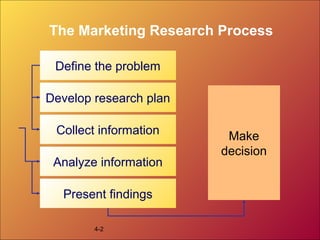
The Marketing Research Process
Define the problem
Develop research plan
Collect information
Analyze information
Present findings
Make
decision
Copyright © 2009 Pearson Education, Inc. Publishing as Prentice Hall 4-3
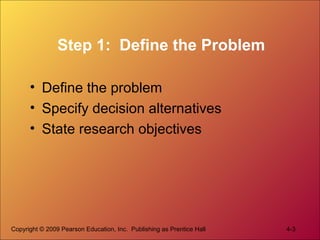
Step 1: Define the Problem
• Define the problem
• Specify decision alternatives
• State research objectives
Copyright © 2009 Pearson Education, Inc. Publishing as Prentice Hall 4-4
Step 2: Develop the Research Plan
Data
Sources
Contact
Methods
Research
Instruments
Sampling
Plan
Research
Approach
Copyright © 2009 Pearson Education, Inc. Publishing as Prentice Hall 4-5
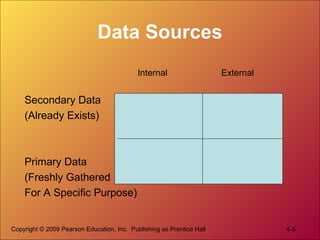
Data Sources
Internal External
Secondary Data
(Already Exists)
Primary Data
(Freshly Gathered
For A Specific Purpose)
Copyright © 2009 Pearson Education, Inc. Publishing as Prentice Hall 4-6
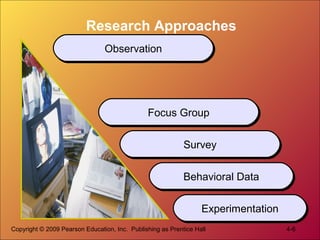
Research Approaches
ObservationObservation
Focus GroupFocus Group
SurveySurvey
Behavioral DataBehavioral Data
ExperimentationExperimentation
Copyright © 2009 Pearson Education, Inc. Publishing as Prentice Hall 4-7
Focus Group in Session
Copyright © 2009 Pearson Education, Inc. Publishing as Prentice Hall 4-8
Research Instruments
Questionnaires
Qualitative Measures
Technological Devices
Copyright © 2009 Pearson Education, Inc. Publishing as Prentice Hall 4-9
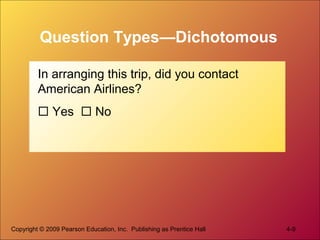
Question Types—Dichotomous
In arranging this trip, did you contact
American Airlines?
 Yes  No
Copyright © 2009 Pearson Education, Inc. Publishing as Prentice Hall 4-10
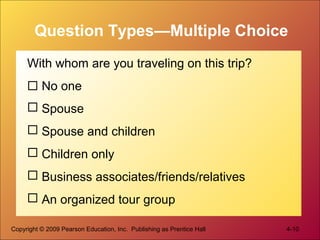
Question Types—Multiple Choice
With whom are you traveling on this trip?
 No one
 Spouse
 Spouse and children
 Children only
 Business associates/friends/relatives
 An organized tour group
Copyright © 2009 Pearson Education, Inc. Publishing as Prentice Hall 4-11
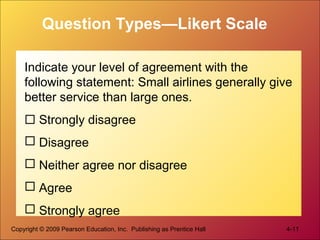
Question Types—Likert Scale
Indicate your level of agreement with the
following statement: Small airlines generally give
better service than large ones.
 Strongly disagree
 Disagree
 Neither agree nor disagree
 Agree
 Strongly agree
Copyright © 2009 Pearson Education, Inc. Publishing as Prentice Hall 4-12
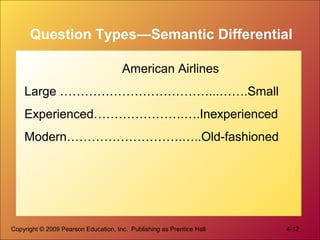
Question Types—Semantic Differential
American Airlines
Large ………………………………...…….Small
Experienced………………….….Inexperienced
Modern……………………….…..Old-fashioned
Copyright © 2009 Pearson Education, Inc. Publishing as Prentice Hall 4-13
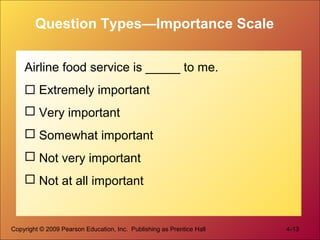
Question Types—Importance Scale
Airline food service is _____ to me.
 Extremely important
 Very important
 Somewhat important
 Not very important
 Not at all important
Copyright © 2009 Pearson Education, Inc. Publishing as Prentice Hall 4-14
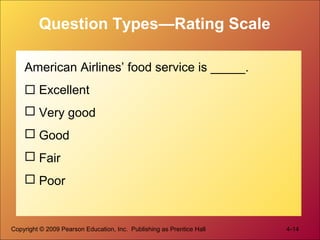
Question Types—Rating Scale
American Airlines’ food service is _____.
 Excellent
 Very good
 Good
 Fair
 Poor
Copyright © 2009 Pearson Education, Inc. Publishing as Prentice Hall 4-15
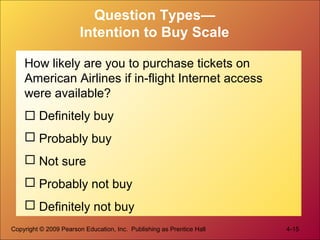
Question Types—
Intention to Buy Scale
How likely are you to purchase tickets on
American Airlines if in-flight Internet access
were available?
 Definitely buy
 Probably buy
 Not sure
 Probably not buy
 Definitely not buy
Copyright © 2009 Pearson Education, Inc. Publishing as Prentice Hall 4-16
Question Types—Completely
Unstructured
What is your opinion of American Airlines?
Copyright © 2009 Pearson Education, Inc. Publishing as Prentice Hall 4-17
Question Types—Word Association
What is the first word that comes to your mind
when you hear the following?
Airline ________________________
American _____________________
Travel ________________________
Copyright © 2009 Pearson Education, Inc. Publishing as Prentice Hall 4-18
Question Types—
Sentence Completion
When I choose an airline, the most important
consideration in my decision is:
_____________________________________
_____________________________________
_____________________________________
_____________________________________
_____________________________________
_____________________________________
__________________.
Copyright © 2009 Pearson Education, Inc. Publishing as Prentice Hall 4-19
Question Types—Story Completion
“I flew American a few days ago. I noticed that
the exterior and interior of the plane had very
bright colors. This aroused in me the following
thoughts and feelings.” Now complete the story.
_______________________________________
_______________________________________
_______________________________________
_______________________________________
_______________________________________
_______________________________________
Copyright © 2009 Pearson Education, Inc. Publishing as Prentice Hall 4-20
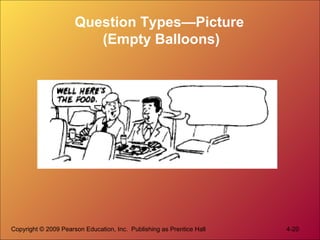
Question Types—Picture
(Empty Balloons)
Copyright © 2009 Pearson Education, Inc. Publishing as Prentice Hall 4-21
Question Types—Thematic
Apperception Test
Make up a story that reflects what you think is
happening in this picture.
Qualitative research approaches
• Word Association
• Projective techniques
• Brand personification
• Laddering
Copyright © 2009 Pearson Education, Inc. Publishing as Prentice Hall 4-22
Technological devices
• Galvanometers
• Eye camera
Copyright © 2009 Pearson Education, Inc. Publishing as Prentice Hall 4-23
Copyright © 2009 Pearson Education, Inc. Publishing as Prentice Hall 4-24
Sampling Plan
• Sampling unit: Who is to be surveyed?
• Sample size: How many people should be
surveyed?
• Sampling procedure: How should the
respondents be chosen?
Copyright © 2009 Pearson Education, Inc. Publishing as Prentice Hall 4-25
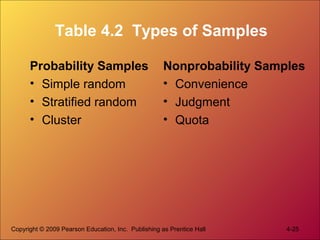
Table 4.2 Types of Samples
Probability Samples
• Simple random
• Stratified random
• Cluster
Nonprobability Samples
• Convenience
• Judgment
• Quota
Copyright © 2009 Pearson Education, Inc. Publishing as Prentice Hall 4-26
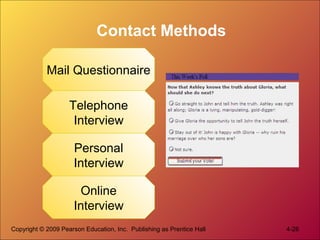
Contact Methods
Mail Questionnaire
Telephone
Interview
Personal
Interview
Online
Interview
Copyright © 2009 Pearson Education, Inc. Publishing as Prentice Hall 4-27
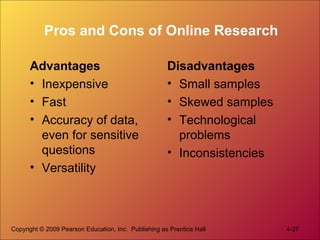
Pros and Cons of Online Research
Advantages
• Inexpensive
• Fast
• Accuracy of data,
even for sensitive
questions
• Versatility
Disadvantages
• Small samples
• Skewed samples
• Technological
problems
• Inconsistencies
Analyze the results
Copyright © 2009 Pearson Education, Inc. Publishing as Prentice Hall 4-28
Present the findings
Copyright © 2009 Pearson Education, Inc. Publishing as Prentice Hall 4-29
Make the decision
Copyright © 2009 Pearson Education, Inc. Publishing as Prentice Hall 4-30
Copyright © 2009 Pearson Education, Inc. Publishing as Prentice Hall 4-31
What is Marketing Metrics?
Marketing metrics is the set of
measures that helps marketers
quantify, compare, and interpret
marketing performance.
Copyright © 2009 Pearson Education, Inc. Publishing as Prentice Hall 4-32
Table 4.4 Marketing Metrics
External
• Awareness
• Market share
• Relative price
• Number of complaints
• Customer satisfaction
• Distribution
• Total number of
customers
• Loyalty
Internal
• Awareness of goals
• Commitment to goals
• Active support
• Resource adequacy
• Staffing levels
• Desire to learn
• Willingness to change
• Freedom to fail
• Autonomy
Copyright © 2009 Pearson Education, Inc. Publishing as Prentice Hall 4-33
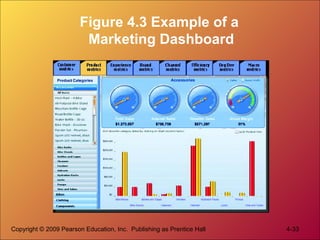
Figure 4.3 Example of a
Marketing Dashboard
Copyright © 2009 Pearson Education, Inc. Publishing as Prentice Hall 4-34
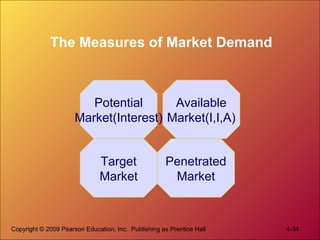
The Measures of Market Demand
Potential
Market(Interest)
Penetrated
Market
Target
Market
Available
Market(I,I,A)
Vocabulary for demand
measurement
• Market Demand
• Market forecast
• Market potential
• Company Demand
• Company Sales forecast
• Company sales potential
Copyright © 2009 Pearson Education, Inc. Publishing as Prentice Hall 4-35
Estimating Current Demand
• Total Market Potential
• Area market Potential
1.Market build up method
2.Multiple factor index method
Copyright © 2009 Pearson Education, Inc. Publishing as Prentice Hall 4-36
Copyright © 2009 Pearson Education, Inc. Publishing as Prentice Hall 4-37
Copyright © 2009 Pearson Education, Inc. Publishing as Prentice Hall 4-38
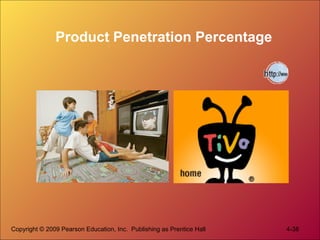
Product Penetration Percentage
Copyright © 2009 Pearson Education, Inc. Publishing as Prentice Hall 4-39
Estimating Future Demand
• Survey of Buyers’ Intentions
• Composite of Sales Force Opinions
• Expert Opinion
• Past-Sales Analysis
• Market-Test Method

Ch 4 marketing research system

  • 1.
    What is MarketingResearch? Marketing research is the systematic design, collection, analysis, and reporting of data and findings relevant to a specific marketing situation facing the company.
  • 2.
    4-2 The Marketing ResearchProcess Define the problem Develop research plan Collect information Analyze information Present findings Make decision
  • 3.
    Copyright © 2009Pearson Education, Inc. Publishing as Prentice Hall 4-3 Step 1: Define the Problem • Define the problem • Specify decision alternatives • State research objectives
  • 4.
    Copyright © 2009Pearson Education, Inc. Publishing as Prentice Hall 4-4 Step 2: Develop the Research Plan Data Sources Contact Methods Research Instruments Sampling Plan Research Approach
  • 5.
    Copyright © 2009Pearson Education, Inc. Publishing as Prentice Hall 4-5 Data Sources Internal External Secondary Data (Already Exists) Primary Data (Freshly Gathered For A Specific Purpose)
  • 6.
    Copyright © 2009Pearson Education, Inc. Publishing as Prentice Hall 4-6 Research Approaches ObservationObservation Focus GroupFocus Group SurveySurvey Behavioral DataBehavioral Data ExperimentationExperimentation
  • 7.
    Copyright © 2009Pearson Education, Inc. Publishing as Prentice Hall 4-7 Focus Group in Session
  • 8.
    Copyright © 2009Pearson Education, Inc. Publishing as Prentice Hall 4-8 Research Instruments Questionnaires Qualitative Measures Technological Devices
  • 9.
    Copyright © 2009Pearson Education, Inc. Publishing as Prentice Hall 4-9 Question Types—Dichotomous In arranging this trip, did you contact American Airlines?  Yes  No
  • 10.
    Copyright © 2009Pearson Education, Inc. Publishing as Prentice Hall 4-10 Question Types—Multiple Choice With whom are you traveling on this trip?  No one  Spouse  Spouse and children  Children only  Business associates/friends/relatives  An organized tour group
  • 11.
    Copyright © 2009Pearson Education, Inc. Publishing as Prentice Hall 4-11 Question Types—Likert Scale Indicate your level of agreement with the following statement: Small airlines generally give better service than large ones.  Strongly disagree  Disagree  Neither agree nor disagree  Agree  Strongly agree
  • 12.
    Copyright © 2009Pearson Education, Inc. Publishing as Prentice Hall 4-12 Question Types—Semantic Differential American Airlines Large ………………………………...…….Small Experienced………………….….Inexperienced Modern……………………….…..Old-fashioned
  • 13.
    Copyright © 2009Pearson Education, Inc. Publishing as Prentice Hall 4-13 Question Types—Importance Scale Airline food service is _____ to me.  Extremely important  Very important  Somewhat important  Not very important  Not at all important
  • 14.
    Copyright © 2009Pearson Education, Inc. Publishing as Prentice Hall 4-14 Question Types—Rating Scale American Airlines’ food service is _____.  Excellent  Very good  Good  Fair  Poor
  • 15.
    Copyright © 2009Pearson Education, Inc. Publishing as Prentice Hall 4-15 Question Types— Intention to Buy Scale How likely are you to purchase tickets on American Airlines if in-flight Internet access were available?  Definitely buy  Probably buy  Not sure  Probably not buy  Definitely not buy
  • 16.
    Copyright © 2009Pearson Education, Inc. Publishing as Prentice Hall 4-16 Question Types—Completely Unstructured What is your opinion of American Airlines?
  • 17.
    Copyright © 2009Pearson Education, Inc. Publishing as Prentice Hall 4-17 Question Types—Word Association What is the first word that comes to your mind when you hear the following? Airline ________________________ American _____________________ Travel ________________________
  • 18.
    Copyright © 2009Pearson Education, Inc. Publishing as Prentice Hall 4-18 Question Types— Sentence Completion When I choose an airline, the most important consideration in my decision is: _____________________________________ _____________________________________ _____________________________________ _____________________________________ _____________________________________ _____________________________________ __________________.
  • 19.
    Copyright © 2009Pearson Education, Inc. Publishing as Prentice Hall 4-19 Question Types—Story Completion “I flew American a few days ago. I noticed that the exterior and interior of the plane had very bright colors. This aroused in me the following thoughts and feelings.” Now complete the story. _______________________________________ _______________________________________ _______________________________________ _______________________________________ _______________________________________ _______________________________________
  • 20.
    Copyright © 2009Pearson Education, Inc. Publishing as Prentice Hall 4-20 Question Types—Picture (Empty Balloons)
  • 21.
    Copyright © 2009Pearson Education, Inc. Publishing as Prentice Hall 4-21 Question Types—Thematic Apperception Test Make up a story that reflects what you think is happening in this picture.
  • 22.
    Qualitative research approaches •Word Association • Projective techniques • Brand personification • Laddering Copyright © 2009 Pearson Education, Inc. Publishing as Prentice Hall 4-22
  • 23.
    Technological devices • Galvanometers •Eye camera Copyright © 2009 Pearson Education, Inc. Publishing as Prentice Hall 4-23
  • 24.
    Copyright © 2009Pearson Education, Inc. Publishing as Prentice Hall 4-24 Sampling Plan • Sampling unit: Who is to be surveyed? • Sample size: How many people should be surveyed? • Sampling procedure: How should the respondents be chosen?
  • 25.
    Copyright © 2009Pearson Education, Inc. Publishing as Prentice Hall 4-25 Table 4.2 Types of Samples Probability Samples • Simple random • Stratified random • Cluster Nonprobability Samples • Convenience • Judgment • Quota
  • 26.
    Copyright © 2009Pearson Education, Inc. Publishing as Prentice Hall 4-26 Contact Methods Mail Questionnaire Telephone Interview Personal Interview Online Interview
  • 27.
    Copyright © 2009Pearson Education, Inc. Publishing as Prentice Hall 4-27 Pros and Cons of Online Research Advantages • Inexpensive • Fast • Accuracy of data, even for sensitive questions • Versatility Disadvantages • Small samples • Skewed samples • Technological problems • Inconsistencies
  • 28.
    Analyze the results Copyright© 2009 Pearson Education, Inc. Publishing as Prentice Hall 4-28
  • 29.
    Present the findings Copyright© 2009 Pearson Education, Inc. Publishing as Prentice Hall 4-29
  • 30.
    Make the decision Copyright© 2009 Pearson Education, Inc. Publishing as Prentice Hall 4-30
  • 31.
    Copyright © 2009Pearson Education, Inc. Publishing as Prentice Hall 4-31 What is Marketing Metrics? Marketing metrics is the set of measures that helps marketers quantify, compare, and interpret marketing performance.
  • 32.
    Copyright © 2009Pearson Education, Inc. Publishing as Prentice Hall 4-32 Table 4.4 Marketing Metrics External • Awareness • Market share • Relative price • Number of complaints • Customer satisfaction • Distribution • Total number of customers • Loyalty Internal • Awareness of goals • Commitment to goals • Active support • Resource adequacy • Staffing levels • Desire to learn • Willingness to change • Freedom to fail • Autonomy
  • 33.
    Copyright © 2009Pearson Education, Inc. Publishing as Prentice Hall 4-33 Figure 4.3 Example of a Marketing Dashboard
  • 34.
    Copyright © 2009Pearson Education, Inc. Publishing as Prentice Hall 4-34 The Measures of Market Demand Potential Market(Interest) Penetrated Market Target Market Available Market(I,I,A)
  • 35.
    Vocabulary for demand measurement •Market Demand • Market forecast • Market potential • Company Demand • Company Sales forecast • Company sales potential Copyright © 2009 Pearson Education, Inc. Publishing as Prentice Hall 4-35
  • 36.
    Estimating Current Demand •Total Market Potential • Area market Potential 1.Market build up method 2.Multiple factor index method Copyright © 2009 Pearson Education, Inc. Publishing as Prentice Hall 4-36
  • 37.
    Copyright © 2009Pearson Education, Inc. Publishing as Prentice Hall 4-37
  • 38.
    Copyright © 2009Pearson Education, Inc. Publishing as Prentice Hall 4-38 Product Penetration Percentage
  • 39.
    Copyright © 2009Pearson Education, Inc. Publishing as Prentice Hall 4-39 Estimating Future Demand • Survey of Buyers’ Intentions • Composite of Sales Force Opinions • Expert Opinion • Past-Sales Analysis • Market-Test Method

Editor's Notes

  • #8 Video icon links to Wild Planet snippet on product research methods.