Knowledge Translation: putting research
and training into policy
Hung Nguyen Viet
Hanoi School of Public Health (HSPH)
Swiss TPH and Sandec/Eawag
EcoZD-FBLI Ecohealth/One Health course
Hanam– 29 May 2013
Content
 Need to translating our academic knowledge into
policy
 Risk assessment for food safety and environmental
health
 Environmental sanitation and health
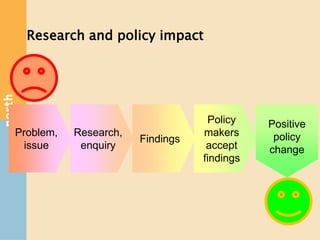
Research and policy impact
Problem,
issue
Research,
enquiry
Findings
Policy
makers
accept
findings
Positive
policy
change
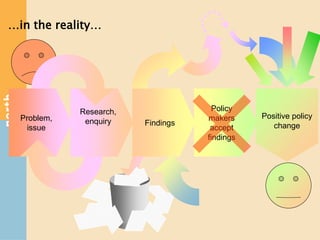
…in the reality…
Problem,
issue
Research,
enquiry Findings
Policy
makers
accept
findings
?Positive policy
change
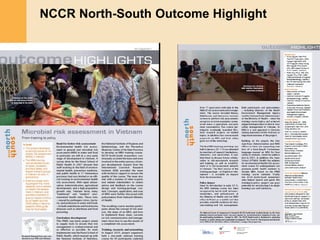
NCCR North-South Outcome Highlight
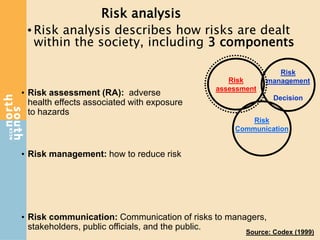
Risk
assessment
Risk
management
Decision
Risk
Communication
Risk analysis
• Risk analysis describes how risks are dealt
within the society, including 3 components
• Risk communication: Communication of risks to managers,
stakeholders, public officials, and the public.
• Risk management: how to reduce risk
• Risk assessment (RA): adverse
health effects associated with exposure
to hazards
Source: Codex (1999)
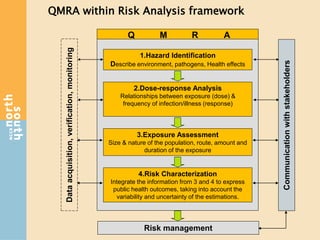
QMRA within Risk Analysis framework
3.Exposure Assessment
Size & nature of the population, route, amount and
duration of the exposure
1.Hazard Identification
Describe environment, pathogens, Health effects
2.Dose-response Analysis
Relationships between exposure (dose) &
frequency of infection/illness (response)
4.Risk Characterization
Integrate the information from 3 and 4 to express
public health outcomes, taking into account the
variability and uncertainty of the estimations.
Q M R A
Risk management
Communicationwithstakeholders
Dataacquisition,verification,monitoring
Introduction
No official training on risk assessment universities
 Very limited number of Public health/preventive
medicine/ health staff in Vietnam have training on
health risk assessment while increasing health risks
due to environmental health hazards.
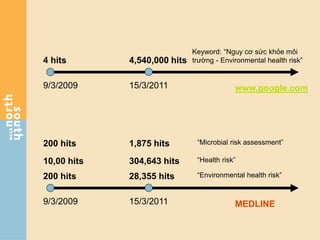
9/3/2009 www.google.com15/3/2011
4 hits 4,540,000 hits
Keyword: “Nguy cơ sức khỏe môi
trường - Environmental health risk”
9/3/2009 MEDLINE15/3/2011
200 hits 28,355 hits “Environmental health risk”
10,00 hits 304,643 hits “Health risk”
200 hits 1,875 hits “Microbial risk assessment”
Introduction
No official training on risk assessment universities
 Very limited number of Public health/preventive medicine/
health staff in Vietnam have training on health risk assessment
while increasing health risks due to environmental health
hazards.
 Need to put theoretical training/teaching into practice.
Willingness to develop a policy of health risk management
related to food, water and sanitation.
 Partnership and combination of common interests from
different stakeholders (university, policy making) create a joint
force in developing health risk assessment approach specific to
Vietnamese context.
Introduction
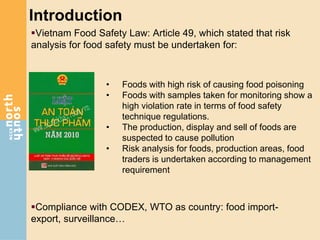
Vietnam Food Safety Law: Article 49, which stated that risk
analysis for food safety must be undertaken for:
• Foods with high risk of causing food poisoning
• Foods with samples taken for monitoring show a
high violation rate in terms of food safety
technique regulations.
• The production, display and sell of foods are
suspected to cause pollution
• Risk analysis for foods, production areas, food
traders is undertaken according to management
requirement
Compliance with CODEX, WTO as country: food import-
export, surveillance…
Partnerships
Objective
General goal: developing a training module on
health risk assessment related to water supply,
sanitation and food in Vietnam
Specific objectives:
 to develop a training module on heath risk assessment related to
water supply, sanitation and food
 to test the developed training module with various stakeholders of
health risk assessment using approach learning by doing
 (perspective): policy implication, replication elsewhere
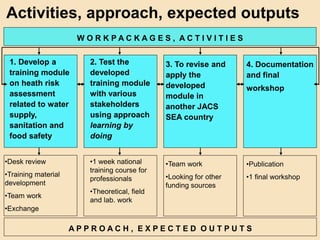
1. Develop a
training module
on heath risk
assessment
related to water
supply,
sanitation and
food safety
2. Test the
developed
training module
with various
stakeholders
using approach
learning by
doing
3. To revise and
apply the
developed
module in
another JACS
SEA country
4. Documentation
and final
workshop
Activities, approach, expected outputs
•Desk review
•Training material
development
•Team work
•Exchange
•1 week national
training course for
professionals
•Theoretical, field
and lab. work
•Team work
•Looking for other
funding sources
•Publication
•1 final workshop
A P P R O A C H , E X P E C T E D O U T P U T S
W O R K P A C K A G E S , A C T I V I T I E S
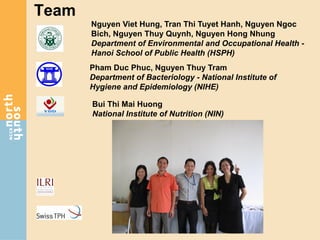
Team
Nguyen Viet Hung, Tran Thi Tuyet Hanh, Nguyen Ngoc
Bich, Nguyen Thuy Quynh, Nguyen Hong Nhung
Department of Environmental and Occupational Health -
Hanoi School of Public Health (HSPH)
Bui Thi Mai Huong
National Institute of Nutrition (NIN)
Pham Duc Phuc, Nguyen Thuy Tram
Department of Bacteriology - National Institute of
Hygiene and Epidemiology (NIHE)
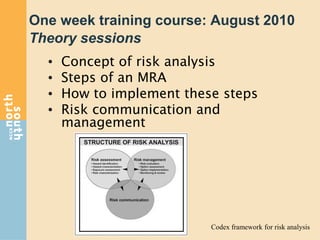
One week training course: August 2010
Theory sessions
• Concept of risk analysis
• Steps of an MRA
• How to implement these steps
• Risk communication and
management
Codex framework for risk analysis
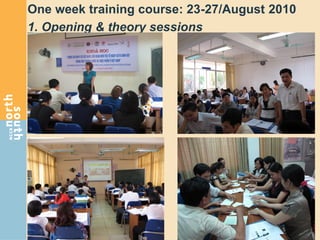
One week training course: 23-27/August 2010
1. Opening & theory sessions
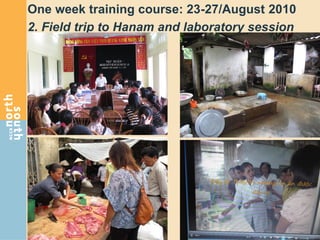
Field-based, and laboratory sessions
• Problem identification in the fields
• Pork meat consumption “farm-to
consumption”
• Wastewater reuse in agriculture
• Perform risk assessments (field, lab,
calculation, presentation with option
of management and communication)
One week training course: 23-27/August 2010
2. Field trip to Hanam and laboratory session
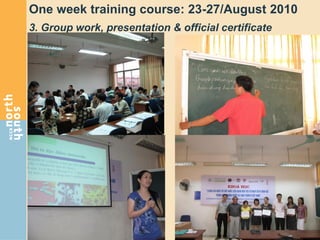
One week training course: 23-27/August 2010
3. Group work, presentation & official certificate
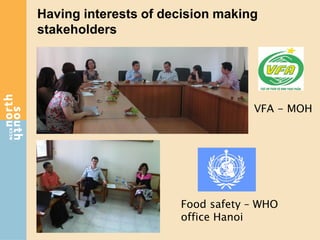
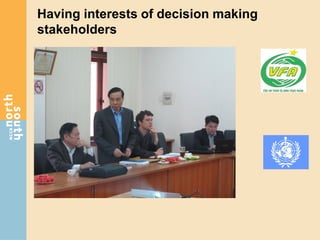
Having interests of decision making
stakeholders
VFA - MOH
Food safety – WHO
office Hanoi
Having interests of decision making
stakeholders
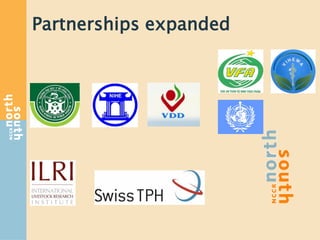
Partnerships expanded
Outcomes
• Policy: First National
guidelines for microbial
risk assessment in food
safety, coming soon
• Working group (task force)
on risk assessment
• Research and training:
• 2 MSc research and proposals submitted to
donors for funding
• Curriculum applied for university with potential of
replication
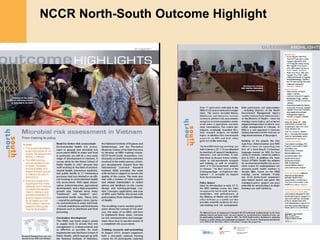
NCCR North-South Outcome Highlight
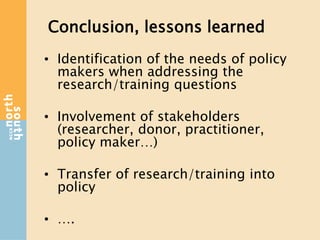
Conclusion, lessons learned
• Identification of the needs of policy
makers when addressing the
research/training questions
• Involvement of stakeholders
(researcher, donor, practitioner,
policy maker…)
• Transfer of research/training into
policy
• ….

Knowledge translation: Putting research and training into policy

  • 1.
    Knowledge Translation: puttingresearch and training into policy Hung Nguyen Viet Hanoi School of Public Health (HSPH) Swiss TPH and Sandec/Eawag EcoZD-FBLI Ecohealth/One Health course Hanam– 29 May 2013
  • 2.
    Content  Need totranslating our academic knowledge into policy  Risk assessment for food safety and environmental health  Environmental sanitation and health
  • 3.
    Research and policyimpact Problem, issue Research, enquiry Findings Policy makers accept findings Positive policy change
  • 4.
    …in the reality… Problem, issue Research, enquiryFindings Policy makers accept findings ?Positive policy change
  • 5.
  • 6.
    Risk assessment Risk management Decision Risk Communication Risk analysis • Riskanalysis describes how risks are dealt within the society, including 3 components • Risk communication: Communication of risks to managers, stakeholders, public officials, and the public. • Risk management: how to reduce risk • Risk assessment (RA): adverse health effects associated with exposure to hazards Source: Codex (1999)
  • 7.
    QMRA within RiskAnalysis framework 3.Exposure Assessment Size & nature of the population, route, amount and duration of the exposure 1.Hazard Identification Describe environment, pathogens, Health effects 2.Dose-response Analysis Relationships between exposure (dose) & frequency of infection/illness (response) 4.Risk Characterization Integrate the information from 3 and 4 to express public health outcomes, taking into account the variability and uncertainty of the estimations. Q M R A Risk management Communicationwithstakeholders Dataacquisition,verification,monitoring
  • 9.
    Introduction No official trainingon risk assessment universities  Very limited number of Public health/preventive medicine/ health staff in Vietnam have training on health risk assessment while increasing health risks due to environmental health hazards.
  • 10.
    9/3/2009 www.google.com15/3/2011 4 hits4,540,000 hits Keyword: “Nguy cơ sức khỏe môi trường - Environmental health risk” 9/3/2009 MEDLINE15/3/2011 200 hits 28,355 hits “Environmental health risk” 10,00 hits 304,643 hits “Health risk” 200 hits 1,875 hits “Microbial risk assessment”
  • 11.
    Introduction No official trainingon risk assessment universities  Very limited number of Public health/preventive medicine/ health staff in Vietnam have training on health risk assessment while increasing health risks due to environmental health hazards.  Need to put theoretical training/teaching into practice. Willingness to develop a policy of health risk management related to food, water and sanitation.  Partnership and combination of common interests from different stakeholders (university, policy making) create a joint force in developing health risk assessment approach specific to Vietnamese context.
  • 12.
    Introduction Vietnam Food SafetyLaw: Article 49, which stated that risk analysis for food safety must be undertaken for: • Foods with high risk of causing food poisoning • Foods with samples taken for monitoring show a high violation rate in terms of food safety technique regulations. • The production, display and sell of foods are suspected to cause pollution • Risk analysis for foods, production areas, food traders is undertaken according to management requirement Compliance with CODEX, WTO as country: food import- export, surveillance…
  • 13.
  • 14.
    Objective General goal: developinga training module on health risk assessment related to water supply, sanitation and food in Vietnam Specific objectives:  to develop a training module on heath risk assessment related to water supply, sanitation and food  to test the developed training module with various stakeholders of health risk assessment using approach learning by doing  (perspective): policy implication, replication elsewhere
  • 15.
    1. Develop a trainingmodule on heath risk assessment related to water supply, sanitation and food safety 2. Test the developed training module with various stakeholders using approach learning by doing 3. To revise and apply the developed module in another JACS SEA country 4. Documentation and final workshop Activities, approach, expected outputs •Desk review •Training material development •Team work •Exchange •1 week national training course for professionals •Theoretical, field and lab. work •Team work •Looking for other funding sources •Publication •1 final workshop A P P R O A C H , E X P E C T E D O U T P U T S W O R K P A C K A G E S , A C T I V I T I E S
  • 16.
    Team Nguyen Viet Hung,Tran Thi Tuyet Hanh, Nguyen Ngoc Bich, Nguyen Thuy Quynh, Nguyen Hong Nhung Department of Environmental and Occupational Health - Hanoi School of Public Health (HSPH) Bui Thi Mai Huong National Institute of Nutrition (NIN) Pham Duc Phuc, Nguyen Thuy Tram Department of Bacteriology - National Institute of Hygiene and Epidemiology (NIHE)
  • 17.
    One week trainingcourse: August 2010 Theory sessions • Concept of risk analysis • Steps of an MRA • How to implement these steps • Risk communication and management Codex framework for risk analysis
  • 18.
    One week trainingcourse: 23-27/August 2010 1. Opening & theory sessions
  • 19.
    Field-based, and laboratorysessions • Problem identification in the fields • Pork meat consumption “farm-to consumption” • Wastewater reuse in agriculture • Perform risk assessments (field, lab, calculation, presentation with option of management and communication)
  • 20.
    One week trainingcourse: 23-27/August 2010 2. Field trip to Hanam and laboratory session
  • 21.
    One week trainingcourse: 23-27/August 2010 3. Group work, presentation & official certificate
  • 23.
    Having interests ofdecision making stakeholders VFA - MOH Food safety – WHO office Hanoi
  • 24.
    Having interests ofdecision making stakeholders
  • 25.
  • 26.
    Outcomes • Policy: FirstNational guidelines for microbial risk assessment in food safety, coming soon • Working group (task force) on risk assessment • Research and training: • 2 MSc research and proposals submitted to donors for funding • Curriculum applied for university with potential of replication
  • 27.
  • 28.
    Conclusion, lessons learned •Identification of the needs of policy makers when addressing the research/training questions • Involvement of stakeholders (researcher, donor, practitioner, policy maker…) • Transfer of research/training into policy • ….