SCHOOL OF
PHARMACEUTICAL
SCIENCES

TOWARDS NATIONAL/REGIONAL POLICY PLATFORMS TO
MANAGE ANTIBIOTIC RESISTANCE - ENGAGING CIVIL SOCIETY
ORGANIZATIONS FOR SOCIAL MOBILIZATION, HEALTH
EDUCATION AND COMMUNICATION
Mr. Muhammad Sharrieffuddin Mohd. Jaki, BSc
Coordinator for ReAct Malaysia Community Project,
School of Pharmaceutical Sciences,
Universiti Sains Malaysia
Assoc. Prof Dr. Mohamed Azmi Hassali, PhD
Principal Investigator ReAcT Malaysia Community Project
Deputy Dean (Student Affairs and Networking)
School of Pharmaceutical Sciences,
Universiti Sains Malaysia
Dr. Fahad Saleem, PhD
ReAct Malaysia Community Project Liaison Officer
School of Pharmaceutical Sciences,
Universiti Sains Malaysia
Presentation Outline
SCHOOL OF
PHARMACEUTICAL
SCIENCES

–
–
–
–

Community Empowerment
Working Structure
Objectives
Phase 1
– Baseline Survey
– Educational Materials Development

– Phase 2
–
–
–
–

Project Launching
Training-of-the-Trainers Workshops
Collaborations
Focus Group Discussions
Community Empowerment
SCHOOL OF
PHARMACEUTICAL
SCIENCES

• Public health education and awareness programs on the issue of
rational use of antibiotics & ABR
– Towards national/ regional policy platforms to manage antibiotic resistanceengaging civil society organizations for social mobilization, health education and
communication (ReAct-USM-Yayasan Bina Ilmu)

– Project Partners:
• Action on Antibiotic Resistance (ReAct), Uppsala University, Sweden
• Discipline of Social & Administrative Pharmacy, School of Pharmaceutical
Sciences, Universiti Sains Malaysia
• Yayasan Bina Ilmu (P. Pinang) Ltd.
• 1Malaysia Community
Working Structure
SCHOOL OF
PHARMACEUTICAL
SCIENCES

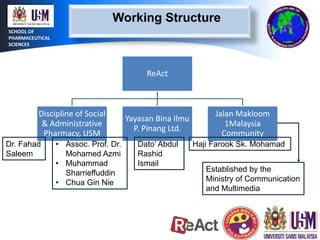
ReAct

Discipline of Social
& Administrative
Pharmacy, USM
Dr. Fahad
Saleem

• Assoc. Prof. Dr.
Mohamed Azmi
• Muhammad
Sharrieffuddin
• Chua Gin Nie

Yayasan Bina Ilmu
P. Pinang Ltd.
Dato’ Abdul
Rashid
Ismail

Jalan Makloom
1Malaysia
Community
Haji Farook Sk. Mohamad
Established by the
Ministry of Communication
and Multimedia
Objectives
SCHOOL OF
PHARMACEUTICAL
SCIENCES

• To catalyse uptake of antibiotic resistance on the agenda of civil
society organizations working in the areas of child health, education,
consumers rights, environment and women’s rights;
• To offer support and materials to these organizations to undertake
relevant work on antibiotic resistance in line with their focus areas;
• To engage civil society organizations as stakeholders in national and
regional policy platforms for antibiotic resistance;
• To link results to global civil society organizations working with
children’s and women’s health to address antibiotic resistance.
Phase 1
SCHOOL OF
PHARMACEUTICAL
SCIENCES

• Project Activities
– Phase 1
1. Conduct Baseline Survey in each project site
regarding knowledge, attitudes, skills and
practices within the organization/ target groups
2. Adapt, translate and develop reading/ training
materials based on 1.
Baseline Survey
SCHOOL OF
PHARMACEUTICAL
SCIENCES

• A pilot survey (n= 64) to assess the baseline knowledge
among community dwellers at Jelutong, Penang was carried
out from 18 to 20 of June 2012.
• Phase 1 Main findings:
– Recent use of antibiotic (in the past 3 months): Yes =
42.2%
– Sources of antibiotic:
• Prescribed: Yes = 92%
• Clinic without prescription: Yes = 2%
• Retail pharmacy: Yes = 17%
• Use someone else’s antibiotic: Yes = 2%
Baseline Survey
SCHOOL OF
PHARMACEUTICAL
SCIENCES

• Main findings (cont’):
– Knowledge of antibiotic
• Role of antibiotic:
– For bacterial infection: Yes = 84%
– For viral infection: Yes = 21%
• Able to Identify antibiotic: Yes = 45%
• Dangers of antibiotic overuse:
– Can cause ABR: Yes = 64%
– Can cause allergic reaction: Yes = 61%
– Does not cause side effects: Yes = 55%
Baseline Survey
SCHOOL OF
PHARMACEUTICAL
SCIENCES

• Main Findings (Cont’)
– Attitudes towards antibiotic usage:
• Throw away antibiotic leftovers: Agree: 53%
• Follow doctor/pharmacist/label instructions: Agree: 98%
• Give antibiotic to other family members: Agree = 14%
• Believe antibiotic will help in recovery: Agree = 58%
• Stop taking when fully recovered: Agree = 55%
• Expect antibiotic to be prescribed whenever they go to
doctor: Agree = 77%
– Misconception about the use of antibiotics
SCHOOL OF
PHARMACEUTICAL
SCIENCES

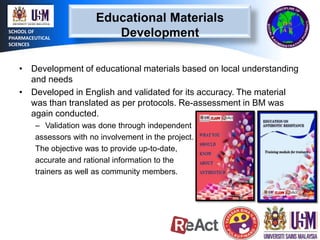
Educational Materials
Development

• Development of educational materials based on local understanding
and needs
• Developed in English and validated for its accuracy. The material
was than translated as per protocols. Re-assessment in BM was
again conducted.
– Validation was done through independent
assessors with no involvement in the project.
The objective was to provide up-to-date,
accurate and rational information to the
trainers as well as community members.
Phase 2
SCHOOL OF
PHARMACEUTICAL
SCIENCES

Project Activities
• Phase 2 (ongoing):
– One-day launch workshop to plan and strategize
outcomes, outputs and activities
– Training-of-the-trainers to develop a team of communitybased trainers
– Initiate activities to foster collaboration among civil society,
local health service providers and local government
agencies to address health issues.
– Focus group discussion with community members
Project Launching
SCHOOL OF
PHARMACEUTICAL
SCIENCES

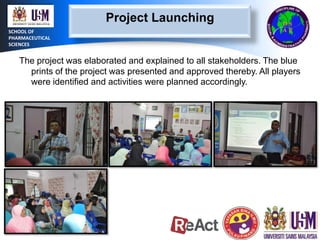
The project was elaborated and explained to all stakeholders. The blue
prints of the project was presented and approved thereby. All players
were identified and activities were planned accordingly.
SCHOOL OF
PHARMACEUTICAL
SCIENCES

Training-of-the-Trainers
Workshops

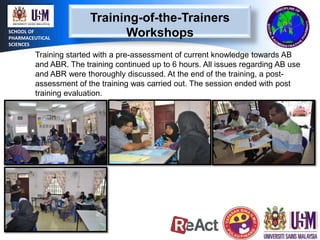
Training started with a pre-assessment of current knowledge towards AB
and ABR. The training continued up to 6 hours. All issues regarding AB use
and ABR were thoroughly discussed. At the end of the training, a postassessment of the training was carried out. The session ended with post
training evaluation.
Collaborations
SCHOOL OF
PHARMACEUTICAL
SCIENCES

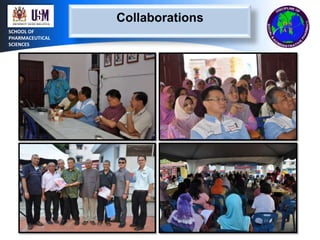
Initiate activities to foster collaboration among civil society,
local health service providers and local government agencies
to address health issues.
– Objectives of the project and layout plan was described by the
moderator. Development of the training material and TOT sessions were
also discussed. The process of dissemination the information to the
community members was also planned out. Audience were
comprehensively informed about the progress of the project and the
future directions.
Collaborations
SCHOOL OF
PHARMACEUTICAL
SCIENCES
Focus Group Discussion
SCHOOL OF
PHARMACEUTICAL
SCIENCES

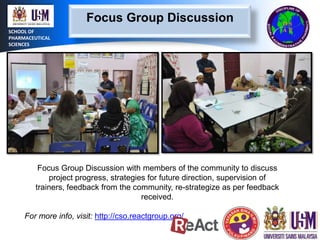
Focus Group Discussion with members of the community to discuss
project progress, strategies for future direction, supervision of
trainers, feedback from the community, re-strategize as per feedback
received.

For more info, visit: http://cso.reactgroup.org/
Thank You
SCHOOL OF
PHARMACEUTICAL
SCIENCES

Contact:
Mohamed Azmi Hassali, PhD
Universiti Sains Malaysia
azmihassali@usm.my

CSO Malaysia presentation

  • 1.
    SCHOOL OF PHARMACEUTICAL SCIENCES TOWARDS NATIONAL/REGIONALPOLICY PLATFORMS TO MANAGE ANTIBIOTIC RESISTANCE - ENGAGING CIVIL SOCIETY ORGANIZATIONS FOR SOCIAL MOBILIZATION, HEALTH EDUCATION AND COMMUNICATION Mr. Muhammad Sharrieffuddin Mohd. Jaki, BSc Coordinator for ReAct Malaysia Community Project, School of Pharmaceutical Sciences, Universiti Sains Malaysia Assoc. Prof Dr. Mohamed Azmi Hassali, PhD Principal Investigator ReAcT Malaysia Community Project Deputy Dean (Student Affairs and Networking) School of Pharmaceutical Sciences, Universiti Sains Malaysia Dr. Fahad Saleem, PhD ReAct Malaysia Community Project Liaison Officer School of Pharmaceutical Sciences, Universiti Sains Malaysia
  • 2.
    Presentation Outline SCHOOL OF PHARMACEUTICAL SCIENCES – – – – CommunityEmpowerment Working Structure Objectives Phase 1 – Baseline Survey – Educational Materials Development – Phase 2 – – – – Project Launching Training-of-the-Trainers Workshops Collaborations Focus Group Discussions
  • 3.
    Community Empowerment SCHOOL OF PHARMACEUTICAL SCIENCES •Public health education and awareness programs on the issue of rational use of antibiotics & ABR – Towards national/ regional policy platforms to manage antibiotic resistanceengaging civil society organizations for social mobilization, health education and communication (ReAct-USM-Yayasan Bina Ilmu) – Project Partners: • Action on Antibiotic Resistance (ReAct), Uppsala University, Sweden • Discipline of Social & Administrative Pharmacy, School of Pharmaceutical Sciences, Universiti Sains Malaysia • Yayasan Bina Ilmu (P. Pinang) Ltd. • 1Malaysia Community
  • 4.
    Working Structure SCHOOL OF PHARMACEUTICAL SCIENCES ReAct Disciplineof Social & Administrative Pharmacy, USM Dr. Fahad Saleem • Assoc. Prof. Dr. Mohamed Azmi • Muhammad Sharrieffuddin • Chua Gin Nie Yayasan Bina Ilmu P. Pinang Ltd. Dato’ Abdul Rashid Ismail Jalan Makloom 1Malaysia Community Haji Farook Sk. Mohamad Established by the Ministry of Communication and Multimedia
  • 5.
    Objectives SCHOOL OF PHARMACEUTICAL SCIENCES • Tocatalyse uptake of antibiotic resistance on the agenda of civil society organizations working in the areas of child health, education, consumers rights, environment and women’s rights; • To offer support and materials to these organizations to undertake relevant work on antibiotic resistance in line with their focus areas; • To engage civil society organizations as stakeholders in national and regional policy platforms for antibiotic resistance; • To link results to global civil society organizations working with children’s and women’s health to address antibiotic resistance.
  • 6.
    Phase 1 SCHOOL OF PHARMACEUTICAL SCIENCES •Project Activities – Phase 1 1. Conduct Baseline Survey in each project site regarding knowledge, attitudes, skills and practices within the organization/ target groups 2. Adapt, translate and develop reading/ training materials based on 1.
  • 7.
    Baseline Survey SCHOOL OF PHARMACEUTICAL SCIENCES •A pilot survey (n= 64) to assess the baseline knowledge among community dwellers at Jelutong, Penang was carried out from 18 to 20 of June 2012. • Phase 1 Main findings: – Recent use of antibiotic (in the past 3 months): Yes = 42.2% – Sources of antibiotic: • Prescribed: Yes = 92% • Clinic without prescription: Yes = 2% • Retail pharmacy: Yes = 17% • Use someone else’s antibiotic: Yes = 2%
  • 8.
    Baseline Survey SCHOOL OF PHARMACEUTICAL SCIENCES •Main findings (cont’): – Knowledge of antibiotic • Role of antibiotic: – For bacterial infection: Yes = 84% – For viral infection: Yes = 21% • Able to Identify antibiotic: Yes = 45% • Dangers of antibiotic overuse: – Can cause ABR: Yes = 64% – Can cause allergic reaction: Yes = 61% – Does not cause side effects: Yes = 55%
  • 9.
    Baseline Survey SCHOOL OF PHARMACEUTICAL SCIENCES •Main Findings (Cont’) – Attitudes towards antibiotic usage: • Throw away antibiotic leftovers: Agree: 53% • Follow doctor/pharmacist/label instructions: Agree: 98% • Give antibiotic to other family members: Agree = 14% • Believe antibiotic will help in recovery: Agree = 58% • Stop taking when fully recovered: Agree = 55% • Expect antibiotic to be prescribed whenever they go to doctor: Agree = 77% – Misconception about the use of antibiotics
  • 10.
    SCHOOL OF PHARMACEUTICAL SCIENCES Educational Materials Development •Development of educational materials based on local understanding and needs • Developed in English and validated for its accuracy. The material was than translated as per protocols. Re-assessment in BM was again conducted. – Validation was done through independent assessors with no involvement in the project. The objective was to provide up-to-date, accurate and rational information to the trainers as well as community members.
  • 11.
    Phase 2 SCHOOL OF PHARMACEUTICAL SCIENCES ProjectActivities • Phase 2 (ongoing): – One-day launch workshop to plan and strategize outcomes, outputs and activities – Training-of-the-trainers to develop a team of communitybased trainers – Initiate activities to foster collaboration among civil society, local health service providers and local government agencies to address health issues. – Focus group discussion with community members
  • 12.
    Project Launching SCHOOL OF PHARMACEUTICAL SCIENCES Theproject was elaborated and explained to all stakeholders. The blue prints of the project was presented and approved thereby. All players were identified and activities were planned accordingly.
  • 13.
    SCHOOL OF PHARMACEUTICAL SCIENCES Training-of-the-Trainers Workshops Training startedwith a pre-assessment of current knowledge towards AB and ABR. The training continued up to 6 hours. All issues regarding AB use and ABR were thoroughly discussed. At the end of the training, a postassessment of the training was carried out. The session ended with post training evaluation.
  • 14.
    Collaborations SCHOOL OF PHARMACEUTICAL SCIENCES Initiate activitiesto foster collaboration among civil society, local health service providers and local government agencies to address health issues. – Objectives of the project and layout plan was described by the moderator. Development of the training material and TOT sessions were also discussed. The process of dissemination the information to the community members was also planned out. Audience were comprehensively informed about the progress of the project and the future directions.
  • 15.
  • 16.
    Focus Group Discussion SCHOOLOF PHARMACEUTICAL SCIENCES Focus Group Discussion with members of the community to discuss project progress, strategies for future direction, supervision of trainers, feedback from the community, re-strategize as per feedback received. For more info, visit: http://cso.reactgroup.org/
  • 17.
    Thank You SCHOOL OF PHARMACEUTICAL SCIENCES Contact: MohamedAzmi Hassali, PhD Universiti Sains Malaysia azmihassali@usm.my

Editor's Notes

  • #17 A series of focus group discussion was held.