1
CONFIDENTIAL AND PROPRIETARY
Any use of this material without specific permission of Egbin Power Plc is strictly prohibited
UNINTERRUPTED POWER
SUPPLY AND DC SYSTEM
May 27, 2022
2
- 2 -
2
Uninterrupted Power Supply System
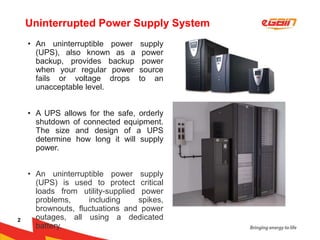
• An uninterruptible power supply
(UPS), also known as a power
backup, provides backup power
when your regular power source
fails or voltage drops to an
unacceptable level.
• A UPS allows for the safe, orderly
shutdown of connected equipment.
The size and design of a UPS
determine how long it will supply
power.
• An uninterruptible power supply
(UPS) is used to protect critical
loads from utility-supplied power
problems, including spikes,
brownouts, fluctuations and power
outages, all using a dedicated
battery.
3
Components of a UPS System
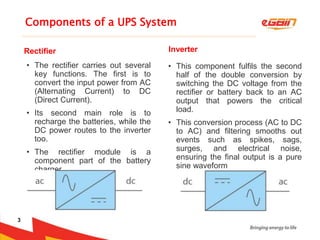
Rectifier
• The rectifier carries out several
key functions. The first is to
convert the input power from AC
(Alternating Current) to DC
(Direct Current).
• Its second main role is to
recharge the batteries, while the
DC power routes to the inverter
too.
• The rectifier module is a
component part of the battery
charger.
Inverter
• This component fulfils the second
half of the double conversion by
switching the DC voltage from the
rectifier or battery back to an AC
output that powers the critical
load.
• This conversion process (AC to DC
to AC) and filtering smooths out
events such as spikes, sags,
surges, and electrical noise,
ensuring the final output is a pure
sine waveform
4
Components of a UPS System
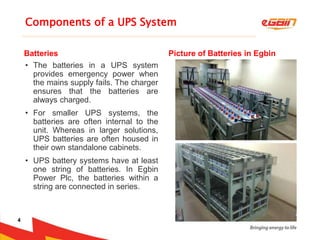
• The batteries in a UPS system
provides emergency power when
the mains supply fails. The charger
ensures that the batteries are
always charged.
• For smaller UPS systems, the
batteries are often internal to the
unit. Whereas in larger solutions,
UPS batteries are often housed in
their own standalone cabinets.
• UPS battery systems have at least
one string of batteries. In Egbin
Power Plc, the batteries within a
string are connected in series.
Picture of Batteries in Egbin
Batteries
5
Static Bypass Switch
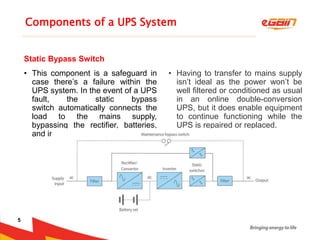
• This component is a safeguard in
case there’s a failure within the
UPS system. In the event of a UPS
fault, the static bypass
switch automatically connects the
load to the mains supply,
bypassing the rectifier, batteries,
and inverter.
• Having to transfer to mains supply
isn’t ideal as the power won’t be
well filtered or conditioned as usual
in an online double-conversion
UPS, but it does enable equipment
to continue functioning while the
UPS is repaired or replaced.
Components of a UPS System
6
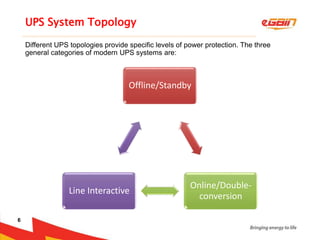
UPS System Topology
Different UPS topologies provide specific levels of power protection. The three
general categories of modern UPS systems are:
Offline/Standby
Online/Double-
conversion
Line Interactive
7
UPS System Topology
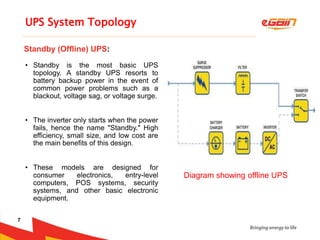
Standby (Offline) UPS:
• Standby is the most basic UPS
topology. A standby UPS resorts to
battery backup power in the event of
common power problems such as a
blackout, voltage sag, or voltage surge.
• The inverter only starts when the power
fails, hence the name "Standby." High
efficiency, small size, and low cost are
the main benefits of this design.
• These models are designed for
consumer electronics, entry-level
computers, POS systems, security
systems, and other basic electronic
equipment.
Diagram showing offline UPS
8
UPS System Topology
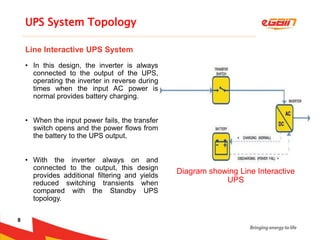
Line Interactive UPS System
• In this design, the inverter is always
connected to the output of the UPS,
operating the inverter in reverse during
times when the input AC power is
normal provides battery charging.
• When the input power fails, the transfer
switch opens and the power flows from
the battery to the UPS output.
• With the inverter always on and
connected to the output, this design
provides additional filtering and yields
reduced switching transients when
compared with the Standby UPS
topology.
Diagram showing Line Interactive
UPS
9
UPS System Topology
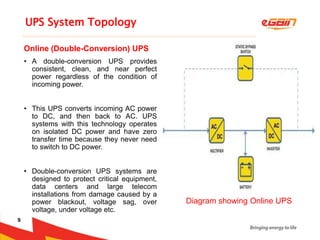
Online (Double-Conversion) UPS
• A double-conversion UPS provides
consistent, clean, and near perfect
power regardless of the condition of
incoming power.
• This UPS converts incoming AC power
to DC, and then back to AC. UPS
systems with this technology operates
on isolated DC power and have zero
transfer time because they never need
to switch to DC power.
• Double-conversion UPS systems are
designed to protect critical equipment,
data centers and large telecom
installations from damage caused by a
power blackout, voltage sag, over
voltage, under voltage etc.
Diagram showing Online UPS
10
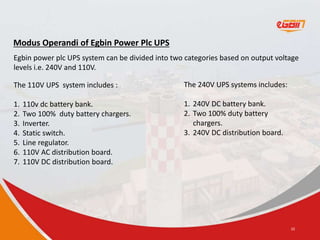
Modus Operandi of Egbin Power Plc UPS
Egbin power plc UPS system can be divided into two categories based on output voltage
levels i.e. 240V and 110V.
The 110V UPS system includes :
1. 110v dc battery bank.
2. Two 100% duty battery chargers.
3. Inverter.
4. Static switch.
5. Line regulator.
6. 110V AC distribution board.
7. 110V DC distribution board.
The 240V UPS systems includes:
1. 240V DC battery bank.
2. Two 100% duty battery
chargers.
3. 240V DC distribution board.
11
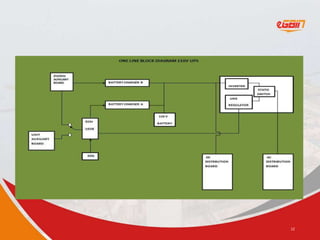
Each Unit is equipped with a pair of battery
chargers that have different power supply source
(i.e. Unit essential service board supplies BATTERY
CHARGER A and Station auxiliary board supplies
BATTERY CHARGER B) both chargers are rated for
100% duty, and under normal condition both are
operated in parallel. This arrangement ensures that
if charger A is out of service due to planned or
unplanned circumstances, charger B will
automatically come into service and vise versa. Both
chargers perform two basic functions of Charging
the batteries and providing DC power directly to the
inverter. But when both chargers loose incoming
power supply or fail simultaneously, the battery will
still continue to provide DC power (for
approximately 10hrs) to the inverter until either of
the chargers is restored.
110V battery chargers A and B
12
13
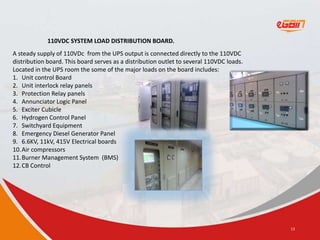
110VDC SYSTEM LOAD DISTRIBUTION BOARD.
A steady supply of 110VDc from the UPS output is connected directly to the 110VDC
distribution board. This board serves as a distribution outlet to several 110VDC loads.
Located in the UPS room the some of the major loads on the board includes:
1. Unit control Board
2. Unit interlock relay panels
3. Protection Relay panels
4. Annunciator Logic Panel
5. Exciter Cubicle
6. Hydrogen Control Panel
7. Switchyard Equipment
8. Emergency Diesel Generator Panel
9. 6.6KV, 11kV, 415V Electrical boards
10.Air compressors
11.Burner Management System (BMS)
12.CB Control
14
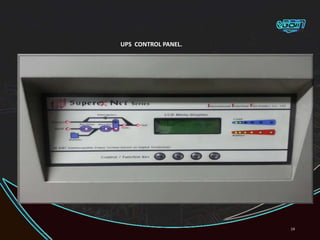
UPS CONTROL PANEL.
15
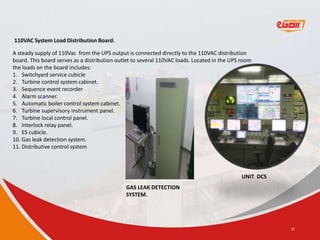
110VAC System Load Distribution Board.
A steady supply of 110Vac from the UPS output is connected directly to the 110VAC distribution
board. This board serves as a distribution outlet to several 110VAC loads. Located in the UPS room
the loads on the board includes:
1. Switchyard service cubicle
2. Turbine control system cabinet.
3. Sequence event recorder
4. Alarm scanner.
5. Automatic boiler control system cabinet.
6. Turbine supervisory instrument panel.
7. Turbine local control panel.
8. Interlock relay panel.
9. ES cubicle.
10. Gas leak detection system.
11. Distributive control system
UNIT DCS
GAS LEAK DETECTION
SYSTEM.
16
240V DC SYSTEM.
The 240v system is for supplying power to critical DC motors which operate under emergency conditions
and the emergency essential lighting. But unlike the 110V UPS its doesn’t have an inverter, hence its output
is DC.
17
The inverter in the 240V system was omitted because 240Vac (which would have been the output of the inverter)
is used exclusively to power AC emergency lighting system, this emergency lighting system is supplied from the
Unit essential service board. The board has three alternate incoming power supply i.e. Unit auxiliary board,
station auxiliary board and EDG so it is a logical solution as opposed to providing an inverter because it is almost
impossible to lose incoming power from these three sources all at once hence an output of 240Vac assured at all
times.
The 240V battery charger arrangement is similar to the 110V system except that the output is 240Vdc, this is
gotten from a battery bank made up of 115 cells of 2V 2000Ah each. As earlier stated, each unit is equipped with
a pair of battery chargers with different incoming power supply source (i.e. Unit essential service board supplies
charger A and Station auxiliary board supplies charger B) both chargers are rated for 100% duty, and under
normal condition both are operated in parallel and will alternate duties whenever applicable (i.e. when incoming
power is lost to the charger in service the other takes over automatically).
With this setup ,a steady supply of 240Vdc is generated at all times. This steady supply is connected directly to
the 240Vdc distribution board.
18
240vdc System Load .
1). Emergency flushing oil pump : After a system collapse
the main oil pump that supplies oil to lubricate the turbine
shaft bearing would lose power and stop working, hence the
EFOP would automatically cut in and continue circulating the
oil.
2). Generator emergency seal oil pump: This pump would
also automatically cut in after a system collapses and
provide adequate seal oil pressure for the hydrogen cooling
system.
3).Vacuum breaker: Whenever there is need eliminate the
vacuum in the condenser, the vacuum breaker it used.
4): Emergency lighting: It provides immediate illumination
pending the restoration of power after a collapse.
VACUUM
BREAKER CUBICLE
EFOP
DC EMERGENCY
LIGHT
GENERATOR EMERGENCY SEAL OIL PUMP
110V DC Circuit breakers supplied by UPS System(MCC Floor)
19
110VDC Circuit breakers supplied by UPS System (Battery room)
20
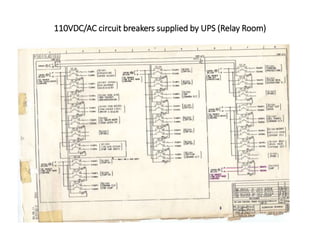
110VDC/AC circuit breakers supplied by UPS (Relay Room)
21
22
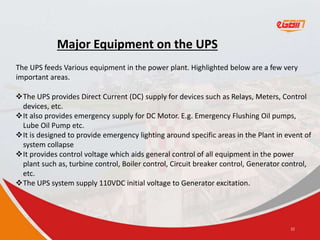
Major Equipment on the UPS
The UPS feeds Various equipment in the power plant. Highlighted below are a few very
important areas.
The UPS provides Direct Current (DC) supply for devices such as Relays, Meters, Control
devices, etc.
It also provides emergency supply for DC Motor. E.g. Emergency Flushing Oil pumps,
Lube Oil Pump etc.
It is designed to provide emergency lighting around specific areas in the Plant in event of
system collapse
It provides control voltage which aids general control of all equipment in the power
plant such as, turbine control, Boiler control, Circuit breaker control, Generator control,
etc.
The UPS system supply 110VDC initial voltage to Generator excitation.
23
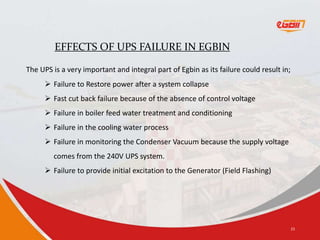
EFFECTS OF UPS FAILURE IN EGBIN
The UPS is a very important and integral part of Egbin as its failure could result in;
 Failure to Restore power after a system collapse
 Fast cut back failure because of the absence of control voltage
 Failure in boiler feed water treatment and conditioning
 Failure in the cooling water process
 Failure in monitoring the Condenser Vacuum because the supply voltage
comes from the 240V UPS system.
 Failure to provide initial excitation to the Generator (Field Flashing)
24

Knowledge sharing on UPS System (Updated).pptx

  • 1.
    1 CONFIDENTIAL AND PROPRIETARY Anyuse of this material without specific permission of Egbin Power Plc is strictly prohibited UNINTERRUPTED POWER SUPPLY AND DC SYSTEM May 27, 2022
  • 2.
    2 - 2 - 2 UninterruptedPower Supply System • An uninterruptible power supply (UPS), also known as a power backup, provides backup power when your regular power source fails or voltage drops to an unacceptable level. • A UPS allows for the safe, orderly shutdown of connected equipment. The size and design of a UPS determine how long it will supply power. • An uninterruptible power supply (UPS) is used to protect critical loads from utility-supplied power problems, including spikes, brownouts, fluctuations and power outages, all using a dedicated battery.
  • 3.
    3 Components of aUPS System Rectifier • The rectifier carries out several key functions. The first is to convert the input power from AC (Alternating Current) to DC (Direct Current). • Its second main role is to recharge the batteries, while the DC power routes to the inverter too. • The rectifier module is a component part of the battery charger. Inverter • This component fulfils the second half of the double conversion by switching the DC voltage from the rectifier or battery back to an AC output that powers the critical load. • This conversion process (AC to DC to AC) and filtering smooths out events such as spikes, sags, surges, and electrical noise, ensuring the final output is a pure sine waveform
  • 4.
    4 Components of aUPS System • The batteries in a UPS system provides emergency power when the mains supply fails. The charger ensures that the batteries are always charged. • For smaller UPS systems, the batteries are often internal to the unit. Whereas in larger solutions, UPS batteries are often housed in their own standalone cabinets. • UPS battery systems have at least one string of batteries. In Egbin Power Plc, the batteries within a string are connected in series. Picture of Batteries in Egbin Batteries
  • 5.
    5 Static Bypass Switch •This component is a safeguard in case there’s a failure within the UPS system. In the event of a UPS fault, the static bypass switch automatically connects the load to the mains supply, bypassing the rectifier, batteries, and inverter. • Having to transfer to mains supply isn’t ideal as the power won’t be well filtered or conditioned as usual in an online double-conversion UPS, but it does enable equipment to continue functioning while the UPS is repaired or replaced. Components of a UPS System
  • 6.
    6 UPS System Topology DifferentUPS topologies provide specific levels of power protection. The three general categories of modern UPS systems are: Offline/Standby Online/Double- conversion Line Interactive
  • 7.
    7 UPS System Topology Standby(Offline) UPS: • Standby is the most basic UPS topology. A standby UPS resorts to battery backup power in the event of common power problems such as a blackout, voltage sag, or voltage surge. • The inverter only starts when the power fails, hence the name "Standby." High efficiency, small size, and low cost are the main benefits of this design. • These models are designed for consumer electronics, entry-level computers, POS systems, security systems, and other basic electronic equipment. Diagram showing offline UPS
  • 8.
    8 UPS System Topology LineInteractive UPS System • In this design, the inverter is always connected to the output of the UPS, operating the inverter in reverse during times when the input AC power is normal provides battery charging. • When the input power fails, the transfer switch opens and the power flows from the battery to the UPS output. • With the inverter always on and connected to the output, this design provides additional filtering and yields reduced switching transients when compared with the Standby UPS topology. Diagram showing Line Interactive UPS
  • 9.
    9 UPS System Topology Online(Double-Conversion) UPS • A double-conversion UPS provides consistent, clean, and near perfect power regardless of the condition of incoming power. • This UPS converts incoming AC power to DC, and then back to AC. UPS systems with this technology operates on isolated DC power and have zero transfer time because they never need to switch to DC power. • Double-conversion UPS systems are designed to protect critical equipment, data centers and large telecom installations from damage caused by a power blackout, voltage sag, over voltage, under voltage etc. Diagram showing Online UPS
  • 10.
    10 Modus Operandi ofEgbin Power Plc UPS Egbin power plc UPS system can be divided into two categories based on output voltage levels i.e. 240V and 110V. The 110V UPS system includes : 1. 110v dc battery bank. 2. Two 100% duty battery chargers. 3. Inverter. 4. Static switch. 5. Line regulator. 6. 110V AC distribution board. 7. 110V DC distribution board. The 240V UPS systems includes: 1. 240V DC battery bank. 2. Two 100% duty battery chargers. 3. 240V DC distribution board.
  • 11.
    11 Each Unit isequipped with a pair of battery chargers that have different power supply source (i.e. Unit essential service board supplies BATTERY CHARGER A and Station auxiliary board supplies BATTERY CHARGER B) both chargers are rated for 100% duty, and under normal condition both are operated in parallel. This arrangement ensures that if charger A is out of service due to planned or unplanned circumstances, charger B will automatically come into service and vise versa. Both chargers perform two basic functions of Charging the batteries and providing DC power directly to the inverter. But when both chargers loose incoming power supply or fail simultaneously, the battery will still continue to provide DC power (for approximately 10hrs) to the inverter until either of the chargers is restored. 110V battery chargers A and B
  • 12.
  • 13.
    13 110VDC SYSTEM LOADDISTRIBUTION BOARD. A steady supply of 110VDc from the UPS output is connected directly to the 110VDC distribution board. This board serves as a distribution outlet to several 110VDC loads. Located in the UPS room the some of the major loads on the board includes: 1. Unit control Board 2. Unit interlock relay panels 3. Protection Relay panels 4. Annunciator Logic Panel 5. Exciter Cubicle 6. Hydrogen Control Panel 7. Switchyard Equipment 8. Emergency Diesel Generator Panel 9. 6.6KV, 11kV, 415V Electrical boards 10.Air compressors 11.Burner Management System (BMS) 12.CB Control
  • 14.
  • 15.
    15 110VAC System LoadDistribution Board. A steady supply of 110Vac from the UPS output is connected directly to the 110VAC distribution board. This board serves as a distribution outlet to several 110VAC loads. Located in the UPS room the loads on the board includes: 1. Switchyard service cubicle 2. Turbine control system cabinet. 3. Sequence event recorder 4. Alarm scanner. 5. Automatic boiler control system cabinet. 6. Turbine supervisory instrument panel. 7. Turbine local control panel. 8. Interlock relay panel. 9. ES cubicle. 10. Gas leak detection system. 11. Distributive control system UNIT DCS GAS LEAK DETECTION SYSTEM.
  • 16.
    16 240V DC SYSTEM. The240v system is for supplying power to critical DC motors which operate under emergency conditions and the emergency essential lighting. But unlike the 110V UPS its doesn’t have an inverter, hence its output is DC.
  • 17.
    17 The inverter inthe 240V system was omitted because 240Vac (which would have been the output of the inverter) is used exclusively to power AC emergency lighting system, this emergency lighting system is supplied from the Unit essential service board. The board has three alternate incoming power supply i.e. Unit auxiliary board, station auxiliary board and EDG so it is a logical solution as opposed to providing an inverter because it is almost impossible to lose incoming power from these three sources all at once hence an output of 240Vac assured at all times. The 240V battery charger arrangement is similar to the 110V system except that the output is 240Vdc, this is gotten from a battery bank made up of 115 cells of 2V 2000Ah each. As earlier stated, each unit is equipped with a pair of battery chargers with different incoming power supply source (i.e. Unit essential service board supplies charger A and Station auxiliary board supplies charger B) both chargers are rated for 100% duty, and under normal condition both are operated in parallel and will alternate duties whenever applicable (i.e. when incoming power is lost to the charger in service the other takes over automatically). With this setup ,a steady supply of 240Vdc is generated at all times. This steady supply is connected directly to the 240Vdc distribution board.
  • 18.
    18 240vdc System Load. 1). Emergency flushing oil pump : After a system collapse the main oil pump that supplies oil to lubricate the turbine shaft bearing would lose power and stop working, hence the EFOP would automatically cut in and continue circulating the oil. 2). Generator emergency seal oil pump: This pump would also automatically cut in after a system collapses and provide adequate seal oil pressure for the hydrogen cooling system. 3).Vacuum breaker: Whenever there is need eliminate the vacuum in the condenser, the vacuum breaker it used. 4): Emergency lighting: It provides immediate illumination pending the restoration of power after a collapse. VACUUM BREAKER CUBICLE EFOP DC EMERGENCY LIGHT GENERATOR EMERGENCY SEAL OIL PUMP
  • 19.
    110V DC Circuitbreakers supplied by UPS System(MCC Floor) 19
  • 20.
    110VDC Circuit breakerssupplied by UPS System (Battery room) 20
  • 21.
    110VDC/AC circuit breakerssupplied by UPS (Relay Room) 21
  • 22.
    22 Major Equipment onthe UPS The UPS feeds Various equipment in the power plant. Highlighted below are a few very important areas. The UPS provides Direct Current (DC) supply for devices such as Relays, Meters, Control devices, etc. It also provides emergency supply for DC Motor. E.g. Emergency Flushing Oil pumps, Lube Oil Pump etc. It is designed to provide emergency lighting around specific areas in the Plant in event of system collapse It provides control voltage which aids general control of all equipment in the power plant such as, turbine control, Boiler control, Circuit breaker control, Generator control, etc. The UPS system supply 110VDC initial voltage to Generator excitation.
  • 23.
    23 EFFECTS OF UPSFAILURE IN EGBIN The UPS is a very important and integral part of Egbin as its failure could result in;  Failure to Restore power after a system collapse  Fast cut back failure because of the absence of control voltage  Failure in boiler feed water treatment and conditioning  Failure in the cooling water process  Failure in monitoring the Condenser Vacuum because the supply voltage comes from the 240V UPS system.  Failure to provide initial excitation to the Generator (Field Flashing)
  • 24.