Knowledge and Life: What does it
mean to be living?
William P. Hall
President
Kororoit Institute Proponents and Supporters
Assoc., Inc. - http://kororoit.org
william-hall@bigpond.com
http://www.orgs-evolution-knowledge.net
Existentialist Society Lecture, 2 April 2013
Access my research papers from
Google Citations
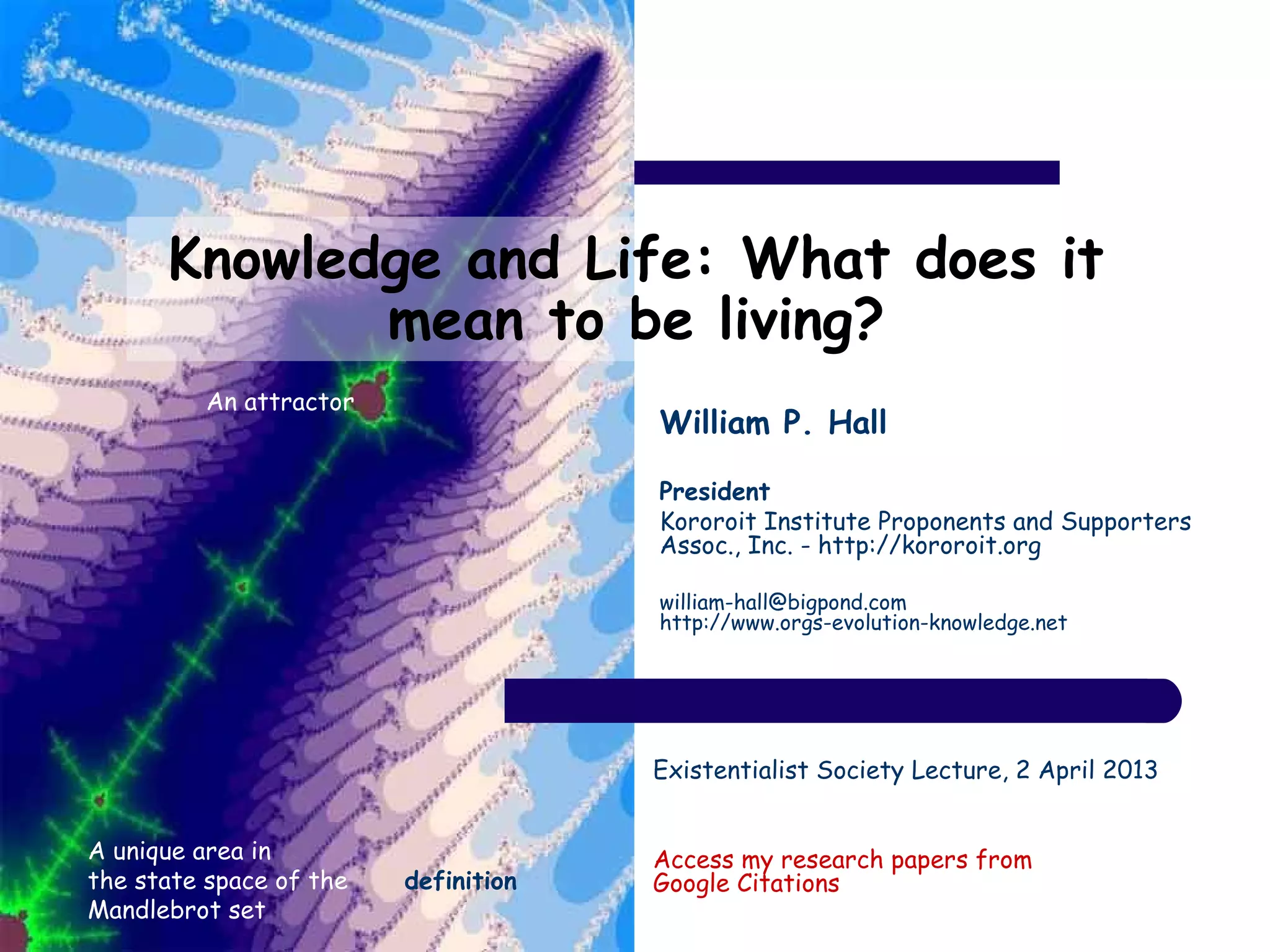
A unique area in
the state space of the
Mandlebrot set
definition
An attractor
Introduction
 Foundation problems in philosophy and biology:
– Epistemology is the branch of philosophy concerned with the
study of knowledge.
– Biology is the branch of science concerned with the study of life
– Both disciplines have been around for centuries
– Neither discipline has formulated a generally acceptable
definition of what it is concerned with
 I will argue that knowledge and life are inextricably
intertwined, and that neither can exist without the other
– Life cannot exist without knowledge
– Knowledge is a product of living
– These statements are not mutually paradoxical
 A unification of concepts from both of these disciplines,
together with some important principles from physics and
complexity theory robustly answers the foundation questions:
What is knowledge? and What is life?2
This talk is one of the outcomes of researching and
writing a fugue on the theory of knowledge
 Application Holy Wars or a new Reformation – A Fugue on
the Theory of Knowledge
– Combines threads from my two major careers
 Evolutionary biology
 Documentation and knowledge management systems analysis and management
– Started part time in late 2000 to survey the co-evolution of and
revolutions in human cognition and the cognitive tools humans used
– Because the story is complex, crossing many diverse disciplinary
paradigms, I adopted a cyclically fugal structure of subject, counter-
subject, several episodes with an interlude, and a cadenza and coda.
 The historical part of the story was easy
 Understanding life and knowledge at the organizational level
was not!
– My constructions are at odds with published dogmas of organization
studies and most knowledge management practitioners
– In trying to answer the foundation questions, as will be presented here, I
have ended up unifying some quite disparate ideas into a common answer to
most of them3
Existentialism, “knowledge”, and “truth”
 Caveat: I am not a student of the philosophy of
existentialism and am not familiar with its literature
– I think my approach here leads to an existential and
materialistic understanding of the world
 There is a “real world” with law-like behaviours
 The operations of reality constrain our individual existences
 What/who we are and how we perceive reality is conditioned by our
existences and individual choices along our trajectories of life
 There are no essences beyond the reality of our existences
 Knowledge is constructed
– All our knowledge and beliefs about the real world are
cognitively constructed by biological processes working
within the constraints of the real world
 Truth is unknowable
– Knowledge of the world is not identical to the real world
– Cognition is in the world - it does not mirror it4
Questions about life arise from my career in
physics and biology
 My early life in Southern California living on a boat
– Immersed in the ocean, equipped with microscope and aquaria
– Prior to university I spent hours almost every day day observing
life’s diversity down to microscopic levels
– Planned to be an engineer and build space ships
 Started university as a physics major in 1957
– Studied physics for 3 years until flunked out due to dyslexia with
numbers (before hand calculators)
– Graduated with BS Zool after 7½ years
 Became an evolutionary biologist
– I taught general biology and invertebrate zoology as a master’s
degree student around the questions: What is life? How does life
survive?
– Completed my PhD in 1973 at Harvard University’s Museum of
Comparative Zoology studying comparative population cytogenetics,
evolution and speciation in a large genus of North Americal Lizards
5
Questions about knowledge arise from my career
in theoretical and applied epistemology
 Came to Australia from 1977 to 79 as a University of
Melbourne Research Fellow in Genetics
– Reviewers of my PhD work forced me to ask whether my approach
to comparative biology was “scientific”
– Spent two years studying history and philosophy of science on my
own (no one in Philosophy was then interested in my questions)
– Returned to the States for a year & concluded there was no
career path (complex transcript, Affirmative Action, etc.)
 Immigrated to Australia in 1980
– Personal computers were evolving much faster than lizards!
– Technical writer and documentation manager for software house
and the original Bank of Melbourne.
– From 1990 until retirement mid 2007 was documentation and
knowledge management systems analyst for Tenix Defence.
– Practical questions: What is knowledge to an organization? Why
is it important? How should it be managed?
6
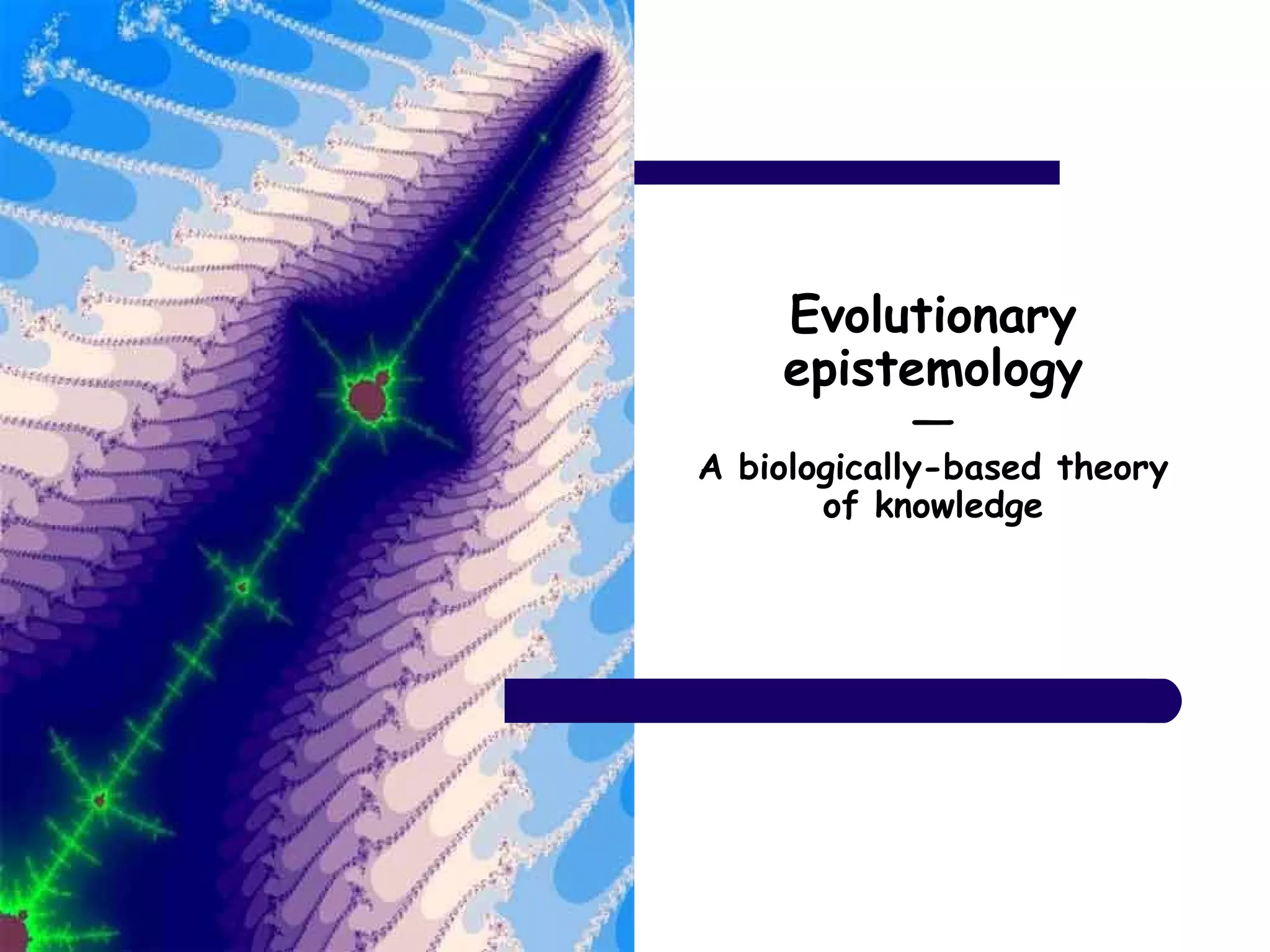
Evolutionary
epistemology
―
A biologically-based theory
of knowledge
Sources for biological approach to epistemology
8
 Charles Darwin (1859) On the Origin of Species
 Konrad Lorenz – 1973 Nobel Prize (animal cognition and knowledge)
 Donald T. Campbell (1960, 1974)
– Psychologist concerned with cognitive processes generating
knowledge
– (1960) Blind Variation and Selective Retention…. (paper)
– (1974) Evolutionary Epistemology (chapter)
 Sir Karl R. Popper (≥ 1972 – knowledge is solutions to problems)
– (1972) Objective Knowledge – An Evolutionary Approach
– (1974) “The main task of the theory of knowledge is to understand
it as continuous with animal knowledge; and … its discontinuity – if
any – from animal knowledge” p 1161, “Replies to my Critics”
– (1994) Knowledge and the Body-Mind Problem
 Knowledge revolutions
– Thomas Kuhn (1960) The Structure of Scientific Revolutions
– Stephen J. Gould (and Eldridge) - Punctuated equilibria
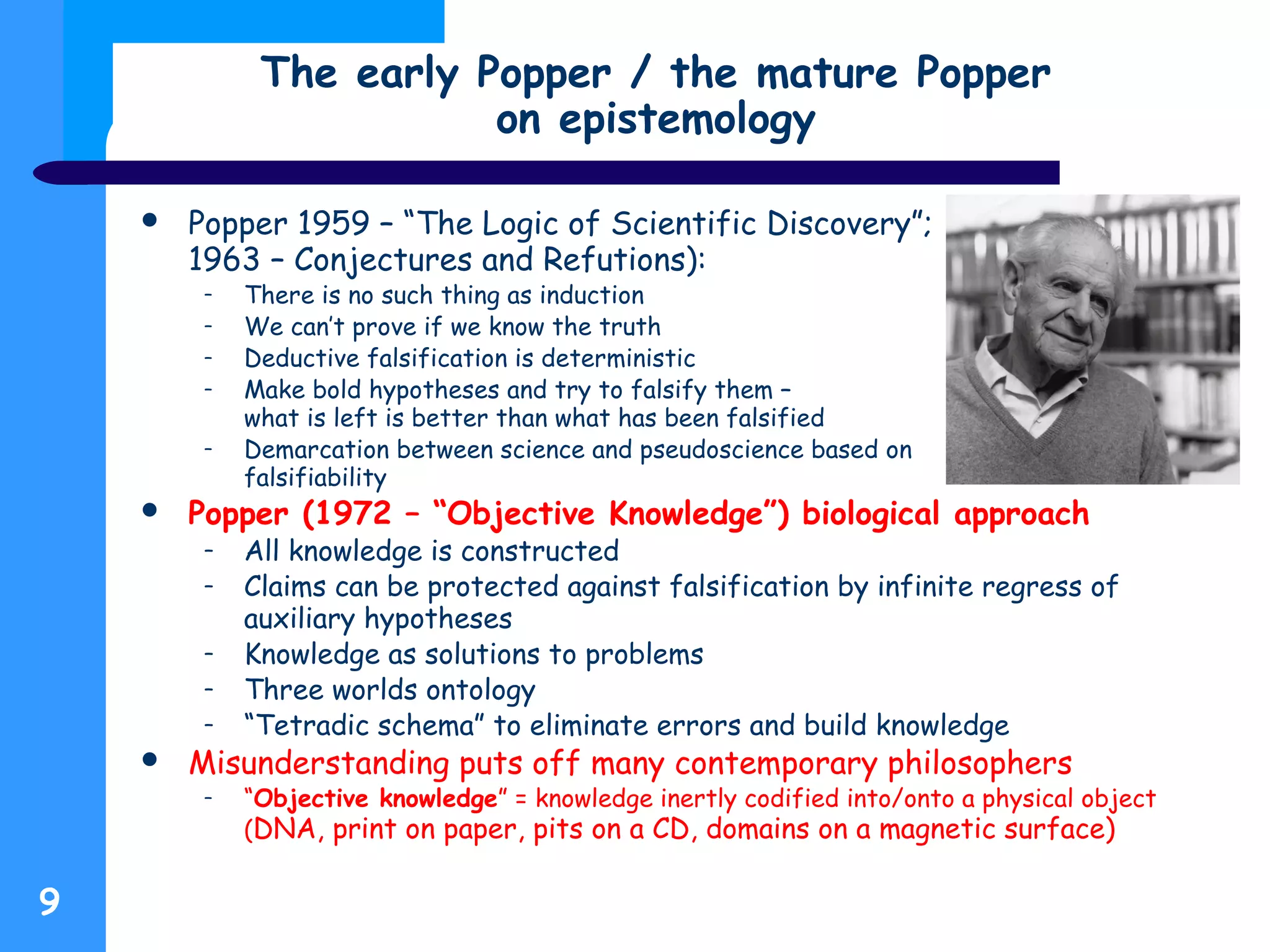
 Popper 1959 – “The Logic of Scientific Discovery”;
1963 – Conjectures and Refutions):
– There is no such thing as induction
– We can’t prove if we know the truth
– Deductive falsification is deterministic
– Make bold hypotheses and try to falsify them –
what is left is better than what has been falsified
– Demarcation between science and pseudoscience based on
falsifiability
 Popper (1972 – “Objective Knowledge”) biological approach
– All knowledge is constructed
– Claims can be protected against falsification by infinite regress of
auxiliary hypotheses
– Knowledge as solutions to problems
– Three worlds ontology
– “Tetradic schema” to eliminate errors and build knowledge
 Misunderstanding puts off many contemporary philosophers
– “Objective knowledge” = knowledge inertly codified into/onto a physical object
(DNA, print on paper, pits on a CD, domains on a magnetic surface)
The early Popper / the mature Popper
on epistemology
9
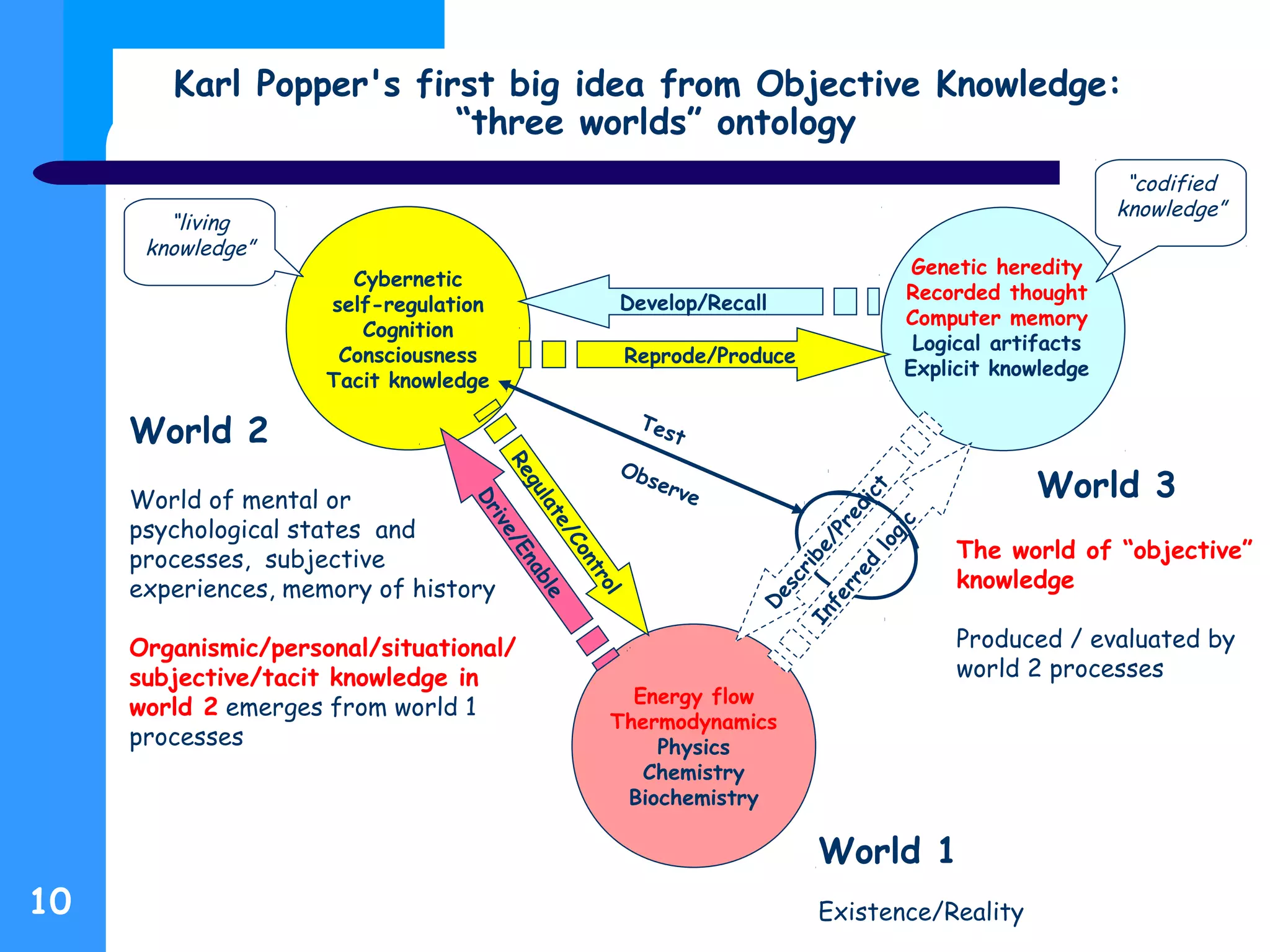
Karl Popper's first big idea from Objective Knowledge:
“three worlds” ontology
10
Energy flow
Thermodynamics
Physics
Chemistry
Biochemistry
Cybernetic
self-regulation
Cognition
Consciousness
Tacit knowledge
Genetic heredity
Recorded thought
Computer memory
Logical artifacts
Explicit knowledge
Reprode/Produce
Develop/Recall
Drive/Enable
Regulate/Control
Inferred
logic
Describe/Predict
Test
Observe
World 1
Existence/Reality
World 2
World of mental or
psychological states and
processes, subjective
experiences, memory of history
Organismic/personal/situational/
subjective/tacit knowledge in
world 2 emerges from world 1
processes
World 3
The world of “objective”
knowledge
Produced / evaluated by
world 2 processes
“living
knowledge”
“codified
knowledge”
“Epistemic cut” concept clarifies validity and relationships of
Popper’s three worlds
 Popper did not physically justify his ontological proposal
 Howard Pattee 1995 “Artificial life needs a real epistemology”
– An “epistemic cut” refers to strict ontological separation in both physical
and philosophical senses between:
Knowledge of reality from reality itself, e.g., description from construction,
simulation from realization, mind from brain [or cognition from physical system].
Selective evolution began with a description-construction cut.... The highly evolved
cognitive epistemology of physics requires an epistemic cut between reversible
dynamic laws and the irreversible process of measuring [or describing]….
– Also known as “Heisenberg cut”
– Different concept from “epistemic gap” separating “phenomenological
knowledge” from “physical knowledge”
– No evidence Pattee or Popper ever cited the other
 One epistemic cut separates the blind physics of world 1 from the
cybernetic self-regulation, cognition, and living memory of world 2
 A second epistemic cut separates the self-regulating dynamics of
living entities from the encoded knowledge of books, computer
memories and DNAs and RNAs
 See Pattee (2012) Laws, Language and Life. Biosemiotics vol. 711
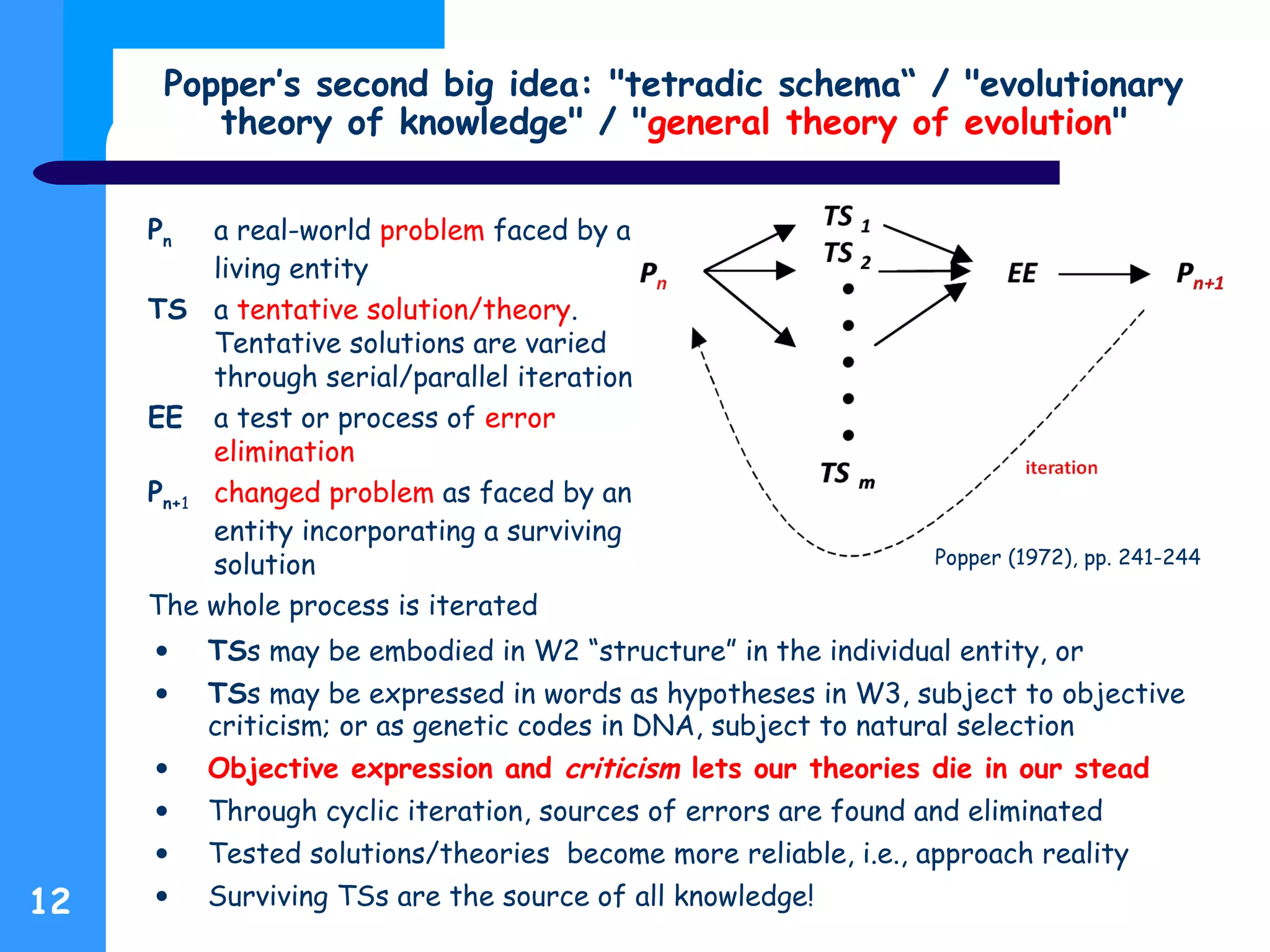
Popper’s second big idea: "tetradic schema“ / "evolutionary
theory of knowledge" / "general theory of evolution"
12
Pn a real-world problem faced by a
living entity
TS a tentative solution/theory.
Tentative solutions are varied
through serial/parallel iteration
EE a test or process of error
elimination
Pn+1 changed problem as faced by an
entity incorporating a surviving
solution
The whole process is iterated
• TSs may be embodied in W2 “structure” in the individual entity, or
• TSs may be expressed in words as hypotheses in W3, subject to objective
criticism; or as genetic codes in DNA, subject to natural selection
• Objective expression and criticism lets our theories die in our stead
• Through cyclic iteration, sources of errors are found and eliminated
• Tested solutions/theories become more reliable, i.e., approach reality
• Surviving TSs are the source of all knowledge!
Popper (1972), pp. 241-244
13
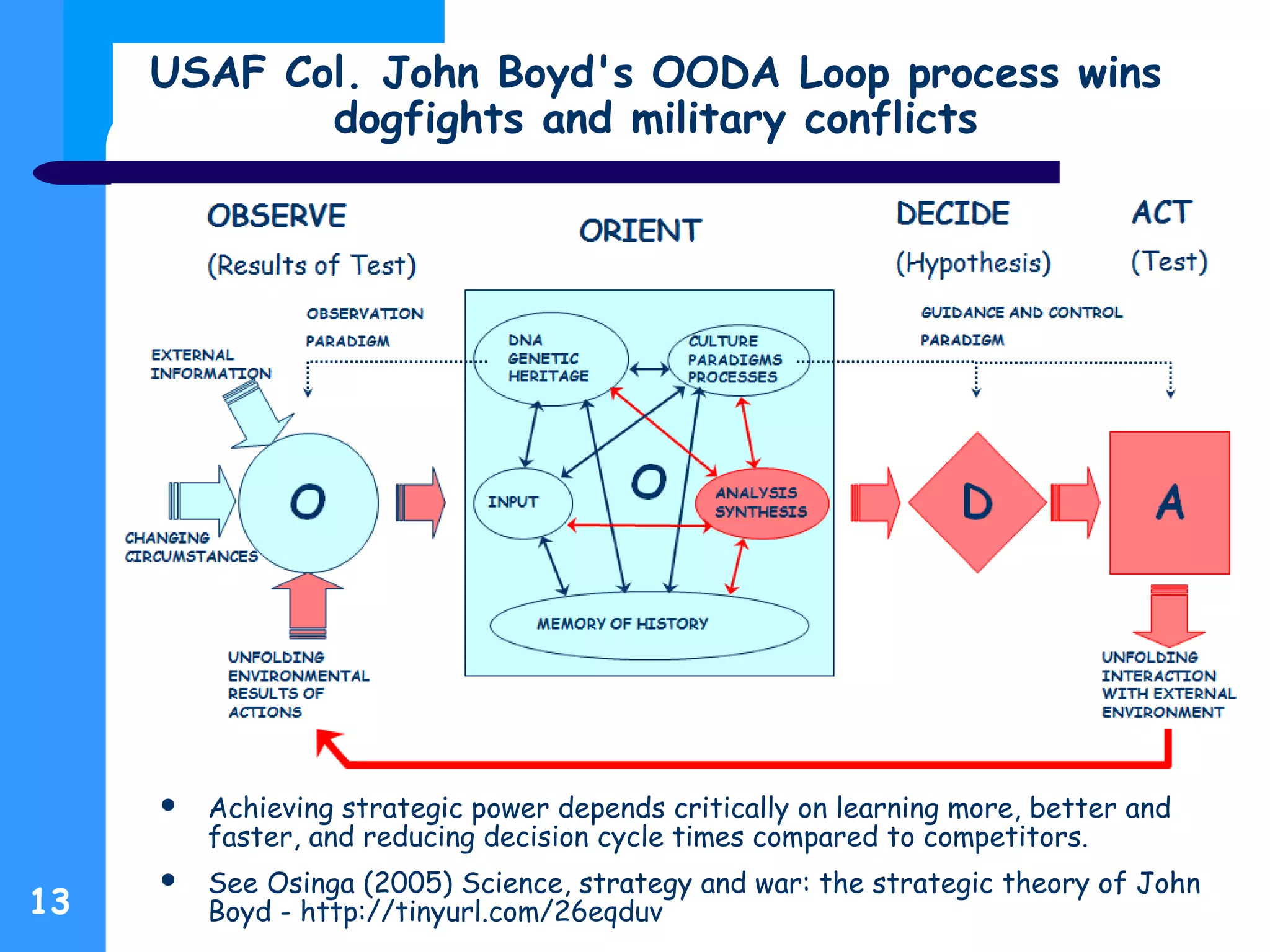
USAF Col. John Boyd's OODA Loop process wins
dogfights and military conflicts
 Achieving strategic power depends critically on learning more, better and
faster, and reducing decision cycle times compared to competitors.
 See Osinga (2005) Science, strategy and war: the strategic theory of John
Boyd - http://tinyurl.com/26eqduv
14
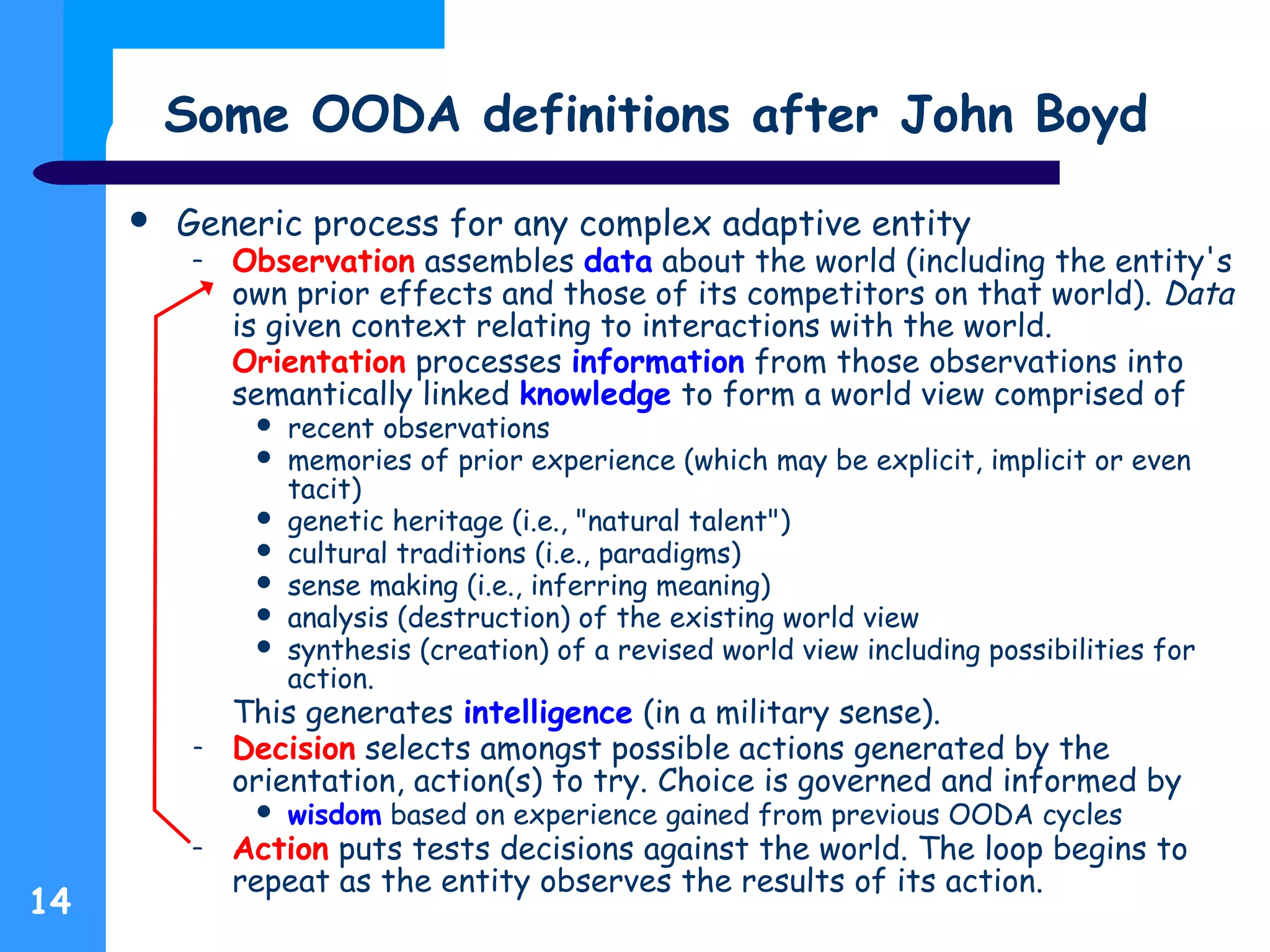
Some OODA definitions after John Boyd
 Generic process for any complex adaptive entity
– Observation assembles data about the world (including the entity's
own prior effects and those of its competitors on that world). Data
is given context relating to interactions with the world.
– Orientation processes information from those observations into
semantically linked knowledge to form a world view comprised of
 recent observations
 memories of prior experience (which may be explicit, implicit or even
tacit)
 genetic heritage (i.e., "natural talent")
 cultural traditions (i.e., paradigms)
 sense making (i.e., inferring meaning)
 analysis (destruction) of the existing world view
 synthesis (creation) of a revised world view including possibilities for
action.
This generates intelligence (in a military sense).
– Decision selects amongst possible actions generated by the
orientation, action(s) to try. Choice is governed and informed by
 wisdom based on experience gained from previous OODA cycles
– Action puts tests decisions against the world. The loop begins to
repeat as the entity observes the results of its action.
15
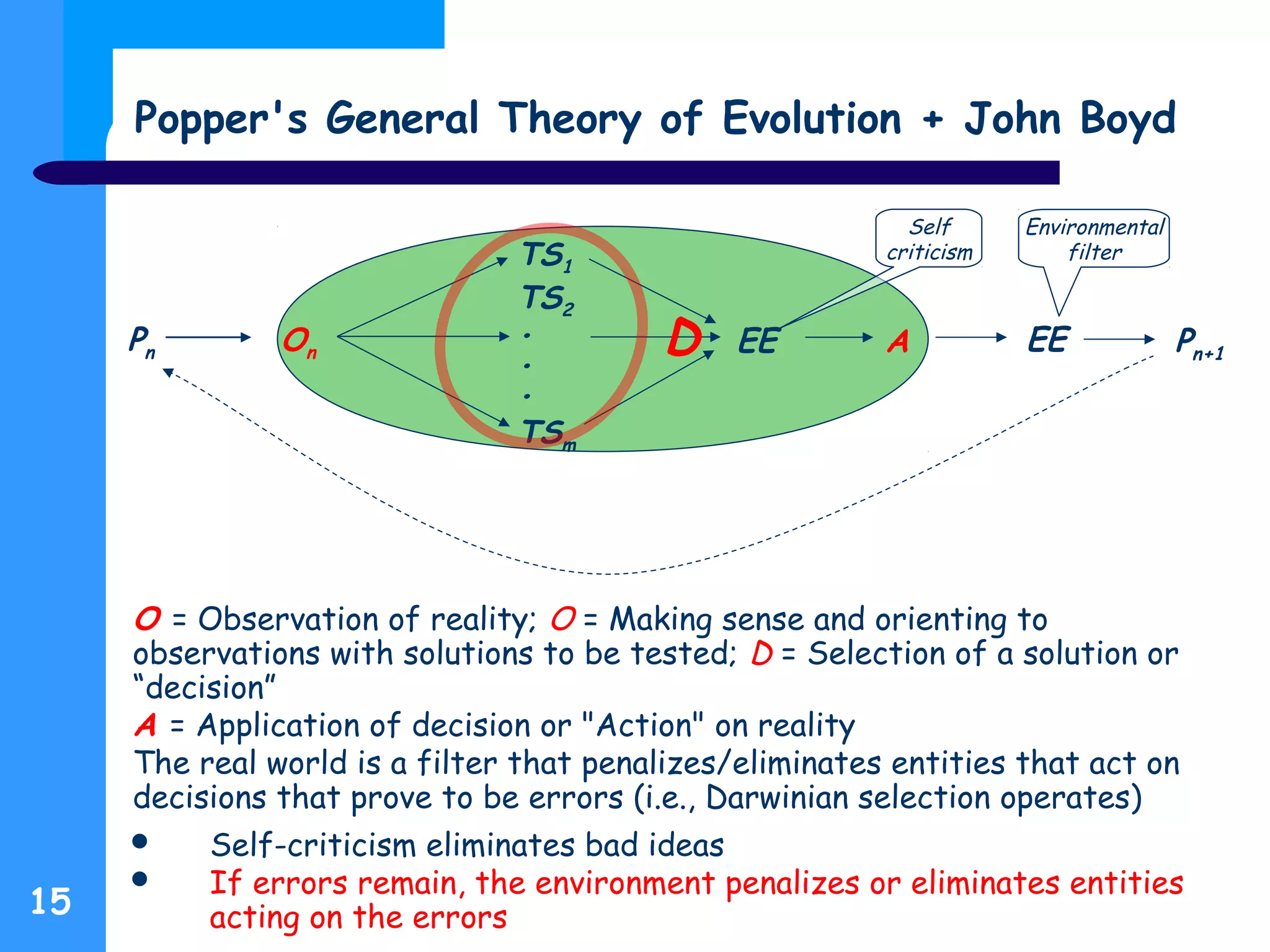
Popper's General Theory of Evolution + John Boyd
O = Observation of reality; O = Making sense and orienting to
observations with solutions to be tested; D = Selection of a solution or
“decision”
A = Application of decision or "Action" on reality
The real world is a filter that penalizes/eliminates entities that act on
decisions that prove to be errors (i.e., Darwinian selection operates)
 Self-criticism eliminates bad ideas
 If errors remain, the environment penalizes or eliminates entities
acting on the errors
TS1
TS2
•
•
•
TSm
Pn Pn+1AOn EE EE
Self
criticism
Environmental
filter
D
Autopoiesis
―
A systems-based theory of
life and cognition
Maturana and Varela (1980). “Autopoiesis and
Cognition – The Realization of the Living”
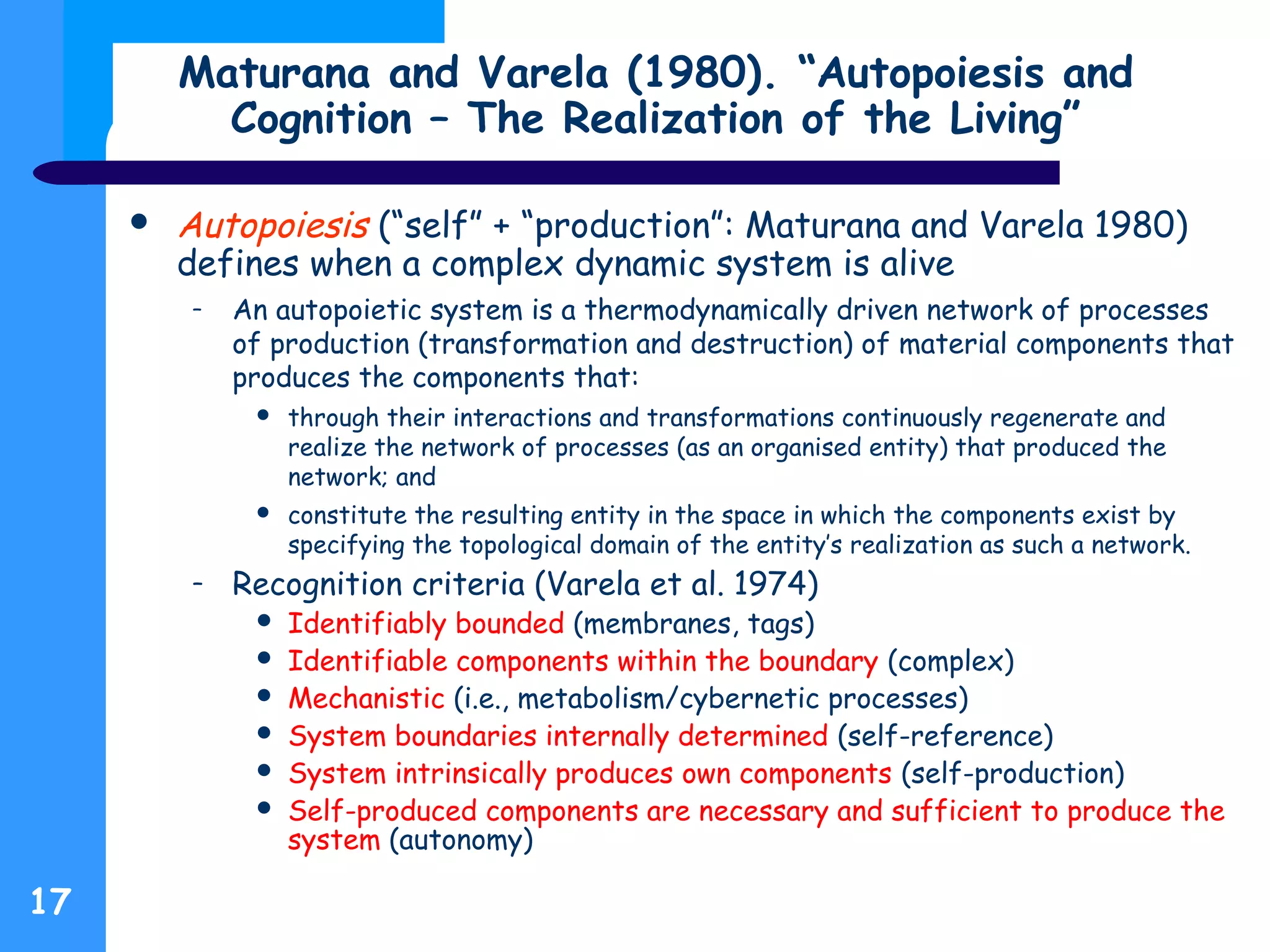
 Autopoiesis (“self” + “production”: Maturana and Varela 1980)
defines when a complex dynamic system is alive
– An autopoietic system is a thermodynamically driven network of processes
of production (transformation and destruction) of material components that
produces the components that:
 through their interactions and transformations continuously regenerate and
realize the network of processes (as an organised entity) that produced the
network; and
 constitute the resulting entity in the space in which the components exist by
specifying the topological domain of the entity’s realization as such a network.
– Recognition criteria (Varela et al. 1974)
 Identifiably bounded (membranes, tags)
 Identifiable components within the boundary (complex)
 Mechanistic (i.e., metabolism/cybernetic processes)
 System boundaries internally determined (self-reference)
 System intrinsically produces own components (self-production)
 Self-produced components are necessary and sufficient to produce the
system (autonomy)
17
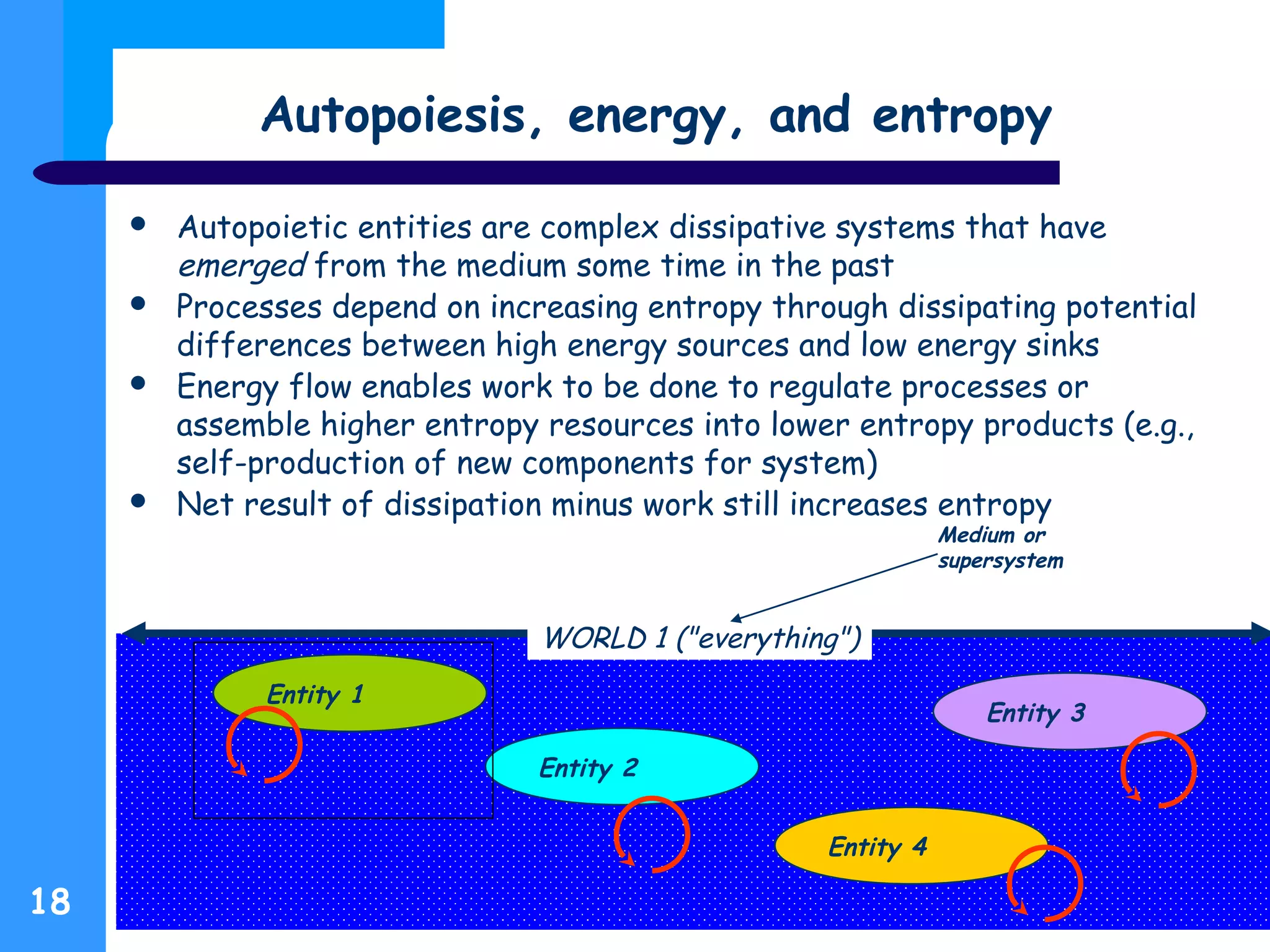
Autopoiesis, energy, and entropy
 Autopoietic entities are complex dissipative systems that have
emerged from the medium some time in the past
 Processes depend on increasing entropy through dissipating potential
differences between high energy sources and low energy sinks
 Energy flow enables work to be done to regulate processes or
assemble higher entropy resources into lower entropy products (e.g.,
self-production of new components for system)
 Net result of dissipation minus work still increases entropy
18
WORLD 1 ("everything")
Medium or
supersystem
Entity 1
Entity 3
Entity 2
Entity 4
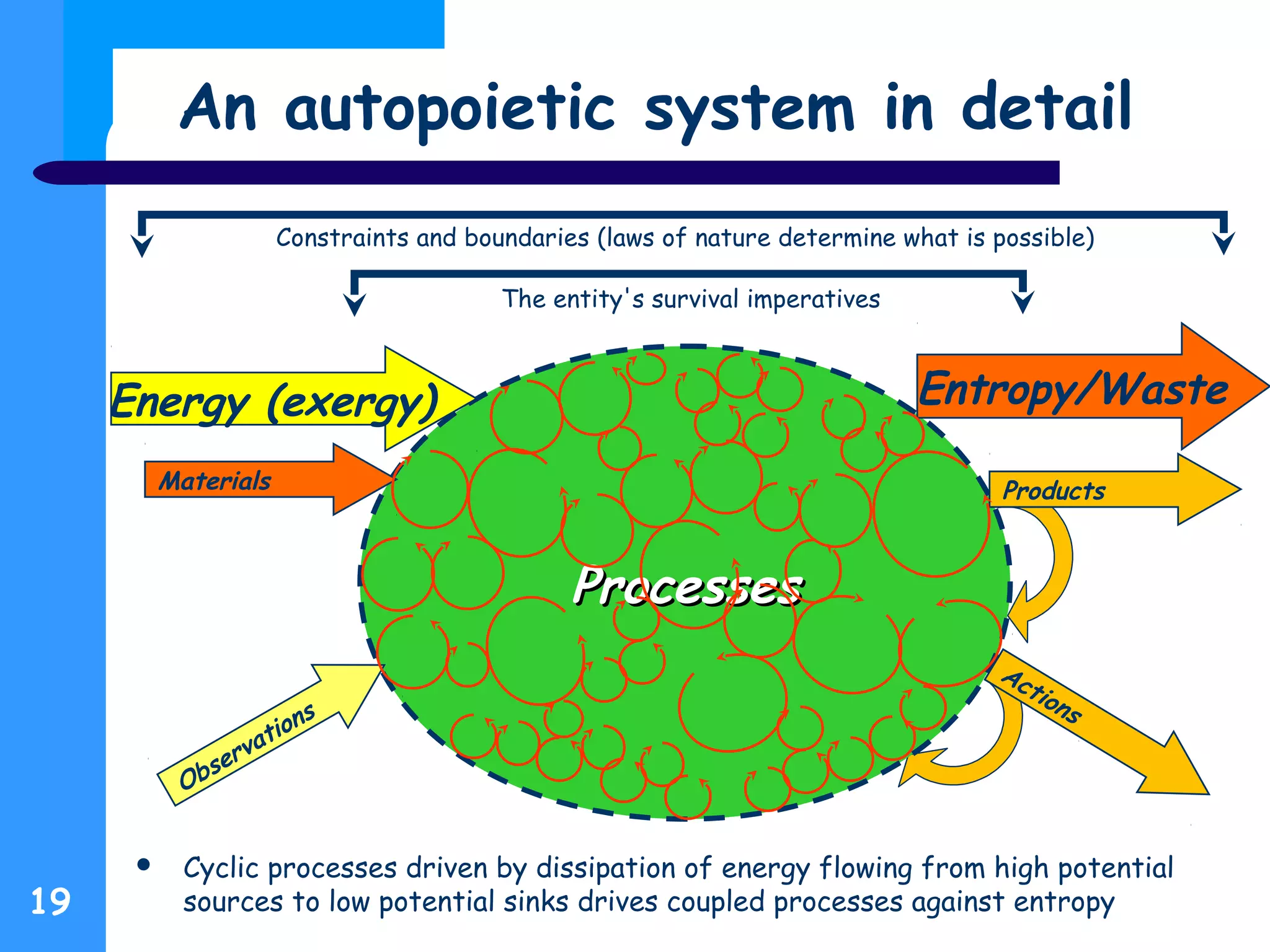
An autopoietic system in detail
 Cyclic processes driven by dissipation of energy flowing from high potential
sources to low potential sinks drives coupled processes against entropy19
ProcessesProcesses
The entity's survival imperatives
Energy (exergy)
Materials
Observations
Entropy/Waste
Products
Actions
Constraints and boundaries (laws of nature determine what is possible)
Knowledge is embodied in the living structure of
the autopoietic system
20
 Continued survival of the quasi cyclical entity depends on the
physical and dynamic configuration of its state in the previous
instant acting to produce its autopoiesis in the next instant
– i.e., the “state space” of an instant, comprising
 spatial location of each particle
 motion vectors and other dynamic properties of each particle that
determine how they will interact in the next instant
– produces the state space of the next instant
 The system remains autopoietic only so long as an autopoietic
configuration is realized from each instant to the next
– If the next configuration fails to remain within an autopoietic
domain its integration as a system is lost (i.e., it has dis-
integrated; ref “attractor basins” in complex system theory)
 A quasi-cyclical sequence of states that continues to generate
autopoietic states is a form of “structural knowledge”
Key points on autopoiesis
 Autopoiesis continues only as long as the entity’s dynamic
structure follows a trajectory of change from one instant to
the next that produces autopoiesis in the next instant
– Fundamentally cyclical
– Continuation depends on the structure of the state in the previous
instant to produce autopoiesis in the next instant
– Feedback regulation is critical
 Loss of control = dis-integration, death
– Survival builds knowledge into living systems one problem solution
at a time
– (Popper 1994 “Alles Leben ist Problemlösen”, p 48) “the adaptation
of life to its environment is a kind of knowledge”
 Niklas Luhmann & his European school argue the logic of self-
production is viciously cyclical
– Requires autopoiesis to exist in an imaginary realm (i.e., orthoganal
to the material world likened to imaginary numbers in mathematics)
– Nature of time in evolutionary processes – to be discussed –
demonstrates that autopoietic cycles are “virtuous” not vicious
21
Cognition in autopoietic systems
Maturana & Varela 1980
 Cognition is the collection of processes by which the
autopoietic system maintains itself
– For any autopoietic system its cognitive domain relates to the
particular way in which its autopoiesis is realized.
 Knowledge is a product of autopoiesis
– Knowledge is descriptive conduct, relative to the cognitive domain
of the knower.
– If the way in which the autopoiesis of an organism is realized
changes during its ontogenic history, the actual knowledge of the
organism (its conduct repertoire) also changes;
– Thus knowledge necessarily reflects the ontogeny of the knower
 Ontogeny as a process of continuous structural change without loss of
autopoiesis
 This is a process of continuous specification of the behavioral capacity
of the organism, and, hence, of its actual domain of interactions.
– Intrinsically, then, no absolute knowledge is possible, and the
validation of all possible relative knowledge is attained through
successful autopoiesis.22
My interpretation of terms relating to cognition
re autopoietic or artificially intelligent systems
 Observation: Initial change induced within the autopoietic
system by a perturbation
 Classification (/ decision): Process by which an induced change
results in the system settling into one of several alternative
attractor basins on a landscape of potential gradients
 Meaning: The net change in the system due to the initial
propagation and classification of an observation
 Ian Coombe's Hierarchy (ref. Aust. Army Information Manual)
– Data: The atomic level of meaning
– Information (first level of synthesis): Classified observations
assembled into relationship structures
– Knowledge (second level of synthesis): Semantically identified and
linked information
– Intelligence (third level of synthesis): Tentative theory(ies) about
the world based on knowledge
– Wisdom (fourth level of synthesis): Solutions after the
elimination of errors through testing theories against the world
– Strategic power (the result): Wisdom applied to control the world
23
First take on what knowledge is
 Popper's World 1 encompasses everything - it is the dynamic
reality that exists independently of observation, knowing and
knowledge
 Observation, meaning and knowledge dynamically emerge in W2
as consequences of universal laws governing physical processes
in W1 as these processes impact living (i.e., autopoietic)
entities with an autonomous history able to distinguish
themselves from the rest of the world
– Observation is a dynamic change propagated within the
autopoietic system resulting from an interaction with the world
– Meaning is a consequence of the observation induced change in
the constitution of the autopoietic system
– Knowledge (in one sense) is the persistent effect of a history
observation and meaning as represented in successfully surviving
autopoietic systems, i.e., those embodying solutions to problems
 There is an epistemic cut between phenomena of W1 and the
knowledge of the phenomena as represented in the living
system (Howard Pattee, 1995)
24
Emergence of
autopoiesis and
knowledge in a
hierarchical world
―
Origins of life and knowledge
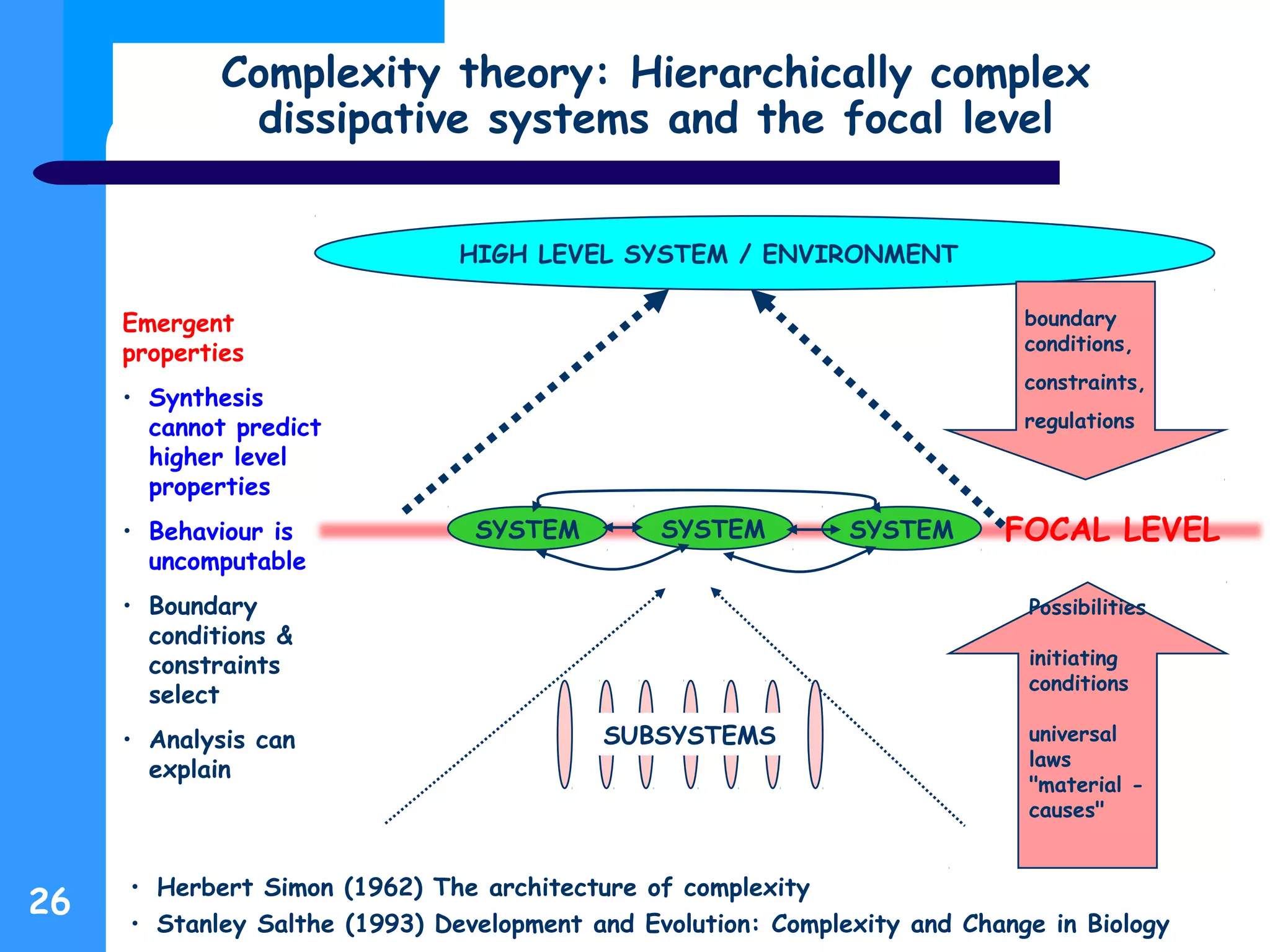
Complexity theory: Hierarchically complex
dissipative systems and the focal level
26
HIGH LEVEL SYSTEM / ENVIRONMENT
SYSTEMSYSTEM SYSTEM
SUBSYSTEMS
boundary
conditions,
constraints,
regulations
FOCAL LEVEL
Possibilities
initiating
conditions
universal
laws
"material -
causes"
Emergent
properties
• Synthesis
cannot predict
higher level
properties
• Behaviour is
uncomputable
• Boundary
conditions &
constraints
select
• Analysis can
explain
• Herbert Simon (1962) The architecture of complexity
• Stanley Salthe (1993) Development and Evolution: Complexity and Change in Biology
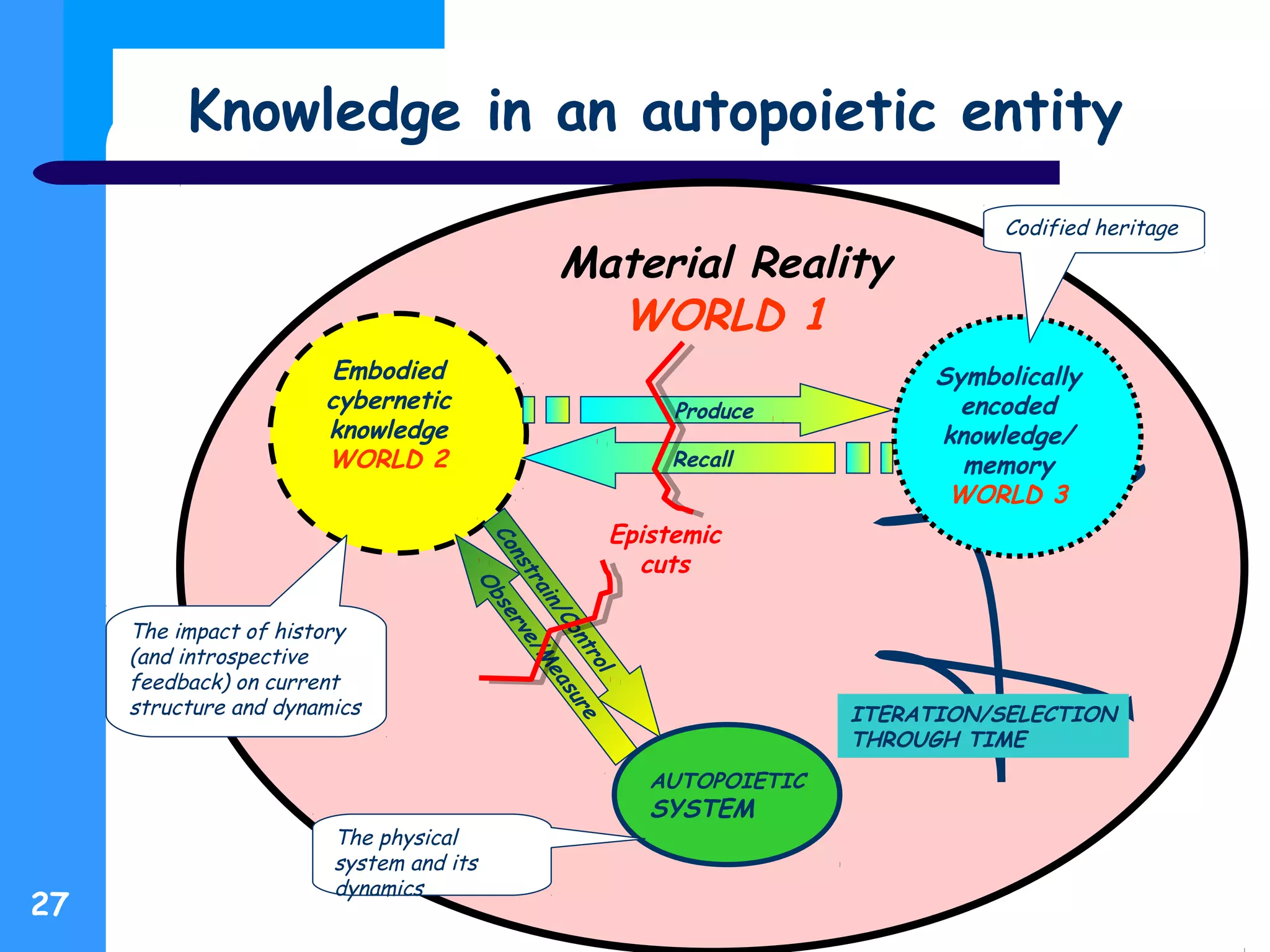
Knowledge in an autopoietic entity
27
Material Reality
WORLD 1
AUTOPOIETIC
SYSTEM
Embodied
cybernetic
knowledge
WORLD 2
Constrain/Control
Observe/M
easure
Recall
ITERATION/SELECTION
THROUGH TIME
Produce
Symbolically
encoded
knowledge/
memory
WORLD 3
The physical
system and its
dynamics
The impact of history
(and introspective
feedback) on current
structure and dynamics
Codified heritage
Epistemic
cuts
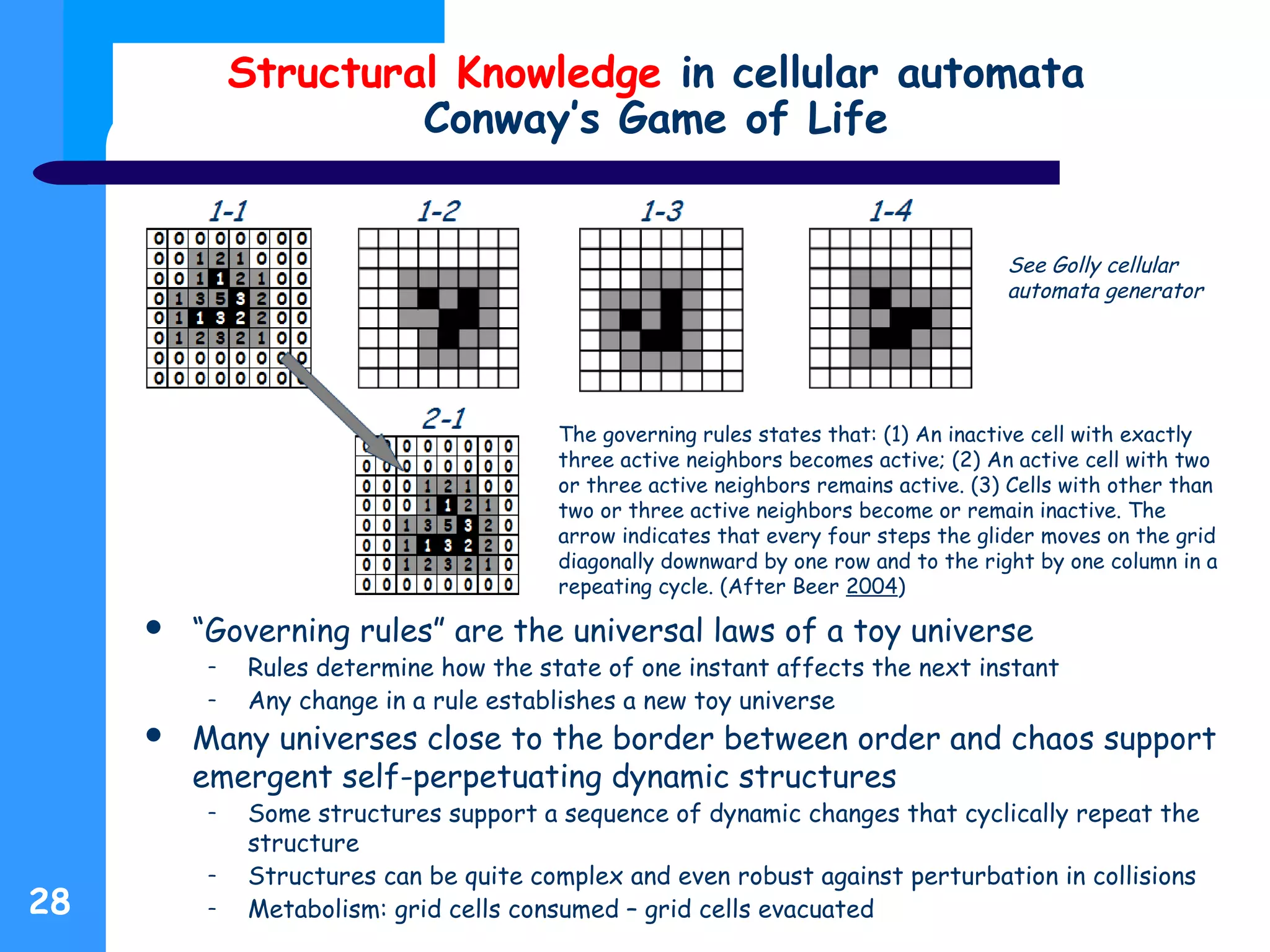
Structural Knowledge in cellular automata
Conway’s Game of Life
 “Governing rules” are the universal laws of a toy universe
– Rules determine how the state of one instant affects the next instant
– Any change in a rule establishes a new toy universe
 Many universes close to the border between order and chaos support
emergent self-perpetuating dynamic structures
– Some structures support a sequence of dynamic changes that cyclically repeat the
structure
– Structures can be quite complex and even robust against perturbation in collisions
– Metabolism: grid cells consumed – grid cells evacuated28
The governing rules states that: (1) An inactive cell with exactly
three active neighbors becomes active; (2) An active cell with two
or three active neighbors remains active. (3) Cells with other than
two or three active neighbors become or remain inactive. The
arrow indicates that every four steps the glider moves on the grid
diagonally downward by one row and to the right by one column in a
repeating cycle. (After Beer 2004)
See Golly cellular
automata generator
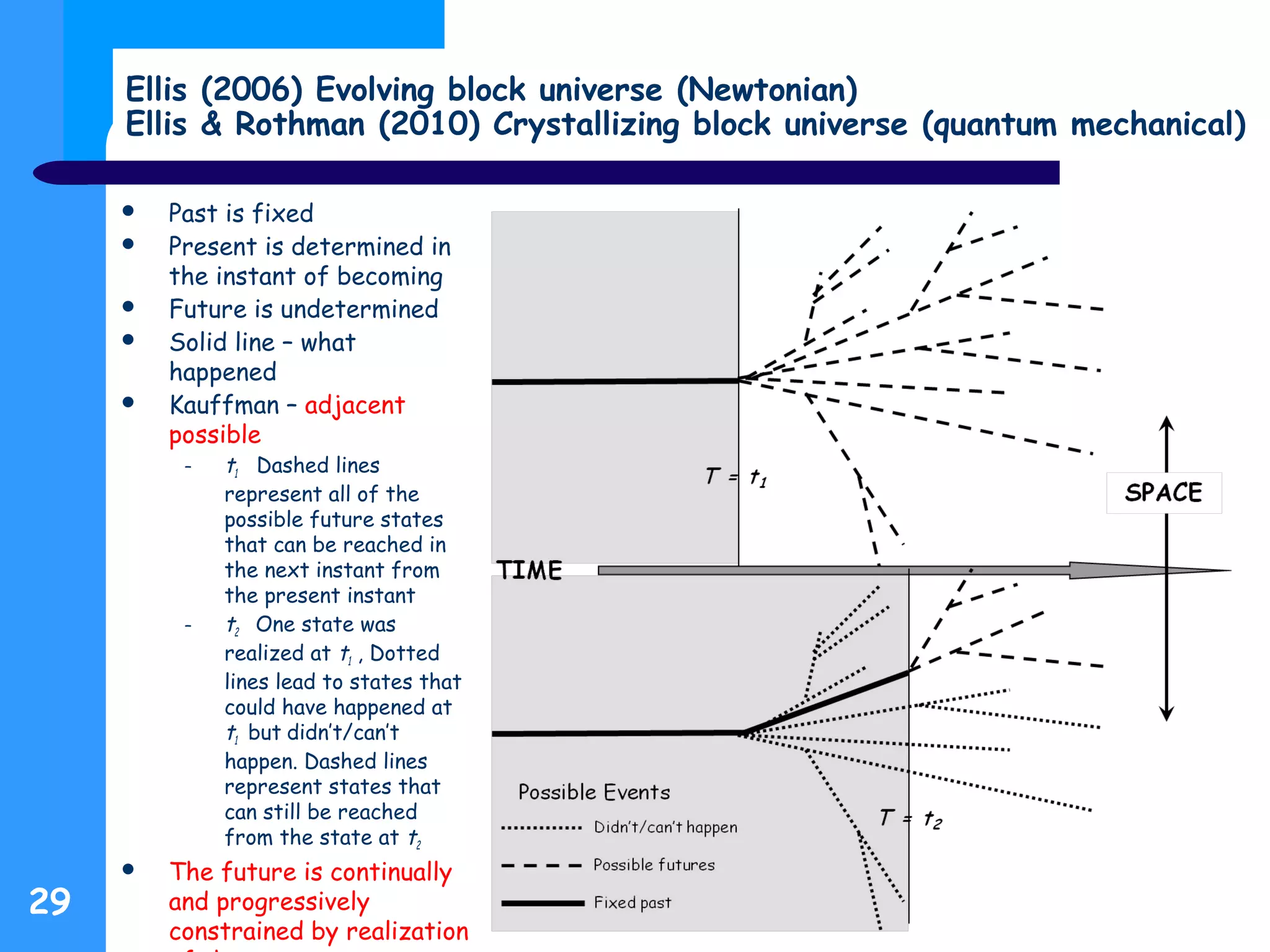
Ellis (2006) Evolving block universe (Newtonian)
Ellis & Rothman (2010) Crystallizing block universe (quantum mechanical)
 Past is fixed
 Present is determined in
the instant of becoming
 Future is undetermined
 Solid line – what
happened
 Kauffman – adjacent
possible
– t1 Dashed lines
represent all of the
possible future states
that can be reached in
the next instant from
the present instant
– t2 One state was
realized at t1 , Dotted
lines lead to states that
could have happened at
t1 but didn’t/can’t
happen. Dashed lines
represent states that
can still be reached
from the state at t2
 The future is continually
and progressively
constrained by realization
29
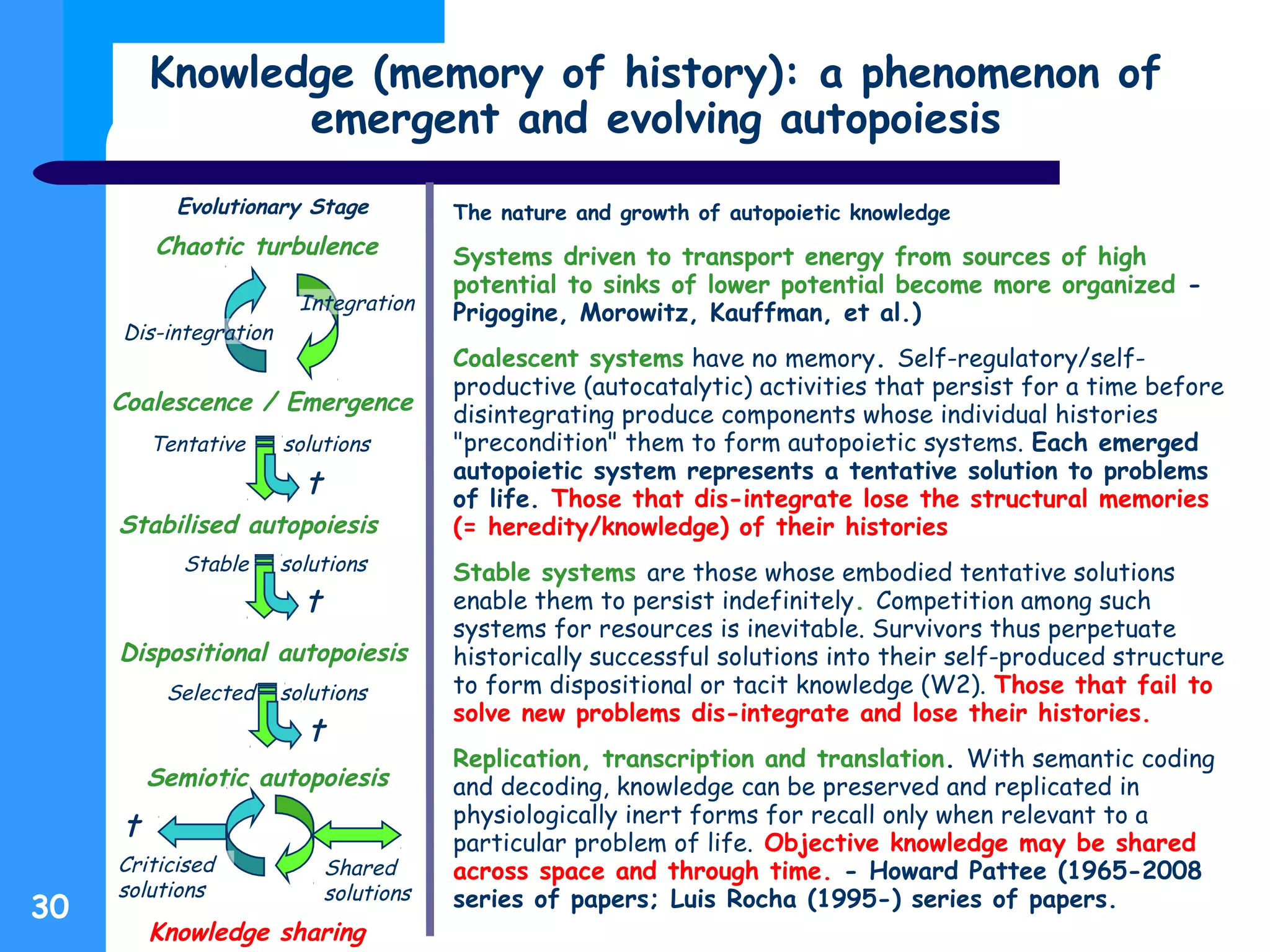
Knowledge (memory of history): a phenomenon of
emergent and evolving autopoiesis
30
Dis-integration
Integration
Tentative solutions
Stable solutions
Selected solutions
Chaotic turbulence
Coalescence / Emergence
Dispositional autopoiesis
Stabilised autopoiesis
Semiotic autopoiesis
†
†
†
Knowledge sharing
Shared
solutions
†
Criticised
solutions
Evolutionary Stage The nature and growth of autopoietic knowledge
Systems driven to transport energy from sources of high
potential to sinks of lower potential become more organized -
Prigogine, Morowitz, Kauffman, et al.)
Coalescent systems have no memory. Self-regulatory/self-
productive (autocatalytic) activities that persist for a time before
disintegrating produce components whose individual histories
"precondition" them to form autopoietic systems. Each emerged
autopoietic system represents a tentative solution to problems
of life. Those that dis-integrate lose the structural memories
(= heredity/knowledge) of their histories
Stable systems are those whose embodied tentative solutions
enable them to persist indefinitely. Competition among such
systems for resources is inevitable. Survivors thus perpetuate
historically successful solutions into their self-produced structure
to form dispositional or tacit knowledge (W2). Those that fail to
solve new problems dis-integrate and lose their histories.
Replication, transcription and translation. With semantic coding
and decoding, knowledge can be preserved and replicated in
physiologically inert forms for recall only when relevant to a
particular problem of life. Objective knowledge may be shared
across space and through time. - Howard Pattee (1965-2008
series of papers; Luis Rocha (1995-) series of papers.
..
.
.
.
. ..
..
.
.
.
.
. ..
..
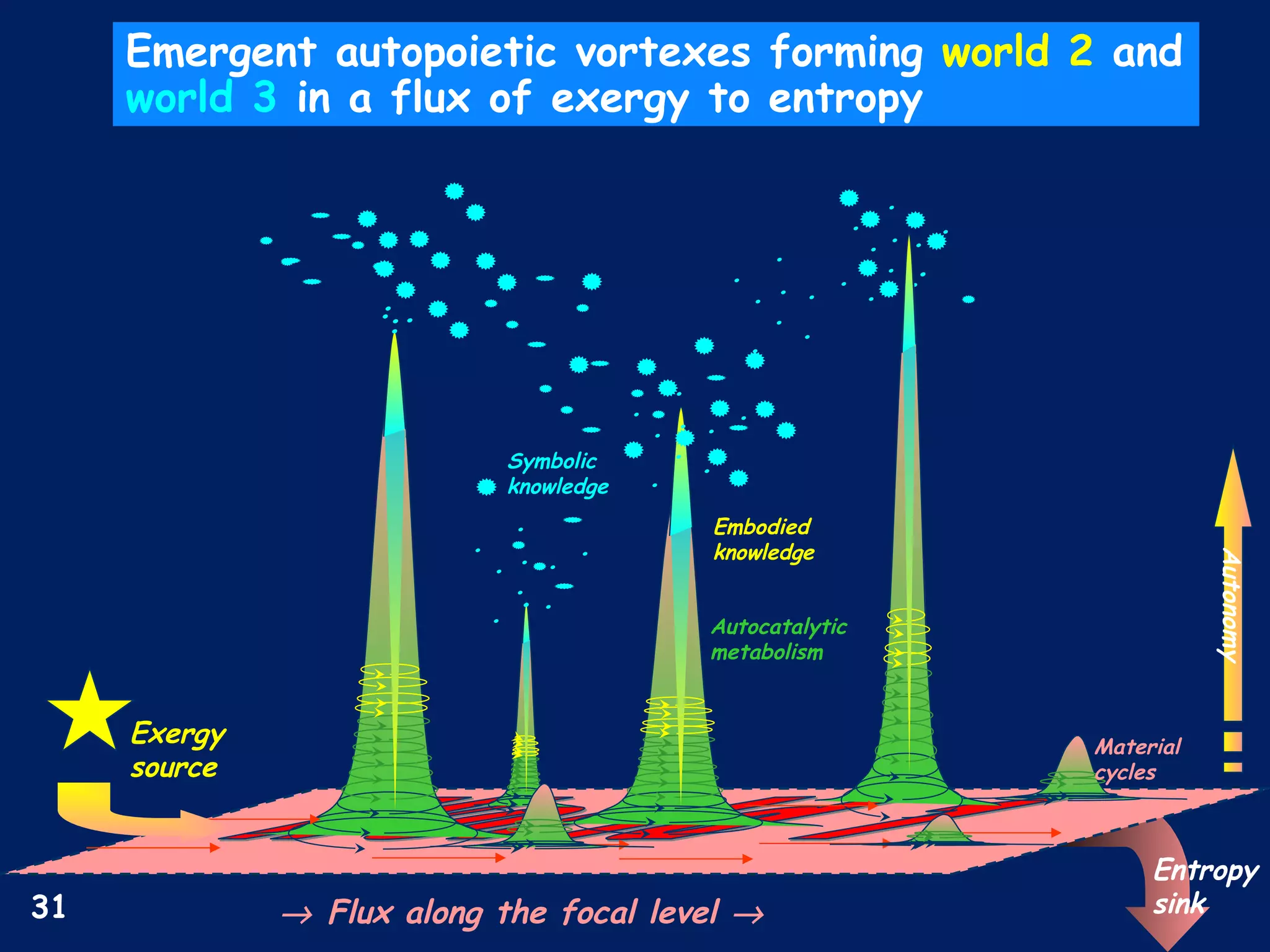
Emergent autopoietic vortexes forming world 2 and
world 3 in a flux of exergy to entropy
.....
.
.
.
.
. ..
..
.
.
.
.
.
. ..
..
→ Flux along the focal level →
Exergy
source
Entropy
sink
Symbolic
knowledge
Embodied
knowledge
Autonomy
Autocatalytic
metabolism
Material
cycles
31
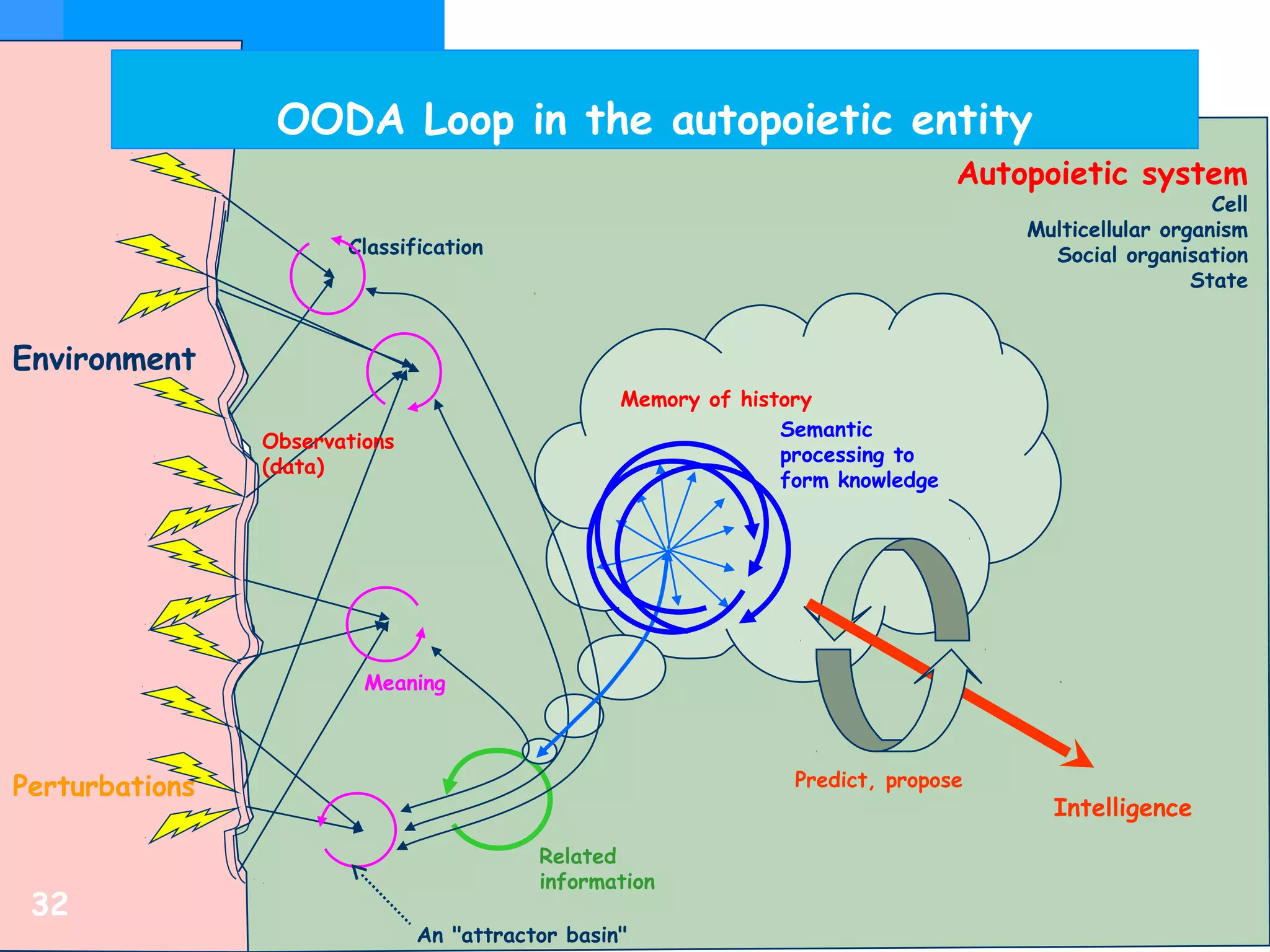
OODA Loop in the autopoietic entity
32
Environment
Autopoietic system
Cell
Multicellular organism
Social organisation
State
Perturbations
Observations
(data)
Classification
Meaning
An "attractor basin"
Related
information
Memory of history
Semantic
processing to
form knowledge
Predict, propose
Intelligence
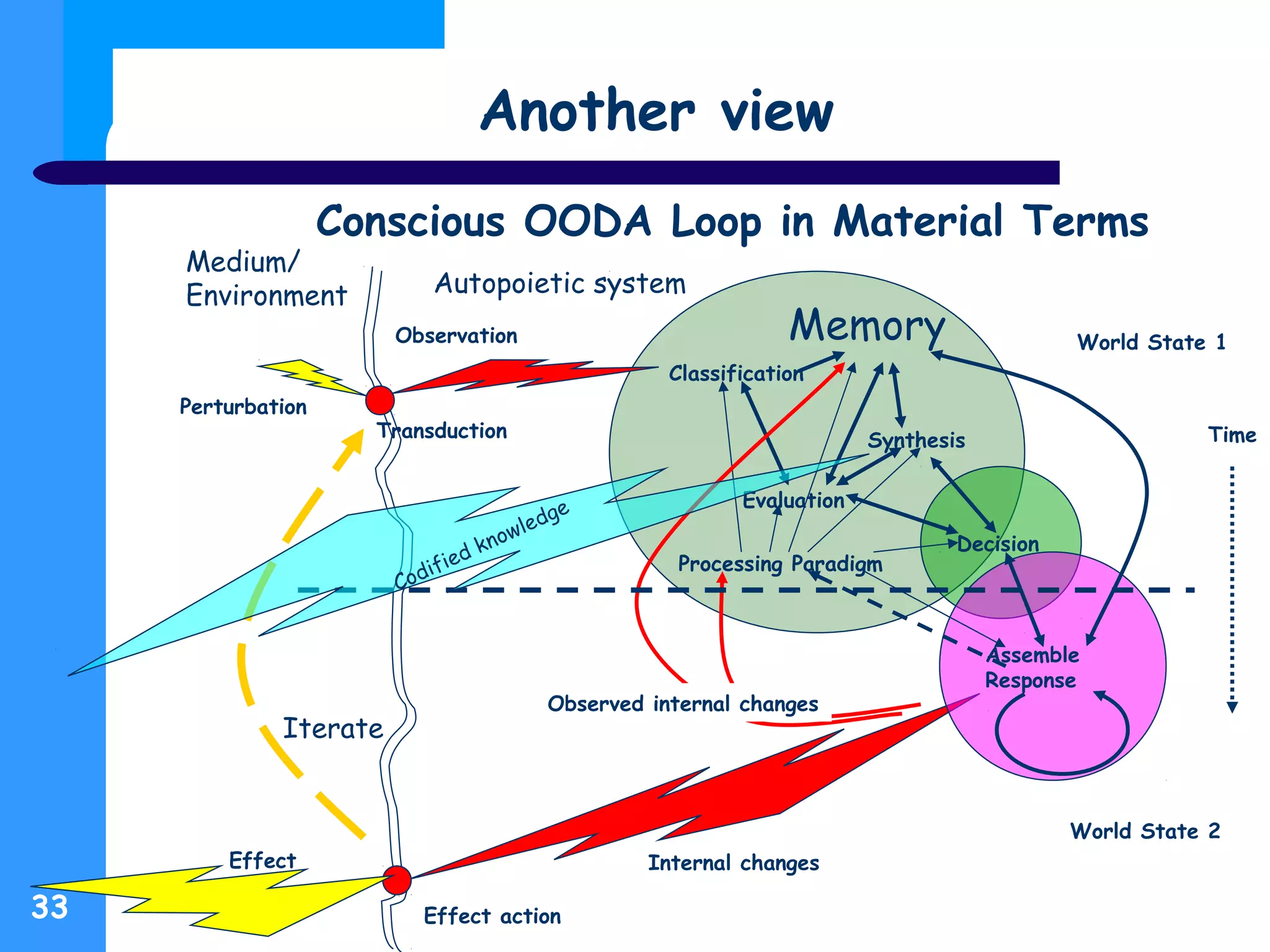
Another view
Decision
Medium/
Environment Autopoietic system
World State 1
Perturbation
Transduction
Observation Memory
Classification
Evaluation
Synthesis
Processing Paradigm
Assemble
Response
Internal changes
Effect action
Effect
Time
World State 2
Iterate
Conscious OODA Loop in Material Terms
Codified knowledge
Observed internal changes
33
Conclusions
 Results highlight the importance to understand autopoiesis as first defined by
Maturana and Varela
– Life is a complex physical organization persisting over time
 Autopoiesis and the construction of knowledge are inseparable aspects of
physical dynamics and the progression of time in an evolutionary block universe
of sufficient complexity
– Life is impossible without the knowledge to survive problems of existence
– All knowledge is constructed by living systems through solving their problems of
existence
– Knowledge and life emerge together as a consequence of the constraints of history
on the adjacent possible
 The result unifies theories of epistemology, physical dynamics, life, biological
evolution, knowledge and social systems.
– Claims asserted in one discipline may be deeply explained in other disciplines
– The resulting biological epistemology is far more robust and scientifically grounded
than are the claims of any one of these disciplines standing alone
 Implications
– No Telos, no essences, but choice in the instant of becoming allows us to constrain
the future
 Criticisms welcome!
34
Contributing disciplines
 Physics: mechanics, dynamics, thermodynamics and cybernetics
– Ilya Prigogine (Nobel laureate) – non equilibrium thermodynamics
– Harold J. Morowitz 1968 – “Energy Flow in Biology”
– Eugene Odum 1971 – “Fundamentals of Ecology”
 Biology: Genetics, cytology, natural history, evolutionary biology
– My own research and teaching background
– S.J. Gould 2002 – “The Structure of Evolutionary Theory”
 Evolutionary epistemology
– Popper 1972 - “Objective Knowledge”
– Thomas Kuhn 1970 - “The Structure of Scientific Revolutions”
– John Boyd 1996 – OODA Loops
 Autopoiesis
– Maturana & Varela 1980 - “Autopoiesis and Cognition”
 Theories of emergent and hierarchical complexity
– Herbert Simon (Nobel laureate in economics)
– Stanley Salthe 1985 – “Evolving Hierarchical Systems”
– Stuart Kauffman 1983 – “The Origins of Order”
 Cosmology, time, causation and the “adjacent possible”
– George F.R. Ellis > 2006 – evolving block and, crystallizing block universes
– Kauffman > 2000 – adjacent possible
35

Knowledge and Life: What does it mean to be living?

  • 1.
    Knowledge and Life:What does it mean to be living? William P. Hall President Kororoit Institute Proponents and Supporters Assoc., Inc. - http://kororoit.org william-hall@bigpond.com http://www.orgs-evolution-knowledge.net Existentialist Society Lecture, 2 April 2013 Access my research papers from Google Citations A unique area in the state space of the Mandlebrot set definition An attractor
  • 2.
    Introduction  Foundation problemsin philosophy and biology: – Epistemology is the branch of philosophy concerned with the study of knowledge. – Biology is the branch of science concerned with the study of life – Both disciplines have been around for centuries – Neither discipline has formulated a generally acceptable definition of what it is concerned with  I will argue that knowledge and life are inextricably intertwined, and that neither can exist without the other – Life cannot exist without knowledge – Knowledge is a product of living – These statements are not mutually paradoxical  A unification of concepts from both of these disciplines, together with some important principles from physics and complexity theory robustly answers the foundation questions: What is knowledge? and What is life?2
  • 3.
    This talk isone of the outcomes of researching and writing a fugue on the theory of knowledge  Application Holy Wars or a new Reformation – A Fugue on the Theory of Knowledge – Combines threads from my two major careers  Evolutionary biology  Documentation and knowledge management systems analysis and management – Started part time in late 2000 to survey the co-evolution of and revolutions in human cognition and the cognitive tools humans used – Because the story is complex, crossing many diverse disciplinary paradigms, I adopted a cyclically fugal structure of subject, counter- subject, several episodes with an interlude, and a cadenza and coda.  The historical part of the story was easy  Understanding life and knowledge at the organizational level was not! – My constructions are at odds with published dogmas of organization studies and most knowledge management practitioners – In trying to answer the foundation questions, as will be presented here, I have ended up unifying some quite disparate ideas into a common answer to most of them3
  • 4.
    Existentialism, “knowledge”, and“truth”  Caveat: I am not a student of the philosophy of existentialism and am not familiar with its literature – I think my approach here leads to an existential and materialistic understanding of the world  There is a “real world” with law-like behaviours  The operations of reality constrain our individual existences  What/who we are and how we perceive reality is conditioned by our existences and individual choices along our trajectories of life  There are no essences beyond the reality of our existences  Knowledge is constructed – All our knowledge and beliefs about the real world are cognitively constructed by biological processes working within the constraints of the real world  Truth is unknowable – Knowledge of the world is not identical to the real world – Cognition is in the world - it does not mirror it4
  • 5.
    Questions about lifearise from my career in physics and biology  My early life in Southern California living on a boat – Immersed in the ocean, equipped with microscope and aquaria – Prior to university I spent hours almost every day day observing life’s diversity down to microscopic levels – Planned to be an engineer and build space ships  Started university as a physics major in 1957 – Studied physics for 3 years until flunked out due to dyslexia with numbers (before hand calculators) – Graduated with BS Zool after 7½ years  Became an evolutionary biologist – I taught general biology and invertebrate zoology as a master’s degree student around the questions: What is life? How does life survive? – Completed my PhD in 1973 at Harvard University’s Museum of Comparative Zoology studying comparative population cytogenetics, evolution and speciation in a large genus of North Americal Lizards 5
  • 6.
    Questions about knowledgearise from my career in theoretical and applied epistemology  Came to Australia from 1977 to 79 as a University of Melbourne Research Fellow in Genetics – Reviewers of my PhD work forced me to ask whether my approach to comparative biology was “scientific” – Spent two years studying history and philosophy of science on my own (no one in Philosophy was then interested in my questions) – Returned to the States for a year & concluded there was no career path (complex transcript, Affirmative Action, etc.)  Immigrated to Australia in 1980 – Personal computers were evolving much faster than lizards! – Technical writer and documentation manager for software house and the original Bank of Melbourne. – From 1990 until retirement mid 2007 was documentation and knowledge management systems analyst for Tenix Defence. – Practical questions: What is knowledge to an organization? Why is it important? How should it be managed? 6
  • 7.
  • 8.
    Sources for biologicalapproach to epistemology 8  Charles Darwin (1859) On the Origin of Species  Konrad Lorenz – 1973 Nobel Prize (animal cognition and knowledge)  Donald T. Campbell (1960, 1974) – Psychologist concerned with cognitive processes generating knowledge – (1960) Blind Variation and Selective Retention…. (paper) – (1974) Evolutionary Epistemology (chapter)  Sir Karl R. Popper (≥ 1972 – knowledge is solutions to problems) – (1972) Objective Knowledge – An Evolutionary Approach – (1974) “The main task of the theory of knowledge is to understand it as continuous with animal knowledge; and … its discontinuity – if any – from animal knowledge” p 1161, “Replies to my Critics” – (1994) Knowledge and the Body-Mind Problem  Knowledge revolutions – Thomas Kuhn (1960) The Structure of Scientific Revolutions – Stephen J. Gould (and Eldridge) - Punctuated equilibria
  • 9.
     Popper 1959– “The Logic of Scientific Discovery”; 1963 – Conjectures and Refutions): – There is no such thing as induction – We can’t prove if we know the truth – Deductive falsification is deterministic – Make bold hypotheses and try to falsify them – what is left is better than what has been falsified – Demarcation between science and pseudoscience based on falsifiability  Popper (1972 – “Objective Knowledge”) biological approach – All knowledge is constructed – Claims can be protected against falsification by infinite regress of auxiliary hypotheses – Knowledge as solutions to problems – Three worlds ontology – “Tetradic schema” to eliminate errors and build knowledge  Misunderstanding puts off many contemporary philosophers – “Objective knowledge” = knowledge inertly codified into/onto a physical object (DNA, print on paper, pits on a CD, domains on a magnetic surface) The early Popper / the mature Popper on epistemology 9
  • 10.
    Karl Popper's firstbig idea from Objective Knowledge: “three worlds” ontology 10 Energy flow Thermodynamics Physics Chemistry Biochemistry Cybernetic self-regulation Cognition Consciousness Tacit knowledge Genetic heredity Recorded thought Computer memory Logical artifacts Explicit knowledge Reprode/Produce Develop/Recall Drive/Enable Regulate/Control Inferred logic Describe/Predict Test Observe World 1 Existence/Reality World 2 World of mental or psychological states and processes, subjective experiences, memory of history Organismic/personal/situational/ subjective/tacit knowledge in world 2 emerges from world 1 processes World 3 The world of “objective” knowledge Produced / evaluated by world 2 processes “living knowledge” “codified knowledge”
  • 11.
    “Epistemic cut” conceptclarifies validity and relationships of Popper’s three worlds  Popper did not physically justify his ontological proposal  Howard Pattee 1995 “Artificial life needs a real epistemology” – An “epistemic cut” refers to strict ontological separation in both physical and philosophical senses between: Knowledge of reality from reality itself, e.g., description from construction, simulation from realization, mind from brain [or cognition from physical system]. Selective evolution began with a description-construction cut.... The highly evolved cognitive epistemology of physics requires an epistemic cut between reversible dynamic laws and the irreversible process of measuring [or describing]…. – Also known as “Heisenberg cut” – Different concept from “epistemic gap” separating “phenomenological knowledge” from “physical knowledge” – No evidence Pattee or Popper ever cited the other  One epistemic cut separates the blind physics of world 1 from the cybernetic self-regulation, cognition, and living memory of world 2  A second epistemic cut separates the self-regulating dynamics of living entities from the encoded knowledge of books, computer memories and DNAs and RNAs  See Pattee (2012) Laws, Language and Life. Biosemiotics vol. 711
  • 12.
    Popper’s second bigidea: "tetradic schema“ / "evolutionary theory of knowledge" / "general theory of evolution" 12 Pn a real-world problem faced by a living entity TS a tentative solution/theory. Tentative solutions are varied through serial/parallel iteration EE a test or process of error elimination Pn+1 changed problem as faced by an entity incorporating a surviving solution The whole process is iterated • TSs may be embodied in W2 “structure” in the individual entity, or • TSs may be expressed in words as hypotheses in W3, subject to objective criticism; or as genetic codes in DNA, subject to natural selection • Objective expression and criticism lets our theories die in our stead • Through cyclic iteration, sources of errors are found and eliminated • Tested solutions/theories become more reliable, i.e., approach reality • Surviving TSs are the source of all knowledge! Popper (1972), pp. 241-244
  • 13.
    13 USAF Col. JohnBoyd's OODA Loop process wins dogfights and military conflicts  Achieving strategic power depends critically on learning more, better and faster, and reducing decision cycle times compared to competitors.  See Osinga (2005) Science, strategy and war: the strategic theory of John Boyd - http://tinyurl.com/26eqduv
  • 14.
    14 Some OODA definitionsafter John Boyd  Generic process for any complex adaptive entity – Observation assembles data about the world (including the entity's own prior effects and those of its competitors on that world). Data is given context relating to interactions with the world. – Orientation processes information from those observations into semantically linked knowledge to form a world view comprised of  recent observations  memories of prior experience (which may be explicit, implicit or even tacit)  genetic heritage (i.e., "natural talent")  cultural traditions (i.e., paradigms)  sense making (i.e., inferring meaning)  analysis (destruction) of the existing world view  synthesis (creation) of a revised world view including possibilities for action. This generates intelligence (in a military sense). – Decision selects amongst possible actions generated by the orientation, action(s) to try. Choice is governed and informed by  wisdom based on experience gained from previous OODA cycles – Action puts tests decisions against the world. The loop begins to repeat as the entity observes the results of its action.
  • 15.
    15 Popper's General Theoryof Evolution + John Boyd O = Observation of reality; O = Making sense and orienting to observations with solutions to be tested; D = Selection of a solution or “decision” A = Application of decision or "Action" on reality The real world is a filter that penalizes/eliminates entities that act on decisions that prove to be errors (i.e., Darwinian selection operates)  Self-criticism eliminates bad ideas  If errors remain, the environment penalizes or eliminates entities acting on the errors TS1 TS2 • • • TSm Pn Pn+1AOn EE EE Self criticism Environmental filter D
  • 16.
  • 17.
    Maturana and Varela(1980). “Autopoiesis and Cognition – The Realization of the Living”  Autopoiesis (“self” + “production”: Maturana and Varela 1980) defines when a complex dynamic system is alive – An autopoietic system is a thermodynamically driven network of processes of production (transformation and destruction) of material components that produces the components that:  through their interactions and transformations continuously regenerate and realize the network of processes (as an organised entity) that produced the network; and  constitute the resulting entity in the space in which the components exist by specifying the topological domain of the entity’s realization as such a network. – Recognition criteria (Varela et al. 1974)  Identifiably bounded (membranes, tags)  Identifiable components within the boundary (complex)  Mechanistic (i.e., metabolism/cybernetic processes)  System boundaries internally determined (self-reference)  System intrinsically produces own components (self-production)  Self-produced components are necessary and sufficient to produce the system (autonomy) 17
  • 18.
    Autopoiesis, energy, andentropy  Autopoietic entities are complex dissipative systems that have emerged from the medium some time in the past  Processes depend on increasing entropy through dissipating potential differences between high energy sources and low energy sinks  Energy flow enables work to be done to regulate processes or assemble higher entropy resources into lower entropy products (e.g., self-production of new components for system)  Net result of dissipation minus work still increases entropy 18 WORLD 1 ("everything") Medium or supersystem Entity 1 Entity 3 Entity 2 Entity 4
  • 19.
    An autopoietic systemin detail  Cyclic processes driven by dissipation of energy flowing from high potential sources to low potential sinks drives coupled processes against entropy19 ProcessesProcesses The entity's survival imperatives Energy (exergy) Materials Observations Entropy/Waste Products Actions Constraints and boundaries (laws of nature determine what is possible)
  • 20.
    Knowledge is embodiedin the living structure of the autopoietic system 20  Continued survival of the quasi cyclical entity depends on the physical and dynamic configuration of its state in the previous instant acting to produce its autopoiesis in the next instant – i.e., the “state space” of an instant, comprising  spatial location of each particle  motion vectors and other dynamic properties of each particle that determine how they will interact in the next instant – produces the state space of the next instant  The system remains autopoietic only so long as an autopoietic configuration is realized from each instant to the next – If the next configuration fails to remain within an autopoietic domain its integration as a system is lost (i.e., it has dis- integrated; ref “attractor basins” in complex system theory)  A quasi-cyclical sequence of states that continues to generate autopoietic states is a form of “structural knowledge”
  • 21.
    Key points onautopoiesis  Autopoiesis continues only as long as the entity’s dynamic structure follows a trajectory of change from one instant to the next that produces autopoiesis in the next instant – Fundamentally cyclical – Continuation depends on the structure of the state in the previous instant to produce autopoiesis in the next instant – Feedback regulation is critical  Loss of control = dis-integration, death – Survival builds knowledge into living systems one problem solution at a time – (Popper 1994 “Alles Leben ist Problemlösen”, p 48) “the adaptation of life to its environment is a kind of knowledge”  Niklas Luhmann & his European school argue the logic of self- production is viciously cyclical – Requires autopoiesis to exist in an imaginary realm (i.e., orthoganal to the material world likened to imaginary numbers in mathematics) – Nature of time in evolutionary processes – to be discussed – demonstrates that autopoietic cycles are “virtuous” not vicious 21
  • 22.
    Cognition in autopoieticsystems Maturana & Varela 1980  Cognition is the collection of processes by which the autopoietic system maintains itself – For any autopoietic system its cognitive domain relates to the particular way in which its autopoiesis is realized.  Knowledge is a product of autopoiesis – Knowledge is descriptive conduct, relative to the cognitive domain of the knower. – If the way in which the autopoiesis of an organism is realized changes during its ontogenic history, the actual knowledge of the organism (its conduct repertoire) also changes; – Thus knowledge necessarily reflects the ontogeny of the knower  Ontogeny as a process of continuous structural change without loss of autopoiesis  This is a process of continuous specification of the behavioral capacity of the organism, and, hence, of its actual domain of interactions. – Intrinsically, then, no absolute knowledge is possible, and the validation of all possible relative knowledge is attained through successful autopoiesis.22
  • 23.
    My interpretation ofterms relating to cognition re autopoietic or artificially intelligent systems  Observation: Initial change induced within the autopoietic system by a perturbation  Classification (/ decision): Process by which an induced change results in the system settling into one of several alternative attractor basins on a landscape of potential gradients  Meaning: The net change in the system due to the initial propagation and classification of an observation  Ian Coombe's Hierarchy (ref. Aust. Army Information Manual) – Data: The atomic level of meaning – Information (first level of synthesis): Classified observations assembled into relationship structures – Knowledge (second level of synthesis): Semantically identified and linked information – Intelligence (third level of synthesis): Tentative theory(ies) about the world based on knowledge – Wisdom (fourth level of synthesis): Solutions after the elimination of errors through testing theories against the world – Strategic power (the result): Wisdom applied to control the world 23
  • 24.
    First take onwhat knowledge is  Popper's World 1 encompasses everything - it is the dynamic reality that exists independently of observation, knowing and knowledge  Observation, meaning and knowledge dynamically emerge in W2 as consequences of universal laws governing physical processes in W1 as these processes impact living (i.e., autopoietic) entities with an autonomous history able to distinguish themselves from the rest of the world – Observation is a dynamic change propagated within the autopoietic system resulting from an interaction with the world – Meaning is a consequence of the observation induced change in the constitution of the autopoietic system – Knowledge (in one sense) is the persistent effect of a history observation and meaning as represented in successfully surviving autopoietic systems, i.e., those embodying solutions to problems  There is an epistemic cut between phenomena of W1 and the knowledge of the phenomena as represented in the living system (Howard Pattee, 1995) 24
  • 25.
    Emergence of autopoiesis and knowledgein a hierarchical world ― Origins of life and knowledge
  • 26.
    Complexity theory: Hierarchicallycomplex dissipative systems and the focal level 26 HIGH LEVEL SYSTEM / ENVIRONMENT SYSTEMSYSTEM SYSTEM SUBSYSTEMS boundary conditions, constraints, regulations FOCAL LEVEL Possibilities initiating conditions universal laws "material - causes" Emergent properties • Synthesis cannot predict higher level properties • Behaviour is uncomputable • Boundary conditions & constraints select • Analysis can explain • Herbert Simon (1962) The architecture of complexity • Stanley Salthe (1993) Development and Evolution: Complexity and Change in Biology
  • 27.
    Knowledge in anautopoietic entity 27 Material Reality WORLD 1 AUTOPOIETIC SYSTEM Embodied cybernetic knowledge WORLD 2 Constrain/Control Observe/M easure Recall ITERATION/SELECTION THROUGH TIME Produce Symbolically encoded knowledge/ memory WORLD 3 The physical system and its dynamics The impact of history (and introspective feedback) on current structure and dynamics Codified heritage Epistemic cuts
  • 28.
    Structural Knowledge incellular automata Conway’s Game of Life  “Governing rules” are the universal laws of a toy universe – Rules determine how the state of one instant affects the next instant – Any change in a rule establishes a new toy universe  Many universes close to the border between order and chaos support emergent self-perpetuating dynamic structures – Some structures support a sequence of dynamic changes that cyclically repeat the structure – Structures can be quite complex and even robust against perturbation in collisions – Metabolism: grid cells consumed – grid cells evacuated28 The governing rules states that: (1) An inactive cell with exactly three active neighbors becomes active; (2) An active cell with two or three active neighbors remains active. (3) Cells with other than two or three active neighbors become or remain inactive. The arrow indicates that every four steps the glider moves on the grid diagonally downward by one row and to the right by one column in a repeating cycle. (After Beer 2004) See Golly cellular automata generator
  • 29.
    Ellis (2006) Evolvingblock universe (Newtonian) Ellis & Rothman (2010) Crystallizing block universe (quantum mechanical)  Past is fixed  Present is determined in the instant of becoming  Future is undetermined  Solid line – what happened  Kauffman – adjacent possible – t1 Dashed lines represent all of the possible future states that can be reached in the next instant from the present instant – t2 One state was realized at t1 , Dotted lines lead to states that could have happened at t1 but didn’t/can’t happen. Dashed lines represent states that can still be reached from the state at t2  The future is continually and progressively constrained by realization 29
  • 30.
    Knowledge (memory ofhistory): a phenomenon of emergent and evolving autopoiesis 30 Dis-integration Integration Tentative solutions Stable solutions Selected solutions Chaotic turbulence Coalescence / Emergence Dispositional autopoiesis Stabilised autopoiesis Semiotic autopoiesis † † † Knowledge sharing Shared solutions † Criticised solutions Evolutionary Stage The nature and growth of autopoietic knowledge Systems driven to transport energy from sources of high potential to sinks of lower potential become more organized - Prigogine, Morowitz, Kauffman, et al.) Coalescent systems have no memory. Self-regulatory/self- productive (autocatalytic) activities that persist for a time before disintegrating produce components whose individual histories "precondition" them to form autopoietic systems. Each emerged autopoietic system represents a tentative solution to problems of life. Those that dis-integrate lose the structural memories (= heredity/knowledge) of their histories Stable systems are those whose embodied tentative solutions enable them to persist indefinitely. Competition among such systems for resources is inevitable. Survivors thus perpetuate historically successful solutions into their self-produced structure to form dispositional or tacit knowledge (W2). Those that fail to solve new problems dis-integrate and lose their histories. Replication, transcription and translation. With semantic coding and decoding, knowledge can be preserved and replicated in physiologically inert forms for recall only when relevant to a particular problem of life. Objective knowledge may be shared across space and through time. - Howard Pattee (1965-2008 series of papers; Luis Rocha (1995-) series of papers.
  • 31.
    .. . . . . .. .. . . . . . .. .. Emergentautopoietic vortexes forming world 2 and world 3 in a flux of exergy to entropy ..... . . . . . .. .. . . . . . . .. .. → Flux along the focal level → Exergy source Entropy sink Symbolic knowledge Embodied knowledge Autonomy Autocatalytic metabolism Material cycles 31
  • 32.
    OODA Loop inthe autopoietic entity 32 Environment Autopoietic system Cell Multicellular organism Social organisation State Perturbations Observations (data) Classification Meaning An "attractor basin" Related information Memory of history Semantic processing to form knowledge Predict, propose Intelligence
  • 33.
    Another view Decision Medium/ Environment Autopoieticsystem World State 1 Perturbation Transduction Observation Memory Classification Evaluation Synthesis Processing Paradigm Assemble Response Internal changes Effect action Effect Time World State 2 Iterate Conscious OODA Loop in Material Terms Codified knowledge Observed internal changes 33
  • 34.
    Conclusions  Results highlightthe importance to understand autopoiesis as first defined by Maturana and Varela – Life is a complex physical organization persisting over time  Autopoiesis and the construction of knowledge are inseparable aspects of physical dynamics and the progression of time in an evolutionary block universe of sufficient complexity – Life is impossible without the knowledge to survive problems of existence – All knowledge is constructed by living systems through solving their problems of existence – Knowledge and life emerge together as a consequence of the constraints of history on the adjacent possible  The result unifies theories of epistemology, physical dynamics, life, biological evolution, knowledge and social systems. – Claims asserted in one discipline may be deeply explained in other disciplines – The resulting biological epistemology is far more robust and scientifically grounded than are the claims of any one of these disciplines standing alone  Implications – No Telos, no essences, but choice in the instant of becoming allows us to constrain the future  Criticisms welcome! 34
  • 35.
    Contributing disciplines  Physics:mechanics, dynamics, thermodynamics and cybernetics – Ilya Prigogine (Nobel laureate) – non equilibrium thermodynamics – Harold J. Morowitz 1968 – “Energy Flow in Biology” – Eugene Odum 1971 – “Fundamentals of Ecology”  Biology: Genetics, cytology, natural history, evolutionary biology – My own research and teaching background – S.J. Gould 2002 – “The Structure of Evolutionary Theory”  Evolutionary epistemology – Popper 1972 - “Objective Knowledge” – Thomas Kuhn 1970 - “The Structure of Scientific Revolutions” – John Boyd 1996 – OODA Loops  Autopoiesis – Maturana & Varela 1980 - “Autopoiesis and Cognition”  Theories of emergent and hierarchical complexity – Herbert Simon (Nobel laureate in economics) – Stanley Salthe 1985 – “Evolving Hierarchical Systems” – Stuart Kauffman 1983 – “The Origins of Order”  Cosmology, time, causation and the “adjacent possible” – George F.R. Ellis > 2006 – evolving block and, crystallizing block universes – Kauffman > 2000 – adjacent possible 35