Know your DevOps:
… Subramanyam Gunda
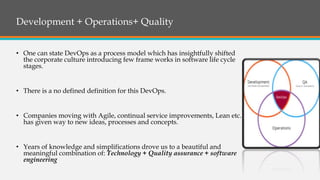
Development + Operations+ Quality
• One can state DevOps as a process model which has insightfully shifted
the corporate culture introducing few frame works in software life cycle
stages.
• There is a no defined definition for this DevOps.
• Companies moving with Agile, continual service improvements, Lean etc.
has given way to new ideas, processes and concepts.
• Years of knowledge and simplifications drove us to a beautiful and
meaningful combination of: Technology + Quality assurance + software
engineering
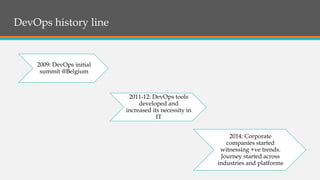
DevOps history line
2009: DevOps initial
summit @Belgium
2011-12: DevOps tools
developed and
increased its necessity in
IT
2014: Corporate
companies started
witnessing +ve trends.
Journey started across
industries and platforms
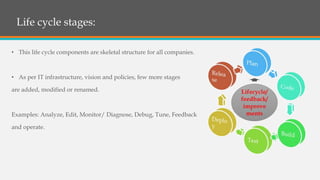
Life cycle stages:
• This life cycle components are skeletal structure for all companies.
• As per IT infrastructure, vision and policies, few more stages
are added, modified or renamed.
Examples: Analyze, Edit, Monitor/ Diagnose, Debug, Tune, Feedback
and operate.
Lifecycle/
feedback/
improve
ments
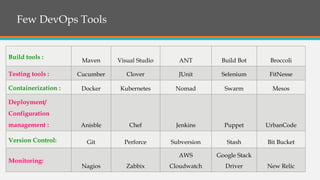
Few DevOps Tools
Build tools :
Maven Visual Studio ANT Build Bot Broccoli
Testing tools : Cucumber Clover JUnit Selenium FitNesse
Containerization : Docker Kubernetes Nomad Swarm Mesos
Deployment/
Configuration
management : Anisble Chef Jenkins Puppet UrbanCode
Version Control: Git Perforce Subversion Stash Bit Bucket
Monitoring:
Nagios Zabbix
AWS
Cloudwatch
Google Stack
Driver New Relic
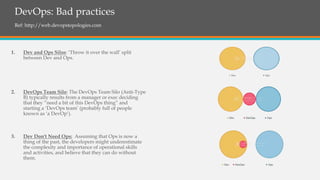
DevOps: Bad practices
Ref: http://web.devopstopologies.com
1. Dev and Ops Silos: ‘Throw it over the wall’ split
between Dev and Ops.
2. DevOps Team Silo: The DevOps Team Silo (Anti-Type
B) typically results from a manager or exec deciding
that they “need a bit of this DevOps thing” and
starting a ‘DevOps team’ (probably full of people
known as ‘a DevOp‘).
3. Dev Don't Need Ops: Assuming that Ops is now a
thing of the past, the developers might underestimate
the complexity and importance of operational skills
and activities, and believe that they can do without
them.
Performance Indicators or success factors
• DevOps is based on performance metrics or called as success measure factors:
MTBF (mean time between failures): It is the average time that an IT service or other configuration item can perform its agreed
function without interruption. This is measured from when the configuration item starts working, until it next fails.
MTTR (mean time to repair): The average time taken to repair an IT service or other configuration item after a failure. MTTR is
measured from when the configuration item fails until it is repaired.
MTRS (mean time to restore service): The average time taken to restore an IT service or other configuration item after a failure.
Fault tolerance: The ability of an IT service or other configuration item to continue to operate correctly after failure of a component
part.
CI (configuration item): Any component or other service asset that needs to be managed in order to deliver an IT service.
Service availability uptime.
Financial aspect in terms of release:
Terminology definitions : https://www.axelos.com/Corporate/media/Files/Glossaries/ITIL_2011_Glossary_GB-v1-0.pdf
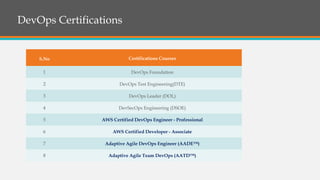
DevOps Certifications
S.No Certifications Courses
1 DevOps Foundation
2 DevOps Test Engineering(DTE)
3 DevOps Leader (DOL)
4 DevSecOps Engineering (DSOE)
5 AWS Certified DevOps Engineer - Professional
6 AWS Certified Developer - Associate
7 Adaptive Agile DevOps Engineer (AADE™)
8 Adaptive Agile Team DevOps (AATD™)

Know your DevOps

  • 1.
    Know your DevOps: …Subramanyam Gunda
  • 2.
    Development + Operations+Quality • One can state DevOps as a process model which has insightfully shifted the corporate culture introducing few frame works in software life cycle stages. • There is a no defined definition for this DevOps. • Companies moving with Agile, continual service improvements, Lean etc. has given way to new ideas, processes and concepts. • Years of knowledge and simplifications drove us to a beautiful and meaningful combination of: Technology + Quality assurance + software engineering
  • 3.
    DevOps history line 2009:DevOps initial summit @Belgium 2011-12: DevOps tools developed and increased its necessity in IT 2014: Corporate companies started witnessing +ve trends. Journey started across industries and platforms
  • 4.
    Life cycle stages: •This life cycle components are skeletal structure for all companies. • As per IT infrastructure, vision and policies, few more stages are added, modified or renamed. Examples: Analyze, Edit, Monitor/ Diagnose, Debug, Tune, Feedback and operate. Lifecycle/ feedback/ improve ments
  • 5.
    Few DevOps Tools Buildtools : Maven Visual Studio ANT Build Bot Broccoli Testing tools : Cucumber Clover JUnit Selenium FitNesse Containerization : Docker Kubernetes Nomad Swarm Mesos Deployment/ Configuration management : Anisble Chef Jenkins Puppet UrbanCode Version Control: Git Perforce Subversion Stash Bit Bucket Monitoring: Nagios Zabbix AWS Cloudwatch Google Stack Driver New Relic
  • 6.
    DevOps: Bad practices Ref:http://web.devopstopologies.com 1. Dev and Ops Silos: ‘Throw it over the wall’ split between Dev and Ops. 2. DevOps Team Silo: The DevOps Team Silo (Anti-Type B) typically results from a manager or exec deciding that they “need a bit of this DevOps thing” and starting a ‘DevOps team’ (probably full of people known as ‘a DevOp‘). 3. Dev Don't Need Ops: Assuming that Ops is now a thing of the past, the developers might underestimate the complexity and importance of operational skills and activities, and believe that they can do without them.
  • 7.
    Performance Indicators orsuccess factors • DevOps is based on performance metrics or called as success measure factors: MTBF (mean time between failures): It is the average time that an IT service or other configuration item can perform its agreed function without interruption. This is measured from when the configuration item starts working, until it next fails. MTTR (mean time to repair): The average time taken to repair an IT service or other configuration item after a failure. MTTR is measured from when the configuration item fails until it is repaired. MTRS (mean time to restore service): The average time taken to restore an IT service or other configuration item after a failure. Fault tolerance: The ability of an IT service or other configuration item to continue to operate correctly after failure of a component part. CI (configuration item): Any component or other service asset that needs to be managed in order to deliver an IT service. Service availability uptime. Financial aspect in terms of release: Terminology definitions : https://www.axelos.com/Corporate/media/Files/Glossaries/ITIL_2011_Glossary_GB-v1-0.pdf
  • 8.
    DevOps Certifications S.No CertificationsCourses 1 DevOps Foundation 2 DevOps Test Engineering(DTE) 3 DevOps Leader (DOL) 4 DevSecOps Engineering (DSOE) 5 AWS Certified DevOps Engineer - Professional 6 AWS Certified Developer - Associate 7 Adaptive Agile DevOps Engineer (AADE™) 8 Adaptive Agile Team DevOps (AATD™)

Editor's Notes

  • #2 To change the image on this slide, select the picture and delete it. Then click the Pictures icon in the placeholder to insert your own image.