Improve the
Development Process
with DevOps Practices
• Vadym Fedorov
Who am I?
• Vadym Fedorov < vfedorov@softserveinc.com >
• Role: Solutions Architect
• Company: SoftServe
• Specialization: Development of the Enterprise
Applications in the IT operations management
segment.
• Technologies and tools: .NET, Python…
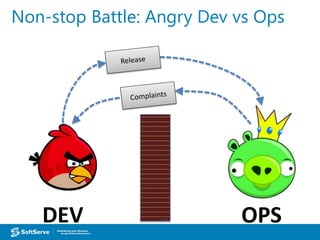
Non-stop Battle: Angry Dev vs Ops
DEV OPS
Pandora’s Box
• There is no single responsible person who would
manage the product from definition of business
requirements to the product release.
• The Dev and Ops teams have different success
metrics.
• Lack of communication between the Dev and
Ops teams.
• There is a difference between development and
target environment configurations.
• Slow and long delivery processes with
unpredictable delivery date.
Image taken from https://www.scriptrock.com/blog/devops-whats-hype-about/
Evaluate the Current
State
• The project maturity model
Key Indicator
• Project Portability, i.e. an ability to move the
project between different environments and
teams.
• Project Continuity ensures that a project can be
successfully completed even if a team changes.
• Time-to-market and cost requires control over
your project development, since these are critical
elements that directly affect revenue and your
position in the market. So make sure you are
using effective ways to optimize this business
driver.
The Project Maturity Model
Ad-hoc
• Deployment or development documentation is
often outdated if present at all
• Developers manage 3rd-party dependencies
manually
• No standardized development workplace
configuration
• Deployment on staging and production
environment is fulfilled manually
• Lack of knowledge sharing
• Low repeatability of the deployment process
• Launching a new team requires significant efforts
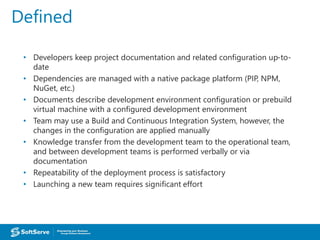
Defined
• Developers keep project documentation and related configuration up-to-
date
• Dependencies are managed with a native package platform (PIP, NPM,
NuGet, etc.)
• Documents describe development environment configuration or prebuild
virtual machine with a configured development environment
• Team may use a Build and Continuous Integration System, however, the
changes in the configuration are applied manually
• Knowledge transfer from the development team to the operational team,
and between development teams is performed verbally or via
documentation
• Repeatability of the deployment process is satisfactory
• Launching a new team requires significant effort
Repeatable
• Regular validation of the deployment and development
documentation
• Developers work on an up to date development environment
• Environment configuration and deployment procedures are
documented in the form of a code deployed to source control
• It is possible to track changes: who and when introduced any
changes, what version was deployed, on whichdevelopers’
workstation, and other staging and production environment
variables
• Team uses virtualization
• High repeatability of the deployment process
• Launching a new team does not require significant effort
Managed
• Managed is the highest level of the project
state when development and production
environments are aligned with
configuration as much as possible:
 The number of manual steps on environment
deployment is as low as possible
What can be changed
to improve?
Organizational Changes
• There should be one, and only one, manager
responsible for a product or feature development
from A to Z: from the stage of requirement
gathering to the release date.
• The development and operational teams need to
share common success indicators focused on the
delivery result.
• The operations team needs to define requirements
for monitoring, log management and disaster
recovery, as well as help the development team
design a solution that complies with these
requirements.
Teams Collaboration Types
Source: http://blog.matthewskelton.net/2013/10/22/what-team-
structure-is-right-for-devops-to-flourish/
Teams Collaboration Types
Source: http://blog.matthewskelton.net/2013/10/22/what-team-
structure-is-right-for-devops-to-flourish/
Teams Collaboration Types
Source: http://blog.matthewskelton.net/2013/10/22/what-team-
structure-is-right-for-devops-to-flourish/
Development Process Changes
• The development team should use a
development environment that’s as close
to the target environment as possible.
• To apply an “infrastructure as code”
approach.
• To automate quality control and
acceptance testing
“Infrastructure as Code” Approach
Virtual
Machine
Provisioner
Scripts
Vagrant
Code
Virtual
Machine
Provisioner
Scripts
Production
Code
Same OS, same configuration and same versions
Ops or DevOps
Dev
Deploy
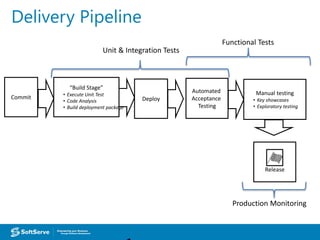
Delivery Pipeline
“Build Stage”
• Execute Unit Test
• Code Analysis
• Build deployment package
Automated
Acceptance
Testing
Manual testing
• Key showcases
• Exploratory testing
Release
Commit Deploy
Unit & Integration Tests
Functional Tests
Production Monitoring
Tools That are Good to Know
• Vagrant: https://docs.vagrantup.com/v2/
• Configuration Management and Provisioners:
 Chef: https://www.chef.io/chef/
 Puppet: https://puppetlabs.com/
 Ansible: http://www.ansible.com/home
• Log management and Monitoring
 Newrelic: http://newrelic.com/
 Loggly: https://www.loggly.com/
 Logstash: https://www.elastic.co/products/logstash
• Testing:
 JMeter: http://jmeter.apache.org/
 Selenium: http://www.seleniumhq.org/
Benefits
• Avoidance of the human factor
• Improvement of the Quality and
Repeatability
• Saved Time and Reduced Risks
Thank you!
US OFFICES EUROPE OFFICES
Austin, TX
Fort Myers, FL
Lehi, UT
Newport Beach, CA
Waltham, MA
Bulgaria
Germany
Netherlands
Poland
Russia
Sweden
Ukraine
United Kingdom
www.softserveinc.com

Improve the Development Process with DevOps Practices by Fedorov Vadim

  • 1.
    Improve the Development Process withDevOps Practices • Vadym Fedorov
  • 2.
    Who am I? •Vadym Fedorov < vfedorov@softserveinc.com > • Role: Solutions Architect • Company: SoftServe • Specialization: Development of the Enterprise Applications in the IT operations management segment. • Technologies and tools: .NET, Python…
  • 3.
    Non-stop Battle: AngryDev vs Ops DEV OPS
  • 4.
    Pandora’s Box • Thereis no single responsible person who would manage the product from definition of business requirements to the product release. • The Dev and Ops teams have different success metrics. • Lack of communication between the Dev and Ops teams. • There is a difference between development and target environment configurations. • Slow and long delivery processes with unpredictable delivery date.
  • 5.
    Image taken fromhttps://www.scriptrock.com/blog/devops-whats-hype-about/
  • 6.
    Evaluate the Current State •The project maturity model
  • 7.
    Key Indicator • ProjectPortability, i.e. an ability to move the project between different environments and teams. • Project Continuity ensures that a project can be successfully completed even if a team changes. • Time-to-market and cost requires control over your project development, since these are critical elements that directly affect revenue and your position in the market. So make sure you are using effective ways to optimize this business driver.
  • 8.
  • 9.
    Ad-hoc • Deployment ordevelopment documentation is often outdated if present at all • Developers manage 3rd-party dependencies manually • No standardized development workplace configuration • Deployment on staging and production environment is fulfilled manually • Lack of knowledge sharing • Low repeatability of the deployment process • Launching a new team requires significant efforts
  • 10.
    Defined • Developers keepproject documentation and related configuration up-to- date • Dependencies are managed with a native package platform (PIP, NPM, NuGet, etc.) • Documents describe development environment configuration or prebuild virtual machine with a configured development environment • Team may use a Build and Continuous Integration System, however, the changes in the configuration are applied manually • Knowledge transfer from the development team to the operational team, and between development teams is performed verbally or via documentation • Repeatability of the deployment process is satisfactory • Launching a new team requires significant effort
  • 11.
    Repeatable • Regular validationof the deployment and development documentation • Developers work on an up to date development environment • Environment configuration and deployment procedures are documented in the form of a code deployed to source control • It is possible to track changes: who and when introduced any changes, what version was deployed, on whichdevelopers’ workstation, and other staging and production environment variables • Team uses virtualization • High repeatability of the deployment process • Launching a new team does not require significant effort
  • 12.
    Managed • Managed isthe highest level of the project state when development and production environments are aligned with configuration as much as possible:  The number of manual steps on environment deployment is as low as possible
  • 13.
    What can bechanged to improve?
  • 14.
    Organizational Changes • Thereshould be one, and only one, manager responsible for a product or feature development from A to Z: from the stage of requirement gathering to the release date. • The development and operational teams need to share common success indicators focused on the delivery result. • The operations team needs to define requirements for monitoring, log management and disaster recovery, as well as help the development team design a solution that complies with these requirements.
  • 15.
    Teams Collaboration Types Source:http://blog.matthewskelton.net/2013/10/22/what-team- structure-is-right-for-devops-to-flourish/
  • 16.
    Teams Collaboration Types Source:http://blog.matthewskelton.net/2013/10/22/what-team- structure-is-right-for-devops-to-flourish/
  • 17.
    Teams Collaboration Types Source:http://blog.matthewskelton.net/2013/10/22/what-team- structure-is-right-for-devops-to-flourish/
  • 18.
    Development Process Changes •The development team should use a development environment that’s as close to the target environment as possible. • To apply an “infrastructure as code” approach. • To automate quality control and acceptance testing
  • 19.
    “Infrastructure as Code”Approach Virtual Machine Provisioner Scripts Vagrant Code Virtual Machine Provisioner Scripts Production Code Same OS, same configuration and same versions Ops or DevOps Dev Deploy
  • 20.
    Delivery Pipeline “Build Stage” •Execute Unit Test • Code Analysis • Build deployment package Automated Acceptance Testing Manual testing • Key showcases • Exploratory testing Release Commit Deploy Unit & Integration Tests Functional Tests Production Monitoring
  • 21.
    Tools That areGood to Know • Vagrant: https://docs.vagrantup.com/v2/ • Configuration Management and Provisioners:  Chef: https://www.chef.io/chef/  Puppet: https://puppetlabs.com/  Ansible: http://www.ansible.com/home • Log management and Monitoring  Newrelic: http://newrelic.com/  Loggly: https://www.loggly.com/  Logstash: https://www.elastic.co/products/logstash • Testing:  JMeter: http://jmeter.apache.org/  Selenium: http://www.seleniumhq.org/
  • 22.
    Benefits • Avoidance ofthe human factor • Improvement of the Quality and Repeatability • Saved Time and Reduced Risks
  • 23.
    Thank you! US OFFICESEUROPE OFFICES Austin, TX Fort Myers, FL Lehi, UT Newport Beach, CA Waltham, MA Bulgaria Germany Netherlands Poland Russia Sweden Ukraine United Kingdom www.softserveinc.com