Frances Westley
Sam Laban
Cheryl Rose, Katharine McGowan,
Kirsten Robinson, Ola Tjornbo,
Mark Tovey
EXECUTIVE SUMMARY
PROLOGUE
By: Joeri van den Steenhoven
SOCIAL INNOVATION LAB
Workshops
Alternative Workshop Agendas
ANTECEDENTS
Social Innovation
Whole Systems Processes
Design Thinking + Design Labs
Computer Modelling
LAB PROCESS in ACTION
RESOURCE BANK
Initiation Phase
Research Phase
Workshop Phase
Computer Modelling
1.
3.
6.
6.
10.
11.
14.
22.
54.
18.
69.
80.
81.
87.
93.
98.
Beginning in 2011, we convened a series of
conversations and learning exchanges between Christian
Bason of the Danish Design Centre (and formerly of
MindLab) in Copenhagen, Banny Banerjee of d.School at
Stanford University in California, Luigi Ferrara of Institute
Without Boundaries at George Brown College in Toronto,
and Bryan Boyer, formerly of Helsinki Design Lab in
Finland.
During 2014, we were fortunate to partner with the MaRS
Solutions Lab, its Director Joeri van den Steenhoven,
and his team in the delivery of two Lab processes. These
experiences afforded us not only an opportunity to work
closely with and learn from the Solutions Lab, but to test
elements of the methodology proposed in this Guide.
We owe much to these colleagues for sharing their own
understanding of the strengths and limitations of current
processes, as well as for playing an important role in
shaping our thinking on the Social Innovation Lab as
described here. In the end, this proposed methodology
for a Social Innovation Lab is a significant departure
from the aforementioned labs, and the authors hold
responsibility for any of its own merits and also, its
limitations.
A number of people have made small and large
contributions to this Guide and to the work that has
informed it. We thank them all, with particular thanks to
Sean Geobey at the University of Waterloo for sharing
his insights and to Steve Williams of Constructive Public
Engagement for his work on the computer-modeling
project.
We are extremely grateful to Terrie Chan of the MaRS
Solutions Lab for the graphic design of the Guide.
This Social Innovation Lab project has been actively
encouraged and generously funded by The Rockefeller
Foundation and The J.W. McConnell Family Foundation.
Their assistance has been instrumental in making this
work possible, and we want to express our sincere
gratitude and appreciation for their support.
This Guide to a Social Innovation Lab is
offered as a resource to peers, colleagues,
practitioners, leaders from all sectors, and
concerned citizens – all who have and/or
will participate in change-making processes.
One hope for this work is that these ideas on
social innovation and these recommendations
for new practice will result in a greater
sense of agency for those who work on what
often seem like impossible aspirations for a
different, better world. Probably our greatest
hope is that these ideas help to transform the
impossible into the possible.
ACKNOWLEDGEMENT "MANIFESTO”
Scientists and activists concerned about the future of
human society and the planet have pointed to the urgent
need for what they term sustainability transitions (Clark
2001; Raskin et al. 2002). In other words, due to the
complex, systemic and interrelated nature of the serious
social, economic and environmental problems confronting
us, we need entirely new forms of solutions. Clearly, we
humans must learn to think differently about our complex
world and to work together in unusual and very strategic
new ways. We need to more fully see and understand the
systems within which we all exist so that we can learn to
identify and create conditions for social innovation.
Since 2007, the team led by Dr. Frances Westley at the
Waterloo Institute for Social Innovation and Resilience
(WISIR), in collaboration with many colleagues, including
those within the Canada’s Social Innovation Generation
(SiG) partnership, has been generating and sharing new
knowledge about how significant change happens in the
world. WISIR’s interest in the possibility of processes that
catalyze real and durable innovation has driven a number
of years of exploring the potential of ‘Labs.’
There is as yet no established orthodoxy about what a
Lab is, and the term is applied to a plethora of processes
and organizations, often with markedly different goals
and employing distinct methods and approaches. For the
purposes of this Guide however, we define a Lab as a
process, one that is intended to support multi-stakeholder
groups in addressing a complex social problem. As such,
we see Labs as part of a rich history in process design:
it includes both ‘whole systems’ processes (e.g., Future
Search) and ‘design thinking.’
The interest in the social sector in the idea of Labs –
however broadly defined – offers an opportunity: can
we push on the limits of existing processes to develop
something tailored specifically to focus on complex
problems and to build strategies for transformation in
systems? This led to our team’s efforts to design and test
a process that can effectively support social innovation.
We call this process the Social Innovation Lab.
The Social Innovation Lab emphasizes not only imagining
high potential interventions but also gaining system
sight, redefining problems, and identifying opportunities
in the broader context with the potential to tip systems
in positive directions. It is a three-step process of
developing, testing and instigating innovation strategies.
It requires the right starting conditions, an investment
in research and skilled facilitators. It also makes use of
computer modeling to prototype interventions in complex
systems. Like other processes for convening multi-
stakeholder groups working on complex challenges, it is
best suited to the early stages of making-change.
The Guide begins with an overview of the history and
thinking behind this new process. This is followed by a
detailed set of step-by-step, practical recommendations
for the design and delivery of a Social Innovation Lab. The
final sections of this guide hold a collection of relevant
resources that include overviews of complexity and
social innovation concepts to help develop a common
understanding by convenors/participants, descriptions of
other lab processes, further information on the research
and on activities in the workshops, and an exploration of
the use of computer modeling in the Social Innovation
Lab.
This methodology is the result of WISIR’s current
knowledge on the dynamics of complex systems. It also
represents lessons learned through consultations with
lab process leaders from around the world, in particular
Christian Basson of Denmark’s Mind Lab, Banny Banerjee
of Stanford University’s D Lab, Luigi Ferrera of Toronto’s
George Brown’s Institute Without Boundaries and
EXECUTIVE
SUMMARY
1.
Brian Boyer of Helsinki Design Lab. Their contributions
were invaluable to our research and a number of these
lab examples are described through the Guide. The
process of developing and testing this Lab process
was supported by generous grants from the Rockefeller
Foundation and the J.W. McConnell Foundation.
Lastly, it is also the product of experience from two
processes in which WISIR was closely involved and that
provided opportunities to test individual elements of the
methodology described here. The “New Solutions for
Youth Employment Lab” was conducted in 2014 in New
York City. It was supported by the Rockefeller Foundation
and delivered by the MaRS Solutions Lab. The “Ontario
Tender Fruit Lab” was also conducted in 2014 and
delivered by the MaRS Solutions Lab. Support for the
Tender Fruit Lab was provided by the J.W. McConnell
Family Foundation. More information on both these
“Labs” can be found at the MaRS Solutions Lab website.
We offer this methodology with a humble appreciation of
both the complexity of the challenges we are, collectively,
seeking to address, as well as the complexities of
the processes we design in our attempts to address
them. We hope that the Guide provides the spark that
encourages others to use, test, refine, and continue to
build upon the design we have proposed.
“Complexity science embraces life as it is:
unpredictable, emergent, evolving and adaptable - not
the least bit machine-like. And though it implies that
we cannot control the world the way we can control a
machine, we are not powerless, either. Using insights
about how the world is changed, we can become
active participants in shaping those changes.”
- Getting to Maybe
Summary of the Social Innovation Lab
Step 1: Initiation - determines that a Social Innovation
Lab process (SI Lab) is the most appropriate for the
problem focus, there are then three additional major
steps, with key activities within each:
Step 2: Research and Preparation – this step includes
months of investment in various ethnographic research
activities to deepen the “design brief” by focusing on
investigation to help clearly identify and frame the
question (Research In) and also exploration across scales
and across a diversity of stakeholders, i.e gathering
stories and
examples from the very local and specific context of
innovation to broad policy contexts (Research Out). This
critically important research enables lab leaders to identify
and then orient lab participants. Information surfaced
during this step also becomes early input of data into
software capable of generating models of the system as
well as
depicting possible new scenarios; this technology will
provide support throughout the Lab Workshops.
Step 3: The Workshops – a series of three (3) workshops,
each running approximately two and a half (2.5) days. The
series of three, spaced workshops, with time between
for reflection, research, and broader consultation efforts,
would be most effective. Each has a specific focus:
Workshop One: Seeing the System
Workshop Two: Designing Innovation
Workshop Three: Prototyping Strategies
After the Lab: Taking action involves any necessary
follow-up, the roll out of strategies by those best
positioned in the system to be effective stewards, and on-
going evaluation of impact across scales in the system.
Because social innovation unfolds in a complex context,
no matter how successful the prototyping stage unfolded,
the roll out should be viewed as an experiment.
2.
Testing a Lab Model
“Translating words into deeds is typically a serious
challenge, but it seems you guys have been a real
catalyst.” Such feedback after running a social innovation
lab with people that were largely strangers before the lab
started, is why I believe this approach can be so valuable.
However, while the field of innovation labs is growing,
this approach is still very much under development.
And as a field, we need more rigor to ground and test
the approach. That comes with becoming a mature
infrastructure for social innovation. That is why I am so
thankful we have been able to help test of a new lab
model.
Over the past year we had the privilege to work with the
Waterloo Institute of Social Innovation and Resilience
(WISIR) to prototype a social innovation lab model.
Professor Frances Westley and her team developed
this model based on extensive research on different
kind of labs, but also by going back to some of its
theoretical foundations, from the work of Eric Trist on
systems thinking in the 1960s to Tim Brown’s design
thinking. They wanted to test it on some real cases and
approached the MaRS Solutions Lab to work with them
on that.
Testing the WISIR model allowed us to explore our own
approach to what labs are and develop some our own
methods. In a time that was most formative for us, as
we started in 2013. MaRS Solutions Lab is a public
and social innovation lab that helps to tackle complex
social and economic challenge that require systems
change. What we recognized in the WISIR model was
a combination of design and systems thinking. When
convening diverse stakeholders, it is crucial to have them
understand the problem from not just different institutional
perspectives, but also from the user and system
perspective. And that is what this model also is about.
In our view, real change that helps solve complex social
challenges can only be achieved when three elements
of a system are being innovated. First, when present
solutions do not work, we need to develop new solutions.
As it is impossible to predict what works, we need to
experiment. Through prototyping, we can get evidence
what works, even before implementing it in the field.
What works can be brought to scale. It must be noted
though that a combination of solutions is needed. One
magic bullet solution does never exist. The goal of
a lab is to develop an adaptive change strategy that
tests multiple solutions, which together could solve the
challenge. These solutions can best be characterized as
interventions that each solve a crucial part of the problem
or create the right inventive towards that.
Second, we need to innovate the way the system
behaves. This means changing how the system is being
governed, funded and/or incentivized. It can require
changing public policy, but also organizations changing
their strategies. It is about creating the conditions for
new solutions to become accepted and replace the old
ways. Building the support system around new solutions
to make them sustainable and bring them to scale. That
starts with framing the challenge in a way that it creates a
sense of urgency and a desire for action.
Third, we need to build the capacity of the people and
organizations involved. Simply saying they need to
change will not work. We need to build a movement,
starting with the innovators that pioneer new solutions.
They are deeply passionate, committed and willing to
take risks. But for systems change, we can not just rely
on that small group. We need to also engage the early
PROLOGUE
- Joeri van den Steenhoven
(MaRS Solutions Lab)
3.
adopters, who see the need to innovation but require
some guidance and a safety net. And beyond that the
early majority, the people who will only innovate when we
can show evidence and offer support to help implement
it.
What WISIR’s social innovation lab model provides, is
the start of the process of systems change. It helps to
convene stakeholders and help them understand the
challenge from user and system perspectives. It helps to
create a common change strategy and early prototypes
of interventions. It helps to frame the challenge and build
momentum for action. It helps to find the innovators
and build their capacity to more effectively address the
challenge.
All of this is crucial to the success of a social innovation
lab., and core to the value that social innovation labs
bring. The thoughtful way the model is constructed gives
a strong fundament to the work of labs, which is much
needed. I advise every lab practitioner to learn from it.
And to conclude, let me share two of the many lessons
we learned from testing this lab model:
First, when you have completed this model, you have
only just begun. The model helps to convene a diverse
group of stakeholders and bring them to the starting line.
The real innovation and impact will only come after, once
interventions are being implemented. And when we learn
if they work, or not. Despite the enormous efforts and
energy put into this stage, you should realize this is just
the beginning. But without a good beginning, nothing will
change or you will make the wrong changes.
Second, as every challenge is different, adjust this model
to the challenge. Do not just follow it step by step. We
had intensive team discussions on all elements of the
model. About if, how and when in the process to apply
each element, and why. Even in the two tests the model
was applied differently. For instance, where in the first
test the steps were done consecutively, we did them the
second test more in parallel. We also developed our own
tools to add to the model, or to translate the model into
group exercises. That can be done in different ways. On
a higher level the model provides a path from research
to workshops that probably remains the same, but make
your own translation of the model the more specific you
get.
Joeri van den Steenhoven is founding Director of MaRS
Solutions Lab in Toronto, Canada. During the WISIR test
he was Project Lead and main facilitator in the Rockefeller
youth Emloyment Lab and Ontario Tender Fruit Lab.
Before he was CEO of Kennisland, one of the leading
social innovation labs in Europe that he co-founded in
1999.
4.
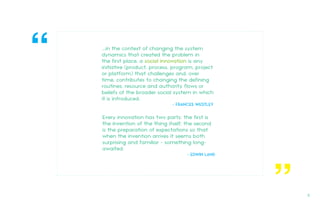
...in the context of changing the system
dynamics that created the problem in
the first place, a social innovation is any
initiative (product, process, program, project
or platform) that challenges and, over
time, contributes to changing the defining
routines, resource and authority flows or
beliefs of the broader social system in which
it is introduced.
- FRANCES WESTLEY
Every innovation has two parts: the first is
the invention of the thing itself; the second
is the preparation of expectations so that
when the invention arrives it seems both
surprising and familiar - something long-
awaited.
- EDWIN LAND
“
“
5.
We live in an increasingly complex world. Less than 150
years ago, during the great waves of migration from
Europe to North American, family members separated
by the Atlantic might not hear from each other for years.
Today, we can communicate with our friends and loved
ones, instantly, wherever they are. We can see their
faces as clearly as if they were in the same room and we
can travel to see them, no matter where they are, in a
matter of hours, not days. We can send pizza to striking
students in Egypt or in Madison and have it delivered in
time for their lunch.
All knowledge is at our fingertips; all communication
instant. And yet we also live in a world where we feel
helpless to influence the forces that threaten our future;
global warming, global epidemics, global economic
crashes seem to be driven by complex dynamics that are
almost possible to understand, never mind control.
Closer to home, we experience, in the course of a
generation, waterways that we used to swim in now
too degraded to support life, the disappearance of the
shadfly that used to herald the beginning of summer, the
spiraling of allergies and mental illness in those we know.
We worry about the deterioration of our innovative health
system, the impoverishment of our schools, the challenge
of realizing our values of compassion and equity when it
comes to our aboriginal populations.
In the face of these mounting challenges, the concept of
social innovation has recently captured the imagination of
practitioners, governments, foundations and universities
around the world. However, the definition of social
innovation ranges broadly, including the creation of
any new product or program with social application
(associated with social entrepreneurship), to those
activities which have both a profit making and a social
change goal (associated with the notion of social
enterprise).
Our research at the Waterloo Institute for Social
Innovation and Resilience has led us to focus on social
innovation as about fundamental system change. We
define social innovation in the context of changing the
system dynamics that created the problem in the first
place. A social innovation is any initiative (product,
process, program, project or platform) that challenges
and, over time, contributes to changing the defining
routines, resource and authority flows or beliefs of the
broader social system in which it is introduced.
This definition highlights two important points – social
innovation is about profoundly changing or transforming
a system rather than adapting or improving it, and it is
about impacting a system across all scales, affecting not
only specific groups, organizations and communities but
the whole system at the very broadest level (changes in
culture, laws, policy, economy, etc.,).
It is important to recognize that this definition of ‘social
innovation’ is used to describe the full process of
transformation, from the beginnings of a good idea
or initiative right up to broad social change. We are
concerned not only about the need for new ideas to
address our most intractable problems but also how
the system in which the problem arose needs to shift to
make room for those new ideas. It’s only by focusing on
both – the idea and the matching of that idea with the
right opportunity context – that we have the best possible
chance of achieving broad, sustained impact.
How is it that broad impact might be possible? Although
the nature of complex systems makes intentionally
intervening to change them extremely difficult,
paradoxically, it’s in these same qualities that we also
see the very possibility of change. Like the systems
themselves, the momentum for social innovation is
SOCIAL
INNOVATION
Creating Transformational
Change in a Complex World
6.
emergent; the right elements, brought together at the
right time, can be transformative.
Complex systems are unpredictable and can disrupt
even the best-laid plans, and yet this emerging pattern
of events, trends, ideas etc., also presents a constantly
shifting landscape of opportunities for change. Critical
thresholds, which are characterized by breaks in the
normal state of the system (this might be an economic
crisis, a change in political power, a grassroots shift in
beliefs, etc.,) represent real windows of opportunity for
change agents.
Complex systems are not subject to the laws of cause
and effect, so that sometimes a large effort will produce
little or no result. Sometimes however, a small effort at
the right time (e.g., a critical threshold) will create a ripple
effect and a cascade of changes that produce a large
result.
Complex systems are shaped by the interaction
between scales so that what’s possible at one scale
(e.g., a community) is shaped by what’s happening at
another (e.g., in the broader culture). The effect can be
dampening or constraining but it can also be amplifying
and the relationship can go in either direction - change
comes from the top down and from the bottom up.
Lastly, it’s important to recognize the role of our own
role in any system. Not only are we a part of the system
but our perception of it is shaped by the perspective we
bring when we attempt to analyze it. If we can perceive
a system we are in fact part of it, so that, effectively, we
must change ourselves and the rules and relationships in
which we engage in order to change the system.
What then, is a Social Innovation Lab? We define Labs
in the social sector, as opposed to those associated
with science, as a highly designed and expert facilitated
process clearly intended to support multi-stakeholder
groups in addressing a complex social problem. Such
processes have been around since the 1960s and the
most effective ones, such as Future Search, Appreciative
Enquiry and Scenario Planning, represent part of
any change agent’s repertoire. We place the kinds of
processes that are commonly referred to as “Labs” within
this broader field. A Social Innovation Lab is one such
process, one that aims specifically at transformation
of systems, and whilst the methodology described in
this manual has unique qualities it both draws from and
benefits from this rich history.
7.
In order to realize the promise of social innovation, we need a particular multi-stakeholder process that
takes the most effective elements from those that already exist, but then also integrates knowledge
about complex systems, system transformation, agency, and the re-engagement of vulnerable
populations. The methodology proposed in this guide attempts to realize this goal: we refer to it as
a Social Innovation Lab and it can serve a specific role for those embarking on the journey of social
innovation.
It is important to note that social innovation is a process, not an outcome. While workshops and labs
can play a role, they are not a panacea. A lab of any kind signifies the coming together of a group of
people in complementary roles in order to experiment with finding novel solutions. It could therefore be
argued that all labs work best in the early stages of any deliberate attempt to create change.
One of the strengths of many lab-like processes is the identification of common concerns, a kind
of sense making particularly necessary after some crisis or abrupt transition. It could be argued
as our systems become more complex, these moments become more common. Complexity
engenders surprise; we find ourselves grappling with events that are unanticipated and seem to
come from nowhere. Before we can react, we need to make sense of what we are experiencing:
What is happening? Why is it happening? What does it mean? In complex systems, arriving at this
understanding is best done collectively, by the people motivated and with the means to act in the face
of complexity.
In the later stages of systems change, change agents work to broker new partnerships, match
initiatives to opportunities and build the networks of resources and influence that can attract much
greater resources to the most promising initiatives. These activities are less attuned to convening Labs
and other kinds of multi-stakeholder processes. The Social Innovation Lab is instead a process that
supports the designing of interventions and strategies that have the best possible chance of reaching
these later stages of systems change.
While the design of the Social Innovation Lab is based on social innovation theory and on the
assumption of complexity dynamics, it stands on the shoulders of other Lab and multi-stakeholder
processes that have been shaping our capacity to respond to intractable problems in the last 50 years.
A Social Innovation Lab
8.
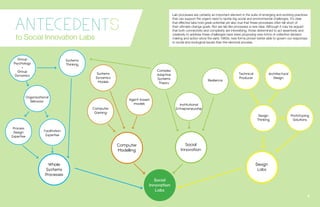
to Social Innovation Labs
Lab processes are certainly an important element in the suite of emerging and evolving practices
that can support the urgent need to tackle big social and environmental challenges. It’s clear
that effective labs hold great potential yet also true that these processes often fall short of
their ultimate change goals. Nor are lab like processes a new idea. Although it may be argued
that both connectivity and complexity are intensifying, those determined to act assertively and
creatively to address these challenges have been proposing new forms of collective decision
making and action since the early 1960s; new forms proven better able to govern our responses
to social and ecological issues than the electoral process.
9.
Social
Innovation
Labs
Design
Thinking
Design
Labs
Social
Innovation
Computer
Modelling
Whole
Systems
Processes
Technical
Producer
Architectural
Design
Prototyping
Solutions
Complex
Adaptive
Systems
Theory
Institutional
Entrepreneurship
Resilience
Agent-based
models
Systems
Dynamics
Models
Computer
Gaming
Group
Psychology
+
Group
Dynamics
Organizational
Behavior
Process
Design
Expertise
Facilitation
Expertise
Systems
Thinking
The issue of groups self-organizing to accomplish tasks
important to the members of the group developed
alongside a growing understanding of the nature of
complex systems in the twentieth century. In the mid
twentieth century, the Tavistock Institute in London
was developing a theory on group dynamics and
change, based on psychoanalytic interpretation. (Bion,
W. R., 1961, Experiences in Groups. Tavistock , UK).
This work was profoundly influential, giving rise to the
very well known notions of group psychology, group
therapy and group dynamics. At this same time, in
the USA, Kurt Lewin, one of the other fathers of group
psychology, was experimenting with a similar approach
at the National Training Labs (NTL). Over time, the
approaches for learning and group change identified
at NTL became the basis of organizational design and
development and NTL established a major training
facility for the first consultants specializing in process
design and group facilitation.
These approaches were integrated with the emerging
field of open system thinking. Between 1946 and 1953,
in small inns in the American countryside, the Macy
Foundation brought together a star-studded group
of intellectuals including Ross Ashby, Julian Bigelow,
Heinz von Foerster, Ralph Gerard, Molly Harrower,
Paul Lazarsfeld, Kurt Lewin, John von Neumann,
Walter Pitts, Leonard Savage and Norbert Wiener,
Gregory Bateson, Margaret Mead and guests including
Erik Erikson, Claude Shannon and Talcott Parsons.
In an unusually collaborative environment, experts
in fields as disparate as anthropology, psychiatry,
social relations and zoology discussed and ultimately
advanced thinking on group processes for effective
communication and teamwork, and the effect of such
processes on the possibility of system change.
In the late 1950s and early 60s, Eric Trist, a social
scientist working at Tavistock, advanced this thinking
further into a theory of change for whole social systems.
Trist was the first to address the notion of whole system
problems or “mega-messes” as he termed them (1963).
Trist felt that we acted like systems in creating large
system problems, but we acted like individuals in trying
to solve them. If we were to find a solution to the broad
problems confronting us, we needed to respond as a
system, or in other words, “get the whole system into
the room”. With colleague Fred Emery he developed a
process that became known as Future Search. This
3-day process was designed to facilitate collective
problem solving and collective governance in complex
systems.
By engaging a cross-functional, cross-hierarchical
sample of individuals and organizations interested
in a particular “mega-mess”, a representation of the
whole system was brought into the room. In a process
designed to take advantage of the understanding of
group dynamics, the people involved in a future search
re-create the past, analyze the present and together
imagine a better future. Differences are “parked” in
favour of working on the “common ground.” Action
plans allow subgroups to move forward, past the
workshop into action.
The Future Search process, one of the first robust
whole system approaches, was tried in many different
cultures and in many different problem contexts. It
stimulated a variety of other approaches to complex
problem solving, including Appreciative Inquiry,
Deliberative Dialogue, World Cafes and, most recently,
Theory U type processes (see Appendix 2).
These processes are heavily dependent on securing
the right participation, and may sometimes fall
short of anticipating opposition and constraints
in implementation. However, they are based in
the breakthrough thinking about group dynamics,
processes and psychology of the mid-20th century
and have proved very powerful in building a new
sense of community and accelerating action through
collaboration. Most recently, these processes have
been extended to create Change Labs, notably
associated with the work of Reos Partners. Among
other things this involves an extension of the process
beyond the workshop gatherings.
WHOLE
SYSTEMS
PROCESSES
10.
While whole system processes drew heavily on the
knowledge of process design, or how to orchestrate
a particular type of outcome through the sequencing
of different structured activities, a new form of design
thinking has recently entered the debate about how
to best stimulate new approaches to complex and
intractable problems and how to best govern complex
problem domains. This approach has originated in
the discipline of design – architectural, technical, and
creative.
While humans have been designing objects and
technologies since the Stone Age, design became a
field of study and expertise sometime in the late 19th,
early 20th century. Throughout the 20th century, the
concept of design was largely used to refer to the
creation of physical objects or spaces. In this discipline,
the term process design may have originated with
automated assembly lines, but took on significance in
the creation of continuous process systems, such as
those in chemical plants. These more complex process
designs developed in parallel with the capacity of
computers to model and simulate interactions between
numerous components through time. Then in the mid
2000’s, a number of well-known designers, including
Canada’s Bruce Mau and IDEO’s Tim Brown, stepped
out to make the claim that “design thinking” could be
used to talk about “massive change” or breakthrough
thinking in complex problem domains.
Design thinking adds precision about the design
process (emphasizing the importance of collecting
good data in advance, the importance of a clear
design brief and how to construct it, and the notion
of rapid prototyping) and adds the specific focus of
breakthrough thinking for innovation. Designers have
a distinct capacity for identifying the fundamental
rules and relationships that make up the essence of
an original design, and are able to translate these into
different contexts and functions.
A number of different groups have organized processes
to assist others to use design thinking to creatively
address complex problems. Among these are Institute
Without Boundaries, Helsinki Design Lab, Stanford
D-Lab. The processes involve a research-intensive
front end, a charette-like process for integrating
interdisciplinary thinking, and the use of design
techniques for thinking through solutions. While
these processes have demonstrated real success at
visualizing solutions that have a technical component
(building, structure, technical system), efforts are
currently being made to extend them to social systems
such as the organization of the public service.
DESIGN
LABS
11.
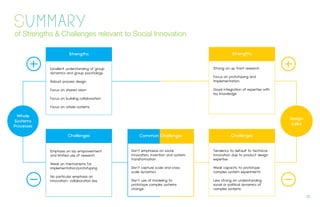
of Strengths & Challenges relevant to Social Innovation
12.
Whole
Systems
Processes
Strengths
Excellent understanding of group
dynamics and group psychology
Robust process design
Focus on shared vision
Focus on building collaboration
Focus on whole systems
Design
Labs
Challenges
Emphasis on lay empowerment
and limited use of research
Weak on mechanisms for
implementation/prototyping
No particular emphasis on
innovation- collaboration key
Strengths
Strong on up front research
Focus on prototyping and
implementation
Good integration of expertise with
lay knowledge
Challenges
Tendency to default to technical
innovation due to product design
expertise
Weak capacity to prototype
complex system experiments
Less strong on understanding
social or political dynamics of
complex systems
Don’t emphasize on social
innovation; invention and system
transformation
Don’t capture scale and cross
scale dynamics
Don’t use of modeling to
prototype complex systems
change
Common Challenges
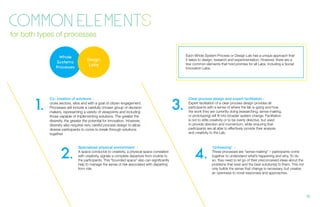
Each Whole System Process or Design Lab has a unique approach that
it takes to design, research and experimentation. However, there are a
few common elements that hold promise for all Labs, including a Social
Innovation Labs.
for both types of processes
1.
Co- creation of solutions -
cross sectors, silos and with a goal of citizen engagement.
Processes will include a carefully chosen group of decision
makers, representing a variety of viewpoints and including
those capable of implementing solutions. The greater the
diversity, the greater the potential for innovation. However,
diversity also requires very careful process design to allow
diverse participants to come to break through solutions
together.
2.
Specialized physical environment -
A space conducive to creativity, a physical space correlated
with creativity, signals a complete departure from routine to
the participants. This “bounded space” also can significantly
help to manage the sense of risk associated with departing
from role.
Clear process design and expert facilitation -
Expert facilitation of a clear process design provides all
participants with a sense of where the lab is going and how
the work they are currently doing (researching, sense-making,
or prototyping) will fit into broader system change. Facilitation
is not to stifle creativity or to be overly directive, but used
to provide direction and momentum, while ensuring that
participants are all able to effectively provide their analysis
and creativity to the Lab.
3.
4.
‘Unfreezing’ -
These processes are “sense-making” – participants come
together to understand what’s happening and why. To do
so, they need to let go of their preconceived ideas about the
problems that exist and the best solution(s) to them. This not
only builds the sense that change is necessary, but creates
an openness to novel responses and approaches.
13.
Whole
Systems
Processes
Design
Labs
Simulations have the potential to give new insight into
how systems function and how they might transform.
With the advancement of computing they have
become increasingly powerful tools for understanding
complexity, testing ideas, and prototyping interventions.
The earliest simulations occurred far before there were
computers. In perhaps the first simulation Georges-
Louis Leclerc, a french naturalist, computed the value
of the constant pi by throwing a needle repeatedly on a
board with horizontal lines on it. Pi was the probability
of a throw landing on a line when the lines were located
twice the length of the needle apart (Goldsman et al.
2010).
Much later Stanislaw Ulam and John von-Neuman
pioneered computer simulations, while working on the
Manhattan project in the 1940s. They were studying
the problem of nuclear detonation for World War II
(Goldsman et al. 2010).
Ulam and von-Neuman’s foundational work found
wide application. With advances in processing power,
cost, size, availability, and ease of use, simulation has
become integral to an expanding array of problems
including the design of new materials (Curtarolo et al.
2013), studying industrial processes (Borshchev and
Filippov 2004), understanding climate and weather
(Kendal and Henderson-Sellers 1997), and setting
monetary policy (Helbing and Balietti 2011).
System dynamics models and agent based models
Two approaches to simulation have particular relevance
in lab like processes: system dynamics models and
agent based models. They each have an established
tradition of being used in workshop processes, well
developed literatures, and particular features that
make them well suited to studying how social systems
transform.
Systems dynamics modeling comes out of the
cybernetics tradition. Cybernetics emerged to
study feedback loops in WWII and was applied to
understanding a wide range of technical, social, and
management systems.
Jay Forester developed system dynamics at MIT in
the 1950‘s. It became a particularly prominent branch
of applied simulation (Radzicki and Taylor 2015).
Forester studied engineering and then began to apply
the methods he learned to social and management
problems. System dynamics models model systems
using feedbacks, stocks, and flows to represent
dynamics over time.
Perhaps the most famous system dynamics model is
the Club of Rome model which illustrated the risk of
population expansion and resource constraints and
played an important role in informing the emerging
environmental movement in the 1970s. Other models
in this tradition include numerous models of corporate
management, the early model of urban dynamics called
Urban Dynamics, and World1 and World2 models of
the world’s socio-dynamics (Radzicki and Taylor 2015).
While systems dynamics models are models of a single
integrated system, agent based models (ABMs) model
many interacting agents. They are models of many
interacting non-linear sub-systems. Each agent follows
a set of decision rules and the agents often interact
over time and space (Borshchev and Filippov 2004).
As with system dynamics models, there are numerous
examples of agent based models that have given
insights into how systems function. Many of these
illustrate how patterns at an individual level can create
unexpected system level properties.
One of the first ABMs was Schelling’s model looking
at segregation in neighbourhoods. In the model,
no individual discriminated against others. They
merely displayed a small preference to live in familiar
COMPUTER
MODELLING
14.
surroundings. The result at a systems level was radical
segregation (Schelling 1971; Schelling 2006). Among
other insightful models: Craig Reynold built a model
that showed how the complexity of bird flocking
behaviour could emerge from agents following just
three simple rules (Reynolds 1987). Robert Axelrod’s
model of the iterated prisoner’s dilemma showed
how cooperation could emerge over time even where
incentives rewarded cheating (Axelrod 1981), and
Joshua Epstein and Robert Axtell’s, Sugarscape model
gave insight into how income inequality emerged
(Epstein and Axtell 1996).
While scientific models of social and political systems
give practical insights into systems and can even help
to guide policy makers, they are unwieldily to use. They
can take years to develop, and the majority are run only
once by the researcher who created them (FitzJohn et
al. 2014).
These distinct types of models have their own
advantages and disadvantages. Both SD and ABMs
give practical insights into how systems function.
SD models can be simpler to build, and easier to
understand and validate than ABMS but they also have
disadvantages. SD models cannot capture the same
level of detail and complexity as ABMs (Goldsman et al.
2010). Furthermore, a designer must understand global
interdependencies to build a SD model, but this is not
needed for ABM model (Goldsman et al. 2010). Finally,
in ABMs it is possible to trace individual trajectories
and thus to link micro and macro scales and to look
at distributions. In studying poverty for example, it is
useful to see not just how many are poor but what are
the distributions and what are trajectories of those who
get stuck in poverty, and what factors would let them
escape.
Games
Games are on the other side of the spectrum. They
may not model practical problems, but are easy to use
and engaging to interact with. They must captivate
audiences or they will not be used. They often may be
played in groups and provide immediate feedback.
Board games go back to the early traditions of
simulations played out on bits of paper without
computers. Some board games like the physical
enormous, Buckminster Fuller World Game (The
Buckminster Fuller Institute 2015) or, the table top
game, Monopoly (Pilon 2015) are designed to illustrate
real world dynamics.
Computer games integrate engagement with
sometimes advanced computer simulation. Computer
games are known for compelling graphics, and
multiplay online games let many players all over the
world play online together and explore a common world
(Indvik 2012). Games like Sim City, Second Life, and
Minecraft make it possible to build whole cities, lives,
or structures (Hale and Stanney 2014). Others like
Democracy II (Positech Games 2015) simulate in detail
the impact of particular policy decisions.
The disadvantage of games is that they typically focus
on entertainment value rather than practical problems.
They may or may not offer insight into particular
problems. Furthermore, as with scientific models, the
model dynamics are typically inflexible so they give little
insight into how innovations could change the structure
of a system.
Using Simulations in Facilitated Processes
The history of simulation in science illustrates that
models and simulations can support rapid prototyping
and sensitivity testing, and can make it possible to play
with scenarios.
Numerous systems change processes use system
mapping and prototyping to help participants to
understand and engage with systems. If it is handled
well, simulation and visualization can play a powerful
supportive role. Encouragingly, a number of groups
have explicitly built simple models as tools for thinking
with. For example:
The Conservation Breading Specialists (CBSG) brought
together policy makers, biologists, people in the field
and others in species protection meetings, to work
together to save species. As part of these workshops,
they developed a tool that let policy makers make
decisions in simulation and understand the effect those
decisions could have on particular species. These
proved remarkably effective for increasing decision
maker’s understanding and as a tool to support
decision making (Lindenmayer et al. 2000).
Another example is John Robinson’s research group
at UBC, which developed visualization software to be
used with members of the public and decision makers
to understand the implications of their own actions,
beliefs and values. The models don’t provide right or
wrong answers, but they can reveal contradictions
within a persons own choices and beliefs. The city of
Vancouver used the models to host public sessions to
engage with people about trade offs in environmental
decision-making (Pecha Kucha Night Vancouver 2010).
.
Unfortunately, our capacity to build models that explore
how sophisticated systems behave under different
circumstances often outstrips our capacity to develop
models as tools for thinking with. Few simulation
technologies leave their interface open and clearly
explain their limitations so that designers and decision
makers can modify the assumptions or the inputs as
part of thinking though their response to a problem.
Even fewer make these capacities so accessible
that groups can use them constructively to build and
explore models together.
15.
SOCIAL
INNOVATION
LAB
1.
2.
3.
4.
5.
16.
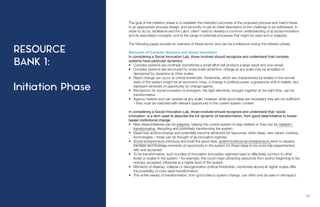
This guide proposes a new process that integrates the best approaches from whole systems processes and
design thinking with social innovation tools and methodologies. The goal of the Social Innovation Lab is to
effectively design for innovation on complex, social problems (such as, addressing food system challenges or
supporting distressed families). It emphasizes, not only imagining high potential interventions but also, gaining
system sight, re-defining problems, and identifying opportunities that can be exploited to tip a system in positive
directions.
The processes employed in the Social Innovation Lab have an intentional focus on maintaining the complexity of
the system and on designing interventions that can move across scales to achieve broad impact. This directly
addresses one of the barriers that prevent systems change; that while individuals working in systems have deep
knowledge of those systems including alternative approaches that do and do not work, those alternatives rarely
move across scales to drive cultural, economic or policy change and so rarely fulfill their potential. The system
remains “stuck” because the richness and complexity of real systems is not integrated into the strategies for
change.
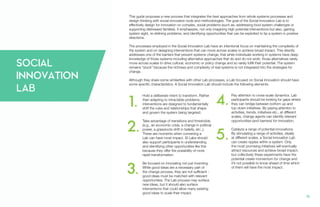
Although they share some similarities with other Lab processes, a Lab focused on Social Innovation should have
some specific characteristics. A Social Innovation Lab should include the following elements:
Hold a deliberate intent to transform. Rather
than adapting to intractable problems,
interventions are designed to fundamentally
shift the rules and relationships that shape
and govern the system being targeted.
Take advantage of transitions and thresholds.
(e.g., an economic crisis, a change in political
power, a grassroots shift in beliefs, etc.,).
These are moments when convening a
Lab can have most impact. SI Labs should
also support participants in understanding
and identifying other opportunities like this
because they offer the possibility of more
rapid transformation.
Be focused on innovating not just inventing.
While good ideas are a necessary part of
the change process, they are not sufficient -
good ideas must be matched with relevant
opportunities. The Lab process may surface
new ideas, but it should also surface
interventions that could allow many existing
good ideas to scale their impact.
Pay attention to cross-scale dynamics. Lab
participants should be looking for gaps where
they can bridge between bottom up and
top down initiatives. By paying attention to
activities, trends, initiatives etc., at different
scales, change agents can identify relevant
opportunities (and barriers) for innovation.
Catalyze a range of potential innovations.
By stimulating a range of activities, ideally
at different scales, a Social Innovation Lab
can create ripples within a system. Only
the most promising initiatives will eventually
attract resources and achieve broad impact,
but collectively these experiments have the
potential create momentum for change and
it’s not possible to know ahead of time which
of them will have the most impact.
17.
Human Resources,
Skills and Knowledge
Multi-disciplinary support
staff
Outputs
Action to implement
prototype strategies
Methods &
Exercises
Uses broad-based up front
research and seeks to
integrate expert and lay
knowledge
Exercises: allow for
prototyping
Human Resources,
Skills & Knowledge
Understanding social and
political dynamics of complex
systems
Methods &
Exercises
Exercises: create shared vision
Outputs
Multiple strategies that are
loosely coupled
Methods &
Exercises
Used early in the change
process
Exercises: reframing the
problem and unfreezing
Whole
Systems
Processes
Design
Labs
Whole
Systems
Processes
Design
Labs
Human Resources,
Skills and Knowledge
Clear process design and
expert facilitation
Specialized Physical
Environment
Social
Innovation
Labs
Human Resources,
Skills & Knowledge
Knowledge of Social
Innovation and related fields
Methods &
Exercises
Computer modeling to
prototype changes in
complex systems
Exercises: see and manipu-
late cross-scale interactions
and generate multiple
interventions and locate
these a elements in a
process of complex system
transformation
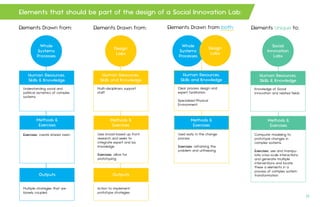
Elements Drawn from: Elements Drawn from: Elements Drawn from both: Elements Unique to:
Elements that should be part of the design of a Social Innovation Lab:
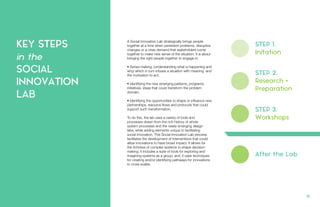
KEY STEPS
in the
SOCIAL
INNOVATION
LAB
A Social Innovation Lab strategically brings people
together at a time when persistent problems, disruptive
changes or a crisis demand that stakeholders come
together to make new sense of the situation. It is about
bringing the right people together to engage in:
• Sense-making, (understanding what is happening and
why) which in turn infuses a situation with meaning and
the motivation to act;
• Identifying the new emerging patterns, programs,
initiatives, ideas that could transform the problem
domain;
• Identifying the opportunities to shape or influence new
partnerships, resource flows and protocols that could
support such transformation.
To do this, the lab uses a variety of tools and
processes drawn from the rich history of whole
system processes and the newly emerging design
labs, while adding elements unique to facilitating
social innovation. This Social Innovation Lab process
facilitates the development of interventions that could
allow innovations to have broad impact: It allows for
the richness of complex systems to shape decision-
making; it includes a suite of tools for exploring and
imagining systems as a group; and, it uses techniques
for creating and/or identifying pathways for innovations
to cross scales.
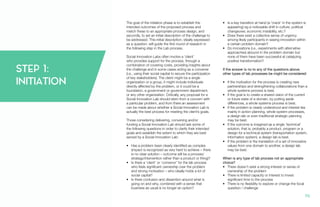
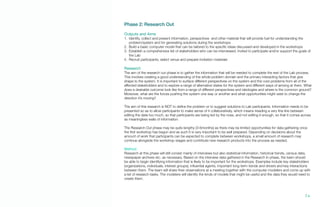
STEP 1.
Initation
STEP 2.
Research +
Preparation
STEP 3.
Workshops
After the Lab
18.
STEP 1.
Initiation
Confirming what the ‘conveners’ want and need/
Matching needs to processes
As people express an interest in deploying a lab
process, it is important for due consideration to be
given to the suite of processes available. Depending
on the nature of the problems to be addressed, the
intended outcomes and available resources, different
kinds of processes may be more or less appropriate.
Those convening and delivering the proposed Lab
should carefully explore their options and decide
together on the right process for their needs and
goals. The Social Innovation Lab process is designed
specifically to address complex challenges that require
investment in processes that support the design and
implementation of interventions capable of achieving
system-wide impact.
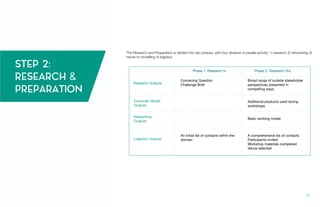
STEP 2.
Research +
Preparation
Recruiting participants / Conducting Research,
including setting the challenge brief / / Working
with modelers / Preparing logistics.
Recruitment
Identifying and successfully recruiting participants in
the Lab process is a critical success factor. In addition
to deepening participants understanding of the
system and fostering a degree of general openness
to transformation, the Social Innovation Lab is also
designed to bring together particular people and foster
relationships that can directly support the propagation
and development of innovations. Participants should
have the capacity to act on their experiences in the Lab
and work towards the implementation of the ideas it
generates.
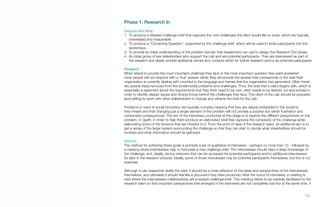
Research
The Social Innovation Lab draws on a variety of
research activities at first focused on deepening and
refining the “challenge brief”- a well-defined convening
question and brief are critical first outputs of the
research - and then on exploring system dynamics
across scales and from a diversity of perspectives.
Interviews with stakeholders for these purposes will
involve gathering stories and examples from the very
local and specific context of innovation to broad policy
contexts.
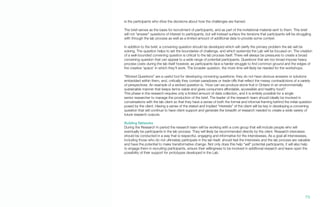
Building Models
Computer programmers (i.e., the modeling team)
will work closely with the research team during the
preparation phase, sharing research and access
to expertise in order to build the core elements of
the model. This process would be similar to system
mapping and include both the different features within
that system (stakeholders, relevant variables, etc) as
well as the relationships (dynamics) between them.
Modelers will also have to make decisions about which
existing models are going to be integrated into the Lab
model.
19.
STEP 3.
Workshops
Designing and delivering workshops / Conducting
additional research / Building model
Workshops
Participants to workshops are selected for their
experience and expertise; the lab would convene a
customized team of activists, innovators, policy makers
etc. particular to the focal problem/design brief, and
who would actually work on parts of the strategies they
develop.
Each workshop will vary slightly based on the topic
and the research that goes into it. The first workshop
will be designed to first engage participants in broad
and deep understanding of the system in which
they are concerned, opening up new possibilities for
interpretation. In these early stages we will draw heavily
on some of the whole system thinking, to create the
experience of unfreezing problem perspectives and
surfacing diversity.
In the central part of the workshop phase we will use
tools and methods associated with social innovation to
begin to understand the breadth of possible innovations
and the opportunities for grafting these to the current
system, or shifting the current system to accommodate
the innovations.
We will then enter the prototyping phase, which is
inspired by design thinking. However we will introduce
a modelling component, to allow participants to try out
their ideas in a simulated system. Finally, depending
on the nature of the idea, we will enter the final roll out
phase, which will take these ideas out into the world.
We will deal with each of these, in turn, in greater detail
below.
Additional Research
Most of the ‘heavy-lifting’ for the research is done
before the workshops are convened, but new questions
and potential areas of enquiry will emerge through the
process. The Lab faces a choice about whether to have
participants conduct this research themselves – talking
to colleagues etc. – or whether the research team can
respond to these additional questions.
Models
Discussions and insights from the first workshop will
shape the building of the basic model, which will be
modifiable so as to reflect the specific and nuanced
discussions held later in the Lab. As the lab develops
a suite of potential interventions, the modeling team
will be able to program the interventions into the model
and adapt existing interventions as the Lab revises the
design of those interventions. Potential innovations
will be as easy as possible for programmers to add,
and very easy for Lab participants to implement once
they’re using the model.
20.
by participants. Lab research and workshop outputs
will likely see a second life after the lab process itself in
making the business case for the support of post-lab
prototyping.
There are of course many scenarios where on-
going support for teams working on prototypes is
necessary. A central team or organization can be useful
if additional workshops are required, and if support
is needed for prototyping. If Lab conveners would
opt for this scenario, Lab facilitators would do well to
integrate additional meetings into the initial proposal as
momentum can be quickly dissipated by any delays in
securing the resources to convene post-lab meetings.
The Social Innovation Lab draws from design labs
the idea that social innovation requires a marriage of
expert and lay knowledge. In the research phase, well-
trained qualitative researchers are paired with those
that can create compelling media content (e.g., graphic
designers, videographers) and complex systems
modelers. In the workshop, process designers,
facilitators, as well as some topic related content
experts should be involved. In the prototyping phase,
modelers who can support the whole system modeling
process need to be involved. For these experts to work
well together as a team, guide the group on their lab
journey and to set the conditions for an effective Social
Innovation Lab process, they should be familiar and
comfortable not only with their own areas of expertise,
but also with the concepts related to social innovation.
Some of the concepts central to this process include:
The innovation cycle; Transformation of systems
through cross scale interactions; Alternative basins of
attraction; Building/reducing resilience; Reengaging
marginal/vulnerable viewpoints; and, agency and
system entrepreneurship. A more detailed discussion of
these concepts can be found in Appendix 3.
Evaluation plays a significant role in the Lab process.
A complex systems approach poses a particular
challenge to evaluation however because attribution
becomes so difficult – how do we know that our
efforts, not some other changes, are responsible for the
outcomes we’re seeing? By aiming to fundamentally
change systems rather than, for example, the
experience of only those that move through a particular
program or service, the Social Innovation Lab creates a
particularly knotty version of this attribution challenge.
The innovation strategies are prototyped and then
implemented with the explicit intention that they be
adapted in response to a changing context. It is highly
recommended that evaluators experienced working
with this approach be contracted to support evaluation
of the Lab’s impact.
In addition to evaluating the impact of the Lab
(described above), evaluation can also serve the Lab’s
facilitators and conveners in making real-time decisions
about the design of the process. Developmental
Evaluation is an approach to evaluation that can be
used to support the on-going development of the Lab –
that is, generating findings that are used when making
strategic changes to the Lab’s design.
Support for the
lab process
It is worth restating that while workshops and labs can
play a role in fomenting social change, they are not
a panacea. Processes of this kind are perhaps best
suited to the early stages of any deliberate attempt to
create change. In the later stages of systems change,
after a Lab process, change agents work to broker
new partnerships, match initiatives to opportunities and
build the networks of resources and influence that can
attract much greater resources to the most promising
initiatives.
Activities that involve the Lab team at this phase are
entirely dependent on decisions taken about the role
of those who have convened and facilitated the Lab.
Popular use of the term Lab makes little distinction
between a Lab as a defined process (as described in
this Guide), a Lab as on-going activity which includes
both workshops to design as well as supports for
implementation; and, a Lab as a permanent unit or
organization that is involved in a range of activities
related to social change. The Social Innovation Lab
process, like others, drives towards stimulating action;
the question here is the extent to which this action is
centrally coordinated and facilitated, and by whom.
In the Social Innovation Lab, ideally the participants
themselves can facilitate this phase, and the
organization(s) that commissioned the lab can invest
the resources necessary to ensure that experiments
continue and continue to be evaluated. For this to work
the communications with lab participants has to have
been clear, and the research and other Lab outputs
will have to be designed cognizant of their later use
After the Lab
Field Testing,
Taking Action
and Follow-Up
21.
What follows is the design of a three-workshop process. It is presented as a facilitator’s agenda
and includes descriptions of specific exercises, along with the goal of each exercise by way
of a rationale for the particular sequence of steps. To support facilitators in responding to the
complex dynamics of the process they run, the agenda includes key ‘transitions’ that describe
critical aspects of what the group should have achieved before moving onto the next set
exercises.
The design of these workshops are offered based on our effort to integrate elements of whole
systems processes and design lab approaches, with gratitude to those who have contributed
to their development. In addition, we have introduced elements of process specifically geared
to social innovation in complex systems, including deliberate efforts to “see” the system in
which the problem has arisen, to identify the criteria for an innovation in the context of this
problem domain, and to identify points of leverage. Finally, from a social innovation perspective,
it is desirable not only to design an innovation but to anticipate the pattern of opportunity
and resistance that the system is likely to have to any innovation, so that strategies for
implementation can be richly connected to the complexity of that system.
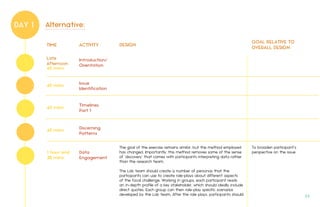
We have designed a set of processes that can, ideally, be carried out as three 2.5 day
workshops, interspersed with time to consult with colleagues and stakeholders about the
process itself. Recognizing the time pressures that can come with asking participants to
dedicate significant amounts of time, and the novelty of the use of computer models, we
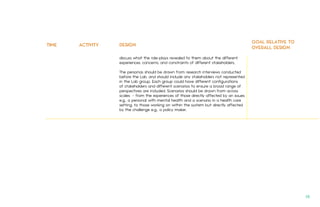
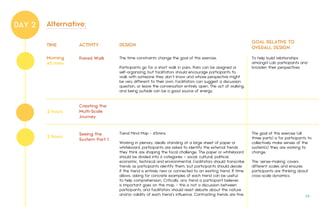
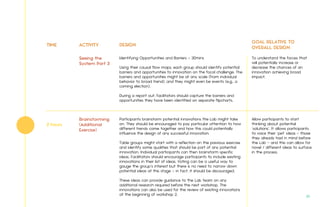
have also included a description of an alternative workshop process that requires only one full
day and does not require computer models. These dramatic changes are not without some
significant trade-offs, which are discussed alongside the alternative agendas.
STEP 3:
The
Workshops
22.
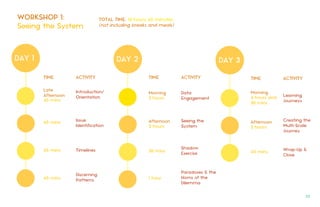
DAY 1
TOTAL TIME: 16 hours 45 minutes
(not including breaks and meals)
TIME ACTIVITY
DAY 2
WORKSHOP 1:
Seeing the System
Introduction/
Orientation
Late
Afternoon
45 mins
Issue
Identification
45 mins
45 mins
45 mins
Timelines
Discerning
Patterns
TIME ACTIVITY
Data
Engagement
Morning
3 hours
Afternoon
2 hours
Seeing the
System
30 mins
Shadow
Exercise
1 hour
Paradoxes & the
Horns of the
Dilemma
DAY 3
TIME ACTIVITY
Learning
Journeys
Morning
4 hours and
30 mins
Afternoon
2 hours
Creating the
Multi-Scale
Journey
Wrap-Up &
Close
45 mins
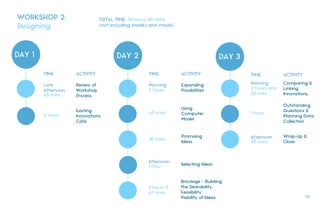
23.
DAY 1
TOTAL TIME: 13 hours 45 mins
(not including breaks and meals)
TIME ACTIVITY
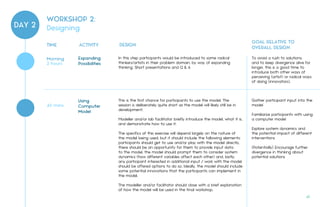
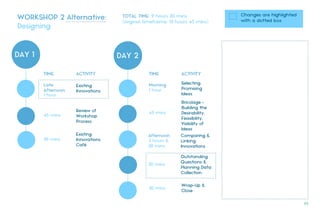
DAY 2
WORKSHOP 2:
Designing
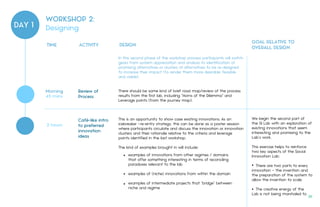
Review of
Workshop
Process
Late
Afternoon
45 mins
Existing
Innovations
Café
2 hours
TIME ACTIVITY
Expanding
Possibilities
Morning
2 hours
Using
Computer
Model
30 mins
Promising
Ideas
1 hour Selecting Ideas
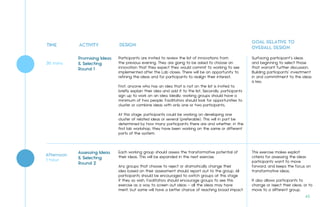
DAY 3
TIME ACTIVITY
45 mins
Afternoon
2 hours &
45 mins
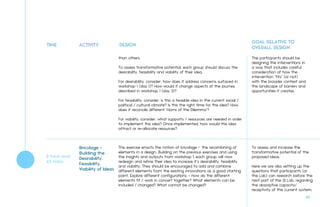
Bricolage - Building
the Desirability,
Feasibility,
Viability of Ideas
Comparing &
Linking
Innovations
Morning
2 hours and
30 mins
Outstanding
Questions &
Planning Data
Collection
Wrap-Up &
Close
1 hour
30 mins
Afternoon
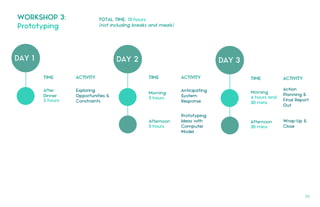
24.
DAY 1
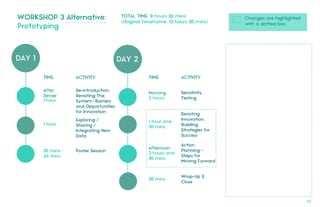
TOTAL TIME: 13 hours
(not including breaks and meals)
TIME ACTIVITY
DAY 2
WORKSHOP 3:
Prototyping
Exploring
Opportunities &
Constraints
After
Dinner
2 hours
TIME ACTIVITY
Anticipating
System
Response
Morning
3 hours
Afternoon
3 hours
Prototyping
Ideas with
Computer
Model
DAY 3
TIME ACTIVITY
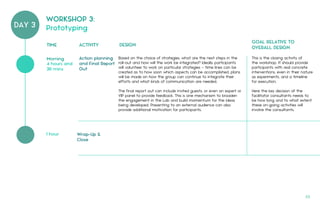
Action
Planning &
Final Report
Out
Morning
4 hours and
30 mins
Afternoon
30 mins
Wrap-Up &
Close
25.
WORKSHOP 1:
SEEING
the
SYSTEM
26.
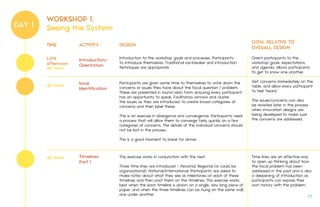
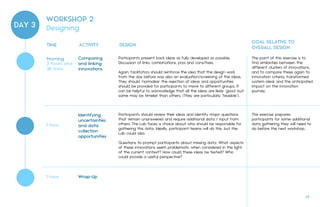
DAY 1
TIME ACTIVITY
Introduction/
Orientation
Late
Afternoon
45 mins
Issue
Identification
45 mins
45 mins Timelines
Part 1
DESIGN
GOAL RELATIVE TO
OVERALL DESIGN
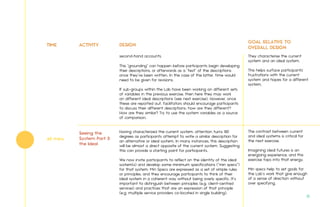
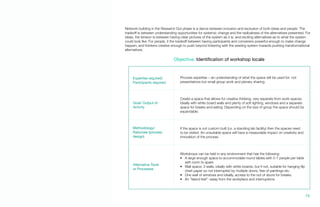
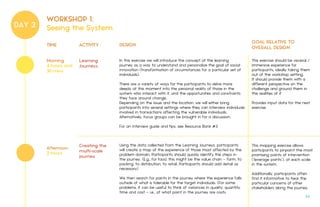
Introduction to the workshop goals and processes. Participants
to introduce themselves. Traditional ice-breaker and introduction
techniques are appropriate.
This exercise works in conjunction with the next.
Three time lines are introduced – Personal, Regional (or could be
organizational), National/International. Participants are asked to
make notes about what they see as milestones on each of these
timelines and then post them on the timelines. This exercise works
best when the each timeline is drawn on a single, very long piece of
paper, and when the three timelines can be hung on the same wall,
one under another.
Orient participants to the
workshop goals, expectations,
and agenda. Allows participants
to get to know one another.
Get concerns immediately on the
table, and allow every participant
to feel ‘heard.’
The issues/concerns can also
be revisited later in the process
when innovation designs are
being developed to make sure
the concerns are addressed.
Time lines are an effective way
to open up thinking about how
the focal problem has been
addressed in the past and is also
a deepening of introduction as
participants can expose their
own history with the problem.
Participants are given some time to themselves to write down the
concerns or issues they have about the focal question / problem.
These are presented in round robin form, ensuring every participant
has an opportunity to speak. Facilitators winnow and cluster
the issues as they are introduced, to create broad categories of
concerns and then label these.
This is an exercise in divergence and convergence. Participants need
a process that will allow them to converge fairly quickly on a few
categories of concerns. The details of the individual concerns should
not be lost in the process.
This is a good moment to break for dinner.
WORKSHOP 1:
Seeing the System
27.
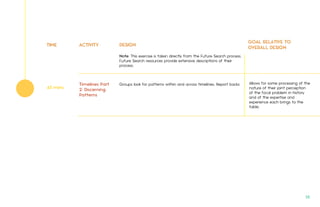
TIME ACTIVITY
Timelines Part
2: Discerning
Patterns
45 mins
DESIGN
GOAL RELATIVE TO
OVERALL DESIGN
Note: This exercise is taken directly from the Future Search process.
Future Search resources provide extensive descriptions of their
process.
Groups look for patterns within and across timelines. Report backs Allows for some processing of the
nature of their joint perception
of the focal problem in history
and of the expertise and
experience each brings to the
table.
28.
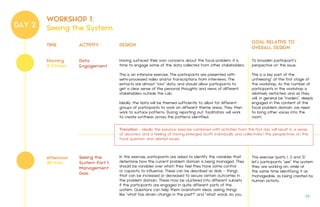
DAY 2
TIME ACTIVITY DESIGN
GOAL RELATIVE TO
OVERALL DESIGN
Having surfaced their own concerns about the focal problem, it is
time to engage some of the data collected from other stakeholders.
This is an intensive exercise. The participants are presented with
semi-processed video and/or transcriptions from interviews. The
extracts are almost "raw” data, and should allow participants to
get a clear sense of the personal thoughts and views of different
stakeholders outside the Lab.
Ideally, the data will be themed sufficiently to allow for different
groups of participants to work on different theme areas. They then
work to surface patterns. During reporting out, facilitators will work
to create synthesis across the patterns identified.
In this exercise, participants are asked to identify the variables that
determine how the current problem domain is being managed. They
should be variables over which they feel they have some control
or capacity to influence. These can be described as dials – things
that can be increased or decreased to secure certain outcomes in
the problem domain. These may be clustered into different subsets
if the participants are engaged in quite different parts of the
system. Questions can help them brainstorm ideas, asking things
like "what has driven change in the past?” and "what words do you
To broaden participant’s
perspective on the issue.
This is a key part of the
unfreezing” of the first stage of
the workshop. As the number of
participants in the workshop is
relatively restricted, and as they
will, in general be "insiders”, deeply
engaged in the content of the
focal problem domain, we need
to bring other voices into the
room.
Data
Engagement
Morning
2-3 hours
Afternoon
30 mins
Seeing the
System Part 1:
Management
Dials
Transition - Ideally the previous exercise combined with activities from the first day will result in a sense
of discovery and a feeling of having enlarged (both individually and collectively) the perspectives on the
focal question and related issues.
This exercise (parts 1, 2 and 3)
let’s participants "see” the system
they are working on, while at
the same time identifying it as
manageable, as being created by
human activity.
WORKSHOP 1:
Seeing the System
29.
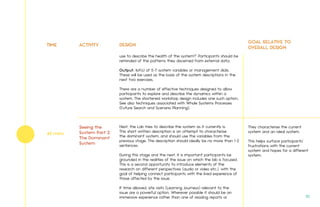
TIME ACTIVITY DESIGN
GOAL RELATIVE TO
OVERALL DESIGN
use to describe the health of the system?” Participants should be
reminded of the patterns they discerned from external data.
Output: list(s) of 5-7 system variables or management dials.
These will be used as the basis of the system descriptions in the
next two exercises.
There are a number of effective techniques designed to allow
participants to explore and describe the dynamics within a
system. The shortened workshop design includes one such option.
See also techniques associated with Whole Systems Processes
(Future Search and Scenario Planning).
Next, the Lab tries to describe the system as it currently is.
This short written description is an attempt to characterise
the dominant system, and should use the variables from the
previous stage. The description should ideally be no more than 1-2
sentences.
During this stage and the next, it is important participants be
grounded in the realities of the issue on which the lab is focused.
This is a second opportunity to introduce elements of the
research on different perspectives (audio or video etc.), with the
goal of helping connect participants with the lived experience of
those affected by the issue.
If time allowed, site visits (Learning Journeys) relevant to the
issue are a powerful option. Wherever possible it should be an
immersive experience rather than one of reading reports or
They characterise the current
system and an ideal system.
This helps surface participants’
frustrations with the current
system and hopes for a different
system.
Seeing the
System Part 2:
The Dominant
System
45 mins
30.
TIME ACTIVITY DESIGN
GOAL RELATIVE TO
OVERALL DESIGN
second-hand accounts.
This "grounding” can happen before participants begin developing
their descriptions, or afterwards as a "test” of the descriptions
once they’ve been written. In the case of the latter, time would
need to be given for revisions.
If sub-groups within the Lab have been working on different sets
of variables in the previous exercise, then here they may work
on different ideal descriptions (see next exercise). However, once
these are reported out, facilitators should encourage participants
to discuss their different descriptions: how are they different?
How are they similar? Try to use the system variables as a source
of comparison.
Having characterized the current system, attention turns 180
degrees as participants attempt to write a similar description for
an alternative or ideal system. In many instances, this description
will be almost a direct opposite of the current system. Suggesting
this can provide a starting point for participants.
We now invite participants to reflect on the identity of the ideal
system(s) and develop some minimum specifications ("min specs”)
for that system. Min Specs are expressed as a set of simple rules
or principles, and they encourage participants to think of their
ideal system in a coherent way without being overly specific. It’s
important to distinguish between principles (e.g. client-centred
services) and practices that are an expression of that principle
(e.g. multiple service providers co-located in single building).
They characterise the current
system and an ideal system.
This helps surface participants’
frustrations with the current
system and hopes for a different
system.
The contrast between current
and ideal systems is critical for
the next exercise.
Imagining ideal futures is an
energizing experience, and this
exercise taps into that energy.
Min specs help to set goals for
the Lab’s work that give enough
of a sense of direction without
over specifying.
Seeing the
System Part 3:
the Ideal
45 mins
31.
TIME ACTIVITY DESIGN
GOAL RELATIVE TO
OVERALL DESIGN
It can be helpful to give each description – current system and
ideal - an identity, which will become an efficient shorthand for
the group.
This begins is an individual exercise.
Participants are introduced to the notion of shadow or nemesis.
They should three columns on a piece of paper. They are then
asked to describe, as emotionally as possible, the characteristics of
someone who "makes them see red.” They should create a list of
descriptive words. (E.g., pedantic, aggressive, insensitive, repressed).
In the next column they write the word that is the antonym of
the words they wrote in column 1. (E.g., if they wrote "pedantic”
as one quality in the first column they might write "easy-going” in
the second). This second column is generally a good description of
themselves, or a reflection of their ideal self. In the third column
they write words that they feel the person they are describing
(their "nemesis”) would use to describe these qualities. (E.g.,
"pedantic” might be described as "thorough” or (detail oriented).
Participants should then reflect on the situations in which the
values/character traits in column 3 might be particularly useful.
This is a preparatory or softening
up” exercise to allow people to
experience the importance of
paradoxes – it allows participants
to recognize the inherent
tendency to see the world in
black and white terms, where
everything is either good or bad.
Shadow
Exercise
30 mins
Transition - There should be a feeling of strong identification with both the current and the ideal
descriptions. During this transition, we will move to a very individual exercise – the shadow exercise, to
prepare for recognizing the enduring tension between the dominant (current) and ideal system. These
define two horns of the dilemma - two attractors which are in tension and which define innovation
space.
32.
TIME ACTIVITY DESIGN
GOAL RELATIVE TO
OVERALL DESIGN
This exercise mimics the previous shadow exercise.
Participants take their description of the dominant system
and turn it into a positive statement.* The revised statement
and original statement of the ideal system are then seen as
alternatives and will be placed on the "horns of the dilemma.”
It can be useful to turn the paradoxes into questions that take
the form "How can we continue to have (value(s) from dominant
system) while at the same time having (value(s) from ideal
system)?”
*It may be necessary to do this in a step-wise fashion. First, they
identify the values or characteristics implicit in their descriptions of
the dominant system. (These are often framed in negative terms
– commonly this might include characteristics like "bureaucratic”
or "unfair.”). They then take the list of characteristics and turn
each into a positive, creating a positive statement about the
dominant system.
For an explanation of the concept of Horns of the Dilemma, and
their relevance to innovation, see Resource Bank #3
The Horns of the Dilemma
exercise allows participants to
identify criteria for assessing an
innovation’s potential for impact.
(Innovations that don’t reconcile
these paradoxes are less likely to
have broad impact as they will
experience significant resistance-
if they are too grounded in the
ideal - or limited novelty - if they
grounded in current realities)
Horns of
Dilemma60 mins
33.
DAY 3
TIME ACTIVITY DESIGN
GOAL RELATIVE TO
OVERALL DESIGN
In this exercise we will introduce the concept of the learning
journey as a way to understand and personalize the goal of social
innovation (transformation of circumstances for a particular set of
individuals).
There are a variety of ways for the participants to delve more
deeply at this moment into the personal reality of those in the
system who interact with it, and the opportunities and constraints
they face around change.
Depending on the issue and the location, we will either bring
participants into several settings where they can interview individuals
involved in transactions affecting the vulnerable individuals.
Alternatively, focus groups can be brought in for a discussion.
For an interview guide and tips, see Resource Bank #3
Using the data collected from the Learning Journeys, participants
will create a map of the experience of those most affected by the
problem domain. Participants should quickly identify the steps in
the journey. (E.g., for food, this might be the value chain – farm, to
packing, to distribution, to retail. Participants should add detail as
necessary)
We then search for points in the journey where the experience falls
outside of what is tolerable for the target individuals. (For some
problems, it can be useful to think of variances in quality, quantity,
time and cost – i.e., at what point in the journey are costs
This exercise should be visceral /
immersive experience for
participants, ideally taking them
out of the workshop setting.
It should provide them with a
different perspective on the
challenge and ground them in
the realities of it
Provides input data for the next
exercise.
Learning
Journeys4 hours and
30 mins
Afternoon
2 hours
This mapping exercise allows
participants to pinpoint the most
promising points of intervention
(‘leverage points’), at each scale
in the system.
Additionally, participants often
find it informative to hear the
particular concerns of other
stakeholders along the journey.
Morning
Creating the
multi-scale
journey
WORKSHOP 1:
Seeing the System
34.
TIME ACTIVITY DESIGN
GOAL RELATIVE TO
OVERALL DESIGN
simply too much? Participants can add additional criteria if desired.
For challenges associated with individuals, e.g., mental health,
participants should think about moments where the system seems
incoherent – it doesn’t make sense, is confusing, it seems impossible
to manage etc.,). Not all problems will be appropriate for this
exercise. Ideally, to benefit from the journey analysis there needs to
be a target population, e.g. youth at risk, the homeless, individuals
suffering from chronic disease, unemployed youth etc. It can be
done with a system –say a sustainable urban environment, but it is
still better to identify a group of individuals for whom innovation will
produce a discernable/measurable change of experience.
The interactions that trigger a variance will then be analysed.
Who are the actors/stakeholders involved? Specific roles are
best. ("Teacher” rather than school”). Participants should then
describe what constrains or drives the particular behaviour of each
stakeholder. These drivers and contraints should then be traced up
through the system – they should keep asking "why.”
Finally, participants should discuss potential intervention points
(scales) at which an intervention could have most impact in tipping
the system. E.g., should they intervene at the level of a school? A
school board? A ministry of education? Or, cultural attitudes to
education, learning, children etc.?
For example of the output from this exercise, and a diagram that
illustrates the ‘journey’ see Resource Bank #3.
35.
TIME ACTIVITY DESIGN
GOAL RELATIVE TO
OVERALL DESIGN
Some closure and looking forward to next workshop.
Exploring existing innovations will be a key element in the second
workshop. These can come directly from the Lab team and
research, or participants can be asked to bring information about
promising innovations with them. The kinds of examples brought
should include:
The Horns of the Dilemma
exercise allows participants to
identify criteria for assessing an
innovation’s potential for impact.
(Innovations that don’t reconcile
these paradoxes are less likely to
have broad impact as they will
experience significant resistance-
if they are too grounded in the
ideal - or limited novelty - if they
grounded in current realities)
Wrap-Up45 mins
examples of innovations from other regimes / domains
that offer something interesting in terms of reconciling
paradoxes relevant to the lab
examples of (niche) innovations from within the domain
(i.e., promising ideas that have not reached scale)
examples of interventions that create pathways for
innovations to scale (move between scales).
•
•
•
Transition - Ideally by the completion of the workshop we will have a sense of the criteria for a
transformational innovation (Horns of the Dilemma) and, as well, some ideas about key leverage points
in the system (Multi-scale journey). This sets the stage for a more in-depth analysis of the kinds of
innovations currently under development and how those might be engaged/tailored to meet the needs
for transformation of the current system.
36.
TIME ACTIVITY DESIGN
GOAL RELATIVE TO
OVERALL DESIGN
This is a key point of convergence. Where significant differences in opinion remain about the very
broad terms and goals of the Lab’s work, facilitators should consider revisiting earlier exercises (or trying
alternatives) before proceeding to the central part of the SI Lab process (Workshop 2). Note that social
innovation theory is rooted in complexity theory. This means that the understanding of the system
and of innovation space is an emergent process. We have outlined the above sequence as a set of
interlocking steps/exercises, designed with the intent of moving participants through broadening their
understanding of the system, identifying its impact on the target population, and identifying innovation
space and intervention scale. However, it is possible that participants will choose to focus on different
aspects of the system, or that some will move very quickly to identify ideal interventions where others
will need to revisit the system dynamics numerous times. Facilitators need to be prepared to respond to
different emergent threads.
37.
WORKSHOP 2:
DESIGNING
38.
DAY 1
TIME ACTIVITY DESIGN
GOAL RELATIVE TO
OVERALL DESIGN
In this second phase of the workshop process participants will switch
gears from system appreciation and analysis to identification of
promising alternatives or clusters of alternatives to be re-designed
to increase their impact (to render them more desirable, feasible
and viable).
There should be some kind of brief road map/review of the process
results from the first lab, including "Horns of the Dilemma” and
Leverage points (from the journey map).
This is an opportunity to show case existing innovations. As an
icebreaker –re-entry strategy, this can be done as a poster session
where participants circulate and discuss the innovation or innovation
clusters and their rationale relative to the criteria and leverage
points identified in the last workshop.
The kind of examples brought in will include:
We begin the second part of
the SI Lab with an exploration of
existing innovations that seem
interesting and promising to the
Lab’s work.
This exercise helps to reinforce
two key aspects of the Social
Innovation Lab:
There are two parts to every
innovation – the invention and
the preparation of the system to
allow the invention to scale
The creative energy of the
Lab is not being marshaled to
Review of
Process
Morning
45 mins
Café-like intro
to preferred
innovation
ideas
2 hours
examples of innovations from other regimes / domains
that offer something interesting in terms of reconciling
paradoxes relevant to the lab
examples of (niche) innovations from within the domain
examples of intermediate projects that "bridge” between
niche and regime
•
•
•
•
•
WORKSHOP 2:
Designing
39.
TIME ACTIVITY DESIGN
GOAL RELATIVE TO
OVERALL DESIGN
Potentially, after hearing about a number of "preferred” innovations,
some voting could be held to discuss front-runners. This will be
reviewed in the morning.
invent something entirely new,
but instead to combine and
adapt existing ideas so that they
can have broader impact. (See
earlier chapter "Towards A Social
Innovation Lab”).
40.
DAY 2
TIME ACTIVITY DESIGN
GOAL RELATIVE TO
OVERALL DESIGN
In this step participants would be introduced to some radical
thinkers/artists in their problem domain, by way of expanding
thinking. Short presentations and Q & A
This is the first chance for participants to use the model. The
session is deliberately quite short as the model will likely still be in
development.
Modeller and/or lab facilitator briefly introduce the model, what it is,
and demonstrate how to use it.
The specifics of this exercise will depend largely on the nature of
the model being used, but it should include the following elements:
participants should get to use and/or play with the model directly,
there should be an opportunity for them to provide input data
to the model, the model should prompt them to consider system
dynamics (how different variables affect each other) and, lastly,
any participant interested in additional input / work with the model
should be offered options to do so. Ideally, the model should include
some potential innovations that the participants can implement in
the model.
The modeller and/or facilitator should close with a brief explanation
of how the model will be used in the final workshop.
To avoid a rush to solutions,
and to keep divergence alive for
longer, this is a good time to
introduce both other ways of
perceiving (artist) or radical ways
of doing (innovators).
Gather participant input into the
model
Familiarize participants with using
a computer model
Explore system dynamics and
the potential impact of different
interventions
(Potentially) Encourage further
divergence in thinking about
potential solutions
Using
Computer
Model
45 mins
Expanding
Possibilities2 hours
Morning
WORKSHOP 2:
Designing
41.
TIME ACTIVITY DESIGN
GOAL RELATIVE TO
OVERALL DESIGN
Participants are invited to review the list of innovations from
the previous evening. They are going to be asked to choose an
innovation that they expect they would commit to working to see
implemented after the Lab closes. There will be an opportunity to
refining the ideas and for participants to realign their interest.
First, anyone who has an idea that is not on the list is invited to
briefly explain their idea and add it to the list. Secondly, participants
sign up to work on an idea. Ideally, working groups should have a
minimum of two people. Facilitators should look for opportunities to
cluster or combine ideas with only one or two participants.
At this stage, participants could be working on developing one
cluster of related ideas or several (preferable). This will in part be
determined by how many participants there are and whether, in the
first lab workshop, they have been working on the same or different
parts of the system.
Each working group should assess the transformative potential of
their ideas. This will be expanded in the next exercise.
Any groups that choose to reject or dramatically change their
idea based on their assessment should report out to the group. All
participants should be encouraged to switch groups at this stage
if they so wish. Facilitators should encourage groups to see this
exercise as a way to screen out ideas – all the ideas may have
merit, but some will have a better chance of reaching broad impact
Surfacing participant’s ideas
and beginning to select those
that warrant further discussion.
Building participants’ investment
in and commitment to the ideas
is key.
This exercise makes explicit
criteria for assessing the ideas
participants want to move
forward, and keeps the focus on
transformative ideas.
It also allows participants to
change or reject their ideas, or to
move to a different group.
Assessing Ideas
& Selecting
Round 2
1 hour
Promising Ideas
& Selecting
Round 1
30 mins
Afternoon
42.
TIME ACTIVITY DESIGN
GOAL RELATIVE TO
OVERALL DESIGN
than others.
To assess transformative potential, each group should discuss the
desirability, feasibility and viability of their idea.
For desirability, consider: how does it address concerns surfaced in
workshop 1 (day 1)? How would it change aspects of the journey
described in workshop 1 (day 3)?
For feasibility, consider: is this a feasible idea in the current social /
political / cultural climate? Is this the right time for this idea? How
does it reconcile different ‘Horns of the Dilemma’?
For viability, consider: what supports / resources are needed in order
to implement this idea? Once implemented, how would this idea
attract or re-allocate resources?
This exercise enacts the notion of bricolage – the recombining of
elements in a design. Building on the previous exercises and using
the insights and outputs from workshop 1, each group will now
redesign and refine their idea to increase it’s desirability, feasibility
and viability. They should be encouraged to add and combine
different elements from the existing innovations as a good starting
point. Explore different configurations – how do the different
elements fit / work in concert together? What elements can be
included / changed? What cannot be changed?
The participants should be
designing the interventions in
a way that includes careful
consideration of how the
intervention "fits” (or not)
with the broader context and
the landscape of barriers and
opportunities it creates.
To assess and increase the
transformative potential of the
proposed ideas.
Here we are also setting up the
questions that participants (or
the Lab) can research before the
next part of the SI Lab, regarding
the absorptive capacity/
receptivity of the current system.
Bricolage -
Building the
Desirability,
Feasibility,
Viability of Ideas
2 hour and
45 mins
43.
TIME ACTIVITY DESIGN
GOAL RELATIVE TO
OVERALL DESIGN
Groups should be encouraged to work iteratively – working through
a couple of versions of the design so as to incorporate insights from
each discussion (e.g., discussion of feasibility might suggest changes
that affect the desirability of the idea). Each group may be at
different stages of the development... some ready quite early to
advance the design quickly, others cycling back to the their analyse
to entirely rethink their idea.
The discussions of feasibility and viability can benefit from broader
input, and so the exercise could be organized around exploring
the economic, political, legal/policy, cultural context of the current
system in plenary, and then discussions in small, innovation specific
groups- or the conversation could be in the innovation specific
groups with sharing about similarities and differences. Additional
questions to consider... Feasibility – what laws, policies, beliefs etc.,
might this idea bump against? What are the implications of this?
Viability – if successful, from where would this idea draw resources?
Who would loose out? What are the implications of this?
Transition - Ideally by the end of this sequence, several related or alternative social innovations, which
could address the key points in the dominant system will have been developed so that they have
"legs”- i.e., they have the potential for broad impact. Teams should be prepared to present the following
morning.
44.
DAY 3
TIME ACTIVITY DESIGN
GOAL RELATIVE TO
OVERALL DESIGN
Participants present back ideas as fully developed as possible.
Discussion of links, combinations, pros and cons/fixes.
Again, facilitators should reinforce the idea that the design work
from the day before was also an evaluation/screening of the ideas.
They should ‘normalise’ the rejection of ideas and opportunities
should be provided for participants to move to different groups. It
can be helpful to acknowledge that all the ideas are likely ‘good’ but
some may be timelier than others. (They are particularly ‘feasible’).
Participants should review their ideas and identify major questions
that remain unanswered and require additional data / input from
others. The Lab faces a choice about who should be responsible for
gathering this data. Ideally, participant teams will do this, but the
Lab could also.
Questions to prompt participants about missing data: What aspects
of these innovations seem problematic when considered in the light
of the current context? How could these ideas be tested? Who
could provide a useful perspective?
The point of this exercise is to
find similarities between the
different clusters of innovations,
and to compare these again to
innovation criteria, transformed
system ideal, and the anticipated
impact on the innovation
journey.
This exercise prepares
participants for some additional
data gathering they will need to
do before the next workshop.
Identifying
uncertainties
and data
collection
opportunities
1 hour
Comparing
and linking
innovations
2 hours and
30 mins
Morning
1 hour Wrap-Up
WORKSHOP 2:
Designing
45.
TIME ACTIVITY DESIGN
GOAL RELATIVE TO
OVERALL DESIGN
Transition: This is a key point at which most participants have organized into working groups.
Participants at this point have good ideas about the preferred innovations that they want to work
on as part of the Lab, and after the Lab processes concludes. They should also have plans for how
these ideas might be tested with colleagues or other stakeholders. (In these conversations, they
should pay particular attention to trying to anticipate barriers and opportunities for rolling out their
innovation).
Some variance in the clarity of each group’s work is to be expected – some may have quickly
moved to interventions where others need to circle back to systems analysis. Where a significant
number of groups do not yet have a good sense of their work, facilitators should consider revisiting
exercises from the workshop (or trying alternatives) before proceeding to the final part of the Lab
process (Workshop 3)
46.
WORKSHOP 3:
PROTOTYPING
47.
DAY 1
TIME ACTIVITY DESIGN
GOAL RELATIVE TO
OVERALL DESIGN
Here we ask participants to share stories in dyads/triads and then
share larger list of opportunities and constraints related to proposed
changes. The conversation is deliberately open and expansive –
‘what is the biggest opportunity (opportunities) to be leveraged in
addressing these issues?’
These are then shared in plenary or group could move into a
collective mind-mapping exercise. Depending on the size, other
techniques, including mind mapping might be used to surface
common opportunities and challenges – using classic categories of
technical, social, environmental, cultural, economic, political.
The structure of this exercise depends whether participants were
tasked with trying to answer questions identified at the conclusion
of workshop 2, or if the Lab was responsible for this.
Either participants will need to share their work with team members,
or the Lab will need to present / provide data to the teams.
Teams should use their discussion to populate a ‘poster’ that
describes their idea. The poster should cover 4 points: the
problem they are addressing; the intervention / innovation
they are proposing; the impact (e.g., how it would change the
journey described in workshop 1); the opportunity context (what
opportunities is it leveraging?)
Change for participants to
reconnect to the focal question
and refresh their thinking about
the system(s) they are working to
change.
Participants to reconnect to
their idea – refresh their thinking
about the system they are
working to change, and their
proposed innovation – and to
introduce data collected since
workshop 2.
Exploring/
Sharing/
Integrating
New Data
1 hour
Re-introduction:
Participants
share stories of
opportunity &
challenge1 hour
Late
Afternoon/
Evening/
After Dinner
WORKSHOP 3:
Prototyping
48.
TIME ACTIVITY DESIGN
GOAL RELATIVE TO
OVERALL DESIGN
Participants circulate, reviewing the full suite of innovation ideas
being proposed through the Lab.
Chance for the group to be
reminded of all the innovations
being proposed. Ideally, this is
a particularly interactive, social
experience.
Poster Session30-45 mins
Transition - We need to leave this exercise with key opportunities and challenges that can be addressed
in working groups.
49.
DAY 2
TIME ACTIVITY DESIGN
GOAL RELATIVE TO
OVERALL DESIGN
This exercise makes use of different ‘lenses’ to examine the barriers
and opportunities faced by each group’s innovation. Small groups
will discuss each innovation using a different ‘lens’ and provide
feedback to the team that has designed the innovation.
Facilitators should remind the group of the trend map and exercises
on barriers and opportunities from workshop 1, and ideally post the
large map and small group work flipcharts back on the wall.
Participants should self-select into one of the 6 groups – social,
cultural, political, technical, economic and environmental. (Different
lenses or combinations are possible). Each group should review
the large trend map, and the causal flow map for their lens
(see workshop 1 for details), and generate a list of questions or
considerations relevant to their lens. They should be encouraged to
think of the lens as a mind-set, one that suggests a particular set of
values, ways of thinking etc. For instance, a group using the ‘political
lens’ might be concerned with political will and elections, but they
might also think about rights and responsibilities, conflict and co-
operation, coalitions, power and the way control is exercised.
Once they have a list of questions / considerations, each group will
go around to each innovation in turn and explore them through the
lens they have chosen. What does this reveal about the innovation,
and about the barriers and opportunities it will face? What
unintended consequences are revealed? What critical considerations
need to be taken into account?
Having built an innovation which
participants feel is promising, it
is time to evaluate its impact
on the current system and the
current system’s impact on it.
Each working group should have
been thinking about barriers and
opportunities throughout the
design of their innovation and
this exercise is an opportunity
to provide more / different
perspective about how the
system will respond to this
innovation.
Sensitivity
Testing: How Will
The System
Respond To This
Innovation?
2 hours
Morning
WORKSHOP 3:
Prototyping
50.
TIME ACTIVITY DESIGN
GOAL RELATIVE TO
OVERALL DESIGN
Whilst the groups should be encouraged to look at the innovation
through their lens, it’s likely that each participant will ‘see’ things
that are apparent because of their own expertise and experience
– these additional insights, suggestions, cautions etc. are extremely
valuable and should be encouraged once they have thoroughly
explored the innovation through a particular lens.
The specific method for providing feedback will depend on the
overall group size and/or number of innovation teams. Feedback
can be written on post-it notes or innovation teams can elect one
member to remain with their innovation to receive the feedback
directly.
Using the modelling capacity, participants working in groups can
test the impact of particular strategies on the system as a whole –
modifying strategies in response to "system” feedback. The specific
protocol for this exercise will be heavily dependent on the nature of
the model used. Suggested elements include:
Spend the minimum amount of time possible explaining the model
and let participants begin interacting with it as quickly as possible.
In an effort to "prototype” before
actual intervention, the model
of the system can be used to
explore possible, unforeseen
impacts of a particular strategy
associated with the innovation.
Transition - Go from identifying possible strategies that can influence current context and allow greater
support for the innovation, to searching for hidden desirable or undesirable consequences of this kind of
system intervention.
Sensitivity
Testing: Part 23 hours
Spend the minimum amount of time possible explaining
the model and let participants begin interacting with it as
quickly as possible.
•
51.
TIME ACTIVITY DESIGN
GOAL RELATIVE TO
OVERALL DESIGN
Participants upgrade the designs of their innovations based on
their analysis of opportunities / barriers and use of the computer
modelling.
To incorporate ideas from the
previous prototyping exercises.
Re-designing
Proposed
Innovations:
Building
Strategies For
Success
1 hour and
30 mins
Short rounds of bounded challenges – e.g., trying to move
one indicator and ignoring the effects and trade-offs -
help participants quickly familiarize themselves with the
model and encourage playful competition amongst groups.
Ideally, facilitators should be able to prompt groups to
reflect on specific system dynamics during the first rounds
of games.
Once in free play, participants should cycle between
prototyping (using the model) and discussions of the design
of their innovations.
Playing the interventions out under different scenarios can
be particularly powerful.
•
•
•
•
Transition - By the end of this day, there should be a list of key strategies that will need to be part of
the social innovation strategy.
52.
DAY 3
TIME ACTIVITY DESIGN
GOAL RELATIVE TO
OVERALL DESIGN
Based on the choice of strategies, what are the next steps in the
roll-out and how will the work be integrated? Ideally participants
will volunteer to work on particular strategies – time lines can be
created as to how soon which aspects can be accomplished, plans
will be made on how the group can continue to integrate their
efforts and what kinds of communication are needed.
The final report out can include invited guests, or even an expert or
VIP panel to provide feedback. This is one mechanism to broaden
the engagement in the Lab and build momentum for the ideas
being developed. Presenting to an external audience can also
provide additional motivation for participants.
This is the closing activity of
the workshop. It should provide
participants with real concrete
interventions, even in their nature
as experiments, and a timeline
for execution.
Here the key decision of the
facilitator consultants needs to
be how long and to what extent
these on-going activities will
involve the consultants.
Action planning
and Final Report
Out
4 hours and
30 mins
Morning
1 hour Wrap-Up &
Close
WORKSHOP 3:
Prototyping
53.
ALTERNATIVE
WORKSHOP
AGENDAS
54.
DAY 1
TOTAL TIME: 11 hours
(Original: timeframe: 16 hours 45 mins)
TIME ACTIVITY
DAY 2
WORKSHOP 1 Alternative:
Seeing the System
Introduction/
Orientation
Late
Afternoon
45 mins
Issue
Identification
45 mins
45 mins
45 mins
Timelines
Discerning
Patterns
TIME ACTIVITY
Paired WalkMorning
45 mins
Afternoon
2 hours
Creating the
Multi-Scale
Journey
Seeing the
System
(Alternative
Process)
1 hour
Brainstorming
(Additional
Exercise)
Changes are highlighted
with a dotted box
1 hour and
30 mins
Data
Engagement
Afternoon
2 hours
45 mins
Wrap-Up and
Close
55.
Summary of Changes: Reduced time and alternative process for data engagement; alternative
process for “Seeing the System;” no “learning journey”; some re-ordering of exercises; brainstorming
exercise added
Cons of alternative agenda:
• Lose time to engage with outside perspectives (data engagement, learning journey), which will likely
reduce the capacity of the workshop to ‘unfreeze’ participant’s ideas / thinking.
• Lose the visceral experience of the Learning Journeys – an important personal but also shared
experience. Learning Journey’s are a powerful way to challenge participant’s own ideas about how a
system works.
• “Seeing the System” – as a criteria for assessing innovations, wicked questions offer a safe guard
against existing solutions and avoid the ‘pendulum swing’ so common in our thinking. (Solutions that
are the direct opposite of existing approaches and fail to engage with the ‘hidden’ virtues of those
existing approaches). The process of developing paradoxes taps into the energy participants experience
when imaging ideal futures, whilst the outputs (the paradoxes) offer a useful point of convergence –
participants feel a strong sense of common ground and that they have collectively made ‘progress.’
Importantly, and in contrast to other exercises that help groups converge, this method honours the
complexity of the system and captures the richness of the conversations that have taken place.
Pros of alternative agenda:
• Alternate process for "Seeing the System” – the opportunities and barriers provide a list of criteria for
strengthening any innovation (it is not a list of criteria for an innovation); and this process also allows
time for participants to spend time imaging potential solutions – this is often a particularly energizing
experience, allows participants to voice their ideas without locking the Lab into using them, and helps
foreshadow the coming workshop.
WORKSHOP 1 Alternative:
SUMMARY OF CHANGES
56.
DAY 1
TIME ACTIVITY
Introduction/
Orientation
Late
Afternoon
45 mins
Issue
Identification
45 mins
45 mins
Timelines
Part 1
DESIGN
GOAL RELATIVE TO
OVERALL DESIGN
The goal of the exercise remains similar, but the method employed
has changed. Importantly, this method removes some of the sense
of ‘discovery’ that comes with participants interpreting data rather
than the research team.
The Lab team should create a number of personas that the
participants can use to create role-plays about different aspects
of the focal challenge. Working in groups, each participant reads
an in-depth profile of a key stakeholder, which should ideally include
direct quotes. Each group can then role-play specific scenarios
developed by the Lab team. After the role plays, participants should
To broaden participant’s
perspective on the issue
45 mins Discerning
Patterns
1 hour and
30 mins
Data
Engagement
Alternative:
57.
TIME ACTIVITY DESIGN
GOAL RELATIVE TO
OVERALL DESIGN
discuss what the role-plays revealed to them about the different
experiences, concerns, and constraints of different stakeholders.
The personas should be drawn from research interviews conducted
before the Lab, and should include any stakeholders not represented
in the Lab group. Each group could have different configurations
of stakeholders and different scenarios to ensure a broad range of
perspectives are included. Scenarios should be drawn from across
scales - from the experiences of those directly affected by an issues
e.g., a personal with mental health and a scenario in a health care
setting, to those working on within the system but directly affected
by the challenge e.g., a policy maker.
58.
DAY 2
TIME ACTIVITY
Paired WalkMorning
45 mins
2 hours
Creating the
Multi-Scale
Journey
DESIGN
GOAL RELATIVE TO
OVERALL DESIGN
The time constraints change the goal of this exercise.
Participants go for a short walk in pairs. Pairs can be assigned or
self-organizing, but facilitators should encourage participants to
walk with someone they don’t know and whose perspective might
be very different to their own. Facilitators can suggest a discussion
question, or leave the conversation entirely open. The act of walking,
and being outside can be a good source of energy.
Trend Mind Map - 45mins
Working in plenary, ideally standing at a large sheet of paper or
whiteboard, participants are asked to identify the external trends
they think are shaping the focal challenge. The paper or whiteboard
should be divided into 6 categories – social, cultural, political,
economic, technical and environmental. Facilitators should transcribe
trends as participants identify them, but participants should decide
if the trend is entirely new or connected to an existing trend. If time
allows, asking for concrete examples of each trend can be useful
to help comprehension. Critically, any trend a participant believes
is important goes on the map – this is not a discussion between
participants, and facilitators should resist debate about the nature
and/or validity of each trend’s influence. Contrasting trends are fine.
To help build relationships
amongst Lab participants and
broaden their perspectives
The goal of this exercise (all
three parts) is for participants to
collectively make senses of the
system(s) they are working to
change.
The ‘sense-making’ covers
different scales and ensures
participants are thinking about
cross-scale dynamics.
2 hours
Seeing the
System Part 1
Alternative:
59.
TIME ACTIVITY DESIGN
GOAL RELATIVE TO
OVERALL DESIGN
The map should look particularly full and complex once finished, with
lots of trends, some connected and some not.
If time allows, participants can vote with stickers on the trends
they think are most significant. The voting provides a visual
representation of the group’s thinking.
See Resource Bank #3 for an example of a mind-map of trends.
This exercise is taken from the Future Search process. Future Search
resources contain additional information on its use for that process.
Causal Flow Maps – 45mins
Participants should self-select to do further analysis of one of the 6
categories of trends. The task for each group is to chart each causal
step between a broad trend identified in the previous exercise and
the specific manifestation of that trend in the actions / behavior
of individuals. It can be useful to start by a) selecting what seems
to be the most significant or important trend (the plenary votes
can help in the choice) and b) listing the different manifestations
of that trend. The group can then identify the intermediary
causal steps. Facilitators should encourage groups to expand
each step they identify, asking ‘what else is causing or influencing
this behavior?’ and to keep asking questions so that the analysis
expands and moves between scales. In doing so it is likely the group
will surface other important trends. Flipcharts can be useful in
creating this map.
See Resource Bank #3 for an example of a causal flow map.
Seeing the
System Part 2
60.
TIME ACTIVITY DESIGN
GOAL RELATIVE TO
OVERALL DESIGN
Identifying Opportunities and Barriers – 30mins
Using their causal flow maps, each group should identify potential
barriers and opportunities to innovation on the focal challenge. The
barriers and opportunities might be at any scale (from individual
behavior to broad trend), and they might even be events (e.g., a
coming election).
During a report out, facilitators should capture the barriers and
opportunities they have been identified on separate flipcharts.
Participants brainstorm potential innovations the Lab might take
on. They should be encouraged to pay particular attention to how
different trends come together and how this could potentially
influence the design of any successful innovation.
Table groups might start with a reflection on the previous exercise
and identify some qualities that should be part of any potential
innovation. Individual participants can then brainstorm specific
ideas. Facilitators should encourage participants to include existing
innovations in their list of ideas. Voting can be a useful way to
gauge the group’s interest but there is no need to narrow down
potential ideas at this stage – in fact, it should be discouraged.
These ideas can provide guidance to the Lab team on any
additional research required before the next workshop. The
innovations can also be used for the review of existing innovations
at the beginning of workshop 2.
To understand the forces that
will potentially increase or
decrease the chances of an
innovation achieving broad
impact.
Allow participants to start
thinking about potential
‘solutions’. It allows participants
to voice their ‘pet’ ideas – those
they already had in mind before
the Lab – and this can allow for
novel / different ideas to surface
in the process.
Seeing the
System Part 3
2 hours
Brainstorming
(Additional
Exercise)
61.
TIME ACTIVITY DESIGN
GOAL RELATIVE TO
OVERALL DESIGN
This is often a high-energy exercise, and good close to the workshop
as it foreshadows the kind of work (creative rather than analytical)
that will be the work of workshop 2.
2 hours
Wrap-Up
and Close
62.
DAY 1
TOTAL TIME: 9 hours 30 mins
(original timeframe: 13 hours 45 mins)
TIME ACTIVITY
DAY 2
WORKSHOP 2 Alternative:
Designing
Existing
Innovations
Late
Afternoon
1 hour
Review of
Workshop
Process
45 mins
TIME ACTIVITY
Selecting
Promising
Ideas
Morning
1 hour
Bricolage -
Building the
Desirability,
Feasibility,
Viability of
Ideas
45 mins
Existing
Innovations
Café
30 mins
Comparing &
Linking
Innovations
Afternoon
2 hours &
30 mins
Outstanding
Questions &
Planning Data
Collection
30 mins
Wrap-Up &
Close
30 mins
Changes are highlighted
with a dotted box
63.
Summary of Changes: Shorter time for exploring existing innovations; no "expanding possibilities” or
Computer modeling; less time to identify outstanding questions
There are no new or different exercises for this alternative agenda. The time shaved from two exercises
(the existing innovations and identifying research questions) will affect the level of detail that can
be achieved and quality of the analysis. The reduced time for planning data collection may decrease
the likelihood that participants complete the work before the next workshop. (Alternatively, the Lab
team could complete the work, however this will require considerable capacity and may reduce the
participant’s sense of ‘ownership’ over and investment in their ideas). More problematic for the goals
of the workshop and the Lab process overall is the removal of the exercise to "expand possibilities.”
This is a critical opportunity to push the quality of ideas produced by the Lab and to challenge
the participants to develop truly novel and innovative responses. Furthermore, hearing from people
with radical and interesting ideas is often one of the goals and part of the expectations for those
participating in a Social Innovation Lab.
WORKSHOP 2 Alternative:
SUMMARY OF CHANGES
64.
DAY 1
TOTAL TIME: 8 hours 30 mins
(Original timeframe: 13 hours 30 mins)
TIME ACTIVITY
DAY 2
WORKSHOP 3 Alternative:
Prototyping
Re-introduction:
Revisiting The
System- Barriers
and Opportunities
for Innovation
After
Dinner
1 hour
TIME ACTIVITY
Sensitivity
Testing
Morning
2 hours
1 hour and
30 mins
Revisting
Innovation,
Building
Strategies for
Success
1 hour
Exploring /
Sharing /
Integrating New
Data
30 mins -
45 mins
Poster Session
Action
Planning -
Steps for
Moving Forward
Afternoon
2 hours and
30 mins
30 mins
Wrap-Up &
Close
Changes are highlighted
with a dotted box
65.
Summary of Changes: Shorter time for exploring existing innovations; no “expanding possibilities”
or Computer modeling; less time to identify outstanding questions
The primary goal of this workshop is to prototype the impact of the proposed innovations on the
system and to anticipate (and attempt to mitigate) the impacts of the system on, and in response to,
the proposed innovations. Computer simulations offer the possibility of bringing both large amounts
of data and expert knowledge in the service of Lab participants. They also allow participants to rapidly
play out different scenarios. Without the modeling, it is particularly challenging to do this.
The more time given to action planning, the more specific the plans and the more likely they are to
be realised. The transition from proposed action (the Lab) to realized action is fundamental to the
successes of the Lab.
WORKSHOP 3 Alternative:
SUMMARY OF CHANGES
66.
DAY 1
TIME ACTIVITY DESIGN
GOAL RELATIVE TO
OVERALL DESIGN
67.
Exploring/
Sharing/
Integrating
New Data
1 hour
Re-introduction:
Participants
share stories of
opportunity &
challenge1 hour
Late
Afternoon/
Evening/
After Dinner
Alternative:
Poster Session30 mins
TIME ACTIVITY DESIGN
GOAL RELATIVE TO
OVERALL DESIGN
Participants upgrade the designs of their innovations based on their
analysis of opportunities / barriers. They should include strategies to
mitigate key barriers and exploit key opportunities
This is a final moment of caution
– a chance to pause, check
assumptions etc., - it should be
constructive (not too disruptive)
and grounded (rather than
abstract or theoretical).
Re-designing
Proposed
Innovations:
Building
Strategies For
Success
1 hour and
30 mins
Action Planning
and Final Report
Out
DAY 2
Sensitivity
Testing: How Will
The System
Respond To This
Innovation?
2 hours
Morning
3 hours
Afternoon
30 mins Wrap-Up
and Close
Alternative:
68.
LAB PROCESS
in ACTION
69.
STEP 1:
INITIATION
The goal of the initiation phase is to establish the
intended outcomes of the proposed process and
match these to an appropriate process design, and
secondly, to set an initial description of the challenge to
be addressed. This initial description, ideally expressed
as a question, will guide the first round of research in
the following step in the Lab process.
Social Innovation Labs often involve a ‘client’
who provides support for the process, through a
combination of covering costs, providing insights about
the challenge and in some cases acting as a convener
(i.e., using their social capital to secure the participation
of key stakeholders). The client might be a single
organization or a group, it might include individuals
directly affected by the problem, or it could be a
foundation, a government or government department,
or any other organization. Critically, any proposal for a
Social Innovation Lab should stem from a concern with
a particular problem, and from there an assessment
can be made about whether a Social Innovation Lab is
actually the best process for meeting the client’s goals.
Those considering delivering, convening and/or
funding a Social Innovation Lab should ask some of
the following questions in order to clarify their intended
goals and establish the extent to which they are best
served by a Social Innovation Lab:
•	 Has a problem been clearly identified as complex
(impact is recognized as very hard to achieve – there
is no clear solution – outcome will be a process/
strategy/intervention rather than a product or thing)?
•	 Is there a ‘client’ or ‘convenor’ for the lab process
who feels significant ownership over the problem
and strong motivation – who ideally holds a lot of
social capital?
•	 Is there confusion and dissention around what is
going on and why, combined with a sense that
business as usual is no longer an option?
•	 Is a key transition at hand (a ‘crack’ in the system is
appearing) eg a noticeable shift in culture, political
changeover, economic instability, etc.?
•	 Does there exist a collective sense of urgency
among likely participants in seeing innovation within
a certain problem domain?
•	 Do innovations (i.e., experiments with alternative
approaches) abound in the problem domain but
none of them have been successful at catalyzing
positive transformation?
If the answer is no to any of the questions above,
other types of lab processes be might be considered:
•	 If the motivation for the process is creating new
partnerships and strengthening collaborations than a
whole systems process is best.
•	 If the goal is to create a shared vision of the current
or future state of a domain, by putting aside
differences, a whole systems process is best.
•	 If the problem is clearly understood and interest lies
mainly in action planning, whole system processes,
a design lab or even traditional strategic planning
may be best.
•	 If the outcome is imagined as a single ‘technical’
solution, that is, probably a product, program or a
design for a technical system (transportation system,
information system), a design lab is best.
•	 If the problem is the translation of a set of innovative
values from one domain to another, a design lab
may be best.
When is any type of lab process not an appropriate
choice?
•	 There doesn’t exist a strong interest or sense of
ownership of the problem
•	 There is limited capacity or interest to invest
significant time to the process
•	 There is no flexibility to explore or change the focal
question / challenge
70.
STEP 2:
RESEARCH &
PREPARATION
The Research and Preparation is divided into two phases, with four streams of parallel activity: 1) research 2) networking 3)
inputs to modelling 4) logistics
Research Outputs
Computer Model
Outputs
Networking
Outputs
Logistics Outputs
Phase 1: Research In Phase 2: Research Out
Convening Question
Challenge Brief
An initial list of contacts within the
domain
Broad range of outside stakeholder
perspectives presented in
compelling ways
Additional products used during
workshops
Basic working model
A comprehensive list of contacts
Participants invited
Workshop materials completed
Venue selected
71.
Phase 1: Research In
Outputs and Aims
1.	 To produce a detailed challenge brief that captures the core challenges the client would like to solve, which are typically
interrelated and inseparable.
2.	 To produce a “Convening Question”, supported by the challenge brief, which will be used to invite participants into the
workshops.
3.	 To provide an initial understanding of the problem domain that researchers can use to design the Research Out phase.
4.	 An initial group of key stakeholders who support the Lab and are potential participants. They are interviewed as part of
the research and ideally provide additional names and contacts either for further research and/or as potential participants.
Research
When asked to provide the most important challenge they face or the most important question they want answered
most people will not respond with a ‘true’ answer rather they will provide the answer that corresponds to the task their
organization is currently dealing with couched in the language and frames that the organization has generated. Often these
are several steps removed from the fundamental problems and challenges. Thus, the brief that a client begins with, which is
essentially a statement about the requirements that they think need to be met, often needs to be fleshed out and probed in
order to identify deeper issues and driving forces behind the challenges they face. The client of the Lab should be prepared
(and willing) to work with other stakeholders to change and reframe the brief for the Lab.
Problems in need of social innovation are typically complex meaning that they are deeply embedded in the systems
they inhabit and that changing just a single element of the problem will not provide a solution but rather frustration and
unintended consequences. The aim of the interviews conducted at this stage is to explore the different perspectives on the
problem, in depth, in order to help them produce an elaborated brief that captures the complexity of the challenge while
elaborating some of the tensions that are inherent to it. From the point of view of the research team, an additional aim is to
get a sense of the larger system surrounding the challenge so that they can start to decide what stakeholders should be
involved and what information should be gathered.
Method
The method for achieving these goals is primarily a set of qualitative of interviews – perhaps no more than 10 - followed by
a meeting where interviewees help to formulate a new challenge brief. The interviewees should have a deep knowledge of
the challenge, and, ideally, strong networks that can be accessed for potential participants and/or additional interviewees
for later in the research process. Ideally, some of those interviewed may be potential participants themselves, but this is not
essential.
Although a Lab researcher drafts the brief, it should be a close reflection of the ideas and perspectives of the interviewees
themselves, and ultimately it should feel like a document they have produced. After the round of interviews, a meeting is
held where the interviewees collaboratively set a revised challenge brief. This meeting needs to be carefully facilitated by the
research team so that important perspectives that emerged in the interviews are not completely lost but at the same time, it
72.
is the participants who drive the decisions about how the challenges are framed.
The brief serves as the basis for recruitment of participants, and as part of the invitational material sent to them. This brief
will not “answer” questions of interest to participants, but will instead surface the tensions that participants will be struggling
with through the lab process as well as a limited amount of additional data to provide some context.
In addition to the brief, a convening question should be developed which will clarify the primary problem the lab will be
solving. The question helps to set the boundaries of challenge, and which system(s) the Lab will be focused on. The creation
of a well-bounded convening question is critical to the lab process itself. There will always be pressures to create a broad
convening question that can appeal to a wide range of potential participants. Questions that are too broad impose heavy
process costs during the lab itself however, as participants face a harder struggle to find common ground and the edges of
the creative ‘space’ in which they’ll work. The broader question, the more time will likely be needed for the workshops.
“Wicked Questions” are a useful tool for developing convening questions: they do not have obvious answers or solutions
embedded within them, and, critically they contain paradoxes or trade-offs that reflect the messy contradictions of a variety
of perspectives. An example of a wicked question is, ‘How can we produce stone fruit in Ontario in an environmentally
sustainable manner that keeps farms viable and gives consumers affordable, accessible and healthy food?’
This phase in the research requires only a limited amount of data collection, and it is entirely possible for a single
senior researcher to manage the production of the brief. The leader of the research team should ideally be involved in
conversations with the lab client so that they have a sense of both the formal and informal framing behind the initial question
posed by the client. Having a sense of the stated and implied “interests” of the client will be key in developing a convening
question that will continue to have client support and generate the breadth of research needed to create a wide variety of
future research outputs.
Building Networks
During the Research In period the research team will be working with a core group that will include people who will
eventually be participants in the lab process. They will likely be recommended directly by the client. Research interviews
should be conducted in a way that is respectful, engaging and informative for the interviewees. As a goal all interviewees,
including those who do not ultimately participate in the lab itself, should feel the interviews and the lab process are valuable
and have the potential to make transformative change. Not only does this help “sell” potential participants, it will also help
to engage them in recruiting participants, ensure their willingness to be involved in additional research and leave open the
possibility of their support for prototypes developed in the Lab.
73.
Phase 2: Research Out
Outputs and Aims
1.	 Identify, collect and present information, perspectives and other material that will provide fuel for understanding the
problem/system and for generating solutions during the workshops
2.	 Build a basic computer model that can be tailored to the specific ideas discussed and developed in the workshops
3.	 Establish a comprehensive list of stakeholders who can be interviewed, invited to participate and/or support the goals of
the Lab
4.	 Recruit participants, select venue and prepare invitation materials
Research
The aim of the research out phase is to gather the information that will be needed to complete the rest of the Lab process.
This involves creating a good understanding of the whole problem domain and the primary interacting factors that give
shape to the system. It is important to surface different perspectives on the system and the core problems from all of the
affected stakeholders and to explore a range of alternative states for the system and different ways of arriving at them. What
does a desirable outcome look like from a range of different perspectives and ideologies and where is the common ground?
Moreover, what are the forces pushing the system one way or another and what opportunities might exist to change the
direction it’s moving?
The aim of this research is NOT to define the problem or to suggest solutions to Lab participants. Information needs to be
presented so as to allow participants to make sense of it collaboratively, which means treading a very fine line between
editing the data too much, so that participants are being led by the nose, and not editing it enough, so that it comes across
as meaningless walls of information.
The Research Out phase may be quite lengthy (3-6months) as there may be limited opportunities for data gathering once
the first workshop has begun and as such it is very important to be well prepared. Depending on decisions about the
amount of work that participants can be expected to complete between workshops, a small amount of research may
continue alongside the workshop stages and contribute new research products into the process as needed.
Method
Research at this phase will still consist mainly of interviews but also statistical information, historical trends, census data,
newspaper archives etc. as necessary. Based on the interview data gathered in the Research In phase, the team should
be able to begin identifying information that is likely to be important for the workshops. Examples include key stakeholders
(organizations, individuals, interest groups), influential agents, important long-term trends and drivers and key interactions
between them. The team will share their observations at a meeting together with the computer modelers and come up with
a list of research tasks. The modelers will identify the kinds of models that might be useful and the data they would need to
create them.
74.
The aim of interviews at this phase is to collect a broad range of perspectives on the system, problem and possible
alternative states. Good questions for evoking such responses may include for example: “How do you see the problem
developing over the next time period?” and “What kind of solution would you like to see?” The research team will use
qualitative interviews to guide its investigation so that new leads and key elements of the system can be identified in an
iterative way. Other types of data will be gathered on a case-by-case basis from whatever sources are available. Survey data
might also be appropriate for representing the views of large stakeholder groups.
There are several key elements that are typically involved in social innovations that should begin to emerge at this point
including cross scale interactions, vulnerable populations, potential traps and windows of opportunity, social innovators and
institutional entrepreneurs, and other emergent properties. (These concepts are outlined in more detail later in this Guide).
Presenting the Data
The most difficult and important task at this stage lies in coding and editing the gathered material for presentation back
to the group. The team must approach the data with an open mind and be prepared to identify the key trends based on
patterns that are surfaced through coding. Once key patterns, perspectives etc. are identified, the team should select
snippets of raw data from interviews that best convey these points, but with an emphasis on providing food for thought
rather than finished interpretations. A broad range of different information media would be ideal, including videos, written
quotes, audio files, tables, graphs and also potentially presentations from key figures. This should then be edited into a
package to be delivered to participants.
The aim in presenting the data is to give workshop participants insight into the full complexity of the problem – the diversity
of perspectives on the problem, the different needs of stakeholder groups, the tradeoffs between different alternative states
and the forces pushing in one direction or another. Well-presented data should have the power to surprise participants,
introducing them to aspects of the problem domain they had not considered, but the researchers should also be surprised
by how participants are able to see things that they could not, even after the lengthy data gathering process.
The data must be collected with how it is to be presented in mind, and the research process should be aligned to support
this. For example, interview data could be collected with video, photographic and written presentation in mind, and this
presentation should be built into workshop elements in a way that provides enough time for participants to process the
material.
Additional Research Outputs
The research out process provides an opportunity to delve deeply into a challenge, and if well connected to the workshop
design, a number of additional outputs can be created. Descriptions of existing innovations are a common example. These
can be collected through desk research, but as with the primary research outputs describe above, all research outputs
must be packaged with their use in the workshops explicitly in mind. Research products that are too “thick” to be assessed
during the workshops or too distant from the work they are doing within the workshops will be ignored or rejected by
participants.
75.
Key figures, innovators/community leaders whose perspectives are particularly important may also be identified through the
research in order to present their point of view or with a view to encouraging their ongoing participation throughout the rest
of the lab.
Network Building
As was the case with the Research In phase, the Research Out phase also includes an element of network building. This
phase is going to be more outreach oriented and it is vital that the perspective of the ultimate end user be brought front-
and-centre and that if possible they are included amongst workshop participants.
Computer Modeling: Evaluation, Interviews, Engagin Experts
Selecting the Right Models
Before beginning to build models, it is important to decide whether the topic is appropriate for modeling or not. Is it too
big or too small? Are there pieces of it that could work, but the whole is too vague? Is it too general? Too specific? The
topic needs to also be scoped to the resources of the programming and research team available. Some topics would be
appropriate to a large team, some to a single programmer.
Interviews for parameter setting
Just as the modelling puts the full capacity of technical modelling in the hands of participants, the contribution of experts
puts expert knowledge at the disposal of workshop participants in a way that they can control and draw on as the need
arises. The models serve to translate their insight and bring it into the conversation so it becomes something participants
can play with.
Brief interviews with a range of people who understand particular features of a system play a central role in informing the
development of models. Using interviews lets qualitative researchers understand how experts understand a system. It
is among the fastest and most effective way to get insight into which relationships and numbers matter, and how to put
them in context. Interviews provide a way to bring in more people in a more flexible way. They make it possible to focus the
attention of some contributors on particular technical questions that inform the models. We have interviews before and after
the workshop, and ask a number of people to be available at particular points during the workshop to answer questions.
Engaging experts in the modelling process
Experts can both point the researchers in the right directions to find specific information, and can work with programmers
to help in rapidly prototyping a simulation or visualization. In building models, in particular, it is essential to decide which
features to include, how they relate to one another, and what reasonable parameter values might be. The group can make
decisions, but expertise plays a tremendously useful role in informing those decisions. They can also assist in supplying
suggestions for validating the model (e.g., providing sources for historical data), and in saying whether a particular simulation
would be useful or not. (A fuller discussion of the role and use of models within a Social Innovation Lab is included in the
Appendix.)
76.
Logistics: Invitations and Materials
In parallel with the research activities, preparations should be made to begin inviting potential participants. Ideally, the small
group engaged during the research in phase can act as an advisory group to help in this process.
Objective: Selection and invitation of participants
Expertise required/
Participants required
Goal/ Output of
Activity
Methodology/
Rationale (process
design)
Alternative Tools
or Processes
Selection team with some client representation and with facilitator(s) to help the
process of identifying and securing invitations. Members of the selection team
should ideally have enough social/ political or positional capacity to (nearly)
guarantee participation of those invited.
To select a group of participants (probably in the 12 to 18 person range) who will
represent a diversity of viewpoints, skills, hierarchical position and other relevant
categories of diversity (gender, ethnicity, age, education, function).
Among them should be those with enough social/political or positional capacity to
support the roll out of selected innovations.
Important to have a structured process – good idea to use a cross scale, cross
functional/diversity category grid to identify individuals.
Important to have some fall back nominations so that there is easy substitution for
those who drop out.
It is possible to go larger- up to 35 or so, but this will slow down the interaction
processes, as will be working with 5-7 working groups who need to report back at
each stage of the workshop itself – the choice is between inclusiveness and agility
and will depend on the nature of the challenge, the importance of general buy-in or
of a broader diversity of perspectives and knowledge.
77.
Network building in the Research Out phase is a dance between inclusion and exclusion of both ideas and people. The
tradeoff is between understanding opportunities for systemic change and the radicalness of the alternatives presented. For
ideas, the tension is between having clear pictures of the system as it is, and exciting alternatives as to what the system
could look like. For people, it the tradeoff between having participants and conveners powerful enough to make change
happen, and thinkers creative enough to push beyond tinkering with the existing system towards pushing transformational
alternatives.
Objective: Identification of workshop locale
Expertise required/
Participants required
Goal/ Output of
Activity
Methodology/
Rationale (process
design)
Alternative Tools
or Processes
Process expertise – an understanding of what the space will be used for- not
presentations but small group work and plenary sharing.
Create a space that allows for creative thinking, very separate from work spaces.
Ideally with white board walls and plenty of soft lighting, windows and a separate
space for breaks and eating. Depending on the size of group the space should be
expandable.
If the space is not custom built (i.e. a standing lab facility) then the spaces need
to be visited. An unsuitable space will have a measurable impact on creativity and
innovation of the process
Workshops can be held in any environment that has the following:
•	 A large enough space to accommodate round tables with 5-7 people per table
with room to spare
•	 Wall space; 3 walls, ideally with white boards, but if not, suitable for hanging flip
chart paper so not interrupted by multiple doors, free of paintings etc.
•	 One wall of windows and ideally, access to the out of doors for breaks.
•	 An “island feel”- away from the workplace and interruptions.
78.
Objective: Preparation of Materials
Expertise required/
Participants required
Goal/ Output of
Activity
Methodology/
Rationale (process
design)
Alternative Tools
or Processes
Workshop facilitator/ Process designer/ Researchers
Clear instruction sheets to help guide participants in the workshop through each
exercise/ stage in the workshop
A facilitator’s guide with any notes and anticipated challenges attached to the
exercises
Presentation / flip charts, including one of basic philosophy/approach; ground
rules for interactions
Research materials from the research phase – processed for presentation to or
work with participants
Depending on the number of working groups, they may be more or less self-
facilitated. Instruction sheets aid this, as do ground rules. These include:
•	 Appointment of a timekeeper, recorder and reporter for group work
•	 Attention to ensuring full participation within the groups (self facilitated) and
reporting when problems occur
•	 Managing time and staying with task.
The presentation of the data gathered in research is an important material impact.
Ideally time can be spent on working with/interpreting materials, so these should
be left relatively open ended
If the group is very small, it may be facilitated by the lead designer/facilitator,
in which case materials not required. However, the interpretation of research
materials requires considerable prep and forethought
79.
79.14.
81.
RESOURCE
BANK
RESOURCE
BANK 1:
Initiation Phase
81.
The goal of the initiation phase is to establish the intended outcomes of the proposed process and match these
to an appropriate process design, and secondly, to set an initial description of the challenge to be addressed. In
order to do so, facilitators and the Lab’s ‘client’ need to develop a common understanding of a) social innovation
and its associated concepts, and b) the range of potential processes that might be used and or adapted.
The following pages provide an overview of these terms, and can be a reference during the initiation phase.
Elements of Complex Systems and Social Innovation
In considering a Social Innovation Lab, those involved should recognize and understand that complex
systems have particular dynamics:
•	 Complex systems are nonlinear (sometimes a small effort will produce a large result and vice versa).
•	 Complex systems are structured by cross-scale dynamics- change at any scale may be amplified or
dampened by dynamics at other scales.
•	 Rapid change can occur at critical thresholds- thresholds, which are characterized by breaks in the normal
state of the system (might be an economic crisis, a change in political power, a grassroots shift in beliefs, etc)
represent windows of opportunity for change agents.
•	 Momentum for social innovation is emergent; the right elements, brought together at the right time, can be
transformative.
•	 Agency matters and can operate at any scale; however, while good ideas are necessary they are not sufficient
– they must be matched with relevant opportunity in the current system context.
In considering a Social Innovation Lab, those involved should recognize and understand that ‘social
innovation’ is a term used to describe the full dynamic of transformation, from good idea/initiative to broad-
based institutional change:
•	 New ideas/initiatives can be adaptive, helping the current system to stay resilient or they can be catalytic/
transformative, disrupting and potentially transforming the system.
•	 Ideas/new actions emerge and potentially become attractors for resources, other ideas, new values, routines,
technologies – these can be thought of as innovation regimes.
•	 Social entrepreneurs introduce and build the good idea; system/institutional entrepreneurs work to expand,
translate and leverage moments of opportunity in the system for these ideas to be more fully experimented
with and accepted.
•	 To be transformative, such bundles of innovation (innovation regimes) need to effectively connect to other
levels or scales in the system – for example, this could mean attracting resources from and/or beginning to be
noticed, accepted, influential at a higher level of the system.
•	 Moments of disarray, collapse or disorganization (critical thresholds, mentioned above) at higher scales offer
the possibility of more rapid transformation.
•	 This entire sweep of transformation, from good idea to system change, can often only be seen in retrospect.
82.
Concepts of Social Innovation
Those designing a process aimed at catalyzing social innovation should be aware of the following concepts.
Innovation Cycle: The lifecycle of a social innovation has four general phases: 1. An idea is born (as the result
of creative destruction or release within a system, organization or regime); 2. An idea is developed (there is a
reorganization/exploration of newly-available or uncommitted resources); 3. An idea is launched as a product,
process, or organization (exploitation – success means a need for organization etc.), and; 4. The innovation
becomes established (the innovation in stabilized, scaled, bureaucratized and becomes the norm). Although we
can see these four phases in the story of most social innovations, it is not an easy, regular, predictable process,
but one that requires the work of committed agents (systems entrepreneurs, see below), looking for opportunities
and working to shift system conditions, collect and connect resources and people to help an innovation grow.
The shift from one phase to another is called a critical transition – which is difficult, and innovations can easily
become trapped in one phase, never to grow or achieve the desired impact. To achieve each transition,
concerned and committed agents must overcome resistance to change, attract and/or build new leadership
capabilities, create new and different kinds of social relationships (social capital investments), and requires
external resources and supports such as funding.
Building/Reducing Resilience: Resilience is a relative measure of the ability to withstand and adapt to internal
and/or external shocks or disturbances, to evolve and learn in response to these shocks and disturbances,
while still maintaining core relationships and identity. An individual, community, organization or system can
display resilience. As a system, community or person loses resilience, they become less able to survive crises,
and on the system-level, can actually shift to a new equilibrium or basin of attraction. One of the key goals of
building a society’s capacity for continual social innovation, is to on the one hand keep a healthy system resilient
(adaptation) or, on the other, to transform an unhealthy system. In the process of the latter, change agents may
need to work to further undermine the resilience of the unhealthy system.
83.
Alternative Basins of Attraction: Basins of attraction comprise a set of conditions that collectively create a
degree of stability or equilibrium – these are the factors (values, authority, resource and information flows and
relationships) that maintain and reinforce a system. A basin may be impediments to change if they are deep
enough, but system entrepreneurs work to destabilize current basins and shift into an alternate, more innovative
basin. There is also the risk of falling into alternate undesirable basins if our current system loses resilience –
basins are neither good nor bad inherently but are the factors that contribute to a system’s staying power.
Institutional/System Entrepreneurship: Successful social innovations – those that have a broad, lasting impact
at the system level - require a variety of actors, working together or separately, and even over different times.
Among these are inventors, sometimes called social entrepreneurs, individuals who initiate or create innovative
programs, products or processes. However, equally important are institutional entrepreneurs, sometimes
also called system entrepreneurs – weaver, impresario, alchemist, system theorist, researcher, organizer, and
pattern-shifter. These individuals or network of individuals actively work to change the broader social system
through reorganizing the patterns that they identify in political, economic, legal or cultural realms, in order that
a particular social innovation can flourish. These ‘pattern shifters’ are unique agents – they can see the system;
they notice rhythms and patterns, they can identify opportunity and have certain deep understandings and
trusted relationships to effectively connect innovative ideas and initiatives with the broader contexts. In this way,
they significantly make a difference in helping change strategies reach full potential and to have as much positive
impact as possible.
Reengaging Marginal/Vulnerable Viewpoints/Populations: One of the principle goals of social innovation is to
re-engage vulnerable populations in mainstream economic, social and cultural institutions. This is not just as
recipients of services or “transfer entitlements” but as active participants and contributors to the social innovation
process/cycle. On the one hand, better integrating excluded groups (such as the poor, mentally ill, or physically
disabled) helps build a system’s resilience as the stress of supporting the excluded (or defending against them)
reduces the resilience of the whole. On the other, their inclusion in the social innovation cycle may actually
84.
help create novelty, bringing different viewpoints into the process of innovation, which is largely the result of
recombining elements (bricolage) in new ways. Therefore, we exclude these voices at our own peril, losing the
diversity of their experiences, expertise and perspectives on the system. The social innovation process benefits
and is benefited by the inclusion of marginalized or vulnerable groups.
Exemplars of Multi-Stakeholder Processes
A Social Innovation Lab has specific and distinct goals and intentions. During the initiation phase, it can be useful
to consider other processes, and if they appear a better ‘fit’, before committing to a Social Innovation Lab. The
following are short examples of some of the best known processes and organizations associated with complex
problem solving.
Future Search: Future search is a tested and successful whole system process. Its a highly facilitated three day
planning meeting that focuses on quickly moving people to action for positive impact on a shared, desired future.
It brings diverse groups of people into dialogue- those with resources, expertise, formal authority and need. It
focuses on mutual learning, voluntary action, cooperation and follow-up that can last for long periods of time. Key
principles are:
•	 Get the “whole system” in the room. Invite a significant cross-section of all parties with a stake in the outcome.
•	 Explore the “whole elephant” before seeking to fix any part. Get everyone talking about the same world. Think
globally, act locally.
•	 Put common ground and future focus front and center while treating problems and conflicts as information,
not action items.
•	 Encourage self-management and responsibility for action by participants before, during, and after the future
search.
•	 Urge full attendance - Keep part-time participants to a minimum.
•	 Meet under healthy conditions - This means airy rooms with windows, healthy snacks and meals, adequate
breaks.
•	 Work across three days (sleep twice) - People need “soak time” to take in everything that happens.
•	 Ask for voluntary public commitments to specific next steps before people leave.
Future Search has been successfully implemented across multiple countries and cultures for over fifty years.
http://www.futuresearch.net/method/whatis/index.cfm
85.
Exemplars of Multi-Stakeholder Processes
Reos Partners are a highly regarded, international consultancy firm that accepts contracts to design and
implement a lab process on behalf of clients. Reos’ Change Lab is a multi-stakeholder effort to address a
particular complex challenge in a given social system. The lab process varies depending on the challenge and
the system. Teams of diverse participants are convened by a client(s), and expertly supported by Reos to deepen
their shared understanding of current realities, clarify a shared intention, and create new realities.
Reos states that they help these teams produce four types of practical results:
•	 They construct new insights about their system (including their own role in it) and new high-leverage options to
shift it.
•	 They form new and stronger relationships within their team and with other stakeholders.
•	 They build their capacities to work together and to lead and effect change.
•	 Out of these insights, relationships and capacities, they take actions—they execute new initiatives, policies,
and enterprises—that address their challenges.
Reos Partners has been involved in a number of high stakes contexts, including reconciliation in South Africa and
the future of energy in North America. http://reospartners.com/
MindLab
MindLab is a cross-ministerial innovation unit in the Danish national government that involves
citizens and businesses in creating new solutions for society. It is also a physical space in Copenhagen – a
neutral zone for inspiring creativity, innovation and collaboration. MindLab is instrumental in helping the
ministries’ key decision-makers and employees view their efforts from the outside-in, to see them from a citizen’s
perspective. They use this approach as a platform for co-creating better ideas.
MindLab’s methodologies are anchored in design-centred thinking, qualitative research and policy development,
with the aim of including the reality experienced by both citizens and businesses into the development of new
public-sector solutions. Their work is based on a process model that consists of seven phases: project focus,
learning about the users, analysis, idea and concept development, concept testing, communication of results
and impact measurement. Problems that MindLab has broached include reducing government red tape, youth
employment, gender equality, and climate change. http://www.mind-lab.dk/en/
The Institute without Boundaries
The Institute without Boundariesis a Toronto-based studio that works towards collaborative design action
and seeks to achieve social, ecological and economic innovation. Founded in 2002, the Institute consists of a
post-graduate program that teaches collaborative design strategy to professionals from diverse backgrounds,
a research division that develops projects attached to curriculum and a commercial division that delivers
professional design consultation based on Institute methods.
86.
The Institute without Boundaries’ process is implemented by students through the college’s curriculum. They
work on projects that have been submitted from the external community. Its inaugural project, the Massive
Change Project, examined the role of design in addressing social, environmental and economic progress.
The next project, World House, explored the design of shelter that protects our global home while creating
advanced residences that promote inclusion, sustainability, affordability, and technological and environmental
responsiveness. Its next project will focus on city systems. http://www.institutewithoutboundaries.com/
d. School at the Stanford Institute for Design
At the Stanford Institute for Design, or d.School, higher education is built into the lab process. Courses in design
are offered to graduate and professional students from any department at Stanford University. Students are
encouraged to frame problems in the field, to build empathy for those who are experiencing the problem and to
work collaboratively, in a classic iterative process, to design a possible solution. These processes are supported
and facilitated by the design experts at d.School. A variety of videos and tools that have been developed at
d.School and stories about how they have been used are posted online.
http://dschool.stanford.edu/
Other Examples For more examples and descriptions of labs around the globe, please refer to the document,
“Labs: Designing the Future”. It is available here http://www.marsdd.com/wp-content/uploads/2012/02/
MaRSReport-Labs-designing-the-future_2012.pdf
Other Examples
For more examples and descriptions of labs around the globe, please refer to the document, “Labs: Designing
the Future”. It is available here http://www.marsdd.com/wp-content/uploads/2012/02/MaRSReport-Labs-
designing-the-future_2012.pdf
RESOURCE
BANK 2:
Research Phase
87.
Qualitative Interviews:
The principle challenge in producing a detailed challenge brief lies in building enough trust between interviewees
and the researchers that the former will be willing to talk honestly and openly about the challenges of their
organization. People working with the problem in a day-to-day way are often very focused on the task that is
immediately in front of them which will already carry implicit understandings about the problem and evaluations
about the best solutions. They may be reluctant to move beyond these understandings and evaluations as this
might imply criticism of them or the work of their organization. Moreover they will have a way of talking about
the problem and framing it that is often laden with jargon that can be a real barrier for interviewers to understand
what there real concerns are. Finally, individuals who have received media training, which most politicians have,
are skilled at avoiding questions and talking about themselves and their own experiences.
Because of these challenges, researchers involved at this stage will have to have very strong qualitative
interviewing skills. In particular they must be good at quickly establishing trust and a rapport between themselves
and the interviewee and have the ability to encourage interviewees to talk openly about their personal
experiences and views on a problem. Useful techniques in doing this include:
•	 Approaching the topic from a neutral standpoint – allow the interviewee to engage in a description of the work that
they do and their relationship to the problem. Emphasis on descriptive not analytical, if they slip into latter they are
likely to be more rehearsed.
•	 Attending – a key skill is to listen carefully for moments during a neutral description when an interviewee’s energy
levels change, they become more animated or emotional, these often indicate issues that are important to explore
further and may be pointing toward more fundamental problems.
•	 Give the interviewee space to talk – try not to interrupt them or make them feel like you are leading the interview,
make note of items you wish to return to later.
•	 Do not push them if they seem uncomfortable, perhaps try to return to the subject later in the interview,
sometimes they may come back to it when they are ready themselves.
Ultimately the interviewers are trying to elicit a more nuanced picture of the problem from interviewees. One in which
there is some awareness of the interacting causes involved in shaping the problem and of the different solution
possibilities. There are several key elements that are typically involved in social innovations that should begin to
emerge including e.g.: Cross scale interactions, vulnerable populations, potential traps and windows of opportunity,
social innovators and institutional entrepreneurs, emergent properties which are outlined in more detail in other
documents.
Typically, interviewers will not be asking interviewees directly about these elements but rather focus on the individual’s
personal experiences that may indicate that such elements are at work. Examples of questions that do this are:
Where has support/opposition to your work come from? Who are the key individuals/organizations that you interact
with? How has your works/ideas changed over time? A full list of questions can be found in the SiG primer
(http://sig.uwaterloo.ca/highlight/a-primer-on-sig-case-writing-draft).
88.
Sense-Making During the Research Process
During the research phase of the Social Innovation Lab, researchers will need to make sense of the data they
are collecting before they begin to develop resources for the workshop phase of the Lab. System maps can be
a useful form of sense making. The following map was created by the research team for the “New Solutions for
Youth Employment Lab” delivered by the MaRS Solutions Lab and Waterloo Institute for Social Innovation and
Resilience in 2014.
This broad map of the employment system focuses on the core hiring tension between worker productivity,
ongoing cost per worker and recruitment cost per worker. The core hiring tension is largely within the purview of
a company and there are a variety of different strategies that can be selected that fall within these three goals.
Alongside this there is an innovation system that connects companies to broader workforce dynamics and to
individual workers. A variety of other subsystems connect the core hiring tension and the broader innovation
system.
89.
Refining the Challenge Brief
In 2014, the Waterloo Institute for Social Innovation and Resilience partnered with the MaRS Solutions Lab to
deliver a Lab process. It shared elements of the Social Innovation Lab methodology proposed in this guide,
particularly the research process. The Challenge Brief created for the Lab serves a useful example of this kind of
document. It includes a core (“convening”) question, and a series of key tensions. The development of the core
question also illustrates the necessary flexibility required in the initial framing of a Social Innovation Lab.
The ultimate goal of the lab was to develop initiatives to increase the market share of healthy and sustainable
food within the Ontario food system. Our initial question centred on food safety as a barrier for small and medium
enterprises, however, the initial round of interviews indicated that while food safety was an important issue, it is
not the only barrier and needed to be considered in the context of other challenges. Critically, the need to focus
on a particular food/value chain became apparent. From the initial question (How can we create the conditions
for small-scale producers, processors and retailers to enter the food system and scale (that is to introduce and
scale innovations into the system) while maintaining food safety and security?) the convening question became
“How can we innovate in order to help the soft fruits industry respond to recent economic losses and longer term
decline, while also promoting food that is healthy, sustainable, safe and affordable, in order to pave the way for a
positive change in the Ontario Food System?”
Note: the Challenge Brief also included appendices titled “Key Facts, Arguments and References” and
“Definitions” which are not included here.
90.
91.
92.
RESOURCE
BANK 3:
Workshop
Phase
93.
Workshop #1: Paradoxes, Horns of the Dilemma (a.k.a. ‘System-Level Wicked Questions’)
The purpose of the wicked questions for the participants in a Social Innovation Lab is to frame the space in which
they will attempt to describe the system dynamics and search for innovations.
Wicked questions are those questions which:
•	 Do not have an obvious answer
•	 Contain the embedded assumptions we hold about a situation
•	 Contain a paradox or tension that demands an innovative response. (From Zimmerman et al., Edgeware)
System level questions are those that are broad enough to encompass the experience of many partisan
perspectives, and so invite a discussion among stakeholders of the dynamics of the system, how it works and
how it could change. Like wicked questions, system level questions are most robust if they are arrived at through
discussion and exploration of system dynamics.
Most problem domains (homelessness, poverty, food security, urban sustainability) are defined by a series of
paradoxes, or oppositions sometimes referred to as the “horns of the dilemma”. We may for example, feel
everyone should have a home, but at the same time value private property. There are some enduring paradoxes
in most human societies – such as individualism vs. the collective good, or the value of expertise vs the
importance of self-help. We are prone to emphasize one “horn of the dilemma” by defining one as positive and
the other (the opposite) as a negative. So, if we believe in care as a property of personal relationships we see the
formal care system as “bureaucratic” (hence community vs. bureaucracy) or if, on the other hand we see personal
relationships as prone to whimsy, we define the formal rules of the bureaucracy instead as ensuring fairness
and justice and see the opposite horn as arbitrary (hence, justice vs. arbitrary solutions). Innovation, however, is
stimulated when we define both horns in terms of their positive value (just rules and personalized relationships;
private property and shelter for all, individual choice and dependable exchanges in the social interest). In more
simple industrial terms, value is added to the car industry when cars can be both safe and sporty – value is
added (and market growth is correlated with) the reconciliation of the apparent opposites that have long defined
an industry. For this reason, wicked questions are best posed as a paradox that demands reconciliation of
perceived opposites, both seen as valuable. This is likely to be most stimulating to the creative mind.
In highly complex problem domains, there will be many paradoxes. But those with expertise and experience in a
problem domain are likely to agree on those that are most dominant. So, for example, in complex organizations
managers often struggle with enduring tensions between such values as:
•	 Integration and specialization
•	 Deliberate and emergent strategy
•	 Creativity and order
•	 Customization and mass marketing (Discussion of horns of the dilemma drawn from Hampden-Turner,
Charles, Charting the Corporate Mind)
•	 Increasing productivity/growth while cutting costs
We should be aware of solutions masquerading as questions. Very often we narrow the question too quickly.
To allow participants in our program to explore a variety of innovation spaces, we want to keep the question
(Discussion of avoiding the pitfalls of poor questions drawn from The Thinkers Toolkit.):
•	 Quite broad in its definition
•	 Clearly a question and not a solution masquerading as a question
•	 Framed as a need to reconcile two opposing values, both defined as positive
•	 Tied to the realities of the problem domain
For example, one enduring dilemma in the debates around food security and sustainability is the need to
reconcile the value of eating locally grown foods, while ensuring that there is a vibrant global food market. We
value both, but they seem paradoxical.
Workshop #1: Learning Journeys
The purpose of the Learning Journey is two fold: firstly to provide an immersive experience for Lab participants,
and secondly to provide input data for the Journey Mapping exercise which comes immediately afterwards. A
sample instruction sheet for participants, which provides some guidance on how to approach the interviews, is
included below. For Lab facilitators, the primary challenge is in selecting appropriate destinations for the Learning
Journeys. Whilst taking participants on site is preferable to bringing guests to the workshops, or to meeting in a
‘neutral’ location, facilitators will also need to consider the mix of organizations / people who act as hosts.
Ideally you will have access to individuals who are affected by the policies and procedures governing this
problem domain. So for example if you are interested in youth at risk, you will have the opportunity of talking to
some individuals who are either in that system or were in the past. These individuals will generally interact with
multiple agencies and people representing those agencies so you should also aim to interview individuals from
those organizations as well. Some of these might be ‘frontline’ staff, whilst others might be more removed, and
operating at a different (‘higher’) scale: a policy maker for instance. For the purposes of the Journey Mapping
exercise that follows the Learning Journeys, the goal is for the Lab, collectively, to be able to describe a) the
steps in the system, i.e., the “journey” through the system as it unfolds, b) as many interactions between people
/ orgs as possible and at different scales, particularly those that are problematic for the people involved c)
what was happening to those individuals? Under what constraints were they operating? What was driving their
behavior?
The following is a sample instruction sheet for a Learning Journey that took place as part of the Graduate
Diploma in Social Innovation.
“We often imagine we’re walking around with a spotlight on our heads, shining our light on the world and
discovering things we don’t yet know. For most of us however, it’s a projector not a spotlight, and instead of
shining a light we project what we already know onto to what we think we see.”
- Adam Kahane, Reos Partners
94.
Purpose of a Learning Journey:
To mindfully experience a part of a system, to observe with a systems lens and explore perspectives different
than your own; to try to identify elements of social innovation, including relevant opportunities and barriers.
During the Visit:
•	 This learning journey is an opportunity to observe part of a system from another perspective. To experience
the system through the eyes of others; to understand what it means to them; to explore and challenge your
own assumptions; to uncover constraints and opportunities at every scale of which you might not be aware;
to engage in disciplined observation. Not to find facts; not to give advice; not to solve problems.
•	 You will have time to de-brief once you are back at the campus so try to stay focused on gathering data rather
than sense-making.
•	 Observe carefully. Look, listen, use all your senses. Pay attention to both the visible and the invisible.
•	 Access your own curiosity and ignorance; cultivate a childlike sense of wonder. Ask open questions that bring
out stories and feelings, rather than only facts.
•	 Remember that whatever unexpected things happen, these are all a part of the Learning Journey.
After the Visit:
Once you are back, you will have approximately 90mins to eat lunch, de-brief your learning journey and prepare
for short report outs.
•	 Find somewhere to sit down with your group. Sit quietly for a few minutes and then journal, in a stream
of consciousness, your observations and thoughts: What did you see? What did you hear? What did you
feel? Focus on the data, rather than on your interpretations. TAKE THIS TIME TO RECORD YOUR OWN
IMPRESSIONS BEFORE JUMPING INTO THE GROUP DISCUSSION.
•	 Put some of the pieces of data, elements of relationships between variables, causal connections, or
associations that revealed constraints or opportunities, cracks or inconsistencies on separate post-its.
•	 Working as a group, try to place the post-its you have gathered into some kind of mind map that tells the
story of your learning journey. Continue to discuss what for you were the highlights and one person should be
prepared to report back on one or two INSIGHTS that really stood out for your group.
95.
Workshop #1: Journey Mapping
Below is an example of the “Journey Map” for troubled young men. The key points of ‘variance’ – those places
where the system appears most frustrating, challenging or opaque for the young men – are the points to explore
in more depth.
The key to this exercise is to have the participants keeping asking questions that force them to consider the drivers
and constraints at different scales - why are the individuals involved at one of these points of variance (you might call
them “pain points”) behaving in this way? What’s driving their behavior? What’s constraining their decisions.
Copied below are notes from a similar exercise from the Ontario Tender Fruit Lab – in this instance, Lab participants
had identified the time it takes to access new varieties as a key ‘variance’ (‘pain point’) in the journey of tender fruit.
96.
From the same Lab process, the diagram below is an electronic version of the causal flow mapping one of the
groups of participants completed. The group was a combination of social and cultural trends (from above), and
decided to map the trend “less / decrease in consumer skill (with food handling and preparation).”
97.
RESOURCE
BANK 4:
Computer
Simulations &
Models
Introduction
Developments in computer simulations have radically increased the power of simulation and visualization. At the
Waterloo Institute for Social Innovation and Resilience, we are experimenting with using simulation models to
prototype and explore the implications of particular social innovations in social innovation labs.
Once lab participants have developed a shared understanding of the system and a notional sense of possible
innovations, models can help to make those ideas concrete, to extend them, and to give participants the
opportunity to explore the implications of their innovations. The models can support rapid prototyping, sensitivity
testing, and can make it possible to play with scenarios.
This resource bank includes a discussion of how and why we use simulation models and what they are, followed by a
general description of how we use them within a typical workshop. It concludes with a case study of a how we used
models as part of the New Solutions for Youth Employment Lab in 2014. Note: the ways the models fit into the flow of
a typical workshop is described in earlier sections of the guide.
What Models Are
Models are computer implementations of some of the logic that describes the behavior of a system. We use
them in social innovation labs to give teams the chance to begin to play with complex systems.
The models and visualizations always play a dual role: representing a particular system or problem and building
intuition about the dynamics of systems. Even simple, toy, dynamical systems models display complex behavior
such as non-linear effects, cascading impacts, and cross-scale dynamics. The goal in developing these models
is not to develop a rigorous formal model, but simply to put the ideas that we do have about how particular
systems function in the service of a group exploring possible innovations in that system.
The simulations need not be overly sophisticated, so long as they have enough pieces right to inspire the
participants to take their thinking further. Trust in the models is built by giving the participants the ability to modify
model parameters and explore the implications of their proposed innovations.
What Models Are Not
We have found it important to emphasize that the models are primarily tools (or even “toys”) for thinking about the
problem. They represent particular ways of seeing a system.
The Social Innovation Lab focuses on prototyping within complex problem domains and the lab participants
identify new and untested innovations. By definition there is not complete data about possibilities that have not
yet been implemented. Although during development we invest every effort in selecting the right elements to
include, building accurate models, and populating them with good data, the models:
98.
•	 Do not provide the truth
•	 Are not complete research tools
•	 Are not fully validated, and
•	 Are not typically predictive.
If particular participants have questions about the models, we have found it useful to offer them the opportunity
to work with the modelers to explore the details of innovations in the model and look for improvements in the
data and/or logic. Where members of the group do not agree on reasonable parameter ranges, it is possible
to run two or more scenarios to explore the differences. We have also explored more formal methods to help
participants understand how changes to the model effect outcomes and to validate hypotheses including
sensitivity testing, calibration, and visualization of uncertainty surfaces. What is most important, however, is that
the models help participants to imagine the implications of particular innovations. Even simple and imperfect
models can serve that purpose.
Models can illustrate a wide range of alternatives. The models themselves cannot, however, tell us which is
better. Furthermore, models are only one of a range of tools Social Innovation Labs use to enrich the lab process.
Labs use a range of research aids including videos, images, improvised skits, infographics and data sets. In
practice the same team develops a range of different tools and the different tools supplement each other.
Why Model?
The core purpose of using models, in social innovation labs, is to explore the implications of social innovations.
The models do not generate the innovations, Lab participants do. However once participants have an idea, the
chance to play with it can help them to carry the idea forward.
Models serve as tools for focusing the discussion on the kinds of questions that shape systems, gaining insight
into the system and one another’s perspectives, and prototyping alternatives and strategies for implementation.
Ultimately, the goal of our work in modeling is to put the full potential of technical modeling in the hands of lab
participants and to make expert domain knowledge available in a way that is engaging and accessible.
To focus the discussion - We’ve found that a model helps to hold the group’s attention focused on a particular
innovation. Whereas without the model, participants will bring in alternatives and consider a number of related
ideas at the same time, once a group is looking at a model, the model suggests a particular kind of inquiry.
Rather than “we’d have to consider (this other factor)”, people ask what happens if we tried this or that variation,
or what response a given stakeholder might have.
Once their attention is focused in a particular way, it can surface questions. While the model will not provide
answers to all the questions, it will answer some and the other questions can inform further work.
99.
To learn about the problem - Playing with the models can help the group to understand the dynamics of a
system. It can help the group to build intuition about the dynamics, and can let them highlight things they don’t
understand or ask unstructured questions.
Even fairly simple models make it possible to get a sense of the scale and kind of responses typical of a system.
It can also put data in context, and suggest constraints that may be hard to overcome.
Just as important as learning about the problem, is understanding the impact of differences between
perspectives. Models give the participants the chance to learn about how different assumptions about the system
shape the system’s behavior.
To identify alternatives and explore implementation - We typically begin using models after the group has
identified possible social innovations. Where possible, we use the model before they have narrowed too tightly
the design of the interventions. The models give insight into how the innovation might play out.
The models put a prototype of an innovation into a toy model of the system that captures some of the central
dynamics. Seeing the innovation in simulation can give the group the chance to explicitly characterize the
distinction between alternatives. Participants can see new angles to the problem and suggest revisions. The
model can highlight new angles. It may be that a particular policy, for instance, does not address the question of
interest directly enough.
The model gives participants the chance to see how the innovation could play out over time. This can highlight
unexpected effects like shifts in other variables, or political pushback. In some instances, the model will reveal
these effects, but in many cases the model serves to prompt analysis from participants – their own knowledge
and experience will suggest effects and consequences that need to be considered in the design of their
innovations.
Playing the simulation can also suggest the kinds of things a particular innovation will not be able to address and
this can suggest further innovations. Once participants see a prototype play out in simulation, the group will often
come up with variations on the innovation that could do better. Models not only help draw out alternatives, they
can also offer a means to explore the distinction between alternatives.
100.
Features of Effective Models for Social Innovation Labs
WISIR has been prototyping different ways of building models for Social Innovation Labs, adapting existing
software as well as developing customized platforms. The following features are critical to the production of any
model used in a Social Innovation Lab.
Changing Dynamics
Existing models rarely have the capacity for participants to shape the fundamental rules and relationships of the
system on which the model is built. i.e., the relationship between variables is built into the model. In a Social
Innovation Lab, potential interventions are specifically designed to change these kinds of relationships. Therefore,
different policies or scenarios should be able to show outcomes (i.e., increases or decreases in variables) as
well as allow participants to see the result of a change in the relationship between variables. For example, if
participants in a Lab on poverty reduction introduced a “basic income” into the model (this is a government
guarantee that all members of society are provided a certain income) the model would be able to show both
an increase / decrease in poverty levels as well as a showing a new relationship between poverty levels and
employment rates.
Visually Compelling and Intuitive
Effective data visualization can allow models to convey complex information in ways that let participants easily
engage with it. In addition, data visualizations can be a powerful tool in illuminating particular aspects of a system
– conveying differences in scale (size) for instance, or revealing relationships that might not be immediately
obvious.
Democracy 2 is one example of how a complex system map (Image A) can be presented in a visually compelling
way (Image B).
Image A Image B
101.
Game-Like Play
A number of principles of game design can help to make the model more engaging and useful for participants.
These include building in an end goal or wining condition, giving regular feedback that shows users how they are
doing, providing natural interface, providing a level of challenge that is enough to be engaging but not so much
as to be discouraging, and adding elements that encourage play, exploration, and fun. This kind of game-like
interface can engage participants more fully and for longer. It also has the potential to put them in an open and
creative state of mind where they will be able to consider more creative a
In image C, below, a participant playing Democracy 2 chooses a newly developed policy.
Ownership and Interactivity
While the model is one way to introduce expert knowledge into the lab process, it should also reflect the
participant’s understanding of the challenge the group is working on. Participants should feel some ownership
over the model and have the capacity to debate and then adjust key variables within the model. This allows
the model to better represent the participant’s understanding of the system, as well as allowing them to play
out different scenarios. Additional technology can make this process more tactile, and more immersive for
participants. In the example below (Image D), from a prototype model related to resource development in
Northern Ontario, the model is projected onto a smart board and a participant is able to adjust a number of key
variables that govern the model.
Image C
102.
Letting people take over the model is particularly important. We offer opportunities for workshop participants to
engage with the programmers in building the model to:
•	 Use the concepts and frame developed in the lab for the model. The variable names and relationships should
come from the understanding the group builds of the system.
•	 Elicit details about their insight so the new variations reflect their vision. This can take time and can be much
easier when one or more individuals spend some time explaining a concept to the modelers in detail.
•	 Offer an outlet for anyone who has concerns or questions about the models to deal with them directly in a way
that is constructive rather than taking away from the group discussion.
One useful strategy is to include one or more participants in the process who are reasonably comfortable with
equations/data within a domain area, but not perhaps with programming. These people can direct the modeling
team to make a model that explores a particular story and then explain it themselves. This really gives the group
ownership of the process and breaks one of the initial barriers.
Even finding fault in a model can engage a participant in thinking about the problem in a highly specific sense.
Mistakes can serve as a rhetorical device to bypass thinking about whether to think about something. Once
something is wrong, the pressure to say so is strong. If the models are not obviously wrong in some way, they
sometimes don’t pull users into engaging with them as quickly. A model that is wrong, corrected and fixed, seems in
our experience to build trust and be quite engaging.
Image D
103.
Once modeling becomes part of the language, people seemed to become comfortable with even quite notional
models. The immediate advantage this offered was that it let whole groups start talking very quickly about
possible futures, because they were directly in front of them. From one option, it became very natural to jump to
another. Building fast models then could bring other alternatives into the discussion. Just writing the revisions on
or with the models can make an idea concrete enough that people are willing to start putting out their thoughts
about it.
Case Study: New Solutions for Youth Employment Lab
In beta-tests of the social innovation lab methodology, we have used computer simulations in two lab processes
– one focused on Youth Employment in the US, and one focused on the future of the soft fruit industry in Ontario.
The Youth Employment Lab Model
Our focus in developing the employment lab model was to engage participants in a particular pattern of
questioning. The model itself offered insight into how the system worked, but the central focus was on what
insights it would stimulate lab participants to come up with.
We used an agent-based model to explore what was happening for young people in the employment system.
We wanted to see distributions, and what happened for individuals. For instance if 10% of people couldn’t get
jobs because they lacked particular skills, that is quite different than if 10% of the population can’t get jobs for
structural reasons (e.g., there aren’t jobs in the regions where the unemployed live). In the second case, if those
without jobs improved their skills and got jobs, it would simply push others out of the employment system.
The model was a model of young people looking for jobs, and employers selecting employees. It modelled the
employment journey from pre-employment, through the point of hiring, to employment. Both employers and
employees made choices that shaped who had access to what opportunities.
The model was ‘played’ over 10 turns and each turn represented one year. (The model ran for ten years). The
model contained 100 young people in the employment system, aged from 18-25. Whenever one young person
aged out of the model, another entered. In each time step young people without a job looked for jobs, and
employers selected employees. Individual young people had particular locations, histories, capacities, credentials,
and barriers. Employers had a set of jobs available and a set of criteria for hiring and retaining staff.
The participants in the lab sat in tables with 5-7 people each. Each table had one computer and played as a
team. Teams had a chance to play one intervention in each of the ten turns. The interventions they could play
were structural changes in the model. They interventions were based on participant’s ideas and included things
like getting more kids through high school, offering childcare, and providing supportive hiring. Once teams played
an intervention, they could see visually the effect on the system in plots and a display of the state of young
people and employers. (E.g., Young people could be long-term unemployed, short-term unemployed, recently
employed, employed long term). The display included a spatial dimension – showing the location of each young
person and employers.
104.
The Interventions
•	 Mobility: make it more likely that those from other regions can access entry level jobs
•	 Childcare: offer support to those with family care responsibility. This lowers reservation wage, increases
productivity, and increases retention
•	 High school: increase the high school completion rate
•	 Skills transfer: increase the transferability of skills between the two sectors, service and manufacturing
•	 Supportive hiring: bias towards hiring those with long term unemployment
•	 Job requirements: reduce requirement for high school in entry-level jobs
•	 Relocation: moving employers into that region
Discussions prompted and facilitated through use of the Model
•	 How big is the employment impact? For which populations?
•	 How long does it take to have an effect?
•	 When does the intervention breakeven?
•	 What are knock-on effects of the intervention, the unintended consequences?
•	 Who would be impacted by these effects and how might they react / push-back?
•	 Where are there synergies between interventions?
•	 Does the time ordering of interventions matter?
•	 What barriers still exist?
•	 Are there intervention points we are missing?
Image E below is a screen capture of the model. The interventions, which can be played with differing degrees
of impact, are listed across the top of the dashboard. The grey box on the left (with red and blue circles) gives a
spatial representation of young people – where are they located in this model of a community, and what is their
employment status. The different graphs show different indicators – costs of the interventions and impacts on
productivity for employers, employment status for different populations of young people etc.
Image E
105.
References:
Desai, A. (2012). Simulation for policy inquiry. New York, NY: Springer.
Soderquist, Chris, (2007). In: Holman, P., Devane, T., & Cady, S., Eds. The change handbook: The definitive
resource on today’s best methods for engaging whole systems. San Francisco: Berrett-Koehler.
“Software Survey: Simulation — Back to the Future / October | Volume 38 | Number 5 / Public Articles / ORMS-
Today / IOL Home - INFORMS.org.” Accessed July 21, 2012. http://informs.org/ORMS-Today/Public-Articles/
October-Volume-38-Number-5/Software-Survey-Simulation-Back-to-the-future.
Swain, J. J. (2001, February). Power Tools for Visualization and Decision-Making. “OR/MS Today - February 2001
- Simulation Software Survey.” Accessed July 21, 2012. http://www.orms-today.org/orms-2-01/simulation.html.
Additional Resources:
Aldrich, Clark. Learning by Doing: A Comprehensive Guide to Simulations, Computer Games, and Pedagogy in
e-Learning and Other Educational Experiences. 1st ed. Pfeiffer, 2005.
———. Simulations and the Future of Learning: An Innovative (and Perhaps Revolutionary) Approach to
e-Learning. 1st ed. Pfeiffer, 2003.
———. The Complete Guide to Simulations and Serious Games: How the Most Valuable Content Will Be
Created in the Age Beyond Gutenberg to Google. 1st ed. Pfeiffer, 2009.
Balint, Peter J., Ronald E. Stewart, Anand Desai, and Lawrence C. Walters. Wicked Environmental Problems:
	 Managing Uncertainty and Conflict. 1st ed. Island Press, 2011.
Becker, K., and J. R. Parker. The Guide to Computer Simulations and Games. 1st ed. Wiley, 2011.
Bremer, Stuart A., ed. The Globus Model: Computer Simulation of Worldwide Political and Economic 	
	 Developments. Westview Pr (Short Disc), 1987.
Desai, Anand, ed. Simulation for Policy Inquiry. 2012th ed. Springer, 2012.
Farley, Robert, and World Politics Review. Teaching Crisis Decision-Making Through Simulations. World Politics
	 Review, 2012.
Haas, Timothy C. Improving Natural Resource Management: Ecological and Political Models. 1st ed. Wiley, 2011.
Iuppa, Nick, and Terry Borst. Story and Simulations for Serious Games: Tales from the Trenches. Focal Press,
	2006.
Jones, Owen, Robert Maillardet, and Andrew Robinson. Introduction to Scientific Programming and Simulation
	 Using R. 1st ed. Chapman and Hall/CRC, 2009.
Law, Averill, and W. David Kelton. Simulation Modeling and Analysis. 3rd ed. McGraw-Hill Science/Engineering/
Math, 1999.
Michael, David, and Sande Chen. Serious Games: Games That Educate, Train, and Inform. 1st ed. Course
	 Technology PTR, 2005.
Reeves, Byron, and J. Leighton Read. Total Engagement: Using Games and Virtual Worlds to Change the Way
	 People Work and Businesses Compete. 1st ed. Harvard Business School Press, 2009.
Shaffer, William R. Computer Simulations of Voting Behaviour. Oxford University Press, 1972.
Squire, Kurt. Video Games and Learning: Teaching and Participatory Culture in the Digital Age. Teachers College
Press, 2011. 106.
Social Innovation Lab Guide

Social Innovation Lab Guide

  • 1.
    Frances Westley Sam Laban CherylRose, Katharine McGowan, Kirsten Robinson, Ola Tjornbo, Mark Tovey
  • 2.
    EXECUTIVE SUMMARY PROLOGUE By: Joerivan den Steenhoven SOCIAL INNOVATION LAB Workshops Alternative Workshop Agendas ANTECEDENTS Social Innovation Whole Systems Processes Design Thinking + Design Labs Computer Modelling LAB PROCESS in ACTION RESOURCE BANK Initiation Phase Research Phase Workshop Phase Computer Modelling 1. 3. 6. 6. 10. 11. 14. 22. 54. 18. 69. 80. 81. 87. 93. 98.
  • 3.
    Beginning in 2011,we convened a series of conversations and learning exchanges between Christian Bason of the Danish Design Centre (and formerly of MindLab) in Copenhagen, Banny Banerjee of d.School at Stanford University in California, Luigi Ferrara of Institute Without Boundaries at George Brown College in Toronto, and Bryan Boyer, formerly of Helsinki Design Lab in Finland. During 2014, we were fortunate to partner with the MaRS Solutions Lab, its Director Joeri van den Steenhoven, and his team in the delivery of two Lab processes. These experiences afforded us not only an opportunity to work closely with and learn from the Solutions Lab, but to test elements of the methodology proposed in this Guide. We owe much to these colleagues for sharing their own understanding of the strengths and limitations of current processes, as well as for playing an important role in shaping our thinking on the Social Innovation Lab as described here. In the end, this proposed methodology for a Social Innovation Lab is a significant departure from the aforementioned labs, and the authors hold responsibility for any of its own merits and also, its limitations. A number of people have made small and large contributions to this Guide and to the work that has informed it. We thank them all, with particular thanks to Sean Geobey at the University of Waterloo for sharing his insights and to Steve Williams of Constructive Public Engagement for his work on the computer-modeling project. We are extremely grateful to Terrie Chan of the MaRS Solutions Lab for the graphic design of the Guide. This Social Innovation Lab project has been actively encouraged and generously funded by The Rockefeller Foundation and The J.W. McConnell Family Foundation. Their assistance has been instrumental in making this work possible, and we want to express our sincere gratitude and appreciation for their support. This Guide to a Social Innovation Lab is offered as a resource to peers, colleagues, practitioners, leaders from all sectors, and concerned citizens – all who have and/or will participate in change-making processes. One hope for this work is that these ideas on social innovation and these recommendations for new practice will result in a greater sense of agency for those who work on what often seem like impossible aspirations for a different, better world. Probably our greatest hope is that these ideas help to transform the impossible into the possible. ACKNOWLEDGEMENT "MANIFESTO”
  • 4.
    Scientists and activistsconcerned about the future of human society and the planet have pointed to the urgent need for what they term sustainability transitions (Clark 2001; Raskin et al. 2002). In other words, due to the complex, systemic and interrelated nature of the serious social, economic and environmental problems confronting us, we need entirely new forms of solutions. Clearly, we humans must learn to think differently about our complex world and to work together in unusual and very strategic new ways. We need to more fully see and understand the systems within which we all exist so that we can learn to identify and create conditions for social innovation. Since 2007, the team led by Dr. Frances Westley at the Waterloo Institute for Social Innovation and Resilience (WISIR), in collaboration with many colleagues, including those within the Canada’s Social Innovation Generation (SiG) partnership, has been generating and sharing new knowledge about how significant change happens in the world. WISIR’s interest in the possibility of processes that catalyze real and durable innovation has driven a number of years of exploring the potential of ‘Labs.’ There is as yet no established orthodoxy about what a Lab is, and the term is applied to a plethora of processes and organizations, often with markedly different goals and employing distinct methods and approaches. For the purposes of this Guide however, we define a Lab as a process, one that is intended to support multi-stakeholder groups in addressing a complex social problem. As such, we see Labs as part of a rich history in process design: it includes both ‘whole systems’ processes (e.g., Future Search) and ‘design thinking.’ The interest in the social sector in the idea of Labs – however broadly defined – offers an opportunity: can we push on the limits of existing processes to develop something tailored specifically to focus on complex problems and to build strategies for transformation in systems? This led to our team’s efforts to design and test a process that can effectively support social innovation. We call this process the Social Innovation Lab. The Social Innovation Lab emphasizes not only imagining high potential interventions but also gaining system sight, redefining problems, and identifying opportunities in the broader context with the potential to tip systems in positive directions. It is a three-step process of developing, testing and instigating innovation strategies. It requires the right starting conditions, an investment in research and skilled facilitators. It also makes use of computer modeling to prototype interventions in complex systems. Like other processes for convening multi- stakeholder groups working on complex challenges, it is best suited to the early stages of making-change. The Guide begins with an overview of the history and thinking behind this new process. This is followed by a detailed set of step-by-step, practical recommendations for the design and delivery of a Social Innovation Lab. The final sections of this guide hold a collection of relevant resources that include overviews of complexity and social innovation concepts to help develop a common understanding by convenors/participants, descriptions of other lab processes, further information on the research and on activities in the workshops, and an exploration of the use of computer modeling in the Social Innovation Lab. This methodology is the result of WISIR’s current knowledge on the dynamics of complex systems. It also represents lessons learned through consultations with lab process leaders from around the world, in particular Christian Basson of Denmark’s Mind Lab, Banny Banerjee of Stanford University’s D Lab, Luigi Ferrera of Toronto’s George Brown’s Institute Without Boundaries and EXECUTIVE SUMMARY 1.
  • 5.
    Brian Boyer ofHelsinki Design Lab. Their contributions were invaluable to our research and a number of these lab examples are described through the Guide. The process of developing and testing this Lab process was supported by generous grants from the Rockefeller Foundation and the J.W. McConnell Foundation. Lastly, it is also the product of experience from two processes in which WISIR was closely involved and that provided opportunities to test individual elements of the methodology described here. The “New Solutions for Youth Employment Lab” was conducted in 2014 in New York City. It was supported by the Rockefeller Foundation and delivered by the MaRS Solutions Lab. The “Ontario Tender Fruit Lab” was also conducted in 2014 and delivered by the MaRS Solutions Lab. Support for the Tender Fruit Lab was provided by the J.W. McConnell Family Foundation. More information on both these “Labs” can be found at the MaRS Solutions Lab website. We offer this methodology with a humble appreciation of both the complexity of the challenges we are, collectively, seeking to address, as well as the complexities of the processes we design in our attempts to address them. We hope that the Guide provides the spark that encourages others to use, test, refine, and continue to build upon the design we have proposed. “Complexity science embraces life as it is: unpredictable, emergent, evolving and adaptable - not the least bit machine-like. And though it implies that we cannot control the world the way we can control a machine, we are not powerless, either. Using insights about how the world is changed, we can become active participants in shaping those changes.” - Getting to Maybe Summary of the Social Innovation Lab Step 1: Initiation - determines that a Social Innovation Lab process (SI Lab) is the most appropriate for the problem focus, there are then three additional major steps, with key activities within each: Step 2: Research and Preparation – this step includes months of investment in various ethnographic research activities to deepen the “design brief” by focusing on investigation to help clearly identify and frame the question (Research In) and also exploration across scales and across a diversity of stakeholders, i.e gathering stories and examples from the very local and specific context of innovation to broad policy contexts (Research Out). This critically important research enables lab leaders to identify and then orient lab participants. Information surfaced during this step also becomes early input of data into software capable of generating models of the system as well as depicting possible new scenarios; this technology will provide support throughout the Lab Workshops. Step 3: The Workshops – a series of three (3) workshops, each running approximately two and a half (2.5) days. The series of three, spaced workshops, with time between for reflection, research, and broader consultation efforts, would be most effective. Each has a specific focus: Workshop One: Seeing the System Workshop Two: Designing Innovation Workshop Three: Prototyping Strategies After the Lab: Taking action involves any necessary follow-up, the roll out of strategies by those best positioned in the system to be effective stewards, and on- going evaluation of impact across scales in the system. Because social innovation unfolds in a complex context, no matter how successful the prototyping stage unfolded, the roll out should be viewed as an experiment. 2.
  • 6.
    Testing a LabModel “Translating words into deeds is typically a serious challenge, but it seems you guys have been a real catalyst.” Such feedback after running a social innovation lab with people that were largely strangers before the lab started, is why I believe this approach can be so valuable. However, while the field of innovation labs is growing, this approach is still very much under development. And as a field, we need more rigor to ground and test the approach. That comes with becoming a mature infrastructure for social innovation. That is why I am so thankful we have been able to help test of a new lab model. Over the past year we had the privilege to work with the Waterloo Institute of Social Innovation and Resilience (WISIR) to prototype a social innovation lab model. Professor Frances Westley and her team developed this model based on extensive research on different kind of labs, but also by going back to some of its theoretical foundations, from the work of Eric Trist on systems thinking in the 1960s to Tim Brown’s design thinking. They wanted to test it on some real cases and approached the MaRS Solutions Lab to work with them on that. Testing the WISIR model allowed us to explore our own approach to what labs are and develop some our own methods. In a time that was most formative for us, as we started in 2013. MaRS Solutions Lab is a public and social innovation lab that helps to tackle complex social and economic challenge that require systems change. What we recognized in the WISIR model was a combination of design and systems thinking. When convening diverse stakeholders, it is crucial to have them understand the problem from not just different institutional perspectives, but also from the user and system perspective. And that is what this model also is about. In our view, real change that helps solve complex social challenges can only be achieved when three elements of a system are being innovated. First, when present solutions do not work, we need to develop new solutions. As it is impossible to predict what works, we need to experiment. Through prototyping, we can get evidence what works, even before implementing it in the field. What works can be brought to scale. It must be noted though that a combination of solutions is needed. One magic bullet solution does never exist. The goal of a lab is to develop an adaptive change strategy that tests multiple solutions, which together could solve the challenge. These solutions can best be characterized as interventions that each solve a crucial part of the problem or create the right inventive towards that. Second, we need to innovate the way the system behaves. This means changing how the system is being governed, funded and/or incentivized. It can require changing public policy, but also organizations changing their strategies. It is about creating the conditions for new solutions to become accepted and replace the old ways. Building the support system around new solutions to make them sustainable and bring them to scale. That starts with framing the challenge in a way that it creates a sense of urgency and a desire for action. Third, we need to build the capacity of the people and organizations involved. Simply saying they need to change will not work. We need to build a movement, starting with the innovators that pioneer new solutions. They are deeply passionate, committed and willing to take risks. But for systems change, we can not just rely on that small group. We need to also engage the early PROLOGUE - Joeri van den Steenhoven (MaRS Solutions Lab) 3.
  • 7.
    adopters, who seethe need to innovation but require some guidance and a safety net. And beyond that the early majority, the people who will only innovate when we can show evidence and offer support to help implement it. What WISIR’s social innovation lab model provides, is the start of the process of systems change. It helps to convene stakeholders and help them understand the challenge from user and system perspectives. It helps to create a common change strategy and early prototypes of interventions. It helps to frame the challenge and build momentum for action. It helps to find the innovators and build their capacity to more effectively address the challenge. All of this is crucial to the success of a social innovation lab., and core to the value that social innovation labs bring. The thoughtful way the model is constructed gives a strong fundament to the work of labs, which is much needed. I advise every lab practitioner to learn from it. And to conclude, let me share two of the many lessons we learned from testing this lab model: First, when you have completed this model, you have only just begun. The model helps to convene a diverse group of stakeholders and bring them to the starting line. The real innovation and impact will only come after, once interventions are being implemented. And when we learn if they work, or not. Despite the enormous efforts and energy put into this stage, you should realize this is just the beginning. But without a good beginning, nothing will change or you will make the wrong changes. Second, as every challenge is different, adjust this model to the challenge. Do not just follow it step by step. We had intensive team discussions on all elements of the model. About if, how and when in the process to apply each element, and why. Even in the two tests the model was applied differently. For instance, where in the first test the steps were done consecutively, we did them the second test more in parallel. We also developed our own tools to add to the model, or to translate the model into group exercises. That can be done in different ways. On a higher level the model provides a path from research to workshops that probably remains the same, but make your own translation of the model the more specific you get. Joeri van den Steenhoven is founding Director of MaRS Solutions Lab in Toronto, Canada. During the WISIR test he was Project Lead and main facilitator in the Rockefeller youth Emloyment Lab and Ontario Tender Fruit Lab. Before he was CEO of Kennisland, one of the leading social innovation labs in Europe that he co-founded in 1999. 4.
  • 8.
    ...in the contextof changing the system dynamics that created the problem in the first place, a social innovation is any initiative (product, process, program, project or platform) that challenges and, over time, contributes to changing the defining routines, resource and authority flows or beliefs of the broader social system in which it is introduced. - FRANCES WESTLEY Every innovation has two parts: the first is the invention of the thing itself; the second is the preparation of expectations so that when the invention arrives it seems both surprising and familiar - something long- awaited. - EDWIN LAND “ “ 5.
  • 9.
    We live inan increasingly complex world. Less than 150 years ago, during the great waves of migration from Europe to North American, family members separated by the Atlantic might not hear from each other for years. Today, we can communicate with our friends and loved ones, instantly, wherever they are. We can see their faces as clearly as if they were in the same room and we can travel to see them, no matter where they are, in a matter of hours, not days. We can send pizza to striking students in Egypt or in Madison and have it delivered in time for their lunch. All knowledge is at our fingertips; all communication instant. And yet we also live in a world where we feel helpless to influence the forces that threaten our future; global warming, global epidemics, global economic crashes seem to be driven by complex dynamics that are almost possible to understand, never mind control. Closer to home, we experience, in the course of a generation, waterways that we used to swim in now too degraded to support life, the disappearance of the shadfly that used to herald the beginning of summer, the spiraling of allergies and mental illness in those we know. We worry about the deterioration of our innovative health system, the impoverishment of our schools, the challenge of realizing our values of compassion and equity when it comes to our aboriginal populations. In the face of these mounting challenges, the concept of social innovation has recently captured the imagination of practitioners, governments, foundations and universities around the world. However, the definition of social innovation ranges broadly, including the creation of any new product or program with social application (associated with social entrepreneurship), to those activities which have both a profit making and a social change goal (associated with the notion of social enterprise). Our research at the Waterloo Institute for Social Innovation and Resilience has led us to focus on social innovation as about fundamental system change. We define social innovation in the context of changing the system dynamics that created the problem in the first place. A social innovation is any initiative (product, process, program, project or platform) that challenges and, over time, contributes to changing the defining routines, resource and authority flows or beliefs of the broader social system in which it is introduced. This definition highlights two important points – social innovation is about profoundly changing or transforming a system rather than adapting or improving it, and it is about impacting a system across all scales, affecting not only specific groups, organizations and communities but the whole system at the very broadest level (changes in culture, laws, policy, economy, etc.,). It is important to recognize that this definition of ‘social innovation’ is used to describe the full process of transformation, from the beginnings of a good idea or initiative right up to broad social change. We are concerned not only about the need for new ideas to address our most intractable problems but also how the system in which the problem arose needs to shift to make room for those new ideas. It’s only by focusing on both – the idea and the matching of that idea with the right opportunity context – that we have the best possible chance of achieving broad, sustained impact. How is it that broad impact might be possible? Although the nature of complex systems makes intentionally intervening to change them extremely difficult, paradoxically, it’s in these same qualities that we also see the very possibility of change. Like the systems themselves, the momentum for social innovation is SOCIAL INNOVATION Creating Transformational Change in a Complex World 6.
  • 10.
    emergent; the rightelements, brought together at the right time, can be transformative. Complex systems are unpredictable and can disrupt even the best-laid plans, and yet this emerging pattern of events, trends, ideas etc., also presents a constantly shifting landscape of opportunities for change. Critical thresholds, which are characterized by breaks in the normal state of the system (this might be an economic crisis, a change in political power, a grassroots shift in beliefs, etc.,) represent real windows of opportunity for change agents. Complex systems are not subject to the laws of cause and effect, so that sometimes a large effort will produce little or no result. Sometimes however, a small effort at the right time (e.g., a critical threshold) will create a ripple effect and a cascade of changes that produce a large result. Complex systems are shaped by the interaction between scales so that what’s possible at one scale (e.g., a community) is shaped by what’s happening at another (e.g., in the broader culture). The effect can be dampening or constraining but it can also be amplifying and the relationship can go in either direction - change comes from the top down and from the bottom up. Lastly, it’s important to recognize the role of our own role in any system. Not only are we a part of the system but our perception of it is shaped by the perspective we bring when we attempt to analyze it. If we can perceive a system we are in fact part of it, so that, effectively, we must change ourselves and the rules and relationships in which we engage in order to change the system. What then, is a Social Innovation Lab? We define Labs in the social sector, as opposed to those associated with science, as a highly designed and expert facilitated process clearly intended to support multi-stakeholder groups in addressing a complex social problem. Such processes have been around since the 1960s and the most effective ones, such as Future Search, Appreciative Enquiry and Scenario Planning, represent part of any change agent’s repertoire. We place the kinds of processes that are commonly referred to as “Labs” within this broader field. A Social Innovation Lab is one such process, one that aims specifically at transformation of systems, and whilst the methodology described in this manual has unique qualities it both draws from and benefits from this rich history. 7.
  • 11.
    In order torealize the promise of social innovation, we need a particular multi-stakeholder process that takes the most effective elements from those that already exist, but then also integrates knowledge about complex systems, system transformation, agency, and the re-engagement of vulnerable populations. The methodology proposed in this guide attempts to realize this goal: we refer to it as a Social Innovation Lab and it can serve a specific role for those embarking on the journey of social innovation. It is important to note that social innovation is a process, not an outcome. While workshops and labs can play a role, they are not a panacea. A lab of any kind signifies the coming together of a group of people in complementary roles in order to experiment with finding novel solutions. It could therefore be argued that all labs work best in the early stages of any deliberate attempt to create change. One of the strengths of many lab-like processes is the identification of common concerns, a kind of sense making particularly necessary after some crisis or abrupt transition. It could be argued as our systems become more complex, these moments become more common. Complexity engenders surprise; we find ourselves grappling with events that are unanticipated and seem to come from nowhere. Before we can react, we need to make sense of what we are experiencing: What is happening? Why is it happening? What does it mean? In complex systems, arriving at this understanding is best done collectively, by the people motivated and with the means to act in the face of complexity. In the later stages of systems change, change agents work to broker new partnerships, match initiatives to opportunities and build the networks of resources and influence that can attract much greater resources to the most promising initiatives. These activities are less attuned to convening Labs and other kinds of multi-stakeholder processes. The Social Innovation Lab is instead a process that supports the designing of interventions and strategies that have the best possible chance of reaching these later stages of systems change. While the design of the Social Innovation Lab is based on social innovation theory and on the assumption of complexity dynamics, it stands on the shoulders of other Lab and multi-stakeholder processes that have been shaping our capacity to respond to intractable problems in the last 50 years. A Social Innovation Lab 8.
  • 12.
    to Social InnovationLabs Lab processes are certainly an important element in the suite of emerging and evolving practices that can support the urgent need to tackle big social and environmental challenges. It’s clear that effective labs hold great potential yet also true that these processes often fall short of their ultimate change goals. Nor are lab like processes a new idea. Although it may be argued that both connectivity and complexity are intensifying, those determined to act assertively and creatively to address these challenges have been proposing new forms of collective decision making and action since the early 1960s; new forms proven better able to govern our responses to social and ecological issues than the electoral process. 9. Social Innovation Labs Design Thinking Design Labs Social Innovation Computer Modelling Whole Systems Processes Technical Producer Architectural Design Prototyping Solutions Complex Adaptive Systems Theory Institutional Entrepreneurship Resilience Agent-based models Systems Dynamics Models Computer Gaming Group Psychology + Group Dynamics Organizational Behavior Process Design Expertise Facilitation Expertise Systems Thinking
  • 13.
    The issue ofgroups self-organizing to accomplish tasks important to the members of the group developed alongside a growing understanding of the nature of complex systems in the twentieth century. In the mid twentieth century, the Tavistock Institute in London was developing a theory on group dynamics and change, based on psychoanalytic interpretation. (Bion, W. R., 1961, Experiences in Groups. Tavistock , UK). This work was profoundly influential, giving rise to the very well known notions of group psychology, group therapy and group dynamics. At this same time, in the USA, Kurt Lewin, one of the other fathers of group psychology, was experimenting with a similar approach at the National Training Labs (NTL). Over time, the approaches for learning and group change identified at NTL became the basis of organizational design and development and NTL established a major training facility for the first consultants specializing in process design and group facilitation. These approaches were integrated with the emerging field of open system thinking. Between 1946 and 1953, in small inns in the American countryside, the Macy Foundation brought together a star-studded group of intellectuals including Ross Ashby, Julian Bigelow, Heinz von Foerster, Ralph Gerard, Molly Harrower, Paul Lazarsfeld, Kurt Lewin, John von Neumann, Walter Pitts, Leonard Savage and Norbert Wiener, Gregory Bateson, Margaret Mead and guests including Erik Erikson, Claude Shannon and Talcott Parsons. In an unusually collaborative environment, experts in fields as disparate as anthropology, psychiatry, social relations and zoology discussed and ultimately advanced thinking on group processes for effective communication and teamwork, and the effect of such processes on the possibility of system change. In the late 1950s and early 60s, Eric Trist, a social scientist working at Tavistock, advanced this thinking further into a theory of change for whole social systems. Trist was the first to address the notion of whole system problems or “mega-messes” as he termed them (1963). Trist felt that we acted like systems in creating large system problems, but we acted like individuals in trying to solve them. If we were to find a solution to the broad problems confronting us, we needed to respond as a system, or in other words, “get the whole system into the room”. With colleague Fred Emery he developed a process that became known as Future Search. This 3-day process was designed to facilitate collective problem solving and collective governance in complex systems. By engaging a cross-functional, cross-hierarchical sample of individuals and organizations interested in a particular “mega-mess”, a representation of the whole system was brought into the room. In a process designed to take advantage of the understanding of group dynamics, the people involved in a future search re-create the past, analyze the present and together imagine a better future. Differences are “parked” in favour of working on the “common ground.” Action plans allow subgroups to move forward, past the workshop into action. The Future Search process, one of the first robust whole system approaches, was tried in many different cultures and in many different problem contexts. It stimulated a variety of other approaches to complex problem solving, including Appreciative Inquiry, Deliberative Dialogue, World Cafes and, most recently, Theory U type processes (see Appendix 2). These processes are heavily dependent on securing the right participation, and may sometimes fall short of anticipating opposition and constraints in implementation. However, they are based in the breakthrough thinking about group dynamics, processes and psychology of the mid-20th century and have proved very powerful in building a new sense of community and accelerating action through collaboration. Most recently, these processes have been extended to create Change Labs, notably associated with the work of Reos Partners. Among other things this involves an extension of the process beyond the workshop gatherings. WHOLE SYSTEMS PROCESSES 10.
  • 14.
    While whole systemprocesses drew heavily on the knowledge of process design, or how to orchestrate a particular type of outcome through the sequencing of different structured activities, a new form of design thinking has recently entered the debate about how to best stimulate new approaches to complex and intractable problems and how to best govern complex problem domains. This approach has originated in the discipline of design – architectural, technical, and creative. While humans have been designing objects and technologies since the Stone Age, design became a field of study and expertise sometime in the late 19th, early 20th century. Throughout the 20th century, the concept of design was largely used to refer to the creation of physical objects or spaces. In this discipline, the term process design may have originated with automated assembly lines, but took on significance in the creation of continuous process systems, such as those in chemical plants. These more complex process designs developed in parallel with the capacity of computers to model and simulate interactions between numerous components through time. Then in the mid 2000’s, a number of well-known designers, including Canada’s Bruce Mau and IDEO’s Tim Brown, stepped out to make the claim that “design thinking” could be used to talk about “massive change” or breakthrough thinking in complex problem domains. Design thinking adds precision about the design process (emphasizing the importance of collecting good data in advance, the importance of a clear design brief and how to construct it, and the notion of rapid prototyping) and adds the specific focus of breakthrough thinking for innovation. Designers have a distinct capacity for identifying the fundamental rules and relationships that make up the essence of an original design, and are able to translate these into different contexts and functions. A number of different groups have organized processes to assist others to use design thinking to creatively address complex problems. Among these are Institute Without Boundaries, Helsinki Design Lab, Stanford D-Lab. The processes involve a research-intensive front end, a charette-like process for integrating interdisciplinary thinking, and the use of design techniques for thinking through solutions. While these processes have demonstrated real success at visualizing solutions that have a technical component (building, structure, technical system), efforts are currently being made to extend them to social systems such as the organization of the public service. DESIGN LABS 11.
  • 15.
    of Strengths &Challenges relevant to Social Innovation 12. Whole Systems Processes Strengths Excellent understanding of group dynamics and group psychology Robust process design Focus on shared vision Focus on building collaboration Focus on whole systems Design Labs Challenges Emphasis on lay empowerment and limited use of research Weak on mechanisms for implementation/prototyping No particular emphasis on innovation- collaboration key Strengths Strong on up front research Focus on prototyping and implementation Good integration of expertise with lay knowledge Challenges Tendency to default to technical innovation due to product design expertise Weak capacity to prototype complex system experiments Less strong on understanding social or political dynamics of complex systems Don’t emphasize on social innovation; invention and system transformation Don’t capture scale and cross scale dynamics Don’t use of modeling to prototype complex systems change Common Challenges
  • 16.
    Each Whole SystemProcess or Design Lab has a unique approach that it takes to design, research and experimentation. However, there are a few common elements that hold promise for all Labs, including a Social Innovation Labs. for both types of processes 1. Co- creation of solutions - cross sectors, silos and with a goal of citizen engagement. Processes will include a carefully chosen group of decision makers, representing a variety of viewpoints and including those capable of implementing solutions. The greater the diversity, the greater the potential for innovation. However, diversity also requires very careful process design to allow diverse participants to come to break through solutions together. 2. Specialized physical environment - A space conducive to creativity, a physical space correlated with creativity, signals a complete departure from routine to the participants. This “bounded space” also can significantly help to manage the sense of risk associated with departing from role. Clear process design and expert facilitation - Expert facilitation of a clear process design provides all participants with a sense of where the lab is going and how the work they are currently doing (researching, sense-making, or prototyping) will fit into broader system change. Facilitation is not to stifle creativity or to be overly directive, but used to provide direction and momentum, while ensuring that participants are all able to effectively provide their analysis and creativity to the Lab. 3. 4. ‘Unfreezing’ - These processes are “sense-making” – participants come together to understand what’s happening and why. To do so, they need to let go of their preconceived ideas about the problems that exist and the best solution(s) to them. This not only builds the sense that change is necessary, but creates an openness to novel responses and approaches. 13. Whole Systems Processes Design Labs
  • 17.
    Simulations have thepotential to give new insight into how systems function and how they might transform. With the advancement of computing they have become increasingly powerful tools for understanding complexity, testing ideas, and prototyping interventions. The earliest simulations occurred far before there were computers. In perhaps the first simulation Georges- Louis Leclerc, a french naturalist, computed the value of the constant pi by throwing a needle repeatedly on a board with horizontal lines on it. Pi was the probability of a throw landing on a line when the lines were located twice the length of the needle apart (Goldsman et al. 2010). Much later Stanislaw Ulam and John von-Neuman pioneered computer simulations, while working on the Manhattan project in the 1940s. They were studying the problem of nuclear detonation for World War II (Goldsman et al. 2010). Ulam and von-Neuman’s foundational work found wide application. With advances in processing power, cost, size, availability, and ease of use, simulation has become integral to an expanding array of problems including the design of new materials (Curtarolo et al. 2013), studying industrial processes (Borshchev and Filippov 2004), understanding climate and weather (Kendal and Henderson-Sellers 1997), and setting monetary policy (Helbing and Balietti 2011). System dynamics models and agent based models Two approaches to simulation have particular relevance in lab like processes: system dynamics models and agent based models. They each have an established tradition of being used in workshop processes, well developed literatures, and particular features that make them well suited to studying how social systems transform. Systems dynamics modeling comes out of the cybernetics tradition. Cybernetics emerged to study feedback loops in WWII and was applied to understanding a wide range of technical, social, and management systems. Jay Forester developed system dynamics at MIT in the 1950‘s. It became a particularly prominent branch of applied simulation (Radzicki and Taylor 2015). Forester studied engineering and then began to apply the methods he learned to social and management problems. System dynamics models model systems using feedbacks, stocks, and flows to represent dynamics over time. Perhaps the most famous system dynamics model is the Club of Rome model which illustrated the risk of population expansion and resource constraints and played an important role in informing the emerging environmental movement in the 1970s. Other models in this tradition include numerous models of corporate management, the early model of urban dynamics called Urban Dynamics, and World1 and World2 models of the world’s socio-dynamics (Radzicki and Taylor 2015). While systems dynamics models are models of a single integrated system, agent based models (ABMs) model many interacting agents. They are models of many interacting non-linear sub-systems. Each agent follows a set of decision rules and the agents often interact over time and space (Borshchev and Filippov 2004). As with system dynamics models, there are numerous examples of agent based models that have given insights into how systems function. Many of these illustrate how patterns at an individual level can create unexpected system level properties. One of the first ABMs was Schelling’s model looking at segregation in neighbourhoods. In the model, no individual discriminated against others. They merely displayed a small preference to live in familiar COMPUTER MODELLING 14.
  • 18.
    surroundings. The resultat a systems level was radical segregation (Schelling 1971; Schelling 2006). Among other insightful models: Craig Reynold built a model that showed how the complexity of bird flocking behaviour could emerge from agents following just three simple rules (Reynolds 1987). Robert Axelrod’s model of the iterated prisoner’s dilemma showed how cooperation could emerge over time even where incentives rewarded cheating (Axelrod 1981), and Joshua Epstein and Robert Axtell’s, Sugarscape model gave insight into how income inequality emerged (Epstein and Axtell 1996). While scientific models of social and political systems give practical insights into systems and can even help to guide policy makers, they are unwieldily to use. They can take years to develop, and the majority are run only once by the researcher who created them (FitzJohn et al. 2014). These distinct types of models have their own advantages and disadvantages. Both SD and ABMs give practical insights into how systems function. SD models can be simpler to build, and easier to understand and validate than ABMS but they also have disadvantages. SD models cannot capture the same level of detail and complexity as ABMs (Goldsman et al. 2010). Furthermore, a designer must understand global interdependencies to build a SD model, but this is not needed for ABM model (Goldsman et al. 2010). Finally, in ABMs it is possible to trace individual trajectories and thus to link micro and macro scales and to look at distributions. In studying poverty for example, it is useful to see not just how many are poor but what are the distributions and what are trajectories of those who get stuck in poverty, and what factors would let them escape. Games Games are on the other side of the spectrum. They may not model practical problems, but are easy to use and engaging to interact with. They must captivate audiences or they will not be used. They often may be played in groups and provide immediate feedback. Board games go back to the early traditions of simulations played out on bits of paper without computers. Some board games like the physical enormous, Buckminster Fuller World Game (The Buckminster Fuller Institute 2015) or, the table top game, Monopoly (Pilon 2015) are designed to illustrate real world dynamics. Computer games integrate engagement with sometimes advanced computer simulation. Computer games are known for compelling graphics, and multiplay online games let many players all over the world play online together and explore a common world (Indvik 2012). Games like Sim City, Second Life, and Minecraft make it possible to build whole cities, lives, or structures (Hale and Stanney 2014). Others like Democracy II (Positech Games 2015) simulate in detail the impact of particular policy decisions. The disadvantage of games is that they typically focus on entertainment value rather than practical problems. They may or may not offer insight into particular problems. Furthermore, as with scientific models, the model dynamics are typically inflexible so they give little insight into how innovations could change the structure of a system. Using Simulations in Facilitated Processes The history of simulation in science illustrates that models and simulations can support rapid prototyping and sensitivity testing, and can make it possible to play with scenarios. Numerous systems change processes use system mapping and prototyping to help participants to understand and engage with systems. If it is handled well, simulation and visualization can play a powerful supportive role. Encouragingly, a number of groups have explicitly built simple models as tools for thinking with. For example: The Conservation Breading Specialists (CBSG) brought together policy makers, biologists, people in the field and others in species protection meetings, to work together to save species. As part of these workshops, they developed a tool that let policy makers make decisions in simulation and understand the effect those decisions could have on particular species. These proved remarkably effective for increasing decision maker’s understanding and as a tool to support decision making (Lindenmayer et al. 2000). Another example is John Robinson’s research group at UBC, which developed visualization software to be used with members of the public and decision makers to understand the implications of their own actions, beliefs and values. The models don’t provide right or wrong answers, but they can reveal contradictions within a persons own choices and beliefs. The city of Vancouver used the models to host public sessions to engage with people about trade offs in environmental decision-making (Pecha Kucha Night Vancouver 2010). . Unfortunately, our capacity to build models that explore how sophisticated systems behave under different circumstances often outstrips our capacity to develop models as tools for thinking with. Few simulation technologies leave their interface open and clearly explain their limitations so that designers and decision makers can modify the assumptions or the inputs as part of thinking though their response to a problem. Even fewer make these capacities so accessible that groups can use them constructively to build and explore models together. 15.
  • 19.
    SOCIAL INNOVATION LAB 1. 2. 3. 4. 5. 16. This guide proposesa new process that integrates the best approaches from whole systems processes and design thinking with social innovation tools and methodologies. The goal of the Social Innovation Lab is to effectively design for innovation on complex, social problems (such as, addressing food system challenges or supporting distressed families). It emphasizes, not only imagining high potential interventions but also, gaining system sight, re-defining problems, and identifying opportunities that can be exploited to tip a system in positive directions. The processes employed in the Social Innovation Lab have an intentional focus on maintaining the complexity of the system and on designing interventions that can move across scales to achieve broad impact. This directly addresses one of the barriers that prevent systems change; that while individuals working in systems have deep knowledge of those systems including alternative approaches that do and do not work, those alternatives rarely move across scales to drive cultural, economic or policy change and so rarely fulfill their potential. The system remains “stuck” because the richness and complexity of real systems is not integrated into the strategies for change. Although they share some similarities with other Lab processes, a Lab focused on Social Innovation should have some specific characteristics. A Social Innovation Lab should include the following elements: Hold a deliberate intent to transform. Rather than adapting to intractable problems, interventions are designed to fundamentally shift the rules and relationships that shape and govern the system being targeted. Take advantage of transitions and thresholds. (e.g., an economic crisis, a change in political power, a grassroots shift in beliefs, etc.,). These are moments when convening a Lab can have most impact. SI Labs should also support participants in understanding and identifying other opportunities like this because they offer the possibility of more rapid transformation. Be focused on innovating not just inventing. While good ideas are a necessary part of the change process, they are not sufficient - good ideas must be matched with relevant opportunities. The Lab process may surface new ideas, but it should also surface interventions that could allow many existing good ideas to scale their impact. Pay attention to cross-scale dynamics. Lab participants should be looking for gaps where they can bridge between bottom up and top down initiatives. By paying attention to activities, trends, initiatives etc., at different scales, change agents can identify relevant opportunities (and barriers) for innovation. Catalyze a range of potential innovations. By stimulating a range of activities, ideally at different scales, a Social Innovation Lab can create ripples within a system. Only the most promising initiatives will eventually attract resources and achieve broad impact, but collectively these experiments have the potential create momentum for change and it’s not possible to know ahead of time which of them will have the most impact.
  • 20.
    17. Human Resources, Skills andKnowledge Multi-disciplinary support staff Outputs Action to implement prototype strategies Methods & Exercises Uses broad-based up front research and seeks to integrate expert and lay knowledge Exercises: allow for prototyping Human Resources, Skills & Knowledge Understanding social and political dynamics of complex systems Methods & Exercises Exercises: create shared vision Outputs Multiple strategies that are loosely coupled Methods & Exercises Used early in the change process Exercises: reframing the problem and unfreezing Whole Systems Processes Design Labs Whole Systems Processes Design Labs Human Resources, Skills and Knowledge Clear process design and expert facilitation Specialized Physical Environment Social Innovation Labs Human Resources, Skills & Knowledge Knowledge of Social Innovation and related fields Methods & Exercises Computer modeling to prototype changes in complex systems Exercises: see and manipu- late cross-scale interactions and generate multiple interventions and locate these a elements in a process of complex system transformation Elements Drawn from: Elements Drawn from: Elements Drawn from both: Elements Unique to: Elements that should be part of the design of a Social Innovation Lab:
  • 21.
    KEY STEPS in the SOCIAL INNOVATION LAB ASocial Innovation Lab strategically brings people together at a time when persistent problems, disruptive changes or a crisis demand that stakeholders come together to make new sense of the situation. It is about bringing the right people together to engage in: • Sense-making, (understanding what is happening and why) which in turn infuses a situation with meaning and the motivation to act; • Identifying the new emerging patterns, programs, initiatives, ideas that could transform the problem domain; • Identifying the opportunities to shape or influence new partnerships, resource flows and protocols that could support such transformation. To do this, the lab uses a variety of tools and processes drawn from the rich history of whole system processes and the newly emerging design labs, while adding elements unique to facilitating social innovation. This Social Innovation Lab process facilitates the development of interventions that could allow innovations to have broad impact: It allows for the richness of complex systems to shape decision- making; it includes a suite of tools for exploring and imagining systems as a group; and, it uses techniques for creating and/or identifying pathways for innovations to cross scales. STEP 1. Initation STEP 2. Research + Preparation STEP 3. Workshops After the Lab 18.
  • 22.
    STEP 1. Initiation Confirming whatthe ‘conveners’ want and need/ Matching needs to processes As people express an interest in deploying a lab process, it is important for due consideration to be given to the suite of processes available. Depending on the nature of the problems to be addressed, the intended outcomes and available resources, different kinds of processes may be more or less appropriate. Those convening and delivering the proposed Lab should carefully explore their options and decide together on the right process for their needs and goals. The Social Innovation Lab process is designed specifically to address complex challenges that require investment in processes that support the design and implementation of interventions capable of achieving system-wide impact. STEP 2. Research + Preparation Recruiting participants / Conducting Research, including setting the challenge brief / / Working with modelers / Preparing logistics. Recruitment Identifying and successfully recruiting participants in the Lab process is a critical success factor. In addition to deepening participants understanding of the system and fostering a degree of general openness to transformation, the Social Innovation Lab is also designed to bring together particular people and foster relationships that can directly support the propagation and development of innovations. Participants should have the capacity to act on their experiences in the Lab and work towards the implementation of the ideas it generates. Research The Social Innovation Lab draws on a variety of research activities at first focused on deepening and refining the “challenge brief”- a well-defined convening question and brief are critical first outputs of the research - and then on exploring system dynamics across scales and from a diversity of perspectives. Interviews with stakeholders for these purposes will involve gathering stories and examples from the very local and specific context of innovation to broad policy contexts. Building Models Computer programmers (i.e., the modeling team) will work closely with the research team during the preparation phase, sharing research and access to expertise in order to build the core elements of the model. This process would be similar to system mapping and include both the different features within that system (stakeholders, relevant variables, etc) as well as the relationships (dynamics) between them. Modelers will also have to make decisions about which existing models are going to be integrated into the Lab model. 19.
  • 23.
    STEP 3. Workshops Designing anddelivering workshops / Conducting additional research / Building model Workshops Participants to workshops are selected for their experience and expertise; the lab would convene a customized team of activists, innovators, policy makers etc. particular to the focal problem/design brief, and who would actually work on parts of the strategies they develop. Each workshop will vary slightly based on the topic and the research that goes into it. The first workshop will be designed to first engage participants in broad and deep understanding of the system in which they are concerned, opening up new possibilities for interpretation. In these early stages we will draw heavily on some of the whole system thinking, to create the experience of unfreezing problem perspectives and surfacing diversity. In the central part of the workshop phase we will use tools and methods associated with social innovation to begin to understand the breadth of possible innovations and the opportunities for grafting these to the current system, or shifting the current system to accommodate the innovations. We will then enter the prototyping phase, which is inspired by design thinking. However we will introduce a modelling component, to allow participants to try out their ideas in a simulated system. Finally, depending on the nature of the idea, we will enter the final roll out phase, which will take these ideas out into the world. We will deal with each of these, in turn, in greater detail below. Additional Research Most of the ‘heavy-lifting’ for the research is done before the workshops are convened, but new questions and potential areas of enquiry will emerge through the process. The Lab faces a choice about whether to have participants conduct this research themselves – talking to colleagues etc. – or whether the research team can respond to these additional questions. Models Discussions and insights from the first workshop will shape the building of the basic model, which will be modifiable so as to reflect the specific and nuanced discussions held later in the Lab. As the lab develops a suite of potential interventions, the modeling team will be able to program the interventions into the model and adapt existing interventions as the Lab revises the design of those interventions. Potential innovations will be as easy as possible for programmers to add, and very easy for Lab participants to implement once they’re using the model. 20.
  • 24.
    by participants. Labresearch and workshop outputs will likely see a second life after the lab process itself in making the business case for the support of post-lab prototyping. There are of course many scenarios where on- going support for teams working on prototypes is necessary. A central team or organization can be useful if additional workshops are required, and if support is needed for prototyping. If Lab conveners would opt for this scenario, Lab facilitators would do well to integrate additional meetings into the initial proposal as momentum can be quickly dissipated by any delays in securing the resources to convene post-lab meetings. The Social Innovation Lab draws from design labs the idea that social innovation requires a marriage of expert and lay knowledge. In the research phase, well- trained qualitative researchers are paired with those that can create compelling media content (e.g., graphic designers, videographers) and complex systems modelers. In the workshop, process designers, facilitators, as well as some topic related content experts should be involved. In the prototyping phase, modelers who can support the whole system modeling process need to be involved. For these experts to work well together as a team, guide the group on their lab journey and to set the conditions for an effective Social Innovation Lab process, they should be familiar and comfortable not only with their own areas of expertise, but also with the concepts related to social innovation. Some of the concepts central to this process include: The innovation cycle; Transformation of systems through cross scale interactions; Alternative basins of attraction; Building/reducing resilience; Reengaging marginal/vulnerable viewpoints; and, agency and system entrepreneurship. A more detailed discussion of these concepts can be found in Appendix 3. Evaluation plays a significant role in the Lab process. A complex systems approach poses a particular challenge to evaluation however because attribution becomes so difficult – how do we know that our efforts, not some other changes, are responsible for the outcomes we’re seeing? By aiming to fundamentally change systems rather than, for example, the experience of only those that move through a particular program or service, the Social Innovation Lab creates a particularly knotty version of this attribution challenge. The innovation strategies are prototyped and then implemented with the explicit intention that they be adapted in response to a changing context. It is highly recommended that evaluators experienced working with this approach be contracted to support evaluation of the Lab’s impact. In addition to evaluating the impact of the Lab (described above), evaluation can also serve the Lab’s facilitators and conveners in making real-time decisions about the design of the process. Developmental Evaluation is an approach to evaluation that can be used to support the on-going development of the Lab – that is, generating findings that are used when making strategic changes to the Lab’s design. Support for the lab process It is worth restating that while workshops and labs can play a role in fomenting social change, they are not a panacea. Processes of this kind are perhaps best suited to the early stages of any deliberate attempt to create change. In the later stages of systems change, after a Lab process, change agents work to broker new partnerships, match initiatives to opportunities and build the networks of resources and influence that can attract much greater resources to the most promising initiatives. Activities that involve the Lab team at this phase are entirely dependent on decisions taken about the role of those who have convened and facilitated the Lab. Popular use of the term Lab makes little distinction between a Lab as a defined process (as described in this Guide), a Lab as on-going activity which includes both workshops to design as well as supports for implementation; and, a Lab as a permanent unit or organization that is involved in a range of activities related to social change. The Social Innovation Lab process, like others, drives towards stimulating action; the question here is the extent to which this action is centrally coordinated and facilitated, and by whom. In the Social Innovation Lab, ideally the participants themselves can facilitate this phase, and the organization(s) that commissioned the lab can invest the resources necessary to ensure that experiments continue and continue to be evaluated. For this to work the communications with lab participants has to have been clear, and the research and other Lab outputs will have to be designed cognizant of their later use After the Lab Field Testing, Taking Action and Follow-Up 21.
  • 25.
    What follows isthe design of a three-workshop process. It is presented as a facilitator’s agenda and includes descriptions of specific exercises, along with the goal of each exercise by way of a rationale for the particular sequence of steps. To support facilitators in responding to the complex dynamics of the process they run, the agenda includes key ‘transitions’ that describe critical aspects of what the group should have achieved before moving onto the next set exercises. The design of these workshops are offered based on our effort to integrate elements of whole systems processes and design lab approaches, with gratitude to those who have contributed to their development. In addition, we have introduced elements of process specifically geared to social innovation in complex systems, including deliberate efforts to “see” the system in which the problem has arisen, to identify the criteria for an innovation in the context of this problem domain, and to identify points of leverage. Finally, from a social innovation perspective, it is desirable not only to design an innovation but to anticipate the pattern of opportunity and resistance that the system is likely to have to any innovation, so that strategies for implementation can be richly connected to the complexity of that system. We have designed a set of processes that can, ideally, be carried out as three 2.5 day workshops, interspersed with time to consult with colleagues and stakeholders about the process itself. Recognizing the time pressures that can come with asking participants to dedicate significant amounts of time, and the novelty of the use of computer models, we have also included a description of an alternative workshop process that requires only one full day and does not require computer models. These dramatic changes are not without some significant trade-offs, which are discussed alongside the alternative agendas. STEP 3: The Workshops 22.
  • 26.
    DAY 1 TOTAL TIME:16 hours 45 minutes (not including breaks and meals) TIME ACTIVITY DAY 2 WORKSHOP 1: Seeing the System Introduction/ Orientation Late Afternoon 45 mins Issue Identification 45 mins 45 mins 45 mins Timelines Discerning Patterns TIME ACTIVITY Data Engagement Morning 3 hours Afternoon 2 hours Seeing the System 30 mins Shadow Exercise 1 hour Paradoxes & the Horns of the Dilemma DAY 3 TIME ACTIVITY Learning Journeys Morning 4 hours and 30 mins Afternoon 2 hours Creating the Multi-Scale Journey Wrap-Up & Close 45 mins 23.
  • 27.
    DAY 1 TOTAL TIME:13 hours 45 mins (not including breaks and meals) TIME ACTIVITY DAY 2 WORKSHOP 2: Designing Review of Workshop Process Late Afternoon 45 mins Existing Innovations Café 2 hours TIME ACTIVITY Expanding Possibilities Morning 2 hours Using Computer Model 30 mins Promising Ideas 1 hour Selecting Ideas DAY 3 TIME ACTIVITY 45 mins Afternoon 2 hours & 45 mins Bricolage - Building the Desirability, Feasibility, Viability of Ideas Comparing & Linking Innovations Morning 2 hours and 30 mins Outstanding Questions & Planning Data Collection Wrap-Up & Close 1 hour 30 mins Afternoon 24.
  • 28.
    DAY 1 TOTAL TIME:13 hours (not including breaks and meals) TIME ACTIVITY DAY 2 WORKSHOP 3: Prototyping Exploring Opportunities & Constraints After Dinner 2 hours TIME ACTIVITY Anticipating System Response Morning 3 hours Afternoon 3 hours Prototyping Ideas with Computer Model DAY 3 TIME ACTIVITY Action Planning & Final Report Out Morning 4 hours and 30 mins Afternoon 30 mins Wrap-Up & Close 25.
  • 29.
  • 30.
    DAY 1 TIME ACTIVITY Introduction/ Orientation Late Afternoon 45mins Issue Identification 45 mins 45 mins Timelines Part 1 DESIGN GOAL RELATIVE TO OVERALL DESIGN Introduction to the workshop goals and processes. Participants to introduce themselves. Traditional ice-breaker and introduction techniques are appropriate. This exercise works in conjunction with the next. Three time lines are introduced – Personal, Regional (or could be organizational), National/International. Participants are asked to make notes about what they see as milestones on each of these timelines and then post them on the timelines. This exercise works best when the each timeline is drawn on a single, very long piece of paper, and when the three timelines can be hung on the same wall, one under another. Orient participants to the workshop goals, expectations, and agenda. Allows participants to get to know one another. Get concerns immediately on the table, and allow every participant to feel ‘heard.’ The issues/concerns can also be revisited later in the process when innovation designs are being developed to make sure the concerns are addressed. Time lines are an effective way to open up thinking about how the focal problem has been addressed in the past and is also a deepening of introduction as participants can expose their own history with the problem. Participants are given some time to themselves to write down the concerns or issues they have about the focal question / problem. These are presented in round robin form, ensuring every participant has an opportunity to speak. Facilitators winnow and cluster the issues as they are introduced, to create broad categories of concerns and then label these. This is an exercise in divergence and convergence. Participants need a process that will allow them to converge fairly quickly on a few categories of concerns. The details of the individual concerns should not be lost in the process. This is a good moment to break for dinner. WORKSHOP 1: Seeing the System 27.
  • 31.
    TIME ACTIVITY Timelines Part 2:Discerning Patterns 45 mins DESIGN GOAL RELATIVE TO OVERALL DESIGN Note: This exercise is taken directly from the Future Search process. Future Search resources provide extensive descriptions of their process. Groups look for patterns within and across timelines. Report backs Allows for some processing of the nature of their joint perception of the focal problem in history and of the expertise and experience each brings to the table. 28.
  • 32.
    DAY 2 TIME ACTIVITYDESIGN GOAL RELATIVE TO OVERALL DESIGN Having surfaced their own concerns about the focal problem, it is time to engage some of the data collected from other stakeholders. This is an intensive exercise. The participants are presented with semi-processed video and/or transcriptions from interviews. The extracts are almost "raw” data, and should allow participants to get a clear sense of the personal thoughts and views of different stakeholders outside the Lab. Ideally, the data will be themed sufficiently to allow for different groups of participants to work on different theme areas. They then work to surface patterns. During reporting out, facilitators will work to create synthesis across the patterns identified. In this exercise, participants are asked to identify the variables that determine how the current problem domain is being managed. They should be variables over which they feel they have some control or capacity to influence. These can be described as dials – things that can be increased or decreased to secure certain outcomes in the problem domain. These may be clustered into different subsets if the participants are engaged in quite different parts of the system. Questions can help them brainstorm ideas, asking things like "what has driven change in the past?” and "what words do you To broaden participant’s perspective on the issue. This is a key part of the unfreezing” of the first stage of the workshop. As the number of participants in the workshop is relatively restricted, and as they will, in general be "insiders”, deeply engaged in the content of the focal problem domain, we need to bring other voices into the room. Data Engagement Morning 2-3 hours Afternoon 30 mins Seeing the System Part 1: Management Dials Transition - Ideally the previous exercise combined with activities from the first day will result in a sense of discovery and a feeling of having enlarged (both individually and collectively) the perspectives on the focal question and related issues. This exercise (parts 1, 2 and 3) let’s participants "see” the system they are working on, while at the same time identifying it as manageable, as being created by human activity. WORKSHOP 1: Seeing the System 29.
  • 33.
    TIME ACTIVITY DESIGN GOALRELATIVE TO OVERALL DESIGN use to describe the health of the system?” Participants should be reminded of the patterns they discerned from external data. Output: list(s) of 5-7 system variables or management dials. These will be used as the basis of the system descriptions in the next two exercises. There are a number of effective techniques designed to allow participants to explore and describe the dynamics within a system. The shortened workshop design includes one such option. See also techniques associated with Whole Systems Processes (Future Search and Scenario Planning). Next, the Lab tries to describe the system as it currently is. This short written description is an attempt to characterise the dominant system, and should use the variables from the previous stage. The description should ideally be no more than 1-2 sentences. During this stage and the next, it is important participants be grounded in the realities of the issue on which the lab is focused. This is a second opportunity to introduce elements of the research on different perspectives (audio or video etc.), with the goal of helping connect participants with the lived experience of those affected by the issue. If time allowed, site visits (Learning Journeys) relevant to the issue are a powerful option. Wherever possible it should be an immersive experience rather than one of reading reports or They characterise the current system and an ideal system. This helps surface participants’ frustrations with the current system and hopes for a different system. Seeing the System Part 2: The Dominant System 45 mins 30.
  • 34.
    TIME ACTIVITY DESIGN GOALRELATIVE TO OVERALL DESIGN second-hand accounts. This "grounding” can happen before participants begin developing their descriptions, or afterwards as a "test” of the descriptions once they’ve been written. In the case of the latter, time would need to be given for revisions. If sub-groups within the Lab have been working on different sets of variables in the previous exercise, then here they may work on different ideal descriptions (see next exercise). However, once these are reported out, facilitators should encourage participants to discuss their different descriptions: how are they different? How are they similar? Try to use the system variables as a source of comparison. Having characterized the current system, attention turns 180 degrees as participants attempt to write a similar description for an alternative or ideal system. In many instances, this description will be almost a direct opposite of the current system. Suggesting this can provide a starting point for participants. We now invite participants to reflect on the identity of the ideal system(s) and develop some minimum specifications ("min specs”) for that system. Min Specs are expressed as a set of simple rules or principles, and they encourage participants to think of their ideal system in a coherent way without being overly specific. It’s important to distinguish between principles (e.g. client-centred services) and practices that are an expression of that principle (e.g. multiple service providers co-located in single building). They characterise the current system and an ideal system. This helps surface participants’ frustrations with the current system and hopes for a different system. The contrast between current and ideal systems is critical for the next exercise. Imagining ideal futures is an energizing experience, and this exercise taps into that energy. Min specs help to set goals for the Lab’s work that give enough of a sense of direction without over specifying. Seeing the System Part 3: the Ideal 45 mins 31.
  • 35.
    TIME ACTIVITY DESIGN GOALRELATIVE TO OVERALL DESIGN It can be helpful to give each description – current system and ideal - an identity, which will become an efficient shorthand for the group. This begins is an individual exercise. Participants are introduced to the notion of shadow or nemesis. They should three columns on a piece of paper. They are then asked to describe, as emotionally as possible, the characteristics of someone who "makes them see red.” They should create a list of descriptive words. (E.g., pedantic, aggressive, insensitive, repressed). In the next column they write the word that is the antonym of the words they wrote in column 1. (E.g., if they wrote "pedantic” as one quality in the first column they might write "easy-going” in the second). This second column is generally a good description of themselves, or a reflection of their ideal self. In the third column they write words that they feel the person they are describing (their "nemesis”) would use to describe these qualities. (E.g., "pedantic” might be described as "thorough” or (detail oriented). Participants should then reflect on the situations in which the values/character traits in column 3 might be particularly useful. This is a preparatory or softening up” exercise to allow people to experience the importance of paradoxes – it allows participants to recognize the inherent tendency to see the world in black and white terms, where everything is either good or bad. Shadow Exercise 30 mins Transition - There should be a feeling of strong identification with both the current and the ideal descriptions. During this transition, we will move to a very individual exercise – the shadow exercise, to prepare for recognizing the enduring tension between the dominant (current) and ideal system. These define two horns of the dilemma - two attractors which are in tension and which define innovation space. 32.
  • 36.
    TIME ACTIVITY DESIGN GOALRELATIVE TO OVERALL DESIGN This exercise mimics the previous shadow exercise. Participants take their description of the dominant system and turn it into a positive statement.* The revised statement and original statement of the ideal system are then seen as alternatives and will be placed on the "horns of the dilemma.” It can be useful to turn the paradoxes into questions that take the form "How can we continue to have (value(s) from dominant system) while at the same time having (value(s) from ideal system)?” *It may be necessary to do this in a step-wise fashion. First, they identify the values or characteristics implicit in their descriptions of the dominant system. (These are often framed in negative terms – commonly this might include characteristics like "bureaucratic” or "unfair.”). They then take the list of characteristics and turn each into a positive, creating a positive statement about the dominant system. For an explanation of the concept of Horns of the Dilemma, and their relevance to innovation, see Resource Bank #3 The Horns of the Dilemma exercise allows participants to identify criteria for assessing an innovation’s potential for impact. (Innovations that don’t reconcile these paradoxes are less likely to have broad impact as they will experience significant resistance- if they are too grounded in the ideal - or limited novelty - if they grounded in current realities) Horns of Dilemma60 mins 33.
  • 37.
    DAY 3 TIME ACTIVITYDESIGN GOAL RELATIVE TO OVERALL DESIGN In this exercise we will introduce the concept of the learning journey as a way to understand and personalize the goal of social innovation (transformation of circumstances for a particular set of individuals). There are a variety of ways for the participants to delve more deeply at this moment into the personal reality of those in the system who interact with it, and the opportunities and constraints they face around change. Depending on the issue and the location, we will either bring participants into several settings where they can interview individuals involved in transactions affecting the vulnerable individuals. Alternatively, focus groups can be brought in for a discussion. For an interview guide and tips, see Resource Bank #3 Using the data collected from the Learning Journeys, participants will create a map of the experience of those most affected by the problem domain. Participants should quickly identify the steps in the journey. (E.g., for food, this might be the value chain – farm, to packing, to distribution, to retail. Participants should add detail as necessary) We then search for points in the journey where the experience falls outside of what is tolerable for the target individuals. (For some problems, it can be useful to think of variances in quality, quantity, time and cost – i.e., at what point in the journey are costs This exercise should be visceral / immersive experience for participants, ideally taking them out of the workshop setting. It should provide them with a different perspective on the challenge and ground them in the realities of it Provides input data for the next exercise. Learning Journeys4 hours and 30 mins Afternoon 2 hours This mapping exercise allows participants to pinpoint the most promising points of intervention (‘leverage points’), at each scale in the system. Additionally, participants often find it informative to hear the particular concerns of other stakeholders along the journey. Morning Creating the multi-scale journey WORKSHOP 1: Seeing the System 34.
  • 38.
    TIME ACTIVITY DESIGN GOALRELATIVE TO OVERALL DESIGN simply too much? Participants can add additional criteria if desired. For challenges associated with individuals, e.g., mental health, participants should think about moments where the system seems incoherent – it doesn’t make sense, is confusing, it seems impossible to manage etc.,). Not all problems will be appropriate for this exercise. Ideally, to benefit from the journey analysis there needs to be a target population, e.g. youth at risk, the homeless, individuals suffering from chronic disease, unemployed youth etc. It can be done with a system –say a sustainable urban environment, but it is still better to identify a group of individuals for whom innovation will produce a discernable/measurable change of experience. The interactions that trigger a variance will then be analysed. Who are the actors/stakeholders involved? Specific roles are best. ("Teacher” rather than school”). Participants should then describe what constrains or drives the particular behaviour of each stakeholder. These drivers and contraints should then be traced up through the system – they should keep asking "why.” Finally, participants should discuss potential intervention points (scales) at which an intervention could have most impact in tipping the system. E.g., should they intervene at the level of a school? A school board? A ministry of education? Or, cultural attitudes to education, learning, children etc.? For example of the output from this exercise, and a diagram that illustrates the ‘journey’ see Resource Bank #3. 35.
  • 39.
    TIME ACTIVITY DESIGN GOALRELATIVE TO OVERALL DESIGN Some closure and looking forward to next workshop. Exploring existing innovations will be a key element in the second workshop. These can come directly from the Lab team and research, or participants can be asked to bring information about promising innovations with them. The kinds of examples brought should include: The Horns of the Dilemma exercise allows participants to identify criteria for assessing an innovation’s potential for impact. (Innovations that don’t reconcile these paradoxes are less likely to have broad impact as they will experience significant resistance- if they are too grounded in the ideal - or limited novelty - if they grounded in current realities) Wrap-Up45 mins examples of innovations from other regimes / domains that offer something interesting in terms of reconciling paradoxes relevant to the lab examples of (niche) innovations from within the domain (i.e., promising ideas that have not reached scale) examples of interventions that create pathways for innovations to scale (move between scales). • • • Transition - Ideally by the completion of the workshop we will have a sense of the criteria for a transformational innovation (Horns of the Dilemma) and, as well, some ideas about key leverage points in the system (Multi-scale journey). This sets the stage for a more in-depth analysis of the kinds of innovations currently under development and how those might be engaged/tailored to meet the needs for transformation of the current system. 36.
  • 40.
    TIME ACTIVITY DESIGN GOALRELATIVE TO OVERALL DESIGN This is a key point of convergence. Where significant differences in opinion remain about the very broad terms and goals of the Lab’s work, facilitators should consider revisiting earlier exercises (or trying alternatives) before proceeding to the central part of the SI Lab process (Workshop 2). Note that social innovation theory is rooted in complexity theory. This means that the understanding of the system and of innovation space is an emergent process. We have outlined the above sequence as a set of interlocking steps/exercises, designed with the intent of moving participants through broadening their understanding of the system, identifying its impact on the target population, and identifying innovation space and intervention scale. However, it is possible that participants will choose to focus on different aspects of the system, or that some will move very quickly to identify ideal interventions where others will need to revisit the system dynamics numerous times. Facilitators need to be prepared to respond to different emergent threads. 37.
  • 41.
  • 42.
    DAY 1 TIME ACTIVITYDESIGN GOAL RELATIVE TO OVERALL DESIGN In this second phase of the workshop process participants will switch gears from system appreciation and analysis to identification of promising alternatives or clusters of alternatives to be re-designed to increase their impact (to render them more desirable, feasible and viable). There should be some kind of brief road map/review of the process results from the first lab, including "Horns of the Dilemma” and Leverage points (from the journey map). This is an opportunity to show case existing innovations. As an icebreaker –re-entry strategy, this can be done as a poster session where participants circulate and discuss the innovation or innovation clusters and their rationale relative to the criteria and leverage points identified in the last workshop. The kind of examples brought in will include: We begin the second part of the SI Lab with an exploration of existing innovations that seem interesting and promising to the Lab’s work. This exercise helps to reinforce two key aspects of the Social Innovation Lab: There are two parts to every innovation – the invention and the preparation of the system to allow the invention to scale The creative energy of the Lab is not being marshaled to Review of Process Morning 45 mins Café-like intro to preferred innovation ideas 2 hours examples of innovations from other regimes / domains that offer something interesting in terms of reconciling paradoxes relevant to the lab examples of (niche) innovations from within the domain examples of intermediate projects that "bridge” between niche and regime • • • • • WORKSHOP 2: Designing 39.
  • 43.
    TIME ACTIVITY DESIGN GOALRELATIVE TO OVERALL DESIGN Potentially, after hearing about a number of "preferred” innovations, some voting could be held to discuss front-runners. This will be reviewed in the morning. invent something entirely new, but instead to combine and adapt existing ideas so that they can have broader impact. (See earlier chapter "Towards A Social Innovation Lab”). 40.
  • 44.
    DAY 2 TIME ACTIVITYDESIGN GOAL RELATIVE TO OVERALL DESIGN In this step participants would be introduced to some radical thinkers/artists in their problem domain, by way of expanding thinking. Short presentations and Q & A This is the first chance for participants to use the model. The session is deliberately quite short as the model will likely still be in development. Modeller and/or lab facilitator briefly introduce the model, what it is, and demonstrate how to use it. The specifics of this exercise will depend largely on the nature of the model being used, but it should include the following elements: participants should get to use and/or play with the model directly, there should be an opportunity for them to provide input data to the model, the model should prompt them to consider system dynamics (how different variables affect each other) and, lastly, any participant interested in additional input / work with the model should be offered options to do so. Ideally, the model should include some potential innovations that the participants can implement in the model. The modeller and/or facilitator should close with a brief explanation of how the model will be used in the final workshop. To avoid a rush to solutions, and to keep divergence alive for longer, this is a good time to introduce both other ways of perceiving (artist) or radical ways of doing (innovators). Gather participant input into the model Familiarize participants with using a computer model Explore system dynamics and the potential impact of different interventions (Potentially) Encourage further divergence in thinking about potential solutions Using Computer Model 45 mins Expanding Possibilities2 hours Morning WORKSHOP 2: Designing 41.
  • 45.
    TIME ACTIVITY DESIGN GOALRELATIVE TO OVERALL DESIGN Participants are invited to review the list of innovations from the previous evening. They are going to be asked to choose an innovation that they expect they would commit to working to see implemented after the Lab closes. There will be an opportunity to refining the ideas and for participants to realign their interest. First, anyone who has an idea that is not on the list is invited to briefly explain their idea and add it to the list. Secondly, participants sign up to work on an idea. Ideally, working groups should have a minimum of two people. Facilitators should look for opportunities to cluster or combine ideas with only one or two participants. At this stage, participants could be working on developing one cluster of related ideas or several (preferable). This will in part be determined by how many participants there are and whether, in the first lab workshop, they have been working on the same or different parts of the system. Each working group should assess the transformative potential of their ideas. This will be expanded in the next exercise. Any groups that choose to reject or dramatically change their idea based on their assessment should report out to the group. All participants should be encouraged to switch groups at this stage if they so wish. Facilitators should encourage groups to see this exercise as a way to screen out ideas – all the ideas may have merit, but some will have a better chance of reaching broad impact Surfacing participant’s ideas and beginning to select those that warrant further discussion. Building participants’ investment in and commitment to the ideas is key. This exercise makes explicit criteria for assessing the ideas participants want to move forward, and keeps the focus on transformative ideas. It also allows participants to change or reject their ideas, or to move to a different group. Assessing Ideas & Selecting Round 2 1 hour Promising Ideas & Selecting Round 1 30 mins Afternoon 42.
  • 46.
    TIME ACTIVITY DESIGN GOALRELATIVE TO OVERALL DESIGN than others. To assess transformative potential, each group should discuss the desirability, feasibility and viability of their idea. For desirability, consider: how does it address concerns surfaced in workshop 1 (day 1)? How would it change aspects of the journey described in workshop 1 (day 3)? For feasibility, consider: is this a feasible idea in the current social / political / cultural climate? Is this the right time for this idea? How does it reconcile different ‘Horns of the Dilemma’? For viability, consider: what supports / resources are needed in order to implement this idea? Once implemented, how would this idea attract or re-allocate resources? This exercise enacts the notion of bricolage – the recombining of elements in a design. Building on the previous exercises and using the insights and outputs from workshop 1, each group will now redesign and refine their idea to increase it’s desirability, feasibility and viability. They should be encouraged to add and combine different elements from the existing innovations as a good starting point. Explore different configurations – how do the different elements fit / work in concert together? What elements can be included / changed? What cannot be changed? The participants should be designing the interventions in a way that includes careful consideration of how the intervention "fits” (or not) with the broader context and the landscape of barriers and opportunities it creates. To assess and increase the transformative potential of the proposed ideas. Here we are also setting up the questions that participants (or the Lab) can research before the next part of the SI Lab, regarding the absorptive capacity/ receptivity of the current system. Bricolage - Building the Desirability, Feasibility, Viability of Ideas 2 hour and 45 mins 43.
  • 47.
    TIME ACTIVITY DESIGN GOALRELATIVE TO OVERALL DESIGN Groups should be encouraged to work iteratively – working through a couple of versions of the design so as to incorporate insights from each discussion (e.g., discussion of feasibility might suggest changes that affect the desirability of the idea). Each group may be at different stages of the development... some ready quite early to advance the design quickly, others cycling back to the their analyse to entirely rethink their idea. The discussions of feasibility and viability can benefit from broader input, and so the exercise could be organized around exploring the economic, political, legal/policy, cultural context of the current system in plenary, and then discussions in small, innovation specific groups- or the conversation could be in the innovation specific groups with sharing about similarities and differences. Additional questions to consider... Feasibility – what laws, policies, beliefs etc., might this idea bump against? What are the implications of this? Viability – if successful, from where would this idea draw resources? Who would loose out? What are the implications of this? Transition - Ideally by the end of this sequence, several related or alternative social innovations, which could address the key points in the dominant system will have been developed so that they have "legs”- i.e., they have the potential for broad impact. Teams should be prepared to present the following morning. 44.
  • 48.
    DAY 3 TIME ACTIVITYDESIGN GOAL RELATIVE TO OVERALL DESIGN Participants present back ideas as fully developed as possible. Discussion of links, combinations, pros and cons/fixes. Again, facilitators should reinforce the idea that the design work from the day before was also an evaluation/screening of the ideas. They should ‘normalise’ the rejection of ideas and opportunities should be provided for participants to move to different groups. It can be helpful to acknowledge that all the ideas are likely ‘good’ but some may be timelier than others. (They are particularly ‘feasible’). Participants should review their ideas and identify major questions that remain unanswered and require additional data / input from others. The Lab faces a choice about who should be responsible for gathering this data. Ideally, participant teams will do this, but the Lab could also. Questions to prompt participants about missing data: What aspects of these innovations seem problematic when considered in the light of the current context? How could these ideas be tested? Who could provide a useful perspective? The point of this exercise is to find similarities between the different clusters of innovations, and to compare these again to innovation criteria, transformed system ideal, and the anticipated impact on the innovation journey. This exercise prepares participants for some additional data gathering they will need to do before the next workshop. Identifying uncertainties and data collection opportunities 1 hour Comparing and linking innovations 2 hours and 30 mins Morning 1 hour Wrap-Up WORKSHOP 2: Designing 45.
  • 49.
    TIME ACTIVITY DESIGN GOALRELATIVE TO OVERALL DESIGN Transition: This is a key point at which most participants have organized into working groups. Participants at this point have good ideas about the preferred innovations that they want to work on as part of the Lab, and after the Lab processes concludes. They should also have plans for how these ideas might be tested with colleagues or other stakeholders. (In these conversations, they should pay particular attention to trying to anticipate barriers and opportunities for rolling out their innovation). Some variance in the clarity of each group’s work is to be expected – some may have quickly moved to interventions where others need to circle back to systems analysis. Where a significant number of groups do not yet have a good sense of their work, facilitators should consider revisiting exercises from the workshop (or trying alternatives) before proceeding to the final part of the Lab process (Workshop 3) 46.
  • 50.
  • 51.
    DAY 1 TIME ACTIVITYDESIGN GOAL RELATIVE TO OVERALL DESIGN Here we ask participants to share stories in dyads/triads and then share larger list of opportunities and constraints related to proposed changes. The conversation is deliberately open and expansive – ‘what is the biggest opportunity (opportunities) to be leveraged in addressing these issues?’ These are then shared in plenary or group could move into a collective mind-mapping exercise. Depending on the size, other techniques, including mind mapping might be used to surface common opportunities and challenges – using classic categories of technical, social, environmental, cultural, economic, political. The structure of this exercise depends whether participants were tasked with trying to answer questions identified at the conclusion of workshop 2, or if the Lab was responsible for this. Either participants will need to share their work with team members, or the Lab will need to present / provide data to the teams. Teams should use their discussion to populate a ‘poster’ that describes their idea. The poster should cover 4 points: the problem they are addressing; the intervention / innovation they are proposing; the impact (e.g., how it would change the journey described in workshop 1); the opportunity context (what opportunities is it leveraging?) Change for participants to reconnect to the focal question and refresh their thinking about the system(s) they are working to change. Participants to reconnect to their idea – refresh their thinking about the system they are working to change, and their proposed innovation – and to introduce data collected since workshop 2. Exploring/ Sharing/ Integrating New Data 1 hour Re-introduction: Participants share stories of opportunity & challenge1 hour Late Afternoon/ Evening/ After Dinner WORKSHOP 3: Prototyping 48.
  • 52.
    TIME ACTIVITY DESIGN GOALRELATIVE TO OVERALL DESIGN Participants circulate, reviewing the full suite of innovation ideas being proposed through the Lab. Chance for the group to be reminded of all the innovations being proposed. Ideally, this is a particularly interactive, social experience. Poster Session30-45 mins Transition - We need to leave this exercise with key opportunities and challenges that can be addressed in working groups. 49.
  • 53.
    DAY 2 TIME ACTIVITYDESIGN GOAL RELATIVE TO OVERALL DESIGN This exercise makes use of different ‘lenses’ to examine the barriers and opportunities faced by each group’s innovation. Small groups will discuss each innovation using a different ‘lens’ and provide feedback to the team that has designed the innovation. Facilitators should remind the group of the trend map and exercises on barriers and opportunities from workshop 1, and ideally post the large map and small group work flipcharts back on the wall. Participants should self-select into one of the 6 groups – social, cultural, political, technical, economic and environmental. (Different lenses or combinations are possible). Each group should review the large trend map, and the causal flow map for their lens (see workshop 1 for details), and generate a list of questions or considerations relevant to their lens. They should be encouraged to think of the lens as a mind-set, one that suggests a particular set of values, ways of thinking etc. For instance, a group using the ‘political lens’ might be concerned with political will and elections, but they might also think about rights and responsibilities, conflict and co- operation, coalitions, power and the way control is exercised. Once they have a list of questions / considerations, each group will go around to each innovation in turn and explore them through the lens they have chosen. What does this reveal about the innovation, and about the barriers and opportunities it will face? What unintended consequences are revealed? What critical considerations need to be taken into account? Having built an innovation which participants feel is promising, it is time to evaluate its impact on the current system and the current system’s impact on it. Each working group should have been thinking about barriers and opportunities throughout the design of their innovation and this exercise is an opportunity to provide more / different perspective about how the system will respond to this innovation. Sensitivity Testing: How Will The System Respond To This Innovation? 2 hours Morning WORKSHOP 3: Prototyping 50.
  • 54.
    TIME ACTIVITY DESIGN GOALRELATIVE TO OVERALL DESIGN Whilst the groups should be encouraged to look at the innovation through their lens, it’s likely that each participant will ‘see’ things that are apparent because of their own expertise and experience – these additional insights, suggestions, cautions etc. are extremely valuable and should be encouraged once they have thoroughly explored the innovation through a particular lens. The specific method for providing feedback will depend on the overall group size and/or number of innovation teams. Feedback can be written on post-it notes or innovation teams can elect one member to remain with their innovation to receive the feedback directly. Using the modelling capacity, participants working in groups can test the impact of particular strategies on the system as a whole – modifying strategies in response to "system” feedback. The specific protocol for this exercise will be heavily dependent on the nature of the model used. Suggested elements include: Spend the minimum amount of time possible explaining the model and let participants begin interacting with it as quickly as possible. In an effort to "prototype” before actual intervention, the model of the system can be used to explore possible, unforeseen impacts of a particular strategy associated with the innovation. Transition - Go from identifying possible strategies that can influence current context and allow greater support for the innovation, to searching for hidden desirable or undesirable consequences of this kind of system intervention. Sensitivity Testing: Part 23 hours Spend the minimum amount of time possible explaining the model and let participants begin interacting with it as quickly as possible. • 51.
  • 55.
    TIME ACTIVITY DESIGN GOALRELATIVE TO OVERALL DESIGN Participants upgrade the designs of their innovations based on their analysis of opportunities / barriers and use of the computer modelling. To incorporate ideas from the previous prototyping exercises. Re-designing Proposed Innovations: Building Strategies For Success 1 hour and 30 mins Short rounds of bounded challenges – e.g., trying to move one indicator and ignoring the effects and trade-offs - help participants quickly familiarize themselves with the model and encourage playful competition amongst groups. Ideally, facilitators should be able to prompt groups to reflect on specific system dynamics during the first rounds of games. Once in free play, participants should cycle between prototyping (using the model) and discussions of the design of their innovations. Playing the interventions out under different scenarios can be particularly powerful. • • • • Transition - By the end of this day, there should be a list of key strategies that will need to be part of the social innovation strategy. 52.
  • 56.
    DAY 3 TIME ACTIVITYDESIGN GOAL RELATIVE TO OVERALL DESIGN Based on the choice of strategies, what are the next steps in the roll-out and how will the work be integrated? Ideally participants will volunteer to work on particular strategies – time lines can be created as to how soon which aspects can be accomplished, plans will be made on how the group can continue to integrate their efforts and what kinds of communication are needed. The final report out can include invited guests, or even an expert or VIP panel to provide feedback. This is one mechanism to broaden the engagement in the Lab and build momentum for the ideas being developed. Presenting to an external audience can also provide additional motivation for participants. This is the closing activity of the workshop. It should provide participants with real concrete interventions, even in their nature as experiments, and a timeline for execution. Here the key decision of the facilitator consultants needs to be how long and to what extent these on-going activities will involve the consultants. Action planning and Final Report Out 4 hours and 30 mins Morning 1 hour Wrap-Up & Close WORKSHOP 3: Prototyping 53.
  • 57.
  • 58.
    DAY 1 TOTAL TIME:11 hours (Original: timeframe: 16 hours 45 mins) TIME ACTIVITY DAY 2 WORKSHOP 1 Alternative: Seeing the System Introduction/ Orientation Late Afternoon 45 mins Issue Identification 45 mins 45 mins 45 mins Timelines Discerning Patterns TIME ACTIVITY Paired WalkMorning 45 mins Afternoon 2 hours Creating the Multi-Scale Journey Seeing the System (Alternative Process) 1 hour Brainstorming (Additional Exercise) Changes are highlighted with a dotted box 1 hour and 30 mins Data Engagement Afternoon 2 hours 45 mins Wrap-Up and Close 55.
  • 59.
    Summary of Changes:Reduced time and alternative process for data engagement; alternative process for “Seeing the System;” no “learning journey”; some re-ordering of exercises; brainstorming exercise added Cons of alternative agenda: • Lose time to engage with outside perspectives (data engagement, learning journey), which will likely reduce the capacity of the workshop to ‘unfreeze’ participant’s ideas / thinking. • Lose the visceral experience of the Learning Journeys – an important personal but also shared experience. Learning Journey’s are a powerful way to challenge participant’s own ideas about how a system works. • “Seeing the System” – as a criteria for assessing innovations, wicked questions offer a safe guard against existing solutions and avoid the ‘pendulum swing’ so common in our thinking. (Solutions that are the direct opposite of existing approaches and fail to engage with the ‘hidden’ virtues of those existing approaches). The process of developing paradoxes taps into the energy participants experience when imaging ideal futures, whilst the outputs (the paradoxes) offer a useful point of convergence – participants feel a strong sense of common ground and that they have collectively made ‘progress.’ Importantly, and in contrast to other exercises that help groups converge, this method honours the complexity of the system and captures the richness of the conversations that have taken place. Pros of alternative agenda: • Alternate process for "Seeing the System” – the opportunities and barriers provide a list of criteria for strengthening any innovation (it is not a list of criteria for an innovation); and this process also allows time for participants to spend time imaging potential solutions – this is often a particularly energizing experience, allows participants to voice their ideas without locking the Lab into using them, and helps foreshadow the coming workshop. WORKSHOP 1 Alternative: SUMMARY OF CHANGES 56.
  • 60.
    DAY 1 TIME ACTIVITY Introduction/ Orientation Late Afternoon 45mins Issue Identification 45 mins 45 mins Timelines Part 1 DESIGN GOAL RELATIVE TO OVERALL DESIGN The goal of the exercise remains similar, but the method employed has changed. Importantly, this method removes some of the sense of ‘discovery’ that comes with participants interpreting data rather than the research team. The Lab team should create a number of personas that the participants can use to create role-plays about different aspects of the focal challenge. Working in groups, each participant reads an in-depth profile of a key stakeholder, which should ideally include direct quotes. Each group can then role-play specific scenarios developed by the Lab team. After the role plays, participants should To broaden participant’s perspective on the issue 45 mins Discerning Patterns 1 hour and 30 mins Data Engagement Alternative: 57.
  • 61.
    TIME ACTIVITY DESIGN GOALRELATIVE TO OVERALL DESIGN discuss what the role-plays revealed to them about the different experiences, concerns, and constraints of different stakeholders. The personas should be drawn from research interviews conducted before the Lab, and should include any stakeholders not represented in the Lab group. Each group could have different configurations of stakeholders and different scenarios to ensure a broad range of perspectives are included. Scenarios should be drawn from across scales - from the experiences of those directly affected by an issues e.g., a personal with mental health and a scenario in a health care setting, to those working on within the system but directly affected by the challenge e.g., a policy maker. 58.
  • 62.
    DAY 2 TIME ACTIVITY PairedWalkMorning 45 mins 2 hours Creating the Multi-Scale Journey DESIGN GOAL RELATIVE TO OVERALL DESIGN The time constraints change the goal of this exercise. Participants go for a short walk in pairs. Pairs can be assigned or self-organizing, but facilitators should encourage participants to walk with someone they don’t know and whose perspective might be very different to their own. Facilitators can suggest a discussion question, or leave the conversation entirely open. The act of walking, and being outside can be a good source of energy. Trend Mind Map - 45mins Working in plenary, ideally standing at a large sheet of paper or whiteboard, participants are asked to identify the external trends they think are shaping the focal challenge. The paper or whiteboard should be divided into 6 categories – social, cultural, political, economic, technical and environmental. Facilitators should transcribe trends as participants identify them, but participants should decide if the trend is entirely new or connected to an existing trend. If time allows, asking for concrete examples of each trend can be useful to help comprehension. Critically, any trend a participant believes is important goes on the map – this is not a discussion between participants, and facilitators should resist debate about the nature and/or validity of each trend’s influence. Contrasting trends are fine. To help build relationships amongst Lab participants and broaden their perspectives The goal of this exercise (all three parts) is for participants to collectively make senses of the system(s) they are working to change. The ‘sense-making’ covers different scales and ensures participants are thinking about cross-scale dynamics. 2 hours Seeing the System Part 1 Alternative: 59.
  • 63.
    TIME ACTIVITY DESIGN GOALRELATIVE TO OVERALL DESIGN The map should look particularly full and complex once finished, with lots of trends, some connected and some not. If time allows, participants can vote with stickers on the trends they think are most significant. The voting provides a visual representation of the group’s thinking. See Resource Bank #3 for an example of a mind-map of trends. This exercise is taken from the Future Search process. Future Search resources contain additional information on its use for that process. Causal Flow Maps – 45mins Participants should self-select to do further analysis of one of the 6 categories of trends. The task for each group is to chart each causal step between a broad trend identified in the previous exercise and the specific manifestation of that trend in the actions / behavior of individuals. It can be useful to start by a) selecting what seems to be the most significant or important trend (the plenary votes can help in the choice) and b) listing the different manifestations of that trend. The group can then identify the intermediary causal steps. Facilitators should encourage groups to expand each step they identify, asking ‘what else is causing or influencing this behavior?’ and to keep asking questions so that the analysis expands and moves between scales. In doing so it is likely the group will surface other important trends. Flipcharts can be useful in creating this map. See Resource Bank #3 for an example of a causal flow map. Seeing the System Part 2 60.
  • 64.
    TIME ACTIVITY DESIGN GOALRELATIVE TO OVERALL DESIGN Identifying Opportunities and Barriers – 30mins Using their causal flow maps, each group should identify potential barriers and opportunities to innovation on the focal challenge. The barriers and opportunities might be at any scale (from individual behavior to broad trend), and they might even be events (e.g., a coming election). During a report out, facilitators should capture the barriers and opportunities they have been identified on separate flipcharts. Participants brainstorm potential innovations the Lab might take on. They should be encouraged to pay particular attention to how different trends come together and how this could potentially influence the design of any successful innovation. Table groups might start with a reflection on the previous exercise and identify some qualities that should be part of any potential innovation. Individual participants can then brainstorm specific ideas. Facilitators should encourage participants to include existing innovations in their list of ideas. Voting can be a useful way to gauge the group’s interest but there is no need to narrow down potential ideas at this stage – in fact, it should be discouraged. These ideas can provide guidance to the Lab team on any additional research required before the next workshop. The innovations can also be used for the review of existing innovations at the beginning of workshop 2. To understand the forces that will potentially increase or decrease the chances of an innovation achieving broad impact. Allow participants to start thinking about potential ‘solutions’. It allows participants to voice their ‘pet’ ideas – those they already had in mind before the Lab – and this can allow for novel / different ideas to surface in the process. Seeing the System Part 3 2 hours Brainstorming (Additional Exercise) 61.
  • 65.
    TIME ACTIVITY DESIGN GOALRELATIVE TO OVERALL DESIGN This is often a high-energy exercise, and good close to the workshop as it foreshadows the kind of work (creative rather than analytical) that will be the work of workshop 2. 2 hours Wrap-Up and Close 62.
  • 66.
    DAY 1 TOTAL TIME:9 hours 30 mins (original timeframe: 13 hours 45 mins) TIME ACTIVITY DAY 2 WORKSHOP 2 Alternative: Designing Existing Innovations Late Afternoon 1 hour Review of Workshop Process 45 mins TIME ACTIVITY Selecting Promising Ideas Morning 1 hour Bricolage - Building the Desirability, Feasibility, Viability of Ideas 45 mins Existing Innovations Café 30 mins Comparing & Linking Innovations Afternoon 2 hours & 30 mins Outstanding Questions & Planning Data Collection 30 mins Wrap-Up & Close 30 mins Changes are highlighted with a dotted box 63.
  • 67.
    Summary of Changes:Shorter time for exploring existing innovations; no "expanding possibilities” or Computer modeling; less time to identify outstanding questions There are no new or different exercises for this alternative agenda. The time shaved from two exercises (the existing innovations and identifying research questions) will affect the level of detail that can be achieved and quality of the analysis. The reduced time for planning data collection may decrease the likelihood that participants complete the work before the next workshop. (Alternatively, the Lab team could complete the work, however this will require considerable capacity and may reduce the participant’s sense of ‘ownership’ over and investment in their ideas). More problematic for the goals of the workshop and the Lab process overall is the removal of the exercise to "expand possibilities.” This is a critical opportunity to push the quality of ideas produced by the Lab and to challenge the participants to develop truly novel and innovative responses. Furthermore, hearing from people with radical and interesting ideas is often one of the goals and part of the expectations for those participating in a Social Innovation Lab. WORKSHOP 2 Alternative: SUMMARY OF CHANGES 64.
  • 68.
    DAY 1 TOTAL TIME:8 hours 30 mins (Original timeframe: 13 hours 30 mins) TIME ACTIVITY DAY 2 WORKSHOP 3 Alternative: Prototyping Re-introduction: Revisiting The System- Barriers and Opportunities for Innovation After Dinner 1 hour TIME ACTIVITY Sensitivity Testing Morning 2 hours 1 hour and 30 mins Revisting Innovation, Building Strategies for Success 1 hour Exploring / Sharing / Integrating New Data 30 mins - 45 mins Poster Session Action Planning - Steps for Moving Forward Afternoon 2 hours and 30 mins 30 mins Wrap-Up & Close Changes are highlighted with a dotted box 65.
  • 69.
    Summary of Changes:Shorter time for exploring existing innovations; no “expanding possibilities” or Computer modeling; less time to identify outstanding questions The primary goal of this workshop is to prototype the impact of the proposed innovations on the system and to anticipate (and attempt to mitigate) the impacts of the system on, and in response to, the proposed innovations. Computer simulations offer the possibility of bringing both large amounts of data and expert knowledge in the service of Lab participants. They also allow participants to rapidly play out different scenarios. Without the modeling, it is particularly challenging to do this. The more time given to action planning, the more specific the plans and the more likely they are to be realised. The transition from proposed action (the Lab) to realized action is fundamental to the successes of the Lab. WORKSHOP 3 Alternative: SUMMARY OF CHANGES 66.
  • 70.
    DAY 1 TIME ACTIVITYDESIGN GOAL RELATIVE TO OVERALL DESIGN 67. Exploring/ Sharing/ Integrating New Data 1 hour Re-introduction: Participants share stories of opportunity & challenge1 hour Late Afternoon/ Evening/ After Dinner Alternative: Poster Session30 mins
  • 71.
    TIME ACTIVITY DESIGN GOALRELATIVE TO OVERALL DESIGN Participants upgrade the designs of their innovations based on their analysis of opportunities / barriers. They should include strategies to mitigate key barriers and exploit key opportunities This is a final moment of caution – a chance to pause, check assumptions etc., - it should be constructive (not too disruptive) and grounded (rather than abstract or theoretical). Re-designing Proposed Innovations: Building Strategies For Success 1 hour and 30 mins Action Planning and Final Report Out DAY 2 Sensitivity Testing: How Will The System Respond To This Innovation? 2 hours Morning 3 hours Afternoon 30 mins Wrap-Up and Close Alternative: 68.
  • 72.
  • 73.
    STEP 1: INITIATION The goalof the initiation phase is to establish the intended outcomes of the proposed process and match these to an appropriate process design, and secondly, to set an initial description of the challenge to be addressed. This initial description, ideally expressed as a question, will guide the first round of research in the following step in the Lab process. Social Innovation Labs often involve a ‘client’ who provides support for the process, through a combination of covering costs, providing insights about the challenge and in some cases acting as a convener (i.e., using their social capital to secure the participation of key stakeholders). The client might be a single organization or a group, it might include individuals directly affected by the problem, or it could be a foundation, a government or government department, or any other organization. Critically, any proposal for a Social Innovation Lab should stem from a concern with a particular problem, and from there an assessment can be made about whether a Social Innovation Lab is actually the best process for meeting the client’s goals. Those considering delivering, convening and/or funding a Social Innovation Lab should ask some of the following questions in order to clarify their intended goals and establish the extent to which they are best served by a Social Innovation Lab: • Has a problem been clearly identified as complex (impact is recognized as very hard to achieve – there is no clear solution – outcome will be a process/ strategy/intervention rather than a product or thing)? • Is there a ‘client’ or ‘convenor’ for the lab process who feels significant ownership over the problem and strong motivation – who ideally holds a lot of social capital? • Is there confusion and dissention around what is going on and why, combined with a sense that business as usual is no longer an option? • Is a key transition at hand (a ‘crack’ in the system is appearing) eg a noticeable shift in culture, political changeover, economic instability, etc.? • Does there exist a collective sense of urgency among likely participants in seeing innovation within a certain problem domain? • Do innovations (i.e., experiments with alternative approaches) abound in the problem domain but none of them have been successful at catalyzing positive transformation? If the answer is no to any of the questions above, other types of lab processes be might be considered: • If the motivation for the process is creating new partnerships and strengthening collaborations than a whole systems process is best. • If the goal is to create a shared vision of the current or future state of a domain, by putting aside differences, a whole systems process is best. • If the problem is clearly understood and interest lies mainly in action planning, whole system processes, a design lab or even traditional strategic planning may be best. • If the outcome is imagined as a single ‘technical’ solution, that is, probably a product, program or a design for a technical system (transportation system, information system), a design lab is best. • If the problem is the translation of a set of innovative values from one domain to another, a design lab may be best. When is any type of lab process not an appropriate choice? • There doesn’t exist a strong interest or sense of ownership of the problem • There is limited capacity or interest to invest significant time to the process • There is no flexibility to explore or change the focal question / challenge 70.
  • 74.
    STEP 2: RESEARCH & PREPARATION TheResearch and Preparation is divided into two phases, with four streams of parallel activity: 1) research 2) networking 3) inputs to modelling 4) logistics Research Outputs Computer Model Outputs Networking Outputs Logistics Outputs Phase 1: Research In Phase 2: Research Out Convening Question Challenge Brief An initial list of contacts within the domain Broad range of outside stakeholder perspectives presented in compelling ways Additional products used during workshops Basic working model A comprehensive list of contacts Participants invited Workshop materials completed Venue selected 71.
  • 75.
    Phase 1: ResearchIn Outputs and Aims 1. To produce a detailed challenge brief that captures the core challenges the client would like to solve, which are typically interrelated and inseparable. 2. To produce a “Convening Question”, supported by the challenge brief, which will be used to invite participants into the workshops. 3. To provide an initial understanding of the problem domain that researchers can use to design the Research Out phase. 4. An initial group of key stakeholders who support the Lab and are potential participants. They are interviewed as part of the research and ideally provide additional names and contacts either for further research and/or as potential participants. Research When asked to provide the most important challenge they face or the most important question they want answered most people will not respond with a ‘true’ answer rather they will provide the answer that corresponds to the task their organization is currently dealing with couched in the language and frames that the organization has generated. Often these are several steps removed from the fundamental problems and challenges. Thus, the brief that a client begins with, which is essentially a statement about the requirements that they think need to be met, often needs to be fleshed out and probed in order to identify deeper issues and driving forces behind the challenges they face. The client of the Lab should be prepared (and willing) to work with other stakeholders to change and reframe the brief for the Lab. Problems in need of social innovation are typically complex meaning that they are deeply embedded in the systems they inhabit and that changing just a single element of the problem will not provide a solution but rather frustration and unintended consequences. The aim of the interviews conducted at this stage is to explore the different perspectives on the problem, in depth, in order to help them produce an elaborated brief that captures the complexity of the challenge while elaborating some of the tensions that are inherent to it. From the point of view of the research team, an additional aim is to get a sense of the larger system surrounding the challenge so that they can start to decide what stakeholders should be involved and what information should be gathered. Method The method for achieving these goals is primarily a set of qualitative of interviews – perhaps no more than 10 - followed by a meeting where interviewees help to formulate a new challenge brief. The interviewees should have a deep knowledge of the challenge, and, ideally, strong networks that can be accessed for potential participants and/or additional interviewees for later in the research process. Ideally, some of those interviewed may be potential participants themselves, but this is not essential. Although a Lab researcher drafts the brief, it should be a close reflection of the ideas and perspectives of the interviewees themselves, and ultimately it should feel like a document they have produced. After the round of interviews, a meeting is held where the interviewees collaboratively set a revised challenge brief. This meeting needs to be carefully facilitated by the research team so that important perspectives that emerged in the interviews are not completely lost but at the same time, it 72.
  • 76.
    is the participantswho drive the decisions about how the challenges are framed. The brief serves as the basis for recruitment of participants, and as part of the invitational material sent to them. This brief will not “answer” questions of interest to participants, but will instead surface the tensions that participants will be struggling with through the lab process as well as a limited amount of additional data to provide some context. In addition to the brief, a convening question should be developed which will clarify the primary problem the lab will be solving. The question helps to set the boundaries of challenge, and which system(s) the Lab will be focused on. The creation of a well-bounded convening question is critical to the lab process itself. There will always be pressures to create a broad convening question that can appeal to a wide range of potential participants. Questions that are too broad impose heavy process costs during the lab itself however, as participants face a harder struggle to find common ground and the edges of the creative ‘space’ in which they’ll work. The broader question, the more time will likely be needed for the workshops. “Wicked Questions” are a useful tool for developing convening questions: they do not have obvious answers or solutions embedded within them, and, critically they contain paradoxes or trade-offs that reflect the messy contradictions of a variety of perspectives. An example of a wicked question is, ‘How can we produce stone fruit in Ontario in an environmentally sustainable manner that keeps farms viable and gives consumers affordable, accessible and healthy food?’ This phase in the research requires only a limited amount of data collection, and it is entirely possible for a single senior researcher to manage the production of the brief. The leader of the research team should ideally be involved in conversations with the lab client so that they have a sense of both the formal and informal framing behind the initial question posed by the client. Having a sense of the stated and implied “interests” of the client will be key in developing a convening question that will continue to have client support and generate the breadth of research needed to create a wide variety of future research outputs. Building Networks During the Research In period the research team will be working with a core group that will include people who will eventually be participants in the lab process. They will likely be recommended directly by the client. Research interviews should be conducted in a way that is respectful, engaging and informative for the interviewees. As a goal all interviewees, including those who do not ultimately participate in the lab itself, should feel the interviews and the lab process are valuable and have the potential to make transformative change. Not only does this help “sell” potential participants, it will also help to engage them in recruiting participants, ensure their willingness to be involved in additional research and leave open the possibility of their support for prototypes developed in the Lab. 73.
  • 77.
    Phase 2: ResearchOut Outputs and Aims 1. Identify, collect and present information, perspectives and other material that will provide fuel for understanding the problem/system and for generating solutions during the workshops 2. Build a basic computer model that can be tailored to the specific ideas discussed and developed in the workshops 3. Establish a comprehensive list of stakeholders who can be interviewed, invited to participate and/or support the goals of the Lab 4. Recruit participants, select venue and prepare invitation materials Research The aim of the research out phase is to gather the information that will be needed to complete the rest of the Lab process. This involves creating a good understanding of the whole problem domain and the primary interacting factors that give shape to the system. It is important to surface different perspectives on the system and the core problems from all of the affected stakeholders and to explore a range of alternative states for the system and different ways of arriving at them. What does a desirable outcome look like from a range of different perspectives and ideologies and where is the common ground? Moreover, what are the forces pushing the system one way or another and what opportunities might exist to change the direction it’s moving? The aim of this research is NOT to define the problem or to suggest solutions to Lab participants. Information needs to be presented so as to allow participants to make sense of it collaboratively, which means treading a very fine line between editing the data too much, so that participants are being led by the nose, and not editing it enough, so that it comes across as meaningless walls of information. The Research Out phase may be quite lengthy (3-6months) as there may be limited opportunities for data gathering once the first workshop has begun and as such it is very important to be well prepared. Depending on decisions about the amount of work that participants can be expected to complete between workshops, a small amount of research may continue alongside the workshop stages and contribute new research products into the process as needed. Method Research at this phase will still consist mainly of interviews but also statistical information, historical trends, census data, newspaper archives etc. as necessary. Based on the interview data gathered in the Research In phase, the team should be able to begin identifying information that is likely to be important for the workshops. Examples include key stakeholders (organizations, individuals, interest groups), influential agents, important long-term trends and drivers and key interactions between them. The team will share their observations at a meeting together with the computer modelers and come up with a list of research tasks. The modelers will identify the kinds of models that might be useful and the data they would need to create them. 74.
  • 78.
    The aim ofinterviews at this phase is to collect a broad range of perspectives on the system, problem and possible alternative states. Good questions for evoking such responses may include for example: “How do you see the problem developing over the next time period?” and “What kind of solution would you like to see?” The research team will use qualitative interviews to guide its investigation so that new leads and key elements of the system can be identified in an iterative way. Other types of data will be gathered on a case-by-case basis from whatever sources are available. Survey data might also be appropriate for representing the views of large stakeholder groups. There are several key elements that are typically involved in social innovations that should begin to emerge at this point including cross scale interactions, vulnerable populations, potential traps and windows of opportunity, social innovators and institutional entrepreneurs, and other emergent properties. (These concepts are outlined in more detail later in this Guide). Presenting the Data The most difficult and important task at this stage lies in coding and editing the gathered material for presentation back to the group. The team must approach the data with an open mind and be prepared to identify the key trends based on patterns that are surfaced through coding. Once key patterns, perspectives etc. are identified, the team should select snippets of raw data from interviews that best convey these points, but with an emphasis on providing food for thought rather than finished interpretations. A broad range of different information media would be ideal, including videos, written quotes, audio files, tables, graphs and also potentially presentations from key figures. This should then be edited into a package to be delivered to participants. The aim in presenting the data is to give workshop participants insight into the full complexity of the problem – the diversity of perspectives on the problem, the different needs of stakeholder groups, the tradeoffs between different alternative states and the forces pushing in one direction or another. Well-presented data should have the power to surprise participants, introducing them to aspects of the problem domain they had not considered, but the researchers should also be surprised by how participants are able to see things that they could not, even after the lengthy data gathering process. The data must be collected with how it is to be presented in mind, and the research process should be aligned to support this. For example, interview data could be collected with video, photographic and written presentation in mind, and this presentation should be built into workshop elements in a way that provides enough time for participants to process the material. Additional Research Outputs The research out process provides an opportunity to delve deeply into a challenge, and if well connected to the workshop design, a number of additional outputs can be created. Descriptions of existing innovations are a common example. These can be collected through desk research, but as with the primary research outputs describe above, all research outputs must be packaged with their use in the workshops explicitly in mind. Research products that are too “thick” to be assessed during the workshops or too distant from the work they are doing within the workshops will be ignored or rejected by participants. 75.
  • 79.
    Key figures, innovators/communityleaders whose perspectives are particularly important may also be identified through the research in order to present their point of view or with a view to encouraging their ongoing participation throughout the rest of the lab. Network Building As was the case with the Research In phase, the Research Out phase also includes an element of network building. This phase is going to be more outreach oriented and it is vital that the perspective of the ultimate end user be brought front- and-centre and that if possible they are included amongst workshop participants. Computer Modeling: Evaluation, Interviews, Engagin Experts Selecting the Right Models Before beginning to build models, it is important to decide whether the topic is appropriate for modeling or not. Is it too big or too small? Are there pieces of it that could work, but the whole is too vague? Is it too general? Too specific? The topic needs to also be scoped to the resources of the programming and research team available. Some topics would be appropriate to a large team, some to a single programmer. Interviews for parameter setting Just as the modelling puts the full capacity of technical modelling in the hands of participants, the contribution of experts puts expert knowledge at the disposal of workshop participants in a way that they can control and draw on as the need arises. The models serve to translate their insight and bring it into the conversation so it becomes something participants can play with. Brief interviews with a range of people who understand particular features of a system play a central role in informing the development of models. Using interviews lets qualitative researchers understand how experts understand a system. It is among the fastest and most effective way to get insight into which relationships and numbers matter, and how to put them in context. Interviews provide a way to bring in more people in a more flexible way. They make it possible to focus the attention of some contributors on particular technical questions that inform the models. We have interviews before and after the workshop, and ask a number of people to be available at particular points during the workshop to answer questions. Engaging experts in the modelling process Experts can both point the researchers in the right directions to find specific information, and can work with programmers to help in rapidly prototyping a simulation or visualization. In building models, in particular, it is essential to decide which features to include, how they relate to one another, and what reasonable parameter values might be. The group can make decisions, but expertise plays a tremendously useful role in informing those decisions. They can also assist in supplying suggestions for validating the model (e.g., providing sources for historical data), and in saying whether a particular simulation would be useful or not. (A fuller discussion of the role and use of models within a Social Innovation Lab is included in the Appendix.) 76.
  • 80.
    Logistics: Invitations andMaterials In parallel with the research activities, preparations should be made to begin inviting potential participants. Ideally, the small group engaged during the research in phase can act as an advisory group to help in this process. Objective: Selection and invitation of participants Expertise required/ Participants required Goal/ Output of Activity Methodology/ Rationale (process design) Alternative Tools or Processes Selection team with some client representation and with facilitator(s) to help the process of identifying and securing invitations. Members of the selection team should ideally have enough social/ political or positional capacity to (nearly) guarantee participation of those invited. To select a group of participants (probably in the 12 to 18 person range) who will represent a diversity of viewpoints, skills, hierarchical position and other relevant categories of diversity (gender, ethnicity, age, education, function). Among them should be those with enough social/political or positional capacity to support the roll out of selected innovations. Important to have a structured process – good idea to use a cross scale, cross functional/diversity category grid to identify individuals. Important to have some fall back nominations so that there is easy substitution for those who drop out. It is possible to go larger- up to 35 or so, but this will slow down the interaction processes, as will be working with 5-7 working groups who need to report back at each stage of the workshop itself – the choice is between inclusiveness and agility and will depend on the nature of the challenge, the importance of general buy-in or of a broader diversity of perspectives and knowledge. 77.
  • 81.
    Network building inthe Research Out phase is a dance between inclusion and exclusion of both ideas and people. The tradeoff is between understanding opportunities for systemic change and the radicalness of the alternatives presented. For ideas, the tension is between having clear pictures of the system as it is, and exciting alternatives as to what the system could look like. For people, it the tradeoff between having participants and conveners powerful enough to make change happen, and thinkers creative enough to push beyond tinkering with the existing system towards pushing transformational alternatives. Objective: Identification of workshop locale Expertise required/ Participants required Goal/ Output of Activity Methodology/ Rationale (process design) Alternative Tools or Processes Process expertise – an understanding of what the space will be used for- not presentations but small group work and plenary sharing. Create a space that allows for creative thinking, very separate from work spaces. Ideally with white board walls and plenty of soft lighting, windows and a separate space for breaks and eating. Depending on the size of group the space should be expandable. If the space is not custom built (i.e. a standing lab facility) then the spaces need to be visited. An unsuitable space will have a measurable impact on creativity and innovation of the process Workshops can be held in any environment that has the following: • A large enough space to accommodate round tables with 5-7 people per table with room to spare • Wall space; 3 walls, ideally with white boards, but if not, suitable for hanging flip chart paper so not interrupted by multiple doors, free of paintings etc. • One wall of windows and ideally, access to the out of doors for breaks. • An “island feel”- away from the workplace and interruptions. 78.
  • 82.
    Objective: Preparation ofMaterials Expertise required/ Participants required Goal/ Output of Activity Methodology/ Rationale (process design) Alternative Tools or Processes Workshop facilitator/ Process designer/ Researchers Clear instruction sheets to help guide participants in the workshop through each exercise/ stage in the workshop A facilitator’s guide with any notes and anticipated challenges attached to the exercises Presentation / flip charts, including one of basic philosophy/approach; ground rules for interactions Research materials from the research phase – processed for presentation to or work with participants Depending on the number of working groups, they may be more or less self- facilitated. Instruction sheets aid this, as do ground rules. These include: • Appointment of a timekeeper, recorder and reporter for group work • Attention to ensuring full participation within the groups (self facilitated) and reporting when problems occur • Managing time and staying with task. The presentation of the data gathered in research is an important material impact. Ideally time can be spent on working with/interpreting materials, so these should be left relatively open ended If the group is very small, it may be facilitated by the lead designer/facilitator, in which case materials not required. However, the interpretation of research materials requires considerable prep and forethought 79.
  • 83.
  • 84.
    RESOURCE BANK 1: Initiation Phase 81. Thegoal of the initiation phase is to establish the intended outcomes of the proposed process and match these to an appropriate process design, and secondly, to set an initial description of the challenge to be addressed. In order to do so, facilitators and the Lab’s ‘client’ need to develop a common understanding of a) social innovation and its associated concepts, and b) the range of potential processes that might be used and or adapted. The following pages provide an overview of these terms, and can be a reference during the initiation phase. Elements of Complex Systems and Social Innovation In considering a Social Innovation Lab, those involved should recognize and understand that complex systems have particular dynamics: • Complex systems are nonlinear (sometimes a small effort will produce a large result and vice versa). • Complex systems are structured by cross-scale dynamics- change at any scale may be amplified or dampened by dynamics at other scales. • Rapid change can occur at critical thresholds- thresholds, which are characterized by breaks in the normal state of the system (might be an economic crisis, a change in political power, a grassroots shift in beliefs, etc) represent windows of opportunity for change agents. • Momentum for social innovation is emergent; the right elements, brought together at the right time, can be transformative. • Agency matters and can operate at any scale; however, while good ideas are necessary they are not sufficient – they must be matched with relevant opportunity in the current system context. In considering a Social Innovation Lab, those involved should recognize and understand that ‘social innovation’ is a term used to describe the full dynamic of transformation, from good idea/initiative to broad- based institutional change: • New ideas/initiatives can be adaptive, helping the current system to stay resilient or they can be catalytic/ transformative, disrupting and potentially transforming the system. • Ideas/new actions emerge and potentially become attractors for resources, other ideas, new values, routines, technologies – these can be thought of as innovation regimes. • Social entrepreneurs introduce and build the good idea; system/institutional entrepreneurs work to expand, translate and leverage moments of opportunity in the system for these ideas to be more fully experimented with and accepted. • To be transformative, such bundles of innovation (innovation regimes) need to effectively connect to other levels or scales in the system – for example, this could mean attracting resources from and/or beginning to be noticed, accepted, influential at a higher level of the system. • Moments of disarray, collapse or disorganization (critical thresholds, mentioned above) at higher scales offer the possibility of more rapid transformation. • This entire sweep of transformation, from good idea to system change, can often only be seen in retrospect.
  • 85.
    82. Concepts of SocialInnovation Those designing a process aimed at catalyzing social innovation should be aware of the following concepts. Innovation Cycle: The lifecycle of a social innovation has four general phases: 1. An idea is born (as the result of creative destruction or release within a system, organization or regime); 2. An idea is developed (there is a reorganization/exploration of newly-available or uncommitted resources); 3. An idea is launched as a product, process, or organization (exploitation – success means a need for organization etc.), and; 4. The innovation becomes established (the innovation in stabilized, scaled, bureaucratized and becomes the norm). Although we can see these four phases in the story of most social innovations, it is not an easy, regular, predictable process, but one that requires the work of committed agents (systems entrepreneurs, see below), looking for opportunities and working to shift system conditions, collect and connect resources and people to help an innovation grow. The shift from one phase to another is called a critical transition – which is difficult, and innovations can easily become trapped in one phase, never to grow or achieve the desired impact. To achieve each transition, concerned and committed agents must overcome resistance to change, attract and/or build new leadership capabilities, create new and different kinds of social relationships (social capital investments), and requires external resources and supports such as funding. Building/Reducing Resilience: Resilience is a relative measure of the ability to withstand and adapt to internal and/or external shocks or disturbances, to evolve and learn in response to these shocks and disturbances, while still maintaining core relationships and identity. An individual, community, organization or system can display resilience. As a system, community or person loses resilience, they become less able to survive crises, and on the system-level, can actually shift to a new equilibrium or basin of attraction. One of the key goals of building a society’s capacity for continual social innovation, is to on the one hand keep a healthy system resilient (adaptation) or, on the other, to transform an unhealthy system. In the process of the latter, change agents may need to work to further undermine the resilience of the unhealthy system.
  • 86.
    83. Alternative Basins ofAttraction: Basins of attraction comprise a set of conditions that collectively create a degree of stability or equilibrium – these are the factors (values, authority, resource and information flows and relationships) that maintain and reinforce a system. A basin may be impediments to change if they are deep enough, but system entrepreneurs work to destabilize current basins and shift into an alternate, more innovative basin. There is also the risk of falling into alternate undesirable basins if our current system loses resilience – basins are neither good nor bad inherently but are the factors that contribute to a system’s staying power. Institutional/System Entrepreneurship: Successful social innovations – those that have a broad, lasting impact at the system level - require a variety of actors, working together or separately, and even over different times. Among these are inventors, sometimes called social entrepreneurs, individuals who initiate or create innovative programs, products or processes. However, equally important are institutional entrepreneurs, sometimes also called system entrepreneurs – weaver, impresario, alchemist, system theorist, researcher, organizer, and pattern-shifter. These individuals or network of individuals actively work to change the broader social system through reorganizing the patterns that they identify in political, economic, legal or cultural realms, in order that a particular social innovation can flourish. These ‘pattern shifters’ are unique agents – they can see the system; they notice rhythms and patterns, they can identify opportunity and have certain deep understandings and trusted relationships to effectively connect innovative ideas and initiatives with the broader contexts. In this way, they significantly make a difference in helping change strategies reach full potential and to have as much positive impact as possible. Reengaging Marginal/Vulnerable Viewpoints/Populations: One of the principle goals of social innovation is to re-engage vulnerable populations in mainstream economic, social and cultural institutions. This is not just as recipients of services or “transfer entitlements” but as active participants and contributors to the social innovation process/cycle. On the one hand, better integrating excluded groups (such as the poor, mentally ill, or physically disabled) helps build a system’s resilience as the stress of supporting the excluded (or defending against them) reduces the resilience of the whole. On the other, their inclusion in the social innovation cycle may actually
  • 87.
    84. help create novelty,bringing different viewpoints into the process of innovation, which is largely the result of recombining elements (bricolage) in new ways. Therefore, we exclude these voices at our own peril, losing the diversity of their experiences, expertise and perspectives on the system. The social innovation process benefits and is benefited by the inclusion of marginalized or vulnerable groups. Exemplars of Multi-Stakeholder Processes A Social Innovation Lab has specific and distinct goals and intentions. During the initiation phase, it can be useful to consider other processes, and if they appear a better ‘fit’, before committing to a Social Innovation Lab. The following are short examples of some of the best known processes and organizations associated with complex problem solving. Future Search: Future search is a tested and successful whole system process. Its a highly facilitated three day planning meeting that focuses on quickly moving people to action for positive impact on a shared, desired future. It brings diverse groups of people into dialogue- those with resources, expertise, formal authority and need. It focuses on mutual learning, voluntary action, cooperation and follow-up that can last for long periods of time. Key principles are: • Get the “whole system” in the room. Invite a significant cross-section of all parties with a stake in the outcome. • Explore the “whole elephant” before seeking to fix any part. Get everyone talking about the same world. Think globally, act locally. • Put common ground and future focus front and center while treating problems and conflicts as information, not action items. • Encourage self-management and responsibility for action by participants before, during, and after the future search. • Urge full attendance - Keep part-time participants to a minimum. • Meet under healthy conditions - This means airy rooms with windows, healthy snacks and meals, adequate breaks. • Work across three days (sleep twice) - People need “soak time” to take in everything that happens. • Ask for voluntary public commitments to specific next steps before people leave. Future Search has been successfully implemented across multiple countries and cultures for over fifty years. http://www.futuresearch.net/method/whatis/index.cfm
  • 88.
    85. Exemplars of Multi-StakeholderProcesses Reos Partners are a highly regarded, international consultancy firm that accepts contracts to design and implement a lab process on behalf of clients. Reos’ Change Lab is a multi-stakeholder effort to address a particular complex challenge in a given social system. The lab process varies depending on the challenge and the system. Teams of diverse participants are convened by a client(s), and expertly supported by Reos to deepen their shared understanding of current realities, clarify a shared intention, and create new realities. Reos states that they help these teams produce four types of practical results: • They construct new insights about their system (including their own role in it) and new high-leverage options to shift it. • They form new and stronger relationships within their team and with other stakeholders. • They build their capacities to work together and to lead and effect change. • Out of these insights, relationships and capacities, they take actions—they execute new initiatives, policies, and enterprises—that address their challenges. Reos Partners has been involved in a number of high stakes contexts, including reconciliation in South Africa and the future of energy in North America. http://reospartners.com/ MindLab MindLab is a cross-ministerial innovation unit in the Danish national government that involves citizens and businesses in creating new solutions for society. It is also a physical space in Copenhagen – a neutral zone for inspiring creativity, innovation and collaboration. MindLab is instrumental in helping the ministries’ key decision-makers and employees view their efforts from the outside-in, to see them from a citizen’s perspective. They use this approach as a platform for co-creating better ideas. MindLab’s methodologies are anchored in design-centred thinking, qualitative research and policy development, with the aim of including the reality experienced by both citizens and businesses into the development of new public-sector solutions. Their work is based on a process model that consists of seven phases: project focus, learning about the users, analysis, idea and concept development, concept testing, communication of results and impact measurement. Problems that MindLab has broached include reducing government red tape, youth employment, gender equality, and climate change. http://www.mind-lab.dk/en/ The Institute without Boundaries The Institute without Boundariesis a Toronto-based studio that works towards collaborative design action and seeks to achieve social, ecological and economic innovation. Founded in 2002, the Institute consists of a post-graduate program that teaches collaborative design strategy to professionals from diverse backgrounds, a research division that develops projects attached to curriculum and a commercial division that delivers professional design consultation based on Institute methods.
  • 89.
    86. The Institute withoutBoundaries’ process is implemented by students through the college’s curriculum. They work on projects that have been submitted from the external community. Its inaugural project, the Massive Change Project, examined the role of design in addressing social, environmental and economic progress. The next project, World House, explored the design of shelter that protects our global home while creating advanced residences that promote inclusion, sustainability, affordability, and technological and environmental responsiveness. Its next project will focus on city systems. http://www.institutewithoutboundaries.com/ d. School at the Stanford Institute for Design At the Stanford Institute for Design, or d.School, higher education is built into the lab process. Courses in design are offered to graduate and professional students from any department at Stanford University. Students are encouraged to frame problems in the field, to build empathy for those who are experiencing the problem and to work collaboratively, in a classic iterative process, to design a possible solution. These processes are supported and facilitated by the design experts at d.School. A variety of videos and tools that have been developed at d.School and stories about how they have been used are posted online. http://dschool.stanford.edu/ Other Examples For more examples and descriptions of labs around the globe, please refer to the document, “Labs: Designing the Future”. It is available here http://www.marsdd.com/wp-content/uploads/2012/02/ MaRSReport-Labs-designing-the-future_2012.pdf Other Examples For more examples and descriptions of labs around the globe, please refer to the document, “Labs: Designing the Future”. It is available here http://www.marsdd.com/wp-content/uploads/2012/02/MaRSReport-Labs- designing-the-future_2012.pdf
  • 90.
    RESOURCE BANK 2: Research Phase 87. QualitativeInterviews: The principle challenge in producing a detailed challenge brief lies in building enough trust between interviewees and the researchers that the former will be willing to talk honestly and openly about the challenges of their organization. People working with the problem in a day-to-day way are often very focused on the task that is immediately in front of them which will already carry implicit understandings about the problem and evaluations about the best solutions. They may be reluctant to move beyond these understandings and evaluations as this might imply criticism of them or the work of their organization. Moreover they will have a way of talking about the problem and framing it that is often laden with jargon that can be a real barrier for interviewers to understand what there real concerns are. Finally, individuals who have received media training, which most politicians have, are skilled at avoiding questions and talking about themselves and their own experiences. Because of these challenges, researchers involved at this stage will have to have very strong qualitative interviewing skills. In particular they must be good at quickly establishing trust and a rapport between themselves and the interviewee and have the ability to encourage interviewees to talk openly about their personal experiences and views on a problem. Useful techniques in doing this include: • Approaching the topic from a neutral standpoint – allow the interviewee to engage in a description of the work that they do and their relationship to the problem. Emphasis on descriptive not analytical, if they slip into latter they are likely to be more rehearsed. • Attending – a key skill is to listen carefully for moments during a neutral description when an interviewee’s energy levels change, they become more animated or emotional, these often indicate issues that are important to explore further and may be pointing toward more fundamental problems. • Give the interviewee space to talk – try not to interrupt them or make them feel like you are leading the interview, make note of items you wish to return to later. • Do not push them if they seem uncomfortable, perhaps try to return to the subject later in the interview, sometimes they may come back to it when they are ready themselves. Ultimately the interviewers are trying to elicit a more nuanced picture of the problem from interviewees. One in which there is some awareness of the interacting causes involved in shaping the problem and of the different solution possibilities. There are several key elements that are typically involved in social innovations that should begin to emerge including e.g.: Cross scale interactions, vulnerable populations, potential traps and windows of opportunity, social innovators and institutional entrepreneurs, emergent properties which are outlined in more detail in other documents. Typically, interviewers will not be asking interviewees directly about these elements but rather focus on the individual’s personal experiences that may indicate that such elements are at work. Examples of questions that do this are: Where has support/opposition to your work come from? Who are the key individuals/organizations that you interact with? How has your works/ideas changed over time? A full list of questions can be found in the SiG primer (http://sig.uwaterloo.ca/highlight/a-primer-on-sig-case-writing-draft).
  • 91.
    88. Sense-Making During theResearch Process During the research phase of the Social Innovation Lab, researchers will need to make sense of the data they are collecting before they begin to develop resources for the workshop phase of the Lab. System maps can be a useful form of sense making. The following map was created by the research team for the “New Solutions for Youth Employment Lab” delivered by the MaRS Solutions Lab and Waterloo Institute for Social Innovation and Resilience in 2014. This broad map of the employment system focuses on the core hiring tension between worker productivity, ongoing cost per worker and recruitment cost per worker. The core hiring tension is largely within the purview of a company and there are a variety of different strategies that can be selected that fall within these three goals. Alongside this there is an innovation system that connects companies to broader workforce dynamics and to individual workers. A variety of other subsystems connect the core hiring tension and the broader innovation system.
  • 92.
    89. Refining the ChallengeBrief In 2014, the Waterloo Institute for Social Innovation and Resilience partnered with the MaRS Solutions Lab to deliver a Lab process. It shared elements of the Social Innovation Lab methodology proposed in this guide, particularly the research process. The Challenge Brief created for the Lab serves a useful example of this kind of document. It includes a core (“convening”) question, and a series of key tensions. The development of the core question also illustrates the necessary flexibility required in the initial framing of a Social Innovation Lab. The ultimate goal of the lab was to develop initiatives to increase the market share of healthy and sustainable food within the Ontario food system. Our initial question centred on food safety as a barrier for small and medium enterprises, however, the initial round of interviews indicated that while food safety was an important issue, it is not the only barrier and needed to be considered in the context of other challenges. Critically, the need to focus on a particular food/value chain became apparent. From the initial question (How can we create the conditions for small-scale producers, processors and retailers to enter the food system and scale (that is to introduce and scale innovations into the system) while maintaining food safety and security?) the convening question became “How can we innovate in order to help the soft fruits industry respond to recent economic losses and longer term decline, while also promoting food that is healthy, sustainable, safe and affordable, in order to pave the way for a positive change in the Ontario Food System?” Note: the Challenge Brief also included appendices titled “Key Facts, Arguments and References” and “Definitions” which are not included here.
  • 93.
  • 94.
  • 95.
  • 96.
    RESOURCE BANK 3: Workshop Phase 93. Workshop #1:Paradoxes, Horns of the Dilemma (a.k.a. ‘System-Level Wicked Questions’) The purpose of the wicked questions for the participants in a Social Innovation Lab is to frame the space in which they will attempt to describe the system dynamics and search for innovations. Wicked questions are those questions which: • Do not have an obvious answer • Contain the embedded assumptions we hold about a situation • Contain a paradox or tension that demands an innovative response. (From Zimmerman et al., Edgeware) System level questions are those that are broad enough to encompass the experience of many partisan perspectives, and so invite a discussion among stakeholders of the dynamics of the system, how it works and how it could change. Like wicked questions, system level questions are most robust if they are arrived at through discussion and exploration of system dynamics. Most problem domains (homelessness, poverty, food security, urban sustainability) are defined by a series of paradoxes, or oppositions sometimes referred to as the “horns of the dilemma”. We may for example, feel everyone should have a home, but at the same time value private property. There are some enduring paradoxes in most human societies – such as individualism vs. the collective good, or the value of expertise vs the importance of self-help. We are prone to emphasize one “horn of the dilemma” by defining one as positive and the other (the opposite) as a negative. So, if we believe in care as a property of personal relationships we see the formal care system as “bureaucratic” (hence community vs. bureaucracy) or if, on the other hand we see personal relationships as prone to whimsy, we define the formal rules of the bureaucracy instead as ensuring fairness and justice and see the opposite horn as arbitrary (hence, justice vs. arbitrary solutions). Innovation, however, is stimulated when we define both horns in terms of their positive value (just rules and personalized relationships; private property and shelter for all, individual choice and dependable exchanges in the social interest). In more simple industrial terms, value is added to the car industry when cars can be both safe and sporty – value is added (and market growth is correlated with) the reconciliation of the apparent opposites that have long defined an industry. For this reason, wicked questions are best posed as a paradox that demands reconciliation of perceived opposites, both seen as valuable. This is likely to be most stimulating to the creative mind. In highly complex problem domains, there will be many paradoxes. But those with expertise and experience in a problem domain are likely to agree on those that are most dominant. So, for example, in complex organizations managers often struggle with enduring tensions between such values as: • Integration and specialization • Deliberate and emergent strategy • Creativity and order • Customization and mass marketing (Discussion of horns of the dilemma drawn from Hampden-Turner, Charles, Charting the Corporate Mind) • Increasing productivity/growth while cutting costs
  • 97.
    We should beaware of solutions masquerading as questions. Very often we narrow the question too quickly. To allow participants in our program to explore a variety of innovation spaces, we want to keep the question (Discussion of avoiding the pitfalls of poor questions drawn from The Thinkers Toolkit.): • Quite broad in its definition • Clearly a question and not a solution masquerading as a question • Framed as a need to reconcile two opposing values, both defined as positive • Tied to the realities of the problem domain For example, one enduring dilemma in the debates around food security and sustainability is the need to reconcile the value of eating locally grown foods, while ensuring that there is a vibrant global food market. We value both, but they seem paradoxical. Workshop #1: Learning Journeys The purpose of the Learning Journey is two fold: firstly to provide an immersive experience for Lab participants, and secondly to provide input data for the Journey Mapping exercise which comes immediately afterwards. A sample instruction sheet for participants, which provides some guidance on how to approach the interviews, is included below. For Lab facilitators, the primary challenge is in selecting appropriate destinations for the Learning Journeys. Whilst taking participants on site is preferable to bringing guests to the workshops, or to meeting in a ‘neutral’ location, facilitators will also need to consider the mix of organizations / people who act as hosts. Ideally you will have access to individuals who are affected by the policies and procedures governing this problem domain. So for example if you are interested in youth at risk, you will have the opportunity of talking to some individuals who are either in that system or were in the past. These individuals will generally interact with multiple agencies and people representing those agencies so you should also aim to interview individuals from those organizations as well. Some of these might be ‘frontline’ staff, whilst others might be more removed, and operating at a different (‘higher’) scale: a policy maker for instance. For the purposes of the Journey Mapping exercise that follows the Learning Journeys, the goal is for the Lab, collectively, to be able to describe a) the steps in the system, i.e., the “journey” through the system as it unfolds, b) as many interactions between people / orgs as possible and at different scales, particularly those that are problematic for the people involved c) what was happening to those individuals? Under what constraints were they operating? What was driving their behavior? The following is a sample instruction sheet for a Learning Journey that took place as part of the Graduate Diploma in Social Innovation. “We often imagine we’re walking around with a spotlight on our heads, shining our light on the world and discovering things we don’t yet know. For most of us however, it’s a projector not a spotlight, and instead of shining a light we project what we already know onto to what we think we see.” - Adam Kahane, Reos Partners 94.
  • 98.
    Purpose of aLearning Journey: To mindfully experience a part of a system, to observe with a systems lens and explore perspectives different than your own; to try to identify elements of social innovation, including relevant opportunities and barriers. During the Visit: • This learning journey is an opportunity to observe part of a system from another perspective. To experience the system through the eyes of others; to understand what it means to them; to explore and challenge your own assumptions; to uncover constraints and opportunities at every scale of which you might not be aware; to engage in disciplined observation. Not to find facts; not to give advice; not to solve problems. • You will have time to de-brief once you are back at the campus so try to stay focused on gathering data rather than sense-making. • Observe carefully. Look, listen, use all your senses. Pay attention to both the visible and the invisible. • Access your own curiosity and ignorance; cultivate a childlike sense of wonder. Ask open questions that bring out stories and feelings, rather than only facts. • Remember that whatever unexpected things happen, these are all a part of the Learning Journey. After the Visit: Once you are back, you will have approximately 90mins to eat lunch, de-brief your learning journey and prepare for short report outs. • Find somewhere to sit down with your group. Sit quietly for a few minutes and then journal, in a stream of consciousness, your observations and thoughts: What did you see? What did you hear? What did you feel? Focus on the data, rather than on your interpretations. TAKE THIS TIME TO RECORD YOUR OWN IMPRESSIONS BEFORE JUMPING INTO THE GROUP DISCUSSION. • Put some of the pieces of data, elements of relationships between variables, causal connections, or associations that revealed constraints or opportunities, cracks or inconsistencies on separate post-its. • Working as a group, try to place the post-its you have gathered into some kind of mind map that tells the story of your learning journey. Continue to discuss what for you were the highlights and one person should be prepared to report back on one or two INSIGHTS that really stood out for your group. 95.
  • 99.
    Workshop #1: JourneyMapping Below is an example of the “Journey Map” for troubled young men. The key points of ‘variance’ – those places where the system appears most frustrating, challenging or opaque for the young men – are the points to explore in more depth. The key to this exercise is to have the participants keeping asking questions that force them to consider the drivers and constraints at different scales - why are the individuals involved at one of these points of variance (you might call them “pain points”) behaving in this way? What’s driving their behavior? What’s constraining their decisions. Copied below are notes from a similar exercise from the Ontario Tender Fruit Lab – in this instance, Lab participants had identified the time it takes to access new varieties as a key ‘variance’ (‘pain point’) in the journey of tender fruit. 96.
  • 100.
    From the sameLab process, the diagram below is an electronic version of the causal flow mapping one of the groups of participants completed. The group was a combination of social and cultural trends (from above), and decided to map the trend “less / decrease in consumer skill (with food handling and preparation).” 97.
  • 101.
    RESOURCE BANK 4: Computer Simulations & Models Introduction Developmentsin computer simulations have radically increased the power of simulation and visualization. At the Waterloo Institute for Social Innovation and Resilience, we are experimenting with using simulation models to prototype and explore the implications of particular social innovations in social innovation labs. Once lab participants have developed a shared understanding of the system and a notional sense of possible innovations, models can help to make those ideas concrete, to extend them, and to give participants the opportunity to explore the implications of their innovations. The models can support rapid prototyping, sensitivity testing, and can make it possible to play with scenarios. This resource bank includes a discussion of how and why we use simulation models and what they are, followed by a general description of how we use them within a typical workshop. It concludes with a case study of a how we used models as part of the New Solutions for Youth Employment Lab in 2014. Note: the ways the models fit into the flow of a typical workshop is described in earlier sections of the guide. What Models Are Models are computer implementations of some of the logic that describes the behavior of a system. We use them in social innovation labs to give teams the chance to begin to play with complex systems. The models and visualizations always play a dual role: representing a particular system or problem and building intuition about the dynamics of systems. Even simple, toy, dynamical systems models display complex behavior such as non-linear effects, cascading impacts, and cross-scale dynamics. The goal in developing these models is not to develop a rigorous formal model, but simply to put the ideas that we do have about how particular systems function in the service of a group exploring possible innovations in that system. The simulations need not be overly sophisticated, so long as they have enough pieces right to inspire the participants to take their thinking further. Trust in the models is built by giving the participants the ability to modify model parameters and explore the implications of their proposed innovations. What Models Are Not We have found it important to emphasize that the models are primarily tools (or even “toys”) for thinking about the problem. They represent particular ways of seeing a system. The Social Innovation Lab focuses on prototyping within complex problem domains and the lab participants identify new and untested innovations. By definition there is not complete data about possibilities that have not yet been implemented. Although during development we invest every effort in selecting the right elements to include, building accurate models, and populating them with good data, the models: 98.
  • 102.
    • Do notprovide the truth • Are not complete research tools • Are not fully validated, and • Are not typically predictive. If particular participants have questions about the models, we have found it useful to offer them the opportunity to work with the modelers to explore the details of innovations in the model and look for improvements in the data and/or logic. Where members of the group do not agree on reasonable parameter ranges, it is possible to run two or more scenarios to explore the differences. We have also explored more formal methods to help participants understand how changes to the model effect outcomes and to validate hypotheses including sensitivity testing, calibration, and visualization of uncertainty surfaces. What is most important, however, is that the models help participants to imagine the implications of particular innovations. Even simple and imperfect models can serve that purpose. Models can illustrate a wide range of alternatives. The models themselves cannot, however, tell us which is better. Furthermore, models are only one of a range of tools Social Innovation Labs use to enrich the lab process. Labs use a range of research aids including videos, images, improvised skits, infographics and data sets. In practice the same team develops a range of different tools and the different tools supplement each other. Why Model? The core purpose of using models, in social innovation labs, is to explore the implications of social innovations. The models do not generate the innovations, Lab participants do. However once participants have an idea, the chance to play with it can help them to carry the idea forward. Models serve as tools for focusing the discussion on the kinds of questions that shape systems, gaining insight into the system and one another’s perspectives, and prototyping alternatives and strategies for implementation. Ultimately, the goal of our work in modeling is to put the full potential of technical modeling in the hands of lab participants and to make expert domain knowledge available in a way that is engaging and accessible. To focus the discussion - We’ve found that a model helps to hold the group’s attention focused on a particular innovation. Whereas without the model, participants will bring in alternatives and consider a number of related ideas at the same time, once a group is looking at a model, the model suggests a particular kind of inquiry. Rather than “we’d have to consider (this other factor)”, people ask what happens if we tried this or that variation, or what response a given stakeholder might have. Once their attention is focused in a particular way, it can surface questions. While the model will not provide answers to all the questions, it will answer some and the other questions can inform further work. 99.
  • 103.
    To learn aboutthe problem - Playing with the models can help the group to understand the dynamics of a system. It can help the group to build intuition about the dynamics, and can let them highlight things they don’t understand or ask unstructured questions. Even fairly simple models make it possible to get a sense of the scale and kind of responses typical of a system. It can also put data in context, and suggest constraints that may be hard to overcome. Just as important as learning about the problem, is understanding the impact of differences between perspectives. Models give the participants the chance to learn about how different assumptions about the system shape the system’s behavior. To identify alternatives and explore implementation - We typically begin using models after the group has identified possible social innovations. Where possible, we use the model before they have narrowed too tightly the design of the interventions. The models give insight into how the innovation might play out. The models put a prototype of an innovation into a toy model of the system that captures some of the central dynamics. Seeing the innovation in simulation can give the group the chance to explicitly characterize the distinction between alternatives. Participants can see new angles to the problem and suggest revisions. The model can highlight new angles. It may be that a particular policy, for instance, does not address the question of interest directly enough. The model gives participants the chance to see how the innovation could play out over time. This can highlight unexpected effects like shifts in other variables, or political pushback. In some instances, the model will reveal these effects, but in many cases the model serves to prompt analysis from participants – their own knowledge and experience will suggest effects and consequences that need to be considered in the design of their innovations. Playing the simulation can also suggest the kinds of things a particular innovation will not be able to address and this can suggest further innovations. Once participants see a prototype play out in simulation, the group will often come up with variations on the innovation that could do better. Models not only help draw out alternatives, they can also offer a means to explore the distinction between alternatives. 100.
  • 104.
    Features of EffectiveModels for Social Innovation Labs WISIR has been prototyping different ways of building models for Social Innovation Labs, adapting existing software as well as developing customized platforms. The following features are critical to the production of any model used in a Social Innovation Lab. Changing Dynamics Existing models rarely have the capacity for participants to shape the fundamental rules and relationships of the system on which the model is built. i.e., the relationship between variables is built into the model. In a Social Innovation Lab, potential interventions are specifically designed to change these kinds of relationships. Therefore, different policies or scenarios should be able to show outcomes (i.e., increases or decreases in variables) as well as allow participants to see the result of a change in the relationship between variables. For example, if participants in a Lab on poverty reduction introduced a “basic income” into the model (this is a government guarantee that all members of society are provided a certain income) the model would be able to show both an increase / decrease in poverty levels as well as a showing a new relationship between poverty levels and employment rates. Visually Compelling and Intuitive Effective data visualization can allow models to convey complex information in ways that let participants easily engage with it. In addition, data visualizations can be a powerful tool in illuminating particular aspects of a system – conveying differences in scale (size) for instance, or revealing relationships that might not be immediately obvious. Democracy 2 is one example of how a complex system map (Image A) can be presented in a visually compelling way (Image B). Image A Image B 101.
  • 105.
    Game-Like Play A numberof principles of game design can help to make the model more engaging and useful for participants. These include building in an end goal or wining condition, giving regular feedback that shows users how they are doing, providing natural interface, providing a level of challenge that is enough to be engaging but not so much as to be discouraging, and adding elements that encourage play, exploration, and fun. This kind of game-like interface can engage participants more fully and for longer. It also has the potential to put them in an open and creative state of mind where they will be able to consider more creative a In image C, below, a participant playing Democracy 2 chooses a newly developed policy. Ownership and Interactivity While the model is one way to introduce expert knowledge into the lab process, it should also reflect the participant’s understanding of the challenge the group is working on. Participants should feel some ownership over the model and have the capacity to debate and then adjust key variables within the model. This allows the model to better represent the participant’s understanding of the system, as well as allowing them to play out different scenarios. Additional technology can make this process more tactile, and more immersive for participants. In the example below (Image D), from a prototype model related to resource development in Northern Ontario, the model is projected onto a smart board and a participant is able to adjust a number of key variables that govern the model. Image C 102.
  • 106.
    Letting people takeover the model is particularly important. We offer opportunities for workshop participants to engage with the programmers in building the model to: • Use the concepts and frame developed in the lab for the model. The variable names and relationships should come from the understanding the group builds of the system. • Elicit details about their insight so the new variations reflect their vision. This can take time and can be much easier when one or more individuals spend some time explaining a concept to the modelers in detail. • Offer an outlet for anyone who has concerns or questions about the models to deal with them directly in a way that is constructive rather than taking away from the group discussion. One useful strategy is to include one or more participants in the process who are reasonably comfortable with equations/data within a domain area, but not perhaps with programming. These people can direct the modeling team to make a model that explores a particular story and then explain it themselves. This really gives the group ownership of the process and breaks one of the initial barriers. Even finding fault in a model can engage a participant in thinking about the problem in a highly specific sense. Mistakes can serve as a rhetorical device to bypass thinking about whether to think about something. Once something is wrong, the pressure to say so is strong. If the models are not obviously wrong in some way, they sometimes don’t pull users into engaging with them as quickly. A model that is wrong, corrected and fixed, seems in our experience to build trust and be quite engaging. Image D 103.
  • 107.
    Once modeling becomespart of the language, people seemed to become comfortable with even quite notional models. The immediate advantage this offered was that it let whole groups start talking very quickly about possible futures, because they were directly in front of them. From one option, it became very natural to jump to another. Building fast models then could bring other alternatives into the discussion. Just writing the revisions on or with the models can make an idea concrete enough that people are willing to start putting out their thoughts about it. Case Study: New Solutions for Youth Employment Lab In beta-tests of the social innovation lab methodology, we have used computer simulations in two lab processes – one focused on Youth Employment in the US, and one focused on the future of the soft fruit industry in Ontario. The Youth Employment Lab Model Our focus in developing the employment lab model was to engage participants in a particular pattern of questioning. The model itself offered insight into how the system worked, but the central focus was on what insights it would stimulate lab participants to come up with. We used an agent-based model to explore what was happening for young people in the employment system. We wanted to see distributions, and what happened for individuals. For instance if 10% of people couldn’t get jobs because they lacked particular skills, that is quite different than if 10% of the population can’t get jobs for structural reasons (e.g., there aren’t jobs in the regions where the unemployed live). In the second case, if those without jobs improved their skills and got jobs, it would simply push others out of the employment system. The model was a model of young people looking for jobs, and employers selecting employees. It modelled the employment journey from pre-employment, through the point of hiring, to employment. Both employers and employees made choices that shaped who had access to what opportunities. The model was ‘played’ over 10 turns and each turn represented one year. (The model ran for ten years). The model contained 100 young people in the employment system, aged from 18-25. Whenever one young person aged out of the model, another entered. In each time step young people without a job looked for jobs, and employers selected employees. Individual young people had particular locations, histories, capacities, credentials, and barriers. Employers had a set of jobs available and a set of criteria for hiring and retaining staff. The participants in the lab sat in tables with 5-7 people each. Each table had one computer and played as a team. Teams had a chance to play one intervention in each of the ten turns. The interventions they could play were structural changes in the model. They interventions were based on participant’s ideas and included things like getting more kids through high school, offering childcare, and providing supportive hiring. Once teams played an intervention, they could see visually the effect on the system in plots and a display of the state of young people and employers. (E.g., Young people could be long-term unemployed, short-term unemployed, recently employed, employed long term). The display included a spatial dimension – showing the location of each young person and employers. 104.
  • 108.
    The Interventions • Mobility:make it more likely that those from other regions can access entry level jobs • Childcare: offer support to those with family care responsibility. This lowers reservation wage, increases productivity, and increases retention • High school: increase the high school completion rate • Skills transfer: increase the transferability of skills between the two sectors, service and manufacturing • Supportive hiring: bias towards hiring those with long term unemployment • Job requirements: reduce requirement for high school in entry-level jobs • Relocation: moving employers into that region Discussions prompted and facilitated through use of the Model • How big is the employment impact? For which populations? • How long does it take to have an effect? • When does the intervention breakeven? • What are knock-on effects of the intervention, the unintended consequences? • Who would be impacted by these effects and how might they react / push-back? • Where are there synergies between interventions? • Does the time ordering of interventions matter? • What barriers still exist? • Are there intervention points we are missing? Image E below is a screen capture of the model. The interventions, which can be played with differing degrees of impact, are listed across the top of the dashboard. The grey box on the left (with red and blue circles) gives a spatial representation of young people – where are they located in this model of a community, and what is their employment status. The different graphs show different indicators – costs of the interventions and impacts on productivity for employers, employment status for different populations of young people etc. Image E 105.
  • 109.
    References: Desai, A. (2012).Simulation for policy inquiry. New York, NY: Springer. Soderquist, Chris, (2007). In: Holman, P., Devane, T., & Cady, S., Eds. The change handbook: The definitive resource on today’s best methods for engaging whole systems. San Francisco: Berrett-Koehler. “Software Survey: Simulation — Back to the Future / October | Volume 38 | Number 5 / Public Articles / ORMS- Today / IOL Home - INFORMS.org.” Accessed July 21, 2012. http://informs.org/ORMS-Today/Public-Articles/ October-Volume-38-Number-5/Software-Survey-Simulation-Back-to-the-future. Swain, J. J. (2001, February). Power Tools for Visualization and Decision-Making. “OR/MS Today - February 2001 - Simulation Software Survey.” Accessed July 21, 2012. http://www.orms-today.org/orms-2-01/simulation.html. Additional Resources: Aldrich, Clark. Learning by Doing: A Comprehensive Guide to Simulations, Computer Games, and Pedagogy in e-Learning and Other Educational Experiences. 1st ed. Pfeiffer, 2005. ———. Simulations and the Future of Learning: An Innovative (and Perhaps Revolutionary) Approach to e-Learning. 1st ed. Pfeiffer, 2003. ———. The Complete Guide to Simulations and Serious Games: How the Most Valuable Content Will Be Created in the Age Beyond Gutenberg to Google. 1st ed. Pfeiffer, 2009. Balint, Peter J., Ronald E. Stewart, Anand Desai, and Lawrence C. Walters. Wicked Environmental Problems: Managing Uncertainty and Conflict. 1st ed. Island Press, 2011. Becker, K., and J. R. Parker. The Guide to Computer Simulations and Games. 1st ed. Wiley, 2011. Bremer, Stuart A., ed. The Globus Model: Computer Simulation of Worldwide Political and Economic Developments. Westview Pr (Short Disc), 1987. Desai, Anand, ed. Simulation for Policy Inquiry. 2012th ed. Springer, 2012. Farley, Robert, and World Politics Review. Teaching Crisis Decision-Making Through Simulations. World Politics Review, 2012. Haas, Timothy C. Improving Natural Resource Management: Ecological and Political Models. 1st ed. Wiley, 2011. Iuppa, Nick, and Terry Borst. Story and Simulations for Serious Games: Tales from the Trenches. Focal Press, 2006. Jones, Owen, Robert Maillardet, and Andrew Robinson. Introduction to Scientific Programming and Simulation Using R. 1st ed. Chapman and Hall/CRC, 2009. Law, Averill, and W. David Kelton. Simulation Modeling and Analysis. 3rd ed. McGraw-Hill Science/Engineering/ Math, 1999. Michael, David, and Sande Chen. Serious Games: Games That Educate, Train, and Inform. 1st ed. Course Technology PTR, 2005. Reeves, Byron, and J. Leighton Read. Total Engagement: Using Games and Virtual Worlds to Change the Way People Work and Businesses Compete. 1st ed. Harvard Business School Press, 2009. Shaffer, William R. Computer Simulations of Voting Behaviour. Oxford University Press, 1972. Squire, Kurt. Video Games and Learning: Teaching and Participatory Culture in the Digital Age. Teachers College Press, 2011. 106.