Chapter 1
Defining Marketing for the New Realities
alfina@uisi.ac.id
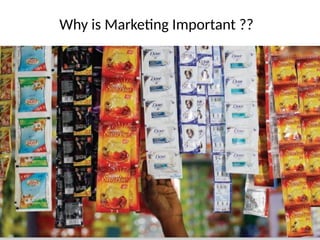
Why is Marketing Important ??
THE SCOPE of MARKETING
What’s Marketing?
• Marketing is about identifying and meeting
human and social needs.
• Marketing management : the art and science of
choosing target markets and getting, keeping,
and growing customers through
creating,delivering,and communicating superior
customer value.
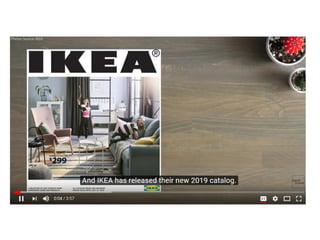
• Example : IKEA & GOOGLE
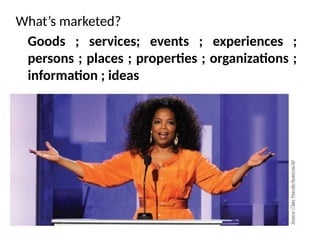
What’s marketed?
Goods ; services; events ; experiences ;
persons ; places ; properties ; organizations ;
information ; ideas
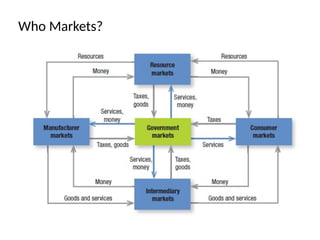
Who Markets?
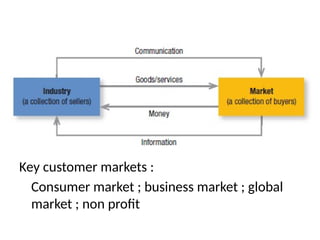
Key customer markets :
Consumer market ; business market ; global
market ; non profit
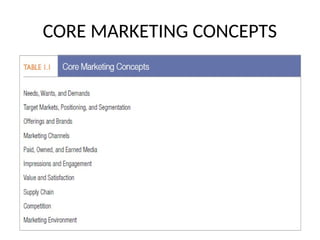
CORE MARKETING CONCEPTS
Needs, wants, & demands
• Needs are the basic human requirements such
as for air, food, water, clothing, and shelter
• needs become wants when directed to specific
objects
• Demands are wants for specific products
backed by an ability to pay.
PLEASE DISCUSS
Target Markets, Positioning, and Segmentation
• Marketers therefore identify distinct segments
• then decide which segment(s) present the greatest
opportunities
• For each of these target markets, the firm develops
a market offer
Which one is the first ??
Impressions & Engagement
• Marketers now think of three “screens” or means
to reach consumers: TV, Internet, and mobile
• Impressions, which occur when consumers view a
communication, are a useful metric for tracking
the scope or breadth of a communication’s reach
that can also be compared across all
communication types
• Engagement is the extent of a customer’s attention
and active involvement with a communication.
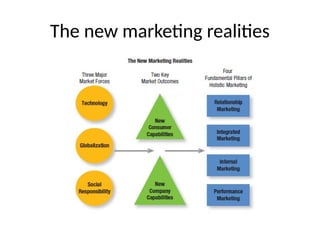
THE NEW MARKETING REALITIES
• Technology
– Boston Consulting Group believes brand marketers must
enhance their “digital balance sheets.”
• Globalization
– New transportation, shipping, and communication technologies
have made it easier for us to know the rest of the world, to
travel, to buy and sell anywhere.
• Social Responsibility
– The organization’s task is thus to determine the needs, wants,
and interests of target markets and satisfy them more effectively
and efficiently than competitors while preserving or enhancing
consumers’ and society’s longterm well-being.
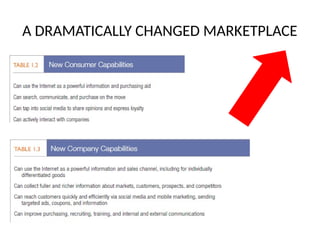
A DRAMATICALLY CHANGED MARKETPLACE
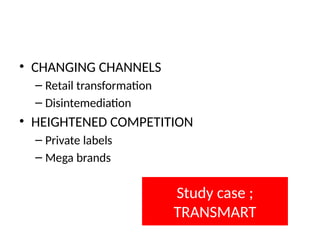
• CHANGING CHANNELS
– Retail transformation
– Disintemediation
• HEIGHTENED COMPETITION
– Private labels
– Mega brands
Study case ;
TRANSMART
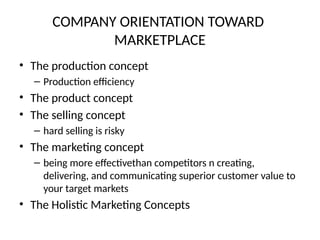
COMPANY ORIENTATION TOWARD
MARKETPLACE
• The production concept
– Production efficiency
• The product concept
• The selling concept
– hard selling is risky
• The marketing concept
– being more effectivethan competitors n creating,
delivering, and communicating superior customer value to
your target markets
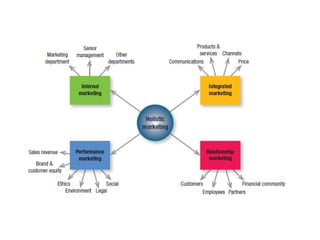
• The Holistic Marketing Concepts
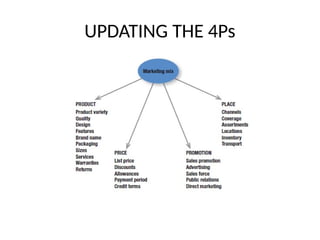
UPDATING THE 4Ps
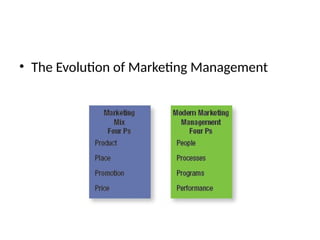
• The Evolution of Marketing Management
The new marketing realities
MARKETING MANAGEMENT TASKS
• Developing Marketing Strategies and Plans
• Capturing Marketing Insights
• Connecting with Customers
• Building Strong Brands
• Creating Value
• Delivering Value
• Communicating Value
• conducting marketing responsibly for long-term
• success

Chapter 1 - Kotler 15th Edition for marketing

  • 1.
    Chapter 1 Defining Marketingfor the New Realities alfina@uisi.ac.id
  • 2.
    Why is MarketingImportant ??
  • 3.
    THE SCOPE ofMARKETING What’s Marketing? • Marketing is about identifying and meeting human and social needs. • Marketing management : the art and science of choosing target markets and getting, keeping, and growing customers through creating,delivering,and communicating superior customer value. • Example : IKEA & GOOGLE
  • 5.
    What’s marketed? Goods ;services; events ; experiences ; persons ; places ; properties ; organizations ; information ; ideas
  • 6.
  • 7.
    Key customer markets: Consumer market ; business market ; global market ; non profit
  • 8.
  • 9.
    Needs, wants, &demands • Needs are the basic human requirements such as for air, food, water, clothing, and shelter • needs become wants when directed to specific objects • Demands are wants for specific products backed by an ability to pay. PLEASE DISCUSS
  • 10.
    Target Markets, Positioning,and Segmentation • Marketers therefore identify distinct segments • then decide which segment(s) present the greatest opportunities • For each of these target markets, the firm develops a market offer Which one is the first ??
  • 11.
    Impressions & Engagement •Marketers now think of three “screens” or means to reach consumers: TV, Internet, and mobile • Impressions, which occur when consumers view a communication, are a useful metric for tracking the scope or breadth of a communication’s reach that can also be compared across all communication types • Engagement is the extent of a customer’s attention and active involvement with a communication.
  • 12.
    THE NEW MARKETINGREALITIES • Technology – Boston Consulting Group believes brand marketers must enhance their “digital balance sheets.” • Globalization – New transportation, shipping, and communication technologies have made it easier for us to know the rest of the world, to travel, to buy and sell anywhere. • Social Responsibility – The organization’s task is thus to determine the needs, wants, and interests of target markets and satisfy them more effectively and efficiently than competitors while preserving or enhancing consumers’ and society’s longterm well-being.
  • 13.
  • 14.
    • CHANGING CHANNELS –Retail transformation – Disintemediation • HEIGHTENED COMPETITION – Private labels – Mega brands Study case ; TRANSMART
  • 15.
    COMPANY ORIENTATION TOWARD MARKETPLACE •The production concept – Production efficiency • The product concept • The selling concept – hard selling is risky • The marketing concept – being more effectivethan competitors n creating, delivering, and communicating superior customer value to your target markets • The Holistic Marketing Concepts
  • 18.
  • 19.
    • The Evolutionof Marketing Management
  • 20.
  • 21.
    MARKETING MANAGEMENT TASKS •Developing Marketing Strategies and Plans • Capturing Marketing Insights • Connecting with Customers • Building Strong Brands • Creating Value • Delivering Value • Communicating Value • conducting marketing responsibly for long-term • success

Editor's Notes

  • #24 40 92 43 68 11 84 23 56 59 17 06 95 102