Enhancing Mobile Populations’ Access to HIV/AIDS Information and Services (EMPHASIS) General Overview Revised May 2010
EMPHASIS  E nhancing   M obile   P opulations ’  Access   to   H IV& A IDS   S ervices ,  I nformation   &   S upport BIG Lottery Fund grant :  £5,102,419 (BD £ 722,833) Duration :  5 years   Regional portfolio :  Bangladesh, Nepal & India Direct Beneficiaries : 141,307 Aim :  To address HIV vulnerability amongst mobile populations in South Asia .
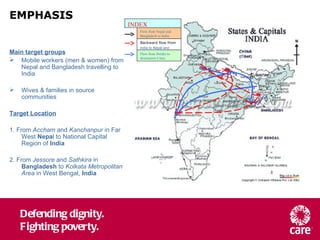
EMPHASIS Main target groups Mobile workers (men & women) from Nepal and Bangladesh travelling to India Wives & families in source communities Target Location 1. From  Accham  and  Kanchanpur  in Far West  Nepa l to National Capital Region of  India 2. From  Jessore  and  Sathkira  in  Bangladesh  to  Kolkata Metropolitan Area  in West Bengal,  India Flow from Nepal and Bangladesh to India INDEX Backward flow from  India to Nepal and   Bangladesh Flow from Border to destination Cities
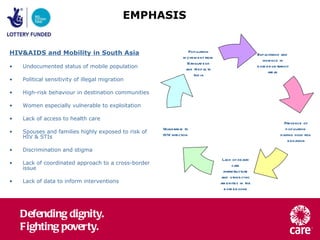
EMPHASIS HIV&AIDS and Mobility in South Asia Undocumented status of mobile population Political sensitivity of illegal migration High-risk behaviour in destination communities Women especially vulnerable to exploitation Lack of access to health care Spouses and families highly exposed to risk of HIV & STIs Discrimination and stigma Lack of coordinated approach to a cross-border issue Lack of data to inform interventions Exploitation and violence in border or transit areas Presence of population having high risk behavior Population movement from Bangladesh and Nepal to India Lack of health care infrastructure and other civic amenities in the border zone Vulnerable to HIV infection
EMPHASIS CARE Piloting a comprehensive cross-border approach Working along the entire mobility continuum:  source (Bangladesh or Nepal) -> transit -> destination (India) -> back to source country Setting up service networks linking into national health systems Increasing access to prevention and treatment services Action research in order to add to the strategic information available on HIV and Mobile populations towards the aim of strengthening the advocacy platform
Objective 1: Demonstrating Good Practices Setting up a model for good practice for accessing and providing services to mobile  populations vulnerable to HIV&AIDS Establishing service centres throughout the mobility route Establishing a service linkage network Increasing access to Voluntary Counselling and Testing, condom provision, advice and information Providing uniform messages to influence behaviour change EMPHASIS
Objective 2: Enhancing capacities Enhancing the capacity of various partners, strengthening mechanisms for consistency and facilitating linkages among service providers and organisations Understanding gender dimensions of HIV and mobility Raising awareness of specific vulnerabilities to HIV arising out of mobility Supporting service providers to reach out to mobile populations sensitively Increase the quality and access of services for mobile populations and their families Key Targets: government agencies, health service providers, CSO service providers, PLWHA networks, research institutes and organisations. EMPHASIS
Objective 3: Research and Advocacy Generating evidence on HIV and mobility to influence national and regional policy-making. Specific research to generate information to strengthen policy advocacy: baseline and end line studies; mapping and analysis of laws, policies and systems which frame the scope for reducing vulnerability of migrants; in-depth study on the vulnerabilities faced by mobile populations and the families; documenting good practice models.  Publication and dissemination of research findings Policy Advocacy: briefing papers, advocacy and campaigning EMPHASIS
Next Steps Year one of the programme has been designated the  Building Knowledge Phase .  Build knowledge, information, and analysis while supporting existing services for the sub-impact groups. Using analysis to clarify assumptions about services for each of the two mobility routes Assess: Inputs -> Outputs -> Outcomes -> Impact   EMPHASIS
Key Task for the Knowledge Building Phase Define Mobile Populations and sub-populations Describe the Impact Population (Primary Beneficiaries) Define the Target Population (Secondary Beneficiaries)
Key Task for the Knowledge Building Phase, cont. Identify for the Impact Population in relation to HIV risk Mapping along the mobility route of: Key service providers Key state and district actors (including security forces) Risk hotspots Resource inventory Resource gaps analysis along the route What services are missing What services are insufficient – access, quality Identify potential community human resources (including potential community leaders, volunteers, educators, mobilisers)
Key Task for the Knowledge Building Phase, cont. Begin to identify potential indicators to measure: Vulnerabilities Determinants of vulnerabilities Risk Effectiveness Capacity Attribution Baseline Survey of mobile workers, communities, service providers (including EMPHASIS stakeholders) and other stake holders on "HIV" and "mobility" Including quality standards for services Situational Analysis by source, transit, and destination communities
Key Task for the Knowledge Building Phase, cont. Analysis of relevant laws and policies from local to regional What laws and policies exists How are they implemented and enforced How supportive are they Government engagement plan from local to regional Within the country Cross-border
Key Task for the Knowledge Building Phase, cont. Analysis of existing or past programmes across the route (in terms of interventions and activities – DICs, Outreach, Peer Education, etc.) Who has done what What has worked What has not worked Attribution of programmes impacting communities Synergies with EMPHASIS – including linkages to existing programmes (e.g., C-NP Safe Passages)
Thank You

Emphasis overview 5 10

  • 1.
    Enhancing Mobile Populations’Access to HIV/AIDS Information and Services (EMPHASIS) General Overview Revised May 2010
  • 2.
    EMPHASIS Enhancing M obile P opulations ’ Access to H IV& A IDS S ervices , I nformation & S upport BIG Lottery Fund grant : £5,102,419 (BD £ 722,833) Duration : 5 years Regional portfolio : Bangladesh, Nepal & India Direct Beneficiaries : 141,307 Aim : To address HIV vulnerability amongst mobile populations in South Asia .
  • 3.
    EMPHASIS Main targetgroups Mobile workers (men & women) from Nepal and Bangladesh travelling to India Wives & families in source communities Target Location 1. From Accham and Kanchanpur in Far West Nepa l to National Capital Region of India 2. From Jessore and Sathkira in Bangladesh to Kolkata Metropolitan Area in West Bengal, India Flow from Nepal and Bangladesh to India INDEX Backward flow from India to Nepal and Bangladesh Flow from Border to destination Cities
  • 4.
    EMPHASIS HIV&AIDS andMobility in South Asia Undocumented status of mobile population Political sensitivity of illegal migration High-risk behaviour in destination communities Women especially vulnerable to exploitation Lack of access to health care Spouses and families highly exposed to risk of HIV & STIs Discrimination and stigma Lack of coordinated approach to a cross-border issue Lack of data to inform interventions Exploitation and violence in border or transit areas Presence of population having high risk behavior Population movement from Bangladesh and Nepal to India Lack of health care infrastructure and other civic amenities in the border zone Vulnerable to HIV infection
  • 5.
    EMPHASIS CARE Pilotinga comprehensive cross-border approach Working along the entire mobility continuum: source (Bangladesh or Nepal) -> transit -> destination (India) -> back to source country Setting up service networks linking into national health systems Increasing access to prevention and treatment services Action research in order to add to the strategic information available on HIV and Mobile populations towards the aim of strengthening the advocacy platform
  • 6.
    Objective 1: DemonstratingGood Practices Setting up a model for good practice for accessing and providing services to mobile populations vulnerable to HIV&AIDS Establishing service centres throughout the mobility route Establishing a service linkage network Increasing access to Voluntary Counselling and Testing, condom provision, advice and information Providing uniform messages to influence behaviour change EMPHASIS
  • 7.
    Objective 2: Enhancingcapacities Enhancing the capacity of various partners, strengthening mechanisms for consistency and facilitating linkages among service providers and organisations Understanding gender dimensions of HIV and mobility Raising awareness of specific vulnerabilities to HIV arising out of mobility Supporting service providers to reach out to mobile populations sensitively Increase the quality and access of services for mobile populations and their families Key Targets: government agencies, health service providers, CSO service providers, PLWHA networks, research institutes and organisations. EMPHASIS
  • 8.
    Objective 3: Researchand Advocacy Generating evidence on HIV and mobility to influence national and regional policy-making. Specific research to generate information to strengthen policy advocacy: baseline and end line studies; mapping and analysis of laws, policies and systems which frame the scope for reducing vulnerability of migrants; in-depth study on the vulnerabilities faced by mobile populations and the families; documenting good practice models. Publication and dissemination of research findings Policy Advocacy: briefing papers, advocacy and campaigning EMPHASIS
  • 9.
    Next Steps Yearone of the programme has been designated the Building Knowledge Phase . Build knowledge, information, and analysis while supporting existing services for the sub-impact groups. Using analysis to clarify assumptions about services for each of the two mobility routes Assess: Inputs -> Outputs -> Outcomes -> Impact EMPHASIS
  • 10.
    Key Task forthe Knowledge Building Phase Define Mobile Populations and sub-populations Describe the Impact Population (Primary Beneficiaries) Define the Target Population (Secondary Beneficiaries)
  • 11.
    Key Task forthe Knowledge Building Phase, cont. Identify for the Impact Population in relation to HIV risk Mapping along the mobility route of: Key service providers Key state and district actors (including security forces) Risk hotspots Resource inventory Resource gaps analysis along the route What services are missing What services are insufficient – access, quality Identify potential community human resources (including potential community leaders, volunteers, educators, mobilisers)
  • 12.
    Key Task forthe Knowledge Building Phase, cont. Begin to identify potential indicators to measure: Vulnerabilities Determinants of vulnerabilities Risk Effectiveness Capacity Attribution Baseline Survey of mobile workers, communities, service providers (including EMPHASIS stakeholders) and other stake holders on "HIV" and "mobility" Including quality standards for services Situational Analysis by source, transit, and destination communities
  • 13.
    Key Task forthe Knowledge Building Phase, cont. Analysis of relevant laws and policies from local to regional What laws and policies exists How are they implemented and enforced How supportive are they Government engagement plan from local to regional Within the country Cross-border
  • 14.
    Key Task forthe Knowledge Building Phase, cont. Analysis of existing or past programmes across the route (in terms of interventions and activities – DICs, Outreach, Peer Education, etc.) Who has done what What has worked What has not worked Attribution of programmes impacting communities Synergies with EMPHASIS – including linkages to existing programmes (e.g., C-NP Safe Passages)
  • 15.

Editor's Notes

  • #3 2,194,066 848,898 1,336,622 722,833 5,102,419 Sec NP IN BD
  • #12 Knowledge – including HIV status, relevant laws and policies Behaviours – including drug use, sexual risk taking (including number of sexual partners, condom use), Practices – including determinants of mobility (why do people move), mobility experience (what happens to you when travelling), HIV testing Attitudes – including issues of self-esteem, auto-stigma
  • #13 Epidemiology Attitudes – including Mobility and/or HIV stigma and discrimination, disaggregated by sex Practices – including influences on enabling risk taking or hindering risk reduction Policies – including government, workplace Mobility Prevalence Impact of Migration Impact of HIV and AIDS