New Developments to Capture
the Manufacturing Process of
Composite Structures in LS-DYNA
Gregor Knust, Thomas Klöppel, Andre Haufe
DYNAmore GmbH
LS-DYNA Developer Forum
Filderstadt, 24.09.2013
12th LS-DYNA Forum 24 - 25 September 2013, Filderstadt, Germany
Composites
• A composite is a combination of two or more materials, differing
in form or composition on a macroscale. The constituents do not
dissolve or merge completely into one another, but can be
physically identified and exhibit an interface.
• Historical facts
– straw was used by Israelites to strengthen mud bricks
– plywood was used by the ancient Egyptians
• Today, carbon/glass fibers reinforced polymers gain in
importance as lightweight structures for automotive and
aerospace industries
– Increasingly demanding regulations for carbon dioxide emission
– These materials allow for the manufacturing of geometrically and
functionally more complex parts than most standard materials
12th LS-DYNA Forum 24 - 25 September 2013, Filderstadt, Germany
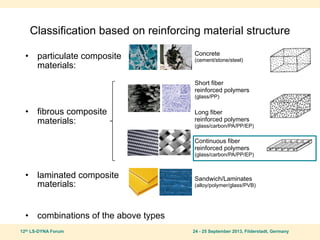
Classification based on reinforcing material structure
• particulate composite
materials:
• fibrous composite
materials:
• laminated composite
materials:
• combinations of the above types
Concrete
(cement/stone/steel)
Short fiber
reinforced polymers
(glass/PP)
Long fiber
reinforced polymers
(glass/carbon/PA/PP/EP)
Sandwich/Laminates
(alloy/polymer/glass/PVB)
Continuous fiber
reinforced polymers
(glass/carbon/PA/PP/EP)
12th LS-DYNA Forum 24 - 25 September 2013, Filderstadt, Germany
Properties of continuous fiber reinforces plastics
(FRP)
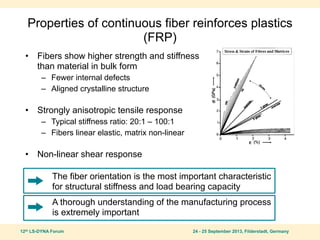
• Fibers show higher strength and stiffness
than material in bulk form
– Fewer internal defects
– Aligned crystalline structure
• Strongly anisotropic tensile response
– Typical stiffness ratio: 20:1 – 100:1
– Fibers linear elastic, matrix non-linear
• Non-linear shear response
The fiber orientation is the most important characteristic
for structural stiffness and load bearing capacity
A thorough understanding of the manufacturing process
is extremely important
12th LS-DYNA Forum 24 - 25 September 2013, Filderstadt, Germany
Agenda
• Process simulation for thermoplastic pre-pregs
– Introduction
– Material formulation
– Examples
• Process simulation thermoset matrix materials
– RTM process
– Wet molding
• Summary
12th LS-DYNA Forum 24 - 25 September 2013, Filderstadt, Germany
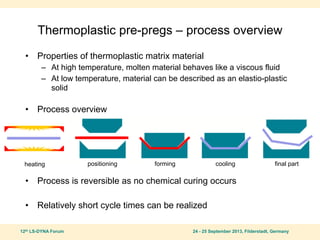
Thermoplastic pre-pregs – process overview
• Properties of thermoplastic matrix material
– At high temperature, molten material behaves like a viscous fluid
– At low temperature, material can be described as an elastio-plastic
solid
• Process overview
• Process is reversible as no chemical curing occurs
• Relatively short cycle times can be realized
heating positioning forming cooling final part
12th LS-DYNA Forum 24 - 25 September 2013, Filderstadt, Germany
Thermoplastic pre-pregs – modeling aspects
• Thermo-mechanical coupling crucial for predictive simulation
study
– Well-established feature of LS-DYNA
• Matrix
– Temperature-dependent elastic properties
– Decreasing yield stress value for increasing temperature
– Non-linear relation between yield stress and equivalent plastic strain
• Reinforcement
– Strong anisotropy
– Almost linear stress response of the fibers to elongation
– Non-linear behavior for shear deformation
12th LS-DYNA Forum 24 - 25 September 2013, Filderstadt, Germany
Thermoplastic pre-pregs – modeling aspects
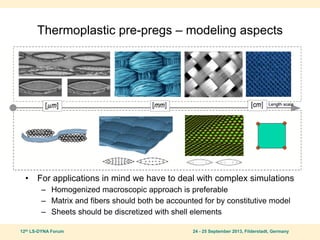
• For applications in mind we have to deal with complex simulations
– Homogenized macroscopic approach is preferable
– Matrix and fibers should both be accounted for by constitutive model
– Sheets should be discretized with shell elements
12th LS-DYNA Forum 24 - 25 September 2013, Filderstadt, Germany
Thermoplastic pre-pregs – material formulation
• Additive split for matrix and fiber contributions
• Matrix formulation
– Elastic properties are defined with
load curves w.r.t. to temperature
– Van-Mises yield criterion is implemented
– Yield stress is given by load tables w.r.t.
• Temperature
• Equivalent plastic strain
– Return-mapping algorithm
[source: Neto et al, 2008]
[source: www.wikipedia.de]
12th LS-DYNA Forum 24 - 25 September 2013, Filderstadt, Germany
Thermoplastic pre-pregs – fiber contribution
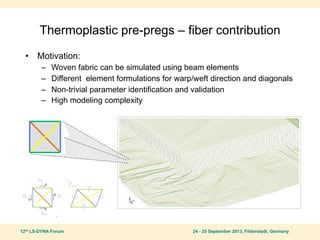
• Motivation:
– Woven fabric can be simulated using beam elements
– Different element formulations for warp/weft direction and diagonals
– Non-trivial parameter identification and validation
– High modeling complexity
12th LS-DYNA Forum 24 - 25 September 2013, Filderstadt, Germany
Thermoplastic pre-pregs – fiber contribution
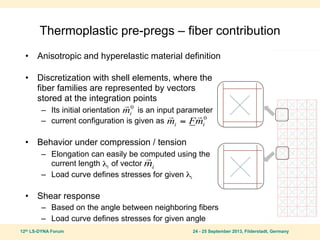
• Anisotropic and hyperelastic material definition
• Discretization with shell elements, where the
fiber families are represented by vectors
stored at the integration points
– Its initial orientation is an input parameter
– current configuration is given as
• Behavior under compression / tension
– Elongation can easily be computed using the
current length of vector
– Load curve defines stresses for given
• Shear response
– Based on the angle between neighboring fibers
– Load curve defines stresses for given angle
12th LS-DYNA Forum 24 - 25 September 2013, Filderstadt, Germany
Thermoplastic pre-pregs – fiber contribution
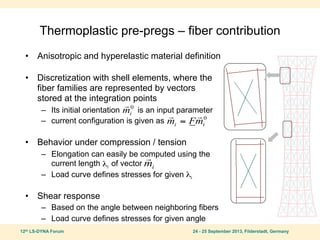
• Anisotropic and hyperelastic material definition
• Discretization with shell elements, where the
fiber families are represented by vectors
stored at the integration points
– Its initial orientation is an input parameter
– current configuration is given as
• Behavior under compression / tension
– Elongation can easily be computed using the
current length of vector
– Load curve defines stresses for given
• Shear response
– Based on the angle between neighboring fibers
– Load curve defines stresses for given angle
12th LS-DYNA Forum 24 - 25 September 2013, Filderstadt, Germany
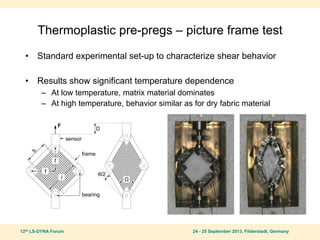
Thermoplastic pre-pregs – picture frame test
• Standard experimental set-up to characterize shear behavior
• Results show significant temperature dependence
– At low temperature, matrix material dominates
– At high temperature, behavior similar as for dry fabric material
sensor
frame
bearing
12th LS-DYNA Forum 24 - 25 September 2013, Filderstadt, Germany
Thermoplastic pre-pregs – picture frame test
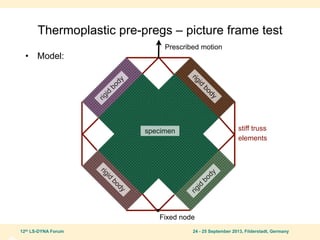
• Model:
stiff truss
elements
r
i
g
i
d
b
o
d
y
r
i
g
i
d
b
o
d
y
r
i
g
i
d
b
o
d
y
r
i
g
i
d
b
o
d
y
specimen
Prescribed motion
Fixed node
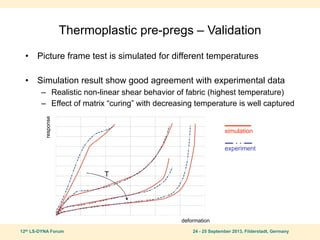
• Picture frame test is simulated for different temperatures
• Simulation result show good agreement with experimental data
– Realistic non-linear shear behavior of fabric (highest temperature)
– Effect of matrix “curing” with decreasing temperature is well captured
12th LS-DYNA Forum 24 - 25 September 2013, Filderstadt, Germany
Thermoplastic pre-pregs – Validation
deformation
response
T
simulation
experiment
12th LS-DYNA Forum 24 - 25 September 2013, Filderstadt, Germany
Thermoplastic pre-pregs – Stamping
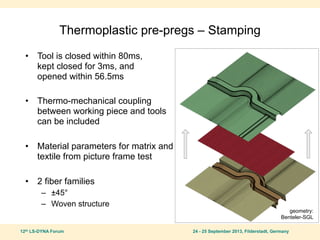
• Tool is closed within 80ms,
kept closed for 3ms, and
opened within 56.5ms
• Thermo-mechanical coupling
between working piece and tools
can be included
• Material parameters for matrix and
textile from picture frame test
• 2 fiber families
– ±45°
– Woven structure
geometry:
Benteler-SGL
12th LS-DYNA Forum 24 - 25 September 2013, Filderstadt, Germany
Thermoplastic pre-pregs – Stamping
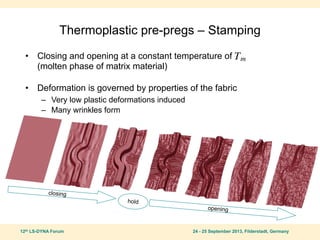
• Closing and opening at a constant temperature of
(molten phase of matrix material)
• Deformation is governed by properties of the fabric
– Very low plastic deformations induced
– Many wrinkles form
closing
opening
hold
Tm
12th LS-DYNA Forum 24 - 25 September 2013, Filderstadt, Germany
Thermoplastic pre-pregs – Stamping
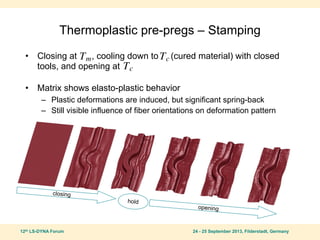
• Closing at , cooling down to (cured material) with closed
tools, and opening at
• Matrix shows elasto-plastic behavior
– Plastic deformations are induced, but significant spring-back
– Still visible influence of fiber orientations on deformation pattern
closing
opening
hold
Tm Tc
Tc
12th LS-DYNA Forum 24 - 25 September 2013, Filderstadt, Germany
Thermoplastic pre-pregs – Stamping
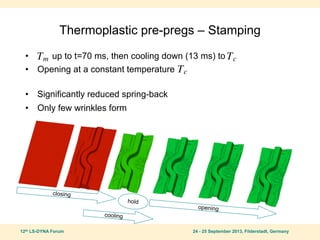
• up to t=70 ms, then cooling down (13 ms) to
• Opening at a constant temperature
• Significantly reduced spring-back
• Only few wrinkles form
closing
opening
hold
cooling
Tm Tc
Tc
12th LS-DYNA Forum 24 - 25 September 2013, Filderstadt, Germany
Thermoplastic pre-pregs – Stamping
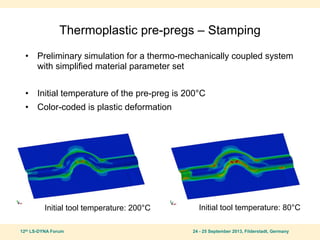
Initial tool temperature: 80°C
Initial tool temperature: 200°C
• Preliminary simulation for a thermo-mechanically coupled system
with simplified material parameter set
• Initial temperature of the pre-preg is 200°C
• Color-coded is plastic deformation
12th LS-DYNA Forum 24 - 25 September 2013, Filderstadt, Germany
Thermoplastic pre-pregs – Work in Progress
• Presented results generated with user defined material in LS-DYNA
• Implementation as standard material *MAT_249 with
– Extension for rovings and strain-rate dependency for matrix formulation
– Elasto-plastic formulation for shear and bending of the fibers
• Improved post-processing capabilities in LS-PrePost
• Tools to map results onto the mesh for crashworthiness simulations
[source: Döbrich et al, 2012]
12th LS-DYNA Forum 24 - 25 September 2013, Filderstadt, Germany
Agenda
• Process simulation for thermoplastic pre-pregs
– Introduction
– Material formulation
– Examples
• Process simulation thermoset matrix materials
– RTM process
– Wet molding
• Summary
12th LS-DYNA Forum 24 - 25 September 2013, Filderstadt, Germany
Resin Transfer Molding (RTM) –
process overview
• In general, thermosets (e.g. epoxy) have superior mechanical
properties as compared to thermoplastics
• All manufacturing processes involve a chemical curing of a liquid
resin
– Curing is induced by high temperatures and chemical additives
– Chemical reactions of curing are nonreversible
• Process overview
preparation of textile draping infiltration curing final part
[source: Benteler-SGL]
12th LS-DYNA Forum 24 - 25 September 2013, Filderstadt, Germany
Resin Transfer Molding (RTM) –
Modeling aspects
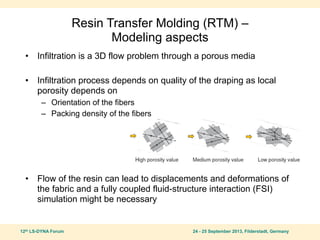
• Infiltration is a 3D flow problem through a porous media
• Infiltration process depends on quality of the draping as local
porosity depends on
– Orientation of the fibers
– Packing density of the fibers
• Flow of the resin can lead to displacements and deformations of
the fabric and a fully coupled fluid-structure interaction (FSI)
simulation might be necessary
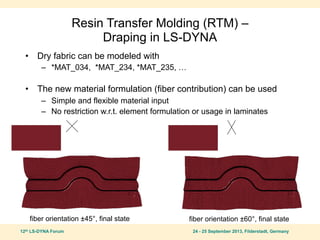
• Dry fabric can be modeled with
– *MAT_034, *MAT_234, *MAT_235, …
• The new material formulation (fiber contribution) can be used
– Simple and flexible material input
– No restriction w.r.t. element formulation or usage in laminates
12th LS-DYNA Forum 24 - 25 September 2013, Filderstadt, Germany
Resin Transfer Molding (RTM) –
Draping in LS-DYNA
fiber orientation ±45°, final state fiber orientation ±60°, final state
12th LS-DYNA Forum 24 - 25 September 2013, Filderstadt, Germany
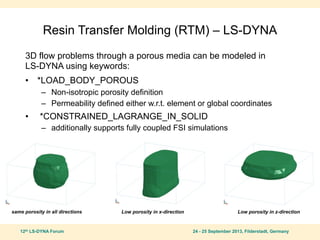
Resin Transfer Molding (RTM) – LS-DYNA
• *LOAD_BODY_POROUS
– Non-isotropic porosity definition
– Permeability defined either w.r.t. element or global coordinates
• *CONSTRAINED_LAGRANGE_IN_SOLID
– additionally supports fully coupled FSI simulations
Low porosity in z-direction
Low porosity in x-direction
same porosity in all directions
3D flow problems through a porous media can be modeled in
LS-DYNA using keywords:
12th LS-DYNA Forum 24 - 25 September 2013, Filderstadt, Germany
Resin Transfer Molding (RTM) – Simulations
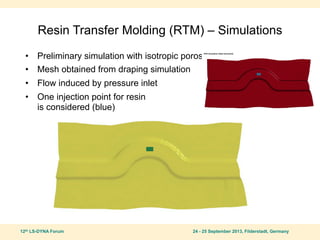
• Preliminary simulation with isotropic porosity
• Mesh obtained from draping simulation
• Flow induced by pressure inlet
• One injection point for resin
is considered (blue)
12th LS-DYNA Forum 24 - 25 September 2013, Filderstadt, Germany
Resin Transfer Molding (RTM) – Simulations
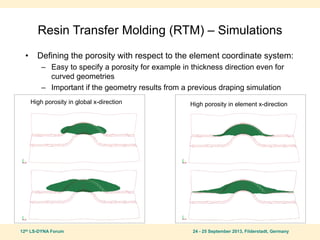
• Defining the porosity with respect to the element coordinate system:
– Easy to specify a porosity for example in thickness direction even for
curved geometries
– Important if the geometry results from a previous draping simulation
High porosity in global x-direction High porosity in element x-direction
12th LS-DYNA Forum 24 - 25 September 2013, Filderstadt, Germany
Resin Transfer Molding (RTM) –
Work in Progress
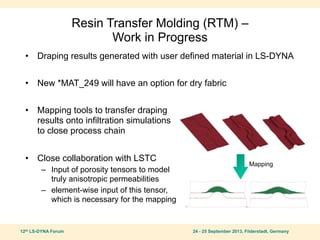
• Draping results generated with user defined material in LS-DYNA
• New *MAT_249 will have an option for dry fabric
• Mapping tools to transfer draping
results onto infiltration simulations
to close process chain
• Close collaboration with LSTC
– Input of porosity tensors to model
truly anisotropic permeabilities
– element-wise input of this tensor,
which is necessary for the mapping
Mapping
12th LS-DYNA Forum 24 - 25 September 2013, Filderstadt, Germany
Wet molding – process overview
• Draping and injection are done in one single step
• Process overview
• Basically, a simulation requires the same numerical tools as RTM
• Simulation more complex
– Fluid-structure interaction plays an important role
– Fluid domain, viscosity, and porosity change during the simulation
preparation of textile impregnating forming curing final part
[source: Benteler-SGL]
12th LS-DYNA Forum 24 - 25 September 2013, Filderstadt, Germany
Wet molding – preliminary simulations
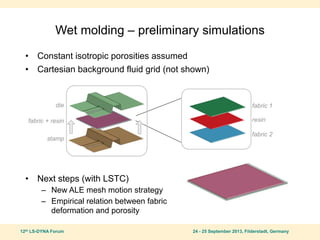
• Constant isotropic porosities assumed
• Cartesian background fluid grid (not shown)
• Next steps (with LSTC)
– New ALE mesh motion strategy
– Empirical relation between fabric
deformation and porosity
die
stamp
fabric + resin
fabric 1
fabric 2
resin
12th LS-DYNA Forum 24 - 25 September 2013, Filderstadt, Germany
Agenda
• Process simulation for thermoplastic pre-pregs
– Introduction
– Material formulation
– Examples
• Process simulation thermoset matrix materials
– RTM process
– Wet molding
• Summary
12th LS-DYNA Forum 24 - 25 September 2013, Filderstadt, Germany
Summary
• Simulation of complete process chain for thermoplastic
pre-pregs:
• Thermo-mechanical coupling possible in LS-DYNA
• Novel, flexible, homogenized material formulation
– Thermo-elasto-plastic constitutive model for the matrix material
– Anistotropic hyperelastic description for the reinforcing fibers
– Simple and flexible input
– No restrictions w.r.t. to element formulation
• Simulations show excellent agreement with picture frame tests
results
• Preliminary stamping simulations very promising
12th LS-DYNA Forum 24 - 25 September 2013, Filderstadt, Germany
Summary
• Thermoset matrix material:
• Properties of dry fabric can be modeled with new material
formulation
• Infiltration as 3D-flow through porous media using the CLIS-
keyword
• Work in progress:
– Mapping from draping results to locally varying porosities for RTM
– Coupling of fiber deformations to permeabilities for wet molding
12th LS-DYNA Forum 24 - 25 September 2013, Filderstadt, Germany
Thank you very much for your attention!
thomas.kloeppel@dynamore.de

Kloeppel_DYNAmore.pdf

  • 1.
    New Developments toCapture the Manufacturing Process of Composite Structures in LS-DYNA Gregor Knust, Thomas Klöppel, Andre Haufe DYNAmore GmbH LS-DYNA Developer Forum Filderstadt, 24.09.2013
  • 2.
    12th LS-DYNA Forum24 - 25 September 2013, Filderstadt, Germany Composites • A composite is a combination of two or more materials, differing in form or composition on a macroscale. The constituents do not dissolve or merge completely into one another, but can be physically identified and exhibit an interface. • Historical facts – straw was used by Israelites to strengthen mud bricks – plywood was used by the ancient Egyptians • Today, carbon/glass fibers reinforced polymers gain in importance as lightweight structures for automotive and aerospace industries – Increasingly demanding regulations for carbon dioxide emission – These materials allow for the manufacturing of geometrically and functionally more complex parts than most standard materials
  • 3.
    12th LS-DYNA Forum24 - 25 September 2013, Filderstadt, Germany Classification based on reinforcing material structure • particulate composite materials: • fibrous composite materials: • laminated composite materials: • combinations of the above types Concrete (cement/stone/steel) Short fiber reinforced polymers (glass/PP) Long fiber reinforced polymers (glass/carbon/PA/PP/EP) Sandwich/Laminates (alloy/polymer/glass/PVB) Continuous fiber reinforced polymers (glass/carbon/PA/PP/EP)
  • 4.
    12th LS-DYNA Forum24 - 25 September 2013, Filderstadt, Germany Properties of continuous fiber reinforces plastics (FRP) • Fibers show higher strength and stiffness than material in bulk form – Fewer internal defects – Aligned crystalline structure • Strongly anisotropic tensile response – Typical stiffness ratio: 20:1 – 100:1 – Fibers linear elastic, matrix non-linear • Non-linear shear response The fiber orientation is the most important characteristic for structural stiffness and load bearing capacity A thorough understanding of the manufacturing process is extremely important
  • 5.
    12th LS-DYNA Forum24 - 25 September 2013, Filderstadt, Germany Agenda • Process simulation for thermoplastic pre-pregs – Introduction – Material formulation – Examples • Process simulation thermoset matrix materials – RTM process – Wet molding • Summary
  • 6.
    12th LS-DYNA Forum24 - 25 September 2013, Filderstadt, Germany Thermoplastic pre-pregs – process overview • Properties of thermoplastic matrix material – At high temperature, molten material behaves like a viscous fluid – At low temperature, material can be described as an elastio-plastic solid • Process overview • Process is reversible as no chemical curing occurs • Relatively short cycle times can be realized heating positioning forming cooling final part
  • 7.
    12th LS-DYNA Forum24 - 25 September 2013, Filderstadt, Germany Thermoplastic pre-pregs – modeling aspects • Thermo-mechanical coupling crucial for predictive simulation study – Well-established feature of LS-DYNA • Matrix – Temperature-dependent elastic properties – Decreasing yield stress value for increasing temperature – Non-linear relation between yield stress and equivalent plastic strain • Reinforcement – Strong anisotropy – Almost linear stress response of the fibers to elongation – Non-linear behavior for shear deformation
  • 8.
    12th LS-DYNA Forum24 - 25 September 2013, Filderstadt, Germany Thermoplastic pre-pregs – modeling aspects • For applications in mind we have to deal with complex simulations – Homogenized macroscopic approach is preferable – Matrix and fibers should both be accounted for by constitutive model – Sheets should be discretized with shell elements
  • 9.
    12th LS-DYNA Forum24 - 25 September 2013, Filderstadt, Germany Thermoplastic pre-pregs – material formulation • Additive split for matrix and fiber contributions • Matrix formulation – Elastic properties are defined with load curves w.r.t. to temperature – Van-Mises yield criterion is implemented – Yield stress is given by load tables w.r.t. • Temperature • Equivalent plastic strain – Return-mapping algorithm [source: Neto et al, 2008] [source: www.wikipedia.de]
  • 10.
    12th LS-DYNA Forum24 - 25 September 2013, Filderstadt, Germany Thermoplastic pre-pregs – fiber contribution • Motivation: – Woven fabric can be simulated using beam elements – Different element formulations for warp/weft direction and diagonals – Non-trivial parameter identification and validation – High modeling complexity
  • 11.
    12th LS-DYNA Forum24 - 25 September 2013, Filderstadt, Germany Thermoplastic pre-pregs – fiber contribution • Anisotropic and hyperelastic material definition • Discretization with shell elements, where the fiber families are represented by vectors stored at the integration points – Its initial orientation is an input parameter – current configuration is given as • Behavior under compression / tension – Elongation can easily be computed using the current length of vector – Load curve defines stresses for given • Shear response – Based on the angle between neighboring fibers – Load curve defines stresses for given angle
  • 12.
    12th LS-DYNA Forum24 - 25 September 2013, Filderstadt, Germany Thermoplastic pre-pregs – fiber contribution • Anisotropic and hyperelastic material definition • Discretization with shell elements, where the fiber families are represented by vectors stored at the integration points – Its initial orientation is an input parameter – current configuration is given as • Behavior under compression / tension – Elongation can easily be computed using the current length of vector – Load curve defines stresses for given • Shear response – Based on the angle between neighboring fibers – Load curve defines stresses for given angle
  • 13.
    12th LS-DYNA Forum24 - 25 September 2013, Filderstadt, Germany Thermoplastic pre-pregs – picture frame test • Standard experimental set-up to characterize shear behavior • Results show significant temperature dependence – At low temperature, matrix material dominates – At high temperature, behavior similar as for dry fabric material sensor frame bearing
  • 14.
    12th LS-DYNA Forum24 - 25 September 2013, Filderstadt, Germany Thermoplastic pre-pregs – picture frame test • Model: stiff truss elements r i g i d b o d y r i g i d b o d y r i g i d b o d y r i g i d b o d y specimen Prescribed motion Fixed node
  • 15.
    • Picture frametest is simulated for different temperatures • Simulation result show good agreement with experimental data – Realistic non-linear shear behavior of fabric (highest temperature) – Effect of matrix “curing” with decreasing temperature is well captured 12th LS-DYNA Forum 24 - 25 September 2013, Filderstadt, Germany Thermoplastic pre-pregs – Validation deformation response T simulation experiment
  • 16.
    12th LS-DYNA Forum24 - 25 September 2013, Filderstadt, Germany Thermoplastic pre-pregs – Stamping • Tool is closed within 80ms, kept closed for 3ms, and opened within 56.5ms • Thermo-mechanical coupling between working piece and tools can be included • Material parameters for matrix and textile from picture frame test • 2 fiber families – ±45° – Woven structure geometry: Benteler-SGL
  • 17.
    12th LS-DYNA Forum24 - 25 September 2013, Filderstadt, Germany Thermoplastic pre-pregs – Stamping • Closing and opening at a constant temperature of (molten phase of matrix material) • Deformation is governed by properties of the fabric – Very low plastic deformations induced – Many wrinkles form closing opening hold Tm
  • 18.
    12th LS-DYNA Forum24 - 25 September 2013, Filderstadt, Germany Thermoplastic pre-pregs – Stamping • Closing at , cooling down to (cured material) with closed tools, and opening at • Matrix shows elasto-plastic behavior – Plastic deformations are induced, but significant spring-back – Still visible influence of fiber orientations on deformation pattern closing opening hold Tm Tc Tc
  • 19.
    12th LS-DYNA Forum24 - 25 September 2013, Filderstadt, Germany Thermoplastic pre-pregs – Stamping • up to t=70 ms, then cooling down (13 ms) to • Opening at a constant temperature • Significantly reduced spring-back • Only few wrinkles form closing opening hold cooling Tm Tc Tc
  • 20.
    12th LS-DYNA Forum24 - 25 September 2013, Filderstadt, Germany Thermoplastic pre-pregs – Stamping Initial tool temperature: 80°C Initial tool temperature: 200°C • Preliminary simulation for a thermo-mechanically coupled system with simplified material parameter set • Initial temperature of the pre-preg is 200°C • Color-coded is plastic deformation
  • 21.
    12th LS-DYNA Forum24 - 25 September 2013, Filderstadt, Germany Thermoplastic pre-pregs – Work in Progress • Presented results generated with user defined material in LS-DYNA • Implementation as standard material *MAT_249 with – Extension for rovings and strain-rate dependency for matrix formulation – Elasto-plastic formulation for shear and bending of the fibers • Improved post-processing capabilities in LS-PrePost • Tools to map results onto the mesh for crashworthiness simulations [source: Döbrich et al, 2012]
  • 22.
    12th LS-DYNA Forum24 - 25 September 2013, Filderstadt, Germany Agenda • Process simulation for thermoplastic pre-pregs – Introduction – Material formulation – Examples • Process simulation thermoset matrix materials – RTM process – Wet molding • Summary
  • 23.
    12th LS-DYNA Forum24 - 25 September 2013, Filderstadt, Germany Resin Transfer Molding (RTM) – process overview • In general, thermosets (e.g. epoxy) have superior mechanical properties as compared to thermoplastics • All manufacturing processes involve a chemical curing of a liquid resin – Curing is induced by high temperatures and chemical additives – Chemical reactions of curing are nonreversible • Process overview preparation of textile draping infiltration curing final part [source: Benteler-SGL]
  • 24.
    12th LS-DYNA Forum24 - 25 September 2013, Filderstadt, Germany Resin Transfer Molding (RTM) – Modeling aspects • Infiltration is a 3D flow problem through a porous media • Infiltration process depends on quality of the draping as local porosity depends on – Orientation of the fibers – Packing density of the fibers • Flow of the resin can lead to displacements and deformations of the fabric and a fully coupled fluid-structure interaction (FSI) simulation might be necessary
  • 25.
    • Dry fabriccan be modeled with – *MAT_034, *MAT_234, *MAT_235, … • The new material formulation (fiber contribution) can be used – Simple and flexible material input – No restriction w.r.t. element formulation or usage in laminates 12th LS-DYNA Forum 24 - 25 September 2013, Filderstadt, Germany Resin Transfer Molding (RTM) – Draping in LS-DYNA fiber orientation ±45°, final state fiber orientation ±60°, final state
  • 26.
    12th LS-DYNA Forum24 - 25 September 2013, Filderstadt, Germany Resin Transfer Molding (RTM) – LS-DYNA • *LOAD_BODY_POROUS – Non-isotropic porosity definition – Permeability defined either w.r.t. element or global coordinates • *CONSTRAINED_LAGRANGE_IN_SOLID – additionally supports fully coupled FSI simulations Low porosity in z-direction Low porosity in x-direction same porosity in all directions 3D flow problems through a porous media can be modeled in LS-DYNA using keywords:
  • 27.
    12th LS-DYNA Forum24 - 25 September 2013, Filderstadt, Germany Resin Transfer Molding (RTM) – Simulations • Preliminary simulation with isotropic porosity • Mesh obtained from draping simulation • Flow induced by pressure inlet • One injection point for resin is considered (blue)
  • 28.
    12th LS-DYNA Forum24 - 25 September 2013, Filderstadt, Germany Resin Transfer Molding (RTM) – Simulations • Defining the porosity with respect to the element coordinate system: – Easy to specify a porosity for example in thickness direction even for curved geometries – Important if the geometry results from a previous draping simulation High porosity in global x-direction High porosity in element x-direction
  • 29.
    12th LS-DYNA Forum24 - 25 September 2013, Filderstadt, Germany Resin Transfer Molding (RTM) – Work in Progress • Draping results generated with user defined material in LS-DYNA • New *MAT_249 will have an option for dry fabric • Mapping tools to transfer draping results onto infiltration simulations to close process chain • Close collaboration with LSTC – Input of porosity tensors to model truly anisotropic permeabilities – element-wise input of this tensor, which is necessary for the mapping Mapping
  • 30.
    12th LS-DYNA Forum24 - 25 September 2013, Filderstadt, Germany Wet molding – process overview • Draping and injection are done in one single step • Process overview • Basically, a simulation requires the same numerical tools as RTM • Simulation more complex – Fluid-structure interaction plays an important role – Fluid domain, viscosity, and porosity change during the simulation preparation of textile impregnating forming curing final part [source: Benteler-SGL]
  • 31.
    12th LS-DYNA Forum24 - 25 September 2013, Filderstadt, Germany Wet molding – preliminary simulations • Constant isotropic porosities assumed • Cartesian background fluid grid (not shown) • Next steps (with LSTC) – New ALE mesh motion strategy – Empirical relation between fabric deformation and porosity die stamp fabric + resin fabric 1 fabric 2 resin
  • 32.
    12th LS-DYNA Forum24 - 25 September 2013, Filderstadt, Germany Agenda • Process simulation for thermoplastic pre-pregs – Introduction – Material formulation – Examples • Process simulation thermoset matrix materials – RTM process – Wet molding • Summary
  • 33.
    12th LS-DYNA Forum24 - 25 September 2013, Filderstadt, Germany Summary • Simulation of complete process chain for thermoplastic pre-pregs: • Thermo-mechanical coupling possible in LS-DYNA • Novel, flexible, homogenized material formulation – Thermo-elasto-plastic constitutive model for the matrix material – Anistotropic hyperelastic description for the reinforcing fibers – Simple and flexible input – No restrictions w.r.t. to element formulation • Simulations show excellent agreement with picture frame tests results • Preliminary stamping simulations very promising
  • 34.
    12th LS-DYNA Forum24 - 25 September 2013, Filderstadt, Germany Summary • Thermoset matrix material: • Properties of dry fabric can be modeled with new material formulation • Infiltration as 3D-flow through porous media using the CLIS- keyword • Work in progress: – Mapping from draping results to locally varying porosities for RTM – Coupling of fiber deformations to permeabilities for wet molding
  • 35.
    12th LS-DYNA Forum24 - 25 September 2013, Filderstadt, Germany Thank you very much for your attention! thomas.kloeppel@dynamore.de