2018 SPE ACCE
Advances in Thermosets
Continuous Fiber Pre-Pregs Optimized
for High Volume Manufacturing
September 5 - 7, 2018
Novi, Michigan
creative | collaborative | committed
makers of
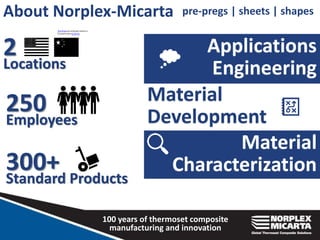
2
Locations
This Photo by Unknown Author is
licensed under CC BY-SA
About Norplex-Micarta pre-pregs | sheets | shapes
250
Employees
300+
Standard Products
100 years of thermoset composite
manufacturing and innovation
Material
Development
Applications
Engineering
Material
Characterization
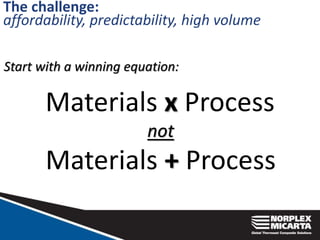
Materials x Process
Materials + Process
not
Start with a winning equation:
The challenge:
affordability, predictability, high volume
The challenge:
affordability, predictability, high volume
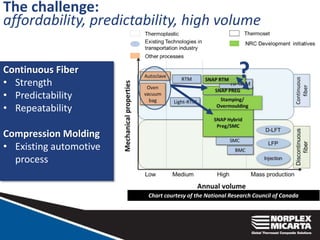
Chart courtesy of the National Research Council of Canada
Continuous Fiber
• Strength
• Predictability
• Repeatability
Compression Molding
• Existing automotive
process
?
The approach:
material optimization for an existing process
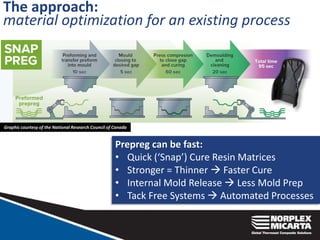
Graphic courtesy of the National Research Council of Canada
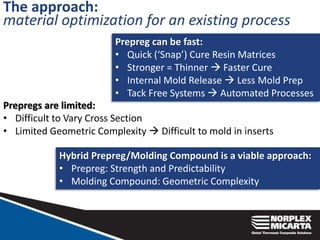
Prepreg can be fast:
• Quick (‘Snap’) Cure Resin Matrices
• Stronger = Thinner  Faster Cure
• Internal Mold Release  Less Mold Prep
• Tack Free Systems  Automated Processes
The approach:
material optimization for an existing process
Prepreg can be fast:
• Quick (‘Snap’) Cure Resin Matrices
• Stronger = Thinner  Faster Cure
• Internal Mold Release  Less Mold Prep
• Tack Free Systems  Automated Processes
Prepregs are limited:
• Difficult to Vary Cross Section
• Limited Geometric Complexity  Difficult to mold in inserts
Hybrid Prepreg/Molding Compound is a viable approach:
• Prepreg: Strength and Predictability
• Molding Compound: Geometric Complexity
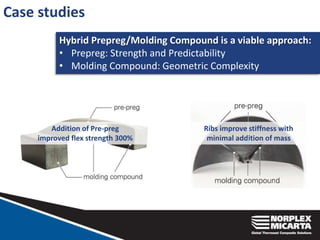
Case studies
Hybrid Prepreg/Molding Compound is a viable approach:
• Prepreg: Strength and Predictability
• Molding Compound: Geometric Complexity
Addition of Pre-preg
improved flex strength 300%
Ribs improve stiffness with
minimal addition of mass
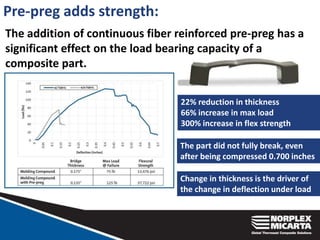
Pre-preg adds strength:
The addition of continuous fiber reinforced pre-preg has a
significant effect on the load bearing capacity of a
composite part.
22% reduction in thickness
66% increase in max load
300% increase in flex strength
Change in thickness is the driver of
the change in deflection under load
The part did not fully break, even
after being compressed 0.700 inches
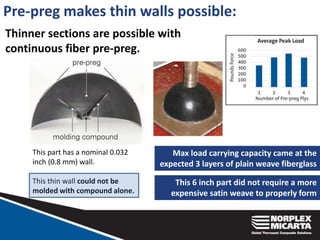
This part has a nominal 0.032
inch (0.8 mm) wall.
This thin wall could not be
molded with compound alone.
Pre-preg makes thin walls possible:
Thinner sections are possible with
continuous fiber pre-preg.
Max load carrying capacity came at the
expected 3 layers of plain weave fiberglass
This 6 inch part did not require a more
expensive satin weave to properly form
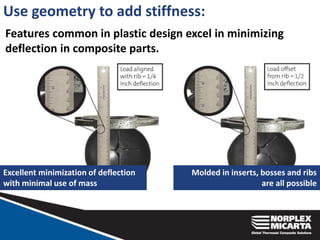
Use geometry to add stiffness:
Features common in plastic design excel in minimizing
deflection in composite parts.
Excellent minimization of deflection
with minimal use of mass
Molded in inserts, bosses and ribs
are all possible
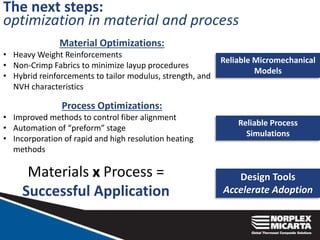
The next steps:
optimization in material and process
Material Optimizations:
• Heavy Weight Reinforcements
• Non-Crimp Fabrics to minimize layup procedures
• Hybrid reinforcements to tailor modulus, strength, and
NVH characteristics
Reliable Micromechanical
Models
Process Optimizations:
• Improved methods to control fiber alignment
• Automation of “preform” stage
• Incorporation of rapid and high resolution heating
methods
Reliable Process
Simulations
Materials x Process =
Successful Application
Design Tools
Accelerate Adoption
Addressing the Challenges
for Composites in Automotive Applications:
Affordable
Predictable
High Volume
www.norplex-micarta.com
Dustin Davis
Director of Business Development
ddavis@norplex-micarta.com
cell: +1.317.498.0149

Prepregs Optimized for Compression Molding (2018 SPE ACCE)

  • 1.
    2018 SPE ACCE Advancesin Thermosets Continuous Fiber Pre-Pregs Optimized for High Volume Manufacturing September 5 - 7, 2018 Novi, Michigan creative | collaborative | committed makers of
  • 2.
    2 Locations This Photo byUnknown Author is licensed under CC BY-SA About Norplex-Micarta pre-pregs | sheets | shapes 250 Employees 300+ Standard Products 100 years of thermoset composite manufacturing and innovation Material Development Applications Engineering Material Characterization
  • 3.
    Materials x Process Materials+ Process not Start with a winning equation: The challenge: affordability, predictability, high volume
  • 4.
    The challenge: affordability, predictability,high volume Chart courtesy of the National Research Council of Canada Continuous Fiber • Strength • Predictability • Repeatability Compression Molding • Existing automotive process ?
  • 5.
    The approach: material optimizationfor an existing process Graphic courtesy of the National Research Council of Canada Prepreg can be fast: • Quick (‘Snap’) Cure Resin Matrices • Stronger = Thinner  Faster Cure • Internal Mold Release  Less Mold Prep • Tack Free Systems  Automated Processes
  • 6.
    The approach: material optimizationfor an existing process Prepreg can be fast: • Quick (‘Snap’) Cure Resin Matrices • Stronger = Thinner  Faster Cure • Internal Mold Release  Less Mold Prep • Tack Free Systems  Automated Processes Prepregs are limited: • Difficult to Vary Cross Section • Limited Geometric Complexity  Difficult to mold in inserts Hybrid Prepreg/Molding Compound is a viable approach: • Prepreg: Strength and Predictability • Molding Compound: Geometric Complexity
  • 7.
    Case studies Hybrid Prepreg/MoldingCompound is a viable approach: • Prepreg: Strength and Predictability • Molding Compound: Geometric Complexity Addition of Pre-preg improved flex strength 300% Ribs improve stiffness with minimal addition of mass
  • 8.
    Pre-preg adds strength: Theaddition of continuous fiber reinforced pre-preg has a significant effect on the load bearing capacity of a composite part. 22% reduction in thickness 66% increase in max load 300% increase in flex strength Change in thickness is the driver of the change in deflection under load The part did not fully break, even after being compressed 0.700 inches
  • 9.
    This part hasa nominal 0.032 inch (0.8 mm) wall. This thin wall could not be molded with compound alone. Pre-preg makes thin walls possible: Thinner sections are possible with continuous fiber pre-preg. Max load carrying capacity came at the expected 3 layers of plain weave fiberglass This 6 inch part did not require a more expensive satin weave to properly form
  • 10.
    Use geometry toadd stiffness: Features common in plastic design excel in minimizing deflection in composite parts. Excellent minimization of deflection with minimal use of mass Molded in inserts, bosses and ribs are all possible
  • 11.
    The next steps: optimizationin material and process Material Optimizations: • Heavy Weight Reinforcements • Non-Crimp Fabrics to minimize layup procedures • Hybrid reinforcements to tailor modulus, strength, and NVH characteristics Reliable Micromechanical Models Process Optimizations: • Improved methods to control fiber alignment • Automation of “preform” stage • Incorporation of rapid and high resolution heating methods Reliable Process Simulations Materials x Process = Successful Application Design Tools Accelerate Adoption
  • 12.
    Addressing the Challenges forComposites in Automotive Applications: Affordable Predictable High Volume www.norplex-micarta.com Dustin Davis Director of Business Development ddavis@norplex-micarta.com cell: +1.317.498.0149