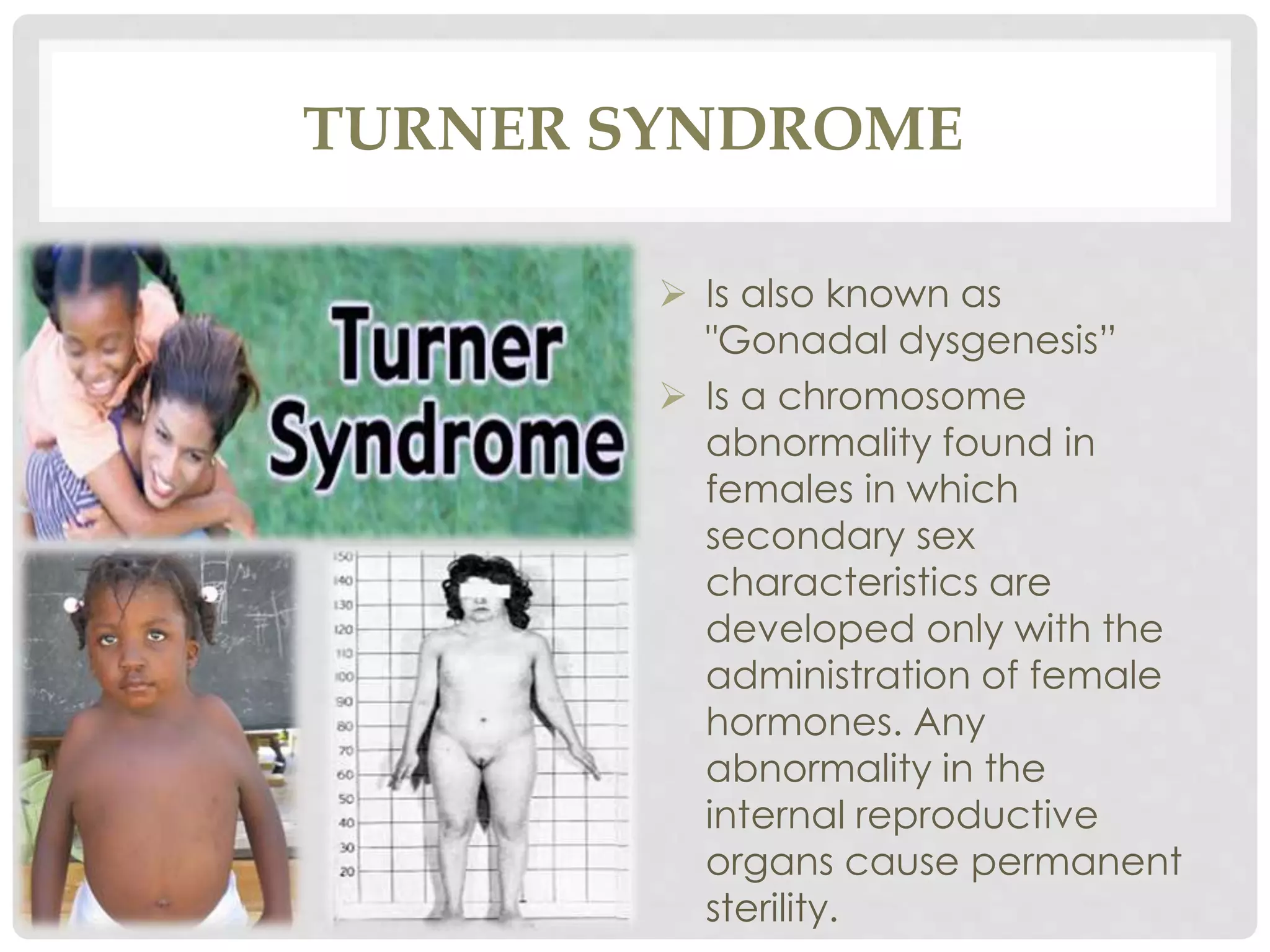
TURNER SYNDROME
 Is also known as
"Gonadal dysgenesis”
 Is a chromosome
abnormality found in
females in which
secondary sex
characteristics are
developed only with the
administration of female
hormones. Any
abnormality in the
internal reproductive
organs cause permanent
sterility.
HISTORY
• Named after Henry
Turner, the
endocrinologist who
described this
condition in 1938
• He described 7 patients
between the ages of
15 and 23, who were
referred to him for
dwarfism and lack of
sexual development
TURNER SYNDROME
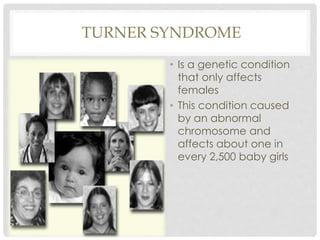
• Is a genetic condition
that only affects
females
• This condition caused
by an abnormal
chromosome and
affects about one in
every 2,500 baby girls
HOW DOES IT OCCUR?
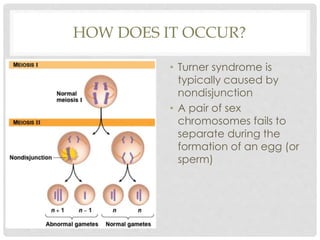
• Turner syndrome is
typically caused by
nondisjunction
• A pair of sex
chromosomes fails to
separate during the
formation of an egg (or
sperm)
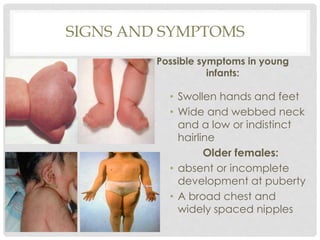
SIGNS AND SYMPTOMS
Possible symptoms in young
infants:
• Swollen hands and feet
• Wide and webbed neck
and a low or indistinct
hairline
Older females:
• absent or incomplete
development at puberty
• A broad chest and
widely spaced nipples
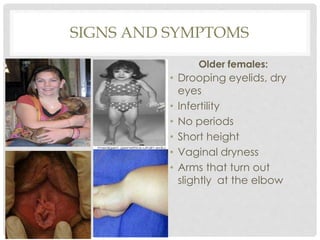
SIGNS AND SYMPTOMS
Older females:
• Drooping eyelids, dry
eyes
• Infertility
• No periods
• Short height
• Vaginal dryness
• Arms that turn out
slightly at the elbow
TREATMENT
• Human growth hormone
• Oestrogen replacement
therapy
• Progesterone
replacement therapy
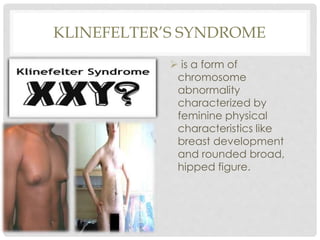
KLINEFELTER’S SYNDROME
 is a form of
chromosome
abnormality
characterized by
feminine physical
characteristics like
breast development
and rounded broad,
hipped figure.
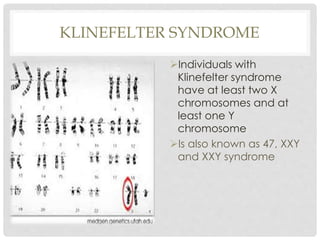
KLINEFELTER SYNDROME
Individuals with
Klinefelter syndrome
have at least two X
chromosomes and at
least one Y
chromosome
Is also known as 47, XXY
and XXY syndrome
KLINEFELTER SYNDROME
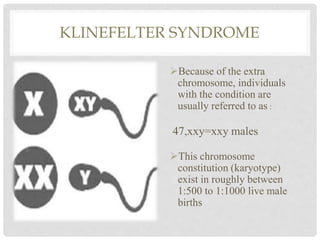
Because of the extra
chromosome, individuals
with the condition are
usually referred to as :
47,xxy=xxy males
This chromosome
constitution (karyotype)
exist in roughly between
1:500 to 1:1000 live male
births
CAUSE
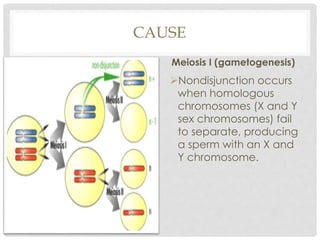
Meiosis I (gametogenesis)
Nondisjunction occurs
when homologous
chromosomes (X and Y
sex chromosomes) fail
to separate, producing
a sperm with an X and
Y chromosome.
SIGNS AND SYMPTOMS
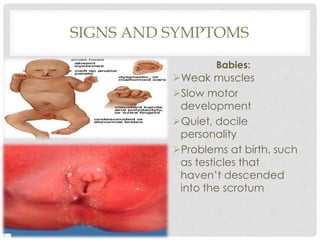
Babies:
Weak muscles
Slow motor
development
Quiet, docile
personality
Problems at birth, such
as testicles that
haven’t descended
into the scrotum
SIGNS AND SYMPTOMS
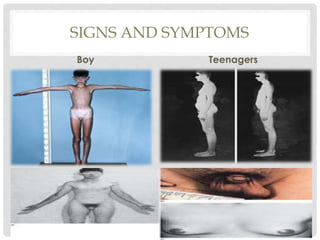
Boy and Teenagers
• Taller than average stature
• Longer legs, shorter torso
and broader hips
compared with other boys
• Absent, delayed or
incomplete puberty
• After puberty , less
muscular bodies and less
facial and body hair
compared with other teens
• Small and firm testicles
• Small penis
• Enlarged breast tissue
(gynecomastia)
• Weak bones
• Low energy levels
• Shyness
• Difficulty expressing
feelings or socializing
• Problems with reading,
writing, spelling or math
• Attention problems
SIGNS AND SYMPTOMS
Boy Teenagers
SIGNS AND SYMPTOMS
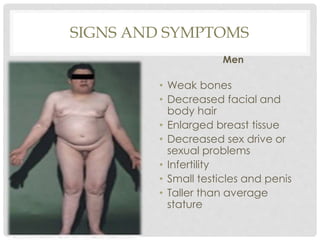
Men
• Weak bones
• Decreased facial and
body hair
• Enlarged breast tissue
• Decreased sex drive or
sexual problems
• Infertility
• Small testicles and penis
• Taller than average
stature
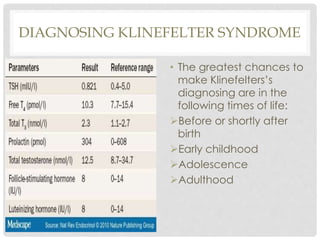
DIAGNOSING KLINEFELTER SYNDROME
• The greatest chances to
make Klinefelters’s
diagnosing are in the
following times of life:
Before or shortly after
birth
Early childhood
Adolescence
Adulthood
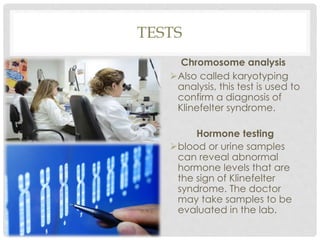
TESTS
Chromosome analysis
Also called karyotyping
analysis, this test is used to
confirm a diagnosis of
Klinefelter syndrome.
Hormone testing
blood or urine samples
can reveal abnormal
hormone levels that are
the sign of Klinefelter
syndrome. The doctor
may take samples to be
evaluated in the lab.
TESTS
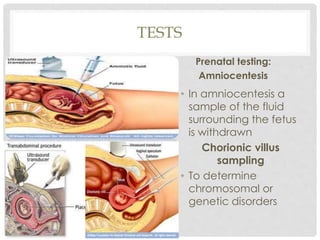
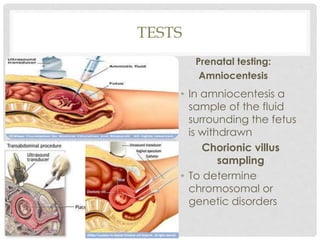
Prenatal testing:
Amniocentesis
• In amniocentesis a
sample of the fluid
surrounding the fetus
is withdrawn
Chorionic villus
sampling
• To determine
chromosomal or
genetic disorders
TREATMENT
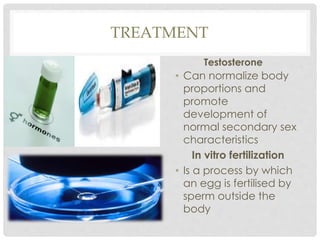
Testosterone
• Can normalize body
proportions and
promote
development of
normal secondary sex
characteristics
In vitro fertilization
• Is a process by which
an egg is fertilised by
sperm outside the
body
FRAGILE X SYNDROME
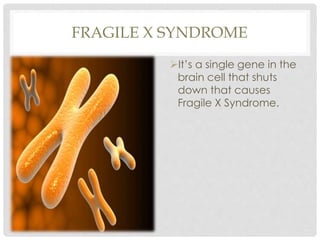
It’s a single gene in the
brain cell that shuts
down that causes
Fragile X Syndrome.
SIGNS AND SYMPTOMS
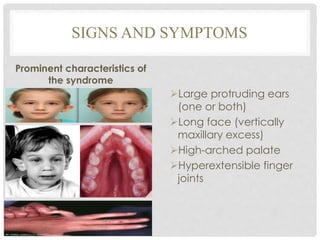
Prominent characteristics of
the syndrome
Large protruding ears
(one or both)
Long face (vertically
maxillary excess)
High-arched palate
Hyperextensible finger
joints
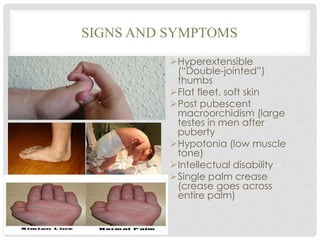
SIGNS AND SYMPTOMS
Hyperextensible
(“Double-jointed”)
thumbs
Flat fleet, soft skin
Post pubescent
macroorchidism (large
testes in men after
puberty
Hypotonia (low muscle
tone)
Intellectual disability
Single palm crease
(crease goes across
entire palm)
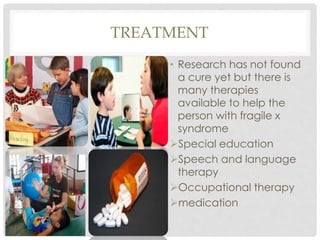
TREATMENT
• Research has not found
a cure yet but there is
many therapies
available to help the
person with fragile x
syndrome
Special education
Speech and language
therapy
Occupational therapy
medication
PERVASIVE DEVELOPMENTAL
DISORDERS
Is a collection of
disorders
characterized by gross
deficits in many areas
of cognitive,
emotional, and social
development. These
results from severe and
pervasive impairment
of social interaction
and communication
skills.
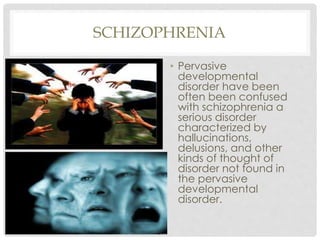
SCHIZOPHRENIA
• Pervasive
developmental
disorder have been
often been confused
with schizophrenia a
serious disorder
characterized by
hallucinations,
delusions, and other
kinds of thought of
disorder not found in
the pervasive
developmental
disorder.
THANK YOU FOR LISTENING
AND
GOD BLESS
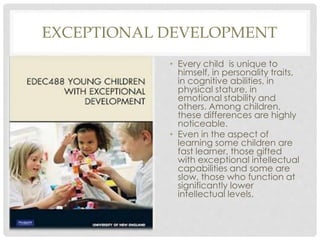
EXCEPTIONAL DEVELOPMENT
• Every child is unique to
himself, in personality traits,
in cognitive abilities, in
physical stature, in
emotional stability and
others. Among children,
these differences are highly
noticeable.
• Even in the aspect of
learning some children are
fast learner, those gifted
with exceptional intellectual
capabilities and some are
slow, those who function at
significantly lower
intellectual levels.
THE INTELLECTUALLY GIFTED
• Think in different ways
• Think about their work in more
than one way
• Talented at solving problems
with what is around them
• Are very aware of events
going on around them
• Enjoy observing their
surroundings
• Enjoy observing their
surroundings
• Are risk takers
• Are not boastful about
accomplishments
• Are motivated to learn
through own
accomplishments
CHILDREN WITH INTELLECTUAL
DEFICITS
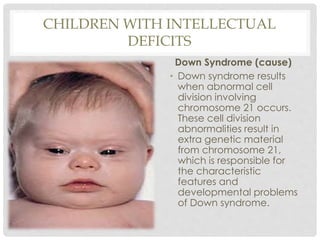
Down Syndrome (cause)
• Down syndrome results
when abnormal cell
division involving
chromosome 21 occurs.
These cell division
abnormalities result in
extra genetic material
from chromosome 21,
which is responsible for
the characteristic
features and
developmental problems
of Down syndrome.
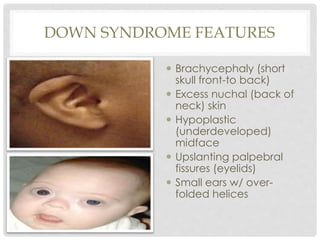
DOWN SYNDROME FEATURES
 Brachycephaly (short
skull front-to back)
 Excess nuchal (back of
neck) skin
 Hypoplastic
(underdeveloped)
midface
 Upslanting palpebral
fissures (eyelids)
 Small ears w/ over-
folded helices
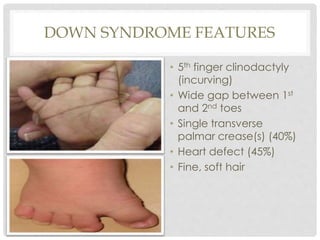
DOWN SYNDROME FEATURES
• 5th finger clinodactyly
(incurving)
• Wide gap between 1st
and 2nd toes
• Single transverse
palmar crease(s) (40%)
• Heart defect (45%)
• Fine, soft hair
TESTS
Prenatal testing:
Amniocentesis
• In amniocentesis a
sample of the fluid
surrounding the fetus
is withdrawn
Chorionic villus
sampling
• To determine
chromosomal or
genetic disorders
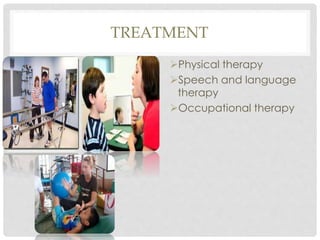
TREATMENT
Physical therapy
Speech and language
therapy
Occupational therapy

Pervasivedeve

  • 1.
    TURNER SYNDROME  Isalso known as "Gonadal dysgenesis”  Is a chromosome abnormality found in females in which secondary sex characteristics are developed only with the administration of female hormones. Any abnormality in the internal reproductive organs cause permanent sterility.
  • 2.
    HISTORY • Named afterHenry Turner, the endocrinologist who described this condition in 1938 • He described 7 patients between the ages of 15 and 23, who were referred to him for dwarfism and lack of sexual development
  • 3.
    TURNER SYNDROME • Isa genetic condition that only affects females • This condition caused by an abnormal chromosome and affects about one in every 2,500 baby girls
  • 4.
    HOW DOES ITOCCUR? • Turner syndrome is typically caused by nondisjunction • A pair of sex chromosomes fails to separate during the formation of an egg (or sperm)
  • 5.
    SIGNS AND SYMPTOMS Possiblesymptoms in young infants: • Swollen hands and feet • Wide and webbed neck and a low or indistinct hairline Older females: • absent or incomplete development at puberty • A broad chest and widely spaced nipples
  • 6.
    SIGNS AND SYMPTOMS Olderfemales: • Drooping eyelids, dry eyes • Infertility • No periods • Short height • Vaginal dryness • Arms that turn out slightly at the elbow
  • 7.
    TREATMENT • Human growthhormone • Oestrogen replacement therapy • Progesterone replacement therapy
  • 8.
    KLINEFELTER’S SYNDROME  isa form of chromosome abnormality characterized by feminine physical characteristics like breast development and rounded broad, hipped figure.
  • 9.
    KLINEFELTER SYNDROME Individuals with Klinefeltersyndrome have at least two X chromosomes and at least one Y chromosome Is also known as 47, XXY and XXY syndrome
  • 10.
    KLINEFELTER SYNDROME Because ofthe extra chromosome, individuals with the condition are usually referred to as : 47,xxy=xxy males This chromosome constitution (karyotype) exist in roughly between 1:500 to 1:1000 live male births
  • 11.
    CAUSE Meiosis I (gametogenesis) Nondisjunctionoccurs when homologous chromosomes (X and Y sex chromosomes) fail to separate, producing a sperm with an X and Y chromosome.
  • 12.
    SIGNS AND SYMPTOMS Babies: Weakmuscles Slow motor development Quiet, docile personality Problems at birth, such as testicles that haven’t descended into the scrotum
  • 13.
    SIGNS AND SYMPTOMS Boyand Teenagers • Taller than average stature • Longer legs, shorter torso and broader hips compared with other boys • Absent, delayed or incomplete puberty • After puberty , less muscular bodies and less facial and body hair compared with other teens • Small and firm testicles • Small penis • Enlarged breast tissue (gynecomastia) • Weak bones • Low energy levels • Shyness • Difficulty expressing feelings or socializing • Problems with reading, writing, spelling or math • Attention problems
  • 14.
  • 15.
    SIGNS AND SYMPTOMS Men •Weak bones • Decreased facial and body hair • Enlarged breast tissue • Decreased sex drive or sexual problems • Infertility • Small testicles and penis • Taller than average stature
  • 16.
    DIAGNOSING KLINEFELTER SYNDROME •The greatest chances to make Klinefelters’s diagnosing are in the following times of life: Before or shortly after birth Early childhood Adolescence Adulthood
  • 17.
    TESTS Chromosome analysis Also calledkaryotyping analysis, this test is used to confirm a diagnosis of Klinefelter syndrome. Hormone testing blood or urine samples can reveal abnormal hormone levels that are the sign of Klinefelter syndrome. The doctor may take samples to be evaluated in the lab.
  • 18.
    TESTS Prenatal testing: Amniocentesis • Inamniocentesis a sample of the fluid surrounding the fetus is withdrawn Chorionic villus sampling • To determine chromosomal or genetic disorders
  • 19.
    TREATMENT Testosterone • Can normalizebody proportions and promote development of normal secondary sex characteristics In vitro fertilization • Is a process by which an egg is fertilised by sperm outside the body
  • 20.
    FRAGILE X SYNDROME It’sa single gene in the brain cell that shuts down that causes Fragile X Syndrome.
  • 21.
    SIGNS AND SYMPTOMS Prominentcharacteristics of the syndrome Large protruding ears (one or both) Long face (vertically maxillary excess) High-arched palate Hyperextensible finger joints
  • 22.
    SIGNS AND SYMPTOMS Hyperextensible (“Double-jointed”) thumbs Flatfleet, soft skin Post pubescent macroorchidism (large testes in men after puberty Hypotonia (low muscle tone) Intellectual disability Single palm crease (crease goes across entire palm)
  • 23.
    TREATMENT • Research hasnot found a cure yet but there is many therapies available to help the person with fragile x syndrome Special education Speech and language therapy Occupational therapy medication
  • 24.
    PERVASIVE DEVELOPMENTAL DISORDERS Is acollection of disorders characterized by gross deficits in many areas of cognitive, emotional, and social development. These results from severe and pervasive impairment of social interaction and communication skills.
  • 25.
    SCHIZOPHRENIA • Pervasive developmental disorder havebeen often been confused with schizophrenia a serious disorder characterized by hallucinations, delusions, and other kinds of thought of disorder not found in the pervasive developmental disorder.
  • 26.
    THANK YOU FORLISTENING AND GOD BLESS
  • 27.
    EXCEPTIONAL DEVELOPMENT • Everychild is unique to himself, in personality traits, in cognitive abilities, in physical stature, in emotional stability and others. Among children, these differences are highly noticeable. • Even in the aspect of learning some children are fast learner, those gifted with exceptional intellectual capabilities and some are slow, those who function at significantly lower intellectual levels.
  • 28.
    THE INTELLECTUALLY GIFTED •Think in different ways • Think about their work in more than one way • Talented at solving problems with what is around them • Are very aware of events going on around them • Enjoy observing their surroundings • Enjoy observing their surroundings • Are risk takers • Are not boastful about accomplishments • Are motivated to learn through own accomplishments
  • 29.
    CHILDREN WITH INTELLECTUAL DEFICITS DownSyndrome (cause) • Down syndrome results when abnormal cell division involving chromosome 21 occurs. These cell division abnormalities result in extra genetic material from chromosome 21, which is responsible for the characteristic features and developmental problems of Down syndrome.
  • 30.
    DOWN SYNDROME FEATURES Brachycephaly (short skull front-to back)  Excess nuchal (back of neck) skin  Hypoplastic (underdeveloped) midface  Upslanting palpebral fissures (eyelids)  Small ears w/ over- folded helices
  • 31.
    DOWN SYNDROME FEATURES •5th finger clinodactyly (incurving) • Wide gap between 1st and 2nd toes • Single transverse palmar crease(s) (40%) • Heart defect (45%) • Fine, soft hair
  • 32.
    TESTS Prenatal testing: Amniocentesis • Inamniocentesis a sample of the fluid surrounding the fetus is withdrawn Chorionic villus sampling • To determine chromosomal or genetic disorders
  • 33.
    TREATMENT Physical therapy Speech andlanguage therapy Occupational therapy