• Values are a basic set
of fundamental beliefs that
guide and motivate certain
attitudes and actions
• They denote the degree
of importance of some
thing or some action for
the person
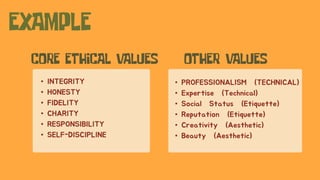
• INTEGRITY
• HONESTY
• FIDELITY
• CHARITY
• RESPONSIBILITY
• SELF-DISCIPLINE
• PROFESSIONALISM (TECHNICAL)
• Expertise (Technical)
• Social Status (Etiquette)
• Reputation (Etiquette)
• Creativity (Aesthetic)
• Beauty (Aesthetic)
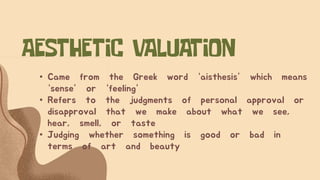
• Came from the Greek word “aisthesis” which means
“sense” or “feeling”
• Refers to the judgments of personal approval or
disapproval that we make about what we see,
hear, smell, or taste
• Judging whether something is good or bad in
terms of art and beauty
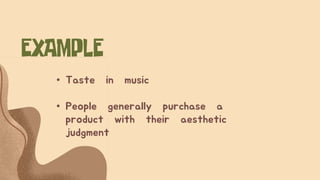
• Taste in music
• People generally purchase a
product with their aesthetic
judgment
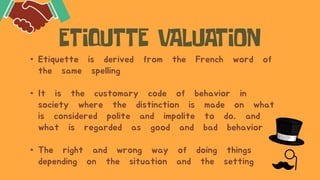
• Etiquette is derived from the French word of
the same spelling
• It is the customary code of behavior in
society where the distinction is made on what
is considered polite and impolite to do, and
what is regarded as good and bad behavior
• The right and wrong way of doing things
depending on the situation and the setting
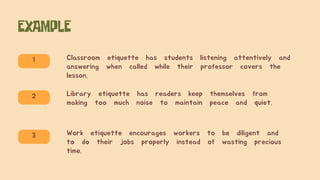
Classroom etiquette has students listening attentively and
answering when called while their professor covers the
lesson.
Library etiquette has readers keep themselves from
making too much noise to maintain peace and quiet.
Work etiquette encourages workers to be diligent and
to do their jobs properly instead of wasting precious
time.
1
3
2
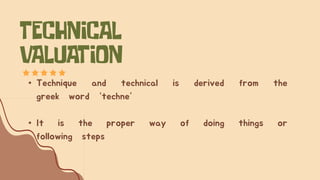
• Technique and technical is derived from the
greek word “techne”
• It is the proper way of doing things or
following steps
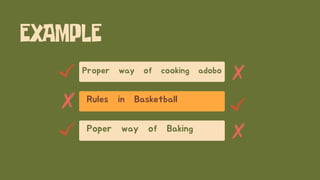
Proper way of cooking adobo
Poper way of Baking
Rules in Basketball
kinds-of-valuation.pptx

kinds-of-valuation.pptx

  • 2.
    • Values area basic set of fundamental beliefs that guide and motivate certain attitudes and actions • They denote the degree of importance of some thing or some action for the person
  • 3.
    • INTEGRITY • HONESTY •FIDELITY • CHARITY • RESPONSIBILITY • SELF-DISCIPLINE • PROFESSIONALISM (TECHNICAL) • Expertise (Technical) • Social Status (Etiquette) • Reputation (Etiquette) • Creativity (Aesthetic) • Beauty (Aesthetic)
  • 4.
    • Came fromthe Greek word “aisthesis” which means “sense” or “feeling” • Refers to the judgments of personal approval or disapproval that we make about what we see, hear, smell, or taste • Judging whether something is good or bad in terms of art and beauty
  • 5.
    • Taste inmusic • People generally purchase a product with their aesthetic judgment
  • 6.
    • Etiquette isderived from the French word of the same spelling • It is the customary code of behavior in society where the distinction is made on what is considered polite and impolite to do, and what is regarded as good and bad behavior • The right and wrong way of doing things depending on the situation and the setting
  • 7.
    Classroom etiquette hasstudents listening attentively and answering when called while their professor covers the lesson. Library etiquette has readers keep themselves from making too much noise to maintain peace and quiet. Work etiquette encourages workers to be diligent and to do their jobs properly instead of wasting precious time. 1 3 2
  • 8.
    • Technique andtechnical is derived from the greek word “techne” • It is the proper way of doing things or following steps
  • 9.
    Proper way ofcooking adobo Poper way of Baking Rules in Basketball