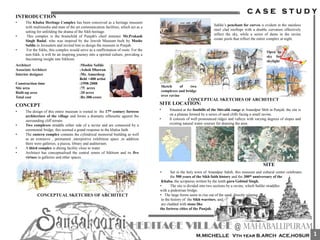
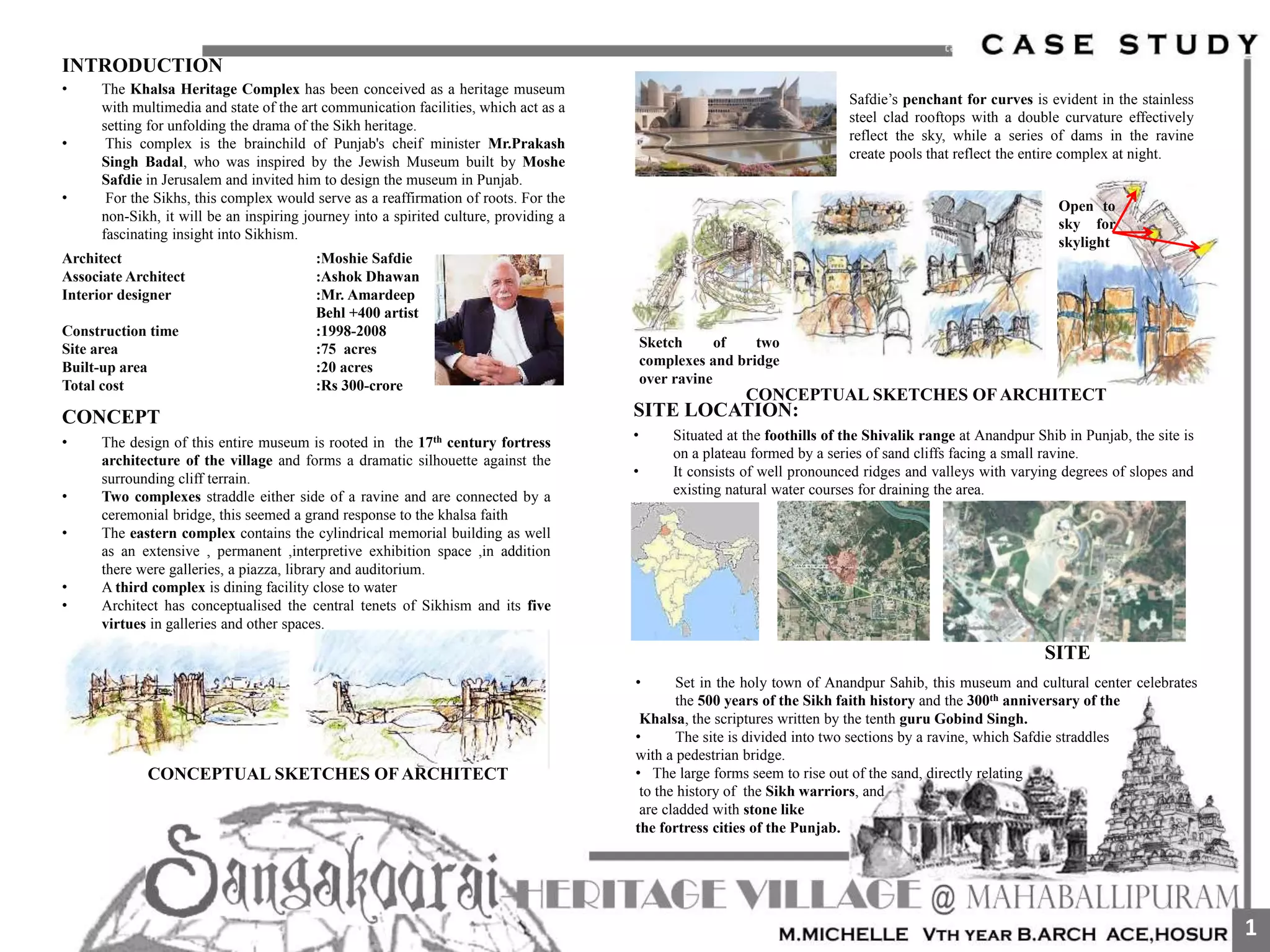
• The Khalsa Heritage Complex has been conceived as a heritage museum
with multimedia and state of the art communication facilities, which act as a
setting for unfolding the drama of the Sikh heritage.
• This complex is the brainchild of Punjab's cheif minister Mr.Prakash
Singh Badal, who was inspired by the Jewish Museum built by Moshe
Safdie in Jerusalem and invited him to design the museum in Punjab.
• For the Sikhs, this complex would serve as a reaffirmation of roots. For the
non-Sikh, it will be an inspiring journey into a spirited culture, providing a
fascinating insight into Sikhism.
INTRODUCTION
Architect :Moshie Safdie
Associate Architect :Ashok Dhawan
Interior designer :Mr. Amardeep
Behl +400 artist
Construction time :1998-2008
Site area :75 acres
Built-up area :20 acres
Total cost :Rs 300-crore
• The design of this entire museum is rooted in the 17th century fortress
architecture of the village and forms a dramatic silhouette against the
surrounding cliff terrain.
• Two complexes straddle either side of a ravine and are connected by a
ceremonial bridge, this seemed a grand response to the khalsa faith
• The eastern complex contains the cylindrical memorial building as well
as an extensive , permanent ,interpretive exhibition space ,in addition
there were galleries, a piazza, library and auditorium.
• A third complex is dining facility close to water
• Architect has conceptualised the central tenets of Sikhism and its five
virtues in galleries and other spaces.
CONCEPT
CONCEPTUAL SKETCHES OFARCHITECT
Safdie’s penchant for curves is evident in the stainless
steel clad rooftops with a double curvature effectively
reflect the sky, while a series of dams in the ravine
create pools that reflect the entire complex at night.
Sketch of two
complexes and bridge
over ravine
CONCEPTUAL SKETCHES OFARCHITECT
Open to
sky for
skylight
SITE LOCATION:
• Situated at the foothills of the Shivalik range at Anandpur Shib in Punjab, the site is
on a plateau formed by a series of sand cliffs facing a small ravine.
• It consists of well pronounced ridges and valleys with varying degrees of slopes and
existing natural water courses for draining the area.
SITE
• Set in the holy town of Anandpur Sahib, this museum and cultural center celebrates
the 500 years of the Sikh faith history and the 300th anniversary of the
Khalsa, the scriptures written by the tenth guru Gobind Singh.
• The site is divided into two sections by a ravine, which Safdie straddles
with a pedestrian bridge.
• The large forms seem to rise out of the sand, directly relating
to the history of the Sikh warriors, and
are cladded with stone like
the fortress cities of the Punjab.
1
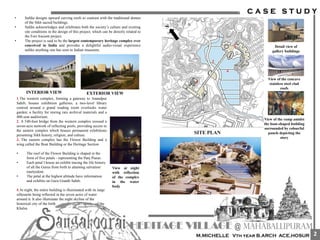
• Safdie designs upward curving roofs to contrast with the traditional domes
of the Sikh sacred buildings.
• Safdie acknowledges and celebrates both the society’s culture and existing
site conditions in the design of this project, which can be directly related to
the Fort Ancient project.
• The project is said to be the largest contemporary heritage complex ever
conceived in India and provides a delightful audio-visual experience
unlike anything one has seen in Indian museums.
1.The western complex, forming a gateway to Anandpur
Sahib, houses exhibition galleries; a two-level library
centred around a grand reading room overlooks water
garden; a facility for storing rare archival materials and a
400-seat auditorium.
2. A 540-foot bridge from the western complex crossed a
seven-acre network of reflecting pools, providing access to
the eastern complex which houses permanent exhibitions
presenting Sikh history, religion, and culture.
3. The eastern complex has the Flower Building and a
wing called the Boat Building or the Heritage Section.
• The roof of the Flower Building is shaped in the
form of five petals - representing the Panj Piaras .
• Each petal l house an exhibit tracing the life history
of all the Gurus from birth to attaining salvation/
martyrdom.
• The petal at the highest altitude have information
and exhibits on Guru Granth Sahib.
4.At night, the entire building is illuminated with its large
silhouette being reflected in the seven acres of water
around it. It also illuminate the night skyline of the
historical city of the birth of the
Khalsa.
1
2
3
4
SITE PLAN
EXTERIOR VIEWINTERIOR VIEW
View at night
with reflection
of the complex
in the water
body
Detail view of
gallery buildings
View of the concave
stainless steel clad
roofs
View of the ramp amidst
the boat-shaped building
surrounded by colourful
panels depicting the
story
2
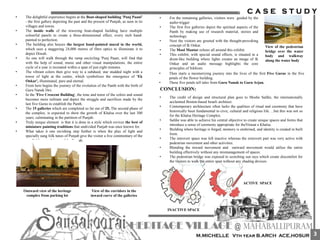
• The delightful experience begins at the Boat-shaped building 'Punj Paani'
- the first gallery depicting the past and the present of Punjab, as seen in its
villages and towns.
• The inside walls of the towering boat-shaped building have multiple
colourful panels to create a three-dimensional effect, every inch hand-
painted to perfection.
• The building also houses the largest hand-painted mural in the world,
which uses a staggering 24,000 metres of fibre optics to illuminate it to
depict Diwali.
• As one will walk through the ramp encircling 'Punj Paani, will find that
with the help of sound, music and other visual manipulations, the entire
cycle of a year is recreated within a span of just eight minutes.
• The vibrant colors then give way to a subdued, star studded night with a
tower of light at the centre, which symbolizes the emergence of 'Ek
Onkar', illuminated, pure and eternal.
• From here begins the journey of the evolution of the Panth with the birth of
Guru Nanak Dev.
• In the 'Five Crescent Building', the tone and tenor of the colors and sound
becomes more militant and depict the struggle and sacrifices made by the
last five Gurus to establish the Panth.
• The 15 galleries which are completed so far out of 25, The second phase of
the complex, is expected to show the growth of Khalsa over the last 300
years, culminating in the partition of Punjab.
• Truly unique element is that it is done in a style which revives the best of
miniature painting traditions that undivided Punjab was once known for.
• What takes it one ravishing step further is when the play of light and
specially sung folk tunes of Punjab give the visitor a live commentary of the
parallel lives and times of the Punjab.
Outward view of the heritage
complex from parking lot
• For the remaining galleries, visitors were guided by the
audio-trigger
• The first five galleries depict the spiritual aspects of the
Panth by making use of research material, stories and
technology.
• Next the visitors are greeted with the thought-provoking
concept of Ik Onkar.
• The Mool Mantar echoes all around this exhibit.
• This exhibit, with special sound effects, is situated in a
drum-like building where lights creates an image of Ik
Onkar and an audio message highlights the core
principles of Sikhism.
View of the corridors in the
inward curve of the galleries
View of the pedestrian
bridge over the water
body and walkway
along the water body
CONCLUSION:
• Then starts a mesmerizing journey into the lives of the first Five Gurus in the five
petals of the flower building.
• These five petals tell tales from Guru Nanak to Guru Arjan.
INACTIVE SPACE
ACTIVE SPACE
• The credit of design and structural plan goes to Moshe Safdie, the internationally
acclaimed Boston-based Israeli architect.
• Contemporary architecture often lacks the qualities of ritual and ceremony that have
historically been fundamental to civic, cultural and religious life. ...but this was not so
for the Khalsa Heritage Complex.
• Safdie was able to achieve his central objective to create unique spaces and forms that
introduce a sense of ceremony appropriate for theVirasat e Khalsa.
• Building where heritage is forged, memory is enshrined, and identity is created in built
form.
• The introvert space was left inactive whereas the extrovert part was very active with
pedestrian movement and other activities.
• Blending the inward movement and outward movement would utilize the entire
building effectively without any mismanagement of spaces.
• The pedestrian bridge was exposed to scorching sun rays which create discomfort for
the visitors to walk the entire span without any shading devices.
3

Khalsa heritage,Anandpur Sahib

  • 1.
    • The KhalsaHeritage Complex has been conceived as a heritage museum with multimedia and state of the art communication facilities, which act as a setting for unfolding the drama of the Sikh heritage. • This complex is the brainchild of Punjab's cheif minister Mr.Prakash Singh Badal, who was inspired by the Jewish Museum built by Moshe Safdie in Jerusalem and invited him to design the museum in Punjab. • For the Sikhs, this complex would serve as a reaffirmation of roots. For the non-Sikh, it will be an inspiring journey into a spirited culture, providing a fascinating insight into Sikhism. INTRODUCTION Architect :Moshie Safdie Associate Architect :Ashok Dhawan Interior designer :Mr. Amardeep Behl +400 artist Construction time :1998-2008 Site area :75 acres Built-up area :20 acres Total cost :Rs 300-crore • The design of this entire museum is rooted in the 17th century fortress architecture of the village and forms a dramatic silhouette against the surrounding cliff terrain. • Two complexes straddle either side of a ravine and are connected by a ceremonial bridge, this seemed a grand response to the khalsa faith • The eastern complex contains the cylindrical memorial building as well as an extensive , permanent ,interpretive exhibition space ,in addition there were galleries, a piazza, library and auditorium. • A third complex is dining facility close to water • Architect has conceptualised the central tenets of Sikhism and its five virtues in galleries and other spaces. CONCEPT CONCEPTUAL SKETCHES OFARCHITECT Safdie’s penchant for curves is evident in the stainless steel clad rooftops with a double curvature effectively reflect the sky, while a series of dams in the ravine create pools that reflect the entire complex at night. Sketch of two complexes and bridge over ravine CONCEPTUAL SKETCHES OFARCHITECT Open to sky for skylight SITE LOCATION: • Situated at the foothills of the Shivalik range at Anandpur Shib in Punjab, the site is on a plateau formed by a series of sand cliffs facing a small ravine. • It consists of well pronounced ridges and valleys with varying degrees of slopes and existing natural water courses for draining the area. SITE • Set in the holy town of Anandpur Sahib, this museum and cultural center celebrates the 500 years of the Sikh faith history and the 300th anniversary of the Khalsa, the scriptures written by the tenth guru Gobind Singh. • The site is divided into two sections by a ravine, which Safdie straddles with a pedestrian bridge. • The large forms seem to rise out of the sand, directly relating to the history of the Sikh warriors, and are cladded with stone like the fortress cities of the Punjab. 1
  • 2.
    • Safdie designsupward curving roofs to contrast with the traditional domes of the Sikh sacred buildings. • Safdie acknowledges and celebrates both the society’s culture and existing site conditions in the design of this project, which can be directly related to the Fort Ancient project. • The project is said to be the largest contemporary heritage complex ever conceived in India and provides a delightful audio-visual experience unlike anything one has seen in Indian museums. 1.The western complex, forming a gateway to Anandpur Sahib, houses exhibition galleries; a two-level library centred around a grand reading room overlooks water garden; a facility for storing rare archival materials and a 400-seat auditorium. 2. A 540-foot bridge from the western complex crossed a seven-acre network of reflecting pools, providing access to the eastern complex which houses permanent exhibitions presenting Sikh history, religion, and culture. 3. The eastern complex has the Flower Building and a wing called the Boat Building or the Heritage Section. • The roof of the Flower Building is shaped in the form of five petals - representing the Panj Piaras . • Each petal l house an exhibit tracing the life history of all the Gurus from birth to attaining salvation/ martyrdom. • The petal at the highest altitude have information and exhibits on Guru Granth Sahib. 4.At night, the entire building is illuminated with its large silhouette being reflected in the seven acres of water around it. It also illuminate the night skyline of the historical city of the birth of the Khalsa. 1 2 3 4 SITE PLAN EXTERIOR VIEWINTERIOR VIEW View at night with reflection of the complex in the water body Detail view of gallery buildings View of the concave stainless steel clad roofs View of the ramp amidst the boat-shaped building surrounded by colourful panels depicting the story 2
  • 3.
    • The delightfulexperience begins at the Boat-shaped building 'Punj Paani' - the first gallery depicting the past and the present of Punjab, as seen in its villages and towns. • The inside walls of the towering boat-shaped building have multiple colourful panels to create a three-dimensional effect, every inch hand- painted to perfection. • The building also houses the largest hand-painted mural in the world, which uses a staggering 24,000 metres of fibre optics to illuminate it to depict Diwali. • As one will walk through the ramp encircling 'Punj Paani, will find that with the help of sound, music and other visual manipulations, the entire cycle of a year is recreated within a span of just eight minutes. • The vibrant colors then give way to a subdued, star studded night with a tower of light at the centre, which symbolizes the emergence of 'Ek Onkar', illuminated, pure and eternal. • From here begins the journey of the evolution of the Panth with the birth of Guru Nanak Dev. • In the 'Five Crescent Building', the tone and tenor of the colors and sound becomes more militant and depict the struggle and sacrifices made by the last five Gurus to establish the Panth. • The 15 galleries which are completed so far out of 25, The second phase of the complex, is expected to show the growth of Khalsa over the last 300 years, culminating in the partition of Punjab. • Truly unique element is that it is done in a style which revives the best of miniature painting traditions that undivided Punjab was once known for. • What takes it one ravishing step further is when the play of light and specially sung folk tunes of Punjab give the visitor a live commentary of the parallel lives and times of the Punjab. Outward view of the heritage complex from parking lot • For the remaining galleries, visitors were guided by the audio-trigger • The first five galleries depict the spiritual aspects of the Panth by making use of research material, stories and technology. • Next the visitors are greeted with the thought-provoking concept of Ik Onkar. • The Mool Mantar echoes all around this exhibit. • This exhibit, with special sound effects, is situated in a drum-like building where lights creates an image of Ik Onkar and an audio message highlights the core principles of Sikhism. View of the corridors in the inward curve of the galleries View of the pedestrian bridge over the water body and walkway along the water body CONCLUSION: • Then starts a mesmerizing journey into the lives of the first Five Gurus in the five petals of the flower building. • These five petals tell tales from Guru Nanak to Guru Arjan. INACTIVE SPACE ACTIVE SPACE • The credit of design and structural plan goes to Moshe Safdie, the internationally acclaimed Boston-based Israeli architect. • Contemporary architecture often lacks the qualities of ritual and ceremony that have historically been fundamental to civic, cultural and religious life. ...but this was not so for the Khalsa Heritage Complex. • Safdie was able to achieve his central objective to create unique spaces and forms that introduce a sense of ceremony appropriate for theVirasat e Khalsa. • Building where heritage is forged, memory is enshrined, and identity is created in built form. • The introvert space was left inactive whereas the extrovert part was very active with pedestrian movement and other activities. • Blending the inward movement and outward movement would utilize the entire building effectively without any mismanagement of spaces. • The pedestrian bridge was exposed to scorching sun rays which create discomfort for the visitors to walk the entire span without any shading devices. 3