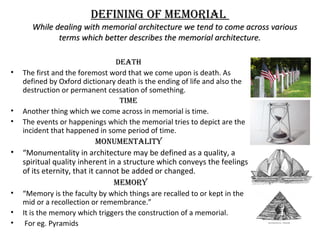
DEFINING OF MEMORIAL
While dealing with memorial architecture we tend to come across variousWhile dealing with memorial architecture we tend to come across various
terms which better describes the memorial architecture.terms which better describes the memorial architecture.
DEATH
• The first and the foremost word that we come upon is death. As
defined by Oxford dictionary death is the ending of life and also the
destruction or permanent cessation of something.
TIME
• Another thing which we come across in memorial is time.
• The events or happenings which the memorial tries to depict are the
incident that happened in some period of time.
MONUMENTALITY
• “Monumentality in architecture may be defined as a quality, a
spiritual quality inherent in a structure which conveys the feelings
of its eternity, that it cannot be added or changed.
MEMORY
• “Memory is the faculty by which things are recalled to or kept in the
mid or a recollection or remembrance.”
• It is the memory which triggers the construction of a memorial.
• For eg. Pyramids
MEMORIAL cUM MUsEUM
cAsE sTUDY
Location
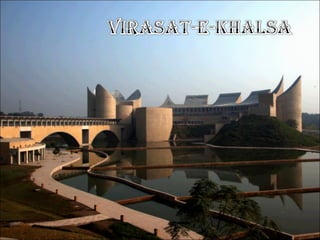
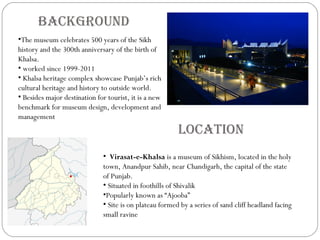
• Virasat-e-Khalsa is a museum of Sikhism, located in the holy
town, Anandpur Sahib, near Chandigarh, the capital of the state
of Punjab.
• Situated in foothills of Shivalik
•Popularly known as “Ajooba”
• Site is on plateau formed by a series of sand cliff headland facing
small ravine
Background
•The museum celebrates 500 years of the Sikh
history and the 300th anniversary of the birth of
Khalsa.
• worked since 1999-2011
• Khalsa heritage complex showcase Punjab’s rich
cultural heritage and history to outside world.
• Besides major destination for tourist, it is a new
benchmark for museum design, development and
management
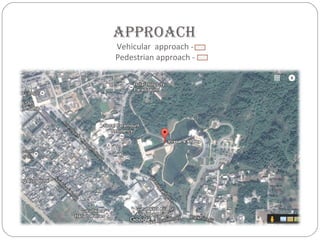
approach
Vehicular approach -
Pedestrian approach -
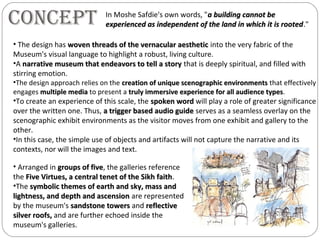
ConCept
• Arranged in groups of fivegroups of five, the galleries reference
the Five Virtues, a central tenet of the Sikh faithFive Virtues, a central tenet of the Sikh faith.
•The symbolic themes of earth and sky, mass andsymbolic themes of earth and sky, mass and
lightness, and depth and ascensionlightness, and depth and ascension are represented
by the museum's sandstone towerssandstone towers and reflectivereflective
silver roofs,silver roofs, and are further echoed inside the
museum's galleries.
In Moshe Safdie's own words, "a building cannot bea building cannot be
experienced as independent of the land in which it is rootedexperienced as independent of the land in which it is rooted."
• The design has woven threads of the vernacular aestheticwoven threads of the vernacular aesthetic into the very fabric of the
Museum's visual language to highlight a robust, living culture.
•A narrative museum that endeavors to tell a storynarrative museum that endeavors to tell a story that is deeply spiritual, and filled with
stirring emotion.
•The design approach relies on the creation of unique scenographic environmentscreation of unique scenographic environments that effectively
engages multiple mediamultiple media to present a truly immersive experience for all audience typestruly immersive experience for all audience types.
•To create an experience of this scale, the spoken wordspoken word will play a role of greater significance
over the written one. Thus, a trigger based audio guidea trigger based audio guide serves as a seamless overlay on the
scenographic exhibit environments as the visitor moves from one exhibit and gallery to the
other.
•In this case, the simple use of objects and artifacts will not capture the narrative and its
contexts, nor will the images and text.
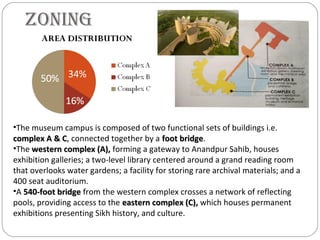
ZonInG
34%
•The museum campus is composed of two functional sets of buildings i.e.
complex A & Ccomplex A & C, connected together by a foot bridgefoot bridge.
•The western complex (A),western complex (A), forming a gateway to Anandpur Sahib, houses
exhibition galleries; a two-level library centered around a grand reading room
that overlooks water gardens; a facility for storing rare archival materials; and a
400 seat auditorium.
•A 540-foot bridge540-foot bridge from the western complex crosses a network of reflecting
pools, providing access to the eastern complex (C),eastern complex (C), which houses permanent
exhibitions presenting Sikh history, and culture.
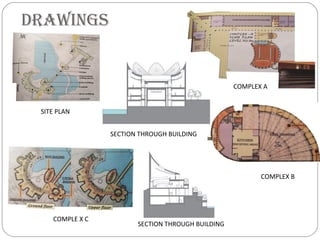
DrawInGs
COMPLE X C
SITE PLAN
COMPLEX B
SECTION THROUGH BUILDING
COMPLEX A
SECTION THROUGH BUILDING
MATERIAL USED
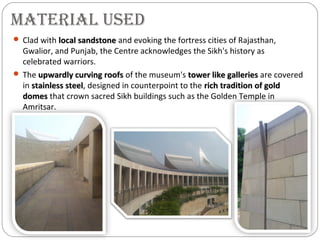
 Clad with local sandstonelocal sandstone and evoking the fortress cities of Rajasthan,
Gwalior, and Punjab, the Centre acknowledges the Sikh's history as
celebrated warriors.
 The upwardly curving roofsupwardly curving roofs of the museum's tower like galleriestower like galleries are covered
in stainless steelstainless steel, designed in counterpoint to the rich tradition of goldrich tradition of gold
domesdomes that crown sacred Sikh buildings such as the Golden Temple in
Amritsar.

Virasat e-khalsa memorial

  • 1.
    DEFINING OF MEMORIAL Whiledealing with memorial architecture we tend to come across variousWhile dealing with memorial architecture we tend to come across various terms which better describes the memorial architecture.terms which better describes the memorial architecture. DEATH • The first and the foremost word that we come upon is death. As defined by Oxford dictionary death is the ending of life and also the destruction or permanent cessation of something. TIME • Another thing which we come across in memorial is time. • The events or happenings which the memorial tries to depict are the incident that happened in some period of time. MONUMENTALITY • “Monumentality in architecture may be defined as a quality, a spiritual quality inherent in a structure which conveys the feelings of its eternity, that it cannot be added or changed. MEMORY • “Memory is the faculty by which things are recalled to or kept in the mid or a recollection or remembrance.” • It is the memory which triggers the construction of a memorial. • For eg. Pyramids
  • 2.
  • 5.
    Location • Virasat-e-Khalsa isa museum of Sikhism, located in the holy town, Anandpur Sahib, near Chandigarh, the capital of the state of Punjab. • Situated in foothills of Shivalik •Popularly known as “Ajooba” • Site is on plateau formed by a series of sand cliff headland facing small ravine Background •The museum celebrates 500 years of the Sikh history and the 300th anniversary of the birth of Khalsa. • worked since 1999-2011 • Khalsa heritage complex showcase Punjab’s rich cultural heritage and history to outside world. • Besides major destination for tourist, it is a new benchmark for museum design, development and management
  • 6.
  • 7.
    ConCept • Arranged ingroups of fivegroups of five, the galleries reference the Five Virtues, a central tenet of the Sikh faithFive Virtues, a central tenet of the Sikh faith. •The symbolic themes of earth and sky, mass andsymbolic themes of earth and sky, mass and lightness, and depth and ascensionlightness, and depth and ascension are represented by the museum's sandstone towerssandstone towers and reflectivereflective silver roofs,silver roofs, and are further echoed inside the museum's galleries. In Moshe Safdie's own words, "a building cannot bea building cannot be experienced as independent of the land in which it is rootedexperienced as independent of the land in which it is rooted." • The design has woven threads of the vernacular aestheticwoven threads of the vernacular aesthetic into the very fabric of the Museum's visual language to highlight a robust, living culture. •A narrative museum that endeavors to tell a storynarrative museum that endeavors to tell a story that is deeply spiritual, and filled with stirring emotion. •The design approach relies on the creation of unique scenographic environmentscreation of unique scenographic environments that effectively engages multiple mediamultiple media to present a truly immersive experience for all audience typestruly immersive experience for all audience types. •To create an experience of this scale, the spoken wordspoken word will play a role of greater significance over the written one. Thus, a trigger based audio guidea trigger based audio guide serves as a seamless overlay on the scenographic exhibit environments as the visitor moves from one exhibit and gallery to the other. •In this case, the simple use of objects and artifacts will not capture the narrative and its contexts, nor will the images and text.
  • 8.
    ZonInG 34% •The museum campusis composed of two functional sets of buildings i.e. complex A & Ccomplex A & C, connected together by a foot bridgefoot bridge. •The western complex (A),western complex (A), forming a gateway to Anandpur Sahib, houses exhibition galleries; a two-level library centered around a grand reading room that overlooks water gardens; a facility for storing rare archival materials; and a 400 seat auditorium. •A 540-foot bridge540-foot bridge from the western complex crosses a network of reflecting pools, providing access to the eastern complex (C),eastern complex (C), which houses permanent exhibitions presenting Sikh history, and culture.
  • 9.
    DrawInGs COMPLE X C SITEPLAN COMPLEX B SECTION THROUGH BUILDING COMPLEX A SECTION THROUGH BUILDING
  • 10.
    MATERIAL USED  Cladwith local sandstonelocal sandstone and evoking the fortress cities of Rajasthan, Gwalior, and Punjab, the Centre acknowledges the Sikh's history as celebrated warriors.  The upwardly curving roofsupwardly curving roofs of the museum's tower like galleriestower like galleries are covered in stainless steelstainless steel, designed in counterpoint to the rich tradition of goldrich tradition of gold domesdomes that crown sacred Sikh buildings such as the Golden Temple in Amritsar.