A few wrap-up notes
for OECD 3rd Annual Conference of of
the Global Forum on Productivity
“Firms, Workers and Disruptive Technologies – Ensuring
Sustainable and Inclusive Growth”
Mike Veall veall@mcmaster.ca
McMaster University
Productivity Partnership – Partenariat productivité
https://productivitypartnership.ca
Thanks to Gilbert Cette and Peter Nicholson. I was not in
Lisbon or Budapest. Here: B sessions.
1
Not rocket science…
Things I learned:
• McGovern (here), Schembri (here), Pereira (here):
the importance to government policy including central banking
• a well-functioning overall economy might prove particularly valuable
1. Little attention to Robert Gordon.
2. A disruption seems more likely than not.
3. “Common” cause.
4. Public policy: intellectual property/intangible
capital problem, a public supports (including
education) problem, a regulatory problem.
But also a public finance problem….
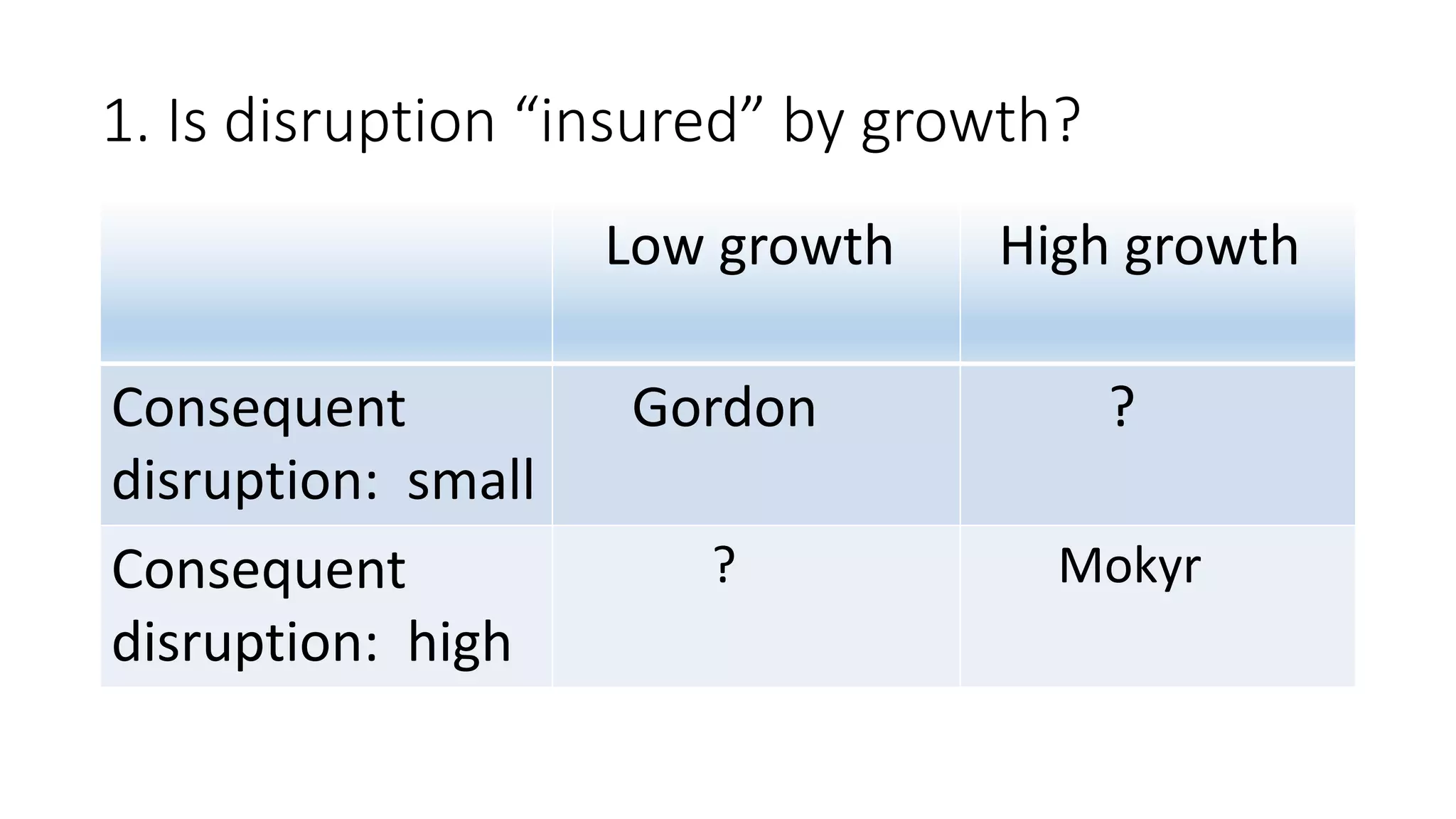
1. Is disruption “insured” by growth?
Low growth High growth
Consequent
disruption: small
Gordon ?
Consequent
disruption: high
? Mokyr
2. The AI disruption is more likely than not
•Furman and Seamans (2018)
•Alexopoulos and Cohen (2018)
•Bartelsman (here), Corrado (here)
•But Bessen (here), Remes (here), Turok (here),
Quintini (here), Blit (here)
• job losses vs. job quality losses
3. Common cause
Average annual growth rate of labor productivity per hour
Smoothed indicator (HP filter, λ = 500) - Whole economy – 1891-2016 – In %
Source: Bergeaud, Cette and Lecat (2016) - See: www.longtermproductivity.com
7
-1%
0%
1%
2%
3%
4%
5%
6%
7%
8%
9%
United States Euro Area United Kingdom Japan Canada
4. A public finance problem (session 2b)
•if measured GDP misses things, likely gov’t
revenue-to-GDP ratio will fall
•maybe we will find that a lot of AI comes from
the Cayman Islands
•maybe there isn’t as much disruption insurance
from growth as I thought
Thank you and bon voyage!
• Things to add? More about inclusivity/sustainability
• Productivity growth as a spillover: gov’t policy
4. A measurement problem would be a public
finance problem
•If GDP per capita isn’t capturing “true”
productivity growth (missing transactions,
missing home production productivity growth…
… then likely government revenues are not
either.

Mike Veall

  • 1.
    A few wrap-upnotes for OECD 3rd Annual Conference of of the Global Forum on Productivity “Firms, Workers and Disruptive Technologies – Ensuring Sustainable and Inclusive Growth” Mike Veall veall@mcmaster.ca McMaster University Productivity Partnership – Partenariat productivité https://productivitypartnership.ca Thanks to Gilbert Cette and Peter Nicholson. I was not in Lisbon or Budapest. Here: B sessions. 1
  • 2.
  • 3.
    Things I learned: •McGovern (here), Schembri (here), Pereira (here): the importance to government policy including central banking • a well-functioning overall economy might prove particularly valuable
  • 4.
    1. Little attentionto Robert Gordon. 2. A disruption seems more likely than not. 3. “Common” cause. 4. Public policy: intellectual property/intangible capital problem, a public supports (including education) problem, a regulatory problem. But also a public finance problem….
  • 5.
    1. Is disruption“insured” by growth? Low growth High growth Consequent disruption: small Gordon ? Consequent disruption: high ? Mokyr
  • 6.
    2. The AIdisruption is more likely than not •Furman and Seamans (2018) •Alexopoulos and Cohen (2018) •Bartelsman (here), Corrado (here) •But Bessen (here), Remes (here), Turok (here), Quintini (here), Blit (here) • job losses vs. job quality losses
  • 7.
    3. Common cause Averageannual growth rate of labor productivity per hour Smoothed indicator (HP filter, λ = 500) - Whole economy – 1891-2016 – In % Source: Bergeaud, Cette and Lecat (2016) - See: www.longtermproductivity.com 7 -1% 0% 1% 2% 3% 4% 5% 6% 7% 8% 9% United States Euro Area United Kingdom Japan Canada
  • 9.
    4. A publicfinance problem (session 2b) •if measured GDP misses things, likely gov’t revenue-to-GDP ratio will fall •maybe we will find that a lot of AI comes from the Cayman Islands •maybe there isn’t as much disruption insurance from growth as I thought
  • 10.
    Thank you andbon voyage!
  • 11.
    • Things toadd? More about inclusivity/sustainability • Productivity growth as a spillover: gov’t policy
  • 12.
    4. A measurementproblem would be a public finance problem •If GDP per capita isn’t capturing “true” productivity growth (missing transactions, missing home production productivity growth… … then likely government revenues are not either.