Safety Initiatives Key Components for Continuous Safety Improvement
 
 
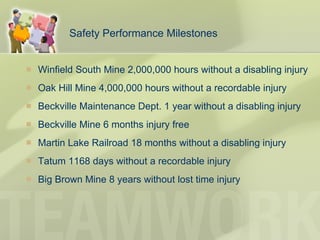
Safety Performance Milestones Winfield South Mine 2,000,000 hours without a disabling injury Oak Hill Mine 4,000,000 hours without a recordable injury Beckville Maintenance Dept. 1 year without a disabling injury Beckville Mine 6 months injury free Martin Lake Railroad 18 months without a disabling injury Tatum 1168 days without a recordable injury Big Brown Mine 8 years without lost time injury
 
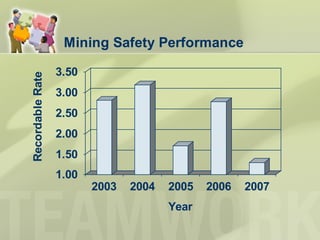
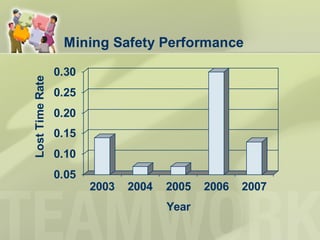
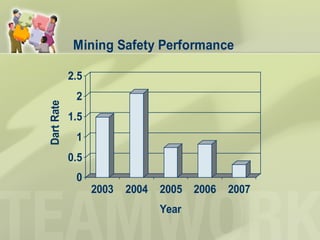
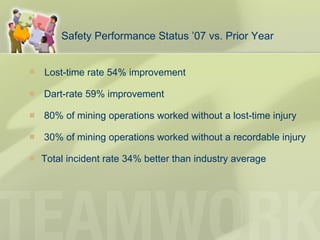
Safety Performance Status ’07 vs. Prior Year Lost-time rate 54% improvement Dart-rate 59% improvement 80% of mining operations worked without a lost-time injury 30% of mining operations worked without a recordable injury Total incident rate 34% better than industry average
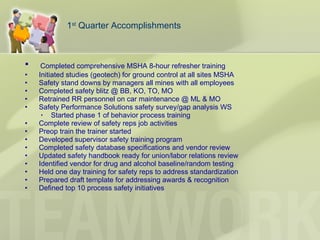
1 st  Quarter Accomplishments Completed comprehensive MSHA 8-hour refresher training Initiated studies (geotech) for ground control at all sites MSHA Safety stand downs by managers all mines with all employees Completed safety blitz @ BB, KO, TO, MO Retrained RR personnel on car maintenance @ ML & MO Safety Performance Solutions safety survey/gap analysis WS Started phase 1 of behavior process training Complete review of safety reps job activities Preop train the trainer started Developed supervisor safety training program Completed safety database specifications and vendor review Updated safety handbook ready for union/labor relations review Identified vendor for drug and alcohol baseline/random testing Held one day training for safety reps to address standardization Prepared draft template for addressing awards & recognition  Defined top 10 process safety initiatives
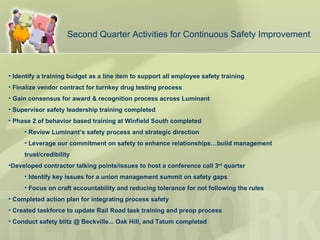
Identify a training budget as a line item to support all employee safety training Finalize vendor contract for turnkey drug testing process Gain consensus for award & recognition process across Luminant Supervisor safety leadership training completed Phase 2 of behavior based training at Winfield South completed Review Luminant’s safety process and strategic direction Leverage our commitment on safety to enhance relationships…build management trust/credibility Developed contractor talking points/issues to host a conference call 3 rd  quarter Identify key issues for a union management summit on safety gaps Focus on craft accountability and reducing tolerance for not following the rules Completed action plan for integrating process safety Created taskforce to update Rail Road task training and preop process Conduct safety blitz @ Beckville... Oak Hill, and Tatum completed Second Quarter Activities for Continuous Safety Improvement
Key Strategies  Continuous Safety Process Improvement Communicate a shared vision Senior management involved in safety performance celebrations Reinforce the message that “If it’s not safe, don’t do it Support sharing of real time safety information through a comprehensive database Remove obstacles and empower broad based action among supervisors Clearly define supervisors role in safety by focusing on: Confronting unsafe practices Reinforcing safe practices Balanced daily view of productivity, safety, and quality Supervisors will complete a comprehensive safety leadership training program
Strategic Issues Transition BST & SPS to Luminant defined behavior process Identify a needs assessment for potential health risks of environmental exposures Develop medical standards for new hire and return to work job placement Conduct periodic and routine industrial hygiene sampling protocol Drive safety performance by activities based metrics ( # of observations, safety inspections, near-miss reporting, etc.) Develop a comprehensive communication plan to achieve optimum awareness Clearly define accountability structure for all operations/staff stakeholders Transition KPI’s to total incidents Implement a comprehensive wellness process and tracking system Incorporate near-miss reporting and corrective action process Align ROI and Safety to enhance awareness with job package process Hold management workshop for benchmarking world class and defining Luminant safety process gaps
Safety Reps Routine Job Activities Allocation of Time Distribution for Current Job Priorities
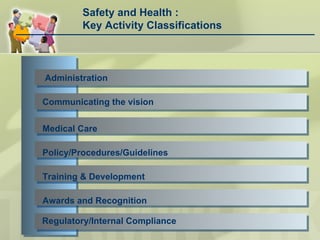
Safety and Health :  Key Activity Classifications Administration  Communicating the vision  Medical Care  Policy/Procedures/Guidelines  Training & Development  Awards and Recognition  Regulatory/Internal Compliance
Incident investigations .  Injury investigations (root cause analysis) Equipment/facility damage investigations Near miss investigations Fire investigations Each investigation involves a quick summary and incident gram distributed. Follow up review to ensure corrective action was initiated. Maintaining regulatory and other safety related reports.  Participate in monthly safety rep meeting.  Attend committee functions (central safety committee, mine maintenance and operations meetings, electrical committees, and local safety rep meetings.  General administrative tasks (emails, phone messages, face to face discussions.  Administration
Communication Establish clearly defined goals and expectations. Sponsor continuous sharing of best practices. Capitalize on streamlining information systems. Real time reporting as events occur Safe production as a daily message Posture safety as a core value Internal publications Regulatory arena (MSHA/OSHA) Public forums Address safety as an agenda item for all meetings
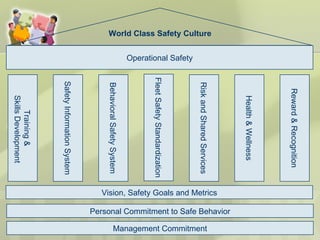
World Class Safety Culture Operational Safety Management Commitment Personal Commitment to Safe Behavior Vision, Safety Goals and Metrics Fleet Safety Standardization Behavioral Safety System Safety Information System Risk and Shared Services Health & Wellness Reward & Recognition Training & Skills Development
Subject: Thermo Safety Action Plan Daily rides with supervisors for some one on one feedback and gain insight as to what issues they see as opportunities for improvement and concerns. Talk to at least 10-15% of the craft employees to understand their issues and concerns. Focus on gaining insight as to recommendations by both groups on taking corrective action. Maintenance is a primary area to understand barriers to timely corrective action on equipment repair and how the status of repairs is communicated. Held shift meetings @ Thermo to discuss continued commitment to safety as a priority, employee accountability to shut down unsafe equipment, importance of communicating with management and stress the open door policy, and address bringing back two supervisors.
Subject: Thermo Safety Action Plan Attend daily shift change meetings and reinforce the message that we are facilitating best practices and want everyone’s support/recommendations. Attend Thursday safety meetings to discuss general observations and point out areas that are handled well and ask questions about issues of concern.  Consider how well preops are appropriately identifying/documenting issues and aligned with what you observe. Spend time with the BST facilitators (Jackie Hooker/Lyle Lawler) and gain their perspective on gaps in the behavior process and general views on safety concerns and processes that are working well.
Two Week Culture Survey Major areas for improvement: Communication Accountability Teamwork
Two Week Culture Survey - Communication Problem (Poor communication) Solutions Safety Central Safety Committee BST Action Plan tracking system Recognition of achievements SPS Safety Survey and Assessment Operating System New visual management system Process Improvement Form feedback Maintenance/Operations G Area plan Communication of weekly plan
Two Week Culture Survey - Accountability Problem (Lack of action to correct hazards) Solutions Increased accountability for  all  employees (including but  not limited to) Housekeeping (facilities and equipment) Highwalls/Spoil (parking under and/or working near) No smoking in shop Ramp, haulroad and berm conditions Lock out / Tag out procedures Safe equipment operation Potential for counseling and/or discipline
Safety  The Next Steps
Key Characteristics  Top Decile Safety Performance Commitment/Involvement Leadership Team Standard Practices Standardized Behavior-Based Process Focused Communications Measurement (leading indicators) Ownership
Key Strategies  Continuous Safety Process Improvement Drive out complacency and maintain a sense of urgency Focus on uniform systems, processes, and practices Define accountability and responsibility through the fleet Create a guiding coalition for organizational change Utilize a comprehensive safety culture survey to identify gaps Develop site specific tactical/strategic action plans based on survey priorities Build a shared vision for daily integration of safety with productivity Identify activities based metrics (leading indicators) Focus on sharing best practices
Standard Practices Implement a uniform approach to exposure monitoring (Industrial Hygiene Sampling) Define minimum job-specific physical requirements New hire medical exams including chest x-ray and pulmonary function testing Return-to-work medical evaluations  Establish uniform contractor compliance guidelines Incorporate a systems approach to accident investigation Establish a safety framework throughout the company Provide for comprehensive focused safety training (budget line item) Correct deficiencies as soon as possible Reduce tolerance level for not following the rules
Decision-based Safety Identify and promote safe behavior Create a mindset that all injuries are preventable Promote individual accountability for safety/coworkers Benchmark alternatives to BST Initiate pilot program at Winfield South as potential transition alternative March ‘08 Enable broad-based action for all employees Define core competency standards Assure ongoing process for continuous improvement
Communications Define clearly defined goals and expectations Sponsor continuous sharing of best practices Capitalize on streamlined information systems Real time reporting as events occur Safe production as a daily message Posture safety as a core value Internal publications Annual report Regulatory arena (MSHA/OSHA) Public forums Address safety as an agenda item for all meetings
Measurement Establish upstream factors to assess performance Near misses Safety meetings  Process audits Behavioral observations Inspection of physical conditions “Safety Blitz” incorporating process safety Focus on activities that demonstrate employee involvement
Ownership Ensure safety process is driven by operations management Establish line management responsibility and accountability Ensure safety reporting structure is at the appropriate level Incorporate wellness as a cost avoidance strategy Extend safety process to incorporate family issues Sponsor annual skills development safety conference

Key Safety Initiatives1

  • 1.
    Safety Initiatives KeyComponents for Continuous Safety Improvement
  • 2.
  • 3.
  • 4.
    Safety Performance MilestonesWinfield South Mine 2,000,000 hours without a disabling injury Oak Hill Mine 4,000,000 hours without a recordable injury Beckville Maintenance Dept. 1 year without a disabling injury Beckville Mine 6 months injury free Martin Lake Railroad 18 months without a disabling injury Tatum 1168 days without a recordable injury Big Brown Mine 8 years without lost time injury
  • 5.
  • 6.
    Safety Performance Status’07 vs. Prior Year Lost-time rate 54% improvement Dart-rate 59% improvement 80% of mining operations worked without a lost-time injury 30% of mining operations worked without a recordable injury Total incident rate 34% better than industry average
  • 7.
    1 st Quarter Accomplishments Completed comprehensive MSHA 8-hour refresher training Initiated studies (geotech) for ground control at all sites MSHA Safety stand downs by managers all mines with all employees Completed safety blitz @ BB, KO, TO, MO Retrained RR personnel on car maintenance @ ML & MO Safety Performance Solutions safety survey/gap analysis WS Started phase 1 of behavior process training Complete review of safety reps job activities Preop train the trainer started Developed supervisor safety training program Completed safety database specifications and vendor review Updated safety handbook ready for union/labor relations review Identified vendor for drug and alcohol baseline/random testing Held one day training for safety reps to address standardization Prepared draft template for addressing awards & recognition Defined top 10 process safety initiatives
  • 8.
    Identify a trainingbudget as a line item to support all employee safety training Finalize vendor contract for turnkey drug testing process Gain consensus for award & recognition process across Luminant Supervisor safety leadership training completed Phase 2 of behavior based training at Winfield South completed Review Luminant’s safety process and strategic direction Leverage our commitment on safety to enhance relationships…build management trust/credibility Developed contractor talking points/issues to host a conference call 3 rd quarter Identify key issues for a union management summit on safety gaps Focus on craft accountability and reducing tolerance for not following the rules Completed action plan for integrating process safety Created taskforce to update Rail Road task training and preop process Conduct safety blitz @ Beckville... Oak Hill, and Tatum completed Second Quarter Activities for Continuous Safety Improvement
  • 9.
    Key Strategies Continuous Safety Process Improvement Communicate a shared vision Senior management involved in safety performance celebrations Reinforce the message that “If it’s not safe, don’t do it Support sharing of real time safety information through a comprehensive database Remove obstacles and empower broad based action among supervisors Clearly define supervisors role in safety by focusing on: Confronting unsafe practices Reinforcing safe practices Balanced daily view of productivity, safety, and quality Supervisors will complete a comprehensive safety leadership training program
  • 10.
    Strategic Issues TransitionBST & SPS to Luminant defined behavior process Identify a needs assessment for potential health risks of environmental exposures Develop medical standards for new hire and return to work job placement Conduct periodic and routine industrial hygiene sampling protocol Drive safety performance by activities based metrics ( # of observations, safety inspections, near-miss reporting, etc.) Develop a comprehensive communication plan to achieve optimum awareness Clearly define accountability structure for all operations/staff stakeholders Transition KPI’s to total incidents Implement a comprehensive wellness process and tracking system Incorporate near-miss reporting and corrective action process Align ROI and Safety to enhance awareness with job package process Hold management workshop for benchmarking world class and defining Luminant safety process gaps
  • 11.
    Safety Reps RoutineJob Activities Allocation of Time Distribution for Current Job Priorities
  • 12.
    Safety and Health: Key Activity Classifications Administration Communicating the vision Medical Care Policy/Procedures/Guidelines Training & Development Awards and Recognition Regulatory/Internal Compliance
  • 13.
    Incident investigations . Injury investigations (root cause analysis) Equipment/facility damage investigations Near miss investigations Fire investigations Each investigation involves a quick summary and incident gram distributed. Follow up review to ensure corrective action was initiated. Maintaining regulatory and other safety related reports. Participate in monthly safety rep meeting. Attend committee functions (central safety committee, mine maintenance and operations meetings, electrical committees, and local safety rep meetings. General administrative tasks (emails, phone messages, face to face discussions. Administration
  • 14.
    Communication Establish clearlydefined goals and expectations. Sponsor continuous sharing of best practices. Capitalize on streamlining information systems. Real time reporting as events occur Safe production as a daily message Posture safety as a core value Internal publications Regulatory arena (MSHA/OSHA) Public forums Address safety as an agenda item for all meetings
  • 15.
    World Class SafetyCulture Operational Safety Management Commitment Personal Commitment to Safe Behavior Vision, Safety Goals and Metrics Fleet Safety Standardization Behavioral Safety System Safety Information System Risk and Shared Services Health & Wellness Reward & Recognition Training & Skills Development
  • 16.
    Subject: Thermo SafetyAction Plan Daily rides with supervisors for some one on one feedback and gain insight as to what issues they see as opportunities for improvement and concerns. Talk to at least 10-15% of the craft employees to understand their issues and concerns. Focus on gaining insight as to recommendations by both groups on taking corrective action. Maintenance is a primary area to understand barriers to timely corrective action on equipment repair and how the status of repairs is communicated. Held shift meetings @ Thermo to discuss continued commitment to safety as a priority, employee accountability to shut down unsafe equipment, importance of communicating with management and stress the open door policy, and address bringing back two supervisors.
  • 17.
    Subject: Thermo SafetyAction Plan Attend daily shift change meetings and reinforce the message that we are facilitating best practices and want everyone’s support/recommendations. Attend Thursday safety meetings to discuss general observations and point out areas that are handled well and ask questions about issues of concern. Consider how well preops are appropriately identifying/documenting issues and aligned with what you observe. Spend time with the BST facilitators (Jackie Hooker/Lyle Lawler) and gain their perspective on gaps in the behavior process and general views on safety concerns and processes that are working well.
  • 18.
    Two Week CultureSurvey Major areas for improvement: Communication Accountability Teamwork
  • 19.
    Two Week CultureSurvey - Communication Problem (Poor communication) Solutions Safety Central Safety Committee BST Action Plan tracking system Recognition of achievements SPS Safety Survey and Assessment Operating System New visual management system Process Improvement Form feedback Maintenance/Operations G Area plan Communication of weekly plan
  • 20.
    Two Week CultureSurvey - Accountability Problem (Lack of action to correct hazards) Solutions Increased accountability for all employees (including but not limited to) Housekeeping (facilities and equipment) Highwalls/Spoil (parking under and/or working near) No smoking in shop Ramp, haulroad and berm conditions Lock out / Tag out procedures Safe equipment operation Potential for counseling and/or discipline
  • 21.
    Safety TheNext Steps
  • 22.
    Key Characteristics Top Decile Safety Performance Commitment/Involvement Leadership Team Standard Practices Standardized Behavior-Based Process Focused Communications Measurement (leading indicators) Ownership
  • 23.
    Key Strategies Continuous Safety Process Improvement Drive out complacency and maintain a sense of urgency Focus on uniform systems, processes, and practices Define accountability and responsibility through the fleet Create a guiding coalition for organizational change Utilize a comprehensive safety culture survey to identify gaps Develop site specific tactical/strategic action plans based on survey priorities Build a shared vision for daily integration of safety with productivity Identify activities based metrics (leading indicators) Focus on sharing best practices
  • 24.
    Standard Practices Implementa uniform approach to exposure monitoring (Industrial Hygiene Sampling) Define minimum job-specific physical requirements New hire medical exams including chest x-ray and pulmonary function testing Return-to-work medical evaluations Establish uniform contractor compliance guidelines Incorporate a systems approach to accident investigation Establish a safety framework throughout the company Provide for comprehensive focused safety training (budget line item) Correct deficiencies as soon as possible Reduce tolerance level for not following the rules
  • 25.
    Decision-based Safety Identifyand promote safe behavior Create a mindset that all injuries are preventable Promote individual accountability for safety/coworkers Benchmark alternatives to BST Initiate pilot program at Winfield South as potential transition alternative March ‘08 Enable broad-based action for all employees Define core competency standards Assure ongoing process for continuous improvement
  • 26.
    Communications Define clearlydefined goals and expectations Sponsor continuous sharing of best practices Capitalize on streamlined information systems Real time reporting as events occur Safe production as a daily message Posture safety as a core value Internal publications Annual report Regulatory arena (MSHA/OSHA) Public forums Address safety as an agenda item for all meetings
  • 27.
    Measurement Establish upstreamfactors to assess performance Near misses Safety meetings Process audits Behavioral observations Inspection of physical conditions “Safety Blitz” incorporating process safety Focus on activities that demonstrate employee involvement
  • 28.
    Ownership Ensure safetyprocess is driven by operations management Establish line management responsibility and accountability Ensure safety reporting structure is at the appropriate level Incorporate wellness as a cost avoidance strategy Extend safety process to incorporate family issues Sponsor annual skills development safety conference