Key concepts and critical approaches
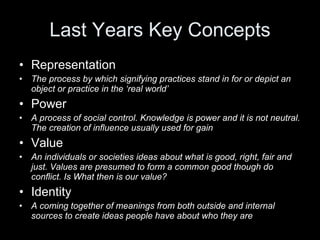
Last Years Key Concepts Representation  The process by which signifying practices stand in for or depict an object or practice in the ‘real world’ Power  A process of social control. Knowledge is power and it is not neutral. The creation of influence usually used for gain Value  An individuals or societies ideas about what is good, right, fair and just. Values are presumed to form a common good though do conflict. Is What then is our value? Identity A coming together of meanings from both outside and internal sources to create ideas people have about who they are
This Years Key Concepts Ideology  A collection of concepts, ideas and values reflecting what is important to a particular group at a given time. Ideology as a structure Mode of Address  ‘ who does the text think I am?’ How we are addressed or positioned by texts. How a text may help form us on ideological lines Discourse  A type of language, or sentence. Like an ideology it constructs reality
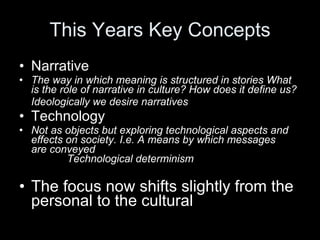
This Years Key Concepts Narrative  The way in which meaning is structured in stories What is the role of narrative in culture? How does it define us? Ideologically we desire narratives Technology Not as objects but exploring technological aspects and effects on society. I.e. A means by which messages  are conveyed  Technological determinism The focus now shifts slightly from the personal to the cultural
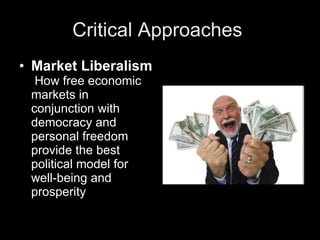
Critical Approaches  Market Liberalism   How free economic markets in conjunction with democracy and personal freedom provide the best political model for well-being and prosperity
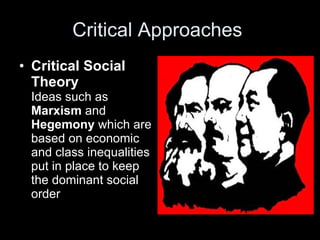
Critical Approaches  Critical Social Theory   Ideas such as  Marxism  and  Hegemony  which are based on economic and class inequalities put in place to keep the dominant social order
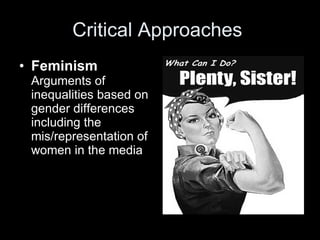
Critical Approaches  Feminism   Arguments of inequalities based on gender differences including the mis/representation of women in the media
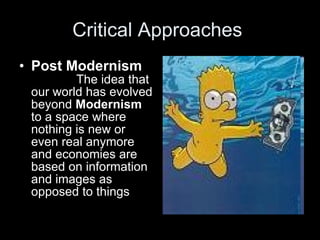
Critical Approaches  Post Modernism   The idea that our world has evolved beyond  Modernism  to a space where nothing is new or even real anymore and economies are based on information and images as opposed to things
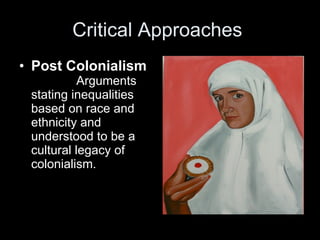
Critical Approaches  Post Colonialism   Arguments stating inequalities based on race and ethnicity and understood to be a cultural legacy of colonialism.

Key concepts and critical approaches

  • 1.
    Key concepts andcritical approaches
  • 2.
    Last Years KeyConcepts Representation The process by which signifying practices stand in for or depict an object or practice in the ‘real world’ Power A process of social control. Knowledge is power and it is not neutral. The creation of influence usually used for gain Value An individuals or societies ideas about what is good, right, fair and just. Values are presumed to form a common good though do conflict. Is What then is our value? Identity A coming together of meanings from both outside and internal sources to create ideas people have about who they are
  • 3.
    This Years KeyConcepts Ideology A collection of concepts, ideas and values reflecting what is important to a particular group at a given time. Ideology as a structure Mode of Address ‘ who does the text think I am?’ How we are addressed or positioned by texts. How a text may help form us on ideological lines Discourse A type of language, or sentence. Like an ideology it constructs reality
  • 4.
    This Years KeyConcepts Narrative The way in which meaning is structured in stories What is the role of narrative in culture? How does it define us? Ideologically we desire narratives Technology Not as objects but exploring technological aspects and effects on society. I.e. A means by which messages are conveyed Technological determinism The focus now shifts slightly from the personal to the cultural
  • 5.
    Critical Approaches Market Liberalism How free economic markets in conjunction with democracy and personal freedom provide the best political model for well-being and prosperity
  • 6.
    Critical Approaches Critical Social Theory Ideas such as Marxism and Hegemony which are based on economic and class inequalities put in place to keep the dominant social order
  • 7.
    Critical Approaches Feminism Arguments of inequalities based on gender differences including the mis/representation of women in the media
  • 8.
    Critical Approaches Post Modernism The idea that our world has evolved beyond Modernism to a space where nothing is new or even real anymore and economies are based on information and images as opposed to things
  • 9.
    Critical Approaches Post Colonialism Arguments stating inequalities based on race and ethnicity and understood to be a cultural legacy of colonialism.