The Ketogenic Diet
Through the Ages
Saba Ahmad, MD
Assistant Professor of Clinical Pediatrics and Neurology
University of Illinois, Chicago
Disclosures
• Nothing to Disclose
What is the Ketogenic Diet?
• Dietary measures to induce a state of ketosis
• Ketosis is the formation of ketone bodies when a
body’s metabolism is burning fats as a primary
fuel source to generate ATP
Why do we care about
ketosis?
The generation of ketosis is the OLDEST KNOWN
method for treating epilepsy
In the modern day, it is also seen as one of the most
effective methods of treating medication resistant
epilepsy.
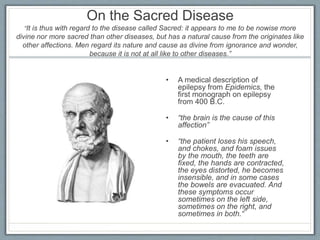
On the Sacred Disease
“It is thus with regard to the disease called Sacred: it appears to me to be nowise more
divine nor more sacred than other diseases, but has a natural cause from the originates like
other affections. Men regard its nature and cause as divine from ignorance and wonder,
because it is not at all like to other diseases.”
• A medical description of
epilepsy from Epidemics, the
first monograph on epilepsy
from 400 B.C.
• “the brain is the cause of this
affection”
• “the patient loses his speech,
and chokes, and foam issues
by the mouth, the teeth are
fixed, the hands are contracted,
the eyes distorted, he becomes
insensible, and in some cases
the bowels are evacuated. And
these symptoms occur
sometimes on the left side,
sometimes on the right, and
sometimes in both.“
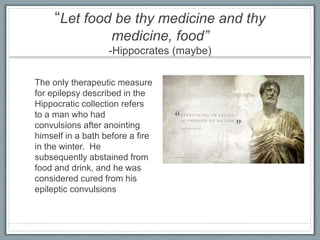
“Let food be thy medicine and thy
medicine, food”
-Hippocrates (maybe)
The only therapeutic measure
for epilepsy described in the
Hippocratic collection refers
to a man who had
convulsions after anointing
himself in a bath before a fire
in the winter. He
subsequently abstained from
food and drink, and he was
considered cured from his
epileptic convulsions
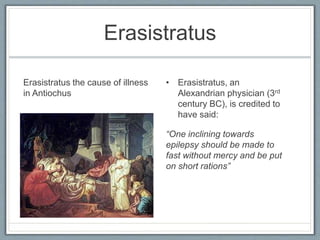
Erasistratus
Erasistratus the cause of illness
in Antiochus
• Erasistratus, an
Alexandrian physician (3rd
century BC), is credited to
have said:
“One inclining towards
epilepsy should be made to
fast without mercy and be put
on short rations”
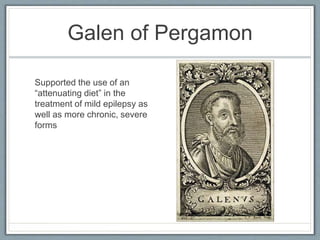
Galen of Pergamon
Supported the use of an
“attenuating diet” in the
treatment of mild epilepsy as
well as more chronic, severe
forms
Moribus Divinus
• The terms “Sacred Disease” moribus divinus or
“Great Disease” moribus maior are found in the
Hippocratic Corpus and ancient texts
• The term moribus maior continued to be used as a
term for epilepsy, and made its way into medieval
French as “grand mal” which continues to be used
today as a term for the “great” epileptic attack
Ancient physicians
• Hippocrates and few of his contemporaries did not
seem to give credence to the idea that these
illnesses were “Divine” in nature
• However, popular theories at the time did indicate
that most people thought that epilepsy was sacred
because it was “sent by a deity” or a that demon
had entered the patient
A Spiritual Affliction
• The notion that epilepsy was caused by a sort of
spiritual affliction or demonic possession was
widely accepted until very recently in history
• Fasting, long considered an act of spiritual
purification, helped epileptic patients
• This may have caused the notion of epilepsy
being a spiritual affliction to persist
New Testament
Mark 9:14-29 (circa 30 A.D.)
These verses tell the tale of a father who brings his
son to Jesus because he was “possessed by an
unclean spirit”
Verse 18
“Master, I have brought unto thee my son, which
hath a dumb spirit; And wheresoever he taketh him,
he teareth him: and he foameth, and gnasheth with
his teeth, and pineth away...”
Biblical Texts
• (Jesus picture) Verse 29
“And he (Jesus) said unto
them, This kind can come
forth by nothing, but by prayer
and fasting.”
"The Possessed Boy at the Foot of Mount Tabor”
(circa late 1890s) by James Tissot
Modern Day
The first published medical literature regarding
dietary manipulation in epilepsy was published in
1911.
Two French physicians Guelpa and Marie describe
fasting followed by a very restrictive vegetarian diet
in the treatment of epilepsy
1921-22
• Hugh Conklin, was treating
epilepsy patients with an
18-25 day fast, and
claimed a 90% cure rate in
children and a 50% cure
rate in adults
• H. Rawle Geyelin, an
American endocrinologist,
noted that fasting
suppressed seizures,
sometimes for many
months after the fast was
over
• He was also the first to
note the cognitive
improvement observed
with fasting
Why did fasting work?
• In the early 1920’s Dr.
Stanley Cobb and W.G.
Lennox observed that
seizure improvement was
noted at 2-3 days into the
fasting period.
• In 1921, Woodyatt
observed that acetone and
beta-hydroxy butyric acid
were produced in normal
fasted subjects
• That same year Russell
Wilder, from the Mayo
Clinic, proposed that
ketonemia, produced by
other means may be
effective at treating
seizures
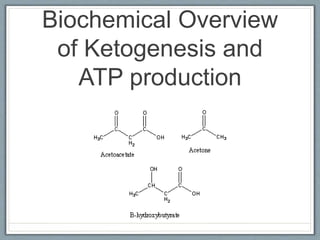
Biochemical Overview
of Ketogenesis and
ATP production
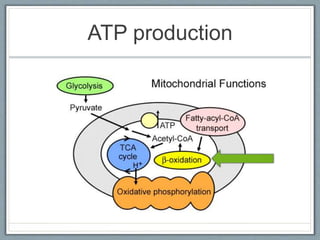
ATP production
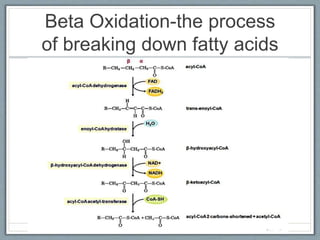
Beta Oxidation-the process
of breaking down fatty acids
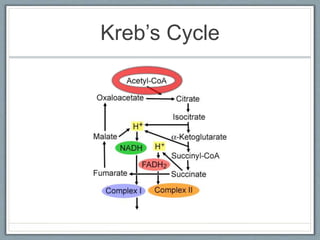
Kreb’s Cycle
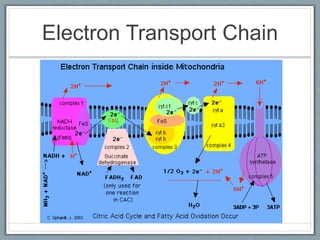
Electron Transport Chain
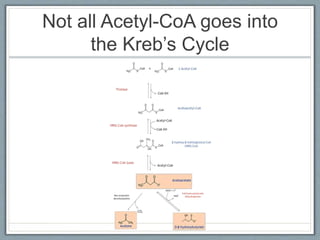
Not all Acetyl-CoA goes into
the Kreb’s Cycle
What happens during ketosis
• Fatty acids cannot readily cross the blood brain
barrier
• When there is no carbohydrate source, ketones
readily cross the blood brain barrier and used as
fuel
The problem with fasting
• NOT a long term solution
• While seizures went away for some months after a
prolonged fast, they often returned
• The ketogenic diet, proposed by Wilder, allowed
for sustained nutrition, primarily in the form of
dietary fat, and continued to provide the benefits
of long term ketonemia to control seizures
The Ketogenic Diet is
born
• Wilder’s colleague, Mynie Peterman, a
pediatrician formulated the classic ketogenic diet.
• “anti-ketogenic foods” such as carbohydrates and
excessive protein were limited: 10-15 grams of
carbohydrates daily and 1 gram/kilogram of
bodyweight of protein
• “ketogenic foods” (fats) made up the rest of the
calories
The Ketogenic Diet
• Peterman showed the diet to be very successful in
children with 95% of patients having improved
seizure control, with 60% of children becoming
seizure free on this regimen
• Peterman was also the first to observe the
cognitive improvements in children on the
ketogenic diet
• The ketogenic diet was described in almost every
textbook on pediatric epilepsy published between
1941 and 1980
The Ketogenic Diet in Adults
• Clifford Barborka, also at the Mayo Clinic, studied
the diet in teenagers and adults
• While more than 50% of patients had a reduction
in seizures, and 12% of these patients became
seizure free-it was concluded that adults were less
likely to benefit from this treatment, and this mode
of therapy was not studied in adults again until the
end of the century
The “classic” ketogenic diet
protocol
• Also called the “Hopkins ketogenic diet protocol”
was popularized by Livingston and Freeman
• Patients were fasted for a period of 24-72 hours
until ketonuria was established and then initiated
on the diet over 3 days to a “4:1 ratio” is achieved
• The ratio refers to 4 grams fat per every 1 gram of
protein + carbohydrates
• Patients less than 2 years old typically given a 3:1
ratio diet
The problem with palatability
• While incredibly effective, the diet was considered
HIGHLY unpalatable and restrictive
• Medium chain triglycerides (MCT’s), were found to
produce more ketone bodies per calorie than
traditional dietary fats which consist mainly of long
chain triglycerides
• Peter Huttenlocher, in 1971, devised a form of the diet
which was 60% MCT oil, which allowed patients to
consume higher amounts of protein and
carbohydrates, with similar effectiveness as the classic
ketogenic diet
The early days of the
ketogenic diet
• Was the mainstay of epilepsy treatment in children
throughout the 1920’s and 1930’s
• In 1972, Livingston from Hopkins, published data
on over 1000 children that were followed over the
prior decades. His data indicated that 52% of
children achieved complete seizure freedom on
the diet, and 27% had improved seizure control.
The pharmacological era
• In 1938, Merrit and Putnam developed the medication
phenytoin
• In the 70’s and 80’s valproic acid and carbemazepine
were developed
• The increased variety of available medications, along
with their ease of use compared to the ketogenic diet
caused the diet to fall out of favor
• This led to fewer dieticians trained in its administration,
and subsequently a change in the perception of it’s
effectiveness
Charlie’s story
• In 1994, the spotlight was again shown on the
ketogenic diet in a program on NBC’s Dateline
• Charlie Abrahams was a 2 year old who suffered
medication resistant generalized epilepsy
• He ultimately went to Hopkins and was started on
the ketogenic diet, and became seizure free
• Charlie’s father started the Charlie Foundation,
which supplied information for medical providers
and families regarding the ketogenic diet
Modern data on effectiveness
in children
• A meta-analysis of the more rigorous studies of the
ketogenic diet, the overall effectiveness observed
• 56% of patients see a 50% or greater reduction in
seizures
• 32% of children had a greater than 90% reduction in
seizures
• and 16% became seizure free
• Most patients in these studies were medication
resistant
Zupec-Kania BA, Spellman E. An overview of the ketogenic diet for pediatric
epilepsy. Nutr Clin Pract 2008;23:589-96
Modern data on effectiveness
in adults
• A meta-analysis of studies of adults on any type of
ketogenic diet confirmed that adults have a better
seizure response but have lower compliance/long-
term adhesion, on the classic ketogenic diet than
on the modified Atkins diet
Ye F, Li XJ, Jiang WL, Sun HB, Liu J. Efficacy of and patient compliance with a
ketogenic diet in adults with intractable epilepsy: a meta-analysis. J Clin Neurol
2015;11(1): 26–31
Problems
• Like any therapy for epilepsy, the ketogenic diet is
not side effect free, and many side effects are not
trivial
• Can cause renal calculi, vitamin and mineral
deficiencies, pancreatitis, hyperlipidemia, growth
failure, cardiovascular disease (in adults), bone
mineral loss (in children)
Contraindications
• Fatty acid oxidation disorders are an ABSOLUTE
contraindication
• Caution should be exercised with disorders of
energy metabolism
• with the exception of GLUT1 deficiency, pyruvate
dehydrogenase deficiency, phosphofructokinase
deficiency-where the ketogenic diet is the therapy of
choice
Why does it work to control
seizures?
• The short answer is, nobody knows.
• There have been many proposed mechanisms,
but few have been supported by basic science
research
Some theories on why it
might work
• Some proposed mechanism have been disproved by
later research
• Lennox and Lennox in 1960 proposed that the the
seizure control was due to intracerebral acidosis.
However, intracerebral pH does not seem to change in
animals (Al-Muldallal 1996) or humans (Novotny 1997)
• Millichap in 1964 proposed that negative sodium and
potassium balances were the reason for the anti-
convulsant effect. Huttenlocher later showed this did
not seem to have significant effect.
More theories-Lipids
• There were also theories that hyperlipidemia had a direct
anticonvulsant effect. Huttenlocher in 1976 also showed this
have little contribution to the anticonvulsant effect
• More recently, many people have proposed that elevations
polyunsaturated fatty acids have a role in seizure control.
Cunnane in 2002 showed that arachidonate and
docosahexaenoate have some anticonvulsant role. Cullingford
in 2004 showed that longer-chain and unsaturated fatty acids
are associated with the anticonvulsant activity.
• Elevated polyunsaturated fatty acids may work in concert with
ketones
• Polyunsaturated fatty acids may decrease cyclooxegenase 2
(COX2) synthesis of eicosanoids. Eicosanoids are thought to play a
role in kainic acid induced hippocampal cell death and seizure
potentiation (Cullingford 2004, Kunz and Oliw 2001)
Neuroprotection and anti-
epileptogenesis
• The ketogenic diet has been shown to inhibit
caspase-3 mediated hippocampal neuronal cell
apoptosis in rat models with kainic acid induced
seizures.
• This might suggest an anti-epileptogenic effect
• May also indicate that early implementation of the
diet may mediate some epilepsy associated learning
and memory deficits (Noh 2008)
Neurotransmitter modulation
• Increased GABAergic effects either directly or
indirectly
• Cheng et al in 2004 suggested demonstrated that
caloric restriction augments brain glutamic acid
decarboxylase (thereby increasing glutamate
conversion to GABA)
• Yudkoff et al in 2005 demonstrated that in ketosis
there is greater production of acetyl-CoA.
• This disrupts the equilibrium of the aspartate
aminotransferase reaction
• Diminished aspartate production
• Potentially enhanced synthesis of glutamine and GABA.
Possible direct anti-
convulsant effect of ketone
bodies
• Acetone seems to have anticonvulsant effects in
animal models (Keith 1933, Likhodii 2003)
• In vitro ketone bodies potentiate GABAA-mediated
inhibitory post-synaptic potentials in hippocampal
CA1 neurons (Ge and Neisen 1998)
Chronic changes in
hippocampal excitability
• In 1999, Stafstrom demonstrated that in rats made
chronically epileptic by kainic acid, the ketogenic
diet is associated with
• Fewer spontaneous seizures
• Decreased in vitro excitability of hippocampal CA1
neurons
• Decreased mossy fiber sprouting
• Xu et al in 2006 demonstrated that the ketogenic
diet may upregulate young rat GluR(5) in inhibitory
interneurons of CA1
The likely story is that ketosis
induces multifactorial
metabolic changes that occur
on the cellular level to
promote seizure control and
possibly epileptogeneis
Uses other than medication
resistant epilepsy
• GLUT1 deficiency, phosphofructokinase
deficiency, pyruvate dehydrogenase deficiency
• Acute refractory status epilepticus
• Possible indications as adjunct treatment in brain
tumors, mood disorders
Its not just for epilepsy
anymore
• Strong interest in the ketogenic diet for patients with various
cancers/tumors (brain, lung, head and neck)
• As a treatment for metabolic syndrome, obesity, type 2
diabetes
• Effects on autism spectrum disorders
• Effects on Tourette's syndrome
• Effects in pediatric brain injury
• Effects in acute stroke
• Effects in multiple sclerosis and other autoimmune diseases
• Effects in ALS
• Effects in Alzheimer’s disease
Selected references
Temkin O. The Falling Sickness, 3nd ed. Johns Hopkins University Press, Baltimore, 1994;
Hippocrates. Epidemics. VII, 46: vol. 5.
Galen, De victu attenuante, c. 1.
Galen, De venae sect. adv. Erasistrateos Romae degentes, c. 8; vol. 11.
Mark 9:14–29. Bible: New King James Version. Guideposts, Carmel, NY, 1982.
Wheless JW. History and origin of the ketogenic diet. In: Epilepsy and the ketogenic diet. Stafstrom CE, Rho JM, editors. Totowa:
Humana Press; 2004.
Peterman MG. The ketogenic diet in epilepsy. JAMA 1925; 84:1979-8.2
Barborka CJ. Epilepsy in adults: results of treatment by ketogenic diet in one hundred cases. Arch Neurol Psychiatry 1930 23:904-
14.
Huttenlocher PR, Wilbourn AJ, Signore JM. Medium-chain triglycerides as a therapy for intractable childhood epilepsy. Neurology.
1971 Nov; 21(11):1097–103.
Ketogenic diet. “Dateline” NBC television. October 26, 1994.
Zupec-Kania BA, Spellman E. An overview of the ketogenic diet for pediatric epilepsy. Nutr Clin Pract 2008;23:589-96.
Thank you
Questions?

Ketogenic Diet through the ages

  • 1.
    The Ketogenic Diet Throughthe Ages Saba Ahmad, MD Assistant Professor of Clinical Pediatrics and Neurology University of Illinois, Chicago
  • 2.
  • 3.
    What is theKetogenic Diet? • Dietary measures to induce a state of ketosis • Ketosis is the formation of ketone bodies when a body’s metabolism is burning fats as a primary fuel source to generate ATP
  • 4.
    Why do wecare about ketosis? The generation of ketosis is the OLDEST KNOWN method for treating epilepsy In the modern day, it is also seen as one of the most effective methods of treating medication resistant epilepsy.
  • 5.
    On the SacredDisease “It is thus with regard to the disease called Sacred: it appears to me to be nowise more divine nor more sacred than other diseases, but has a natural cause from the originates like other affections. Men regard its nature and cause as divine from ignorance and wonder, because it is not at all like to other diseases.” • A medical description of epilepsy from Epidemics, the first monograph on epilepsy from 400 B.C. • “the brain is the cause of this affection” • “the patient loses his speech, and chokes, and foam issues by the mouth, the teeth are fixed, the hands are contracted, the eyes distorted, he becomes insensible, and in some cases the bowels are evacuated. And these symptoms occur sometimes on the left side, sometimes on the right, and sometimes in both.“
  • 6.
    “Let food bethy medicine and thy medicine, food” -Hippocrates (maybe) The only therapeutic measure for epilepsy described in the Hippocratic collection refers to a man who had convulsions after anointing himself in a bath before a fire in the winter. He subsequently abstained from food and drink, and he was considered cured from his epileptic convulsions
  • 7.
    Erasistratus Erasistratus the causeof illness in Antiochus • Erasistratus, an Alexandrian physician (3rd century BC), is credited to have said: “One inclining towards epilepsy should be made to fast without mercy and be put on short rations”
  • 8.
    Galen of Pergamon Supportedthe use of an “attenuating diet” in the treatment of mild epilepsy as well as more chronic, severe forms
  • 9.
    Moribus Divinus • Theterms “Sacred Disease” moribus divinus or “Great Disease” moribus maior are found in the Hippocratic Corpus and ancient texts • The term moribus maior continued to be used as a term for epilepsy, and made its way into medieval French as “grand mal” which continues to be used today as a term for the “great” epileptic attack
  • 10.
    Ancient physicians • Hippocratesand few of his contemporaries did not seem to give credence to the idea that these illnesses were “Divine” in nature • However, popular theories at the time did indicate that most people thought that epilepsy was sacred because it was “sent by a deity” or a that demon had entered the patient
  • 11.
    A Spiritual Affliction •The notion that epilepsy was caused by a sort of spiritual affliction or demonic possession was widely accepted until very recently in history • Fasting, long considered an act of spiritual purification, helped epileptic patients • This may have caused the notion of epilepsy being a spiritual affliction to persist
  • 12.
    New Testament Mark 9:14-29(circa 30 A.D.) These verses tell the tale of a father who brings his son to Jesus because he was “possessed by an unclean spirit” Verse 18 “Master, I have brought unto thee my son, which hath a dumb spirit; And wheresoever he taketh him, he teareth him: and he foameth, and gnasheth with his teeth, and pineth away...”
  • 13.
    Biblical Texts • (Jesuspicture) Verse 29 “And he (Jesus) said unto them, This kind can come forth by nothing, but by prayer and fasting.” "The Possessed Boy at the Foot of Mount Tabor” (circa late 1890s) by James Tissot
  • 14.
    Modern Day The firstpublished medical literature regarding dietary manipulation in epilepsy was published in 1911. Two French physicians Guelpa and Marie describe fasting followed by a very restrictive vegetarian diet in the treatment of epilepsy
  • 15.
    1921-22 • Hugh Conklin,was treating epilepsy patients with an 18-25 day fast, and claimed a 90% cure rate in children and a 50% cure rate in adults • H. Rawle Geyelin, an American endocrinologist, noted that fasting suppressed seizures, sometimes for many months after the fast was over • He was also the first to note the cognitive improvement observed with fasting
  • 16.
    Why did fastingwork? • In the early 1920’s Dr. Stanley Cobb and W.G. Lennox observed that seizure improvement was noted at 2-3 days into the fasting period. • In 1921, Woodyatt observed that acetone and beta-hydroxy butyric acid were produced in normal fasted subjects • That same year Russell Wilder, from the Mayo Clinic, proposed that ketonemia, produced by other means may be effective at treating seizures
  • 17.
  • 18.
  • 19.
    Beta Oxidation-the process ofbreaking down fatty acids
  • 20.
  • 21.
  • 22.
    Not all Acetyl-CoAgoes into the Kreb’s Cycle
  • 23.
    What happens duringketosis • Fatty acids cannot readily cross the blood brain barrier • When there is no carbohydrate source, ketones readily cross the blood brain barrier and used as fuel
  • 24.
    The problem withfasting • NOT a long term solution • While seizures went away for some months after a prolonged fast, they often returned • The ketogenic diet, proposed by Wilder, allowed for sustained nutrition, primarily in the form of dietary fat, and continued to provide the benefits of long term ketonemia to control seizures
  • 25.
    The Ketogenic Dietis born • Wilder’s colleague, Mynie Peterman, a pediatrician formulated the classic ketogenic diet. • “anti-ketogenic foods” such as carbohydrates and excessive protein were limited: 10-15 grams of carbohydrates daily and 1 gram/kilogram of bodyweight of protein • “ketogenic foods” (fats) made up the rest of the calories
  • 26.
    The Ketogenic Diet •Peterman showed the diet to be very successful in children with 95% of patients having improved seizure control, with 60% of children becoming seizure free on this regimen • Peterman was also the first to observe the cognitive improvements in children on the ketogenic diet • The ketogenic diet was described in almost every textbook on pediatric epilepsy published between 1941 and 1980
  • 27.
    The Ketogenic Dietin Adults • Clifford Barborka, also at the Mayo Clinic, studied the diet in teenagers and adults • While more than 50% of patients had a reduction in seizures, and 12% of these patients became seizure free-it was concluded that adults were less likely to benefit from this treatment, and this mode of therapy was not studied in adults again until the end of the century
  • 28.
    The “classic” ketogenicdiet protocol • Also called the “Hopkins ketogenic diet protocol” was popularized by Livingston and Freeman • Patients were fasted for a period of 24-72 hours until ketonuria was established and then initiated on the diet over 3 days to a “4:1 ratio” is achieved • The ratio refers to 4 grams fat per every 1 gram of protein + carbohydrates • Patients less than 2 years old typically given a 3:1 ratio diet
  • 29.
    The problem withpalatability • While incredibly effective, the diet was considered HIGHLY unpalatable and restrictive • Medium chain triglycerides (MCT’s), were found to produce more ketone bodies per calorie than traditional dietary fats which consist mainly of long chain triglycerides • Peter Huttenlocher, in 1971, devised a form of the diet which was 60% MCT oil, which allowed patients to consume higher amounts of protein and carbohydrates, with similar effectiveness as the classic ketogenic diet
  • 30.
    The early daysof the ketogenic diet • Was the mainstay of epilepsy treatment in children throughout the 1920’s and 1930’s • In 1972, Livingston from Hopkins, published data on over 1000 children that were followed over the prior decades. His data indicated that 52% of children achieved complete seizure freedom on the diet, and 27% had improved seizure control.
  • 31.
    The pharmacological era •In 1938, Merrit and Putnam developed the medication phenytoin • In the 70’s and 80’s valproic acid and carbemazepine were developed • The increased variety of available medications, along with their ease of use compared to the ketogenic diet caused the diet to fall out of favor • This led to fewer dieticians trained in its administration, and subsequently a change in the perception of it’s effectiveness
  • 32.
    Charlie’s story • In1994, the spotlight was again shown on the ketogenic diet in a program on NBC’s Dateline • Charlie Abrahams was a 2 year old who suffered medication resistant generalized epilepsy • He ultimately went to Hopkins and was started on the ketogenic diet, and became seizure free • Charlie’s father started the Charlie Foundation, which supplied information for medical providers and families regarding the ketogenic diet
  • 33.
    Modern data oneffectiveness in children • A meta-analysis of the more rigorous studies of the ketogenic diet, the overall effectiveness observed • 56% of patients see a 50% or greater reduction in seizures • 32% of children had a greater than 90% reduction in seizures • and 16% became seizure free • Most patients in these studies were medication resistant Zupec-Kania BA, Spellman E. An overview of the ketogenic diet for pediatric epilepsy. Nutr Clin Pract 2008;23:589-96
  • 34.
    Modern data oneffectiveness in adults • A meta-analysis of studies of adults on any type of ketogenic diet confirmed that adults have a better seizure response but have lower compliance/long- term adhesion, on the classic ketogenic diet than on the modified Atkins diet Ye F, Li XJ, Jiang WL, Sun HB, Liu J. Efficacy of and patient compliance with a ketogenic diet in adults with intractable epilepsy: a meta-analysis. J Clin Neurol 2015;11(1): 26–31
  • 35.
    Problems • Like anytherapy for epilepsy, the ketogenic diet is not side effect free, and many side effects are not trivial • Can cause renal calculi, vitamin and mineral deficiencies, pancreatitis, hyperlipidemia, growth failure, cardiovascular disease (in adults), bone mineral loss (in children)
  • 36.
    Contraindications • Fatty acidoxidation disorders are an ABSOLUTE contraindication • Caution should be exercised with disorders of energy metabolism • with the exception of GLUT1 deficiency, pyruvate dehydrogenase deficiency, phosphofructokinase deficiency-where the ketogenic diet is the therapy of choice
  • 37.
    Why does itwork to control seizures? • The short answer is, nobody knows. • There have been many proposed mechanisms, but few have been supported by basic science research
  • 38.
    Some theories onwhy it might work • Some proposed mechanism have been disproved by later research • Lennox and Lennox in 1960 proposed that the the seizure control was due to intracerebral acidosis. However, intracerebral pH does not seem to change in animals (Al-Muldallal 1996) or humans (Novotny 1997) • Millichap in 1964 proposed that negative sodium and potassium balances were the reason for the anti- convulsant effect. Huttenlocher later showed this did not seem to have significant effect.
  • 39.
    More theories-Lipids • Therewere also theories that hyperlipidemia had a direct anticonvulsant effect. Huttenlocher in 1976 also showed this have little contribution to the anticonvulsant effect • More recently, many people have proposed that elevations polyunsaturated fatty acids have a role in seizure control. Cunnane in 2002 showed that arachidonate and docosahexaenoate have some anticonvulsant role. Cullingford in 2004 showed that longer-chain and unsaturated fatty acids are associated with the anticonvulsant activity. • Elevated polyunsaturated fatty acids may work in concert with ketones • Polyunsaturated fatty acids may decrease cyclooxegenase 2 (COX2) synthesis of eicosanoids. Eicosanoids are thought to play a role in kainic acid induced hippocampal cell death and seizure potentiation (Cullingford 2004, Kunz and Oliw 2001)
  • 40.
    Neuroprotection and anti- epileptogenesis •The ketogenic diet has been shown to inhibit caspase-3 mediated hippocampal neuronal cell apoptosis in rat models with kainic acid induced seizures. • This might suggest an anti-epileptogenic effect • May also indicate that early implementation of the diet may mediate some epilepsy associated learning and memory deficits (Noh 2008)
  • 41.
    Neurotransmitter modulation • IncreasedGABAergic effects either directly or indirectly • Cheng et al in 2004 suggested demonstrated that caloric restriction augments brain glutamic acid decarboxylase (thereby increasing glutamate conversion to GABA) • Yudkoff et al in 2005 demonstrated that in ketosis there is greater production of acetyl-CoA. • This disrupts the equilibrium of the aspartate aminotransferase reaction • Diminished aspartate production • Potentially enhanced synthesis of glutamine and GABA.
  • 42.
    Possible direct anti- convulsanteffect of ketone bodies • Acetone seems to have anticonvulsant effects in animal models (Keith 1933, Likhodii 2003) • In vitro ketone bodies potentiate GABAA-mediated inhibitory post-synaptic potentials in hippocampal CA1 neurons (Ge and Neisen 1998)
  • 43.
    Chronic changes in hippocampalexcitability • In 1999, Stafstrom demonstrated that in rats made chronically epileptic by kainic acid, the ketogenic diet is associated with • Fewer spontaneous seizures • Decreased in vitro excitability of hippocampal CA1 neurons • Decreased mossy fiber sprouting • Xu et al in 2006 demonstrated that the ketogenic diet may upregulate young rat GluR(5) in inhibitory interneurons of CA1
  • 44.
    The likely storyis that ketosis induces multifactorial metabolic changes that occur on the cellular level to promote seizure control and possibly epileptogeneis
  • 45.
    Uses other thanmedication resistant epilepsy • GLUT1 deficiency, phosphofructokinase deficiency, pyruvate dehydrogenase deficiency • Acute refractory status epilepticus • Possible indications as adjunct treatment in brain tumors, mood disorders
  • 46.
    Its not justfor epilepsy anymore • Strong interest in the ketogenic diet for patients with various cancers/tumors (brain, lung, head and neck) • As a treatment for metabolic syndrome, obesity, type 2 diabetes • Effects on autism spectrum disorders • Effects on Tourette's syndrome • Effects in pediatric brain injury • Effects in acute stroke • Effects in multiple sclerosis and other autoimmune diseases • Effects in ALS • Effects in Alzheimer’s disease
  • 47.
    Selected references Temkin O.The Falling Sickness, 3nd ed. Johns Hopkins University Press, Baltimore, 1994; Hippocrates. Epidemics. VII, 46: vol. 5. Galen, De victu attenuante, c. 1. Galen, De venae sect. adv. Erasistrateos Romae degentes, c. 8; vol. 11. Mark 9:14–29. Bible: New King James Version. Guideposts, Carmel, NY, 1982. Wheless JW. History and origin of the ketogenic diet. In: Epilepsy and the ketogenic diet. Stafstrom CE, Rho JM, editors. Totowa: Humana Press; 2004. Peterman MG. The ketogenic diet in epilepsy. JAMA 1925; 84:1979-8.2 Barborka CJ. Epilepsy in adults: results of treatment by ketogenic diet in one hundred cases. Arch Neurol Psychiatry 1930 23:904- 14. Huttenlocher PR, Wilbourn AJ, Signore JM. Medium-chain triglycerides as a therapy for intractable childhood epilepsy. Neurology. 1971 Nov; 21(11):1097–103. Ketogenic diet. “Dateline” NBC television. October 26, 1994. Zupec-Kania BA, Spellman E. An overview of the ketogenic diet for pediatric epilepsy. Nutr Clin Pract 2008;23:589-96.
  • 48.