Constitutional Law of India - 1
Module 1
Topic 3
Rule of Law
By Gagan K
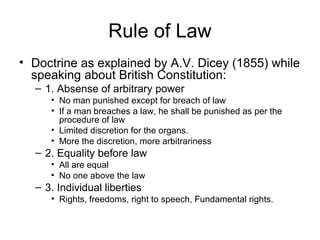
Rule of Law
• Doctrine as explained by A.V. Dicey (1855) while
speaking about British Constitution:
– 1. Absense of arbitrary power
• No man punished except for breach of law
• If a man breaches a law, he shall be punished as per the
procedure of law
• Limited discretion for the organs.
• More the discretion, more arbitrariness
– 2. Equality before law
• All are equal
• No one above the law
– 3. Individual liberties
• Rights, freedoms, right to speech, Fundamental rights.
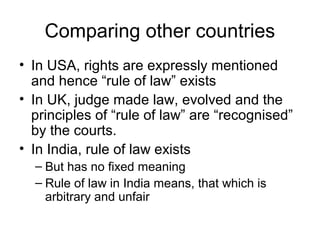
Comparing other countries
• In USA, rights are expressly mentioned
and hence “rule of law” exists
• In UK, judge made law, evolved and the
principles of “rule of law” are “recognised”
by the courts.
• In India, rule of law exists
– But has no fixed meaning
– Rule of law in India means, that which is
arbitrary and unfair
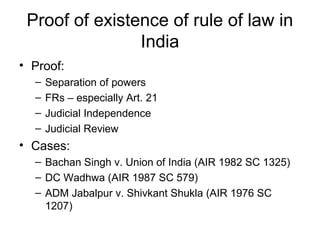
Proof of existence of rule of law in
India
• Proof:
– Separation of powers
– FRs – especially Art. 21
– Judicial Independence
– Judicial Review
• Cases:
– Bachan Singh v. Union of India (AIR 1982 SC 1325)
– DC Wadhwa (AIR 1987 SC 579)
– ADM Jabalpur v. Shivkant Shukla (AIR 1976 SC
1207)
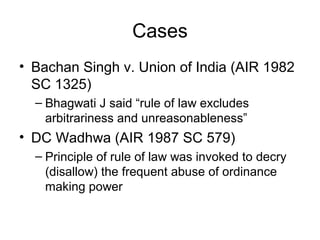
Cases
• Bachan Singh v. Union of India (AIR 1982
SC 1325)
– Bhagwati J said “rule of law excludes
arbitrariness and unreasonableness”
• DC Wadhwa (AIR 1987 SC 579)
– Principle of rule of law was invoked to decry
(disallow) the frequent abuse of ordinance
making power
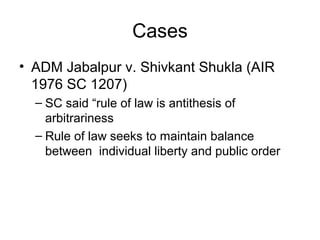
Cases
• ADM Jabalpur v. Shivkant Shukla (AIR
1976 SC 1207)
– SC said “rule of law is antithesis of
arbitrariness
– Rule of law seeks to maintain balance
between individual liberty and public order
Constitutional Law of India slides by Gagan
Krishnadas is licensed under a
Creative Commons Attribution-
NonCommercial-ShareAlike
4.0 International License
gagan555@gmail.com

rule of law

  • 1.
    Constitutional Law ofIndia - 1 Module 1 Topic 3 Rule of Law By Gagan K
  • 2.
    Rule of Law •Doctrine as explained by A.V. Dicey (1855) while speaking about British Constitution: – 1. Absense of arbitrary power • No man punished except for breach of law • If a man breaches a law, he shall be punished as per the procedure of law • Limited discretion for the organs. • More the discretion, more arbitrariness – 2. Equality before law • All are equal • No one above the law – 3. Individual liberties • Rights, freedoms, right to speech, Fundamental rights.
  • 3.
    Comparing other countries •In USA, rights are expressly mentioned and hence “rule of law” exists • In UK, judge made law, evolved and the principles of “rule of law” are “recognised” by the courts. • In India, rule of law exists – But has no fixed meaning – Rule of law in India means, that which is arbitrary and unfair
  • 4.
    Proof of existenceof rule of law in India • Proof: – Separation of powers – FRs – especially Art. 21 – Judicial Independence – Judicial Review • Cases: – Bachan Singh v. Union of India (AIR 1982 SC 1325) – DC Wadhwa (AIR 1987 SC 579) – ADM Jabalpur v. Shivkant Shukla (AIR 1976 SC 1207)
  • 5.
    Cases • Bachan Singhv. Union of India (AIR 1982 SC 1325) – Bhagwati J said “rule of law excludes arbitrariness and unreasonableness” • DC Wadhwa (AIR 1987 SC 579) – Principle of rule of law was invoked to decry (disallow) the frequent abuse of ordinance making power
  • 6.
    Cases • ADM Jabalpurv. Shivkant Shukla (AIR 1976 SC 1207) – SC said “rule of law is antithesis of arbitrariness – Rule of law seeks to maintain balance between individual liberty and public order
  • 7.
    Constitutional Law ofIndia slides by Gagan Krishnadas is licensed under a Creative Commons Attribution- NonCommercial-ShareAlike 4.0 International License gagan555@gmail.com