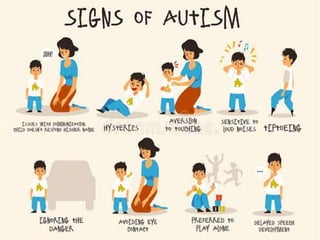
PLAYBEHAVIOURINAUTISM
SUBMITTED TO: NANCY MA’AM
SUBMITTED BY: VANSHIKHA, RAZI, ALIZA,
AQDAS, HARSHITA, SHUAIB, SAPNA
Play is an important part of a
child’s development. It builds fine
and gross motor skills, social skills,
communication skills, language,
thinking and problem solving skills.
In autistic children, play can be
very limited. For example, a child
may want to play alone, engage in
repetitive play like lining up toys or
moving from them from point A to
point B and then back again, or
play with the same thing over and
over. Children can learn play skills
with guidance and by structuring
play.
Play is an important part of a
child’s development. It builds fine
and gross motor skills, social
skills, communication skills,
language, thinking and problem
solving skills. In autistic children,
play can be very limited. For
example, a child may want to play
alone, engage in repetitive play
like lining up toys or moving from
them from point A to point B and
then back again, or play with the
same thing over and over.
Children can learn play skills with
guidance and by structuring play.
THE IMPORTANCE OF PLAY FOR AUTISTIC CHILDREN
Play: why it’s important for autistic
children
Autistic children enjoy and learn through
play.
There are 6 main types of play, which
develop in stages:
• exploratory play
• cause-and-effect play
• toy play
• constructive play
• physical play
• pretend play.
By helping your child’s play develop, you also help your child learn and practice new skills and
abilities. These skills are important for your child’s overall development. They include the
ability to explore the environment, copy others, share things, take turns, imagine what other
people are thinking and feeling, communicate, and more.
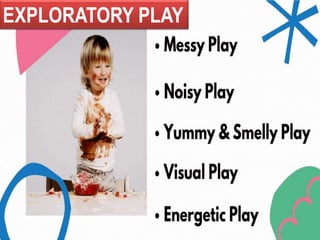
EXPLORATORY PLAY
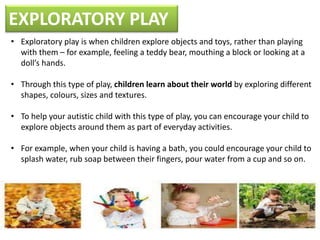
• Exploratory play is when children explore objects and toys, rather than playing
with them – for example, feeling a teddy bear, mouthing a block or looking at a
doll’s hands.
• Through this type of play, children learn about their world by exploring different
shapes, colours, sizes and textures.
• To help your autistic child with this type of play, you can encourage your child to
explore objects around them as part of everyday activities.
• For example, when your child is having a bath, you could encourage your child to
splash water, rub soap between their fingers, pour water from a cup and so on.
EXPLORATORY PLAY
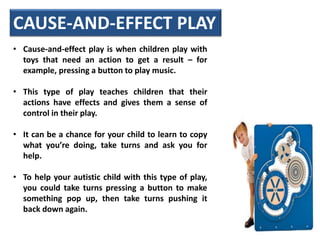
• Cause-and-effect play is when children play with
toys that need an action to get a result – for
example, pressing a button to play music.
• This type of play teaches children that their
actions have effects and gives them a sense of
control in their play.
• It can be a chance for your child to learn to copy
what you’re doing, take turns and ask you for
help.
• To help your autistic child with this type of play,
you could take turns pressing a button to make
something pop up, then take turns pushing it
back down again.
CAUSE-AND-EFFECT PLAY
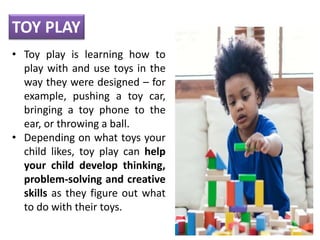
• Toy play is learning how to
play with and use toys in the
way they were designed – for
example, pushing a toy car,
bringing a toy phone to the
ear, or throwing a ball.
• Depending on what toys your
child likes, toy play can help
your child develop thinking,
problem-solving and creative
skills as they figure out what
to do with their toys.
TOY PLAY
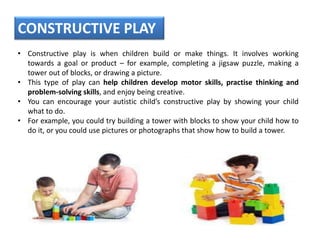
• Constructive play is when children build or make things. It involves working
towards a goal or product – for example, completing a jigsaw puzzle, making a
tower out of blocks, or drawing a picture.
• This type of play can help children develop motor skills, practise thinking and
problem-solving skills, and enjoy being creative.
• You can encourage your autistic child’s constructive play by showing your child
what to do.
• For example, you could try building a tower with blocks to show your child how to
do it, or you could use pictures or photographs that show how to build a tower.
CONSTRUCTIVE PLAY
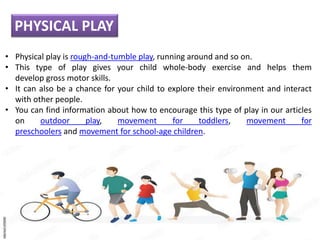
• Physical play is rough-and-tumble play, running around and so on.
• This type of play gives your child whole-body exercise and helps them
develop gross motor skills.
• It can also be a chance for your child to explore their environment and interact
with other people.
• You can find information about how to encourage this type of play in our articles
on outdoor play, movement for toddlers, movement for
preschoolers and movement for school-age children.
PHYSICAL PLAY
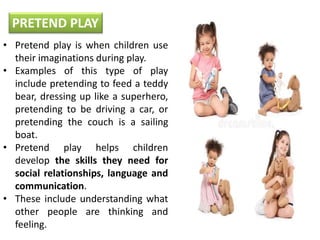
• Pretend play is when children use
their imaginations during play.
• Examples of this type of play
include pretending to feed a teddy
bear, dressing up like a superhero,
pretending to be driving a car, or
pretending the couch is a sailing
boat.
• Pretend play helps children
develop the skills they need for
social relationships, language and
communication.
• These include understanding what
other people are thinking and
feeling.
PRETEND PLAY
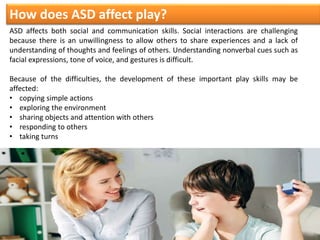
ASD affects both social and communication skills. Social interactions are challenging
because there is an unwillingness to allow others to share experiences and a lack of
understanding of thoughts and feelings of others. Understanding nonverbal cues such as
facial expressions, tone of voice, and gestures is difficult.
Because of the difficulties, the development of these important play skills may be
affected:
• copying simple actions
• exploring the environment
• sharing objects and attention with others
• responding to others
• taking turns
How does ASD affect play?
Balloons – Bounce them around or blow them up and deflate them. (Use
under supervision only)
Bubbles – There are so many types available – different wands, bubble
machines. This is a great activity to wait for a child to ask/gesture for more
bubbles. My daughter used to sign “more” before she could speak to keep
bubble blowing going.
Blocks– Playing with blocks encourages turn taking. Build a tower with each
person adding a block until it falls down. The parent can build a tower and the
child knocks it down. My son loved this one!
Simple Puzzles – Puzzles are also great for turn taking. Chunky puzzles with
knobs on the top can make handling pieces easier. Puzzles also help with
problem solving skills.
Books – Books with interactive sounds, pop-up books, books with textures, or
books with things to do like pull a tab or spin a wheel are all very engaging.
WHAT ARE SOME SIMPLE THINGS I
CAN USE FOR ENGAGEMENT?
play behaviour.pptx

play behaviour.pptx

  • 1.
    PLAYBEHAVIOURINAUTISM SUBMITTED TO: NANCYMA’AM SUBMITTED BY: VANSHIKHA, RAZI, ALIZA, AQDAS, HARSHITA, SHUAIB, SAPNA
  • 3.
    Play is animportant part of a child’s development. It builds fine and gross motor skills, social skills, communication skills, language, thinking and problem solving skills. In autistic children, play can be very limited. For example, a child may want to play alone, engage in repetitive play like lining up toys or moving from them from point A to point B and then back again, or play with the same thing over and over. Children can learn play skills with guidance and by structuring play.
  • 4.
    Play is animportant part of a child’s development. It builds fine and gross motor skills, social skills, communication skills, language, thinking and problem solving skills. In autistic children, play can be very limited. For example, a child may want to play alone, engage in repetitive play like lining up toys or moving from them from point A to point B and then back again, or play with the same thing over and over. Children can learn play skills with guidance and by structuring play. THE IMPORTANCE OF PLAY FOR AUTISTIC CHILDREN
  • 5.
    Play: why it’simportant for autistic children Autistic children enjoy and learn through play. There are 6 main types of play, which develop in stages: • exploratory play • cause-and-effect play • toy play • constructive play • physical play • pretend play. By helping your child’s play develop, you also help your child learn and practice new skills and abilities. These skills are important for your child’s overall development. They include the ability to explore the environment, copy others, share things, take turns, imagine what other people are thinking and feeling, communicate, and more.
  • 6.
  • 7.
    • Exploratory playis when children explore objects and toys, rather than playing with them – for example, feeling a teddy bear, mouthing a block or looking at a doll’s hands. • Through this type of play, children learn about their world by exploring different shapes, colours, sizes and textures. • To help your autistic child with this type of play, you can encourage your child to explore objects around them as part of everyday activities. • For example, when your child is having a bath, you could encourage your child to splash water, rub soap between their fingers, pour water from a cup and so on. EXPLORATORY PLAY
  • 8.
    • Cause-and-effect playis when children play with toys that need an action to get a result – for example, pressing a button to play music. • This type of play teaches children that their actions have effects and gives them a sense of control in their play. • It can be a chance for your child to learn to copy what you’re doing, take turns and ask you for help. • To help your autistic child with this type of play, you could take turns pressing a button to make something pop up, then take turns pushing it back down again. CAUSE-AND-EFFECT PLAY
  • 9.
    • Toy playis learning how to play with and use toys in the way they were designed – for example, pushing a toy car, bringing a toy phone to the ear, or throwing a ball. • Depending on what toys your child likes, toy play can help your child develop thinking, problem-solving and creative skills as they figure out what to do with their toys. TOY PLAY
  • 10.
    • Constructive playis when children build or make things. It involves working towards a goal or product – for example, completing a jigsaw puzzle, making a tower out of blocks, or drawing a picture. • This type of play can help children develop motor skills, practise thinking and problem-solving skills, and enjoy being creative. • You can encourage your autistic child’s constructive play by showing your child what to do. • For example, you could try building a tower with blocks to show your child how to do it, or you could use pictures or photographs that show how to build a tower. CONSTRUCTIVE PLAY
  • 11.
    • Physical playis rough-and-tumble play, running around and so on. • This type of play gives your child whole-body exercise and helps them develop gross motor skills. • It can also be a chance for your child to explore their environment and interact with other people. • You can find information about how to encourage this type of play in our articles on outdoor play, movement for toddlers, movement for preschoolers and movement for school-age children. PHYSICAL PLAY
  • 12.
    • Pretend playis when children use their imaginations during play. • Examples of this type of play include pretending to feed a teddy bear, dressing up like a superhero, pretending to be driving a car, or pretending the couch is a sailing boat. • Pretend play helps children develop the skills they need for social relationships, language and communication. • These include understanding what other people are thinking and feeling. PRETEND PLAY
  • 14.
    ASD affects bothsocial and communication skills. Social interactions are challenging because there is an unwillingness to allow others to share experiences and a lack of understanding of thoughts and feelings of others. Understanding nonverbal cues such as facial expressions, tone of voice, and gestures is difficult. Because of the difficulties, the development of these important play skills may be affected: • copying simple actions • exploring the environment • sharing objects and attention with others • responding to others • taking turns How does ASD affect play?
  • 15.
    Balloons – Bouncethem around or blow them up and deflate them. (Use under supervision only) Bubbles – There are so many types available – different wands, bubble machines. This is a great activity to wait for a child to ask/gesture for more bubbles. My daughter used to sign “more” before she could speak to keep bubble blowing going. Blocks– Playing with blocks encourages turn taking. Build a tower with each person adding a block until it falls down. The parent can build a tower and the child knocks it down. My son loved this one! Simple Puzzles – Puzzles are also great for turn taking. Chunky puzzles with knobs on the top can make handling pieces easier. Puzzles also help with problem solving skills. Books – Books with interactive sounds, pop-up books, books with textures, or books with things to do like pull a tab or spin a wheel are all very engaging. WHAT ARE SOME SIMPLE THINGS I CAN USE FOR ENGAGEMENT?