Governance Innovation
for the Digital Era
January 13, 2020
Keita Nishiyama
Ministry of Economy, Trade and Industry, Japan
1. Why we need Governance Innovation
- Transformation to “Society 5.0”
1
2
 Basic feature of ‘Society 5.0’ is the post- information society.
 However, it may have much wider implication for our society and its
governance structure.
 Post- modernity
 Post- homo sapiens (homo deus?)
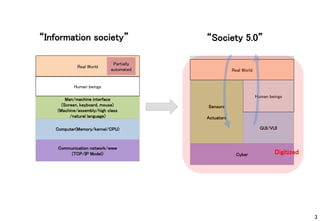
Society5.0 is the fifth stage of society for the humankind after
①hunting society, ➁agriculture society, ➂industrial society and
④information society.
“Information society”
Real World
Computer(Memory/kernel/CPU)
Man/machine interface
(Screen, keyboard, mouse)
(Machine/assembly/high class
/natural language)
Communication network/www
(TCP/IP Model)
Human beings
Partially
automated
“Society 5.0”
GUI/VUI
Human beings
Sensors
Actuators
Cyber
Real World
Digitized
3
4
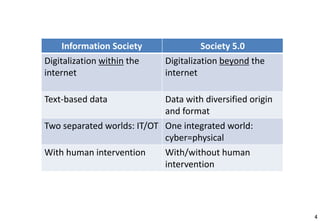
Information Society Society 5.0
Digitalization within the
internet
Digitalization beyond the
internet
Text-based data Data with diversified origin
and format
Two separated worlds: IT/OT One integrated world:
cyber=physical
With human intervention With/without human
intervention
2. What is Governance Innovation?
5
6
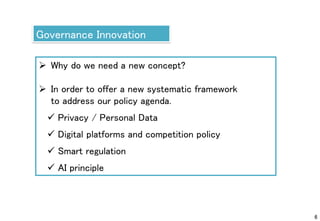
Governance Innovation
 Why do we need a new concept?
 In order to offer a new systematic framework
to address our policy agenda.
 Privacy / Personal Data
 Digital platforms and competition policy
 Smart regulation
 AI principle
7
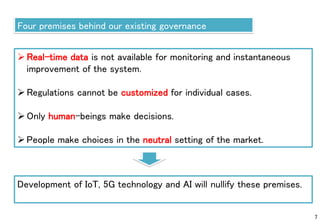
Four premises behind our existing governance
Real-time data is not available for monitoring and instantaneous
improvement of the system.
Regulations cannot be customized for individual cases.
Only human-beings make decisions.
People make choices in the neutral setting of the market.
Development of IoT, 5G technology and AI will nullify these premises.
Human beings
Society 5.0
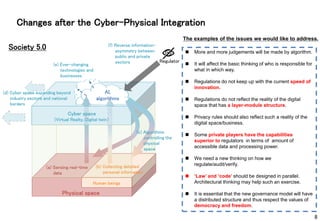
(a) Sensing real-time
data
Regulator
(f) Reverse information-
asymmetry between
public and private
sectors
Cyber space
(Virtual Realty, Digital twin)
Physical space
AI,
algorithms
(e) Ever-changing
technologies and
businesses
(b) Collecting detailed
personal information
Changes after the Cyber-Physical Integration
 More and more judgements will be made by algorithm.
 It will affect the basic thinking of who is responsible for
what in which way.
 Regulations do not keep up with the current speed of
innovation.
 Regulations do not reflect the reality of the digital
space that has a layer-module structure.
 Privacy rules should also reflect such a reality of the
digital space/business.
 Some private players have the capabilities
superior to regulators in terms of amount of
accessible data and processing power.
 We need a new thinking on how we
regulate/audit/verify.
 ‘Law’ and ‘code’ should be designed in parallel.
Architectural thinking may help such an exercise.
 It is essential that the new governance model will have
a distributed structure and thus respect the values of
democracy and freedom.
The examples of the issues we would like to address.
(c) Algorithms
controlling the
physical
space
(d) Cyber space expanding beyond
industry sectors and national
borders
8
9
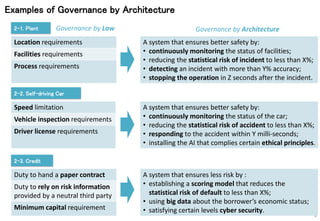
Examples of Governance by Architecture
Location requirements A system that ensures better safety by:
• continuously monitoring the status of facilities;
• reducing the statistical risk of incident to less than X%;
• detecting an incident with more than Y% accuracy;
• stopping the operation in Z seconds after the incident.
Facilities requirements
Process requirements
2-1. Plant
Speed limitation A system that ensures better safety by:
• continuously monitoring the status of the car;
• reducing the statistical risk of accident to less than X%;
• responding to the accident within Y milli-seconds;
• installing the AI that complies certain ethical principles.
Vehicle inspection requirements
Driver license requirements
2-2. Self-driving Car
Duty to hand a paper contract A system that ensures less risk by :
• establishing a scoring model that reduces the
statistical risk of default to less than X%;
• using big data about the borrower’s economic status;
• satisfying certain levels cyber security.
Duty to rely on risk information
provided by a neutral third party
Minimum capital requirement
2-3. Credit
Governance by Law Governance by Architecture
10
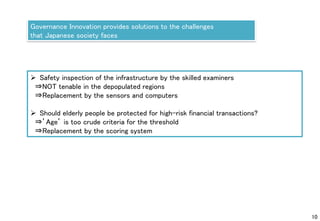
Governance Innovation provides solutions to the challenges
that Japanese society faces
 Safety inspection of the infrastructure by the skilled examiners
⇒NOT tenable in the depopulated regions
⇒Replacement by the sensors and computers
 Should elderly people be protected for high-risk financial transactions?
⇒’Age’ is too crude criteria for the threshold
⇒Replacement by the scoring system
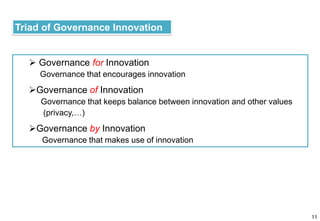
Triad of Governance Innovation
11
 Governance for Innovation
Governance that encourages innovation
Governance of Innovation
Governance that keeps balance between innovation and other values
(privacy,…)
Governance by Innovation
Governance that makes use of innovation
12
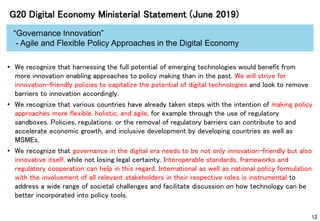
G20 Digital Economy Ministerial Statement (June 2019)
“Governance Innovation”
- Agile and Flexible Policy Approaches in the Digital Economy
• We recognize that harnessing the full potential of emerging technologies would benefit from
more innovation enabling approaches to policy making than in the past. We will strive for
innovation-friendly policies to capitalize the potential of digital technologies and look to remove
barriers to innovation accordingly.
• We recognize that various countries have already taken steps with the intention of making policy
approaches more flexible, holistic, and agile, for example through the use of regulatory
sandboxes. Policies, regulations, or the removal of regulatory barriers can contribute to and
accelerate economic growth, and inclusive development by developing countries as well as
MSMEs.
• We recognize that governance in the digital era needs to be not only innovation-friendly but also
innovative itself, while not losing legal certainty. Interoperable standards, frameworks and
regulatory cooperation can help in this regard. International as well as national policy formulation
with the involvement of all relevant stakeholders in their respective roles is instrumental to
address a wide range of societal challenges and facilitate discussion on how technology can be
better incorporated into policy tools.
13
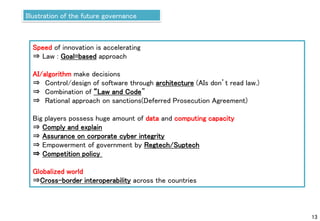
Speed of innovation is accelerating
⇒ Law : Goal=based approach
AI/algorithm make decisions
⇒ Control/design of software through architecture (AIs don’t read law.)
⇒ Combination of “Law and Code”
⇒ Rational approach on sanctions(Deferred Prosecution Agreement)
Big players possess huge amount of data and computing capacity
⇒ Comply and explain
⇒ Assurance on corporate cyber integrity
⇒ Empowerment of government by Regtech/Suptech
⇒ Competition policy
Globalized world
⇒Cross-border interoperability across the countries
Illustration of the future governance
14
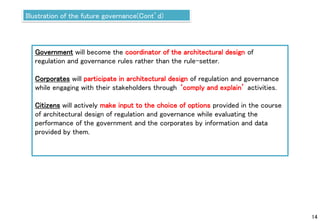
Government will become the coordinator of the architectural design of
regulation and governance rules rather than the rule-setter.
Corporates will participate in architectural design of regulation and governance
while engaging with their stakeholders through ‘comply and explain’ activities.
Citizens will actively make input to the choice of options provided in the course
of architectural design of regulation and governance while evaluating the
performance of the government and the corporates by information and data
provided by them.
Illustration of the future governance(Cont’d)
15
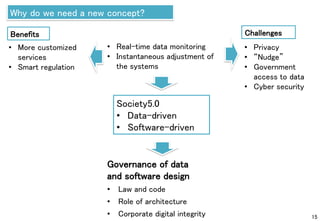
Governance of data
and software design
• Law and code
• Role of architecture
• Corporate digital integrity
Society5.0
• Data-driven
• Software-driven
• More customized
services
• Smart regulation
Benefits
• Real-time data monitoring
• Instantaneous adjustment of
the systems
Challenges
• Privacy
• “Nudge”
• Government
access to data
• Cyber security
Why do we need a new concept?
16
Role of Architecture
 Foundation for designing digitalized industrial/social systems
 Bridge between Law and Code
 Tool for comply and explain
17
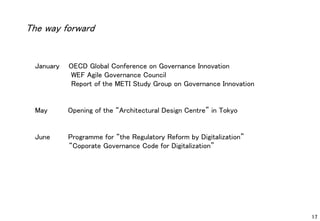
January OECD Global Conference on Governance Innovation
WEF Agile Governance Council
Report of the METI Study Group on Governance Innovation
May Opening of the “Architectural Design Centre” in Tokyo
June Programme for “the Regulatory Reform by Digitalization”
“Coporate Governance Code for Digitalization”
The way forward
18
https://www.meti.go.jp/english/press/2019/pdf/191226001.pdf
Governance Innovation(Redesigning Law and Architecture in the Age of Society 5.0) –Jan 2020
Overview of the New Governance Model
State/Government Companies Communities/Individuals
Rule-making
Goal-based regulations • System architecture
• Market mechanism
• Social norms
Guidelines / Standards
Transparency and competition rules
Monitoring
SupTech: Data
collection in cyberspace
• RegTech: Voluntary
monitoring
• Comply & Explain
• Internal/External audits
Evaluation based on
information from multi-
stakeholders
Real-time data monitoring / Implementation of monitoring review
Enforcement
• Enhanced Information disclosure ・Enforcement of competition law
• Impact-based
sanctions
• Deferred prosecution
agreement mechanism
• Incident reporting
• Cooperation in
investigation
• Improvement
measures
• Posting reviews on
social media, etc.
• Impact on finance
Online Dispute Resolution
International cooperation
Entity
Process
Refer
Feed-
back

Keita Nishiyama, Opening session

  • 1.
    Governance Innovation for theDigital Era January 13, 2020 Keita Nishiyama Ministry of Economy, Trade and Industry, Japan
  • 2.
    1. Why weneed Governance Innovation - Transformation to “Society 5.0” 1
  • 3.
    2  Basic featureof ‘Society 5.0’ is the post- information society.  However, it may have much wider implication for our society and its governance structure.  Post- modernity  Post- homo sapiens (homo deus?) Society5.0 is the fifth stage of society for the humankind after ①hunting society, ➁agriculture society, ➂industrial society and ④information society.
  • 4.
    “Information society” Real World Computer(Memory/kernel/CPU) Man/machineinterface (Screen, keyboard, mouse) (Machine/assembly/high class /natural language) Communication network/www (TCP/IP Model) Human beings Partially automated “Society 5.0” GUI/VUI Human beings Sensors Actuators Cyber Real World Digitized 3
  • 5.
    4 Information Society Society5.0 Digitalization within the internet Digitalization beyond the internet Text-based data Data with diversified origin and format Two separated worlds: IT/OT One integrated world: cyber=physical With human intervention With/without human intervention
  • 6.
    2. What isGovernance Innovation? 5
  • 7.
    6 Governance Innovation  Whydo we need a new concept?  In order to offer a new systematic framework to address our policy agenda.  Privacy / Personal Data  Digital platforms and competition policy  Smart regulation  AI principle
  • 8.
    7 Four premises behindour existing governance Real-time data is not available for monitoring and instantaneous improvement of the system. Regulations cannot be customized for individual cases. Only human-beings make decisions. People make choices in the neutral setting of the market. Development of IoT, 5G technology and AI will nullify these premises.
  • 9.
    Human beings Society 5.0 (a)Sensing real-time data Regulator (f) Reverse information- asymmetry between public and private sectors Cyber space (Virtual Realty, Digital twin) Physical space AI, algorithms (e) Ever-changing technologies and businesses (b) Collecting detailed personal information Changes after the Cyber-Physical Integration  More and more judgements will be made by algorithm.  It will affect the basic thinking of who is responsible for what in which way.  Regulations do not keep up with the current speed of innovation.  Regulations do not reflect the reality of the digital space that has a layer-module structure.  Privacy rules should also reflect such a reality of the digital space/business.  Some private players have the capabilities superior to regulators in terms of amount of accessible data and processing power.  We need a new thinking on how we regulate/audit/verify.  ‘Law’ and ‘code’ should be designed in parallel. Architectural thinking may help such an exercise.  It is essential that the new governance model will have a distributed structure and thus respect the values of democracy and freedom. The examples of the issues we would like to address. (c) Algorithms controlling the physical space (d) Cyber space expanding beyond industry sectors and national borders 8
  • 10.
    9 Examples of Governanceby Architecture Location requirements A system that ensures better safety by: • continuously monitoring the status of facilities; • reducing the statistical risk of incident to less than X%; • detecting an incident with more than Y% accuracy; • stopping the operation in Z seconds after the incident. Facilities requirements Process requirements 2-1. Plant Speed limitation A system that ensures better safety by: • continuously monitoring the status of the car; • reducing the statistical risk of accident to less than X%; • responding to the accident within Y milli-seconds; • installing the AI that complies certain ethical principles. Vehicle inspection requirements Driver license requirements 2-2. Self-driving Car Duty to hand a paper contract A system that ensures less risk by : • establishing a scoring model that reduces the statistical risk of default to less than X%; • using big data about the borrower’s economic status; • satisfying certain levels cyber security. Duty to rely on risk information provided by a neutral third party Minimum capital requirement 2-3. Credit Governance by Law Governance by Architecture
  • 11.
    10 Governance Innovation providessolutions to the challenges that Japanese society faces  Safety inspection of the infrastructure by the skilled examiners ⇒NOT tenable in the depopulated regions ⇒Replacement by the sensors and computers  Should elderly people be protected for high-risk financial transactions? ⇒’Age’ is too crude criteria for the threshold ⇒Replacement by the scoring system
  • 12.
    Triad of GovernanceInnovation 11  Governance for Innovation Governance that encourages innovation Governance of Innovation Governance that keeps balance between innovation and other values (privacy,…) Governance by Innovation Governance that makes use of innovation
  • 13.
    12 G20 Digital EconomyMinisterial Statement (June 2019) “Governance Innovation” - Agile and Flexible Policy Approaches in the Digital Economy • We recognize that harnessing the full potential of emerging technologies would benefit from more innovation enabling approaches to policy making than in the past. We will strive for innovation-friendly policies to capitalize the potential of digital technologies and look to remove barriers to innovation accordingly. • We recognize that various countries have already taken steps with the intention of making policy approaches more flexible, holistic, and agile, for example through the use of regulatory sandboxes. Policies, regulations, or the removal of regulatory barriers can contribute to and accelerate economic growth, and inclusive development by developing countries as well as MSMEs. • We recognize that governance in the digital era needs to be not only innovation-friendly but also innovative itself, while not losing legal certainty. Interoperable standards, frameworks and regulatory cooperation can help in this regard. International as well as national policy formulation with the involvement of all relevant stakeholders in their respective roles is instrumental to address a wide range of societal challenges and facilitate discussion on how technology can be better incorporated into policy tools.
  • 14.
    13 Speed of innovationis accelerating ⇒ Law : Goal=based approach AI/algorithm make decisions ⇒ Control/design of software through architecture (AIs don’t read law.) ⇒ Combination of “Law and Code” ⇒ Rational approach on sanctions(Deferred Prosecution Agreement) Big players possess huge amount of data and computing capacity ⇒ Comply and explain ⇒ Assurance on corporate cyber integrity ⇒ Empowerment of government by Regtech/Suptech ⇒ Competition policy Globalized world ⇒Cross-border interoperability across the countries Illustration of the future governance
  • 15.
    14 Government will becomethe coordinator of the architectural design of regulation and governance rules rather than the rule-setter. Corporates will participate in architectural design of regulation and governance while engaging with their stakeholders through ‘comply and explain’ activities. Citizens will actively make input to the choice of options provided in the course of architectural design of regulation and governance while evaluating the performance of the government and the corporates by information and data provided by them. Illustration of the future governance(Cont’d)
  • 16.
    15 Governance of data andsoftware design • Law and code • Role of architecture • Corporate digital integrity Society5.0 • Data-driven • Software-driven • More customized services • Smart regulation Benefits • Real-time data monitoring • Instantaneous adjustment of the systems Challenges • Privacy • “Nudge” • Government access to data • Cyber security Why do we need a new concept?
  • 17.
    16 Role of Architecture Foundation for designing digitalized industrial/social systems  Bridge between Law and Code  Tool for comply and explain
  • 18.
    17 January OECD GlobalConference on Governance Innovation WEF Agile Governance Council Report of the METI Study Group on Governance Innovation May Opening of the “Architectural Design Centre” in Tokyo June Programme for “the Regulatory Reform by Digitalization” “Coporate Governance Code for Digitalization” The way forward
  • 19.
  • 20.
    Overview of theNew Governance Model State/Government Companies Communities/Individuals Rule-making Goal-based regulations • System architecture • Market mechanism • Social norms Guidelines / Standards Transparency and competition rules Monitoring SupTech: Data collection in cyberspace • RegTech: Voluntary monitoring • Comply & Explain • Internal/External audits Evaluation based on information from multi- stakeholders Real-time data monitoring / Implementation of monitoring review Enforcement • Enhanced Information disclosure ・Enforcement of competition law • Impact-based sanctions • Deferred prosecution agreement mechanism • Incident reporting • Cooperation in investigation • Improvement measures • Posting reviews on social media, etc. • Impact on finance Online Dispute Resolution International cooperation Entity Process Refer Feed- back