DEGRADATION OR LIMITATION OF DATA
INTEROPERABILITY AND PORTABILITY AS AN
ANTITRUST OFFENSE
Michal Gal
University of Haifa
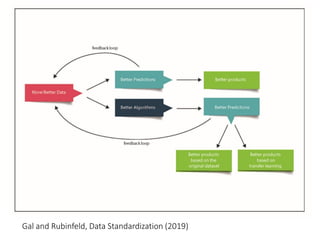
Gal and Rubinfeld, Data Standardization (2019)
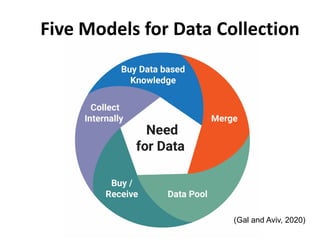
Five Models for Data Collection
(Gal and Aviv, 2020)
Is it an antitrust Concern?
Theory of Harm: use of data portability and interoperability (standards) to
indirectly foreclose (partly or fully) access of rivals to an input (data) which
they might have otherwise legally accessed, in a way designed to negatively
affects rivals' ability to compete.
Put simply: creating artificial barriers to data flows in the market.
When applied to private data:
• Increases switching costs, strengthens consumer lock-in, and limits multi-homing
• Prevents data-subjects to enjoy the benefits of their data
Might be relevant in two main instances: as an offense (agreement in
restraint of trade; abuse of dominance), or as a consideration in merger
control
Requirements (1)
• Data important for competition in that market
• Already collected, or can be collected by infringer
• Feasibility of use by other firms (e.g., data relevant to their operations)
• Data need not be essential, sufficient if limited access can raise rivals' costs significantly
• Suggestion: Need not specify in minute detail how rivals will use the data
• Significant barriers to access to such data (Gal and Rubinfeld):
• Data is a public good, yet not all data are equal (e.g., medical history)
• High barriers (technological, legal, financial) to collection of such data (e.g., data
ecosystems)
• No easy ways to circumvent (e.g., content scraping, algorithms that need less data)
• Suggestion: Where data transfer is mandated by law, this can be assumed
Requirements (2)
• No legal constraints on data transfer (e.g. security, privacy, data
ownership)
• Need to determine priorities among laws
• Suggestion: Where data transfer is mandated by law, this can be assumed
• Data transfer increases welfare
• Due to competition, synergies, and extended network effects
• Long term analysis: effects on motivations to collect data
• Counter-justifications: Is it needed to significantly improve privacy or data security,
beyond what is mandated by law? (Nicholas and Weinberg, 2019)
• Suggestion: Reversing the burden of proof: burden should be on dominant firms
restricting multi-homing to demonstrate the efficiencies associated with these actions
(Crémer, de Montjoye and Schweitzer, 2019)
• Suggestion: Where data transfer is mandated by law, this can be assumed
Requirements (3)
• Infringer’s actions affect data interoperability and portability in a
way which (significantly) limits data transfers
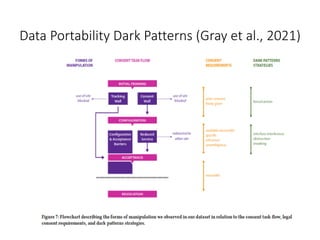
• Affects ability to use his own data by others (e.g., dark patterns for consent); or
• Directly or indirectly affects the setting of data interoperability or portability standards
in the industry (Standard-Setting Market Power)
• Such actions create a comparative advantage to the one limiting
interoperability and portability
• Whether directly (B2B) or indirectly (B2C: increase user switching costs)
Institution-wise: Requires a more-technological approach
Data Portability Dark Patterns (Gray et al., 2021)
Specific Prohibitions
Unilateral Conduct
• Opportunistic setting of sub-standards (path dependency)
• Refusal to supply (depends on legal requirements)
• De facto bundling (envelopment policies)
• Exclusivity
• Self-preferencing
• Margin squeeze strategy
• Excessive pricing for access to data
Joint Conduct
• Joint opportunistic setting of sub-standards (path dependency)
Merger Policy
• Market contestability considerations
AS A
REMEDY
Relevance:
• Offense is degradation or limitation of interoperability or
portability
• Part of a remedy for restoring competition in the market, to
enable data sharing
• Alternative to structural remedies (Crémer et al., 2019)
Benefits:
• Limits anticompetitive conduct and/or its consequences
• May introduce competition in the market and for the market,
both with firms and with ecosystems
• Remedies can be flexibly designed according to the situation of
a given market
Limitations
• Time is of essence: Ex post regulation (Kerber, 2019)
• Specific case vs market-wide standards (solution: market studies)
• Devil in details: Determining standards and terms (e.g., “pretend
sharing”)
• May require substantial oversight
• Often not stand-alone. Data standardization?
• Effectiveness affected by ability to mitigate data protection concerns
• Effectiveness affected by user consent and behavioral limitations
• Market transparency might facilitate collusion
• Risk discouraging investments in data collection
• implementation costs (do they create comparative advantages to some?)
• Better alternatives? (sharing of learning (Gal and Petit, 2021))
• Economies of scale from data transfer might be limited (Nicholas and
Weinberg, 2019; Gal and Aviv, 2020)
Slides for last part of discussion:
Data Protection, Consumer Protection,
and Competition Law
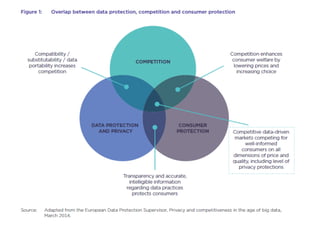
The relationship between competition law and
privacy/data protection law
Share the ultimate goal of protecting consumers
• Competition law seeks to ensure that consumers enjoy the benefits of a
competitive market
• Privacy law seeks to ensure that consumers have some measure of control over
their personal data
Contact:
• Competition over privacy:
• Privacy as a quality parameter for consumers
• Firms can offer enhanced privacy to distinguish their products (Apple) if there is
competition
• Competition and Privacy:
• Ensuring interoperability and portability of voluntarily shared data by the data
subject
• Increasing access to alternative data that does not infringe data protection laws
• Excessive private data collection as an abuse (Facebook case)
Competition or privacy:
• Increasing competition (and data portability) may imply that more firms access
private data.
• Tension also arises when a competitor relies on access to consumers’ personal
information held by a rival (e.g., hiQ v. LinkedIn)
• Increasing privacy protections can reduce the benefits of competition by limiting
internal and external data flows.
• Yet data protection may increase trust in markets and raise users' willingness to
voluntarily provide their data and at lower cost.
• The mode of regulation itself might create obstacles to competition: which firms
benefit more from the type of legal regime chosen?
• By itself
• By manipulations (changes framed as a response to privacy issues)
• Misapplications without deterrence (Tombal, 2021)
GDPR: Shaping Choices
•Compliance of external supplier
•Compliance of Buyer
•Data Management Obligations
•Size-Dependent Requirements
(Gal and Aviv, 2020)
Dynamics created by the GDPR (Gal and Aviv, 2020)
• Sharing sometimes impossible
• Reduced incentives for sharing
• Economies of scale
• High costs of non-compliance
• Costs of uncertainty
• Effect on data subjects
Effects:
• Higher concentration levels
• More limited data synergies
• Reduced international competitiveness
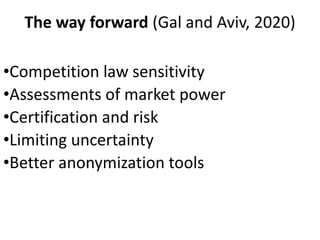
The way forward (Gal and Aviv, 2020)
•Competition law sensitivity
•Assessments of market power
•Certification and risk
•Limiting uncertainty
•Better anonymization tools
Thank you!
Rubinfeld, Daniel L. and Gal, Michal, Access Barriers to Big Data (August
26, 2016). 59 Arizona Law Review 33
(2017) https://ssrn.com/abstract=2830586
Gal, Michal and Rubinfeld, Daniel L., Data Standardization 94 NYU Law
Rev. (2019) https://ssrn.com/abstract=3326377
Gal, Michal and Oshrit Aviv, The Competitive Effects of the GDPR, Journal
of Competition Law and Economics (2020)
https://ssrn.com/abstract=3548444
Gal, Michal and Petit, Nicolas, Radical Restorative Remedies for Digital
Markets, 37 Berkeley Technology Law Journal
(2021) https://ssrn.com/abstract=3687604

Data Portability and Interoperability –GAL – June 2021 OECD discussion

  • 1.
    DEGRADATION OR LIMITATIONOF DATA INTEROPERABILITY AND PORTABILITY AS AN ANTITRUST OFFENSE Michal Gal University of Haifa
  • 2.
    Gal and Rubinfeld,Data Standardization (2019)
  • 3.
    Five Models forData Collection (Gal and Aviv, 2020)
  • 4.
    Is it anantitrust Concern? Theory of Harm: use of data portability and interoperability (standards) to indirectly foreclose (partly or fully) access of rivals to an input (data) which they might have otherwise legally accessed, in a way designed to negatively affects rivals' ability to compete. Put simply: creating artificial barriers to data flows in the market. When applied to private data: • Increases switching costs, strengthens consumer lock-in, and limits multi-homing • Prevents data-subjects to enjoy the benefits of their data Might be relevant in two main instances: as an offense (agreement in restraint of trade; abuse of dominance), or as a consideration in merger control
  • 5.
    Requirements (1) • Dataimportant for competition in that market • Already collected, or can be collected by infringer • Feasibility of use by other firms (e.g., data relevant to their operations) • Data need not be essential, sufficient if limited access can raise rivals' costs significantly • Suggestion: Need not specify in minute detail how rivals will use the data • Significant barriers to access to such data (Gal and Rubinfeld): • Data is a public good, yet not all data are equal (e.g., medical history) • High barriers (technological, legal, financial) to collection of such data (e.g., data ecosystems) • No easy ways to circumvent (e.g., content scraping, algorithms that need less data) • Suggestion: Where data transfer is mandated by law, this can be assumed
  • 6.
    Requirements (2) • Nolegal constraints on data transfer (e.g. security, privacy, data ownership) • Need to determine priorities among laws • Suggestion: Where data transfer is mandated by law, this can be assumed • Data transfer increases welfare • Due to competition, synergies, and extended network effects • Long term analysis: effects on motivations to collect data • Counter-justifications: Is it needed to significantly improve privacy or data security, beyond what is mandated by law? (Nicholas and Weinberg, 2019) • Suggestion: Reversing the burden of proof: burden should be on dominant firms restricting multi-homing to demonstrate the efficiencies associated with these actions (Crémer, de Montjoye and Schweitzer, 2019) • Suggestion: Where data transfer is mandated by law, this can be assumed
  • 7.
    Requirements (3) • Infringer’sactions affect data interoperability and portability in a way which (significantly) limits data transfers • Affects ability to use his own data by others (e.g., dark patterns for consent); or • Directly or indirectly affects the setting of data interoperability or portability standards in the industry (Standard-Setting Market Power) • Such actions create a comparative advantage to the one limiting interoperability and portability • Whether directly (B2B) or indirectly (B2C: increase user switching costs) Institution-wise: Requires a more-technological approach
  • 8.
    Data Portability DarkPatterns (Gray et al., 2021)
  • 9.
    Specific Prohibitions Unilateral Conduct •Opportunistic setting of sub-standards (path dependency) • Refusal to supply (depends on legal requirements) • De facto bundling (envelopment policies) • Exclusivity • Self-preferencing • Margin squeeze strategy • Excessive pricing for access to data Joint Conduct • Joint opportunistic setting of sub-standards (path dependency) Merger Policy • Market contestability considerations
  • 10.
  • 11.
    Relevance: • Offense isdegradation or limitation of interoperability or portability • Part of a remedy for restoring competition in the market, to enable data sharing • Alternative to structural remedies (Crémer et al., 2019) Benefits: • Limits anticompetitive conduct and/or its consequences • May introduce competition in the market and for the market, both with firms and with ecosystems • Remedies can be flexibly designed according to the situation of a given market
  • 12.
    Limitations • Time isof essence: Ex post regulation (Kerber, 2019) • Specific case vs market-wide standards (solution: market studies) • Devil in details: Determining standards and terms (e.g., “pretend sharing”) • May require substantial oversight • Often not stand-alone. Data standardization? • Effectiveness affected by ability to mitigate data protection concerns • Effectiveness affected by user consent and behavioral limitations • Market transparency might facilitate collusion • Risk discouraging investments in data collection • implementation costs (do they create comparative advantages to some?) • Better alternatives? (sharing of learning (Gal and Petit, 2021)) • Economies of scale from data transfer might be limited (Nicholas and Weinberg, 2019; Gal and Aviv, 2020)
  • 13.
    Slides for lastpart of discussion: Data Protection, Consumer Protection, and Competition Law
  • 15.
    The relationship betweencompetition law and privacy/data protection law Share the ultimate goal of protecting consumers • Competition law seeks to ensure that consumers enjoy the benefits of a competitive market • Privacy law seeks to ensure that consumers have some measure of control over their personal data Contact: • Competition over privacy: • Privacy as a quality parameter for consumers • Firms can offer enhanced privacy to distinguish their products (Apple) if there is competition • Competition and Privacy: • Ensuring interoperability and portability of voluntarily shared data by the data subject • Increasing access to alternative data that does not infringe data protection laws • Excessive private data collection as an abuse (Facebook case)
  • 16.
    Competition or privacy: •Increasing competition (and data portability) may imply that more firms access private data. • Tension also arises when a competitor relies on access to consumers’ personal information held by a rival (e.g., hiQ v. LinkedIn) • Increasing privacy protections can reduce the benefits of competition by limiting internal and external data flows. • Yet data protection may increase trust in markets and raise users' willingness to voluntarily provide their data and at lower cost. • The mode of regulation itself might create obstacles to competition: which firms benefit more from the type of legal regime chosen? • By itself • By manipulations (changes framed as a response to privacy issues) • Misapplications without deterrence (Tombal, 2021)
  • 17.
    GDPR: Shaping Choices •Complianceof external supplier •Compliance of Buyer •Data Management Obligations •Size-Dependent Requirements (Gal and Aviv, 2020)
  • 18.
    Dynamics created bythe GDPR (Gal and Aviv, 2020) • Sharing sometimes impossible • Reduced incentives for sharing • Economies of scale • High costs of non-compliance • Costs of uncertainty • Effect on data subjects Effects: • Higher concentration levels • More limited data synergies • Reduced international competitiveness
  • 19.
    The way forward(Gal and Aviv, 2020) •Competition law sensitivity •Assessments of market power •Certification and risk •Limiting uncertainty •Better anonymization tools
  • 20.
    Thank you! Rubinfeld, DanielL. and Gal, Michal, Access Barriers to Big Data (August 26, 2016). 59 Arizona Law Review 33 (2017) https://ssrn.com/abstract=2830586 Gal, Michal and Rubinfeld, Daniel L., Data Standardization 94 NYU Law Rev. (2019) https://ssrn.com/abstract=3326377 Gal, Michal and Oshrit Aviv, The Competitive Effects of the GDPR, Journal of Competition Law and Economics (2020) https://ssrn.com/abstract=3548444 Gal, Michal and Petit, Nicolas, Radical Restorative Remedies for Digital Markets, 37 Berkeley Technology Law Journal (2021) https://ssrn.com/abstract=3687604