Resilient Oxidation Catalysts for Electrochemical Hydrogen Pump

Final Presentation
May 21, 2013

William A. Rigdon
Diana Larrabee
Xinyu Huang, Ph.D.
Electrochemical Hydrogen Pump

Pump serves to separate and compress hydrogen. Process is performed by
applying power across the electrochemical cell. No moving parts in this design
and this method provides the most efficient way to compress hydrogen.

2
Project Goals
• Problem: Hydrogen oxidation electrocatalysts are used
in anode of hydrogen pump and fuel cell. They are subject
to poisoning from impurities like carbon monoxide [CO]
and durability concerns that arise from cleaning up CO.
• Challenge: Develop supports which can improve the
activity and durability of electrocatalysts for H2 pump.
• Approach: Design a composite support structure which
can aid in the improvement of both desired properties.
Demonstrate performance improvements through
working membrane electrode assemblies (MEA). Study
the material behavior and elucidate the benefits.
3
Electrocatalyst Degradation

The corrosion mechanisms are all related, but it can be understood by four
simple schematics of the contribution to the detachment, dissolution, diffusion,
and re-deposition of Pt catalysts resulting in particle growth and loss of activity
Y. Shao-Horn, W. C. Sheng, S. Chen, P. J. Ferreira, E. F. Holby, D. Morgan. Instability of Supported Platinum Nanoparticles in Low-Temperature Fuel
Cells. Topics in Catalysis. 46 (3-4), 285-305 (2007).
4
Project Approach
Prepare composite supports: CNT-Titania
Synthesize Pt electrocatalysts on supports
Characterize material structure/properties
Design and construct MEAs for testing
Test electrochemical performance
Observe carbon corrosion resistance
Report results and publish
5
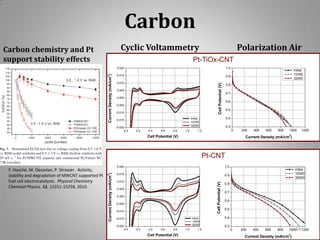
Carbon Structure
Carbon chemistry and Pt support stability effects

-o- High surface
area amorphous
carbon black
supports have best
activity, but have
high defect density
and poor stability

-□- A carbon
nanotube (CNT)
demonstrates long
range order and
graphitic bonding
with fewer defect
sites on the surface

F. Hasché, M. Oezaslan, P. Strasser. Activity, stability and degradation of MWCNT supported Pt
fuel cell electrocatalysts. Physical Chemistry Chemical Physics. 12, 15251-15258, 2010.
6
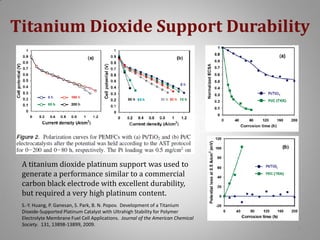
Titanium Dioxide Support Durability

A titanium dioxide platinum support was used to
generate a performance similar to a commercial
carbon black electrode with excellent durability,
but required a very high platinum content.
S.-Y. Huang, P. Ganesan, S. Park, B. N. Popov. Development of a Titanium
Dioxide-Supported Platinum Catalyst with Ultrahigh Stability for Polymer
Electrolyte Membrane Fuel Cell Applications. Journal of the American Chemical
Society. 131, 13898-13899, 2009.

7
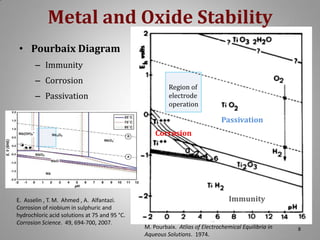
Metal and Oxide Stability
• Pourbaix Diagram
– Immunity

– Corrosion
– Passivation

Region of
electrode
operation

Passivation
Corrosion

E. Asselin , T. M. Ahmed , A. Alfantazi.
Corrosion of niobium in sulphuric and
hydrochloric acid solutions at 75 and 95 °C.
Corrosion Science. 49, 694-700, 2007.

Immunity

M. Pourbaix. Atlias of Electrochemical Equilibria in
Aqueous Solutions. 1974.

8
Mechanistic Effect on Activity of
CO Oxidation for Pt-TiOx

D. Jiang, S. H. Overbury, and S. Dai. Structures and Energetics of
Pt Clusters on TiO2: Interplay between Metal-Metal Bonds and
Metal-Oxygen Bonds. J. of Physical Chemistry. 116, 2188021885, 2012.

TiOx−OH + Pt−COad  CO2 + Pt + TiO2 + H+ + e-

S. Bonanni, K. Aït-Mansour, W. Harbich, H. Brune. Effect of the
TiO2 Reduction State on the Catalytic CO Oxidation on Deposited
Size-Selected Pt Clusters. J. of the American Chemical Society.
134, 3445-3450, 2012.

S. C. Ammal, A. Heyden. Nature of Ptn/TiO2(110)
Interface under Water-Gas Shift Reaction Conditions:
A Constrained ab Initio Thermodynamics Study. J. of
9
Physical of Chemistry. 115, 19246–19259, 2011.
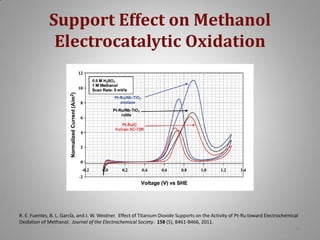
Support Effect on Methanol
Electrocatalytic Oxidation

R. E. Fuentes, B. L. GarcÍa, and J. W. Weidner. Effect of Titanium Dioxide Supports on the Activity of Pt-Ru toward Electrochemical
Oxidation of Methanol. Journal of the Electrochemical Society. 158 (5), B461-B466, 2011.
10
Metal Oxides & Defect Chemistry
By metal oxide doping of Ti site with Nb,
𝑁𝑏2 𝑂5

2 𝑇𝑖𝑂2

1

2 𝑁𝑏·𝑇𝑖 + 4 𝑂 𝑂𝑋 + 2 𝑂2 + 2 𝑒 −

The equilibrium reaction for oxygen at low pressures is:
1
𝑂 𝑂𝑋 ⇌ 𝑉 ·· + 2 𝑒 − + 2 𝑂2
𝑂
The mass action law follows this expression for the equilibrium constant K
for electrons
𝑉 ·· ∗[𝑛]2
𝑂

[𝑂2 ]1/2

= 𝐾 𝑛 where [O2] = Partial pressure of O2 or P(O2)

At low P(O2), where e- compensates for the oxygen vacancies [n] ≈ 2 𝑉 ··
𝑂
1
2

𝑛 ∗ 𝑛

2

1

−2

= 𝐾 𝑛 ∗ 𝑃(𝑂2 )
1
3

𝑛 = (2𝐾 𝑛 ) ∗ 𝑃(𝑂2 )

therefore,

1

−6

11
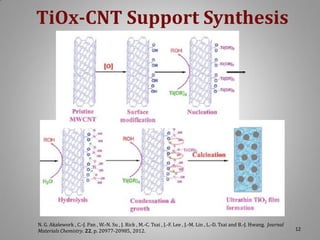
TiOx-CNT Support Synthesis

N. G. Akalework , C.-J. Pan , W.-N. Su , J. Rick , M.-C. Tsai , J.-F. Lee , J.-M. Lin , L.-D. Tsai and B.-J. Hwang. Journal
Materials Chemistry. 22, p. 20977-20985, 2012.

12
MEA Manufacturing
• Novel in our approach for application of electrocatalysts for benefit to
CO oxidation in working electrochemical cells
• Prepared electrocatalyst powders and mixed into inks
• Ultrasonic spray deposition to prepare MEAs
• MEA is greater design challenge than half cell study
• Compared 3 symmetric 10 cm2 electrode designs with 0.3 mgPt/cm2
1. Pt-CNT
2. Pt-TiOx-CNT
3. Pt-TiNbOx-CNT (10 atomic % Nb substituted for Ti)

13
1.0

Pt-CNT

0.8

32.1 m2/gPt

0.6

Current (A)

b)

0.683 V max

0.4
0.2
0.0
-0.2

0.0

0.2

0.4

0.8

38.7

0.6

Current (A)

0.6

0.8

1.0

1.2

Pt-TiNbOx-CNT

m2/g

Pt

0.631 V max

0.4

0.601 V peak 1

0.2
0.0

-0.4

0.646 V max

0.4
0.2

0.0

0.2

0.4

0.6

0.8

Potential (V)

-0.2
-0.4

Potential (V)

1.0

-0.2

36.5 m2/gPt

0.0

-0.4

c)

Pt-TiOx-CNT

0.8
0.6

Current (A)

a)

1.0

1.0

1.2

0.0

0.2

0.4

0.6

0.8

1.0

1.2

Potential (V)

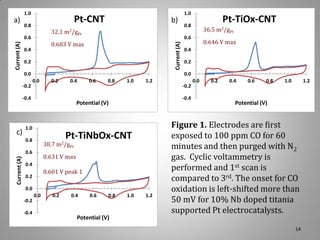
Figure 1. Electrodes are first
exposed to 100 ppm CO for 60
minutes and then purged with N2
gas. Cyclic voltammetry is
performed and 1st scan is
compared to 3rd. The onset for CO
oxidation is left-shifted more than
50 mV for 10% Nb doped titania
supported Pt electrocatalysts.
14
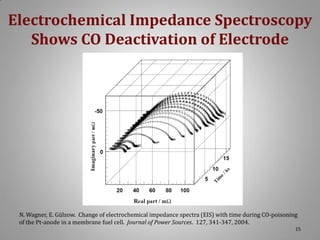
Electrochemical Impedance Spectroscopy
Shows CO Deactivation of Electrode

N. Wagner, E. Gülzow. Change of electrochemical impedance spectra (EIS) with time during CO-poisoning
of the Pt-anode in a membrane fuel cell. Journal of Power Sources. 127, 341-347, 2004.
15
Pt- TiOx-CNT

0.070

0.070

0.042

0.028

0.014

0.056

-Z imaginary (ohms)

0.056

0.042

0.028

0.014

0.000

0.000

0.02

0.04

0.06

0.08

0.10

0.12

0.14

0.16

0.00

0.070

0.042

0.028

0.014

-Z imaginary (ohms)

0.056

0.000

als
)

E2

int
e
m

inu
te

C14

D2

0.06

0.08

Z real (ohms)

0.10

0.12

0.14

0.16

Ti
m

D6

e

(5

C10

rv

C18

0.04

0.02

0.04

0.06

0.08

0.10

0.12

0.14

inu
te
m

0.16

Z real (ohms)

Pt- TiNbOx-CNT

0.02

e

Ti
m

C2

Z real (ohms)

0.00

Ti
m

e

(5

C10
C6

C2

0.00

int

int
m

inu
te

C14

(5

C10
C6

er

C18

er

C18

va

va

ls)

C22

ls)

C22

C14

-Z imaginary (ohms)

Pt- CNT

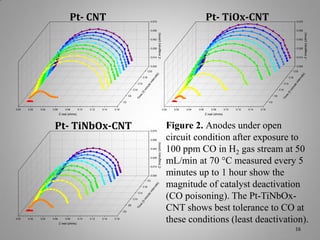
Figure 2. Anodes under open
circuit condition after exposure to
100 ppm CO in H2 gas stream at 50
mL/min at 70 °C measured every 5
minutes up to 1 hour show the
magnitude of catalyst deactivation
(CO poisoning). The Pt-TiNbOxCNT shows best tolerance to CO at
these conditions (least deactivation).
16
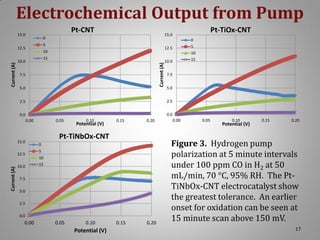
Electrochemical Output from Pump
Pt-CNT

15.0

0
5
15

10.0
7.5
5.0

10.0
7.5
5.0
2.5

2.5

0.0

0.0
0.00

15.0
12.5

Current (A)

0
5
10
15

12.5

10

Current (A)

Current (A)

12.5

Pt-TiOx-CNT

15.0

10.0

0.05

0.10

Potential (V)

0.15

0.20

Pt-TiNbOx-CNT
0
5
10
15

7.5
5.0
2.5
0.0

0.00

0.05

0.10

Potential (V)

0.15

0.20

0.00

0.05

0.10

Potential (V)

0.15

0.20

Figure 3. Hydrogen pump
polarization at 5 minute intervals
under 100 ppm CO in H2 at 50
mL/min, 70 °C, 95% RH. The PtTiNbOx-CNT electrocatalyst show
the greatest tolerance. An earlier
onset for oxidation can be seen at
15 minute scan above 150 mV.
17
XRD Spectra of Composite Support
and effect of [C:Ti] atomic ratio
Effect of Titanium Isopropoxide
added to fixed 0.1 g mass of CNT

Titanium Moles Added

Power (Ti moles)

6.E-04

[10:1]

60000

Ti moles

7.E-04

5.E-04
4.E-04
3.E-04

50000
40000
30000
20000

[80:1]

2.E-04

[80:1]

70000

[10:1]

8.E-04

80000

Intensity (counts)

9.E-04

XRD Spectra of TiOx-CNT Catalyst Supports

10000

1.E-04
0.E+00
0

100

200

[Ti:C] Atomic Ratio

300

400

0
10

30

50

70

90

2Ѳ

XRD scans show the presence of small anatase crystallites on the carbon nanotube
support. A higher titanium loading of 10:1 had a greater resistance and also
lacked sufficient electronic contact to function as electrocatalyst as evidenced by
the minimal ECSA and lack of i-V performance. A lowered ration of C:Ti [80:1] (5%
18
mass ratio of Ti) was used successfully.
Raman Spectra of Composite Support
Raman Spectra of CNT:Titania

18000

Titania-CNT
Oxidized-CNT

16000

25000

12000

20000

10000
8000
6000
4000
2000
0
0

500

1000

1500

2000

Intensity (a.u.)

Intensity (a. u.)

14000

[80:1]

15000

[10:1]
10000

TiNbOx

5000

-1

Raman Shift (cm )
0
0

500

1000

1500

2000

Raman Shift (cm-1)

Raman data from red laser also shows the confirmation
of dual phase support with presence of anatase. The
concentration of titania on the surface may have an effect
on the material’s band gap, Eg. Later, dopant Nb atoms
wer added to effectively reduce the titanium oxidation
state and increase its electronic conductivity.
W. F. Zhang, Y. L. He, M. S. Zhang, Z Yin, Q. Chen. Raman scattering study on anatase TiO2 nanocrystals. J. Phys. D: Appl. Phys. 33, 912–916 (2000).

19
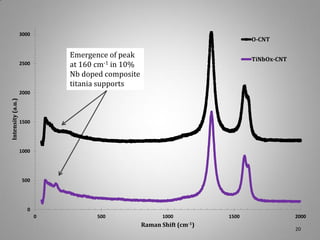
3000

O-CNT

Emergence of peak
at 160 cm-1 in 10%
Nb doped composite
titania supports

2500

TiNbOx-CNT

Intensity (a.u.)

2000

1500

1000

500

0
0

500

1000

Raman Shift (cm-1)

1500

2000
20
Carbon Corrosion Resistance

L. M. Roen, C. H. Paik, and T. D. Jarvi. Electrocatalytic Corrosion of Carbon Support in PEMFC Cathodes.
Electrochemical and Solid-State Letters. 7 (1), A-19-A22, 2004.

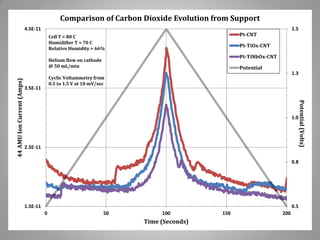
A method to quickly screen electrocatalyst durability achieved by scanning cell
potential and monitoring the evolution of carbon dioxide [CO2+] ion current by mass
spectrometer from sample capillary attached to the exhaust line. Real time
concentrations can be correlated with potential dynamic.
21
Comparison of Carbon Dioxide Evolution from Support
4.5E-11
Cell T = 80 C
Humidifier T = 70 C
Relative Humidity = 66%

Pt-TiOx-CNT
Pt-TiNbOx-CNT

Helium flow on cathode
@ 50 mL/min

Potential
1.3

Cyclic Voltammetry from
0.5 to 1.5 V at 10 mV/sec

3.5E-11

1.0

2.5E-11

Potential (Volts)

44 AMU Ion Current (Amps)

1.5

Pt-CNT

0.8

1.5E-11

0.5
0

50

100

150

200

Time (Seconds)
22
Electron Microscopy
Distribution of Pt Crystallites

0.40

Frequency

0.35
0.30
0.25
0.20

Atomic ratio near 1:1 between Ti:Pt
in this image from STEM and EDX

0.15
0.10
0.05
0.00
2-2.5 2.5-3 3-3.5 3.5-4 4-4.5 4.5-5 5-5.5

[Ti]

Pt Crtystallite Diameter (nm)

HRTEM of Pt particle distribution on support (above)
TEM at USC shows area for improvement and also a
single CNT/Pt electrocatalys (below; left and right)
[O]

Credit: Haijun Qian and JoAn Hudson at Clemson EMF for HRTEM and STEM images & EDX data

[Pt]

23
Industry Collaboration:
Sustainable Innovations, LLC

Template design for MEA construction
Before
Worked closely with industry partner to prepare a resilient
hydrogen oxidation catalyst and delivered MEA for testing.
Electrochemical hydrogen pump results will be presented at
the 2013 Fuel Cell Seminar & Energy Exposition.

After

24
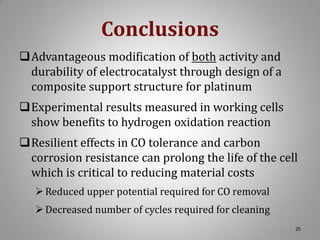
Conclusions
Advantageous modification of both activity and
durability of electrocatalyst through design of a
composite support structure for platinum
Experimental results measured in working cells
show benefits to hydrogen oxidation reaction
Resilient effects in CO tolerance and carbon
corrosion resistance can prolong the life of the cell
which is critical to reducing material costs
 Reduced upper potential required for CO removal
 Decreased number of cycles required for cleaning
25
26
Backup Slides

27
Background and Introduction
•
•
•
•
•

Application for H2 Pumps
Cost of Materials, Platinum
Cost of Fuel, Pure H2
High Pressure Delivery, Mechanical v. EC
Sources of CO and Impurities
– Natural Gas, water-gas shift
– Biofuels

• Carbon Monoxide Effect on Pt Catalysis
• CO clean up leads to corrosion!
28
50 mV hold test + CO 100 ppm
5
Pt-C (TKK)
Pt-TiNbOx-CNT
4

Pt-TiOx-CNT

Current (A)

Pt-CNT

3

2

1

0
0

100

200

300

400

500

Time (seconds)

600

700

800

900
29
Polar
Pt-CNT

15.0

0
5

12.5

15

Current (A)

Current (A)

7.5
5.0

10.0
7.5
5.0
2.5

2.5

0.0

0.0
0.00

0.05

0.10

Potential (V)

0.15

0.20

Pt-TiNbOx-CNT

15.0

5
10
15

10.0

0.00

0.05

0.10

Potential (V)

0.15

0.20

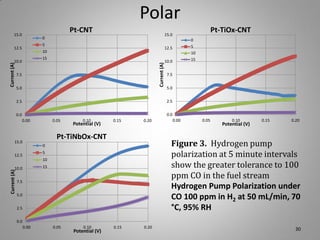
Figure 3. Hydrogen pump
polarization at 5 minute intervals
show the greater tolerance to 100
ppm CO in the fuel stream
Hydrogen Pump Polarization under
CO 100 ppm in H2 at 50 mL/min, 70
°C, 95% RH

0

12.5

Current (A)

0
5
10
15

12.5

10

10.0

Pt-TiOx-CNT

15.0

7.5
5.0
2.5
0.0
0.00

0.05

0.10

Potential (V)

0.15

0.20

30
What’s Remaining?
Durability measurements by CO2 evolution
X-ray photoelectron spectroscopy
Electron Microscopy (TEM, STEM, FESEM)
Prepare MEA materials for stack tests by S. I.
Experimental data quantification + present
Submit abstracts to relevant conferences
o Electrochemical Society
o Fuel Cell Seminar & Exposition
o American Chemical Society
31
Raman Spectra of Carbon:Titanium Catalyst Supports

Raman Spectroscopy

25000

20000

[80:1]
Intensity (a.u.)

15000

[10:1]
TiNbOx

10000

5000

0
0

200

400

600

800

1000

Raman Shift

1200

1400

1600

1800

2000

(cm-1)
32
XRD of Pt Composite Electrocatalysts
80000

70000

Intensity (a.u.)

60000

Pt-CNT
Pt-TiOx

50000

Pt-TiNbOx
40000

30000

20000

10000

0
30

35

40

45

50

2Ѳ

55

60

65

70
33
Carbon
Cyclic Voltammetry

Carbon chemistry and Pt
support stability effects

Polarization Air

Pt-TiOx-CNT
1.0

0.015

0.9

0.010

Cell Potential (V)

2

Current Density (mA/cm )

0.020

0.005
0.000
-0.005
-0.010

-0.020
0.0

0.8
0.7
0.6
0.5
0.4

Initial
12300
32000

-0.015

0.2

0.4

0.6

0.8

1.0

Initial
12300
32000

0.3
0

1.2

200

400

600

800

1000

1200

2

Cell Potential (V)

Current Density (mA/cm )

Pt-CNT
0.020

1.0

0.015

0.9

0.010

Cell Potential (V)

2

Current Density (mA/cm )

F. Hasché, M. Oezaslan, P. Strasser. Activity,
stability and degradation of MWCNT supported Pt
fuel cell electrocatalysts. Physical Chemistry
Chemical Physics. 12, 15251-15258, 2010.

0.005
0.000
-0.005
-0.010
Initial
10000
30000

-0.015
-0.020
0.0

0.2

0.4

0.6

0.8

Cell Potential (V)

1.0

1.2

Initial
10000
30000

0.8
0.7
0.6
0.5
0.4
0.3
0

200

400

600

800

34
1000 1200
2

Current Density (mA/cm )
0.2

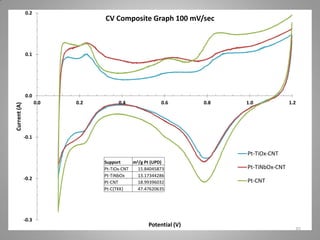
CV Composite Graph 100 mV/sec

0.1

0.0

Current (A)

0.0

0.2

0.4

0.6

0.8

1.0

1.2

-0.1

Pt-TiOx-CNT

-0.2

-0.3

Support
m2/g Pt (UPD)
Pt-TiOx-CNT
15.84045873
Pt-TiNbOx
13.17344286
Pt-CNT
18.99396032
Pt-C(TKK)
47.47620635

Potential (V)

Pt-TiNbOx-CNT
Pt-CNT

35
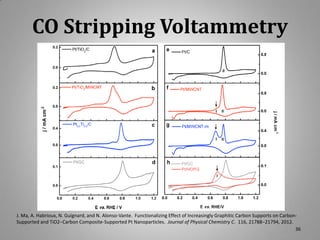
CO Stripping Voltammetry

J. Ma, A. Habrioux, N. Guignard, and N. Alonso-Vante. Functionalizing Effect of Increasingly Graphitic Carbon Supports on CarbonSupported and TiO2−Carbon Composite-Supported Pt Nanoparticles. Journal of Physical Chemistry C. 116, 21788−21794, 2012.
36
X-ray Photoelectro Spectroscoopy

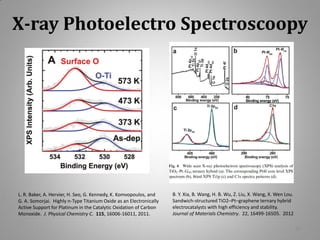
L. R. Baker, A. Hervier, H. Seo, G. Kennedy, K. Komvopoulos, and
G. A. Somorjai. Highly n-Type Titanium Oxide as an Electronically
Active Support for Platinum in the Catalytic Oxidation of Carbon
Monoxide. J. Physical Chemistry C. 115, 16006-16011, 2011.

B. Y. Xia, B. Wang, H. B. Wu, Z. Liu, X. Wang, X. Wen Lou.
Sandwich-structured TiO2–Pt–graphene ternary hybrid
electrocatalysts with high efficiency and stability.
Journal of Materials Chemistry. 22, 16499-16505. 2012
37
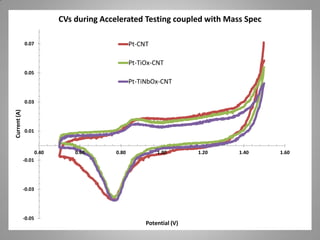
CVs during Accelerated Testing coupled with Mass Spec
Pt-CNT

0.07

Pt-TiOx-CNT
0.05

Pt-TiNbOx-CNT

Current (A)

0.03

0.01

0.40

0.60

0.80

1.00

1.20

1.40

1.60

-0.01

-0.03

-0.05

Potential (V)
38
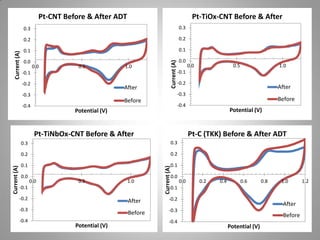
Pt-CNT Before & After ADT

Pt-TiOx-CNT Before & After
0.2

0.1

0.1

0.0

0.0

0.5

1.0

-0.1
-0.2

After

Current (A)

0.3

0.2

Current (A)

0.3

0.0

0.5

1.0

-0.1

-0.2

After

-0.3

-0.3

Before

-0.4

Before

-0.4

Potential (V)

Pt-TiNbOx-CNT Before & After

Potential (V)

Pt-C (TKK) Before & After ADT
0.3

0.2

0.2

0.1

0.1

0.0

0.0

0.5

1.0

-0.1

0.0

0.0

0.2

0.4

0.6

0.8

1.0

1.2

-0.1

-0.2

After

Potential (V)

-0.2

Before

-0.3
-0.4

Current (A)

0.3

Current (A)

0.0

-0.3
-0.4

After
Before
Potential (V)

39
Industry Collaboration:
Sustainable Innovations

40

CapItalIs Fuel Cell Challenge V Presentation

  • 1.
    Resilient Oxidation Catalystsfor Electrochemical Hydrogen Pump Final Presentation May 21, 2013 William A. Rigdon Diana Larrabee Xinyu Huang, Ph.D.
  • 2.
    Electrochemical Hydrogen Pump Pumpserves to separate and compress hydrogen. Process is performed by applying power across the electrochemical cell. No moving parts in this design and this method provides the most efficient way to compress hydrogen. 2
  • 3.
    Project Goals • Problem:Hydrogen oxidation electrocatalysts are used in anode of hydrogen pump and fuel cell. They are subject to poisoning from impurities like carbon monoxide [CO] and durability concerns that arise from cleaning up CO. • Challenge: Develop supports which can improve the activity and durability of electrocatalysts for H2 pump. • Approach: Design a composite support structure which can aid in the improvement of both desired properties. Demonstrate performance improvements through working membrane electrode assemblies (MEA). Study the material behavior and elucidate the benefits. 3
  • 4.
    Electrocatalyst Degradation The corrosionmechanisms are all related, but it can be understood by four simple schematics of the contribution to the detachment, dissolution, diffusion, and re-deposition of Pt catalysts resulting in particle growth and loss of activity Y. Shao-Horn, W. C. Sheng, S. Chen, P. J. Ferreira, E. F. Holby, D. Morgan. Instability of Supported Platinum Nanoparticles in Low-Temperature Fuel Cells. Topics in Catalysis. 46 (3-4), 285-305 (2007). 4
  • 5.
    Project Approach Prepare compositesupports: CNT-Titania Synthesize Pt electrocatalysts on supports Characterize material structure/properties Design and construct MEAs for testing Test electrochemical performance Observe carbon corrosion resistance Report results and publish 5
  • 6.
    Carbon Structure Carbon chemistryand Pt support stability effects -o- High surface area amorphous carbon black supports have best activity, but have high defect density and poor stability -□- A carbon nanotube (CNT) demonstrates long range order and graphitic bonding with fewer defect sites on the surface F. Hasché, M. Oezaslan, P. Strasser. Activity, stability and degradation of MWCNT supported Pt fuel cell electrocatalysts. Physical Chemistry Chemical Physics. 12, 15251-15258, 2010. 6
  • 7.
    Titanium Dioxide SupportDurability A titanium dioxide platinum support was used to generate a performance similar to a commercial carbon black electrode with excellent durability, but required a very high platinum content. S.-Y. Huang, P. Ganesan, S. Park, B. N. Popov. Development of a Titanium Dioxide-Supported Platinum Catalyst with Ultrahigh Stability for Polymer Electrolyte Membrane Fuel Cell Applications. Journal of the American Chemical Society. 131, 13898-13899, 2009. 7
  • 8.
    Metal and OxideStability • Pourbaix Diagram – Immunity – Corrosion – Passivation Region of electrode operation Passivation Corrosion E. Asselin , T. M. Ahmed , A. Alfantazi. Corrosion of niobium in sulphuric and hydrochloric acid solutions at 75 and 95 °C. Corrosion Science. 49, 694-700, 2007. Immunity M. Pourbaix. Atlias of Electrochemical Equilibria in Aqueous Solutions. 1974. 8
  • 9.
    Mechanistic Effect onActivity of CO Oxidation for Pt-TiOx D. Jiang, S. H. Overbury, and S. Dai. Structures and Energetics of Pt Clusters on TiO2: Interplay between Metal-Metal Bonds and Metal-Oxygen Bonds. J. of Physical Chemistry. 116, 2188021885, 2012. TiOx−OH + Pt−COad  CO2 + Pt + TiO2 + H+ + e- S. Bonanni, K. Aït-Mansour, W. Harbich, H. Brune. Effect of the TiO2 Reduction State on the Catalytic CO Oxidation on Deposited Size-Selected Pt Clusters. J. of the American Chemical Society. 134, 3445-3450, 2012. S. C. Ammal, A. Heyden. Nature of Ptn/TiO2(110) Interface under Water-Gas Shift Reaction Conditions: A Constrained ab Initio Thermodynamics Study. J. of 9 Physical of Chemistry. 115, 19246–19259, 2011.
  • 10.
    Support Effect onMethanol Electrocatalytic Oxidation R. E. Fuentes, B. L. GarcÍa, and J. W. Weidner. Effect of Titanium Dioxide Supports on the Activity of Pt-Ru toward Electrochemical Oxidation of Methanol. Journal of the Electrochemical Society. 158 (5), B461-B466, 2011. 10
  • 11.
    Metal Oxides &Defect Chemistry By metal oxide doping of Ti site with Nb, 𝑁𝑏2 𝑂5 2 𝑇𝑖𝑂2 1 2 𝑁𝑏·𝑇𝑖 + 4 𝑂 𝑂𝑋 + 2 𝑂2 + 2 𝑒 − The equilibrium reaction for oxygen at low pressures is: 1 𝑂 𝑂𝑋 ⇌ 𝑉 ·· + 2 𝑒 − + 2 𝑂2 𝑂 The mass action law follows this expression for the equilibrium constant K for electrons 𝑉 ·· ∗[𝑛]2 𝑂 [𝑂2 ]1/2 = 𝐾 𝑛 where [O2] = Partial pressure of O2 or P(O2) At low P(O2), where e- compensates for the oxygen vacancies [n] ≈ 2 𝑉 ·· 𝑂 1 2 𝑛 ∗ 𝑛 2 1 −2 = 𝐾 𝑛 ∗ 𝑃(𝑂2 ) 1 3 𝑛 = (2𝐾 𝑛 ) ∗ 𝑃(𝑂2 ) therefore, 1 −6 11
  • 12.
    TiOx-CNT Support Synthesis N.G. Akalework , C.-J. Pan , W.-N. Su , J. Rick , M.-C. Tsai , J.-F. Lee , J.-M. Lin , L.-D. Tsai and B.-J. Hwang. Journal Materials Chemistry. 22, p. 20977-20985, 2012. 12
  • 13.
    MEA Manufacturing • Novelin our approach for application of electrocatalysts for benefit to CO oxidation in working electrochemical cells • Prepared electrocatalyst powders and mixed into inks • Ultrasonic spray deposition to prepare MEAs • MEA is greater design challenge than half cell study • Compared 3 symmetric 10 cm2 electrode designs with 0.3 mgPt/cm2 1. Pt-CNT 2. Pt-TiOx-CNT 3. Pt-TiNbOx-CNT (10 atomic % Nb substituted for Ti) 13
  • 14.
    1.0 Pt-CNT 0.8 32.1 m2/gPt 0.6 Current (A) b) 0.683V max 0.4 0.2 0.0 -0.2 0.0 0.2 0.4 0.8 38.7 0.6 Current (A) 0.6 0.8 1.0 1.2 Pt-TiNbOx-CNT m2/g Pt 0.631 V max 0.4 0.601 V peak 1 0.2 0.0 -0.4 0.646 V max 0.4 0.2 0.0 0.2 0.4 0.6 0.8 Potential (V) -0.2 -0.4 Potential (V) 1.0 -0.2 36.5 m2/gPt 0.0 -0.4 c) Pt-TiOx-CNT 0.8 0.6 Current (A) a) 1.0 1.0 1.2 0.0 0.2 0.4 0.6 0.8 1.0 1.2 Potential (V) Figure 1. Electrodes are first exposed to 100 ppm CO for 60 minutes and then purged with N2 gas. Cyclic voltammetry is performed and 1st scan is compared to 3rd. The onset for CO oxidation is left-shifted more than 50 mV for 10% Nb doped titania supported Pt electrocatalysts. 14
  • 15.
    Electrochemical Impedance Spectroscopy ShowsCO Deactivation of Electrode N. Wagner, E. Gülzow. Change of electrochemical impedance spectra (EIS) with time during CO-poisoning of the Pt-anode in a membrane fuel cell. Journal of Power Sources. 127, 341-347, 2004. 15
  • 16.
    Pt- TiOx-CNT 0.070 0.070 0.042 0.028 0.014 0.056 -Z imaginary(ohms) 0.056 0.042 0.028 0.014 0.000 0.000 0.02 0.04 0.06 0.08 0.10 0.12 0.14 0.16 0.00 0.070 0.042 0.028 0.014 -Z imaginary (ohms) 0.056 0.000 als ) E2 int e m inu te C14 D2 0.06 0.08 Z real (ohms) 0.10 0.12 0.14 0.16 Ti m D6 e (5 C10 rv C18 0.04 0.02 0.04 0.06 0.08 0.10 0.12 0.14 inu te m 0.16 Z real (ohms) Pt- TiNbOx-CNT 0.02 e Ti m C2 Z real (ohms) 0.00 Ti m e (5 C10 C6 C2 0.00 int int m inu te C14 (5 C10 C6 er C18 er C18 va va ls) C22 ls) C22 C14 -Z imaginary (ohms) Pt- CNT Figure 2. Anodes under open circuit condition after exposure to 100 ppm CO in H2 gas stream at 50 mL/min at 70 °C measured every 5 minutes up to 1 hour show the magnitude of catalyst deactivation (CO poisoning). The Pt-TiNbOxCNT shows best tolerance to CO at these conditions (least deactivation). 16
  • 17.
    Electrochemical Output fromPump Pt-CNT 15.0 0 5 15 10.0 7.5 5.0 10.0 7.5 5.0 2.5 2.5 0.0 0.0 0.00 15.0 12.5 Current (A) 0 5 10 15 12.5 10 Current (A) Current (A) 12.5 Pt-TiOx-CNT 15.0 10.0 0.05 0.10 Potential (V) 0.15 0.20 Pt-TiNbOx-CNT 0 5 10 15 7.5 5.0 2.5 0.0 0.00 0.05 0.10 Potential (V) 0.15 0.20 0.00 0.05 0.10 Potential (V) 0.15 0.20 Figure 3. Hydrogen pump polarization at 5 minute intervals under 100 ppm CO in H2 at 50 mL/min, 70 °C, 95% RH. The PtTiNbOx-CNT electrocatalyst show the greatest tolerance. An earlier onset for oxidation can be seen at 15 minute scan above 150 mV. 17
  • 18.
    XRD Spectra ofComposite Support and effect of [C:Ti] atomic ratio Effect of Titanium Isopropoxide added to fixed 0.1 g mass of CNT Titanium Moles Added Power (Ti moles) 6.E-04 [10:1] 60000 Ti moles 7.E-04 5.E-04 4.E-04 3.E-04 50000 40000 30000 20000 [80:1] 2.E-04 [80:1] 70000 [10:1] 8.E-04 80000 Intensity (counts) 9.E-04 XRD Spectra of TiOx-CNT Catalyst Supports 10000 1.E-04 0.E+00 0 100 200 [Ti:C] Atomic Ratio 300 400 0 10 30 50 70 90 2Ѳ XRD scans show the presence of small anatase crystallites on the carbon nanotube support. A higher titanium loading of 10:1 had a greater resistance and also lacked sufficient electronic contact to function as electrocatalyst as evidenced by the minimal ECSA and lack of i-V performance. A lowered ration of C:Ti [80:1] (5% 18 mass ratio of Ti) was used successfully.
  • 19.
    Raman Spectra ofComposite Support Raman Spectra of CNT:Titania 18000 Titania-CNT Oxidized-CNT 16000 25000 12000 20000 10000 8000 6000 4000 2000 0 0 500 1000 1500 2000 Intensity (a.u.) Intensity (a. u.) 14000 [80:1] 15000 [10:1] 10000 TiNbOx 5000 -1 Raman Shift (cm ) 0 0 500 1000 1500 2000 Raman Shift (cm-1) Raman data from red laser also shows the confirmation of dual phase support with presence of anatase. The concentration of titania on the surface may have an effect on the material’s band gap, Eg. Later, dopant Nb atoms wer added to effectively reduce the titanium oxidation state and increase its electronic conductivity. W. F. Zhang, Y. L. He, M. S. Zhang, Z Yin, Q. Chen. Raman scattering study on anatase TiO2 nanocrystals. J. Phys. D: Appl. Phys. 33, 912–916 (2000). 19
  • 20.
    3000 O-CNT Emergence of peak at160 cm-1 in 10% Nb doped composite titania supports 2500 TiNbOx-CNT Intensity (a.u.) 2000 1500 1000 500 0 0 500 1000 Raman Shift (cm-1) 1500 2000 20
  • 21.
    Carbon Corrosion Resistance L.M. Roen, C. H. Paik, and T. D. Jarvi. Electrocatalytic Corrosion of Carbon Support in PEMFC Cathodes. Electrochemical and Solid-State Letters. 7 (1), A-19-A22, 2004. A method to quickly screen electrocatalyst durability achieved by scanning cell potential and monitoring the evolution of carbon dioxide [CO2+] ion current by mass spectrometer from sample capillary attached to the exhaust line. Real time concentrations can be correlated with potential dynamic. 21
  • 22.
    Comparison of CarbonDioxide Evolution from Support 4.5E-11 Cell T = 80 C Humidifier T = 70 C Relative Humidity = 66% Pt-TiOx-CNT Pt-TiNbOx-CNT Helium flow on cathode @ 50 mL/min Potential 1.3 Cyclic Voltammetry from 0.5 to 1.5 V at 10 mV/sec 3.5E-11 1.0 2.5E-11 Potential (Volts) 44 AMU Ion Current (Amps) 1.5 Pt-CNT 0.8 1.5E-11 0.5 0 50 100 150 200 Time (Seconds) 22
  • 23.
    Electron Microscopy Distribution ofPt Crystallites 0.40 Frequency 0.35 0.30 0.25 0.20 Atomic ratio near 1:1 between Ti:Pt in this image from STEM and EDX 0.15 0.10 0.05 0.00 2-2.5 2.5-3 3-3.5 3.5-4 4-4.5 4.5-5 5-5.5 [Ti] Pt Crtystallite Diameter (nm) HRTEM of Pt particle distribution on support (above) TEM at USC shows area for improvement and also a single CNT/Pt electrocatalys (below; left and right) [O] Credit: Haijun Qian and JoAn Hudson at Clemson EMF for HRTEM and STEM images & EDX data [Pt] 23
  • 24.
    Industry Collaboration: Sustainable Innovations,LLC Template design for MEA construction Before Worked closely with industry partner to prepare a resilient hydrogen oxidation catalyst and delivered MEA for testing. Electrochemical hydrogen pump results will be presented at the 2013 Fuel Cell Seminar & Energy Exposition. After 24
  • 25.
    Conclusions Advantageous modification ofboth activity and durability of electrocatalyst through design of a composite support structure for platinum Experimental results measured in working cells show benefits to hydrogen oxidation reaction Resilient effects in CO tolerance and carbon corrosion resistance can prolong the life of the cell which is critical to reducing material costs  Reduced upper potential required for CO removal  Decreased number of cycles required for cleaning 25
  • 26.
  • 27.
  • 28.
    Background and Introduction • • • • • Applicationfor H2 Pumps Cost of Materials, Platinum Cost of Fuel, Pure H2 High Pressure Delivery, Mechanical v. EC Sources of CO and Impurities – Natural Gas, water-gas shift – Biofuels • Carbon Monoxide Effect on Pt Catalysis • CO clean up leads to corrosion! 28
  • 29.
    50 mV holdtest + CO 100 ppm 5 Pt-C (TKK) Pt-TiNbOx-CNT 4 Pt-TiOx-CNT Current (A) Pt-CNT 3 2 1 0 0 100 200 300 400 500 Time (seconds) 600 700 800 900 29
  • 30.
    Polar Pt-CNT 15.0 0 5 12.5 15 Current (A) Current (A) 7.5 5.0 10.0 7.5 5.0 2.5 2.5 0.0 0.0 0.00 0.05 0.10 Potential(V) 0.15 0.20 Pt-TiNbOx-CNT 15.0 5 10 15 10.0 0.00 0.05 0.10 Potential (V) 0.15 0.20 Figure 3. Hydrogen pump polarization at 5 minute intervals show the greater tolerance to 100 ppm CO in the fuel stream Hydrogen Pump Polarization under CO 100 ppm in H2 at 50 mL/min, 70 °C, 95% RH 0 12.5 Current (A) 0 5 10 15 12.5 10 10.0 Pt-TiOx-CNT 15.0 7.5 5.0 2.5 0.0 0.00 0.05 0.10 Potential (V) 0.15 0.20 30
  • 31.
    What’s Remaining? Durability measurementsby CO2 evolution X-ray photoelectron spectroscopy Electron Microscopy (TEM, STEM, FESEM) Prepare MEA materials for stack tests by S. I. Experimental data quantification + present Submit abstracts to relevant conferences o Electrochemical Society o Fuel Cell Seminar & Exposition o American Chemical Society 31
  • 32.
    Raman Spectra ofCarbon:Titanium Catalyst Supports Raman Spectroscopy 25000 20000 [80:1] Intensity (a.u.) 15000 [10:1] TiNbOx 10000 5000 0 0 200 400 600 800 1000 Raman Shift 1200 1400 1600 1800 2000 (cm-1) 32
  • 33.
    XRD of PtComposite Electrocatalysts 80000 70000 Intensity (a.u.) 60000 Pt-CNT Pt-TiOx 50000 Pt-TiNbOx 40000 30000 20000 10000 0 30 35 40 45 50 2Ѳ 55 60 65 70 33
  • 34.
    Carbon Cyclic Voltammetry Carbon chemistryand Pt support stability effects Polarization Air Pt-TiOx-CNT 1.0 0.015 0.9 0.010 Cell Potential (V) 2 Current Density (mA/cm ) 0.020 0.005 0.000 -0.005 -0.010 -0.020 0.0 0.8 0.7 0.6 0.5 0.4 Initial 12300 32000 -0.015 0.2 0.4 0.6 0.8 1.0 Initial 12300 32000 0.3 0 1.2 200 400 600 800 1000 1200 2 Cell Potential (V) Current Density (mA/cm ) Pt-CNT 0.020 1.0 0.015 0.9 0.010 Cell Potential (V) 2 Current Density (mA/cm ) F. Hasché, M. Oezaslan, P. Strasser. Activity, stability and degradation of MWCNT supported Pt fuel cell electrocatalysts. Physical Chemistry Chemical Physics. 12, 15251-15258, 2010. 0.005 0.000 -0.005 -0.010 Initial 10000 30000 -0.015 -0.020 0.0 0.2 0.4 0.6 0.8 Cell Potential (V) 1.0 1.2 Initial 10000 30000 0.8 0.7 0.6 0.5 0.4 0.3 0 200 400 600 800 34 1000 1200 2 Current Density (mA/cm )
  • 35.
    0.2 CV Composite Graph100 mV/sec 0.1 0.0 Current (A) 0.0 0.2 0.4 0.6 0.8 1.0 1.2 -0.1 Pt-TiOx-CNT -0.2 -0.3 Support m2/g Pt (UPD) Pt-TiOx-CNT 15.84045873 Pt-TiNbOx 13.17344286 Pt-CNT 18.99396032 Pt-C(TKK) 47.47620635 Potential (V) Pt-TiNbOx-CNT Pt-CNT 35
  • 36.
    CO Stripping Voltammetry J.Ma, A. Habrioux, N. Guignard, and N. Alonso-Vante. Functionalizing Effect of Increasingly Graphitic Carbon Supports on CarbonSupported and TiO2−Carbon Composite-Supported Pt Nanoparticles. Journal of Physical Chemistry C. 116, 21788−21794, 2012. 36
  • 37.
    X-ray Photoelectro Spectroscoopy L.R. Baker, A. Hervier, H. Seo, G. Kennedy, K. Komvopoulos, and G. A. Somorjai. Highly n-Type Titanium Oxide as an Electronically Active Support for Platinum in the Catalytic Oxidation of Carbon Monoxide. J. Physical Chemistry C. 115, 16006-16011, 2011. B. Y. Xia, B. Wang, H. B. Wu, Z. Liu, X. Wang, X. Wen Lou. Sandwich-structured TiO2–Pt–graphene ternary hybrid electrocatalysts with high efficiency and stability. Journal of Materials Chemistry. 22, 16499-16505. 2012 37
  • 38.
    CVs during AcceleratedTesting coupled with Mass Spec Pt-CNT 0.07 Pt-TiOx-CNT 0.05 Pt-TiNbOx-CNT Current (A) 0.03 0.01 0.40 0.60 0.80 1.00 1.20 1.40 1.60 -0.01 -0.03 -0.05 Potential (V) 38
  • 39.
    Pt-CNT Before &After ADT Pt-TiOx-CNT Before & After 0.2 0.1 0.1 0.0 0.0 0.5 1.0 -0.1 -0.2 After Current (A) 0.3 0.2 Current (A) 0.3 0.0 0.5 1.0 -0.1 -0.2 After -0.3 -0.3 Before -0.4 Before -0.4 Potential (V) Pt-TiNbOx-CNT Before & After Potential (V) Pt-C (TKK) Before & After ADT 0.3 0.2 0.2 0.1 0.1 0.0 0.0 0.5 1.0 -0.1 0.0 0.0 0.2 0.4 0.6 0.8 1.0 1.2 -0.1 -0.2 After Potential (V) -0.2 Before -0.3 -0.4 Current (A) 0.3 Current (A) 0.0 -0.3 -0.4 After Before Potential (V) 39
  • 40.