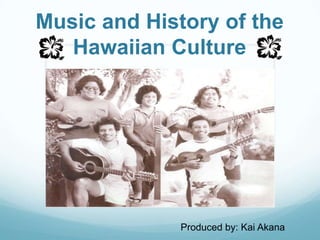
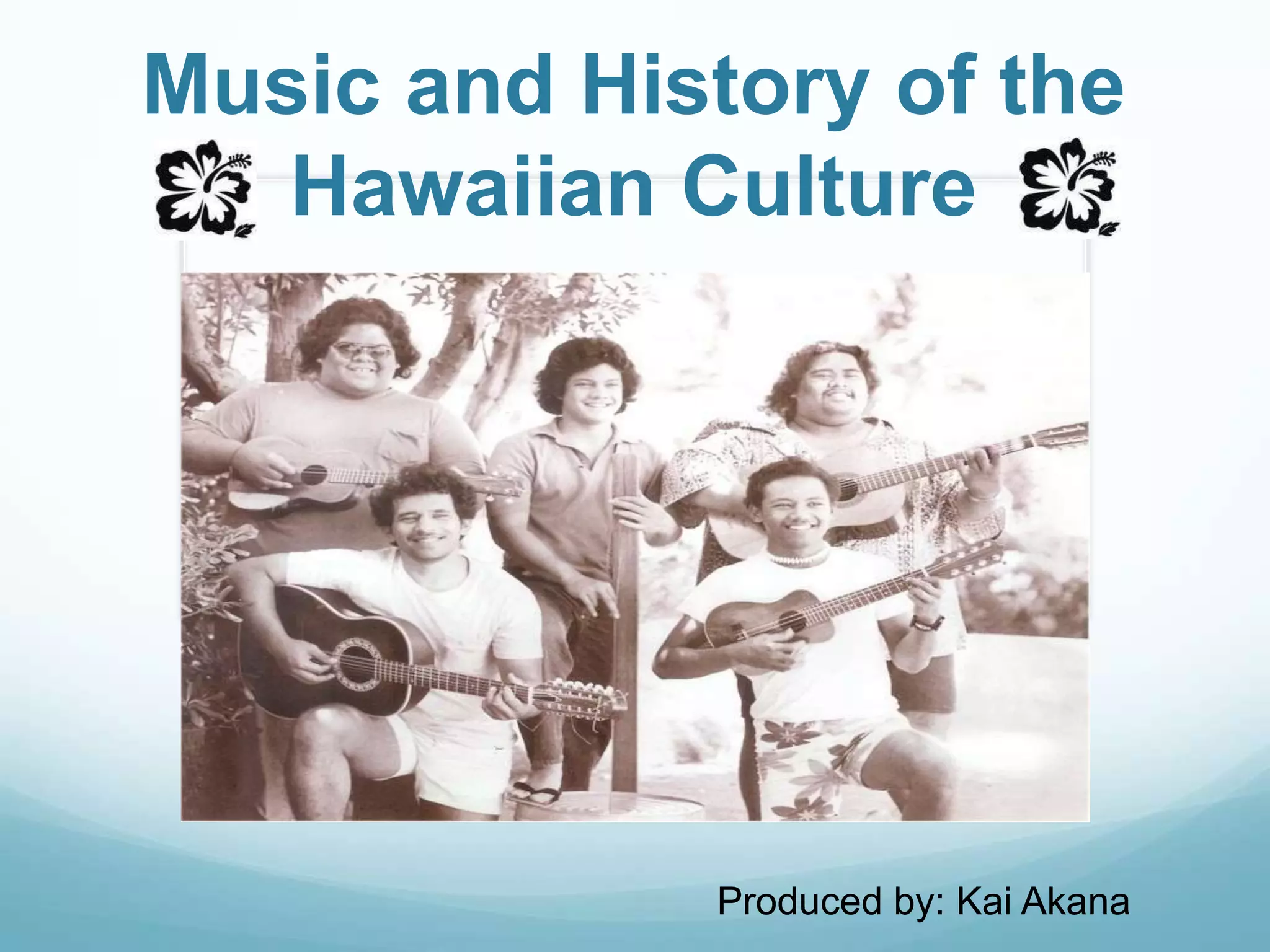
Music and History of the Hawaiian CultureProduced by: Kai Akana
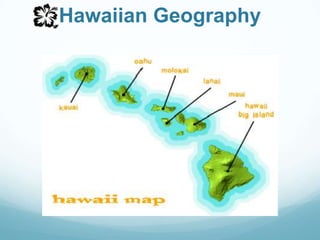
Hawaiian Geography
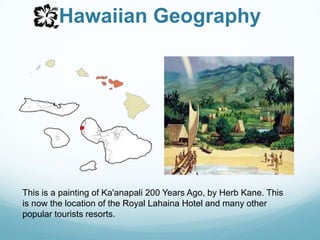
Hawaiian Geography This is a painting of Ka'anapali 200 Years Ago, by Herb Kane. This is now the location of the Royal LahainaHotel and many other popular tourists resorts.
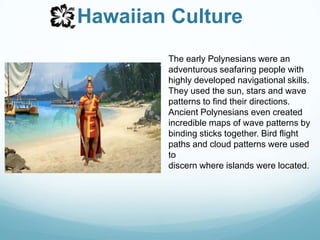
Hawaiian CultureThe early Polynesians were an adventurous seafaring people with highly developed navigational skills. They used the sun, stars and wave patterns to find their directions. Ancient Polynesians even created incredible maps of wave patterns by binding sticks together. Bird flight paths and cloud patterns were used to discern where islands were located.
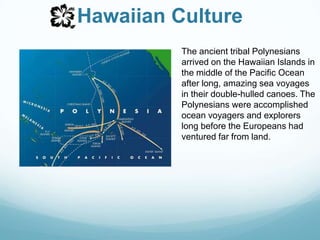
Hawaiian CultureThe ancient tribal Polynesians arrived on the Hawaiian Islands in the middle of the Pacific Ocean after long, amazing sea voyages in their double-hulled canoes. The Polynesians were accomplished ocean voyagers and explorers long before the Europeans had ventured far from land.
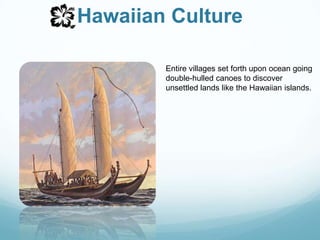
Hawaiian CultureEntire villages set forth upon ocean going double-hulled canoes to discover unsettled lands like the Hawaiian islands. 
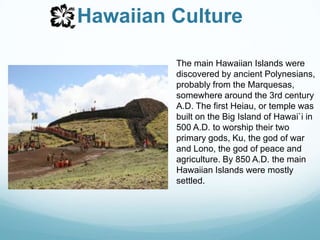
Hawaiian CultureThe main Hawaiian Islands were discovered by ancient Polynesians, probably from the Marquesas, somewhere around the 3rd century A.D. The first Heiau, or temple was built on the Big Island of Hawai`i in 500 A.D. to worship their two primary gods, Ku, the god of war and Lono, the god of peace and agriculture. By 850 A.D. the main Hawaiian Islands were mostly settled.
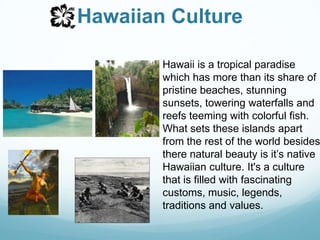
Hawaiian CultureHawaii is a tropical paradise which has more than its share of pristine beaches, stunning sunsets, towering waterfalls and reefs teeming with colorful fish. What sets these islands apart from the rest of the world besides there natural beauty is it’s native Hawaiian culture. It's a culture that is filled with fascinating customs, music, legends, traditions and values.
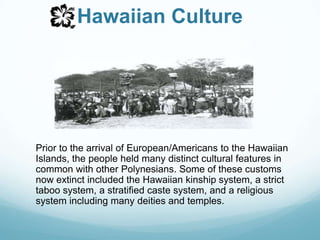
Hawaiian CulturePrior to the arrival of European/Americans to the Hawaiian Islands, the people held many distinct cultural features in common with other Polynesians. Some of these customs now extinct included the Hawaiian kinship system, a strict taboo system, a stratified caste system, and a religious system including many deities and temples.
Hawaiian CultureHawaiian Stratified Caste System: Hawaii had developed a strict caste system, where people were born to a specific social class and were unable to move into another class. With the caste system, the Hawaiians developed a feudalistic society, similar to European feudalism. The general classes included, in order of importance:Ali’i, the Hawaiian royal classKahuna, the Hawaiian priestly classMaka'ainana, the Hawaiian commoner class
Hawaiian CultureHawaiian Religion: Hawaiian religion was polytheistic and animistic, as spirits were believed to dwell in nature and objects. The Hawaiians held respect for all living things, for natural forces, and for spirits and deities. Some spirits could be benevolent and some evil.Hawaiians worshipped at heiaus (temples or places of worship), which were sacred locations for prayers, offerings, rituals and human sacrifices. Hawaiian sacred places also included thousands of koa(shrines), and many wahi pana (sacred sites).A strictly followed system of kapus (taboos or cursed things) served as a legal system for the Hawaiians. Kapu means “forbidden,” but it also carries the meaning of “sacred,” as some items and activities were marked as consecrated, to be used or touched only by certain classes.
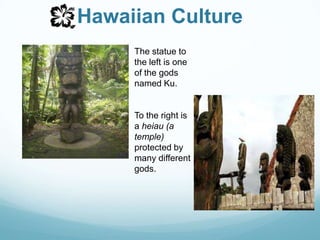
Hawaiian CultureThe statue to the left is one of the gods named Ku. To the right is a heiau(a temple) protected by many different gods.
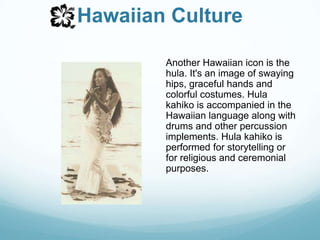
Hawaiian CultureAnother Hawaiian icon is the hula. It's an image of swaying hips, graceful hands and colorful costumes. Hula kahiko is accompanied in the Hawaiian language along with drums and other percussion implements. Hula kahiko is performed for storytelling or for religious and ceremonial purposes.
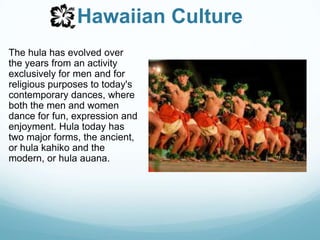
Hawaiian CultureThe hula has evolved over the years from an activity exclusively for men and for religious purposes to today's contemporary dances, where both the men and women dance for fun, expression and enjoyment. Hula today has two major forms, the ancient, or hula kahiko and the modern, or hula auana.
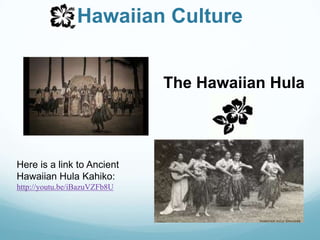
Hawaiian CultureThe Hawaiian HulaHere is a link to Ancient Hawaiian Hula Kahiko: http://youtu.be/iBazuVZFb8U
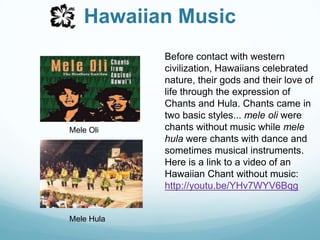
Hawaiian MusicBefore contact with western civilization, Hawaiians celebrated nature, their gods and their love of life through the expression of Chants and Hula. Chants came in two basic styles... mele oli were chants without music while mele hula were chants with dance and sometimes musical instruments. Here is a link to a video of an Hawaiian Chant without music:                     http://youtu.be/YHv7WYV6BqgMele OliMele Hula
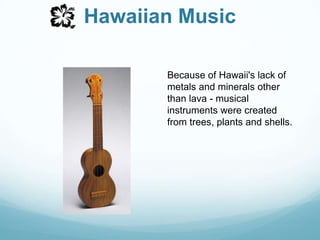
Hawaiian MusicBecause of Hawaii's lack of metals and minerals other than lava - musical instruments were created from trees, plants and shells.
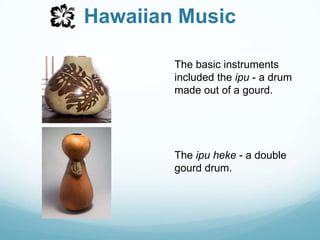
Hawaiian MusicThe basic instruments included the ipu - a drum made out of a gourd. The ipu heke - a double gourd drum.
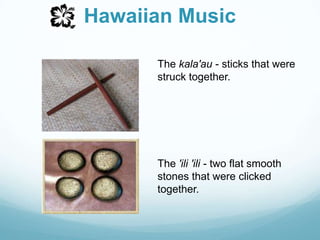
Hawaiian MusicThe kala'au - sticks that were struck together.The 'ili 'ili - two flat smooth stones that were clicked together.
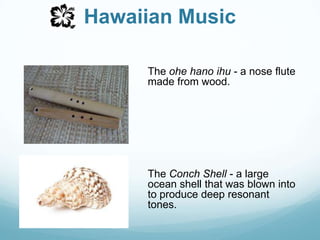
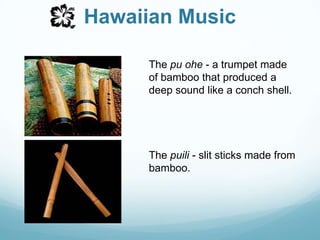
Hawaiian MusicThe ohe hanoihu - a nose flute made from wood.The Conch Shell - a large ocean shell that was blown into to produce deep resonant tones.
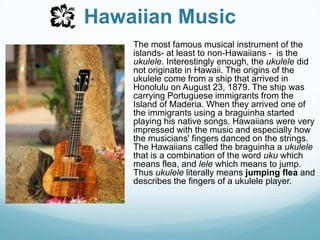
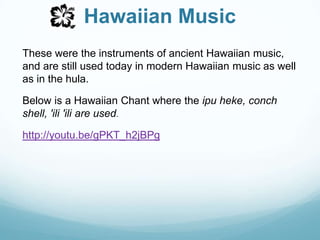
Hawaiian MusicThe pu ohe - a trumpet made of bamboothat produced a deep sound like a conch shell.The puili - slit sticks made from bamboo.
Hawaiian MusicThe most famous musical instrument of the islands- at least to non-Hawaiians -  is the ukulele. Interestingly enough, the ukulele did not originate in Hawaii. The origins of the ukulele come from a ship that arrived in Honolulu on August 23, 1879. The ship was carrying Portuguese immigrants from the Island of Maderia. When they arrived one of the immigrants using a braguinha started playing his native songs. Hawaiians were very impressed with the music and especially how the musicians' fingers danced on the strings. The Hawaiians called the braguinha a ukulele that is a combination of the word uku which means flea, and lele which means to jump. Thus ukulele literally means jumping flea and describes the fingers of a ukulele player.
Hawaiian MusicThese were the instruments of ancient Hawaiian music, and are still used today in modern Hawaiian music as well as in the hula.Below is a Hawaiian Chant where the ipu heke, conch shell, 'ili 'iliare used.http://youtu.be/gPKT_h2jBPg
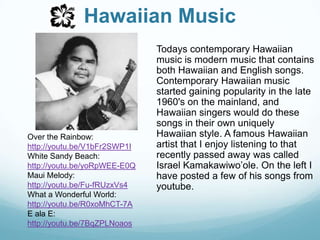
Hawaiian MusicTodays contemporary Hawaiian music is modern music that contains both Hawaiian and English songs. Contemporary Hawaiian music started gaining popularity in the late 1960's on the mainland, and Hawaiian singers would do these songs in their own uniquely Hawaiian style. A famous Hawaiian artist that I enjoy listening to that  recently passed away was called Israel Kamakawiwo’ole. On the left I have posted a few of his songs from youtube.Over the Rainbow: http://youtu.be/V1bFr2SWP1IWhite Sandy Beach:http://youtu.be/yoRpWEE-E0QMaui Melody:http://youtu.be/Fu-fRUzxVs4What a Wonderful World:http://youtu.be/R0xoMhCT-7AE ala E:http://youtu.be/7BqZPLNoaos
Hawaiian MusicConclusionIn my overview of the Native Hawaiians, they were very much like the Native Americans in music, religion and culture. They used and constructed rough instruments from natural resources on the island. They used their instruments, dance and vocal chants to worship and honor the different and many gods that they had. Their music was also very primitive at the time, and the encounter of the Europeans or Americans in the late 1700’s affected their culture the same as it did the Native Americans. Some Europeans tried to work with native Hawaiian’s to incorporate them into the United States, others, less patient, decided that force was the better approach. And thus, Hawaii was absorbed into the United States somewhat against Hawaiian will, but because they were somewhat separate geographically from the United States, they were better able to maintain their original culture.
SourcesMarcus, Ben. FROM POLYNESIA, WITH LOVE. The History of Surfing From Captain Cook to the Present http://www.surfingforlife.com/history.htmlAlternative Hawaii. ©alternativehawaii.com 2011http://www.alternative-hawaii.com/hacul/history.htmCopyright © 2008 VTHawaii.Com, All Rights Reserved.http://www.vthawaii.com/The Ancient Hawaiian Culture | Suite101.com http://www.suite101.com/content/the-ancient-hawaiian-culture-society-and-religion-a241871#ixzz1SUcIwywQHawaiianCulture. To-Hawaii.com © 2006-2011. http://www.to-hawaii.com/hawaiian-culture.phpInstant Hawaii. Copyright © 2004-2008.                                                  http://www.instanthawaii.com/cgi-bin/hawaii?MusicHawaiian Music Store . Com         						http://www.hawaiianmusicstore.com/list_contemporary_cds.html

Music 34 Final - Hawaiian Presentation

  • 1.
    Music and Historyof the Hawaiian CultureProduced by: Kai Akana
  • 2.
  • 3.
    Hawaiian Geography Thisis a painting of Ka'anapali 200 Years Ago, by Herb Kane. This is now the location of the Royal LahainaHotel and many other popular tourists resorts.
  • 4.
    Hawaiian CultureThe earlyPolynesians were an adventurous seafaring people with highly developed navigational skills. They used the sun, stars and wave patterns to find their directions. Ancient Polynesians even created incredible maps of wave patterns by binding sticks together. Bird flight paths and cloud patterns were used to discern where islands were located.
  • 5.
    Hawaiian CultureThe ancienttribal Polynesians arrived on the Hawaiian Islands in the middle of the Pacific Ocean after long, amazing sea voyages in their double-hulled canoes. The Polynesians were accomplished ocean voyagers and explorers long before the Europeans had ventured far from land.
  • 6.
    Hawaiian CultureEntire villagesset forth upon ocean going double-hulled canoes to discover unsettled lands like the Hawaiian islands. 
  • 7.
    Hawaiian CultureThe mainHawaiian Islands were discovered by ancient Polynesians, probably from the Marquesas, somewhere around the 3rd century A.D. The first Heiau, or temple was built on the Big Island of Hawai`i in 500 A.D. to worship their two primary gods, Ku, the god of war and Lono, the god of peace and agriculture. By 850 A.D. the main Hawaiian Islands were mostly settled.
  • 8.
    Hawaiian CultureHawaii isa tropical paradise which has more than its share of pristine beaches, stunning sunsets, towering waterfalls and reefs teeming with colorful fish. What sets these islands apart from the rest of the world besides there natural beauty is it’s native Hawaiian culture. It's a culture that is filled with fascinating customs, music, legends, traditions and values.
  • 9.
    Hawaiian CulturePrior tothe arrival of European/Americans to the Hawaiian Islands, the people held many distinct cultural features in common with other Polynesians. Some of these customs now extinct included the Hawaiian kinship system, a strict taboo system, a stratified caste system, and a religious system including many deities and temples.
  • 10.
    Hawaiian CultureHawaiian StratifiedCaste System: Hawaii had developed a strict caste system, where people were born to a specific social class and were unable to move into another class. With the caste system, the Hawaiians developed a feudalistic society, similar to European feudalism. The general classes included, in order of importance:Ali’i, the Hawaiian royal classKahuna, the Hawaiian priestly classMaka'ainana, the Hawaiian commoner class
  • 11.
    Hawaiian CultureHawaiian Religion:Hawaiian religion was polytheistic and animistic, as spirits were believed to dwell in nature and objects. The Hawaiians held respect for all living things, for natural forces, and for spirits and deities. Some spirits could be benevolent and some evil.Hawaiians worshipped at heiaus (temples or places of worship), which were sacred locations for prayers, offerings, rituals and human sacrifices. Hawaiian sacred places also included thousands of koa(shrines), and many wahi pana (sacred sites).A strictly followed system of kapus (taboos or cursed things) served as a legal system for the Hawaiians. Kapu means “forbidden,” but it also carries the meaning of “sacred,” as some items and activities were marked as consecrated, to be used or touched only by certain classes.
  • 12.
    Hawaiian CultureThe statueto the left is one of the gods named Ku. To the right is a heiau(a temple) protected by many different gods.
  • 13.
    Hawaiian CultureAnother Hawaiianicon is the hula. It's an image of swaying hips, graceful hands and colorful costumes. Hula kahiko is accompanied in the Hawaiian language along with drums and other percussion implements. Hula kahiko is performed for storytelling or for religious and ceremonial purposes.
  • 14.
    Hawaiian CultureThe hulahas evolved over the years from an activity exclusively for men and for religious purposes to today's contemporary dances, where both the men and women dance for fun, expression and enjoyment. Hula today has two major forms, the ancient, or hula kahiko and the modern, or hula auana.
  • 15.
    Hawaiian CultureThe HawaiianHulaHere is a link to Ancient Hawaiian Hula Kahiko: http://youtu.be/iBazuVZFb8U
  • 16.
    Hawaiian MusicBefore contactwith western civilization, Hawaiians celebrated nature, their gods and their love of life through the expression of Chants and Hula. Chants came in two basic styles... mele oli were chants without music while mele hula were chants with dance and sometimes musical instruments. Here is a link to a video of an Hawaiian Chant without music: http://youtu.be/YHv7WYV6BqgMele OliMele Hula
  • 17.
    Hawaiian MusicBecause ofHawaii's lack of metals and minerals other than lava - musical instruments were created from trees, plants and shells.
  • 18.
    Hawaiian MusicThe basicinstruments included the ipu - a drum made out of a gourd. The ipu heke - a double gourd drum.
  • 19.
    Hawaiian MusicThe kala'au- sticks that were struck together.The 'ili 'ili - two flat smooth stones that were clicked together.
  • 20.
    Hawaiian MusicThe ohehanoihu - a nose flute made from wood.The Conch Shell - a large ocean shell that was blown into to produce deep resonant tones.
  • 21.
    Hawaiian MusicThe puohe - a trumpet made of bamboothat produced a deep sound like a conch shell.The puili - slit sticks made from bamboo.
  • 22.
    Hawaiian MusicThe mostfamous musical instrument of the islands- at least to non-Hawaiians - is the ukulele. Interestingly enough, the ukulele did not originate in Hawaii. The origins of the ukulele come from a ship that arrived in Honolulu on August 23, 1879. The ship was carrying Portuguese immigrants from the Island of Maderia. When they arrived one of the immigrants using a braguinha started playing his native songs. Hawaiians were very impressed with the music and especially how the musicians' fingers danced on the strings. The Hawaiians called the braguinha a ukulele that is a combination of the word uku which means flea, and lele which means to jump. Thus ukulele literally means jumping flea and describes the fingers of a ukulele player.
  • 23.
    Hawaiian MusicThese werethe instruments of ancient Hawaiian music, and are still used today in modern Hawaiian music as well as in the hula.Below is a Hawaiian Chant where the ipu heke, conch shell, 'ili 'iliare used.http://youtu.be/gPKT_h2jBPg
  • 24.
    Hawaiian MusicTodays contemporaryHawaiian music is modern music that contains both Hawaiian and English songs. Contemporary Hawaiian music started gaining popularity in the late 1960's on the mainland, and Hawaiian singers would do these songs in their own uniquely Hawaiian style. A famous Hawaiian artist that I enjoy listening to that recently passed away was called Israel Kamakawiwo’ole. On the left I have posted a few of his songs from youtube.Over the Rainbow: http://youtu.be/V1bFr2SWP1IWhite Sandy Beach:http://youtu.be/yoRpWEE-E0QMaui Melody:http://youtu.be/Fu-fRUzxVs4What a Wonderful World:http://youtu.be/R0xoMhCT-7AE ala E:http://youtu.be/7BqZPLNoaos
  • 25.
    Hawaiian MusicConclusionIn myoverview of the Native Hawaiians, they were very much like the Native Americans in music, religion and culture. They used and constructed rough instruments from natural resources on the island. They used their instruments, dance and vocal chants to worship and honor the different and many gods that they had. Their music was also very primitive at the time, and the encounter of the Europeans or Americans in the late 1700’s affected their culture the same as it did the Native Americans. Some Europeans tried to work with native Hawaiian’s to incorporate them into the United States, others, less patient, decided that force was the better approach. And thus, Hawaii was absorbed into the United States somewhat against Hawaiian will, but because they were somewhat separate geographically from the United States, they were better able to maintain their original culture.
  • 26.
    SourcesMarcus, Ben. FROMPOLYNESIA, WITH LOVE. The History of Surfing From Captain Cook to the Present http://www.surfingforlife.com/history.htmlAlternative Hawaii. ©alternativehawaii.com 2011http://www.alternative-hawaii.com/hacul/history.htmCopyright © 2008 VTHawaii.Com, All Rights Reserved.http://www.vthawaii.com/The Ancient Hawaiian Culture | Suite101.com http://www.suite101.com/content/the-ancient-hawaiian-culture-society-and-religion-a241871#ixzz1SUcIwywQHawaiianCulture. To-Hawaii.com © 2006-2011. http://www.to-hawaii.com/hawaiian-culture.phpInstant Hawaii. Copyright © 2004-2008. http://www.instanthawaii.com/cgi-bin/hawaii?MusicHawaiian Music Store . Com http://www.hawaiianmusicstore.com/list_contemporary_cds.html