
Community-Centered Land
Governance in Myanmar
• Large-scale investment projects have
immense impacts on communities and
their relationship to and ability to manage
their land.
The Impacts of Business-Related
Harms on Land Governance
• Because of these impacts, access to
remedy is critical to successful land
governance.
• An effective remedial mechanism must
start with the impacted communities.
Land Governance and Remedy
UN Guiding Principles on Business &
Human Rights (UNGP) Third Pillar
• Access to remedy through:
– 1) state-based judicial remedies
– 2) state-based non-judicial remedies
– 3) non-state based, non-judicial grievance
mechanisms
Remedy for harms caused by
business activity
• A non-judicial complaints process set up at the
operational sites to handle complaints from workers,
community members and other stakeholders
• Principle 29 of the UNGP states: “To make it possible
for grievances to be addressed early and remediated
directly, business enterprises should establish or
participate in effective operational-level grievance
mechanisms for individuals and communities who may
be adversely impacted.”
Remedy through Operational-level
Grievance Mechanism (OGM)
• The number one deficiency in existing OGMs is
the extent and type of stakeholder engagement.
• Where communities are excluded from the remedy
design process,
– They cannot put land issues on the table
– They may not get remedy at all for land-related issues
– If a remedy is offered, it will likely be inadequate
– Weakens the other aspects of land governance
Challenges with Existing OGMs
In a CD-OGM, the community decides:
• The scope of the OGM
– The harms that fall under the OGM
– The outcomes of individual grievance complaints
• The processes by which it functions
• The people who staff it
• The strategy for long-term monitoring
• The strategy for outreach and education
The Community-Driven Model
• A CD-OGM is more efficient
• A CD-OGM is more just
• A CD-OGM can help strengthen land
governance overall
The Benefits of a Community-
Driven Model
Background:
• Development of Myanmar’s first SEZ
• Relocation of over 4,000 villagers from
2,400 hectare area
– 400-hectare area (Phase 1), relocated in 2013
– 2,000 hectare area (Phase 2), to be relocated
in stages in the near future
The Thilawa Pilot
Issues:
• Contested land ownership
• Lack of Engagement with other
Stakeholders
• Impacts of the Relocation Itself
• Concerns over environmental impacts of
the factories
The Thilawa Pilot
• General informational workshops to assess whether
the community wants to do it
• Conduct workshops
• Bring in experts as needed
• Assist with:
– Drafting the agreement
– Negotiating with the company-side stakeholders
• Gather feedback and help improve
• *This is the community’s CD-OGM, NOT ours
ERI’s Role
• Challenges:
– Time
– Buy-in from other stakeholders
– Capacity
– Short-term wins vs. long-term change
Reflections so Far
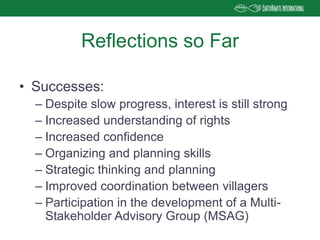
• Successes:
– Despite slow progress, interest is still strong
– Increased understanding of rights
– Increased confidence
– Organizing and planning skills
– Strategic thinking and planning
– Improved coordination between villagers
– Participation in the development of a Multi-
Stakeholder Advisory Group (MSAG)
Reflections so Far
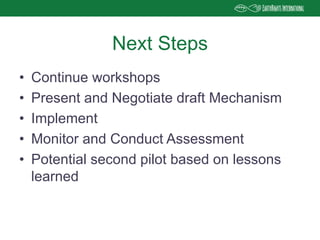
• Continue workshops
• Present and Negotiate draft Mechanism
• Implement
• Monitor and Conduct Assessment
• Potential second pilot based on lessons
learned
Next Steps
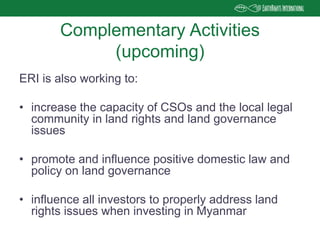
ERI is also working to:
• increase the capacity of CSOs and the local legal
community in land rights and land governance
issues
• promote and influence positive domestic law and
policy on land governance
• influence all investors to properly address land
rights issues when investing in Myanmar
Complementary Activities
(upcoming)
Katherine mc donnell s1_conflict trasnformation

Katherine mc donnell s1_conflict trasnformation

  • 1.
  • 2.
    • Large-scale investmentprojects have immense impacts on communities and their relationship to and ability to manage their land. The Impacts of Business-Related Harms on Land Governance
  • 3.
    • Because ofthese impacts, access to remedy is critical to successful land governance. • An effective remedial mechanism must start with the impacted communities. Land Governance and Remedy
  • 4.
    UN Guiding Principleson Business & Human Rights (UNGP) Third Pillar • Access to remedy through: – 1) state-based judicial remedies – 2) state-based non-judicial remedies – 3) non-state based, non-judicial grievance mechanisms Remedy for harms caused by business activity
  • 5.
    • A non-judicialcomplaints process set up at the operational sites to handle complaints from workers, community members and other stakeholders • Principle 29 of the UNGP states: “To make it possible for grievances to be addressed early and remediated directly, business enterprises should establish or participate in effective operational-level grievance mechanisms for individuals and communities who may be adversely impacted.” Remedy through Operational-level Grievance Mechanism (OGM)
  • 6.
    • The numberone deficiency in existing OGMs is the extent and type of stakeholder engagement. • Where communities are excluded from the remedy design process, – They cannot put land issues on the table – They may not get remedy at all for land-related issues – If a remedy is offered, it will likely be inadequate – Weakens the other aspects of land governance Challenges with Existing OGMs
  • 7.
    In a CD-OGM,the community decides: • The scope of the OGM – The harms that fall under the OGM – The outcomes of individual grievance complaints • The processes by which it functions • The people who staff it • The strategy for long-term monitoring • The strategy for outreach and education The Community-Driven Model
  • 8.
    • A CD-OGMis more efficient • A CD-OGM is more just • A CD-OGM can help strengthen land governance overall The Benefits of a Community- Driven Model
  • 9.
    Background: • Development ofMyanmar’s first SEZ • Relocation of over 4,000 villagers from 2,400 hectare area – 400-hectare area (Phase 1), relocated in 2013 – 2,000 hectare area (Phase 2), to be relocated in stages in the near future The Thilawa Pilot
  • 10.
    Issues: • Contested landownership • Lack of Engagement with other Stakeholders • Impacts of the Relocation Itself • Concerns over environmental impacts of the factories The Thilawa Pilot
  • 11.
    • General informationalworkshops to assess whether the community wants to do it • Conduct workshops • Bring in experts as needed • Assist with: – Drafting the agreement – Negotiating with the company-side stakeholders • Gather feedback and help improve • *This is the community’s CD-OGM, NOT ours ERI’s Role
  • 12.
    • Challenges: – Time –Buy-in from other stakeholders – Capacity – Short-term wins vs. long-term change Reflections so Far
  • 13.
    • Successes: – Despiteslow progress, interest is still strong – Increased understanding of rights – Increased confidence – Organizing and planning skills – Strategic thinking and planning – Improved coordination between villagers – Participation in the development of a Multi- Stakeholder Advisory Group (MSAG) Reflections so Far
  • 14.
    • Continue workshops •Present and Negotiate draft Mechanism • Implement • Monitor and Conduct Assessment • Potential second pilot based on lessons learned Next Steps
  • 15.
    ERI is alsoworking to: • increase the capacity of CSOs and the local legal community in land rights and land governance issues • promote and influence positive domestic law and policy on land governance • influence all investors to properly address land rights issues when investing in Myanmar Complementary Activities (upcoming)

Editor's Notes

  • #3 The political transition in Myanmar has opened up many opportunities, but also poses a number of challenges for communities, who bear the brunt of increasing investment interest. Examples of land-related impacts of SEZs: Loss of existing land, resulting in loss of livelihood, food security Land confiscation- where land title is in dispute, communities often lose out Involuntary resettlement, sometimes through intimidation and coercion Conditions at the relocation site can be worse than the community’s original conditions No access to replacement land to continue livelihood Land degradation and contamination from business enterprises
  • #5 UNGPs provide an internationally accepted framework for the responsibilities and obligations of states and companies with respect to the human rights impacts of business operations. More and more states and businesses are pledging support for these Principles
  • #6 After the UNGPs, the use of OGMs have become more and more common. Many financial institutions require them from Borrowers It should be noted that these mechanisms CANNOT preclude access to judicial mechanisms
  • #7 Potential to create an access to remedy for issues that arise in land use planning and management Can address land-related issues promptly and locally Can prevent escalation of harms and/or conflicts But Companies generally rely on internal expertise Outside third parties are consulted sometimes, but impacted stakeholders rarely are. Because of that, users may not know the mechanism exists at all, may not know how to access it, may not be able to, or may be scared to. They may have difficulties with the process and often do not get enough information throughout, and are generally not satisfied with the results
  • #8 ERI is piloting a model for a Community-Driven Operational-Level Grievance Mechanism (CD-OGM), where communities take the lead in creating the process by which they access remedies for impacts they face.
  • #9 The impacted people are in the best position to identify the harms and the appropriate remedies The impacted people are the rights-holders Entitled to Effective Remedy under International Human Rights Law
  • #11 Contested land ownership No compensation for land Original claimed compensation is being questioned Lack of Engagement exacerbates land governance challenges Villagers have tried to go through proper channels (JICA complaint, IRP, direct to TSEZMC, MJTD, development of MSAG) Impacts of the Relocation Itself Loss of land-based livelihoods No replacement land Conditions at the relocation site Concerns over environmental impacts of the factories
  • #12 Workshops provide the information and tools to enable the community to make informed choices about what they want