Land governance issues in the Mekong region
in the context of the integration of the ASEAN Economic Community
School of Geosciences, University of Sydney
Keynote address at the Regional Land Forum
Hanoi, 21-23 June 2016
Philip Hirsch, Professor of Human Geography
Mekong
Research
Group
Land governance as a regional question 1
Land governance as a regional question
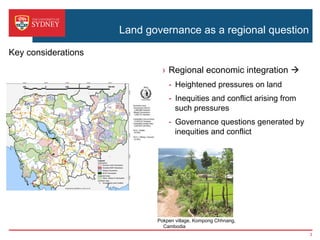
›  Regional economic integration à
-  Heightened pressures on land
-  Inequities and conflict arising from
such pressures
-  Governance questions generated by
inequities and conflict
Pokpen village, Kompong Chhnang,
Cambodia
Key considerations
3
Land governance, ASEAN and the AEC 2
Land governance, ASEAN and the AEC
›  Little specifically on land within the
ASEAN Charter or ASEAN
institutional arrangements
›  ASEAN Commission on the
Promotion and Protection of the
Rights of Women and Children
study
›  Environmental provisions within
ASEAN Socio-Cultural Community
›  ASEAN National Treatment
provisions exclude land ownership
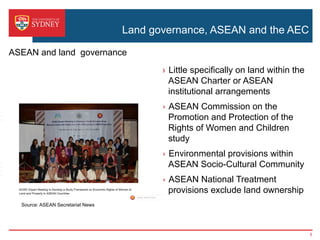
Source: ASEAN Secretariat News
ASEAN and land governance
5
Land governance, ASEAN and the AEC
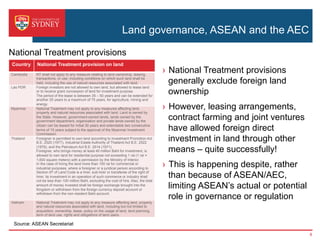
›  National Treatment provisions
generally exclude foreign land
ownership
›  However, leasing arrangements,
contract farming and joint ventures
have allowed foreign direct
investment in land through other
means – quite successfully!
›  This is happening despite, rather
than because of ASEAN/AEC,
limiting ASEAN’s actual or potential
role in governance or regulation
Source: ASEAN Secretariat
National Treatment provisions
Country National Treatment provision on land
Cambodia NT shall not apply to any measure relating to land ownership, leasing,
transactions, or use; including conditions on which such land shall be
held, including the use of natural resources associated with land.
Lao PDR Foreign investors are not allowed to own land, but allowed to lease land
or to receive grant concession of land for investment purpose.
The period of the lease is between 35 – 50 years and can be extended for
another 25 years to a maximum of 75 years, for agriculture, mining and
energy.
Myanmar National Treatment may not apply to any measures affecting land,
property and natural resources associated with land. Land is owned by
the State. However, government-owned lands, lands owned by the
government department, organization and private lands owned by the
citizen can be leased for initial 30 years and extendable two consecutive
terms of 15 years subject to the approval of the Myanmar Investment
Commission.
Thailand Foreigner is permitted to own land according to Investment Promotion Act
B.E. 2520 (1977), Industrial Estate Authority of Thailand Act B.E. 2522
(1979), and the Petroleum Act B.E. 2514 (1971).
Foreigner, who brings money at least 40 million Baht for investment, is
allowed to own land for residential purpose not exceeding 1 rai (1 rai =
1,600 square meters) with a permission by the Ministry of Interior.
In the case of hiring the land more than 100 rai for commercial or
industrial purposes, where a foreigner or a juridical person according to
Section 97 of Land Code is a hirer, sub-hirer or transferee of the right of
hirer, its investment in an operation of such commerce or industry shall
not be less than 100 million Baht, excluding the cost of hire. Also, the total
amount of money invested shall be foreign exchange brought into the
Kingdom or withdrawn from the foreign currency deposit account or
withdrawn from the non-resident Baht account.
Vietnam National Treatment may not apply to any measure affecting land, property
and natural resources associated with land, including but not limited to
acquisition, ownership, lease, policy on the usage of land, land planning,
term of land use, rights and obligations of land users.
6
Land issues and regional economic integration 3
Land issues and regional economic integration
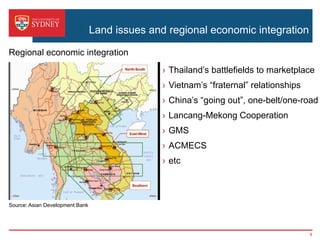
›  Thailand’s battlefields to marketplace
›  Vietnam’s “fraternal” relationships
›  China’s “going out”, one-belt/one-road
›  Lancang-Mekong Cooperation
›  GMS
›  ACMECS
›  etc
Source: Asian Development Bank
Regional economic integration
8
Land issues and regional economic integration
›  Complementarity
-  Factor endowments
-  Land [immobile]
-  Labour [partially mobile]
-  Capital [mobile]
-  Markets à commodity flows
-  Knowhow
-  Capital- vs land-abundant/scarce
-  China, Thailand, Vietnam
-  Cambodia, Laos, Myanmar
-  Eg 3+2 policy in Laos
Complementarity and inequality
0%
10%
20%
30%
40%
50%
60%
70%
80%
90%
100%
Services
Industry
Agriculture
% GDP by sector 2000
Source: World Bank 2014
0
0.05
0.1
0.15
0.2
0.25
0.3
0.35
2000
2013
Arable land per person 2013 (ha)
Source: World Bank 2014
9
Land issues and regional economic integration
›  Complementarity
-  Factor endowments
-  Land [immobile]
-  Labour [partially mobile]
-  Capital [mobile]
-  Markets à commodity flows
-  Knowhow
-  Capital- vs land-abundant/scarce
-  China, Thailand, Vietnam
-  Cambodia, Laos, Myanmar
-  Eg 3+2 policy in Laos
Complementarity and inequality
10
Land issues and regional economic integration
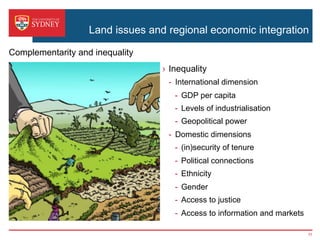
›  Inequality
-  International dimension
-  GDP per capita
-  Levels of industrialisation
-  Geopolitical power
-  Domestic dimensions
-  (in)security of tenure
-  Political connections
-  Ethnicity
-  Gender
-  Access to justice
-  Access to information and markets
Complementarity and inequality
11
Land issues and regional economic integration
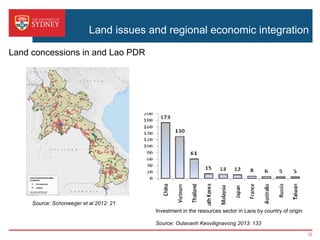
Land concessions in and Lao PDR
Investment in the resources sector in Laos by country of origin
Source: Oulavanh Keovilignavong 2013: 133
Source: Schonweger et al 2012: 21
12
Land issues and regional economic integration
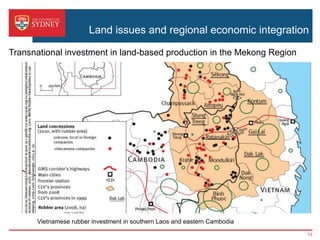
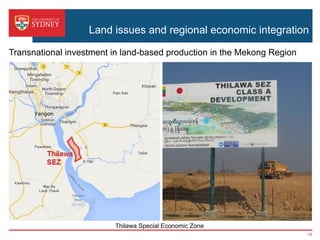
Transnational investment in land-based production in the Mekong Region
Vietnamese rubber investment in southern Laos and eastern Cambodia
13
Land issues and regional economic integration
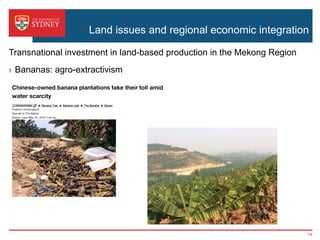
›  Bananas: agro-extractivism
Transnational investment in land-based production in the Mekong Region
14
Land issues and regional economic integration
Transnational investment in land-based production in the Mekong Region
Thilawa Special Economic Zone
15
Land issues and regional economic integration
›  Social impact concerns
-  Eg social land concessions in Cambodia
›  Economic risk
-  Limits on rubber investment in Laos
›  Sovereignty concerns
-  Eg Rethinking land in exchange for infrastructure investment (eg Chinese-built
railway in Laos)
›  Environmental sustainability concerns
-  Eg brake on banana investment in northern Laos
Limits to land grabbing and agro-extractivism
16
Land disputes as a source of conflict in the region 4
Land disputes as a source of conflict in the region
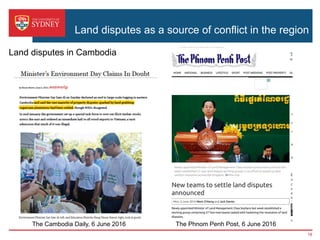
Land disputes in Cambodia
The Cambodia Daily, 6 June 2016 The Phnom Penh Post, 6 June 2016
18
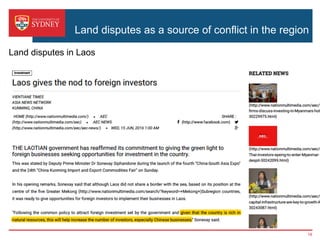
Land disputes as a source of conflict in the region
Land disputes in Laos
19
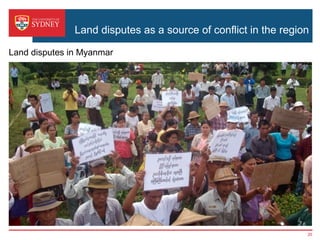
Land disputes as a source of conflict in the region
Land disputes in Myanmar
20
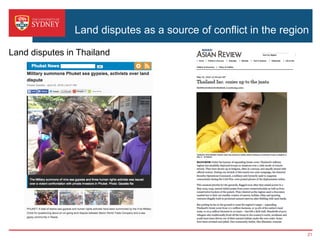
Land disputes as a source of conflict in the region
Land disputes in Thailand
21
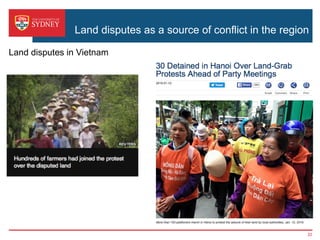
Land disputes as a source of conflict in the region
›  Issues over peri-urban land
conversion
›  Compensation issues
›  Issues over divestment of state-
owned forest enterprise land
›  etc
22
Land disputes in Vietnam
Challenges and openings in land governance 5
Challenges and openings in land governance
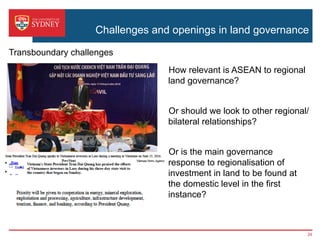
›  How relevant is ASEAN to regional
land governance?
›  Or should we look to other regional/
bilateral relationships?
›  Or is the main governance
response to regionalisation of
investment in land to be found at
the domestic level in the first
instance?
Transboundary challenges
24
Challenges and openings in land governance
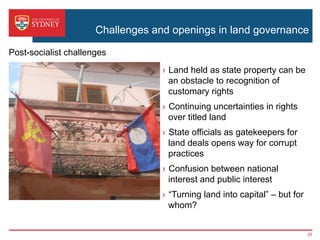
›  Changing role of the state in land tenure and protecting the public
interest
›  Confusion between national interest and public interest
›  Land held as state property can be an obstacle to recognition of
customary rights
›  Continuing uncertainties in rights over titled land
›  State officials as gatekeepers for land deals opens way for corrupt
practices
›  “Turning land into capital” – but for whom?
Post-reform challenges
25
Challenges and openings in land governance
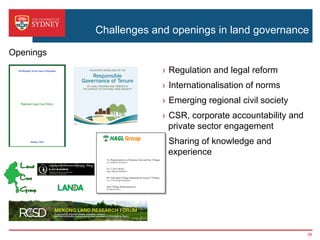
›  Regulation and legal reform
›  Internationalisation of norms
›  Emerging regional civil society
›  CSR, corporate accountability and
private sector engagement
›  Sharing of knowledge and
experience
Openings
26
Conclusion: Limits to regional governance 6
Further reading
philip.hirsch@sydney.edu.au
www.sydney.edu.au/mekong
28

Prof phil hirsch plenary session 0945

  • 1.
    Land governance issuesin the Mekong region in the context of the integration of the ASEAN Economic Community School of Geosciences, University of Sydney Keynote address at the Regional Land Forum Hanoi, 21-23 June 2016 Philip Hirsch, Professor of Human Geography Mekong Research Group
  • 2.
    Land governance asa regional question 1
  • 3.
    Land governance asa regional question ›  Regional economic integration à -  Heightened pressures on land -  Inequities and conflict arising from such pressures -  Governance questions generated by inequities and conflict Pokpen village, Kompong Chhnang, Cambodia Key considerations 3
  • 4.
  • 5.
    Land governance, ASEANand the AEC ›  Little specifically on land within the ASEAN Charter or ASEAN institutional arrangements ›  ASEAN Commission on the Promotion and Protection of the Rights of Women and Children study ›  Environmental provisions within ASEAN Socio-Cultural Community ›  ASEAN National Treatment provisions exclude land ownership Source: ASEAN Secretariat News ASEAN and land governance 5
  • 6.
    Land governance, ASEANand the AEC ›  National Treatment provisions generally exclude foreign land ownership ›  However, leasing arrangements, contract farming and joint ventures have allowed foreign direct investment in land through other means – quite successfully! ›  This is happening despite, rather than because of ASEAN/AEC, limiting ASEAN’s actual or potential role in governance or regulation Source: ASEAN Secretariat National Treatment provisions Country National Treatment provision on land Cambodia NT shall not apply to any measure relating to land ownership, leasing, transactions, or use; including conditions on which such land shall be held, including the use of natural resources associated with land. Lao PDR Foreign investors are not allowed to own land, but allowed to lease land or to receive grant concession of land for investment purpose. The period of the lease is between 35 – 50 years and can be extended for another 25 years to a maximum of 75 years, for agriculture, mining and energy. Myanmar National Treatment may not apply to any measures affecting land, property and natural resources associated with land. Land is owned by the State. However, government-owned lands, lands owned by the government department, organization and private lands owned by the citizen can be leased for initial 30 years and extendable two consecutive terms of 15 years subject to the approval of the Myanmar Investment Commission. Thailand Foreigner is permitted to own land according to Investment Promotion Act B.E. 2520 (1977), Industrial Estate Authority of Thailand Act B.E. 2522 (1979), and the Petroleum Act B.E. 2514 (1971). Foreigner, who brings money at least 40 million Baht for investment, is allowed to own land for residential purpose not exceeding 1 rai (1 rai = 1,600 square meters) with a permission by the Ministry of Interior. In the case of hiring the land more than 100 rai for commercial or industrial purposes, where a foreigner or a juridical person according to Section 97 of Land Code is a hirer, sub-hirer or transferee of the right of hirer, its investment in an operation of such commerce or industry shall not be less than 100 million Baht, excluding the cost of hire. Also, the total amount of money invested shall be foreign exchange brought into the Kingdom or withdrawn from the foreign currency deposit account or withdrawn from the non-resident Baht account. Vietnam National Treatment may not apply to any measure affecting land, property and natural resources associated with land, including but not limited to acquisition, ownership, lease, policy on the usage of land, land planning, term of land use, rights and obligations of land users. 6
  • 7.
    Land issues andregional economic integration 3
  • 8.
    Land issues andregional economic integration ›  Thailand’s battlefields to marketplace ›  Vietnam’s “fraternal” relationships ›  China’s “going out”, one-belt/one-road ›  Lancang-Mekong Cooperation ›  GMS ›  ACMECS ›  etc Source: Asian Development Bank Regional economic integration 8
  • 9.
    Land issues andregional economic integration ›  Complementarity -  Factor endowments -  Land [immobile] -  Labour [partially mobile] -  Capital [mobile] -  Markets à commodity flows -  Knowhow -  Capital- vs land-abundant/scarce -  China, Thailand, Vietnam -  Cambodia, Laos, Myanmar -  Eg 3+2 policy in Laos Complementarity and inequality 0% 10% 20% 30% 40% 50% 60% 70% 80% 90% 100% Services Industry Agriculture % GDP by sector 2000 Source: World Bank 2014 0 0.05 0.1 0.15 0.2 0.25 0.3 0.35 2000 2013 Arable land per person 2013 (ha) Source: World Bank 2014 9
  • 10.
    Land issues andregional economic integration ›  Complementarity -  Factor endowments -  Land [immobile] -  Labour [partially mobile] -  Capital [mobile] -  Markets à commodity flows -  Knowhow -  Capital- vs land-abundant/scarce -  China, Thailand, Vietnam -  Cambodia, Laos, Myanmar -  Eg 3+2 policy in Laos Complementarity and inequality 10
  • 11.
    Land issues andregional economic integration ›  Inequality -  International dimension -  GDP per capita -  Levels of industrialisation -  Geopolitical power -  Domestic dimensions -  (in)security of tenure -  Political connections -  Ethnicity -  Gender -  Access to justice -  Access to information and markets Complementarity and inequality 11
  • 12.
    Land issues andregional economic integration Land concessions in and Lao PDR Investment in the resources sector in Laos by country of origin Source: Oulavanh Keovilignavong 2013: 133 Source: Schonweger et al 2012: 21 12
  • 13.
    Land issues andregional economic integration Transnational investment in land-based production in the Mekong Region Vietnamese rubber investment in southern Laos and eastern Cambodia 13
  • 14.
    Land issues andregional economic integration ›  Bananas: agro-extractivism Transnational investment in land-based production in the Mekong Region 14
  • 15.
    Land issues andregional economic integration Transnational investment in land-based production in the Mekong Region Thilawa Special Economic Zone 15
  • 16.
    Land issues andregional economic integration ›  Social impact concerns -  Eg social land concessions in Cambodia ›  Economic risk -  Limits on rubber investment in Laos ›  Sovereignty concerns -  Eg Rethinking land in exchange for infrastructure investment (eg Chinese-built railway in Laos) ›  Environmental sustainability concerns -  Eg brake on banana investment in northern Laos Limits to land grabbing and agro-extractivism 16
  • 17.
    Land disputes asa source of conflict in the region 4
  • 18.
    Land disputes asa source of conflict in the region Land disputes in Cambodia The Cambodia Daily, 6 June 2016 The Phnom Penh Post, 6 June 2016 18
  • 19.
    Land disputes asa source of conflict in the region Land disputes in Laos 19
  • 20.
    Land disputes asa source of conflict in the region Land disputes in Myanmar 20
  • 21.
    Land disputes asa source of conflict in the region Land disputes in Thailand 21
  • 22.
    Land disputes asa source of conflict in the region ›  Issues over peri-urban land conversion ›  Compensation issues ›  Issues over divestment of state- owned forest enterprise land ›  etc 22 Land disputes in Vietnam
  • 23.
    Challenges and openingsin land governance 5
  • 24.
    Challenges and openingsin land governance ›  How relevant is ASEAN to regional land governance? ›  Or should we look to other regional/ bilateral relationships? ›  Or is the main governance response to regionalisation of investment in land to be found at the domestic level in the first instance? Transboundary challenges 24
  • 25.
    Challenges and openingsin land governance ›  Changing role of the state in land tenure and protecting the public interest ›  Confusion between national interest and public interest ›  Land held as state property can be an obstacle to recognition of customary rights ›  Continuing uncertainties in rights over titled land ›  State officials as gatekeepers for land deals opens way for corrupt practices ›  “Turning land into capital” – but for whom? Post-reform challenges 25
  • 26.
    Challenges and openingsin land governance ›  Regulation and legal reform ›  Internationalisation of norms ›  Emerging regional civil society ›  CSR, corporate accountability and private sector engagement ›  Sharing of knowledge and experience Openings 26
  • 27.
    Conclusion: Limits toregional governance 6
  • 28.