SESSION 3:Demystifying FPIC: Tools to support
development, avoid conflict and
respect community rights
KEY TAKE-AWAYS
“
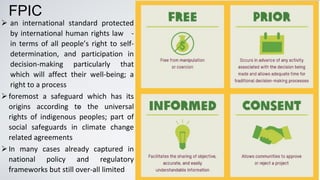
➢ an international standard protected
by international human rights law -
in terms of all people’s right to self-
determination, and participation in
decision-making particularly that
which will affect their well-being; a
right to a process
➢foremost a safeguard which has its
origins according to the universal
rights of indigenous peoples; part of
social safeguards in climate change
related agreements
➢In many cases already captured in
national policy and regulatory
frameworks but still over-all limited
FPIC
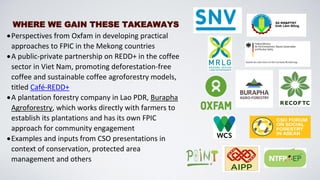
WHERE WE GAIN THESE TAKEAWAYS
•Perspectives from Oxfam in developing practical
approaches to FPIC in the Mekong countries
•A public-private partnership on REDD+ in the coffee
sector in Viet Nam, promoting deforestation-free
coffee and sustainable coffee agroforestry models,
titled Café-REDD+
•A plantation forestry company in Lao PDR, Burapha
Agroforestry, which works directly with farmers to
establish its plantations and has its own FPIC
approach for community engagement
•Examples and inputs from CSO presentations in
context of conservation, protected area
management and others
▪
➢FPIC could easily be seen as a challenging process, costly,
and could be a bed of conflict and distrust; Lack of clarity in
laws and institutions to enforce FPIC may contribute to this.
➢As a process consultations must be in good faith and
genuine among government, private sector and
communities. Some examples are demonstrating this and we
can build from this.
➢Meaningful engagement in various forms such as structured
and multiple dialogues at different levels, accessible and
appropriate communication would constitute good practice
➢ It is important to understand the enabling policy and business
environment to widen application and practice of FPIC – move beyond
concept but as a widely held and applied process from a rights based
perspective. Existing entry points nationally and in ASEAN are good
start including MRLG program.
➢ CSOs, indigenous peoples, ethnic and local communities still need to
increase their capacity and knowledge on FPIC to better and
strategically advocate and lobby for its full and effective
implementation. They need a platform and safe space to raise and
discuss experience and importance of FPIC, and connect with other key
stakeholders such as the government and private sector to
communicate the need for FPIC
Please participate at your own time. Intermediary results will be
downloaded at 17:00 (GMT +7)
Intermediary and final results in the Mekong State of Land
discussion group on Whova
In the address bar of your browser, type:
When asked, enter the code:
www.menti.com
7414 3422
What are your priorities to
ensure responsible
agriculture investments in
the region?
Poll
2

27 1215 mrlf session 3 key takeaways_pinto

  • 1.
    SESSION 3:Demystifying FPIC:Tools to support development, avoid conflict and respect community rights KEY TAKE-AWAYS
  • 2.
    “ ➢ an internationalstandard protected by international human rights law - in terms of all people’s right to self- determination, and participation in decision-making particularly that which will affect their well-being; a right to a process ➢foremost a safeguard which has its origins according to the universal rights of indigenous peoples; part of social safeguards in climate change related agreements ➢In many cases already captured in national policy and regulatory frameworks but still over-all limited FPIC
  • 3.
    WHERE WE GAINTHESE TAKEAWAYS •Perspectives from Oxfam in developing practical approaches to FPIC in the Mekong countries •A public-private partnership on REDD+ in the coffee sector in Viet Nam, promoting deforestation-free coffee and sustainable coffee agroforestry models, titled Café-REDD+ •A plantation forestry company in Lao PDR, Burapha Agroforestry, which works directly with farmers to establish its plantations and has its own FPIC approach for community engagement •Examples and inputs from CSO presentations in context of conservation, protected area management and others
  • 4.
    ▪ ➢FPIC could easilybe seen as a challenging process, costly, and could be a bed of conflict and distrust; Lack of clarity in laws and institutions to enforce FPIC may contribute to this. ➢As a process consultations must be in good faith and genuine among government, private sector and communities. Some examples are demonstrating this and we can build from this. ➢Meaningful engagement in various forms such as structured and multiple dialogues at different levels, accessible and appropriate communication would constitute good practice
  • 5.
    ➢ It isimportant to understand the enabling policy and business environment to widen application and practice of FPIC – move beyond concept but as a widely held and applied process from a rights based perspective. Existing entry points nationally and in ASEAN are good start including MRLG program. ➢ CSOs, indigenous peoples, ethnic and local communities still need to increase their capacity and knowledge on FPIC to better and strategically advocate and lobby for its full and effective implementation. They need a platform and safe space to raise and discuss experience and importance of FPIC, and connect with other key stakeholders such as the government and private sector to communicate the need for FPIC
  • 7.
    Please participate atyour own time. Intermediary results will be downloaded at 17:00 (GMT +7) Intermediary and final results in the Mekong State of Land discussion group on Whova In the address bar of your browser, type: When asked, enter the code: www.menti.com 7414 3422 What are your priorities to ensure responsible agriculture investments in the region? Poll 2