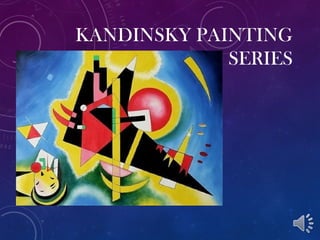
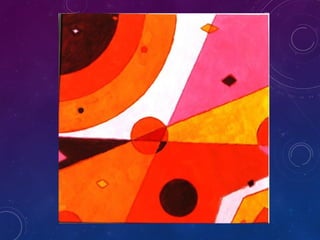
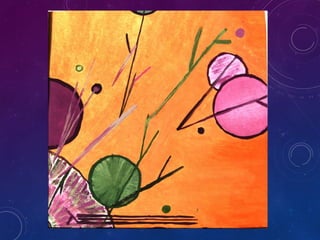
KANDINSKY PAINTING
SERIES
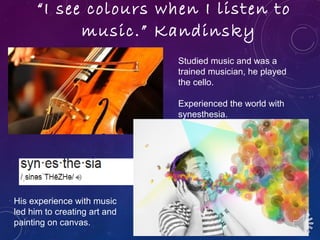
“I see colours when I listen to
music.” Kandinsky
Studied music and was a
trained musician, he played
the cello.
Experienced the world with
synesthesia.
His experience with music
led him to creating art and
painting on canvas.
SYNESTHESIA
!
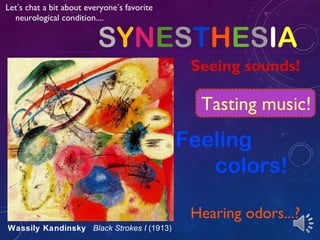
Wassily Kandinsky Black Strokes I (1913)
Let’s chat a bit about everyone’s favorite
neurological condition....
Seeing sounds!
Tasting music!
Hearing odors...?
Feeling
colors!
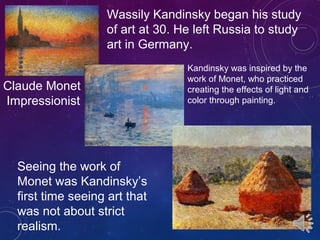
Wassily Kandinsky began his study
of art at 30. He left Russia to study
art in Germany.
Claude Monet
Impressionist
Kandinsky was inspired by the
work of Monet, who practiced
creating the effects of light and
color through painting.
Seeing the work of
Monet was Kandinsky’s
first time seeing art that
was not about strict
realism.
A FATHER
OF
ABSTRACTI
ON
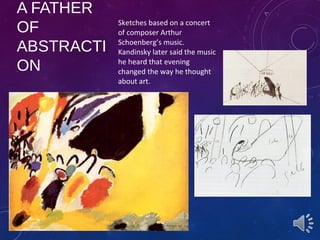
Sketches based on a concert
of composer Arthur
Schoenberg’s music.
Kandinsky later said the music
he heard that evening
changed the way he thought
about art.
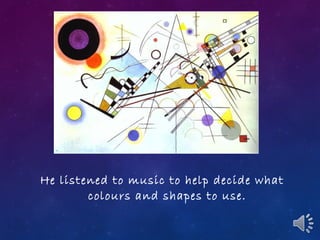
He listened to music to help decide what
colours and shapes to use.
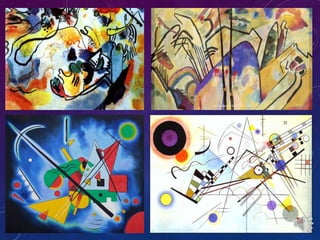
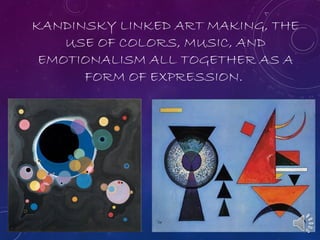
KANDINSKY LINKED ART MAKING, THE
USE OF COLORS, MUSIC, AND
EMOTIONALISM ALL TOGETHER AS A
FORM OF EXPRESSION.
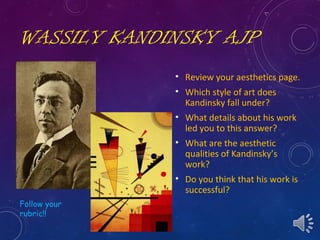
WASSILY KANDINSKY AJP
• Review your aesthetics page.
• Which style of art does
Kandinsky fall under?
• What details about his work
led you to this answer?
• What are the aesthetic
qualities of Kandinsky’s
work?
• Do you think that his work is
successful?
Follow your
rubric!!
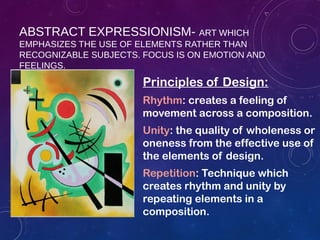
ABSTRACT EXPRESSIONISM- ART WHICH
EMPHASIZES THE USE OF ELEMENTS RATHER THAN
RECOGNIZABLE SUBJECTS. FOCUS IS ON EMOTION AND
FEELINGS.
Principles of Design:
Rhythm: creates a feeling of
movement across a composition.
Unity: the quality of wholeness or
oneness from the effective use of
the elements of design.
Repetition: Technique which
creates rhythm and unity by
repeating elements in a
composition.
ABSTRACT EXPRESSIONISM- ART WHICH
EMPHASIZES THE USE OF ELEMENTS RATHER THAN
RECOGNIZABLE SUBJECTS. FOCUS IS ON EMOTION AND
FEELINGS.
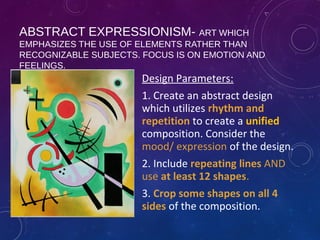
Design Parameters:
1. Create an abstract design
which utilizes rhythm and
repetition to create a unified
composition. Consider the
mood/ expression of the design.
2. Include repeating lines AND
use at least 12 shapes.
3. Crop some shapes on all 4
sides of the composition.
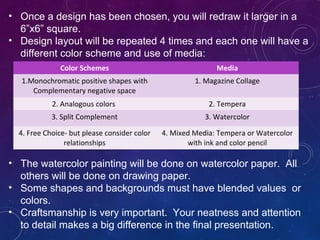
• Once a design has been chosen, you will redraw it larger in a
6”x6” square.
• Design layout will be repeated 4 times and each one will have a
different color scheme and use of media:
• The watercolor painting will be done on watercolor paper. All
others will be done on drawing paper.
• Some shapes and backgrounds must have blended values or
colors.
• Craftsmanship is very important. Your neatness and attention
to detail makes a big difference in the final presentation.
Color Schemes Media
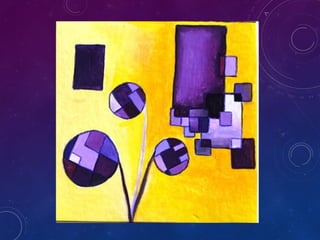
1.Monochromatic positive shapes with
Complementary negative space
1. Magazine Collage
2. Analogous colors 2. Tempera
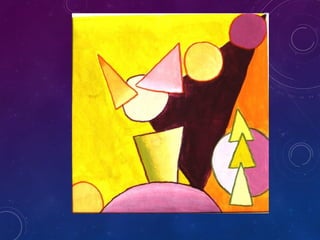
3. Split Complement 3. Watercolor
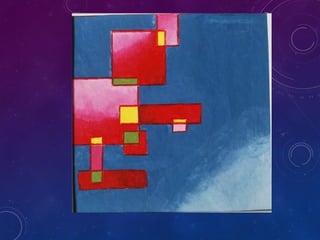
4. Free Choice- but please consider color
relationships
4. Mixed Media: Tempera or Watercolor
with ink and color pencil
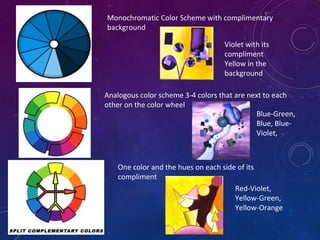
Monochromatic Color Scheme with complimentary
background
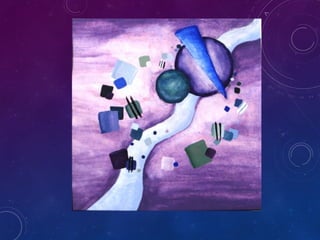
Analogous color scheme 3-4 colors that are next to each
other on the color wheel
One color and the hues on each side of its
compliment
Violet with its
compliment
Yellow in the
background
Blue-Green,
Blue, Blue-
Violet,
Red-Violet,
Yellow-Green,
Yellow-Orange
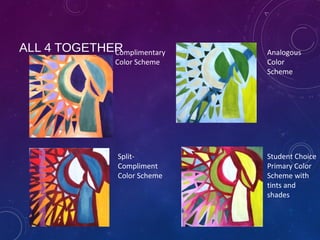
ALL 4 TOGETHERComplimentary
Color Scheme
Analogous
Color
Scheme
Split-
Compliment
Color Scheme
Student Choice
Primary Color
Scheme with
tints and
shades
STUDENT EXAMPLES
Kandinsky painting
Kandinsky painting
Kandinsky painting
Kandinsky painting
Kandinsky painting
Kandinsky painting
Kandinsky painting
Kandinsky painting
Kandinsky painting

Kandinsky painting

  • 1.
  • 3.
    “I see colourswhen I listen to music.” Kandinsky Studied music and was a trained musician, he played the cello. Experienced the world with synesthesia. His experience with music led him to creating art and painting on canvas.
  • 4.
    SYNESTHESIA ! Wassily Kandinsky BlackStrokes I (1913) Let’s chat a bit about everyone’s favorite neurological condition.... Seeing sounds! Tasting music! Hearing odors...? Feeling colors!
  • 5.
    Wassily Kandinsky beganhis study of art at 30. He left Russia to study art in Germany. Claude Monet Impressionist Kandinsky was inspired by the work of Monet, who practiced creating the effects of light and color through painting. Seeing the work of Monet was Kandinsky’s first time seeing art that was not about strict realism.
  • 6.
    A FATHER OF ABSTRACTI ON Sketches basedon a concert of composer Arthur Schoenberg’s music. Kandinsky later said the music he heard that evening changed the way he thought about art.
  • 7.
    He listened tomusic to help decide what colours and shapes to use.
  • 9.
    KANDINSKY LINKED ARTMAKING, THE USE OF COLORS, MUSIC, AND EMOTIONALISM ALL TOGETHER AS A FORM OF EXPRESSION.
  • 10.
    WASSILY KANDINSKY AJP •Review your aesthetics page. • Which style of art does Kandinsky fall under? • What details about his work led you to this answer? • What are the aesthetic qualities of Kandinsky’s work? • Do you think that his work is successful? Follow your rubric!!
  • 11.
    ABSTRACT EXPRESSIONISM- ARTWHICH EMPHASIZES THE USE OF ELEMENTS RATHER THAN RECOGNIZABLE SUBJECTS. FOCUS IS ON EMOTION AND FEELINGS. Principles of Design: Rhythm: creates a feeling of movement across a composition. Unity: the quality of wholeness or oneness from the effective use of the elements of design. Repetition: Technique which creates rhythm and unity by repeating elements in a composition.
  • 12.
    ABSTRACT EXPRESSIONISM- ARTWHICH EMPHASIZES THE USE OF ELEMENTS RATHER THAN RECOGNIZABLE SUBJECTS. FOCUS IS ON EMOTION AND FEELINGS. Design Parameters: 1. Create an abstract design which utilizes rhythm and repetition to create a unified composition. Consider the mood/ expression of the design. 2. Include repeating lines AND use at least 12 shapes. 3. Crop some shapes on all 4 sides of the composition.
  • 15.
    • Once adesign has been chosen, you will redraw it larger in a 6”x6” square. • Design layout will be repeated 4 times and each one will have a different color scheme and use of media: • The watercolor painting will be done on watercolor paper. All others will be done on drawing paper. • Some shapes and backgrounds must have blended values or colors. • Craftsmanship is very important. Your neatness and attention to detail makes a big difference in the final presentation. Color Schemes Media 1.Monochromatic positive shapes with Complementary negative space 1. Magazine Collage 2. Analogous colors 2. Tempera 3. Split Complement 3. Watercolor 4. Free Choice- but please consider color relationships 4. Mixed Media: Tempera or Watercolor with ink and color pencil
  • 16.
    Monochromatic Color Schemewith complimentary background Analogous color scheme 3-4 colors that are next to each other on the color wheel One color and the hues on each side of its compliment Violet with its compliment Yellow in the background Blue-Green, Blue, Blue- Violet, Red-Violet, Yellow-Green, Yellow-Orange
  • 17.
    ALL 4 TOGETHERComplimentary ColorScheme Analogous Color Scheme Split- Compliment Color Scheme Student Choice Primary Color Scheme with tints and shades
  • 18.

Editor's Notes

  • #5 https://artsy.net/post/ibiayi-seeing-sounds-kandinsky-plus-schoenberg