Kandinsky
The artist must train not only his eye
but also his soul. ”
- Wassily Kandinsky
Kandinsky
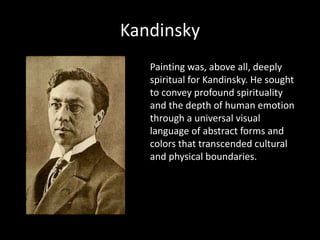
Painting was, above all, deeply
spiritual for Kandinsky. He sought
to convey profound spirituality
and the depth of human emotion
through a universal visual
language of abstract forms and
colors that transcended cultural
and physical boundaries.
Compositions
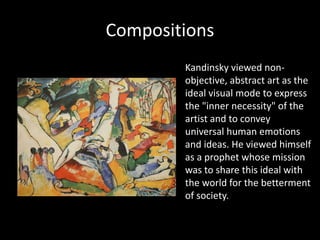
Kandinsky viewed non-
objective, abstract art as the
ideal visual mode to express
the "inner necessity" of the
artist and to convey
universal human emotions
and ideas. He viewed himself
as a prophet whose mission
was to share this ideal with
the world for the betterment
of society.
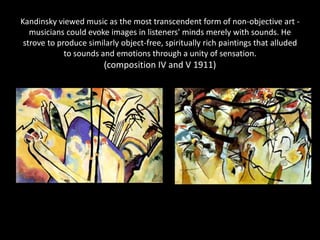
Kandinsky viewed music as the most transcendent form of non-objective art -
musicians could evoke images in listeners' minds merely with sounds. He
strove to produce similarly object-free, spiritually rich paintings that alluded
to sounds and emotions through a unity of sensation.
(composition IV and V 1911)
Composition VI (1913)
I applied streaks and blobs of color onto the canvas with a palette knife and
made them sing with all the intensity I could...”
-Wassily Kandinsky
Composition VII (1913)
"Colour is the key. The eye is the hammer. The soul is the piano with its many
chords. The artist is the hand that, by touching this or that key, sets the soul
vibrating automatically."
Composition VII (1923)
"Objects damage pictures."
Composition IX (1936)
Composition X (1936) "The true work of art is born from the 'artist': a
mysterious, enigmatic, and mystical creation. It detaches itself from him, it
acquires an autonomous life, becomes a personality, an independent subject,
animated with a spiritual breath, the living subject of a real existence of
being."
what d

Kandinsky

  • 1.
    Kandinsky The artist musttrain not only his eye but also his soul. ” - Wassily Kandinsky
  • 2.
    Kandinsky Painting was, aboveall, deeply spiritual for Kandinsky. He sought to convey profound spirituality and the depth of human emotion through a universal visual language of abstract forms and colors that transcended cultural and physical boundaries.
  • 3.
    Compositions Kandinsky viewed non- objective,abstract art as the ideal visual mode to express the "inner necessity" of the artist and to convey universal human emotions and ideas. He viewed himself as a prophet whose mission was to share this ideal with the world for the betterment of society.
  • 4.
    Kandinsky viewed musicas the most transcendent form of non-objective art - musicians could evoke images in listeners' minds merely with sounds. He strove to produce similarly object-free, spiritually rich paintings that alluded to sounds and emotions through a unity of sensation. (composition IV and V 1911)
  • 5.
    Composition VI (1913) Iapplied streaks and blobs of color onto the canvas with a palette knife and made them sing with all the intensity I could...” -Wassily Kandinsky
  • 6.
    Composition VII (1913) "Colouris the key. The eye is the hammer. The soul is the piano with its many chords. The artist is the hand that, by touching this or that key, sets the soul vibrating automatically."
  • 7.
  • 8.
  • 9.
    Composition X (1936)"The true work of art is born from the 'artist': a mysterious, enigmatic, and mystical creation. It detaches itself from him, it acquires an autonomous life, becomes a personality, an independent subject, animated with a spiritual breath, the living subject of a real existence of being." what d