Kanban Overview and
 Experience Report

      David Joyce
     BBC Worldwide


           1
Kanban Overview
Kanban is a transparent, work-limited,
        value pulling system.


                             Eric Willeke - Kanbandev Yahoo! group
                   2
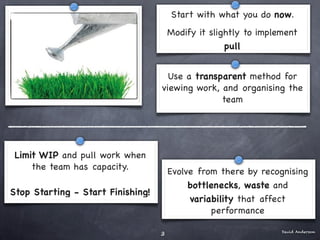
Start with what you do now.
                                       Modify it slightly to implement
                                                     pull


                                     Use a transparent method for
                                   viewing work, and organising the
                                                 team


 Limit WIP and pull work when
     the team has capacity.
                                       Evolve from there by recognising
                                            bottlenecks, waste and
Stop Starting - Start Finishing!
                                            variability that affect
                                                 performance

                                                                  David Anderson
                                   3
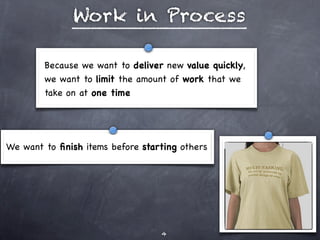
Work in Process

        Because we want to deliver new value quickly,
        we want to limit the amount of work that we
        take on at one time


We want to finish items before starting others


                                  4
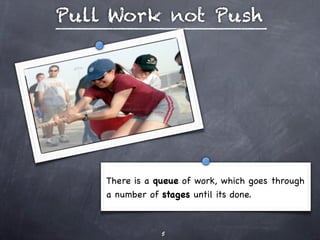
Pull Work not Push


    There is a queue of work, which goes through
    a number of stages until its done.


                5
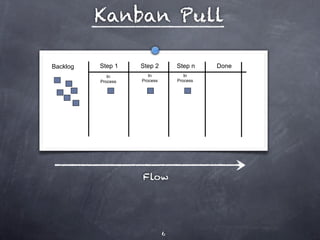
Kanban Pull

Backlog   Step 1    Step 2        Step n    Done
             In        In            In
          Process   Process       Process


                    Flow


                              6
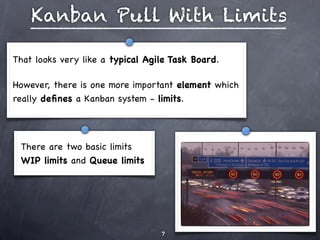
Kanban Pull With Limits

That looks very like a typical Agile Task Board.

However, there is one more important element which
really defines a Kanban system - limits. 


 There are two basic limits
 WIP limits and Queue limits


                                  7
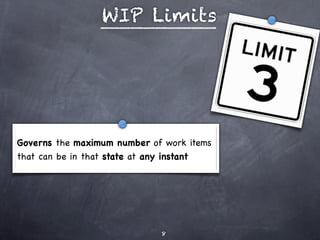
WIP Limits


Governs the maximum number of work items
that can be in that state at any instant


                             8
Queues and Queue Limits

A queue distinguishes work that is eligible to
be pulled, from work that is still in process.

The queue allows for slack


                                9
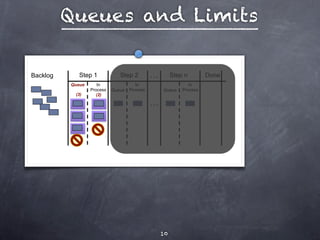
Queues and Limits

Backlog      Step 1            Step 2         …        Step n        Done
          Queue      In                In                     In
                  Process   Queue   Process       Queue    Process
           (3)      (2)

                                              …


                                                  10
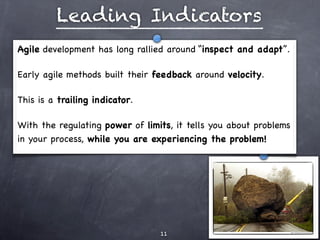
Leading Indicators
Agile development has long rallied around “inspect and adapt”.

Early agile methods built their feedback around velocity.

This is a trailing indicator.

With the regulating power of limits, it tells you about problems
in your process, while you are experiencing the problem!


                                 11
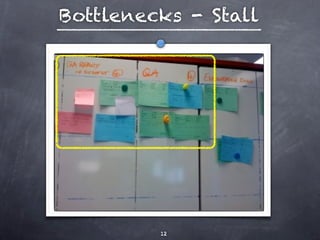
Bottlenecks - Stall


         12
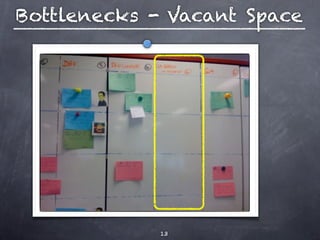
Bottlenecks - Vacant Space


             13
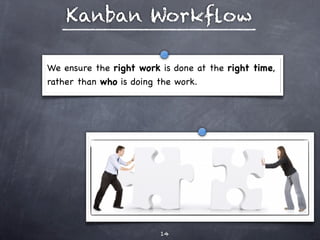
Kanban Workflow

We ensure the right work is done at the right time,
rather than who is doing the work.


                         14
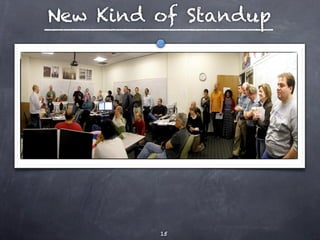
New Kind of Standup


         15
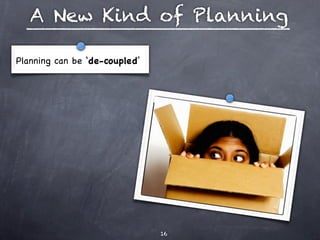
A New Kind of Planning

Planning can be ‘de-coupled’


                               16
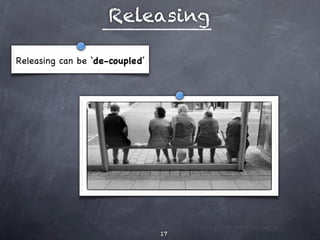
Releasing

Releasing can be ‘de-coupled’


                                17
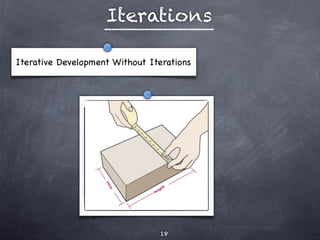
Iterations

Iterative Development Without Iterations


                    tim


                                   gth
                     e


                               len


                                   18
Retrospectives

We have more choice on when and how to reflect and improve


                              19
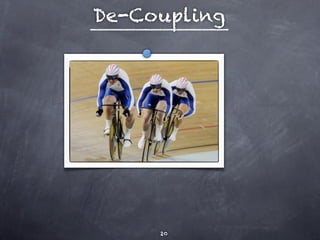
De-Coupling


     20
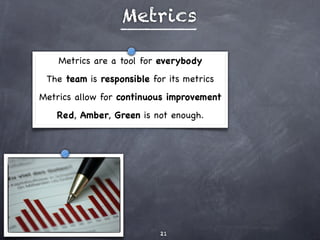
Metrics

    Metrics are a tool for everybody
 The team is responsible for its metrics
Metrics allow for continuous improvement
   Red, Amber, Green is not enough.


                           21
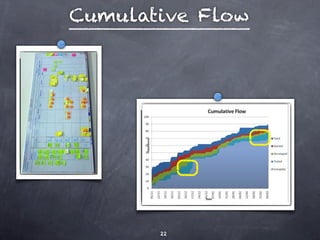
Cumulative Flow


       22
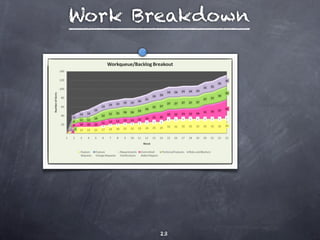
Work Breakdown


       23
Kanban for Everyone


         24
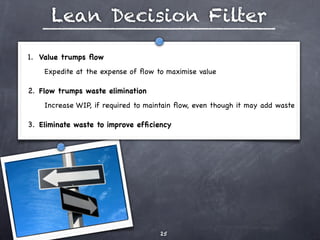
Lean Decision Filter

1. Value trumps flow 
    Expedite at the expense of flow to maximise value

2. Flow trumps waste elimination
    Increase WIP, if required to maintain flow, even though it may add waste

3. Eliminate waste to improve efficiency 


                                    25
Kanban Usage


      26
Kanban

Summary


         John Seddon - Freedom from Command & Control
   27
Experience Report


              Eric Willeke - Kanbandev Yahoo! group
        28
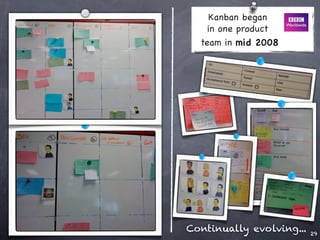
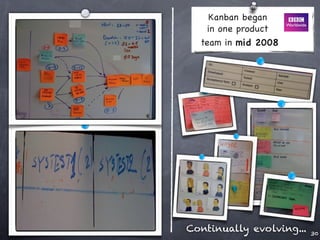
Kanban began
    in one product
  team in mid 2008


Continually evolving...   29
Kanban began
    in one product
  team in mid 2008


Continually evolving...   30
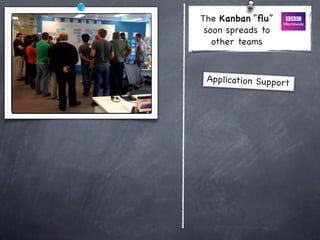
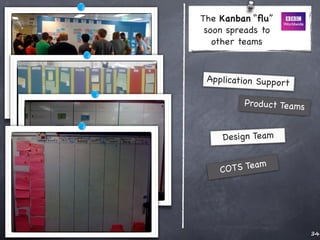
The Kanban “flu”
 soon spreads to
   other teams


 Application Support
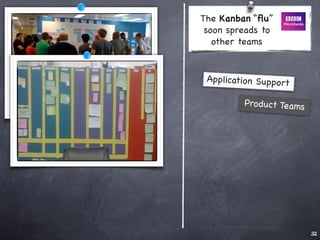
The Kanban “flu”
 soon spreads to
   other teams


 Application Support

         Pro duct Teams


                          32
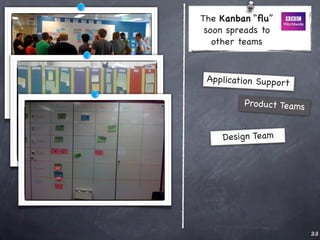
The Kanban “flu”
 soon spreads to
   other teams


 Application Support

         Pro duct Teams


    Design Team


                          33
The Kanban “flu”
 soon spreads to
   other teams


 Application Support

         Pro duct Teams


    Design Team


    CO TS Team


                          34
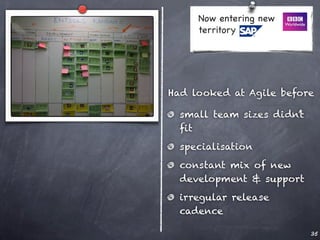
Now entering new
     territory


Had looked at Agile before

  small team sizes didn’t
  fit
  specialisation
  constant mix of new
  development & support
  irregular release
  cadence

                            35
Future Media & Technology!


                             36
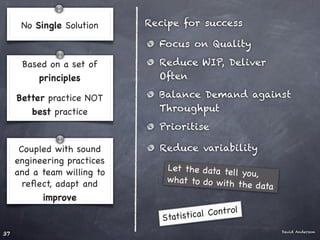
No Single Solution     Recipe for success

                               Focus on Quality

      Based on a set of        Reduce WIP, Deliver
         principles            Often

     Better practice NOT       Balance Demand against
        best practice          Throughput
                               Prioritise

      Coupled with sound       Reduce variability
     engineering practices
     and a team willing to       Let the data tel
                                                  l yo u,
       reflect, adapt and         what to do w ith
                                                   the data
           improve
                                            Control
                                Statistical
                                                              David Anderson
37
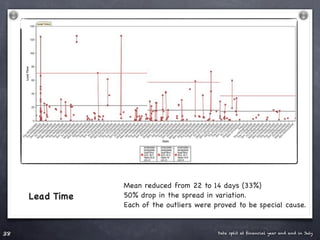
Mean reduced from 22 to 14 days (33%)
     Lead Time   50% drop in the spread in variation.
                 Each of the outliers were proved to be special cause.


38                                          Data split at financial year end and in July
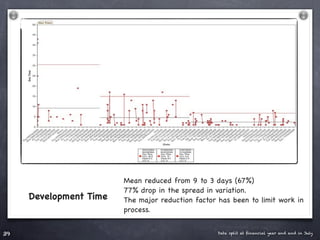
Mean reduced from 9 to 3 days (67%)
                        77% drop in the spread in variation.
     Development Time   The major reduction factor has been to limit work in
                        process.


39                                                 Data split at financial year end and in July
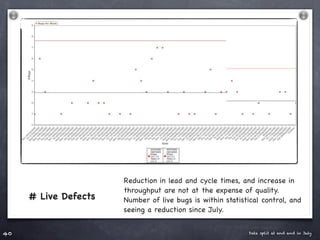
Reduction in lead and cycle times, and increase in
                      throughput are not at the expense of quality.
     # Live Defects   Number of live bugs is within statistical control, and
                      seeing a reduction since July.


40                                                          Data split at end and in July
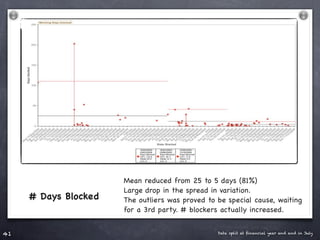
Mean reduced from 25 to 5 days (81%)
                      Large drop in the spread in variation.
     # Days Blocked   The outliers was proved to be special cause, waiting
                      for a 3rd party. # blockers actually increased.


41                                               Data split at financial year end and in July
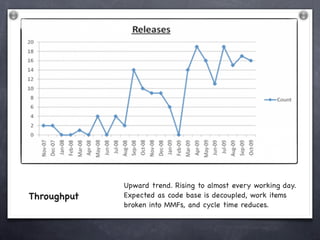
Upward trend. Rising to almost every working day.
Throughput   Expected as code base is decoupled, work items
             broken into MMFs, and cycle time reduces.
43
Scrum to Kanban
                                                     Data split at end and in July


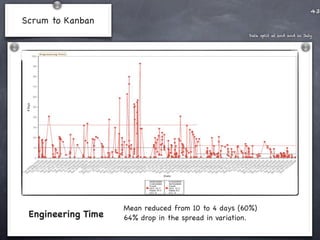
                    Mean reduced from 10 to 4 days (60%)
 Engineering Time   64% drop in the spread in variation.
Kanban

Summary


         John Seddon - Freedom from Command & Control
Scrumban

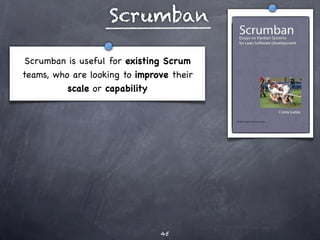
 Scrumban is useful for existing Scrum
teams, who are looking to improve their
          scale or capability


                               45
More information on Kanban

My blog http://leanandkanban.wordpress.com/


Kanban community site http://www.limitedwipsociety.org


Kanban for Software Engineering http://bit.ly/hz9Ju


Soon to be published academic paper on BBCW and Kanban case study


                                   46
Thank you

Questions?


        John Seddon - Freedom from Command & Control

Kanban Overview And Experience Report Export

  • 1.
    Kanban Overview and Experience Report David Joyce BBC Worldwide 1
  • 2.
    Kanban Overview Kanban isa transparent, work-limited, value pulling system. Eric Willeke - Kanbandev Yahoo! group 2
  • 3.
    Start with whatyou do now. Modify it slightly to implement pull Use a transparent method for viewing work, and organising the team Limit WIP and pull work when the team has capacity. Evolve from there by recognising bottlenecks, waste and Stop Starting - Start Finishing! variability that affect performance David Anderson 3
  • 4.
    Work in Process Because we want to deliver new value quickly, we want to limit the amount of work that we take on at one time We want to finish items before starting others 4
  • 5.
    Pull Work notPush There is a queue of work, which goes through a number of stages until its done. 5
  • 6.
    Kanban Pull Backlog Step 1 Step 2 Step n Done In In In Process Process Process Flow 6
  • 7.
    Kanban Pull WithLimits That looks very like a typical Agile Task Board. However, there is one more important element which really defines a Kanban system - limits.  There are two basic limits WIP limits and Queue limits 7
  • 8.
    WIP Limits Governs themaximum number of work items that can be in that state at any instant 8
  • 9.
    Queues and QueueLimits A queue distinguishes work that is eligible to be pulled, from work that is still in process. The queue allows for slack 9
  • 10.
    Queues and Limits Backlog Step 1 Step 2 … Step n Done Queue In In In Process Queue Process Queue Process (3) (2) … 10
  • 11.
    Leading Indicators Agile developmenthas long rallied around “inspect and adapt”. Early agile methods built their feedback around velocity. This is a trailing indicator. With the regulating power of limits, it tells you about problems in your process, while you are experiencing the problem! 11
  • 12.
  • 13.
  • 14.
    Kanban Workflow We ensurethe right work is done at the right time, rather than who is doing the work. 14
  • 15.
    New Kind ofStandup 15
  • 16.
    A New Kindof Planning Planning can be ‘de-coupled’ 16
  • 17.
    Releasing Releasing can be‘de-coupled’ 17
  • 18.
    Iterations Iterative Development WithoutIterations tim gth e len 18
  • 19.
    Retrospectives We have morechoice on when and how to reflect and improve 19
  • 20.
  • 21.
    Metrics Metrics are a tool for everybody The team is responsible for its metrics Metrics allow for continuous improvement Red, Amber, Green is not enough. 21
  • 22.
  • 23.
  • 24.
  • 25.
    Lean Decision Filter 1.Value trumps flow  Expedite at the expense of flow to maximise value 2. Flow trumps waste elimination Increase WIP, if required to maintain flow, even though it may add waste 3. Eliminate waste to improve efficiency  25
  • 26.
  • 27.
    Kanban Summary John Seddon - Freedom from Command & Control 27
  • 28.
    Experience Report Eric Willeke - Kanbandev Yahoo! group 28
  • 29.
    Kanban began in one product team in mid 2008 Continually evolving... 29
  • 30.
    Kanban began in one product team in mid 2008 Continually evolving... 30
  • 31.
    The Kanban “flu” soon spreads to other teams Application Support
  • 32.
    The Kanban “flu” soon spreads to other teams Application Support Pro duct Teams 32
  • 33.
    The Kanban “flu” soon spreads to other teams Application Support Pro duct Teams Design Team 33
  • 34.
    The Kanban “flu” soon spreads to other teams Application Support Pro duct Teams Design Team CO TS Team 34
  • 35.
    Now entering new territory Had looked at Agile before small team sizes didn’t fit specialisation constant mix of new development & support irregular release cadence 35
  • 36.
    Future Media &Technology! 36
  • 37.
    No Single Solution Recipe for success Focus on Quality Based on a set of Reduce WIP, Deliver principles Often Better practice NOT Balance Demand against best practice Throughput Prioritise Coupled with sound Reduce variability engineering practices and a team willing to Let the data tel l yo u, reflect, adapt and what to do w ith the data improve Control Statistical David Anderson 37
  • 38.
    Mean reduced from22 to 14 days (33%) Lead Time 50% drop in the spread in variation. Each of the outliers were proved to be special cause. 38 Data split at financial year end and in July
  • 39.
    Mean reduced from9 to 3 days (67%) 77% drop in the spread in variation. Development Time The major reduction factor has been to limit work in process. 39 Data split at financial year end and in July
  • 40.
    Reduction in leadand cycle times, and increase in throughput are not at the expense of quality. # Live Defects Number of live bugs is within statistical control, and seeing a reduction since July. 40 Data split at end and in July
  • 41.
    Mean reduced from25 to 5 days (81%) Large drop in the spread in variation. # Days Blocked The outliers was proved to be special cause, waiting for a 3rd party. # blockers actually increased. 41 Data split at financial year end and in July
  • 42.
    Upward trend. Risingto almost every working day. Throughput Expected as code base is decoupled, work items broken into MMFs, and cycle time reduces.
  • 43.
    43 Scrum to Kanban Data split at end and in July Mean reduced from 10 to 4 days (60%) Engineering Time 64% drop in the spread in variation.
  • 44.
    Kanban Summary John Seddon - Freedom from Command & Control
  • 45.
    Scrumban Scrumban isuseful for existing Scrum teams, who are looking to improve their scale or capability 45
  • 46.
    More information onKanban My blog http://leanandkanban.wordpress.com/ Kanban community site http://www.limitedwipsociety.org Kanban for Software Engineering http://bit.ly/hz9Ju Soon to be published academic paper on BBCW and Kanban case study 46
  • 47.
    Thank you Questions? John Seddon - Freedom from Command & Control