KAIZEN
MANAGEMENT
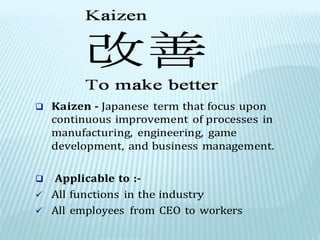
 Kaizen - Japanese term that focus upon
continuous improvement of processes in
manufacturing, engineering, game
development, and business management.
 Applicable to :-
 All functions in the industry
 All employees from CEO to workers
KAIZEN PHILOSOPHY
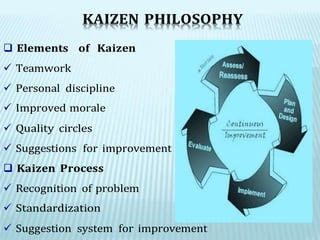
 Elements of Kaizen
 Teamwork
 Personal discipline
 Improved morale
 Quality circles
 Suggestions for improvement
 Kaizen Process
 Recognition of problem
 Standardization
 Suggestion system for improvement
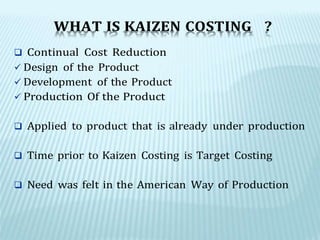
WHAT IS KAIZEN COSTING ?
 Continual Cost Reduction
 Design of the Product
 Development of the Product
 Production Of the Product
 Applied to product that is already under production
 Time prior to Kaizen Costing is Target Costing
 Need was felt in the American Way of Production
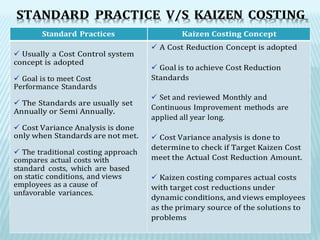
STANDARD PRACTICE V/S KAIZEN COSTING
Standard Practices Kaizen Costing Concept
 Usually a Cost Control system
concept is adopted
 Goal is to meet Cost
Performance Standards
 The Standards are usually set
Annually or Semi Annually.
 Cost Variance Analysis is done
only when Standards are not met.
 The traditional costing approach
compares actual costs with
standard costs, which are based
on static conditions, and views
employees as a cause of
unfavorable variances.
 A Cost Reduction Concept is adopted
 Goal is to achieve Cost Reduction
Standards
 Set and reviewed Monthly and
Continuous Improvement methods are
applied all year long.
 Cost Variance analysis is done to
determine to check if Target Kaizen Cost
meet the Actual Cost Reduction Amount.
 Kaizen costing compares actual costs
with target cost reductions under
dynamic conditions, and views employees
as the primary source of the solutions to
problems
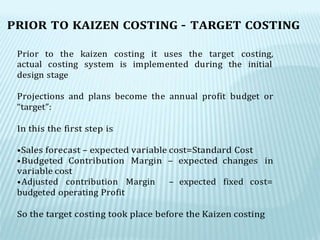
PRIOR TO KAIZEN COSTING – TARGET COSTING
Prior to the kaizen costing it uses the target costing,
actual costing system is implemented during the initial
design stage
Projections and plans become the annual profit budget or
“target”:
In this the first step is
•Sales forecast – expected variable cost=Standard Cost
•Budgeted Contribution Margin – expected changes in
variable cost
•Adjusted contribution Margin – expected fixed cost=
budgeted operating Profit
So the target costing took place before the Kaizen costing
GAP ANALYSIS : TOTAL COST – KAIZEN COST?
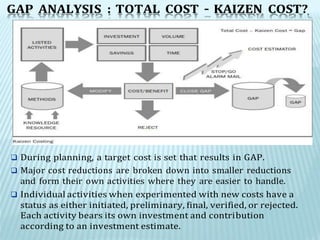
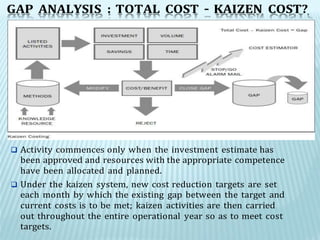
 During planning, a target cost is set that results in GAP.
 Major cost reductions are broken down into smaller reductions
and form their own activities where they are easier to handle.
 Individual activities when experimented with new costs have a
status as either initiated, preliminary, final, verified, or rejected.
Each activity bears its own investment and contribution
according to an investment estimate.
GAP ANALYSIS : TOTAL COST – KAIZEN COST?
 Activity commences only when the investment estimate has
been approved and resources with the appropriate competence
have been allocated and planned.
 Under the kaizen system, new cost reduction targets are set
each month by which the existing gap between the target and
current costs is to be met; kaizen activities are then carried
out throughout the entire operational year so as to meet cost
targets.
PDCA MANTRA
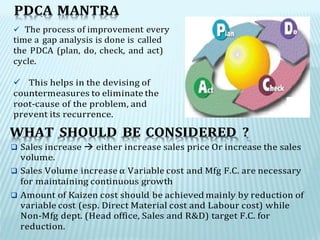
 The process of improvement every
time a gap analysis is done is called
the PDCA (plan, do, check, and act)
cycle.
 This helps in the devising of
countermeasures to eliminate the
root-cause of the problem, and
prevent its recurrence.
WHAT SHOULD BE CONSIDERED ?
 Sales increase  either increase sales price Or increase the sales
volume.
 Sales Volume increase α Variable cost and Mfg F.C. are necessary
for maintaining continuous growth
 Amount of Kaizen cost should be achieved mainly by reduction of
variable cost (esp. Direct Material cost and Labour cost) while
Non-Mfg dept. (Head office, Sales and R&D) target F.C. for
reduction.
IMPLEMENTATION OF KAIZEN CONCEPT
 OHNO – Great believer of Kaizen initiated Kaizen in Toyota in
TOYOTA MOTOR CORPORATION
“Human beings think our way is the best, but at
Toyota we are told we have to always change. We
believe there is no perfect way, so we continue to
search. The aim is to break current condition
through Kaizen.”
--- Shiochoro Toyoda, Chairman, TMC
1950.
 One of first company to use practices such as Kanban, Jikoda,
JIT through integration with Kaizen.
 Aims:
 Increase efficiency.
 Reduce waste irrespective of major/minor activity.
Seven types of waste identified at Toyota
 Overproduction ahead of demand
 Unnecessarily movement of materials and
products
 Excessive inventories
 Production of defective products
 Idle time
 Over processing
 Unnecessarily movement of people
KAIZEN IN TOYOTA
 Pre – Production:
 Costing method: Design stage included
 Setting of target cost for component
 Standard time for production
 Product Plan
 Shop floors to meet target cost and standard time
 The above cost and time were referential cost and
standard time
 If workers do not meet target cost and standard time then
Kaizen pursued to decrease cost and time
 It workers meet target cost and standard time then further
reduction through Kaizen to increase efficiency
KAIZEN: PRIOR TO 1990 – ORGANIZED KAIZEN
KAIZEN COSTING
 Setting up of cost councils to reduce material cost
 Control of costs through division of responsibilities amongst group
leaders, chief leaders and engineers
 Formation of try teams of skilled workers to establish production
time and then involving them to implement Kaizen at production level
 Main aims were to establish
 Standard time
 Standard work
 Line stop system
 Further increase in production efficiency by
 Reduction in standard time through process improvement
 Reduction in labour cost through reducing workers in unit
(Shojinka)
KAIZEN IMPLEMENTATION AT WORKER LEVEL
 Each worker was expected to question every process and
test all assumptions
 Errors were viewed as learning opportunities
 Implementation of quality circles and employee suggestion
systems
 Each team member as quality inspector and any one stop
production line on observing problem
 (More than 90000 employee suggestions were reported every
year & few employees gave more than 1000 suggestions)
NEED FOR IMPROVEMENT
 In early 1990s
 Acute labour shortage
 Emergence of high wage jobs and shortage of young
manpower
 Low birth rates in Japan in two decades
 Strained work atmosphere
 Exodus of young workers from company
 Required New Approach:
Modified Kaizen – Human Friendly
THE MODIFICATION
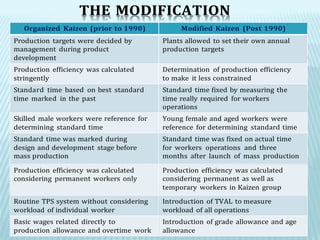
Organized Kaizen (prior to 1990) Modified Kaizen (Post 1990)
Production targets were decided by
management during product
development
Plants allowed to set their own annual
production targets
Production efficiency was calculated
stringently
Determination of production efficiency
to make it less constrained
Standard time based on best standard
time marked in the past
Standard time fixed by measuring the
time really required for workers
operations
Skilled male workers were reference for
determining standard time
Young female and aged workers were
reference for determining standard time
Standard time was marked during
design and development stage before
mass production
Standard time was fixed on actual time
for workers operations and three
months after launch of mass production
Production efficiency was calculated
considering permanent workers only
Production efficiency was calculated
considering permanent as well as
temporary workers in Kaizen group
Routine TPS system without considering
workload of individual worker
Introduction of TVAL to measure
workload of all operations
Basic wages related directly to
production allowance and overtime work
Introduction of grade allowance and age
allowance
THE MODIFICATION
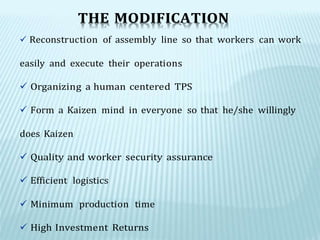
 Reconstruction of assembly line so that workers can work
easily and execute their operations
 Organizing a human centered TPS
 Form a Kaizen mind in everyone so that he/she willingly
does Kaizen
 Quality and worker security assurance
 Efficient logistics
 Minimum production time
 High Investment Returns
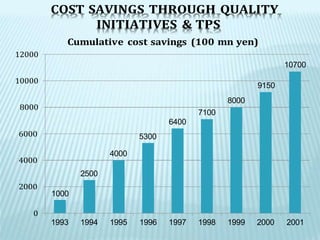
12000
10000
8000
Cumulative cost savings (100 mn yen)
9150
8000
7100
6400
10700
6000
4000
2000
1000
2500
4000
5300
0
1993 1994 1995 1996 1997 1998 1999 2000 2001
COST SAVINGS THROUGH QUALITY
INITIATIVES & TPS
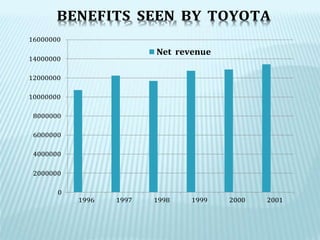
BENEFITS SEEN BY TOYOTA
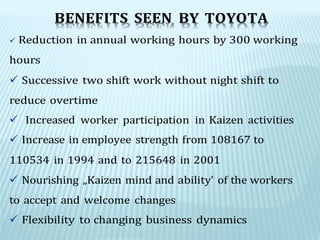
 Reduction in annual working hours by 300 working
hours
 Successive two shift work without night shift to
reduce overtime
 Increased worker participation in Kaizen activities
 Increase in employee strength from 108167 to
110534 in 1994 and to 215648 in 2001
 Nourishing „Kaizen mind and ability‟ of the workers
to accept and welcome changes
 Flexibility to changing business dynamics
16000000
14000000
12000000
10000000
8000000
6000000
4000000
2000000
0
1996 1997 1998 1999 2000 2001
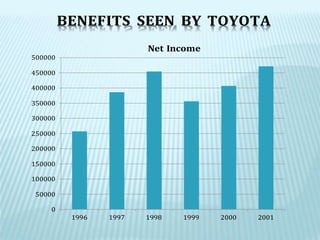
BENEFITS SEEN BY TOYOTA
Net revenue
500000
450000
400000
350000
300000
250000
200000
150000
100000
50000
0
Net Income
1996 1997 1998 1999 2000 2001
BENEFITS SEEN BY TOYOTA
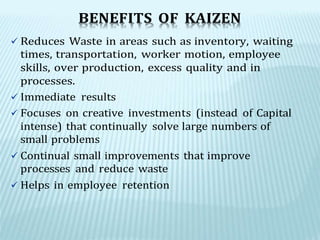
BENEFITS OF KAIZEN
 Reduces Waste in areas such as inventory, waiting
times, transportation, worker motion, employee
skills, over production, excess quality and in
processes.
 Immediate results
 Focuses on creative investments (instead of Capital
intense) that continually solve large numbers of
small problems
 Continual small improvements that improve
processes and reduce waste
 Helps in employee retention
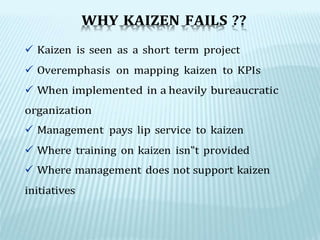
WHY KAIZEN FAILS ??
 Kaizen is seen as a short term project
 Overemphasis on mapping kaizen to KPIs
 When implemented in a heavily bureaucratic
organization
 Management pays lip service to kaizen
 Where training on kaizen isn‟t provided
 Where management does not support kaizen
initiatives
Thank You

kaizenmanagement-finalppt.docx

  • 1.
  • 2.
     Kaizen -Japanese term that focus upon continuous improvement of processes in manufacturing, engineering, game development, and business management.  Applicable to :-  All functions in the industry  All employees from CEO to workers
  • 3.
    KAIZEN PHILOSOPHY  Elementsof Kaizen  Teamwork  Personal discipline  Improved morale  Quality circles  Suggestions for improvement  Kaizen Process  Recognition of problem  Standardization  Suggestion system for improvement
  • 4.
    WHAT IS KAIZENCOSTING ?  Continual Cost Reduction  Design of the Product  Development of the Product  Production Of the Product  Applied to product that is already under production  Time prior to Kaizen Costing is Target Costing  Need was felt in the American Way of Production
  • 5.
    STANDARD PRACTICE V/SKAIZEN COSTING Standard Practices Kaizen Costing Concept  Usually a Cost Control system concept is adopted  Goal is to meet Cost Performance Standards  The Standards are usually set Annually or Semi Annually.  Cost Variance Analysis is done only when Standards are not met.  The traditional costing approach compares actual costs with standard costs, which are based on static conditions, and views employees as a cause of unfavorable variances.  A Cost Reduction Concept is adopted  Goal is to achieve Cost Reduction Standards  Set and reviewed Monthly and Continuous Improvement methods are applied all year long.  Cost Variance analysis is done to determine to check if Target Kaizen Cost meet the Actual Cost Reduction Amount.  Kaizen costing compares actual costs with target cost reductions under dynamic conditions, and views employees as the primary source of the solutions to problems
  • 6.
    PRIOR TO KAIZENCOSTING – TARGET COSTING Prior to the kaizen costing it uses the target costing, actual costing system is implemented during the initial design stage Projections and plans become the annual profit budget or “target”: In this the first step is •Sales forecast – expected variable cost=Standard Cost •Budgeted Contribution Margin – expected changes in variable cost •Adjusted contribution Margin – expected fixed cost= budgeted operating Profit So the target costing took place before the Kaizen costing
  • 7.
    GAP ANALYSIS :TOTAL COST – KAIZEN COST?  During planning, a target cost is set that results in GAP.  Major cost reductions are broken down into smaller reductions and form their own activities where they are easier to handle.  Individual activities when experimented with new costs have a status as either initiated, preliminary, final, verified, or rejected. Each activity bears its own investment and contribution according to an investment estimate.
  • 8.
    GAP ANALYSIS :TOTAL COST – KAIZEN COST?  Activity commences only when the investment estimate has been approved and resources with the appropriate competence have been allocated and planned.  Under the kaizen system, new cost reduction targets are set each month by which the existing gap between the target and current costs is to be met; kaizen activities are then carried out throughout the entire operational year so as to meet cost targets.
  • 9.
    PDCA MANTRA  Theprocess of improvement every time a gap analysis is done is called the PDCA (plan, do, check, and act) cycle.  This helps in the devising of countermeasures to eliminate the root-cause of the problem, and prevent its recurrence. WHAT SHOULD BE CONSIDERED ?  Sales increase  either increase sales price Or increase the sales volume.  Sales Volume increase α Variable cost and Mfg F.C. are necessary for maintaining continuous growth  Amount of Kaizen cost should be achieved mainly by reduction of variable cost (esp. Direct Material cost and Labour cost) while Non-Mfg dept. (Head office, Sales and R&D) target F.C. for reduction.
  • 10.
    IMPLEMENTATION OF KAIZENCONCEPT  OHNO – Great believer of Kaizen initiated Kaizen in Toyota in TOYOTA MOTOR CORPORATION “Human beings think our way is the best, but at Toyota we are told we have to always change. We believe there is no perfect way, so we continue to search. The aim is to break current condition through Kaizen.” --- Shiochoro Toyoda, Chairman, TMC 1950.  One of first company to use practices such as Kanban, Jikoda, JIT through integration with Kaizen.  Aims:  Increase efficiency.  Reduce waste irrespective of major/minor activity.
  • 11.
    Seven types ofwaste identified at Toyota  Overproduction ahead of demand  Unnecessarily movement of materials and products  Excessive inventories  Production of defective products  Idle time  Over processing  Unnecessarily movement of people KAIZEN IN TOYOTA
  • 12.
     Pre –Production:  Costing method: Design stage included  Setting of target cost for component  Standard time for production  Product Plan  Shop floors to meet target cost and standard time  The above cost and time were referential cost and standard time  If workers do not meet target cost and standard time then Kaizen pursued to decrease cost and time  It workers meet target cost and standard time then further reduction through Kaizen to increase efficiency KAIZEN: PRIOR TO 1990 – ORGANIZED KAIZEN
  • 13.
    KAIZEN COSTING  Settingup of cost councils to reduce material cost  Control of costs through division of responsibilities amongst group leaders, chief leaders and engineers  Formation of try teams of skilled workers to establish production time and then involving them to implement Kaizen at production level  Main aims were to establish  Standard time  Standard work  Line stop system  Further increase in production efficiency by  Reduction in standard time through process improvement  Reduction in labour cost through reducing workers in unit (Shojinka)
  • 14.
    KAIZEN IMPLEMENTATION ATWORKER LEVEL  Each worker was expected to question every process and test all assumptions  Errors were viewed as learning opportunities  Implementation of quality circles and employee suggestion systems  Each team member as quality inspector and any one stop production line on observing problem  (More than 90000 employee suggestions were reported every year & few employees gave more than 1000 suggestions)
  • 15.
    NEED FOR IMPROVEMENT In early 1990s  Acute labour shortage  Emergence of high wage jobs and shortage of young manpower  Low birth rates in Japan in two decades  Strained work atmosphere  Exodus of young workers from company  Required New Approach: Modified Kaizen – Human Friendly
  • 16.
    THE MODIFICATION Organized Kaizen(prior to 1990) Modified Kaizen (Post 1990) Production targets were decided by management during product development Plants allowed to set their own annual production targets Production efficiency was calculated stringently Determination of production efficiency to make it less constrained Standard time based on best standard time marked in the past Standard time fixed by measuring the time really required for workers operations Skilled male workers were reference for determining standard time Young female and aged workers were reference for determining standard time Standard time was marked during design and development stage before mass production Standard time was fixed on actual time for workers operations and three months after launch of mass production Production efficiency was calculated considering permanent workers only Production efficiency was calculated considering permanent as well as temporary workers in Kaizen group Routine TPS system without considering workload of individual worker Introduction of TVAL to measure workload of all operations Basic wages related directly to production allowance and overtime work Introduction of grade allowance and age allowance
  • 17.
    THE MODIFICATION  Reconstructionof assembly line so that workers can work easily and execute their operations  Organizing a human centered TPS  Form a Kaizen mind in everyone so that he/she willingly does Kaizen  Quality and worker security assurance  Efficient logistics  Minimum production time  High Investment Returns
  • 18.
    12000 10000 8000 Cumulative cost savings(100 mn yen) 9150 8000 7100 6400 10700 6000 4000 2000 1000 2500 4000 5300 0 1993 1994 1995 1996 1997 1998 1999 2000 2001 COST SAVINGS THROUGH QUALITY INITIATIVES & TPS
  • 19.
    BENEFITS SEEN BYTOYOTA  Reduction in annual working hours by 300 working hours  Successive two shift work without night shift to reduce overtime  Increased worker participation in Kaizen activities  Increase in employee strength from 108167 to 110534 in 1994 and to 215648 in 2001  Nourishing „Kaizen mind and ability‟ of the workers to accept and welcome changes  Flexibility to changing business dynamics
  • 20.
  • 21.
  • 22.
    BENEFITS OF KAIZEN Reduces Waste in areas such as inventory, waiting times, transportation, worker motion, employee skills, over production, excess quality and in processes.  Immediate results  Focuses on creative investments (instead of Capital intense) that continually solve large numbers of small problems  Continual small improvements that improve processes and reduce waste  Helps in employee retention
  • 23.
    WHY KAIZEN FAILS??  Kaizen is seen as a short term project  Overemphasis on mapping kaizen to KPIs  When implemented in a heavily bureaucratic organization  Management pays lip service to kaizen  Where training on kaizen isn‟t provided  Where management does not support kaizen initiatives
  • 24.