PROJECT CONCEPT NOTE
1
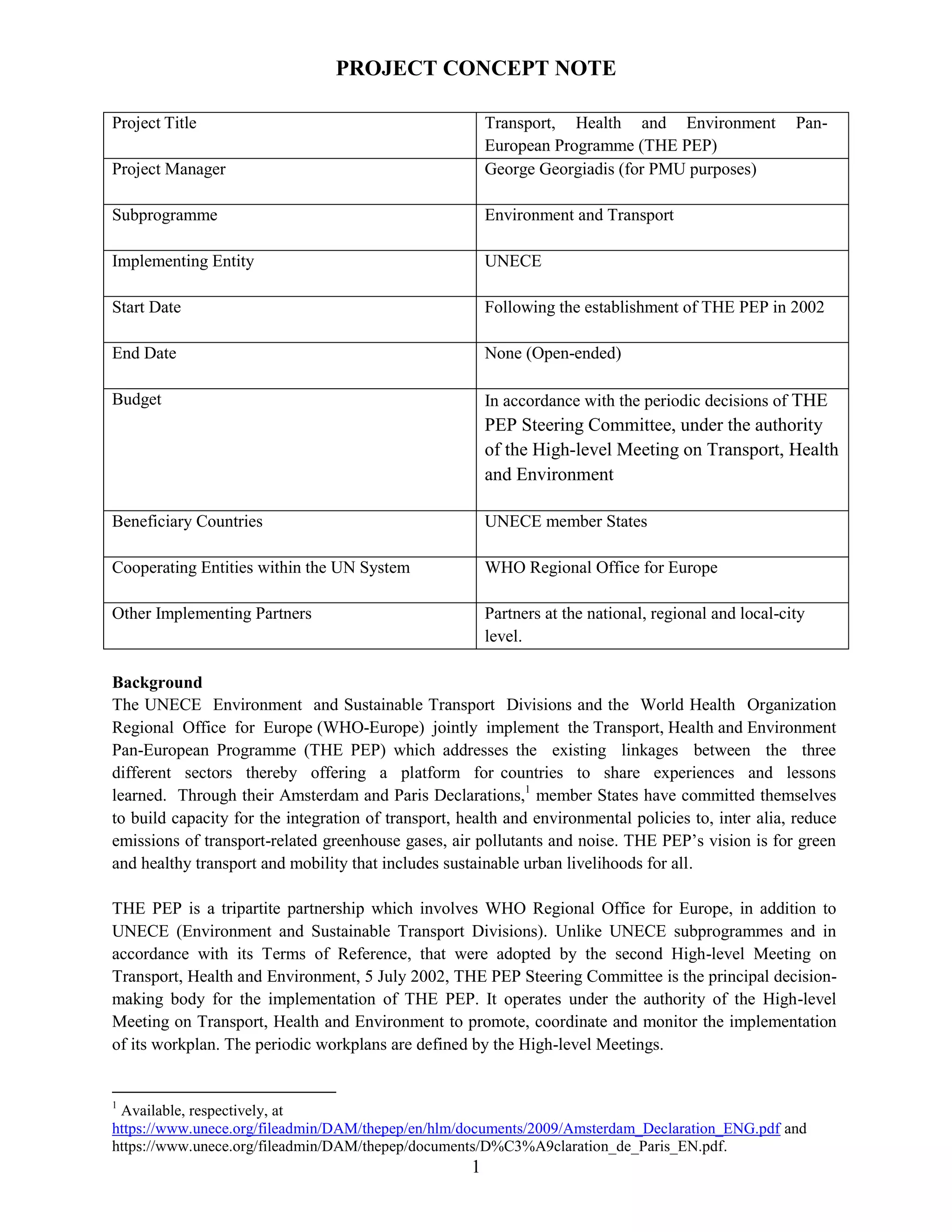
Project Title Transport, Health and Environment Pan-
European Programme (THE PEP)
Project Manager George Georgiadis (for PMU purposes)
Subprogramme Environment and Transport
Implementing Entity UNECE
Start Date Following the establishment of THE PEP in 2002
End Date None (Open-ended)
Budget In accordance with the periodic decisions of THE
PEP Steering Committee, under the authority
of the High-level Meeting on Transport, Health
and Environment
Beneficiary Countries UNECE member States
Cooperating Entities within the UN System WHO Regional Office for Europe
Other Implementing Partners Partners at the national, regional and local-city
level.
Background
The UNECE Environment and Sustainable Transport Divisions and the World Health Organization
Regional Office for Europe (WHO-Europe) jointly implement the Transport, Health and Environment
Pan-European Programme (THE PEP) which addresses the existing linkages between the three
different sectors thereby offering a platform for countries to share experiences and lessons
learned. Through their Amsterdam and Paris Declarations,1
member States have committed themselves
to build capacity for the integration of transport, health and environmental policies to, inter alia, reduce
emissions of transport-related greenhouse gases, air pollutants and noise. THE PEP’s vision is for green
and healthy transport and mobility that includes sustainable urban livelihoods for all.
THE PEP is a tripartite partnership which involves WHO Regional Office for Europe, in addition to
UNECE (Environment and Sustainable Transport Divisions). Unlike UNECE subprogrammes and in
accordance with its Terms of Reference, that were adopted by the second High-level Meeting on
Transport, Health and Environment, 5 July 2002, THE PEP Steering Committee is the principal decision-
making body for the implementation of THE PEP. It operates under the authority of the High-level
Meeting on Transport, Health and Environment to promote, coordinate and monitor the implementation
of its workplan. The periodic workplans are defined by the High-level Meetings.
1
Available, respectively, at
https://www.unece.org/fileadmin/DAM/thepep/en/hlm/documents/2009/Amsterdam_Declaration_ENG.pdf and
https://www.unece.org/fileadmin/DAM/thepep/documents/D%C3%A9claration_de_Paris_EN.pdf.
2
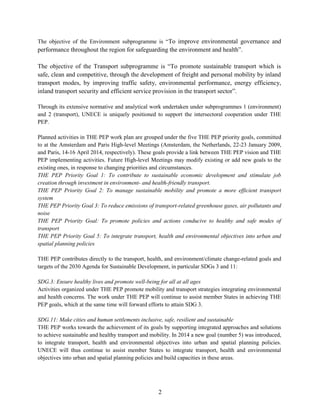
The objective of the Environment subprogramme is “To improve environmental governance and
performance throughout the region for safeguarding the environment and health”.
The objective of the Transport subprogramme is “To promote sustainable transport which is
safe, clean and competitive, through the development of freight and personal mobility by inland
transport modes, by improving traffic safety, environmental performance, energy efficiency,
inland transport security and efficient service provision in the transport sector”.
Through its extensive normative and analytical work undertaken under subprogrammes 1 (environment)
and 2 (transport), UNECE is uniquely positioned to support the intersectoral cooperation under THE
PEP.
Planned activities in THE PEP work plan are grouped under the five THE PEP priority goals, committed
to at the Amsterdam and Paris High-level Meetings (Amsterdam, the Netherlands, 22-23 January 2009,
and Paris, 14-16 April 2014, respectively). These goals provide a link between THE PEP vision and THE
PEP implementing activities. Future High-level Meetings may modify existing or add new goals to the
existing ones, in response to changing priorities and circumstances.
THE PEP Priority Goal 1: To contribute to sustainable economic development and stimulate job
creation through investment in environment- and health-friendly transport.
THE PEP Priority Goal 2: To manage sustainable mobility and promote a more efficient transport
system
THE PEP Priority Goal 3: To reduce emissions of transport-related greenhouse gases, air pollutants and
noise
THE PEP Priority Goal: To promote policies and actions conducive to healthy and safe modes of
transport
THE PEP Priority Goal 5: To integrate transport, health and environmental objectives into urban and
spatial planning policies
THE PEP contributes directly to the transport, health, and environment/climate change-related goals and
targets of the 2030 Agenda for Sustainable Development, in particular SDGs 3 and 11:
SDG.3: Ensure healthy lives and promote well-being for all at all ages
Activities organized under THE PEP promote mobility and transport strategies integrating environmental
and health concerns. The work under THE PEP will continue to assist member States in achieving THE
PEP goals, which at the same time will forward efforts to attain SDG 3.
SDG.11: Make cities and human settlements inclusive, safe, resilient and sustainable
THE PEP works towards the achievement of its goals by supporting integrated approaches and solutions
to achieve sustainable and healthy transport and mobility. In 2014 a new goal (number 5) was introduced,
to integrate transport, health and environmental objectives into urban and spatial planning policies.
UNECE will thus continue to assist member States to integrate transport, health and environmental
objectives into urban and spatial planning policies and build capacities in these areas.
3
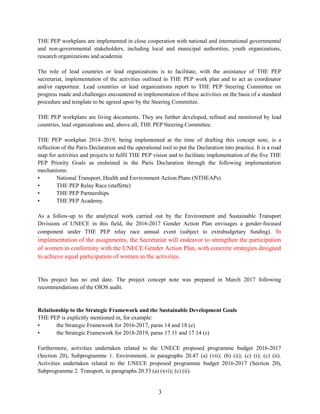
THE PEP workplans are implemented in close cooperation with national and international governmental
and non-governmental stakeholders, including local and municipal authorities, youth organizations,
research organizations and academia
The role of lead countries or lead organizations is to facilitate, with the assistance of THE PEP
secretariat, implementation of the activities outlined in THE PEP work plan and to act as coordinator
and/or rapporteur. Lead countries or lead organizations report to THE PEP Steering Committee on
progress made and challenges encountered in implementation of these activities on the basis of a standard
procedure and template to be agreed upon by the Steering Committee.
THE PEP workplans are living documents. They are further developed, refined and monitored by lead
countries, lead organizations and, above all, THE PEP Steering Committee.
THE PEP workplan 2014–2019, being implemented at the time of drafting this concept note, is a
reflection of the Paris Declaration and the operational tool to put the Declaration into practice. It is a road
map for activities and projects to fulfil THE PEP vision and to facilitate implementation of the five THE
PEP Priority Goals as enshrined in the Paris Declaration through the following implementation
mechanisms:
• National Transport, Health and Environment Action Plans (NTHEAPs)
• THE PEP Relay Race (staffette)
• THE PEP Partnerships
• THE PEP Academy.
As a follow-up to the analytical work carried out by the Environment and Sustainable Transport
Divisions of UNECE in this field, the 2016-2017 Gender Action Plan envisages a gender-focused
component under THE PEP relay race annual event (subject to extrabudgetary funding). In
implementation of the assignments, the Secretariat will endeavor to strengthen the participation
of women in conformity with the UNECE Gender Action Plan, with concrete strategies designed
to achieve equal participation of women in the activities.
This project has no end date. The project concept note was prepared in March 2017 following
recommendations of the OIOS audit.
Relationship to the Strategic Framework and the Sustainable Development Goals
THE PEP is explicitly mentioned in, for example:
• the Strategic Framework for 2016-2017, paras 14 and 18 (e)
• the Strategic Framework for 2018-2019, paras 17.11 and 17.14 (e)
Furthermore, activities undertaken related to the UNECE proposed programme budget 2016-2017
(Section 20), Subprogramme 1. Environment, in paragraphs 20.47 (a) (vii); (b) (ii); (c) (i); (c) (ii).
Activities undertaken related to the UNECE proposed programme budget 2016-2017 (Section 20),
Subprogramme 2. Transport, in paragraphs 20.53 (a) (xvi); (c) (ii).
4
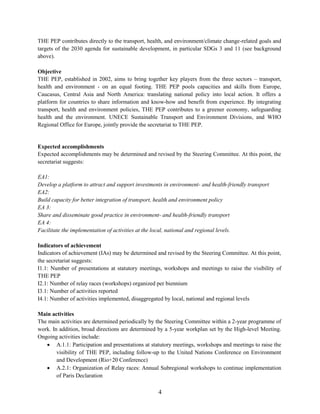
THE PEP contributes directly to the transport, health, and environment/climate change-related goals and
targets of the 2030 agenda for sustainable development, in particular SDGs 3 and 11 (see background
above).
Objective
THE PEP, established in 2002, aims to bring together key players from the three sectors – transport,
health and environment - on an equal footing. THE PEP pools capacities and skills from Europe,
Caucasus, Central Asia and North America: translating national policy into local action. It offers a
platform for countries to share information and know-how and benefit from experience. By integrating
transport, health and environment policies, THE PEP contributes to a greener economy, safeguarding
health and the environment. UNECE Sustainable Transport and Environment Divisions, and WHO
Regional Office for Europe, jointly provide the secretariat to THE PEP.
Expected accomplishments
Expected accomplishments may be determined and revised by the Steering Committee. At this point, the
secretariat suggests:
EA1:
Develop a platform to attract and support investments in environment- and health-friendly transport
EA2:
Build capacity for better integration of transport, health and environment policy
EA 3:
Share and disseminate good practice in environment- and health-friendly transport
EA 4:
Facilitate the implementation of activities at the local, national and regional levels.
Indicators of achievement
Indicators of achievement (IAs) may be determined and revised by the Steering Committee. At this point,
the secretariat suggests:
I1.1: Number of presentations at statutory meetings, workshops and meetings to raise the visibility of
THE PEP
I2.1: Number of relay races (workshops) organized per biennium
I3.1: Number of activities reported
I4.1: Number of activities implemented, disaggregated by local, national and regional levels
Main activities
The main activities are determined periodically by the Steering Committee within a 2-year programme of
work. In addition, broad directions are determined by a 5-year workplan set by the High-level Meeting.
Ongoing activities include:
 A.1.1: Participation and presentations at statutory meetings, workshops and meetings to raise the
visibility of THE PEP, including follow-up to the United Nations Conference on Environment
and Development (Rio+20 Conference)
 A.2.1: Organization of Relay races: Annual Subregional workshops to continue implementation
of Paris Declaration
5
 A.3.1: Revitalization of Clearing House as centre of information exchange as a follow-up to the
Paris Declaration
 A.3.2: Sharing and disseminate of good practices, including through analytical studies
 A.4.1: Launch and implementation of activities under THE PEP Partnership on a pan-European
Master Plan for cycling
 A.4.2: Support for the development and implementation of National Transport, Health And
Environment Action Plans (NTHEAPs)
Assumptions and Risks
THE PEP work plan 2014–2019 is an aspirational one. Implementation of the proposed activities will be
conditional on the mobilization of the necessary resources, since THE PEP relies on extrabudgetary
resources for its analytical and capacity building activities.
6
Annex 1.
Indicative results-based work plan
The workplan is determined periodically by THE PEP Steering Committee.
(1 January – 31 December 2017)
UMOJA OBJECT CLASS
(SPONSORED CLASS
/COMMITMENT ITEMS)
Object of Expenditure GL account Activity No Total (US$)
FT30_CLASS_010
Staff and personnel costs -
International Consultants
fees/Institutional Consultants
fees/national consultants and
Consultants travel/Individual
Contractors
74172010/
74171010/
7417310
EA2 A.2.1
EA3 A.3.1
EA4 A.4.1
EA4 A.4.2
87,750
FT30_CLASS_120 Contractual Services 74281010 EA3 A.3.2 6,000
FT30_CLASS_120 Contractual Services (External Printing) 74281010 EA3 A.3.2 5,000
FT30_CLASS_120
Contractual Services (Other miscellaneous
services) - bank charges, freight and related
costs
74201030/7
4251010
EA3 A.3.2 1,000
FT30_CLASS_125 Operating and Other Direct Costs 77003510 EA3 A.3.2 4,000
FT30_CLASS_125
Operating and Other Direct Costs
(Expendable Equipment/Stationery and
Office supplies)
77003510 EA3 A.3.2 1,000
FT30_CLASS_125
Operating and Other Direct Costs (Rental,
Operation & Maintenance of equipment)
74112010/7
4111010
EA3 A.3.2 1,000
FT30_CLASS_125
Operating and Other Direct Costs
(Hospitality)
79101010 EA3 A.3.2 1,000
FT30_CLASS_125
Operating and Other Direct Costs
(Telecommunication costs)
74121010 EA3 A.3.2 1,000
FT30_CLASS_135
Equipment Vehicles and Furniture
(Acquisition of IT Equipment Hardware
and software packages)
77171020 EA3 A.3.2 5,000
FT30_CLASS_160 Travel 72111211
EA1 A.1.1
EA2 A.2.1
EA4 A.4.1
55,000
FT30_CLASS_160 Travel - Official travel of staff - ECE 72111211
EA1 A.1.1
EA2 A.2.1
EA4 A.4.1
25,000
FT30_CLASS_160
Travel -Official travel of Meeting
Participants/Study Tour/seminars and
workshops
72111174
EA1 A.1.1
EA2 A.2.1
30,000
[1] Net Total 157,750
(2) FT30_CLASS_155
UN-PSC (13% Programme Support Costs of
[1]
20,508
[3] GRAND TOTAL: [1]+[2] 178,258
7
Annex 2.
Illustrative Budget
Resource requirements are determined periodically by THE PEP Steering Committee
Resource Requirements for 2017
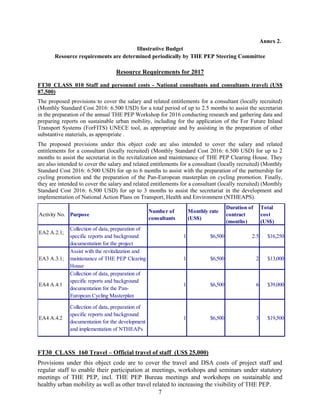
FT30_CLASS_010 Staff and personnel costs - National consultants and consultants travel) (US$
87,500)
The proposed provisions to cover the salary and related entitlements for a consultant (locally recruited)
(Monthly Standard Cost 2016: 6.500 USD) for a total period of up to 2.5 months to assist the secretariat
in the preparation of the annual THE PEP Workshop for 2016 conducting research and gathering data and
preparing reports on sustainable urban mobility, including for the application of the For Future Inland
Transport Systems (ForFITS) UNECE tool, as appropriate and by assisting in the preparation of other
substantive materials, as appropriate .
The proposed provisions under this object code are also intended to cover the salary and related
entitlements for a consultant (locally recruited) (Monthly Standard Cost 2016: 6.500 USD) for up to 2
months to assist the secretariat in the revitalization and maintenance of THE PEP Clearing House. They
are also intended to cover the salary and related entitlements for a consultant (locally recruited) (Monthly
Standard Cost 2016: 6.500 USD) for up to 6 months to assist with the preparation of the partnership for
cycling promotion and the preparation of the Pan-European masterplan on cycling promotion. Finally,
they are intended to cover the salary and related entitlements for a consultant (locally recruited) (Monthly
Standard Cost 2016: 6.500 USD) for up to 3 months to assist the secretariat in the development and
implementation of National Action Plans on Transport, Health and Environment (NTHEAPS).
Activity No. Purpose
Number of
consultants
Monthly rate
(US$)
Duration of
contract
(months)
Total
cost
(US$)
EA2 A.2.1;
Collection of data, preparation of
specific reports and background
documentation for the project
1 $6,500 2.5 $16,250
EA3 A.3.1;
Assist with the revitalization and
maintenance of THE PEP Clearing
House
1 $6,500 2 $13,000
EA4 A.4.1
Collection of data, preparation of
specific reports and background
documentation for the Pan-
European Cycling Masterplan
1 $6,500 6 $39,000
EA4 A.4.2
Collection of data, preparation of
specific reports and background
documentation for the development
and implementation of NTHEAPs
1 $6,500 3 $19,500
FT30_CLASS_160 Travel – Official travel of staff (US$ 25,000)
Provisions under this object code are to cover the travel and DSA costs of project staff and
regular staff to enable their participation at meetings, workshops and seminars under statutory
meetings of THE PEP, incl. THE PEP Bureau meetings and workshops on sustainable and
healthy urban mobility as well as other travel related to increasing the visibility of THE PEP.
8
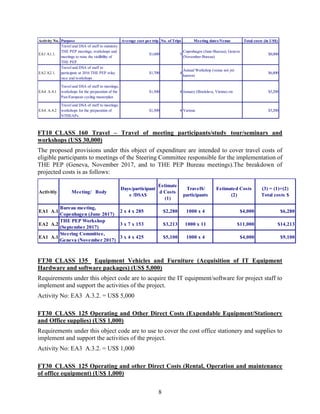
Activity No. Purpose Average cost per trip No. of Trips Meeting dates/Venue Total costs (in US$)
EA1 A1.1.
Travel and DSA of staff to statutory
THE PEP meetings, workshops and
meetings to raise the visilibility of
THE PEP
$1,600 5
Copenhagen (June-Bureau); Geneva
(November-Bureau)
$8,000
EA2 A2.1.
Travel and DSA of staff to
participate at 2016 THE PEP relay
race and workshops
$1,700 4
Annual Workshop (venue not yet
known)
$6,800
EA4. A.4.1
Travel and DSA of staff to meetings,
workshops for the preparation of the
Pan-European cycling masterplan
$1,300 4 January (Bratislava, Vienna) etc $5,200
EA4. A.4.2
Travel and DSA of staff to meetings,
workshops for the preparation of
NTHEAPs
$1,300 4 Various $5,200
FT10_CLASS_160 Travel – Travel of meeting participants/study tour/seminars and
workshops (US$ 30,000)
The proposed provisions under this object of expenditure are intended to cover travel costs of
eligible participants to meetings of the Steering Committee responsible for the implementation of
THE PEP (Geneva, November 2017, and to THE PEP Bureau meetings).The breakdown of
projected costs is as follows:
Activitiy No. Meeting/ Body
Days/participant
s /DSA$
Estimate
d Costs
(1)
Travel$/
participants
Estimated Costs
(2)
(3) = (1)+(2)
Total costs $
EA1 A.1.1
Bureau meeting,
Copenhagen (June 2017)
2 x 4 x 285 $2,280 1000 x 4 $4,000 $6,280
EA2 A.2.1
THE PEP Workshop
(September 2017)
3 x 7 x 153 $3,213 1000 x 11 $11,000 $14,213
EA1 A.1.1
Steering Committee,
Geneva (November 2017)
3 x 4 x 425 $5,100 1000 x 4 $4,000 $9,100
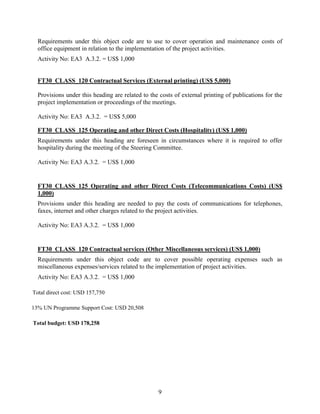
FT30_CLASS_135 Equipment Vehicles and Furniture (Acquisition of IT Equipment
Hardware and software packages) (US$ 5,000)
Requirements under this object code are to acquire the IT equipment/software for project staff to
implement and support the activities of the project.
Activity No: EA3 A.3.2. = US$ 5,000
FT30_CLASS_125 Operating and Other Direct Costs (Expendable Equipment/Stationery
and Office supplies) (US$ 1,000)
Requirements under this object code are to use to cover the cost office stationery and supplies to
implement and support the activities of the project.
Activity No: EA3 A.3.2. = US$ 1,000
FT30_CLASS_125 Operating and other Direct Costs (Rental, Operation and maintenance
of office equipment) (US$ 1,000)
9
Requirements under this object code are to use to cover operation and maintenance costs of
office equipment in relation to the implementation of the project activities.
Activity No: EA3 A.3.2. = US$ 1,000
FT30_CLASS_120 Contractual Services (External printing) (US$ 5,000)
Provisions under this heading are related to the costs of external printing of publications for the
project implementation or proceedings of the meetings.
Activity No: EA3 A.3.2. = US$ 5,000
FT30_CLASS_125 Operating and other Direct Costs (Hospitality) (US$ 1,000)
Requirements under this heading are foreseen in circumstances where it is required to offer
hospitality during the meeting of the Steering Committee.
Activity No: EA3 A.3.2. = US$ 1,000
FT30_CLASS_125 Operating and other Direct Costs (Telecommunications Costs) (US$
1,000)
Provisions under this heading are needed to pay the costs of communications for telephones,
faxes, internet and other charges related to the project activities.
Activity No: EA3 A.3.2. = US$ 1,000
FT30_CLASS_120 Contractual services (Other Miscellaneous services) (US$ 1,000)
Requirements under this object code are to cover possible operating expenses such as
miscellaneous expenses/services related to the implementation of project activities.
Activity No: EA3 A.3.2. = US$ 1,000
Total direct cost: USD 157,750
13% UN Programme Support Cost: USD 20,508
Total budget: USD 178,258

Project_Concept_Note_THE_PEP_05_ntc.pdf

  • 1.
    PROJECT CONCEPT NOTE 1 ProjectTitle Transport, Health and Environment Pan- European Programme (THE PEP) Project Manager George Georgiadis (for PMU purposes) Subprogramme Environment and Transport Implementing Entity UNECE Start Date Following the establishment of THE PEP in 2002 End Date None (Open-ended) Budget In accordance with the periodic decisions of THE PEP Steering Committee, under the authority of the High-level Meeting on Transport, Health and Environment Beneficiary Countries UNECE member States Cooperating Entities within the UN System WHO Regional Office for Europe Other Implementing Partners Partners at the national, regional and local-city level. Background The UNECE Environment and Sustainable Transport Divisions and the World Health Organization Regional Office for Europe (WHO-Europe) jointly implement the Transport, Health and Environment Pan-European Programme (THE PEP) which addresses the existing linkages between the three different sectors thereby offering a platform for countries to share experiences and lessons learned. Through their Amsterdam and Paris Declarations,1 member States have committed themselves to build capacity for the integration of transport, health and environmental policies to, inter alia, reduce emissions of transport-related greenhouse gases, air pollutants and noise. THE PEP’s vision is for green and healthy transport and mobility that includes sustainable urban livelihoods for all. THE PEP is a tripartite partnership which involves WHO Regional Office for Europe, in addition to UNECE (Environment and Sustainable Transport Divisions). Unlike UNECE subprogrammes and in accordance with its Terms of Reference, that were adopted by the second High-level Meeting on Transport, Health and Environment, 5 July 2002, THE PEP Steering Committee is the principal decision- making body for the implementation of THE PEP. It operates under the authority of the High-level Meeting on Transport, Health and Environment to promote, coordinate and monitor the implementation of its workplan. The periodic workplans are defined by the High-level Meetings. 1 Available, respectively, at https://www.unece.org/fileadmin/DAM/thepep/en/hlm/documents/2009/Amsterdam_Declaration_ENG.pdf and https://www.unece.org/fileadmin/DAM/thepep/documents/D%C3%A9claration_de_Paris_EN.pdf.
  • 2.
    2 The objective ofthe Environment subprogramme is “To improve environmental governance and performance throughout the region for safeguarding the environment and health”. The objective of the Transport subprogramme is “To promote sustainable transport which is safe, clean and competitive, through the development of freight and personal mobility by inland transport modes, by improving traffic safety, environmental performance, energy efficiency, inland transport security and efficient service provision in the transport sector”. Through its extensive normative and analytical work undertaken under subprogrammes 1 (environment) and 2 (transport), UNECE is uniquely positioned to support the intersectoral cooperation under THE PEP. Planned activities in THE PEP work plan are grouped under the five THE PEP priority goals, committed to at the Amsterdam and Paris High-level Meetings (Amsterdam, the Netherlands, 22-23 January 2009, and Paris, 14-16 April 2014, respectively). These goals provide a link between THE PEP vision and THE PEP implementing activities. Future High-level Meetings may modify existing or add new goals to the existing ones, in response to changing priorities and circumstances. THE PEP Priority Goal 1: To contribute to sustainable economic development and stimulate job creation through investment in environment- and health-friendly transport. THE PEP Priority Goal 2: To manage sustainable mobility and promote a more efficient transport system THE PEP Priority Goal 3: To reduce emissions of transport-related greenhouse gases, air pollutants and noise THE PEP Priority Goal: To promote policies and actions conducive to healthy and safe modes of transport THE PEP Priority Goal 5: To integrate transport, health and environmental objectives into urban and spatial planning policies THE PEP contributes directly to the transport, health, and environment/climate change-related goals and targets of the 2030 Agenda for Sustainable Development, in particular SDGs 3 and 11: SDG.3: Ensure healthy lives and promote well-being for all at all ages Activities organized under THE PEP promote mobility and transport strategies integrating environmental and health concerns. The work under THE PEP will continue to assist member States in achieving THE PEP goals, which at the same time will forward efforts to attain SDG 3. SDG.11: Make cities and human settlements inclusive, safe, resilient and sustainable THE PEP works towards the achievement of its goals by supporting integrated approaches and solutions to achieve sustainable and healthy transport and mobility. In 2014 a new goal (number 5) was introduced, to integrate transport, health and environmental objectives into urban and spatial planning policies. UNECE will thus continue to assist member States to integrate transport, health and environmental objectives into urban and spatial planning policies and build capacities in these areas.
  • 3.
    3 THE PEP workplansare implemented in close cooperation with national and international governmental and non-governmental stakeholders, including local and municipal authorities, youth organizations, research organizations and academia The role of lead countries or lead organizations is to facilitate, with the assistance of THE PEP secretariat, implementation of the activities outlined in THE PEP work plan and to act as coordinator and/or rapporteur. Lead countries or lead organizations report to THE PEP Steering Committee on progress made and challenges encountered in implementation of these activities on the basis of a standard procedure and template to be agreed upon by the Steering Committee. THE PEP workplans are living documents. They are further developed, refined and monitored by lead countries, lead organizations and, above all, THE PEP Steering Committee. THE PEP workplan 2014–2019, being implemented at the time of drafting this concept note, is a reflection of the Paris Declaration and the operational tool to put the Declaration into practice. It is a road map for activities and projects to fulfil THE PEP vision and to facilitate implementation of the five THE PEP Priority Goals as enshrined in the Paris Declaration through the following implementation mechanisms: • National Transport, Health and Environment Action Plans (NTHEAPs) • THE PEP Relay Race (staffette) • THE PEP Partnerships • THE PEP Academy. As a follow-up to the analytical work carried out by the Environment and Sustainable Transport Divisions of UNECE in this field, the 2016-2017 Gender Action Plan envisages a gender-focused component under THE PEP relay race annual event (subject to extrabudgetary funding). In implementation of the assignments, the Secretariat will endeavor to strengthen the participation of women in conformity with the UNECE Gender Action Plan, with concrete strategies designed to achieve equal participation of women in the activities. This project has no end date. The project concept note was prepared in March 2017 following recommendations of the OIOS audit. Relationship to the Strategic Framework and the Sustainable Development Goals THE PEP is explicitly mentioned in, for example: • the Strategic Framework for 2016-2017, paras 14 and 18 (e) • the Strategic Framework for 2018-2019, paras 17.11 and 17.14 (e) Furthermore, activities undertaken related to the UNECE proposed programme budget 2016-2017 (Section 20), Subprogramme 1. Environment, in paragraphs 20.47 (a) (vii); (b) (ii); (c) (i); (c) (ii). Activities undertaken related to the UNECE proposed programme budget 2016-2017 (Section 20), Subprogramme 2. Transport, in paragraphs 20.53 (a) (xvi); (c) (ii).
  • 4.
    4 THE PEP contributesdirectly to the transport, health, and environment/climate change-related goals and targets of the 2030 agenda for sustainable development, in particular SDGs 3 and 11 (see background above). Objective THE PEP, established in 2002, aims to bring together key players from the three sectors – transport, health and environment - on an equal footing. THE PEP pools capacities and skills from Europe, Caucasus, Central Asia and North America: translating national policy into local action. It offers a platform for countries to share information and know-how and benefit from experience. By integrating transport, health and environment policies, THE PEP contributes to a greener economy, safeguarding health and the environment. UNECE Sustainable Transport and Environment Divisions, and WHO Regional Office for Europe, jointly provide the secretariat to THE PEP. Expected accomplishments Expected accomplishments may be determined and revised by the Steering Committee. At this point, the secretariat suggests: EA1: Develop a platform to attract and support investments in environment- and health-friendly transport EA2: Build capacity for better integration of transport, health and environment policy EA 3: Share and disseminate good practice in environment- and health-friendly transport EA 4: Facilitate the implementation of activities at the local, national and regional levels. Indicators of achievement Indicators of achievement (IAs) may be determined and revised by the Steering Committee. At this point, the secretariat suggests: I1.1: Number of presentations at statutory meetings, workshops and meetings to raise the visibility of THE PEP I2.1: Number of relay races (workshops) organized per biennium I3.1: Number of activities reported I4.1: Number of activities implemented, disaggregated by local, national and regional levels Main activities The main activities are determined periodically by the Steering Committee within a 2-year programme of work. In addition, broad directions are determined by a 5-year workplan set by the High-level Meeting. Ongoing activities include:  A.1.1: Participation and presentations at statutory meetings, workshops and meetings to raise the visibility of THE PEP, including follow-up to the United Nations Conference on Environment and Development (Rio+20 Conference)  A.2.1: Organization of Relay races: Annual Subregional workshops to continue implementation of Paris Declaration
  • 5.
    5  A.3.1: Revitalizationof Clearing House as centre of information exchange as a follow-up to the Paris Declaration  A.3.2: Sharing and disseminate of good practices, including through analytical studies  A.4.1: Launch and implementation of activities under THE PEP Partnership on a pan-European Master Plan for cycling  A.4.2: Support for the development and implementation of National Transport, Health And Environment Action Plans (NTHEAPs) Assumptions and Risks THE PEP work plan 2014–2019 is an aspirational one. Implementation of the proposed activities will be conditional on the mobilization of the necessary resources, since THE PEP relies on extrabudgetary resources for its analytical and capacity building activities.
  • 6.
    6 Annex 1. Indicative results-basedwork plan The workplan is determined periodically by THE PEP Steering Committee. (1 January – 31 December 2017) UMOJA OBJECT CLASS (SPONSORED CLASS /COMMITMENT ITEMS) Object of Expenditure GL account Activity No Total (US$) FT30_CLASS_010 Staff and personnel costs - International Consultants fees/Institutional Consultants fees/national consultants and Consultants travel/Individual Contractors 74172010/ 74171010/ 7417310 EA2 A.2.1 EA3 A.3.1 EA4 A.4.1 EA4 A.4.2 87,750 FT30_CLASS_120 Contractual Services 74281010 EA3 A.3.2 6,000 FT30_CLASS_120 Contractual Services (External Printing) 74281010 EA3 A.3.2 5,000 FT30_CLASS_120 Contractual Services (Other miscellaneous services) - bank charges, freight and related costs 74201030/7 4251010 EA3 A.3.2 1,000 FT30_CLASS_125 Operating and Other Direct Costs 77003510 EA3 A.3.2 4,000 FT30_CLASS_125 Operating and Other Direct Costs (Expendable Equipment/Stationery and Office supplies) 77003510 EA3 A.3.2 1,000 FT30_CLASS_125 Operating and Other Direct Costs (Rental, Operation & Maintenance of equipment) 74112010/7 4111010 EA3 A.3.2 1,000 FT30_CLASS_125 Operating and Other Direct Costs (Hospitality) 79101010 EA3 A.3.2 1,000 FT30_CLASS_125 Operating and Other Direct Costs (Telecommunication costs) 74121010 EA3 A.3.2 1,000 FT30_CLASS_135 Equipment Vehicles and Furniture (Acquisition of IT Equipment Hardware and software packages) 77171020 EA3 A.3.2 5,000 FT30_CLASS_160 Travel 72111211 EA1 A.1.1 EA2 A.2.1 EA4 A.4.1 55,000 FT30_CLASS_160 Travel - Official travel of staff - ECE 72111211 EA1 A.1.1 EA2 A.2.1 EA4 A.4.1 25,000 FT30_CLASS_160 Travel -Official travel of Meeting Participants/Study Tour/seminars and workshops 72111174 EA1 A.1.1 EA2 A.2.1 30,000 [1] Net Total 157,750 (2) FT30_CLASS_155 UN-PSC (13% Programme Support Costs of [1] 20,508 [3] GRAND TOTAL: [1]+[2] 178,258
  • 7.
    7 Annex 2. Illustrative Budget Resourcerequirements are determined periodically by THE PEP Steering Committee Resource Requirements for 2017 FT30_CLASS_010 Staff and personnel costs - National consultants and consultants travel) (US$ 87,500) The proposed provisions to cover the salary and related entitlements for a consultant (locally recruited) (Monthly Standard Cost 2016: 6.500 USD) for a total period of up to 2.5 months to assist the secretariat in the preparation of the annual THE PEP Workshop for 2016 conducting research and gathering data and preparing reports on sustainable urban mobility, including for the application of the For Future Inland Transport Systems (ForFITS) UNECE tool, as appropriate and by assisting in the preparation of other substantive materials, as appropriate . The proposed provisions under this object code are also intended to cover the salary and related entitlements for a consultant (locally recruited) (Monthly Standard Cost 2016: 6.500 USD) for up to 2 months to assist the secretariat in the revitalization and maintenance of THE PEP Clearing House. They are also intended to cover the salary and related entitlements for a consultant (locally recruited) (Monthly Standard Cost 2016: 6.500 USD) for up to 6 months to assist with the preparation of the partnership for cycling promotion and the preparation of the Pan-European masterplan on cycling promotion. Finally, they are intended to cover the salary and related entitlements for a consultant (locally recruited) (Monthly Standard Cost 2016: 6.500 USD) for up to 3 months to assist the secretariat in the development and implementation of National Action Plans on Transport, Health and Environment (NTHEAPS). Activity No. Purpose Number of consultants Monthly rate (US$) Duration of contract (months) Total cost (US$) EA2 A.2.1; Collection of data, preparation of specific reports and background documentation for the project 1 $6,500 2.5 $16,250 EA3 A.3.1; Assist with the revitalization and maintenance of THE PEP Clearing House 1 $6,500 2 $13,000 EA4 A.4.1 Collection of data, preparation of specific reports and background documentation for the Pan- European Cycling Masterplan 1 $6,500 6 $39,000 EA4 A.4.2 Collection of data, preparation of specific reports and background documentation for the development and implementation of NTHEAPs 1 $6,500 3 $19,500 FT30_CLASS_160 Travel – Official travel of staff (US$ 25,000) Provisions under this object code are to cover the travel and DSA costs of project staff and regular staff to enable their participation at meetings, workshops and seminars under statutory meetings of THE PEP, incl. THE PEP Bureau meetings and workshops on sustainable and healthy urban mobility as well as other travel related to increasing the visibility of THE PEP.
  • 8.
    8 Activity No. PurposeAverage cost per trip No. of Trips Meeting dates/Venue Total costs (in US$) EA1 A1.1. Travel and DSA of staff to statutory THE PEP meetings, workshops and meetings to raise the visilibility of THE PEP $1,600 5 Copenhagen (June-Bureau); Geneva (November-Bureau) $8,000 EA2 A2.1. Travel and DSA of staff to participate at 2016 THE PEP relay race and workshops $1,700 4 Annual Workshop (venue not yet known) $6,800 EA4. A.4.1 Travel and DSA of staff to meetings, workshops for the preparation of the Pan-European cycling masterplan $1,300 4 January (Bratislava, Vienna) etc $5,200 EA4. A.4.2 Travel and DSA of staff to meetings, workshops for the preparation of NTHEAPs $1,300 4 Various $5,200 FT10_CLASS_160 Travel – Travel of meeting participants/study tour/seminars and workshops (US$ 30,000) The proposed provisions under this object of expenditure are intended to cover travel costs of eligible participants to meetings of the Steering Committee responsible for the implementation of THE PEP (Geneva, November 2017, and to THE PEP Bureau meetings).The breakdown of projected costs is as follows: Activitiy No. Meeting/ Body Days/participant s /DSA$ Estimate d Costs (1) Travel$/ participants Estimated Costs (2) (3) = (1)+(2) Total costs $ EA1 A.1.1 Bureau meeting, Copenhagen (June 2017) 2 x 4 x 285 $2,280 1000 x 4 $4,000 $6,280 EA2 A.2.1 THE PEP Workshop (September 2017) 3 x 7 x 153 $3,213 1000 x 11 $11,000 $14,213 EA1 A.1.1 Steering Committee, Geneva (November 2017) 3 x 4 x 425 $5,100 1000 x 4 $4,000 $9,100 FT30_CLASS_135 Equipment Vehicles and Furniture (Acquisition of IT Equipment Hardware and software packages) (US$ 5,000) Requirements under this object code are to acquire the IT equipment/software for project staff to implement and support the activities of the project. Activity No: EA3 A.3.2. = US$ 5,000 FT30_CLASS_125 Operating and Other Direct Costs (Expendable Equipment/Stationery and Office supplies) (US$ 1,000) Requirements under this object code are to use to cover the cost office stationery and supplies to implement and support the activities of the project. Activity No: EA3 A.3.2. = US$ 1,000 FT30_CLASS_125 Operating and other Direct Costs (Rental, Operation and maintenance of office equipment) (US$ 1,000)
  • 9.
    9 Requirements under thisobject code are to use to cover operation and maintenance costs of office equipment in relation to the implementation of the project activities. Activity No: EA3 A.3.2. = US$ 1,000 FT30_CLASS_120 Contractual Services (External printing) (US$ 5,000) Provisions under this heading are related to the costs of external printing of publications for the project implementation or proceedings of the meetings. Activity No: EA3 A.3.2. = US$ 5,000 FT30_CLASS_125 Operating and other Direct Costs (Hospitality) (US$ 1,000) Requirements under this heading are foreseen in circumstances where it is required to offer hospitality during the meeting of the Steering Committee. Activity No: EA3 A.3.2. = US$ 1,000 FT30_CLASS_125 Operating and other Direct Costs (Telecommunications Costs) (US$ 1,000) Provisions under this heading are needed to pay the costs of communications for telephones, faxes, internet and other charges related to the project activities. Activity No: EA3 A.3.2. = US$ 1,000 FT30_CLASS_120 Contractual services (Other Miscellaneous services) (US$ 1,000) Requirements under this object code are to cover possible operating expenses such as miscellaneous expenses/services related to the implementation of project activities. Activity No: EA3 A.3.2. = US$ 1,000 Total direct cost: USD 157,750 13% UN Programme Support Cost: USD 20,508 Total budget: USD 178,258