Kaizen
今井正明
• Kaizen
– Ongoing improvement involves everyone
• Top management
• Managers
• Workers
– A culture of supporting quality improvement
• more important than the use of any specific tools
• Kaizen
– The unifying thread running through
• The philosophy
• The systems
• The problem-solving tools developed
of Japanese quality movement
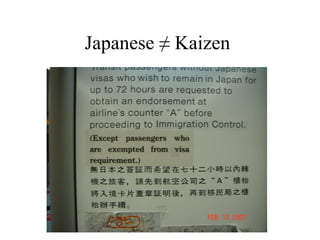
Japanese ≠ Kaizen
• Japanese management
– Kaizen
– Process-oriented way
of thinking
• Western management
– Innovation
– Result-oriented
thinking
• Climate features innovation
– Rapid expending markets
• Increasing sales more important than reducing cost
– Consumers oriented more toward quantity
rather than quality
– Abundant and low-cost resources
– A belief that success with innovative product
will offset sluggish performance
• Climate favors Kaizen
– Sharp increase in the costs of material, energy,
and labor
– Overcapacity of production facilities
– Increasing competitions
– 資訊不對稱的消失
– Need to introduce new products more rapidly
– Need to lower the breakeven point
• Kaizen Culture
– A corporate culture in which everyone can
freely admit these problems
– A systematic and collaborative approach to
cross-functional problem-solving
• Internal, Next process is customer
• External, suppliers
• Kaizen Culture
– A customer-driven strategy for improvement
• Quality, cost, schedule, and delivery requirements
– Emphasis on process
• Result is not the only thing and everything
• Support and acknowledge people’s process-oriented
efforts for improvement
Kaizen and management
Innovation
Kaizen
Maintenance
Top
Mgnt
Middle
Mgnt
Supervisor Worker
• QC Circles
– Primarily focus on
• Cost, safety, and productivity
• Indirectly to product-quality improvement
– Account for only 10% - 30% of the overall
TQC efforts in Japanese companies
– Making improvements in the workplace
• TQC in Japan
– A movement center on the improvement of
managerial performance at all levels
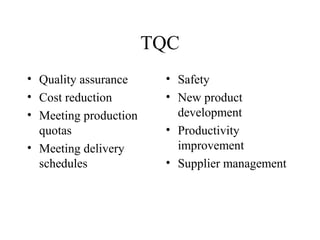
TQC
• Quality assurance
• Cost reduction
• Meeting production
quotas
• Meeting delivery
schedules
• Safety
• New product
development
• Productivity
improvement
• Supplier management
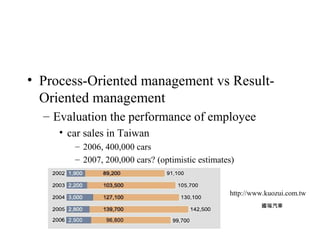
• Process-Oriented management vs Result-
Oriented management
– Evaluation the performance of employee
• car sales in Taiwan
– 2006, 400,000 cars
– 2007, 200,000 cars? (optimistic estimates)
http://www.kuozui.com.tw
國瑞汽車
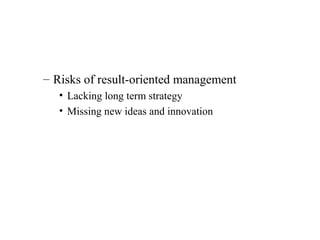
– Risks of result-oriented management
• Lacking long term strategy
• Missing new ideas and innovation
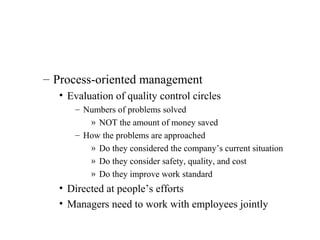
– Process-oriented management
• Evaluation of quality control circles
– Numbers of problems solved
» NOT the amount of money saved
– How the problems are approached
» Do they considered the company’s current situation
» Do they consider safety, quality, and cost
» Do they improve work standard
• Directed at people’s efforts
• Managers need to work with employees jointly
• Manager’s job
– Maintenance-related administration
• Checking the performance (result) of work
– Improvement-related management
• Checking the process that has led to a specific result
Key phrases of TQC
• Speak with data, 數據會說話
• Quality first, not profit first
• Quality at source, 源頭管理
• The next process is the customer
• Customer-oriented TQC
• TQC starts with training and ends with
training
• Speak with data
– Emphasize the use of data
However, aware of
• False data,
• Mistaken data,
• Immeasurable
• Quality First
– Customers are satisfied with the quality of
products or services
• Building quality into product
• Building quality into people
– Training is essential
» Help employee become KAIZEN-conscious
• Quality First
– Making the top quality products
– At the low cost
– In large quantity
– From the very beginning
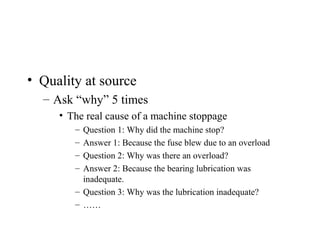
• Quality at source
– Ask “why” 5 times
• The real cause of a machine stoppage
– Question 1: Why did the machine stop?
– Answer 1: Because the fuse blew due to an overload
– Question 2: Why was there an overload?
– Answer 2: Because the bearing lubrication was
inadequate.
– Question 3: Why was the lubrication inadequate?
– ……
• The next process is the customer
– Mass production age
• The person making the products neither knows nor
care who the customers are
– The design engineer’s customers
• The manufacturing people
• (End customers)
• Customer-oriented TQC,
– Not manufacturer-oriented TQC
– Build a system for designing, developing,
producing, and servicing products to satisfy
their customers
• 華航 – 退票作業
– 要求旅客繳回機票正本
– 不告訴旅客如何 follow up
– Cf. 以客為尊 ?
• TQC starts with training and ends with
training
– Building quality into people
• Cross-functional management to facilitate
Kaizen
– “Quality at source” means TQC should be
extended to include
• Vendors
• Suppliers
• subcontractors
• Follow the PDCA cycle
– Problem-solving
– Management
• Design – Plan: product design corresponds to the
planning phase of management
• Production – Do: making products as designed
• Sale – Check: customers satisfied?
• Research – Action: how to approach complaints
– Not PDCF
• Plan
• Do
• Check
• Fight/fire!
• No layoff policy
– Virginia Mason Medical Center,
Seattle, WA
– 改善造就『冗員』
• Redeploys employees
– Training
• Kaizen Promotion Office
– Toyota’s suppliers support center
• Use the QC story to persuade
– Case study of shortening telephone waiting
time
• kaizenStory.doc
• Standardize the results
– There can be no improvement where there are
no standards
– A way of spreading the benefits of
improvement throughout the organization
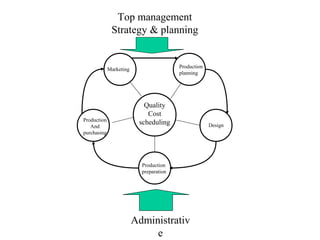
Cross-Functional Management
• Building a better system for
– Quality
– Cost
– Scheduling
• Resolving inter-unit conflict on
– Quality
– Cost
– Schedule
Quality
Cost
scheduling
Production
planning
Design
Production
preparation
Production
And
purchasing
Marketing
Top management
Strategy & planning
Administrativ
e
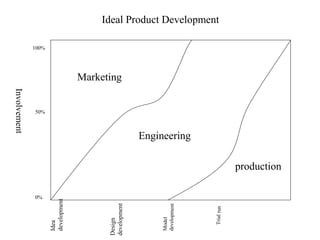
Involvement
100%
50%
0%
Marketing
Engineering
production
Idea
development
Design
development
Model
development
Trialrun
Ideal Product Development
• Cross Functional Management at Toyota
– Clarify its quality goals and deploy them to all
employees at every level
– Establish a system of close coordination among
different department
• toyotaXfun.doc

Kaizen

  • 1.
  • 2.
    • Kaizen – Ongoingimprovement involves everyone • Top management • Managers • Workers – A culture of supporting quality improvement • more important than the use of any specific tools
  • 3.
    • Kaizen – Theunifying thread running through • The philosophy • The systems • The problem-solving tools developed of Japanese quality movement
  • 4.
  • 6.
    • Japanese management –Kaizen – Process-oriented way of thinking • Western management – Innovation – Result-oriented thinking
  • 7.
    • Climate featuresinnovation – Rapid expending markets • Increasing sales more important than reducing cost – Consumers oriented more toward quantity rather than quality – Abundant and low-cost resources – A belief that success with innovative product will offset sluggish performance
  • 8.
    • Climate favorsKaizen – Sharp increase in the costs of material, energy, and labor – Overcapacity of production facilities – Increasing competitions – 資訊不對稱的消失 – Need to introduce new products more rapidly – Need to lower the breakeven point
  • 9.
    • Kaizen Culture –A corporate culture in which everyone can freely admit these problems – A systematic and collaborative approach to cross-functional problem-solving • Internal, Next process is customer • External, suppliers
  • 10.
    • Kaizen Culture –A customer-driven strategy for improvement • Quality, cost, schedule, and delivery requirements – Emphasis on process • Result is not the only thing and everything • Support and acknowledge people’s process-oriented efforts for improvement
  • 11.
  • 12.
    • QC Circles –Primarily focus on • Cost, safety, and productivity • Indirectly to product-quality improvement – Account for only 10% - 30% of the overall TQC efforts in Japanese companies – Making improvements in the workplace
  • 13.
    • TQC inJapan – A movement center on the improvement of managerial performance at all levels
  • 14.
    TQC • Quality assurance •Cost reduction • Meeting production quotas • Meeting delivery schedules • Safety • New product development • Productivity improvement • Supplier management
  • 15.
    • Process-Oriented managementvs Result- Oriented management – Evaluation the performance of employee • car sales in Taiwan – 2006, 400,000 cars – 2007, 200,000 cars? (optimistic estimates) http://www.kuozui.com.tw 國瑞汽車
  • 16.
    – Risks ofresult-oriented management • Lacking long term strategy • Missing new ideas and innovation
  • 17.
    – Process-oriented management •Evaluation of quality control circles – Numbers of problems solved » NOT the amount of money saved – How the problems are approached » Do they considered the company’s current situation » Do they consider safety, quality, and cost » Do they improve work standard • Directed at people’s efforts • Managers need to work with employees jointly
  • 18.
    • Manager’s job –Maintenance-related administration • Checking the performance (result) of work – Improvement-related management • Checking the process that has led to a specific result
  • 19.
    Key phrases ofTQC • Speak with data, 數據會說話 • Quality first, not profit first • Quality at source, 源頭管理 • The next process is the customer • Customer-oriented TQC • TQC starts with training and ends with training
  • 20.
    • Speak withdata – Emphasize the use of data However, aware of • False data, • Mistaken data, • Immeasurable
  • 21.
    • Quality First –Customers are satisfied with the quality of products or services • Building quality into product • Building quality into people – Training is essential » Help employee become KAIZEN-conscious
  • 22.
    • Quality First –Making the top quality products – At the low cost – In large quantity – From the very beginning
  • 23.
    • Quality atsource – Ask “why” 5 times • The real cause of a machine stoppage – Question 1: Why did the machine stop? – Answer 1: Because the fuse blew due to an overload – Question 2: Why was there an overload? – Answer 2: Because the bearing lubrication was inadequate. – Question 3: Why was the lubrication inadequate? – ……
  • 24.
    • The nextprocess is the customer – Mass production age • The person making the products neither knows nor care who the customers are – The design engineer’s customers • The manufacturing people • (End customers)
  • 25.
    • Customer-oriented TQC, –Not manufacturer-oriented TQC – Build a system for designing, developing, producing, and servicing products to satisfy their customers • 華航 – 退票作業 – 要求旅客繳回機票正本 – 不告訴旅客如何 follow up – Cf. 以客為尊 ?
  • 26.
    • TQC startswith training and ends with training – Building quality into people
  • 27.
    • Cross-functional managementto facilitate Kaizen – “Quality at source” means TQC should be extended to include • Vendors • Suppliers • subcontractors
  • 28.
    • Follow thePDCA cycle – Problem-solving – Management • Design – Plan: product design corresponds to the planning phase of management • Production – Do: making products as designed • Sale – Check: customers satisfied? • Research – Action: how to approach complaints
  • 29.
    – Not PDCF •Plan • Do • Check • Fight/fire! • No layoff policy – Virginia Mason Medical Center, Seattle, WA – 改善造就『冗員』 • Redeploys employees – Training • Kaizen Promotion Office – Toyota’s suppliers support center
  • 30.
    • Use theQC story to persuade – Case study of shortening telephone waiting time • kaizenStory.doc
  • 31.
    • Standardize theresults – There can be no improvement where there are no standards – A way of spreading the benefits of improvement throughout the organization
  • 32.
    Cross-Functional Management • Buildinga better system for – Quality – Cost – Scheduling • Resolving inter-unit conflict on – Quality – Cost – Schedule
  • 33.
  • 34.
  • 35.
    • Cross FunctionalManagement at Toyota – Clarify its quality goals and deploy them to all employees at every level – Establish a system of close coordination among different department • toyotaXfun.doc