








Welcome to an Introduction to Kahoot!
AGENDA
1. Introduction Natalie
2. Game & Demonstration Natalie & Camila
3. Theory of Gamification Iryna
4. Problems and Benefits Niamh & Natalie
5. Video Demonstration Camila
6. Summary Camila
Introduction
Natalie Boyle
Introduction
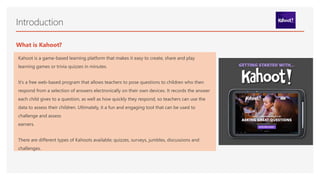
Kahoot is a game-based learning platform that makes it easy to create, share and play
learning games or trivia quizzes in minutes.
It’s a free web-based program that allows teachers to pose questions to children who then
respond from a selection of answers electronically on their own devices. It records the answer
each child gives to a question, as well as how quickly they respond, so teachers can use the
data to assess their children. Ultimately, it a fun and engaging tool that can be used to
challenge and assess
earners.
There are different types of Kahoots available; quizzes, surveys, jumbles, discussions and
challenges.
What is Kahoot?
Kahoot Quiz!
What is a Kahoot Quiz?
A Kahoot quiz is a series of questions with between two to four multiple-choice answers
to choose from. Teachers can create their own quizzes, duplicate and edit others created
and shared by other teachers, or simply play Kahoots created by other users.
Teachers set a game to play and a game pin is created and displayed on screen. Children
connect to the game by going to https://kahoot.it and entering the game pin into the first
box, then their name into the second. Once all children have connected, you’re ready to
start the quiz.
The questions are presented on screen with text (and an accompanying image if you
desire) and children are given an allotted time to respond using their smart device or
computer. Kahoot allocates each multiple-choice answer a colour and shape which
children see on their own devices and select by clicking/tapping on them. Questions and
answers can be set to randomise each time the Kahoot is played meaning the same quiz
can be used again without worrying that children will simply memorise the order of
questions and answers.
Game & Demonstration
Natalie Boyle & Camila Brito
Game and Demonstration
Our game
click here to play....!
Theory of Gamification
Iryna Fox
Theory of Gamification
Pedagogical underpinnings of Kahoot learning platform
Place within current pedagogical trends
Kahoot is used by teachers as part of the trend of gamification of education and training. Gamification aims to
make the learning process more attractive to learners and increase motivation (Kocakoyun, 2018 In broader
sense, gamification is related to the concept of learning through play. According to research: play has a
motivational advantage (Kennedy et al, 2012)play promotes higher levels of attention, symbolising and
problem-solving (Bodrova, 2008)
Play is a well-recognised form of learning for young children. Curriculum for children aged 0-6 is based on
learning through play (NCCA, 2009). Today, it is increasingly recognised that adults enjoy playing and learning
through play too. Even though the place of play and its appropriateness in higher education is debated, we can
say that the tide is turning and playful communities are springing up within and across universities (James,
2018). The book edited by Alison James and Chrissi Nerantzi, The Power of Play in Higher Education: Creativity
in Tertiary Education, is an excellent example how playful experiences can be used in teaching across various
fields and disciplines.
Play can be characterised and defined in different ways. We can talk about free play or structured play which is
bound by rules and is purpose-oriented. Kahoot falls under the second category and is therefore widely
accepted by educators because it enables them to introduce playful experiences into the classroom while still
maintain the sense of being in control and having a purpose.
Theory of Gamification
Learner-centred approach tool
The learner-centered approach to education is based on the
principle that knowledge is created in the interaction between
the instructor and the learner rather than transmitted from one
to the other. The focus is on the learning and what needs to
be done in order for the student to achieve learning, while
characteristics of the teacher and the learner are not regarded
as essential (Biggs and Tann, 2011). Using Kahoot with
students makes the context more familiar and the experience
is less stressful and more engaging than traditional question-
and-answer exercises or tests.
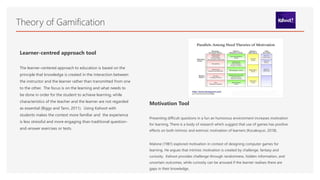
Motivation Tool
Presenting difficult questions in a fun an humorous environment increases motivation
for learning. There is a body of research which suggest that use of games has positive
effects on both intrinsic and extrinsic motivation of learners (Kocakoyun, 2018).
Malone (1981) explored motivation in context of designing computer games for
learning. He argues that intrinsic motivation is created by challenge, fantasy and
curiosity. Kahoot provides challenge through randomness, hidden information, and
uncertain outcomes, while curiosity can be aroused if the learner realises there are
gaps in their knowledge.
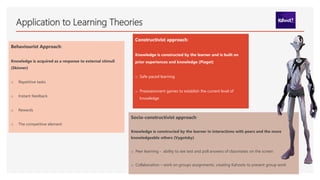
Application to Learning Theories
Behaviourist Approach:
Knowledge is acquired as a response to external stimuli
(Skinner)
o Repetitive tasks
o Instant feedback
o Rewards
o The competitive element
Constructivist approach:
Knowledge is constructed by the learner and is built on
prior experiences and knowledge (Piaget)
o Safe-paced learning
o Preassessment games to establish the current level of
knowledge
Socio-constructivist approach:
Knowledge is constructed by the learner in interactions with peers and the more
knowledgeable others (Vygotsky)
o Peer learning - ability to see test and poll answers of classmates on the screen
o Collaboration – work on groups assignments, creating Kahoots to present group work
Benefits & Concerns
Niamh O’Sullivan
Benefits and Concerns
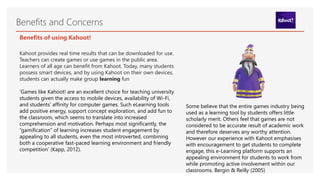
Benefits of using Kahoot!
Kahoot provides real time results that can be downloaded for use.
Teachers can create games or use games in the public area.
Learners of all age can benefit from Kahoot. Today, many students
possess smart devices, and by using Kahoot on their own devices,
students can actually make group learning fun
‘Games like Kahoot! are an excellent choice for teaching university
students given the access to mobile devices, availability of Wi-Fi,
and students’ affinity for computer games. Such eLearning tools
add positive energy, support concept exploration, and add fun to
the classroom, which seems to translate into increased
comprehension and motivation. Perhaps most significantly, the
“gamification” of learning increases student engagement by
appealing to all students, even the most introverted, combining
both a cooperative fast-paced learning environment and friendly
competition’ (Kapp, 2012).
Some believe that the entire games industry being
used as a learning tool by students offers little
scholarly merit. Others feel that games are not
considered to be accurate result of academic work
and therefore deserves any worthy attention.
However our experience with Kahoot emphasises
with encouragement to get students to complete
engage, this e-Learning platform supports an
appealing environment for students to work from
while promoting active involvement within our
classrooms. Bergin & Reilly (2005)
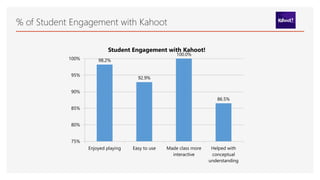
% of Student Engagement with Kahoot
98.2%
92.9%
100.0%
86.5%
75%
80%
85%
90%
95%
100%
Enjoyed playing Easy to use Made class more
interactive
Helped with
conceptual
understanding
Student Engagement with Kahoot!
Advantages of Using Kahoot
Summary:
• Free
• Easy for instructors to learn
• Simple process for students (no account registration or downloading of application)
• Compatible with smart phones, tablets, or computers
• Real time results help instructors provide clarification when needed
• Music and colors add to student excitement and energy
• Increases student engagement
• Instructors can download, review, and save student results
• Students can take quizzes multiple times
• Instructors can creates quizzes, discussion questions, or surveys
• Instructors can adjust the response time
Concerns with Kahoot!
Recent research studies found that students found that they had difficulty in
staying motivated when using Kahoot when they were unable to answer
questions and therefore could not win games. Other advised that the fun
experienced when playing the game faded away when the same students
keep winning. Some remarked it as being ‘gimmicky’ and they found they
didn’t have enough time to think.
‘Professor Neil Selwyn from Monash University recognized a similar potential
limitation of Kahoot! when he noted that being ranked doesn’t appeal to
every student similarly’ (Singer, 2016).
Kahoot is advertised as being an effective tool to review vocabulary and
concepts to prepare for test however in a 2014 study has advised that the
most effective way of doing this is taking notes in longhand in the classroom
in order to retain information in a more effective way. Also when taking into
account the results of this study, Kahoot is viewed as being of no benefit in
the classroom as they feel students could be using class time to study more
efficiently. Pam A Mueller, Daniel M Oppenheimer (2014),
There are also limitations in Teachers being able to create challenging
questions in order to more accurately access a students knowledge to a
particular subject due to time constraints in using Kahoot.
Ethical Issues:
Video Demonstration
https://www.screencast.com/t/Ln86DsPigat
Summary
It’s friendly platform for teachers and students,
Have a good interface with social media and main video conference platforms,
It can be used to review students' knowledge, for formative assessment, or as a break from traditional classroom activities,
Learner-centred approach tool and increase the motivation
Thank You!
More questions about Kahoot?
Visit the Kahoot Blog
Go to free Kahoot training
SELECT THE ARROW WHEN IN SLIDE SHOW MODE
References
References:
Biggs, J. and Tang, C. (2011) Quality Learning at University. Maindenhead, Open University Press.
Bodrova, A. (2008) Make-believe Play Versus Academic Skills: A Vygotskian Approach to Today's Dilemma. European Early Childhood Education Research Journal, 16(3), pp. 357-369
James, A. and Nerantzi, C. (Eds). (2019) The Power of Play in Higher Education: Creativity in Tertiary Education. Cham, Szwitzerland: Pagrave McMillan
Kennedy, E. et al. (2012) Literacy in Early Childhood and Primary Education (3-8 years), Dublin: NCCA
Kocakoyun, S. (2018) Perceptions of Students for Gamification Approach: Kahoot as a Case Study. Intermational Journal of Emerging Technologoies in Learning, 13 (2), pp. 72-93.
Malone, T (1981) Towards a Theory of Instrinsically Motivated Instruction. Cognitive Scince, 4, pp. 333-369.
Kapp, K. (2012). The gamification of learning and instruction: Game-based methods and strategies for training and education. San Francisco, CA: Pfeiffer.
Bergin, S., & Reilly, R. (2005). The influence of motivation and comfort-level on learning to program. Proceedings of the 17th workshop on psychology of programming – PPIG, 293-304.
Singer, N. (2016, April 16). Kahoot app brings urgency of a quiz show to the classroom. The New York Times. Retrieved from http://www.nytimes.com/2016/04/17/technology/kahoot-app-brings-urgency-of-a-quiz-show-to-the-
classroom.html?_r=1
Pam A Mueller, Daniel M Oppenheimer (2014), The Pen is Mightier that the keyboard: Advantages of Longhand over Laptop Note Taking, Psychological Science.

Kahoot presentation (1)

  • 1.
    Welcome to anIntroduction to Kahoot!
  • 2.
    AGENDA 1. Introduction Natalie 2.Game & Demonstration Natalie & Camila 3. Theory of Gamification Iryna 4. Problems and Benefits Niamh & Natalie 5. Video Demonstration Camila 6. Summary Camila
  • 3.
  • 4.
    Introduction Kahoot is agame-based learning platform that makes it easy to create, share and play learning games or trivia quizzes in minutes. It’s a free web-based program that allows teachers to pose questions to children who then respond from a selection of answers electronically on their own devices. It records the answer each child gives to a question, as well as how quickly they respond, so teachers can use the data to assess their children. Ultimately, it a fun and engaging tool that can be used to challenge and assess earners. There are different types of Kahoots available; quizzes, surveys, jumbles, discussions and challenges. What is Kahoot?
  • 5.
    Kahoot Quiz! What isa Kahoot Quiz? A Kahoot quiz is a series of questions with between two to four multiple-choice answers to choose from. Teachers can create their own quizzes, duplicate and edit others created and shared by other teachers, or simply play Kahoots created by other users. Teachers set a game to play and a game pin is created and displayed on screen. Children connect to the game by going to https://kahoot.it and entering the game pin into the first box, then their name into the second. Once all children have connected, you’re ready to start the quiz. The questions are presented on screen with text (and an accompanying image if you desire) and children are given an allotted time to respond using their smart device or computer. Kahoot allocates each multiple-choice answer a colour and shape which children see on their own devices and select by clicking/tapping on them. Questions and answers can be set to randomise each time the Kahoot is played meaning the same quiz can be used again without worrying that children will simply memorise the order of questions and answers.
  • 6.
    Game & Demonstration NatalieBoyle & Camila Brito
  • 7.
    Game and Demonstration Ourgame click here to play....!
  • 8.
  • 9.
    Theory of Gamification Pedagogicalunderpinnings of Kahoot learning platform Place within current pedagogical trends Kahoot is used by teachers as part of the trend of gamification of education and training. Gamification aims to make the learning process more attractive to learners and increase motivation (Kocakoyun, 2018 In broader sense, gamification is related to the concept of learning through play. According to research: play has a motivational advantage (Kennedy et al, 2012)play promotes higher levels of attention, symbolising and problem-solving (Bodrova, 2008) Play is a well-recognised form of learning for young children. Curriculum for children aged 0-6 is based on learning through play (NCCA, 2009). Today, it is increasingly recognised that adults enjoy playing and learning through play too. Even though the place of play and its appropriateness in higher education is debated, we can say that the tide is turning and playful communities are springing up within and across universities (James, 2018). The book edited by Alison James and Chrissi Nerantzi, The Power of Play in Higher Education: Creativity in Tertiary Education, is an excellent example how playful experiences can be used in teaching across various fields and disciplines. Play can be characterised and defined in different ways. We can talk about free play or structured play which is bound by rules and is purpose-oriented. Kahoot falls under the second category and is therefore widely accepted by educators because it enables them to introduce playful experiences into the classroom while still maintain the sense of being in control and having a purpose.
  • 10.
    Theory of Gamification Learner-centredapproach tool The learner-centered approach to education is based on the principle that knowledge is created in the interaction between the instructor and the learner rather than transmitted from one to the other. The focus is on the learning and what needs to be done in order for the student to achieve learning, while characteristics of the teacher and the learner are not regarded as essential (Biggs and Tann, 2011). Using Kahoot with students makes the context more familiar and the experience is less stressful and more engaging than traditional question- and-answer exercises or tests. Motivation Tool Presenting difficult questions in a fun an humorous environment increases motivation for learning. There is a body of research which suggest that use of games has positive effects on both intrinsic and extrinsic motivation of learners (Kocakoyun, 2018). Malone (1981) explored motivation in context of designing computer games for learning. He argues that intrinsic motivation is created by challenge, fantasy and curiosity. Kahoot provides challenge through randomness, hidden information, and uncertain outcomes, while curiosity can be aroused if the learner realises there are gaps in their knowledge.
  • 11.
    Application to LearningTheories Behaviourist Approach: Knowledge is acquired as a response to external stimuli (Skinner) o Repetitive tasks o Instant feedback o Rewards o The competitive element Constructivist approach: Knowledge is constructed by the learner and is built on prior experiences and knowledge (Piaget) o Safe-paced learning o Preassessment games to establish the current level of knowledge Socio-constructivist approach: Knowledge is constructed by the learner in interactions with peers and the more knowledgeable others (Vygotsky) o Peer learning - ability to see test and poll answers of classmates on the screen o Collaboration – work on groups assignments, creating Kahoots to present group work
  • 12.
  • 13.
    Benefits and Concerns Benefitsof using Kahoot! Kahoot provides real time results that can be downloaded for use. Teachers can create games or use games in the public area. Learners of all age can benefit from Kahoot. Today, many students possess smart devices, and by using Kahoot on their own devices, students can actually make group learning fun ‘Games like Kahoot! are an excellent choice for teaching university students given the access to mobile devices, availability of Wi-Fi, and students’ affinity for computer games. Such eLearning tools add positive energy, support concept exploration, and add fun to the classroom, which seems to translate into increased comprehension and motivation. Perhaps most significantly, the “gamification” of learning increases student engagement by appealing to all students, even the most introverted, combining both a cooperative fast-paced learning environment and friendly competition’ (Kapp, 2012). Some believe that the entire games industry being used as a learning tool by students offers little scholarly merit. Others feel that games are not considered to be accurate result of academic work and therefore deserves any worthy attention. However our experience with Kahoot emphasises with encouragement to get students to complete engage, this e-Learning platform supports an appealing environment for students to work from while promoting active involvement within our classrooms. Bergin & Reilly (2005)
  • 14.
    % of StudentEngagement with Kahoot 98.2% 92.9% 100.0% 86.5% 75% 80% 85% 90% 95% 100% Enjoyed playing Easy to use Made class more interactive Helped with conceptual understanding Student Engagement with Kahoot!
  • 15.
    Advantages of UsingKahoot Summary: • Free • Easy for instructors to learn • Simple process for students (no account registration or downloading of application) • Compatible with smart phones, tablets, or computers • Real time results help instructors provide clarification when needed • Music and colors add to student excitement and energy • Increases student engagement • Instructors can download, review, and save student results • Students can take quizzes multiple times • Instructors can creates quizzes, discussion questions, or surveys • Instructors can adjust the response time
  • 16.
    Concerns with Kahoot! Recentresearch studies found that students found that they had difficulty in staying motivated when using Kahoot when they were unable to answer questions and therefore could not win games. Other advised that the fun experienced when playing the game faded away when the same students keep winning. Some remarked it as being ‘gimmicky’ and they found they didn’t have enough time to think. ‘Professor Neil Selwyn from Monash University recognized a similar potential limitation of Kahoot! when he noted that being ranked doesn’t appeal to every student similarly’ (Singer, 2016). Kahoot is advertised as being an effective tool to review vocabulary and concepts to prepare for test however in a 2014 study has advised that the most effective way of doing this is taking notes in longhand in the classroom in order to retain information in a more effective way. Also when taking into account the results of this study, Kahoot is viewed as being of no benefit in the classroom as they feel students could be using class time to study more efficiently. Pam A Mueller, Daniel M Oppenheimer (2014), There are also limitations in Teachers being able to create challenging questions in order to more accurately access a students knowledge to a particular subject due to time constraints in using Kahoot. Ethical Issues:
  • 17.
  • 18.
    Summary It’s friendly platformfor teachers and students, Have a good interface with social media and main video conference platforms, It can be used to review students' knowledge, for formative assessment, or as a break from traditional classroom activities, Learner-centred approach tool and increase the motivation
  • 19.
  • 20.
    More questions aboutKahoot? Visit the Kahoot Blog Go to free Kahoot training SELECT THE ARROW WHEN IN SLIDE SHOW MODE
  • 21.
    References References: Biggs, J. andTang, C. (2011) Quality Learning at University. Maindenhead, Open University Press. Bodrova, A. (2008) Make-believe Play Versus Academic Skills: A Vygotskian Approach to Today's Dilemma. European Early Childhood Education Research Journal, 16(3), pp. 357-369 James, A. and Nerantzi, C. (Eds). (2019) The Power of Play in Higher Education: Creativity in Tertiary Education. Cham, Szwitzerland: Pagrave McMillan Kennedy, E. et al. (2012) Literacy in Early Childhood and Primary Education (3-8 years), Dublin: NCCA Kocakoyun, S. (2018) Perceptions of Students for Gamification Approach: Kahoot as a Case Study. Intermational Journal of Emerging Technologoies in Learning, 13 (2), pp. 72-93. Malone, T (1981) Towards a Theory of Instrinsically Motivated Instruction. Cognitive Scince, 4, pp. 333-369. Kapp, K. (2012). The gamification of learning and instruction: Game-based methods and strategies for training and education. San Francisco, CA: Pfeiffer. Bergin, S., & Reilly, R. (2005). The influence of motivation and comfort-level on learning to program. Proceedings of the 17th workshop on psychology of programming – PPIG, 293-304. Singer, N. (2016, April 16). Kahoot app brings urgency of a quiz show to the classroom. The New York Times. Retrieved from http://www.nytimes.com/2016/04/17/technology/kahoot-app-brings-urgency-of-a-quiz-show-to-the- classroom.html?_r=1 Pam A Mueller, Daniel M Oppenheimer (2014), The Pen is Mightier that the keyboard: Advantages of Longhand over Laptop Note Taking, Psychological Science.

Editor's Notes

  • #21 In Slide Show mode, select the arrows to visit links.