LOGIC DESIGN
Ch 4
Karnaugh Maps
KARNAUGH MAPS
 Introduction
 Venn Diagrams
 2-variable K-maps
 3-variable K-maps
 4-variable K-maps
 5-variable and larger K-maps
 Simplification using K-maps
2
KARNAUGH MAPS
 Converting to Minterms Form
 Simplest SOP Expressions
 Getting POS Expressions
 Don’t-care Conditions
 Review
 Examples
3
INTRODUCTION
 Systematic method to obtain simplified sum-of-
products (SOPs) Boolean expressions.
 Objective: Fewest possible terms/literals.
 Diagrammatic technique based on a special form of
Venn diagram.
 Advantage: Easy with visual aid.
 Disadvantage: Limited to 5 or 6 variables.
4
VENN DIAGRAMS
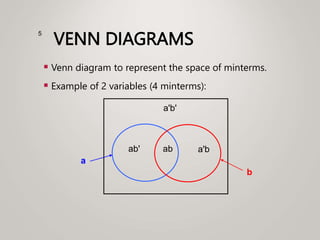
 Venn diagram to represent the space of minterms.
 Example of 2 variables (4 minterms):
5
ab' a'b
a'b'
ab
a
b
2-VARIABLE K-MAPS
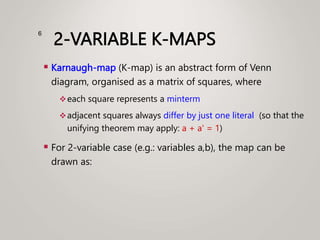
 Karnaugh-map (K-map) is an abstract form of Venn
diagram, organised as a matrix of squares, where
each square represents a minterm
adjacent squares always differ by just one literal (so that the
unifying theorem may apply: a + a' = 1)
 For 2-variable case (e.g.: variables a,b), the map can be
drawn as:
6
2-VARIABLE K-MAPS
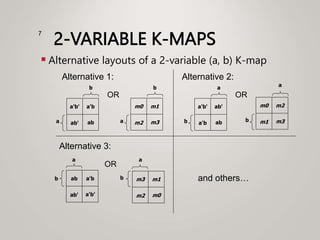
 Alternative layouts of a 2-variable (a, b) K-map
7
a'b' ab'
a'b ab
b
a
m0 m2
m1 m3
b
a
OR
Alternative 2:
a'b' a'b
ab' ab
a
b
m0 m1
m2 m3
a
b
Alternative 1:
OR
ab a'b
ab' a'b'
b
a
m3 m1
m2 m0
b
a
OR
Alternative 3:
and others…
2-VARIABLE K-MAPS
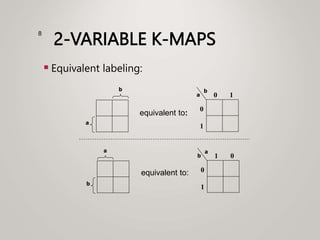
 Equivalent labeling:
8
a
b
equivalent to:
a
b
0 1
0
1
b
a
equivalent to:
b
a
1 0
0
1
2-VARIABLE K-MAPS
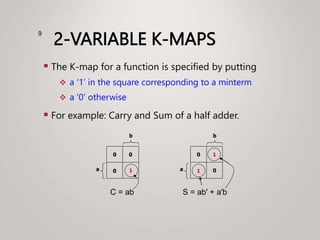
 The K-map for a function is specified by putting
 a ‘1’ in the square corresponding to a minterm
 a ‘0’ otherwise
 For example: Carry and Sum of a half adder.
9
0 0
0 1
a
b
0 1
1 0
a
b
C = ab S = ab' + a'b
3-VARIABLE K-MAPS
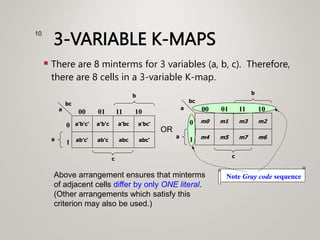
 There are 8 minterms for 3 variables (a, b, c). Therefore,
there are 8 cells in a 3-variable K-map.
10
ab'c' ab'c
a
b
abc abc'
a'b'c' a'b'c a'bc a'bc'
0
1
00 01 11 10
c
a
bc
OR
m4 m5
a
b
m7 m6
m0 m1 m3 m2
0
1
00 01 11 10
c
a
bc
Note Gray code sequence
Above arrangement ensures that minterms
of adjacent cells differ by only ONE literal.
(Other arrangements which satisfy this
criterion may also be used.)
3-VARIABLE K-MAPS
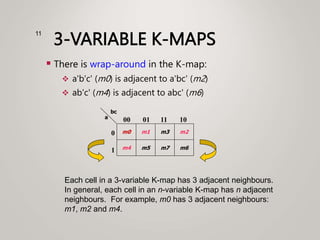
 There is wrap-around in the K-map:
 a'b'c' (m0) is adjacent to a'bc' (m2)
 ab'c' (m4) is adjacent to abc' (m6)
11
m4 m5 m7 m6
m0 m1 m3 m2
0
1
00 01 11 10
a
bc
Each cell in a 3-variable K-map has 3 adjacent neighbours.
In general, each cell in an n-variable K-map has n adjacent
neighbours. For example, m0 has 3 adjacent neighbours:
m1, m2 and m4.
SOLVE IT YOURSELF (EXERCISE
6.1)
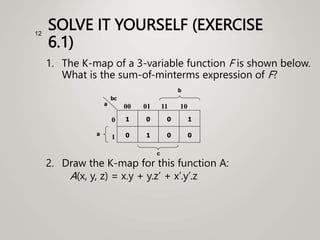
1. The K-map of a 3-variable function F is shown below.
What is the sum-of-minterms expression of F?
2. Draw the K-map for this function A:
A(x, y, z) = x.y + y.z’ + x’.y’.z
12
0 1
a
b
0 0
1 0 0 1
0
1
00 01 11 10
c
a
bc
4-VARIABLE K-MAPS
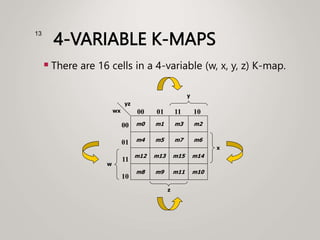
 There are 16 cells in a 4-variable (w, x, y, z) K-map.
13
m4 m5
w
y
m7 m6
m0 m1 m3 m2
00
01
11
10
00 01 11 10
z
wx
yz
m12 m13 m15 m14
m8 m9 m11 m10
x
4-VARIABLE K-MAPS
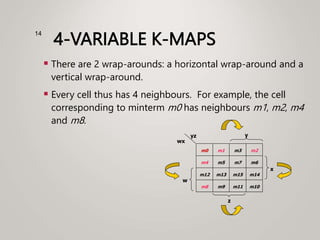
 There are 2 wrap-arounds: a horizontal wrap-around and a
vertical wrap-around.
 Every cell thus has 4 neighbours. For example, the cell
corresponding to minterm m0 has neighbours m1, m2, m4
and m8.
14
m4 m5
w
y
m7 m6
m0 m1 m3 m2
z
wx
yz
m12 m13 m15 m14
m8 m9 m11 m10
x
5-VARIABLE K-MAPS
 Maps of more than 4 variables are more difficult to
use because the geometry (hyper-cube
configurations) for combining adjacent squares
becomes more involved.
 For 5 variables, e.g. vwxyz, need 25
= 32 squares.
15
5-VARIABLE K-MAPS
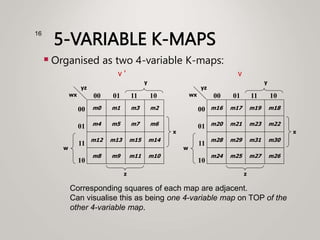
 Organised as two 4-variable K-maps:
16
Corresponding squares of each map are adjacent.
Can visualise this as being one 4-variable map on TOP of the
other 4-variable map.
m20 m21
w
y
m23 m22
m16 m17 m19 m18
00
01
11
10
00 01 11 10
z
wx
yz
m28 m29 m31 m30
m24 m25 m27 m26
x
m4 m5
w
y
m7 m6
m0 m1 m3 m2
00
01
11
10
00 01 11 10
z
wx
yz
m12 m13 m15 m14
m8 m9 m11 m10
x
v ' v
LARGER K-MAPS
 6-variable K-map is pushing the limit of human
“pattern-recognition” capability.
 K-maps larger than 6 variables are practically
unheard of!
 Normally, a 6-variable K-map is organised as four 4-
variable K-maps, which are mirrored along two axes.
17
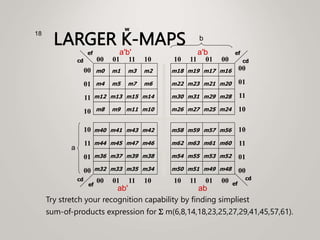
LARGER K-MAPS
Try stretch your recognition capability by finding simpliest
sum-of-products expression for S m(6,8,14,18,23,25,27,29,41,45,57,61).
18
w
a'b'
m0
00
01
11
10
00 01 11 10
cd
ef
m1 m3 m2
m4 m5 m7 m6
m12 m13 m15 m14
m8 m9 m11 m10
m40
10
11
01
00
00 01 11 10
cd
ef
m41 m43 m42
m44 m45 m47 m46
m36 m37 m39 m38
m32 m33 m35 m34
m18 00
01
11
10
10 11 01 00 cd
ef
m19 m17 m16
m22 m23 m21 m20
m30 m31 m29 m28
m26 m27 m25 m24
m58 10
11
01
00
10 11 01 00 cd
ef
m59 m57 m56
m62 m63 m61 m60
m54 m55 m53 m52
m50 m51 m49 m48
a'b
ab' ab
a
b
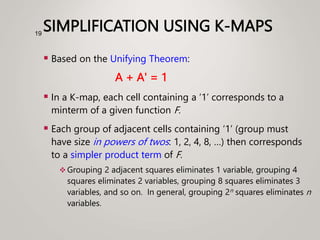
SIMPLIFICATION USING K-MAPS
 Based on the Unifying Theorem:
A + A' = 1
 In a K-map, each cell containing a ‘1’ corresponds to a
minterm of a given function F.
 Each group of adjacent cells containing ‘1’ (group must
have size in powers of twos: 1, 2, 4, 8, …) then corresponds
to a simpler product term of F.
 Grouping 2 adjacent squares eliminates 1 variable, grouping 4
squares eliminates 2 variables, grouping 8 squares eliminates 3
variables, and so on. In general, grouping 2n squares eliminates n
variables.
19
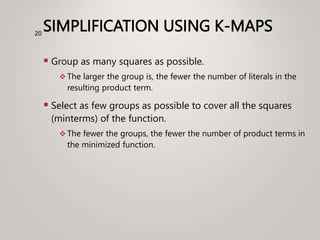
SIMPLIFICATION USING K-MAPS
 Group as many squares as possible.
 The larger the group is, the fewer the number of literals in the
resulting product term.
 Select as few groups as possible to cover all the squares
(minterms) of the function.
 The fewer the groups, the fewer the number of product terms in
the minimized function.
20
SIMPLIFICATION USING K-MAPS
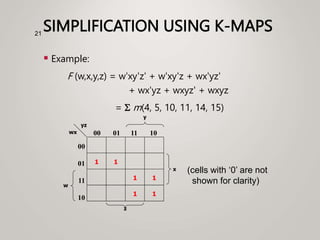
 Example:
F (w,x,y,z) = w'xy'z' + w'xy'z + wx'yz'
+ wx'yz + wxyz' + wxyz
= S m(4, 5, 10, 11, 14, 15)
21
z
1 1
w
y
00
01
11
10
00 01 11 10
wx
yz
1 1
1 1
x (cells with ‘0’ are not
shown for clarity)
SIMPLIFICATION USING K-MAPS
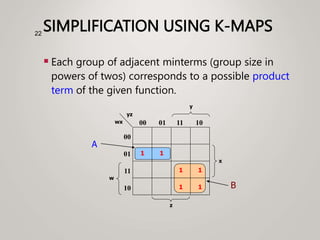
 Each group of adjacent minterms (group size in
powers of twos) corresponds to a possible product
term of the given function.
22
1 1
w
00
01
11
10
00 01 11 10
z
wx
yz
1 1
1 1
x
A
B
y
SIMPLIFICATION USING K-MAPS
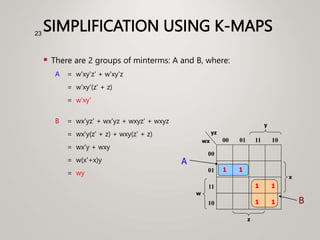
 There are 2 groups of minterms: A and B, where:
A = w'xy'z' + w'xy'z
= w'xy'(z' + z)
= w'xy'
B = wx'yz' + wx'yz + wxyz' + wxyz
= wx'y(z' + z) + wxy(z' + z)
= wx'y + wxy
= w(x'+x)y
= wy
23
1 1
w
00
01
11
10
00 01 11 10
z
wx
yz
1 1
1 1
x
A
B
y
SIMPLIFICATION USING K-MAPS
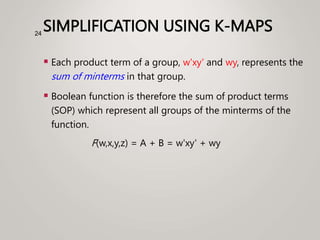
 Each product term of a group, w'xy' and wy, represents the
sum of minterms in that group.
 Boolean function is therefore the sum of product terms
(SOP) which represent all groups of the minterms of the
function.
F(w,x,y,z) = A + B = w'xy' + wy
24
SIMPLIFICATION USING K-MAPS
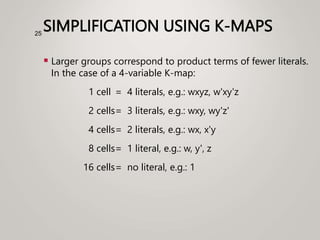
 Larger groups correspond to product terms of fewer literals.
In the case of a 4-variable K-map:
1 cell = 4 literals, e.g.: wxyz, w'xy'z
2 cells= 3 literals, e.g.: wxy, wy'z'
4 cells= 2 literals, e.g.: wx, x'y
8 cells= 1 literal, e.g.: w, y', z
16 cells= no literal, e.g.: 1
25
SIMPLIFICATION USING K-MAPS
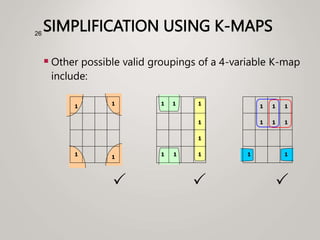
 Other possible valid groupings of a 4-variable K-map
include:
26
1
1
1
1
1
1
1
1
P
1
1
1
1 1
1
1
1
P
1
1
1
1
P
SIMPLIFICATION USING K-MAPS
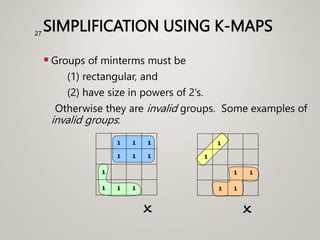
 Groups of minterms must be
(1) rectangular, and
(2) have size in powers of 2’s.
Otherwise they are invalid groups. Some examples of
invalid groups:
27
1
1
1
1 1
1
1
1
1
1
O
1
1
1
1
1
1
O
CONVERTING TO MINTERMS FORM
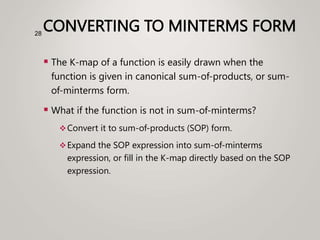
 The K-map of a function is easily drawn when the
function is given in canonical sum-of-products, or sum-
of-minterms form.
 What if the function is not in sum-of-minterms?
Convert it to sum-of-products (SOP) form.
Expand the SOP expression into sum-of-minterms
expression, or fill in the K-map directly based on the SOP
expression.
28
CONVERTING TO MINTERMS FORM
 Example:
f(A,B,C,D) = A(C+D)'(B'+D') + C(B+C'+A'D)
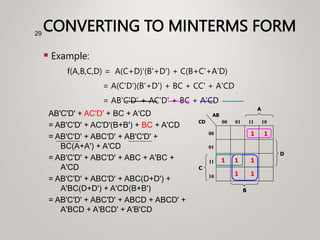
= A(C'D')(B'+D') + BC + CC' + A'CD
= AB'C'D' + AC'D' + BC + A'CD
29
1
1
C
A
00
01
11
10
00 01 11 10
B
CD
AB
D
1 1 1
1 1
AB'C'D' + AC'D' + BC + A'CD
= AB'C'D' + AC'D'(B+B') + BC + A'CD
= AB'C'D' + ABC'D' + AB'C'D' +
BC(A+A') + A'CD
= AB'C'D' + ABC'D' + ABC + A'BC +
A'CD
= AB'C'D' + ABC'D' + ABC(D+D') +
A'BC(D+D') + A'CD(B+B')
= AB'C'D' + ABC'D' + ABCD + ABCD' +
A'BCD + A'BCD' + A'B'CD
SIMPLEST SOP EXPRESSIONS
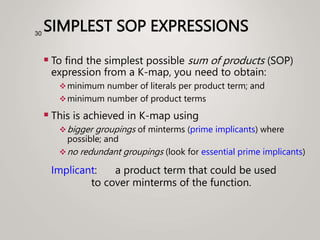
 To find the simplest possible sum of products (SOP)
expression from a K-map, you need to obtain:
minimum number of literals per product term; and
minimum number of product terms
 This is achieved in K-map using
bigger groupings of minterms (prime implicants) where
possible; and
no redundant groupings (look for essential prime implicants)
Implicant: a product term that could be used
to cover minterms of the function.
30
SIMPLEST SOP EXPRESSIONS
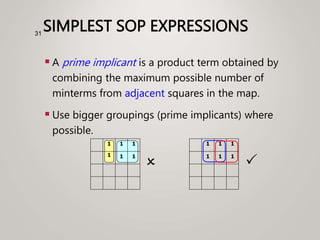
 A prime implicant is a product term obtained by
combining the maximum possible number of
minterms from adjacent squares in the map.
 Use bigger groupings (prime implicants) where
possible.
31
1
1 1
1
1
1
O
1
1 1
1
1
1
P
SIMPLEST SOP EXPRESSIONS
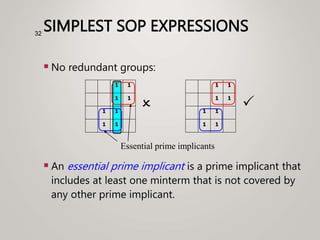
 No redundant groups:
 An essential prime implicant is a prime implicant that
includes at least one minterm that is not covered by
any other prime implicant.
32
1
1
1
1
1
1
P
1
1
1
1
1
1
1
1
O
1
1
Essential prime implicants
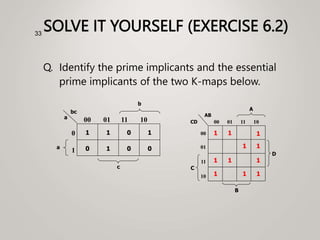
SOLVE IT YOURSELF (EXERCISE 6.2)
Q. Identify the prime implicants and the essential
prime implicants of the two K-maps below.
33
0 1
a
b
0 0
1 1 0 1
0
1
00 01 11 10
c
a
bc
1
1
C
A
00
01
11
10
00 01 11 10
B
CD
AB
D
1 1 1
1 1
1
1 1
1
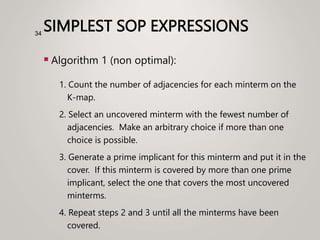
SIMPLEST SOP EXPRESSIONS
 Algorithm 1 (non optimal):
1. Count the number of adjacencies for each minterm on the
K-map.
2. Select an uncovered minterm with the fewest number of
adjacencies. Make an arbitrary choice if more than one
choice is possible.
3. Generate a prime implicant for this minterm and put it in the
cover. If this minterm is covered by more than one prime
implicant, select the one that covers the most uncovered
minterms.
4. Repeat steps 2 and 3 until all the minterms have been
covered.
34
SIMPLEST SOP EXPRESSIONS
 Algorithm 2 (non optimal):
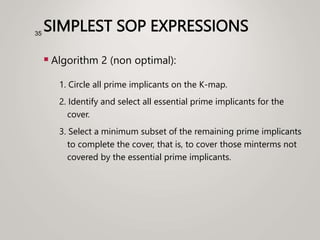
1. Circle all prime implicants on the K-map.
2. Identify and select all essential prime implicants for the
cover.
3. Select a minimum subset of the remaining prime implicants
to complete the cover, that is, to cover those minterms not
covered by the essential prime implicants.
35
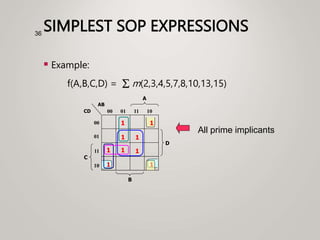
SIMPLEST SOP EXPRESSIONS
 Example:
f(A,B,C,D) =  m(2,3,4,5,7,8,10,13,15)
36
All prime implicants
1
1
C
A
00
01
11
10
00 01 11 10
B
CD
AB
1
1
1
1
D
1
1
1
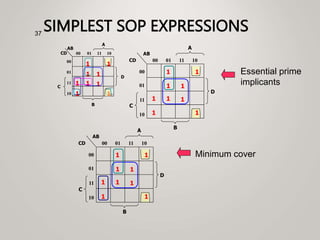
SIMPLEST SOP EXPRESSIONS
37
B
1
1
C
A
00
01
11
10
00 01 11 10
CD
AB
1
1
1
1
D
1
1
1
1
1
C
A
00
01
11
10
00 01 11 10
B
CD
AB
1
1
1
1
D
1
1
1
Essential prime
implicants
1
1
C
A
00
01
11
10
00 01 11 10
B
CD
AB
1
1
1
1
D
1
1
1
Minimum cover
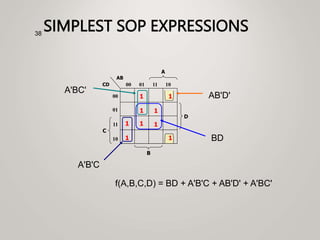
SIMPLEST SOP EXPRESSIONS
38
1
1
C
A
00
01
11
10
00 01 11 10
B
CD
AB
1
1
1
1
D
1
1
1
BD
AB'D'
A'BC'
A'B'C
f(A,B,C,D) = BD + A'B'C + AB'D' + A'BC'
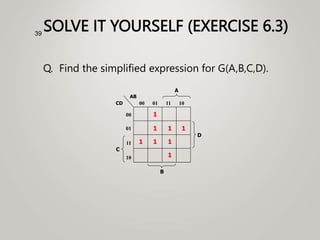
SOLVE IT YOURSELF (EXERCISE 6.3)
Q. Find the simplified expression for G(A,B,C,D).
39
1
C
A
00
01
11
10
00 01 11 10
B
CD
AB
D
1 1 1
1
1
1 1
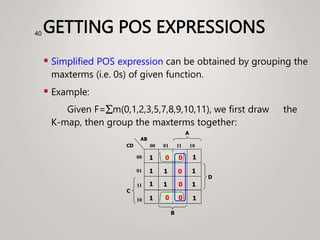
GETTING POS EXPRESSIONS
 Simplified POS expression can be obtained by grouping the
maxterms (i.e. 0s) of given function.
 Example:
Given F=m(0,1,2,3,5,7,8,9,10,11), we first draw the
K-map, then group the maxterms together:
40
1
1
C
A
00
01
11
10
00 01 11 10
B
CD
AB
1
0
1
1
D
1
1
1 1
1
0
0
0
0 0
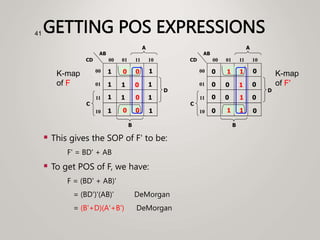
GETTING POS EXPRESSIONS
 This gives the SOP of F' to be:
F' = BD' + AB
 To get POS of F, we have:
F = (BD' + AB)'
= (BD')'(AB)' DeMorgan
= (B'+D)(A'+B') DeMorgan
41
0
0
C
A
00
01
11
10
00 01 11 10
B
CD
AB
0
1
0
0
D
0
0
0 0
0
1
1
1
1 1
1
1
C
A
00
01
11
10
00 01 11 10
B
CD
AB
1
0
1
1
D
1
1
1 1
1
0
0
0
0 0
K-map
of F
K-map
of F'
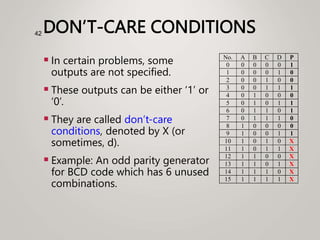
DON’T-CARE CONDITIONS
 In certain problems, some
outputs are not specified.
 These outputs can be either ‘1’ or
‘0’.
 They are called don’t-care
conditions, denoted by X (or
sometimes, d).
 Example: An odd parity generator
for BCD code which has 6 unused
combinations.
42
No. A B C D P
0 0 0 0 0 1
1 0 0 0 1 0
2 0 0 1 0 0
3 0 0 1 1 1
4 0 1 0 0 0
5 0 1 0 1 1
6 0 1 1 0 1
7 0 1 1 1 0
8 1 0 0 0 0
9 1 0 0 1 1
10 1 0 1 0 X
11 1 0 1 1 X
12 1 1 0 0 X
13 1 1 0 1 X
14 1 1 1 0 X
15 1 1 1 1 X
DON’T-CARE CONDITIONS
 Don’t-care conditions can be used to help simplify
Boolean expression further in K-maps.
 They could be chosen to be either ‘1’ or ‘0’, depending
on which gives the simpler expression.
43
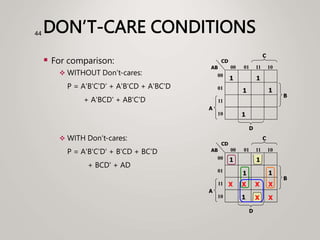
DON’T-CARE CONDITIONS
 For comparison:
 WITHOUT Don’t-cares:
P = A'B'C'D’ + A'B'CD + A'BC'D
+ A'BCD' + AB'C'D
 WITH Don’t-cares:
P = A'B'C'D' + B'CD + BC'D
+ BCD' + AD
44
1
A
C
00
01
11
10
00 01 11 10
D
AB
CD
1
B
1
1
1
1
A
C
00
01
11
10
00 01 11 10
D
AB
CD
1
B
1
1
1
X X
X
X
X
X
REVIEW – THE TECHNIQUES
 Algebraic Simplification.
requires skill but extremely open-ended.
 Karnaugh Maps.
can obtain simplified standard forms.
easy for humans (pattern-matching skills).
limited to not more than 6 variables.
 Other computer-aided techniques such as Quine-
McCluskey method
45
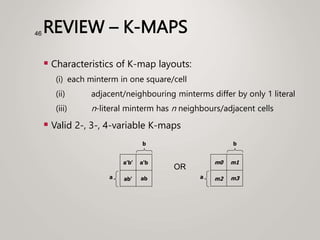
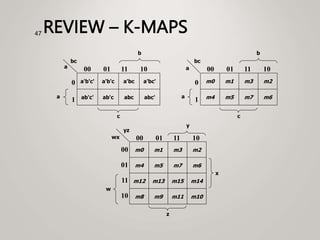
REVIEW – K-MAPS
 Characteristics of K-map layouts:
(i) each minterm in one square/cell
(ii) adjacent/neighbouring minterms differ by only 1 literal
(iii) n-literal minterm has n neighbours/adjacent cells
 Valid 2-, 3-, 4-variable K-maps
46
a'b' a'b
ab' ab
a
b
m0 m1
m2 m3
a
b
OR
REVIEW – K-MAPS
47
ab'c' ab'c
a
b
abc abc'
a'b'c' a'b'c a'bc a'bc'
0
1
00 01 11 10
c
a
bc
m4 m5
a
b
m7 m6
m0 m1 m3 m2
0
1
00 01 11 10
c
a
bc
m4 m5
w
y
m7 m6
m0 m1 m3 m2
00
01
11
10
00 01 11 10
z
wx
yz
m12 m13 m15 m14
m8 m9 m11 m10
x
REVIEW – K-MAPS
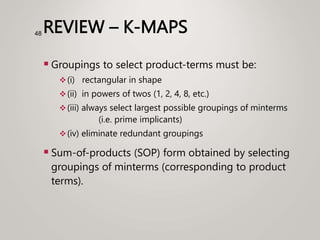
 Groupings to select product-terms must be:
(i) rectangular in shape
(ii) in powers of twos (1, 2, 4, 8, etc.)
(iii) always select largest possible groupings of minterms
(i.e. prime implicants)
(iv) eliminate redundant groupings
 Sum-of-products (SOP) form obtained by selecting
groupings of minterms (corresponding to product
terms).
48
REVIEW – K-MAPS
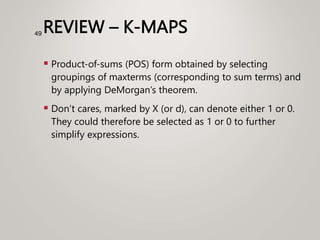
 Product-of-sums (POS) form obtained by selecting
groupings of maxterms (corresponding to sum terms) and
by applying DeMorgan’s theorem.
 Don’t cares, marked by X (or d), can denote either 1 or 0.
They could therefore be selected as 1 or 0 to further
simplify expressions.
49
EXAMPLES
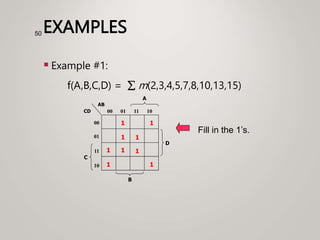
 Example #1:
f(A,B,C,D) =  m(2,3,4,5,7,8,10,13,15)
50
Fill in the 1’s.
1
1
C
A
00
01
11
10
00 01 11 10
B
CD
AB
1
1
1
1
D
1
1
1
EXAMPLES
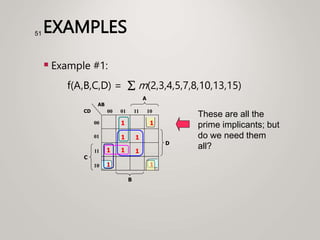
 Example #1:
f(A,B,C,D) =  m(2,3,4,5,7,8,10,13,15)
51
These are all the
prime implicants; but
do we need them
all?
1
1
C
A
00
01
11
10
00 01 11 10
B
CD
AB
1
1
1
1
D
1
1
1
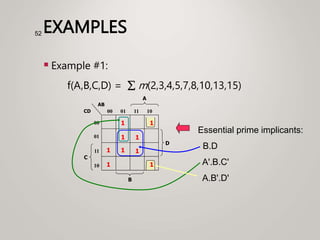
EXAMPLES
 Example #1:
f(A,B,C,D) =  m(2,3,4,5,7,8,10,13,15)
52
Essential prime implicants:
B.D
A'.B.C'
A.B'.D'
1
1
C
A
00
01
11
10
00 01 11 10
B
CD
AB
1
1
1
1
D
1
1
1
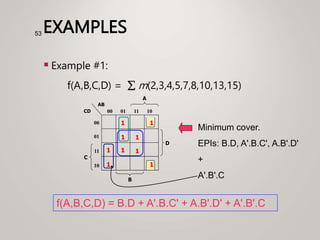
EXAMPLES
 Example #1:
f(A,B,C,D) =  m(2,3,4,5,7,8,10,13,15)
53
Minimum cover.
EPIs: B.D, A'.B.C', A.B'.D'
+
A'.B'.C
1
1
C
A
00
01
11
10
00 01 11 10
B
CD
AB
1
1
1
1
D
1
1
1
f(A,B,C,D) = B.D + A'.B.C' + A.B'.D' + A'.B'.C
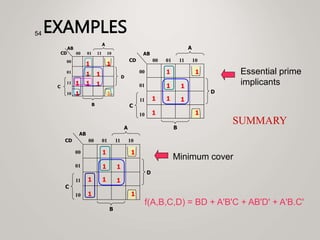
EXAMPLES
54
1
1
C
A
00
01
11
10
00 01 11 10
B
CD
AB
1
1
1
1
D
1
1
1
1
1
C
A
00
01
11
10
00 01 11 10
B
CD
AB
1
1
1
1
D
1
1
1
B
1
1
C
A
00
01
11
10
00 01 11 10
CD
AB
1
1
1
1
D
1
1
1
Essential prime
implicants
Minimum cover
SUMMARY
f(A,B,C,D) = BD + A'B'C + AB'D' + A'B.C'
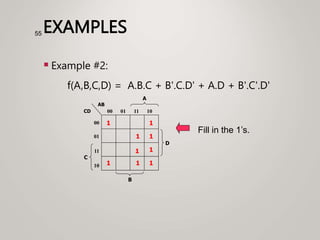
EXAMPLES
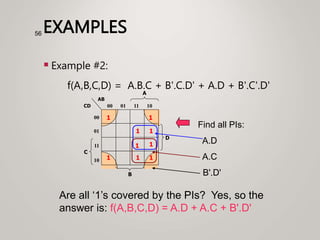
 Example #2:
f(A,B,C,D) = A.B.C + B'.C.D' + A.D + B'.C'.D'
55
Fill in the 1’s.
1
1
C
A
00
01
11
10
00 01 11 10
B
CD
AB
1
1
1
D
1
1
1
1
EXAMPLES
 Example #2:
f(A,B,C,D) = A.B.C + B'.C.D' + A.D + B'.C'.D'
56
Find all PIs:
A.D
A.C
B'.D'
1
1
C
A
00
01
11
10
00 01 11 10
B
CD
AB
1
1
1
D
1
1
1
1
Are all ‘1’s covered by the PIs? Yes, so the
answer is: f(A,B,C,D) = A.D + A.C + B'.D'
EXAMPLES
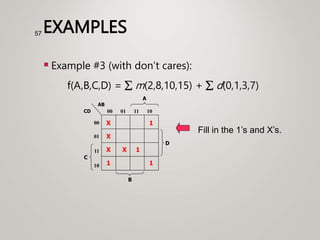
 Example #3 (with don’t cares):
f(A,B,C,D) =  m(2,8,10,15) +  d(0,1,3,7)
57
Fill in the 1’s and X’s.
1
X
C
A
00
01
11
10
00 01 11 10
B
CD
AB
X 1
X
D
1
1
X
EXAMPLES
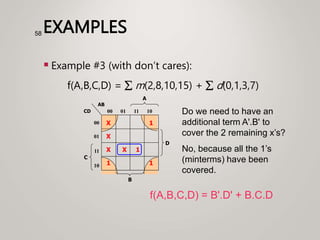
 Example #3 (with don’t cares):
f(A,B,C,D) =  m(2,8,10,15) +  d(0,1,3,7)
58
1
X
C
A
00
01
11
10
00 01 11 10
B
CD
AB
X 1
X
D
1
1
X
f(A,B,C,D) = B'.D' + B.C.D
Do we need to have an
additional term A'.B' to
cover the 2 remaining x’s?
No, because all the 1’s
(minterms) have been
covered.
EXAMPLES
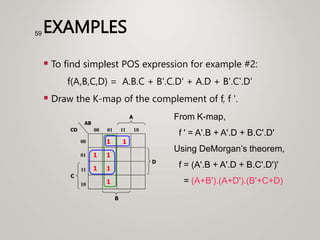
 To find simplest POS expression for example #2:
f(A,B,C,D) = A.B.C + B'.C.D' + A.D + B'.C'.D'
 Draw the K-map of the complement of f, f '.
59
1
1
C
A
00
01
11
10
00 01 11 10
B
CD
AB
1
1
D
1
1
1
From K-map,
f ' = A'.B + A'.D + B.C'.D'
Using DeMorgan’s theorem,
f = (A'.B + A'.D + B.C'.D')'
= (A+B').(A+D').(B'+C+D)
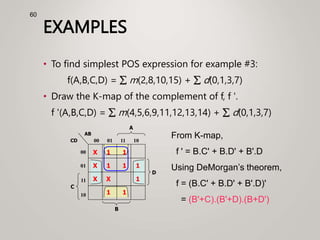
EXAMPLES
• To find simplest POS expression for example #3:
f(A,B,C,D) =  m(2,8,10,15) +  d(0,1,3,7)
• Draw the K-map of the complement of f, f '.
f '(A,B,C,D) =  m(4,5,6,9,11,12,13,14) +  d(0,1,3,7)
60
From K-map,
f ' = B.C' + B.D' + B'.D
Using DeMorgan’s theorem,
f = (B.C' + B.D' + B'.D)'
= (B'+C).(B'+D).(B+D')
1
1
C
A
00
01
11
10
00 01 11 10
B
CD
AB
1
1
D
1
1
1
X
X
X
X
1
END OF SEGMENT
61

Digital Logic design. Chapter 3, Karnaugh maps

  • 1.
  • 2.
    KARNAUGH MAPS  Introduction Venn Diagrams  2-variable K-maps  3-variable K-maps  4-variable K-maps  5-variable and larger K-maps  Simplification using K-maps 2
  • 3.
    KARNAUGH MAPS  Convertingto Minterms Form  Simplest SOP Expressions  Getting POS Expressions  Don’t-care Conditions  Review  Examples 3
  • 4.
    INTRODUCTION  Systematic methodto obtain simplified sum-of- products (SOPs) Boolean expressions.  Objective: Fewest possible terms/literals.  Diagrammatic technique based on a special form of Venn diagram.  Advantage: Easy with visual aid.  Disadvantage: Limited to 5 or 6 variables. 4
  • 5.
    VENN DIAGRAMS  Venndiagram to represent the space of minterms.  Example of 2 variables (4 minterms): 5 ab' a'b a'b' ab a b
  • 6.
    2-VARIABLE K-MAPS  Karnaugh-map(K-map) is an abstract form of Venn diagram, organised as a matrix of squares, where each square represents a minterm adjacent squares always differ by just one literal (so that the unifying theorem may apply: a + a' = 1)  For 2-variable case (e.g.: variables a,b), the map can be drawn as: 6
  • 7.
    2-VARIABLE K-MAPS  Alternativelayouts of a 2-variable (a, b) K-map 7 a'b' ab' a'b ab b a m0 m2 m1 m3 b a OR Alternative 2: a'b' a'b ab' ab a b m0 m1 m2 m3 a b Alternative 1: OR ab a'b ab' a'b' b a m3 m1 m2 m0 b a OR Alternative 3: and others…
  • 8.
    2-VARIABLE K-MAPS  Equivalentlabeling: 8 a b equivalent to: a b 0 1 0 1 b a equivalent to: b a 1 0 0 1
  • 9.
    2-VARIABLE K-MAPS  TheK-map for a function is specified by putting  a ‘1’ in the square corresponding to a minterm  a ‘0’ otherwise  For example: Carry and Sum of a half adder. 9 0 0 0 1 a b 0 1 1 0 a b C = ab S = ab' + a'b
  • 10.
    3-VARIABLE K-MAPS  Thereare 8 minterms for 3 variables (a, b, c). Therefore, there are 8 cells in a 3-variable K-map. 10 ab'c' ab'c a b abc abc' a'b'c' a'b'c a'bc a'bc' 0 1 00 01 11 10 c a bc OR m4 m5 a b m7 m6 m0 m1 m3 m2 0 1 00 01 11 10 c a bc Note Gray code sequence Above arrangement ensures that minterms of adjacent cells differ by only ONE literal. (Other arrangements which satisfy this criterion may also be used.)
  • 11.
    3-VARIABLE K-MAPS  Thereis wrap-around in the K-map:  a'b'c' (m0) is adjacent to a'bc' (m2)  ab'c' (m4) is adjacent to abc' (m6) 11 m4 m5 m7 m6 m0 m1 m3 m2 0 1 00 01 11 10 a bc Each cell in a 3-variable K-map has 3 adjacent neighbours. In general, each cell in an n-variable K-map has n adjacent neighbours. For example, m0 has 3 adjacent neighbours: m1, m2 and m4.
  • 12.
    SOLVE IT YOURSELF(EXERCISE 6.1) 1. The K-map of a 3-variable function F is shown below. What is the sum-of-minterms expression of F? 2. Draw the K-map for this function A: A(x, y, z) = x.y + y.z’ + x’.y’.z 12 0 1 a b 0 0 1 0 0 1 0 1 00 01 11 10 c a bc
  • 13.
    4-VARIABLE K-MAPS  Thereare 16 cells in a 4-variable (w, x, y, z) K-map. 13 m4 m5 w y m7 m6 m0 m1 m3 m2 00 01 11 10 00 01 11 10 z wx yz m12 m13 m15 m14 m8 m9 m11 m10 x
  • 14.
    4-VARIABLE K-MAPS  Thereare 2 wrap-arounds: a horizontal wrap-around and a vertical wrap-around.  Every cell thus has 4 neighbours. For example, the cell corresponding to minterm m0 has neighbours m1, m2, m4 and m8. 14 m4 m5 w y m7 m6 m0 m1 m3 m2 z wx yz m12 m13 m15 m14 m8 m9 m11 m10 x
  • 15.
    5-VARIABLE K-MAPS  Mapsof more than 4 variables are more difficult to use because the geometry (hyper-cube configurations) for combining adjacent squares becomes more involved.  For 5 variables, e.g. vwxyz, need 25 = 32 squares. 15
  • 16.
    5-VARIABLE K-MAPS  Organisedas two 4-variable K-maps: 16 Corresponding squares of each map are adjacent. Can visualise this as being one 4-variable map on TOP of the other 4-variable map. m20 m21 w y m23 m22 m16 m17 m19 m18 00 01 11 10 00 01 11 10 z wx yz m28 m29 m31 m30 m24 m25 m27 m26 x m4 m5 w y m7 m6 m0 m1 m3 m2 00 01 11 10 00 01 11 10 z wx yz m12 m13 m15 m14 m8 m9 m11 m10 x v ' v
  • 17.
    LARGER K-MAPS  6-variableK-map is pushing the limit of human “pattern-recognition” capability.  K-maps larger than 6 variables are practically unheard of!  Normally, a 6-variable K-map is organised as four 4- variable K-maps, which are mirrored along two axes. 17
  • 18.
    LARGER K-MAPS Try stretchyour recognition capability by finding simpliest sum-of-products expression for S m(6,8,14,18,23,25,27,29,41,45,57,61). 18 w a'b' m0 00 01 11 10 00 01 11 10 cd ef m1 m3 m2 m4 m5 m7 m6 m12 m13 m15 m14 m8 m9 m11 m10 m40 10 11 01 00 00 01 11 10 cd ef m41 m43 m42 m44 m45 m47 m46 m36 m37 m39 m38 m32 m33 m35 m34 m18 00 01 11 10 10 11 01 00 cd ef m19 m17 m16 m22 m23 m21 m20 m30 m31 m29 m28 m26 m27 m25 m24 m58 10 11 01 00 10 11 01 00 cd ef m59 m57 m56 m62 m63 m61 m60 m54 m55 m53 m52 m50 m51 m49 m48 a'b ab' ab a b
  • 19.
    SIMPLIFICATION USING K-MAPS Based on the Unifying Theorem: A + A' = 1  In a K-map, each cell containing a ‘1’ corresponds to a minterm of a given function F.  Each group of adjacent cells containing ‘1’ (group must have size in powers of twos: 1, 2, 4, 8, …) then corresponds to a simpler product term of F.  Grouping 2 adjacent squares eliminates 1 variable, grouping 4 squares eliminates 2 variables, grouping 8 squares eliminates 3 variables, and so on. In general, grouping 2n squares eliminates n variables. 19
  • 20.
    SIMPLIFICATION USING K-MAPS Group as many squares as possible.  The larger the group is, the fewer the number of literals in the resulting product term.  Select as few groups as possible to cover all the squares (minterms) of the function.  The fewer the groups, the fewer the number of product terms in the minimized function. 20
  • 21.
    SIMPLIFICATION USING K-MAPS Example: F (w,x,y,z) = w'xy'z' + w'xy'z + wx'yz' + wx'yz + wxyz' + wxyz = S m(4, 5, 10, 11, 14, 15) 21 z 1 1 w y 00 01 11 10 00 01 11 10 wx yz 1 1 1 1 x (cells with ‘0’ are not shown for clarity)
  • 22.
    SIMPLIFICATION USING K-MAPS Each group of adjacent minterms (group size in powers of twos) corresponds to a possible product term of the given function. 22 1 1 w 00 01 11 10 00 01 11 10 z wx yz 1 1 1 1 x A B y
  • 23.
    SIMPLIFICATION USING K-MAPS There are 2 groups of minterms: A and B, where: A = w'xy'z' + w'xy'z = w'xy'(z' + z) = w'xy' B = wx'yz' + wx'yz + wxyz' + wxyz = wx'y(z' + z) + wxy(z' + z) = wx'y + wxy = w(x'+x)y = wy 23 1 1 w 00 01 11 10 00 01 11 10 z wx yz 1 1 1 1 x A B y
  • 24.
    SIMPLIFICATION USING K-MAPS Each product term of a group, w'xy' and wy, represents the sum of minterms in that group.  Boolean function is therefore the sum of product terms (SOP) which represent all groups of the minterms of the function. F(w,x,y,z) = A + B = w'xy' + wy 24
  • 25.
    SIMPLIFICATION USING K-MAPS Larger groups correspond to product terms of fewer literals. In the case of a 4-variable K-map: 1 cell = 4 literals, e.g.: wxyz, w'xy'z 2 cells= 3 literals, e.g.: wxy, wy'z' 4 cells= 2 literals, e.g.: wx, x'y 8 cells= 1 literal, e.g.: w, y', z 16 cells= no literal, e.g.: 1 25
  • 26.
    SIMPLIFICATION USING K-MAPS Other possible valid groupings of a 4-variable K-map include: 26 1 1 1 1 1 1 1 1 P 1 1 1 1 1 1 1 1 P 1 1 1 1 P
  • 27.
    SIMPLIFICATION USING K-MAPS Groups of minterms must be (1) rectangular, and (2) have size in powers of 2’s. Otherwise they are invalid groups. Some examples of invalid groups: 27 1 1 1 1 1 1 1 1 1 1 O 1 1 1 1 1 1 O
  • 28.
    CONVERTING TO MINTERMSFORM  The K-map of a function is easily drawn when the function is given in canonical sum-of-products, or sum- of-minterms form.  What if the function is not in sum-of-minterms? Convert it to sum-of-products (SOP) form. Expand the SOP expression into sum-of-minterms expression, or fill in the K-map directly based on the SOP expression. 28
  • 29.
    CONVERTING TO MINTERMSFORM  Example: f(A,B,C,D) = A(C+D)'(B'+D') + C(B+C'+A'D) = A(C'D')(B'+D') + BC + CC' + A'CD = AB'C'D' + AC'D' + BC + A'CD 29 1 1 C A 00 01 11 10 00 01 11 10 B CD AB D 1 1 1 1 1 AB'C'D' + AC'D' + BC + A'CD = AB'C'D' + AC'D'(B+B') + BC + A'CD = AB'C'D' + ABC'D' + AB'C'D' + BC(A+A') + A'CD = AB'C'D' + ABC'D' + ABC + A'BC + A'CD = AB'C'D' + ABC'D' + ABC(D+D') + A'BC(D+D') + A'CD(B+B') = AB'C'D' + ABC'D' + ABCD + ABCD' + A'BCD + A'BCD' + A'B'CD
  • 30.
    SIMPLEST SOP EXPRESSIONS To find the simplest possible sum of products (SOP) expression from a K-map, you need to obtain: minimum number of literals per product term; and minimum number of product terms  This is achieved in K-map using bigger groupings of minterms (prime implicants) where possible; and no redundant groupings (look for essential prime implicants) Implicant: a product term that could be used to cover minterms of the function. 30
  • 31.
    SIMPLEST SOP EXPRESSIONS A prime implicant is a product term obtained by combining the maximum possible number of minterms from adjacent squares in the map.  Use bigger groupings (prime implicants) where possible. 31 1 1 1 1 1 1 O 1 1 1 1 1 1 P
  • 32.
    SIMPLEST SOP EXPRESSIONS No redundant groups:  An essential prime implicant is a prime implicant that includes at least one minterm that is not covered by any other prime implicant. 32 1 1 1 1 1 1 P 1 1 1 1 1 1 1 1 O 1 1 Essential prime implicants
  • 33.
    SOLVE IT YOURSELF(EXERCISE 6.2) Q. Identify the prime implicants and the essential prime implicants of the two K-maps below. 33 0 1 a b 0 0 1 1 0 1 0 1 00 01 11 10 c a bc 1 1 C A 00 01 11 10 00 01 11 10 B CD AB D 1 1 1 1 1 1 1 1 1
  • 34.
    SIMPLEST SOP EXPRESSIONS Algorithm 1 (non optimal): 1. Count the number of adjacencies for each minterm on the K-map. 2. Select an uncovered minterm with the fewest number of adjacencies. Make an arbitrary choice if more than one choice is possible. 3. Generate a prime implicant for this minterm and put it in the cover. If this minterm is covered by more than one prime implicant, select the one that covers the most uncovered minterms. 4. Repeat steps 2 and 3 until all the minterms have been covered. 34
  • 35.
    SIMPLEST SOP EXPRESSIONS Algorithm 2 (non optimal): 1. Circle all prime implicants on the K-map. 2. Identify and select all essential prime implicants for the cover. 3. Select a minimum subset of the remaining prime implicants to complete the cover, that is, to cover those minterms not covered by the essential prime implicants. 35
  • 36.
    SIMPLEST SOP EXPRESSIONS Example: f(A,B,C,D) =  m(2,3,4,5,7,8,10,13,15) 36 All prime implicants 1 1 C A 00 01 11 10 00 01 11 10 B CD AB 1 1 1 1 D 1 1 1
  • 37.
    SIMPLEST SOP EXPRESSIONS 37 B 1 1 C A 00 01 11 10 0001 11 10 CD AB 1 1 1 1 D 1 1 1 1 1 C A 00 01 11 10 00 01 11 10 B CD AB 1 1 1 1 D 1 1 1 Essential prime implicants 1 1 C A 00 01 11 10 00 01 11 10 B CD AB 1 1 1 1 D 1 1 1 Minimum cover
  • 38.
    SIMPLEST SOP EXPRESSIONS 38 1 1 C A 00 01 11 10 0001 11 10 B CD AB 1 1 1 1 D 1 1 1 BD AB'D' A'BC' A'B'C f(A,B,C,D) = BD + A'B'C + AB'D' + A'BC'
  • 39.
    SOLVE IT YOURSELF(EXERCISE 6.3) Q. Find the simplified expression for G(A,B,C,D). 39 1 C A 00 01 11 10 00 01 11 10 B CD AB D 1 1 1 1 1 1 1
  • 40.
    GETTING POS EXPRESSIONS Simplified POS expression can be obtained by grouping the maxterms (i.e. 0s) of given function.  Example: Given F=m(0,1,2,3,5,7,8,9,10,11), we first draw the K-map, then group the maxterms together: 40 1 1 C A 00 01 11 10 00 01 11 10 B CD AB 1 0 1 1 D 1 1 1 1 1 0 0 0 0 0
  • 41.
    GETTING POS EXPRESSIONS This gives the SOP of F' to be: F' = BD' + AB  To get POS of F, we have: F = (BD' + AB)' = (BD')'(AB)' DeMorgan = (B'+D)(A'+B') DeMorgan 41 0 0 C A 00 01 11 10 00 01 11 10 B CD AB 0 1 0 0 D 0 0 0 0 0 1 1 1 1 1 1 1 C A 00 01 11 10 00 01 11 10 B CD AB 1 0 1 1 D 1 1 1 1 1 0 0 0 0 0 K-map of F K-map of F'
  • 42.
    DON’T-CARE CONDITIONS  Incertain problems, some outputs are not specified.  These outputs can be either ‘1’ or ‘0’.  They are called don’t-care conditions, denoted by X (or sometimes, d).  Example: An odd parity generator for BCD code which has 6 unused combinations. 42 No. A B C D P 0 0 0 0 0 1 1 0 0 0 1 0 2 0 0 1 0 0 3 0 0 1 1 1 4 0 1 0 0 0 5 0 1 0 1 1 6 0 1 1 0 1 7 0 1 1 1 0 8 1 0 0 0 0 9 1 0 0 1 1 10 1 0 1 0 X 11 1 0 1 1 X 12 1 1 0 0 X 13 1 1 0 1 X 14 1 1 1 0 X 15 1 1 1 1 X
  • 43.
    DON’T-CARE CONDITIONS  Don’t-careconditions can be used to help simplify Boolean expression further in K-maps.  They could be chosen to be either ‘1’ or ‘0’, depending on which gives the simpler expression. 43
  • 44.
    DON’T-CARE CONDITIONS  Forcomparison:  WITHOUT Don’t-cares: P = A'B'C'D’ + A'B'CD + A'BC'D + A'BCD' + AB'C'D  WITH Don’t-cares: P = A'B'C'D' + B'CD + BC'D + BCD' + AD 44 1 A C 00 01 11 10 00 01 11 10 D AB CD 1 B 1 1 1 1 A C 00 01 11 10 00 01 11 10 D AB CD 1 B 1 1 1 X X X X X X
  • 45.
    REVIEW – THETECHNIQUES  Algebraic Simplification. requires skill but extremely open-ended.  Karnaugh Maps. can obtain simplified standard forms. easy for humans (pattern-matching skills). limited to not more than 6 variables.  Other computer-aided techniques such as Quine- McCluskey method 45
  • 46.
    REVIEW – K-MAPS Characteristics of K-map layouts: (i) each minterm in one square/cell (ii) adjacent/neighbouring minterms differ by only 1 literal (iii) n-literal minterm has n neighbours/adjacent cells  Valid 2-, 3-, 4-variable K-maps 46 a'b' a'b ab' ab a b m0 m1 m2 m3 a b OR
  • 47.
    REVIEW – K-MAPS 47 ab'c'ab'c a b abc abc' a'b'c' a'b'c a'bc a'bc' 0 1 00 01 11 10 c a bc m4 m5 a b m7 m6 m0 m1 m3 m2 0 1 00 01 11 10 c a bc m4 m5 w y m7 m6 m0 m1 m3 m2 00 01 11 10 00 01 11 10 z wx yz m12 m13 m15 m14 m8 m9 m11 m10 x
  • 48.
    REVIEW – K-MAPS Groupings to select product-terms must be: (i) rectangular in shape (ii) in powers of twos (1, 2, 4, 8, etc.) (iii) always select largest possible groupings of minterms (i.e. prime implicants) (iv) eliminate redundant groupings  Sum-of-products (SOP) form obtained by selecting groupings of minterms (corresponding to product terms). 48
  • 49.
    REVIEW – K-MAPS Product-of-sums (POS) form obtained by selecting groupings of maxterms (corresponding to sum terms) and by applying DeMorgan’s theorem.  Don’t cares, marked by X (or d), can denote either 1 or 0. They could therefore be selected as 1 or 0 to further simplify expressions. 49
  • 50.
    EXAMPLES  Example #1: f(A,B,C,D)=  m(2,3,4,5,7,8,10,13,15) 50 Fill in the 1’s. 1 1 C A 00 01 11 10 00 01 11 10 B CD AB 1 1 1 1 D 1 1 1
  • 51.
    EXAMPLES  Example #1: f(A,B,C,D)=  m(2,3,4,5,7,8,10,13,15) 51 These are all the prime implicants; but do we need them all? 1 1 C A 00 01 11 10 00 01 11 10 B CD AB 1 1 1 1 D 1 1 1
  • 52.
    EXAMPLES  Example #1: f(A,B,C,D)=  m(2,3,4,5,7,8,10,13,15) 52 Essential prime implicants: B.D A'.B.C' A.B'.D' 1 1 C A 00 01 11 10 00 01 11 10 B CD AB 1 1 1 1 D 1 1 1
  • 53.
    EXAMPLES  Example #1: f(A,B,C,D)=  m(2,3,4,5,7,8,10,13,15) 53 Minimum cover. EPIs: B.D, A'.B.C', A.B'.D' + A'.B'.C 1 1 C A 00 01 11 10 00 01 11 10 B CD AB 1 1 1 1 D 1 1 1 f(A,B,C,D) = B.D + A'.B.C' + A.B'.D' + A'.B'.C
  • 54.
    EXAMPLES 54 1 1 C A 00 01 11 10 00 01 1110 B CD AB 1 1 1 1 D 1 1 1 1 1 C A 00 01 11 10 00 01 11 10 B CD AB 1 1 1 1 D 1 1 1 B 1 1 C A 00 01 11 10 00 01 11 10 CD AB 1 1 1 1 D 1 1 1 Essential prime implicants Minimum cover SUMMARY f(A,B,C,D) = BD + A'B'C + AB'D' + A'B.C'
  • 55.
    EXAMPLES  Example #2: f(A,B,C,D)= A.B.C + B'.C.D' + A.D + B'.C'.D' 55 Fill in the 1’s. 1 1 C A 00 01 11 10 00 01 11 10 B CD AB 1 1 1 D 1 1 1 1
  • 56.
    EXAMPLES  Example #2: f(A,B,C,D)= A.B.C + B'.C.D' + A.D + B'.C'.D' 56 Find all PIs: A.D A.C B'.D' 1 1 C A 00 01 11 10 00 01 11 10 B CD AB 1 1 1 D 1 1 1 1 Are all ‘1’s covered by the PIs? Yes, so the answer is: f(A,B,C,D) = A.D + A.C + B'.D'
  • 57.
    EXAMPLES  Example #3(with don’t cares): f(A,B,C,D) =  m(2,8,10,15) +  d(0,1,3,7) 57 Fill in the 1’s and X’s. 1 X C A 00 01 11 10 00 01 11 10 B CD AB X 1 X D 1 1 X
  • 58.
    EXAMPLES  Example #3(with don’t cares): f(A,B,C,D) =  m(2,8,10,15) +  d(0,1,3,7) 58 1 X C A 00 01 11 10 00 01 11 10 B CD AB X 1 X D 1 1 X f(A,B,C,D) = B'.D' + B.C.D Do we need to have an additional term A'.B' to cover the 2 remaining x’s? No, because all the 1’s (minterms) have been covered.
  • 59.
    EXAMPLES  To findsimplest POS expression for example #2: f(A,B,C,D) = A.B.C + B'.C.D' + A.D + B'.C'.D'  Draw the K-map of the complement of f, f '. 59 1 1 C A 00 01 11 10 00 01 11 10 B CD AB 1 1 D 1 1 1 From K-map, f ' = A'.B + A'.D + B.C'.D' Using DeMorgan’s theorem, f = (A'.B + A'.D + B.C'.D')' = (A+B').(A+D').(B'+C+D)
  • 60.
    EXAMPLES • To findsimplest POS expression for example #3: f(A,B,C,D) =  m(2,8,10,15) +  d(0,1,3,7) • Draw the K-map of the complement of f, f '. f '(A,B,C,D) =  m(4,5,6,9,11,12,13,14) +  d(0,1,3,7) 60 From K-map, f ' = B.C' + B.D' + B'.D Using DeMorgan’s theorem, f = (B.C' + B.D' + B'.D)' = (B'+C).(B'+D).(B+D') 1 1 C A 00 01 11 10 00 01 11 10 B CD AB 1 1 D 1 1 1 X X X X 1
  • 61.