3
Introduction
Since the beginningof the teaching and
learning process, teachers have been
looking for ways to determine how much
learners have learned from their teachings.
This is the main purpose of assessment, at
least the common connotation of what
assessment does for teaching and learning.
4.
4
THINK: Assessment inLearning
English
Assessment is conducted to determine
whether the learners know, understand, and
are able to perform knowledge and
competencies required of them.
Assessment could be viewed in three
lenses:
•Assessment for learning- This is a type of
assessment that determines the learners'
5.
5
• Assessment aslearning - This type of
assessment is a more learner-centered
approach. This lets the learner reflect on
the results of his/her progress and plans
the next steps to improve performance.
• Assessment of learning -This is the
more traditional view of learning as it
measures the learners' attainment of the
learning objectives or goals of the lesson
or of the standards.
6.
6
•Assessment of learning-This is the more
traditional view of learning as it measures
the learners' attainment of the learning
objectives or goals of the lesson or of the
standards.
7.
7
What is assessed?
Theteacher in the classroom would focus
more on the following areas to assess under
the K to 12 Curriculum:
•Content Standards - These are the
essential understandings that the learners
should learn. It basically answers the
question "What should the learners
know?", as stipulated in the K to 12
Curriculum.
8.
8
• Performance Standards- These are the
abilities and skills that learners must be
able to demonstrate in relation to the
content.
• Learning Competencies -These are
knowledge, skills, and attitudes that
learners have to demonstrate in every
lesson or activity.
• Concept Development- This is a
measure of how the learners are able to
progress in the attainment of the
9.
9
How are learnersassessed?
Learners' progress is not only based on
the tests given to them, but also on the
learning that takes place within the
classroom and in different settings outside of
the classroom setting. The main purpose
here is to gather evidence of the learners'
learning through the daily activities the
teacher provides by the things that they say,
write, and do.
10.
10
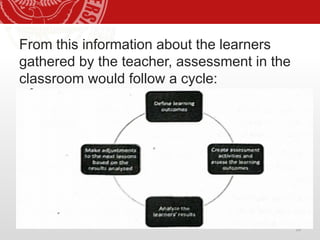
From this informationabout the learners
gathered by the teacher, assessment in the
classroom would follow a cycle:
11.
11
Defined learning outcomesdetermine
which standards or competencies will be
assessed. Then, the teacher creates
assessment activities to measure the
defined outcomes and given these activities
to the learners, the teacher then collects
and analyzes these results, and uses
them to adjust the next lessons, provide
more activities, or move on to the next one.
12.
12
Summative Assessment
(Assessment ofLearning)
•The purpose of summative assessment in
the traditional sense is to evaluate learner
performance usually at the end of the
quarter, term, or year.
•Summative assessments are usually the
basis for grades of learners or teachers.
13.
13
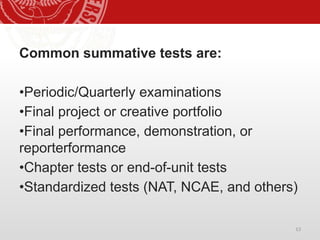
Common summative testsare:
•Periodic/Quarterly examinations
•Final project or creative portfolio
•Final performance, demonstration, or
reporterformance
•Chapter tests or end-of-unit tests
•Standardized tests (NAT, NCAE, and others)
14.
14
LESSON 14: FormativeAssessment
Objectives
In this lesson you will be able to:
•differentiate formative assessment from
summative tests;
•apply formative assessment strategies in
formulating instructional plans; and
•develop an instructional plan using
formative assessment strategies.
15.
15
Introduction
In this lesson,we are going to look into
formative assessment and its importance in
the ensuring that learning objectives are
instilled to the learners.
16.
16
THINK: Formative Assessment
•Unlike summative assessment where the
objective is to evaluate student
performance to be graded, and which is
normally formal, formative assessments
are designed around the aim to determine
what the learners know as they are in the
process of learning.
17.
17
• It isused mainly to gather information about
learner performance, and use that to make
informed decision on future instruction.
• In a way, formative assessment does not refer
to the assessment itself, but rather to the
function that evidence from the assessment
serves.
• It can also be called informative assessment
as it provides information to the teacher on the
performance of the learners as they go
through the learning experience.
18.
18
• For effectiveimplementation of formative
assessment in the classroom, it has to be
planned and be strategic.
• As they are usually not graded, formative
assessment strategies are mainly used to
guide instruction.
19.
19
A formative assessmentsystem to be used
in the classroom tries to answer the
following questions:
Where am I going?
• Learners must be able to know what the
learning objectives are or what the general
goal of the lesson is to give them an idea
of what is expected of them in the lesson
or unit.
20.
20
• The learningobjectives must describe the
knowledge, skills, and understandings that
the learners will learn and aim for in the
lesson.
• They could be worded in the view of the
learner for them to a have a sense of
ownership of it.
21.
21
Example of theseobjectives could be:
•I can identify a sequence of events
(beginning, middle, and end) in a story.
•I can draw and write sentences about these
actions using signal words to indicate the
sequence.
22.
22
Where am Inow?
•This should be able to give the learners an
idea where they are in reaching the learning
objective and they should be given regular
checks on progress on their way.
•These checks need not be formal nor
should be left at the end of the unit, lesson,
or year.
23.
23
• Though commonpen and paper quizzes
are useful in checking the understanding
of the learners, the teacher could be more
creative in implementing more formative
assessment strategies.
24.
24
Some of thesecould include:
•Oral recitation
•Questioning
•Project outputs
•Surveys
•Raising hands or thumbs
•Writing activities
25.
25
• Writing couldbe an excellent formative
assessment strategy because of the very
nature of the activity as a complex cognitive
process. It helps provide an idea on how
the learners think.
• As important as gathering information to the
learners' progress is providing them with
feedback to let them determine how they
are faring.
26.
26
Feedback must havethe following
traits in order to be effective:
• Goal-referenced- The feedback must be
able to tell the learner if they are on the
right track in attaining the learning
objective or not.
• Tangible - The feedback should help the
learners learn from it and relate it to the
learning objective.
27.
27
• Actionable- Thefeedback must be
concrete, specific, and useful in the sense
that the learners can tell what to do next to
improve performance.
• User-friendly - The feedback must be
worded in a language the learners can
understand. Making it too complicated or
technical cannot yield actionable
response.
• Timely - The feedback should be provided
at the right timing to give the learner
28.
28
Examples of goodfeedback to learners
could include:
•You have used precise language in this
paper. I saw the scenes from my mind's eye.
•I got confused by your paper. You have a
weak thesis and you have failed to provide
concrete pieces of evidence in the
succeeding paragraphs.
29.
29
What can Ido to get where I need
to go?
• Teachers provide the learners with a plan
and activities to help them attain the
learning objectives.
• Using the data from the formative
assessment given to the learners, the
teachers can now use them to plan, to
improve instruction or make tweaks in
his/her strategies, and to help learners
improve.
30.
30
LESSON 15: Traditionaland
Authentic Assessment
Objectives
In this lesson you will be able to:
•differentiate traditional assessment and
authentic assessment;
•give examples of each type of assessment;
and
•develop one own authentic assessment
based on a lesson.
31.
31
Introduction
• In thislesson we are going to explore
other forms of assessment that are
commonly used especially the one used
for performance tasks.
32.
32
THINK: Traditional andAuthentic
Assessments
• Traditional assessment, as the name
suggests, are conventional methods of
testing the understanding of the learners.
It usually produces a written document
such as quizzes, exams, or papers.
• It also includes standardized tests,
achievement tests, or final examinations.
These tests are popular especially
because of their ease of use, as they
33.
33
• However, thesetypes of tests tend to emphasize
memorization of concepts over development of
complex skills.
• This is where authentic assessments gained
popularity in recent years. Also called "alternative
assessments," authentic assessments use
activities that help show what learners can do,
especially with the learnings they have gained in
the lessons. In authentic assessment, learners get
to take more responsibility for their learning.
34.
34
Creating Authentic Assessments
•Identify standards/objectives - These
are statements of what the learners should
know and be able to do. These should be
worded in such a way that it is narrow
enough to be clear and attainable within a
specific time.
35.
35
• Select anauthentic task - The teacher
finds a task that can demonstrate their
understanding of the lesson to meet the
standard or objective. Again, the task
should reflect real-world contexts, and
they should be worded in such a way that
is clear for the learners to understand and
attain.
36.
36
• Identify thecriteria for the task-The criteria will
help the learners determine the level of
competence needed in order for them to
determine how good they are performing in the
task.
A good criterion must be:
• clearly stated;
• brief;
• observable; and
• written in the language the learners can
understand.
37.
37
Example: Grade 4Writing Performance
Task
Objective: The learners will be able to write
a friendly letter using the correct letter
format.
Task: Write a friendly letter using the basic
letter format.
Criteria: Uses the basic parts of a friendly
letter. Applies correct grammar rules.
Presentation must be neat and clear.
Content must demonstrate courtesy and
38.
38
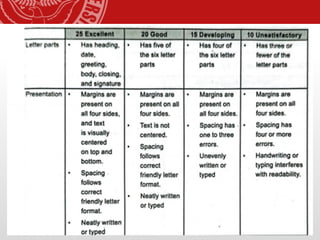
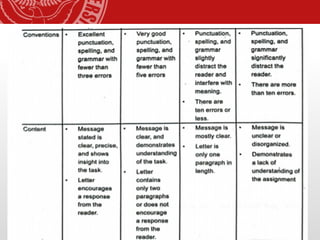
•Create the rubricfor scoring - Using the
identified criteria, the teacher then creates a
scoring rubric to help the learners rate their
own performance in the task.