Chapter 3

                           RESEARCH METHODOLOGY


       This chapter presents the research design, research procedure, the subject of the

study, determination of sample, research instrument and statistical treatment of data.


Research Design

       This study determined the factors affecting mathematics performance of

Laboratory High School Students at Laguna State Polytechnic University. The

descriptive – correlation method was used in this study.


       In descriptive method, Calmorin(1994) as cited by Bagayana (2006), wrote the

study focuses on the present condition. The purpose is to find new truth, which may come

in different forms such as increased quantity of knowledge, a new generalization, or

increased insights into factors, which are operating, the discovery of a new causal

relationship, a more accurate formulation of the problem to be solved and many others.


       Since this study measured data that already exists and the number of respondents

is not large, the descriptive – correlation method of studies is best suited. As mentioned,

the student-related factors in terms of interest and study habits, and the teacher-related

factors in terms of personality traits, teaching skills and instructional materials were

generated using researcher – made questionnaire.
Subject of the Study

       The respondents in this study were the one hundred twenty six (126) Laboratory

High School Students at Laguna State Polytechnic University Academic Year 2009-2010.


Research Instrument

       The main tool used in this study was a researcher – made questionnaire –

checklist. Set of questionnaire-checklist was constructed for the student respondents. The

questionnaire – checklist consisted of the students’ level of interest in Mathematics, their

study habits and their teachers’ personality traits, teaching skills and instructional

materials use in teaching as perceived by the students.


       Part 1 on the questionnaire – checklist obtained the students’ level of interest in

Mathematics presented five(5) statements and the students’ study habits presented ten(10)

situations. These were given one set of five checkboxes each. The five checkboxes were

ranked as:


                              5 – Always

                              4 – Often

                              3 – Sometimes

                              2 – Rarely

                              1 – Never
Part 2 obtained teacher’s personality traits, teaching skills and instructional

materials used in teaching as rated by the students. Each statement was given one set of

five checkboxes. Again the five checkboxes were ranked as:


                             5 – Always

                             4 – Often

                             3 – Sometimes

                             2 – Rarely

                             1 – Never


       The questionnaire – checklist was presented to the adviser and expert on

Mathematics for comments, corrections, and suggestions on the content.


Research Procedure

       The original title proposed by the researcher was checked, revised and rechecked

by the researcher’s adviser to maintain conformity on the subject of research. The

questionnaire-checklist that aims to draw out proper responses on the objectives of this

study was constructed. This questionnaire – checklist made by the researcher and was

presented to, analyzed and checked by the research adviser to ensure the validity of

responses it would elicit.


       Permit to conduct research and study was secured of letter requesting permission

to the principal of Laboratory High School at Laguna State Polytechnic University.
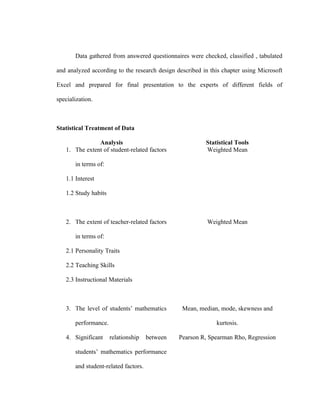
Data gathered from answered questionnaires were checked, classified , tabulated

and analyzed according to the research design described in this chapter using Microsoft

Excel and prepared for final presentation to the experts of different fields of

specialization.


Statistical Treatment of Data

               Analysis                                  Statistical Tools
   1. The extent of student-related factors              Weighted Mean

       in terms of:

   1.1 Interest

   1.2 Study habits


   2. The extent of teacher-related factors               Weighted Mean

       in terms of:

   2.1 Personality Traits

   2.2 Teaching Skills

   2.3 Instructional Materials


   3. The level of students’ mathematics         Mean, median, mode, skewness and

       performance.                                          kurtosis.

   4. Significant     relationship    between   Pearson R, Spearman Rho, Regression

       students’ mathematics performance

       and student-related factors.
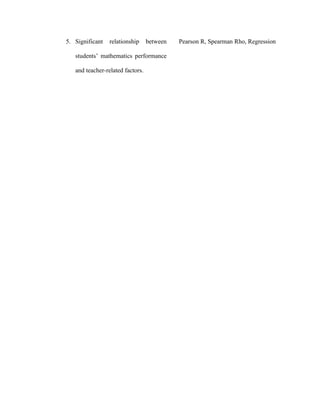
5. Significant   relationship     between   Pearson R, Spearman Rho, Regression

   students’ mathematics performance

   and teacher-related factors.

Jen3

  • 1.
    Chapter 3 RESEARCH METHODOLOGY This chapter presents the research design, research procedure, the subject of the study, determination of sample, research instrument and statistical treatment of data. Research Design This study determined the factors affecting mathematics performance of Laboratory High School Students at Laguna State Polytechnic University. The descriptive – correlation method was used in this study. In descriptive method, Calmorin(1994) as cited by Bagayana (2006), wrote the study focuses on the present condition. The purpose is to find new truth, which may come in different forms such as increased quantity of knowledge, a new generalization, or increased insights into factors, which are operating, the discovery of a new causal relationship, a more accurate formulation of the problem to be solved and many others. Since this study measured data that already exists and the number of respondents is not large, the descriptive – correlation method of studies is best suited. As mentioned, the student-related factors in terms of interest and study habits, and the teacher-related factors in terms of personality traits, teaching skills and instructional materials were generated using researcher – made questionnaire.
  • 2.
    Subject of theStudy The respondents in this study were the one hundred twenty six (126) Laboratory High School Students at Laguna State Polytechnic University Academic Year 2009-2010. Research Instrument The main tool used in this study was a researcher – made questionnaire – checklist. Set of questionnaire-checklist was constructed for the student respondents. The questionnaire – checklist consisted of the students’ level of interest in Mathematics, their study habits and their teachers’ personality traits, teaching skills and instructional materials use in teaching as perceived by the students. Part 1 on the questionnaire – checklist obtained the students’ level of interest in Mathematics presented five(5) statements and the students’ study habits presented ten(10) situations. These were given one set of five checkboxes each. The five checkboxes were ranked as: 5 – Always 4 – Often 3 – Sometimes 2 – Rarely 1 – Never
  • 3.
    Part 2 obtainedteacher’s personality traits, teaching skills and instructional materials used in teaching as rated by the students. Each statement was given one set of five checkboxes. Again the five checkboxes were ranked as: 5 – Always 4 – Often 3 – Sometimes 2 – Rarely 1 – Never The questionnaire – checklist was presented to the adviser and expert on Mathematics for comments, corrections, and suggestions on the content. Research Procedure The original title proposed by the researcher was checked, revised and rechecked by the researcher’s adviser to maintain conformity on the subject of research. The questionnaire-checklist that aims to draw out proper responses on the objectives of this study was constructed. This questionnaire – checklist made by the researcher and was presented to, analyzed and checked by the research adviser to ensure the validity of responses it would elicit. Permit to conduct research and study was secured of letter requesting permission to the principal of Laboratory High School at Laguna State Polytechnic University.
  • 4.
    Data gathered fromanswered questionnaires were checked, classified , tabulated and analyzed according to the research design described in this chapter using Microsoft Excel and prepared for final presentation to the experts of different fields of specialization. Statistical Treatment of Data Analysis Statistical Tools 1. The extent of student-related factors Weighted Mean in terms of: 1.1 Interest 1.2 Study habits 2. The extent of teacher-related factors Weighted Mean in terms of: 2.1 Personality Traits 2.2 Teaching Skills 2.3 Instructional Materials 3. The level of students’ mathematics Mean, median, mode, skewness and performance. kurtosis. 4. Significant relationship between Pearson R, Spearman Rho, Regression students’ mathematics performance and student-related factors.
  • 5.
    5. Significant relationship between Pearson R, Spearman Rho, Regression students’ mathematics performance and teacher-related factors.