1
A tool for datascience at scale.
Matthias Bussonnier
(UC Berkeley mbussonnier@berkeley.edu)
Slides examples on GitHub:
https://github.com/Carreau/talks/tree/master/labtech-2015
Jupyter
A bit of History
The Notebook Application
The document format & Publication
Multi-User & scaling
The Ecosystem
2
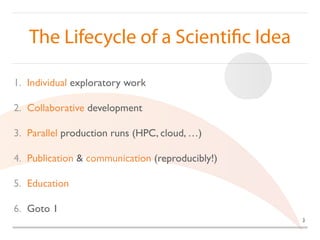
The Lifecycle of a Scientific Idea
1. Individual exploratory work
2. Collaborative development
3. Parallel production runs (HPC, cloud, …)
4. Publication & communication (reproducibly!)
5. Education
6. Goto 1
3
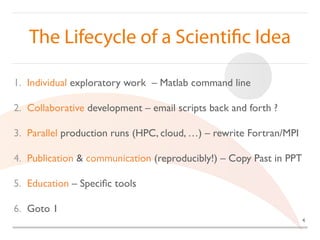
The Lifecycle of a Scientific Idea
1. Individual exploratory work – Matlab command line
2. Collaborative development – email scripts back and forth ?
3. Parallel production runs (HPC, cloud, …) – rewrite Fortran/MPI
4. Publication & communication (reproducibly!) – Copy Past in PPT
5. Education – Specific tools
6. Goto 1
4
Can we have a single tool that cover all the lifecycle of
a scientific idea, from data collection to publication ?
5
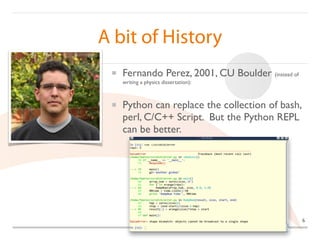
A bit of History
Fernando Perez, 2001, CU Boulder (instead of
writing a physics dissertation):
Python can replace the collection of bash,
perl, C/C++ Script. But the Python REPL
can be better.
6
NOVEMBER 2001: "JUST AN AFTERNOON HACK"
259 Line Python script. (https://gist.github.com/fperez/1579699)
sys.ps1 -> In [N].
sys.displayhook -> Out[N], caches results.
Plotting, Numeric, etc.
2014 (OPENHUB STATS)
19,279 commits
442 contributors
Total Lines: 187,326
Number of Languages : 7 (JS, CSS, HTML, …)
7
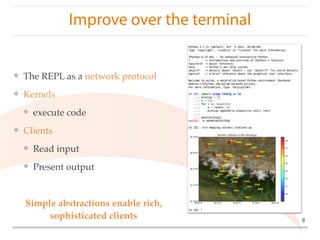
Improve over the terminal
❖ The REPL as a network protocol
❖ Kernels
❖ execute code
❖ Clients
❖ Read input
❖ Present output
Simple abstractions enable rich,
sophisticated clients 8
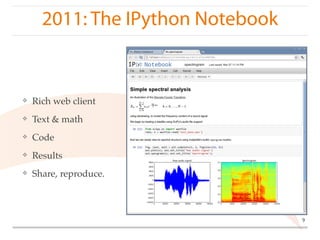
❖ Rich web client
❖ Text & math
❖ Code
❖ Results
❖ Share, reproduce.
2011: The IPython Notebook
9
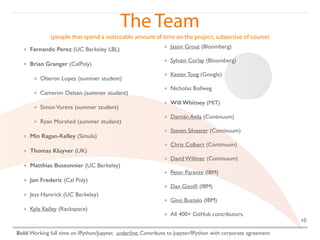
The Team
(people that spend a noticeable amount of time on the project, subjective of course)
Fernando Perez (UC Berkeley LBL)
Brian Granger (CalPoly)
Oberon Lopez (summer student)
Cameron Oelsen (summer student)
SimonVurens (summer student)
Ryan Morshed (summer student)
Min Ragan-Kelley (Simula)
Thomas Kluyver (UK)
Matthias Bussonnier (UC Berkeley)
Jon Frederic (Cal Poly)
Jess Hamrick (UC Berkeley)
Kyle Kelley (Rackspace)
Jason Grout (Bloomberg)
Sylvain Corlay (Bloomberg)
Kester Tong (Google)
Nicholas Bollweg
Will Whitney (MIT)
Damián Avila (Continuum)
Steven Silvester (Continuum)
Chris Colbert (Continuum)
David Willmer (Continuum)
Peter Parente (IBM)
Dan Gisolfi (IBM)
Gino Bustelo (IBM)
All 400+ GitHub contributors.
Bold:Working full time on IPython/Jupyter, underline: Contribute to Jupyter/IPython with corporate agreement
10
Funding
11
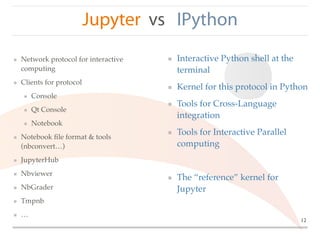
Jupyter vs IPython
Network protocol for interactive
computing
Clients for protocol
Console
Qt Console
Notebook
Notebook file format & tools
(nbconvert…)
JupyterHub
Nbviewer
NbGrader
Tmpnb
…
Interactive Python shell at the
terminal
Kernel for this protocol in Python
Tools for Cross-Language
integration
Tools for Interactive Parallel
computing
The “reference” kernel for
Jupyter
12
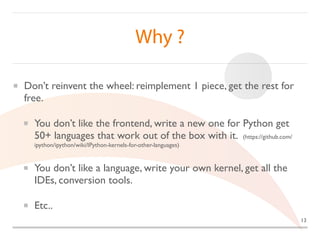
Why ?
Don’t reinvent the wheel: reimplement 1 piece, get the rest for
free.
You don’t like the frontend, write a new one for Python get
50+ languages that work out of the box with it. (https://github.com/
ipython/ipython/wiki/IPython-kernels-for-other-languages)
You don’t like a language, write your own kernel, get all the
IDEs, conversion tools.
Etc..
13
The Notebook
Try it on https://try.jupyter.org
Demo
Notebook app, also have a terminal, text editor, increasing
number of plugins, and of course support 50 languages.
14
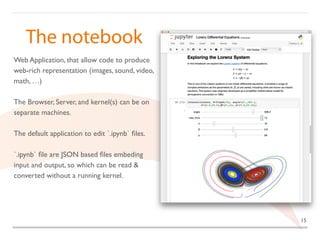
The notebook
Web Application, that allow code to produce
web-rich representation (images, sound, video,
math, …)
The Browser, Server, and kernel(s) can be on
separate machines.
The default application to edit `.ipynb` files.
`.ipynb` file are JSON based files embeding
input and output, so which can be read &
converted without a running kernel.
15
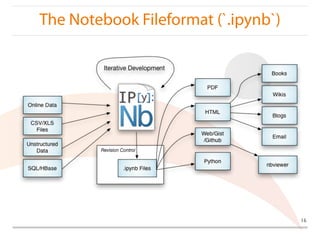
The Notebook Fileformat (`.ipynb`)
16
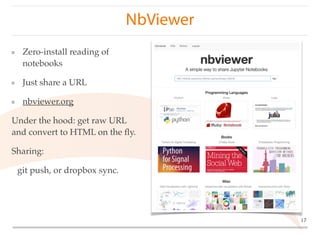
NbViewer
Zero-install reading of
notebooks
Just share a URL
nbviewer.org
Under the hood: get raw URL
and convert to HTML on the fly.
Sharing:
git push, or dropbox sync.
17
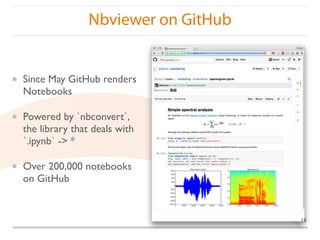
Nbviewer on GitHub
Since May GitHub renders
Notebooks
Powered by `nbconvert`,
the library that deals with
`.ipynb` -> *
Over 200,000 notebooks
on GitHub
18
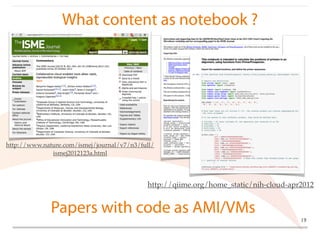
What content as notebook ?
http://www.nature.com/ismej/journal/v7/n3/full/
ismej2012123a.html
http://qiime.org/home_static/nih-cloud-apr2012
Papers with code as AMI/VMs
19
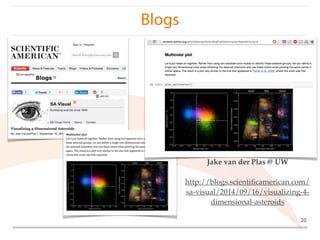
Blogs
Jake van der Plas @ UW
http://blogs.scientificamerican.com/
sa-visual/2014/09/16/visualizing-4-
dimensional-asteroids
20
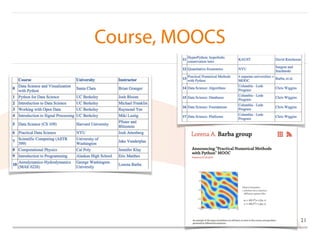
Course, MOOCS
21
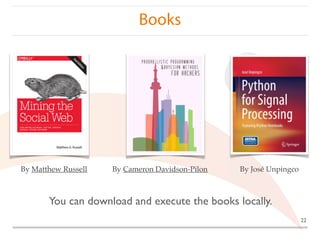
Books
By Cameron Davidson-PilonBy Matthew Russell By José Unpingco
You can download and execute the books locally.
22
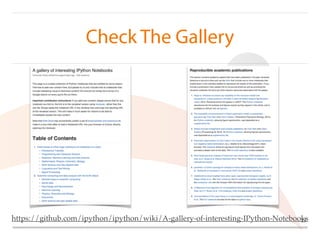
Check The Gallery
https://github.com/ipython/ipython/wiki/A-gallery-of-interesting-IPython-Notebooks23
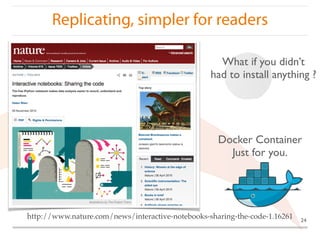
Replicating, simpler for readers
http://www.nature.com/news/interactive-notebooks-sharing-the-code-1.16261
What if you didn’t
had to install anything ?
Docker Container
Just for you.
24
Replicating, simpler for authors
1. Fixed set of notebooks/dependencies
1. Tmpnb, (https://lambdaops.com/ipythonjupyter-tmpnb-debuts/)
2. CodeNeuro, (http://codeneuro.org/)
2. Build on demand
1. Everware, (https://github.com/everware)
2. Binder, (MyBinder.org)
25
https://github.com/binder-project
by Jeremy Freeman
(Demo mybinder.org )
26
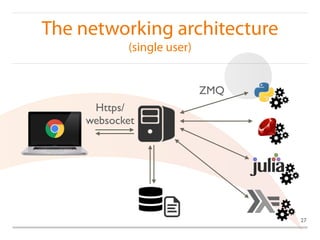
The networking architecture
(single user)
Https/
websocket
ZMQ
27
MULTI-USER
Jupyter Notebook is Single-User by design.
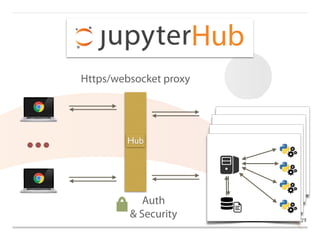
Multi-User enable through JupyterHub
- Allow Better scalability
- resources monitoring/user
- Per-user configuration/version of IPython
- Better integration with existing infrastructure
28
Hub
Https/websocket proxy
Auth
& Security
Hub
29
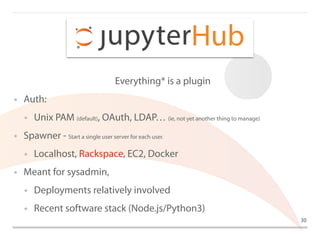
Everything* is a plugin
• Auth:
• Unix PAM (default), OAuth, LDAP… (ie, not yet another thing to manage)
• Spawner - Start a single user server for each user.
• Localhost, Rackspace, EC2, Docker
• Meant for sysadmin,
• Deployments relatively involved
• Recent software stack (Node.js/Python3)
Hub
30
Quick Demo
31
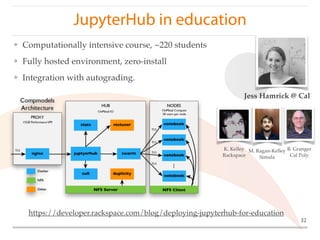
JupyterHub in education
Jess Hamrick @ Cal
K. Kelley
Rackspace
M. Ragan-Kelley
Simula
B. Granger
Cal Poly
https://developer.rackspace.com/blog/deploying-jupyterhub-for-education
❖ Computationally intensive course, ~220 students
❖ Fully hosted environment, zero-install
❖ Integration with autograding.
32
Deploy at larger scale this fall at UC Berkeley
- Data Science 101
- Everyone with CalNet account.
New Jupyter in Education Mailing List:
https://groups.google.com/forum/#!forum/jupyter-education
33
Ecosystem
34
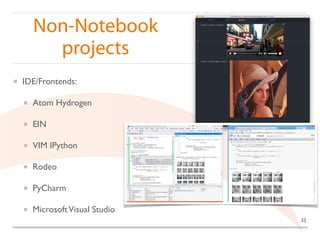
Non-Notebook
projects
IDE/Frontends:
Atom Hydrogen
EIN
VIM IPython
Rodeo
PyCharm
MicrosoftVisual Studio
35
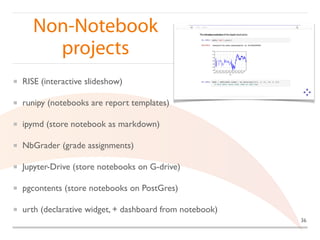
Non-Notebook
projects
RISE (interactive slideshow)
runipy (notebooks are report templates)
ipymd (store notebook as markdown)
NbGrader (grade assignments)
Jupyter-Drive (store notebooks on G-drive)
pgcontents (store notebooks on PostGres)
urth (declarative widget, + dashboard from notebook)
36
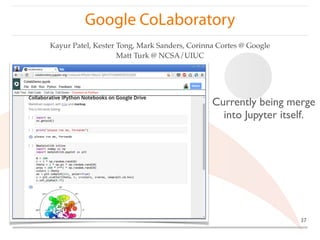
Google CoLaboratory
Kayur Patel, Kester Tong, Mark Sanders, Corinna Cortes @ Google
Matt Turk @ NCSA/UIUC
Currently being merge
into Jupyter itself.
37
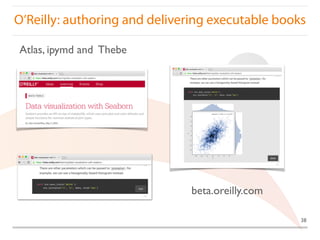
O’Reilly: authoring and delivering executable books
Atlas, ipymd and Thebe
beta.oreilly.com
38
The Future
39
40
Future work
Interactive Computing
Notebooks as interactive applications
Modular, reusable UI/UX
Software engineering with notebooks
Computational Narratives
nbconvert
Element filtering
Documentation
Collaboration
Real time collaboration
JupyterHub
Sustainability
People
Events
41
Future work
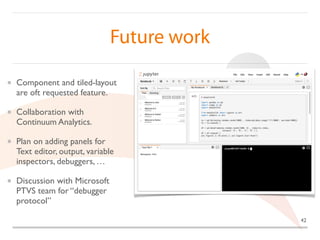
Component and tiled-layout
are oft requested feature.
Collaboration with
Continuum Analytics.
Plan on adding panels for
Text editor, output, variable
inspectors, debuggers, …
Discussion with Microsoft
PTVS team for “debugger
protocol”
42
43
Hiring
At UC Berkeley
Two new postdocs
Project manager
Web developer, tech writer (short contracts)
One administrative assistant.
At Cal Poly
Three software engineers (one already hired)
One designer
One administrative assistant.
44
Time for questions ?
Thanks
45

Jupyter, A Platform for Data Science at Scale

  • 1.
    1 A tool fordatascience at scale. Matthias Bussonnier (UC Berkeley mbussonnier@berkeley.edu) Slides examples on GitHub: https://github.com/Carreau/talks/tree/master/labtech-2015
  • 2.
    Jupyter A bit ofHistory The Notebook Application The document format & Publication Multi-User & scaling The Ecosystem 2
  • 3.
    The Lifecycle ofa Scientific Idea 1. Individual exploratory work 2. Collaborative development 3. Parallel production runs (HPC, cloud, …) 4. Publication & communication (reproducibly!) 5. Education 6. Goto 1 3
  • 4.
    The Lifecycle ofa Scientific Idea 1. Individual exploratory work – Matlab command line 2. Collaborative development – email scripts back and forth ? 3. Parallel production runs (HPC, cloud, …) – rewrite Fortran/MPI 4. Publication & communication (reproducibly!) – Copy Past in PPT 5. Education – Specific tools 6. Goto 1 4
  • 5.
    Can we havea single tool that cover all the lifecycle of a scientific idea, from data collection to publication ? 5
  • 6.
    A bit ofHistory Fernando Perez, 2001, CU Boulder (instead of writing a physics dissertation): Python can replace the collection of bash, perl, C/C++ Script. But the Python REPL can be better. 6
  • 7.
    NOVEMBER 2001: "JUSTAN AFTERNOON HACK" 259 Line Python script. (https://gist.github.com/fperez/1579699) sys.ps1 -> In [N]. sys.displayhook -> Out[N], caches results. Plotting, Numeric, etc. 2014 (OPENHUB STATS) 19,279 commits 442 contributors Total Lines: 187,326 Number of Languages : 7 (JS, CSS, HTML, …) 7
  • 8.
    Improve over theterminal ❖ The REPL as a network protocol ❖ Kernels ❖ execute code ❖ Clients ❖ Read input ❖ Present output Simple abstractions enable rich, sophisticated clients 8
  • 9.
    ❖ Rich webclient ❖ Text & math ❖ Code ❖ Results ❖ Share, reproduce. 2011: The IPython Notebook 9
  • 10.
    The Team (people thatspend a noticeable amount of time on the project, subjective of course) Fernando Perez (UC Berkeley LBL) Brian Granger (CalPoly) Oberon Lopez (summer student) Cameron Oelsen (summer student) SimonVurens (summer student) Ryan Morshed (summer student) Min Ragan-Kelley (Simula) Thomas Kluyver (UK) Matthias Bussonnier (UC Berkeley) Jon Frederic (Cal Poly) Jess Hamrick (UC Berkeley) Kyle Kelley (Rackspace) Jason Grout (Bloomberg) Sylvain Corlay (Bloomberg) Kester Tong (Google) Nicholas Bollweg Will Whitney (MIT) Damián Avila (Continuum) Steven Silvester (Continuum) Chris Colbert (Continuum) David Willmer (Continuum) Peter Parente (IBM) Dan Gisolfi (IBM) Gino Bustelo (IBM) All 400+ GitHub contributors. Bold:Working full time on IPython/Jupyter, underline: Contribute to Jupyter/IPython with corporate agreement 10
  • 11.
  • 12.
    Jupyter vs IPython Networkprotocol for interactive computing Clients for protocol Console Qt Console Notebook Notebook file format & tools (nbconvert…) JupyterHub Nbviewer NbGrader Tmpnb … Interactive Python shell at the terminal Kernel for this protocol in Python Tools for Cross-Language integration Tools for Interactive Parallel computing The “reference” kernel for Jupyter 12
  • 13.
    Why ? Don’t reinventthe wheel: reimplement 1 piece, get the rest for free. You don’t like the frontend, write a new one for Python get 50+ languages that work out of the box with it. (https://github.com/ ipython/ipython/wiki/IPython-kernels-for-other-languages) You don’t like a language, write your own kernel, get all the IDEs, conversion tools. Etc.. 13
  • 14.
    The Notebook Try iton https://try.jupyter.org Demo Notebook app, also have a terminal, text editor, increasing number of plugins, and of course support 50 languages. 14
  • 15.
    The notebook Web Application,that allow code to produce web-rich representation (images, sound, video, math, …) The Browser, Server, and kernel(s) can be on separate machines. The default application to edit `.ipynb` files. `.ipynb` file are JSON based files embeding input and output, so which can be read & converted without a running kernel. 15
  • 16.
  • 17.
    NbViewer Zero-install reading of notebooks Justshare a URL nbviewer.org Under the hood: get raw URL and convert to HTML on the fly. Sharing: git push, or dropbox sync. 17
  • 18.
    Nbviewer on GitHub SinceMay GitHub renders Notebooks Powered by `nbconvert`, the library that deals with `.ipynb` -> * Over 200,000 notebooks on GitHub 18
  • 19.
    What content asnotebook ? http://www.nature.com/ismej/journal/v7/n3/full/ ismej2012123a.html http://qiime.org/home_static/nih-cloud-apr2012 Papers with code as AMI/VMs 19
  • 20.
    Blogs Jake van derPlas @ UW http://blogs.scientificamerican.com/ sa-visual/2014/09/16/visualizing-4- dimensional-asteroids 20
  • 21.
  • 22.
    Books By Cameron Davidson-PilonByMatthew Russell By José Unpingco You can download and execute the books locally. 22
  • 23.
  • 24.
    Replicating, simpler forreaders http://www.nature.com/news/interactive-notebooks-sharing-the-code-1.16261 What if you didn’t had to install anything ? Docker Container Just for you. 24
  • 25.
    Replicating, simpler forauthors 1. Fixed set of notebooks/dependencies 1. Tmpnb, (https://lambdaops.com/ipythonjupyter-tmpnb-debuts/) 2. CodeNeuro, (http://codeneuro.org/) 2. Build on demand 1. Everware, (https://github.com/everware) 2. Binder, (MyBinder.org) 25
  • 26.
  • 27.
    The networking architecture (singleuser) Https/ websocket ZMQ 27
  • 28.
    MULTI-USER Jupyter Notebook isSingle-User by design. Multi-User enable through JupyterHub - Allow Better scalability - resources monitoring/user - Per-user configuration/version of IPython - Better integration with existing infrastructure 28
  • 29.
  • 30.
    Everything* is aplugin • Auth: • Unix PAM (default), OAuth, LDAP… (ie, not yet another thing to manage) • Spawner - Start a single user server for each user. • Localhost, Rackspace, EC2, Docker • Meant for sysadmin, • Deployments relatively involved • Recent software stack (Node.js/Python3) Hub 30
  • 31.
  • 32.
    JupyterHub in education JessHamrick @ Cal K. Kelley Rackspace M. Ragan-Kelley Simula B. Granger Cal Poly https://developer.rackspace.com/blog/deploying-jupyterhub-for-education ❖ Computationally intensive course, ~220 students ❖ Fully hosted environment, zero-install ❖ Integration with autograding. 32
  • 33.
    Deploy at largerscale this fall at UC Berkeley - Data Science 101 - Everyone with CalNet account. New Jupyter in Education Mailing List: https://groups.google.com/forum/#!forum/jupyter-education 33
  • 34.
  • 35.
  • 36.
    Non-Notebook projects RISE (interactive slideshow) runipy(notebooks are report templates) ipymd (store notebook as markdown) NbGrader (grade assignments) Jupyter-Drive (store notebooks on G-drive) pgcontents (store notebooks on PostGres) urth (declarative widget, + dashboard from notebook) 36
  • 37.
    Google CoLaboratory Kayur Patel,Kester Tong, Mark Sanders, Corinna Cortes @ Google Matt Turk @ NCSA/UIUC Currently being merge into Jupyter itself. 37
  • 38.
    O’Reilly: authoring anddelivering executable books Atlas, ipymd and Thebe beta.oreilly.com 38
  • 39.
  • 40.
  • 41.
    Future work Interactive Computing Notebooksas interactive applications Modular, reusable UI/UX Software engineering with notebooks Computational Narratives nbconvert Element filtering Documentation Collaboration Real time collaboration JupyterHub Sustainability People Events 41
  • 42.
    Future work Component andtiled-layout are oft requested feature. Collaboration with Continuum Analytics. Plan on adding panels for Text editor, output, variable inspectors, debuggers, … Discussion with Microsoft PTVS team for “debugger protocol” 42
  • 43.
  • 44.
    Hiring At UC Berkeley Twonew postdocs Project manager Web developer, tech writer (short contracts) One administrative assistant. At Cal Poly Three software engineers (one already hired) One designer One administrative assistant. 44
  • 45.
    Time for questions? Thanks 45